Hillary’s Latest Bow to AIPAC

hillaryclintonaipacspeechtranscript

By Ralph Nader

Source: CounterPunch

It is well known to Washington political observers that politicians invited to speak at the annual, giant AIPAC convention ask for suggested talking points from this powerful pro-Israeli government lobby. Hillary Clinton’s pandering speech must have registered close to 100% on AIPAC’s checklist.

Of course, both parties pander to AIPAC to such depths of similar obeisance that reporters have little to report as news. But giving big-time coverage to sheer political power is automatic. Compare it to the sparse attention given to the conference a few days earlier at the National Press Club on the Israeli lobby featuring scholars, authors and the well-known Israeli dissenter, Gideon Levy of the respected Ha’aretz newspaper (see israellobbyus.org/).

But Mrs. Clinton’s speech was newsworthy for its moral obtuseness and the way in which it promised unilateral White House belligerence should she become president. A reader would never know that her condemnation of Palestinian terrorism omitted any reference to the fact that Israel is the occupier of what is left of Palestinian lands, colonizing them, seizing their water and land, brutalizing the natives and continuing the selective blockade of Gaza, the world’s largest Gulag ever since Israel closed its last colony there in 2005.

Clinton emphasized her condemnation of Palestinian children being taught “incitement” against their Israeli oppressors and the recent deplorable knife attacks against Israeli soldiers and civilians. She neglected to point to massive, daily Israeli incitement backed up by U.S.-supplied deadly weapons that over the last decade have caused 400 times more Palestinian fatalities and serious injuries to innocents than the defenseless Palestinians have caused their Israeli counterparts. One of Prime Minister Netanyahu’s coalition partners, for example, from the Jewish Home Party, called for the slaughter of all Palestinians, the elderly and women in general. “Otherwise,” the partner said (in an English-language translation from the Hebrew), “more little snakes will be raised there.”

Clinton did not mention any of these brutalities, though they are components of what is an illegal occupation under international law and the United Nations charter. The Yale Law graduate simply chooses not to know better. Instead, she told her wildly-applauding audience of her support for increasing the amount of U.S. taxpayer spending for the latest military equipment and technology to over $4 billion a year. For the record, Israel is an economic, technological and military powerhouse that provides Israelis with universal health insurance and other social safety nets that are denied the American people.

In an obvious slap at President Obama, whose name she never mentioned (even Netanyahu thanked Obama in his address to AIPAC), Clinton almost shouted out: “one of the first things I’ll do in office is invite the Israeli Prime Minister to visit the White House.” This was a thinly-veiled reference to Netanyahu’s trip to a joint session of Congress, where he tried to undermine President Obama’s negotiations with Iran in what was an unprecedented interference by a foreign leader. Not surprisingly, Obama did not ask Netanyahu over to visit the White House for a drink before he headed back to Israel.

High on AIPAC’s checklist is to insist that all speakers condemn what Clinton called the “alarming boycott, divestment and sanctions movement known as BDS.” She then twice slanderously associated this modest effort (in which many Jews are active participants) to get Israel to lift some oppression from the occupied Palestinian territories, with antisemitism. However, by totally erasing any nod, any mention, any compassion toward the slaughter of Palestinian children, women and men in their homes, schools and hospitals, Hillary Clinton makes a mockery of her touted Methodist upbringing and her declared concern for children everywhere.

For repeated applause at AIPAC’s convention and its associated campaign contributors, she has lost all credibility with the peoples of the Arab world. Moreover, such hostility in her words registers “the other antisemitism,” to cite the title of an address by James Zogby before an Israeli university in 1994.

With all her self-regarded experience in foreign affairs, Mrs. Clinton could pause to ponder why she is backing state terrorism against millions of Arab Palestinians trapped in two enclaves, surrounded by walls, military outposts, and suffering from deep poverty, including widespread diseases and severe anemia among Palestinian infants and children.

Unlimited is her militant animosity toward Iran, bragging about crippling sanctions that she spearheaded (which caused untold harm to the health and care of civilians), and threatening military force “for even the smallest violations of this [nuclear] agreement.” Yet for decades Israel has violated numerous U.N. resolutions to withdraw its occupation and repression of Palestinians without a murmur from Secretary of State Clinton, who as a candidate opposes a role for the U.N. Security Council (over which the U.S. has an often-used veto) in the peace process.

There were some restraints. She repeated her support for a Palestinian state but wondered whether the Palestinian Leadership was up to the negotiations. Also, she resisted going along with recognizing the shift of Israel’s capital from Tel Aviv to Jerusalem.

Her very oblique reference to illegal, expanding Israeli settlements did not amount to anything more than a wink, foreshadowing no action on her part to stop the expansion of colonies in the occupied territories should she reach the White House.

Near the conclusion of her deferential remarks, she stated “If you see bigotry, oppose it. If you see violence, condemn it. If you see a bully, stand up to him.” Some courageous Israeli human rights groups, such as B’Tselem, who defend Palestinian human rights, might view her words as applicable daily to how they perform their noble work.

Ralph Nader is a consumer advocate, lawyer and author of Only the Super-Rich Can Save Us! 

Living in a PNAC World: The Toxic Legacy of 9/11

pnac-criminals-2-1

By Chris Floyd

Source: Empire Burlesque

In September 2000, an advocacy group called “Project for New American Century,” led by Jeb Bush, Dick Cheney, Donald Rumsfeld, Paul Wolfowitz and others — published a “blueprint” for “transforming” America’s future. PNAC acknowledged that the “revolutionary” changes it envisaged could take decades to bring about — unless, they said, the United States was struck by “some catastrophic and catalyzing event – like a new Pearl Harbor.” One year later, after the disputed election of George W. Bush, came the “catalyzing” event of the 9/11 attacks — which indeed “transformed” America’s future in many “revolutionary” ways.

Here are some of the changes PNAC called for in 2000, all of which came about after the “new Pearl Harbor” they had hoped for: An attack on Iraq. Vast increases in military spending. Planting new American bases all over the world. Embracing the concept of “pre-emptive war” and unilateral action as cornerstones of national strategy. Developing sophisticated new technologies to “control the global commons of cyberspace” by closely monitoring communications and transactions on the Internet. Pursuing the development of “new methods of attack – electronic, ‘non-lethal, biological…in new dimensions, in space, cyberspace and perhaps the world of microbes.”

Oddly enough, although “regime change” in Iraq was clearly a priority for PNAC, it had little to do with Saddam Hussein and his brutal rule. Instead, removing Saddam was tied to the larger goal of establishing a permanent U.S. military presence in the Persian Gulf in order to “secure energy supplies” and preclude any other power from dominating the vital oil regions of the Middle East and Central Asia. The PNAC report puts it quite plainly:
“The United States has for decades sought to play a more permanent role in Gulf regional security. While the unresolved conflict with Iraq provides the immediate justification, the need for a substantial American force presence in the Gulf transcends the issue of the regime of Saddam Hussein.”

This is why the Bush Administration offered a constantly shifting menu of rationales for the impending attack on Iraq: because the decision to remove Saddam was taken long ago, as part of a larger strategic plan, and had little to do with any imminent threat from the broken-backed Iraqi regime, which at that time was constantly bombed, partially occupied (with U.S. forces already working in the autonomous Kurdish territories) and swarming with UN inspectors. If the strategic need for the attack “transcends the issue of the regime of Saddam Hussein,” then almost any rationale will do.

The same desire to “secure energy supplies” and prevent any other power from gaining dominance in the oil regions also underlies current and recent US policies in Libya, Syria, Yemen and elsewhere. That’s why we see the same shifting rationales, see policies that on the surface seem to make no sense: we fight al Qaeda in Iraq, we support al Qaeda in Yemen and Syria; we say defeating ISIS is of supreme global importance, but we prevent other countries (Iran, Russia) from joining the fight; we push “regime change” to “liberate” Libya and Syria while partnering with one of most repressive, extremists nations on earth, Saudi Arabia, and arming other dictators like Sisi in Egypt. We are “fighting” terrorism while turning whole nations (Iraq, Libya, Syria) into swamps of ruin and violence where terrorism can breed. None of these contradictory rationales make sense on the surface. But viewed as part of an ongoing, bipartisan agenda of securing American dominance of economically strategic lands — and of “discouraging advanced industrial nations from challenging our leadership or even aspiring to a larger regional or global role” (as an earlier Cheney-Wolfowitz document put it) — it becomes easier to see a pattern in today’s howling chaos.

This is not “conspiracy theory.” These motives and agendas are out in the open, and always have been. Our bipartisan leaders eagerly trumpet them, and declare that it is our right and our duty to dominate the world in this way. What’s more, any actions we take to accomplish this — wars, regime change, intrusive surveillance, drone campaigns, death squads, torture, killing thousands of innocent people (mere “collateral damage”), fomenting more hatred and extremism, breaking our own laws, turning our own people into fearful cowards ready to throw away their liberties to “stay safe,” etc. — are automatically just and righteous, because we are “exceptional.”

So yes, the “transformations” wrought in American policy — and the American psyche — since that “new Pearl Harbor” have indeed been “revolutionary.” Post-9/11, we are all living in a PNAC world.

Note: The above post was adapted (and updated) from a much more detailed piece originally written in 2002, which can be found here.


“Good al-Qaeda’s” Air Force: The United States Is At War With Syria

nusra-front-us-weapons-tow

By Jim Kavanagh

Source: The Polemecist

“The President does not have power under the Constitution to unilaterally authorize a military attack in a situation that does not involve stopping an actual or imminent threat to the nation”
candidate Barack Obama, December, 2007

The United States has decided to allow airstrikes to defend Syrian rebels trained by the U.S. military from any attackers, even if the enemies hail from forces loyal to Syrian President Bashar al-Assad, U.S. officials said on Sunday.
—  “U.S. to defend Syrian rebels with airpower, including from Assad,” Reuters, August 3, 2105

The United States just went to war with Syria. With the confirmation today that American planes will shoot down Syrian planes attacking USDA-approved “rebels,” the United States is now overtly engaged in another criminal attack on a sovereign country that poses no conceivable, let alone actual or imminent, threat to the nation. This is an act of war.

Please don’t try any not-really-war “no-fly zone” or “safe zone” bullshit. As the Commander of NATO says, a no-fly zone is “quite frankly an act of war and it is not a trivial matter….[I]t’s basically to start a war with that country because you are going to have to go in and kinetically take out their air defense capability.” Or as Shamus Cooke puts it: “In a war zone an area is made ‘safe’ by destroying anything in it or around that appears threatening.”  Inevitably, “U.S. and Turkish fighter jets will engage with Syrian aircraft, broadening and deepening the war until the intended aim of regime change has been accomplished.”1

Does anybody doubt that this is exactly what’s intended? Perhaps Obama will soothe the discomfort of his purportedly peace-loving progressive fans with some assurance like: “broadening our military mission to include regime change would be a mistake.” He’ll be lying, as he was four years ago when he said that about Libya.

As an aggressive, unprovoked war, this is totally illegal under international law, and all the political and military authorities undertaking it are war criminals, who would be prosecuted as such, if there were an international legal regime that had not already been undermined by the United States.

As an act of war, to be constitutional, it also demands a congressional act of war, and, at the very least, congressional authorization under the War Powers Act. Will Obama ask for this? Will any Democratic or Republican congresscritter demand it? Is the Pope a Hindu?

Would it make any difference? Don’t forget that Obama completely ignored the War Powers Act, the Constitution, Congress, and his own Attorney General and legal advisers,2 and went right ahead with a war on Libya, under the theory that, if we pretend no American troops are on the ground (everybody knows there were, and must be3), it isn’t really a war or “hostilities” at all. So, I guess if the Chinese Air Force starts shooting down American planes in American airspace in defense of the Occupy Wall Street movement’s assault on the White House, China wouldn’t really be engaging in an act of war.

Please don’t complain that the last sentence makes no sense. The U.S. is now officially acting as al-Qaeda’s air force, trying to force a regime change that everybody knows will result in turning Syria into another jihadi playground, Libya 2.0. This makes sense?

Obama is, in fact, now building on the imperial executive arrogance he demonstrated in the Libyan intervention — as Bruce Ackerman said, “betraying the electoral majorities who twice voted him into office on his promise to end Bush-era abuses of executive authority…and the Constitution he swore to uphold,” and asserting the president’s unilateral authority to make war. Per Ackerman: “Nothing attempted by his predecessor, George W. Bush, remotely compares in imperial hubris.”4

It’s impossible to overstate the danger in these executive war-making prerogatives that Obama has now normalized — with the irresponsible connivance of his sometimes-progressive groupies, who pretend not to know where this leads: “I don’t believe at this stage, therefore, if I’m president that we need to have a war powers approval or special authorization for military force. The president has that capacity now,” said Mitt Romney in 2012, and every Republican thereafter.5

It’s also quite clear now, that the War on ISIS is a sham, that ISIS was always just a pretext to get the American military directly involved in attacking the Syrian army and destroying the coherence of the Syrian state. Jihadi horror-show “ISIS” replaced the WMD horror-show “chemical weapons” pretext that Putin so adroitly took off the table in 2013, removing the excuse for the war on Syria Obama was itching to launch then (and earning the lasting enmity of the deep-state neocon cabal). If the U.S. and Turkey wanted to defeat ISIS, they would, besides not sending ISIS arms and fighters, be coordinating their actions with, and not against, the forces who have been most effectively fighting it: the Syrian Arab Army, the Kurds, Iran, and Hezbollah.

Turns out that ISIS and the U.S. have the same enemies. Go figure. Must be some kind of bizarre accident. Doesn’t mean a thing. The U.S. is now even supporting Turkey’s attacks on the Kurds, who have recently won some major victories against ISIS — which is why (Can’t let those Kurds get too uppity.) the Turks are attacking the Kurds!  But really, we’re attacking all of ISIS’s worst enemies in order to defeat ISIS. That the American media pretend there is some credibility to this story reveals… well, at least their utter credulity.

By the way, did you know there’s now a “good Al-Qaeda”? The Wild Ones in the picture above. (They just look like the “bad Al-Qaeda.”) They’re the jihadis our Air Force will be fighting for defending. As Daniel Lazare points out: “After years of hemming and hawing, the Obama administration has finally come clean about its goals in Syria.  In the battle to overthrow Bashar al-Assad, it is siding with Al Qaeda.” And that’s A-OK with the Serious People in Washington: “[R]ather than protesting what is in fact a joint U.S.-Al Qaeda assault, the Beltway crowd is either maintaining a discreet silence or loudly hailing Al Nusra’s advance as ‘the best thing that could happen in a Middle East in crisis.’” Al-Nusra is the official affiliate of Al-Qaeda in Syria. As Lazare says:It is as if 9/11 never happened.” Kiss and make up. New fish to fry, don’t you know.6
The best thing that could happen. You read that right.
As anyone with one eye and half a brain can reckon, the primary goal in creating a “safe zone” is to make a safe redoubt from which al-Qaeda, al-Nusra, ISIS, the Army of Conquest, and all 60 of the U.S.-vetted “moderate” rebels – all jihadi brothers-in-arms against Syrian secular nationalism – can launch their attacks to overthrow the government of Syria.

Really. A total of 60, at $9 million per.7 I can’t make this stuff up.

Syria is now under explicit attack by the armed forces of two states – the U.S. and its NATO ally Turkey (sanctioned by NATO) – along with a panoply of jihadi proxy armies supported by at least two other states – Saudi Arabia and Israel (Oh, yes!8). The Syrian state and its allies, Iran and Russia, have the right to respond, and any military response of theirs will be legitimate self-defense. Turkish soldiers, and American pilots (and any Special Ops soldiers, who will be on the ground) have no right to be in Syria trying to impose regime change by deadly force. The Syrian Army, on the other hand, has every right to stop them with deadly force, and every right to strike back at the American military apparatus, everywhere.

So please, do not pretend to be shocked, shocked, if Syria and its allies fight back, inflicting American casualties. Don’t pose as the morally superior victim when Americans are killed by the people they are attacking. And don’t be preaching about how everyone has to support our troops in a criminal, unconstitutional, aggressive attack on a country that has not threatened ours in any way. Every casualty of this war, however big it gets, is the ethico-political responsibility of the attacking party – US. The first responsibility of every American is not to “support our troops,” but to stop this war. Right now. Before it gets worse.

Three years ago, Col. Lawrence Wilkerson, Colin Powell’s Chief of Staff and another Johnny-come-late (just after he could have made a difference) to the honesty and responsibility party, exhibited either his precognitive powers or the fact that everybody in the deep-state-know has known for a long time what plans were in motion:

I could paint you a scenario where we start a NATO no-fly zone over Syria, and wind up, in a year or two, with a general regional war, and then, within a year or two of that, possibly lots of big players fighting each other, first through surrogates, and then their own troops…I wouldn’t be surprised to see the Russians … begin to sell their most sophisticated air defense missiles to Syria. Then they’re going to start shooting down NATO airplanes; not one or two, but lots of them.9

Yup, because Iran and/or Russia may come to Syria’s defense, as they have every right to do, there is a real danger of this quickly developing into a wider regional war. And this, of course, is something that at least one of the parties targeting Syria would welcome. As I’ve said many times before, those who think all this makes no sense need to understand that there are those for whom it does.10 Israel would love to have the United States and NATO involved in conflict in the region, and would greatly prefer having ISIS/al-Nusra/Army of Conquest/good-or-bad-al-Qaeda misrule Syria, because, as the Association of Arab-American University Graduates said over thirty years ago, commenting on the Yinon plan: “the Zionist hope is that sectarian-based states become Israel’s satellites and, ironically, its source of moral legitimation.”

A plan? Yes, there is a plan, and it’s being followed. It’s getting hard not to notice. In an essay this week, Roger Van Zwanenberg, founder of Zed Press, comes around to noticing. He asks: “So why do the great powers continue with these policies?” He continues: “My question is whether the cock-up theory is really sufficient to explain the chaos that we are witnessing and whether our foreign policies really are conducted by idiots?” And he goes on the notice the Yinon plan, and “how close Israel is to the USA. There is no equal to these nations’ fraternal relations in the world. There is no doubt that American policy toward the Middle East and Israel’s policy in the region are powerfully coordinated.”11

No, the neocons driving American foreign policy are not idiots (although some of the more public frontmen may be), any more than Lawrence Wilkerson or the Arab-American University Graduates are precogs. They all just understand the plan.

Really, who wants a war with Syria? After Iraq and Libya, who wants this? Who thinks it’s a good idea, and for what reasons? Who wants years of conflict between the Caliph, al-Nusra, and the Army of Conquest over the spoils of Damascus and Aleppo? Who wants another five thousand well-trained, victorious jihadis marching off to take down Lebanon and Jordan, and another ten thousand migrants storming the Greek islands and the Chunnel? Did I miss the tens of thousands of people in the streets of America clamoring for it, and for all the benefits it will bring them? (Although I was in the streets with millions of people throughout the world trying to stop a war in 2003, and being ignored.) Or did I just not see – what was not invisible, but was never highlighted, and required some effort at peeking behind the curtain – those inside the foreign policy apparatus of the United States and its special allies arguing and preparing for this, and refusing to give up on it, tirelessly conjuring up pretext after pretext, and pack of lies after pack of lies, until they got what they wanted? These are not rhetorical questions. Because this – the United States going to war on Syria – is not happening by accident. It is only happening because somebody does want it, for some reasons. Go figure.

Really. Think about it.

Any self-identified “liberal” or “progressive” American who spent (and may still spend) their political energy attacking Bush, et. al., for that crazy war in Iraq, and who goes along with this war for a second – who does not recognize, and immediately and energetically denounce it for the criminal and dangerous adventure that it is, and its authors, from Obama on down, for the dangerous criminals they are – is a political hypocrite. Any politician or presidential candidate who does not immediately and energetically denounce it certainly has no right to pretend to be progressive.

Let’s see what Bernie does and what his followers say. A $15 minimum wage and imperialist chaos? We’ll have to go along with that, ‘cause we can’t bother raising the troublesome questions about militarism, exceptionalism, and what constellation of forces is devastating the Middle East?

Hillary? You’re kidding.

Those who wanted a war with Syria in 2013 have finally gotten what they wanted. It will be a dangerous diversion, at least, for the United States, and a certain disaster for the people of the Middle East. And nobody will stop it.

Let’s talk about Donald Trump some more.

1 Breedlove: No-fly zone over Syria would constitute ‘act of war’: Why Obama’s “Safe Zone” in Syria Will Inflame the War Zone

2 Glenn Greenwald. The illegal war in Libya – Salon.com; Charlie Savage, 2 Top Lawyers Lost to Obama in Libya War Policy Debate – The New York Times

3 “The administration promised not to send ground troops into Libya, but Obama secretly authorized covert action by CIA paramilitary officers to aid the rebels.”

Obama the Conservative | Tracking Obama’s abandoning of the progressive agenda, and the disconnect between his words and deeds.

4 Bruce Ackerman, Obama’s Betrayal of the Constitution – The New York Times

5 Conor Friedersdorf,  How Obama Ignored Congress, and Misled America, on War in Libya – The Atlantic

6 Daniel Lazare, Climbing into Bed with Al-Qaeda | Consortiumnews

7 Pentagon Recruits 60 “Moderate” Syrian Rebels, Pays $9 Million to Train Each One | Global Research – Centre for Research on Globalization; In Syria: $36 million to train 60 opposition fighters? – LA Times
8 Israel acknowledges it is helping Syrian rebel fighters | The Times of IsraelTurkey and Israel Are Directly Supporting ISIS and Al Qaeda Terrorists In Syria Washington’s Blog [update on 8/6/2015]

9 Thomas Hedges, War Power Abuse Makes Iran Conflict More Likely – Truthdig

10 America, ISIS, and Syria: We have to bomb the jihadis in order to save them, and other posts on Syria.

11 Middle East chaos: Cock-up or conspiracy? | Middle East Eye

Other Links [update on 8/6/2015]
Tony Cartalucci, US To Begin Invasion of Syria | New Eastern Outlook

Eric Draitser, The Fake War on ISIS: US and Turkey Escalate in Syria | New Eastern Outlook

Mike Whitney, The Brookings Institute Plan to Liquidate Syria

Moon of Alabama – Turkey Lauches War On Islamic State’s Worst Enemies – The Kurds

James Petras, Erodoğan and Netanyahu Declare War

State Dept. ‘frankly doesn’t know’ legal authority behind US airstrikes supporting Syrian rebels — RT USA


Hillary Clinton: The International Neocon Warmonger

06

By Webster G. Tarpley

Source: Voltaire.net

Hillary Clinton has announced her candidacy for President of the United States. While the European press showers her with praise without thinking, Webster G. Tarpley recalls her balance sheet: in all circumstances, she supported war and corporate interests.

As the National Journal reported in 2014, even the pathetically weak anti-war left is not ready to reconcile with Hillary given her warmongering as Secretary of State. And with good reason. Scratching just lightly beneath the surface of Hillary Clinton’s career reveals the empirical evidence of her historic support for aggressive interventions around the globe.

Beginning with Africa, Hillary defended the 1998 cruise missile strike on the El Shifa pharmaceutical plant in the Sudanese capital of Khartoum, destroying the largest producer of cheap medications for treating malaria and tuberculosis and provided over 60% of available medicine in Sudan. In 2006 she supported sending United Nations troops to Darfur with logistical and technical support provided by NATO forces. Libyan leader Moammar Qaddafi was outspoken in his condemnation of this intervention, claiming it was not committed out of concern for Sudanese people but “…for oil and for the return of colonialism to the African continent.”

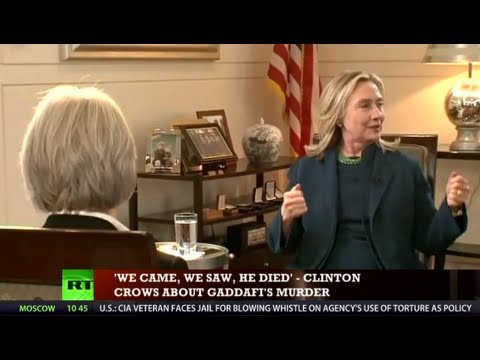
This is the same leader who was murdered in the aftermath of the 2011 NATO bombing of Libya; an attack promoted and facilitated with the eager support of Mrs. Clinton. In an infamous CBS news interview, said regarding this international crime: “We came, we saw, he died.” As Time magazine pointed out in 2011, the administration understood removing Qaddafi from power would allow the terrorist cells active in Libya to run rampant in the vacuum left behind. Just last month the New York Times reported that Libya has indeed become a terrorist safe haven and failed state— conducive for exporting radicals through “ratlines” to the conflict against Assad in Syria.

Hillary made prompt use of the ratlines for conflicts in the Middle East. In the summer of 2012, Clinton privately worked with then CIA director and subversive bonapartist David Petraeus on a proposal for providing arms and training to death squads to be used to topple Syria just as in Libya. This proposal was ultimately struck down by Obama, reported the New York Times in 2013, but constituted one of the earliest attempts at open military support for the Syrian death squads.

Her voting record on intervening in Afghanistan and Iraq is well known and she also has consistently called for attacking Iran. She even told Fareed Zakaria the State Department was involved “behind the scenes” in Iran’s failed 2009 Green Revolution. More recently in Foreign Policy magazine David Rothkopf wrote on the subject of the Lausanne nuclear accord, predicting a “snap-back” in policy by the winner of the 2016 election to the foreign policy in place since the 1980s. The title of this article? “Hillary Clinton is the Real Iran Snap-Back.” This makes Hillary the prime suspect for a return to the madcap Iranian policies that routinely threaten the world with a World War 3 scenario.

Hillary Clinton is not only actively aggressing against Africa and the Middle East. She was one of the loudest proponents against her husband’s hesitancy over the bombing of Kosovo, telling Lucina Frank: “I urged him to bomb,” even if it was a unilateral action.

While no Clinton spokesperson responded to a request by the Washington Free Beacon regarding her stance on Ukraine, in paid speeches she mentioned “putting more financial support into the Ukrainian government”. When Crimea decided to choose the Russian Federation over Poroshenko’s proto-fascist rump state, Hillary anachronistically called President Putin’s actions like “what Hitler did in the ‘30s.” As a leader of the bumbled ”reset” policy towards Russia, Hillary undoubtedly harbors some animus against Putin and will continue the destabilization project ongoing in Ukraine.

Not content with engaging in debacles in Eastern Europe, she has vocally argued for a more aggressive response to what she called the “rollback of democratic development and economic openness in parts of Latin America.” This indicates her willingness to allow the continuation of CIA sponsored efforts at South American destabilization in the countries of Venezuela, Bolivia, Ecuador, Argentina and Brazil.

It is one of the proud prerogatives of the Tax Wall Street Party to push out into the light the Wall Street and foundation-funded Democrats. The final blow to Hillary’s clumsy façade comes directly from arch-neocon Robert Kagan. Kagan worked as a foreign policy advisor to Hillary along with his wife, Ukraine madwoman Victoria Nuland, during Hillary’s term as Secretary of State. He claimed in the New York Times that his view of American foreign policy is best represented in the “mainstream” by the foreign policy of Hillary Clinton; a foreign policy he obviously manipulated or outright crafted. Kagan stated: “If she pursues a policy which we think she will pursue…it’s something that might have been called neocon, but clearly her supporters are not going to call it that; they are going to call it something else.” What further reason could any sane person need to refute Hillary? A vote for Hillary is a vote for the irrational return to war.

The “Giant Sucking Sound”: Clinton Gave US NAFTA and Other Free Trade Sellouts

“There is no success story for workers to be found in North America 20 years after NAFTA,” states AFL-CIO president Richard Trumka. Unlike other failures of his Presidency, Bill Clinton can not run from NAFTA. It was Vice President Al Gore, not a veto-proof Republican congress, who lobbied to remove trade barriers with low-wage Mexico.

The record of free trade is clear. Multinational corporations and Wall Street speculators realize incredible profits, wages remain stagnant in the US, poverty persists in the developing world, and the remaining industrial corporations in America and Canada are increasingly owned by Chinese, Indian and other foreign interests.

America’s free trade policy is upside down. Besides Canada, Australia and Korea, most of our “free” trade partners are low-wage sweatshop paradises like Mexico, Chile, Panama, Guatemala, Bahrain and Oman. The US does in fact apply tariffs on most goods and on most nations of origin – rates are set by the US International Trade Commission (USTIC), a quasi-public federal agency.

Since a German- or Japanese-made automobile would under USITC’s schedule be taxed 10% upon importation, Volkswagen and Toyota can circumvent taxation by simply building their auto assembly plants for the US market in Mexico. In Detroit, an auto assembly worker is paid between $14 and $28/hour, ($29,120-$58,240/yr); hard work for modest pay. In Mexico, the rate varies from $2-5/hour.

In China, all automobile imports regardless of origin are tariffed as high as 25%. This allows the Chinese to attract joint ventures with Volkswagen and Toyota, and to paraphrase Abraham Lincoln, “keep the jobs, the cars and the money.”

NAFTA-related job loss is not a question of productivity, currency manipulation, “fair trade,” environmental standards, etc. While these issues are not trivial, free trade – as Lincoln’s advisor Henry C. Carey proved – is a matter of simple accounting. Can an American family survive on $4,160/year ($2/hr)? If not, cars and their components will be built in Mexico. If we want cars built in the United States, the only solution is a general tariff (import tax) reflecting the difference between those wage standards, like the very tariffs repealed by Bill Clinton.

In the United States the “runaway shop” under NAFTA and CAFTA has sent trade deficits and unemployment soaring while wages drop relative to the cost of living. Yet Mexico and other “partners” receive no benefit either. Many manufacturing sectors in Mexico pay wages lower than the equivalent sector in China. Mexico is now the world leader in illegal narcotics exportation and weapons importation. The poverty level between 1994 and 2009 remained virtually identical. (52.4% – 52.3%). The shipping of raw materials to Mexico comprise the majority of so called American “exports”. The finished products from these exports are assembled and sold back to the United States at slave labor prices.

Don’t expect Hillary to behave differently with the coming “Trans-Pacific Partnership,” which seeks to replace an ascendant China with less-developed Vietnam and Malaysia. Vietnam would overtake India-allied Bangladesh in the global apparel trade, and Malaysia has a high-tech manufacturing sector poised to rival China’s. With America’s manufacturing economy in shambles, the Clinton machine can now be redirected to geopolitical maneuvers.


The Real Story Behind the Republicans’ Iran Letter

images

By Gareth Porter

Source: Middle East Eye

The “open letter” from Senator Tom Cotton and 46 other Republican Senators to the leadership of Iran, which even Republicans themselves admit was aimed at encouraging Iranian opponents of the nuclear negotiations to argue that the United States cannot be counted on to keep the bargain, has created a new political firestorm. It has been harshly denounced by Democratic loyalists as “stunning” and “appalling”, and critics have accused the signers of the letter of being “treasonous” for allegedly violating a law forbidding citizens from negotiating with a foreign power.

But the response to the letter has primarily distracted public attention from the real issue it raises: how the big funders of the Likud Party in Israel control Congressional actions on Iran.

The infamous letter is a ham-handed effort by Republican supporters of the Netanyahu government to blow up the nuclear negotiations between the United States and Iran. The idea was to encourage Iranians to conclude that the United States would not actually carry out its obligations under the agreement – i.e. the lifting of sanctions against Iran. Cotton and his colleagues were inviting inevitable comparison with the 1968 conspiracy by Richard Nixon, through rightwing campaign official Anna Chenault, to encourage the Vietnamese government of President Nguyen Van Thieu to boycott peace talks in Paris.

But while Nixon was plotting secretly to get Thieu to hold out for better terms under a Nixon administration, the 47 Republican Senators were making their effort to sabotage the Iran nuclear talks in full public scrutiny. And the interest served by the letter was not that of a possible future president but of the Israeli government.

The Cotton letter makes arguments that are patently false. The letter suggested that any agreement that lacked approval of Congress “is a mere executive agreement”, as though such agreements are somehow of only marginal importance in US diplomatic history. In fact, the agreements on withdrawal of US forces from both the wars in Vietnam and in Iraq were not treaties but executive agreements.

Equally fatuous is the letter’s assertion that “future Congresses could modify the terms of the agreement at any time”. Congress can nullify the agreement by passing legislation that contradicts it but can’t renegotiate it. And the claim that the next president could “revoke the agreement with the stroke of a pen”, ignores the fact that the Iran nuclear agreement, if signed, will become binding international law through a United Nations Security Council resolution, as Iranian Foreign Minister Mohammad Javad Zarif has pointed out.

The letter has provoked the charge of “treason” against the signers and a demand for charges against them for negotiating with a foreign government in violation of the Logan Act. In a little over 24 hours, more than 200,000 people had signed a petition on the White House website calling such charges to be filed.

But although that route may seem satisfying at first thought, it is problematic for both legal and political reasons. The Logan Act was passed in 1799, and has never been used successfully to convict anyone, mainly because it was written more than a century before US courts created legal standards for the protection of first amendment speech rights. And it is unclear whether the Logan Act was even meant to apply to members of Congress anyway.

AIPAC marching orders

The more serious problem with focusing on the Logan Act, however, is that what Cotton and his Republican colleagues were doing was not negotiating with a foreign government but trying to influence the outcome of negotiations in the interest of a foreign government. The premise of the Senate Republican reflected in the letter – that Iran must not be allowed to have any enrichment capacity whatever – did not appear spontaneously. The views that Cotton and the other Republicans have espoused on Iran were the product of assiduous lobbying by Israeli agents of influence using the inducement of promises of election funding and the threat of support for the members’ opponents in future elections.

Those members of Congress don’t arrive at their positions on issues related to Iran through discussion and debate among themselves. They are given their marching orders by AIPAC lobbyists, and time after time, they sign the letters and vote for legislation or resolution that they are given, as former AIPAC lobbyist MJ Rosenberg has recalled. This Israeli exercise of control over Congress on Iran and issues of concern to Israel resembles the Soviet direction of its satellite regimes and loyal Communist parties more than any democratic process, but with campaign contributions replacing the inducements that kept its bloc allies in line.

Cotton’s loyalty to Israel

Rosenberg has reasoned that AIPAC must have drafted the letter and handed it to Senator Cotton. “Nothing happens on Capitol Hill related to Israel,” he tweets, “unless and until Howard Kohr (AIPAC chief) wants it to happen. Nothing.” AIPAC apparently supported the letter, but there may be more to the story. Senator Cotton just happens to be a protégé of neoconservative political kingpin Bill Kristol, whose Emergency Committee on Israel gave him nearly a million dollars late in his 2014 Senate campaign and guaranteed that Cotton would have the support of the four biggest funders of major anti-Iran organisations.

Cotton proved his absolute fealty to Likudist policy on Iran by sponsoring an amendment to the Nuclear Iran Prevention Act of 2013 that would have punished violators of the sanctions against Iran with prison sentences of up to 20 years and extended the punishment to “a spouse and any relative, to the third degree” of the sanctions violator. In presenting the amendment in the House Foreign Affairs Committee, Cotton provided the useful clarification that it would have included “parents, children, aunts, uncles, nephews, nieces, grandparents, great grandparents, grandkids, great grandkids”.

That amendment, which he apparently believed would best reflect his adoption of the Israeli view of how to cut Iran down to size, was unsuccessful, but it established his reliability in the eyes of the Republican Likudist kingmakers. Now Kristol is grooming him to be the vice-presidential nominee in 2016.

So the real story behind the letter from Cotton and his Republican colleagues is how the enforcers of Likudist policy on Iran used an ambitious young Republican politician to try to provoke a breakdown in the Iran nuclear negotiations. The issue it raises is a far more serious issue than the Logan Act, but thus far major news organisations have steered clear of that story.

– Gareth Porter is an independent investigative journalist and winner of the 2012 Gellhorn Prize for journalism. He is the author of the newly published Manufactured Crisis: The Untold Story of the Iran Nuclear Scare.


US War on ISIS a Trojan Horse

obama-isis-cia

In America’s coming war, don’t be surprised if everything in Syria is destroyed except ISIS.

By Ulson Gunnar

Source: Land Destroyer Report

In August of 2013, even as the words came out of US President Barack Obama’s mouth regarding an “impending” US military strike against the Syrian state, the impotence of American foreign policy loomed over him and those who wrote his speech for him like an insurmountable wall.  So absurd was America’s attempt to once again use the canard of “weapons of mass destruction” to justify yet another military intervention, that many believed America’s proxy war in Syria had finally reached its end.

The counterstroke by Russia included Syria’s immediate and unconditional surrendering of its chemical weapons arsenal, and with that, so evaporated America’s casus belli.

Few would believe if one told them then, that in 2015, that same discredited US would be routinely bombing Syrian territory and poised to justify the raising of an entire army of terrorists to wage war within Syria’s borders, yet that is precisely what is happening. President Obama has announced plans to formally increase military force in Iraq and Syria “against ISIS,” but of course includes building up huge armies of “rebels” who by all other accounts are as bad as ISIS itself (not to mention prone to joining ISIS’ ranks by the thousands).

All it took for this miraculous turn in fortune was the creation of “ISIS,” and serial provocations committed by these Hollywood-style villains seemingly engineered to reinvigorate America’s justification to militarily intervene more directly in a war it itself started in Syria beginning in 2011.

ISIS could not be a more effective part of America’s plans to overthrow the Syrian government and destroy the Syrian state if it had an office at the Pentagon.

Having failed to achieve any of its objectives in Syria, it inexplicably “invaded” Iraq, affording the US military a means of “easing into” the conflict by first confronting ISIS in Iraq, then following them back across the border into Syria. When this scheme began to lose its impact on public perception, ISIS first started executing Western hostages including several Americans. When the US needed the French on board, ISIS executed a Frenchman. When the US needed greater support in Asia, two Japanese were beheaded. And just ahead of President Obama’s recent attempt to formally authorize the use of military force against “ISIS,” a Jordanian pilot was apparently burned to death in a cage in an unprecedented act of barbarity that shocked even the most apathetic.

The theatrics of ISIS parallel those seen in a Hollywood production. This doesn’t mean ISIS didn’t really burn to death a Jordanian pilot or behead scores of hostages. But it does mean that a tremendous amount of resources and planning were put into each murder, except apparently, the effect it would have of rallying the world behind the US and its otherwise hopelessly stalled efforts to overturn the government of Syria.

Could ISIS have built a set specifically to capture dramatic shots like a flame trail passing the camera on its way to the doomed Jordanian pilot, planned crane shots, provided matching uniforms for all the extras on their diabolical movie set, but failed to consider the target audience and how they would react to their production? Could they have, just by coincidence, given exactly what the United States needed to continue its war on Syria in 2015 when it otherwise had effectively failed in 2013?

The answer is obviously no. ISIS’s theatrics were designed specifically to accomplish this. ISIS itself is a fictional creation. In reality the legions of terrorists fighting across the Arab World under the flag of “ISIS” are the same Al Qaeda militants the US, Saudi Arabia and others in an utterly unholy axis have been backing, arming and exploiting in a variety of ways for decades.

Just as the “Islamic State” in Iraq was exposed as a fictional cover for what was also essentially Al Qaeda (as reported by the NYT in their article, “Leader of Al Qaeda group in Iraq was fictional, U.S. military says“), ISIS too is just the latest and greatest re-visioning yet.

The fighters are real. Their atrocities are real. The notion that they’ve sprung out of the dunes of Syria and Iraq, picked their weapons from local date trees and have managed to wage war regionally against several collective armies is entirely fantasy. Required to maintain ISIS’ ranks would be billions in constant support. These are billions ISIS simply cannot account for from hostage ransoms and black market oil alone. The only source that could prop ISIS up for as long as it has allegedly existed and to the extent it allegedly exists, is a state or collection of states intentionally sponsoring the terrorist enterprise.

Those states are of course the chief benefactors of ISIS’ atrocities, and we can clearly see those benefactors are the US and its partners both in Europe and in the Middle East. The US would claim that the threat of ISIS necessitates them to intervene militarily in Syria (when lies about WMDs were flatly rejected by the American and international public). Of course, before the serial headline atrocities ISIS committed, the US attempted to sell this same lie but without affect. Now that sufficient blood has been split and the public sufficiently riled, the US is once again trying to move forward its agenda.

Don’t be surprised, if the US manages to succeed, that everything in Syria is left destroyed except for ISIS. A Hollywood villain this popular and effective is surely destined for a sequel in neighboring Iran or southern Russia, coincidentally where the US would like to create strife and carnage the most.

Ulson Gunnar, a New York-based geopolitical analyst and writer especially for the online magazine “New Eastern Outlook”.

The Victory of ‘Perception Management’

wpid-facebook_-1640825551

By Robert Parry

Source: Consortium News

To understand how the American people find themselves trapped in today’s Orwellian dystopia of endless warfare against an ever-shifting collection of “evil” enemies, you have to think back to the Vietnam War and the shock to the ruling elite caused by an unprecedented popular uprising against that war.

While on the surface Official Washington pretended that the mass protests didn’t change policy, a panicky reality existed behind the scenes, a recognition that a major investment in domestic propaganda would be needed to ensure that future imperial adventures would have the public’s eager support or at least its confused acquiescence.

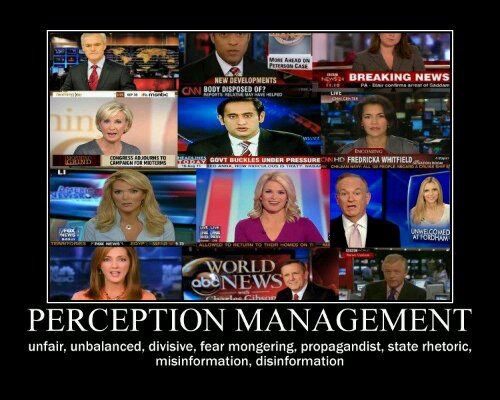
This commitment to what the insiders called “perception management” began in earnest with the Reagan administration in the 1980s but it would come to be the accepted practice of all subsequent administrations, including the present one of President Barack Obama.

In that sense, propaganda in pursuit of foreign policy goals would trump the democratic ideal of an informed electorate. The point would be not to honestly inform the American people about events around the world but to manage their perceptions by ramping up fear in some cases and defusing outrage in others – depending on the U.S. government’s needs.

Thus, you have the current hysteria over Russia’s supposed “aggression” in Ukraine when the crisis was actually provoked by the West, including by U.S. neocons who helped create today’s humanitarian crisis in eastern Ukraine that they now cynically blame on Russian President Vladimir Putin.

Yet, many of these same U.S. foreign policy operatives – outraged over Russia’s limited intervention to protect ethic Russians in eastern Ukraine – are demanding that President Obama launch an air war against the Syrian military as a “humanitarian” intervention there.

In other words, if the Russians act to shield ethnic Russians on their border who are being bombarded by a coup regime in Kiev that was installed with U.S. support, the Russians are the villains blamed for the thousands of civilian deaths, even though the vast majority of the casualties have been inflicted by the Kiev regime from indiscriminate bombing and from dispatching neo-Nazi militias to do the street fighting.

In Ukraine, the exigent circumstances don’t matter, including the violent overthrow of the constitutionally elected president last February. It’s all about white hats for the current Kiev regime and black hats for the ethnic Russians and especially for Putin.

But an entirely different set of standards has applied to Syria where a U.S.-backed rebellion, which included violent Sunni jihadists from the start, wore the white hats and the relatively secular Syrian government, which has responded with excessive violence of its own, wears the black hats. But a problem to that neat dichotomy arose when one of the major Sunni rebel forces, the Islamic State, started seizing Iraqi territory and beheading Westerners.

Faced with those grisly scenes, President Obama authorized bombing the Islamic State forces in both Iraq and Syria, but neocons and other U.S. hardliners have been hectoring Obama to go after their preferred target, Syria’s President Bashar al-Assad, despite the risk that destroying the Syrian military could open the gates of Damascus to the Islamic State or al-Qaeda’s Nusra Front.

Lost on the Dark Side

You might think that the American public would begin to rebel against these messy entangling alliances with the 1984-like demonizing of one new “enemy” after another. Not only have these endless wars drained trillions of dollars from the U.S. taxpayers, they have led to the deaths of thousands of U.S. troops and to the tarnishing of America’s image from the attendant evils of war, including a lengthy detour into the “dark side” of torture, assassinations and “collateral” killings of children and other innocents.

But that is where the history of “perception management” comes in, the need to keep the American people compliant and confused. In the 1980s, the Reagan administration was determined to “kick the Vietnam Syndrome,” the revulsion that many Americans felt for warfare after all those years in the blood-soaked jungles of Vietnam and all the lies that clumsily justified the war.

So, the challenge for the U.S. government became: how to present the actions of “enemies” always in the darkest light while bathing the behavior of the U.S. “side” in a rosy glow. You also had to stage this propaganda theater in an ostensibly “free country” with a supposedly “independent press.”

From documents declassified or leaked over the past several decades, including an unpublished draft chapter of the congressional Iran-Contra investigation, we now know a great deal about how this remarkable project was undertaken and who the key players were.

Perhaps not surprisingly much of the initiative came from the Central Intelligence Agency, which housed the expertise for manipulating target populations through propaganda and disinformation. The only difference this time would be that the American people would be the target population.

For this project, Ronald Reagan’s CIA Director William J. Casey sent his top propaganda specialist Walter Raymond Jr. to the National Security Council staff to manage the inter-agency task forces that would brainstorm and coordinate this “public diplomacy” strategy.

Many of the old intelligence operatives, including Casey and Raymond, are now dead, but other influential Washington figures who were deeply involved by these strategies remain, such as neocon stalwart Robert Kagan, whose first major job in Washington was as chief of Reagan’s State Department Office of Public Diplomacy for Latin America.

Now a fellow at the Brookings Institution and a columnist at the Washington Post, Kagan remains an expert in presenting foreign policy initiatives within the “good guy/bad guy” frames that he learned in the 1980s. He is also the husband of Assistant Secretary of State for European Affairs Victoria Nuland, who oversaw the overthrow of Ukraine’s elected President Viktor Yanukovych last February amid a very effective U.S. propaganda strategy.

During the Reagan years, Kagan worked closely on propaganda schemes with Elliott Abrams, then the Assistant Secretary of State for Latin America. After getting convicted and then pardoned in the Iran-Contra scandal, Abrams reemerged on President George W. Bush’s National Security Council handling Middle East issues, including the Iraq War, and later “global democracy strategy.” Abrams is now a senior fellow at the Council on Foreign Relations.

These and other neocons were among the most diligent students learning the art of “perception management” from the likes of Raymond and Casey, but those propaganda skills have spread much more widely as “public diplomacy” and “information warfare” have now become an integral part of every U.S. foreign policy initiative.

A Propaganda Bureaucracy

Declassified documents now reveal how extensive Reagan’s propaganda project became with inter-agency task forces assigned to develop “themes” that would push American “hot buttons.” Scores of documents came out during the Iran-Contra scandal in 1987 and hundreds more are now available at the Reagan presidential library in Simi Valley, California.

What the documents reveal is that at the start of the Reagan administration, CIA Director Casey faced a daunting challenge in trying to rally public opinion behind aggressive U.S. interventions, especially in Central America. Bitter memories of the Vietnam War were still fresh and many Americans were horrified at the brutality of right-wing regimes in Guatemala and El Salvador, where Salvadoran soldiers raped and murdered four American churchwomen in December 1980.

The new leftist Sandinista government in Nicaragua also was not viewed with much alarm. After all, Nicaragua was an impoverished country of only about three million people who had just cast off the brutal dictatorship of Anastasio Somoza.

So, Reagan’s initial strategy of bolstering the Salvadoran and Guatemalan armies required defusing the negative publicity about them and somehow rallying the American people into supporting a covert CIA intervention inside Nicaragua via a counterrevolutionary force known as the Contras led by Somoza’s ex-National Guard officers.

Reagan’s task was made tougher by the fact that the Cold War’s anti-communist arguments had so recently been discredited in Vietnam. As deputy assistant secretary to the Air Force, J. Michael Kelly, put it, “the most critical special operations mission we have … is to persuade the American people that the communists are out to get us.”

At the same time, the White House worked to weed out American reporters who uncovered facts that undercut the desired public images. As part of that effort, the administration attacked New York Times correspondent Raymond Bonner for disclosing the Salvadoran regime’s massacre of about 800 men, women and children in the village of El Mozote in northeast El Salvador in December 1981. Accuracy in Media and conservative news organizations, such as The Wall Street Journal’s editorial page, joined in pummeling Bonner, who was soon ousted from his job.

But these were largely ad hoc efforts. A more comprehensive “public diplomacy” operation took shape beginning in 1982 when Raymond, a 30-year veteran of CIA clandestine services, was transferred to the NSC.

A slight, soft-spoken New Yorker who reminded some of a character from a John le Carré spy novel, Raymond was an intelligence officer who “easily fades into the woodwork,” according to one acquaintance. But Raymond would become the sparkplug for this high-powered propaganda network, according to a draft chapter of the Iran-Contra report.

Though the draft chapter didn’t use Raymond’s name in its opening pages, apparently because some of the information came from classified depositions, Raymond’s name was used later in the chapter and the earlier citations matched Raymond’s known role. According to the draft report, the CIA officer who was recruited for the NSC job had served as Director of the Covert Action Staff at the CIA from 1978 to 1982 and was a “specialist in propaganda and disinformation.”

“The CIA official [Raymond] discussed the transfer with [CIA Director] Casey and NSC Advisor William Clark that he be assigned to the NSC as [Donald] Gregg’s successor [as coordinator of intelligence operations in June 1982] and received approval for his involvement in setting up the public diplomacy program along with his intelligence responsibilities,” the chapter said.

“In the early part of 1983, documents obtained by the Select [Iran-Contra] Committees indicate that the Director of the Intelligence Staff of the NSC [Raymond] successfully recommended the establishment of an inter-governmental network to promote and manage a public diplomacy plan designed to create support for Reagan Administration policies at home and abroad.”

During his Iran-Contra deposition, Raymond explained the need for this propaganda structure, saying: “We were not configured effectively to deal with the war of ideas.”

One reason for this shortcoming was that federal law forbade taxpayers’ money from being spent on domestic propaganda or grassroots lobbying to pressure congressional representatives. Of course, every president and his team had vast resources to make their case in public, but by tradition and law, they were restricted to speeches, testimony and one-on-one persuasion of lawmakers.

But things were about to change. In a Jan. 13, 1983, memo, NSC Advisor Clark foresaw the need for non-governmental money to advance this cause. “We will develop a scenario for obtaining private funding,” Clark wrote. (Just five days later, President Reagan personally welcomed media magnate Rupert Murdoch into the Oval Office for a private meeting, according to records on file at the Reagan library.)

As administration officials reached out to wealthy supporters, lines against domestic propaganda soon were crossed as the operation took aim not only at foreign audiences but at U.S. public opinion, the press and congressional Democrats who opposed funding the Nicaraguan Contras.

At the time, the Contras were earning a gruesome reputation as human rights violators and terrorists. To change this negative perception of the Contras as well as of the U.S.-backed regimes in El Salvador and Guatemala, the Reagan administration created a full-blown, clandestine propaganda network.

In January 1983, President Reagan took the first formal step to create this unprecedented peacetime propaganda bureaucracy by signing National Security Decision Directive 77, entitled “Management of Public Diplomacy Relative to National Security.” Reagan deemed it “necessary to strengthen the organization, planning and coordination of the various aspects of public diplomacy of the United States Government.”

Reagan ordered the creation of a special planning group within the National Security Council to direct these “public diplomacy” campaigns. The planning group would be headed by the CIA’s Walter Raymond Jr. and one of its principal arms would be a new Office of Public Diplomacy for Latin America, housed at the State Department but under the control of the NSC.

CIA Taint

Worried about the legal prohibition barring the CIA from engaging in domestic propaganda, Raymond formally resigned from the CIA in April 1983, so, he said, “there would be no question whatsoever of any contamination of this.” But Raymond continued to act toward the U.S. public much like a CIA officer would in directing a propaganda operation in a hostile foreign country.

Raymond fretted, too, about the legality of Casey’s ongoing involvement. Raymond confided in one memo that it was important “to get [Casey] out of the loop,” but Casey never backed off and Raymond continued to send progress reports to his old boss well into 1986. It was “the kind of thing which [Casey] had a broad catholic interest in,” Raymond shrugged during his Iran-Contra deposition. He then offered the excuse that Casey undertook this apparently illegal interference in domestic politics “not so much in his CIA hat, but in his adviser to the president hat.”

As a result of Reagan’s decision directive, “an elaborate system of inter-agency committees was eventually formed and charged with the task of working closely with private groups and individuals involved in fundraising, lobbying campaigns and propagandistic activities aimed at influencing public opinion and governmental action,” the draft Iran-Contra chapter said. “This effort resulted in the creation of the Office of Public Diplomacy for Latin America and the Caribbean in the Department of State (S/LPD), headed by Otto Reich,” a right-wing Cuban exile from Miami.

Though Secretary of State George Shultz wanted the office under his control, President Reagan insisted that Reich “report directly to the NSC,” where Raymond oversaw the operations as a special assistant to the President and the NSC’s director of international communications, the chapter said.

“Reich relied heavily on Raymond to secure personnel transfers from other government agencies to beef up the limited resources made available to S/LPD by the Department of State,” the chapter said. “Personnel made available to the new office included intelligence specialists from the U.S. Air Force and the U.S. Army. On one occasion, five intelligence experts from the Army’s 4th Psychological Operations Group at Fort Bragg, North Carolina, were assigned to work with Reich’s fast-growing operation.”

A “public diplomacy strategy paper,” dated May 5, 1983, summed up the administration’s problem. “As far as our Central American policy is concerned, the press perceives that: the USG [U.S. government] is placing too much emphasis on a military solution, as well as being allied with inept, right-wing governments and groups. …The focus on Nicaragua [is] on the alleged U.S.-backed ‘covert’ war against the Sandinistas. Moreover, the opposition … is widely perceived as being led by former Somozistas.”

The administration’s difficulty with most of these press perceptions was that they were correct. But the strategy paper recommended ways to influence various groups of Americans to “correct” the impressions anyway, removing what another planning document called “perceptional obstacles.”

“Themes will obviously have to be tailored to the target audience,” the strategy paper said.

Casey’s Hand

As the Reagan administration struggled to manage public perceptions, CIA Director Casey kept his personal hand in the effort. On one muggy day in August 1983, Casey convened a meeting of Reagan administration officials and five leading ad executives at the Old Executive Office Building next to the White House to come up with ideas for selling Reagan’s Central American policies to the American people.

Earlier that day, a national security aide had warmed the P.R. men to their task with dire predictions that leftist governments would send waves of refugees into the United States and cynically flood America with drugs. The P.R. executives jotted down some thoughts over lunch and then pitched their ideas to the CIA director in the afternoon as he sat hunched behind a desk taking notes.

“Casey was kind of spearheading a recommendation” for better public relations for Reagan’s Central America policies, recalled William I. Greener Jr., one of the ad men. Two top proposals arising from the meeting were for a high-powered communications operation inside the White House and private money for an outreach program to build support for U.S. intervention.

The results from the discussions were summed up in an Aug. 9, 1983, memo written by Raymond who described Casey’s participation in the meeting to brainstorm how “to sell a ‘new product’ – Central America – by generating interest across-the-spectrum.”

In the memo to then-U.S. Information Agency director Charles Wick, Raymond also noted that “via Murdock [sic] may be able to draw down added funds” to support pro-Reagan initiatives. Raymond’s reference to Rupert Murdoch possibly drawing down “added funds” suggests that the right-wing media mogul had been recruited to be part of the covert propaganda operation. During this period, Wick arranged at least two face-to-face meetings between Murdoch and Reagan.

In line with the clandestine nature of the operation, Raymond also suggested routing the “funding via Freedom House or some other structure that has credibility in the political center.” (Freedom House would later emerge as a principal beneficiary of funding from the National Endowment for Democracy, which was also created under the umbrella of Raymond’s operation.)

As the Reagan administration pushed the envelope on domestic propaganda, Raymond continued to worry about Casey’s involvement. In an Aug. 29, 1983, memo, Raymond recounted a call from Casey pushing his P.R. ideas. Alarmed at a CIA director participating so brazenly in domestic propaganda, Raymond wrote that “I philosophized a bit with Bill Casey (in an effort to get him out of the loop)” but with little success.

Meanwhile, Reich’s Office of Public Diplomacy for Latin America (S/LPD) proved extremely effective in selecting “hot buttons” that would anger Americans about the Sandinistas. He also browbeat news correspondents who produced stories that conflicted with the administration’s “themes.” Reich’s basic M.O. was to dispatch his propaganda teams to lobby news executives to remove or punish out-of-step reporters – with a disturbing degree of success. Reich once bragged that his office “did not give the critics of the policy any quarter in the debate.”

Another part of the office’s job was to plant “white propaganda” in the news media through op-eds secretly financed by the government. In one memo, Jonathan Miller, a senior public diplomacy official, informed White House aide Patrick Buchanan about success placing an anti-Sandinista piece in The Wall Street Journal’s friendly pages. “Officially, this office had no role in its preparation,” Miller wrote.

Other times, the administration put out “black propaganda,” outright falsehoods. In 1983, one such theme was designed to anger American Jews by portraying the Sandinistas as anti-Semitic because much of Nicaragua’s small Jewish community fled after the revolution in 1979.

However, the U.S. embassy in Managua investigated the charges and “found no verifiable ground on which to accuse the GRN [the Sandinista government] of anti-Semitism,” according to a July 28, 1983, cable. But the administration kept the cable secret and pushed the “hot button” anyway.

Black Hats/White Hats

Repeatedly, Raymond lectured his subordinates on the chief goal of the operation: “in the specific case of Nica[ragua], concentrate on gluing black hats on the Sandinistas and white hats on UNO [the Contras’ United Nicaraguan Opposition].” So Reagan’s speechwriters dutifully penned descriptions of Sandinista-ruled Nicaragua as a “totalitarian dungeon” and the Contras as the “moral equivalent of the Founding Fathers.”

As one NSC official told me, the campaign was modeled after CIA covert operations abroad where a political goal is more important than the truth. “They were trying to manipulate [U.S.] public opinion … using the tools of Walt Raymond’s trade craft which he learned from his career in the CIA covert operation shop,” the official admitted.

Another administration official gave a similar description to The Miami Herald’s Alfonso Chardy. “If you look at it as a whole, the Office of Public Diplomacy was carrying out a huge psychological operation, the kind the military conduct to influence the population in denied or enemy territory,” that official explained. [For more details, see Parry’s Lost History.]

Another important figure in the pro-Contra propaganda was NSC staffer Oliver North, who spent a great deal of his time on the Nicaraguan public diplomacy operation even though he is better known for arranging secret arms shipments to the Contras and to Iran’s radical Islamic government, leading to the Iran-Contra scandal.

The draft Iran-Contra chapter depicted a Byzantine network of contract and private operatives who handled details of the domestic propaganda while concealing the hand of the White House and the CIA. “Richard R. Miller, former head of public affairs at AID, and Francis D. Gomez, former public affairs specialist at the State Department and USIA, were hired by S/LPD through sole-source, no-bid contracts to carry out a variety of activities on behalf of the Reagan administration policies in Central America,” the chapter said.

“Supported by the State Department and White House, Miller and Gomez became the outside managers of [North operative] Spitz Channel’s fundraising and lobbying activities. They also served as the managers of Central American political figures, defectors, Nicaraguan opposition leaders and Sandinista atrocity victims who were made available to the press, the Congress and private groups, to tell the story of the Contra cause.”

Miller and Gomez facilitated transfers of money to Swiss and offshore banks at North’s direction, as they “became the key link between the State Department and the Reagan White House with the private groups and individuals engaged in a myriad of endeavors aimed at influencing the Congress, the media and public opinion,” the chapter said.

The Iran-Contra draft chapter also cited a March 10, 1985, memo from North describing his assistance to CIA Director Casey in timing disclosures of pro-Contra news “aimed at securing Congressional approval for renewed support to the Nicaraguan Resistance Forces.”

The chapter added: “Casey’s involvement in the public diplomacy effort apparently continued throughout the period under investigation by the Committees,” including a 1985 role in pressuring Congress to renew Contra aid and a 1986 hand in further shielding the Office of Public Diplomacy for Latin America from the oversight of Secretary Shultz.

A Raymond-authored memo to Casey in August 1986 described the shift of the S/LPD office – where Robert Kagan had replaced Reich – to the control of the Bureau of Inter-American Affairs, which was headed by Assistant Secretary of State Elliott Abrams, who had tapped Kagan for the public diplomacy job.

Even after the Iran-Contra scandal unraveled in 1986-87 and Casey died of brain cancer on May 6, 1987, the Republicans fought to keep secret the remarkable story of the public diplomacy apparatus. As part of a deal to get three moderate Republican senators to join Democrats in signing the Iran-Contra majority report, Democratic leaders agreed to drop the draft chapter detailing the CIA’s domestic propaganda role (although a few references were included in the executive summary). But other Republicans, including Rep. Dick Cheney, still issued a minority report defending broad presidential powers in foreign affairs.

Thus, the American people were spared the chapter’s troubling conclusion: that a secret propaganda apparatus had existed, run by “one of the CIA’s most senior specialists, sent to the NSC by Bill Casey, to create and coordinate an inter-agency public-diplomacy mechanism [which] did what a covert CIA operation in a foreign country might do. [It] attempted to manipulate the media, the Congress and public opinion to support the Reagan administration’s policies.”

Kicking the Vietnam Syndrome

The ultimate success of Reagan’s propaganda strategy was affirmed during the tenure of his successor, George H.W. Bush, when Bush ordered a 100-hour ground war on Feb. 23, 1991, to oust Iraqi troops from Kuwait, which had been invaded the previous August.

Though Iraqi dictator Saddam Hussein had long been signaling a readiness to withdraw – and Soviet President Mikhail Gorbachev had negotiated a withdrawal arrangement that even had the blessings of top U.S. commanders in the field – President Bush insisted on pressing ahead with the ground attack.

Bush’s chief reason was that he – and his Defense Secretary Dick Cheney – saw the assault against Iraq’s already decimated forces as an easy victory, one that would demonstrate America’s new military capacity for high-tech warfare and would cap the process begun a decade earlier to erase the Vietnam Syndrome from the minds of average Americans.

Those strategic aspects of Bush’s grand plan for a “new world order” began to emerge after the U.S.-led coalition started pummeling Iraq with air strikes in mid-January 1991. The bombings inflicted severe damage on Iraq’s military and civilian infrastructure and slaughtered a large number of non-combatants, including the incineration of some 400 women and children in a Baghdad bomb shelter on Feb. 13. [For details, see Consortiumnews.com’s “Recalling the Slaughter of Innocents.”]

The air war’s damage was so severe that some world leaders looked for a way to end the carnage and arrange Iraq’s departure from Kuwait. Even senior U.S. military field commanders, such as Gen. Norman Schwarzkopf, looked favorably on proposals for sparing lives.

But Bush was fixated on a ground war. Though secret from the American people at that time, Bush had long determined that a peaceful Iraqi withdrawal from Kuwait would not be allowed. Indeed, Bush was privately fearful that the Iraqis might capitulate before the United States could attack.

At the time, conservative columnists Rowland Evans and Robert Novak were among the few outsiders who described Bush’s obsession with exorcising the Vietnam Syndrome. On Feb. 25, 1991, they wrote that the Gorbachev initiative brokering Iraq’s surrender of Kuwait “stirred fears” among Bush’s advisers that the Vietnam Syndrome might survive the Gulf War.

“There was considerable relief, therefore, when the President … made clear he was having nothing to do with the deal that would enable Saddam Hussein to bring his troops out of Kuwait with flags flying,” Evans and Novak wrote. “Fear of a peace deal at the Bush White House had less to do with oil, Israel or Iraqi expansionism than with the bitter legacy of a lost war. ‘This is the chance to get rid of the Vietnam Syndrome,’ one senior aide told us.”

In the 1999 book, Shadow, author Bob Woodward confirmed that Bush was adamant about fighting a war, even as the White House pretended it would be satisfied with an unconditional Iraqi withdrawal. “We have to have a war,” Bush told his inner circle of Secretary of State James Baker, national security adviser Brent Scowcroft and Gen. Colin Powell, according to Woodward.

“Scowcroft was aware that this understanding could never be stated publicly or be permitted to leak out. An American president who declared the necessity of war would probably be thrown out of office. Americans were peacemakers, not warmongers,” Woodward wrote.

The Ground War

However, the “fear of a peace deal” resurfaced in the wake of the U.S.-led bombing campaign. Soviet diplomats met with Iraqi leaders who let it be known that they were prepared to withdraw their troops from Kuwait unconditionally.

Learning of Gorbachev’s proposed settlement, Schwarzkopf also saw little reason for U.S. soldiers to die if the Iraqis were prepared to withdraw and leave their heavy weapons behind. There was also the prospect of chemical warfare that the Iraqis might use against advancing American troops. Schwarzkopf saw the possibility of heavy U.S. casualties.

But Gorbachev’s plan was running into trouble with President Bush and his political subordinates who wanted a ground war to crown the U.S. victory. Schwarzkopf reached out to Gen. Powell, chairman of the Joint Chiefs of Staff, to make the case for peace with the President.

On Feb. 21, 1991, the two generals hammered out a cease-fire proposal for presentation to the NSC. The peace deal would give Iraqi forces one week to march out of Kuwait while leaving their armor and heavy equipment behind. Schwarzkopf thought he had Powell’s commitment to pitch the plan at the White House.

But Powell found himself caught in the middle. He wanted to please Bush while still representing the concerns of the field commanders. When Powell arrived at the White House late on the evening of Feb. 21, he found Bush angry about the Soviet peace initiative. Still, according to Woodward’s Shadow, Powell reiterated that he and Schwarzkopf “would rather see the Iraqis walk out than be driven out.”

In My American Journey, Powell expressed sympathy for Bush’s predicament. “The President’s problem was how to say no to Gorbachev without appearing to throw away a chance for peace,” Powell wrote. “I could hear the President’s growing distress in his voice. ‘I don’t want to take this deal,’ he said. ‘But I don’t want to stiff Gorbachev, not after he’s come this far with us. We’ve got to find a way out’.”

Powell sought Bush’s attention. “I raised a finger,” Powell wrote. “The President turned to me. ‘Got something, Colin?’,” Bush asked. But Powell did not outline Schwarzkopf’s one-week cease-fire plan. Instead, Powell offered a different idea intended to make the ground offensive inevitable.

“We don’t stiff Gorbachev,” Powell explained. “Let’s put a deadline on Gorby’s proposal. We say, great idea, as long as they’re completely on their way out by, say, noon Saturday,” Feb. 23, less than two days away.

Powell understood that the two-day deadline would not give the Iraqis enough time to act, especially with their command-and-control systems severely damaged by the air war. The plan was a public-relations strategy to guarantee that the White House got its ground war. “If, as I suspect, they don’t move, then the flogging begins,” Powell told a gratified president.

The next day, at 10:30 a.m., a Friday, Bush announced his ultimatum. There would be a Saturday noon deadline for the Iraqi withdrawal, as Powell had recommended. Schwarzkopf and his field commanders in Saudi Arabia watched Bush on television and immediately grasped its meaning.

“We all knew by then which it would be,” Schwarzkopf wrote. “We were marching toward a Sunday morning attack.”

When the Iraqis predictably missed the deadline, American and allied forces launched the ground offensive at 0400 on Feb. 24, Persian Gulf time.

Though Iraqi forces were soon in full retreat, the allies pursued and slaughtered tens of thousands of Iraqi soldiers in the 100-hour war. U.S. casualties were light, 147 killed in combat and another 236 killed in accidents or from other causes. “Small losses as military statistics go,” wrote Powell, “but a tragedy for each family.”

On Feb. 28, the day the war ended, Bush celebrated the victory. “By God, we’ve kicked the Vietnam Syndrome once and for all,” the President exulted, speaking to a group at the White House. [For more details, see Robert Parry’s Secrecy & Privilege.]

So as not to put a damper on the post-war happy feelings, the U.S. news media decided not to show many of the grisliest photos, such as charred Iraqi soldiers ghoulishly still seated in their burned-out trucks where they had been incinerated while trying to flee. By that point, U.S. journalists knew it wasn’t smart for their careers to present a reality that didn’t make the war look good.

Enduring Legacy

Though Reagan’s creation of a domestic propaganda bureaucracy began more than three decades ago – and Bush’s vanquishing of the Vietnam Syndrome was more than two decades ago – the legacy of those actions continue to reverberate today in how the perceptions of the American people are now routinely managed. That was true during last decade’s Iraq War and this decade’s conflicts in Libya, Syria and Ukraine as well as the economic sanctions against Iran and Russia.

Indeed, while the older generation that pioneered these domestic propaganda techniques has passed from the scene, many of their protégés are still around along with some of the same organizations. The National Endowment for Democracy, which was formed in 1983 under the supervision of Walter Raymond’s NSC operation, is still run by the same neocon, Carl Gershman, and has an even bigger budget, now exceeding $100 million a year.

Gershman and his NED played important behind-the-scenes roles in instigating the Ukraine crisis by financing activists, journalists and other operatives who supported the coup against elected President Yanukovych. The NED-backed Freedom House also beat the propaganda drums. [See Consortiumnews.com’s “A Shadow Foreign Policy.”]

Two other Reagan-era veterans, Elliott Abrams and Robert Kagan, have both provided important intellectual support for continuing U.S. interventionism around the world. Earlier this year, Kagan’s article for The New Republic, entitled “Superpowers Don’t Get to Retire,” touched such a raw nerve with President Obama that he hosted Kagan at a White House lunch and crafted the presidential commencement speech at West Point to deflect some of Kagan’s criticism of Obama’s hesitancy to use military force.

A New York Times article about Kagan’s influence over Obama reported that Kagan’s wife, Assistant Secretary of State Victoria Nuland, apparently had a hand in crafting the attack on her ostensible boss, President Obama.

According to the Times article, the husband-and-wife team share both a common world view and professional ambitions, Nuland editing Kagan’s articles and Kagan “not permitted to use any official information he overhears or picks up around the house” – a suggestion that Kagan’s thinking at least may be informed by foreign policy secrets passed on by his wife.

Though Nuland wouldn’t comment specifically on Kagan’s attack on President Obama, she indicated that she holds similar views. “But suffice to say,” Nuland said, “that nothing goes out of the house that I don’t think is worthy of his talents. Let’s put it that way.”

Misguided Media

In the three decades since Reagan’s propaganda machine was launched, the American press corps also has fallen more and more into line with an aggressive U.S. government’s foreign policy strategies. Those of us in the mainstream media who resisted the propaganda pressures mostly saw our careers suffer while those who played along moved steadily up the ranks into positions of more money and more status.

Even after the Iraq War debacle when nearly the entire mainstream media went with the pro-invasion flow, there was almost no accountability for that historic journalistic failure. Indeed, the neocon influence at major newspapers, such as the Washington Post and the New York Times, only has solidified since.

Today’s coverage of the Syrian civil war or the Ukraine crisis is so firmly in line with the State Department’s propaganda “themes” that it would put smiles on the faces of William Casey and Walter Raymond if they were around today to see how seamlessly the “perception management” now works. There’s no need any more to send out “public diplomacy” teams to bully editors and news executives. Everyone is already onboard.

Rupert Murdoch’s media empire is bigger than ever, but his neocon messaging barely stands out as distinctive, given how the neocons also have gained control of the editorial and foreign-reporting sections of the Washington Post, the New York Times and virtually every other major news outlet. For instance, the demonizing of Russian President Putin is now so total that no honest person could look at those articles and see anything approaching objective or evenhanded journalism. Yet, no one loses a job over this lack of professionalism.

The Reagan administration’s dreams of harnessing private foundations and non-governmental organizations have also come true. The Orwellian circle has been completed with many American “anti-war” groups advocating for “humanitarian” wars in Syria and other countries targeted by U.S. propaganda. [See Consortiumnews.com’s “Selling ‘Peace Groups’ on US-Led Wars.”]

Much as Reagan’s “public diplomacy” apparatus once sent around “defectors” to lambaste Nicaragua’s Sandinistas by citing hyped-up human rights violations now the work is done by NGOs with barely perceptible threads back to the U.S. government. Just as Freedom House had “credibility” in the 1980s because of its earlier reputation as a human rights group, now other groups carrying the “human rights” tag, such as Human Rights Watch, are in the forefront of urging U.S. military interventions based on murky or propagandistic claims. [See Consortiumnews.com’s “The Collapsing Syria-Sarin Case.”]

At this advanced stage of America’s quiet surrender to “perception management,” it is even hard to envision how one could retrace the many steps that would lead back to the concept of a democratic Republic based on an informed electorate. Many on the American Right remain entranced by the old propaganda theme about the “liberal media” and still embrace Reagan as their beloved icon. Meanwhile, many liberals can’t break away from their own wistful trust in the New York Times and their empty hope that the media really is “liberal.”

To confront the hard truth is not easy. Indeed, in this case, it can cause despair because there are so few voices to trust and they are easily drowned out by floods of disinformation that can come from any angle – right, left or center. Yet, for the American democratic Republic to reset its goal toward an informed electorate, there is no option other than to build institutions that are determinedly committed to the truth.

Investigative reporter Robert Parry broke many of the Iran-Contra stories for The Associated Press and Newsweek in the 1980s. You can buy his latest book, America’s Stolen Narrative, either in print here or as an e-book (from Amazon and barnesandnoble.com). You also can order Robert Parry’s trilogy on the Bush Family and its connections to various right-wing operatives for only $34. The trilogy includes America’s Stolen Narrative. For details on this offer, click here.

The Chickenshit Lobby Is Mad As Hell – but just how mad are they?

100shot1

By Justin Raimondo

Source: Antiwar.com

Israel, Israel, Israel, Israel – can we ever escape the endless kvetching of its partisans? In the media, in both houses of Congress, on the campuses and in the streets, Israel’s fifth column in America is everywhere, making its presence felt. From Chuck Hagel’s confirmation battle to the public relations campaign accompanying their latest Gaza massacre, the Jewish state’s on-the-ground army of American flacks, publicists, and fanatic rank-and-filers mobilizes the moment someone looks cross-eyed at Bibi Netanyahu – and the Chickenshit scandal has them screaming to high heaven.

The scandal was created, unsurprisingly, by Israel’s semi-official flack-in-chief, Jeffrey Goldberg, a former Israeli prison guard turned journalist, whose pronouncements carry the authority of someone with impeccable connections in both Tel Aviv and Washington. Writing in The Atlantic, he reports:

“The other day I was talking to a senior Obama administration official about the foreign leader who seems to frustrate the White House and the State Department the most. ‘The thing about Bibi is, he’s a chickenshit’ this official said …

Goldberg has a carefully cultivated image as a moderate-to-liberal Obama sympathizer, and he goes into his familiar riff about how the rapidly fraying US-Israeli relationship is largely a function of Bibi’s truculence. Yet it’s clear Goldberg – who surely knew what the response to his reporting would be, even inside the President’s own party – is appalled by this display of candor:

“’The good thing about Netanyahu is that he’s scared to launch wars,’ the official said, expanding the definition of what a chickenshit Israeli prime minister looks like. ‘The bad thing about him is that he won’t do anything to reach an accommodation with the Palestinians or with the Sunni Arab states. The only thing he’s interested in is protecting himself from political defeat. He’s not [Yitzhak] Rabin, he’s not [Ariel] Sharon, he’s certainly no [Menachem] Begin. He’s got no guts.’”

The Lebanese and Gazans might quibble with the notion that Bibi’s “scared to launch wars,” but then again those weren’t wars, they were massacres. And why should Bibi fight anyone who can possibly fight back when he has the United States to do his dirty work for him?

Goldberg’s assessment of the rupture is that “The fault for this breakdown in relations can be assigned in good part to the junior partner in the relationship, Netanyahu” – but perhaps Bibi doesn’t recognize his junior status because that isn’t the way it worked during most of the Bush years.

Obama is apparently much less willing than his predecessor to sacrifice American lives while Bibi directs the action from behind the scenes. The President’s initial reluctance to get more deeply involved in Syria, not to mention his eagerness to get the heck out of Iraq ASAP, had Tel Aviv – and its American amen corner – fuming. On the other side of the equation, the dramatic escalation of Israel’s “settlement”-building campaign has at least some in the Obama administration infused with a “red-hot anger,” as Goldberg reports the phrase used by one Obama administration official, possibly the same one cited here:

“I ran this notion by another senior official who deals with the Israel file regularly. This official agreed that Netanyahu is a ‘chickenshit’ on matters related to the comatose peace process, but added that he’s also a ‘coward’ on the issue of Iran’s nuclear threat. The official said the Obama administration no longer believes that Netanyahu would launch a preemptive strike on Iran’s nuclear facilities in order to keep the regime in Tehran from building an atomic arsenal. ‘It’s too late for him to do anything. Two, three years ago, this was a possibility. But ultimately he couldn’t bring himself to pull the trigger. It was a combination of our pressure and his own unwillingness to do anything dramatic. Now it’s too late.’”

The reality is that there was never any possibility of an Israeli strike, as I pointed out in 2011, when speculation was at an all-time high:

“The problem with this alleged plan is that Israel doesn’t have the military capacity to do the job and do it well: Iran’s nuclear facilities are enclosed within hardened sites, and are spread out to such a degree that Israeli war planes would have trouble reaching them. While the Israelis have recently tested a long-range missile that has the capacity to hit Iranian targets, the idea that they could take out all the intended targets in one fell swoop is simply a fantasy. Therefore, this alleged “debate” taking place within the Israeli leadership, complete with a phony “investigation” by Netanyahu into who leaked the nonexistent Israeli attack ‘plan,’ is a non-event. The whole thing, in short, is a bluff.

“But who is being bluffed here? Not the Iranians, who are surely aware of Israel’s incapacity. The volume of the war hysteria is being turned up with one purpose in mind: the Israelis want the US to do their dirty work for them. This is a threat aimed not only – or even primarily – at Iran, but at us.” 

The Obama administration is well-aware of Israel’s technical incapacity, as is Goldberg’s source: so what, exactly, is the purpose of this manufactured controversy?

The Israelis are hoping a propaganda campaign in the US will subvert the administration’s plans to reach a deal with Iran. As Goldberg reports;

“Netanyahu has told several people I’ve spoken to in recent days that he has ‘written off’ the Obama administration, and plans to speak directly to Congress and to the American people should an Iran nuclear deal be reached.”

Goldberg’s contribution to this whiny narrative – “Israel has been thrown under the bus!” – is pretty clear, but then again none of this is surprising. After all, what is Goldberg doing in America aside from acting as a kind of semiofficial (albeit ostensibly self-critical) Voice of Israel in the US media?

What’s surprising is how Netanyahu, in a speech to the Knesset, took the opportunity to answer his critics in the Obama administration: “Netanyahu angrily insisted he was ‘under attack simply for defending Israel,’ adding that he ‘cherished’ Israel’s relationship with the US.”

The famously combative Israeli Prime Minister went on to say:

“When there are pressures on Israel to concede its security, the easiest thing to do is to concede. You get a round of applause, ceremonies on grassy knolls, and then come the missiles and the tunnels.”

Bibi, who spent many years in the United States, is surely cognizant of what his “grassy knoll” reference connotes. You can argue it was just an infelicitous phrase, or that Bibi was referring to himself, not Obama. Maybe so. But what if, say, an Iranian official, even a low-ranking one, had said such a thing? The uproar would be deafening. And so the question must be asked: was Bibi threatening the President of the United States?

If we take seriously Goldberg’s depiction of the poisoned relationship between Bibi and Obama, the possibility can’t be completely dismissed.

The Chickenshit Lobby, otherwise known as Israel’s amen corner in the US, is mad as hell – but just how mad are they? I don’t know the answer to that question, but as the prospect of a peace agreement with Iran looms larger, those whose job it is to protect the President need to take this potential threat seriously. As we’ve seen recently, the White House isn’t exactly an impregnable fortress. In the meantime, it’s time to start reevaluating the “special relationship” in light of an Israeli leader who talks about the “grassy knoll” while denouncing an American president.

Editor’s note: We may get an indication of how seriously Obama takes such threats when he makes his decision on S.2673 (which was passed by Congress on Dec. 3, 2014).