The Fed Has Triggered A Stagflationary Disaster That Will Hit Hard This Year

By Brandon Smith

Source: Alt-Market.US

I don’t think I can overstate the danger that the U.S. economy is in right now as we enter 2022. While most people are caught up in the ongoing drama of Covid-19, a REAL threat looms over the nation in the form of a stagflationary tidal wave. The mainstream media is attempting to place the blame on “supply chain disruptions,” but this is a misrepresentation of the issue.

The two factors are indeed intertwined, but the reality is that inflation is the cause of supply chain disruptions, not the result of supply chain disruptions. If we look at the underlying stats for price rises in essential products we can get a clearer picture.

Before I get into my argument, I really want to stress that this is a precarious time and I suggest that people prepare accordingly. In just the past few months I have seen personal expenses rise at least 20% overall, and I’m sure it’s the same or worse for most of you. Stocking necessities and safe-haven investments with intrinsic value like physical precious metals are a good choice for protecting whatever buying power your dollars have left…

Higher prices everywhere

The Consumer Price Index (CPI) is officially at the highest levels in 40 years. CPI measurements often diminish the scale of the problem because they do not include things like food, energy and housing which are core expenses for the public. CPI calculations have also been “adjusted” over the past few decades by the government to express a more positive view on inflation. If we look at the inflation numbers at Shadowstats, calculated according to the same methods they used in the 1980’s, we see a dramatic increase in CPI which paints a more dire (but more accurate) picture.

U.S. food prices have spiked to levels not seen since 2008 at the onset of the credit and derivatives collapse that brought about tens of trillions of dollars in Federal Reserve bailouts.

If we look beyond the 2008 crisis, food costs do not see a similar jump until the 1980s. Rising food prices in the US are often obscured by creative accounting and “shrinkflation” (shrinking packages and rising prices), but if we look at global food prices the average is a 30% jump in the past year.

Rental and home prices have also gone into the stratosphere. Rental costs went up around 18% in 2021, and this is an extension of a trend that has been prevalent for the past decade. Prices have been rising for a while, it’s just that now the avalanche has accelerated.

Home prices are currently out of the range of most new potential home buyers. Values jumped 16% in the past year alone, with the average property costing $408,000. Home sales continue to remain elevated compared to two years ago despite inflating prices for one reason and one reason only – the mass migration of Americans away from the draconian mandates and bureaucracy of blue states into more conservative states.

I live in Montana, a primary destination for people relocating, and from my experience the majority of these people are conservatives seeking to escape the vaccine and lockdown mandates in places like California, New York and Illinois. They see the writing on the wall and they are trying to get ahead of the economic and social calamity that will surely befall such states.

I would also note that home sales have finally begun to flatten in the past six months but prices are not dropping, which is a trend that I think needs to be explored further because it illustrates the larger issue of stagflation.

When inflation becomes stagflation

Understand that prices are not just rising because of increased demand (demand is starting to fall in many sectors), prices are rising because of increased money supply and dollar devaluation which is not yet being reflected in the Dollar Index.

Take a look at U.S. GDP and you will see that for the past several years it has tracked in tandem with price inflation. Obviously, if prices inflate then this means people are spending more, which then leads to higher U.S. GDP; it’s like magic, right? In other words, inflation makes it seem as though U.S. GDP is always improving.

However, this has not been the case in the past couple of years.

Official GDP has flattened despite the fact that U.S. money supply and inflation have rocketed higher. What does this mean? I believe it is a sign of stagflation and a reckoning in 2022. If we examine inflation adjusted GDP numbers from Shadowstats we see that GDP has declined rather aggressively in the past couple of years.

We can also see odd tendencies in oil and gasoline prices. While it’s true that gas prices have been higher in the past, this does not address the full context of the situation. U.S. travel spending has declined 12% since 2019 and airline travel has dropped at least 21% in the past year. Average gasoline usage dropped after 2019 and still has not recovered. Yet, gas prices continue to rise? In other words, travel demand is stagnant but prices are INCREASING – this is another signal of inflationary pressures and dollar devaluation. Oil is priced in dollars globally, and therefore any inflation in the dollar will be readily visible in oil. This would help explain why pandemic paranoia and reduced travel have not caused gas prices to drop.

If the current momentum continues the majority of necessities in the U.S. will not be affordable for most people by next year. We are looking at a fast-moving decline in production along with a swift explosion in prices. In other words, a stagflationary disaster.

This is the Federal Reserve’s fault

I and many other alternative economists have been warning about the inevitable inflation/stagflation crisis for years, but the most important factor to understand is WHO is responsible this event?

The mainstream financial media is going to protect the government and the Federal Reserve at all costs during this breakdown. They are going to blame Covid, the lockdowns here and overseas as well as the supply chain bottleneck.

The Fed is the true culprit, though.

While there have been many American Presidents and other politicians that have supported the Fed in its inflationary activities, the central bank itself needs to be held accountable for the downturn that is about to occur. This is a process that started back at the founding of the Fed, but spread like cancer after the crash of 2008 and the introduction of 12+ years of stimulus and bailout measures along with near-zero interest rates.

The inflationary end-game

The pandemic is the perfect cover for the inflationary end game. In 2008 the response to the crisis was to print and pump dollars into banks and corporations in the U.S. and around the globe. This money supply was held in corporate coffers and in central banks overseas, which slowed the effects of inflation. This set the precedent for subversive stimulus policies by giving the Fed a blank check to do whatever it wanted.

In 2020, the Fed created trillions more but this time the money was injected directly into the U.S. economy through Covid stimulus checks, PPP loans and other measures. In the alternative economic field we call this “helicopter money.” These dollars triggered a massive retail buying spree in 2020, but with more dollars in the economy chasing less goods prices are now spiking much higher.

The big discussion today is whether or not the Fed will taper their asset purchases, reduce their balance sheet and raise interest rates to counter inflation?

The fact is it won’t matter; inflation/stagflation will continue or even accelerate as the Fed tapers. With a taper comes the threat of a flattening yield curve in Treasury bonds as well as the danger of bonds and dollars being dumped by foreign investors and central banks. If the trillions upon trillions of dollars being held overseas come flooding back into the U.S., inflation will continue at its current pace or erupt even higher. In fact, the world’s ownership of dollars reached a 26-year low recently. The global transition away from the dollar, toward inflation-resistant investments, has already begun.

This is not a policy error

I explained this Catch-22 threat in my recent article The Fed’s Catch-22 Taper Is a Weapon, Not a Policy Error. In that essay I outline the Fed’s documented history of creating economic disasters that conveniently end up benefiting their friends in the international banks.

I also explained (with evidence) how the Federal Reserve actually takes its marching orders from the Bank for International Settlements, a globalist institution which along with the International Monetary Fund and World Economic Forum is openly seeking a one-world economic system and one-world currency system.

I do not believe that the Fed’s actions are a product of ignorance or stupidity or basic greed. I do not believe the Fed is scrambling to keep the U.S. economy afloat. I believe according to the evidence that the Fed knows exactly what it is doing. The pandemic offers a perfect scapegoat for an engineered crash of the U.S. economy which the Fed is trying to facilitate.

Why? Because the more desperate people are financially, the easier they are to buy off with false promises and a loaf of bread. They are easier to control. On top of that, with the U.S. economy reduced to second- or third-world status, it is easier to sell the public on the predetermined solution – total global centralization and far less freedom.

As the stagflationary crash plays out, never forget who was really the cause of the public’s suffering. In the fog of national crisis it is easy for the establishment to shift blame and responsibility and to cloud the truth. The inflation calamity is about to get much worse, and as it does we need to rally newly awakened people to take action against the central bankers and globalists behind it.

Another Housing Crisis in America Is Coming

By Tim Kirby

Source: Covert Geopolitics

There is now an unprecedented spike in housing costs while COVID-19 has driven down the wealth of the average American.

Let’s begin our discussion of the next Housing Crisis with a relevant personal anecdote, that is a microcosm of what is happening all over the United States right now.

Some of my relatives made the wise decision to live within their means and build a smaller (by American standards) house in the early 2000s. They live in the Midwest which means there is generally plenty of space for a big house even within city limits. Mortgages and loans were super easy to get for even fantastically large sums of money at that time. So my kin were definitely in the minority in terms of choosing something smaller and affordable rather than a giant debt pit with a huge kitchen. In a region of America known for having a shockingly low average income of $20,000-$30,000 per year in the 2020s, the banks two decades ago were just throwing $300,000 worth of credit for McMansions to all-comers with seemingly little discretion.

When the 2008 Financial Crisis hit it was the McMansions that got seized first and foremost, whereas my relatives got through it relatively unscathed. It looks like across America some 10,000,000 homes were lost (or perhaps it would be better to say “transferred” to the banks) due to this crisis. Again, because of choosing to have low square footage my family members did just fine with their more reasonable payments, however something recently happened that should sound some alarm bells that a second crisis is nigh.

Image: It costs over a quarter of a million dollars to live in a relatively small stick-frame house in the absolutely most dangerous neighborhood in a city with no significant employment opportunities. Something is not right here.

My relatives were given an offer from a neighbor to buy their home at its value (the last time it was appraised before the Covid Pandemic) plus more than $100,000 on top of that. The explanation was that the offering party wanted to have their son or daughter move closer to them and they were willing to pay big bucks for any house on that particular street. My family members thought they had won the lottery. They ecstatically looked for smaller homes to buy, so they could sell theirs, pay off their current mortgage early and keep a hefty percentage of this seemingly massive overpayment living the rest of their lives debt free.

But to their surprise, besides double-wide trailers they couldn’t find anything to buy. Now even the price of a home, smaller than their already modest home, in the impoverished Rust Belt, now sells for the prices that the McMansions demanded before the 2008 Crisis. To be clear, a house at Pre-Covid value + $100,000 in that region, now cannot even buy a sanitary home that is one half its size.

Again, for foreign readers, the house in question is not a piece of real estate in Silicon Valley or Manhattan where insane sounding prices could be justified by elite salaries and the presence of successful entrepreneurs. No, this is in the part of America where making $15 an hour to sling pizzas is considered a “good” job, but this price hike is not isolated to my state of birth, this madness is happening across all of America, just take a look at the graph below.

It does not take an elite degree in economics to see that there is now an unprecedented spike in housing costs while at the same time, paradoxically, COVID-19 has driven down the wealth of the average American. It is true that building materials have become artificially expensive and that would reflect on housing prices, but in a nation that has so many homes, including abandoned ones, it is hard to believe that America is in a desperate shortage of housing, furiously building to catch up like the Soviets after WWII, who had all their villages bombed into the dirt by the Germans.

Panic is driving housing prices up in a few different ways. Americans are flipping out because of the supposed…

  • Lack of building materials, which means there must be a housing “shortage” because construction is mostly off the table, so they must buy now or be left outdoors.
  • Prices, that are just going to keep going up so they must buy now before the affordability train leaves the station forever.
  • “Historically low mortgage rates”, which are probably the most dangerous aspect of this situation that will turn it into the next economic fiasco.

One of the key reasons that the 2008 Financial Crisis happened was because of the low interest rates on mortgages and inflated values of homes in connection with a lack of regulation over the financial world as a whole – and these exact same things are happening again right now in front of our faces. Just look at these interest rates.

It is not hyperbolic to say that they are “historically low”, because they are. The only difference is that in the past people were suckered into a McMansion while making $20,000 a year, now they will be suckered into a tiny house, trailer or grungy hellhole for the same price, that they will probably end up losing anyways when the crisis hits. Ranch-style homes in Texas far from major cities are starting to reach the $600,000-$700,000 mark which is simply unsustainable unless there are vastly more cattle and oil tycoons down there than we are aware of.

It simply does not require a genius financial mind or the word “Harvard” on your resume to see where this is going. We are again heading towards a housing crisis, only this time the bar is lower as the average American is getting less house and is paying more for it. Of course, the banks will “win” because whenever homes are lost they do not vanish out of existence, but get transferred to them the real lords of the realm so this won’t be bad for everyone, just almost everyone. The normies are doomed.

In a political context this repeating madness seems only to underline my belief that the arguments for small government are correct, but the problem is when government is both small and weak. This situation would not happen if those we elect were completely in charge of how America works systemically as a reflection of the will of the masses. The power that banks have may at times be overexaggerated by the conspiratorial types, but as we can see the nation is again being pushed down the wrong path and no one can stop it, meaning the benefactors of the coming crisis, the bankers, must have vastly more influence and power over Washington than anyone else, who would not benefit from this housing catastrophe.

America’s Bottom 50% Have Nowhere To Go But Down

By Charles Hugh Smith

Source: Of Two Minds

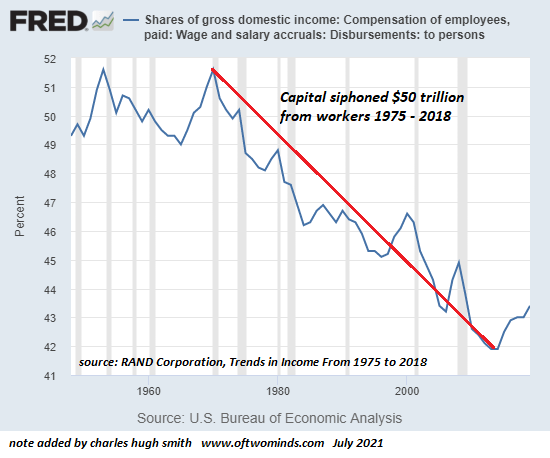
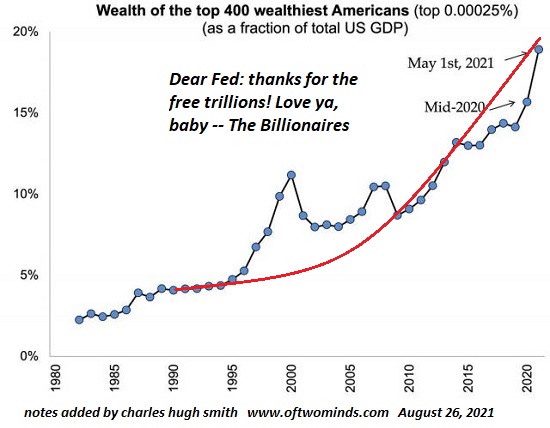
One might anticipate that the bottom 50%’s meager share of the nation’s exploding wealth would have increased as smartly as the wealth of the billionaires, but alas, no.

America’s economy has changed in ways few of the winners seem to notice, as they’re too busy cheerleading their own brilliance and success. In the view of the winners, who just so happen to occupy all the seats at the media-punditry-Federal Reserve, etc. table–the rising tide of stock, bond and real estate bubbles are raising all boats. What’s left unsaid is except for the 50% of boats with gaping holes below the waterline, i.e. stagnant wages and a fast-rising cost of living.

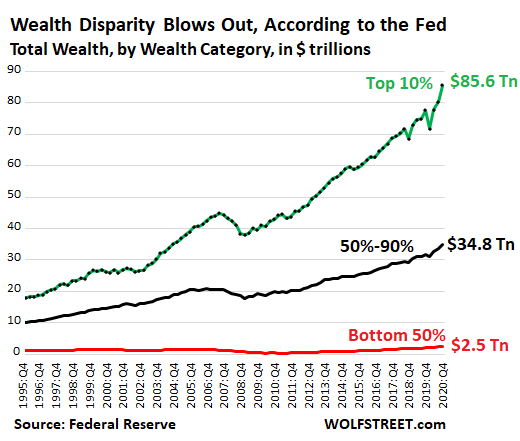
The truth the self-satisfied winners don’t include in their self-congratulatory rah-rah is there’s no place for the bottom 50% of American households to go but down. All the winnings flow to those who already owned assets back when they were affordable– the already-wealthy–whose wealth has soared as assets have shot to the moon while the the burdens of inflation and debt service hit the bottom 50% the hardest.

Meanwhile, the Federal Reserve is whining that inflation isn’t high enough yet for their refined tastes. Boo-hoo, how sad for the Fed–inflation isn’t yet high enough. Oh wait–didn’t they each mint millions by front-running their own policies? No wonder they’re not worried about inflation.

The reality few acknowledge is that globalization and financialization have stripped the American economy of low-skilled jobs that don’t demand much of the employee. The reality is that a great many people don’t have what it takes to learn high-level skills and work at a demanding pace under constant pressure–the description of the average job in America.

There were once millions of low-skill, low-pay jobs for people who for whatever mix of reasons were unable to muster the wherewithal to fulfill the fantasy of working extra hard, going to night school, soaking up high-level skills, moving quickly up the ladder to higher pay, buying the starter home and then moving up the food chain to middle class security from there.

The cost of living was low enough that those working these low-skill, low-pay jobs could still have an independent life. There were still low-cost rentals, often derided by the wealthy, in nooks and crannies of even the costliest cities. (I once lived in a room stuffed with old tax records in a poolside shack in an upscale neighborhood. The room had been cleared for a single bed and a path to the decrepit bathroom. Its most important attribute was that I could afford it on my low earnings.)

Affordable housing has vanished, eliminated by the financialization of America’s economy. Once landlords pay double the price for the property, rents have to double to pay their higher expenses. The apartment didn’t double in size or amenities–the rent doubled without any increase in utility to the renter. You get nothing more for double the price–nice.

Yes, people could make better choices, and some do. The point here is the game is rigged against those in the lower tier of the economy who can no longer afford a house or other stake in the only winning game in town–speculative asset bubbles. Go ahead and work a second job and go to night school–you’ll still be left behind the already-rich.

Globalization opened every job in America to global competition via offshoring or the influx of undocumented workers so desperate to support their families back home that no pay was too low and no working condition too wretched to refuse.

Many overindulged pundits who never worked an honest day in their lives sneer about burger flippers without realizing how hard those burger flippers have to work. I doubt the well-dressed pundits, snobbish about their university degrees and general brilliance, could manage to work a single day in a demanding fast-food job.

As the price of housing and other assets have soared, enriching the already rich, they’re out of reach for the bottom 50% who struggle to pay their bills as wages have stagnated and the costs of essentials have skyrocketed.

The rising cost of parking tickets, junk fees, user fees, utilities and food don’t impact the well-paid top 5% technocrat class, whose stake in the Everything Bubble keeps expanding by tens or hundreds of thousands of dollars. But for the bottom 50%, those incremental increases are, when added to higher rents, absolutely crushing.

As for getting high-quality healthcare that includes mental health support–those are reserved for the rich. But no worries, self-medication is always a “choice.”

Getting a boost in pay from $12 an hour to $15 an hour is welcome, but that doesn’t put the worker any closer to affording a house or equivalent stake in the Everything Bubble.

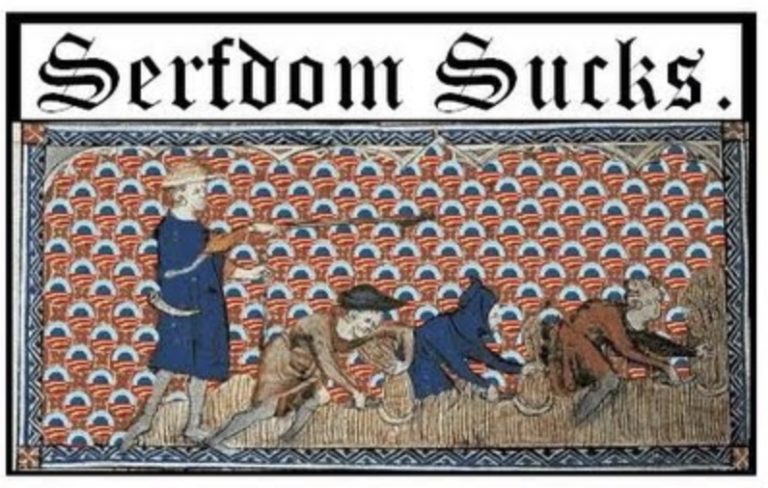
The new feudalism is masked by the glossy SillyCon Valley PR of a gig economy where (per the PR fantasy) bright, shiny and totally independent workers freely choose to serve the winners in the rigged sweepstakes for low pay and zero benefits.

In the SillyCon Valley PR, serfs freely choose to serve their noble masters for nothing but survival because they love the “freedom” and “choice” of kissing the nobility’s plump derrieres. (After all, there were “choices” even back in the good old days of feudalism–one could join the brigands in the forest, or enlist in a poorly paid mercenary army where the odds of dying were high–you know, “choices” of “gigs.”)

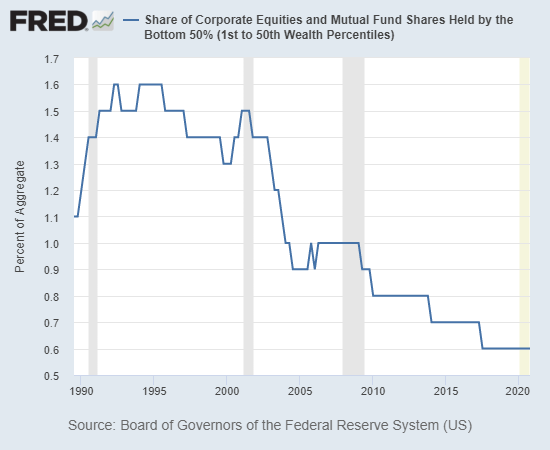
One might anticipate that the bottom 50%’s meager share of the nation’s exploding wealth would have increased as smartly as the wealth of the billionaires, but alas, no–the bottom 50%’s share of stocks (equities) actually plummeted in the the glorious decades of Federal Reserve free money for financiers, stock buy-backs and asset bubbles.

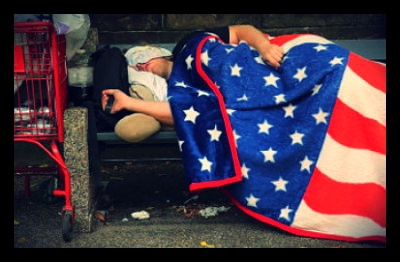
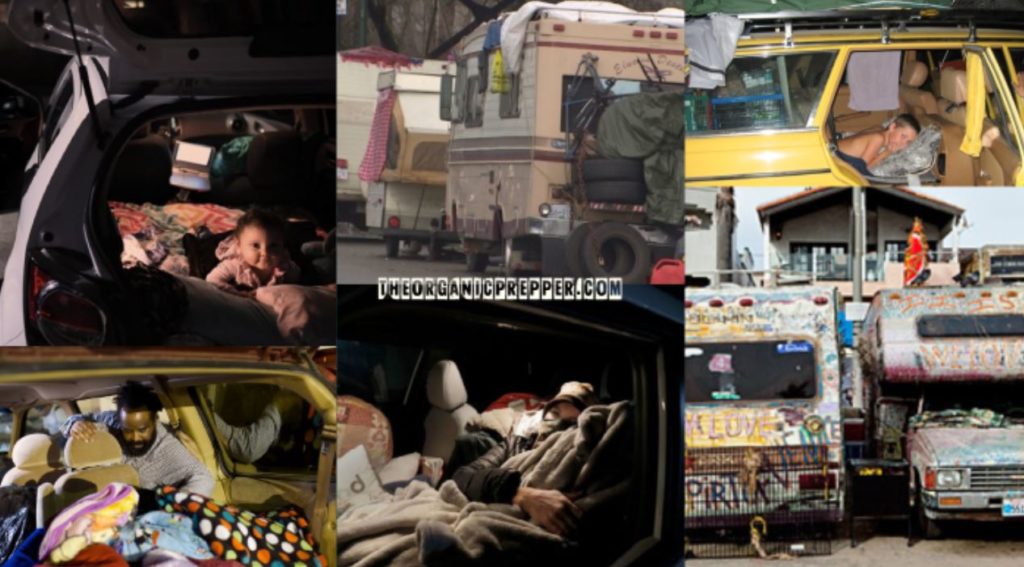
All this suits the billionaires and those collecting the crumbs of the Everything Bubble just fine. So what if the bottom 50% have nowhere to go but down? There’s plenty of room in the homeless encampment for another broken down station wagon or an old camper. There’s lots of “choices.”

And no consequences for the winners, of course, because The Fed has our backs.

Desperate Americans Who Can’t Afford Housing Are Becoming “Modern-Day Nomads” …But Not By Choice

By Robert Wheeler

Source: The Organic Prepper

A recent story floating around mainstream media regarding “modern-day nomads” reads like a contemporary article on Henry David Thoreau. It shares stories of people looking to downsize their life and live simply and stories of people who have fallen on hard times, unable to afford rent. 

However, what is lacking is the exposure of the dark underbelly of the “modern-day nomad” culture. In other words, they neglect to mention the fact that the enormous growth of the “modern-day nomad” is rooted in the fact that the world economy has all but collapsed, now mired in a global economic depression of unemployment, low wages, and personal financial catastrophes.

While it sounds romantic, it’s often rooted in desperation.

Nevertheless, some of the stories begin in the following way:

If you look closely on city streets, campgrounds, and stretches of desert run by the Bureau of Land Management, you’ll see more Americans living in vehicles than ever before. It was never their plan.

“I wasn’t prepared when I had to move into my SUV. The transmission was going. I had no money saved. I was really scared,” said April Craren, 52, bundled in blankets atop a cot inside her new minivan, a 2003 Toyota Sienna.

She flipped the camera on her phone to show me the camp stove she uses to make coffee and her view of the sun rising over the Colorado River. She has no toilet, shower, or refrigeration.

After separating from her husband, April found herself homeless in June 2020, exacerbating the depressive disorder for which she receives $1,100 a month in disability benefits.

“I could have gotten an apartment but in a crappy unsafe place with no money to do anything at all,” she explained.

Last year, where April lived in Nixa, Missouri, the average rent for an apartment was $762, slightly less than the national average. Like nearly half of American renters, she would have been crippled by the cost.

It’s not surprising, then, that job loss, divorce, or, say, the sudden onset of global health or financial crisis can push so many over the edge.

Many Americans have found themselves trapped in a spiral of poverty from which they simply can’t recover.

It doesn’t sound so bad to those of us with minimalist persuasions

At 52, April Craren didn’t choose this life. It was thrust upon her by unfortunate life circumstances. Craren couldn’t afford the exorbitant rent that is now average across the country on a fixed income. (Partly due to inflation but mostly due to the housing crash in 2008.)

The coordination of lockdowns and COVID restrictions have plunged the world into a deep depression of which we are only beginning to see. Even Wall Street couldn’t have caused this much damage. 

“If the Great Recession was a crack in the system, Covid and climate change will be the chasm,” says Bob Wells, the nomad who plays himself in the film Nomadland. Thankfully, Wells was able to help Craren adopt her lifestyle so she can now survive as a “nomad” through his Home On Wheels Alliance.

Wells’s lifestyle was a choice. But the newfound interest in the nomadic lifestyle is not a choice for many.

From Yahoo:

Realizing he had something valuable to share, he bought the domain name Cheap RV Living in 2005. He posted tips and tricks about better vehicle-dwelling, but what he was really offering was a road map to a better life.

Four years later, when close to 10 million Americans were displaced after the Great Recession, traffic to his site exploded. Finding himself at the center of a growing online community, he decided to create a meet-up in Quartzsite, Arizona. He dubbed it the Rubber Tramp Rendezvous (RTR), and in January 2011, 45 vehicles showed up. Eight years later, an estimated 10,000 vehicles convened for what was said to be the largest nomad gathering in the world.

The event’s explosive growth is undoubtedly a reflection of America’s increasing interest in van life as an answer to the affordable housing crisis, an idea made accessible by Bob on his YouTube channel, also named Cheap RV Living, created in 2015.

The “increasing interest in van life” that Yahoo News refers to is not some petit-bourgeois fantasy being realized by privileged middle-class white kids, able to go home at any time. It is the necessity of formerly middle class, working-class, and poor people all across America who are out of work or are working but cannot afford housing.

Minimalism is a legitimate lifestyle for some; others have no choice

For many, this culture of minimalism is genuinely how they wish to live. Nomads have a genuine desire to see empty overconsumption come to an end. However, we can not ignore that minimalism is being promoted to prepare the Western population who are used to high living standards to accept those that are much lower.

Why do you think we continually see articles promoting insects as a legitimate dining option? Why are The Great Reset promoters at the World Economic Forum telling the public that they will soon own nothing and learn to love it?

Being a nomad doesn’t mean you can’t be prepared.

For those who are already nomads, whether by choice or forced by economic circumstance, it might be helpful to know that there are many prepping options available to you. There is no need to be left to the mercy of wherever you are right now. 

I highly encourage you to access Daisy Luther’s article, “There’s Another Option Besides Hunkering Down and Bugging Out: Nomadic Living.” It will give you the perspective of someone who has voluntarily experienced and lived the nomadic lifestyle while also the mindset of remaining prepared for anything and everything. 

At the rate the Great Reset is taking shape, many of us may find ourselves embracing the nomadic lifestyle, willingly or not.

Have you considered nomadic living?

Why Assets Will Crash

By Charles Hugh Smith

Source: Of Two Minds

This is how it happens that boats that were once worth tens of thousands of dollars are set adrift by owners who can no longer afford to pay slip fees.

The increasing concentration of the ownership of wealth/assets in the top 10% has an under-appreciated consequence: when only the top 10% can afford to buy assets, that unleashes an almost karmic payback for the narrowing of ownership, a.k.a. soaring wealth and income inequality: assets crash.

Most of you are aware that the bottom 90% own very little other than their labor (tradeable only in full employment) and modest amounts of home equity that are highly vulnerable to a collapse of the housing bubble. (The same can be said of China’s middle class, only more so, as 75% of China’s household wealth is in real estate, more than double the percentage of wealth held in housing in U.S. households.)

As the chart illustrates, the top 10% own 84% of all stocks, over 90% of all business equity and over 80% of all non-home real estate. The concentration of ownership of assets such as vintage autos, collectibles, art, pleasure craft and second homes in the top 10% is likely even greater.

The more expensive the asset, the greater the concentration of ownership, as the top 5% own roughly 2/3 of all wealth, the top 1% own 40% and the top 0.1% own 20%. In other words, the more costly the asset, the narrower the ownership. (Total number of US households is about 128 million, so the top 5% is around 6 million households and the top 1% is 1.2 million households.)

This means the pool of potential buyers is relatively small, even if we include global wealth owners.

Since price is set on the margins, and assets like houses are illiquid, then we can anticipate all the markets for assets owned solely by the wealthy to go bidless–yachts, collectibles, vacation real estate–because the pool of buyers is small, and if that pool gets cautious due to a drop in net worth/unearned income, there won’t be any buyers except at the margins, at incredible discounts.

As we know, in a neighborhood of 100 homes currently valued ar $1 million each, when a desperate seller accepts $500,000, the value of the other 99 homes immediately drops to $500,000.

Since few of the current bubble-era asset valuations are supported by actual income fundamentals, then the sales price boils down to a very small number of potential buyers and what they’re willing to pay.

Houses have a value based on rent, of course, but rents will drop very quickly for the same reason: prices are set on the margins. The most desperate landlords will drop rents and re-set the rental market from the margins. If demand plummets (which it will as people can no longer afford rents in hot urban markets once they lose their jobs), then vacancies will soar and rents will crash as a few desperate landlords will take $1200/month instead of $2500/month.

Due to the multi-year building boom of multi-family buildings in hot job markets (which inevitably leads to an over-supply once the boom ends), there are now hundreds of vacancies where there were once only a few dozen, and thousands where there were previously only hundreds.

As millions of wait staff, bartenders, etc. who made good money in tips find their jobs have vanished, all the urban hotspots will see mass out-migration: Seattle, Portland, the S.F. Bay Area, L.A., NYC, Denver, etc. as demand for rentals will evaporate and rents will be set on the margins by the most desperate landlords. Everyone holding out for the previous bubble-era rent will have $0 income as their units are vacant.

Tech start-ups and Unicorns are melting like ice cubes in Death Valley, and tech-sector layoffs are already in the tens of thousands. This wave of highly paid techies losing their jobs will become a tsunami, further reducing the pool of people who can afford rents of $2,500 to $3,000 for a studio or one-bedroom apartment.)

The concentration of ownership generates a self-reinforcing feedback that further depresses prices: since the top 10% own most of the assets of the nation, they are most prone to a reversal of “the wealth effect.” As their assets soared in value, the top 10% felt wealthier and more confident in future gains, enabling them to borrow and spend freely on second homes, pleasure craft, new vehicles, collectibles, luxury travel, etc.

Once even one class of assets plummets in value–for example, the recent decline in the stock market– the wealth effect reverses and the top 10% feel poorer and less confident about future gains, and thus less enthused about borrowing and spending. The demand for other costly assets quickly evaporates, further reducing the wealth of the “ownership class,” which further reduces their desire and ability to buy bubble-era assets.

The high-priced assets owned by the top 10% will be the assets least in demand due to their high cost and potential for enormous losses: nothing loses value faster in a recession that narrowly owned assets such as vintage cars, art, vacation homes, yachts, etc.

Once assets start sliding in value, the reverse wealth effect quickly dries up demand for all asset classes with narrow ownership. Since these assets are illiquid–that is, the market for them is thin, with buyers few and far between–the prices are set by a very shallow pool of buyers and desperate sellers.

Consider a pleasure craft that retails new for $120,000. In the boom era of rising stocks and housing, a used boat might fetch $65,000. But as the wealth of the small pool of households able to buy and maintain a costly craft evaporates, the number of qualified buyers evaporates, too.

The seller might be aghast by an offer of $35,000 and reject it angrily. Six months later, he’s praying someone will take it off his hands for $15,000, and in another six months, he’ll accept $500 just to get out from underneath the insurance, slip-rental and licencing fees.

This is how it happens that boats that were once worth tens of thousands of dollars are set adrift by owners who can no longer afford to pay slip fees, and vacation homes are abandoned and auctioned off for overdue property taxes: the market for these luxuries dries up and blows away, i.e. goes bidless–there are no buyers at any price.

Once housing and real estate valuations fall, that will trigger a decline in the value of all other costly, narrowly owned assets, which will reinforce the reverse wealth effect.

This is the systemic payback for concentrating ownership of assets in the hands of the few: when their bubble-era priced assets plummet in value, the bottom falls out of all assets with narrow ownership. The price of superfluous assets such as boats, vintage cars, collectibles, art and vacation homes can quickly fall to a fraction of bubble-era valuations, destroying much of what was always fictional capital.

(For more on the intrinsic fragility of a system that concentrates ownership in the hands of the few, please read Our Inevitable Collapse: We Can’t Save a Fragile Economy With Bailouts That Increase Fragility May 1, 2020.)

The Federal Reserve reckons it can “save” the bubble-era valuations of junk bonds by being the “buyer of last resort,” but it will end up being the “only buyer,” effectively making the system even more fragile and prone to collapse.

The public will eventually have to decide if the nation’s central bank should be bailing out assets owned by the financial elite while the upper-middle class watches its assets collapse in value.

Locked Down and Locking in the New Global Order

By Colin Todhunter

Source: CounterPunch

On 12 March, British PM Boris Johnson informed the public that families would continue to “lose loved ones before their time” as the coronavirus outbreak worsens. He added:

“We’ve all got to be clear, this is the worst public health crisis for a generation.”

In a report, the Imperial College had warned of modelling that suggested over 500,000 would die from the virus in the UK. The lead author of the report, epidemiologist Neil Ferguson, has since revised the estimate downward to a maximum of 20,000 if current ‘lockdown’ measures work. Johnson seems to have based his statement on Ferguson’s original figures.

Before addressing the belief that a lockdown will help the UK, it might be useful to turn to an ongoing public health crisis that receives scant media and government attention – because context is everything and responses that are proportionate to crises are important.

The silent public health crisis

In a new 29-page open letter to Fiona Godlee, editor-in-chief of the British Medical Journal, environmentalist Dr Rosemary Mason spends 11 pages documenting the spiralling rates of disease that she says (supported by numerous research studies cited) are largely the result of exposure to health-damaging agrochemicals, not least the world’s most widely used weedkiller – glyphosate.

The amount of glyphosate-based herbicides sprayed by UK farmers on crops has gone from 226,762 kg in 1990 to 2,240,408 kg in 2016, a 10-fold increase. Mason discusses links between multiple pesticide residues (including glyphosate) in food and steady increases in the number of cancers both in the UK and worldwide as well as allergic diseases, chronic kidney disease, Alzheimer’s, Parkinson’s, obesity and many other conditions.

Mason is at pains to stress that agrochemicals are a major contributory factor (or actual cause) for the spikes in these diseases and conditions. She says this is the real public health crisis affecting the UK (and the US). Each year, she argues, there are steady increases in the numbers of new cancers in the UK and increases in deaths from the same cancers, with no treatments making any difference to the numbers.

Of course, it would be unwise to lay all the blame at the door of the agrochemicals sector: we are subjected each day to a cocktail of toxic chemicals via household goods, food processing practices and food additives and environmental pollution. Yet there seems to be a serious lack of action to interfere with corporate practices and profits on the part of public bodies, so much so that a report by the Corporate Europe Observatory said in 2014 that the then outgoing European Commission had become a willing servant of a corporate agenda.

In a 2017 report, Hilal Elver, UN Special rapporteur on the right to food, and UN Special Rapporteur on human rights and hazardous substances and wastes Baskut Tuncak were severely critical of the global corporations that manufacture pesticides, accusing them of the “systematic denial of harms”, “aggressive, unethical marketing tactics” and heavy lobbying of governments which has “obstructed reforms and paralysed global pesticide restrictions”.

The authors said that pesticides have catastrophic impacts on the environment, human health and society as a whole, including an estimated 200,000 deaths a year from acute poisoning.  They concluded that it is time to create a global process to transition toward safer and healthier food and agricultural production.

At the time, Elver said that, in order to tackle this issue, the power of the corporations must be addressed.

While there is currently much talk of the coronavirus placing immense strain on the NHS, Mason highlights that the health service is already creaking and that due to weakened immune systems brought about by the contaminated food we eat, any new virus could spell disaster for public health.

But do we see a ‘lockdown’ on the activities of the global agrochemical conglomerates? Not at all. As Mason has highlighted in her numerous reports, we see governments and public health bodies working hand in glove with the agrochemicals and pharmaceuticals manufacturers to ensure ‘business as usual’. So, it might seem strange to many that the UK government is seemingly going out of its way (by stripping people of their freedoms) under the guise of a public health crisis but is all too willing to oversee a massive, ongoing one caused by the chemical pollution of our bodies.

Mason’s emphasis on an ongoing public health crisis brought about by poisoned crops and food is but part of a wider story. And it must be stated that it is a ‘silent’ crisis because the mainstream media and various official reports in the UK have consistently ignored or downplayed the role of pesticides in fuelling this situation.

Systemic immiseration

Another part of the health crisis story involves ongoing austerity measures.

The current Conservative administration in the UK is carrying out policies that it says will protect the general population and older people in particular. This is in stark contrast to its record over the previous decade which demonstrates contempt for the most vulnerable in society.

In 2019, a leading UN poverty expert compared Conservative welfare policies to the creation of 19th-century workhouses and warned that unless austerity is ended, the UK’s poorest people face lives that are “solitary, poor, nasty, brutish, and short”. Philip Alston, the UN rapporteur on extreme poverty, accused ministers of being in a state of denial about the impact of policies. He accused them of the “systematic immiseration of a significant part of the British population”.

In another 2019 report, it was claimed that more than 130,000 deaths in the UK since 2012 could have been prevented if improvements in public health policy had not stalled as a direct result of austerity cuts.

Over the past 10 years in the UK, there has been rising food poverty and increasing reliance on food banks, while the five richest families are now worth more than the poorest 20% and about a third of Britain’s population lives in poverty.

Almost 18 million cannot afford adequate housing conditions; 12 million are too poor to engage in common social activities; one in three cannot afford to heat their homes adequately in winter; and four million children and adults are not properly fed (Britain’s population is estimated at 63 to 64 million). Welfare cuts have pushed hundreds of thousands below the poverty line since 2012, including more than 300,000 children.

In the wake of a lockdown, we can only speculate about how a devastated economy might be exploited to further this ‘austerity’ agenda. With bailouts being promised to companies and many workers receiving public money to see them through the current crisis, this will need to be clawed back from somewhere. Will that be the excuse for defunding the NHS and handing it over to private healthcare companies with health insurance firms in tow? Are we to see a further deepening of the austerity agenda, let alone an extension of the surveillance state given the current lockdown measures which may not be fully rolled back?

The need for the current lockdown and the eradication of our freedoms has been questioned by some, not least Lord J. Sumption, former Supreme Court Justice. He has questioned the legitimacy of Boris Johnson’s press conference/statement to deprive people of their liberty and has said:

“There is a difference between law and official instructions. It is the difference between a democracy and a police state”.

Journalist Peter Hitchens says a newspaper headline for what Sumption says might be – ‘Former Supreme Court justice says Johnson measures lead towards police state’ or ‘TOP JUDGE WARNS OF POLICE STATE’.

But, as Hitchens implies, such headlines do not appear. Indeed, where is the questioning in the mainstream media or among politicians about any of this? To date, there have been a few isolated voices, with Hitchens himself being one.

In his recent articles, Hitchens has questioned the need for the stripping of the public’s rights and freedoms under the pretext of a perceived coronavirus pandemic. He has referred to esteemed scientists who question the need for and efficacy of ‘social distancing’ and keeping the public under virtual ‘house arrest’.

An open Letter from Dr. Sucharit Bhakdi, emeritus professor of medical microbiology at the Johannes Gutenberg University Mainz, to Angela Merkel calls for an urgent reassessment of Germany’s lockdown response to Covid-19. Then there is Dr Ioannidis, a professor of medicine and professor of epidemiology and population health at Stanford University. He argues that we have made such decisions on the basis of unreliable data. These two scientists are not alone. On the OffGuardian website, two articles have appeared which present the views of 22 experts who question policies and/or the data that is being cited about the coronavirus.

Shift in balance of power

Professor Michel Chossudovsky has looked at who could ultimately benefit from current events and concludes that certain pharmaceutical companies could be (are already) major beneficiaries as they receive lavish funding to develop vaccines. He asks whether we can trust the main actors behind what could amount to a multibillion dollar global (compulsory) vaccination (surveillance) project.

The issue of increased government surveillance has also been prominent in various analyses of the ongoing situation, not least in pushing the world further towards cashless societies (under the pretext that cash passes on viruses) whereby our every transaction is digitally monitored and a person’s virtual money could be declared null and void if a government so decides. Many discussions have implicated the Bill and Melinda Gates Foundation in this – an entity that for some time has been promoting the roll-out of global vaccine programmes and a global ‘war on cash’.

For instance, financial journalist Norbert Haring notes that the Gates Foundation and US state-financial interests had an early pivotal role in pushing for the 2016 demonestisation policy with the aim of pushing India further towards a cashless society. However, the policy caused immense damage to the economy and the lives and livelihoods of hundreds of millions in India who rely on cash in their everyday activities.

But that does not matter to those who roll out such policies. What matters is securing control over global payments and the ability to monitor and block them. Control food you control people. Control digital payments (and remove cash), you can control and monitor everything a country and its citizens do and pay for.

India has now also implemented a lockdown on its population and tens of millions of migrant workers have been returning to their villages. If there is a risk of corona virus infection, masses of people congregating in close proximity then returning to the countryside does not bode well.

Indeed, the impact of lockdowns and social isolation could have more harm than the effects of the coronavirus itself in terms of hunger, depression, suicides and the overall deterioration of the health of older people who are having operations delayed and who are stuck indoors with little social interaction or physical movement.

If current events show us anything, it is that fear is a powerful weapon for securing hegemony. Any government can manipulate fear about certain things while conveniently ignoring real dangers that a population faces. In a recent article, author and researcher Robert J Burrowes says:

“… if we were seriously concerned about our world, the gravest and longest-standing health crisis on the planet is the one that starves to death 100,000 people each day. No panic about that, of course. And no action either.”

And, of course, each day we live with the very real danger of dying a horrific death because of the thousands of nuclear missiles that hang over our heads. But this is not up for discussion. The media and politicians say nothing. Fear perception can be deliberately managed, while Walter Lippmann’s concept of the ‘bewildered herd’ cowers on cue and demands the government to further strip its rights under the guise of safety.

Does the discussion thus far mean that those who question the mainstream narrative surrounding the coronavirus are in denial of potential dangers and deaths that have been attributed to the virus? Not at all. But perspective and proportionate responses are everything and healthy debate should still take place, especially when our fundamental freedoms are at stake.

Unfortunately, many of those who would ordinarily question power and authority have meekly fallen into line: those in the UK who would not usually accept anything at face value that Boris Johnson or his ministers say, are now all too easily willing to accept the data and the government narrative. This is perplexing as both the government and the mainstream media have serious trust deficits (putting it mildly) if we look at their false narratives in numerous areas, including chemical attacks in Syria, ‘Russian aggression’, baseless smear campaigns directed at Jeremy Corbyn and WMDs in Iraq.

What will emerge from current events is anyone’s guess. Some authors like economist and geopolitical analyst Peter Koenig have presented disturbing scenarios for a future authoritarian world order under the control of powerful state-corporate partners. Whatever the eventual outcome, financial institutions, pharmaceuticals companies and large corporations will capitalise on current events to extend their profits, control and influence.

Major corporations are already in line for massive bailouts despite them having kept workers’ wages low and lining the pockets of top executives and shareholders by spending zero-interest money on stock buy backs. And World Bank Group President David Malpass has stated that poorer countries will be ‘helped’ to get back on their feet – on the condition that further neoliberal reforms and the undermining of public services are implemented and become further embedded:

“Countries will need to implement structural reforms to help shorten the time to recovery and create confidence that the recovery can be strong.  For those countries that have excessive regulations, subsidies, licensing regimes, trade protection or litigiousness as obstacles, we will work with them to foster markets, choice and faster growth prospects during the recovery.”

In the face of economic crisis and stagnation at home, this seems like an ideal opportunity for Western capital to further open up and loot economies abroad. In effect, the coronavirus provides cover for the further entrenchment of dependency and dispossession. Global conglomerates will be able to hollow out the remnants of nation state sovereignty, while ordinary people’s rights and ability to organise and challenge the corporate hijack of economies and livelihoods will be undermined by the intensified, globalised system of surveillance that beckons.

Financial Feudalism

By Michael Krieger

Source: Liberty Blitzkrieg

“Happy 18th Birthday! Meet your new Daddy,” read one website advertisement. “Do you have strong oral skills? We’ve got a job for you!” cooed another.

A message on another billboard directed at the “daddies” was more blunt: “The alternative to escorts. Desperate women will do anything”…

SeekingArrangement was founded by Las Vegas tech tycoon Brandon Wade. Wade is apparently worth somewhere in the neighborhood of $40 million. His motto is, “Love is a concept invented by poor people”…

SA also markets itself as an antidote to student debt. In the U.S. and elsewhere, college students are enduring financial instability and hardship. Because of rising college fees and rent, and the lack of time available for work during studies, many women are extremely vulnerable to exploitation. “SeekingArrangement.com has helped facilitate hundreds of thousands, if not millions, of arrangements that have helped students graduate debt-free,” Wade boasts on the website. Promotional videos show young, beautiful women enrolled in “Sugar Baby University” — in classrooms, holding wads of cash, driving luxury cars, and discussing the pleasure and ease of being a sugar baby.

When signing up for an account, potential sugar babies are told, “Tip: Using a .edu email address earns you a free upgrade!”

TruthDig: Sugar-Coated Pimping

Watching politics unfold in the post-financial crisis era has been extraordinarily frustrating. While it’s been refreshing to observe the emergence of grassroots populism over the last few years, there’s a problematic lack of depth and clarity embedded in these burgeoning mass movements. Tens if not hundreds of millions of Americans now acknowledge that something’s deeply broken within the current paradigm, but we remain focused on identifying symptoms as opposed to understanding and rectifying the systemic nature of the problem.

Of course, there are numerous complexities when it comes to the administration of an imperial oligarchy, and our system didn’t emerge overnight. Perhaps the most fundamental mutation of the post WW2 era came in 1971 when the international convertibility of U.S. dollars into gold was severed. This is when the country began its long transformation from a largely industrial empire to a financial one. I’ve often highlighted how the purely fiat USD reserve currency is the most powerful weapon ever invented, and how the U.S. control of the global financial system is the true backbone of empire, but it’s equally important to understand how the predatory financial system is also used to subjugate Americans in their own country.

In order to understand how this works we need to dig into the most fundamentally important four letter word in any modern economy: Debt.

When most people consider the debilitating societal effects of excessive debt they tend to see it from one basic level. How the bottom half of the population essentially has no choice but to borrow in order to participate in the economy as constructed. This is because the cost of so many things has been inflated way beyond the capacity of most people to purchase them outright. Specifically, wage growth has failed to keep up with the soaring costs of fundamental things such as shelter, healthcare and higher education.

For instance, home prices have been rising faster than wages in 80% of U.S. markets, which means the higher cost tends to offset historically low mortgage rates. Low interest rates don’t really help such people, it just lets them maybe, barely purchase an intentionally inflated asset to live in by taking on a huge chunk of debt. An asset that could quickly become completely unaffordable should the economy turn down as it did a decade ago.

As such, you have multitudes taking on debt defensively just to keep going and avoid falling further down the socioeconomic scale. Debt doesn’t empower such people, rather, it turns them into modern day indentured servants endlessly stuck on a hamster wheel with little to no hope of getting off. This is not an accident, it’s a tried and tested tool which, when combined with incessant mass media propaganda, is an effective way of creating a submissive, confused and desperate underclass.

Many people understand this by now, but what’s far less understood, yet potentially more significant, is how the wealthy use debt.

When you own your primary home outright and you’ve got enough savings that healthcare premiums and paying for your kids college in cash doesn’t make a dent, debt becomes something else entirely. Debt’s no longer an albatross around your neck, instead it becomes a tool to increase wealth. Debt becomes leverage.

Much of the explosion in wealth inequality over the past several decades can be traced back to this systemic interclass weaponization of debt. If you’re very wealthy and connected, access to extremely cheap debt is virtually unlimited, and this access is used to make leveraged bets on all sorts of stuff, but primarily real estate and financial assets such as stocks and bonds. Hasn’t this always been the case you ask? Aren’t those with capital always extremely advantaged over those without it? Isn’t that the history of capitalism and America since the beginning? My answer would be yes and no.

The main difference between prior periods of history and, let’s say the 21st century, has been the vast increase in power of the financial services sector thanks to the Federal Reserve’s willingness to encourage and enable the insatiable reckless behavior of the speculator class. It’s no secret the Fed has been intentionally boosting assets across the FIRE sector such as real estate, stocks and bonds since the crisis. Those with the capital to ride the coattails of this irresponsible and undemocratic central planning rushed out to take on debt to buy these assets, thus multiplying the return on investment.

While the white-collar cubicle worker with enough extra income to diligently add to their retirement account over the past decade has done fine, bankers or hedge fund managers who took on massive leverage to amplify such bets made generational fortunes while creating nothing of value. It’s the way debt works for the financial services sector versus how it works for the average person in a world dominated by big finance and the central bankers who provide them unlimited welfare.

The same thing occurs within the corporate suite, as executives across industries have used access to extremely cheap debt to buyback stock and reward themselves handsomely despite creating nothing of societal value while doing so. It’s pure financial engineering. Nobody should become generationally wealthy this way, but it’s exactly what’s been happening. So you see, debt’s not just a means to subjugate a desperate bottom half of the population, it’s concurrently an effective tool to expand wealth and power at the top. 

Then there’s this.

When was the last time the bond market paid you to make an acquisition? As Max Keiser so eloquently puts it, this is interest rate apartheid.

But it’s even more pernicious than that. It’s still possible for regular wealthy people to take on too much leverage, make a mistake, and lose their fortunes — unless of course you’re an executive at major financial services firm. In that case you simply can’t lose, which was the primary lesson learned from the response to the financial crisis.

Not only were the titans of this industry not jailed, they walked away with their fortunes intact. The Federal Reserve and the U.S. government made this happen. It wasn’t an accident and it wasn’t to “save the economy;” that’s just nonsense talk for the confused masses. The entire point was to consolidate and further entrench the unaccountable power of those at the very top of the finance feudalism paradigm and signal they’ll also be bailed out for any future catastrophe they create.

Significantly, financial feudalism isn’t just interclass, it’s also intergenerational. The stock market and real estate crash of a decade ago was the market’s attempt to reset those assets more in line with median incomes, but central banks would have none of that. They determined asset prices needed to be re-inflated as much as possible as fast as possible, and these unelected banker stooges went about implementing this major policy decision of central economic planning with zero public debate. Young people entering the workforce had no savings and poor wage growth, so a generation was quickly priced out of homeownership while simultaneously stuck with an enormous pile of student debt. The results of all this are unsurprising.

The crisis facing this country is simmering and metastasizing under the surface of misleading aggregate economic data and record stock markets. While it’s tempting to focus on the symptoms, we’ll never confront and tackle any of this properly unless we understand the structure and how the game is really played. The system you’re living in isn’t capitalism or socialism, it’s financial feudalism. 

This holiday season, American workers have little to celebrate

By Danny Haiphong

Source: Intrepid Report

Every year, much of the U.S. population celebrates Thanksgiving and Christmas to show appreciation for their families and friends. Thanksgiving normalizes the colonial origins of the United States and erases the brutality of the English settlers who massacred indigenous people to prepare the land for capitalist accumulation. Christmas is the annual holiday of big business. On no other day are workers more encouraged to spend their wages on the latest consumer product to gift to their loved ones. The holidays bring with them a deep pressure to be merry. Yet on this holiday season, workers have little to celebrate.

A new study by Brookings Institution provides a snapshot into the devastation wrought on the working class by American capitalism. Forty-four percent of all workers between the ages of 18-64 are employed in low-wage sectors and earn an average of $16 or less per hour. The study excluded workers who logged over 98 hours per week over the last year as well as certain sections of the college-educated population such as those living in dormitories and attending graduate school. Had these groups of workers been counted, the percentage of low-wage workers out of the total population would likely be even higher. This verifies prior datasets which proved that around half of the U.S. population makes less $30,000 per year.

The growing poverty of the American worker is a major contributor to the growth of toxic stress and mental illness. Half of all U.S. adults will develop a mental illness over the course of their life. Serious mental health conditions afflict nearly ten million people in the United States and over a quarter of these individuals live below the official poverty line. Suicide rates are at a thirty-year high. An obvious connection exists between rising poverty and the worsening mental health of the American worker.

Workers in the United States see no future under the current stage of capitalism. They struggle to afford rent in a nation where the federal minimum wage cannot pay for a two-bedroom apartment anywhere in the country. They indebt themselves in the trillions to attend college and obtain healthcare. They work in redundant, service sector jobs where hours are long and mistreatment, abuse, and injury are all too common. The American worker is increasingly alienated from themselves and each other. Union density rates in the U.S. have fallen to just ten percent of all workers since World War II.

The shrinking labor movement has followed a larger trend in U.S. society. Privatization has decimated the public sector. Workers have few places to socially convene independent of the machinations of consumer capitalism. Workers are competing for fewer jobs, most of which are not worth competing for at all. Homelessness, mass incarceration, and endless war remind workers that they can easily be turned into cannon fodder if they step out of line. In such an environment, addiction and self-destruction is encouraged while organizing for justice is discouraged.

Economic insecurity and alienation place more pressure on families to make up for stagnant wages and exorbitant amounts of debt. More young workers are living with their parents than at any other time in the last one hundred years. Older workers are not only forestalling retirement but also finding themselves without family or community support as siblings and adult children chase the highest paying jobs and the lowest rents and property values. Couples feel compelled to remain in toxic relationships for economic reasons. A strong link exists between domestic violence and poverty.

Contrary to the messages in Hallmark cards or the corporate media, the holidays are far from a time of celebration. Many workers view the holiday season as a harsh reminder of the loss, alienation, and despair that they’ve experienced over the course of their lives. Holidays place added pressure on workers to dismiss the ills of capitalism and the personal stressors associated with them. It should come as no surprise that most workers already struggling with mental health conditions report that the holidays only worsen their symptoms. Instead of embracing humanity, the holidays encourage workers to embrace rampant commercialism and the nuclear family.

To break from a culture steeped in the profit motive, workers will need to create their own traditions based upon solidarity and social transformation. Not everything about the holidays needs to be thrown out in the process. Spending time with family and friends during a day off from work can and should be rewarding to the psyche and to society. The conditions of capitalism prevent the holidays from serving a social purpose. Holidays under capitalism breed despair but brand themselves as moments of pure joy.

While workers may have little to celebrate this holiday season, there are reasons for the working class to be optimistic in the years to come. Teachers in cities such as Chicago and Los Angeles have won key gains in 2019 by using the most powerful weapon at the disposal of organized labor: the strike. At the beginning of the year, the Los Angeles Teachers won smaller class sizes and more support staff. The Chicago Teachers Union massively increased the number of nurses in the school district by forcing the city to hire nurses rather than continue the inefficient and harmful practice of hiring private contractors. The UAW’s strike of General Motors (GM) earlier this Fall made global headlines even if it was unable to win every demand that the workers put forth. These strikes reflect a growth of class consciousness in the United States. The continued growth of class consciousness will be critical toward building the kind of struggle capable of bringing about massive political and economic change for the working class.

Furthermore, workers around the world are leading the way in the struggle against class inequality and foreign-sponsored wars. Massive protests in Haiti, Chile, Honduras, and Algeria are just a few of many occurring around the globe. The protests have mainly targeted repressive U.S.-backed governments and their neoliberal economic agenda. China is leading the world in poverty reduction. Cuba is the most sustainably developed nation in the world. A vast majority of workers around the world want to see an end of the miseries imposed by global capital and are actively fighting to make their demands a reality.

The question is whether workers in the United States can decisively break from the despair, the racism, and the extreme alienation shaping their current condition. Being determines consciousness. At this moment, the neoliberal race to the bottom has rendered most workers too fearful, disorganized, and full of self-blame to fight back. However, millions of workers have rallied behind the political campaign of Bernie Sanders. Labor unrest is likely to continue as neither political party appears interested in implementing Bernie Sanders’ social democratic agenda. Workers in the United States are in desperate need of a revived labor movement to quench their thirst for a better life. Putting our energies into building this movement will go a long way toward shaking the Holiday Blues and giving workers something to really celebrate: a society run by workers, in the interests of workers.