Hiroshima Denial is Terror

By Finian Cunningham

Source: Information Clearing House

Those who deny history, or who are oblivious, are apt to repeat it. That is the frightening, perhaps most disturbing aspect of the 75th anniversary this week of the American atomic bombing of Hiroshima and Nagasaki.

The indiscriminate mass murder of 200,000 people on August 6 and 9, 1945, is beyond words in its horror and moral depravity. But what is equally condemning is the ostensible lack of remorse and the obfuscation to conceal the scale of such evil.

For if there were any remorse or realization about the crime there would surely be a commitment to never repeat it. The most solemn manifestation of commitment would be the pursuance of nuclear disarmament.

Seventy-five years on, yes, American news media run so-called commemorative articles on the historic events. However, there is a sense of glibness about the calamity, a sort of dull duty to mark the occasion as if it is a yearly chore of “regret”. There is also a sneaking awe at the destructive power unleashed on those Japanese cities, as well as the usual inclusion of official justification about how US leaders at the time were allegedly motivated by ending the Pacific War quickly. There are even in some media coverage brief mentions of acknowledgement that the dropping of the A-bombs was “unnecessary”.

But it’s all delivered in an insidious way to obscure the shocking, barbaric truth that the United States dropped weapons of mass destruction on civilians. How about going further and acknowledging it was a deliberate act of mass terror for political purpose to establish American hegemony in the postwar order?

No proper humane or moral lessons, it seems, have been drawn about the genocide that took place at Hiroshima and Nagasaki. Neither by the people in US government and media establishments nor, lamentably, by the wider American population. If lessons were truly learned then there would be a sense of revulsion and outrage demanding immediate nuclear disarmament and the end to all war machinery.

Just last month, the US Congress passed an annual military budget of $740 billion, including for the development of weapons of mass destruction. This is while 30 million American workers and their families are suffering from unemployment and deprivation due to the coronavirus pandemic and the government shutting off pittance welfare payments.

The anniversary of Hiroshima and Nagasaki comes as the Trump administration issues ever-more provocative slander against China over the pandemic and other matters that are really not Washington’s business nor remit, especially the subjects of alleged human rights violations or government espionage against citizens.

Washington continues to provoke both Russia and China with ever-expanding plans to deploy intermediate-range missiles near their territories. This only one year after Washington scrapped the Intermediate-range Nuclear Forces (INF) treaty with Moscow.

It is the US side which is threatening to collapse the New START accord, the last-remaining nuclear arms-control treaty with Moscow.

It is the US side which is pushing recklessly ahead with weaponizing outer space while falsely, cynically, accusing Russia and China of doing so, even though the latter have both repeatedly called for a United Nations-backed moratorium on militarizing this domain.

It is the US side which reserves the unilateral “right to first nuclear strike” while Russia and China have declared to only use such weapons as defensive response to attack.

The militarization by Washington and its bellicose policies towards Moscow and Beijing are proof that the criminality of Hiroshima and Nagasaki has never been accounted for.

The criminality of that genocide remains unacknowledged and ignored by the US ruling system because, evidently, it wants to use that horror as a psychological weapon against others. The psychological weapon being: “We did it before, and we can do it again”. The ultimate “terror card” was played and continues to be played, albeit tacitly.

Contemporary developments and indicators of geopolitical tensions with China and Russia show that Washington is not willing or indeed capable of engaging for mutual peace. It is hellbent on stoking cold war confrontation, even if that confrontation results in hot war. A war with Russia or China would inevitably escalate into a catastrophic nuclear end.

On August 6 and 9, 1945, 75 years ago, the world witnessed two cities despatched to the hell of nuclear annihilation. It is utterly shameful that the nation that perpetrated such an absolute crime remains unapologetic and in denial. But more than that, it is utterly nefarious because the unapologetic logic means it could happen again.

ATOMIC BOMBINGS AT 75: Scholars Speak Out Against ‘Unnecessary’ Attacks


The bombing of Nagasaki as seen from the town of Koyagi, about 13 km south, taken 15 minutes after the bomb exploded. In the foreground, life seemingly went on unaffected. (Wikipedia)

Japan was ready to surrender, making the atomic bombings of Hiroshima on Aug. 6, 1945, and Nagasaki two days later, totally unnecessary and morally indefensible, say a panel of scholars in two video discussions.

By Consortium News

The debate over the atomic bombings—a controversy that forced the Smithsonian Institution to abandon its Enola Gay exhibit 25 years ago—continues unabated in America today as we approach the 75th anniversary of the incineration of Hiroshima and Nagasaki.

Four historians, each of whom has written extensively on the topic, discussed the documentary evidence and explored the current state of knowledge about the bombings in two sessions with TV, print, radio, and internet journalists from around the world.

Among other points, they argue that the bombings were unnecessary as Japan was ready to surrender as long as they could keep the emperor (which the U.S. eventually allowed them to do); that U.S. generals, including Dwight Eisenhower and Douglas MacArthur, were opposed to the bombings; and that a real aim of the attacks was to send a message to the Soviet Union and not to avert a U.S. invasion, which was still months away.

The historians taking part are:

Gar Alperovitz, formerly a Fellow of Kings College Cambridge, the Institute of Politics at Harvard, and Lionel Bauman Professor of Political Economy at the University of Maryland, is the author of Atomic Diplomacy: Hiroshima and Potsdam and The Decision to Use the Atomic Bomb. He is currently a Principal of The Democracy Collaborative, an independent research institution in Washington, D.C.

Martin Sherwin, University Professor of History, George Mason University, is author of A World DestroyedHiroshima and Its Legacies winner of the Society of Historians of American Foreign Relation’s Bernath Book Prize, co-author with Kai Bird of American Prometheus: The Triumph and Tragedy of J. Robert Oppenheimer winner of the 2006 Pulitzer Prize for biography, and Gambling with Armageddon: Nuclear Roulette from Hiroshima to the Cuban Missile Crisis, forthcoming in September 2020.

Kai Bird, Executive Director, CUNY Graduate Center’s Leon Levy Center for Biography, co-author (with Martin Sherwin) of Pulitzer Prize-winning American Prometheus: The Triumph and Tragedy of J. Robert Oppenheimer, co-editor (with Lawrence Lifschultz) Hiroshima’s Shadow, and author The Chairman: John J. McCloy and the Making of the American Establishment.

Peter Kuznick, Professor of History, Director, Nuclear Studies Institute, American University, co-author (with Akira Kimura), Rethinking the Atomic Bombings of Hiroshima and Nagasaki: Japanese and American Perspectives, co-author (with Oliver Stone) of The New York Times best-selling The Untold History of the United States (books and documentary film series), and author “The Decision to Risk the Future: Harry Truman, the Atomic Bomb and the Apocalyptic Narrative.”

Former news executive at NPR, NBC, and CBS and professor emeritus at the University of Missouri Barbara Cochran moderated both sessions. The questioning in the first press briefing began with Owen Ullmann, former world news editor at USA Today, and current executive editor of International Economy Magazine, followed by former Washington Post columnist and current John S. and James L. Knight Chair in Public Affairs Journalism at the University of Maryland Dana Priest, Walter Pincus, former reporter/columnist at The Washington Post and contributing senior national security columnist at the Cipher Brief, Pablo Pardo of El Mundo, and Yuliya Olhovskaya of Channel One Russia. The second briefing was kicked off by New York Times Tokyo station chief Motoko Rich, Masato Tainaka of Asahi Shimbun, and Miya Tanaka of Kyodo News.

The two press briefings, one for the Western press, and the other for journalists in Asia, can be seen here:

Death: A Simple Idea with a Powerful Punch

By Edward Curtin

Source: Off-Guardian

Since death is one idea that has no history except as an idea and not a reality any of us have experienced, it is the most frightening idea there is and also quite simple. It is the ultimate unknown. It has always haunted human beings, whether consciously or unconsciously.

It lies at the root of war, violence, religion, art, love, and civilization. The good and the bad, the beautiful and the ugly, why we like to win and not lose, pass and not fail, “pass on” and not die. It is so funny and so sad. We would be lost without it, even when we feel lost when thinking about it. And it is fundamental for understanding the action and reaction to Covid-19.

Societies have always been people banded together in the face of death. And since people are not just physical beings but symbolic creatures who can think and imagine the past and the future, societies are necessarily mythic symbol systems whose job is not only to protect people physically, but symbolically as well.

Sometimes, however, the protection is a protection racket with racketeers holding people hostage to fabricated fears that keep them locked in a living-death.

Thus death, this most potent imaginative idea and reality that doesn’t exist except as a mystery about which anything we say is speculation, can be used for good and evil, depending on who controls society.

Death is the great fear, the human haunting that hangs by a thread over life like the sword of Damocles.

In 1944 in a newspaper column, George Orwell made an astute remark:

There is little doubt that the modern cult of power worship is bound up with the modern man’s feeling that life here and now is the only life there is. If death ends everything, it becomes much harder to believe that you can be in the right even if you are defeated…. I would say that the decay in the belief in personal immortality has been as important as the rise of machine civilization.

Beliefs, of course, like “personal immortality” and all others, such as the recent rise in the belief in atheism, which is as much a belief as belief in God, are, partially at least, relative to time and place, and develop out of social storytelling. The “hard facts” on which many feel their lives and security rest are themselves dependent upon the symbols which give them legitimacy.

Reality is indeed precarious with society suspended by a web of myths and symbols. It is through cultural and social symbol systems that society’s meaning is transmitted to individuals, and it is within the symbol systems that the control and release of action resides.

In today’s electronic mass media world, those who control the mass media that control the narrative flow – the storytelling – control the majority’s beliefs and actions.

Since society is held together by this myth system – the beliefs and values people live for and live by – that sustains it, societies have always had to offer symbolic “answers” to death. For without a meaningful symbolic for coming to terms with death, human action would be stymied and people would be reduced to what the psychiatrist Allan Wheelis termed “intense, preoccupying yearning.”

Today we can hear such yearning everywhere.

Shortly after Orwell made his prescient comment in The Tribune, nuclear weapons were developed and used by the United States to kill hundreds of thousands of innocent Japanese civilians. With those weapons and their use, the ages-old symbolic narrative of life and death was transformed in a flash.

“The significance of the possibility of nuclear death is that it radically affects the meaning of death, of immortality, of life itself,” wrote Hans Morgenthau.

The traditional symbolic sources that once served to allow humans to transcend death were fundamentally undercut, and the search for new modes of death transcendence was carried on beneath the portentous covering of the nuclear umbrella.

A qualitative transformation in the meaning of human existence was thus brought about as humans, who had the weapons, replaced the belief in God as the holder of the power over life and death, since nuclear war could result in the extinction of human life, leaving no one left to die.

This is our world today, and it is where the Covid-19 story takes place. A world not just of nuclear fear, but a host of other fears constantly inflamed by the mass media that hypnotize people through the conjuring of death-fear.

In his great work on group psychology, Freud showed us how it was not just mental contagion and the herd instinct that got people to join in group behavior. People could be induced to become little children and obey their leaders because they have “an extreme passion for authority.”

When leaders speak, the children hear the inner voices of their parents telling them to be careful, be very careful, the bogeyman is everywhere, so listen and obey. Freud, the Jewish atheist, and Dostoevsky, the Russian Orthodox Christian, were in agreement about people’s desire to give up their freedom to authority figures who would allegedly shelter them within their warm embrace.

The easiest way to do this is to convince people that death is stalking them, for the bogeyman is always death in one form or another.

It works to get people to support the terrifying sadism of wars against fabricated “others,” who are always portrayed as aliens who are out to kill the good people.

It works to get people to give up their freedoms out of fear of “terrorists,” who are said to slide and hide in the interstices of everyday life, ready to pounce and kill at any moment.

And it works to get people to obey orders to protect themselves from terrifying viruses that are lying in wait everywhere to strike them dead.

In his novel The Brothers Karamazov, Dostoevsky said that people want miracles, mystery, and authority, not freedom. His Grand Inquisitor, while a fictional creation, lives on in reality.

For the Grand Inquisitor represents those power elites across the world who wish to cower people into accepting their dicta on Covid-19 as truth without questioning its logic or rationale.

To question has become an act of insubordination deserving death by censorship or the defiling of one’s name via the term “conspiracy theorist,” a name used by the CIA to dismiss anyone questioning its murder of President Kennedy. Death comes in many forms, and the fear of it has always been used by the powerful to render the common people speechless and obedient.

How can any thinking person, anyone not totally crippled by fear, not question what is going on with the coronavirus disaster when reading what Peter Koenig, a thirty-year veteran economist of the World Bank and World Health Organization, writes in his article The Farce and Diabolical Agenda of a ‘Universal Lockdown’:

The pandemic was needed as a pretext to halt and collapse the world economy and the underlying social fabric.

There is no coincidence. There were a number of preparatory events, all pointing into the direction of a worldwide monumental historic disaster. It started at least 10 years ago – probably considerably earlier – with the infamous 2010 Rockefeller Report, which painted the first phase of a monstrous Plan, called the “Lock Step” scenario. Among the last preparatory moves for the “pandemic” was Event 201, held in NYC on 18 October 2019.

The event was sponsored by the Johns Hopkins Center for Public Health, the Bill and Melinda Gates Foundation (BMGF) and the World Economic Forum (WEF), the club of the rich and powerful that meets every January in Davos, Switzerland. Participating were a number of pharmaceuticals (vaccine interest groups), as well as the Centers for Disease Control and Prevention (CDC)’s of the US and – of China.

One of the objectives of Event 201 was a computer simulation of a corona virus pandemic. The simulated virus was called SARS-2-nCoV, or later 2019-nCoV. The simulation results were disastrous, killing 65 million people in 18 months and plunging the stock market by more than 30% — causing untold unemployment and bankruptcies. Precisely the scenario of which we are now living the beginning.

The Lock Step scenario foresees a number of ghastly and disturbing events or components of The Plan to be implemented by the so called Agenda ID2020, a Bill Gates creation, fully integrated into the UN’s Sustainable Development Goals (SDG) – target date for completion – 2030 (also called Agenda 2030, the hidden agenda unknown to most of the UN members), the same target date for completion of the Agenda ID02020.

I ask the question but I am afraid I know the answer: miracle, mystery, and authority usually defeat evidence and simple logic. Fear of death and free thought scare children. The Grand Inquisitor lives on:

But man seeks to bow before that only which is recognized by the greater majority, if not by all his fellow-men, as having a right to be worshipped; whose rights are so unquestionable that men agree unanimously to bow down to it.

Death: A simple idea with such a powerful punch.

Nuclear War: Just Another Day


By Colin Todhunter

Source: OffGuardian

Catastrophic events that send the world into turmoil happen on ‘just another day’. The atom bomb that exploded over Hiroshima took place while thousands of ordinary folk were just going about their everyday business on ‘just another day’.

A missile attack on a neighbourhood in Gaza or a drone attack on unsuspecting civilians in Afghanistan: death and destruction come like a bolt from the blue as people shop at the local market or take their kids to school on ‘just another day’.

Will it be ‘just another day’ when the next nuclear bomb is exploded in anger, an ordinary day when people are just going about their daily business? By then it might be too late to do anything, too late to act to try to prevent an unfolding global catastrophe on a scale never before witnessed by humans.

Yet so many appear too apathetic and wrapped up in a world of gadgets, technology, shopping malls, millionaire sports players and big-time sports events to think that such a thing could be imminent.

Are they so preoccupied with the machinations of their own lives in cotton-wool cocooned societies to think that what is happening in Syria or Iraq is just too boring to follow or that it doesn’t really concern them or it is ‘not my problem’?

Do they think they are untouchable, that only death, war and violence happens in faraway places?

Could any of us even contemplate that on some not-too-distant day a series of European cities could be laid waste within a matter of minutes? It isn’t worth thinking about. Or is it.

The US (and the West’s) foreign policy is being driven on the basis of fake morality and duplicity. Millions lie dead in Iraq, Afghanistan, Syria and Libya as a result of US-led imperialism, and nuclear-armed Russia is constantly demonised simply because it will not acquiesce to Washington and serve as a vassal state.

And now, as the US continues to stir up tensions with Iran and as China warns neighbouring countries about allowing US nuclear missiles aimed at it on their territories, much of the Western public and media remain oblivious to the dangers of conflict escalation and the biggest immediate threat to all life on Earth: nuclear war.

The threat of mass murder

Some fell to the ground and their stomachs already expanded full, burst and organs fell out. Others had skin falling off them and others still were carrying limbs. And one in particular was carrying their eyeballs in their hand.”

The above extract comes from an account by a Hiroshima survivor talking about the fate of her schoolmates. In 2016, it was read out in the British parliament by Scottish National Party MP Chris Law during a debate about Britain’s nuclear arsenal.

In response to a question from MP George Kereven, the then British PM Theresa May said without hesitation that, if necessary, she would authorise the use of a nuclear weapon that would kill hundreds of thousands of innocent men, women and children. May also implied that those wishing to scrap Britain’s nuclear weapons are siding with the nation’s enemies.

Politicians like May read from a script devised by elite interests. This transnational capitalist class dictates global economic policies and decides on who lives and who dies and which wars are fought and inflicted on which people.

The mainstream narrative tends to depict individuals who belong to this class as ‘wealth creators’. In reality, however, these ‘high flyers’ have stolen ordinary people’s wealth, stashed it away in tax havens, bankrupted economies and have imposed a form of globalisation that results in devastating destruction and war for those who attempt to remain independent or structurally adjusted violence via privatisation and economic neo-liberalism for millions in countries that have acquiesced.

While ordinary folk across the world have been subjected to policies that have resulted in oppression, poverty and conflict, this is all passed off by politicians and the mainstream media as the way things must be.

The agritech sector poisons our food and agriculture. Madelaine Albright says it was worth it to have killed half a million kids in Iraq to secure energy resources for rich corporations and extend the wider geopolitical goals of ‘corporate America’. The welfare state is dismantled and austerity is imposed on millions. The rich increase their already enormous wealth.

Powerful corporations corrupt government machinery and colonise every aspect of life for profit. Environmental destruction and ecological devastation continue apace.

And nuclear weapons hang over humanity like the sword of Damocles.

The public is supposed to back this status quo in support of what? Austerity, powerlessness, imperialism, propping up the US dollar and a moribund system. For whom? Occidental Petroleum, Soros, Murdoch, Rothschild, BP, JP Morgan, Boeing and the rest of the elite and their corporations whose policies are devised in think tanks and handed to politicians to sell to a largely ignorant public: those who swallow the lie about some ‘war on terror’ or Washington as the world’s policeman, protecting life and liberty.

Rejecting hegemonic thought

Many believe nuclear weapons are a necessary evil and fall into line with hegemonic thinking about humanity being inherently conflictual, competitive and war-like.

Such tendencies do of course exist, but they do not exist in a vacuum. They are fuelled by capitalism and imperialism and played upon by politicians, the media and elite interests who seek to scare the population into accepting a ‘necessary’ status quo.

Co-operation and equality are as much a part of any arbitrary aspect of ‘human nature’ as any other defined characteristic. These values are, however, sidelined by a system of capitalism that is inherently conflict-ridden and expansionist.

Much of humanity has been convinced to accept the potential for instant nuclear Armageddon hanging over its collective head as a given, as a ‘deterrent’. However, the reality is that these weapons exist to protect elite, imperialist interests or to pressure others to cave into their demands.

If the 20th century has shown us anything, it is these interests are adept at gathering the masses under notions of flag, god and country to justify their slaughter.

To prevent us all shuddering with the fear of the threat of instant nuclear destruction on a daily basis, it’s a case of don’t worry, be happy, forget about it and watch TV.

It was the late academic Rick Roderick who highlighted that modern society trivialises issues that are of ultimate importance: they eventually become banal or ‘matter of fact’ to the population.

People are spun the notion that nuclear-backed militarism and neoliberalism and its structural violence are necessary for securing peace, defeating terror, creating prosperity or promoting ‘growth’. The ultimate banality is to accept this pack of lies and to believe there is no alternative, to acquiesce or just switch off to it all.

Instead of acquiescing and accepting it as ‘normal’, we should listen to writer and campaigner Robert J Burrowes:

Many people evade responsibility, of course, simply by believing and acting as if someone else, perhaps even ‘the government’, is ‘properly’ responsible. Undoubtedly, however, the most widespread ways of evading responsibility are to deny any responsibility for military violence while paying the taxes to finance it, denying any responsibility for adverse environmental and climate impacts while making no effort to reduce consumption, denying any responsibility for the exploitation of other people while buying the cheap products produced by their exploited (and sometimes slave) labour, denying any responsibility for the exploitation of animals despite eating and/or otherwise consuming a range of animal products, and denying any part in inflicting violence, especially on children, without understanding the many forms this violence can take.”

Burrowes concludes by saying that ultimately, we evade responsibility by ignoring the existence of a problem. The evasion of responsibility, acquiescence and acceptance are, of course, part of the conditioning process.

The ‘problem’ encompasses not only ongoing militarism, but the structural violence of neoliberal capitalism, aided and abetted by the World Bank, IMF and the WTO. It’s a type of violence that is steady, lingering and a daily fact of life under globalised capitalism.

Of course, oppression and conflict have been a feature throughout history and have taken place under various economic and political systems. Indeed, in his various articles, Burrowes goes deep into the psychology and causes of violence.

But there is potentially a different path for humanity.

In 1990, the late British MP Tony Benn gave a speech in parliament (above) that indicated the kind of values that such a route might look like.

Benn spoke about having been on a crowded train, where people had been tapping away on calculators and not interacting or making eye contact with one another. It represented what Britain had apparently become under Thatcherism: excessively individualistic, materialistic, narcissistic and atomised.

The train broke down. As time went by, people began to talk with one another, offer snacks and share stories. Benn said it wasn’t too long before that train had been turned into a socialist train of self-help, communality and comradeship.

Despite the damaging policies and ideology of Thatcherism, these features had survived her tenure, were deeply embedded and never too far from the surface.

For Tony Benn, what had been witnessed aboard that train was an aspect of ‘human nature’ that is too often suppressed, devalued and, when used as a basis for political change, regarded as a threat to ruling interests.

It is an aspect that draws on notions of unity, solidarity, common purpose, self-help and finds its ultimate expression in the vibrancy of community, the collective ownership of productive resources and co-operation.

The type of values far removed from the destructive, divisive ones of imperialism and capitalism which key politicians and the corporate media protect and promote.


Were the Atomic Bombings of Hiroshima and Nagasaki a War Crime and a Crime Against Humanity?

This August 6, 1945 file photo shows the destruction from the explosion of an atomic bomb in Hiroshima Japan AP-Photo-File

By Rossen Vassilev Jr.

Source: Global Research

74 Years Ago, the first atomic bomb was dropped on Hiroshima on August 6, 1945

Was President Harry Truman “a murderer,” as the renowned British analytic philosopher Gertrude Elizabeth Anscombe once charged? Were the atomic bombings of Hiroshima and Nagasaki indeed a war crime and a crime against humanity, as she and other academic luminaries have publicly claimed? A Distinguished Professor of Philosophy and Ethics at Oxford and Cambridge, who was one of the 20th century’s most gifted philosophers and recognizably the greatest woman philosopher in history, Dr. Anscombe openly called President Truman a “war criminal” for his decision to have the Japanese cities of Hiroshima and Nagasaki leveled by atomic bombs in August 1945 (Rachels & Rachels 127). According to another academic critic, the late American historian Howard Zinn, at least 140,000 Japanese civilians were “turned into powder and ash” in Hiroshima. Over 70,000 civilians were incinerated in Nagasaki, and another 130,000 residents of the two cities died of radiation sickness in the next five years (Zinn 23).

The two most often cited reasons for President Truman’s controversial decision were to shorten the war and to save the lives of “between 250,000 and 500,000” American soldiers who could have possibly died in battle had the U.S. military had to invade the home islands of Imperial Japan. Truman reportedly claimed that

“I could not bear this thought and it led to the decision to use the atomic bomb” (Dallek 26).

But Dr. Gertrude Anscombe, who along with her husband, Dr. Peter Geach, Professor of Philosophical Logic and Ethics, were the 20th century’s foremost philosophical champions of the doctrine that moral rules are absolute, did not buy this morally callous argument:

“Come now: if you had to choose between boiling one baby and letting some frightful disaster befall a thousand people—or a million people, if a thousand is not enough—what would you do? For men to choose to kill the innocent as a means to their ends is always murder” (Rachels & Rachels 128-129).

In 1956, Professor Anscombe and other prominent faculty members of Oxford University openly protested the decision of university administrators to grant Truman an honorary degree in gratitude for America’s wartime help. She even wrote a pamphlet, explaining that the former U.S. President was “a murderer” and “a war criminal” (Rachels & Rachels 128).

In the eyes of many contemporaries of Elizabeth Anscombe, the atomic bombings of Hiroshima and Nagasaki violated famous philosophical-ethical norms such as the “Sanctity of Human Life,” the “Wrongfulness of Killing,” and also that “it is wrong to use people as means to other people’s ends.” Former President Herbert Hoover was another early critic, openly declaring that

“The use of the atom bomb, with its indiscriminate killing of women and children, revolts me” (Alperovitz The Decision 635).

Even President Truman’s own Chief of Staff, the five-star Admiral William D. Leahy (the most senior U.S. military officer during the war) made no secret of his strong disapprobation of the atomic bombings:

“It is my opinion that the use of this barbarous weapon at Hiroshima and Nagasaki was of no material assistance in our war against Japan. The Japanese were already defeated and ready to surrender because of the effective sea blockade and the successful bombing with conventional weapons…. My own feeling is that in being the first to use it, we had adopted an ethical standard common to the barbarians of the Dark Ages…. I was not taught to make war in that fashion, and wars cannot be won by destroying women and children” (Claypool 86-87, emphasis added).

The apologists for President Truman, on the other hand, seem to be using the quasi-Utilitarian “Benefits Argument” to justify the barbaric use of a devastating weapon of mass destruction, which killed hundreds of thousands of innocent civilians in the two targeted Japanese cities even though (contrary to Truman’s many public pronouncements at that time) there had been no military troops, no heavy weaponry, or even any major war-related industries in either city. Because nearly the entire adult male population of both Hiroshima and Nagasaki had been drafted by the Japanese military, it was mostly women, children, and old men who fell victims to fiery death from the sky. The excuse that Truman himself repeatedly offered was:

“The dropping of the bombs stopped the war, saved millions of lives” (Alperovitz Atomic Diplomacy 10).

He even boasted that he had “slept like a baby” the night after signing the final order to use the atomic bombs against Japan (Rachels & Rachels 127). But what Truman was saying in self-justification was far from being the truth—let alone the whole truth.

Unleashing a nuclear Frankenstein

At the urging of a fellow nuclear physicist—the anti-Nazi Hungarian émigré Leo SzilardAlbert Einstein wrote a letter to President Franklin D. Roosevelt on August 2, 1939, recommending that the U.S. government should start work on a powerful atomic device as a defensive deterrent to Nazi Germany’s possible acquisition and use of nuclear weaponry (Ham 103-104). But when the top-secret Manhattan Project finally got off the ground in early 1942, the U.S. military obviously had other, much more offensive plans regarding the future targets of America’s A-bombs. While at least 67 other Japanese cities, including the capital Tokyo, were reduced to rubble by daily conventional firebombing, including the use of napalm and other incendiaries, Hiroshima and Nagasaki had been deliberately spared for the sole purpose of testing the destructiveness of the new atomic device (Claypool 11).

An even more important reason for employing the bomb was to scare Stalin, who had turned quickly from “Old Uncle Joe” at the time of the FDR presidency into “the Red Menace” in the eyes of Truman and his top advisers. President Truman had quickly abandoned FDR’s policy of cooperation with Moscow, replacing it with a new policy of hostile confrontation with Stalin, in which America’s newly-acquired monopoly over nuclear armaments would be exploited as an aggressive tool of Washington’s anti-Soviet diplomacy (Truman’s so-called “atomic diplomacy”). Fully two months before Hiroshima and Nagasaki, the same Leo Szilard had met privately with Truman’s Secretary of State, James F. Byrnes, and had tried unsuccessfully to persuade him that the nuclear weapon should not be used to destroy helpless civilian targets such as Japan’s cities. According to Dr. Szilard,

“Mr. Byrnes did not argue that it was necessary to use the bomb against the cities of Japan in order to win the war…. Mr. Byrnes’s view [was] that our possessing and demonstrating the bomb would make Russia more manageable in Europe” (Alperovitz Atomic Diplomacy 1, 290).

The Truman Administration had, in fact, postponed the Potsdam meeting of the Big Three until July 17, 1945—one day after the successful Trinity test of the first A-bomb at the Alamogordo testing range in New Mexico—to give Truman extra diplomatic leverage in negotiating with Stalin (Alperovitz Atomic Diplomacy 6). In Truman’s own words, the atom bomb “would keep the Russians straight” and “put us in a position to dictate our own terms at the end of the war” (Alperovitz Atomic Diplomacy 54, 63).

At this point, the Truman Administration was no longer interested in having Moscow’s Red Army liberate Northern China (Manchuria) from Japanese military occupation (as FDR, Churchill, and Stalin had jointly agreed at the Yalta Conference in February 1945)—let alone invade or capture Imperial Japan itself. Quite to the contrary. Publicly deploring the “political-diplomatic rather than military motives” behind Truman’s decision to nuke Japan, Albert Einstein complained that “a great majority of scientists were opposed to the sudden employment of the atom bomb. I suspect that the affair was precipitated by a desire to end the war in the Pacific by any means before Russia’s participation” (Alperovitz The Decision 444). Winston Churchill privately told his Foreign Secretary, Anthony Eden,at the Potsdam Conference that

“It is quite clear that the United States do not at the present time desire Russian participation in the war against Japan” (Claypool 78).

Not even Tokyo’s last-minute desperate offer (made during and after the Potsdam Conference) to surrender if the Allies promised not to prosecute Japan’s god-like emperor or remove him from office—could prevent this deadly decision, even though Truman “had indicated a willingness to maintain the emperor on the throne” (Dallek 25).

Therefore, sparing the lives of American GIs was hardly one of Truman’s more convincing arguments. In early 1945, FDR and Army General Dwight Eisenhower, Supreme Commander of the Allied Forces in Europe, had together decided to leave the capture of Berlin to Soviet Marshal Georgi Zhukov‘s battle-hardened troops in order to avoid heavy American casualties. After officially declaring war on Tokyo on August 8, 1945, and having destroyed the Japanese military forces in Manchuria, Stalin’s Red Army prepared to invade and occupy Japan’s home islands—which certainly would have saved the lives of thousands of U.S. servicemen about whom Truman seemed so vocally concerned. But following Nazi Germany’s unconditional surrender in May 1945, Truman had come to share Winston Churchill’s famous revisionist assessment that “We have slain the wrong swine.”

It is not even clear whether Tokyo finally surrendered on August 14 due to the two U.S. nuclear attacks carried out on August 6 and August 9, respectively (after which there were practically no more Japanese cities left to destroy nor any more U.S. A-bombs to drop)—or because of the threat of Soviet invasion and occupation after Moscow had entered the war against the Empire of Japan. Just days before the Soviet declaration of war, the Japanese ambassador to Moscow had cabled Foreign Minister Shigenori Togo in Tokyo that Moscow’s entry into the war would spell a total disaster for Japan:

“If Russia…should suddenly decide to take advantage of our weakness and intervene against us with force of arms, we would be in a completely hopeless situation. It is clear as day that the Imperial Army in Manchukuo [Manchuria] would be completely unable to oppose the Red Army which has just won a great victory and is superior to us on all points” (Barnes).

To nuke or not to nuke

General Eisenhower was later quoted as stating his conviction that it had not been “necessary” militarily to use the bomb to force Japanese surrender:

“Japan was, at that very moment, seeking some way to surrender with a minimum loss of ‘face’…it wasn’t necessary to hit them with that awful thing” (Alperovitz Atomic Diplomacy 14).

In private, Eisenhower repeated his objections to his direct boss, Truman’s Secretary of War Henry L. Stimson:

“I had been conscious of a feeling of depression and so I voiced to him my strong misgivings, first on the basis of my belief that Japan was already defeated and that dropping the bomb was completely unnecessary, and secondly because I thought that our country should avoid shocking world opinion by the use of a weapon whose employment was, I thought, no longer mandatory as a measure to save American lives” (Alperovitz Atomic Diplomacy 14).

Admiral William F. Halsey, commander of the U.S. Third Fleet (which conducted the bulk of naval operations against the Japanese in the Pacific during the entire war), agreed that there was “no military need” to employ the new weapon, which was used only because the Truman Administration had a “toy and they wanted to try it out…. The first atomic bomb was an unnecessary experiment…. It was a mistake to ever drop it” (Alperovitz The Decision 445). Indeed, it was quite “certain” at the time that a totally devastated Japan, which was on the verge of internal collapse, would have surrendered within weeks, if not days, without the atomic bombings of Hiroshima and Nagasaki or even without the Soviet declaration of war against Tokyo. As the official U.S. Strategic Bombing Survey concluded at the end of the war, “certainly prior to 31 December 1945, and in all probability prior to 1 November 1945, Japan would have surrendered even if the atomic bombs had not been dropped, even if Russia had not entered the war, and even if no invasion had been planned or contemplated” (Alperovitz Atomic Diplomacy 10-11).

Major General Curtis E. Lemay, commander of the U.S. Twenty-first Bomber Command which had conducted the massive conventional bombing campaign against wartime Japan and dropped the atomic bombs on Hiroshima and Nagasaki, stated publicly: “I felt there was no need to use them [atomic weapons]. We were doing the job with incendiaries. We were hurting Japan badly…. We went ahead and dropped the bombs because President Truman told me to do it…. All the atomic bomb did was, in all probability, save a few days” (Alperovitz The Decision 340).

The fateful decision to drop the two atomic bombs code-named “Little Boy” and “Fat Man” on Japan may have been made a little bit more morally acceptable for Truman by the daily carpet bombing of German and Japanese cities throughout the war, including the firebombings of Hamburg, Dresden, and Tokyowhich had nearly wiped out their civilian populations. The declared goal of these relentless city-busting air raids was to destroy the morale and the will to fight of the German and Japanese people and thus shorten the war. But many years after the war Dr. Howard Zinn (himself a B-17 co-pilot and bombardier who had flown dozens of bombing missions against Nazi Germany) sadly mused: “No one seemed conscious of the irony—that one of the reasons for the general indignation against the fascist powers was their history of indiscriminate bombing of civilian populations” (Zinn 37). But, in fact, Secretary of War Henry Stimson, Admiral William Leahy, and Army General Douglas MacArthur were no less disturbed by what they saw as the barbarity of the “terror” air campaign, with Stimson privately fearing that the U.S. would “get the reputation for outdoing Hitler in atrocities” (Ham 63).

Clearly, Japan was defeated and was preparing to surrender before the bomb was used, whose main—if not the only—purpose was to intimidate the Soviet Union. But there had been several viable alternatives, some of which were discussed prior to the atomic bombings. The Under Secretary of the Navy, Ralph Bard, had become convinced that “the Japanese war was really won” and was so disturbed by the prospect of using atom bombs against defenseless civilians that he secured a meeting with President Truman, at which he unsuccessfully pressed his case “for warning the Japanese of the nature of the new weapon” (Alperovitz Atomic Diplomacy 19). Admiral Lewis L. Strauss, Special Assistant to the Secretary of the Navy, who replaced Bard after the latter’s angry resignation, also believed that “the war was very nearly over. The Japanese were nearly ready to capitulate.” That is why Admiral Strauss insisted that the atom bomb should be demonstrated in a way that would not kill large numbers of civilians, proposing that “…a satisfactory place for such a demonstration would be a large forest of cryptomeria trees not far from Tokyo” (Alperovitz Atomic Diplomacy 19). General George C. Marshall, U.S. Army Chief of Staff, was equally opposed to the bomb being used on civilian areas, arguing instead that

“…these weapons might be used against straight military objectives such as a large naval installation and then if no complete result was derived from the effect of that…we ought to designate a number of large manufacturing areas from which people would be warned to leave —telling the Japanese that we intend to destroy such centers…. Every effort should be made to keep our record of warning clear…. We must offset by such warning methods the opprobrium which might follow from an ill-considered employment of such force” (Alperovitz Atomic Diplomacy 20).

General Marshall also insisted that instead of surprising the Russians with the first use of the atom bomb, Moscow should be invited to send observers to the Alamogordo nuclear test. Many of the scientists working for the Manhattan Project likewise urged that a demonstration be arranged first, including a possible nuclear explosion at sea in close proximity to Japan’s coast, so that the bomb’s destructive power would be made clear to the Japanese before it was used against them. But, like the U.S. military’s dissenting views, the nuclear scientists’ opposition was never considered seriously by the Truman Administration (Alperovitz Atomic Diplomacy 20-21).

Conclusion

As a result of Truman’s immoral decision to use nuclear explosives against the “Japs” (a derogatory name for the Japanese commonly used in public in wartime America, including by President Truman himself), well over 200,000 civilians were instantly cremated and many thousands died later of radiation sickness. J. Robert Oppenheimer, scientific director of the Manhattan Project and “father” of the U.S. atom bomb, declared that Truman’s decision was “a grievous error,” because now “we have blood on our hands” (Claypool 17). Howard Zinn agreed with Dr. Oppenheimer’s judgment, remarking that “much of the argument defending the atomic bombings has been based on a mood of retaliation, as if the children of Hiroshima had bombed Pearl Harbor…. Did American children deserve to die because of the U.S. massacre of Vietnamese children at My Lai?” (Zinn 59).

The controversial General Curtis Lemay, who had opposed the two atomic blasts, later confided to former Secretary of Defense Robert McNamara (who had worked for Lemay during the war, helping select Japanese targets for the American firebombing raids): “If we’d lost the war, we’d all have been prosecuted as war criminals” (Schanberg). Given the unjustifiable and unnecessary use of such an inhumane and indiscriminate weapon of mass destruction as the atomic bombs dropped on Hiroshima and Nagasaki, Professor Elizabeth Anscombe called President Truman a murderer and a war criminal. Until the day she died, Dr. Anscombe believed that Truman should have been put on trial for having committed some of the worst war crimes and crimes against humanity during WWII.


Sources

Alperovitz, Gar. Atomic Diplomacy: Hisroshima and Potsdam. The Use of the Atomic Bomb and the American Confrontation with Soviet Power. London and Boulder, CO: Pluto Press. 1994. Print.

—-. The Decision to Use the Atomic Bomb. New York: Vintage Books. 1996. Print.

Barnes, Michael. “The Decision to Use the Atomic Bomb: Arguments Against.” Web. 14 Apr. 2019.
Claypool, Jane. Hisroshima and Nagasaki. New York and London: Franklin Watts, 1984. Print.

Dallek, Robert. Harry S. Truman. New York: Times Books, 2008. Print.

Ham, Paul. Hiroshima Nagasaki: The Real Story of the Atomic Bombings and Their Aftermath. New York: St. Martin’s Press. 2011. Print.

Rachels, James, and Stuart Rachels. The Elements of Moral Philosophy (8th edition). McGraw-Hill Education, 2015. Print.

Schanberg, Sydney. “Soul on Ice.” The American Prospect, October 27, 2003. Web. 14 Apr. 2019.

Zinn, Howard. The Bomb. San Francisco, CA: City Lights Books, 2010. Print.

The Satanic Nature of the Atomic Bombings of Hiroshima and Nagasaki

By Edward Curtain

Source: Dissident Voice

Ahab is forever Ahab, man.  This whole act’s immutably decreed.  ‘Twas rehearsed by thee and me billion years before this ocean rolled.  Fool!  I am the Fates’ lieutenant; I act under orders.

— Herman Melville, Moby Dick

The greatest evil is not now done in those sordid ‘dens of crime’ that Dickens loved to paint…But it is conceived and ordered (moved, seconded, carried, and minuted) in clean, carpeted, warmed, and well-lighted offices, by quiet men with white collars and cut fingernails and smooth-shaven cheeks who do not need to raise their voice.

— C. S. Lewis, author’s preface, 1962, The Screwtape Letters

American history can only accurately be described as the story of demonic possession, however you choose to understand that phrase.  Maybe radical “evil” will suffice.  But right from the start the American colonizers were involved in massive killing because they considered themselves divinely blessed and guided, a chosen people whose mission would come to be called “manifest destiny.”  Nothing stood in the way of this divine calling, which involved the need to enslave and kill millions and millions of innocent people that continues down to today.  “Others” have always been expendable since they have stood in the way of the imperial march ordained by the American god. This includes all the wars waged based on lies and false flag operations. It is not a secret, although most Americans, if they are aware of it, prefer to see it as a series of aberrations carried out by “bad apples.”  Or something from the past.

Our best writers and prophets have told us the truth: Thoreau, Twain, William James, MLK, Fr. Daniel Berrigan, et al.: we are a nation of killers of the innocent.  We are conscienceless.  We are brutal.  We are in the grip of evil forces.

The English writer D. H. Lawrence said it perfectly in 1923, “The American soul is hard, isolate, stoic and a killer.  It has never yet melted.”  It still hasn’t.

This August 6, 1945 file photo shows the destruction from the explosion of an atomic bomb in Hiroshima Japan AP-Photo-File

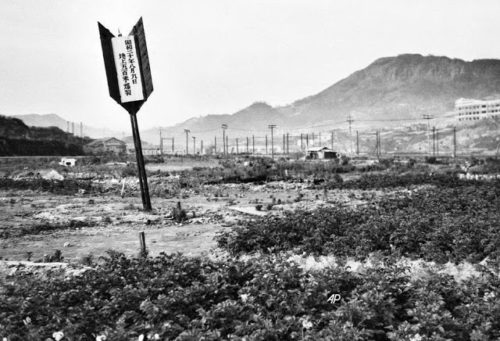
August 10, 1945: Arrow marks the spot where the atomic bomb hit in Nagasaki. Photo by AP

When on August 6 and 9, 1945 the United States killed 200-300 thousand innocent Japanese civilians with atomic bombs in Hiroshima and Nagasaki, they did so intentionally.  It was an act of sinister state terrorism, unprecedented by the nature of the weapons but not by the slaughter. The American terror bombings of Japanese cities that preceded the atomic bombings of Hiroshima and Nagasaki – led by the infamous Major General Curtis LeMay – were also intentionally aimed at Japanese civilians and killed hundreds of thousands of them.

Is there an American artist’s painting of Tokyo destroyed by the firebombing to go next to Picasso’s Guernica, where estimates of the dead range between 800 and 1,600?  In Tokyo alone more than 100,000 Japanese civilians were burnt to death by cluster bombs of napalm.  All this killing was intentional. I repeat: Intentional.  Is that not radical evil?  Demonic?  Only five Japanese cities were spared such bombing.

The atomic bombings were an intentional holocaust, not to end the war, as the historical record amply demonstrates, but to send a message to the Soviet Union that we could do to them what we did to the residents of Japan.  President Truman made certain that the Japanese willingness to surrender in May 1945 was made unacceptable because he and his Secretary-of-State James Byrnes  wanted to use the atomic bombs – “as quickly as possible to ‘show results’” in Byrnes’ words – to send a message to the Soviet Union.  So “the Good War” was ended in the Pacific with the “good guys” killing hundreds of thousands Japanese civilians to make a point to the “bad guys,” who have been demonized ever since.  Russia phobia is nothing new.

Satan always wears the other’s face.

Many Baby Boomers like to say they grew up with the bomb.  They are lucky. They grew up.  They got to be scared.  They got to hide under their desks and wax nostalgic about it.  Do you remember dog tags?  Those 1950s and 1960s?  The scary movies?

The children of Hiroshima and Nagasaki who died under our bombs on August 6 and 9, 1945 didn’t get to grow up.  They couldn’t hide.  They just went under. To be accurate: we put them under. Or they were left to smolder for decades in pain and then die.  But that it was necessary to save American lives is the lie. It’s always about American lives, as if the owners of the country actually cared about them.  But to tender hearts and innocent minds, it’s a magic incantation.  Poor us!

Fat Man, Little Boy – how the words echo down the years to the now fat Americans who grew up in the 1950s and who think like little boys and girls about their country’s demonic nature.  Innocence – it is wonderful!  We are different now. “We are great because we are good,” that’s what Hillary Clinton told us.  The Libyans can attest to that.  We are exceptional, special.  The next election will prove we can defeat Mr. Pumpkin Head and restore America to its “core values.”

Perhaps you think I am cynical.  But understanding true evil is not child’s play.  It seems beyond the grasp of most Americans who need their illusions.  Evil is real.  There is simply no way to understand the savage nature of American history without seeing its demonic nature.  How else can we redeem ourselves at this late date, possessed as we are by delusions of our own God-blessed goodness?

But average Americans play at innocence.  They excite themselves at the thought that with the next election the nation will be “restored” to the right course.  Of course, there never was a right course, unless might makes right, which has always been the way of America’s rulers.  Today Trump is viewed by so many as an aberration.  He is far from it.  He’s straight out of a Twain short story.  He’s Vaudeville. He’s Melville’s confidence man.  He’s us. Did it ever occur to those who are fixated on him that if those who own and run the country wanted him gone, he’d be gone in an instant?  He can tweet and tweet idiotically, endlessly send out messages that he will contradict the next day, but as long as he protects the super-rich, accepts Israel’s control of him, and allows the CIA-military-industrial complex to do its world-wide killing and looting of the treasury, he will be allowed to entertain and excite the public – to get them worked up in a lather in pseudo-debates.  And to make this more entertaining, he will be opposed by the “sane” Democratic opposition, whose intentions are as benign as an assassin’s smile.

Look back as far as you can to past U.S. presidents, the figureheads who “act under orders” (whose orders?), as did Ahab in his lust to kill the “evil” great white whale, and what do you see?  You see servile killers in the grip of a sinister power.  You see hyenas with polished faces. You see pasteboard masks.  On the one occasion when one of these presidents dared to follow his conscience and rejected the devil’s pact that is the presidency’s killer-in-chief role, he – JFK – had his brains blown out in public view.  An evil empire thrives on shedding blood, and it enforces its will through demonic messages.  Resist and there will be blood on the streets, blood on the tracks, blood in your face.

Despite this, President Kennedy’s witness, his turn from cold warrior to an apostle of peace, remains to inspire a ray of hope in these dark days. As recounted by James Douglass in his masterful JFK and the Unspeakable, Kennedy agreed to a meeting in May 1962 with a group of Quakers who had been demonstrating outside the While House for total disarmament.  They urged him to move in that direction.  Kennedy was sympathetic to their position.  He said he wished it were easy to do so from the top down, but that he was being pressured by the Pentagon and others to never do that, although he had given a speech urging “a peace race” together with the Soviet Union. He told the Quakers it would have to come from below.  According to the Quakers, JFK listened intently to their points, and before they left said with a smile, “You believe in redemption, don’t you?”  Soon Kennedy was shaken to his core by the Cuban missile crisis when the world teetered on the brink of extinction and his insane military and “intelligence” advisers urged him to wage a nuclear war.  Not long after, he took a sharp top-down turn toward peace despite their fierce opposition, a turn so dramatic over the next year that it led to his martyrdom.  And he knew it would.  He knew it would.

So hope is not all lost.  There are great souls like JFK to inspire us. Their examples flash here and there. But to even begin to hope to change the future, a confrontation with our demonic past (and present) is first necessary, a descent into the dark truth that is terrifying in its implications.  False innocence must be abandoned.  Carl Jung, in “On the Psychology of the Unconscious,” addressed this with the words:

It is a frightening thought that man also has a shadow side to him, consisting not just of little weaknesses – and foibles, but of a positively demonic dynamism. The individual seldom knows anything of this; to him, as an individual, it is incredible that he should ever in any circumstances go beyond himself. But let these harmless creatures form a mass, and there emerges a raging monster; and each individual is only one tiny cell in the monster’s body, so that for better or worse he must accompany it on its bloody rampages and even assist it to the utmost. Having a dark suspicion of these grim possibilities, man turns a blind eye to the shadow-side of human nature. Blindly he strives against the salutary dogma of original sin, which is yet so prodigiously true. Yes, he even hesitates to admit the conflict of which he is so painfully aware.

How can one describe men who would intentionally slaughter so many innocent people?  American history is rife with such examples up to the present day.  Iraq, Afghanistan, Libya, Syria, etc. – the list is very long.  Savage wars carried out by men and women who own and run the country, and who try to buy the souls of regular people to join them in their pact with the devil, to acquiesce to their ongoing wicked deeds.  Such monstrous evil was never more evident than on August 6 and 9, 1945.

Unless we enter into deep contemplation of the evil that was released into the world with those bombings of Hiroshima and Nagasaki, we are lost in a living hell without escape.  And we will pay.  Nemesis always demands retribution.  We have gradually been accepting rule by those for whom the killing of innocents is child’s play, and we have been masquerading as innocent and good children for whom the truth is too much to bear.  “Indeed, the safest road to Hell is the gradual one,” Screwtape the devil tells his nephew, Wormwood, a devil in training, “the gentle slope, soft underfoot, without sudden turnings, without milestones, without signposts.”  That’s the road we’ve been traveling.

The projection of evil onto others works only so long.  We must reclaim our shadows and withdraw our projections.  Only the fate of the world depends on it.


Related Article:

Barbarians at the Helm (Cindy Sheehan’s Speech in Hiroshima August 6th 2018)

The World Will Not Mourn the Decline of U.S. Hegemony

By Paul Street

Source: Consortium News

There are good reasons to bemoan the presence of the childish, racist, sexist and ecocidal, right-wing plutocrat Donald Trump in the White House. One complaint about Trump that should be held at arm’s-length by anyone on the left, however, is the charge that Trump is contributing to the decline of U.S. global power—to the erosion of the United States’ superpower status and the emergence of a more multipolar world.

This criticism of Trump comes from different elite corners. Last October, the leading neoconservative foreign policy intellectual and former George W. Bush administration adviser Eliot Cohen wrote an Atlantic magazine essay titled “How Trump Is Ending the American Era.” Cohen recounted numerous ways in which Trump had reduced “America’s standing and ability to influence global affairs.” He worried that Trump’s presidency would leave “America’s position in the world stunted” and an “America lacking confidence” on the global stage.

But it isn’t just the right wing that writes and speaks in such terms about how Trump is contributing to the decline of U.S. hegemony. A recent Time magazine reflection by the liberal commentator Karl Vick (who wrote in strongly supportive terms about the giant January 2017 Women’s March against Trump) frets that that Trump’s “America First” and authoritarian views have the world “looking for leadership elsewhere.”

“Could this be it?” Vick asks. “Might the American Century actually clock out at just 72 years, from 1945 to 2017? No longer than Louis XIV ruled France? Only 36 months more than the Soviet Union lasted, after all that bother?”

I recently reviewed a manuscript on the rise of Trump written by a left-liberal American sociologist. Near the end of this forthcoming and mostly excellent and instructive volume, the author finds it “worrisome” that other nations see the U.S. “abdicating its role as the world’s leading policeman” under Trump—and that, “given what we have seen so far from the [Trump] administration, U.S. hegemony appears to be on shakier ground than it has been in a long time.”

I’ll leave aside the matter of whether Trump is, in fact, speeding the decline of U.S. global power (he undoubtedly is) and how he’s doing that, to focus instead on a very different question: What would be so awful about the end of “the American Era”—the seven-plus decades of U.S. global economic and related military supremacy between 1945 and the present? Why should the world mourn the “premature” end of the “American Century”?

What Would the Rest of the World Say?

It would be interesting to see a reliable opinion poll on how the politically cognizant portion of the 94 percent of humanity that lives outside the U.S. would feel about the end of U.S. global dominance. My guess is that Uncle Sam’s weakening would be just fine with most Earth residents who pay attention to world events.

According to a global survey of 66,000 people conducted across 68 countries by the Worldwide Independent Network of Market Research (WINMR) and Gallup International at the end of 2013, Earth’s people see the United States as the leading threat to peace on the planet. The U.S. was voted top threat by a wide margin.

There is nothing surprising about that vote for anyone who honestly examines the history of “U.S. foreign affairs,” to use a common elite euphemism for American imperialism. Still, by far and away world history’s most extensive empire, the U.S. has at least 800 military bases spread across more than 80 foreign countries and “troops or other military personnel in about 160

foreign countries and territories.” The U.S. accounts for more than 40 percent of the planet’s military spending and has more than 5,500 strategic nuclear weapons, enough to blow the world up 5 to 50 times over. Last year it increased its “defense” (military empire) spending, which was already three times higher than China’s, and nine times higher than Russia’s.

Think it’s all in place to ensure peace and democracy the world over, in accord with the standard boilerplate rhetoric of U.S. presidents, diplomats and senators?

Do you know any other good jokes?

Pentagon study released last summer laments the emergence of a planet on which the U.S. no longer controls events. Titled “At Our Own Peril: DoD Risk Assessment in a Post-Primary World,” the study warns that competing powers “seek a new distribution of power and authority commensurate with their emergence as legitimate rivals to U.S. dominance” in an increasingly multipolar world. China, Russia and smaller players like Iran and North Korea have dared to “engage,” the Pentagon study reports, “in a deliberate program to demonstrate the limits of U.S. authority, reach influence and impact.” What chutzpah! This is a problem, the report argues, because the endangered U.S.-managed world order was “favorable” to the interests of U.S. and allied U.S. states and U.S.-based transnational corporations.

Any serious efforts to redesign the international status quo so that it favors any other states or people is portrayed in the report as a threat to U.S. interests. To prevent any terrible drifts of the world system away from U.S. control, the report argues, the U.S. and its imperial partners (chiefly its European NATO partners) must maintain and expand “unimpeded access to the air, sea, space, cyberspace, and the electromagnetic spectrum in order to underwrite their security and prosperity.” The report recommends a significant expansion of U.S. military power. The U.S. must maintain “military advantage” over all other states and actors to “preserve maximum freedom of action” and thereby “allow U.S. decision-makers the opportunity to dictate or hold significant sway over outcomes in international disputes,” with the “implied promise of unacceptable consequences” for those who defy U.S. wishes.

“America First” is an understatement here. The underlying premise is that Uncle Sam owns the world and reserves the right to bomb the hell out of anyone who doesn’t agree with that (to quote President George H.W. Bush after the first Gulf War in 1991: “What we say goes.”

Investment Not Democracy

It’s nothing new. From the start, the “American Century” had nothing to do with advancing democracy. As numerous key U.S. planning documents reveal over and over, the goal of that policy was to maintain and, if necessary, install governments that “favor[ed] private investment of domestic and foreign capital, production for export, and the right to bring profits out of the country,” according to Noam Chomsky. Given the United States’ remarkable possession of half the world’s capital after World War II, Washington elites had no doubt that U.S. investors and corporations would profit the most. Internally, the basic selfish national and imperial objectives were openly and candidly discussed. As the “liberal” and “dovish” imperialist, top State Department planner, and key Cold War architect George F. Kennan explained in “Policy Planning Study 23,” a critical 1948 document:

We have about 50% of the world’s wealth, but only 6.3% of its population. … In this situation, we cannot fail to be the object of envy and resentment. Our real task in the coming period is to devise a pattern of relationships which will permit us to maintain this position of disparity. … To do so, we will have to dispense with all sentimentality and day-dreaming; and our attention will have to be concentrated everywhere on our immediate national objectives. … We should cease to talk about vague and … unreal objectives such as human rights, the raising of the living standards, and democratization. The day is not far off when we are going to have to deal in straight power concepts. The less we are then hampered by idealistic slogans, the better.

The harsh necessity of abandoning “human rights” and other “sentimental” and “unreal objectives” was especially pressing in the global South, what used to be known as the Third World. Washington assigned the vast “undeveloped” periphery of the world capitalist system—Africa, Latin America, Southeast Asia and the energy-rich and thus strategically hyper-significant Middle East—a less than flattering role. It was to “fulfill its major function as a source of raw materials and a market” (actual State Department language) for the great industrial (capitalist) nations (excluding socialist Russia and its satellites, and notwithstanding the recent epic racist-fascist rampages of industrial Germany and Japan). It was to be exploited both for the benefit of U.S. corporations/investors and for the reconstruction of Europe and Japan as prosperous U.S. trading and investment partners organized on capitalist principles and hostile to the Soviet bloc.

“Democracy” was fine as a slogan and benevolent, idealistic-sounding mission statement when it came to marketing this imperialist U.S. policy at home and abroad. Since most people in the “third” or “developing” world had no interest in neocolonial subordination to the rich nations and subscribed to what U.S. intelligence officials considered the heretical “idea that government has direct responsibility for the welfare of its people” (what U.S. planners called “communism”), Washington’s real-life commitment to popular governance abroad was strictly qualified, to say the least.

“Democracy” was suitable to the U.S. as long as its outcomes comported with the interests of U.S. investors/corporations and related U.S. geopolitical objectives. Democracy had to be abandoned, undermined and/or crushed when it threatened those investors/corporations and the broader imperatives of business rule to any significant degree. As President Richard Nixon’s coldblooded national security adviser Henry Kissinger explained in June 1970, three years before the U.S. sponsored a bloody fascist coup that overthrew Chile’s democratically elected socialist president, Salvador Allende: “I don’t see why we need to stand by and watch a country go Communist because of the irresponsibility of its own people.”

The U.S.-sponsored coup government that murdered Allende would kill tens of thousands of real and alleged leftists with Washington’s approval. The Yankee superpower sent some of its leading neoliberal economists and policy advisers to help the blood-soaked Pinochet regime turn Chile into a “free market” model and to help Chile write capitalist oligarchy into its national constitution.

“Since 1945, by deed and by example,” the great Australian author, commentator and filmmaker John Pilger wrote nearly nine years ago, “the U.S. has overthrown 50 governments, including democracies, crushed some 30 liberation movements and supported tyrannies from Egypt to Guatemala (see William Blum’s histories). Bombing is apple pie.” Along the way, Washington has crassly interfered in elections in dozens of “sovereign” nations, something curious to note in light of current liberal U.S. outrage over real or alleged Russian interference in “our” supposedly democratic electoral process in 2016. Uncle Sam also has bombed civilians in 30 countries, attempted to assassinate foreign leaders and deployed chemical and biological weapons.

If we “consider only Latin America since the 1950s,” writes the sociologist Howard Waitzkin:

[T]he United States has used direct military invasion or has supported military coups to overthrow elected governments in Guatemala, the Dominican Republic, Chile, Haiti, Grenada, and Panama. In addition, the United States has intervened with military action to suppress revolutionary movements in El Salvador, Nicaragua, and Bolivia. More recently … the United States has spent tax dollars to finance and help organize opposition groups and media in Honduras, Paraguay, and Brazil, leading to congressional impeachments of democratically elected presidents. Hillary Clinton presided over these efforts as Secretary of State in the Obama administration, which pursued the same pattern of destabilization in Venezuela, Ecuador, Argentina, Chile, and Bolivia.

Death Count: In the Millions

The death count resulting from “American Era” U.S. foreign policy runs well into the many millions, including possibly as many as 5 million Indochinese killed by Uncle Sam and his agents and allies between 1962 and 1975. The flat-out barbarism of the American war on Vietnam is widely documented on record. The infamous My Lai massacre of March 16, 1968, when U.S. Army soldiers slaughtered more than 350 unarmed civilians—including terrified women holding babies in their arms—in South Vietnam was no isolated incident in the U.S. “crucifixion of Southeast Asia” (Noam Chomsky’s phrase at the time). U.S. Army Col. Oran Henderson, who was charged with covering up the massacre, candidly told reporters that “every unit of brigade size has its My Lai hidden somewhere.”

It is difficult, sometimes, to wrap one’s mind around the extent of the savagery the U.S. has unleashed on the world to advance and maintain its global supremacy. In the early 1950s, the Harry Truman administration responded to an early challenge to U.S. power in Northern Korea with a practically genocidal three-year bombing campaign that was described in soul-numbing terms by the Washington Post years ago:

The bombing was long, leisurely and merciless, even by the assessment of America’s own leaders. ‘Over a period of three years or so, we killed off—what—20 percent of the population,’ Air Force Gen. Curtis LeMay, head of the Strategic Air Command during the Korean War, told the Office of Air Force History in 1984. Dean Rusk, a supporter of the war and later Secretary of State, said the United States bombed ‘everything that moved in North Korea, every brick standing on top of another.’ After running low on urban targets, U.S. bombers destroyed hydroelectric and irrigation dams in the later stages of the war, flooding farmland and destroying crops … [T]he U.S. dropped 635,000 tons of explosives on North Korea, including 32,557 tons of napalm, an incendiary liquid that can clear forested areas and cause devastating burns to human skin.

Gee, why does North Korea fear and hate us?

This ferocious bombardment, which killed 2 million or more civilians, began five years after Truman arch-criminally and unnecessarily ordered the atom bombing of hundreds of thousands pf civilians in Hiroshima and Nagasaki to warn the Soviet Union to stay out of Japan and Western Europe.

Some benevolent “world policeman.”

The ferocity of U.S. foreign policy in the “America Era” did not always require direct U.S. military intervention. Take Indonesia and Chile, for two examples from the “Golden Age” height of the “American Century.” In Indonesia, the U.S.-backed dictator Suharto killed millions of his subjects, targeting communist sympathizers, ethnic Chinese and alleged leftists. A senior CIA operations officer in the 1960s later described Suharto’s 1965-66 U.S.-assisted coup as s “the model operation” for the U.S.-backed coup that eliminated the democratically elected president of Chile, Salvador Allende, seven years later. “The CIA forged a document purporting to reveal a leftist plot to murder Chilean military leaders,” the officer wrote, “[just like] what happened in Indonesia in 1965.”

As Pilger noted 10 years ago, “the U.S. embassy in Jakarta supplied Suharto with a ‘zap list’ of Indonesian Communist party members and crossed off the names when they were killed or captured. … The deal was that Indonesia under Suharto would offer up what Richard Nixon had called ‘the richest hoard of natural resources, the greatest prize in south-east Asia.’ ”

“No single American action in the period after 1945,” wrote the historian Gabriel Kolko, “was as bloodthirsty as its role in Indonesia, for it tried to initiate [Suharto’s] massacre.”

Two years and three months after the Chilean coup, Suharto received a green light from Kissinger and the Gerald Ford White House to invade the small island nation of East Timor. With Washington’s approval and backing, Indonesia carried out genocidal massacres and mass rapes and killed at least 100,000 of the island’s residents.

Mideast Savagery

Among the countless episodes of mass-murderous U.S. savagery in the oil-rich Middle East over the last generation, few can match for the barbarous ferocity of the “Highway of Death,” where the “global policeman’s” forces massacred tens of thousands of surrendered Iraqi troops retreating from Kuwait on Feb. 26 and 27, 1991. Journalist Joyce Chediac testified that:

U.S. planes trapped the long convoys by disabling vehicles in the front, and at the rear, and then pounded the resulting traffic jams for hours. ‘It was like shooting fish in a barrel,’ said one U.S. pilot. On the sixty miles of coastal highway, Iraqi military units sit in gruesome repose, scorched skeletons of vehicles and men alike, black and awful under the sun … for 60 miles every vehicle was strafed or bombed, every windshield is shattered, every tank is burned, every truck is riddled with shell fragments. No survivors are known or likely. … ‘Even in Vietnam I didn’t see anything like this. It’s pathetic,’ said Major Bob Nugent, an Army intelligence officer. … U.S. pilots took whatever bombs happened to be close to the flight deck, from cluster bombs to 500-pound bombs. … U.S. forces continued to drop bombs on the convoys until all humans were killed. So many jets swarmed over the inland road that it created an aerial traffic jam, and combat air controllers feared midair collisions. … The victims were not offering resistance. … [I]t was simply a one-sided massacre of tens of thousands of people who had no ability to fight back or defend.

The victims’ crime was having been conscripted into an army controlled by a dictator perceived as a threat to U.S. control of Middle Eastern oil. President George H.W. Bush welcomed the so-called Persian Gulf War as an opportunity to demonstrate America’s unrivaled power and new freedom of action in the post-Cold War world, where the Soviet Union could no longer deter Washington. Bush also heralded the “war” (really a one-sided imperial assault) as marking the end of the “Vietnam Syndrome,” the reigning political culture’s curious term for U.S. citizens’ reluctance to commit U.S. troops to murderous imperial mayhem.

As Chomsky observed in 1992, reflecting on U.S. efforts to maximize suffering in Vietnam by blocking economic and humanitarian assistance to the nation it had devastated: “No degree of cruelty is too great for Washington sadists.”

But Uncle Sam was only getting warmed up building his Iraqi body count in early 1991. Five years later, Bill Clinton’s U.S. Secretary of State Madeline Albright told CBS News’ Leslie Stahl that the death of 500,000 Iraqi children due to U.S.-led economic sanctions imposed after the first “Persian Gulf War” (a curious term for a one-sided U.S. assault) was a “price … worth paying” for the advancement of inherently noble U.S. goals.

“The United States,” Secretary Albright explained three years later, “is good. We try to do our best everywhere.”

In the years following the collapse of the counter-hegemonic Soviet empire, however, American neoliberal intellectuals like Thomas Friedman—an advocate of the criminal U.S. bombing of Serbia—felt free to openly state that the real purpose of U.S. foreign policy was to underwrite the profits of U.S.-centered global capitalism. “The hidden hand of the market,” Friedman famously wrote in The New York Times Magazine in March 1999, as U.S. bombs and missiles exploded in Serbia, “will never work without a hidden fist. McDonald’s cannot flourish without McDonnell Douglas, the designer of the F-15. And the hidden fist that keeps the world safe for Silicon Valley’s technologies to flourish is called the U.S. Army, Air Force, Navy and Marine Corps.”

In a foreign policy speech Sen. Barack Obama gave to the Chicago Council of Global Affairs on the eve of announcing his candidacy for the U.S. presidency in the fall of 2006, Obama had the audacity to say the following in support of his claim that U.S. citizens supported “victory” in Iraq: “The American people have been extraordinarily resolved. They have seen their sons and daughters killed or wounded in the streets of Fallujah.”

It was a spine-chilling selection of locales. In 2004, the ill-fated city was the site of colossal U.S. war atrocities, crimes including the indiscriminate murder of thousands of civilians, the targeting even of ambulances and hospitals, and the practical leveling of an entire city by the U.S. military in April and November. By one account, “Incoherent Empire,” Michael Mann wrote:

The U.S. launched two bursts of ferocious assault on the city, in April and November of 2004 … [using] devastating firepower from a distance which minimizes U.S. casualties. In April … military commanders claimed to have precisely targeted … insurgent forces, yet the local hospitals reported that many or most of the casualties were civilians, often women, children, and the elderly… [reflecting an] intention to kill civilians generally. … In November … [U.S.] aerial assault destroyed the only hospital in insurgent territory to ensure that this time no one would be able to document civilian casualties. U.S. forces then went through the city, virtually destroying it. Afterwards, Fallujah looked like the city of Grozny in Chechnya after Putin’s Russian troops had razed it to the ground.

The “global policeman’s” deployment of radioactive ordnance (depleted uranium) in Fallujah created an epidemic of infant mortality, birth defects, leukemia and cancer there.

‘Bug-Splat’

Fallujah was just one especially graphic episode in a broader arch-criminal invasion that led to the premature deaths of at least 1 million Iraqi civilians and left Iraq as what Tom Engelhardt called “a disaster zone on a catastrophic scale hard to match in recent memory.” It reflected the same callous mindset behind the Pentagon’s early computer program name for ordinary Iraqis certain to be killed in the 2003 invasion: “bug-splat.” America’s petro-imperial occupation led to the death of as many as one million Iraqi “bugs” (human beings). According to the respected journalist Nir Rosen in December 2007, “Iraq has been killed. … [T]he American occupation has been more disastrous than that of the Mongols who sacked Baghdad in the thirteenth century.”

As the Senate is poised to confirm an alleged torturer as CIA director it is important to remember that along with death in Iraq came ruthless and racist torture. In an essay titled “I Helped Create ISIS,” Vincent Emanuele, a former U.S. Marine, recalled his enlistment in an operation that gave him nightmares more than a decade later:

I think about the hundreds of prisoners we took captive and tortured in makeshift detention facilities. … I vividly remember the marines telling me about punching, slapping, kicking, elbowing, kneeing and head-butting Iraqis. I remember the tales of sexual torture: forcing Iraqi men to perform sexual acts on each other while marines held knives against their testicles, sometimes sodomizing them with batons. … [T]hose of us in infantry units … round[ed] up Iraqis during night raids, zip-tying their hands, black-bagging their heads and throwing them in the back of HUMVEEs and trucks while their wives and kids collapsed to their knees and wailed. … Some of them would hold hands while marines would butt-stroke the prisoners in the face. … [W]hen they were released, we would drive them from the FOB (Forward Operating Base) to the middle of the desert and release them several miles from their homes. … After we cut their zip-ties and took the black bags off their heads, several of our more deranged marines would fire rounds from their AR-15s into their air or ground, scaring the recently released captives. Always for laughs. Most Iraqis would run, still crying from their long ordeal.

The award-winning journalist Seymour Hersh told the ACLU about the existence of classified Pentagon evidence files containing films of U.S-“global policeman” soldiers sodomizing Iraqi boys in front of their mothers behind the walls of the notorious Abu Ghraib prison. “You haven’t begun to see [all the] … evil, horrible things done [by U.S. soldiers] to children of women prisoners, as the cameras run,” Hersh told an audience in Chicago in the summer of 2014.

It isn’t just Iraq where Washington has wreaked sheer mass murderous havoc in the Middle East, always a region of prime strategic significance to the U.S. thanks to its massive petroleum resources. In a recent Truthdig reflection on Syria, historian Dan Lazare reminds us that:

[Syrian President Assad’s] Baathist crimes pale in comparison to those of the U.S., which since the 1970s has invested trillions in militarizing the Persian Gulf and arming the ultra-reactionary petro-monarchies that are now tearing the region apart. The U.S. has provided Saudi Arabia with crucial assistance in its war on Yemen, it has cheered on the Saudi blockade of Qatar, and it has stood by while the Saudis and United Arab Emirates send in troops to crush democratic protests in neighboring Bahrain. In Syria, Washington has worked hand in glove with Riyadh to organize and finance a Wahhabist holy war that has reduced a once thriving country to ruin.

Chomsky has called Barack Obama’s targeted drone assassination program “the most extensive global terrorism campaign the world has yet seen.” The program “officially is aimed at killing people who the administration believes might someday intend to harm the U.S. and killing anyone else who happens to be nearby.” As Chomsky adds, “It is also a terrorism generating campaign—that is well understood by people in high places. When you murder somebody in a Yemen village, and maybe a couple of other people who are standing there, the chances are pretty high that others will want to take revenge.”

The Last, Best Hope

“We lead the world,” presidential candidate Obama explained, “in battling immediate evils and promoting the ultimate good. … America is the last, best hope of earth.”

Obama elaborated in his first inaugural address. “Our security,” the president said, “emanates from the justness of our cause; the force of our example; the tempering qualities of humility and restraint”—a fascinating commentary on Fallujah, Hiroshima, the U.S. crucifixion of Southeast Asia, the “Highway of Death” and more.

Within less than half a year of his inauguration and his lauded Cairo speech, Obama’s rapidly accumulating record of atrocities in the Muslim world would include the bombing of the Afghan village of Bola Boluk. Ninety-three of the dead villagers torn apart by U.S. explosives in Bola Boluk were children. “In a phone call played on a loudspeaker on Wednesday to outraged members of the Afghan Parliament,” The New York Times reported, “the governor of Farah Province … said that as many as 130 civilians had been killed.” According to one Afghan legislator and eyewitness, “the villagers bought two tractor trailers full of pieces of human bodies to his office to prove the casualties that had occurred. Everyone at the governor’s cried, watching that shocking scene.” The administration refused to issue an apology or to acknowledge the “global policeman’s” responsibility.

By telling and sickening contrast, Obama had just offered a full apology and fired a White House official because that official had scared New Yorkers with an ill-advised Air Force One photo-shoot flyover of Manhattan that reminded people of 9/11. The disparity was extraordinary: Frightening New Yorkers led to a full presidential apology and the discharge of a White House staffer. Killing more than 100 Afghan civilians did not require any apology.

Reflecting on such atrocities the following December, an Afghan villager was moved to comment as follows: “Peace prize? He’s a killer. … Obama has only brought war to our country.” The man spoke from the village of Armal, where a crowd of 100 gathered around the bodies of 12 people, one family from a single home. The 12 were killed, witnesses reported, by U.S. Special Forces during a late-night raid.

Obama was only warming up his “killer” powers. He would join with France and other NATO powers in the imperial decimation of Libya, which killed more than 25,000 civilians and unleashed mass carnage in North Africa. The U.S.-led assault on Libya was a disaster for black Africans and sparked the biggest refugee crisis since World War II.

Two years before the war on Libya, the Obama administration helped install a murderous right-wing coup regime in Honduras. Thousands of civilians and activists have been murdered by that regime.

The clumsy and stupid Trump has taken the imperial baton from the elegant and silver-tongued “imperial grandmaster” Obama, keeping the superpower’s vast global military machine set on kill. As Newsweek reported last fall, in a news item that went far below the national news radar screen in the age of the endless insane Trump clown show:

According to research from the nonprofit monitoring group Airwars … through the first seven months of the Trump administration, coalition air strikes have killed between 2,800 and 4,500 civilians. … Researchers also point to another stunning trend—the ‘frequent killing of entire families in likely coalition airstrikes.’ In May, for example, such actions led to the deaths of at least 57 women and 52 children in Iraq and Syria. … In Afghanistan, the U.N. reports a 67 percent increase in civilian deaths from U.S. airstrikes in the first six months of 2017 compared to the first half of 2016.

That Trump murders with less sophistication, outward moral restraint and credible claim to embody enlightened Western values and multilateral commitment than Obama did is perhaps preferable to some degree. It is better for empire to be exposed in its full and ugly nakedness, to speed its overdue demise.

The U.S. is not just the top menace only to peace on Earth. It is also the leading threat to personal privacy (as was made clearer than ever by the Edward Snowden revelations), to democracy (the U.S. funds and equips repressive regimes around the world) and to a livable global natural environment (thanks in no small part to its role as headquarters of global greenhouse gassing and petro-capitalist climate denial).

The world can be forgiven, perhaps, if it does not join Eliot Cohen and Karl Vick in bemoaning the end of the “American Era,” whatever Trump’s contribution to that decline, which was well underway before he entered the Oval Office.

Ordinary Americans, too, can find reasons to welcome the decline of the American empire. As Chomsky noted in the late 1960s: “The costs of empire are in general distributed over the society as a whole, while its profits revert to a few within.”

The Pentagon system functions as a great form of domestic corporate welfare for high-tech “defense” (empire) firms like Lockheed Martin, Boeing and Raytheon—this while it steals trillions of dollars that might otherwise meet social and environmental needs at home and abroad. It is a significant mode of upward wealth distribution within “the homeland.”

The biggest costs have fallen on the many millions killed and maimed by the U.S. military and allied and proxy forces in the last seven decades and before. The victims include the many U.S. military veterans who have killed themselves, many of them haunted by their own participation in sadistic attacks and torture on defenseless people at the distant command of sociopathic imperial masters determined to enforce U.S. hegemony by any and all means deemed necessary.

There’s Only One Rogue Nuclear State, and it’s the USA

It was human nature to walk with their arms out forward to ease the pain of their burnt skin falling off their bodies. Image drawn by a survivor.

By Bruce A. Dixon

Source: Black Agenda Report

This week marks the anniversary of two monstrous war crimes, the nuking of two undefended Japanese cities, Hiroshima and Nagasaki on August 6 and 9, 1945. The fake history I learned as a child in the 50s and 60s was that the bombings saved the lives of a million Japanese and Americans who would have perished in a land invasion of Japan. That was a lie. The US anticipated turning its World War 2 ally the Soviet Union into its postwar enemy, and hoped to scare the scare the Soviets with the terrible carnage its new nuclear weapons would inflict.

The hundreds of thousands murdered at Hiroshima and Nagasaki were the opening acts of the Cold War between the United States and the Soviet Union, the beginning of a US nuclear armed crime wave which has lasted over 70 years and included each and every US president from Harry Truman to Donald Trump. This isn’t hype and it’s not exaggeration. When you rob someone and tell your victim you’ve got a gun, you’re charged with armed robbery whether or not you pull or use the weapon.

By that standard, the US has been a rogue nation on a nuclear armed crime spree now in its eighth decade. A few years ago the American Friends Service Committee compiled a partial list of the times US presidents have openly threatened humanity with nuclear destruction. You can find it by googling “American Friends Service Committee” and “nuclear blackmail.” Here are a few of the dozens of incidents it lists.

In 1946 and 1948 President Harry Truman threatened the Soviets over Iran and Berlin, respectively, and the Chinese in 1950 and 51.

President Eisenhower also threatened the Chinese over Korea in 1953, and again in 1956 over Quemoy and Matsu. He offered the French nukes to use against the Vietnamese at Dienbienphu in 1954.

President Kennedy threatened a nuclear strike at the Soviets over Berlin, and sent nuclear armed missiles to Turkey on the Russian border in 1961. Though these were later wisely withdrawn after the nuclear standoff of the Cuban missile crisis, the US has consistently based its nukes on its fleets and bases in the Pacific, in Europe and Asia, and for decades in South Korea.

Presidents Johnson and Nixon menaced North Korea, Vietnam and the Soviet Union with air and seaborne nukes, and President Gerald Ford ordered nuclear armed bombers from Guam to loiter for an extended time off the coast of North Korea. Jimmy Carter issued the Carter Doctrine, reaffirmed by Ronald Reagan which committed the US to a nuclear response if its vital interests in the Middle East were every threatened. Ronald Reagan terrified the world, though he did briefly consider a lasting arms treaty with the USSR.

Bush 1, Bush 2 and Bill Clinton all menaced North Korea and Iraq, and Obama declared “all options on the table” against Iran.

The AFSC list does not include vital US assistance in developing nuclear weapons technology given to apartheid South Africa which later relinquished its nukes, and apartheid Israel, which currently has missiles aimed at every Arab capital within a thousand miles, and at Iran.

So while Donald Trump’s “fire and destruction” bombast IS criminal and detestable, it’s not new. It’s merely the latest installment in a long running crime wave by the planet’s number one nuclear armed felon, the United States of America.

U-S-A. Let’s make it great again.