Economic Earthquake Ahead? The Cracks Are Spreading Fast

By Brandon Smith

Source: The Burning Platform

One of my favorite false narratives floating around corporate media platforms has been the argument that the American people “just don’t seem to understand how good the economy really is right now.” If only they would look at the stats, they would realize that we are in the middle of a financial renaissance, right? It must be that people have been brainwashed by negative press from conservative sources…

I have to laugh at this notion because it’s a very common one throughout history – it’s an assertion made by almost every single political regime right before a major collapse. These people always say the same things, and when you study economics as long as I have you can’t help but throw up your hands and marvel at their dedication to the propaganda.

One example that comes to mind immediately is the delusional optimism of the “roaring” 1920s and the lead up to the Great Depression. At the time around 60% of the U.S. population was living in poverty conditions (according to the metrics of the decade) earning less than $2000 a year. However, in the years after WWI ravaged Europe, America’s economic power was considered unrivaled.

The 1920s was an era of mass production and rampant consumerism but it was all fueled by easy access to debt, a condition which had not really existed before in America. It was this illusion of prosperity created by the unchecked application of credit that eventually led to the massive stock market bubble and the crash of 1929. This implosion, along with the Federal Reserve’s policy of raising interest rates into economic weakness, created a black hole in the U.S. financial system for over a decade.

There are two primary tools that various failing regimes will often use to distort the true conditions of the economy: Debt and inflation. In the case of America today, we are experiencing BOTH problems simultaneously and this has made certain economic indicators appear healthy when they are, in fact, highly unstable. The average American knows this is the case because they see the effects everyday. They see the damage to their wallets, to their buying power, in the jobs market and in their quality of life. This is why public faith in the economy has been stuck in the dregs since 2021.

The establishment can flash out-of-context stats in people’s faces, but they can’t force the populace to see a recovery that simply does not exist. Let’s go through a short list of the most faulty indicators and the real reasons why the fiscal picture is not a rosy as the media would like us to believe…

The “miracle” labor market recovery

In the case of the U.S. labor market, we have a clear example of distortion through inflation. The $8 trillion+ dropped on the economy in the first 18 months of the pandemic response sent the system over the edge into stagflation land. Helicopter money has a habit of doing two things very well: Blowing up a bubble in stock markets and blowing up a bubble in retail. Hence, the massive rush by Americans to go out and buy, followed by the sudden labor shortage and the race to hire (mostly for low wage part-time jobs).

The problem with this “miracle” is that inflation leads to price explosions, which we have already experienced. The average American is spending around 30% more for goods, services and housing compared to what they were spending in 2020. This is what happens when you have too much money chasing too few goods and limited production.

The jobs market looks great on paper, but the majority of jobs generated in the past few years are jobs that returned after the covid lockdowns ended. The rest are jobs created through monetary stimulus and the artificial retail rush. Part time low wage service sector jobs are not going to keep the country rolling for very long in a stagflation environment. The question is, what happens now that the stimulus punch bowl has been removed?

Just as we witnessed in the 1920s, Americans have turned to debt to make up for higher prices and stagnant wages by maxing out their credit cards. With the central bank keeping interest rates high, the credit safety net will soon falter. This condition also goes for businesses; the same businesses that will jump headlong into mass layoffs when they realize the party is over. It happened during the Great Depression and it will happen again today.

Cracks in the foundation

We saw cracks in the narrative of the financial structure in 2023 with the banking crisis, and without the Federal Reserve backstop policy many more small and medium banks would have dropped dead. The weakness of U.S. banks is offset by the relative strength of the U.S. dollar, which lures in foreign investors hoping to protect their wealth using dollar denominated assets.

But something is amiss. Gold and bitcoin have rocketed higher along with economically sensitive assets and the dollar. This is the opposite of what’s supposed to happen. Gold and BTC are supposed to be hedges against a weak dollar and a weak economy, right? If global faith in the dollar and in the U.S. economy is so high, why are investors diving into protective assets like gold?

Again, as noted above, inflation distorts everything.

Tens of trillions of extra dollars printed by the Fed are floating around and it’s no surprise that much of that cash is flooding into the economy which simply pushes higher right along with prices on the shelf. But, gold and bitcoin are telling us a more honest story about what’s really happening.

Right now, the U.S. government is adding around $600 billion per month to the national debt as the Fed holds rates higher to fight inflation. This debt is going to crush America’s financial standing for global investors who will eventually ask HOW the U.S. is going to handle that growing millstone? As I predicted years ago, the Fed has created a perfect Catch-22 scenario in which the U.S. must either return to rampant inflation, or, face a debt crisis. In either case, U.S. dollar-denominated assets will lose their appeal and their prices will plummet.

“Healthy” GDP is a complete farce

GDP is the most common out-of-context stat used by governments to convince the citizenry that all is well. It is yet another stat that is entirely manipulated by inflation. It is also manipulated by the way in which modern governments define “economic activity.”

GDP is primarily driven by spending. Meaning, the higher inflation goes, the higher prices go, and the higher GDP climbs (to a point). Eventually prices go too high, credit cards tap out and spending ceases. But, for a short time inflation makes GDP (as well as retail sales) look good.

Another factor that creates a bubble is the fact that government spending is actually included in the calculation of GDP. That’s right, every dollar of your tax money that the government wastes helps the establishment by propping up GDP numbers. This is why government spending increases will never stop – It’s too valuable for them to spend as a way to make the economy appear healthier than it is.

The REAL economy is eclipsing the fake economy

The bottom line is that Americans used to be able to ignore the warning signs because their bank accounts were not being directly affected. This is over. Now, every person in the country is dealing with a massive decline in buying power and higher prices across the board on everything – from food and fuel to housing and financial assets alike. Even the wealthy are seeing a compression to their profit and many are struggling to keep their businesses in the black.

The unfortunate truth is that the elections of 2024 will probably be the turning point at which the whole edifice comes tumbling down. Even if the public votes for change, the system is already broken and cannot be repaired without a complete overhaul.

We have consistently avoided taking our medicine and our disease has gotten worse and worse.

People have lost faith in the economy because they have not faced this kind of uncertainty since the 1930s. Even the stagflation crisis of the 1970s will likely pale in comparison to what is about to happen. On the bright side, at least a large number of Americans are aware of the threat, as opposed to the 1920s when the vast majority of people were utterly conned by the government, the banks and the media into thinking all was well. Knowing is the first step to preparing.

The second step is securing your own financial future – that’s where physical precious metals can play a role. Diversifying your savings with inflation-resistant, uninflatable assets whose intrinsic value doesn’t rely on a counterparty’s promise to pay adds resilience to your savings. That’s the main reason physical gold and silver have been the safe haven store-of-value assets of choice for centuries (among both the elite and the everyday citizen).
From Burkina Faso to Niger to Gabon, Western Hegemony Dying in Africa

By Harun Elbinawi

Source: Covert Geopolitics

Berlin Conference of 1884-1885 was undeniably one of the biggest evil summits in modern history. Greedy and racist European colonialists sat down in the German city and divided Africans as if they were sharing bread on a breakfast table.

The conference was organized by Otto von Bismarck, the first chancellor of Germany at the request of King Leopold II of Belgium, the Western genocidal barbarian that murdered more than 10 million innocent Africans in Congo.

Most Africans are not even aware of this genocide in Congo perpetrated by the Belgium colonialists because it is not in our history books written by the white colonialists.

European colonialism in Africa lasted more than a century with only the ancient Kingdom of Ethiopia spared because they defeated the Italian colonialists on the battlefield.

Trillions and trillions of dollars were stolen from Africa, millions of Africans were murdered by the European colonialists and Africans were massively brainwashed that they had no history before European colonialism.

The wave of ‘independence’ in Africa from the 1950s and 1960s did not represent true independence. What actually happened was that colonialism was cleverly replaced with neocolonialism by the genocidal imperialist barbarians of the West.

The massive looting of rich resources in Africa continued under Western puppet leadership. The courageous African leaders who refused to dance to the tune of the European colonialists were eliminated.

This was what happened to African heroes, Patrick Lumumba of Congo and Thomas Sankara of Burkina Faso. Congo has all mineral resources except for crude oil.

The uranium used by the US regime to make the atomic bombs unleashed on Hiroshima and Nagasaki was mined in Congo.

French greed in Africa

Among the European colonialists, French colonialism was more brutal and exploitative.

France killed more than 1.5 million civilians in Algeria alone. They murdered tens of thousands of civilians in other African countries.

One of the Modus Operandi of the French colonialists was to assemble Islamic scholars in a hall and exterminate all of them. They did this in Algeria, Chad, Mali and Senegal.

And the greed of their neocolonialism is extreme. Even after independence, France is still controlling the wealth of its former colonies in Africa.

The rich resources of French nations are still controlled by France and they continue to pay colonial tax to France.

French goods and services dominate their markets. The domineering presence of France in these countries has been excruciating and devastating for local populations.

Niger Republic does not know the quantity of uranium France was taking from there, which is worst than slavery.

No evil lasts forever

There is a popular saying that “No evil lasts forever”.

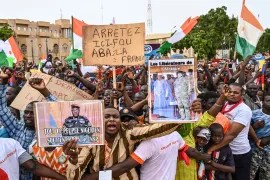
France’s neocolonialism in Africa will not last forever. Popular military coups against puppets of France imperialism have started and are gathering momentum.

The recent military coup in the West African state of Niger Republic does not stand in isolation but follows similar upheavals in the neighboring countries of Mali, Burkina Faso, and Guinea in recent years.

Mali is facing insurgency that is backed by Western hegemony. Mali expelled French troops because they were actively aiding the insurgents to justify its military presence in the African country.

Now, on Wednesday, we woke up with the news of another puppet of the Western hegemonic barbarians in Gabon overthrown by the military. Ali Bango inherited the Gabon presidency from his corrupt Father, Omar Bongo.

Early on Wednesday, some military personnel appeared on state TV and announced that they were seizing power and dislodging a family that has ruled the country for 56 years.

The military officers introduced themselves as members of the Committee of Transition and the Restoration of Institutions.

“Today the country is undergoing a severe institutional, political, economic, and social crisis,” the officers said in a statement, dubbing the recent election illegitimate.

“In the name of the Gabonese people … we have decided to defend the peace by putting an end to the current regime.”

Pertinently, Gabon’s former president had 70 bank accounts, 39 apartments, 2 Ferraris, 6 Mercedes Benz cars, 3 Porsches and a Bugatti in France. He ruled for 42 years (from 1967 to 2009). French leaders loved Bongo because he was loyal to them.

His son, Ali Bongo has been the president for 14 years (2009 – 2023). He has just been overthrown in a  coup.

Failure of Western liberal democracy

The fact is that the Western liberal democracy has not only failed in Africa but has failed woefully.

Democracy in Africa has become a tool for the corrupt ruling elites to steal the wealth of their respective countries and transfer it to Western financial institutions while the populations remain in abject poverty and hunger.

Democracy is just another system of government hijacked by the Western hegemonic barbarians, the biggest enemies of the human race. Democracy is now an imperialist tool of Western hegemony in Africa. This is a bitter and undeniable fact.

The people of Gabon will definitely celebrate this military coup as it marks the end of French interference and looting in their country. Another setback for the French leaders.

Africa must rise again

The most noticeable current in Mali, Burkina Faso, Guinea, Niger Republic and Gabon is that the change of governments all have popular support as the people of those countries are tired of France’s imperialism, arrogance and terrorism.

Today France has the 4th largest gold reserves in the world and there is no single gold mine in France.

These gold mines are all in Mali, Niger Republic and other African countries. The France neocolonialism in Africa must end. Its time has come.

The War in Ukraine Marks the End of the American Century. “What’s Left is a Steaming Pile of Dollar Denominated Debt”

By Mike Whitney

Source: Global Research

“The ferocity of the confrontation in Ukraine shows that we’re talking about much more than the fate of the regime in Kiev. The architecture of the entire world order is at stake.” Sergei Naryshkin, Director of Russia’s Foreign Intelligence.

***

Here’s your ‘reserve currency’ thought for the day: Every US dollar is a check written on an account that is overdrawn by 30 trillion dollars.

It’s true. The “full faith and credit” of the US Treasury is largely a myth held together by an institutional framework that rests on a foundation of pure sand. In fact, the USD is not worth the paper it is printed onit is an IOU flailing in an ocean of red ink.

The only thing keeping the USD from vanishing into the ether, is the trust of credulous people who continue to accept it as legal tender.

But why do people remain confident in the dollar when its flaws are known to all? After all, America’s $30 trillion National Debt is hardly a secret, nor is the additional $9 trillion that’s piled up on the Fed’s balance sheet. That is a stealth debt of which the American people are completely unaware, but they are responsible for all the same.

In order to answer that question, we need to look at how the system actually works and how the dollar is propped up by the numerous institutions that were created following WW2. These institutions provide an environment for conducting history’s longest and most flagrant swindle, the exchange of high-ticket manufactured goods, raw materials and hard-labor for slips of green paper with dead presidents on them.

One can only marvel at the genius of the elites who concocted this scam and then imposed it wholesale on the masses without a peep of protest. Of course, the system is accompanied by various enforcement mechanisms that swiftly remove anyone who tries to either break free from the dollar or, God help us, create an alternate system altogether. (Saddam Hussein and Muammar Qaddafi come to mind.) But the fact is– aside from the institutional framework and the ruthless extermination of dollar opponents– there’s no reason why humanity should remain yoked to a currency that is buried beneath a mountain of debt and whose real value is virtually unknowable.

It wasn’t always like this. There was a time when the dollar was the strongest currency in the world and deserved its spot at the top of the heap. Following WW1, the US was “the owner of the majority of the world’s gold” which was why an international delegation “decided that the world’s currencies would no longer be linked to gold but could be pegged to the U.S. dollar, “because the greenback was, itself, linked to gold.” Here’s more from an article at Investopedia:

“The arrangement came to be known as the Bretton Woods Agreement. It established the authority of central banks, which would maintain fixed exchange rates between their currencies and the dollar. In turn, the United States would redeem U.S. dollars for gold on demand….

The U.S dollar was officially crowned the world’s reserve currency and was backed by the world’s largest gold reserves thanks to the Bretton Woods Agreement. Instead of gold reserves, other countries accumulated reserves of U.S. dollars. Needing a place to store their dollars, countries began buying U.S. Treasury securities, which they considered to be a safe store of money.

The demand for Treasury securities, coupled with the deficit spending needed to finance the Vietnam War and the Great Society domestic programs, caused the United States to flood the market with paper money….

The demand for gold was such that President Richard Nixon was forced to intervene and de-link the dollar from gold, which led to the floating exchange rates that exist today. Although there have been periods of stagflation, which is defined as high inflation and high unemployment, the U.S. dollar has remained the world’s reserve currency.” (“How the U.S. Dollar Became the World’s Reserve Currency”, Investopedia)

But now the gold is gone and what’s left is a steaming pile of debt. So, how on earth has the dollar managed to preserve its status as the world’s preeminent currency?

Proponents of the dollar system, will tell you it has something to do with “the size and strength of the U.S. economy and the dominance of the U.S. financial markets.” But that’s nonsense.

The truth is, reserve currency status has nothing to do with “the size and strength” of America’s post-industrial, service-oriented, bubble-driven, third-world-sh**hole economy. Nor does it have anything to do with the alleged safety of US Treasuries” which– next to the dollar– is the biggest Ponzi flim-flam of all time.

The real reason the dollar has remained the world’s premier currency is because of the cartelization of Central Banking.

The Western Central Banks are a de facto monopoly run by a small cabal of inter-breeding bottom-feeders who coordinate and collude on monetary policy in order to preserve their maniacal death-grip on the financial markets and the global economy. It’s a Monetary Mafia and– as George Carlin famously said: “You and I are not in it. You and I are not in the big club.” Bottom line: It is the relentless manipulation of interest rates, forward guidance and Quantitative Easing (QE) that has kept the dollar in its lofty but undeserved spot.

But all that is about to change due entirely to Biden’s reckless foreign policy which is forcing critical players in the global economy to create their own rival system. This is a real tragedy for the West that has enjoyed a century of nonstop wealth extraction from the developing world.

Now– due to the economic sanctions on Russia– an entirely new order is emerging in which the dollar will be substituted for national currencies (processed through an independent financial settlement system) in bilateral trade deals until– later this year– Russia launches an exchange-traded commodities-backed currency that will be used by trading partners in Asia and Africa.

Washington’s theft of Russia’s foreign reserves in April turbo-charged the current process which was further accelerated by banning of Russia from foreign markets. In short, US economic sanctions and boycotts have expanded the non-dollar zone by many orders of magnitude and forced the creation of a new monetary order.

How dumb is that? For decades the US has been running a scam in which it exchanges its fishwrap currency for things of genuine value. (oil, manufactured goods and labor) But now the Biden troupe has scrapped that system altogether and divided the world into warring camps.

But, why?

To punish Russia, is that it?

Yes, that’s it.

But, if that’s the case, then shouldn’t we try to figure out whether the sanctions actually work or not before we recklessly change the system?

Too late for that. The war on Russia has begun and the early results are already pouring in. Just look at the way we’ve destroyed Russia’s currency, the ruble. It’s shocking! Here’s the scoop from an article at CBS:

“The Russian ruble is the best-performing currency in the world this year….

Two months after the ruble’s value fell to less than a U.S. penny amid the swiftest, toughest economic sanctions in modern history, Russia’s currency has mounted a stunning turnaround. The ruble has jumped 40% against the dollar since January.

Normally, a country facing international sanctions and a major military conflict would see investors fleeing and a steady outflow of capital, causing its currency to drop….

The ruble’s resiliency means that Russia is partly insulated from the punishing economic penalties imposed by Western nations after its invasion of Ukraine…” (“Russia’s ruble is the strongest currency in the world this year“, CBS News)

Huh? You mean the attack on the ruble didn’t work after all?

Sure looks that way. But that doesn’t mean the sanctions are a failure. Oh, no. Just at look at the effect they’ve had on Russian commodities. Export receipts are way-down, right? Here’s more from CBS:

“Commodity prices are currently sky-high, and even though there is a drop in the volume of Russian exports due to embargoes and sanctioning, the increase in commodity prices more than compensates for these drops,” said Tatiana Orlova, lead emerging markets economist at Oxford Economics.

Russia is pulling in nearly $20 billion a month from energy exports. Since the end of March, many foreign buyers have complied with a demand to pay for energy in rubles, pushing up the currency’s value.” (“Russia’s ruble is the strongest currency in the world this year“, CBS News)

You’re kidding me? You mean the ruble is surging and Putin is raking in more dough on commodities than ever before?

Yep, and it’s the same deal with Russia’s trade surplus. Take a look at this excerpt from an article in The Economist:

“Russia’s exports… have held up surprisingly well, including those directed to the West. Sanctions permit the sale of oil and gas to most of the world to continue uninterrupted. And a spike in energy prices has boosted revenues further.

As a result, analysts expect Russia’s trade surplus to hit record highs in the coming months. The IIF reckons that in 2022 the current-account surplus, which includes trade and some financial flows, could come in at $250bn (15% of last year’s GDP), more than double the $120bn recorded in 2021. That sanctions have boosted Russia’s trade surplus, and thus helped finance the war, is disappointing, says Mr Vistesen. Ms Ribakova reckons that the efficacy of financial sanctions may have reached its limits. A decision to tighten trade sanctions must come next.

But such measures could take time to take effect. Even if the EU enacts its proposal to ban Russian oil, the embargo would be phased in so slowly that the bloc’s oil imports from Russia would fall by just 19% this year, says Liam Peach of Capital Economics, a consultancy. The full impact of these sanctions would be felt only at the start of 2023—by which point Mr Putin will have amassed billions to fund his war.” ( “Russia is on track for a record trade surplus”, The Economist)

Let me get this straight: The sanctions are actually hurting the US and helping Russia, so the experts think we should impose more sanctions? Is that it?

Precisely. Now that we have shot ourselves in the foot, the experts think it would be wise to shoot the other one too.

Am I the only one who is struck by the insanity of this policy? Check out this clip from an article at RT:

Russia could earn a record $100 billion from gas sales to European countries in 2022 due to the sharp rise in energy prices, French newspaper Les Echos reported this week, citing Citibank analysts.

According to the paper, the projected income from gas sales will be almost twice as much as last year. The analysis does not take into account profits from the sale of other Russian commodities, such as oil, coal, and other minerals.

Les Echos reports that, despite sanctions and warnings of a sweeping embargo on Russian energy, the 27 EU countries continue to send roughly $200 million per day to Gazprom.”(“Russian gas revenues projected to hit new highs”, RT)

So the revenues from gas and oil sales are literally flooding Moscow’s coffers like never before. Meanwhile, energy prices in the EU and America have skyrocketed to 40-year highs.

Can you see how counterproductive this policy is?

The EU is sinking into recession, supply lines have been severely disrupted, food shortages are steadily emerging, and gas and oil prices are through-the-roof. By every objective standard, the sanctions have not only failed, but backfired spectacularly. Can’t the Biden people see the damage they’re doing? Are they completely divorced from reality?

Imagine if the Ukrainians use Biden’s new artillery battery (HIMARS) to shell cities in Russia? Then what?

Then Putin takes off the gloves and shuts off the flow of hydrocarbons to Europe immediately. That’s what’s going to happen if Washington continues to escalate. You can bet on it. If Russia’s “Special Military Operation” suddenly becomes a war, the lights across Europe will go dark, homes will begin to freeze, factories will go silent, and the continent will slide headlong into a protracted and painful depression.

Does anyone in Washington think about these things or are they all so drunk on their own press clippings they’ve completely lost touch with reality?

Here’s more from an article at RT:

“Even as the collective West continues to insist – against all observable reality – that the conflict in Ukraine is going well for Kiev, major media outlets are becoming increasingly uneasy with the situation on the economic front. More and more observers are admitting that the embargoes imposed by the US and its allies aren’t crushing the Russian economy, as originally intended, but rather their own.

“Russia is winning the economic war,” the Guardian’s economics editor Larry Elliott declared on Thursday. “It is now three months since the west launched its economic war against Russia, and it is not going according to plan. On the contrary, things are going very badly indeed,” he wrote…

In a May 30 essay, Guardian columnist Simon Jenkins also said that the embargo had failed…

As Jenkins points out, the sanctions have actually raised the price of Russian exports such as oil and grain – thus enriching, rather than impoverishing, Moscow while leaving Europeans short of gas and Africans running out of food.” (“As sanctions fail to work and Russia’s advance continues, Western media changes its tune on Ukraine”, RT)

Did you catch that part about “Russia winning the economic war”? What do you think that means in practical terms?

Does it mean that Washington’s failed attempt to maintain its global hegemony by “weakening” Russia is actually putting enormous strains on the Transatlantic Alliance and NATO that will trigger a re-calibration of relations leading to a defiant rejection of the “rules-based system.”

Is that what it means? Is Europe going to split with Washington and leave America to sink beneath its $30 trillion ocean of red ink?

Yes, that’s exactly what it means.

Uncle Sam’s 30 Year Bender

Proponents of Washington’s proxy-war have no idea of the magnitude of their mistake or how much damage they are inflicting on their own country. The Ukraine debacle is the culmination of 30 years of bloody interventions that have brought us to a tipping point where the nation’s fortunes are about to take a dramatic turn-for-the-worse. As the dollar-zone shrinks, standards of living will plunge, unemployment will soar, and the economy will go into a downward-death spiral.

Washington has greatly underestimated its vulnerability to catastrophic geopolitical blowback that is about to bring the New American Century to a swift and excruciating end.

A wise leader would do everything in his power to pull us back from the brink.

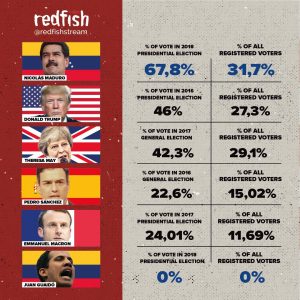
Saker interview with Michael Hudson on Venezuela, February 7, 2019

By The Saker and Michael Hudson

Source: The Saker

Introduction: There is a great deal of controversy about the true shape of the Venezuelan economy and whether Hugo Chavez’ and Nicholas Maduro’s reform and policies were crucial for the people of Venezuela or whether they were completely misguided and precipitated the current crises.  Anybody and everybody seems to have very strong held views about this.  But I don’t simply because I lack the expertise to have any such opinions.  So I decided to ask one of the most respected independent economists out there, Michael Hudson, for whom I have immense respect and whose analyses (including those he co-authored with Paul Craig Roberts) seem to be the most credible and honest ones you can find.  In fact, Paul Craig Roberts considers Hudson the “best economist in the world“!
I am deeply grateful to Michael for his replies which, I hope, will contribute to a honest and objective understanding of what really is taking place in Venezuela.
The Saker

The Saker: Could you summarize the state of Venezuela’s economy when Chavez came to power?

Michael Hudson: Venezuela was an oil monoculture. Its export revenue was spent largely on importing food and other necessities that it could have produced at home. Its trade was largely with the United States. So despite its oil wealth, it ran up foreign debt.

From the outset, U.S. oil companies have feared that Venezuela might someday use its oil revenues to benefit its overall population instead of letting the U.S. oil industry and its local comprador aristocracy siphon off its wealth. So the oil industry – backed by U.S. diplomacy – held Venezuela hostage in two ways.

First of all, oil refineries were not built in Venezuela, but in Trinidad and in the southern U.S. Gulf Coast states. This enabled U.S. oil companies – or the U.S. Government – to leave Venezuela without a means of “going it alone” and pursuing an independent policy with its oil, as it needed to have this oil refined. It doesn’t help to have oil reserves if you are unable to get this oil refined so as to be usable.
Second, Venezuela’s central bankers were persuaded to pledge their oil reserves and all assets of the state oil sector (including Citgo) as collateral for its foreign debt. This meant that if Venezuela defaulted (or was forced into default by U.S. banks refusing to make timely payment on its foreign debt), bondholders and U.S. oil majors would be in a legal position to take possession of Venezuelan oil assets.

These pro-U.S. policies made Venezuela a typically polarized Latin American oligarchy. Despite being nominally rich in oil revenue, its wealth was concentrated in the hands of a pro-U.S. oligarchy that let its domestic development be steered by the World Bank and IMF. The indigenous population, especially its rural racial minority as well as the urban underclass, was excluded from sharing in the country’s oil wealth. The oligarchy’s arrogant refusal to share the wealth, or even to make Venezuela self-sufficient in essentials, made the election of Hugo Chavez a natural outcome.

The Saker: Could you outline the various reforms and changes introduced by Hugo Chavez? What did he do right, and what did he do wrong?

Michael Hudson: Chavez sought to restore a mixed economy to Venezuela, using its government revenue – mainly from oil, of course – to develop infrastructure and domestic spending on health care, education, employment to raise living standards and productivity for his electoral constituency.

What he was unable to do was to clean up the embezzlement and built-in rake-off of income from the oil sector. And he was unable to stem the capital flight of the oligarchy, taking its wealth and moving it abroad – while running away themselves.

This was not “wrong”. It merely takes a long time to change an economy’s disruption – while the U.S. is using sanctions and “dirty tricks” to stop that process.

The Saker: What are, in your opinion, the causes of the current economic crisis in Venezuela – is it primarily due to mistakes by Chavez and Maduro or is the main cause US sabotage, subversion and sanctions?

Michael Hudson: There is no way that’s Chavez and Maduro could have pursued a pro-Venezuelan policy aimed at achieving economic independence without inciting fury, subversion and sanctions from the United States. American foreign policy remains as focused on oil as it was when it invaded Iraq under Dick Cheney’s regime. U.S. policy is to treat Venezuela as an extension of the U.S. economy, running a trade surplus in oil to spend in the United States or transfer its savings to U.S. banks.

By imposing sanctions that prevent Venezuela from gaining access to its U.S. bank deposits and the assets of its state-owned Citco, the United States is making it impossible for Venezuela to pay its foreign debt. This is forcing it into default, which U.S. diplomats hope to use as an excuse to foreclose on Venezuela’s oil resources and seize its foreign assets much as Paul Singer hedge fund sought to do with Argentina’s foreign assets.

Just as U.S. policy under Kissinger was to make Chile’s “economy scream,” so the U.S. is following the same path against Venezuela. It is using that country as a “demonstration effect” to warn other countries not to act in their self-interest in any way that prevents their economic surplus from being siphoned off by U.S. investors.

The Saker: What in your opinion should Maduro do next (assuming he stays in power and the USA does not overthrow him) to rescue the Venezuelan economy?

Michael Hudson: I cannot think of anything that President Maduro can do that he is not doing. At best, he can seek foreign support – and demonstrate to the world the need for an alternative international financial and economic system.

He already has begun to do this by trying to withdraw Venezuela’s gold from the Bank of England and Federal Reserve. This is turning into “asymmetrical warfare,” threatening what to de-sanctify the dollar standard in international finance. The refusal of England and the United States to grant an elected government control of its foreign assets demonstrates to the entire world that U.S. diplomats and courts alone can and will control foreign countries as an extension of U.S. nationalism.

The price of the U.S. economic attack on Venezuela is thus to fracture the global monetary system. Maduro’s defensive move is showing other countries the need to protect themselves from becoming “another Venezuela” by finding a new safe haven and paying agent for their gold, foreign exchange reserves and foreign debt financing, away from the dollar, sterling and euro areas.

The only way that Maduro can fight successfully is on the institutional level, upping the ante to move “outside the box.” His plan – and of course it is a longer-term plan – is to help catalyze a new international economic order independent of the U.S. dollar standard. It will work in the short run only if the United States believes that it can emerge from this fight as an honest financial broker, honest banking system and supporter of democratically elected regimes. The Trump administration is destroying illusion more thoroughly than any anti-imperialist critic or economic rival could do!

Over the longer run, Maduro also must develop Venezuelan agriculture, along much the same lines that the United States protected and developed its agriculture under the New Deal legislation of the 1930s – rural extension services, rural credit, seed advice, state marketing organizations for crop purchase and supply of mechanization, and the same kind of price supports that the United States has long used to subsidize domestic farm investment to increase productivity.

The Saker: What about the plan to introduce a oil-based crypto currency? Will that be an effective alternative to the dying Venezuelan Bolivar?

Michael Hudson: Only a national government can issue a currency. A “crypto” currency tied to the price of oil would become a hedging vehicle, prone to manipulation and price swings by forward sellers and buyers. A national currency must be based on the ability to tax, and Venezuela’s main tax source is oil revenue, which is being blocked from the United States. So Venezuela’s position is like that of the German mark coming out of its hyperinflation of the early 1920s. The only solution involves balance-of-payments support. It looks like the only such support will come from outside the dollar sphere.

The solution to any hyperinflation must be negotiated diplomatically and be supported by other governments. My history of international trade and financial theory, Trade, Development and Foreign Debt, describes the German reparations problem and how its hyperinflation was solved by the Rentenmark.

Venezuela’s economic-rent tax would fall on oil, and luxury real estate sites, as well as monopoly prices, and on high incomes (mainly financial and monopoly income). This requires a logic to frame such tax and monetary policy. I have tried to explain how to achieve monetary and hence political independence for the past half-century. China is applying such policy most effectively. It is able to do so because it is a large and self-sufficient economy in essentials, running a large enough export surplus to pay for its food imports. Venezuela is in no such position. That is why it is looking to China for support at this time.

The Saker: How much assistance do China, Russia and Iran provide and how much can they do to help? Do you think that these three countries together can help counter-act US sabotage, subversion and sanctions?

Michael Hudson: None of these countries have a current capacity to refine Venezuelan oil. This makes it difficult for them to take payment in Venezuelan oil. Only a long-term supply contract (paid for in advance) would be workable. And even in that case, what would China and Russia do if the United States simply grabbed their property in Venezuela, or refused to let Russia’s oil company take possession of Citco? In that case, the only response would be to seize U.S. investments in their own country as compensation.

At least China and Russia can provide an alternative bank clearing mechanism to SWIFT, so that Venezuela can by pass the U.S. financial system and keep its assets from being grabbed at will by U.S. authorities or bondholders. And of course, they can provide safe-keeping for however much of Venezuela’s gold it can get back from New York and London.

Looking ahead, therefore, China, Russia, Iran and other countries need to set up a new international court to adjudicate the coming diplomatic crisis and its financial and military consequences. Such a court – and its associated international bank as an alternative to the U.S.-controlled IMF and World Bank – needs a clear ideology to frame a set of principles of nationhood and international rights with power to implement and enforce its judgments.

This would confront U.S. financial strategists with a choice: if they continue to treat the IMF, World Bank, ITO and NATO as extensions of increasingly aggressive U.S. foreign policy, they will risk isolating the United States. Europe will have to choose whether to remain a U.S. economic and military satellite, or to throw in its lot with Eurasia.

However, Daniel Yergin reports in the Wall Street Journal (Feb. 7) that China is trying to hedge its bets by opening a back-door negotiation with Guaido’s group, apparently to get the same deal that it has negotiated with Maduro’s government. But any such deal seems unlikely to be honored in practice, given U.S. animosity toward China and Guaido’s total reliance on U.S. covert support.

The Saker: Venezuela kept a lot of its gold in the UK and money in the USA. How could Chavez and Maduro trust these countries or did they not have another choice? Are there viable alternatives to New York and London or are they still the “only game in town” for the world’s central banks?

Michael Hudson: There was never real trust in the Bank of England or Federal Reserve, but it seemed unthinkable that they would refuse to permit an official depositor from withdrawing its own gold. The usual motto is “Trust but verify.” But the unwillingness (or inability) of the Bank of England to verify means that the formerly unthinkable has now arrived: Have these central banks sold this gold forward in the post-London Gold Pool and its successor commodity markets in their attempt to keep down the price so as to maintain the appearance of a solvent U.S. dollar standard.

Paul Craig Roberts has described how this system works. There are forward markets for currencies, stocks and bonds. The Federal Reserve can offer to buy a stock in three months at, say, 10% over the current price. Speculators will by the stock, bidding up the price, so as to take advantage of “the market’s” promise to buy the stock. So by the time three months have passed, the price will have risen. That is largely how the U.S. “Plunge Protection Team” has supported the U.S. stock market.

The system works in reverse to hold down gold prices. The central banks holding gold can get together and offer to sell gold at a low price in three months. “The market” will realize that with low-priced gold being sold, there’s no point in buying more gold and bidding its price up. So the forward-settlement market shapes today’s market.

The question is, have gold buyers (such as the Russian and Chinese government) bought so much gold that the U.S. Fed and the Bank of England have actually had to “make good” on their forward sales, and steadily depleted their gold? In this case, they would have been “living for the moment,” keeping down gold prices for as long as they could, knowing that once the world returns to the pre-1971 gold-exchange standard for intergovernmental balance-of-payments deficits, the U.S. will run out of gold and be unable to maintain its overseas military spending (not to mention its trade deficit and foreign disinvestment in the U.S. stock and bond markets). My book on Super-Imperialism explains why running out of gold forced the Vietnam War to an end. The same logic would apply today to America’s vast network of military bases throughout the world.

Refusal of England and the U.S. to pay Venezuela means that other countries means that foreign official gold reserves can be held hostage to U.S. foreign policy, and even to judgments by U.S. courts to award this gold to foreign creditors or to whoever might bring a lawsuit under U.S. law against these countries.

This hostage-taking now makes it urgent for other countries to develop a viable alternative, especially as the world de-dedollarizes and a gold-exchange standard remains the only way of constraining the military-induced balance of payments deficit of the United States or any other country mounting a military attack. A military empire is very expensive – and gold is a “peaceful” constraint on military-induced payments deficits. (I spell out the details in my Super Imperialism: The Economic Strategy of American Empire (1972), updated in German as Finanzimperium(2017).

The U.S. has overplayed its hand in destroying the foundation of the dollar-centered global financial order. That order has enabled the United States to be “the exceptional nation” able to run balance-of-payments deficits and foreign debt that it has no intention (or ability) to pay, claiming that the dollars thrown off by its foreign military spending “supply” other countries with their central bank reserves (held in the form of loans to the U.S. Treasury – Treasury bonds and bills – to finance the U.S. budget deficit and its military spending, as well as the largely military U.S. balance-of-payments deficit.

Given the fact that the EU is acting as a branch of NATO and the U.S. banking system, that alternative would have to be associated with the Shanghai Cooperation Organization, and the gold would have to be kept in Russia and/or China.

The Saker:  What can other Latin American countries such as Bolivia, Nicaragua, Cuba and, maybe, Uruguay and Mexico do to help Venezuela?

Michael Hudson: The best thing neighboring Latin American countries can do is to join in creating a vehicle to promote de-dollarization and, with it, an international institution to oversee the writedown of debts that are beyond the ability of countries to pay without imposing austerity and thereby destroying their economies.

An alternative also is needed to the World Bank that would make loans in domestic currency, above all to subsidize investment in domestic food production so as to protect the economy against foreign food-sanctions – the equivalent of a military siege to force surrender by imposing famine conditions. This World Bank for Economic Acceleration would put the development of self-reliance for its members first, instead of promoting export competition while loading borrowers down with foreign debt that would make them prone to the kind of financial blackmail that Venezuela is experiencing.

Being a Roman Catholic country, Venezuela might ask for papal support for a debt write-down and an international institution to oversee the ability to pay by debtor countries without imposing austerity, emigration, depopulation and forced privatization of the public domain.

Two international principles are needed. First, no country should be obliged to pay foreign debt in a currency (such as the dollar or its satellites) whose banking system acts to prevents payment.

Second, no country should be obliged to pay foreign debt at the price of losing its domestic autonomy as a state: the right to determine its own foreign policy, to tax and to create its own money, and to be free of having to privatize its public assets to pay foreign creditors. Any such debt is a “bad loan” reflecting the creditor’s own irresponsibility or, even worse, pernicious asset grab in a foreclosure that was the whole point of the loan.

The Saker:  Thank you very much for taking the time to reply to my questions!

Hillary’s email revelation: France and US killed Qaddafi for his gold and oil

hilary_clinton_laughs_gaddafi_

By Bob Fitrakis

Source: FreePress.org

With the recent release of Hillary Clinton’s emails by Wikileaks, the public now knows exactly how the North Atlantic Treaty Organization (NATO) went from a collective defense organization to the new Barbary Coast Pirates of imperialism.

During the 2011 Libyan uprising, the United Nations Security Council passed Resolution 1973 which called for a ceasefire and authorized military action to protect civilian lives. A coalition formed, centered around NATO with the March 17, 2011 passing of the Resolution. Its purpose — a so-called “no-fly zone” over Libya.

The irony that the U.S.-dominated NATO military organization would be concerned with “protecting” Arab civilians is all too obvious since the United States is the nation most responsible for killing Arab civilians.

The real reasons for the attack have been dealt with most directly by America’s famous reformed “economic hitman,” John Perkins.

Perkins points out that the attack on Libya, like the attack on Iraq, has to do with power and control of resources, not only oil, but gold. Libya has the highest standard of living in Africa. “According to the IMF, Libya’s Central Bank is 100% state owned. The IMF estimates that the bank has nearly 144 tons of gold in its vaults,” Perkins wrote.

NATO went there like modern Barbary Coast Pirates — to loot Libya’s gold. The Russian media, in addition to Perkins, reported that the Pan-Africanist Qaddafi, the former President of the African Union, had been advocating that Africa use the gold so plentiful in Libya and South Africa to create an African currency based on a gold dinar.

“It is significant that in the months running up to the UN resolution that allowed the U.S. and its allies to send troops into Libya, Muammar al-Qaddafi was openly advocating the creation of a new currency that would rival the dollar and the euro. In fact, he called upon African and Muslim nations to join an alliance that would make this new currency, the gold dinar, their primary form of money and foreign exchange. They would sell oil and other resources to the US and the rest of the world only for gold dinars,” Perkins explained.

Revelation in Email to Hillary Clinton

Wikileaks released an unclassified U.S. Department of State document emailed to Hillary dated April 2, 2011, key Clinton aide Sidney Blumenthal confirmed that the Perkins was right and the attack on Libya had nothing to do with Qaddafi being a threat to the United States and NATO and everything to do with looting his gold.

“Qaddafi’s government holds 143 tons of gold, and a similar amount in silver. During late March, 2011, these stocks were moved to Sabha (south west in the direction of the Libyan border with Niger and Chad); taken from the vaults of the Libyan Central Bank in Tripoli,” Blumenthal reported to Clinton.

Blumenthal pointed out the purpose of Qaddafi’s precious metal: “This gold was accumulated prior to the current rebellion and was intended to be used to establish a pan-African currency based on the Libyan golden Dinar. This plan was designed to provide the Francophone African Countries with an alternative to the French franc (CFA).”

Blumenthal spells out the reason for NATO’s attack and France’s imperial plunder, “French intelligence officers discovered this plan shortly after the current rebellion began, and this was one of the factors that influenced President Nicholas Sarkozy’s decision to commit France to the attack on Libya.”

There were five reasons for France’s illegal war with NATO against Libya. Sarkozy sought, according to Blumenthal, “a. A desire to gain a greater share of Libyan oil production, b. Increase French influence in North Africa, c. Improve his internal situation in France, d. Provide the French military with an opportunity to assert its position in the world, e. Address the concern of his advisors over Qaddafi’s long term plans to supplant France as the dominant power in Francophone Africa.”

Under the neo-colonialism favored after World War II during the period of the Cold War, we preferred to bribe various African leaders to help us loot their nation’s resources. The U.S., of course, killed any Pan-African aspirations as well as potential leaders like Patrice Lumumba.

This highjacking of Arab and African resources and slaughtering of Arab civilians is a long-standing plan put forth by neo-conservatives in the United States. The Project for a New American Century (PNAC) has had a “hit list” of Arab nations and little regard for Arab casualties.

General Wesley Clark wrote in “Winning Modern Wars” that “As I went back through the Pentagon in November 2001, one of the senior military staff officers had time for a chat. Yes, we are still on track for going against Iraq, he said. But there was more. This was being discussed as part of a five-year campaign plan, he said, and there was a total of seven countries beginning with Iraq, then Syria, Lebanon, Libya, Iran, Somalia, and Sudan.

What we witnessed in Libya was old-fashioned 19th century imperialism — the deliberate plundering of a sovereign nation-state’s resources by more powerful Western conquistadors.

Link to Wikileaks article

Exposing the Libyan Agenda: A Closer Look at Hillary’s Emails

hilary_clinton_laughs_gaddafi_

By Ellen Brown

Source: Web of Debt

Critics have long questioned why violent intervention was necessary in Libya. Hillary Clinton’s recently published emails confirm that it was less about protecting the people from a dictator than about money, banking, and preventing African economic sovereignty.

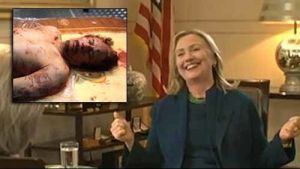
The brief visit of then-Secretary of State Hillary Clinton to Libya in October 2011 was referred to by the media as a “victory lap.” “We came, we saw, he died!” she crowed in a CBS video interview on hearing of the capture and brutal murder of Libyan leader Muammar el-Qaddafi.

But the victory lap, write Scott Shane and Jo Becker in the New York Times, was premature. Libya was relegated to the back burner by the State Department, “as the country dissolved into chaos, leading to a civil war that would destabilize the region, fueling the refugee crisis in Europe and allowing the Islamic State to establish a Libyan haven that the United States is now desperately trying to contain.”

US-NATO intervention was allegedly undertaken on humanitarian grounds, after reports of mass atrocities; but human rights organizations questioned the claims after finding a lack of evidence. Today, however, verifiable atrocities are occurring. As Dan Kovalik wrote in the Huffington Post, “the human rights situation in Libya is a disaster, as ‘thousands of detainees [including children] languish in prisons without proper judicial review,’ and ‘kidnappings and targeted killings are rampant’.”

Before 2011, Libya had achieved economic independence, with its own water, its own food, its own oil, its own money, and its own state-owned bank. It had arisen under Qaddafi from one of the poorest of countries to the richest in Africa. Education and medical treatment were free; having a home was considered a human right; and Libyans participated in an original system of local democracy. The country boasted the world’s largest irrigation system, the Great Man-made River project, which brought water from the desert to the cities and coastal areas; and Qaddafi was embarking on a program to spread this model throughout Africa.

But that was before US-NATO forces bombed the irrigation system and wreaked havoc on the country. Today the situation is so dire that President Obama has asked his advisors to draw up options including a new military front in Libya, and the Defense Department is reportedly standing ready with “the full spectrum of military operations required.”

The Secretary of State’s victory lap was indeed premature, if what we’re talking about is the officially stated goal of humanitarian intervention. But her newly-released emails reveal another agenda behind the Libyan war; and this one, it seems, was achieved.

Mission Accomplished?

Of the 3,000 emails released from Hillary Clinton’s private email server in late December 2015, nearly a third were from her close confidante Sidney Blumenthal, the Clinton aide who gained notoriety when he testified against Monica Lewinsky. One of these emails, dated April 2, 2011, reads in part:

Qaddafi’s government holds 143 tons of gold, and a similar amount in silver . . . . This gold was accumulated prior to the current rebellion and was intended to be used to establish a pan-African currency based on the Libyan golden Dinar. This plan was designed to provide the Francophone African Countries with an alternative to the French franc (CFA).

In a “source comment,” the original declassified email adds:

According to knowledgeable individuals this quantity of gold and silver is valued at more than $7 billion. French intelligence officers discovered this plan shortly after the current rebellion began, and this was one of the factors that influenced President Nicolas Sarkozy’s decision to commit France to the attack on Libya. According to these individuals Sarkozy’s plans are driven by the following issues:

  1. A desire to gain a greater share of Libya oil production,
  2. Increase French influence in North Africa,
  3. Improve his internal political situation in France,
  4. Provide the French military with an opportunity to reassert its position in the world,
  5. Address the concern of his advisors over Qaddafi’s long term plans to supplant France as the dominant power in Francophone Africa

Conspicuously absent is any mention of humanitarian concerns. The objectives are money, power and oil.

Other explosive confirmations in the newly-published emails are detailed by investigative journalist Robert Parry. They include admissions of rebel war crimes, of special ops trainers inside Libya from nearly the start of protests, and of Al Qaeda embedded in the US-backed opposition. Key propaganda themes for violent intervention are acknowledged to be mere rumors. Parry suggests they may have originated with Blumenthal himself. They include the bizarre claim that Qaddafi had a “rape policy” involving passing Viagra out to his troops, a charge later raised by UN Ambassador Susan Rice in a UN presentation. Parry asks rhetorically:

So do you think it would it be easier for the Obama administration to rally American support behind this “regime change” by explaining how the French wanted to steal Libya’s wealth and maintain French neocolonial influence over Africa – or would Americans respond better to propaganda themes about Gaddafi passing out Viagra to his troops so they could rape more women while his snipers targeted innocent children? Bingo!

Toppling the Global Financial Scheme

Qaddafi’s threatened attempt to establish an independent African currency was not taken lightly by Western interests. In 2011, Sarkozy reportedly called the Libyan leader a threat to the financial security of the world. How could this tiny country of six million people pose such a threat? First some background.

It is banks, not governments, that create most of the money in Western economies, as the Bank of England recently acknowledged. This has been going on for centuries, through the process called “fractional reserve” lending. Originally, the reserves were in gold.  In 1933, President Franklin Roosevelt replaced gold domestically with central bank-created reserves, but gold remained the reserve currency internationally.

In 1944, the International Monetary Fund and the World Bank were created in Bretton Woods, New Hampshire, to unify this bank-created money system globally. An IMF ruling said that no paper money could have gold backing. A money supply created privately as debt at interest requires a continual supply of debtors; and over the next half century, most developing countries wound up in debt to the IMF. The loans came with strings attached, including “structural adjustment” policies involving austerity measures and privatization of public assets.

After 1944, the US dollar traded interchangeably with gold as global reserve currency. When the US was no longer able to maintain the dollar’s gold backing, in the 1970s it made a deal with OPEC to “back” the dollar with oil, creating the “petro-dollar.”  Oil would be sold only in US dollars, which would be deposited in Wall Street and other international banks.

In 2001, dissatisfied with the shrinking value of the dollars that OPEC was getting for its oil, Iraq’s Saddam Hussein broke the pact and sold oil in euros. Regime change swiftly followed, accompanied by widespread destruction of the country.

In Libya, Qaddafi also broke the pact; but he did more than just sell his oil in another currency.

As these developments are detailed by blogger Denise Rhyne:

For decades, Libya and other African countries had been attempting to create a pan-African gold standard.  Libya’s al-Qadhafi and other heads of African States had wanted an independent, pan-African, “hard currency.”

Under al-Qadhafi’s leadership, African nations had convened at least twice for monetary unification.  The countries discussed the possibility of using the Libyan dinar and the silver dirham as the only possible money to buy African oil.

Until the recent US/NATO invasion, the gold dinar was issued by the Central Bank of Libya (CBL).  The Libyan bank was 100% state owned and independent.  Foreigners had to go through the CBL to do business with Libya.  The Central Bank of Libya issued the dinar, using the country’s 143.8 tons of gold.

Libya’s Qadhafi (African Union 2009 Chair) conceived and financed a plan to unify the sovereign States of Africa with one gold currency (United States of Africa).  In 2004, a pan-African Parliament (53 nations) laid plans for the African Economic Community – with a single gold currency by 2023.

African oil-producing nations were planning to abandon the petro-dollar, and demand gold payment for oil/gas.

Showing What Is Possible

Qaddafi had done more than organize an African monetary coup. He had demonstrated that financial independence could be achieved. His greatest infrastructure project, the Great Man-made River, was turning arid regions into a breadbasket for Libya; and the $33 billion project was being funded interest-free without foreign debt, through Libya’s own state-owned bank.

That could explain why this critical piece of infrastructure was destroyed in 2011. NATO not only bombed the pipeline but finished off the project by bombing the factory producing the pipes necessary to repair it. Crippling a civilian irrigation system serving up to 70% of the population hardly looks like humanitarian intervention. Rather, as Canadian Professor Maximilian Forte put it in his heavily researched book Slouching Towards Sirte: NATO’s War on Libya and Africa:

[T]he goal of US military intervention was to disrupt an emerging pattern of independence and a network of collaboration within Africa that would facilitate increased African self-reliance. This is at odds with the geostrategic and political economic ambitions of extra-continental European powers, namely the US.

Mystery Solved

Hillary Clinton’s emails shed light on another enigma remarked on by early commentators. Why, within weeks of initiating fighting, did the rebels set up their own central bank? Robert Wenzel wrote in The Economic Policy Journal in 2011:

This suggests we have a bit more than a rag tag bunch of rebels running around and that there are some pretty sophisticated influences. I have never before heard of a central bank being created in just a matter of weeks out of a popular uprising.

It was all highly suspicious, but as Alex Newman concluded in a November 2011 article:

Whether salvaging central banking and the corrupt global monetary system were truly among the reasons for Gadhafi’s overthrow . . . may never be known for certain – at least not publicly.

There the matter would have remained – suspicious but unverified like so many stories of fraud and corruption – but for the publication of Hillary Clinton’s emails after an FBI probe. They add substantial weight to Newman’s suspicions: violent intervention was not chiefly about the security of the people. It was about the security of global banking, money and oil.

Errata: Sidney Blumenthal is not an attorney, as originally stated in this article. When he earned notoriety as Bill Clinton’s defender against Monica Lewinsky, it was as special adviser for the Clintons.

__________________

Ellen Brown is an attorney and author of twelve books, including the best-selling Web of Debt. Her latest book, The Public Bank Solution, explores successful public banking models historically and globally. Her 300+ blog articles are at EllenBrown.com. Listen to “It’s Our Money with Ellen Brown” on PRN.FM.


Related Podcast:  Progressive Commentary Hour – 03.15.16 James and Joanne Moriarty on the real motives behind the 2011 invasion of Libya.

25 Signs That The Global Elite’s Ship Is About To Sink

225473091_Rats_300x231_xlarge

By Lance Schuttler

Source: The Mind Unleashed

Make no mistake about it. The tide has turned on the global elite and there will be no going back. A new day is rising for humanity as those who have planned for complete control are now being exposed, cornered and investigated from many different angles. There is no need to buy into the fear-based propaganda the major media and even several alternative media outlets dispense. Very good things are happening and even better things are coming. Let’s take a look at some of the major stories that have occurred in the last 8 weeks alone. Piecing the puzzle together, we see that the jig is up and the events surrounding it are growing in size and speed.

1. 57 Nations approved as founding members of the China-led Asian Infrastructure Investment Bank. Notable countries who signed on June 29th, 2015 include Russia, India, Iran, Switzerland, Germany, France, Saudi Arabia, Australia, Indonesia, the UK, Italy and Austria. Notables who did not join are the U.S. and Japan.

2. May 12th, 2015: Russia asks Greece to join the BRICS Alliance. Notice the BRICS trend in the stories to follow.

3. May 24th, 2015: The Pentagon released documents to Judicial Watch, a government watchdog law firm,
proving that the US Government played a central role in creating ISIL. Interestingly, the mainstream media failed to cover this story. A few weeks later, ex US Intelligence officials confirm the report.

4. May 31st, 2015: Greece’s Prime Minister Alexis Tsipras writes an open letter, warns European leaders they are “making a grave mistake,” and suggests they re-read Hemingways’s “For Whom The Bell Tolls.”

5. June 2nd, 2015: The U.S. Federal Government was hacked as the personal data of 4 million current, former and prospective employees believed to have been breached. 3 weeks later FBI Director James Comey told US Senators the actual number could be 18 million. Some believe the hack was coordinated to gather further evidence
of crimes by certain government officials. More on that further down.

6. June 2nd, 2015: Kentucky Senator Rand Paul calls for the U.S. Government to declassify 28 pages in the 9/11 attack report that the Bush Administration blacked out.

7. June 3rd, 2015: Famous musician Akon announces his Solar Academy will bring solar power to over 600 million people in Africa. A major victory for clean energy and humanity.

8. June 4th, 2015: Whistle-blower Edward Snowden says a “profound difference” had occurred since releasing the NSA documents and that the balance of power has shifted in our world.  Is he referring to the BRICS Alliance?

9. June 5th, 2015: “There Will Be A Reset of The Financial Industry.” The International Monetary Fund says the Chinese yuan is no longer undervalued. This sets the stage for the yuan to be recognized as a global reserve currency, something the U.S. Dollar (which is backed by war and oil) does not like.

10. June 7, 2015: Deutsche Bank, one of the world’s largest banks, co-CEO’s Jain and Fitschen resign. Two days later, German prosecutors raided the Bank’s headquarters in a criminal tax-fraud probe.

11. June 15, 2015: China says the G-7 Summit in Germany was a “gathering of debtors.” They mean this literally as the Bretton Woods western financial system is based on debt. And in fact, the entire western financial system has been running illegally and is technically bankrupt. For more on the real history of Bretton Woods and its connection to JFK, The Global Collateral Accounts and the gold standard, read here.

12. June 17th, 2015 is quite the day with the next four stories all being reported at that time. First, JP Morgan’s number 2, the Vice Chairman Jimmy Lee, suddenly and unexpectedly passes over. Since late 2013, the list of high-level banking officials to have passed over has grown to 70. Clearly, something is happening.

13. June 17, 2015: Russia and China announced that all natural gas and crude oil sales between
the two countries will now be done in Chinese yuan( formerly the U.S. Dollar) and will be convertible into Russian Rubles. The U.S. Dollar hegemony is waning.

14. June 17, 2015: The State of Texas has signed a bill that calls for the repatriation of their gold from the Federal Government. When asked what would happen if the government tried to steal back the gold, State Representative Giovanni Capriglione said this: There is a motto in the office of almost every state legislator in Texas, and it’s a flag that we have [from the Texas Revolution], it’s below a cannon and what the motto says is, “Come and Take it.”

15. June 17, 2015: Greece’s Hellenic Parliament’s Debt Truth Committee released a report stating that the debt Greece “owes” is illegal, illegitimate and odious, according to international law. Further, they stated the IMF and ECB ( European Central Bank) having illegally and knowingly imposed these illegitimate debts upon Greece and other nations. A direct call out to the global banking cartel.

16. June 18th, 2015: Baron David de Rothschild has been indicted by a French court over financial fraud. French police have been ordered by the court to track down Baron. The Rothschild family has long been viewed as the family sitting atop the global financial ponzi scheme. Lawyer Antonio Flores told reporters, ” it’s a real breakthrough moment for everyone involved.”

17. June 18, 2015: In a 2-1 ruling, the 2nd Circuit U.S. Court of Appeals says Bush era officials can be held liable for detaining innocent people after the 9/11 attack. Will this lead to some major arrests?

18. June 19, 2015: While European leaders try to save face on the debt crisis, Greek PM Alexis Tsipras was in Russia and gave a speech at the St. Petersburg Economic Forum, stating that “the economic center of the planet has already shifted” and that new powers are playing an “important role on an economic and geopolitical level.” * Reread story header number 8…BRICS, anyone? Oh, and Greece and Russia signed a €2 billion gas pipeline deal that day too…a strategic economic and geopolitical game-changer.

19. July 5th, 2015: Greece votes “NO” to the creditors’ bailout offer. This is a massive stance for humanity that Greece just took against the banking elite. As of this writing, a “deal” has been reached but is expected to fall apart in the coming days. Kicking the can down the road does not solve the issue, but rather speeds up the revolution mindset of many frustrated Greek citizens. September/October is when many financial experts are saying that some fireworks are to be expected. 

20. July 7th, 2015: The BRICS Bank officially opens for business.

21. July 8th, 2015: On this day, several strange events occurred. The NYSE was taken down for multiple hours, the Wall Street Journal was taken offline just after the stock exchange went down, United Airlines was forced to ground all of its flights nationwide due to computer “issues,” and 2,500 people losing power in Washington D.C. This whistle-blower journalist just wrote that his Pentagon sources said the Pentagon/BRICS Alliance took it down as a “dry run.”

22. July 7th, 2015: Backing up one day we see that the hacking group Anonymous tweeted this on the evening prior to the stock exchange hack: Wonder if tomorrow is going to be bad for Wall Street….we can only hope. 
David Wilcock has previously written a detailed document stating that Anonymous is working with certain patriotic US Military forces to legally take down the banking elite.. This aligns nicely with what the whistle-blower journalist, Benjamin Fulford, just wrote this week about the Pentagon and BRICS Alliance in the previous story.

23. July 14th, 2015: Iran, China, Russia, France, Germany, the U.K. and the U.S. reach a historic deal on Iran’s nuclear program. Entire books could be written on the geopolitical, financial and technological implications of this move. There are also reports that the reality of this situation is that Iran has free energy technology and will be using this to help bring down the banking/political/oil industry elite. This would make sense as the strongest opponents to this deal have been Israel and its Prime Minister and several American politicians like the Bushes, Marco Rubio and Ted Cruz. 

24. July 15th, 2015: Santa Cruz County votes to stop doing business with 5 major banks, including JP Morgan Chase, Barclays, Citigroup, Royal Bank of Scotland and UBS. Watch this set off a chain reaction in those who will follow suit.

25. Now: You are here on the planet at this time to make a wonderful contribution. Please continue playing your role for the benefit of us all.

It is clear that something big is happening. Use this information to move forward with optimism and hope. Share with your friends. Discuss with your friends. Continue to search and dig for the truth. Two people I strongly suggest the reader looking into are Benjamin Fulford, the whistleblower who was the Asia Pacific Bureau Chief for Forbes Magazine and is listed in stories number 21 and 22, and Neil Keenan, who is working with many well connected sources to open up the global collateral accounts. These accounts are what President Kennedy was assassinated over and are what the banking elite does not want the public to know exists. This revolution WILL NOT be televised.