Net Zero, the Digital Panopticon and the Future of Food 

By Colin Todhunter

Source: Off-Guardian

The food transition, the energy transition, net-zero ideology, programmable central bank digital currencies, the censorship of free speech and clampdowns on protest. What’s it all about? To understand these processes, we need to first locate what is essentially a social and economic reset within the context of a collapsing financial system.

Writer Ted Reece notes that the general rate of profit has trended downwards from an estimated 43% in the 1870s to 17% in the 2000s. By late 2019, many companies could not generate enough profit. Falling turnover, squeezed margins, limited cashflows and highly leveraged balance sheets were prevalent.

Professor Fabio Vighi of Cardiff University has described how closing down the global economy in early 2020 under the guise of fighting a supposedly new and novel pathogen allowed the US Federal Reserve to flood collapsing financial markets (COVID relief) with freshly printed money without causing hyperinflation. Lockdowns curtailed economic activity, thereby removing demand for the newly printed money (credit) in the physical economy and preventing ‘contagion’.

According to investigative journalist Michael Byrant, €1.5 trillion was needed to deal with the crisis in Europe alone. The financial collapse staring European central bankers in the face came to a head in 2019. The appearance of a ‘novel virus’ provided a convenient cover story.

The European Central Bank agreed to a €1.31 trillion bailout of banks followed by the EU agreeing to a €750 billion recovery fund for European states and corporations. This package of long-term, ultra-cheap credit to hundreds of banks was sold to the public as a necessary programme to cushion the impact of the pandemic on businesses and workers.

In response to a collapsing neoliberalism, we are now seeing the rollout of an authoritarian great reset — an agenda that intends to reshape the economy and change how we live.

SHIFT TO AUTHORITARIANISM

The new economy is to be dominated by a handful of tech giants, global conglomerates and e-commerce platforms, and new markets will also be created through the financialisation of nature, which is to be colonised, commodified and traded under the notion of protecting the environment.

In recent years, we have witnessed an overaccumulation of capital, and the creation of such markets will provide fresh investment opportunities (including dodgy carbon offsetting Ponzi schemes)  for the super-rich to park their wealth and prosper.

This great reset envisages a transformation of Western societies, resulting in permanent restrictions on fundamental liberties and mass surveillance. Being rolled out under the benign term of a ‘Fourth Industrial Revolution’, the World Economic Forum (WEF) says the public will eventually ‘rent’ everything they require (remember the WEF video ‘you will own nothing and be happy’?): stripping the right of ownership under the guise of a ‘green economy’ and underpinned by the rhetoric of ‘sustainable consumption’ and ‘climate emergency’.

Climate alarmism and the mantra of sustainability are about promoting money-making schemes. But they also serve another purpose: social control.

Neoliberalism has run its course, resulting in the impoverishment of large sections of the population. But to dampen dissent and lower expectations, the levels of personal freedom we have been used to will not be tolerated. This means that the wider population will be subjected to the discipline of an emerging surveillance state.

To push back against any dissent, ordinary people are being told that they must sacrifice personal liberty in order to protect public health, societal security (those terrible Russians, Islamic extremists or that Sunak-designated bogeyman George Galloway) or the climate. Unlike in the old normal of neoliberalism, an ideological shift is occurring whereby personal freedoms are increasingly depicted as being dangerous because they run counter to the collective good.

The real reason for this ideological shift is to ensure that the masses get used to lower living standards and accept them. Consider, for instance, the Bank of England’s chief economist Huw Pill saying that people should ‘accept’ being poorer. And then there is Rob Kapito of the world’s biggest asset management firm BlackRock, who says that a “very entitled” generation must deal with scarcity for the first time in their lives.

At the same time, to muddy the waters, the message is that lower living standards are the result of the conflict in Ukraine and supply shocks that both the war and ‘the virus’ have caused.

The net-zero carbon emissions agenda will help legitimise lower living standards (reducing your carbon footprint) while reinforcing the notion that our rights must be sacrificed for the greater good. You will own nothing, not because the rich and their neoliberal agenda made you poor but because you will be instructed to stop being irresponsible and must act to protect the planet.

NET-ZERO AGENDA

But what of this shift towards net-zero greenhouse gas emissions and the plan to slash our carbon footprints? Is it even feasible or necessary?

Gordon Hughes, a former World Bank economist and current professor of economics at the University of Edinburgh, says in a new report that current UK and European net-zero policies will likely lead to further economic ruin.

Apparently, the only viable way to raise the cash for sufficient new capital expenditure (on wind and solar infrastructure) would be a two decades-long reduction in private consumption of up to 10 per cent. Such a shock has never occurred in the last century outside war; even then, never for more than a decade.

But this agenda will also cause serious environmental degradation. So says Andrew Nikiforuk in the article The Rising Chorus of Renewable Energy Skeptics, which outlines how the green techno-dream is vastly destructive.

He lists the devastating environmental impacts of an even more mineral-intensive system based on renewables and warns:

“The whole process of replacing a declining system with a more complex mining-based enterprise is now supposed to take place with a fragile banking system, dysfunctional democracies, broken supply chains, critical mineral shortages and hostile geopolitics.”

All of this assumes that global warming is real and anthropogenic. Not everyone agrees. In the article Global warming and the confrontation between the West and the rest of the world, journalist Thierry Meyssan argues that net zero is based on political ideology rather than science. But to state such things has become heresy in the Western countries and shouted down with accusations of ‘climate science denial’.

Regardless of such concerns, the march towards net zero continues, and key to this is the United Nations Agenda 2030 for Sustainable Development Goals.

Today, almost every business or corporate report, website or brochure includes a multitude of references to ‘carbon footprints’, ‘sustainability’, ‘net zero’ or ‘climate neutrality’ and how a company or organisation intends to achieve its sustainability targets. Green profiling, green bonds and green investments go hand in hand with displaying ‘green’ credentials and ambitions wherever and whenever possible.

It seems anyone and everyone in business is planting their corporate flag on the summit of sustainability. Take Sainsbury’s, for instance. It is one of the ‘big six’ food retail supermarkets in the UK and has a vision for the future of food that it published in 2019.

Here’s a quote from it:

“Personalised Optimisation is a trend that could see people chipped and connected like never before. A significant step on from wearable tech used today, the advent of personal microchips and neural laces has the potential to see all of our genetic, health and situational data recorded, stored and analysed by algorithms which could work out exactly what we need to support us at a particular time in our life. Retailers, such as Sainsbury’s could play a critical role to support this, arranging delivery of the needed food within thirty minutes — perhaps by drone.”

Tracked, traced and chipped — for your own benefit. Corporations accessing all of our personal data, right down to our DNA. The report is littered with references to sustainability and the climate or environment, and it is difficult not to get the impression that it is written so as to leave the reader awestruck by the technological possibilities.

However, the promotion of a brave new world of technological innovation that has nothing to say about power — who determines policies that have led to massive inequalities, poverty, malnutrition, food insecurity and hunger and who is responsible for the degradation of the environment in the first place — is nothing new.

The essence of power is conveniently glossed over, not least because those behind the prevailing food regime are also shaping the techno-utopian fairytale where everyone lives happily ever after eating bugs and synthetic food while living in a digital panopticon.

FAKE GREEN

The type of ‘green’ agenda being pushed is a multi-trillion market opportunity for lining the pockets of rich investors and subsidy-sucking green infrastructure firms and also part of a strategy required to secure compliance required for the ‘new normal’.

It is, furthermore, a type of green that plans to cover much of the countryside with wind farms and solar panels with most farmers no longer farming. A recipe for food insecurity.

Those investing in the ‘green’ agenda care first and foremost about profit. The supremely influential BlackRock invests in the current food system that is responsible for polluted waterways, degraded soils, the displacement of smallholder farmers, a spiralling public health crisis, malnutrition and much more.

It also invests in healthcare — an industry that thrives on the illnesses and conditions created by eating the substandard food that the current system produces. Did Larry Fink, the top man at BlackRock, suddenly develop a conscience and become an environmentalist who cares about the planet and ordinary people? Of course not.

Any serious deliberations on the future of food would surely consider issues like food sovereignty, the role of agroecology and the strengthening of family farms — the backbone of current global food production.

The aforementioned article by Andrew Nikiforuk concludes that, if we are really serious about our impacts on the environment, we must scale back our needs and simplify society.

In terms of food, the solution rests on a low-input approach that strengthens rural communities and local markets and prioritises smallholder farms and small independent enterprises and retailers, localised democratic food systems and a concept of food sovereignty based on self-sufficiency, agroecological principles and regenerative agriculture.

It would involve facilitating the right to culturally appropriate food that is nutritionally dense due to diverse cropping patterns and free from toxic chemicals while ensuring local ownership and stewardship of common resources like land, water, soil and seeds.

That’s where genuine environmentalism and the future of food begins.

If……Then That’s Treason

[Source: dcclothesline.com]

By Michael Diamond

Source: Covert Action

The Perpetrators

This list of perpetrators is not meant to be exhaustive, but it can help us begin a conversation that should lead to indictments for treason, in addition to other crimes. The harms these perpetrators are doing must be stopped. Survival is at stake.

If COVID-19 was a laboratory-created disease for which people were denied palliative treatments and forced to receive harmful injections, then that was treason.

If global warming is occurring because of refusals by coal, oil and gas producers to curb those uses and switch to renewables, then that conduct was treason.

If coal, oil and gas producers knew of new energy technologies that could have eased our environmental crisis and stood in the way of their implementation, then that was treason.

If anyone in authority knew of new or unique energy technologies that could have eased our environmental crisis and stood in the way of implementation, then they were guilty of treason.

If harsh weather patterns and damaging weather events are being created that are destroying regions and parts of this country, then those manipulations of the weather are acts of treason.

If earthquakes, tsunamis, and fires are being created by weapons of war, like HAARP (High-frequency Active Auroral Research Program) and DEW (directed energy weapons), then bringing about that devastation is treasonous conduct.

If high-flying airplanes are spraying nanoparticulates of toxic metals and harmful materials upon the population, then those bombardments, which sorely affect physical health and mental acuities, are acts of treason.

If the communications industry persists in expanding wireless technology without allowing governmental oversight to make reasonable regulations for safety against harmful EMF (electro-magnetic frequency) exposures, then that conduct is treason.

If World Trade Center Buildings 1, 2 and 7 came down, not as a result of airplane collisions, but by controlled demolition, then that was treason.

If the Pentagon was struck on 9/11, not by an airplane but by one of our own missiles, then that was treason. 

If U.S. weapons-grade anthrax was used against Congressmen who were holding up passage of the USA Patriot Act after 9/11, then that was treason. 

The American people are now beset with harms from an extraordinary array of toxic chemical exposures that began four generations ago. If the large agricultural and industrial interests continue to harm our significantly burdened population with toxic exposures, then that will be treason.

The American people are now experiencing extensive health deficits, including physical, mental and behavioral declines. Our health-care system was created in the early 1900s. It was and continues to be dominated by allopathic medicine to the exclusion of a great number of safe, effective and inexpensive healing modalities. Pharmaceutical companies are the major beneficiaries of an insurance-funded allopathic system that’s incapable of bringing about adequate and preventive health care for all. Continued resistance by the pharmaceutical companies to necessary changes that must be made can and should be considered treason. 

What Is Treason?

The crime of treason is set forth in the U.S Constitution. “Treason against the United States, shall consist only in levying War against them, or in adhering to their Enemies, giving them Aid and Comfort.” See Article III, Section 3, Clause 1. A number of states have identical treason provisions.

The punishment for those who owe “allegiance to the United States” and commit treason is death or imprisonment for not less than five years and a fine of not less than $10,000. See 18 U.S. Code, Chapter 115, Section 2381.

People often make the mistake of believing that we need to be at war for there to be an indictment for treason. That is incorrect. To commit the crime of treason (the levying of war part), one need only use force to prevent the carrying out of laws or to affect the public policies of the nation.

For example, our history books are filled with charges of treason that were leveled against those who used force in efforts to stop the capture and return of runaway slaves before the Civil War. Defendants were charged with treason because they interfered with the Fugitive Slave Acts. Abraham Lincoln, as a young lawyer, participated in those cases. 

And the case of United States v. Aaron Burr, Circuit Court, D Virginia, 25 F. Cas 49 (1807) is most instructive. Chief Justice John Marshall presided over the trial of Aaron Burr who was charged with treason. Marshall carefully instructed the jury that they could find Burr guilty of treason only if they had proof that he used force in an effort to interfere with laws or public policies of the United States. Planning alone was insufficient, said the Chief Justice. There had to have been some force—like actually having soldiers marching with weapons to do harm.

The perpetrators listed above went far beyond planning. They used force to poison us, to kill us, to make this Earth less habitable for us, and to take us into unnecessary wars. They trampled upon our most sacred public policies of respect for due process, the expectation of health protections, and the basic right of reliance upon representative government to act on our behalf.

Misprision of Treason

Prosecutions for the crimes of treason will be relatively easy as a result of 18 USC, Chapter 115, Section 2382, which provides: “Whoever, owing allegiance to the United States and having knowledge of the commission of any treason against them, conceals and does not, as soon as may be, disclose and make known the same to the President or to some judge of the United States, or to the governor or to some judge or justice of a particular State, is guilty of misprision of treason and shall be fined under this title or imprisoned not more than seven years, or both.” A few states have identical misprision of treason statutes.

There are millions of upstanding and brave witnesses to the ongoing crimes of COVID-19. Thousands of them have been unfairly vilified and falsely charged with lying.

And so many witnesses know the details about how global warming was allowed to occur and how weather has been made into a weapon of mass destruction.

The bombing of people with nanoparticulates of poisonous materials requires meteorologists, air traffic controllers, and pilots to abide by the official story that trails in the sky are merely water vapor, even though the trails remain in the skies indefinitely. Anyone who has ever used a humidifier knows differently. Water vapor evaporates quickly.

Anyone with an eighth-grade science background can see through the falsehoods of the official story of the 9/11 attacks, especially the way in which Building 7 came down. It came down in its own footprint, seven hours after Buildings 1 and 2, having experienced nothing more than a few sporadic office fires.

Similarly, anyone who has any observational skills knows that an airplane with wide wings, massive engines, and a tall tail could not have hit the Pentagon on 9/11, leaving no aircraft debris and only one circular hole in the outside wall and circular holes in a succession of interior walls.

Everyone involved in the anthrax investigation knows that the anthrax used against U.S. Congressmen to assure passage of the USA Patriot Act was manufactured at a particular U.S. Army base.

And scientists who continually create new versions of things like forever chemicals are firsthand witnesses to how agricultural and manufacturing interests continue to knowingly make the world more toxic by the day.

Finally, the medical profession is filled with practitioners who have come to understand that there are gentler ways to assure that their patients survive and thrive. And millions of us have been successfully treated by alternative methods which are safe and inexpensive.

A Last Line of Defense

There are thousands of federal, state, and county prosecutors across the United States. All have a sworn obligation to investigate and bring crimes to the attention of grand juries in their jurisdictions. 

They should be thought of as our last line of defense. We might have only a decade before this Earth reaches the point of no return concerning habitability. Vested interests have largely captured both state and federal regulatory systems. The two major political parties are incapable of bringing forth adequate responses and leaders capable of quickly making necessary changes for our protection.

Meanwhile, public health continues to deteriorate. In 1970, René Dubos, a world renowned microbiologist, in an essay titled “The Limits of Adaptability,” pleaded for us to stop the toxic exposures that are so far beyond human tolerance. Not stopping the exposures, he feared, will lead us to the development of “a form of life that will retain little of true humanness.”

The evidence all around us makes it apparent that we are fast approaching that point. Certainly, the skills to bring about major analyses of current affairs is slipping away, as are the abilities to bring about large societal changes. Indeed, human consciousness itself is waning. So now, as never before, we need the prosecutors to fully investigate and prosecute the crimes of treason, while there is still time to turn this world around. 

The treasons that are now being carried out are interfering with and violating our basic rights. The perpetrators are making a mockery of what should be the blessings of life, liberty and justice. 

U.S. Government Likely Perpetrated Biggest-Ever Catastrophic Global Warming Event

By Eric Zuesse

Source: The Duran

On September 28th, the AP headlined “Record methane leak flows from damaged Baltic Sea pipelines” and reported that “Methane leaking from the damaged Nord Stream pipelines is likely to be the biggest burst of the potent greenhouse gas on record, by far. … Andrew Baxter, a chemical engineer who formerly worked in the offshore oil and gas industry, and is now at the environmental group EDF …  said, ‘It’s catastrophic for the climate.’” The article pointed out that methane “is 82.5 times more potent than carbon dioxide at absorbing the sun’s heat and warming the Earth.”

Russian President Vladimir Putin had been aiming ultimately (and maybe soon) to get the gas to Europe flowing again, and said to EU nations on September 16th, “Just lift the sanctions on Nord Stream 2, which is 55 billion cubic metres of gas per year, just push the button and everything will get going.”

Here is what U.S. President Joe Biden had already promised about that on February 7th:

If Germany — if Russia invades — that means tanks or troops crossing the — the border of Ukraine again — then there will be — we — there will be no longer a Nord Stream 2.  We will bring an end to it. 

Q    But how will you — how will you do that exactly, since the project and control of the project is within Germany’s control?

PRESIDENT BIDEN:  We will — I promise you, we’ll be able to do it

He had promised to cause permanently the end of Nord Stream if Russia invaded, which it did on February 24th. He fulfilled on that promise on September 27th.

Radek Sikorsky, who is a Member of the European Parliament and had been Poland’s Foreign Minister and is the husband of the famous writer against Russia Anne Applebaum, and has been affiliated with Oxford University, Harvard University, and NATO, tweeted on the day of the explosions, “Thank you, USA.” He also tweeted explanations: “All Ukrainian and Baltic sea states have opposed Nordstream’s construction for 20 years. Now $20 billion of scrap metal lies at the bottom of the sea, another cost to Russia of its criminal decision to invade Ukraine.” And: “Nordstream’s only logic was for Putin to be able to blackmail or wage war on Eastern Europe with impunity.”

Furthermore on September 27th, Germany’s Spiegel magazine reported that, as Reuters put it, “The U.S. Central Intelligence Agency (CIA) had weeks ago warned Germany about possible attacks on gas pipelines in the Baltic Sea” 

On September 28th, SouthFront headlined “No Way Back for Europe” and reported

It is reasonably suspected that the pipeline was blown up by the special services of the United States in order to finally stop the gas supplies to Germany from Russia.

On September 27, a detachment of warships led by the US amphibious assault ship USS Kearsarge reported on the completion of their tasks in the area of the alleged sabotage in the Baltic Sea and headed for the North Sea.

Since the beginning of September, suspicious activity by anti-submarine helicopters of the US Navy has been observed in the area. In the last few days, reconnaissance activities of NATO aircraft have significantly intensified in the Baltic Sea area. In particular, a US Boeing E-3 Sentry reconnaissance aircraft was on constant patrol over the Baltic States, and a US Joint STARS was spotted over Germany and Poland.

—————

Investigative historian Eric Zuesse’s new book, AMERICA’S EMPIRE OF EVIL: Hitler’s Posthumous Victory, and Why the Social Sciences Need to Change, is about how America took over the world after World War II in order to enslave it to U.S.-and-allied billionaires. Their cartels extract the world’s wealth by control of not only their ‘news’ media but the social ‘sciences’ — duping the public.

Saving Capitalism or Saving the Planet? 

By Colin Todhunter

Source: Dissident Voice

The UK government’s Behavioural Insights Team helped to push the public towards accepting the COVID narrative, restrictions and lockdowns. It is now working on ‘nudging’ people towards further possible restrictions or at least big changes in their behaviour in the name of ‘climate emergency’. From frequent news stories and advertisements to soap opera storylines and government announcements, the message about impending climate catastrophe is almost relentless.

Part of the messaging includes blaming the public’s consumption habits for a perceived ‘climate emergency’. At the same time, young people are being told that we only have a decade or so (depending on who is saying it) to ‘save the planet’.

Setting the agenda are powerful corporations that helped degrade much of the environment in the first place. But ordinary people, not the multi-billionaires pushing this agenda, will pay the price for this as living more frugally seems to be part of the programme (‘own nothing and be happy’). Could we at some future point see ‘climate emergency’ lockdowns, not to ‘save the NHS’ but to ‘save the planet’?

A tendency to focus on individual behaviour and not ‘the system’ exists.

But let us not forget this is a system that deliberately sought to eradicate a culture of self-reliance that prevailed among the working class in the 19th century (self-education, recycling products, a culture of thrift, etc) via advertising and a formal school education that ensured conformity and set in motion a lifetime of wage labour and dependency on the products manufactured by an environmentally destructive capitalism.

A system that has its roots in inflicting massive violence across the globe to exert control over land and resources elsewhere.

In his 2018 book The Divide: A Brief Guide to Global Inequalities and its solutions, Jason Hickel describes the processes involved in Europe’s wealth accumulation over a 150-year period of colonialism that resulted in tens of millions of deaths.

By using other countries’ land, Britain effectively doubled the size of arable land in its control. This made it more practical to then reassign the rural population at home (by stripping people of their means of production) to industrial labour. This too was underpinned by massive violence (burning villages, destroying houses, razing crops).

Hickel argues that none of this was inevitable but was rooted in the fear of being left behind by other countries because of Europe’s relative lack of land resources to produce commodities.

This is worth bearing in mind as we currently witness a fundamental shift in our relationship to the state resulting from authoritarian COVID-related policies and the rapidly emerging corporate-led green agenda. We should never underestimate the ruthlessness involved in the quest for preserving wealth and power and the propensity for wrecking lives and nature to achieve this.

Commodification of nature

Current green agenda ‘solutions’ are based on a notion of ‘stakeholder’ capitalism or private-public partnerships whereby vested interests are accorded greater weight, with governments and public money merely facilitating the priorities of private capital.

A key component of this strategy involves the ‘financialisation of nature’ and the production of new ‘green’ markets to deal with capitalism’s crisis of over accumulation and weak consumer demand caused by decades of neoliberal policies and the declining purchasing power of working people. The banking sector is especially set to make a killing via ‘green profiling’ and ‘green bonds’.

According to Friends of the Earth (FoE), corporations and states will use the financialisation of nature discourse to weaken laws and regulations designed to protect the environment with the aim of facilitating the goals of extractive industries, while allowing mega-infrastructure projects in protected areas and other contested places.

Global corporations will be able to ‘offset’ (greenwash) their activities by, for example, protecting or planting a forest elsewhere (on indigenous people’s land) or perhaps even investing in (imposing) industrial agriculture which grows herbicide-resistant GMO commodity crop monocultures that are misleadingly portrayed as ‘climate friendly’.

FoE states:

Offsetting schemes allow companies to exceed legally defined limits of destruction at a particular location, or destroy protected habitat, on the promise of compensation elsewhere; and allow banks to finance such destruction on the same premise.

This agenda could result in the weakening of current environmental protection legislation or its eradication in some regions under the pretext of compensating for the effects elsewhere. How ecoservice ‘assets’ (for example, a forest that performs a service to the ecosystem by acting as a carbon sink) are to be evaluated in a monetary sense is very likely to be done on terms that are highly favourable to the corporations involved, meaning that environmental protection will play second fiddle to corporate and finance sector return-on-investment interests.

As FoE argues, business wants this system to be implemented on its terms, which means the bottom line will be more important than stringent rules that prohibit environmental destruction.

Saving capitalism

The envisaged commodification of nature will ensure massive profit-seeking opportunities through the opening up of new markets and the creation of fresh investment instruments.

Capitalism needs to keep expanding into or creating new markets to ensure the accumulation of capital to offset the tendency for the general rate of profit to fall (according to writer Ted Reese, it has trended downwards from an estimated 43% in the 1870s to 17% in the 2000s). The system suffers from a rising overaccumulation (surplus) of capital.Reese notes that, although wages and corporate taxes have been slashed, the exploitability of labour continued to become increasingly insufficient to meet the demands of capital accumulation. By late 2019, the world economy was suffocating under a mountain of debt. Many companies could not generate enough profit and falling turnover, squeezed margins, limited cashflows and highly leveraged balance sheets were prevalent. In effect, economic growth was already grinding to a halt prior to the massive stock market crash in February 2020.

In the form of COVID ‘relief’, there has been a multi-trillion bailout for capitalism as well as the driving of smaller enterprises to bankruptcy. Or they have being swallowed up by global interests. Either way, the likes of Amazon and other predatory global corporations have been the winners.

New ‘green’ Ponzi trading schemes to offset carbon emissions and commodify ‘ecoservices’ along with electric vehicles and an ‘energy transition’ represent a further restructuring of the capitalist economy, resulting in a shift away from a consumer oriented demand-led system.

It essentially leaves those responsible for environmental degradation at the wheel, imposing their will and their narrative on the rest of us.

Global agribusiness

Between 2000 and 2009, Indonesia supplied more than half of the global palm oil market at an annual expense of some 340,000 hectares of Indonesian countryside. Consider too that Brazil and Indonesia have spent over 100 times more in subsidies to industries that cause deforestation than they received in international conservation aid from the UN to prevent it.

These two countries gave over $40bn in subsidies to the palm oil, timber, soy, beef and biofuels sectors between 2009 and 2012, some 126 times more than the $346m they received to preserve their rain forests.

India is the world’s leading importer of palm oil, accounting for around 15% of the global supply. It imports over two-­thirds of its palm oil from Indonesia.

Until the mid-1990s, India was virtually self-sufficient in edible oils. Under pressure from the World Trade Organization (WTO), import tariffs were reduced, leading to an influx of cheap (subsidised) edible oil imports that domestic farmers could not compete with. This was a deliberate policy that effectively devastated the home-grown edible oils sector and served the interests of palm oil growers and US grain and agriculture commodity company Cargill, which helped write international trade rules to secure access to the Indian market on its terms.

Indonesia leads the world in global palm oil production, but palm oil plantations have too often replaced tropical forests, leading to the killing of endangered species and the uprooting of local communities as well as contributing to the release of potential environment-damaging gases. Indonesia emits more of these gases than any country besides China and the US, largely due to the production of palm oil.

The issue of palm oil is one example from the many that could be provided to highlight how the drive to facilitate corporate need and profit trumps any notion of environmental protection or addressing any ‘climate emergency’. Whether it is in Indonesia, Latin America or elsewhere, transnational agribusiness – and the system of globalised industrial commodity crop agriculture it promotes – fuels much of the destruction we see today.

Even if the mass production of lab-created food, under the guise of ‘saving the planet’ and ‘sustainability’, becomes logistically possible (which despite all the hype is not at this stage), it may still need biomass and huge amounts of energy. Whose land will be used to grow these biomass commodities and which food crops will they replace? And will it involve that now-famous Gates’ euphemism ‘land mobility’ (farmers losing their land)?

Microsoft is already mapping Indian farmers’ lands and capturing agriculture datasets such as crop yields, weather data, farmers’ personal details, profile of land held (cadastral maps, farm size, land titles, local climatic and geographical conditions), production details (crops grown, production history, input history, quality of output, machinery in possession) and financial details (input costs, average return, credit history).

Is this an example of stakeholder-partnership capitalism, whereby a government facilitates the gathering of such information by a private player which can then use the data for developing a land market (courtesy of land law changes that the government enacts) for institutional investors at the expense of smallholder farmers who find themselves ‘land mobile’? This is a major concern among farmers and civil society in India.

Back in 2017, agribusiness giant Monsanto was judged to have engaged in practices that impinged on the basic human right to a healthy environment, the right to food and the right to health. Judges at the ‘Monsanto Tribunal’, held in The Hague, concluded that if ecocide were to be formally recognised as a crime in international criminal law, Monsanto could be found guilty.

The tribunal called for the need to assert the primacy of international human and environmental rights law. However, it was also careful to note that an existing set of legal rules serves to protect investors’ rights in the framework of the WTO and in bilateral investment treaties and in clauses in free trade agreements. These investor trade rights provisions undermine the capacity of nations to maintain policies, laws and practices protecting human rights and the environment and represent a disturbing shift in power.

The tribunal denounced the severe disparity between the rights of multinational corporations and their obligations.

While the Monsanto Tribunal judged that company to be guilty of human rights violations, including crimes against the environment, in a sense we also witnessed global capitalism on trial.

Global conglomerates can only operate as they do because of a framework designed to allow them to capture or co-opt governments and regulatory bodies and to use the WTO and bilateral trade deals to lever influence. As Jason Hickel notes in his book (previously referred to), old-style colonialism may have gone but governments in the Global North and its corporations have found new ways to assert dominance via leveraging aid, market access and ‘philanthropic’ interventions to force lower income countries to do what they want.

The World Bank’s ‘Enabling the Business of Agriculture’ and its ongoing commitment to an unjust model of globalisation is an example of this and a recipe for further plunder and the concentration of power and wealth in the hands of the few.

Brazil and Indonesia have subsidised private corporations to effectively destroy the environment through their practices. Canada and the UK are working with the GMO biotech sector to facilitate its needs. And India is facilitating the destruction of its agrarian base according to World Bank directives for the benefit of the likes of Corteva and Cargill.

The TRIPS Agreement, written by Monsanto, and the WTO Agreement on Agriculture, written by Cargill, was key to a new era of corporate imperialism. It came as little surprise that in 2013 India’s then Agriculture Minister Sharad Pawar accused US companies of derailing the nation’s oil seeds production programme.

Powerful corporations continue to regard themselves as the owners of people, the planet and the environment and as having the right – enshrined in laws and agreements they wrote – to exploit and devastate for commercial gain.

Partnership or co-option?

It was noticeable during a debate on food and agriculture at the United Nations Climate Change Conference in Glasgow that there was much talk about transforming the food system through partnerships and agreements. Fine-sounding stuff, especially when the role of agroecology and regenerative farming was mentioned.

However, if, for instance, the interests you hope to form partnerships with are coercing countries to eradicate their essential buffer food stocks then bid for such food on the global market with US dollars (as in India) or are lobbying for the enclosure of seeds through patents (as in Africa and elsewhere), then surely this deliberate deepening of dependency should be challenged; otherwise ‘partnership’ really means co-option.

Similarly, the UN Food Systems Summit (UNFSS) that took place during September in New York was little more than an enabler of corporate needs. The UNFSS was founded on a partnership between the UN and the World Economic Forum and was disproportionately influenced by corporate actors.

Those granted a pivotal role at the UNFSS support industrial food systems that promote ultra-processed foods, deforestation, industrial livestock production, intensive pesticide use and commodity crop monocultures, all of which cause soil deterioration, water contamination and irreversible impacts on biodiversity and human health. And this will continue as long as the environmental effects can be ‘offset’ or these practices can be twisted on the basis of them somehow being ‘climate-friendly’.

Critics of the UNFSS offer genuine alternatives to the prevailing food system. In doing so, they also provide genuine solutions to climate-related issues and food injustice based on notions of food sovereignty, localisation and a system of food cultivation deriving from agroecological principles and practices. Something which people who organised the climate summit in Glasgow would do well to bear in mind.

Current greenwashed policies are being sold by tugging at the emotional heartstrings of the public. This green agenda, with its lexicon of ‘sustainability’, ‘carbon neutrality’, ‘net-zero’ and doom-laden forecasts, is part of a programme that seeks to restructure capitalism, to create new investment markets and instruments and to return the system to viable levels of profitability.

Our Vanishing World: Oceans

By Robert J. Burrowes

As the human onslaught against life on Earth accelerates, no part of the biosphere is left pristine. The simple act of consuming more than we actually need drives the world’s governments and corporations to endlessly destroy more and more of the Earth to extract the resources necessary to satisfy our insatiable desires. In fact, an initiative of the World Economic Forum has just reported that ‘For the first time in history, more than 100 billion tonnes of materials are entering the global economy every year’ – see ‘The Circularity Gap Report 2020’ – which means that, on average, every person on Earth uses more than 13 tonnes of materials each year extracted from the Earth.

As I have explained elsewhere, however, the psychological damage we have all suffered, which leaves us with unmet but critically important emotional needs (and, in many cases, the sense that our lives are meaningless), cannot be rectified by material consumption. Despite this, most of us will spend our lives engaged in a futile attempt to fill the aching void in our psyche by consuming and accumulating, at staggering cost to the Earth. Identifying when we have ‘enough’ is a capacity that most modern humans have never acquired for reasons that can be easily explained. See ‘Love Denied: The Psychology of Materialism, Violence and War’.

Hence, our world continues to vanish, as has been extensively documented. For a summary, see ‘Human Extinction Now Imminent and Inevitable? A Report on the State of Planet Earth’.

And nowhere is this more evident than in the planet’s oceans, which are being systematically destroyed and where life is being progressively extinguished.

In fact, our destruction of the oceans is now so advanced that the fish, mammals (including seals, whales, manatees, sea otters and polar bears), crustaceans (including crabs, lobsters, crayfish, shrimps, prawns, krill and barnacles), coral reefs (made up of coral polyps, marine invertebrate animals that live in colonies) and the millions of species that live in and around them (including sponges, mollusks, sea anemones, seahorses, sea turtles as well as crustaceans and an enormous variety of fish), plants (such as algae, seaweed and seagrass), microscopic organisms (residing in the ocean and on the ocean floor), invertebrates (such as sea urchins and sea slugs), birds (including better known ones such as penguins, auks, murres, razorbills, puffins, tubenoses – such as the albatross and petrels – pelicans and gulls and a great many species that are less well known), and the other lifeforms that live in and on the ocean are vanishing rapidly.

Starkly illustrating the catastrophic nature of what is taking place, one recent incident alone killed 100 million Pacific cod. See ‘Ocean heat waves like the Pacific’s deadly “Blob” could become the new normal’. But, tragically, such incidents are no longer unusual and, of course, they generate cascading impacts. See, for example, ‘Fish all gone!… Millions of small sea birds died since 2015’.

‘How can we destroy the oceans?’ you might ask. Unfortunately, far too easily when you consider the range of assaults to which they are being subjected.

So let me give you a brief 18-point outline of what we are doing that is destroying the oceans – where life on Earth originated and which remains the planet’s main life support system by dominating the processes that keep our planet habitable such as regulating the climate by absorbing excess carbon dioxide and heat – while also giving you some idea of the impacts of this on the creatures that live in and on the oceans.

As a result of human activities that generate carbon emissions, we are dumping ever-increasing amounts of carbon dioxide into the oceans which have absorbed 20–30% of total anthropogenic emissions in the last two decades. This is causing the oceans to warm, acidify and lose oxygen, among several other adverse outcomes. See ‘The Ocean and Cryosphere in a Changing Climate: A Special Report of the Intergovernmental Panel on Climate Change’. p. 450. These adverse changes, in turn, generate a range of ‘downstream’ negative impacts. However, there are other human activities unrelated to carbon emissions that are destroying the oceans too.

So here is the summary.


  1. The oceans are warming.

In relation to warming, the oceans have been heating up for several decades and, since 2005, the increase has been unchecked. Moreover, it is occurring at all ocean depths, including in the deep ocean (below 2,000 metres). In addition, the rate of warming has been increasing and the rate of ocean uptake of atmospheric CO2 has continued to strengthen in the last two decades in response to the increasing concentration of CO2 in the atmosphere. This is causing the upper ocean to stratify making the surface ocean less dense over time, compared to the deeper ocean, and inhibiting the exchange between surface and deep waters.

As one result of this ocean warming, the range of some species has expanded and, in the case of tropical species that have expanded into higher latitudes, it has led to increased grazing on some coral reefs, rocky reefs, seagrass meadows and epipelagic (near-surface) ecosystems, leading to altered ecosystem structure.

Ocean warming has also contributed to changes in the biogeography of organisms ranging from phytoplankton to marine mammals, consequently changing community composition, and in some cases, altering interactions between organisms. The net outcome is an adverse impact on marine organisms and fisheries with serious implications for human communities and food production.

Ocean warming is also manifesting in a range of diverse and unpredicted ways with one of the more catastrophic aberrations, touched on above, being the occurrence of ‘blobs’: huge patches of unusually warm ocean water that can be millions of square kilometres in size. These ‘marine heatwaves’ wreak havoc, sometimes killing millions of ocean creatures in a single incident (including by disturbing food chains), forcing others to relocate, and perhaps generating unusual blooms of toxic algae. See ‘Ocean heat waves like the Pacific’s deadly “Blob” could become the new normal’.

Among its other impacts, the warming oceans mean there is more available energy that can be converted into cyclonic winds. Research on this subject indicates that there has been ‘an increase in intense hurricane activity over the past 40 years’. See ‘Hurricanes and Climate Change’ and Changes in Tropical Cyclone Number, Duration, and Intensity in a Warming Environment. These events cause landslides, collapses in fisheries, and damage to reefs and shallow-water habitats. When they impact on coastal communities, they kill people and destroy properties, among other outcomes. See ‘The state of our oceans – The damaging effects of ocean pollution’.

Warming oceans also cause coral bleaching. This is because corals have algae that live in their tissues and these algae provide the coral with essential nutrients and give them their color. The warming oceans cause this relationship to become stressed, forcing the algae out of the coral. As a result, the coral becomes white, loses its main food source, and becomes more vulnerable to disease. See ‘Coral Bleaching’.

Warmer ocean water causes sea level rise too because warmer water has a greater volume than colder water. Of course, sea level rise also occurs because of the additional water from melting land ice and a devastating level of rise from this cause is already ‘locked in’ because of past emissions. See ‘Sea Level Rise!’

Ocean warming and increased stratification disturb ocean nutrient cycles and this is having a regionally variable (but usually adverse) impact on many species too.

And finally, ocean warming – most likely from ice loss in the Arctic – is weakening the Atlantic Meridional Overturning Circulation (AMOC) which is one of the key drivers of global ocean circulation; it includes the Gulf Stream that transports warm and salty tropical waters north to the western coasts of Europe where the warm water releases heat to the atmosphere, playing a key role in the warming of western Europe and thus its functional habitability. Once the tropical water reaches the south and east of Greenland, it cools before sinking to the base of the North Atlantic Ocean because it is saltier and thus denser than the surrounding fresh water. The water is then pushed south along the abyss of the Atlantic Ocean completing what has been, from a human viewpoint, a perpetual cycle. See Arctic sea-ice decline weakens the Atlantic Meridional Overturning Circulation and Global Ocean Circulation Appears To Be Collapsing Due To A Warming Planet’. How much longer it will be so appears to defy reliable scientific assessment. But as it breaks down, the adverse outcomes multiply rapidly.

In fact, ocean circulation generally is being impacted by the warming climate, as established by a recently concluded study:

Ocean circulation plays a vital role in regulating the weather and climate and supporting marine life…. Here, we show for the first time, independent satellite observational evidence demonstrating that the large-scale ocean gyres are moving poleward during the past four decades. Further analysis based on climate models and various other data sets reveal that the poleward shifting of the ocean gyre circulation is most likely to be a consequence of global warming, which so far has not been well recognized by the public and the scientific community…. Such changes have had disastrous consequences…. See Poleward shift of the major ocean gyres detected in a warming climate.


  1. The oceans are becoming more acidic.

In response to the increasing carbon uptake the oceans are also becoming more acidic. This has probably been the case for three-quarters of the near-surface open ocean since prior to 1950 and it is very likely that over 95% of the near surface open ocean has now been affected. See ‘The Ocean and Cryosphere in a Changing Climate: A Special Report of the Intergovernmental Panel on Climate Change’. p. 450.

In a stark warning issued by the International Programme on the State of the Ocean (IPSO) in 2013, scientists had already noted that the oceans are becoming more acidic at the fastest rate in 300m years. Why? Because of carbon dioxide emissions from burning fossil fuels. ‘This [acidification] is unprecedented in the Earth’s known history. We are entering an unknown territory of marine ecosystem change, and exposing organisms to intolerable evolutionary pressure. The next mass extinction may have already begun.’ See ‘Rate of ocean acidification due to carbon emissions is at highest for 300m years’.

In its latest report, issued in 2018, IPSO declared the following: ‘The ocean, by its breadth and depth, occupies more than 97% of the living space on Earth. It dominates the processes that keep our planet habitable…. But this protection comes at a cost as the ocean is now becoming more acidic…. For too long we have mistaken the immensity of the ocean for inviolability, but those days are gone, and we stand at a critical juncture. Cutting emissions, while essential, will not alone solve the environmental problems we face.’ See ‘Eight urgent fundamental and simultaneous steps needed to restore ocean health, and the consequences for humanity and the planet of inaction or delay’.


  1. The oceans are deoxygenating.

Oxygen in the air or water is of paramount importance to most living organisms. Unfortunately, as a recent report documents in considerable detail (and which confirms earlier research), oxygen levels are currently declining across the ocean (and not just in the more widely known ocean ‘dead zones’: see below). See ‘Ocean deoxygenation: Everyone’s problem. Causes, impacts, consequences and solutions’.

Deoxygenation of the ocean is the result of two overlying causes – eutrophication (the process by which a body of water becomes overly enriched with minerals and nutrients thus inducing excessive growth of algae which absorb the oxygen at the expense of the water body) as a result of nutrient run-off from land and deposition of nitrogen from the burning of fossil fuels, as well as the heating of ocean waters as another outcome of burning fossil fuels, primarily causing a change in ventilation with the overlying atmosphere so that the oceans hold less soluble oxygen (and which is compounded by reduced ocean mixing and changes in currents and wind patterns). Ocean deoxygenation is but the latest consequence of our activities on the ocean to be recognized and is yet another ‘major stressor’ on marine systems.

Eutrophication has been identified as a problem in 900 separate areas of the ocean, with 700 of these suffering hypoxia (low oxygen) as a result. But because ocean warming lowers oxygen directly, it is now impacting vast areas of the ocean as well. As a result, ‘the ocean has now become a source of oxygen for the atmosphere even though its oxygen inventory is only about 0.6% of that of the atmosphere’. Moreover, different analyses have concluded that global ocean oxygen content has decreased by 1-2 % since the middle of the 20th century. Given existing trends in the factors driving this change, the rate of loss must accelerate.

Obviously, the future intensification and expansion of low oxygen zones will have further adverse ecosystem and biogeochemical consequences, particularly in combination with, and sometimes synergistically with, other threats. For example, ‘ocean warming accompanied by deoxygenation will drive habitat contraction and fragmentation in regions where oxygen levels decline below metabolic requirements’.


  1. The oceans are being contaminated with nuclear radiation.

Despite an extensive and ongoing coverup by the Japanese government and nuclear corporations as well as the International Atomic Energy Agency (IAEA), vast amounts of radioactive waste are being dumped into the biosphere from the TEPCO nuclear power plant at Fukushima in Japan including by discharge into the Pacific Ocean. This is killing an incalculable number of fish and other marine organisms and indefinitely contaminating expanding areas of that ocean. See ‘Fukushima: A Nuclear War without a War: The Unspoken Crisis of Worldwide Nuclear Radiation’, ‘2019 Annual Report – Fukushima 8th Anniversary’, ‘Eight years after triple nuclear meltdown, Fukushima No. 1’s water woes show no signs of ebbing’ and ‘Fukushima’s Three Nuclear Meltdowns Are “Under Control” – That’s a Lie’.

In addition, one critical legacy of the US military’s 67 secretive and lethal nuclear weapons tests on the Marshall Islands between 1946 and 1958 is the ‘eternally’ radioactive garbage left behind and now leaking into the Pacific Ocean. See ‘The Pentagon’s Disastrous Radioactive Waste Dump in the Drowning Marshall Islands is Leaking into the Pacific Ocean’.

And, of course, there are up to 70 ‘still functional’ nuclear weapons as well as nine nuclear reactors lying on the ocean floor as a result of accidents involving nuclear warships and submarines. These are leaking an unknown amount of radiation into the oceans. See ‘Naval Nuclear Accidents: The Secret Story’, ‘A Nuclear Needle in a Haystack: The Cold War’s Missing Atom Bombs’ and, for one specific example (the former Soviet submarine Komsomolets), see ‘Soviet nuclear submarine emitting radiation “100,000 times normal level” into sea, scientists find’.


  1. The oceans are being contaminated as a result of offshore oil and gas drilling, as well as oil spills.

The complex but far-from-perfect technologies and the many environmental challenges associated with oil and gas drilling in the ocean have ensured the near-routine occurrence of often disastrous accidents which invariably lead to fossil fuels and other contaminants being discharged into the ocean, sometimes on a vast scale.

The classic case, of course, was the BP-leased Deepwater Horizon rig which had drilled a well to 35,055 feet (10 kilometers) while operating in 4,130 feet (1 kilometer) of water. The oil rig exploded and sank in the Gulf of Mexico on 20 April 2010 releasing 5 million barrels of oil into the ocean making it the worst environmental disaster in US history. It caused extensive damage to the ocean, corals and beaches and killed millions of fish, birds and marine mammals in and on the ocean. Despite a ‘clean up’, only one quarter of the oil was ever removed from the ocean. See ‘The Dangers of Offshore Drilling’.

The simple reality is that despite the industry’s safety claims, oil rig fires are commonplace. See ‘Why Is Offshore Drilling So Dangerous?’

And so are oil spills into the ocean for other reasons, including from tankers – see ‘Top 10 Worst Oil Spills’ – as the Exxon Valdez disaster in 1989 demonstrated all too graphically. See ‘The Complete Story of the Exxon Valdez Oil Spill’.

Often enough as well, oil is discharged into the ocean as a result of military activities and war. During the Gulf War in 1991, for example, vast quantities of oil were released into the Persian Gulf as a military tactic. See ‘The World’s Largest Oil Spill: The Gulf War Kuwait, 1991’ and Gulf War Oil Disaster: A Brief History’.


  1. The oceans are being damaged by deep sea mining.

Recent technological advances spurred by growing demand for minerals used in consumer electronics has led to increased interest in deep sea mining as the next frontier in resource extraction. Hailed as the new ‘global gold rush’, deep sea mining entails extracting minerals from deposits in the deep sea (approximately 400 to 6,000 meters below sea level) for use in emerging and high technology, among other sectors. Predictably, deep sea mining shares many features with past resource scrambles, including a general disregard for environmental and social impacts, and the marginalization of indigenous peoples and their rights. See ‘Broadening Common Heritage: Addressing Gaps in the Deep Sea Mining Regulatory Regime’ and ‘Deep-sea mining possibly as damaging as land mining, lawyers say’.

Beyond these adverse impacts, however, recent research makes it increasingly clear that deep sea mining poses a grave threat to vital seabed functions, including those played by hydrothermal vents and cold seeps, for example, which support remarkable biodiversity and sequester disproportionate amounts of carbon. Moreover, recent scientific breakthroughs have further revealed that most of the excess heat resulting from increased atmospheric concentrations of greenhouse gases has been absorbed by the deep ocean, thereby significantly limiting the climate catastrophe’s impacts on the ocean’s surface and on land. See ‘Deep sea ecology: hydrothermal vents and cold seeps’ and ‘Broadening Common Heritage: Addressing Gaps in the Deep Sea Mining Regulatory Regime’.

In essence, deep sea mining threatens the ‘common heritage’ the seabed provides through its substantial contributions to biodiversity, climate regulation and heat storage.


  1. The oceans are being polluted with industrial (including chemical) and farming wastes including pesticides and fertilizers which are generating ‘dead zones’, regions of the oceans that are devoid of life.

Despite the existence of the ‘Convention on the Prevention of Marine Pollution by Dumping of Wastes and other Matter’ (otherwise known as the London Dumping Convention, 1972), an international treaty ‘that created a global system to protect the marine environment from pollution caused by ocean dumping’ – and certainly including radioactive wastes, fossil fuels, some toxic wastes, biological and chemical warfare agents, and persistent synthetic materials such as plastic – and supposedly ‘ensures that the few materials that are permitted for ocean disposal are carefully evaluated to make sure that they will not pose a danger to human health or the environment’ – see ‘1972 Prevention of Marine Pollution by Dumping of Wastes and Other Matter (London Convention)’ – the Convention must be one of the least comprehensive and most violated in international law. In any case, there is no evidence that it has any restraining impact on the actions of states or corporations as the evidence above and below demonstrates.

For example, a vast runoff of industrial wastes (including heavy metals), agricultural poisons, fossil fuels and other wastes is discharged into the ocean, adversely impacting life at all ocean depths – see ‘Staggering level of toxic chemicals found in creatures at the bottom of the sea, scientists say’ – and, as noted above, generating ocean ‘dead zones’ (of which there are many hundred): regions that have too little oxygen to support marine organisms. See ‘Ocean Dead Zones Are Getting Worse Globally Due to Climate Change’ and ‘Ocean “dead zones” are spreading – and that spells disaster for fish’.


  1. The oceans are being polluted by nitrogen.

While nitrogen is vital to the health of the ocean, like everything else that makes up the ocean, it must be in balance, not fluctuating beyond very narrow parameters. See ‘Understanding nitrogen’s role in the ocean’.

But it is now well past the point when this state has been the case.

This is because nitrogen is one important element of the industrial and agricultural pollution just mentioned. It is the nitrogen component in the runoffs of these wastes (such as fertilizers and sewage) into the ocean that causes harmful algal blooms, eutrophication and ocean dead zones (hypoxia) while making marine life more vulnerable to disease, reducing biodiversity in shallow estuarine waters, degrading ocean ecosystems and contributing to global warming. ‘Algal blooms deplete dissolved oxygen, causing marine wildlife to suffer and become more vulnerable to toxins and disease. Nitrogen in the blooms also produces nitrous oxide (N20), a greenhouse gas far more potent than carbon dioxide. This contributes to global warming, which further degrades oceans by increasing acidity in the water as the oceans absorb more and more carbon.’ See ‘Stop Nitrogen Pollution of Oceans – Green Algal Slime Busters’.


  1. The oceans are being polluted with discharges from warships, commercial shipping and cruise ships: bilge water, ballast water, sewage, graywater and general rubbish.

Despite the 1973 International Convention for the Prevention of Pollution from Ships, known as the MARPOL Convention, which has been routinely added to over subsequent years and gives the impression of being comprehensive, there is obviously little interest in abiding by the terms of the Convention and little evidence that most ship crews do so. Moreover, given that many provisions of the Convention focus on minimizing discharges within 12 nautical miles of land, that leaves a great deal of ocean into which such discharges can be done legally even if disposal of plastics beyond the 12 mile limit remains illegal.

In addition, while the MARPOL Convention was theoretically designed to minimize releases by both operational and accidental causes, laws do not prevent accidents as the long list of oil tanker accidents, touched on above, such as that of the Odyssey in 1988, the Exxon Valdez in 1989 and the Haven in 1991, resulting in massive oil discharges into the ocean reminds us. See, for example, ‘Top 10 Worst Oil Spills’.

But the law is violated deliberately in any case. Bilge water – a filthy, oily mess of fresh water, seawater, chemicals, oil, sludge, and other fluids from a ship – is found at the very bottom of the ship where the two sides of the hull meet. Seawater is pumped into large ships to cool their engines and as the water moves through the cooling system it picks up loose oil and waste from the engine and this, together with oil drips from the pipes and machinery fittings, ends up in the bilge well of the ship. See ‘What is Bilge Water?’

However, despite the MARPOL Convention, across the world many oceangoing vessels break these international laws and empty their untreated bilge water into the ocean. For example, in 2016 Princess Cruises, one of 10 brands owned by Carnival Corporation, the world’s largest cruise holiday company, was fined £32million for bypassing oil treatment systems on their vessels, deliberately and illegally dumping thousands of gallons of oil and waste off the UK coast. See ‘Cruise line fined £32m for using “magic pipe” to dump oily waste into UK waters’.

And while we are on cruise ships, of which there are more than 300 carrying half a million passengers annually – see ‘2018 Worldwide Cruise Line Passenger Capacity’ – the glossy advertising brochures do not tell you the extraordinary downside of this holiday/travel option which, among many other problems, are an ecological nightmare for our oceans. Altogether, the 16 major cruise lines generate over one billion gallons of sewage each year, much of it raw or poorly treated and simply discharged into the ocean. And apart from the carbon emissions (with one cruise ship producing 13 million cars worth of CO2 each day) and the oily bilge water, grey water and various other pollutants are a concern both while at sea and docked in port. See ‘16 Things Cruise Lines Never Tell You’.

And while some shipwrecks are a source of fascination for scuba divers and treasure hunters, the vast bulk of the estimated 3 million shipwrecks, particularly more recent ones, are just more junk (or even sources of contamination) in the ocean. See ‘How Many Shipwrecks Are There?’


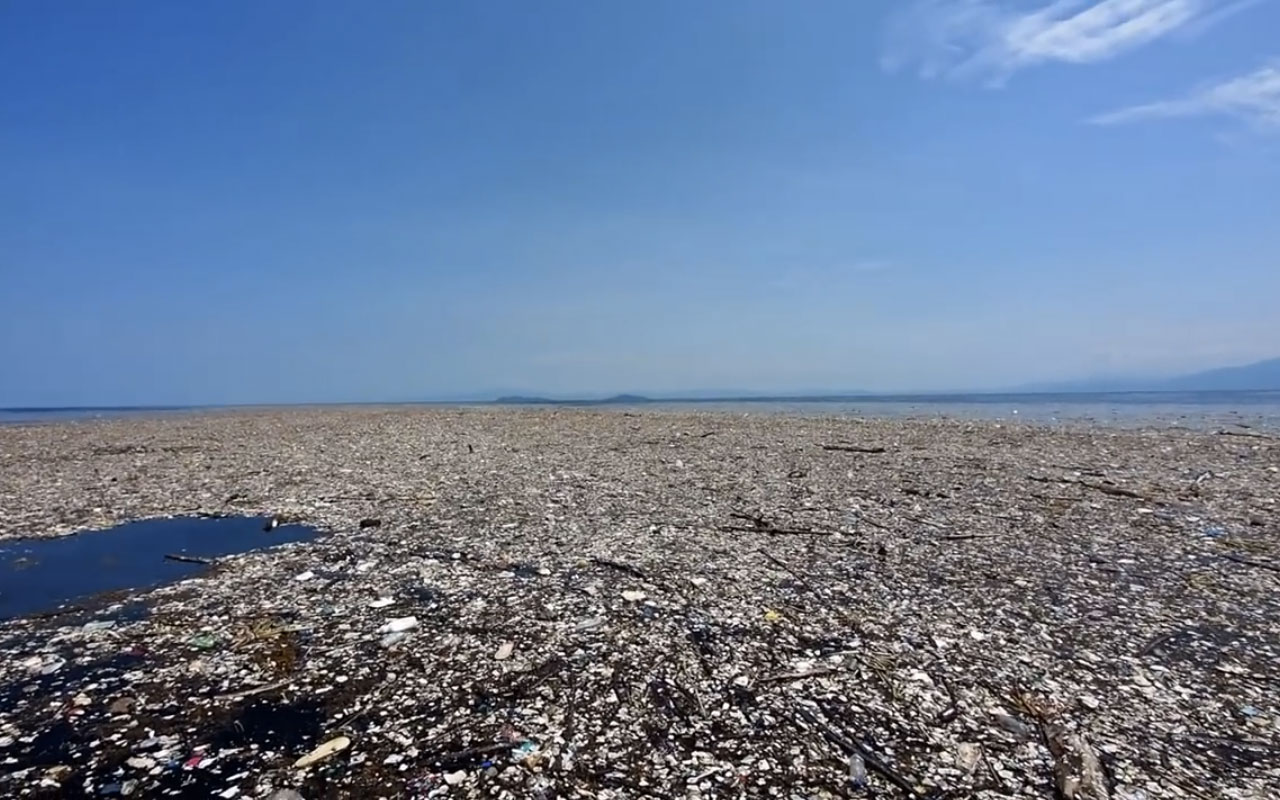
  1. The oceans are being used as a vast rubbish dump, resulting in such phenomena as the Great Pacific Garbage Patch.

We are making the oceans a rubbish dump for vast quantities of pollutants and contaminants, ranging from plastic, microplastics, microbeads and microfibers to toxic and radioactive wastes.

In relation to plastic, a major scientific study involving 24 expeditions conducted between 2007 and 2013, which was designed to estimate ‘the total number of plastic particles and their weight floating in the world’s oceans’ the team of scientists estimated that there was ‘a minimum of 5.25 trillion particles weighing 268,940 tons’. See ‘Plastic Pollution in the World’s Oceans: More than 5 Trillion Plastic Pieces Weighing over 250,000 Tons Afloat at Sea’ and ‘Full scale of plastic in the world’s oceans revealed for first time’.

Since then, of course, the problem has become progressively worse with vast quantities of plastic (entangled in other garbage) forming into floating garbage patches that are vast in size. See ‘Plastic Garbage Patch Bigger Than Mexico Found in Pacific’ and ‘Plastic Chokes the Seas’.

Furthermore, a recent UN report documenting marine debris – that is, rubbish in the ocean – noted the increasing number of marine species impacted by debris through ingestion and entanglement and provided further information on the types of impacts occurring, particularly with respect to microplastics and their physical and chemical effects. The report paid particular attention to ‘persistent, bio-accumulative and toxic substances’ (PBTs), noting the recent studies of the presence of toxic chemicals derived from plastics in marine taxa in a separate appendix. See ‘Marine Debris: Understanding, Preventing and Mitigating the Significant Adverse Impacts on Marine and Coastal Biodiversity’.

Another article highlights the now ubiquitous nature of the ocean garbage problem: There is rubbish everywhere, literally. See ‘How an Uninhabited Island Got the World’s Highest Density of Trash’.

‘Does it matter?’ you might ask. According to a UN report, it matters a great deal: marine debris is harming an increasing number of species, now more than 800, and previous research places the cost of pollution caused by marine debris at $13 billion annually. See ‘New UN report finds marine debris harming more than 800 species, costing countries millions’.


  1. The oceans are being overfished and illegally fished.

Apart from the destruction wrought by aquaculture, considered in the next section, the world’s oceans are being plundered mercilessly for remaining fish stocks. In 2017, a report from the United Nations Conference on Trade and Development (UNCTAD) noted that ‘The international community is harvesting fish at unsustainable biological levels. The Mediterranean Sea is about 70 per cent exploited; the Black Sea 90 per cent.’ Of course, the fact that the fishing industry is subsidized to the tune of $US35billion annually (more than one-fifth of the annual fish market of $US150billion) adds enormous additional incentive to fish the world’s oceans. Needless to say, these subsidies facilitate ‘a race to the bottom’ as fishing fleets compete to harvest increasing amounts of fish ‘at a time when seafood is already a scarce resource’. See ‘Next month’s ocean conference eyes cutting $35 billion in fisheries subsidies – UN trade officials’.

Unfortunately too, despite supposed ambitions to end illegal, unreported and unregulated (IUU) fishing methods, the annual value of fish caught these ways is estimated at $US23billion. See ‘More Plastic than Fish or How Politicians Help Ocean Destruction’.

In essence, with a global fishing fleet of 4.6 million vessels, massive government subsidies to encourage over-fishing, virtually nothing done to prevent illegal and unregulated fishing, and almost half the human population relying on fish for an adequate diet, the increasing biological unsustainability of fishing is destined, particularly when considered in conjunction with other threats mentioned above and below, to wreak ongoing havoc on fish populations (as well as species caught incidentally as ‘bycatch’) until the oceans are emptied of fish.

Moreover, given the ever-neglected synergistic impacts of the many threats discussed in this article, as well as the inevitably increasing number of incidents – such as the ‘blob’ that suddenly killed 100 million Pacific cod mentioned above – this can now happen very quickly.

Of course, it is not just fish that are being taken from the ocean. Many other species are heavily impacted too.

Whales have been hunted mercilessly for a very long time with the total number in the ocean reduced from about 5 million 500 years ago to about 1 million now. This has caused enormous damage to the ocean but also the biosphere as a whole given the prodigious capacity of whales to sequester carbon, for example. See ‘How Whales Sequester Tonnes of CO2: Our Secret Weapon against Climate Change’. Apart from the ongoing hunting – see ‘Iceland is killing fin whales for Japanese pet treats’ – whales are now killed by many other human activities ranging from entanglement in discarded fishing gear and consumption of plastic – see ‘Plastic Waste Kills Six-Ton Whale’ – to seismic airguns which are a probable cause of beach strandings – see ‘337 Dead Whales In Chile Is Worst Case Of Mass Deaths So Far’ – as explained below.

And sea otters – which play a vital role in maintaining the health of the ocean’s kelp forests by eating the sea urchins that eat the kelp – have also been mercilessly slaughtered in vast numbers for their fur pelts in the past. More recently, however, they are being hunted by killer whales which have changed their diet to include otters because their main food source, the great whale, has been almost entirely wiped out by commercial hunting. See ‘Sea Otters as Habitat Protectors’.


  1. The oceans are being subjected to destructive fishing practices, such as bottom trawling, blast fishing, cyanide fishing, ghost fishing and aquaculture.

Some fishing methods are so destructive that they cause harm to the ocean environments where fish are caught. ‘Bottom trawling’ is one such practice: it involves fishing boats dragging large, heavy nets along the ocean floor and it is practiced on a huge scale all around the world. Blast fishing involves the use of explosives and cyanide fishing uses poison.

Damage to the surrounding ocean – including corals, sponges, and other organisms living on the seabed – is inevitable ‘collateral damage’ to these types of fishing. See ‘The state of our oceans – The damaging effects of ocean pollution’.

But if you think the above fishing practices are bad, consider ‘ghost fishing’: the damage done by the (at least) 640,000 tonnes of fishing gear that is lost or abandoned in the oceans each year. Official estimates indicate that ‘ghost gear’ makes up 10% of waste in the oceans. Moreover, while it has an enormous adverse impact on ocean life, derelict gear also detrimentally alters seabed and marine environments. See ‘Our oceans are haunted: How “ghost fishing” is devastating our marine environments’ and ‘Ghost Fishing? 640,000 Tonnes of Fishing Gear Dumped in Oceans Every Year’.

And if the existing overfishing and illegal fishing are not doing enough damage to Earth’s oceans, every year 80 million tons – almost half of annual seafood consumption – is produced by ‘aquaculture’: an industry that builds floating cages for salmon, artificial ponds for prawns on the coasts, and tanks for seafood in factory buildings – that is, aquatic factory farms. Of course, aquaculture is not the solution to overfishing: it is worsening the problem. ‘Trawler fleets sweep up vast quantities of wild fish and grind them into fishmeal and fish oil to feed farmed fish. Far from being “sustainable”, this is an incredibly inefficient and wasteful process: it takes up to five kilos of edible fish such as anchovies, mackerels or sardines, for example, to produce a single kilo of salmon.’

Moreover, as traditional stocks of species used to make fishmeal and fish oil collapse, the industry becomes less discriminating in its selection of targeted species and frequently includes juveniles as well as rare and endangered species, including turtles, stingrays and sharks. Predictably investigators researching the problem ‘did not have to dig deep to uncover shocking evidence of how this industry is trashing the oceans, but the full scale of its impacts is concealed from public view’. See ‘Fishing for Catastrophe: How global aquaculture supply chains are leading to the destruction of wild fish stocks and depriving people of food in India, Vietnam and The Gambia’, ‘Stop plundering the oceans for industrial aquaculture!’ and ‘Until the Seas Run Dry: How industrial aquaculture is plundering the oceans’.

Another problem with aquaculture is the way in which disease and parasites can spread among the intensively-farmed fish with, for example, the sea louse causing enormous problems among farmed salmon in Scotland, Norway, and Canada reducing the amount of fish produced by tens of thousands of tons per year and causing increasingly drastic – that is, inhumane and environmentally harmful – responses to be attempted. See ‘Salmon farming in crisis: “We are seeing a chemical arms race in the seas”’.

But disease and parasites can spread from the intensively farmed fish to wild populations too and, for example, this is causing populations of wild salmon and trout to decrease. See ‘The state of our oceans – The damaging effects of ocean pollution’.


  1. The oceans are being damaged by sand mining.

The largest mining endeavour on Earth, accounting for 85% of all mineral extraction, is sand mining. See ‘The Hidden Environmental Toll of Mining the World’s Sand’. However, one study has suggested that existing figures ‘grossly underestimate global sand extraction and use’ because official statistics widely under-report sand use and typically ‘do not include nonconstruction purposes such as hydraulic fracturing and beach nourishment’. See ‘Global Patterns and Trends for Non‐Metallic Minerals used for Construction’ and ‘The world is facing a global sand crisis’.

More problematically than inaccurate official statistics, however, is that sand mining, of all mining activity, is ‘the least regulated, and quite possibly the most corrupt and environmentally destructive.’ See ‘The Hidden Environmental Toll of Mining the World’s Sand’.

Why is sand mined? Sand is mainly used for the concrete that goes into building but it is also a key ingredient for roads, glass and electronics. In addition, massive amounts of sand are mined for land reclamation projects, shale gas extraction and beach renourishment programs. See ‘A looming tragedy of the sand commons’ and ‘The world is facing a global sand crisis’.

Of course, not all of this sand comes from the oceans but plenty of it does. Moreover: ‘As land quarries and riverbeds become tapped out, sand miners are turning to the seas, where thousands of ships now vacuum up huge amounts of the stuff from the ocean floor.’ See ‘The Deadly Global War for Sand’.

For example, Britain now gets up to a quarter of its sand from sand banks off East Anglia in the North Sea, dredging up to 10 million tons from a region where there has been concern that the loss of sediment accelerates rampant coastal erosion, as well as damaging sea-bed communities such as crabs and starfish. See ‘A new sand and gravel map for the UK Continental Shelf to support sustainable planning’ and ‘The Hidden Environmental Toll of Mining the World’s Sand’.

But much of the sand dredged from the ocean is used for land reclamation projects, particularly in Asia. Most notoriously, Singapore has created an extra 50 square miles of land, expanding its area by 20 percent. How? It imported more than half-a-billion tons of sand, most of it from Indonesia, where at least 24 small islands have reportedly been removed from the map. But countries like the Philippines, Malaysia and China are also reclaiming vast quantities of sand, usually to expand or build coastal cities and, in China’s case, to dump on reefs and make islands to consolidate its territorial claims to the South China Sea. See ‘The Hidden Environmental Toll of Mining the World’s Sand’.

Does this cause much damage to the ocean floor? According to a United Nations Environment Program report: ‘Dredging and extraction… from the benthic (sea bottom) zone destroys organisms, habitats and ecosystems and deeply affects the composition of biodiversity, usually leading to a net decline in faunal biomass and abundance’. See ‘Sand, rarer than one thinks’.


  1. The oceans are being damaged by port and harbour dredging.

There is growing economic and social demand for the development of coastal regions all over the world. Virtually all of these activities, such as coastal construction, land reclamation, beach reclamation and port construction/maintenance, involve dredging: the ‘excavation, transportation and disposal of soft-bottom material’ such as sand and debris from the bottom of ports, harbors, and marinas usually so that facilities are kept deep enough for ships to use. Dredging is also carried out where a river or ocean currents drop lots of sediment onto the seabed, to improve water drainage from a river so that flood risk is reduced and to remove sediments on the seabed if they are contaminated with environmental pollutants.

But, of course, all of this comes at a cost to the local ecology. Notably, in many cases, dredging has contributed to the loss of coral reef habitats. This can occur directly, due to the removal or burial of reefs, or indirectly, as a consequence of stress to corals caused by elevated turbidity and sedimentation. Dredging can also affect surrounding areas in a number of ways including turbid plumes, sedimentation and the release of contaminants. See ‘Environmental impacts of dredging and other sediment disturbances on corals: A review’.

Dredging does not only adversely impact coral reefs, however. Dredging also kicks up a lot of debris into the water disturbing the resident plants and animals. And when the collected sediment is dumped at sea, it again disturbs the resident organisms.


  1. The oceans are being damaged by the increasing spread of invasive species.

Invasive species are those animals or plants from another region of the world that arrive in a new environment where they do not belong. They can be introduced to an area by ship ballast water, accidental release, ocean temperature rises allowing them to migrate, attachment to ship hulls or floating plastic, and most often, by people. Invasive species usually do not have natural predators in their new environment which means their populations can increase rapidly. They often compete with indigenous species for local resources, can permanently alter habitats, destroy biodiversity and lead to the extinction of plants and animals. See ‘What is an invasive species?’

The lionfish is an excellent example. A carnivorous fish native to the Indo-Pacific, it is now an invasive species in the Atlantic, notably the U.S. southeast and Caribbean coastal waters. Because the lionfish is a top predator, it has the capacity to harm reef ecosystems by competing for food and space with overfished native stocks such as snapper and grouper. Scientists fear that lionfish will also kill off species, such as algae-eating parrotfish, that will allow seaweed to overtake the reefs. The lionfish population is continuing to grow – a mature female releases roughly two million eggs a year – and to expand its range. With no known predators, this invasive species is causing enormous damage in its new home. See ‘What is a lionfish?’

You can read more examples of invasive species in the article ‘5 Invasive Species You Should Know’.


  1. The oceans are being damaged by the live trade in fish and coral for the aquarium industry.

Because it is difficult to breed marine fish in aquariums, they must be captured from the wild. The tropical seas around Indonesia, the Philippines, Sri Lanka, the Maldives, and the central Pacific Islands including Hawaii are particularly popular as sources for these fish but there are other sources too. Because ornamental fish are in high demand and can have a very high market value, they are being caught in ever larger numbers threatening the sustainability of the fishery and the habitat in which they are caught. For example, the Yellow Tang, which cannot be bred in captivity, is one of Hawaii’s most targeted fish with fishers taking somewhere between 2 and 10 million Yellow Tangs every year. As a result, its population has plunged in recent years. See ‘The state of our oceans – The damaging effects of ocean pollution’ and ‘The Hawaii Legislature wants to stop the aquarium fish trade. The governor has other ideas’.

Not content with reef fish alone, however, since 1990 the aquarium trade has seen a shift in consumer preference from fish-only aquariums to miniature reef ecosystems. As a result, the most recent estimates suggest that the trade targets over 150 species of stony corals, hundreds of species of non-coral invertebrates, and at least 1,472 reef fish species from 50 families.

Hence, with about 1,800 species of fish traded internationally for some 2,000,000 (private and public) aquariums worldwide – see ‘Revealing the Appetite of the Marine Aquarium Fish Trade: The Volume and Biodiversity of Fish Imported into the United States’ – and the industry worth about $5billion annually – see ‘The Hawaii Legislature wants to stop the aquarium fish trade. The governor has other ideas’ – the trade in fish and coral is now a major global enterprise.

Little, if any of it, however, is sustainable. Even worse, virtually all of the saltwater fish that are captured for aquariums are caught illegally using cyanide. This also kills non-targeted fish and coral (at the rate of one square meter per fish captured) as collateral damage. As the coral on the reef is progressively killed, reef fish, crustaceans, plants, and other animals no longer have food, shelter, and breeding grounds and these impacts ripple up the food chain affecting thousands of species. Given that reef habitats provide food for tens of millions of people and contribute to the livelihoods, through commercial fishing and tourism, of many more, capturing fish using cyanide is utterly destructive. See ‘The Horrific Way Fish Are Caught for Your Aquarium – With Cyanide’.


  1. The oceans are being damaged by the increasing level of noise pollution.

Several studies have revealed the nature and extent of the damage caused to ocean life by human activities that generate noise in the oceans. And there have been calls by scientists to protect marine life from such noise. See, for example, ‘Marine Life Needs Protection from Noise Pollution’.

The main noises are generated by nuclear explosions, ship-shock trials (explosions used by the Navy to test the structural integrity of their ships), seismic airgun arrays, military sonars, supertankers, warships, merchant vessels (of which there are now more than 53,000 in the world: see ‘Number of ships in the world merchant fleet’), fishing vessels and pleasure craft (such as speed boats and jet skis). For example, seismic airgun surveys to discover oil and gas deposits are loud enough ‘to penetrate hundreds of kilometers into the ocean floor, even after going through thousands of meters of ocean’. See ‘A Review of the Impacts of Seismic Airgun Surveys on Marine Life’.

The damage these noises cause to marine mammals include disruption of feeding and breeding habitats – see ‘Fin whale (Balaenoptera physalus) population identity in the western Mediterranean Sea’ – hearing loss – see ‘Marine seismic surveys and ocean noise: time for coordinated and prudent planning’ – physiological changes such as stress responses to trauma and a weakened immune system; behavioral alterations such as avoidance responses; a change in vocalizations or through masking (obliterating sounds of interest); interference with communications, particularly among species, such as humpback and fin whales, that communicate over distances of at least tens of kilometers; and through impacts on prey. Seismic airguns are a probable cause of whale strandings (‘beachings’) and deaths as well. See ‘A Review of the Impacts of Seismic Airgun Surveys on Marine Life’.

But studies of fish, turtles and invertebrates such as squid also reveal a range of adverse impacts to anthropogenic noise including seismic air guns. Fish have exhibited damaged ears, decreased egg viability, increased embryonic mortality and damage to brain cells. Turtles have exhibited behavioural change and hearing loss with squid suffering internal injuries with organs and ears badly damaged. See ‘A Review of the Impacts of Seismic Airgun Surveys on Marine Life’.


  1. The oceans are being damaged by wildfires.

Just because the oceans cannot burn, it does not mean that they are not adversely impacted by wildfires. Apart from the people and wildlife they kill, wildfires leave vast amounts of charred plants and ash behind which subsequent rains wash into creeks and rivers where it flows into coastal lakes, estuaries, and seagrass and seaweed beds with a range of adverse impacts on the ocean and life that occupies these areas. For a fuller explanation in one recent context, see ‘Australia’s Marine Animals Are the Fires’ Unseen Victims’.


Summary

As can be seen from the evidence presented above, the oceans are under siege on a vast range of fronts. They are being stripped of everything of value to humans (ranging from its many creatures, such as fish and whales, to products such as sand, oil and minerals) while having a monumental range and quantity of garbage and pollutants (ranging from household to radioactive waste) dumped into them.

Is anything being done? Not really. There are some tokenistic efforts to tackle the plastics problem by cleaning the occasional beach and ongoing calls to limit certain forms of resource exploitation or waste dumping but all international laws in relation to this are largely ignored with impunity. Other efforts have less than marginal impact. Of course, there is also plenty of talk, including that which will take place at the forthcoming UN Ocean Conference in June 2020 when powerful corporate interests will again ensure that nothing profound happens.

So while there is considerable but still utterly inadequate attention given to the climate catastrophe and some activists draw attention to other threats to human survival (such as the nuclear threat, the biodiversity crisis, the dangers of electromagnetic radiation and especially 5G, geoengineering, and destruction of the rainforests), the ongoing threat to the biosphere as a whole, including the oceans, attract only marginal attention and, sometimes, tokenistic responses.

And because human beings are so psychologically dysfunctional and, so far at least, incapable of responding strategically to our multifaceted crisis, the urge to consume and accumulate will continue to overwhelm serious efforts to avert our own extinction.


Saving the Earth’s Oceans

If you wish to fight powerfully to save Earth’s biosphere, including the oceans, consider joining those participating in ‘The Flame Tree Project to Save Life on Earth’ which outlines a simple program to systematically reduce your consumption and increase your self-reliance over a period of years.

Given the fear-driven violence in our world which also generates the addiction of most people in industrialized countries to the over-consumption that is destroying Earth’s biosphere – see ‘Love Denied: The Psychology of Materialism, Violence and War’ – consider addressing this directly starting with yourself – see ‘Putting Feelings First’ – and by reviewing your relationship with children. See ‘My Promise to Children’ and ‘Nisteling: The Art of Deep Listening’. For fuller explanations, see ‘Why Violence?’ and ‘Fearless Psychology and Fearful Psychology: Principles and Practice’.

If you wish to campaign strategically to defend the oceans then consider joining those working to halt the climate catastrophe, end military activities of all kinds including war, and halt all forms of resource extraction from the oceans as well. See Nonviolent Campaign Strategy which already includes a comprehensive list of the strategic goals necessary to achieve two of these outcomes in ‘Strategic Aims’.

In those cases where corrupt or even electorally unresponsive governments are leading the destruction of the oceans – by supporting, sponsoring and/or engaging in environmentally destructive practices – it might be necessary to remove these governments as part of the effort. See Nonviolent Defense/Liberation Strategy.

You might also consider joining the global network of people resisting violence in all contexts, including against the biosphere, by signing the online pledge of ‘The People’s Charter to Create a Nonviolent World’.

Or, if none of the above options appeal or they seem too complicated, consider committing to:

The Earth Pledge

Out of love for the Earth and all of its creatures, and my respect for their needs, from this day onwards I pledge that:

  1. I will listen deeply to children (see explanation above)
  2. I will not travel by plane
  3. I will not travel by car
  4. I will not eat meat and fish
  5. I will only eat organically/biodynamically grown food
  6. I will minimize the amount of fresh water I use, including by minimizing my ownership and use of electronic devices
  7. I will not buy rainforest timber
  8. I will not buy or use single-use plastic, such as bags, bottles, containers, cups and straws
  9. I will not use banks, superannuation (pension) funds or insurance companies that provide any service to corporations involved in fossil fuels, nuclear power and/or weapons
  10. I will not accept employment from, or invest in, any organization that supports or participates in the exploitation of fellow human beings or profits from killing and/or destruction of the biosphere
  11. I will not get news from the corporate media (mainstream newspapers, television, radio, Google, Facebook, Twitter…)
  12. I will make the effort to learn a skill, such as food gardening or sewing, that makes me more self-reliant
  13. I will gently encourage my family and friends to consider signing this pledge.

Do all these options sound unpalatable? Prefer something requiring less commitment? You can, if you like, do as most sources suggest: nothing (or its many tokenistic equivalents). I admit that the options I offer are for those powerful enough to comprehend and act on the truth. Why? Because there is so little time left and I have no interest in deceiving people or treating them as unintelligent and powerless. See ‘Human Extinction by 2026? A Last Ditch Strategy to Fight for Human Survival’.


Conclusion

Every person on Earth depends directly on the ocean. It covers 71% of the Earth’s surface and contains about 97% of the Earth’s water. It generates 50 percent of the oxygen we need and is home to up to 80 percent of all life.

Yet human activity is destroying it. You can make choices that make a difference. Or leave it to others.


Biodata: Robert J. Burrowes has a lifetime commitment to understanding and ending human violence. He has done extensive research since 1966 in an effort to understand why human beings are violent and has been a nonviolent activist since 1981. He is the author of ‘Why Violence?’ His email address is flametree@riseup.net and his website is here.


Our Vanishing World: Glaciers

Glacier collapse in Greenland. DurkTalsma/Getty

By Robert J. Burrowes

Something is causing the world’s glaciers and mountain ice fields to melt. And, despite your first thought, it is not the ongoing climate catastrophe.

It does not matter where on Earth the glaciers and mountain ice fields are located, they are all melting. Moreover, the projected timeframe for some of them to disappear altogether is ‘imminently’; that is, within years. And for the rest: a few decades (although that projection is being routinely revised downwards, depending on the glacier).

Why? Because the most recent research suggests that beneath the ocean surface glaciers may be melting ten to 100 times faster than previously believed. This is because, until now, scientists had a limited understanding of what happens underwater at the point where glaciers meet the sea. By using a combination of radar, sonar and time-lapse photography, a team of researchers has now provided the first detailed measurements of the underwater changes over time. Their findings suggest that the theories currently used to gauge glacier change are underestimating glacier ice loss. ‘The overall trend of glacier retreat around the world is due to both warming air and warming oceans’, observed Professor David Sutherland, an oceanographer at the University of Oregon and lead author of the new study. Glaciers are getting ‘eaten away on both ends’.

According to Professor Rebecca Jackson, an oceanographer at Rutgers University and co-author of the study: ‘The theory we’ve been relying on for these melt rates is wrong. We should be able to predict melt rates based on ocean conditions… [but] they’re not at all related in the way we expected.’ Beyond air and water temperatures, ‘ocean salinity, currents and the glacier’s shape can all play a role in influencing tidewater glacier melt’. See ‘Direct observations of submarine melt and subsurface geometry at a tidewater glacier’ and ‘Oceans Are Melting Glaciers from Below Much Faster than Predicted, Study Finds’. These findings of rapid glacier melt confirm earlier research, touched on below, although the variables melting high mountain glaciers are different to those melting ones that terminate at sea level.

So how many glaciers are there and what is their status?

According to the Randolph Glacier Inventory (RGI), the most reliable estimate of the number of glaciers in the world is 198,000. These glaciers cover 726,000 square kilometres, that is, 0.5% of the Earth’s land surface. See the Randolph Glacier Inventory and ‘Mapping the World’s Glaciers’.

The Global Land Ice Measurements from Space (GLIMS) project is designed to monitor the world’s glaciers primarily using data from optical satellite instruments. Glacier inventories are a specific technique for mapping glacier attributes, such as area, length, slope, aspect, terminal environment (calving into the sea or a lake, or terminating on dry land), elevation, and glacier classification. See ‘Mapping the World’s Glaciers’. There are many types of glacier. For an extensive (and stunning) selection of photos of glaciers, illustrating many aspects of these majestic ice formations, see the ‘Glaciers online Photoglossary’.

So, from north to south, what is the status of the world’s glaciers?

Glaciers in the North

As you would expect, the vast ice masses in the Arctic – which consists of the Arctic Ocean, adjacent seas, and parts of Alaska (United States), Finland, Greenland (Denmark), Iceland, Northern Canada, Norway, Russia and Sweden – include many glaciers.

While there are no glaciers in the Arctic Ocean itself (because it has no landmass), the glaciers in places like Greenland, North America, Russia and western Europe are melting rapidly.

A recent study, for example, confirmed the rapid melting of Greenland’s glaciers: ‘The recent deglaciation of Greenland is a response to both oceanic and atmospheric forcings. From 2000 to 2010, ice loss was concentrated in the southeast and northwest margins of the ice sheet, in large part due to the increasing discharge of marine-terminating outlet glaciers, emphasizing the importance of oceanic forcing.’ See ‘Accelerating changes in ice mass within Greenland, and the ice sheet’s sensitivity to atmospheric forcing’ and ‘The Greenland Ice Sheet Is Melting at Astonishing Rate’.

But Greenland is not the only place in the far north where glaciers are melting rapidly. For a snapshot of glacier melt in other regions, see ‘Melting glaciers threaten to inundate Russia’s Far North and Siberia’, ‘Glaciers in the Canadian High Arctic are melting at an unprecedented rate’, ‘Graphic: Dramatic glacier melt [in Alaska]’, ‘Sweden’s Highest Peak, a Melting Glacier, Is No Longer the Nation’s Tallest’ and ‘The Devdoraki Glacier in the Georgian Caucasus Keeps Collapsing’.

Glaciers in the Himalaya

Substantial glacial melt in the Himalaya has been evident for a long time. By 2011, glacier melt in the Nepalese Himalaya, for example, had already created a ‘spattering’ of 1,600 high altitude glacier lakes that threatened communities living ‘downstream’. For example, if the Imja glacier lake ‘breaks through its walls of glacial debris, known as moraine, it could release a deluge of water, mud and rock up to 60 miles away. This would swamp homes and fields with a layer of rubble up to 15m thick, leading to the loss of the land for a generation. But the question is when, rather than if.’ See ‘Watching a glacier die at Imja Lake’ and ‘Glacier lakes: Growing danger zones in the Himalayas’.

A 2013 study by a University of Milan team led by a Nepali scientist found that ‘some glaciers on or around Mount Everest had shrunk by 13% in the last 50 years with the snow line 180 metres higher than it was 50 years ago. The glaciers are disappearing faster every year’, the report noted, ‘with some smaller glaciers now only half the size they were in the 1960s’. See ‘Glacier response to climate trend and climate variability in Mt. Everest region (Nepal)’ and ‘Most glaciers in Mount Everest area will disappear with climate change – study’.

And a study done in 2015 concluded that the estimated 5,500 glaciers in the Hindu Kush-Himalayan (HKH) region will likely experience ‘continued and possibly accelerated mass loss from glaciers… given the projected increase in temperatures,’ according to Joseph Shea, a glacier hydrologist at the International Centre for Integrated Mountain Development in Nepal, and leader of the study published in The Cryosphere, the journal of the European Geosciences Union (EGU). See ‘Most glaciers in Mount Everest area will disappear with climate change – study’.

But the latest word comes from the comprehensive and authoritative 2019 report The Hindu Kush Himalaya Assessment: Mountains, Climate Change, Sustainability and People, requested by the eight nations – Afghanistan, Pakistan, China, India, Nepal, Bhutan, Bangladesh and Myanmar – the mountains span, and involving more than 200 scientists working on the report over five years (with another 125 experts peer reviewing their work). The scientists examined the hyper-complex 3,500 kilometres-long Hindu Kush Himalayan system where glaciers feed the Ganges, the Indus, the Yellow River, the Mekong and the Irrawaddy, among ten major river systems. Directly and indirectly, these glaciers supply1.65 billion people with clean air, food, energy and work. See ‘Himalayan glaciers on the eve of destruction’.

Summarizing the report, Pepe Escobar explains: ‘The path towards environmental disaster is eerily straightforward. Melting glaciers flow into rivers and lakes. Bursting lakes inevitably translate into more floods. And that means extra glacier runoff into major rivers, more flooding and inevitable destruction of crops.’ See ‘Himalayan glaciers on the eve of destruction’.

The conclusion to be drawn from this report is simple: ‘Even radical climate change action won’t save glaciers, endangering 2 billion people.’ See ‘A third of Himalayan ice cap doomed, finds report’.

Glaciers at the Equator

At the Equator, glaciers are under siege. Glaciers at the Equator? you might ask.

Yes indeed. Mt. Kilimanjaro, which has three distinct volcanic cones – Kibo at 5,895 metres (19,340 ft), Mawenzi at 5,149 metres (16,893 ft) and Shira at 4,005 metres (13,140 ft) of which the latter two are extinct with Kibo dormant – is the highest mountain in Africa and the highest free-standing mountain in the world. It rises out of the Great Plains of East Africa almost on the Equator. At over 19,000 feet, this mountain was once covered in glaciers, proving an awe-inspiring sight to those who saw it.

However, glacial melt on Kilimanjaro is accelerating and a 2013 report noted that Kilimanjaro’s shrinking northern glaciers, thought to be 10,000 years old, could disappear by 2030. The entire northern ice field, which holds most of Kilimanjaro’s remaining glacial ice, lost more than 4 million cubic meters of ice between 2000 and 2013, representing a volume loss of approximately 29 percent during that period with a loss in total surface area of 32 percent. In 2012, the ice field split in two, revealing ancient lava that may not have seen the sun for millennia. See ‘Kilimanjaro’s Shrinking Glaciers Could Vanish by 2030’. The southside glaciers should last a little longer.

The latest report, based largely on an analysis of NASA Earth Observatory satellite data in 2019, conducted by scientists at the University of Massachusetts, simply confirms earlier documented if irregular trends: ‘The long rains (Masika) of 2019 are concluding with virtually no snow accumulation on Kilimanjaro glaciers.’

More ominously, ‘Absent a major event bringing sufficient snow (e.g. 30-50 cm) to reduce solar radiation penetration, the forthcoming extended dry season will probably begin with a snow-free crater. As a result, ablation of both horizontal and vertical glacier surfaces is likely to be dramatic in the months ahead.’ See ‘Kilimanjaro Climate & Glaciers’.

If you would like to see some spectacular photos of remaining glaciers and remnant glaciers on Mt Kilimanjaro as they were in 2016, you can see them in Ian van Coller’s limited edition art book ‘Kilimanjaro: The Last Glacier’ or see them in a ‘flip through’ video.

Glaciers in Southern Latitudes

Like glaciers elsewhere, those in southern latitudes are melting rapidly. Recent research confirms the rapid demise of glaciers in the icefields of Patagonia, located in the high Andes atop Chile and Argentina, where glacial retreat is occurring ‘at a non-glacial pace’. The North Patagonian Icefield feeds ice to 30 significant outlet glaciers, of which the San Rafael Glacier is ‘the fastest-moving glacier in Patagonia’ and ‘one of the most actively calving glaciers in the world’.

The South Patagonian Icefield, more than triple the size of its northern counterpart, includes the Jorge Montt Glacier which terminates in an ‘iceberg-choked fjord’ as a result of the glacier’s rapid disintegration and retreat. The Upsala Glacier has been retreating ever since documentation began in 1810. For photos and a video, see ‘Melting Beauty: The Icefields of Patagonia’.

One extensive study revealed that 90.2% of Patagonian glaciers shrank between 1870 and 2011 with all regions suffering extensive glacier loss. Notably, however, annual rates of shrinkage across the Patagonian Andes ‘increased in each time segment analysed (1870-1986, 1986-2001, 2001-2011), with annual rates of shrinkage twice as rapid from 2001-2011 as from 1870-1986’. See ‘Shrinking Patagonian Glaciers’.

Elsewhere in the southern hemisphere, glaciers in New Zealand, including the famous Fox, Franz Josef and Tasman glaciers, are also in retreat. See ‘New Zealand’s glaciers are shrinking’.

Glaciers in Antarctica

As with the Antarctic itself, glaciers are melting at an accelerating rate generating a near-endless sequence of dramatic news headlines, as one glacier after another attracts attention due to the extraordinary nature of the changes, with the latest research showing affected areas losing ice five times faster than in the 1990s, with more than 100m of thickness gone in some places. See ‘“Extraordinary thinning” of ice sheets revealed deep inside Antarctica’.

One recent analysis of satellite data has found ‘extreme’ changes are underway at eight of Antarctica’s major glaciers as ‘unusually warm ocean water slips in under their ice shelves’. The warmer water is ‘eating away at the glaciers’ icy grasp on the seafloor. As a result, the grounding line – where the ice last touches bedrock – has been receding by as much as 600 feet per year’. See ‘Net retreat of Antarctic glacier grounding lines’ and ‘“Extreme” Changes Underway in Some of Antarctica’s Biggest Glaciers’.

For example, Pine Island Glacier is an immense glacier on the West Antarctic Ice Sheet. It is one of the least stable of glaciers – quickly retreating and losing massive amounts of ice – accounting for about 20 percent of the ice sheet’s total ice flow to the ocean. Every year Pine Island Glacier loses 45 billion tons (40.8 billion metric tons) of ice. See ‘Photo Gallery: Antarctica’s Pine Island Glacier Cracks’.

Since 2001, Pine Island Glacier has calved six huge icebergs but, ominously, the rate of calving is increasing. Following major calvings in January 2001, November 2007, December 2011 and August 2015, in September 2017 it calved an iceberg 4.5 times the size of Manhattan and, just one year later, was poised for another – and even larger – calving as a 30 kilometre rift appeared in its centre ‘where the ice shelf touches warmer ocean waters that are melting it from underneath’. See ‘Huge Iceberg Poised to Break Off Antarctica’s Pine Island Glacier’.

Meanwhile, the Thwaites Glacier, also in West Antarctica, is disintegrating. According to a recent NASA-led study ‘A gigantic cavity – two-thirds the area of Manhattan and almost 1,000 feet (300 meters) tall – growing at the bottom of Thwaites Glacier in West Antarctica is one of several disturbing discoveries.’ See ‘Huge Cavity in Antarctic Glacier Signals Rapid Decay’.

While the ongoing destruction of Antarctic glaciers already guarantees sea level rise of considerable magnitude, even if emissions of carbon dioxide, methane and nitrous oxide were halted today, there will be other climate feedback effects. Oceanographers have detected a trend of decreasing salinity in Antarctic waters fed by ice sheet melt: This affects the density of the deep, very cold waters that drive key ocean currents that affect climate at the surface. Moreover, increasing freshwater at the edge of the ice sheet ‘could also disrupt the timing of biological cycles… starting with phytoplankton – the critical base of the Antarctic food web’. See ‘“Extreme” Changes Underway in Some of Antarctica’s Biggest Glaciers’.

Can We Save the Glaciers?

A joint research project conducted by scientists at the Universities of Bremen and Innsbruck concluded that ‘contemporary glacier mass is in disequilibrium with the current climate, and 36 ± 8% mass loss is already committed in response to past greenhouse gas emissions. Consequently, mitigating future emissions will have only very limited influence on glacier mass change in the twenty-first century. No significant differences between 1.5 and 2 K warming scenarios are detectable in the sea-level contribution of glaciers accumulated within the twenty-first century.’

In other words: ‘more than a third of the glacier ice that still exists today in mountain glaciers can no longer be saved, even with the most ambitious measures’. Calculated on the basis of a new, average car, one kilogram of glacier ice is lost every five hundred meters traveled by that single car. See ‘Limited influence of climate change mitigation on short-term glacier mass loss’ and ‘Glacier mass loss passes the point of no return, researchers report’.

So can we save what will be left of the remaining glaciers? Obviously, not without a monumental effort. But before inviting your involvement in an effort to do this, let me explain a point I made in the opening paragraph: it is not the ongoing climate catastrophe that is destroying Earth’s glaciers. It is human behaviour. The climate catastrophe, including the melting of the glaciers, is being generated by our behaviour.

And we have control of that behaviour. Or, more accurately, we can each control our own behaviour. And that means you have some choices to make that will make a huge difference, for good or bad, depending on what you decide.

If you wish to fight powerfully to save the remaining glaciers, consider joining those participating in ‘The Flame Tree Project to Save Life on Earth’ which outlines a simple program to systematically reduce your consumption and increase your self-reliance over a period of years.

Given the fear-driven violence in our world which also generates the addiction of most people in industrialized countries to the over-consumption that is destroying Earth’s biosphere – see ‘Love Denied: The Psychology of Materialism, Violence and War’ – then consider addressing this directly starting with yourself – see ‘Putting Feelings First’ – and by reviewing your relationship with children. See ‘My Promise to Children’ and ‘Nisteling: The Art of Deep Listening’. For fuller explanations, see ‘Why Violence?’ and ‘Fearless Psychology and Fearful Psychology: Principles and Practice’.

If you wish to campaign strategically to defend the glaciers then consider joining those working to halt the climate catastrophe and end military activities of all kinds, including war, as well. See Nonviolent Campaign Strategy which includes a comprehensive list of the strategic goals necessary to achieve these outcomes in ‘Strategic Aims’.

In those cases where corrupt or even electorally unresponsive governments are leading the destruction of the biosphere – by supporting, sponsoring and/or engaging in environmentally destructive practices – it might be necessary to remove these governments as part of the effort. See Nonviolent Defense/Liberation Strategy.

You might also consider joining the global network of people resisting violence in all contexts, including against the biosphere, by signing the online pledge of ‘The People’s Charter to Create a Nonviolent World’.

Or, if none of the above options appeal or they seem too complicated, consider committing to:

The Earth Pledge

Out of love for the Earth and all of its creatures, and my respect for their needs, from this day onwards I pledge that:

  1. I will listen deeply to children (see explanation above)
  2. I will not travel by plane
  3. I will not travel by car
  4. I will not eat meat and fish
  5. I will only eat organically/biodynamically grown food
  6. I will minimize the amount of fresh water I use, including by minimizing my ownership and use of electronic devices
  7. I will not buy rainforest timber
  8. I will not buy or use single-use plastic, such as bags, bottles, containers, cups and straws
  9. I will not use banks, superannuation (pension) funds or insurance companies that provide any service to corporations involved in fossil fuels, nuclear power and/or weapons
  10. I will not accept employment from, or invest in, any organization that supports or participates in the exploitation of fellow human beings or profits from killing and/or destruction of the biosphere
  11. I will not get news from the corporate media (mainstream newspapers, television, radio, Google, Facebook, Twitter…)
  12. I will make the effort to learn a skill, such as food gardening or sewing, that makes me more self-reliant
  13. I will gently encourage my family and friends to consider signing this pledge.

Do all these options sound unpalatable? Prefer something requiring less commitment? You can, if you like, do as most sources suggest: nothing (or its many tokenistic equivalents). I admit that the options I offer are for those powerful enough to comprehend and act on the truth. Why? Because there is so little time left and I have no interest in deceiving people or treating them as unintelligent and powerless. See ‘Human Extinction by 2026? A Last Ditch Strategy to Fight for Human Survival’.

So, in a nutshell: Are you willing to fight to save the glaciers (and preserve the biosphere)? Then remember this: The only way to fight is for you to reduce your consumption and to help persuade others, one way or another, to do so as well. Nothing else can work.


Biodata: Robert J. Burrowes has a lifetime commitment to understanding and ending human violence. He has done extensive research since 1966 in an effort to understand why human beings are violent and has been a nonviolent activist since 1981. He is the author of ‘Why Violence?’ His email address is flametree@riseup.net and his website is here. He is a frequent contributor to Global Research.

From Dollar Hegemony to Global Warming

Globalization, Glyphosate and Doctrines of Consent

By Colin Todhunter

Source: Dissident Voice

There has been an on-going tectonic shift in the West since the abandonment of the Bretton Woods agreement in 1971. This accelerated when the USSR ended and has resulted in the ‘neoliberal globalization’ we see today.

At the same time, there has been an unprecedented campaign to re-engineer social consensus in the West. Part of this strategy, involves getting populations in Western countries to fixate on ‘global warming’, ‘gender equity’ and ‘anti-racism’: by focusing on identity politics and climate change, the devastating effects and injustices brought about by globalized capitalism and associated militarism largely remain unchallenged by the masses and stay firmly in the background.

This is the argument presented by Denis Rancourt, researcher at Ontario Civil Liberties Association, in a new report. Rancourt is a former full professor of physics at the University of Ottawa in Canada and author of ‘Geo-economics and geo-politics drive successive eras of predatory globalization and socialengineering: Historical emergence of climate change, gender equity, andanti-racism as state doctrines’ (April 2019).

In the report, Rancourt references Michael Hudson’s 1972 book Super Imperialism: The Economic Strategy of American Empire to help explain the key role of maintaining dollar hegemony and the importance of the petrodollar to US global dominance. Aside from the significance of oil, Rancourt argues that the US has an existential interest to ensure that opioid drugs are traded in US dollars, another major global commodity. This explains the US occupation of Afghanistan. He also pinpoints the importance of US agribusiness and the arms industry in helping to secure US geo-strategic goals.

Since the fall of the USSR in 1991, Rancourt says that US war campaigns have, among other things, protected the US dollar from abandonment, destroyed nations seeking sovereignty from US dominance, secured the opium trade, increased control over oil and have frustrated Eurasian integration. In addition, we have seen certain countries face a bombardment of sanctions and hostility in an attempt to destroy energy-producing centres that the US does not control, not least Russia.

He also outlines the impacts within Western countries too, including: the systematic relative loss of middle-class economic status, the rise of urban homelessness, the decimation of the industrial working class, corporate megamergers, rising inequality, the dismantling of welfare, financial speculation, stagnant wages, debt, deregulation and privatisation. In addition, the increased leniency in food and drug regulation has led to the dramatic increase in the use of the herbicide glyphosate, which has been concurrent with upsurges of many diseases and chronic ailments.

In the face of this devastation, Western nations have had to secure ongoing consent among their own populations. To help explain how this has been achieved, Rancourt focuses on gender equity, anti-racism and global warming as state doctrines that have been used to divert attention from the machinations of US empire (and also to prevent class consciousness taking hold). I recently asked Denis Rancourt about this aspect of his report.

Colin Todhunter:  Can you say a bit about yourself and how you came to produce this report? What is it meant to achieve?

Denis Rancourt:  I’m a former physics professor, environmental scientist and a civil rights advocate. I currently work as a researcher for the Ontario Civil Liberties Association (ocla.ca). During a conversation about civil rights issues I had with the executive director of OCLA, we identified several important societal and economic phenomena that seemed to be related to the early 1990s. So, I eventually settled in to do some ‘heavy lifting’, research wise.

While there is no lack of hired intellectuals and experts to wrongly guide our perception, my research demonstrates a link between surges in large-scale suppression and exploitation of national populations with the acceleration of an aggressive, exploitative globalization.

CT: In your report, you’ve described the consequences of the abandonment of Bretton Woods and the dissolution of the USSR in terms of dollar hegemony, US militarism and the devastating impacts of ‘neoliberal globalisation’ both for nation states and for ordinary people.

DR: There is little doubt that Russian and Chinese analysts have a solid understanding of what I have outlined in my report. For instance, foreshadowing Trump’s trade war, the People’s Liberation Army Major-General Qiao Liang’s April 2015 speech to the Chinese Communist Party’s Central Committee and government office, included the following:

Since that day [dissolution of Bretton Woods], a true financial empire has emerged, the US dollar’s hegemony has been established, and we have entered a true paper currency era. There is no precious metal behind the US dollar. The government’s credit is the sole support for the US dollar. The US makes a profit from the whole world. This means that the Americans can obtain material wealth from the world by printing a piece of green paper. […] If we [now] acknowledge that there is a US dollar index cycle [punctuated by engineered crises, including war] and the Americans use this cycle to harvest from other countries, then we can conclude that it was time for the Americans to harvest China…

CT: You discuss the need for states to ensure consent: the need to pacify, hypnotize and align populations for continued globalization; more precisely, the need to divert attention from the structural violence of economic policies and the actual violence of militarism. Can you say something about how the issue of global warming relates to this?

DR:  Irrespective of whether the so-called ‘climate crisis’ is real, exaggerated or fabricated, it is clear, from the data in my report, that the ethos of global warming was engineered on a global scale and benefits the exploiters of the carbon-economy and, more indirectly, the state.

For example, one of the studies that I review shows that a many-fold increase in mainstream media reporting about global warming suddenly occurred in the mid-2000s, in all the leading news media, at the same time that the financiers and their acolytes such as Al Gore decided to make and manage a global carbon economy. This media campaign has been sustained ever since and the global warming ethos has been institutionalized.

Carbon sequestration schemes have devastated local communities on every occupied continent. If anything, carbon schemes − from wind farms to biofuel harvesting to industrial battery production to solar-cell array installations to mining uranium to mega hydro-dam construction and so on – have accelerated habitat destruction.

Meanwhile, economic and military warfare rages, glyphosate is dumped into the ecosphere at unprecedented rates (poured on GM herbicide-resistant cash crops), active genocides are in progress (Yemen), the US is unilaterally withdrawing from nuclear treaties and forcing an arms race with next generation death machines and US-held extortionary loans are serviced by land-use transformation on the scale of nations; while our educated children have nervous breakdowns trying to get governments to “act” on “climate”.

In the early-1990s, a world conference on climate environmentalism was an express response to the dissolution of the Soviet Union. This was part of a global propaganda project intended to mask the new wave of accelerated predatory globalism that was unleashed now that the USSR was definitively out of the way.

CT: What are your thoughts on Greta Thunberg and the movement surrounding her?

DR:  It is sad and pathetic. The movement is a testament to the success of the global propaganda project that I describe in my report. The movement is also an indicator of the degree to which totalitarianism has taken hold in Western societies; wherein individuals, associations and institutions lose their ability for independent thought to steer society away from the designs of an occupying elite. Individuals (and their parents) become morality police in the service of this ‘environmentalism’.

CT: You also talk about the emergence of gender-equity (third wave feminism) and anti-racism as state doctrines. Can you say something about this?

DR: In my report, I use historical institutional records and societal data to demonstrate that a triad of ‘state religions’ was globally engendered and emerged on cue following the dissolution of the Soviet Union. This triad consists of climate alarmism, exaggerated tunnel-vision focus on gender equity and a campaign of anti-racism focused on engineering thoughts, language and attitudes.

These state ideologies were conceived and propelled by UN efforts and the resulting signed protocols. Western academia enthusiastically took up and institutionalized the program. Mainstream media religiously promoted the newly minted ethos. Political parties largely applied increased quotas of gender and race elected representatives.

These processes and ideas served to sooth, massage and occupy the Western mind, especially among the upper-middle, professional and managerial classes and the elite classes of economically occupied territories but did nothing to alleviate the most violent and globally widespread forms of actual racism and misogyny as a result of predatory globalization and militarism.

Ironically, the global attacks on human dignity, human health and the environment were in proportion to the systematic and sometimes shrill calls for gender equity, anti-racism and climate ‘action’. The entire edifice of these ‘state religions’ leaves no room for required conflicts of class and expressly undermines any questioning of the mechanisms and consequences of globalization.

CT: Can you say something about the Gilets Jaunes (Yellow Vests), Brexit and the Trump electoral phenomenon?

DR: Combine aggressive globalization, constant financial predation, gutting of the Western working and middle classes and a glib discourse of climate change, anti-racism and gender equity and something has to give. French geographer Christophe Guilluy predicted the reactions in some detail, and it is not difficult to understand. It is no accident that the revolting working- and middle-classes are critical of the narratives of climate crisis, anti-racism and gender equity; and that their voices are cast by the mainstream media as racist, misogynist and ignorant of science.

It seems that any class which opposes its own destruction is accused of being populated by racist and ignorant folks that can’t see that salvation lies in a carbon-managed and globalized world. It becomes imperative, therefore, to shut down all the venues where such an ‘ignorant lot’ could communicate their views, attempt to organize and thereby threaten the prevailing social order.

Human Extinction by 2026? A Last Ditch Strategy to Fight for Human Survival

By Robert J. Burrowes

There is almost unanimous agreement among climate scientists and organizations – that is, 97% of over 10,000 climate scientists and the various scientific organizations engaged in climate science research – that human beings have caused a dramatic increase in the amount of carbon dioxide, methane and nitrous oxide released into Earth’s atmosphere since the pre-industrial era and that this is driving the climate catastrophe that continues to unfold. For the documentary evidence on this point see, for example, ‘Quantifying the consensus on anthropogenic global warming in the scientific literature’, ‘Consensus on consensus: a synthesis of consensus estimates on human-caused global warming’ and ‘Scientists Agree: Global Warming is Happening and Humans are the Primary Cause’.

However, there is no consensus regarding the timeframe in which this climate catastrophe will cause human extinction. This lack of consensus is primarily due to the global elite controlling the public perception of this timeframe with frequent talk of ‘the end of the century’ designed to allow ongoing profit maximization through ‘business as usual’ for as long as possible. Why has this happened?

When evidence of the climate catastrophe (including the pivotal role of burning fossil fuels) became incontrovertible, which meant that the fossil fuel industry’s long-standing efforts to prevent action on the climate catastrophe had finally ended, the industry shifted its focus to arguing that the timeframe, which it presented as ‘end of the century’, meant that we could defer action (and thus profit-maximization through business as usual could continue indefinitely). Consequently, like the tobacco, sugar and junk food industries, the fossil fuel industry has employed a range of tactics to deflect attention from their primary responsibility for a problem and to delay action on it.

These well-worn tactics include suggesting that the research is incomplete and more research needs to be done, funding ‘research’ to come up with ‘evidence’ to counter the climate science, employing scholars to present this ‘research’, discrediting honest climate scientists, infiltrating regulatory bodies to water down (or reverse) decisions and recommendations that would adversely impact profits, setting up ‘concerned’ groups to act as ‘fronts’ for the industry, making generous political donations to individuals and political parties as well as employing lobbyists.

As a result of its enormous power too, the global elite has been able to control much of the funding available for climate science research and a great deal of the information about it that is made widely available to the public, particularly through its corporate media. For this reason, the elite wields enormous power to shape the dialogue in relation to both the climate science and the timeframe.

Therefore, and despite the overwhelming consensus noted above, many climate scientists are reluctant to be fully truthful about the state of the world’s climate or they are just conservative in their assessments of the climate catastrophe. For example, eminent climate scientist Professor James Hansen referred to ‘scientific reticence’ in his article ‘Scientific reticence and sea level rise’, scientists might be conservative in their research – for example, dependence upon historical records leads to missing about one-fifth of global warming since the 1860s as explained in ‘Reconciled climate response estimates from climate models and the energy budget of Earth’ – and, in some cases, governments muzzle scientists outright. See ‘Scientist silencing continues for federally-funded research’. But many of the forces working against full exposure of the truth are explained in Professor Guy McPherson’s article ‘Climate-Change Summary and Update’.

However, in contrast to the elite-managed mainstream narrative regarding the climate timeframe, there is a group of courageous and prominent climate scientists who offer compelling climate science evidence that human beings, along with millions of other species, will be extinct by 2026 (and perhaps as early as 2021) in response to a projected 10 degree celsius increase in global temperatures above the pre-industrial level by that date. See ‘Will humans be extinct by 2026?’

Before outlining the essence of this article, it is worth noting that the website on which it is posted is ‘Arctic News’ and the editors of this site post vital articles on the world’s climate by highly prominent climate scientists, such as Professor Peter Wadhams (Emeritus Professor of Polar Ocean Physics at Cambridge University and author of A Farewell to Ice: A Report from the Arctic), Dr Andrew Glikson (an Earth and paleoclimate scientist who is a visiting fellow at the Australian National University), Professor Guy McPherson who has written extensively and lectures all over the world on the subject, and ‘Sam Carana’, the pseudonym used by a group of climate scientists concerned to avoid too many adverse impacts on their research, careers and funding by declaring themselves publicly but nevertheless committed to making the truth available for those who seek it.

So, in a few brief points, let me summarize the evidence and argument outlined in the article ‘Will humans be extinct by 2026?’


The Climate Science of Destruction of the Biosphere

In the Arctic, there is a vast amount of carbon stored in soils that are now still largely frozen; this frozen soil is called permafrost. But as Arctic temperatures continue to rise and the permafrost thaws, in response to the warming that has occurred already (and is ongoing) by burning fossil fuels and farming animals for human consumption, much of this carbon will be converted into carbon dioxide or methane and released into the atmosphere. There is also a vast amount of methane – in the form of methane hydrates and free gas – stored in sediments under the Arctic Ocean seafloor. As temperatures rise, these sediments are being destabilized and will soon result in massive eruptions of methane from the ocean floor. ‘Due to the abrupt character of such releases and the fact that many seas in the Arctic Ocean are shallow, much of the methane will then enter the atmosphere without getting broken down in the water.’

Adversely impacting this circumstance is that the sea ice continues to retreat as the polar ice cap melts in response to the ongoing temperature increases. Because sea ice reflects sunlight back into Space, as the ice retreats more sunlight hits the (dark-colored) ocean (which absorbs the sunlight) and warms the ocean even more. This causes even more ice melt in what becomes an ongoing self-reinforcing feedback loop that ultimately impacts worldwide, such as triggering huge firestorms in forests and peatlands in North America and Russia.

More importantly, however, without sea ice, storms develop more easily and because they mix warm surface waters with the colder water at the bottom of shallow seas, reaching cracks in sediments filled with ice which acts as a glue holding the sediment together, the ice melt destabilizes the sediments, which are vulnerable to even small differences in temperature and pressure that are triggered by earthquakes, undersea landslides or changes in ocean currents.

As a result, huge amounts of methane can erupt from the seafloor of the Arctic Ocean and once this occurs, it will further raise temperatures, especially over the Arctic, thus acting as another self-reinforcing feedback loop that again makes the situation even worse in the Arctic, with higher temperatures causing even further methane releases, contributing to the vicious cycle that precipitates ‘runaway global warming’.

‘These developments can take place at such a speed that adaptation will be futile. More extreme weather events can hit the same area with a succession of droughts, cold snaps, floods, heat waves and wildfires that follow each other up rapidly. Within just one decade [from 2016], the combined impact of extreme weather, falls in soil quality and air quality, habitat loss and shortages of food, water, shelter and just about all the basic things needed to sustain life can threaten most, if not all life on Earth with extinction.’

The article goes on to outline how the 10 degree increase (above the pre-industrial level) by 2026 is likely to occur. It will involve further carbon dioxide and methane releases from human activity (particularly driving cars and other vehicles, flying in aircraft and eating animal products, as well as military violence), ongoing reduction of snow and ice cover around the world (thus reflecting less sunlight back into Space), an increase in the amount of water vapor (a greenhouse gas) in the atmosphere, a falling away of ‘aerosol masking’ (which has helped reduce the impact of emissions so far) as emissions decline, as well as methane eruptions from the ocean floor. If you would like to read more about this and see the graphs and substantial documentation, you can do so in the article cited above: ‘Will humans be extinct by 2026?’


The Ecology of Destruction of the Biosphere

Not that these scientists, who focus on the climate, discuss it but there are other human activities adversely impacting Earth’s biosphere which also threaten near-term extinction for humans, particularly given their synergistic impacts.

For example, recent research has drawn attention to the fact that the ‘alarming loss of insects will likely take down humanity before global warming hits maximum velocity…. The worldwide loss of insects is simply staggering with some reports of 75% up to 90%, happening much faster than the paleoclimate record rate of the past five major extinction events’. Without insects ‘burrowing, forming new soil, aerating soil, pollinating food crops…’ and providing food for many bird species, the biosphere simply collapses. See ‘Insect Decimation Upstages Global Warming’.

Moreover, apart from ongoing destruction of other vital components of Earth’s life support system such as the rainforests – currently being destroyed at the rate of 80,000 acres each day: see ‘Measuring the Daily Destruction of the World’s Rainforests’ – and oceans – see ‘The state of our oceans in 2018 (It’s not looking good!)’ – which is generating an extinction rate of 200 species (plants, birds, animals, fish, amphibians, insects and reptiles) each day with another 26,000 species already identified as ‘under threat’ – see ‘Red list research finds 26,000 global species under extinction threat’ – some prominent scholars have explained how even these figures mask a vital component of the rapidly accelerating catastrophe of species extinctions: the demise of local populations of a species. See ‘Biological annihilation via the ongoing sixth mass extinction signaled by vertebrate population losses and declines’.

In addition, relying on our ignorance and our complicity, elites kill vast areas of Earth’s biosphere through war and other military violence – see, for example, the Toxic Remnants of War Project and the film ‘Scarred Lands & Wounded Lives’ – subject it to uncontrolled releases of radioactive contamination – see Fukushima Radiation Has Contaminated The Entire Pacific Ocean And It’s Going To Get Worse’ – and use geoengineering to wage war on Earth’s climate, environment and ultimately ourselves. See, for example, ‘Engineered Climate Cataclysm: Hurricane Harvey’ and ‘The Ultimate Weapon of Mass Destruction: “Owning the Weather” for Military Use’.

Separately from all of this, we live under the unending threat of nuclear war.

This is because insane political and corporate elites are still authorizing and manufacturing more of these highly profitable weapons rather than dismantling them all (as well as conventional weapons) and redirecting the vast resources devoted to ongoing military killing (US$1.7 trillion annually: see ‘Global military spending remains high at $1.7 trillion’) to environmental restoration and programs of social uplift.

By the way, if you think the risk of nuclear war can be ignored, you might find this recent observation sobering. In a review of (former US nuclear war planner) Daniel Ellsberg’s recent book The Doomsday Machine: Confessions of a Nuclear War Planner, Earth and paleoclimate scientist Dr Andrew Glikson summarized the book as follows: ‘This, then, is the doomsday machine. Not simply the existence of fission weapons or unspeakably destructive hydrogen bombs, but the whole network rigged together: thousands of them on hair-trigger alert, command and control equipment built in the 1970s and ’80s, millions of lines of antique code sitting on reels of magnetic tape or shuffled around on floppy discs even now. An architecture tended by fallible and deeply institutionalized human beings.’ See ‘Two Minutes To Mid-Night: The Global Nuclear Suicide Machine’.

So, irrespective of whether elites or their agents or even we acknowledge it, Earth’s biosphere is under siege on many fronts and, very soon now, Earth will not support life. Any honest news source routinely reports one or another aspect of the way in which humans are destroying the Earth and perhaps suggests courses of action to respond powerfully to it. This, of course, does not include the insane global elite’s corporate media, which functions to distract us from any semblance of the truth.


How did all this happen?

How did human beings end up in a situation that human extinction is likely to occur within eight years (even assuming we can avert nuclear war)? And is there any prospect of doing enough about it now to avert this extinction?

To answer the first question briefly: We arrived at this juncture in our history because of a long sequence of decisions, essentially made by elites to expand their profit, power and privilege, and which they then imposed on us and which we did not resist powerfully enough. For a fuller explanation, see ‘Strategy and Conscience: Subverting Elite Power So We End Human Violence’.

In any case, the key questions now are simply these: Is it too late to avert our own extinction? And, if not, what must we do?

Well, I am not going to dwell on it but some scientists believe it is too late: we have already passed the point of no return. Professor Guy McPherson is one of these scientists, with a comprehensive explanation and a great deal of evidence to support it in his long and heavily documented article ‘Climate-Change Summary and Update’.

So, the fundamental question is this: If we assume (highly problematically I acknowledge) that it is possible to avert our own extinction by 2026, what must we do?

Because we need to address, in a strategic manner, the interrelated underlying causes that are driving the rush to extinction, let me first identify one important symptom of these underlying causes and then the underlying structural and behavioral causes themselves. Finally, let me invite your participation in (one or more aspects of) a comprehensive strategy designed to address all of this.

As in the past, at least initially, the vast bulk of the human population is not going to respond to this crisis in any way. We need to be aware of this but not let it get in our way. There is a straightforward explanation for it.

Fear or, far more accurately, unconscious terror will ensure that the bulk of the human population will not investigate or seriously consider the scientific evidence in relation to the ongoing climate catastrophe, despite its implications for them personally and humanity generally (not to mention other species and the biosphere). Moreover, given that climate science is not an easy subject with which to grapple, elite control of most media in relation to it (including, most of the time, by simply excluding mention of key learning from the climate scientists) ensures that public awareness, while reasonably high, is not matched by knowledge, which is negligible.

As a result, most people will fearfully, unintelligently and powerlessly accept the delusions, distractions and denial that are promulgated by the insane global elite through its various propaganda channels including the corporate media, public relations and entertainment industries, as well as educational institutions. This propaganda always includes the implicit message that people can’t (and shouldn’t) do anything in response to the climate catastrophe (invariably and inaccurately, benignly described as ‘climate change’).

A primary way in which the corporate media reports the issue but frames it for a powerless response is to simply distribute ‘news’ about each climate-related event without connecting it either with other climate-related events or even mentioning it as yet another symptom of the climate catastrophe. Even if they do mention these connections, they reliably mention distant dates for phenomena like ‘heatwaves’ repeating themselves and an overall ‘end of century’ timeframe to preclude the likelihood that any sense of urgency will arise.

The net outcome of all this, as I stated above, is that the bulk of the human population will not respond to the crisis in the short term (as it hasn’t so far) with most of what limited response there is confined to powerlessly lobbying elite-controlled governments.

However, as long as you consider responding – and by responding, I mean responding strategically – and then do respond, you become a powerful agent of change, including by recruiting others through your example.

But before I present the strategy, let me identify the major structural and behavioral causes that are driving the climate catastrophe and destruction of the biosphere, and explain why some key elements of this strategy are focused on tackling these underlying causes.


The Political Economy of Destruction of the Biosphere

The global elite ensures that it has political control of the biosphere as well as Space by using various systems, structures and processes that it largely created (over the past few centuries) and now controls, including the major institutions of governance in the world such as national governments and key international organizations like the United Nations. For further information, see ‘Strategy and Conscience: Subverting Elite Power So We End Human Violence’.

It does this, for example, so that it can economically utilize, via the exploitative mechanisms of capitalism and its corporations (which the elite also created), domains of the biosphere rich in resources, particularly fossil fuels, strategic minerals and fresh water. The elite will use any means – including psychological manipulation, propaganda issued by its corporate media, national educational institutions, legal systems and extraordinary military violence – to achieve this outcome whatever the cost to life on Earth. See ‘Profit Maximization Is Easy: Invest In Violence’.

In short, the global elite is so insane that its members believe that killing and exploiting fellow human beings and destroying the biosphere are simply good ways to make a profit. Of course, they do not perceive us as fellow human beings; they perceive and treat us as a great deal less. This is why, for example, the elite routinely uses its military forces to attack impoverished and militarily primitive countries so that they can steal their resources. See ‘The Global Elite is Insane Revisited’.

But they are happy to steal from those of us living in western economies too, with Professor Barbara G. Ellis issuing the latest warning about yet another way this could easily happen. See Depositors – Not Taxpayers – Will Take the Hit for the Next “2008” Crash Because Major Banks May Use the “Bail-In” System’.

Anyway, because of elite control of governments, it is a waste of time lobbying politicians if we want action on virtually all issues that concern us, particularly the ‘big issues’ that threaten extinction, such as the climate catastrophe, environmental destruction and war (especially the threat of nuclear war). While in very limited (and usually social) contexts (such as issues in relation to the right of women to abortions or rights for the LGBTQIA communities), when it doesn’t significantly adversely impact elite priorities, gains are sometimes made (at least temporarily) by mobilizing sufficient people to pressure politicians. This has two beneficial outcomes for elites: it keeps many people busy on ‘secondary issues’ (from the elite perspective) that do not impact elite profit, power and privilege; and it reinforces the delusion that democracy ‘works’.

However, in the contexts that directly impact elite concerns (such as their unbridled exploitation of the biosphere for profit), politicians serve their elite masters, even to the extent that any laws that might appear to have been designed to impede elite excesses (such as pollution generated by their activities) are readily ignored if necessary, with legal penalties too insignificant to deter phenomenally wealthy corporations. See ‘The Rule of Law: Unjust and Violent’.

Of course, if any government does not obey elite directives, it is overthrown. Just ask any independently-minded government over the past century. For a list of governments overthrown by the global elite using its military and ‘intelligence’ agencies since World War II, see William Blum’s book Killing Hope: U.S. Military and CIA Interventions Since World War II or, for just the list, see ‘Overthrowing other people’s governments: The Master List’.

How does the elite maintain this control over political, economic, military, legal and social structures and processes?


The Sociology of Destruction of the Biosphere

As explained in the literature on the sociology of knowledge, reality is socially constructed. See the classic work The Social Construction of Reality: A Treatise in the Sociology of Knowledge. That is, if an individual is born or introduced into a society in which particular institutions are in control and behaviors such as chronic over-consumption, unlimited profit-making, rampant exploitation of the environment and grotesque violence against (at least some) people are practiced, then the typical individual will accept the existence of these institutions and adopt the behaviors of the people around them even though the institutions and behaviors are dysfunctional and violent.

But while the sociology of knowledge literature recognizes that children ‘must be “taught to behave” and, once taught, must be “kept in line”’ to maintain the institutional order, this literature clearly has no understanding of the nature and extent of the violence to which each child is actually subjected in order to achieve the desired ‘socialization’. This terrorization, as I label it, is so comprehensive that the typical child quickly becomes incapable of using their own intellectual and emotional capacities, including conscience and courage, to actually evaluate any institution or behavior before accepting/adopting it themselves. Obviously then, they quickly become too terrified to overtly challenge dysfunctional institutions and behaviors as well.

Moreover, as a result of this ongoing terrorization, inflicted by the significant adults (and particularly the parents) in the child’s life, the child soon becomes too (unconsciously) afraid to resist the behavioral violence that is inflicted on them personally in many forms, as outlined briefly in the next section, so that they are ‘taught to behave’ and are ‘kept in line’.

In response to elite-driven imperatives then, such as ‘you are what you own’ to encourage very profitable over-consumption, most people are delusionarily ‘happy’ while utterly trapped behaving exactly as elites manipulate them – they are devoid of the psychological capacity to critique and resist – and the elite-preferred behavior quickly acquires the status of being ‘the only and the right way to behave’, irrespective of its dysfunctionality.

In essence: virtually all humans fearfully adopt dysfunctional social behaviors such as over-consumption and profit-making at the expense of the biosphere, rather than intelligently, conscientiously and courageously analyzing the total situation (including the moral and ecological dimensions of it) and behaving appropriately in the context.

Given the pervasiveness and power of elite institutions, ranging from those mentioned above to the corporate media and psychiatry – see ‘Defeating the Violence of Psychiatry’ – resistance to violent socialization (of both children and adults) requires considerable awareness, not to mention courage.

And so our fear makes virtually all of us succumb to the socialization pressure (that is, violence) to accept existing institutions and participate in widespread social behaviors (such as over-consumption) that are dysfunctional and violent.


The Psychology of Destruction of the Biosphere

This happens because each child, from birth, is terrorized (again: what we like to call ‘socialized’) until they become a slave willing to work and, in industrialized countries at least, to over-consume as directed.

Under an unrelenting regime of ‘visible’, ‘invisible’ and ‘utterly invisible’ violence, each child unconsciously surrenders their search in pursuit of their own unique and powerful destiny and succumbs to the obedience that every adult demands. Why do adults demand this? Because the idea of a powerful child who courageously follows their own Self-will terrifies adults. So how does this happen?

Unfortunately, far too easily and, strange though it may seem, it is not just the ‘visible’ violence (such as hitting, screaming at and sexually abusing) that we normally label ‘violence’ that causes the main damage, although this is extremely damaging. The largest component of damage arises from the ‘invisible’ and ‘utterly invisible’ violence that we adults unconsciously inflict on children during the ordinary course of the day. Tragically, the bulk of this violence occurs in the family home and at school. See ‘Why Violence?’ and Fearless Psychology and Fearful Psychology: Principles and Practice.

So what is ‘invisible’ violence? It is the ‘little things’ we do every day, partly because we are just ‘too busy’. For example, when we do not allow time to listen to, and value, a child’s thoughts and feelings, the child learns to not listen to themSelf thus destroying their internal communication system. When we do not let a child say what they want (or ignore them when they do), the child develops communication and behavioral dysfunctionalities as they keep trying to meet their own needs (which, as a basic survival strategy, they are genetically programmed to do).

When we blame, condemn, insult, mock, embarrass, shame, humiliate, taunt, goad, guilt-trip, deceive, lie to, bribe, blackmail, moralize with and/or judge a child, we both undermine their sense of Self-worth and teach them to blame, condemn, insult, mock, embarrass, shame, humiliate, taunt, goad, guilt-trip, deceive, lie, bribe, blackmail, moralize and/or judge.

The fundamental outcome of being bombarded throughout their childhood by this ‘invisible’ violence is that the child is utterly overwhelmed by feelings of fear, pain, anger and sadness (among many others). However, mothers, fathers, teachers, religious figures and other adults also actively interfere with the expression of these feelings and the behavioral responses that are naturally generated by them and it is this ‘utterly invisible’ violence that explains why the dysfunctional behavioral outcomes actually occur.

For example, by ignoring a child when they express their feelings, by comforting, reassuring or distracting a child when they express their feelings, by laughing at or ridiculing their feelings, by terrorizing a child into not expressing their feelings (for instance, by screaming at them when they cry or get angry), and/or by violently controlling a behavior that is generated by their feelings (for example, by hitting them, restraining them or locking them into a room), the child has no choice but to unconsciously suppress their awareness of these feelings.

However, once a child has been terrorized into suppressing their awareness of their feelings (rather than being allowed to have their feelings and to act on them) the child has also unconsciously suppressed their awareness of the reality that caused these feelings. This has many outcomes that are disastrous for the individual, for society and for the biosphere because the individual will now easily suppress their awareness of the feelings that would tell them how to act most functionally in any given circumstance and they will progressively acquire a phenomenal variety of dysfunctional behaviors, including some that are violent towards themself, others and/or the Earth.

Moreover, terrorizing the child has many flow-on effects. For example, once you terrorise a child into accepting certain information about themself, other people or the state of the world, the child becomes unconsciously fearful of dealing with new information, especially if this information is contradictory to what they have been terrorized into believing. As a result, the child will unconsciously dismiss new information out of hand.

In short, the child has been terrorized in such a way that they are no longer capable of learning (or their learning capacity is seriously diminished by excluding any information that is not a simple extension of what they already ‘know’). This is one important explanation why some people are ‘climate deniers’ and most others do nothing in response to the climate catastrophe. See ‘The Psychology of Denial’.

Consequently, under this onslaught of terror and violence, the child surrenders their own unique Self and takes on their socially constructed delusional identity which gives them relief from being terrorized while securing the approval they crave to survive.

So if we want to end violence against the biosphere, we must tackle this fundamental cause. Primarily, this means giving everyone, child and adult alike, all of the space they need to feel, deeply, what they want to do, and to then let them do it (or to have the emotional responses they naturally have if they are prevented from doing so).

For some insight into the critical role that school plays in reducing virtually all children to wage slaves for employment in some menial or ‘professional’ role or as ‘cannon fodder’ for the military, while stripping them of the capacity to ask penetrating questions about the very nature of society and their own role in it, see ‘Do We Want School or Education?’

In summary, given that human society is so dysfunctional, beginning with the fact that human beings do not know how to parent or educate their children to nurture their unique and extraordinary potential, humans face a monumental challenge, in an incredibly short timeframe, to have any chance of survival.

And we are going to have to fix a lot more things than just our destruction of the biosphere if we are to succeed, given that ecologically destructive behavior and institutions have their origin in dysfunctional psychology, societies and political economy.

To reiterate however, it is our (often unconscious) fear that underpins every problem. Whether it is the fear getting in the way of our capacity to intelligently analyze the various structures and behaviors that generate the interrelated crises in which we now find ourselves or the fear undermining our courage to act powerfully in response to these crises, acknowledging and dealing with our fear is the core of any strategy for survival.


So what’s the plan?

Let’s start with you. If you consider the evidence in relation to destruction of our biosphere, essentially one of two things will happen. Either you will be powerful enough, both emotionally and intellectually, to grapple with this evidence and you will take strategic action that has ongoing positive impact on the crisis or your (unconscious) fear will simply use one of its lifelong mechanisms to remove awareness of what you have just read from your mind or otherwise delude you, such as by making you believe you are powerless to act differently or that you are ‘doing enough already’. This immobilizing fear, whether or not you experience it consciously, is a primary outcome of the terrorization to which you were subjected as a child.

So, if you sense that improving your own functionality – so that you can fully access your emotional responses, conscience and courage – is a priority, try ‘Putting Feelings First’.

If you already feel able to act powerfully in response to this multi-faceted crisis, in a way that will have strategic impact, you are invited to consider joining those participating in The Flame Tree Project to Save Life on Earth, which outlines a simple plan for people to systematically reduce their consumption, by at least 80%, involving both energy and resources of every kind – water, household energy, transport fuels, metals, meat, paper and plastic – while dramatically expanding their individual and community self-reliance in 16 areas, so that all environmental concerns are effectively addressed. You might also consider signing the online pledge of ‘The People’s Charter to Create a Nonviolent World’.

If you are interested in nurturing children to live by their conscience and to gain the courage necessary to resist elite violence fearlessly, while living sustainably despite the entreaties of capitalism to over-consume, then you are welcome to make ‘My Promise to Children’. To reiterate: capitalism and other dysfunctional political, economic, military, legal and social structures only thrive because our dysfunctional parenting robs children of their conscience and courage, among many other qualities, while actively teaching them to over-consume as compensation for having vital emotional needs denied. See ‘Love Denied: The Psychology of Materialism, Violence and War’.

If you are interested in conducting or participating in a campaign to halt our destruction of the biosphere (or any other manifestation of violence for that matter) you are welcome to consider acting strategically in the way that the extraordinary activist Mohandas K. Gandhi did. Whether you are engaged in a peace, climate, environment or social justice campaign, the 12-point strategic framework and principles are the same. See Nonviolent Campaign Strategy.

The two strategic aims and a core list of strategic goals to end war and to end the climate catastrophe, for example, are identified in Campaign Strategic Aims’ and, using these examples, it is a straightforward task to identify an appropriate set of strategic goals for your local environment campaign. As an aside, the strategic framework to defend against a foreign invading power or a political/military coup, to liberate your country from a dictatorship or a foreign occupation, or to defeat a genocidal assault is explained in Nonviolent Defense/Liberation Strategy.

If you would like a straightforward explanation of ‘Nonviolent Action: Why and How it Works’ and an introduction to what it means to think strategically, try reading about the difference between ‘The Political Objective and Strategic Goal of Nonviolent Actions’.

If you anticipate violent repression by a ruthless opponent, consider planning and implementing any nonviolent action according to the explanation in ‘Nonviolent Action: Minimizing the Risk of Violent Repression’.

Finally, if you are going to do nothing in response to this crisis, make it a conscious decision to do nothing. This is far preferable to unconsciously and powerlessly doing nothing by never even considering the evidence or by simply deluding yourself. It also allows you to consciously revise your decision at some point in future if you so wish.


Conclusion

The evidence in relation to destruction of the Earth’s biosphere, leading to ongoing and rapid degradation of all ecosystems and their services, is readily available and overwhelming. The many and varied forms of destruction are having synergistic impact. An insignificant amount of the vast evidence in relation to this destruction is sampled above.

There is a notable group of prominent climate scientists who present compelling evidence that human extinction will occur by 2026 as a result of a projected 10 degree celsius increase in global temperatures above the pre-industrial level by this date. The primary document for this is noted above and this document, together with the evidence it cites, is readily available to be read and analyzed by anyone.

Largely separately from the climate catastrophe (although now increasingly complicated by it), Earth’s sixth mass extinction is already advancing rapidly as we destroy habitat and, on our current trajectory, all species will soon enter the fossil record.

Why? Because we live in a world in which the political, economic, military, legal and social structures and processes of human society are utterly incapable of producing either functional human beings or governance mechanisms that take into account, and respect, the ecological realities of Earth’s biosphere.

So, to reiterate: We are on the fast-track to extinction. On the current trajectory, assuming we can avert nuclear war, some time between 2021 and 2026 the last human will take their final breath.

Our only prospect of survival, and it still has only a remote chance of succeeding, is that a great number of us respond powerfully now and keep mobilizing more people to do so.

If you do absolutely nothing else, consider rearranging your life to exclude all meat from your diet, stop traveling by car and aircraft, substantially reduce your water consumption by scaling down your ownership of electronic devices (which require massive amounts of water to manufacture), and only eat biodynamically or organically grown whole food.

And tell people why you are doing so.

This might give those of us who fight strategically, which can include you if you so choose, a little more time to overturn the structural and remaining behavioral drivers of extinction which will require a profound change in the very nature of human society, including all of its major political, economic, military, legal and social institutions and processes (most of which will need to be abolished).

If this sounds ‘radical’, remember that they are about to vanish anyway. Our strategy must be to replace them with functional equivalents, all of which are readily available (with some briefly outlined in the various documents mentioned in the plan above).

‘It won’t happen’, you might say? And, to be candid, I sincerely believe that you are highly probably right. I have spent a lifetime observing, analyzing, writing about and acting to heal dysfunctional and violent human behavior and, for that reason, I am not going to delude myself that anything less than what I have outlined above will achieve the outcome that I seek: to avert human extinction. But I am realistic.

The insane individuals who control the institutions that are driving extinction will never act to avert it. If they were sane enough to do so, they would have been directing and coordinating these institutions in taking action for the past 40 years. This is why we must resist them strategically. Moreover, I am only too well aware that the bulk of the human population has been terrorized into powerlessness and won’t even act. But our best chance lies in offering them our personal example, and giving them simple and various options for responding effectively.

It is going to be a tough fight for human survival, particularly this late in the ‘game’. Nevertheless, I intend to fight until my last breath. I hope that you will too.


Biodata: Robert J. Burrowes has a lifetime commitment to understanding and ending human violence. He has done extensive research since 1966 in an effort to understand why human beings are violent and has been a nonviolent activist since 1981. He is the author of ‘Why Violence?’ http://tinyurl.com/whyviolence His email address is flametree@riseup.net and his website is here. http://robertjburrowes.wordpress.com

Robert J. Burrowes
P.O. Box 68
Daylesford, Victoria 3460
Australia

Email: flametree@riseup.net

Websites:
Nonviolence Charter
Flame Tree Project to Save Life on Earth
‘Why Violence?’
Feelings First
Nonviolent Campaign Strategy
Nonviolent Defense/Liberation Strategy
Anita: Songs of Nonviolence
Robert Burrowes
Global Nonviolence Network