
Decriminalizing the Drug War?

Calculating the Damage from a Century of Drug Prohibition

By Alfred W. McCoy

Source: TomDispatch.com

We live in a time of change, when people are questioning old assumptions and seeking new directions. In the ongoing debate over health care, social justice, and border security, there is, however, one overlooked issue that should be at the top of everyone’s agenda, from Democratic Socialists to libertarian Republicans: America’s longest war. No, not the one in Afghanistan. I mean the drug war.

For more than a century, the U.S. has worked through the U.N. (and its predecessor, the League of Nations) to build a harsh global drug prohibition regime — grounded in draconian laws, enforced by pervasive policing, and punished with mass incarceration. For the past half-century, the U.S. has also waged its own “war on drugs” that has complicated its foreign policy, compromised its electoral democracy, and contributed to social inequality. Perhaps the time has finally come to assess the damage that drug war has caused and consider alternatives.

Even though I first made my mark with a 1972 book that the CIA tried to suppress on the heroin trade in Southeast Asia, it’s taken me most of my life to grasp all the complex ways this country’s drug war, from Afghanistan to Colombia, the Mexican border to inner-city Chicago, has shaped American society. Last summer, a French director doing a documentary interviewed me for seven hours about the history of illicit narcotics. As we moved from the seventeenth century to the present and from Asia to America, I found myself trying to answer the same relentless question: What had 50 years of observation actually drilled into me, beyond some random facts, about the character of the illicit traffic in drugs?

At the broadest level, the past half-century turns out to have taught me that drugs aren’t just drugs, drug dealers aren’t just “pushers,” and drug users aren’t just “junkies” (that is, outcasts of no consequence). Illicit drugs are major global commodities that continue to influence U.S. politics, both national and international. And our drug wars create profitable covert netherworlds in which those very drugs flourish and become even more profitable. Indeed, the U.N. once estimated that the transnational traffic, which supplied drugs to 4.2% of the world’s adult population, was a $400 billion industry, the equivalent of 8% of global trade.

In ways that few seem to understand, illicit drugs have had a profound influence on modern America, shaping our international politics, national elections, and domestic social relations. Yet a feeling that illicit drugs belong to a marginalized demimonde has made U.S. drug policy the sole property of law enforcement and not health care, education, or urban development.

During this process of reflection, I’ve returned to three conversations I had back in 1971 when I was a 26-year-old graduate student researching that first book of mine, The Politics of Heroin: CIA Complicity in the Global Drug Trade. In the course of an 18-month odyssey around the globe, I met three men, deeply involved in the drug wars, whose words I was then too young to fully absorb.

The first was Lucien Conein, a “legendary” CIA operative whose covert career ranged from parachuting into North Vietnam in 1945 to train communist guerrillas with Ho Chi Minh to organizing the CIA coup that killed South Vietnamese President Ngo Dinh Diem in 1963. In the course of our interview at his modest home near CIA headquarters in Langley, Virginia, he laid out just how the Agency’s operatives, like so many Corsican gangsters, practiced the “clandestine arts” of conducting complex operations beyond the bounds of civil society and how such “arts” were, in fact, the heart and soul of both covert operations and the drug trade.

Second came Colonel Roger Trinquier, whose life in a French drug netherworld extended from commanding paratroopers in the opium-growing highlands of Vietnam during the First Indochina War of the early 1950s to serving as deputy to General Jacques Massu in his campaign of murder and torture in the Battle of Algiers in 1957. During an interview in his elegant Paris apartment, Trinquier explained how he helped fund his own paratroop operations through Indochina’s illicit opium traffic. Emerging from that interview, I felt almost overwhelmed by the aura of Nietzschean omnipotence that Trinquier had clearly gained from his many years in this shadowy realm of drugs and death.

My last mentor on the subject of drugs was Tom Tripodi, a covert operativewho had trained Cuban exiles in Florida for the CIA’s 1961 Bay of Pigs invasion and then, in the late 1970s, penetrated mafia networks in Sicily for the U.S. Drug Enforcement Administration. In 1971, he appeared at my front door in New Haven, Connecticut, identified himself as a senior agent for the Treasury Department’s Bureau of Narcotics, and insisted that the Bureau was worried about my future book. Rather tentatively, I showed him just a few draft pages of my manuscript for The Politics of Heroin and he promptly offered to help me make it as accurate as possible. During later visits, I would hand him chapters and he would sit in a rocking chair, shirt sleeves rolled up, revolver in his shoulder holster, scribbling corrections and telling remarkable stories about the drug trade — like the time his Bureau found that French intelligence was protecting the Corsican syndicates smuggling heroin into New York City. Far more important, though, through him I grasped how ad hoc alliances between criminal traffickers and the CIA regularly helped both the Agency and the drug trade prosper.

Looking back, I can now see how those veteran operatives were each describing to me a clandestine political domain, a covert netherworld in which government agents, military men, and drug traders were freed from the shackles of civil society and empowered to form secret armies, overthrow governments, and even, perhaps, kill a foreign president.

At its core, this netherworld was then and remains today an invisible political realm inhabited by criminal actors and practitioners of Conein’s “clandestine arts.” Offering some sense of the scale of this social milieu, in 1997 the United Nations reported that transnational crime syndicates had 3.3 million members worldwide who trafficked in drugs, arms, humans, and endangered species. Meanwhile, during the Cold War, all the major powers — Britain, France, the Soviet Union, and the United States — deployed expanded clandestine services worldwide, making covert operations a central facet of geopolitical power. The end of the Cold War has in no way changed this reality.

For over a century now, states and empires have used their expanding powers for moral prohibition campaigns that have periodically transformed alcohol, gambling, tobacco, and, above all, drugs into an illicit commerce that generates sufficient cash to sustain covert netherworlds.

Drugs and U.S. Foreign Policy

The influence of illicit drugs on U.S. foreign policy was evident between 1979 and 2019 in the abysmal failure of its never-ending wars in Afghanistan. Over a period of 40 years, two U.S. interventions there fostered all the conditions for just such a covert netherworld. While mobilizing Islamic fundamentalists to fight the Soviet occupation of that country in the 1980s, the CIA tolerated opium trafficking by its Afghan mujahedeen allies, while arming them for a guerrilla war that would ravage the countryside, destroying conventional agriculture and herding.

In the decade after superpower intervention ended in 1989, a devastating civil war and then Taliban rule only increased the country’s dependence upon drugs, raising opium production from 250 tons in 1979 to 4,600 tons by 1999. This 20-fold increase transformed Afghanistan from a diverse agricultural economy into a country with the world’s first opium monocrop — that is, a land thoroughly dependent on illicit drugs for exports, employment, and taxes. Demonstrating that dependence, in 2000 when the Taliban banned opium in a bid for diplomatic recognition and cut production to just 185 tons, the rural economy imploded and their regime collapsed as the first U.S. bombs fell in October 2001.

To say the least, the U.S. invasion and occupation of 2001-2002 failed to effectively deal with the drug situation in the country. As a start, to capture the Taliban-controlled capital, Kabul, the CIA had mobilized Northern Alliance leaders who had long dominated the drug trade in northeast Afghanistan, as well as Pashtun warlords active as drug smugglers in the southeastern part of the country. In the process, they created a post-war politics ideal for the expansion of opium cultivation.

Even though output surged in the first three years of the U.S. occupation, Washington remained uninterested, resisting anything that might weaken military operations against the Taliban guerrillas. Testifying to this policy’s failure, the U.N.’s Afghanistan Opium Survey 2007 reported that the harvest that year reached a record 8,200 tons, generating 53% of the country’s gross domestic product, while accounting for 93% of the world’s illicit narcotics supply.

When a single commodity represents over half of a nation’s economy, everyone — officials, rebels, merchants, and traffickers — is directly or indirectly implicated. In 2016, the New York Times reported that both Taliban rebels and provincial officials opposing them were locked in a struggle for control of the lucrative drug traffic in Helmand Province, the source of nearly half the country’s opium. A year later, the harvest reached a record 9,000 tons, which, according to the U.S. command, provided 60% of the Taliban’s funding. Desperate to cut that funding, American commanders dispatched F-22 fighters and B-52 bombers to destroy the insurgency’s heroin laboratories in Helmand — doing inconsequential damage to a handful of crude labs and revealing the impotence of even the most powerful weaponry against the social power of the covert drug netherworld.

With unchecked opium production sustaining Taliban resistance for the past 17 years and capable of doing so for another 17, the only U.S. exit strategy now seems to be restoring those rebels to power in a coalition government — a policy tantamount to conceding defeat in its longest military intervention and least successful drug war.

High Priests of Prohibition

For the past half-century, the ever-failing U.S. drug war has found a compliant handmaiden at the U.N., whose dubious role when it comes to drug policy stands in stark contrast to its positive work on issues like climate change and peace-keeping.

In 1997, the director of U.N. drug control, Dr. Pino Arlacchi, proclaimed a 10-year program to eradicate all illicit opium and coca cultivation from the face of the planet, starting in Afghanistan. A decade later, his successor, Antonio Maria Costa, glossing over that failure, announced in the U.N.’s World Drug Report 2007 that “drug control is working and the world drug problem is being contained.” While U.N. leaders were making such grandiloquent promises about drug prohibition, the world’s illicit opium production was, in fact, rising 10-fold from just 1,200 tons in 1971, the year the U.S. drug war officially started, to a record 10,500 tons by 2017.

This gap between triumphal rhetoric and dismal reality cries out for an explanation. That 10-fold increase in illicit opium supply is the result of a market dynamic I’ve termed “the stimulus of prohibition.” At the most basic level, prohibition is the necessary precondition for the global narcotics trade, creating both local drug lords and transnational syndicates that control this vast commerce. Prohibition, of course, guarantees the existence and well-being of such criminal syndicates which, to evade interdiction, constantly shift and build up their smuggling routes, hierarchies, and mechanisms, encouraging a worldwide proliferation of trafficking and consumption, while ensuring that the drug netherworld will only grow.

In seeking to prohibit addictive drugs, U.S. and U.N. drug warriors act as if mobilizing for forceful repression could actually reduce drug trafficking, thanks to the imagined inelasticity of, or limits on, the global narcotics supply. In practice, however, when suppression reduces the opium supply from one area (Burma or Thailand), the global price just rises, spurring traders and growers to sell off stocks, old growers to plant more, and new areas (Colombia) to enter production. In addition, such repression usually only increases consumption. If drug seizures, for instance, raise the street price, then addicted consumers will maintain their habit by cutting other expenses (food, rent) or raising their income by dealing drugs to new users and so expanding the trade.

Instead of reducing the traffic, the drug war has actually helped stimulate that 10-fold increase in global opium production and a parallel surge in U.S. heroin users from just 68,000 in 1970 to 886,000 in 2017.

By attacking supply and failing to treat demand, the U.N.-U.S. drug war has been pursuing a “solution” to drugs that defies the immutable law of supply and demand. As a result, Washington’s drug war has, in the past 50 years, gone from defeat to debacle.

The Domestic Influence of Illicit Drugs

That drug war has, however, incredible staying power. It has persisted despite decades of failure because of an underlying partisan logic. In 1973, while President Richard Nixon was still fighting his drug war in Turkey and Thailand, New York’s Republican governor, Nelson Rockefeller, enacted the notorious “Rockefeller Drug Laws.” Those included mandatory penalties of 15 years to life for the possession of just four ounces of narcotics.

As the police swept inner-city streets for low-level offenders, annual prison sentences in New York State for drug crimes surged from only 470 in 1970 to a peak of 8,500 in 1999, with African-Americans representing 90% of those incarcerated. By then, New York’s state prisons held a previously unimaginable 73,000 people. During the 1980s, President Ronald Reagan, a conservative Republican, dusted off Rockefeller’s anti-drug campaign for intensified domestic enforcement, calling for a “national crusade” against drugs and winning draconian federal penalties for personal drug use and small-scale dealing.

For the previous 50 years, the U.S. prison population had remained remarkably stable at just 110 prisoners per 100,000 people. The new drug war, however, doubled those prisoners from 370,000 in 1981 to 713,000 in 1989. Driven by Reagan-era drug laws and parallel state legislation, prison inmates soared to 2.3 million by 2008, raising the country’s incarceration rate to an extraordinary 751 prisoners per 100,000 population. And 51% of those in federal penitentiaries were there for drug offenses.

Such mass incarceration has led as well to significant disenfranchisement, starting a trend that would, by 2012, deny the vote to nearly six million people, including 8% of all African-American voting-age adults, a liberal constituency that had gone overwhelmingly Democratic for more than half a century. In addition, this carceral regime concentrated its prison populations, including guards and other prison workers, in conservative rural districts of the country, creating something akin to latter-day “rotten boroughs” for the Republican Party.

Take, for example, New York’s 21st Congressional District, which covers the Adirondacks and the state’s heavily forested northern panhandle. It’s home to 14 state prisons, including some 16,000 inmates, 5,000 employees, and their 8,000 family members — making them collectively the district’s largest employer and a defining political presence. Add in the 13,000 or so troops in nearby Fort Drum and you have a reliably conservative bloc of 26,000 voters (and 16,000 non-voters), or the largest political force in a district where only 240,000 residents actually vote. Not surprisingly, the incumbent Republican congresswoman survived the 2018 blue wave to win handily with 56% of the vote. (So never say that the drug war had no effect.)

So successful were Reagan Republicans in framing this partisan drug policy as a moral imperative that two of his liberal Democratic successors, Bill Clinton and Barack Obama, avoided any serious reform of it. Instead of systemic change, Obama offered clemency to about 1,700 convicts, an insignificant handful among the hundreds of thousands still locked up for non-violent drug offenses.

While partisan paralysis at the federal level has blocked change, the separate states, forced to bear the rising costs of incarceration, have slowly begun reducing prison populations. In a November 2018 ballot measure, for instance, Florida — where the 2000 presidential election was decided by just 537 ballots — voted to restore electoral rights to the state’s 1.4 million felons, including 400,000 African-Americans. No sooner did that plebiscite pass, however, than Florida’s Republican legislators desperately tried to claw backthat defeat by requiring that the same felons pay fines and court costs before returning to the electoral rolls.

Not only does the drug war influence U.S. politics in all sorts of negative ways but it has reshaped American society — and not for the better, either. The surprising role of illicit drug distribution in ordering life inside some of the country’s major cities has been illuminated in a careful study by a University of Chicago researcher who gained access to the financial records of a drug gang inside Chicago’s impoverished Southside housing projects.  He found that, in 2005, the Black Gangster Disciple Nation, known as GD, had about 120 bosses who employed 5,300 young men, largely as street dealers, and had another 20,000 members aspiring to those very jobs. While the boss of each of the gang’s hundred crews earned about $100,000 annually, his three officers made just $7.00 an hour, his 50 street dealers only $3.30 an hour, and their hundreds of other members served as unpaid apprentices, vying for entry-level slots when street dealers were killed, a fate which one in four regularly suffered.

So what does all this mean? In an impoverished inner city with very limited job opportunities, this drug gang provided high-mortality employment on a par with the minimum wage (then $5.15 a hour) that their peers in more affluent neighborhoods earned from much safer work at McDonald’s. Moreover, with some 25,000 members in Southside Chicago, GD was providing social order for young men in the volatile 16-to-30 age cohort — minimizing random violence, reducing petty crime, and helping Chicago maintain its gloss as a world-class business center. Until there is sufficient education and employment in the nation’s cities, the illicit drug market will continue to fill the void with work that carries a high cost in violence, addiction, imprisonment, and more generally blighted lives.

The End of Drug Prohibition

As the global prohibition effort enters its second century, we are witnessing two countervailing trends. The very idea of a prohibition regime has reached a crescendo of dead-end violence not just in Afghanistan but recently in Southeast Asia, demonstrating the failure of the drug war’s repression strategy. In 2003, Thai Prime Minister Thaksin Shinawatra launched a campaign against methamphetamine abuse that prompted his police to carry out 2,275 extrajudicial killings in just three months. Carrying that coercive logic to its ultimate conclusion, on his first day as Philippine president in 2016, Rodrigo Duterte ordered an attack on drug trafficking that has since yielded 1.3 million surrenders by dealers and users, 86,000 arrests, and some 20,000 bodies dumped on city streets across the country. Yet drug use remains deeply rooted in the slums of both Bangkok and Manila.

On the other side of history’s ledger, the harm-reduction movement led by medical practitioners and community activists worldwide is slowly working to unravel the global prohibition regime. With a 1996 ballot measure, California voters, for instance, started a trend by legalizing medical marijuana sales. By 2018, Oklahoma had become the 30th state to legalize medical cannabis. Following initiatives by Colorado and Washington in 2012, eight more states to date have decriminalized the recreational use of cannabis, long the most widespread of all illicit drugs.

Hit by a surge of heroin abuse during the 1980s, Portugal’s government first reacted with repression that, as everywhere else on the planet, did little to stanch rising drug abuse, crime, and infection. Gradually, a network of medical professionals across the country adopted harm-reduction measures that would provide a striking record of proven success. After two decades of this ad hoc trial, in 2001 Portugal decriminalized the possession of all illegal drugs, replacing incarceration with counseling and producing a sustained drop in HIV and hepatitis infections.

Projecting this experience into the future, it seems likely that harm-reduction measures will be adopted progressively at local and national levels around the globe, while various endless and unsuccessful wars on drugs are curtailed or abandoned. Perhaps someday a caucus of Republican legislators in some oak-paneled Washington conference room and a choir of U.N. bureaucrats in their glass-towered Vienna headquarters will remain the only apostles preaching the discredited gospel of drug prohibition.
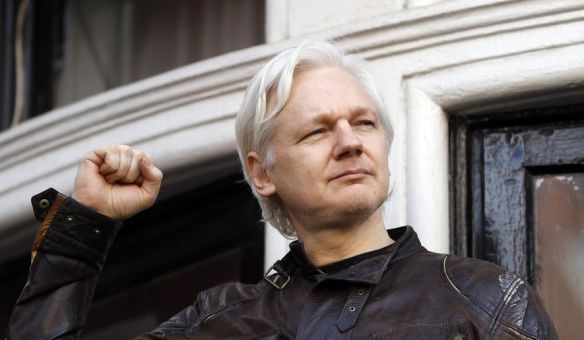
Assange and the Unforgivable Sin of Disemboweling Official Narratives

By Charles Hugh Smith

Source: Of Two Minds

The entire global status quo is on the cusp of the S-Curve decline phase.

There is really only one unforgivable sin in the political realm, and that’s destroying the official narrative by revealing the facts of the matter. This is why whistleblowers who make public the secret machinery of the elaborately artful lies underpinning all official narratives are hounded to the ends of the Earth.

Employees of state entities such as Ellsberg, Manning and Snowden are bound by vows of secrecy and threatened by the promise of severe punishment. Outsiders such as Assange are even further beyond the pale because they can’t be accused of being traitors, as they never took the vows of secrecy required by the Deep State.

The single most damaging revelation to all the elaborate lies that make up official narratives is the truth revealed in official emails, documents and conversations. This is why virtually every document and correspondence is now “classified,” so anyone releasing even a mundane scrap can be sentenced to rot in federal prison.

In a recent C-SPAN interview, author Nomi Prins explained the incredible difficulty of accessing papers in presidential libraries now due to virtually everything being classified. Freedom of Information Act (FOIA) applications must be filed, and researchers must wait years to gain access to routine correspondence that was freely available to all a decade or so ago.

Official paranoia has a 100% correlation with the amount of damage done to official narratives by any leaks of the facts of the matter. What are they so afraid of? Here’s the dynamic in play: the more fragile the narrative, the greater the dependence on half-truths and lies, the greater the official urgency to crush all whistleblowers and maintain a Stasi-like vigilance against any murmurs of dissent or doubt.

If the entire contraption wasn’t so vulnerable to exposure and so dependent on lies, why the infinite paranoia? This paranoia extends past the present system of lies into the past, as exposing the lies in decades past calls into question the official narratives of today.

Any doubt is extremely dangerous, as if even a single thread is pulled loose, the entire fabric of ginned-up statistics, false assurances, half-truths and outright lies unravels. Once the Pentagon Papers revealed the facts of the war in Vietnam, support for the official narrative collapsed essentially overnight.

In the immortal words of Jean-Claude Juncker, when it becomes serious you have to lie, and it’s now serious all the time.

The entire global status quo is on the cusp of the S-Curve decline phase. Hence the vulnerability to disruption of its official narratives and the panicky paranoia of its handlers.


Coup Attempt in Venezuela: What You’re Not Being Told

By Derrick Broze

Source: The Conscious Resistance

As self-proclaimed “Interim President” Juan Guaidó attempted to stage a military coup in Venezuela, the country’s U.N. ambassador declared President Nicolas Maduro victorious and called the United States a “rogue nation.”

The turbulent situation that has been unfolding in Venezuela for the last few years reached new heights on Tuesday as opposition leader and self-declared “Interim President” Juan Guaidó attempted to wrangle power away from Venezuelan President Nicolas Maduro, in what many are calling an attempted coup. Early Tuesday morning, Guaidó gave a press conference declaring that he has the support of the Venezuelan people and military, and demanded that Maduro step down. Guaidó also called on Venezuelans to take to the streets and call for an end to Maduro’s reign as president.

During the day’s events, cameras caught armored vehicles, reportedly belonging to the Bolivian military, running into crowds of protesters. Human Rights Watch (HRW) tweeted that 25 peopled were detained and dozens were wounded. HRW also noted that Venezuelan authorities shut down two international television channels and censored one radio station. “The regime should know that it will be held accountable for these abuses,” tweeted José Miguel Vivanco, Executive Director of HRW’s America Division.

Meanwhile, Venezuela’s U.N. ambassador Samuel Moncada held a press conference stating that President Maduro has “defeated” opposition leader Juan Guaidó and his supporters. Moncada stated “the country is right now in a situation of perfect normality.” Moncada criticized U.N. Secretary-General Antonio Guterres for not supporting Maduro’s government against Guaidó.

Moncada also attacked the United States for what he said was another example of their interventionist policies, singling out President Trump and Vice President Mike Pence for their support of Guaidó. “This is one of the most strange and weird situations we are in now, which the superpower of the world is the main rogue state going around, without care, destroying countries, invading countries, and threatening with the use of force,” Moncada stated.

The Ambassador to the UN also noted that the United States’ use of sanctions amounts to an act of war and only hurts the Venezuelan people. “Sanctions kill, as simple as that. Sanctions are criminal sanctions, are weapons of mass destruction. You don’t see the smoke, but you see the effect, you see the deleterious effect of killing and suffering,” Moncada said. “The sanctions use banks sanction, sanctions use ships, sanctions use insurance companies, and financial blockades. They cannot just say that they are concerned about liberty or freedom or the children in Venezuela, and then exercise a ghastly, nasty policy of calculated cruelty. They are acting like torturers, it is a collective punishment.”

Indeed, the Washington D.C.-based Center for Economic Policy Research published a reportlast week which determined that U.S. sanctions against Venezuela were likely responsible for 40,000 deaths in 2017-2018.

The harsh reality is that Maduro is by no means a perfect leader and his support of censoring media, use of the military to suppress protests (whether engineered or authentic), his suppression of the opposition, and other despicable acts do need to be called out. However, Ambassador Moncada is also correct that the United States does act as an imperialist “rogue” nation, using force on any nation that does not follow the Western Imperialist agenda. Unfortunately, it seems that the Venezuelan people are caught between a leader who is unpopular in some circles and an even more unpopular self-proclaimed “Interim President” with multiple connections to the Western Empire.

Of course, if our readers are unaware of these connections, it is because the corporate media (CNNWaPoThe Hill, and others) have been running non-stop coverage of why Guaidó should be accepted as the leader of Venezuela while ignoring any bit of evidence that the “uprising” might be less than genuine.

Despite the round the clock support of Guaidó, on April 13 the Grayzone exclusively reportedthat a who’s who of Trump advisors, right-wing Latin American officials, and Venezuelan opposition figures met to discuss “Assessing the Use of Military Force in Venezuela.” The meeting was hosted on April 10 at the Center for Strategic and International Studies (CSIS), a Washington-based think tank. This meeting included current and former State Department, National Intelligence Council, and National Security Council officials, along with Admiral Kurt Tidd, who was until recently the commander of the US Naval Forces Southern Command, overseeing operations in Central and South America.

The truth is that the Western Empire has been attempting to use Guaidó to install a puppet government in Venezuela. There is also evidence that the U.S. government and its intelligence agencies have attempted to take advantage of electricity blackouts in order to dethrone Maduro. In addition, there are a number of corporations and special interests who stand to benefit from the overthrow of Maduro and the crowning of Guaidó.

Although the American media has failed to report any of the above conflicts, there are still some Americans who are standing against the Venezuelan coup. A group calling itself the Embassy Protection Collective was invited by Venezuela’s government to protect the Venezuelan Embassy in Washington D.C. from illegal seizure by the U.S. government or opposition supporters. The group—which includes members of CODEPINK, Popular Resistance, the Answer Coalition, MintPress News and more—has been working to raise awareness on the attempts by the Western oligarchy to install another puppet government in Venezuela.

The reality of the situation in Venezuela is much more complicated than the likes of CNNwould have the American people believe. Only by dissecting the lies from the American media, the Maduro government, and the Guaidó contingent can we hope to get to the truth and support the people who really matter: The Venezuelan People.

Tackling the ‘Impossible’: Ending Violence

By Robert J. Burrowes

Whenever, in ordinary circumstances, the subject of violence comes up, most people throw up their hands in horror and comment along the lines that it is ‘in our genes’, ‘nothing can be done about it’ or other words that reflect the powerlessness that most people feel around violence.

It is true that violence is virtually ubiquitous, has a near-infinite variety of manifestations and, at its most grotesque (as nuclear war or run-away climate catastrophe), even threatens human extinction in the near-term.

Nevertheless, anyone who pays attention to the subject of violence in any detail soon discovers that plenty of people are interested in tackling this problem, even if it is ‘impossible’. Moreover, of course, at least some people recognize that while we must tackle each manifestation of violence, understanding the cause of violence is imperative if we are to successfully tackle its many manifestations at their source. To do all of this effectively, however, is a team effort. And hopefully, one day, this team will include all of us.

In the meantime, let me start by telling you a little about some of the people who are already working to end violence by tackling one or more of its many manifestations. These individuals are part of a worldwide network set up to focus on ending violence – ‘The People’s Charter to Create a Nonviolent World’ – and they have signed a pledge to do so.

Concerned about US government threats to Iran and Venezuela, several Charter signatories were part of one or both recent peace delegations to Iran and Venezuela respectively. These delegations were designed to open more lines of communication and to demonstrate solidarity with those who do not submit to US hegemony.

The 28-member US peace delegation to Iran from 25 February to 6 March 2019 included long-term nonviolent activists Margaret Flowers, Kevin Zeese and David Hartsough. Unfortunately for David, author of Waging Peace: Global Adventures of a Lifelong Activist and director of Peaceworkers, his trip didn’t go as planned. If you would like to read a compelling account of his time in Iran with some wonderful Iranians, while learning something about what it means to be on the wrong end of US sanctions, you will find it here: ‘An American Casualty of U.S. Economic Sanctions on Iran’. Glad you got the lifesaving medical treatment from our Iranian friends that you needed David, despite the sanctions! And it is a tragedy that Iran has recently suffered even more, as a result of the devastating floods that have hit the country, with the sanctions cruelly denying them vital emergency assistance. See ‘Stop the ongoing U.S. economic terrorism against Iran and help its people!’

In relation to Venezuela, a 13-member peace and solidarity delegation from North America landed in Caracas, Venezuela on the weekend of 9-10 March 2019. The delegation included leaders of antiwar groups from the US and Canada and, once again, Kevin Zeese and Margaret Flowers of ‘Popular Resistance’ and ‘Clearing the Fog’ podcasts. You can read an account of this delegation’s findings in Kevin and Margaret’s highly informative report ‘Venezuela: US Imperialism Is Based On Lies And Threats’.

Another initiative to support Venezuelans was outlined in the article A Nonviolent Strategy to Defeat a US Military Invasion of Venezuela.

Traveling widely to witness and demonstrate solidarity with those on the receiving end of US military violence, another long-term nonviolent activist, Kathy Kelly, recently wrote an article pointing out that ‘Every War Is a War against Children’ in which she evocatively documented examples of what this means for those children living in the war zones we call Yemen and Afghanistan. In an earlier article, Kathy questioned the morality of those corporations – such as Lockheed Martin, Boeing, General Dynamics and Raytheon – that profit from the killing their weapons inflict. See ‘Can We Divest from Weapons Dealers?’

Environmental journalist Robert Hunziker continues to fearlessly research and truthfully document the ongoing assaults that humans are inflicting on Earth’s biosphere. In his most recent article ‘The Blue Ocean Event and Collapsing Ecosystems’, Robert straightforwardly explains the content of a recent interview of Dr. Peter Wadhams, the world’s leading Arctic scientist. Robert notes that ‘Currently, the Arctic is heating up about 4 times faster than the rest of the planet… the temp difference between the Arctic and the tropics is dropping precipitously… thus, driving the jet streams less… creating meandering jet streams… in turn, producing extreme weather events throughout the Northern Hemisphere, especially in mid-latitudes where most of the world’s food is grown.’ Robert also notes that the study of ancient ice cores by a team from the British Antarctic Survey, University of Cambridge and University of Birmingham found ‘major reductions in sea ice in the Arctic’ which will crank up (via temperature amplification as a result of no Arctic sea ice) Greenland regional temperatures ‘by 16°C in less than a decade’ with horrific implications for life on Earth. Thank you, Robert, for reporting what the corporate media won’t touch and even many activists find too terrifying to seriously contemplate.

In Chile, Pía Figueroa continues her heavy involvement in efforts to network those committed to peace and nonviolence and to develop media channels that report the truth. Pía reports that ‘Pressenza International Press Agency’, which celebrated its tenth anniversary last November ‘in more than 40 places of the world’, continues to advance its contribution ‘with a journalism focused on peace and nonviolence, to a world in which all human beings have a place and their rights are fully respected, in a framework of disarmed and demilitarized societies, capable of re-establishing the ecological balance through governments of real and participatory democracy.’

Since attending the Media Forum organized in the city of Chongqing, China, by CCTV+ and CGTN, in October last year, Pía has been busy organizing the upcoming Latinamerican Humanist Forum in Santiago with the objective of ‘Building Convergences’, as its slogan points out. It will be held on 10-12 May with the participation of many grassroots and social organizations involved in more than twenty networks of nonviolent action and inspired by the European Humanist Forum that took place in Madrid, Spain, in May 2018.

Anwar A. Khan was born into ‘a liberal Muslim family in Bangladesh’. As a 16 year old college student, he participated in the ‘Bangladesh Liberation War of 1971, which resulted in horrendous loss of life, genocide against Bangladesh’s intelligentsia and systematic rapes.’ This experience taught him the nature of the US establishment as he was ‘on the battle field along with so many friends of mine and Indian soldiers to fight back the obnoxious nexus of the Pakistani military regime and the Whitehouse establishment’ to create Bangladesh. Khan Bhai went on to complete a post-graduate education, before embarking on a 43-year (so far) business career, involving many different levels of corporate engagement and which took him to many countries of the world, including Venezuela in 2010 where he met both Hugo Chavez and Nicolás Maduro.

He also writes regularly in his spare time and recently wrote an article highlighting the adverse impact of the lack of infrastructure under which many impoverished countries suffer, given the way in which the global economy functions to exploit them. In the article, he describes an inferno that started on the night of 20 February 2019 in a building at Chawkbazar, a 300-year-old Dhaka neighbourhood, ‘where chemicals for making deodorants and other household uses were illegally stored’. The fire ‘quickly spread to four nearby buildings where many people were trapped. Hundreds of firefighters rushed to the scene but traffic jams in the narrow streets held them up. It took almost 12 hours to bring the fire under control….’ The horrific inferno claimed about 100 lives and more were injured. For the full account, see ‘After Nimtali, now Chawkbazar inferno hell, a crisis of humanity’.

Commenting on the current project that she is organizing with friends, Lori Lightning outlines the rationale behind ‘Bear Bones Parenting’:

‘There’s no course or exam to pass to become a parent, and most try to figure this out once a parent, and usually in an exhausted overwhelmed state. Bedtimes, meals, chores, and healthy open communication all become a task without a trusted framework in place.

‘Based on 51 years of combined wisdom as educators, counselors, health practitioners, moms, step moms and foster moms, Bear Bones Parenting offers an intuitive formula to demystify the basics of parenting and a workbook with tools for reflection and wellness practices to take you actively through day to day living no matter where you are at in your life. You dedicate 15 minutes a day and in trade stop being overwhelmed. A “do it yourself” workbook filled with tools to turn life into what you envision for yourself and your family.

‘Our cast of puppets help to inspire playful reflection on our children’s temperaments and our own. Eventual creation of short videos will be easily accessible for busy parents and provide some examples of how things typically play out with temperaments and inspiration of the Bear way, which is curious, intuitive, firm and loving.

‘We hope that BBP can help reduce parental stress and frustration so there is time to connect in joy and curiosity with our children and foster their independence.’

For more information, you can contact Lori at this email address: <BearBonesParenting@gmail.com>

Professor Mazin Qumsiyeh is volunteer Director of The Palestine Institute for Biodiversity and Sustainability (PIBS) and the Palestine Museum of Natural History (PMNH) but he is also actively engaged in the Palestinian struggle for liberation from Israeli occupation. As he evocatively noted in a recent Easter reflection: ‘This is the tenth Easter I celebrate after returning to Palestine in 2008. When we native Christian Palestinians have a few moments to meditate and reflect in this season, we reflect that some 2.5 billion human beings believe in a message that originated with a Palestinian baby born in a manger here and was crucified for being the first revolutionary Palestinian to push for caring for the sick and the poor.

‘We reflect on the real message of Jesus, a message of love and coexistence. The harsh reality on the ground reminds us of our responsibility to shape a better future.

‘We are hopeful because we take a long view of history. Some 150,000 years ago, humans migrated from Africa using Palestine as the passage way to Western Asia and then the rest of the world. 12,000 years ago, this area became the center of development for agriculture (the Fertile Crescent). This was where we humans first domesticated animals like goats and donkeys and plants like wheat, barley, chickpeas, and lentils. This transformation allowed our ancestors time to evolve what we now call “civilization”. Hence, the first writings, the first music, and art, and the first thoughts of deities. From our Aramaic alphabet came the Latin, Arabic, Syriac, and Hebrew alphabets. Aramaic was the language of Jesus and much of our current Palestinian Arabic is still Aramaic words.’

Mazin continues to travel regularly, lecturing about initiatives of the museum but also about the political reality in Palestine. If you would like to volunteer to assist the museum’s projects, or to donate money, books, natural history items or anything else that would be useful, you are welcome to contact Mazin and his colleagues at <info@palestinenature.org>

Finally, we are deeply saddened to report the passing of Tom Shea, a long-time stalwart in the struggle for a better world and one of the original team of individuals who launched ‘The People’s Charter to Create a Nonviolent World’ on 11 November 2011. We include below the testament of his great friend and fellow nonviolent activist, Leonard Eiger:

‘For Tom Shea, Peace WAS the Way

‘My dear friend and fellow Ground Zero member Tom Shea passed away peacefully in the early morning hours of April 3rd surrounded by his family.

‘Earlier in his life Tom had been a Jesuit, a high school teacher, and had started an alternative high school and Jesuit Volunteer Corp: Midwest. He had also been involved in social justice issues on the national level with the Jesuits. Ground Zero member Bernie Meyer remembers Tom with great fondness, from being a student at St. Ignatius High School in Cleveland where Tom was teaching, to resisting together at Ground Zero many years later.

‘Tom was 47 when he left Cleveland for Traverse City, Michigan in 1977. There he met his partner Darylene, and they were inseparable from then on. Together, they participated in the Nuclear Freeze movement, and were part of the Michigan Peace Team. They traveled to New York for the second Conference on Disarmament in 1982. They protested both the first Gulf War and the war in Iraq. They also engaged in war tax resistance.

‘At Darylene’s suggestion, they attended a course in conflict mediation in the early ‘80s at a time when there was little written on the subject. That experience led them to a course taught by Quakers at Swarthmore College in 1986. In 1990 Tom and Darylene founded the five-county Conflict Resolution Service in Northern Michigan and trained the first group of volunteer mediators. Their mission was to promote peace and civility in the community through the use of mediator guided dialogue. In the early days of the program, volunteers met in church basements and around kitchen tables to train, role play and share experiences. They would travel to the homes of people needing mediation, focusing on resolving family and neighborhood conflicts.

‘Tom and Darylene moved to Snoqualmie, Washington in 2007 to spend more time with Darylene’s children. Tom got involved in community issues and continued his war tax resistance work. You could find him every April 15th, in front of the local post office, offering tax resistance information.

‘I was still leading a social justice ministry at the Snoqualmie United Methodist Church when one day Tom called the church office and asked who was doing social justice work in the area. We connected immediately due to common work and friends. Soon, Tom and I were making the pilgrimage together across the water to Ground Zero Center for Nonviolent Action, and the rest (as they say) is history.

‘I have spent countless hours with Tom and Darylene, discussing world affairs and working together on strategies and tactics for our work with Ground Zero. Tom and Darylene have been inseparable as both life partners and co-conspirators for peace. Tom once said that Darylene is like a Jesuit herself: “Jesuits are taken as very scholarly people and she’s very scholarly.”

‘In addition to working on media and communications for Ground Zero, and planning vigils and nonviolent direct actions at the Bangor Trident nuclear submarine base, Tom put himself on the line many times, often entering the roadway blocking traffic, both on the County and Federal sides, symbolically closing the base and risking arrest. Tom also created street theatre scripts that have been used during vigils at the submarine base to entertain and educate people.

‘Robert Burrowes, who cofounded ‘The People’s Charter to Create a Nonviolent World’, said that “Tom was one of the true legends in my life. A long-standing symbol of, and nonviolent fighter for, everything that could be in our world.” When all is said and done, Tom’s life can be summed up by A.J Muste: “There is no way to peace. Peace is the way.”

‘We will be scattering some of Tom’s ashes (per his wishes) at Ground Zero Center during our August Hiroshima-Nagasaki weekend of remembrance and action.

‘I invite you to honor Tom’s memory by supporting the work of the National War Tax Resistance Coordinating Committee. There are many ways we can engage in war tax resistance in the context of a broad range of nonviolent strategies for social change.’

While diminished by the passing of Tom, the Ground Zero Center for Nonviolent Action continues ‘to explore the meaning and practice of nonviolence from a perspective of deep spiritual reflection, providing a means for witnessing to and resisting all nuclear weapons, especially Trident. We seek to go to the root of violence and injustice in our world and experience the transforming power of love through nonviolent direct action.’ You can read about their ongoing efforts on their website, Ground Zero, which also features a ‘Current Action Alert: Stop the “Low-Yield” Trident Warhead!’

Each of the individuals mentioned above is part of the ongoing and steadily expanding effort to end the violence in our world. They refuse to accept that violence cannot be ended, and each has chosen to focus on working to end one or more manifestations of violence, according to their particular interests. If you would like to join these people, you are welcome to sign the online pledge of ‘The People’s Charter to Create a Nonviolent World’.

If your own interest is campaigning on a peace, climate, environment or social justice issue, consider doing it strategically. See Nonviolent Campaign Strategy.

If your focus is a defense or liberation struggle being undertaken by a national group, consider enhancing its strategic impact. See Nonviolent Defense/Liberation Strategy.

If your preference is addressing the climate and environmental catastrophes systematically, consider participating in ‘The Flame Tree Project to Save Life on Earth’.

If you would like to tackle violence at its source, consider revising your parenting in accordance with ‘My Promise to Children’. If you want the evidence to understand why this is so crucial, see ‘Why Violence?’ and ‘Fearless Psychology and Fearful Psychology: Principles and Practice’.

If you are aware enough to know that you are not dealing effectively with our deepening crisis, consider doing the personal healing necessary to do so. See ‘Putting Feelings First’.

It may be that ending human violence is impossible, as many believe. But there are a great number of people around the world who do not accept this and who are struggling, relentlessly, to end violence before it ends us. What about you?


Biodata: Robert J. Burrowes has a lifetime commitment to understanding and ending human violence. He has done extensive research since 1966 in an effort to understand why human beings are violent and has been a nonviolent activist since 1981. He is the author of ‘Why Violence?’ His email address is flametree@riseup.net and his website is here.


Freedom Rider: The “Resistance” Is Silent on Julian Assange

By Margaret Kimberly

Source: Black Agenda Report

Liberals are just as much true believers in imperialism as the right wing they claim to oppose.

“Attacking the person who revealed war crimes is compliance in the service of the state.”

Ever since Donald Trump was elected president we have heard a lot about people who call themselves the “resistance.” That word has very significant meaning and should not be used frivolously. The enslaved Haitian people resisted the French 200 years ago. Harriet Tubman resisted and so did Tecumseh. Brave people all over the world have resisted colonial invasion, occupation, and racist violence.

But resistance for the anti-Trump group doesn’t amount to very much. They are united in dislike of Donald Trump, but only some of the time. They call him a fascist, but they mute themselves when his fascism supports the bipartisan imperialist consensus.

The so-called resistance have been conspicuously silent ever since Julian Assange was arrested after Ecuador withdrew his asylum from its London embassy. Under the guise of defending the press, this same group became hysterical when Trump had a stupid argument with a CNN reporter.They are enraged when he refers to the media as “enemies of the people.” But when publisher and journalist Julian Assange was snatched up by the U.S. and its vassal states they either said nothing or condemned a man whose actions are the very embodiment of resistance.

“This same group became hysterical when Trump had a stupid argument with a CNN reporter.”

Julian Assange now sits in a London prison awaiting extradition hearings. The United States government convened a grand jury in 2017 which handed down a secret indictment against him. He is charged with conspiracy to commit computer intrusionin relation to Chelsea Manning’s 2010 revelation of United States war crimes in Iraq. The Collateral Murder video shows army soldiers killing civilians, returning for a “double tap” killing of first responders, and laughing about their massacre. Anyone who revealed these horrors is a hero and should be supported without any ifs, ands or buts.

The United Kingdom played its usual role of partner in crime for the U.S. Fellow puppet state Australia refused to protect its citizen. Ecuador made off with a cool $4 billion in IMF loans. There is so much corruption to oppose but one wouldn’t know that with all the cheering on behalf of the surveillance state.

“Anyone who revealed these horrors is a hero.”

This resistance is little more than a collective hissy fit from dead ender Democrats who insist on following a party that can’t even reliably stay in office.  They have spent the last three years railing against Trump but bite their tongues when he commits an act that reeks of fascist ideology.

The kindest thing that can be said is that they have been hypnotized by a combination of Democratic Party and corporate media lies. It is very difficult to determine the truth in a culture saturated with all the deformities of an imperial state in panic mode. One has to act as a detective and know which web sites to read or whom to follow on social media in order to learn anything outside of the confines of state propaganda. Ever since election night in November 2016 the public have been subjected to a relentless campaign meant to deflect righteous anger away from the Democrats while furthering imperialist goals at the same time.

Julian Assange has become the poster child for the big lie. His leaks of Democratic National Committee emails are blamed for Hillary Clinton’s defeat. But there was no computer hack of the DNC at all. Assange received leaked materials from an insider and used Wikileaks to publish it.

“His leaks of Democratic National Committee emails are blamed for Hillary Clinton’s defeat.”

But that is only a partial explanation. The reality is far worse. Liberals are just as much true believers in imperialism as the right wing they claim to oppose.They are nothing if not consistent. When the Trump administration announced the coup attempt against the Venezuelan government the resistance didn’t resist at all.

Instead they repeated talking points from the New York Timesand National Public Radio which labeled the elected Venezuelan president a brutal dictator. They didn’t question the United States claim of a right to undo the will of people in another country. Some gave wishy washy criticism of military intervention but none of them questioned an intervention which is fascist by any definition.

“Liberals are just as much true believers in imperialism as the right wing they claim to oppose.”

These people will never defend Julian Assange. According to their world view he doesn’t deserve to be defended. He revealed government secrets, which runs counter to their support of the imperialist state, and they think he deprived them of a second Clinton presidency.

Now we know who is for real and who is a phony. Chelsea Manning sits in jail for a second time because she refused to testify before the grand jury which indicted Assange. There are people all over the world occupying Venezuelan embassies and consulates in order to protect them from the would be usurpers. That is resistance. Attacking the person who revealed war crimes is compliance in the service of the state. Perhaps this group needs a new name. They should be honest and call themselves the conformists. That would be truth in advertising.


Margaret Kimberley’s Freedom Rider column appears weekly in BAR, and is widely reprinted elsewhere. She maintains a frequently updated blog as well at http://freedomrider.blogspot.com . Ms. Kimberley lives in New York City, and can be reached via e-Mail at Margaret.Kimberley(at)BlackAgendaReport.com.     

Ecuador Has Been Hit by 40 Million Cyber Attacks Since Assange’s Arrest

By Elias Marat

Source: The Mind Unleashed

The government of Ecuador claims that the country has come under a broad and concerted cyber attack, with approximately 40 million attempts to compromise web portals connected to public institutions ever since the controversial decision to allow UK police to forcibly remove Wikileaks founder Julian Assange from their London Embassy.

Deputy Minister of Information and Communication Technologies Patricio Real told reporters that the wave of attacks began shortly after last Thursday’s arrest of Assange by British authorities. Real said that the attacks “principally come from the United States, Brazil, Holland, Germany, Romania, France, Austria and the United Kingdom, and also from here, from our territory.”

On April 11, Ecuadorian President Lenin Moreno revoked the diplomatic asylum extended to Asange by the South American nation in 2012. In a legally dubious move, Quito also revoked the Ecuadorian nationality granted to Assange in 2017.

Ecuador’s El Comercio reported that the telecommunications ministry’s undersecretary of electronic government, Javier Jara, claimed that following “threats received by these groups related to Julian Assange”–such as the shadowy network Anonymous–the country began suffering “volumetric attacks.

Volumetric attacks are a type of distributed denial of service (DDoS) attack in which servers are flooded with requests in an attempt to overload them with traffic, thus preventing users from accessing the network.

According to AFP, the targets included the foreign ministry, central bank, tax authorities, the office of the president, and a number of other government agencies’ websites. None of the attacks succeeded in destroying or stealing data.

The attacks also come amid the Ecuadorian government’s detention of Ola Bini, a Swedish national and software developer allegedly tied to Wikileaks who was detained last Thursday as he attempted to attend a martial arts event in Japan. Bini, as well as two unidentified Russian “hackers,” are being held for their alleged role in a “hackers’ network” based in the country. Bini, who is accused of having met with Assange 12 times, has also just been accused of playing a role in blackmail attempts targeting President Moreno.

Since 2017, Assange’s relationship with his Ecuadorean hosts sharply deteriorated amid President Lenin Moreno’s attempts to curry favor with international creditors and wealthy governments in the north such as the United States, the United Kingdom and Spain. Moreno began referring to Assange on various occasions as a “miserable hacker,” an “irritant,” and a “stone in the shoe” of his government.

Last year, the London embassy cut off his access to the internet for alleged political meddling following requests by Quito that he stop commenting on affairs in other countries.

Relations took a strong turn for the worse in March following the release of a batch of documents known as the “INA Papers,” which implicated the president in alleged corruption, including money-laundering, offshore bank accounts and a shell company named INA Investment Corporation that is based in Panama and was used by President Moreno’s family to procure furniture, property, and luxury goods.

It is widely speculated that while Wikileaks has still not been directly tied to the release of the INA Papers, President Moreno was enraged after personal photographs were released showing his opulent private life, including photos of the president enjoying lavish lobster breakfast-in-bed and lobster dinners–imagery considered damning by Ecuador’s electorate especially given Moreno’s prior boasting of a poverty diet of eggs and white rice, which he claimed to regularly eat as he rammed through austerity measures that led to thousands of layoffs in the poor yet resource-rich South American country.

Within Ecuador, opinions have been evenly split about Assange, with the country’s right-wing and centrists supporting the decision to end his asylum while the left and supporters of former President Rafael Correa have considered the move a scandalous act of outright prostration before the “imperialists” of the Global North.

As such, social media reactions to the government’s complaints of “cyber attacks” have provoked both outrage and mockery from the Ecuadorian public, with some social media users thanking Assange for releasing the INA Papers and others claiming that the attacks will serve as a convenient smokescreen for the country’s authorities to further plunder the public coffers of the South American country.

A Land Uncharted: the Persecution of Julian Assange

Drawing by Nathaniel St. Clair

By Kenn Orphan

Source: CounterPunch

“The freedom of the press is not safe. It’s over. And I think our republic is in its last days, because unauthorized disclosures of this kind are the lifeblood of a republic.”

– Daniel Ellsberg

The persecution and arrest of Julian Assange is the first and most definitive step toward full blown global fascism. The symbolism of a gravely ill journalist being manhandled by uniformed henchmen is the exact imagery it needed to send a chilling message to whistleblowers and the press. The assault and eventual dismantling of what remains of a free press has always been that first step, and it is what lies on the horizon barring mass dissent. For decades the mainstream media has acquiesced to the demands of the corporate world of high finance that now owns them outright and the military and surveillance state that informs their narrative. To be sure, many of them must be trembling at the events that unfolded in London.

That so many prominent American liberals are cheering this on is hardly surprising. History is replete with examples of how the privileged bourgeoisie are the first to capitulate to fascism. It happened in the 1930’s in Germany, Spain and Italy. It happened in the 1970’s in Argentina and Chile. It is happening now across the supposedly “democratic” western world. The animus they possess for Assange is not over his personal ethics, politics or affiliations, which are indeed open for criticism and debate. Like any human being, he is flawed. It is rooted in sore feelings over Wikileaks exposure of the machinations of the corrupt Democratic Party and their Wall Street favoured war hawk, Hillary Clinton. None of what Wikileaks revealed was untrue, but they blame the failure of their deeply flawed candidate on it nonetheless. They care little about the war crimes the platform helped expose through the courage of Chelsea Manning or the threat his persecution represents to press freedom itself.

That the fascist despot Trump has disavowed Wikileaks is hardly surprising either. After all, he may have used the leaks to his benefit, but the man who has relentlessly demonized the press will undoubtedly use this moment to his benefit again. Wikileaks as an organization isn’t perfect and, like any other media outlet, it is not beyond criticism. But nearly every major news outlet has used and published its material, without appreciation or gratitude, because it provided an unprecedented glimpse into the nefarious activities and guiding principles of the ruling elite. The veil had been finally lifted. But with the arrest of Julian Assange this makes all of those news outlets vulnerable to state or corporate repression and censure.

With the Trump administration chomping at the bit to launch a war against Iran and Venezuela, this must come as welcome news to them. After all, it was Wikileaks that exposed the war crimes of the Bush administration in Iraq, not the corporate media. So they can be assured little reporting, aside from a few courageous citizen journalists or those embedded with the troops who parrot Pentagon talking points, will be done to expose the Empire’s war crimes now.

Indeed, Trump has been given a green light with this one event to continue and expand the American Empire, moribund as it is, without reproach. And like a bloated corpse, it will undoubtedly infect and defile everything it touches. More brutal violations of the global south, more coups against democratically elected governments, and bolder acts of authoritarian cruelty at home. He has made no pretense of this. His minions, Pompeo and Bolton, are working tirelessly constructing the next war. And in the past several weeks he has purged his administration of monsters he deemed “too weak” when it comes to crackdowns against immigrants and asylum seekers. A classic tactic of all tyrants. He has anointed the rabid white supremacist, Stephen Miller, in this 21st century pogrom and has also toyed with the idea of making the military in charge of internment camps for migrants. Only a fool would not find such a thing chilling to the bone.

Indeed fascist leaders around the world, along with the military/surveillance establishment and their neoliberal enablers, are celebrating the silencing of Assange. After all, Wikileaks has represented a major thorn in their sides for a decade. From Netanyahu to Duterte to Bolsonaro to Modi and even Putin, all will be emboldened to expand their own attacks on press freedom. All of them will feel empowered to be even more unrestrained in their brutality.

We are on the eve of a sweeping, global, fascist tyranny. Thanks to the continued proliferation of nuclear arms, endless corporate and military assaults on the life sustaining biosphere, catastrophic climate change and the systematic dismantling of democracy, it is a land uncharted. Journalists, especially those who are independent of the corporate stranglehold, are being routinely and relentlessly persecuted and even murdered around the world. They are a bulwark against fascism we dare not lose. But the arrest of Assange is representative of a free press now under constant threat of annihilation. And it will without a doubt grow even more difficult for them to navigate through the mendacity of a ruthless ruling order that has become utterly unrestrained.

Kenn Orphan is an artist, sociologist, radical nature lover and weary, but committed activist. He can be reached at kennorphan.com.

Free Julian Assange and All Political Prisoners

By Rob Urie

Source: Counterpunch

The American war against Iraq was among the more idiotic and gratuitous slaughters in human history. It was premised on lies, prosecuted by criminals and fools, outsourced to professional murderers and it isn’t over. In addition to those murdered directly and indirectly in the war, several million refugees were scattered across the Middle East, including over a million into Syria. ISIS grew from the ranks of the disbanded Iraqi army. This fiasco appeared as it was to all the world, the gasp of a dying empire sunk under the weight of its ignorance and arrogance.

Late in the war Julian Assange and his colleagues at Wikileaks published documents and videos allegedly leaked by Chelsea Manning that brought the gratuitous nature of American violence home for all to see. The most damning was this video that shows American soldiers carefully and methodically slaughtering civilians, including Reuters staffers, outside of any determinable theater of war. The label ‘collateral murders’ was attached to the video, but those murdered were targeted— they weren’t ancillary to otherwise justifiable murders.

Julian Assange has reportedly been charged by an American Grand Jury for his role in publishing this leaked video, among others. He will apparently be extradited to the U.S. where he is expected to stand trial for doing what reporters do— publishing true information in the public interest. The New York Times and other newspapers also published the leaked documents, but have as yet not been charged. This legal maneuvering appears to be a politically motivated vendetta against Julian Assange for embarrassing the War Criminals behind the Iraq war.

National Democrats and the liberal press have spent the last 2.5 years demonizing Mr. Assange for his role in publishing leaked DNC emails in the run up to the 2016 Presidential race. As with the government’s case against him, the content of the leaked videos and documents is not in dispute. They are what they are purported to be. American soldiers did murder civilians and Reuters staffers who posed no immediate threat to them. Hillary Clinton’s campaign staff did screw Bernie Sanders out of the Democratic nomination and she did give contradictory information about her political positions depending on what she thought her audience wanted to hear.

Mr. Assange’s accusers are largely those responsible for the imperial decline that his reporting has illuminated. The leading Republicans and Democrats behind the Iraq war should have been charged with War Crimes. There is no statute of limitations on War Crimes. The national security officials among Mr. Assange’s accusers illegally spied on Americans and lied about doing so under oath to congress. The CIA illegally spied on the congressional committee charged with investigating illegal torture in the Iraq War after illegally destroying videotape evidence of its crimes. What is Julian Assange being charged with again?

What Mr. Assange did is expose the crimes of the rich and powerful. Arguments over his methods conflate process errors with the gratuitous murder of civilians. If these murdered civilians had been well-to-do white Americans and staffers at the New York Times, where might ‘process’ fit into the utterly predictable (and justifiable) calls to give those charged fair trials and prison sentences if convicted. Through what lens are the crimes exposed by Mr. Assange and Wikileaks not crimes? As with everything about a gratuitous war in which a million or more civilians are killed, why aren’t its architects and chief instigators in the dock at The Hague pleading for their lives?

While the political pump has been primed in the U.S. by war-state Democrats and war-state liberals to go after Julian Assange without legal restraint, he is lauded by much of the world for bringing the crimes of the American elite into public view. What will be illuminated by prosecuting Mr. Assange is the crimes of the elite and their use of power and office to cover up their crimes. While most Americans haven’t seen the video (link above) of American soldiers murdering civilians and press staffers, the publicity of a trial will certainly stir public interest.

Much as the Iraq War was a late gasp of an empire in decline, the prosecution of Julian Assange is the desperate act of a political establishment that is losing its grip on power. Mr. Assange is but a messenger. This establishment is the agent of its own demise. And it couldn’t happen to a more deserving group of people. Free Julian Assange and All Political Prisoners. All Power to the People!