THE MADNESS OF WAR

By Julian Rose

Source: Waking Times

It is essential to constantly remind ourselves, that war, apart from a very few exceptions, is a symptom of madness. Yet war is a disease which is largely taken for granted; considered ‘normal’ and unless it involves a large swathe of humanity, ignored. How did we allow ourselves to be trapped by such insanity?

In 2017, wars are as prevalent as ever. They are being manifest in the Middle East, in Africa, in South America, and in a lesser form, in almost all countries of the World. They are the result of a failure to recognize that killing another is actually killing one’s self. A failure to grasp that humanity is a collective made up of millions of individuals, all of whom share a common ancestry and, on a subconscious plain, a common aspiration and destiny.

There is no victory in war. War is an admission of defeat. When humans resort to mass killing of each other we see an expression of failure, never success. Not so long ago war was glorified and, for the victor, held up as an expression of supreme national pride. In fact, such an attitude was predominant in the species for thousands of years.

However two World Wars put an end to the hubris. The levels of destruction were so great and so many millions died brutal and ugly deaths, that a kind of ‘war weariness’ set-in amongst the survivors, and a new sense of the futility of it all became integrated into societies which had undergone the experience. The world looked like it might have learned its lesson; people had pounded each other, and the natural environment, into a sickening pulp, and there was no glorious aftermath. Just a sense of what ‘peace’ could actually mean.

There were, and are, still some who find war ‘exciting’, whose own lives are too dull and routine to find any thrill in the act of daily living. They look-on at wars in foreign territories as extensions of their own angst and frustrations. Such individuals find temporary comfort in watching others die.

This condition is more prevalent than many might realize; it is symptomatic of a world crushed by meaningless routine and managed by those lacking any manifest vision of something more deeply fulfilling to awaken starved imaginations.

Of course, a history of war will reveal that whole civilizations were born and dissolved via victory and defeat on the battlefield. It was believed that these blood baths were a price worth paying for the great accumulation of national wealth which followed them, if one was on the winning side. It is sobering to reflect that much of the fine architecture of old Europe is a result of plundered wealth.

War is made no less destructive by the fact that it can now be carried out by people sitting in air-conditioned ‘cockpits’ in Houston. People trained to kill ‘at a distance’. People whose chance of being themselves attacked by those they target, being pretty much nil. This type of killing is one step away from the ‘robotic soldier’, the envisioned battle field of the future and a direct of extension of the war games kids (and adults) play on their electronic gizmos.

But look, it’s still the same underlying disease. It’s still the fascination with the idea of somehow ‘coming out on top’ and having it over ‘an inferior’. It’s still reveling in destruction, on all planes of planetary life.

Children play war games. I used to play ‘Cowboys and Indians’. I was indoctrinated into ‘war thinking’ from a very early age. It was just after World War Two, and life in Britain was steeped in stories of heroism carried out by ‘our boys’ against the Nazis. Toy soldier armies ranged against each other across the sitting room floor as parents looked on with quiet acceptance. We soon graduated on to ‘cap guns’ and staged mock battles around the garden bushes and trees.

But nobody got killed in these ‘war games’ and the ground wasn’t turned into a sea of craters and toxic mud by our childhood antics. Other matters eventually attracted our curiosity and interest, and the guns and bows and arrows were dumped, unlikely to be seen again.

If mankind would only grow up, the same situation would repeat around the world. Adult individuals, blessed with a little responsibility and the slimmest glimmer of wisdom, would ‘move on’ to areas of interest that expressed an eagerness to support the planet, and not destroy it. A wish to explore new horizons of consciousness, and not to regress into thoughtless thuggery. A desire to meet and enjoy the company of other races and nationalities, and not to put a gun to their heads.

How can this madness have gone on so long? How can war still ‘be taken for granted’ in 2017?

Even those who argue vociferously for cutting back excessive CO2 emissions on the planet, don’t call for an end to war and ‘war games’ that are responsible for a large part of these emissions. They fail to realize that here is to be found the single largest transmission of toxic CO2 when set against any other global activity. I’m including a brief summary of the US position in 2013, just to illustrate the point:

“According to its own study, in 2013 the Pentagon consumed fuel equivalent to 90,000,000 barrels of crude oil. This amounts to 80% of the total fuel usage by the federal government. If burned as jet fuel it produces about 38,700,000 metric tons of CO2. And the Pentagon’s figures do not include carbon produced by the thousands of bombs dropped in 2013, or the fires that burned after the jets and drones departed. ” (Counter Punch).

Most environmentalists and climate change campaigners also ‘take war for granted’, it seems. It has been etched into our bones by an endless indoctrination process. A process whose symptoms can also be found in the way we are urged to be ‘aggressive’ and ‘competitive’ in order to make progress within the demands of the status quo. How much of what is called ‘education’ is about bringing out our creative potential instead of our aggressive potential? And how much is about cramming us with the means to ‘succeed’ in the mostly cut throat world of business and indeed, almost all professions?

We see the symptoms of aggression in daily life, and fail to question it. Is it any wonder that we fail to question war?

War is the most favored tool of the controlling powers. It supplies the coffers of the military industrial complex with an endless demand for production of weapons. The state then gets the pay-off and looks for another war to keep the cycle of death going. It is also a valuable diversionary tool for distracting the general public, while unpopular and controversial issues are pushed through the system, with only a few noticing.

Of course a great prize for warmongers in general, is anticipation of the breaking out of mother of all wars. And indeed, the ever looming threat of genocide never seems far off at the hands of those who play with power the way children play with their toy guns and swords, but without any of the child’s creativity. Today, in the USA in particular, megalomania has become wedded with a sort of Russian Roulette approach to who might present the next useful target for a bombing run or drone attack.

Witness how high the stakes get set in this fiendish game. Witness the Russian Federation and President Putin being ever further provoked by the West to take an aggressive step that could trigger a mega war scenario. The vicious taunting, without a shred of evidence to give it credence, is a mark of the madness which all too often grips those in power. Those who are determined to diminish all of life to a poisoned arrow of fabricated fear, which, if ever launched, would take all of humanity with it.

Let us be sure to keep a close eye on those whom we elect to administer our countries. The intoxication which comes with power is a very dangerous addiction, particularly when the play things at such people’s disposal are weapons of mass destruction. We need, more than ever, to be able to recognize the symptoms of megalomania and not confuse it with ‘strong leadership’. It is a major weakness in the delivery of what is called democracy, that so many people are still so easily fooled by those ‘standing for election’.

We are being pushed by ‘anti-life’ forces, some of whose origins are less than human, to see the planet and its people as expendable. To accept lies, deception and crude power-play as something akin to ‘normal’. To feel that it is not in our powers to bring deep change to a washed-out and degraded status quo. To believe that war is an ‘acceptable’ way of shifting around the totems of power.

It’s time we not only woke up, but got out of bed too. The hour is late, and this should add a significant degree of urgency to our endeavors. Mankind is blessed with deep powers of positive potential and these powers are far greater than the force which drives the war mongering anti-life minority. We are close to a tipping point in the growth of conscious awareness amongst caring human beings.

The key will be to channel this awareness into taking measures to regain control of our destinies.

To rid this world of those who hold its fate in their numb, insensitive hands. To act in unison and to defy all efforts to divide and conquer our growing sense of purpose and endeavor.

We can and we will, put an end to the madness of war. We must not wait for war to put an end to us.


Julian Rose is an early pioneer of UK Organic farming, a writer, actor, social entrepreneur and international activist. During the 1970’s he worked in experimental theatre as actor and assistant director, co-founding the The Institute for Creative Development, in Belgium, teaching holistic thinking and dramatic art. In the 1980’s he returned to the UK to take over the family farm and convert it to an organic system. His experience as a leader in reviving rural economies throughout the 1990’s, led him to be invited to join the advisory board of the South East of England Development Agency, and the Country Land Owners Association. He also served on the Oxfordshire Economic Partnership and was founder-chairman of The Association of Rural Businesses in Oxfordshire. In 2,000 he led an innovative project to revive regionally important market towns as centres of vibrant local activity and hubs for rejuvenated local food initiatives.

Julian is a prolific writer and broadcaster, his articles appear in a wide diversity of journals and on-line sites. Visit www.julianrose.info to find out about Julian’s highly diverse life and acclaimed books ‘Changing Course for Life’ and ‘In Defence of Life’.

A Nonviolent Strategy to Defeat Genocide

Rohingya protesters gather in front of a United Nations regional office building to call for an end to the ongoing unrest and violence in Myanmar’s Rakhine State in Bangkok on June 11, 2012. AFP PHOTO/ Nicolas ASFOURI


By Robert J. Burrowes

It is a tragic measure of the depravity of human existence that genocide is a continuing and prevalent manifestation of violence in the international system, despite the effort following World War II to abolish it through negotiation, and then adoption and ratification of the 1948 ‘Genocide Convention‘.

According to the Genocide Convention, genocide is any act committed with the intent to destroy, in whole or in part, a national, ethnic, racial or religious group by killing members of the group, causing serious bodily or mental harm to members of the group, deliberately inflicting on the group conditions of life calculated to bring about its physical destruction in whole or in part, imposing measures intended to prevent births within the group and/or forcibly transferring children of the group to another group.

While this definition is contested because, for example, it excludes killing of political groups, and words such as ‘democide’ (the murder or intentionally reckless and depraved disregard for the life of any person or people by their government,) and ‘politicide’ (the murder of any person or people because of their political or ideological beliefs) have been suggested as complementary terms, in fact atrocities that have been characterized as ‘genocide’ by various authors include mass killings, mass deportations, politicides, democides, withholding of food and/or other necessities of life, death by deliberate exposure to invasive infectious disease agents or combinations of these. See ‘Genocides in history‘.

While genocide and attempts at genocide were prevalent enough both before World War II (just ask the world’s indigenous peoples) and then during World War II itself, which is why the issue attracted serious international attention in the war’s aftermath, it cannot be claimed that the outlawing of genocide did much to end the practice, as the record clearly demonstrates.

Moreover, given that the United Nations and national governments, out of supposed ‘deference’ to ‘state sovereignty’, have been notoriously unwilling and slow to meaningfully respond to genocides, as was the case in Rwanda in 1994 and has been the case with the Rohingya in Myanmar (Burma) for four decades – as carefully documented in ‘The Slow-Burning Genocide of Myanmar’s Rohingya‘ – there is little evidence to suggest that major actors in the international system have any significant commitment to ending the practice, either in individual cases or in general. For example, as official bodies of the world watch, solicit reports and debate whether or not the Rohingya are actually victims of genocide, this minority Muslim population clearly suffers from what many organizations and any decent human being have long labeled as such. For a sample of the vast literature on this subject, see ‘The 8 Stages of Genocide Against Burma’s Rohingya‘ and ‘Countdown to Annihilation: Genocide in Myanmar‘.

Of course, it is not difficult to understand institutional inaction. Despite its fine rhetoric and even legal provisions, the United Nations, acting in response to the political and corporate elites that control it, routinely fails to act to prevent or halt wars (despite a UN Charter and treaties, such as the Kellogg-Briand Pact, that empower and require it to do so), routinely fails to defend refugees, routinely fails to act decisively on issues (such as nuclear weapons and the climate catastrophe) that constitute global imperatives for human survival, and turns the other way when peoples under military occupation (such as those of Tibet, West Papua, Western Sahara and Palestine) seek their support.

Why then should those under genocidal assault expect supportive action from the UN or international community in general? The factors which drive these manifestations of violence serve a diverse range of geopolitical interests in each case, and are usually highly profitable into the bargain. What hope justice or even decency in such circumstances?

Moreover, the deep psychological imperatives that drive the phenomenal violence in the international system are readily nominated: in essence, phenomenal fear, self-hatred and powerlessness. These psychological characteristics, together with the others that drive the behaviour of perpetrators of violence, have been identified and explained – see ‘Why Violence?‘ and ‘Fearless Psychology and Fearful Psychology: Principles and Practice‘ – but it is the way these (unconsciously and deeply-suppressed) emotions are projected that is critical to understanding the violent (and insane) behavioural outcomes in our world. For brief explanations see, for example, ‘Understanding Self-Hatred in World Affairs‘ and ‘The Global Elite is Insane‘.

Given the deep psychological imperatives that drive the violence of global geopolitics and corporate exploitation (as well as national, subnational and individual acts of violence), we cannot expect a compassionate and effective institutional response to genocide in the prevailing institutional order, as the record demonstrates. So, is there anything a targeted population can do to resist a genocidal assault?

Fortunately, there is a great deal that a targeted population can do. The most effective response is to develop and implement a comprehensive nonviolent strategy to either prevent a genocidal assault in the first place or to halt it once it has begun. This is done most effectively by using a sound strategic framework that guides the comprehensive planning of the strategy. Obviously, there is no point designing a strategy that is incomplete or cannot be successful.

A sound strategic framework enables us to think and plan strategically so that once our strategy has been elaborated, it can be widely shared and clearly understood by everyone involved. It also means that nonviolent actions can then be implemented because they are known to have strategic utility and that precise utility is understood in advance.

There is little point taking action at random, especially if our opponent is powerful and committed (even if that ‘commitment’ is insane which, as briefly noted above, is invariably the case). There is a simple diagram presenting a 12-point strategic framework illustrated here in the form of the ‘Nonviolent Strategy Wheel‘.

In order to think strategically about nonviolently defending against a genocidal assault, a clearly defined political purpose is needed; that is, a simple summary statement of ‘what you want’. In general terms, this might be stated thus: To defend the [nominated group] against the genocidal assault and establish the conditions for the group to live in peace, free of violence and exploitation.

Once the political purpose has been defined, the two strategic aims (‘how you get what you want’) of the strategy acquire their meaning. These two strategic aims (which are always the same whatever the political purpose) are as follows: 1. To increase support for the struggle to defeat the genocidal assault by developing a network of groups who can assist you. 2. To alter the will and undermine the power of those groups inciting, facilitating, organizing and conducting the genocide.

While the two strategic aims are always the same, they are achieved via a series of intermediate strategic goals which are always specific to each struggle. I have identified a generalized set of 48 strategic goals that would be appropriate in the context of ending any genocide here. These strategic goals can be readily modified to the circumstances of each particular instance of genocide.

Many of these strategic goals would usually be tackled by action groups working in solidarity with the affected population campaigning in third-party countries. Of course, individual activist groups would usually accept responsibility for focusing their work on achieving just one or a few of the strategic goals (which is why any single campaign within the overall strategy is readily manageable).

As I hope is apparent, the two strategic aims are achieved via a series of intermediate strategic goals.

Not all of the strategic goals will need to be achieved for the strategy to be successful but each goal is focused in such a way that its achievement will functionally undermine the power of those conducting the genocide.

It is the responsibility of the struggle’s strategic leadership to ensure that each of the strategic goals, which should be identified and prioritized according to their precise understanding of the circumstances in the country where the genocide is occurring, is being addressed (or to prioritize if resource limitations require this).

I wish to emphasize that I have only briefly discussed two aspects of a comprehensive strategy for ending a genocide: its political purpose and its two strategic aims (with its many subsidiary strategic goals). For the strategy to be effective, all twelve components of the strategy should be planned (and then implemented). See Nonviolent Defense/Liberation Strategy.

This will require, for example, that tactics that will achieve the strategic goals must be carefully chosen and implemented bearing in mind the vital distinction between the political objective and strategic goal of any such tactic. See ‘The Political Objective and Strategic Goal of Nonviolent Actions‘.

It is not difficult to nonviolently defend a targeted population against genocide. Vitally, however, it requires a leadership that can develop a sound strategy so that people are mobilized and deployed effectively.


Biodata: Robert J. Burrowes has a lifetime commitment to understanding
and ending human violence. He has done extensive research since 1966 in
an effort to understand why human beings are violent and has been a
nonviolent activist since 1981. He is the author of ‘Why Violence?
His email address is flametree@riseup.net
and his website is at http://robertjburrowes.wordpress.com


Robert J. Burrowes
P.O. Box 68
Daylesford
Victoria 3460
Australia
Email: flametree@riseup.net

Websites:
Nonviolence Charter
Flame Tree Project to Save Life on Earth
‘Why Violence?’
Nonviolent Campaign Strategy
Nonviolent Defense/Liberation Strategy
Anita: Songs of Nonviolence
Robert Burrowes
Global Nonviolence Network

How Fear of Russia Misleads Americans

NSA whistleblower Thomas Drake sees grave dangers in the U.S. government and media exaggerating foreign threats as a means to mislead and control the American public, reports Dennis J Bernstein.

By Dennis J Bernstein

Source: Consortium News

Russia has been made “the go-to scapegoat” for distracting Americans from the serious problems afflicting the U.S. government, says Thomas Drake, a former senior executive at the National Security Agency who blew the whistle on multi-billion-dollar waste and violations of the rights of citizens through secret mass surveillance programs after 9/11.

As retaliation, the Obama Administration indicted Drake in 2010 as the first whistleblower since Daniel Ellsberg charged with espionage, carrying a possible 35-year prison term. However, in 2011, the government’s case against him collapsed and he went free in a plea deal. He became the recipient of the 2011 Ridenhour Truth-Telling Prize.

I sat down with Thomas Drake on June 3, 2017, at the home of ConsortiumNews editor Robert Parry in Arlington, Virginia, on the occasion of the awarding of the 2016 Gary Webb Freedom of the Press Award to Oliver Stone.

Dennis Bernstein: I want to ask you about a story. ConsortiumNews has offered quite a different perspective on the relationship between the U.S. government and Russia [questioning the allegations about] Trump collaborating with Putin. What’s your take on this story? Do you think that ConsortiumNews is onto something in terms of really questioning that whole line?

Thomas Drake: Yes. This hyperbolic narrative that is posited almost to the point of hysteria. They would say that Russians are behind everything. “It’s all the Russians’ fault and you can blame Russia.” It’s just pure political pretension and there is a significant amount of propaganda behind it.

It’s intended to distract. It’s intended to keep people from really looking at some of the deeper truths of our own government and so it is very convenient for the political elites, on both sides of what has become the Democratic/Republican divide, which in fact is not a divide; it’s two sides of the same coin, with slightly different narrative – to project all the blame on Russia and particularly the hyper-conflation of the littlest thing that would appear to be that Trump is ruining the country or Trump is the worst thing that has ever happened. Just really taking this
way, way beyond the pale.

And ConsortiumNews — having written for ConsortiumNews going back several years now as a result of my case and mass domestic surveillance and government abuse of power — is one of the few – it’s surreal for me to say this right now – it’s one of the few alternative media outlets who have the courage to stand up to the elite narrative and get behind this hyper-partisan politicization of blaming it all on external entities.

And, in this case, Russia has become the go-to scapegoat, frankly. And it’s easy to simply focus on that as your excuse without having to concern yourself with the deeper trends in terms of the darker history of American politics.

And Gary Webb – I am quite familiar with his case. Remember he had his own profession turn on him because they wanted to curry favor with power and they wanted to have access to power. So it was full access press and power is an aphrodisiac. Henry Kissinger said that. …

DB: Access press, as in, if you don’t say the right thing […] they can toss you into prison.

TD: Yep, precisely. And so you’re willing to overlook what may be done under the cover or blanket of government, the government structure. And so ConsortiumNews is one of the few. …

I was sort of the pre-Snowden Snowden. …

DB: He cites you for opening that door….

TD: Well, he has said there wouldn’t have been him without me. And he has cited a number of people who have preceded him, right? And I was there at the foundation, at this extraordinary willful violation of, in secret, of what I call the subversion of the Constitution. Really, it was a silent coup against the Constitution….

DB: What are the multiple dangers of the way in which information is used now, and slanted to support policy as opposed to inform?

TD: Well, it’s self-interest. It’s largely self-interest driven. You have, what I have sometimes called Gov-Corp, which is a combination of government and corporations and it’s an extraordinarily pathological relationship because they feed on each other. One protects the other and when you have the government corrupting itself to serve very powerful interests at the expense of public interests, guess what? Something has to give and what gives is public transparency. What gives is accountability. What gives is responsible power. What gives is the promise. What gives is “we the people”, right?

Power just… generally at least, power is about the people and it’s pathological, and so unfortunately the checks and balances that have in the past – Ellsberg is eyewitness to this — he’s certainly a key person by simply standing up with his colleague Edgar Russo, standing up to power in terms of the bright and shiny light called Vietnam, right? He clearly brought into the public purview what was really going on with Vietnam and, ultimately, as we know, I was a very young teen growing up in the ’70s. He was already in his early 40s at the time. That, yeah, the government can use power… and that, yeah, power does tend to corrupt. Lord Acton was right.

So, what became known as the imperial presidency of Nixon, this era makes that era look like a hyper type of person, especially post-9/11. It’s just extremely concerning. It’s what I would call the devolution of democracy and constitutional rights following 9/11 and Ellsberg has said and I have said, what was actually unlawful and unconstitutional has been made legal from his time.

And the old, what became the infamous statement made by Nixon, “You know, if the President says it’s okay, it’s not illegal.” I heard almost those exact same words when I confronted the lead attorney in the Office of General Counsel. That was the first week in October 2001. I had already found out about the massive domestic surveillance program that had been unleashed. And I confronted him and he said, “This is great. The White House has approved the program. It’s all legal.” …. The hairs on the back of my neck were like…. I’m having major flashbacks… Wait a minute, just because the White House approves it, it makes it okay? I mean, history is not kind. He says,” Yep, we’re the executive agent – all approved. Yes. Don’t ask any more questions.”

So, because the White House approved it, then it’s okay to violate the Constitution. All those checks were put in place as a result of the … president resigning, the standing committees and intelligence House and the Senate, the Foreign Intelligence Surveillance Act and a whole lot of others, right? So that was the check and balance, right? Nah, just, hey 9/11, the failure of the government to provide the common defense. 3,000 people murdered that day. It should never have happened. It really should never have happened. And so we are going to use that as sort of a reverse false flag. We’re going to use that as an excuse, because, “Hey, after all, the Constitution is not a suicide pact… you know, we don’t know where the enemy is.”

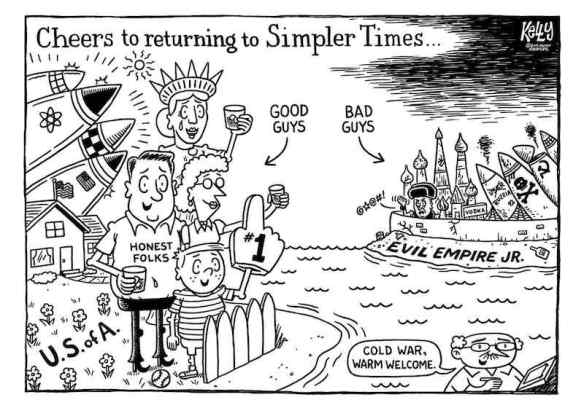
So just this weird, everything is existential now. We now know how the enemy is because of 9/11. And so it’s weird for me, having been brought up as a very young lad during the Cold War and remembering alarms going off and they’d turn off the lights and block the hall and face your lockers, right? The air raid sign drills and fears of the nuclear winter. It’s like these people want a World War 2.0.

We have far more in common with the Russians than we don’t. We have far in common than our own disputes. I assume there are some differences, right? I recognize, I am well aware, in terms of historical notes, but hey we have far more in common than we have difference.

DB: I guess what we all have in common is the state of the Earth at this point.

TD: The state of the Earth? We are the third rock from the sun. I mean, this is our home. The world is a much smaller place, in part because of technology and in part because we find out that, yeah, we really are dependent on each other.

And yet there is this addiction to conflict. There is this addiction to have threats. There is this addiction to divide. And this is not pretty. I mean, human history, the dark side of human history, and if the 20th century is not an optic lesson, then I don’t know what is….. I could go back to any of the others, in terms of written history that we know of, right? And yet here we are. And so, to me it is a sign of an empire….

The U.S. is an empire… and it is a sign of an empire that is losing it. And so, just like the Roman Empire, I mean, if you go back to the rise and fall of the Roman Empire, you know…. Those who don’t learn the lessons of the past are doomed to repeat them.

DB: Well, and the beat goes on. We’re going to let you join the party.

TD: The beat does go on. Yeah.

DB: But as we speak, there’s a major bombing, frightening bombing in Iran today.

TD: I did not know that. Wow.

DB: After the President of the United States is in Saudi Arabia. When is the last time you heard of a major suicide bomb in Iran?

TD: Not in Iran, no.

DB: So, here we go and who knows what comes next, who know what that’s going to bring in that part of the world. We thank you for all of your courage and all the suffering you did for all of us so we could know more. Thank you very much.

TD: Yeah. No. I have really become a warrior for peace. That’s what I have become. Ultimately it’s about who we are as human beings and who we are for each other and after all it is us, right? And in terms of U.S. culture and background, I think Pogo was right. We have met the enemy and the enemy is us. We are our own worst enemies.

It’s just that, for some of us, it’s critical to hold power accountable. We recognize we don’t govern ourselves very well. If you put people over others, yeah, bad things happen. But bad things tend to happen. And it’s that whole control, power. It’s all about — psychopathy is an area of study that I increasingly have as an issue, because of this idea that people gaining pleasure from the distress of others. So, it’s a disease. It really is. And some of us, at great sacrifice, weren’t going to just sit idly by and watch it all happen.

I care deeply about who we are as human beings. And I’ve spent a lot of time in front of college students and high school students and civic auditoriums and small group settings and churches and college campuses talking about these things. These are things that matter.https://consortiumnews.com/2017/06/20/how-fear-of-russia-misleads-americans/

US Gov’t Proves Love for ISIS as Bill to “Stop Arming Terrorists” Gets Only 13 Supporters

By Matt Agorist

Source: Activist Post

For the last several decades, the US government has openly funded, supported, and armed various terrorist networks throughout the world to forward an agenda of destabilization and proxy war. It is not a secret, nor a conspiracy theory, America arms bad guys.

Given the insidious history of the American empire and its creation and fostering of terrorist regimes across the globe, it should come as no surprise that the overwhelming majority of politicians would refuse to sign on to a law that requires them to ‘Stop Arming Terrorists.’ And, that is exactly what’s happened.

H.R.608 – Stop Arming Terrorists Act was introduced by Rep. Gabbard, Tulsi [D-HI] on January 23 of this year. The bill doesn’t have any crazy strings attached and its original cosponsors are a mix of Republicans and Democrats — highlighting that it transcends party lines.

“For years, our government has been providing both direct and indirect support to these armed militant groups, who are working directly with or under the command of terrorist groups like Al-Qaeda and ISIS, all in their effort and fight to overthrow the Syrian government,” Gabbard said in an interview earlier this year.

The text of the bill is simple. It merely states that it prohibits the use of federal agency funds to provide covered assistance to: (1) Al Qaeda, Jabhat Fateh al-Sham, the Islamic State of Iraq and the Levant (ISIL), or any individual or group that is affiliated with, associated with, cooperating with, or adherents to such groups; or (2) the government of any country that the Office of the Director of National Intelligence (ODNI) determines has, within the most recent 12 months, provided covered assistance to such a group or individual.

The only thing this bill does is prohibit the US government from giving money and weapons to people who want to murder Americans and who do murder innocent men, women, and children across the globe. It is quite possibly the simplest and most rational bill ever proposed by Congress. Given its rational and humanitarian nature, one would think that representatives would be lining up to show their support. However, one would be wrong.

After nearly 5 months since its introduction, only 13 of the 535 members of Congress have signed on as co-sponsors. What this lack of support for the bill shows is that the federal government is addicted to funding terror and has no intention of ever stopping it.

To add insult to treason and murder, Senator Rand Paul [R-KY] introduced this same legislation in the Senate. He currently has zero cosponsors.

Given the overwhelming lack of support for a bill that simply asks the government to stop giving money to people who behead children and video it, it should come as no surprise that Donald Trump signed hundreds of billions of dollars in weapons deals with other countries who also fund these people.

As Americans bicker over Trump’s bogus and non-existent Russian scandal, he’s signing a deal worth hundreds of billions of dollars with the largest state sponsor of terror in the world — ensuring decades of future wars and the continuation of the cycle of terrorism.

What’s more is the fact that less than one week after publicly reprimanding Qatar for terrorism, President Trump signed off on the sale of $12 billion in weapons to the country he referred to as a “funder of terrorism.” This move, in Trump’s own stance, makes him a de facto funder of terrorism now.

What this lack of support for the bills and the recent moves to arm the terrorist regimes illustrates is the fact that the US has no intention of ever stopping terrorism. Trump, just like Obama and Bush before him, will continue to foster the growth of terrorism to enrich those who profit from war.

Terrorism is necessary for the State. War, is the health of the State.

Without the constant fear mongering about an enemy who ‘hates our freedom’, Americans begin questioning things. They challenge the status quo and inevitably desire more freedom. However, when they are told that bogeymen want to kill them, they become immediately complacent and blinded by their fear.

While these bogeymen were once mostly mythical, since 9/11, they have been funded and supported by the US to the point that they now pose a very real threat to innocent people everywhere. As the recent attacks in the UK illustrate, ISIS is organizing and spreading. Even the terrorists in the UK had ties to the British government who allowed them to freely travel and train with ISIS-linked groups because those groups were in opposition to Muammar Gaddafi, who the West wanted to snub out.

It’s a vicious cycle of creating terrorists, killing innocence, and stoking war. And, unless something radical happens, it shows no signs of ever reversing.

The radical change that is necessary to shift this paradigm back to peace is for people to wake up to the reality that no matter which puppet is in the White House, the status quo remains unchanged.

Trump is proving that he can lie to get into power and his supporters ignore it. If you doubt this fact, look at what Trump did by calling out Saudi Arabia for their role in 9/11 and their support for terror worldwide prior to getting elected. He now supports these terrorists and his constituency couldn’t care less.

This madness has to stop. Humanity has to stop being fooled by rhetoric read from teleprompters by puppets doing the bidding of their masters.

Please share this article with your friends and family to show them how their supposed ‘leaders’ — except for a few good ones — are content with funding the enemy, laying waste to rights, and condone the murder of innocence.

Absent Without Leave

By James Howard Kunstler

Source: Kunstler.com

It ain’t bragging if it’s true. I’ve said repeatedly on this blog for years that the federal government would only become more impotent, more incompetent, and more ineffectual as The Long Emergency rolled out. And here we are now, at just such pass in history.

The process has been well underway since the beginning of the century. Even the attempts to expand its scope and reach — such as the post 9-11 addition of God-knows-how-many new intelligence services — has only produced an epic clusterfuck of cross-purposed mission creep that threatens the federal government’s existential legitimacy.

After nearly a year of investigating, the FBI, the CIA, the NSA, the DIA, DHS, et. al. haven’t been able to leak any substantial fact about “Russian collusion” with the Trump election campaign — and, considering the torrent of leaks about all manner of other collateral matters during this same period, it seems impossible to conclude that there is anything actually there besides utterly manufactured hysteria.

Now, one might imagine that this intelligence community could have manufactured some gift-wrapped facts rather than just waves of hysteria, but that’s where the incompetence and impotence comes in. They never came up with anything besides Flynn and Sessions having conversations with the Russian ambassador — as if the ambassadors are not here to have conversations with our government officials. You’d think that with all the computer graphics available these days they could concoct a cineplex-quality feature film-length recording of Donald Trump making a “great deal” to swap Kansas for Lithuania, or Jared Kushner giving piggyback rides to Vladimir Putin in the Kremlin. But all we’ve really ever gotten was a packet of emails from the Democratic National Committee and John Podesta of the Clinton campaign gloating about how nicely they fucked over Bernie Sanders — and that doesn’t exactly reflect so well on what has evolved to be the so-called “Resistance.”

The net effect of all this sound and fury is a government so paralyzed that it can’t even pass bad legislation or execute its existing (excessive) duties. That might theoretically be a good thing, except what we’re seeing are individual departments just veering off on their own, especially the military, which now operates without any civilian control. Apparently General Mattis, the Secretary of Defense, pretty much decided on his own to dispatch another 8,000 US troops to Afghanistan to move things along there in the war’s 16th year. Or did he get President Trump to look up from his Twitter window for three seconds to explain the situation and get a nod of approval?

Perhaps you also didn’t notice the news item over the weekend that a US-led fighter plane coalition shot down a Syrian air force plane in Syrian airspace. In an earlier era that could easily be construed as an act of war. Who gave the order for that, you have to wonder. And what will the consequences be? Reasonable people might also ask: haven’t we already made enough deadly mischief in that part of the world?

With the US military gone rogue in foreign lands, and the intelligence community off-the-reservation at home, and the Trump White House all gummed up in the tarbaby of RussiaGate, and the House and Senate lost in the shuffle, you also have to wonder what anybody is going to do about the imminent technical bankruptcy of the USA as the Treasury Department spends down its dwindling fund of remaining cash money to pay ongoing expenses — everything from agriculture subsidies to Medicare. That well is going dry in the middle of the summer, and without any resolution to the debt ceiling debate, the country will not be able to borrow more to pretend that it’s solvent.

I don’t see any indication that the House and Senate will be able to bluster their way through this. Instead, the situation will compel extraordinary new acts of financial fraud via the central banks and its cadre of Too-Big-To-Fail associates. In the event, the likely outcome will be a spectacular fall in the value of the US dollar, and perhaps consecutively, the collapse of the equity and real estate markets.

The public may not give a shit about Syria, Afghanistan, or federal dairy supports, but they’ll sure perk up and notice that their money is going worthless. I doubt they’ll be clamoring for Hillary Clinton to be installed as the first US Caesar to fix it all.

The Crisis of US Imperial Governance and the Struggle for a New World

By Danny Haiphong

Source: Black Agenda Report

“Economic crisis at home and endless war abroad has placed finance and monopoly capital in political disarray.”

When I was here last year, I spoke a lot about ideology and how the struggle for social transformation in the mainland of imperialism partly depended upon the ideological development of oppressed people trapped within US borders. The 2016 elections were beginning to pick-up momentum, but it was unclear what direction they would go. Fast-forward to the present and, I don’t know about you all, but I am exhausted. The election of Donald Trump has presented both new and old challenges. It has created an almost circus-like political environment with dire consequences for the masses. What precipitated the circus-show is a crisis of governance that has been intentionally misunderstood by US imperialism’s corporately owned media and political elite.

To distort the crisis, a state of anti-Russian madness has been prescribed to medicate political consciousness in rapidly changing times. The rise of China and Russia has exposed the bankruptcy of US imperialism on all fronts. Economic crisis at home and endless war abroad has placed finance and monopoly capital in political disarray. Donald Trump took advantage of the chaos. He spoke about jobs, he spoke about wars, and he spoke to the growing insecurities of white Americans of working and middle class status who no longer can rely on the wages of whiteness for guaranteed prosperity. The duopoly and its capitalist masters had no one to offer, indeed nothing to offer, so Trump rode in on his orange horse to become the head of state of imperialism.

“The rise of China and Russia has exposed the bankruptcy of US imperialism on all fronts.”

The ruling class does not want people in the United States to understand the context of the Trump Presidency. It has reapplied Cold War fears with Russia as the prime target. Russia’s geopolitical moves away from imperialism have been deemed just as criminal as China’s economic supremacy. The US does not depend as much on Russia in the economic sense, but it trembles in fear at the prospect of growing Russian economic activity across Eurasia. Yet, provoking Russia militarily will lead to World War. This is a risk the ruling class appears willing to take as the anti-Russia narrative in the US has only intensified since Hillary Clinton made the erroneous claim of Russian interference in the 2016 elections.

According to the US ruling class and its “intelligence officials,” Russia promotes “fakes news” to assist Donald Trump. Russian President Vladimir Putin lurks in our social media, and is hacking his way through algorithms to smear the US political system. Russia is infecting minds with its Russia Today “propaganda” arm. The Ruskies have no regard for the damage they have caused to so-called US democracy. Putin wants total control of the US and will wield his most talented social media users to get the job done. This is what the corporate media sounds like these days.

“The U.S. trembles in fear at the prospect of growing Russian economic activity across Eurasia.”

Of course, the US ruling class doesn’t want to talk about how US intelligence already collects the numbers, emails, and calls of every single person in the world who uses a cell phone or computer. They don’t want to tell you about how the US has interfered in every election in Russia since the Soviet Union fell, or how it has led bloody proxy wars and coups in over fifty countries in as many years. They don’t want to discuss how Russia has absolutely nothing to do with the millions of incarcerated people in the US or the fact that it is the US monopoly capitalist economy, not the emerging capitalist economy of Russia, which has automated many of the jobs and siphoned much of the wealth that once belonged to a privileged sector of US workers. No, it would rather attention be placed on the Russian boogeyman.

Anti-Russian hysteria doesn’t just distract the broad masses of people from the legitimate causes of the conditions afflicting the working and unemployed. It feeds into an atmosphere of war that strikes the very roots of the US social order. Imperialism is the rule of monopoly and finance capital. This system has run its course. It cannot hold onto political legitimacy any more than it can spur economic development beyond the meager 1 to 2 percent growth calculated year after year. In a sense, war is all the system has left. And war is exactly what the ruling class will get, with or without Trump.

“They don’t want to tell you about how the US has interfered in every election in Russia since the Soviet Union fell, or how it has led bloody proxy wars and coups in over fifty countries in as many years.”

War with Russia is today’s clarion call for “American unity.” In times of crisis, the US imperial state has relied on war to bring political and economic relief from domestic crisis. Every major US-led war has in part been waged for this purpose. What differs now is that war with Russia could bring about the destruction of humanity. Scientists have confirmed that nuclear war could make the planet uninhabitable.

What is also different about this current war drive with Russia is how it marks the historical conclusion of the current stage in the world imperialist order. When the US threatened nuclear war with the atomic bombing of Japan in 1945 and the Cuban missile crisis almost two decades later, the world was in the midst of a transition from Western monopoly capitalism to proletarian socialism. Revolutions in Vietnam, Cuba, and the Soviet Union, to name a few, threatened to undo the very notion of private property. And while US and Western backlash nearly eliminated the socialist bloc by 1991, the imperialist order entered a transition stage of its own that some call “neo-liberalism.”

Neo-liberalism has greatly expanded the reach of capitalism’s tentacles and widened the impact of capitalist crisis since its inception in the late 1970s. Neo-liberalism has unleashed unfettered capitalist production by imposing economic stagnation on participating countries. Meanwhile, China’s socialist model has paved a different path, one marked by unprecedented growth and poverty reduction. China has understandably attracted underdeveloped nations so desperately seeking to escape from the clutches of neo-colonial impoverishment. Russia has grown close to China, providing both countries with much assistance in the way of constructing a multi-polar economic arrangement based on the principles of sovereignty and mutually beneficial cooperation. According to the logic of neo-liberal capital, only war with Russia and China can save the system from itself.

“War with Russia could bring about the destruction of humanity.”

This conclusion stems from the fact that neo-liberal capital is not growing, it is contracting. Eighty-percent of workers are near-poor in the US while six mega billionaires hold ownership of over half of the planet’s wealth. Concentrated profit does not mean that all is well with the ruling class. Internal contradictions are eating the capitalist system alive. Neither finance capital nor its monopoly investors can arrest the resultant decline. The growth of technology to speed up production and profit has left millions stuck in permanent unemployment. A high-tech system of production is an expensive system of production, requiring lower wages and debt to absorb the falling rate of profit. Global overproduction has thus developed alongside mass misery.

Such conditions are at the root of mass incarceration, where millions of mostly Black and poor workers are warehoused in cages because there is nothing on the outside that the system can offer. They are also the root of mass surveillance, as the system must keep tabs on an increasingly restless population and justify infringements on civil liberties as necessary counter-terror measures. The War on Terror and Drugs have been prerequisites toward keeping the population scared and its attention away from the US capitalist overlords who fund and support drug trafficking and terrorism for political gain. And when all else fails, blame Russia.

“The system must keep tabs on an increasingly restless population and justify infringements on civil liberties as necessary counter-terror measures.”

The struggle against neo-liberal capital and anti-Russian hysteria is a struggle to transform and revolutionize society. This struggle requires both practical political organization and ideological development. There will be no revolution without revolutionary thought, and no revolution without revolutionary action. All too often the left is debating which one is the most important for the future success of a revolutionary movement. The answer is both, together.

For most, this explanation is understandably too broad to inform individual political energy. Liberal thought and action thus becomes attractive because it hides behind the cloak of the possible and pragmatic. It is easier to think in terms of electoral politics than in global struggle. It is far more simple to advocate for a cooperative economy or universal basic income without spelling out the broad context that prevents their formation. In order for any material victories to be won on a mass scale, the victors must understand the world in which they fight.

“A movement for social transformation in the US has still yet to be born.”

Conscious struggle has brought about meaningful and deep changes in recent years. Mumia Abu-Jamal is now receiving Hep-C treatment after years of struggle with the State of Pennsylvania. The release of Chelsea Manning and Oscar Rivera Lopez also come to mind. Solidarity with Cuba freed the Cuban 5 and has given the socialist nation more opportunities to develop its economy. But these victories have come in the midst of great cost. A movement for social transformation in the US has still yet to be born, as the presence of dozens of political prisoners and the ongoing US blockade against Cuba reminds us.

Not once did I mention the Democratic or Republican Party. Both parties have done their part to create the crisis before us. A rejection of the two-parties means an embrace of the struggle against imperialism worldwide. It means that the nations with US targets on their backs should be seen as potential allies. Yes, this includes Russia. And Syria. It includes the left movements in Latin America. In the spirit of Malcolm X, the Black liberation movement, and the historic anti-imperialist struggle around the world, the time has come to search for real bonds of solidarity around the world to aid in the struggle against white supremacy, capitalism, and empire in the US and the West. Let no one, not even those who call themselves “the left,” tell you otherwise.


Danny Haiphong is an Asian activist and political analyst in the Boston area. He canbereachedatwakeupriseup1990@gmail.com

Oligarchs Succeed! Only the People Suffer!

By James Petra

Source: The Fourth Media

On a scale not seen since the ‘great’ world depression of the 1930’s, the US political system is experiencing sharp political attacks, divisions and power grabs. Executive firings, congressional investigations, demands for impeachment, witch hunts, threats of imprisonment for ‘contempt of Congress’ and naked power struggles have shredded the façade of political unity and consensus among competing powerful US oligarchs.

For the first time in US history, the incumbent elected president struggles on a daily basis to wield state power. The opposition-controlled state (National Public Radio) and corporate organs of mass propaganda are pitted against the presidential regime. Factions of the military elite and business oligarchy face off in the domestic and international arena. The oligarchs debate and insult each other. They falsify charges, plot and deceive. Their political acolytes, who witness these momentous conflicts, are mute, dumb and blind to the real interests at stake.

The struggle between the Presidential oligarch and the Opposition oligarchs has profound consequences for their factions and for the American people. Wars and markets, pursued by sections of the Oligarchs, have led opposing sections to seek control over the means of political manipulation (media and threats of judicial action).

Intense political competition and open political debate have nothing to do with ‘democracy’ as it now exists in the United States.

In fact, it is the absence of real democracy, which permits the oligarchs to engage in serious intra-elite warfare. The marginalized, de-politicized electorate are incapable of taking advantage of the conflict to advance their own interests.

What the ‘Conflict’ is Not About

The ‘life and death’ inter-oligarchical fight is not about peace!

None of the factions of the oligarchy, engaged in this struggle, is aligned with democratic or independent governments.

Neither side seeks to democratize the American electoral process or to dismantle the grotesque police state apparatus.

Neither side has any commitment to a ‘new deal’ for American workers and employees.

Neither is interested in policy changes needed to address the steady erosion of living standards or the unprecedented increase in ‘premature’ mortality among the working and rural classes.

Despite these similarities in their main focus of maintaining oligarchical power and policies against the interests of the larger population, there are deep divisions over the content and direction of the presidential regime and the permanent state apparatus.

What the Oligarchical Struggle is About

There are profound differences between the oligarch factions on the question of overseas wars and ‘interventions’.

The ‘opposition’ (Democratic Party and some Republican elite) pursues a continuation of their policy of global wars, especially aimed at confronting Russian and China, as well as regional wars in Asia and the Middle East. There is a stubborn refusal to modify military policies, despite the disastrous consequences domestically (economic decline and increased poverty) and internationally with massive ethnic cleansing, terrorism, forced migrations of war refugees to Europe, and famine and epidemics (such as cholera and starvation in Yemen).

The Trump Presidency appears to favor increased military confrontation with Iran and North Korea and intervention in Syria, Venezuela and Yemen.

The ‘Opposition’ supports multilateral economic and trade agreements, (such as TTP and NAFTA), while Trump favors lucrative ‘bilateral’ economic agreements. Trump relies on trade and investment deals with Saudi Arabia and the Gulf Emirates and the formation of an aggressive military ‘axis’ (US-Saudi Arabia-Israel -Gulf Emirates) to eventually overthrow the nationalist regime in Iran and divide the country.

The ‘Opposition’ pursues wars and violent ‘regime change’ to replace disobedient ‘tyrants’ and nationalists and set up ‘client governments’, which will provide bases for the US military empire. Trump’s regime embraces existing dictators, who can invest in his domestic infrastructure agenda.

The ‘opposition’ seeks to maximize the role of Washington’s global military power. President Trump focuses on expanding the US role in the global market.

While both oligarchical factions support US imperialism, they differ in terms of its nature and means.

For the ‘opposition’, every country, large or small, can be a target for military conquest. Trump tends to favor the expansion of lucrative overseas markets, in addition to projecting US military dominance.

Oligarchs: Tactical Similarities

The competition among oligarchs does not preclude similarities in means and tactics. Both factions favor increased military spending, support for the Saudi war on Yemen and intervention in Venezuela. They support trade with China and international sanctions against Russia and Iran. They both display slavish deference to the State of Israel and favor the appointment of openly Zionist agents throughout the political, economic and intelligence apparatus.

These similarities are, however, subject to tactical political propaganda skirmishes. The ‘Opposition’ denounces any deviation in policy toward Russia as ‘treason’, while Trump accuses the ‘Opposition’ of having sacrificed American workers through NAFTA.

Whatever the tactical nuances and similarities, the savage inter-oligarchic struggle is far from a theatrical exercise. Whatever the real and feigned similarities and differences, the oligarchs’ struggle for imperial and domestic power has profound consequence for the political and constitutional order.

Oligarchical Electoral Representation and the Parallel Police State

The ongoing fight between the Trump Administration and the ‘Opposition’ is not the typical skirmish over pieces of legislation or decisions. It is not over control of the nation’s public wealth. The conflict revolves around control of the regime and the exercise of state power.

The opposition has a formidable array of forces, including the national intelligence apparatus (NSA, Homeland Security, FBI, CIA, etc.) and a substantial sector of the Pentagon and defense industry. Moreover, the opposition has created new power centers for ousting President Trump, including the judiciary.

This is best seen in the appointment of former FBI Chief Robert Mueller as ‘Special Investigator’ and key members of the Attorney General’s Office, including Deputy Attorney General Rob Rosenstein. It was Rosenstein who appointed Mueller, after the Attorney General ‘Jeff’ Session (a Trump ally) was ‘forced’ to recluse himself for having ‘met’ with Russian diplomats in the course of fulfilling his former Congressional duties as a senior member of the Senate Foreign Relations Committee. This ‘recusal’ took significant discretionary power away from Trump’s most important ally within the Judiciary.

The web of opposition power spreads and includes former police state officials including mega-security impresario, Michael Chertoff (an associate of Robert Mueller), who headed Homeland Security under GW Bush, John Brennan (CIA), James Comey (FBI) and others.

The opposition dominates the principal organs of propaganda -the press (Washington Post, Financial Times, New York Times, and Wall Street Journal), television and radio (ABC, NBC, CBS and PBS/ NPR), which breathlessly magnify and prosecute the President and his allies for an ever-expanding web of unsubstantiated ‘crimes and misdemeanors’. Neo-conservative and liberal think tanks and foundations, academic experts and commentators have all joined the ‘hysteria chorus’ and feeding frenzy to oust the President.

The President has an increasingly fragile base of support in his Cabinet, family and closest advisers. He has a minority of supporters in the legislature and possibly in the Supreme Court, despite nominal majorities for the Republican Party.

The President has the passive support of his voters, but they have demonstrated little ability to mobilize in the streets. The electorate has been marginalized.

Outside of politics (the ‘Swamp’ as Trump termed Washington, DC) the President’s trade, investment, taxation and deregulation policies are backed by the majority of investors, who have benefited from the rising stock market. However, ‘money’ does not appear to influence the parallel state.

The divergence between Trumps supporters in the investment community and the political power of the opposition state is one of the most extraordinary changes of our century.

Given the President’s domestic weakness and the imminent threat of a coup d’état, he has turned to securing ‘deals’ with overseas allies, including billion-dollar trade and investment agreements.

The multi-billion arms sales to Saudi Arabia and the Gulf Emirates will delight the military-industrial complex and its hundreds of thousands of workers.

Political and diplomatic ‘kowtowing’ to Israeli Prime Minister Netanyahu should please some American Zionists.

But the meetings with the EU in Brussels and with the G7 in Siciliy failed to neutralize Trump’s overseas opposition.

NATO’s European members did not accept Trump’s demands that they increase their contribution to the alliance and they condemned his reluctance to offer unconditional US military support for new NATO members. They showed no sympathy for domestic problems.

In brief, the President’s overseas supporters, meetings and agreements will have little impact on the domestic correlation of forces.

Moreover, there are long-standing ties among the various state apparatuses and spy agencies in the EU and the US, which strengthen the reach of the opposition in their attacks on Trump.

While substantive issues divide the Presidential and Opposition oligarchs, these issues are vertical, not horizontal, cleavages – a question of ‘their’ wars or ‘ours’.

Trump intensified the ideological war with North Korea and Iran; promised to increase ground troops in Afghanistan and Syria; boosted military and advisory support for the Saudi invasion of Yemen; and increased US backing for violent demonstrations and mob attacks in Venezuela.

The opposition demands more provocations against Russia and its allies; and the continuation of former President Obama’s seven wars.

While both sets of oligarchs support the ongoing wars, the major difference is over who is managing the wars and who can be held responsible for the consequences.

Both conflicting oligarchs are divided over who controls the state apparatus since their power depends on which side directs the spies and generates the fake news.

Currently, both sets of oligarchs wash each other’s ‘dirty linen’ in public, while covering up for their collective illicit practices at home and abroad.

The Trump’s oligarchs want to maximize economic deals through ‘uncritical’ support for known tyrants; the opposition ‘critically’ supports tyrants in exchange for access to US military bases and military support for ‘interventions’.

President Trump pushes for major tax cuts to benefit his oligarch allies while making massive cuts in social programs for his hapless supporters. The Opposition supports milder tax cuts and lesser reductions in social programs.

Conclusion

The battle of the oligarchs has yet to reach a decisive climax. President Trump is still the President of the United States. The Opposition forges ahead with its investigations and lurid media exposés.

The propaganda war is continuous. One day the opposition media focuses on a deported student immigrant and the next day the President features new jobs for American military industries.

The emerging left-neo-conservative academic partnership (e.g. Noam Chomsky-William Kristol) has denounced President Trump’s regime as a national ‘catastrophe’ from the beginning. Meanwhile, Wall Street investors and libertarians join to denounce the Opposition’s resistance to major tax ‘reforms’.

Oligarchs of all stripes and colors are grabbing for total state power and wealth while the majority of citizens are labeled ‘losers’ by Trump or ‘deplorables’ by Madame Clinton.

The ‘peace’ movement, immigrant rights groups and ‘black lives matter’ activists have become mindless lackeys pulling the opposition oligarchs’ wagon, while rust-belt workers, rural poor and downwardly mobile middle class employees are powerless serfs hitched to President Trump’s cart.

Epilogue

After the blood-letting, when and if President Trump is overthrown, the State Security functionaries in their tidy dark suits will return to their nice offices to preside over their ‘normal’ tasks of spying on the citizens and launching clandestine operations abroad.

The media will blow out some charming tid-bits and ‘words of truth’ from the new occupant of the ‘Oval Office’.

The academic left will churn out some criticism against the newest ‘oligarch-in-chief’ or crow about how their heroic ‘resistance’ averted a national catastrophe.

Trump, the ex-President and his oligarch son-in-law Jared Kushner will sign new real estate deals. The Saudis will receive the hundreds of billions of dollars of US arms to re-supply ISIS or its successors and to rust in the ‘vast and howling’ wilderness of US-Middle East intervention. Israel will demand even more frequent ‘servicing’ from the new US President.

The triumphant editorialists will claim that ‘our’ unique political system, despite the ‘recent turmoil’, has proven that democracy succeeds … only the people suffer!

Long live the Oligarchs!


James Petras is a Bartle Professor (Emeritus) of Sociology at Binghamton University, New York. http://petras.lahaine.org


3 Questions You’re Never Supposed to Ask After a Terrorist Attack

By Isaac Davis

Source: Waking Times

In a world where defense budgets are astronomical and wars of occupation and destabilization never end, political leaders in the UK and in Europe want you accept street level terror as the new everyday normal. The attacks are unstoppable, they say, and the world must embrace this hopelessness with faith that the government is doing all it can to create a better, safer world. Run, hide, and call the authorities, for you are helpless in this reality, so they say. But who creates and sustains this reality?

Terrorism is defined as the use of violence in the pursuit of political aims, and as politicians respond to terrorism by holding news conferences, posing, grandstanding, eulogizing, weeping for the cameras, applauding first responders and proposing legislation, so many of the important questions which can help guide us out of such a gloomy future are going unasked and unanswered. And these questions are always the same for any of these attacks, be it the London attacks, Manchester, Orlando, the Boston marathon, 7/7 or 9/11.

Here are three things we should be always ask about when Islamic terror , all of which are fair questions for any of the major terror attacks happening in Western nations.

1. In what ways do Western governments contribute to the problem of Islamic terror?

The media wants you to believe that this type of terror is unrelated to government policies and actions, thus attempting to divorce them from the greater context of geopolitics and the decades long push toward globalist world government. But how do Western governments contribute to the problem of terrorism?

Do never-ending occupations of Middle Eastern conditions and the wrecking of stable nations contribute to terrorism? Does supplying arms and financial support to known terrorist organizations make attacks in Western nations more likely? Does bombing infrastructure, hospitals and civilians in foreign nations play a role? Does promoting and supporting the massive influx of Middle Eastern and African migrants into Western nations have an effect? Does permitting known radicals and others on terror watch lists to operate freely in the West make it more likely that events like the London Bridge attack will occur? Does preventing and punishing people for speaking out in defense of their own nations and customs contribute to the situation?

2. How does government benefit from the reaction to the problem?

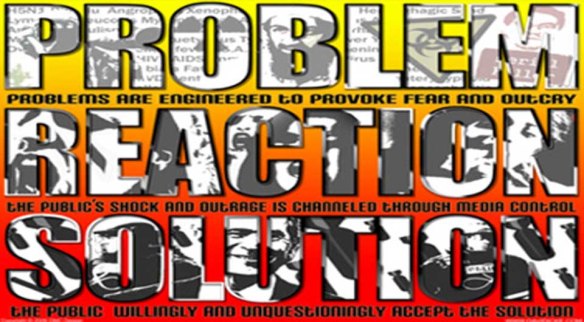
Terror creates fear, insecurity, panic, uncertainty, chaos, anger, hate and irrationality, and none are more easily lorded over than those living in terror. Historically, governments make exceptional gains in power and authority when their citizens are psychologically abused.

3. What is the pre-packaged government solution to the problem?

In the case of the London Bridge attacks, the very next day, UK Prime Minister Theresa May called for government regulation of the internet, a demand which is now being echoed by wise politicians and pundits. But this measure was already being floated, it just a dramatic push for it to gain popularity.

Whether it is the Patriot Act, the pre-planned invasion of Afghanistan, calls to restrict the 2nd Amendment, greater government surveillance, increased spending on war and police state security measures, the detainment of innocent people or torture of detainees, the government always has a solution in place before an attack happens.

Final Thoughts

Accepting terror as the norm is absolutely unacceptable and must be totally rejected by people who wish to live in peace and prosperity, which will forever remain impossible while government is allowed to contribute and benefit from terror.