By Bill Gibron
Source: Pop Matters
Film has always been a visual medium. In the days before sound, the image was all we had. It told our story, established our characters, and accentuated the drama or comedy. Visual flair is as old as movies themselves, and yet so few directors today seem to rely on and relish in the imaginative or outrageous. Since the early ’60s, Hollywood and its filmmakers have de-evolved style in a vicious cycle real world recreation for the hyper-stylized universe of the big screen, exploiting small events to find the hidden theatrics. Instead of broad canvases of color or rich, dense imagery, we witness the mundane or maudlin. Even those epic dreamscapes woven by complex computers and deranged art designers usually have one foot firmly planted in the easy to recognize and rationalize. But not The City of Lost Children. It harkens back to a more old-fashioned pictographic mindset. In many significant and indirect ways, the wild world of Marc Caro and Jean-Pierre Jeunet is art come to life. As in their previous film together, 1991’s Delicatessen, it is a fairy tale presentation of pure unbridled, wonderfully wicked imagination. It’s the Brothers Grimm as envisioned by Salvador Dali and filmed by Fritz Lang.
This is a lost classic, a film not often discussed when visionary works of imaginative cinema are mentioned. Part of this may be due to its foreign film roots. Or perhaps, for many, the film is too dark, not your typical sweet Saturday morning matinee. There are very disturbing subtexts to City that do not exist in other flights of fancy. The children here are indeed lost, either captured and tormented by a character known as Krank, or forced into a life of juvenile crime by the manipulative twins who run an orphanage. We do not see mothers or fathers. There are no caregivers or guardians, nor do we see orphans or outcasts longing for them. This lack of unconditional love creates youths who are vastly more mature, discussing subjects like love and fear with ferocious intensity and sly maturity. The strongman known as One is the closest we have to any type of parental figure, and even he is not really the older, bigger brother. “No parents” does not equal “no worries” in City. This is also a film that wallows in the subtle beauty of the grotesque, amplifying ugliness to illustrate unbridled absurdity. From Jean Paul Gautier’s Marquis de Sade meets Moby Dick fashion statements to the walleyed, demon-like faces of the child-napping zealot Cyclops, the film takes the long lost look of the circus sideshow and melds it to a nightmarish world of technological and emotional freaks.
Jean-Pierre and Marc are obviously obsessed with the carnival. The entire color scheme seems lifted from a tattooed man’s body illustrations. Like Fellini’s La Strada, which sought to tell a simple tale of love and the human spirit within the unreal realm of the circus, the filmmakers use the fantastical festival setting as a means of expressing their themes. Within its pandemonium pallet are the purity of youth, the pain of age, the wickedness of greed, and the comfort of love. There are also religious philosophies at play, battles with God both figuratively and literally. Krank and his army of clones fight and argue amongst themselves, all in the hope that, one day, the Creator will return to right his genetic missteps. The twins lord over their orphan charges like devils at the seat of Satan’s cloven hoof, waiting for instruction and brimstone beatitudes. Even the Cyclops proclaim their undying faith by blinding themselves, hoping that God will see that through both their devotion and their evangelism how truly gifted with sight (both internal and external) they are. Just like the wistful notion of running off to join the traveling show, The City of Lost Children is a chance not taken, a place where the oppression of maturity, of the stark reality of mortality and responsibility turn adults into monsters, and children into commodities.
The viewer can see many divergent ideals and inspirations at work here. But the most interesting influence to wind its way throughout the entire film is American cartoonist and inventor Rube Goldberg. Goldberg’s ingenious drawings illustrated incredibly complicated and multi-stepped procedures to achieve the most basic of results. Several set pieces in the film apply his principles and influences, and there is a giddy joy when their cause and effect logic draws to its ultimate conclusion. One sequence, involving the animal kingdom and a call to arms, is as beautiful as it is ridiculously complex. Like all other special, unnerving aspects of this movie, from the twisted fable at the core of its narrative, to the subtle pronouncements on love and family, The City of Lost Children is indeed like one of Goldberg’s wildest inventions. It’s a film that hitches its humor to the stinger of a flea, rides it on the heads of circus strongmen, and brings its heartfelt conclusion to rest in the bubbling tank of a talking, sarcastic brain. Yet the movie never gets lost itself. There is a perverse logic in its over symbolic and stylized storytelling.
No discussion of City would be complete without a word or two about the film’s music and its wonderful performances. As he has done in so many other films for auteurs like David Lynch and Paul Schrader, Angelo Badalamenti creates the perfect score, adding the clarion call of the calliope and the lonesome moan of the strings to underscore the strangeness and the sadness. This is a town under fire from within (the gangs of mercenary urchins) and without (the abductions), and Badalamenti creates a theme and an aural presence for every ideal. Sonically, The City of Lost Children is a near seamless matching of music to moving image. As for the actors, Ron Perlman has always seemed like a stunt waiting to be cast. Usually unrecognizable in face altering or obliterating make-up, he normally essays roles as unreal as the location in this film. But interestingly enough, he is the very human core of the film, a strong, faithful muscleman whose basic needs match his simpleton intellect. His is a perfectly modulated, understated performance. Among the child actors, little Judith Vittet stands out as Miette, a child who carries an incredible amount of adult soul and beauty within her delicate, French bisque features. And as usual, Jeunet regular Dominique Pinon applies his elastic facial features to the creation of six distinct characters, all out of minimal dialogue and elegant pantomime.
A movie like The City of Lost Children doesn’t really want to show us where the secrets of youth are hidden. It buries its message of adulthood and its perils in elaborate sets and visually arresting images. It symbolizes the dead end of avarice, the importance of familial bonds, and the painful loss of innocence through dreams in wonderful, paint box strokes. But it still leaves us wondering if such a place actually exists. For some, the manufactured wonders of Disney World or Universal Studios theme parks offer a glimpse into the sacred village of eternal childhood. Still others find it in the magic of their offspring at play, in their riotous laughter. Many see it in the eyes of their son or daughter as they light up in loving response. And there are those who, no matter how hard they try or how long they look, will never find the City. It will pass them by, or they will look over or through it in pursuit of a more complicated, unimportant goal. Jean-Pierre Jeunet and Marc Caro have at least provided a roadmap to the mythological place in their film La Cité des Enfants Perdus. Just turn right at your dreams, be on the lookout for your heartstrings, and ride your imagination all the way to where the sea meets the sky.
https://vimeo.com/75469682


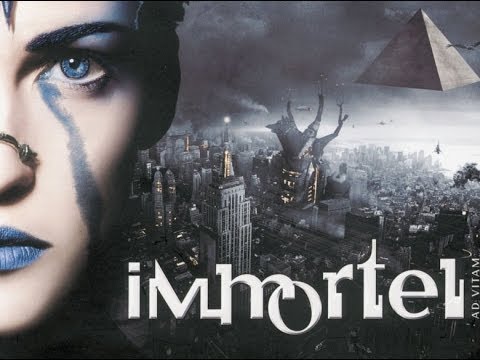 “Immortal” (2004) is a French-produced live-action/animated feature directed by Enki Bilal and based on his graphic novel The Carnival of Immortals. It was one of the first major films (along with Casshern and Sky Captain and the World of Tomorrow) to be shot entirely with a digital backdrop, blending live actors with computer generated surroundings.