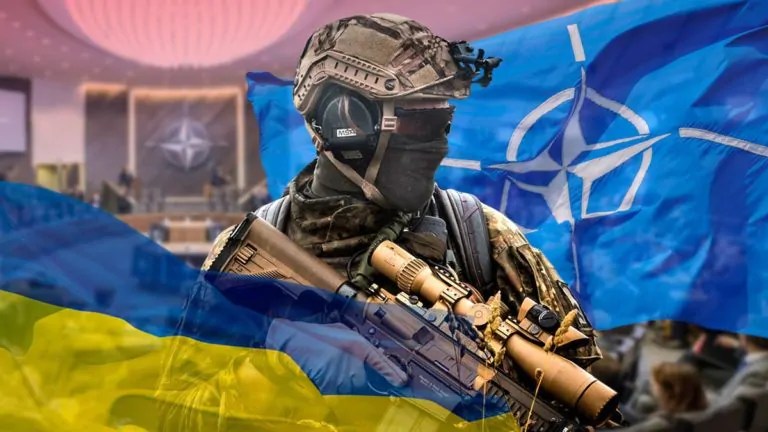
Europe is in a state of desperation; the continent is losing in Ukraine despite the ‘mighty’ strength of NATO; and European leaders are now vowing for a ‘stronger’ response, including via sending their own forces to combat Russian military forces in Ukraine. Will this decision, if it is ultimately taken, bring any meaningful change to Ukraine’s slow fall is, however, a moot question. What makes it a moot question is the scale of Ukraine’s fall and the depletion of Western stockpiles of weapons and ammunition that it is already finding hard to refill. Russia, on the other hand, is already outpacing its rivals in the West as far as the production of more – and better – weapon systems is concerned. A report in The Guardian noted that “Russian arms production worries Europe’s war planners” primarily because they cannot match this level of military preparedness and the sheer ability to sustain the fighting for two to three years.
The EU’s leader, Josep Borrell, recently noted after two years of high-intensity supply of weapons from EU allies, mainly from existing stocks, European states’ existing stocks are now depleted and “the conflict has evolved from a war of stocks to a war of production”, which, as the said report shows, Russia is clearly winning.
This information is now public, reinforcing, alongside some recently leaked Pentagon documents, the reality of Russian dominance in Ukraine. Propaganda notwithstanding, these leaked documents show that the Pentagon believes that Russian losses in Ukraine have been far less than losses publicly stated by US officials. For example, as opposed to various publicly stated estimates, Russia is said to have lost around 200,000 troops. But the Pentagon documents from February and March 2024 put the figure at around 17,000 only. Such is the scale of propaganda and the magnitude of the fear surrounding the collapse of the NATO expansion agenda that the West is now taking steps to hand over seized Russian assets to Ukraine to fund their war on Russia. They’re probably running out of enough money too!
The situation, according to a French newspaper’s investigation – which also claims to have consulted many official reports – is “critical”, with many French military officials ridiculing the idea of sending French troops to Ukraine, where the French army of “cheerleaders” can hardly fight a battle handed Russian military. But France is not an exception here. Most European military forces share this state of affairs, with very little active hardware or few troops to offer. Surely, Europe cannot send in everything, since it will leave the continent itself unprotected.
But it is highly unlikely that Russia will attack Europe, although a European provocation might change this scenario. However considering the fact that Russian military operation in Ukraine were/are driven by the Western imperative of expanding NATO, Russian success in preventing this expansion serves the purpose. For the West, however, a Russian victory in Ukraine is fretful for different purposes. They publicly talk of a Russian victory leading to a wider war in Europe, but the reality is that a Russian victory will stamp the end of western hegemony in global politics since the end of the Second World War. The West will no longer be an all-powerful ‘centre’ of the world.
Geopolitically, the West will be unable to dictate global politics, as it has been able to in the past several decades. Economically, the US dollar might lose its financial hegemony, primarily because a Russian victory in Ukraine will also indicate Russia’s ability to bypass the Western-dominated financial system. If the West can no longer control the global financial system, it automatically creates the space for alternative systems to flourish and acquire central significance. Such a scenario bodes very well for the imperatives of a new, alternative international order.
For the West – especially, the US, the self-declared leader of the ‘free world’ – this is a deeply troubling situation. Washington’s 2024 Annual Threat Assessment shows this anxiety reaching critical levels. It says: “Moscow will continue to employ all applicable sources of national power to advance its interests and try to undermine the United States and its allies … [challenging] the US primacy within” the global system. Making other admissions of failure, the report also says that the Russian economy continues to grow and that, despite western sanctions, Moscow’s oil trade is far from diminished. The report accepts that “Moscow has successfully diverted most of its seaborne oil exports and probably is selling significant volumes above the G-7–led crude oil and refined product price caps, which came into effect in December 2022 and February 2023, respectively—in part because Russia is increasing its use of non-Western options to facilitate diversion of most of its seaborne oil exports and because global oil prices increased last year”.
Because Russia is able to maintain its “energy leverage”, according to 2024 Assessment, it means it is not facing any problems vis-à-vis financing its military operations in Ukraine. In fact, the report also accepts Russia’s ability to increase public spending despite the ongoing conflict.
This is the Western assessment after financing the war on Russia for two consecutive years. Logically, such assessments infuse a sense of fear and desperation, which has led some leaders in Europe to push for sending NATO troops to Ukraine. While it may only be a threat, it does show an extremely heightened sense of defeat and a clear sense of the beginning of the end of the “Western century”.
No more shadow play. It’s now in the open. No holds barred.
Exhibit 1: Friday, March 22, 2024. It’s War. The Kremlin, via Peskov, finally admits it, on the record.
The money quote:
“Russia cannot allow the existence on its borders of a state that has a documented intention to use any methods to take Crimea away from it, not to mention the territory of new regions.”
Translation: the Hegemon-constructed Kiev mongrel is doomed, one way or another. The Kremlin signal: “We haven’t even started” starts now.
Exhibit 2: Friday afternoon, a few hours after Peskov. Confirmed by a serious European – not Russian – source. The first counter-signal.
Regular troops from France, Germany and Poland have arrived, by rail and air, to Cherkassy, south of Kiev. A substantial force. No numbers leaked. They are being housed in schools. For all practical purposes, this is a NATO force.
That signals, “Let the games begin”. From a Russian point of view, Mr. Khinzal’s business cards are set to be in great demand.
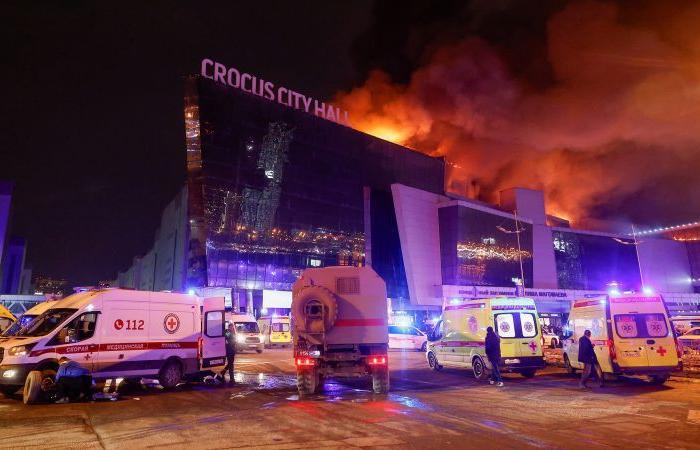
Exhibit 3: Friday evening. Terror attack on Crocus City, a music venue northwest of Moscow. A heavily trained commando shoots people on sight, point blank, in cold blood, then sets a concert hall on fire. The definitive counter-signal: with the battlefield collapsing, all that’s left is terrorism in Moscow.
And just as terror was striking Moscow, the US and the UK, in southwest Asia, was bombing Sana’a, the Yemeni capital, with at least five strikes.
Some nifty coordination. Yemen has just clinched a strategic deal in Oman with Russia-China for no-hassle navigation in the Red Sea, and is among the top candidates for BRICS+ expansion at the summit in Kazan next October.
Not only the Houthis are spectacularly defeating thalassocracy, they have the Russia-China strategic partnership on their side. Assuring China and Russia that their ships can sail through the Bab-al-Mandeb, Red Sea and Gulf of Aden with no problems is exchanged with total political support from Beijing and Moscow.
The sponsors remain the same
Deep in the night in Moscow, before dawn on Saturday 23. Virtually no one is sleeping. Rumors dance like dervishes on countless screens. Of course nothing has been confirmed – yet. Only the FSB will have answers. A massive investigation is in progress.
The timing of the Crocus massacre is quite intriguing. On a Friday during Ramadan. Real Muslims would not even think about perpetrating a mass murder of unarmed civilians under such a holy occasion. Compare it with the ISIS card being frantically branded by the usual suspects.
Let’s go pop. To quote Talking Heads: “This ain’t no party/ this ain’t no disco/ this ain’t no fooling around”. Oh no; it’s more like an all-American psy op. ISIS are cartoonish mercenaries/goons. Not real Muslims. And everyone knows who finances and weaponizes them.
That leads to the most possible scenario, before the FSB weighs in: ISIS goons imported from the Syria battleground – as it stands, probably Tajiks – trained by CIA and MI6, working on behalf of the Ukrainian SBU. Several witnesses at Crocus referred to “Wahhabis” – as in the commando killers did not look like Slavs.
It was up to Serbia’s Aleksandar Vucic to cut to the chase. He directly connected the “warnings” in early March from American and British embassies directed at their citizens not to visit public places in Moscow with CIA/MI6 intel having inside info about possible terrorism, and not disclosing it to Moscow.
The plot thickens when it is established that Crocus is owned by the Agalarovs: an Azeri-Russian billionaire family, very close friends of…
… Donald Trump.
Talk about a Deep State-pinpointed target.
ISIS spin-off or banderistas – the sponsors remain the same. The clownish secretary of the National Security and Defense Council of Ukraine, Oleksiy Danilov, was dumb enough to virtually, indirectly confirm they did it, saying on Ukrainian TV, “we will give them [Russians] this kind of fun more often.”
But it was up to Sergei Goncharov, a veteran of the elite Russia Alpha anti-terrorism unit, to get closer to unwrapping the enigma: he told Sputnik the most feasible mastermind is Kyrylo Budanov – the chief of the Main Directorate of Intelligence at the Ukrainian Ministry of Defense.
The “spy chief” who happens to be the top CIA asset in Kiev.
It’s got to go till the last Ukrainian
The three exhibits above complement what the head of NATO’s
military committee, Rob Bauer, previously told a security forum in Kiev: “You need more than just grenades – you need people to replace the dead and wounded. And this means mobilization.”
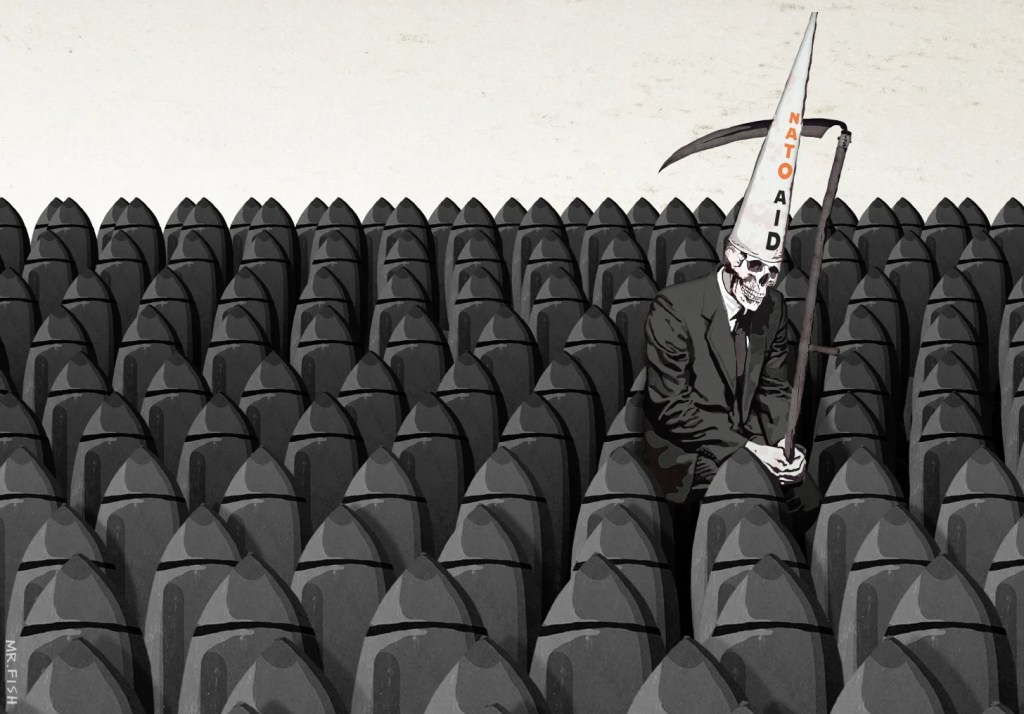
Translation: NATO spelling out this is a war until the last Ukrainian.
And the “leadership” in Kiev still does not get it. Former Minister of Infrastructure Omelyan: “If we win, we will pay back with Russian oil, gas, diamonds and fur. If we lose, there will be no talk of money – the West will think about how to survive.”
In parallel, puny “garden-and jungle” Borrell admitted that it would be “difficult” for the EU to find an extra 50 billion euros for Kiev if Washington pulls the plug. The cocaine-fueled sweaty sweatshirt leadership actually believes that Washington is not “helping” in the form of loans, but in the form of free gifts. And the same applies for the EU.
The Theater of the Absurd is unmatchable. The German Liver Sausage Chancellor actually believes that proceeds from stolen Russian assets “do not belong to anyone”, so they can be used to finance extra Kiev weaponizing.
Everyone with a brain knows that using interest from “frozen”, actually stolen Russian assets to weaponize Ukraine is a dead end – unless they steal all of Russia’s assets, roughly $200 billion, mostly parked in Belgium and Switzerland: that would tank the Euro for good, and the whole EU economy for that matter.
Eurocrats better listen to Russian Central Bank major “disrupter” (American terminology) Elvira Nabiullina: The Bank of Russia will take “appropriate measures” if the EU does anything on the “frozen”/stolen Russian assets.
It goes without saying that the three exhibits above completely nullify the “La Cage aux Folles” circus promoted by the puny Petit Roi, now known across his French domains as Macronapoleon.
Virtually the whole planet, including the English-speaking Global North, had already been mocking the “exploits” of his Can Can Moulin Rouge Army.
So French, German and Polish soldiers, as part of NATO, are already in the south of Kiev. The most possible scenario is that they will stay far, far away from the frontlines – although traceable by Mr. Khinzal’s business activities.
Even before this new NATO batch arriving in the south of Kiev, Poland – which happens to serve as prime transit corridor for Kiev’s troops – had confirmed that Western troops are already on the ground.
So this is not about mercenaries anymore. France, by the way, is only 7th in terms of mercenaries on the ground, largely trailing Poland, the US and Georgia, for instance. The Russian Ministry of Defense has all the precise records.
In a nutshell: now war has morphed from Donetsk, Avdeyevka and Belgorod to Moscow. Further on down the road, it may not just stop in Kiev. It may only stop in Lviv. Mr. 87%, enjoying massive national near-unanimity, now has the mandate to go all the way. Especially after Crocus.
There’s every possibility the terror tactics by Kiev goons will finally drive Russia to return Ukraine to its original 17th century landlocked borders: Black Sea-deprived, and with Poland, Romania, and Hungary reclaiming their former territories.
Remaining Ukrainians will start to ask serious questions about what led them to fight – literally to their death – on behalf of the US Deep State, the military complex and BlackRock.
As it stands, the Highway to Hell meat grinder is bound to reach maximum velocity.
In 2023, the West was unable to contain the advance of multipolarity. Despite continuing to finance aggression against Russia and fomenting chaos in several regions to avoid the geopolitical transition process, the US and its allies are weakened in the current world scenario and have not been able to make their projects successful.
On the Russian-Ukrainian battlefield, Kiev was unable to achieve any significant victory throughout the entire year. Since late 2022, the neo-Nazi regime has been betting on the possibility of launching a major “counteroffensive” in the spring-summer season of 2023. According to Western media, this counterattack would be strong enough to retake all the territories claimed by Kiev, including Crimea.
However, the Ukrainian measures have absolutely failed. Neo-Nazi forces were unable to inflict damage on the strong Russian defense lines and thus failed to achieve territorial gains. The Ukrainians’ focus then shifted from the battlefield to the media, with the launch of a series of terrorist attacks on demilitarized Russian territory with the aim of showing Western public opinion that at least some harm was being inflicted on the Russians – thus justifying continued military support.
Russian strong defense capabilities and high-precision strikes, however, disrupted Ukrainian plans once again and neutralized all terrorist incursions. In the end, the Ukrainians had no more arguments to disguise their failures and publicly admitted that the counteroffensive was not successful. As a result, the situation on the front lines became even more disadvantageous for NATO’s proxy forces. With more than half a million Ukrainians dead – tens of thousands of them in the failed “counteroffensive” alone – and with increasingly greater territorial losses, Ukraine already appears to be a “lost battle” in the West, having a growing critical opinion regarding the support for the regime.
Some other relevant military events also took place in 2023, such as a new war in the Nagorno-Karabakh region. In September, Azerbaijani forces launched a series of attacks against the Armenian resistance in the former separatist republic and achieved a quick military victory, gaining complete territorial control over the region. Without support from Armenia or sufficient military force to resist Azerbaijani aggression, the separatist government declared the extinction of the Republic of Artsakh, formally handing over the territory to Baku.
Since 2018, Armenia has been governed by a pro-Western regime that has moved it away from Russia and closer to the US and EU. Local politicians were led to believe that with such an approach it would be possible to contain the Azerbaijani advance, but indeed they got precisely the contrary. NATO is interested in generating as much instability as possible in the Russian [and Iranian] strategic environment and therefore encourages the worsening of crises in the Caucasus.
The scenario in the region now is one in which on one side there are Azerbaijani forces supported by the Turks and on the other Americans and Europeans backing Armenia. Both sides share common anti-Russian interests and want to make the region a NATO occupation zone. In this scenario, Moscow only tries to avoid new conflicts and works diplomatically so that peace between the parties is achieved as quickly as possible.
However, it was in the Middle East that the biggest “geopolitical news” of the year emerged. In October, Hamas-led Palestinian Resistance’s forces launched a military incursion into areas illegally occupied by Israel. Called “Al Aqsa Flood Operation“, the action was successful in causing real damage to the Israeli armed forces and settlers, but it prompted a brutal response from Tel Aviv, with Netanyahu declaring war on the Palestinians and launching a series of bombings that already killed thousands of innocent civilians.
Israeli brutality, however, was not enough to give Israel victory. On the contrary, on the battlefield there is a complicated scenario in which Zionist troops are suffering to obtain gains. There are many difficulties on the ground, mainly due to the fact that Hamas maintains a complex network of underground tunnels and knows the local terrain much better than the Israelis. Furthermore, Israel’s tanks are not able to circulate easily due to the amount of debris from bombed buildings, making frictions more favorable to Palestinian guerrillas.
Suffering heavy military losses and simultaneously killing thousands of civilians, the Zionist government is in a situation of serious crisis, both domestically and diplomatically. Globally, Israel is isolated, gaining support from only a few Western countries. Internally, the pressure for his impeachment is great, with part of his armed forces and the intelligence sector joining the opposition.
In this regional context, the Yemeni Houthi government showed solidarity with the Palestinians through a declaration of war on Israel. The Houthis have been conducting operations in the Red Sea, hindering naval flow and severely damaging the Israeli economy. The US tried to neutralize Yemen by launching a multinational naval operation, but the coalition collapsed before it even started fighting, with European countries refusing to participate.
It is also important to note how Iran has acted in this crisis scenario in the Middle East. Tehran’s proxies in the so-called “Axis of Resistance” are acting in deep support of Palestine, as can be seen, for example, in the role of Hezbollah. The Lebanese militia has launched multiple attacks against Israeli positions, severely damaging the Zionist intelligence system.
In practice, it is possible to say that the crisis in the Middle East harmed American war plans. Until recently, the US had a clear strategy to avoid the multipolarization of the world order. The plan consisted of waging a proxy war against Russia and a direct conflict with China. It was expected to defeat China and wear down Russia, but none of that happened.
Ukraine proved inefficient in causing damage to Moscow, and the West was unable to generate more conflicts in the region. Attempts at regime change to radicalize anti-Russian positions have failed – as in Georgia -, preventing the emergence of new flanks. The US has also tried to provoke a proxy war against the Russians in Africa, financing terrorist groups against the revolutionary governments of the former “Françafrique”. But this is also failing because, in partnership with the Russian PMC Wagner Group, local governments have achieved several victories against Western-backed gangs.
In the same sense, China did not “take the bait” and continued to act only diplomatically and economically, without engaging in any conflict. And, in the meantime, the Palestinians – with Iranian support – launched a military operation that forced Washington to ignore its previous plans and focus on supporting Israel. With a strong Zionist lobby in the US, there is pressure for total support for Israel, even if it means an end of the aid to Ukraine or anti-China plans.
Until October, the US was preparing to fight on the two fronts. Now, with the emergence of a third flank, the situation has become much more complicated. Washington does not seem to have enough strength to fight being involved in the three conflicts at the same time. Faced with this situation, it remains to be seen whether there will be diplomatic willingness or whether the US will irrationally opt for total war. But, in any case, what is clear is that in 2023 the West proved to be weaker than ever.
Combine all these factors and the result is a potentially volatile mixture awaiting a catalyst.
In the past, I reckoned the odds of America experiencing a revolution akin to France 1789 were low due to the different political, economic and cultural conditions present then and now, but recently I’ve considered the possibility that America’s extremes of wealth, income and power inequality are a powder keg awaiting ignition.
By French-Style Revolution I don’t mean a violent overthrow of the ruling elite as much as a tumultuous reset of how resources and power are distributed. Systems become vulnerable to such resets when they become highly asymmetrical in how they distribute resources and power, and rigid in their defense of the extreme inequality of the distribution.
The fundamental source of democracy’s stability is the dynamic competition of various interests and the dynamic equilibrium of the three branches of the state each balancing the others by restraining the dominance of any one branch or interest.
But extremes of inequality undermine this stability, as the wealthiest elites now bring such a preponderance of wealth to bear that each of the three branches of the state are now beholden to the interests of the few, leaving little recourse to the many.
When the agenda and narratives have been shaped by the wealthiest elites’ foundations, think tanks, corporate PR and lobbyists, then electing different representatives has little effect on the power structure.
The masses can still influence cultural / social policies by voting in a liberal or conservative slate, but the distribution of wealth, power and resources remains unchanged.
As wealth and power are concentrated into ever fewer hands, the mythology of broad-based access to prosperity has vastly expanded the pool of second-tier elites who feel entitled (via implicit promises made by the system) to their fair share of income, wealth and power–financial security and political agency, i.e. a say in public decisions.
These second-tier elites are primarily university graduates and the offspring of upper-middle class households who have been led to expect a secure slot in the upper reaches of the economy or state is a birthright gained by their education and class.
That there are no longer enough slots for this class means those left out constitute the raw material of a potently dissatisfied and potentially angry political class. Historian Peter Turchin presents this as the result of the overproduction of elites, a dynamic he has traced back to previous eras of tumultuous upheaval.
Another common factor driving the masses to revolt is when the essentials of life are no longer affordable or available in sufficient quantity. Historian David Hackett Fischer has documented the perilous impact of inflation, i.e. the collapse of the purchasing power of wages.
Yet another potentially explosive factor is the supreme confidence of the wealthiest elites that the system they rule could ever turn against them or crumble beneath their feet–in a word, a hubris as extreme as their wealth and power. The resignation of the masses and the ease of distracting them with ginned-up controversies and crises and consumerist novelties has fed elite confidence that their supremacy is unassailable.
This hubris leads to the elite becoming tone-deaf to their own excesses and the instability their excesses are generating within the system, an instability that’s currently hidden beneath the resignation and distraction of the masses and the mute frustration of the second-tier elites facing lifetimes of insecurity.
Another factor is the promises made by the state generations ago can no longer be met without creating new money on a scale that guarantees destabilizing inflation. This new money is issued as Treasury bonds which are purchased for income by the wealthy, further exacerbating wealth and income inequality.
The power elite are incapable of demanding sacrifices of the wealthy as the prime directive of the status quo is to defend the current asymmetry of wealth and power. This undermines the collective consensus needed to take the collective action needed to reset the system.
Combine all these factors and the result is a potentially volatile mixture awaiting a catalyst. The confidence of the status quo that it is essentially omnipotent (the Federal Reserve will always save us, etc.) and eternal is itself a factor in the mix.
The key factor is the rigidity or flexibility of the power structure. If the structure is incapable of resetting to a more flexible, symmetric distribution of power as resources, it will come apart as pressures mount.
NATO’s military intervention in Libya in 2011, which overthrew the regime of Muammar Gaddafi, resulted in a chaotic and murderous failed state. Libyans pay a horrific price for this catastrophe.
“We came, we saw, he died,” Hillary Clinton famously quipped when Muammar Gaddafi, after seven months of U.S. and NATO bombing, was overthrown in 2011 and killed by a mob who sodomized him with a bayonet. But Gaddafi would not be the only one to die. Libya, once the most prosperous and one of the most stable countries in Africa, a country with free healthcare and education, the right for all citizens to a home, subsidized electricity, water and gasoline, along with the lowest infant mortality rate and highest life expectancy on the continent, along with one of the highest literacy rates, swiftly fragmented into warring factions. There are currently two rival regimes battling for control in Libya, along with an array of rogue militias.
The chaos that followed Western intervention saw weapons from the country’s arsenals flood the black market, with many snatched up by groups such as the Islamic State. Civil society ceased to function. Journalists captured images of migrants from Nigeria, Senegal and Eritrea being beaten and sold as slaves to work in fields or on construction sites. Libya’s infrastructure, including its electrical grids, aquifers, oil fields and dams, fell into disrepair. And when the torrential rains from Storm Daniel — the climate crisis being another gift to Africa from the industrialized world — overwhelmed two decrepit dams, walls of water 20 feet high raced down to flood the port of Derna and Benghazi, leaving up to 20,000 dead according to Abdulmenam Al-Gaiti, Mayor of Derna, and some 10,000 missing.
“The fragmentation of the country’s disaster management and disaster response mechanisms, as well as deteriorating infrastructure, exacerbated the enormity of the challenges. The political situation is a driver of risk,” said Professor Petteri Taalas, Secretary General of the World Meteorological Organization.
Taalas told reporters last Thursday that “most of the human casualties” would have been avoided if there had been a “normally operating meteorological service” which “would have issued the [necessary] warnings and also the emergency management of this would have been able to carry out evacuations of the people.”
Western regime-change, carried out in the name of human rights under the doctrine of R2P (Responsibility to Protect), destroyed Libya – as it did Iraq – as a unified and stable nation. The flood victims are part of the tens of thousands of Libyan dead resulting from our “humanitarian intervention,” which rendered disaster relief non-existent. We bear responsibility for Libya’s prolonged suffering. But once we wreak havoc on a country in the name of saving its persecuted — regardless of whether they are being persecuted or not — we forget they exist.
Karl Popper in “The Open Society and Its Enemies” warned against utopian engineering, massive social transformations, almost always implanted by force, and led by those who believe they are endowed with a revealed truth. These utopian engineers carry out the wholesale destruction of systems, institutions and social and cultural structures in a vain effort to achieve their vision. In the process, they dismantle the self-correcting mechanisms of incremental and piecemeal reform that are impediments to that grand vision. History is replete with murderous utopian social engineering — the Jacobins, the communists, the fascists and now, in our own age, the globalists, or neoliberal imperialists.
Libya, like Iraq and Afghanistan, fell victim to the self-delusions peddled by humanitarian interventionists — Barack Obama, Hillary Clinton, Ben Rhodes, Samantha Power and Susan Rice. The Obama administration armed and backed an insurgent force that they believed would do the bidding of the U.S. Obama in a recent post urged people to support aid agencies to alleviate the suffering of the people of Libya, a plea that ignited an understandable backlash on social media.
There is no official tally of the casualties in Libya that have resulted directly and indirectly from the violence in Libya over the last 12 years. This is exacerbated by the fact that NATO failed to investigate casualties resulting from its seven month bombardment of the country in 2011. But the total figure of those killed and injured is likely in the tens of thousands. Action on Armed Violence recorded “8,518 deaths and injuries from explosive violence in Libya” from 2011 to 2020, 6,027 of which were civilian casualties.
In 2020, a statement published by seven U.N. agencies reported that “Close to 400,000 Libyans have been displaced since the start of the conflict nine years ago — around half of them within the past year, since the attack on the capital, Tripoli, [by Field Marshal Khalifa Belqasim Haftar’s forces] started.”
“The Libyan economy has been battered by the [civil war], the COVID-19 pandemic, and Russia’s invasion of Ukraine,” the World Bank reported in April of this year. “The country’s fragility is having far-reaching economic and social impact. GDP per capita declined by 50 percent between 2011 and 2020 while it could have increased by 68 percent if the economy had followed its pre-conflict trend,” the report says. “This suggests that Libya’s income per capita could have been 118 percent higher without the conflict. Economic growth in 2022 remained low and volatile due to conflict-related disruptions in oil production.”
Amnesty International’s 2022 Libya report also makes for grim reading. “Militias, armed groups and security forces continued to arbitrarily detain thousands of people,” it says. “Scores of protesters, lawyers, journalists, critics and activists were rounded up and subjected to torture and other ill-treatment, enforced disappearances and forced ‘confessions’ on camera.” Amnesty describes a country where militias operate with impunity, human rights abuses, including kidnappings and sexual violence, are widespread. It adds that “EU-backed Libyan coastguards and the Stability Support Authority militia intercepted thousands of refugees and migrants at sea and forcibly returned them to detention in Libya. Detained migrants and refugees were subjected to torture, unlawful killings, sexual violence and forced labour.”
Reports by the U.N. Support Mission to Libya (UNSMIL) are no less dire.
Stockpiles of weapons and ammunition — estimated to be between 150,000 and 200,000 tons — were looted from Libya with many being trafficked to neighboring states. In Mali, weapons from Libya fuelled a dormant insurgency by the Tuareg, destabilizing the country. It ultimately led to a military coup and a jihadist insurgency which supplanted the Tuareg, as well as a protracted war between the Malian government and jihadists. This triggered another French military intervention and led to 400,000 people being displaced. Weapons and ammunition from Libya also made their way into other parts of the Sahel including Chad, Niger, Nigeria and Burkina Faso.
The misery and carnage, which rippled out from a dismembered Libya, was unleashed in the name of democratization, nation-building, promoting the rule of law and human rights.
The pretext for the assault was that Gaddafi was about to launch a military operation to massacre civilians in Benghazi where rebellious forces had seized power. It had as much substance as the charge that Saddam Hussein had weapons of mass destruction, another example of utopian social engineering that left over a million Iraqi dead and millions more driven from their homes.
Gaddafi — who I interviewed for two hours in April 1995 near the gutted remains of his home that was bombed by U.S. warplanes in 1986 — and Hussein were targeted not because of what they did to their own people, although both could be brutal. They were targeted because their nations had large oil reserves and were independent of Western control. They renegotiated more favorable contracts for their nations with Western oil producers and awarded oil contracts to China and Russia. Gaddafi also gave the Russian fleet access to the port of Benghazi.
Hillary Clinton’s emails, obtained via a freedom of information request and published by WikiLeaks, also expose France’s concerns about Gaddafi’s efforts to “provide Francophone African Countries with an alternative to the French Fran (CFA).” Sidney Blumenthal, a longtime adviser to Clinton, reported on his conversations with French intelligence officers about the motivations of French President Nicholas Sarkozy, the chief architect of the attack on Libya. Blumenthal writes that the French president seeks “a greater share of Libyan oil”, increased French influence in the region, an improvement in his domestic political standing, a reassertion of French military power and an end to Gaddafi’s attempts to supplant French influence in “Francophone Africa.”
Sarkozy, who has been convicted on two separate cases of corruption and breach of campaign finance laws, faces a historic trial in 2025 for allegedly receiving millions of euros in secret illegal campaign contributions from Gadaffi, to assist with his successful 2007 presidential bid.
These were the real “crimes” in Libya. But the real crimes always remain hidden, papered over by florid rhetoric about democracy and human rights.
The American experiment, built on slavery, began with a genocidal campaign against Native Americans that was exported to the Philippines and, later, nations such as Vietnam. The narratives we tell ourselves about World War II, largely to justify our right to intervene around the globe, are a lie. It was the Soviet Union that destroyed the German army long before we landed at Normandy. We firebombed cities in Germany and Japan killing hundreds of thousands of civilians. The war in the South Pacific, where one of my uncles fought, was bestial, characterized by rabid racism, mutilation, torture and the routine execution of prisoners. The atomic bombings of Hiroshima and Nagasaki were egregious war crimes. The U.S. routinely destroys democracies that nationalize U.S. and European corporations as in Chile, Iran and Guatemala, replacing them with repressive military regimes. Washington supported the genocides in Guatemala and East Timor. It embraces the crime of preemptive war. There is little in our history to justify the claim of unique American virtues.
The nightmares we orchestrated in Iraq, Afghanistan and Libya are minimized or ignored by the press while the benefits are exaggerated or fabricated. And since the U.S. does not recognize the International Criminal Court, there is no chance of any American leader being held accountable for their crimes.
Human rights advocates have become a vital cog in the imperial project. The extension of U.S. power, they argue, is a force for good. This is the thesis of Samantha Power’s book “A Problem from Hell: America and the Age of Genocide.” They champion the R2P doctrine, unanimously adopted in 2005 at the U.N. World Summit. Under this doctrine, states are required to respect the human rights of their citizens. When these rights are violated, then sovereignty is nullified. Outside forces are permitted to intervene. Miguel d’Escoto Brockmann, the former president of the U.N. General Assembly, warned in 2009 that R2P could be misused “to justify arbitrary and selective interventions against the weakest states.”
“Since the end of the Cold War, the idea of human rights has been made into a justification for intervention by the world’s leading economic and military powers, above all, the United States, in countries that are vulnerable to their attacks,” writes Jean Bricmont in “Humanitarian Imperialism: Using Human Rights to Sell War.” “Until the U.S. invasion of Iraq, [a] large part of the left was often complicit in this ideology of intervention, discovering new ‘Hitlers’ as the need arose, and denouncing antiwar arguments as appeasement on the model of Munich in 1938.”
The creed of humanitarian intervention is selective. Compassion is extended to “worthy” victims while “unworthy” victims are ignored. Military intervention is good for Iraqis, Afghans or Libyans, but not for Palestinians or Yeminis. Human rights are supposedly sacrosanct when discussing Cuba, Venezuela and Iran, but irrelevant in our offshore penal colonies, the world’s largest open air prison in Gaza or our drone-infested war zones. The persecution of dissidents and journalists is a crime in China or Russia, but not when the targets are Julian Assange and Edward Snowden.
Utopian social engineering is always catastrophic. It creates power vacuums that augment the suffering of those the utopianists claim to protect. The moral bankruptcy of the liberal class, which I chronicle in “Death of the Liberal Class,” is complete. Liberals have prostituted their supposed values to the Empire. Incapable of taking responsibility for the carnage they inflict, they clamor for more destruction and death to save the world.
Three interesting facets of news over Niger appear to be doing the rounds. Firstly, that a terrorist group in Nigeria has openly appealed to the Nigerian President – who also happens to be the ECOWAS leader – to avoid at all costs a military intervention in Niger; secondly, that Joe Biden took the initiative to meet the same gentleman Bola Ahmed Tinubu in the corridors of the United Nations, hinting that huge amounts of U.S. investment could be directed towards Nigeria if Tinubu played ball; and thirdly, that just recently, the stakes were raised in Niger when its junta announced that it had invited the armies of both Mali and Burkina Faso onto its soil to help defend themselves against an “intervention” which ECOWAS has threatened was on the cards only days earlier.
But Biden’s little chat with Tinubu says a lot about the realities of what is going to happen and what can happen on the ground as clearly his administration does not want another proxy war between East and West on its hands before the re-election run up next year. The question of whether the U.S. would support ECOWAS militarily has been answered by Biden’s bribe to the Nigerian president. It’s not going to happen.
Tinubu, who is certainly the man at the centre of events, gives the impression in interviews that he is under great pressure from ECOWAS members to intervene, but he is the one cooling tempers and looking for a diplomatic solution. And yet, his comments to the press seem to have been written by the U.S. state department such is the proximity of his office and the U.S. administration – debunking the myth of how much ECOWAS is influenced by France (given that the majority of the countries are former French colonies). The Nigerian president’s role as ECOWAS chief is under the spotlight.
What does he really want? Are his objectives focussed more on Nigeria rather than the bloc?
Joe Biden’s offer of a fresh injection of investment from U.S. firms hasn’t seemed to hit the mark. It seems that Tinubu is after even faster and even easier cash.
Tinubu said that African democracies are “currently under assault by anti-democratic forces within and outside the continent”, which is really state department jargon for “the Russians are coming”.
He then called on the “American-backed development finance and multilateral institutions, which were designed to support war-torn Europe after World War II, to adopt a swift and comprehensive reform to meet the developmental requirements of young democracies in Africa”.
The translation isn’t too cryptic. Can the U.S. intervene and, also, while they’re at it, pump our central bank full of never-never-pay soft loans from IMF and World bank? Cheers!
Neither Biden nor Tinubu though seem to be bothered about the possibility of a fourth francophone African country falling into the hands of Mother Russia. Mali and Burkina Faso, who both can be assumed to be vassals of Russia have shown great solidarity with Niger which has lost no time kicking the French out and becoming a major pain in the arse for western elites who are confused about the events and want to oversimplify the nuances. “We lost Niger to the Russians” may be the well worn cliché although the facts on the ground and more complicated. There certainly seems in Niger to be an endearment towards the new junta’s government but Russia’s role so far is unclear.
About the only thing that Putin and Biden agree on is they don’t want a war in Niger.
It’s easy to forget though that Niger was a key player in ECOWAS and that many of its members placed great importance on Niger’s front line assault on Islamic groups in the region – which, if given more freedoms, could cause havoc right across West Africa but in particular in neighbouring Nigeria.
For the moment though, the so-called pressure from ECOWAS is unlikely to manifest itself beyond chest beating. ECOWAS members may have the hunger for intervention but they don’t have the guts for a war, which neither the U.S. or Russia will bankroll, so sobriety is likely to take over the narrative in the coming days. The war in Ukraine, the abysmal foreign policy blunders of Biden, the deluded arrogance of Macron and the emergence of BRICS have all contributed to the current crisis in Africa as the old relationship with the West is put to the test, with disastrous consequences. The only thing left of Obama’s “soft power” idea he conjured up in 2015 after his humiliation in Syria is a suitcase full of cash for a corrupt West African leader to share with his cabal. Pretty pathetic.
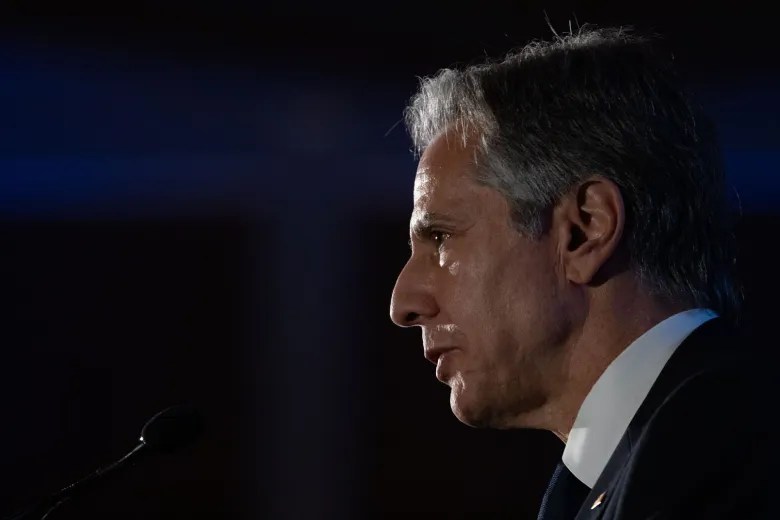
Secretary of State Antony Blinken speaks during the Mandela Washington Fellowship Summit for Young African Leaders in Washington, DC, August 2, 2023. (Official State Department photo by Chuck Kennedy)
It’s been weeks since we looked into the adventures of the Biden administration’s foreign policy cluster, led by Tony Blinken, Jake Sullivan, and Victoria Nuland. How has the trio of war hawks spent the summer?
Sullivan, the national security adviser, recently brought an American delegation to the second international peace summit earlier this month at Jeddah in Saudi Arabia. The summit was led by Crown Prince Mohammed bin Salman, known as MBS, who in June announced a merger between his state-backed golf tour and the PGA. Four years earlier MBS was accused of ordering the assassination and dismemberment of the journalist Jamal Khashoggi at the Saudi consulate in Istanbul, for perceived disloyalty to the state.
As unlikely as it sounds, there was such a peace summit and its stars did include MBS, Sullivan, and President Volodymyr Zelensky of Ukraine. What was missing was a representative of Russia, which was not invited to the summit. It included just a handful of heads of state from the fewer than fifty nations that sent delegates. The conference lasted two days, and attracted what could only be described as little international attention.
Reuters reported that Zelensky’s goal was to get international support for “the principles” that that he will consider as a basis for the settlement of the war, including “the withdrawal of all Russian troops and the return of all Ukrainian territory.” Russia’s formal response to the non-event came not from President Vladimir Putin but from Deputy Minister of Foreign Affairs Sergei Ryabkov. He called the summit “a reflection of the West’s attempt to continue futile, doomed efforts” to mobilize the Global South behind Zelensky.
India and China both sent delegations to the session, perhaps drawn to Saudi Arabia for its immense oil reserves. One Indian academic observer dismissed the event as achieving little more than “good advertising for MBS’s convening power within the Global South; the kingdom’s positioning in the same; and perhaps more narrowly, aiding American efforts to build consensus by making sure China attends the meeting with . . . Jake Sullivan in the same room.”
Meanwhile, far away on the battlefield in Ukraine, Russia continued to thwart Zelensky’s ongoing counteroffensive. I asked an American intelligence official why it was Sullivan who emerged from the Biden administration’s foreign policy circle to preside over the inconsequential conference in Saudi Arabia.
“Jeddah was Sullivan’s baby,” the official said. “He planned it to be Biden’s equivalent of [President Woodrow] Wilson’s Versailles. The grand alliance of the free world meeting in a victory celebration after the humiliating defeat of the hated foe to determine the shape of nations for the next generation. Fame and Glory. Promotion and re-election. The jewel in the crown was to be Zelensky’s achievement of Putin’s unconditional surrender after the lightning spring offensive. They were even planning a Nuremberg type trial at the world court, with Jake as our representative. Just one more fuck-up, but who is counting? Forty nations showed up, all but six looking for free food after the Odessa shutdown”—a reference to Putin’s curtailing of Ukrainian wheat shipments in response to Zelensky’s renewed attacks on the bridge linking Crimea to the Russian mainland.
Enough about Sullivan. Let us now turn to Victoria Nuland, an architect of the 2014 overthrow of the pro-Russian government in Ukraine, one of the American moves that led us to where we are, though it was Putin who initiated the horrid current war. The ultra-hawkish Nuland was promoted early this summer by Biden, over the heated objections of many in the State Department, to be the acting deputy secretary of state. She has not been formally nominated as the deputy for fear that her nomination would lead to a hellish fight in the Senate.
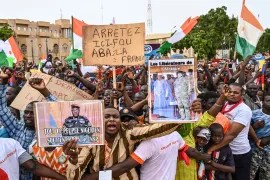
It was Nuland who was sent last week to see what could be salvaged after a coup led to the overthrow of a pro-Western government in Niger, one of a group of former French colonies in West Africa that have remained in the French sphere of influence. President Mohamed Bazoum, who was democratically elected, was tossed out of office by a junta led by the head of his presidential guard, General Abdourahmane Tchiani. The general suspended the constitution and jailed potential political opponents. Five other military officers were named to his cabinet. All of this generated enormous public support on the streets in Niamey, Niger’s capital—enough support to discourage outside Western intervention.
There were grim reports in the Western press that initially viewed the upheaval in East-West terms: some of the supporters of the coup were carrying Russian flags as they marched in the streets. The New York Times saw the coup as a blow to the main US ally in the region, Nigerian President Bola Ahmed Tinubu, who controls vast oil and gas reserves. Tinubu threatened the new government in Niger with military action unless they returned power to Bazoum. He set a deadline that passed without any outside intervention.
The revolution in Niger was not seen by those living in the region in east-west terms but as a long needed rejection of long-standing French economic and political control. It is a scenario that may be repeated again and again throughout the French-dominated Sahel nations in sub-Saharan Africa.
There are distinctions that do not bode well for the new government in Niger. The nation is blessed, or perhaps cursed, by having a significant amount of the remaining natural uranium deposits in the world. As the world warms up, a return to nuclear generated power is seen as inevitable, with obvious implications for the value of the stuff underground in Niger. The raw uranium ore, when separated, filtered and processed is known worldwide as yellowcake.
The corruption so often “talked about in Niger is not about petty bribes by government officials, but about an entire structure—developed during French colonial rule—that prevents Niger from establishing sovereignty over its raw materials and over its development,” according to a recent analysis published by Baltimore’s Real News Network. Three out of four laptops in France are powered by nuclear energy, much of which is derived from uranium mines in Niger effectively controlled by its former colonial overlord.
Niger is also the home of three American drone bases targeting Islamic radicals throughout the region. There are also undeclared Special Forces outposts in the region, whose soldiers receive double pay while on their risky combat assignments. The American official told me that “the 1,500 US troops now in Niger are exactly the number of American troops who were in South Vietnam at the time John F. Kennedy took over the presidency in 1961.”
Into this scene came Victoria Nuland, who must have drawn the short straw inside the Biden Administration. She was sent to negotiate with the new regime and to arrange a meeting with the ousted President Bazoum, whose life remains under constant threat from the governing junta. The New York Times reported that she got nowhere after talks she described as “extremely frank and at times quite difficult.” The intelligence official put her remarks to the Times in American military lingo: “Victoria set out to save the Niger uranium owners from the barbaric Russians and got a huge single-finger salute.”
Quieter in recent weeks than Sullivan and Nuland has been Secretary of State Tony Blinken. Where was he? I asked that question of the official, who said that Blinken “has figured out that the United States”—that is, our ally Ukraine—“will not win the war” against Russia. “The word was getting to him through the Agency [CIA] that the Ukrainian offense was not going to work. It was a show by Zelensky and there were some in the administration who believed his bullshit.
“Blinken wanted to broker a peace deal between Russia and Ukraine as Kissinger did in Paris to end the Vietnam war.” Instead, the official said, “it was going to be a big lose and Blinken found himself way over his skis. But he does not want to go down as the court jester.”
It was at this moment of doubt, the official said, that Bill Burns, the CIA director, “made his move to join the sinking ship.” He was referring to Burns’s speech earlier this summer at the annual Ditchley conference near London. He appeared to put aside his earlier doubts about expanding NATO to the east and affirmed his support at least five times for Biden’s program.
“Burns does not lack self-confidence and ambition,” the intelligence official said, especially when Blinken, the ardent war hawk, was suddenly having doubts. Burns served in a prior administration as deputy secretary of state and running the CIA was hardly a just reward.
Burns would not replace a disillusioned Blinken, but only get a token promotion: an appointment to Biden’s cabinet. The cabinet meets no more than once a month and, as recorded by C-SPAN, the meetings tend to be tightly scripted affairs and to begin with the president reading from a prepared text.
Tony Blinken, who publicly vowed just a few months ago that there would be no immediate ceasefire in Ukraine, is still in office and, if asked, would certainly dispute any notion of discontent with Zelensky or the administration’s murderous and failing war policy in Ukraine.
So the White House’s wishful approach to the war, when it comes to realistic talk to the American people, will continue apace. But the end is nearing, even if the assessments supplied by Biden to the public are out of a comic strip.
This piece is from Seymour Hersh’s Substack, you may subscribe to it here.
Berlin Conference of 1884-1885 was undeniably one of the biggest evil summits in modern history. Greedy and racist European colonialists sat down in the German city and divided Africans as if they were sharing bread on a breakfast table.
The conference was organized by Otto von Bismarck, the first chancellor of Germany at the request of King Leopold II of Belgium, the Western genocidal barbarian that murdered more than 10 million innocent Africans in Congo.
Most Africans are not even aware of this genocide in Congo perpetrated by the Belgium colonialists because it is not in our history books written by the white colonialists.
European colonialism in Africa lasted more than a century with only the ancient Kingdom of Ethiopia spared because they defeated the Italian colonialists on the battlefield.
Trillions and trillions of dollars were stolen from Africa, millions of Africans were murdered by the European colonialists and Africans were massively brainwashed that they had no history before European colonialism.
The wave of ‘independence’ in Africa from the 1950s and 1960s did not represent true independence. What actually happened was that colonialism was cleverly replaced with neocolonialism by the genocidal imperialist barbarians of the West.
The massive looting of rich resources in Africa continued under Western puppet leadership. The courageous African leaders who refused to dance to the tune of the European colonialists were eliminated.
This was what happened to African heroes, Patrick Lumumba of Congo and Thomas Sankara of Burkina Faso. Congo has all mineral resources except for crude oil.
The uranium used by the US regime to make the atomic bombs unleashed on Hiroshima and Nagasaki was mined in Congo.
French greed in Africa
Among the European colonialists, French colonialism was more brutal and exploitative.
France killed more than 1.5 million civilians in Algeria alone. They murdered tens of thousands of civilians in other African countries.
One of the Modus Operandi of the French colonialists was to assemble Islamic scholars in a hall and exterminate all of them. They did this in Algeria, Chad, Mali and Senegal.
And the greed of their neocolonialism is extreme. Even after independence, France is still controlling the wealth of its former colonies in Africa.
The rich resources of French nations are still controlled by France and they continue to pay colonial tax to France.
French goods and services dominate their markets. The domineering presence of France in these countries has been excruciating and devastating for local populations.
Niger Republic does not know the quantity of uranium France was taking from there, which is worst than slavery.
No evil lasts forever
There is a popular saying that “No evil lasts forever”.
France’s neocolonialism in Africa will not last forever. Popular military coups against puppets of France imperialism have started and are gathering momentum.
The recent military coup in the West African state of Niger Republic does not stand in isolation but follows similar upheavals in the neighboring countries of Mali, Burkina Faso, and Guinea in recent years.
Mali is facing insurgency that is backed by Western hegemony. Mali expelled French troops because they were actively aiding the insurgents to justify its military presence in the African country.
Now, on Wednesday, we woke up with the news of another puppet of the Western hegemonic barbarians in Gabon overthrown by the military. Ali Bango inherited the Gabon presidency from his corrupt Father, Omar Bongo.
Early on Wednesday, some military personnel appeared on state TV and announced that they were seizing power and dislodging a family that has ruled the country for 56 years.
The military officers introduced themselves as members of the Committee of Transition and the Restoration of Institutions.
“Today the country is undergoing a severe institutional, political, economic, and social crisis,” the officers said in a statement, dubbing the recent election illegitimate.
“In the name of the Gabonese people … we have decided to defend the peace by putting an end to the current regime.”
Pertinently, Gabon’s former president had 70 bank accounts, 39 apartments, 2 Ferraris, 6 Mercedes Benz cars, 3 Porsches and a Bugatti in France. He ruled for 42 years (from 1967 to 2009). French leaders loved Bongo because he was loyal to them.
His son, Ali Bongo has been the president for 14 years (2009 – 2023). He has just been overthrown in a coup.
The fact is that the Western liberal democracy has not only failed in Africa but has failed woefully.
Democracy in Africa has become a tool for the corrupt ruling elites to steal the wealth of their respective countries and transfer it to Western financial institutions while the populations remain in abject poverty and hunger.
Democracy is just another system of government hijacked by the Western hegemonic barbarians, the biggest enemies of the human race. Democracy is now an imperialist tool of Western hegemony in Africa. This is a bitter and undeniable fact.
The people of Gabon will definitely celebrate this military coup as it marks the end of French interference and looting in their country. Another setback for the French leaders.
Africa must rise again
The most noticeable current in Mali, Burkina Faso, Guinea, Niger Republic and Gabon is that the change of governments all have popular support as the people of those countries are tired of France’s imperialism, arrogance and terrorism.
Today France has the 4th largest gold reserves in the world and there is no single gold mine in France.
These gold mines are all in Mali, Niger Republic and other African countries. The France neocolonialism in Africa must end. Its time has come.


 After the Crash