The Raging Twenties: A New Map of Dystopia

Pepe Escobar’s new book Raging Twenties: Great Power Politics Meets Techno-Feudalism tells the story of a new phase of the U.S. empire.

By Pepe Escobar

Source: Consortium News

The Raging Twenties started with a murder: a missile strike on Gen. Soleimani at Baghdad airport on Jan. 3, 2020. Almost simultaneously, that geopolitical lethality was amplified when a virus cannibalized virtually the whole planet.

It’s as if Time has been standing still – or imploded – ever since. We cannot even begin to imagine the consequences of the anthropological rupture caused by SARS-CoV-2.

Throughout the process, language has been metastasizing, yielding a whole new basket of concepts while solidifying others. Circuit breaker. Biosecurity. Negative feedback loops. State of exception. Necropolitics. New Brutalism. Hybrid Neofascism. New Viral Paradigm.

This new terminology collates to the lineaments of a new regime, actually a hybrid mode of production: turbo-capitalism re-engineered as Rentier Capitalism 2.0, where Silicon Valley behemoths take the place of estates, and also The State. That is the “techno-feudal” option, as defined by economist Cedric Durand.

Squeezed and intoxicated by information performing the role of a dominatrix, we have been presented with a new map of Dystopia, packaged as a “new normal”, featuring cognitive dissonance, a bio-security paradigm, the inevitability of virtual work, social distancing as a political program, info-surveillance, and triumphant Trans-humanism.

A sanitary shock was superimposed over the ongoing economic shock – where financialization always takes precedence over the real economy.

But then the glimpse of a rosy future was offered towards more “inclusive” capitalism, in the form of a Great Reset, designed by a tiny plutocratic oligarchy duly self-appointed as Saviors.

All of these themes evolve along the 25 small chapters of this book, interacting with the larger geopolitical chessboard.

SARS-CoV-2 accelerated what was already a swing of the power center of the world towards Asia.

Since WWII, a great deal of the planet lived as cogs of a tributary system, with the Hegemon constantly transferring wealth and influence to itself – via what analyst Ray McGovern describes as SS (security state) enforcing the will of the MICIMATT (Military-Industrial-Congressional-Intelligence-Media-Academia-Think-Tank) complex.

This world-system is irretrievably fading out – especially due to the interpolations of the Russia-China strategic partnership. And that’s the other overarching theme of this book.

As a proposal to escape our excess hyper-reality show, this book does not offer recipes, but trails: configurations where there’s no masterplan, but multiple entryways and multiple possibilities.

These trails are networked to the narrative of a possible, emerging new configuration, in the anchoring essay titled “Eurasia, The Hegemon and the Three Sovereigns.”

In a running dialogue, you will have Michel Foucault talking to Lao Tzu, Marcus Aurelius talking to Vladimir Putin, philosophy talking to geoeconomics – all the while attempting to defuse the toxic interaction of the New Great Depression and variations of Cold War 2.0.

With the exception of the anchoring essay, this is a series of columns, arranged chronologically, originally published here on Consortium News/Washington D.C., Asia Times/Hong Kong and Strategic Culture/Moscow, widely republished and translated across the Global South.

They come from a global nomad. Since the mid 1990s I have lived and work between (mostly) East and West. With the exception of the first two months of 2020, I spent the bulk of the Raging Twenties in Asia, in Buddhist land.

So you will feel that the scent of these words is inescapably Buddhist, but in many aspects even more Taoist and Confucianist. In Asia we learn that the Tao transcends everything as it provides serenity. There’s much we can learn from humanism, stripped-off metaphysics.

2021 may be even fiercer than 2020. Yet nothing condemns us to be lost in a wilderness of mirrors while, as Ezra Pound wrote,

a tawdry cheapness

shall reign throughout our days.

The hidden “secret” of this book may be actually a yearning – that we’re able to muster our inner strength and choose a Taoist trail to ride the whale.

For those who don’t use Amazon, here is a mini-guide on how to order Raging Twenties: Great Power Politics Meets Techno-Feudalism.

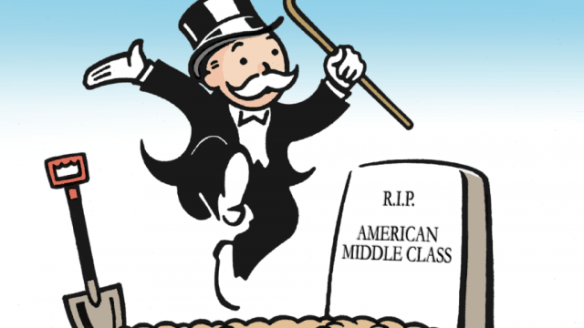
The Top 10% Is Doing Just Fine, The Middle Class Is Dying on the Vine

By Charles Hugh Smith

Source: Of Two Minds

Please study these charts as a means of understanding the inevitability of economic stagnation and a revolt of the decapitalized middle class.
I’ve been covering the decline of America’s middle class for over a decade with charts, data and commentary on the social depression that has accompanied the decline.

While there are many mutually reinforcing dynamics in this 45-year decline–demographics, global energy costs, financialization and globalization, to name a few– one term describes the accelerating erosion of America’s middle class: decapitalization.

To understand decapitalization, we need to start with the fundamentals of any economy between labor (wages) and capital and between investment and speculation. Although it’s tempting to oversimplify and demonize one or the other of these basics (speculators bad! etc.), they each provide an essential role in a healthy economy, one which is in dynamic equilibrium, a state analogous to a healthy ecosystem with constantly changing interactions of numerous species, individuals and inputs (weather, etc.). This variability enables the order of fluctuations (to use Ilya Prigogine’s profound phrase), a dynamic stability / equilibrium.

If labor’s share of the economy drops too low, the workforce cannot consume enough to support their households and the economy as a whole. If capital can no longer earn an attractive return, investment dries up and production stagnates. If speculators are not allowed to take on risk, liquidity dries up and risk crushes investment. But if speculation becomes the foundation of the economy’s “growth,” then the inevitable collapse of speculative bubbles will crash the economy.

In modern social-capitalist systems, the core stabilizer of the system is the wage-earning middle class which provides the stable workforce driving production and the stable pool of consumers needed to borrow money and consume enough to soak up the production of goods and services at a profit to producers.

Without a stable, dominant middle class, capital has few opportunities to invest in productive capacity. Without a stable, dominant middle class, the economy stagnates and is prone to collapse as it is far from equilibrium.

The process of middle class decline is best explained as decapitalization because the middle class is fundamentally a means of transforming labor into capital via savings and investment. The traditional ladder of social mobility from the working class to the middle class is one of capitalizing work: time and savings are invested in higher education, in effect capitalizing future labor by increasing productivity.

Capital isn’t limited to cash, land or tools; in an information economy, knowledge and skills are also capital, as is the social capital of social networking and relationships formed with mentors, suppliers, lenders, colleagues, investors, etc.

The second way to capitalize work is to save earnings and invest the savings in assets that produce income or gain value: a house, land, rental property, small business and income-producing financial assets such as bonds or dividend-paying stocks.

Thrift, investing, long-term planning and deferred consumption are all essential to capitalizing work by turning that labor into income-producing assets. As the household’s ownership of these assets that yield unearned income rises, so does their income and wealth. These increase the financial security of the household and build a nestegg which can be passed down to the next generation, improving their security via inheritance of income-producing assets.

As long as productivity is increasing the value of their labor, the middle class can leverage future earnings into assets by borrowing money to invest in assets: to buy a house, a mortgage is borrowed against future earnings. As long as the mortgage is a fixed-interest loan and income can be expected to rise with productivity, then this is a win-win situation: capital earns a predictable, low-risk return from the mortgage and the middle class household has stake in a family home, an asset which acts as a savings mechanism as the mortgage slowly pays down the debt and increases the household’s home equity–a form of savings.

The processes of decapitalization have upended this entire structure. In the systems context outlined above, our economy is out of balance and far from equilibrium and thus prone to collapse.

For the bottom 90%, which of course includes the middle class however you define it, it’s increasingly difficult to capitalize labor into capital. There are a number of factors driving this decapitalization:

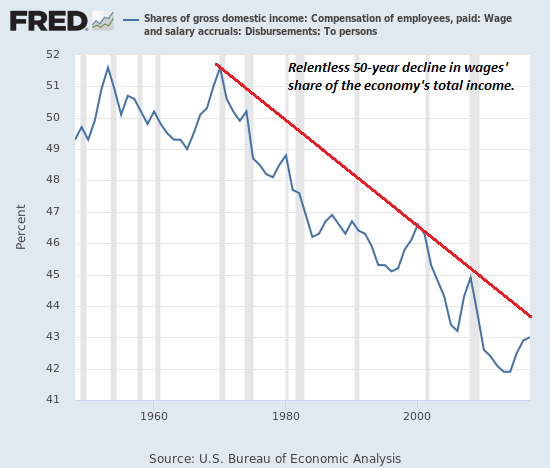
1. Wages’ share of the national income has continued a five-decade downtrend. (See chart below) National income since 1973 has shifted from labor (wages) to capital and more specifically, to debt and speculative gaming of the system, a.k.a. financialization.

Total household income in the U.S. in 2018 was $17.6 trillion. The decline in wages’ share of the national income from 1973 to 2018 is about 8.5%, which equals $1.5 trillion, the sum shifted from labor to capital every year. (See chart below)(source: https://www.statista.com/statistics/216756/us-personal-income/)

No, this is not a typo. As this RAND report documents, $50 trillion has been siphoned from labor (the lower 90% of the workforce) to the Financial Aristocracy and their technocrat lackeys (the top 10%) who own the vast majority of the capital (see charts below): Trends in Income From 1975 to 2018.

2. Within the workforce, wages have shifted to the top 10% who now earn 50% of all taxable income. (See RAND chart below) Financialization and globalization have decapitalized the skills of entire sectors of the workforce as automation and offshoring reduced the human capital of workers’ skills and experience and the value of their social capital. When the entire industry is offshored, skills and professional relationships lose their market value.

In a fully globalized economy, every worker producing tradable goods/services is competing with the entire global workforce, a reality that reduces wages in high-cost developed nations such as the U.S.

Financialization has heavily rewarded workers with specialized gaming the financial system skills and devalued every other skill as only the skills of financialization are highly profitable in a globalized, financialized economy.

3. As the high-wage jobs and capital shifted to coastal urban centers, middle class owners of homes and capital elsewhere saw the value of their assets decline. If a home valued at $100,000 in the late 1990s is now worth $150,000, the owners lost ground even with “official” inflation. In terms of real-world purchasing power, their home actually lost significant value in the past 23 years.

Meanwhile, middle class owners who bought their home in a coastal hot-spot for $100,000 23 years ago are now enjoying home valuations close to $1 million. Homes, along with every other asset, have been shifted into a casino where almost everyone is sorted into winners and losers, less often by skill and more often by luck.

For those who were too young to buy in 1997, sorry–the opportunity to buy a home for three times average middle class income is gone. The lucky generation who bought in the late 1990s in booming coastal magnets for global capital joined the top 10% and their colleagues in less desirable regions lost ground.

4. As capital siphoned off income and appreciation from labor (human and social capital), the gains accruing to capital accelerated. Those who already owned income-producing assets reaped both income and asset appreciation gains as yields on savings collapsed to near-zero as the Federal Reserve and other central banks dropped yields to near-zero in 2009 and kept them low for the following 13 years.

This had two devastating effects on the middle class: hundreds of billions of dollars that once flowed to savers and money markets disappeared, swallowed by the banks as a direct (and intentional) effect of the Fed’s ZIRP (zero-interest rate policy).

Since the Fed destroyed low-risk yields, anyone seeking any real yield (i.e. above inflation) would have to enter the casino and compete with hedge funds, insiders and the Financial Aristocracy. Very few middle class workers have the skills and experience to beat the pros in the casino, and so income and wealth accrued to those who already owned capital.

This is a key reason why the rich got richer and the poor got poorer. Those with capital accrued the majority of gains in income and wealth, leaving the bottom 90% in the dust.

A recent Foreign Affairs essay Monopoly Versus Democracy included these stunning statistics:

Ten percent of Americans now control 97 percent of all capital income in the country. Nearly half of the new income generated since the global financial crisis of 2008 has gone to the wealthiest one percent of U.S. citizens. The richest three Americans collectively have more wealth than the poorest 160 million Americans. (emphasis added.)

The 3% of income from capital collected by the bottom 90%–which includes the middle class– is basically signal noise: the middle class collects inconsequential crumbs of income from capital.

Prior to the Fed’s ZIRP and financialization of the economy, the middle class could both collect income from capital they owned and they could afford to acquire assets that yielded low-risk solid returns. Now they can do neither. Even worse, the puchasing power of their labor continues to decline, leaving them less able to save and buy assets.

This is why The Top 10% Is Doing Just Fine, The Middle Class Is Dying on the Vine. Please study these charts as a means of understanding the inevitability of economic stagnation and a revolt of the decapitalized middle class.


The Top 10%’s Bubble Is About to Burst

By Charles Hugh Smith

Source: Of Two Minds

When the top 10%’s bubble pops in 2021, the loss of illusions/delusions of security and wealth will be shattering to all those who believed artifice and illusory “wealth” were real.

A great many people are living in bubbles that are about to pop. The largest bubble is the one inhabited by people who complacently believe in time travel, i.e. that the world of 2019 is about to replace the nightmare of 2020 and we can all go back to our carefree debt-funded consumption frenzy and illusions of ever-greater wealth forever and ever.

The greater one’s sense of security, the more durable the bubble. Those in America’s top 10% who have reaped virtually all the gains in income and wealth of the past 20 years live in a bubble that they view as unbreakable: no matter what problems arise, their personal income and wealth is secured by the government, central bank, etc.

Put another way, the top 10% are confident their position atop the wealth-power pyramid is secure no matter what happens. Any dip in stocks, bonds, real estate, bat guano futures, etc. that causes their personal wealth to decline (horrors!) will be instantly bought because the Federal Reserve will print another couple trillion dollars and funnel it into risk assets, as it has done for the past 20 years.

Any spot of bother in the gravy trains that fund the top 10%–local and state government, universities, Big Tech, Big Pharma, Department of Defense, Wall Street, hedge funds, venture capital, etc.– will be doused with trillions of dollars borrowed or printed into existence by the Treasury or Fed. No matter what spot of bother arises, the solution–more trillions–is just a few keystrokes away.

The top 10% are supremely confident in the godlike powers of these agencies and solutions: the idea that these “solutions” become insoluble problems does not compute, just as a decline in asset valuations that doesn’t rebound within three weeks thanks to Fed intervention is firmly outside the realm of possibility.

The top 10% are also supremely confident in the rightness of their position atop the heap. That their position atop the heap is largely the result of a web of privilege and a long run of extraordinarily good fortune does not enter their bubble at all; in their bubble, their wealth, status, prestige and income are all the result of hard work and merit.

While this is certainly true for some, it is not true for all, and even those who scraped their way to the top the hard way do not recognize that their success over the past 20 years (and arguably the past 50 years) has been largely the result of a financialized rising tide raising all boats. In a Bull Market in virtually everything (except commodities), everyone is a hard-working genius who got it all via merit.

On top of this myopic belief that their success is all the result of their own endeavors rather than a tide of financialization, the top 10% are equally blind to the toxic consequences of the wealth/income inequality that has so richly benefited the few at the expense of the many. The idea that the bottom 90% might rebel against the financial / political system that has favored the already-wealthy for a generation is outside the top 10%’s realm of possibility.

But tides do not run in one direction forever, and a revolt against the unprecedented inequality that heavily favors the top 10% is not “impossible,” it’s a certainty. The top 10% are accustomed to being admired and respected for their accomplishments, expertise, wise investing and professional acumen. They are accustomed to viewing themselves as the essential technocrat class that keeps the U.S. system functioning.

The problem with this self-congratulatory perspective is the U.S. system is now in thrall to process rather than results. The technocrat class has been trained to follow needlessly complex procedures and compliance processes as the path to professional advancement while avoiding accountability for the increasingly dismal results of America’s bloated, sclerotic, insider-dominated systems.

All this needless complexity will be jettisoned once printing/borrowing trillions become the problem rather than the solution. The bottom 90% will demand not just a fairer distribution of income and wealth, they will also demand a system that actually functions for the greater social good rather than for insiders, parasites, leeches and technocrat processors who declare victory not from results but from their success in following approved processes / narratives.

Once costs must be cut and results take precedence over process, much of the technocrat class will find itself replaced by automated software. Those that remain will be valued for getting results by whatever means are available, up to and including ignoring all compliance procedures and bureaucratic box-ticking.

The top 10%–the rentier-technocrat class–will find the bottom 90% can no longer pay their rent, insurance, etc.–all the “services” that employ and enrich the top 10%. In other words, the losses as unproductive complexity unravels will finally fall on the top 10%, many of whom have been protected from exposure to market forces and risk.

Lastly, the top 10%’s ownership of assets will be crushed by asset deflation as insolvency can no longer be papered over by liquidity. Assets that are the foundation of top 10% wealth (that the bottom 90% own very little of) will go bidless as phantom wealth dissipates into the thin air from whence it came.

The top 10% reckon they’re untouchable, safe and protected in their asset lifeboats, and the sinking of the 90% won’t affect them. The top 10%’s bubble is about to burst. Not only will their lifeboats prove unstable, every level of government will come after whatever is left as taxes will soar on virtually every form of income and wealth.

Unlike the bottom 60%, who have few illusions about the rampant unfairness and predation of real-world America, the top 10%’s bubble is 90% illusion seasoned with 10% absolute delusion. The comfortable are about to experience some of the discomfort that is everyday life for the bottom 60%, and an increasing percentage of the next 30% who still aspire to fantasies of middle-class security will find social mobility is an escalator down.

We cannot print wealth, or borrow it into existence. All we can print/borrow is artifice, phantom representations of illusory “wealth” that will vanish into thin air, in a reverse of how the “money” was created–out of thin air.

When the top 10%’s bubble pops in 2021, the loss of illusions/delusions of security and wealth will be shattering to all those who believed artifice and illusory “wealth” were real. What’s real is the tide of financialization and globalization reversed over a year ago. The tide is now running out, but few loading their “wealth” into lifeboats have noticed–yet.

“The Great Reset” Already Happened

By Charles Hugh Smith

Source: Of Two Minds

Put another way: the elites have cannibalized the system so thoroughly that there’s nothing left to steal, exploit or cannibalize.

The global elites’ techno-fantasy of a completely centralized future, The Great Reset, is addressed as a future project. Too bad it already happened in 2008-09. The lackeys and toadies tasked with spewing the PR are 12 years too late, and so are the critics listening to the PR with foreboding.

Simply put, events outran our understanding of them. The future already manifested while we were trying to cram the present arrangement into an obsolete conceptual framework.

In broad-brush, the post-World War II era ended around 1970. The legitimate prosperity of 1946-1970 was based on cheap oil controlled by the U.S. and the hegemony of the U.S. dollar. Everything else was merely decoration.

The Original Sin to hard-money advocates was America’s abandonment of the gold standard in 1971, but this was the only way to maintain hegemony. Maintaining the reserve currency is tricky, as the nation issuing the reserve currency has to supply the global economy with enough of the currency to grease commerce and stock central bank reserves around the world.

As the global economy expanded, the only way the U.S. could send enough dollars overseas was to run trade deficits, which in a gold standard meant the gold reserves would go to zero as trading partners holding dollars would exchange the currency for gold.

So the choice was: give up the reserve currency and the hegemony of the U.S. dollar by jacking up the dollar’s value so high that imports would collapse, or accept that hegemony was no longer compatible with the gold standard. It wasn’t a difficult decision: who would give up global hegemony, and for what?

Many other dynamics changed around the same time: social, cultural, political. These charts reflect the end of the postwar era and the ushering in of a new era.

Again in broad-brush, the key economic dynamic was the decline of labor’s share of the economy in favor of capital. Those who had only their labor to sell lost purchasing power, while those who could borrow or access capital benefited enormously. The charts below tell the story: labor’s share of the national income has stairstepped lower for 50 years (since 1970) while the super-wealthy’s share has outpaced everyone else 15-fold.

The dominance of financial capital is visible in the third chart, as private-sector financial assets are now 6 times the nation’s GDP, double the percentage of the postwar era.

This capital-friendly era was rocket-boosted by financialization in the 1980s, technology in the 1990s and globalization in the early 21st century. You can see each advance of capital’s top tier–the top 0.1%–in the chart below: the top 0.1% first pulled away in the 1980s financialization, stutter-stepped in the early 1990s and then exploded higher as technology fueled capital’s leverage and exposure to the gains reaped by computers and the Internet.

Alas, these extremes are not stable or sustainable, and so each wave ends in a devastating crash. The income of the top 0.1% took a hit as the dotcom bubble burst, but then China’s entry into the WTO saved the day as rampant globalization and additional extremes of financial leverage and fraud boosted their fortunes in the 2000s.

The dual extremes of financialization and globalization created the 2008 bubble, and its collapse almost took down the entire global capital house of cards. Central banks, ultimately financed by the Fed to the tune of $29 trillion, twice the size of America’s entire GDP, instituted The Great Reset under the usual guise of “emergency measures” which then became permanent policies.

The Great Reset led to the hyper-centralization of control over the global economy’s money as central banks coordinated unprecedented money-printing and financial repression, which includes zero-interest rate policies (ZIRP), as the debt-bubble would pop if rates aren’t nailed down to zero.

All the PR being spewed about The Great Reset is the final frantic flailing of a system that’s drowning in its own excesses. The 50-year long era of the few enriching themselves as the expense of the many has ended, for the same reason eras of extreme exploitation always end–the elites got too greedy and overshot the economy’s ability to sustain their rapidly expanding share of the income and wealth.

Put another way: the elites have cannibalized the system so thoroughly that there’s nothing left to steal, exploit or cannibalize. The hyper-centralized global money control has run out of rope as the cheap oil is gone, debts have ballooned to the point there is no way they’ll ever be paid down, and the only thing staving off collapse is money-printing, which holds the seeds of its own demise.

Allow me to summarize the only way The Great Reset envisioned by global elites can actually manifest: The Martians arrive towing huge meteorites of pure lithium and gold, and rather than incinerating the global elites, they hand the global elites the meteorites to further their concentration of wealth and power.

Short of that science fiction, this sucker’s going down. The Great Reset has already run its course after 12 long years of artifice, fraud and trickery. So global elite shills, lackeys, factotums, toadies and apparatchiks–prepare for your Wil-E-Coyote moment of truth.

Sacrifice for Thee But None For Me

By Charles Hugh Smith

Source: Of Two Minds

The banquet of consequences for the Fed, the elites and their armies of parasitic flunkies and factotums is being laid out, and there won’t be much choice in the seating.

Words can be debased just like currencies. Take the word sacrifice. The value of the original has been debased by trite, weepy overuse to the point of cliche. Like other manifestations of derealization and denormalization, this debasement is invisible, profound and ultimately devastating.

Consider the overworked slogan of implied shared sacrifice: we’re all in this together. Pardon my cynicism, but doesn’t this sound like what the first class passengers in the lifeboats shouted to the doomed steerage passengers on the sinking Titanic?

Here is the ice-cold reality of America in 2020: Sacrifice for Thee But None For Me. This isn’t a new trend, of course. Any measurable sacrifices shared by all the socio-economic classes ended with World War II in 1945, and since then it’s been one long slide to Sacrifice for Thee But None For Me.

We’ve seen this slide to decay and collapse many times in history. The elites who once gained social status and political power by making real sacrifices on behalf of the nation / empire become entirely self-serving, accumulating ever greater wealth and power by transferring all the sacrifices and risks onto the lower classes.

Peter Turchin, author of War and Peace and War: The Rise and Fall of Empires, describes how civic virtue is gradually replaced by personal greed and self-interest.

This excerpt perfectly captures the current zeitgeist:

“Virtus included the ability to distinguish between good and evil and to act in ways that promoted good, and especially the common good. Unlike Greeks, Romans did not stress individual prowess, as exhibited by Homeric heroes or Olympic champions. The ideal of hero was one whose courage, wisdom, and self-sacrifice saved his country in time of peril.

Unlike the selfish elites of the later periods, the aristocracy of the early Republic did not spare its blood or treasure in the service of the common interest. When 50,000 Romans, a staggering one fifth of Rome’s total manpower, perished in the battle of Cannae, as mentioned previously, the senate lost almost one third of its membership. This suggests that the senatorial aristocracy was more likely to be killed in wars than the average citizen….

The wealthy classes were also the first to volunteer extra taxes when they were needed… A graduated scale was used in which the senators paid the most, followed by the knights, and then other citizens. In addition, officers and centurions (but not common soldiers!) served without pay, saving the state 20 percent of the legion’s payroll….

The richest 1 percent of the Romans during the early Republic was only 10 to 20 times as wealthy as an average Roman citizen.”

Now compare that to the situation in Late Antiquity when

“An average Roman noble of senatorial class had property valued in the neighborhood of 20,000 Roman pounds of gold. There was no ‘middle class’ comparable to the small landholders of the third century B.C.; the huge majority of the population was made up of landless peasants working land that belonged to nobles. These peasants had hardly any property at all, but if we estimate it (very generously) at one tenth of a pound of gold, the wealth differential would be 200,000! Inequality grew both as a result of the rich getting richer (late imperial senators were 100 times wealthier than their Republican predecessors) and those of the middling wealth becoming poor.”

Compare this to the America of World War II and the America of today. Wealthy, politically influential families such as the Kennedys could only retain their influence if their sons served in positions of combat leadership, and Joe Kennedy was killed in the European theater after volunteering for a highly risky air mission. John F. Kennedy very nearly lost his life in the South Pacific.

And how do our era’s crop of presidents and presidential contenders fare by comparison? The idea that flesh and blood should ever be at risk in defense of the nation /empire–perish the thought.

As Turchin sagely observed, it’s not just the limitless greed and avoidance of sacrifice of the elite that generates destabilizing inequality–it’s the eradication of the middle class as all the risks and sacrifices were shifted from the self-serving top to the middle and lower classes.

As I’ve often noted, risk cannot be made to disappear, it can only be transferred to others. In the grand scheme of things, the inherent risks of globalization and financialization have all been transferred to the middle and working classes (however you define them). The elite class enjoys the near-infinite support of the Federal Reserve and it’s ability to print near-infinite sums of currency to bail out the greediest, most self-serving scum of parasites and speculators.

Meanwhile, all the sacrifices required to support this unfair, corrupt, predatory system have been transferred to the middle and working classes via sleight of hand. The sacrifices weren’t transparent and up front; they were cloaked in the decline of job security, in ever-higher costs, in the decline of social mobility and the erosion of the purchasing power of wages.

The elites’ economist flunkies and factotums claimed that bailing out the freeloaders, parasites and speculators would benefit “the little people” because the grand trade-off delivered by the Federal Reserve (as correspondent R.J. pointed out to me) was: no more financial panics, which caused much misery in the working class due to business failures causing layoffs and unemployment.

But globalization, financialization and the rise of cartel-state monopolies have eviscerated the middle and working classes far more effectively and permanently than any brief financial panic, while greatly enriching the elite class–a rise in wealth that is backstopped by the Federal Reserve: profits are the elites to keep while their losses are socialized, i.e. transferred to the lower classes.

Job security, the purchasing power of wages and social mobility–nothing vital to the middle or working classes is backstopped by the Fed; the Fed’s one and only job is backstopping the wealth of our parasitic, predatory elite.

Sacrifice for Thee But None For Me. The banquet of consequences for the Fed, the elites and their armies of parasitic flunkies and factotums is being laid out, and there won’t be much choice in the seating.

The Pandemic Is Accelerating Trends That Are Disrupting the Foundations of the Economy

By Charles Hugh Smith

Source: Of Two Minds

The problem is the economy that’s left has no means of creating tens of millions of jobs to replace those lost as the 1959 economic model collapses.

Fundamentally, the economy of 2019 was not very different from the economy of 1959: people went shopping at retail stores, were educated at sprawling college campuses, went to work downtown, drove to the doctor’s office or hospital, caught a flight at the airport, and so on.

The daily routine of the vast majority of the workforce was no different from 1959. In 2019, the commutes were longer, white-collar workers stared at screens rather than typewriters, factory workers tended robots and so on, but the fundamentals of everyday life and the nature of work were pretty much the same.

Beneath the surface, the fundamental change in the economy was financialization, the commodification of everything into a financial asset or income stream that could then be leveraged, bundled and sold globally at an immense profit by Wall Street financiers.

This layer of speculative asset-income mining had no relation to the actual work being done; it existed in its own derealized realm.

For decades, these two realmsthe structure of everyday life (to borrow Braudel’s apt term) and the abstract, derealized but oh so profitable realm of financialization–co-existed in an uneasy state of loosely bound systems.

If you squinted hard enough and repeated the mantras often enough, you could persuade yourself there was still some connection between the everyday-life economy and the realm of financialization.

The two realms have now disconnected, and the real-world economy has been ripped from its moorings, as patterns of work and every-day life that stretch back 70 years to the emergence of the postwar era unravel and dissolve.

The trends that are currently fatally disrupting retail, education, office work and healthcare have been in place for years. When I wrote my 2013 book about the digitized future of higher education in a low-cost union of high-touch and low-touch learning, The Nearly Free University, all these trends were already clearly visible to those willing to look beyond the models embedded in the economy for decades or even centuries.

Visionaries like Peter Drucker foresaw the complete disruption of the education and healthcare sectors as far back as 1994. Post-Capitalist Society.

The problem with this disruption is it eliminates tens of millions of jobs–not just the low-paying jobs in retail and dining-out, but high-paying jobs in university administration, healthcare, and other core service sectors.

The last real-world connection between everyday life and financialization was the over-supply of everything that could be financialized: the way to reap the big profits was expand whatever could be leveraged and sold. So retail and commercial space ballooned, colleges proliferated, cafes sprang up on every corner, etc.

Meanwhile, financialization’s unquenchable thirst for higher profits stripped everything of the redundancy and buffers required to stabilize the system in times of crisis. So hospitals no longer kept inventory because by the logic of financialization, all that mattered was maximizing the return on capital–nothing else could possibly matter in the derealized realm of speculative profiteering.

Now healthcare finds itself trapped between the pincers of financialization’s stripmining and the collapse of retail in-person demand–the financial foundation of the entire system. Under the relentless pressure of financialization’s stripmining and profteering, healthcare only survives if it can bill somebody somewhere a staggering amount for everything from office visits to procedures to hospital stays to medications.

Once that avalanche of billing dries up, the entire sector implodes: a sector that accounts for almost 20% of the U.S. economy.

Higher education is also imploding, and for the same reason: its output no longer justified its enormous cost structure. The same can be said of overbuilt retail and commercial space: the financial justification for sky-high rents have imploded and will never come back. The over-supply is so monumental and the collapse of demand so permanent, the gigantic pyramid of debt and speculative excess piled on all these excesses is collapsing.

A bailout by the Federal Reserve won’t change the fundamentals of the collapse of financialization; all the Fed can do is reserve scarce lifeboat seats for its billionaire banker-financier pals. (Warren, you know Bill, have you met Jamie, Jeff, Tim and the rest of the Zillionaire Rat-Pack?)

Despite the record highs in the stock market–the ultimate expression of financialization disconnected from the real-world economy–financialization is also imploding. Financialization still claimed a connection to the real world of income streams and the value of the collateral underlying all the speculative profiteering: the high rents paid by the restaurants on the ground floor and the businesses for office space above justified the high value of the collateral, the commercial building.

Foundational swaths of the real-world economy have been swept away, and so the collateral is largely worthless. Lots of people want their employer to start paying for business-class airline seats again so they can jet around the country on somebody else’s dime, staying in pricey hotels and attending conferences, but these activities no longer have any financial justification.

The economy of 1959 is finally expiring. The enormous time and money sinks of transporting humans hither and yon no longer have any financial justification.

The problem is the economy that’s left has no means of creating tens of millions of jobs to replace those lost as the 1959 economic model collapses. We all know that automation is replacing human labor, but the real change is the collapse of the financial justification for the enormously costly systems we now depend on to generate jobs: healthcare, retail, tourism, dining out, education, working downtown, and all the professions dependent on managing all this complexity.

While the elimination of low-skill jobs–a longstanding trend–is attracting attention, the implosion of the 1959 economic model and financialization will soon sweep away millions of high-paying professional jobs that no longer have any financial justification.

As the 1959 economy implodes, so does the tax system based on payroll taxes and property taxes. This article sketches out the perverse incentives for employers to invest in automation rather than hire workers: Covid-19 Is Dividing the American Worker (WSJ.com)

There are alternatives, but they require accepting the implosion of both the 1959 economic model and its evil offspring, financialization.

I sketched out an alternative way of organizing work, everyday life and finance in my book A Radically Beneficial World. There are alternative ways of organizing civilization other than the insanely wasteful and exploitive system we now inhabit.

The financialization of the end of the world

By Kurt Cobb

Source: resilience

For those who are fans of cartoons from The New Yorker magazine and consistent readers of this blog, you might be able to guess my two favorite cartoons. In the first one, a man in a coat and tie stands at a podium and tells his unseen audience the following: “And so, while the end-of-the-world scenario will be rife with unimaginable horrors, we believe that the pre-end period will be filled with unprecedented opportunities for profit.”

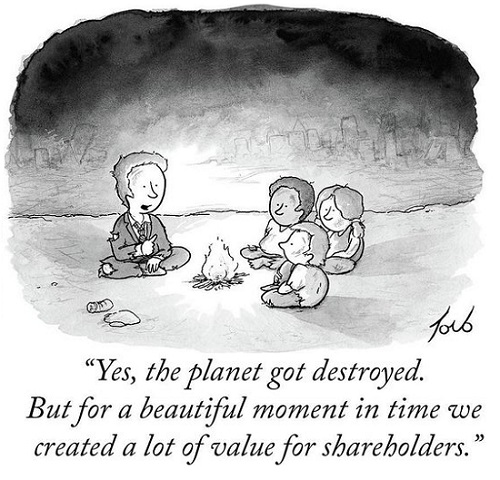
In the second, a man in a tattered suit sits cross-legged near a campfire with three children listening to him intently as he says this: “Yes, the planet got destroyed. But for a beautiful moment in time we created a lot of value for shareholders.”

Now, in the you-can’t-make-this-stuff-up category, financial writer Paul Farrell used the caption from the first cartoon in a 2015 piece for MarketWatch entitled: “Your No. 1 end-of-the-world investing strategy.” The subheading is: “How to pick stocks for the near term when long-term trends say collapse is near.” The subhead actually seems like it might be another caption from a New Yorker cartoon (or possibly one from The Onion). Why exactly would you invest in stocks—as opposed to seeds of food crops and sturdy garden implements—”when long-term trends say collapse is near”? But I’ll put that down to bad headline writing.

In Farrell’s defense, he frequently used his column in MarketWatch to warn his readers of the coming collapse of modern civilization if we don’t change our ways. He was obliged to give investment advice, of course, because that’s what the column was for.

Few other investment gurus are as intellectually honest as Farrell. Among prominent investment managers, only Jeremy Grantham comes close to understanding the scope of the challenges we face. Grantham wrote a piece in 2013 called “The Race of Our Lives” that outlines the myriad challenges humans face. He starts with a discussion of the fall of civilizations. (He updated his views in 2018.)

One would think that the coronavirus pandemic would allow for some sober reflection among those in the financial community as the pandemic-induced crash of the economy and the markets has called into question the stability of practically all the arrangements of modern civilization. Instead, the focus is on how stock markets could be back at or near all-times highs at the beginning of what is arguably the next Great Depression.

The New Yorker cartoons linked above appropriately characterize the madness that grips late-stage civilizations as their pillars begin to fall. Instead of attempting to adapt to new realities, every attempt is made to maintain the current fragile system. The trillions of dollars pumped into the world financial system by central banks and governments in the wake of the pandemic have done little except stoke renewed financial bubbles in practically all financial markets (and thereby bailed out the mostly wealthy owners of financial assets).

The disconnect is hard to miss. The latest reading of the U.S. Federal Reserve Bank of Atlanta’s GDPNow indicator, which is frequently updated as new data becomes available, now predicts that U.S. GDP will contract by 45.5 percent in the current quarter. (The number is annualized and seasonally adjusted.)

Even so the NASDAQ Composite Index hit a new all-time high earlier this month just three months after the recent trough reached during the crash. The S&P 500 is now very close to a new all-time high. Neither development makes sense in the middle of the worst economic downturn since the Great Depression. For comparison, it took more than two years for the NASDAQ Composite from the bottom in 2009 during the Great Financial Crisis to regain its 2007 highs. It took the S&P 500 more than four years.

Of course, the financialization of everything continues. Vaccine makers are in line for government funds. Naturally, it takes money to develop a vaccine. But drug makers aren’t in the business of keeping people healthy. They are in the business of making money. In the United States at least they are helped by the fact that they aren’t liable if their vaccine kills or injuries someone. And, executives in one money-losing pharmaceutical firm cashed in stock right after their company goosed the shares significantly higher with a very preliminary announcement about the company’s coronavirus vaccine research.

When it comes to real estate, it used to be that people bought it for income and as a store of value. Now firms buy real estate mostly with borrowed money and try to make gains mostly through property price appreciation. Often the real estate loans are packaged into securities that are sold and resold as part of the giant Wall Street and worldwide financial casino.

One of the surest signs of the financialization of everything and the growing disconnect of finance from reality is the credit default swap (CDS). The CDS is essentially insurance for loans and bonds. The buyer pays the seller a premium every month. If the instrument insured defaults, the seller provides a predetermined payment to reimburse the CDS buyer. Now here’s the weird thing: An investor doesn’t even have to own the loan or bond to insure it. It’s like me taking out an insurance policy on your home against fire when I have no ownership or interest in the home. In fact, I have every incentive to make sure your house burns down. Do you see any problem with that?

For normal insurance, the buyer must have an insurable interest. Typically, this means the buyer must actually own the thing he or she is insuring. The CDS, on the other hand, is an ideal instrument for those who want to bring on a financial end-of-the-world scenario. The buyers have every reason to want the economy to go down the drain as their payments may be 10 or even 20 times their initial investment.

Many wealthy people fear and even believe an end-of-the-world scenario is possible or probable. Some think they can hold up in luxury bunkers until the dust clears. But what if, when the dust clears, their wealth is gone and the financial world they used to inhabit has vanished.

Perhaps they will sit around campfires telling their grandchildren about the old days when finance was king and the real economy of goods and services was just a place where rubes got their daily bread—while, of course, simultaneously providing an outsized portion to the rich.

No, This Is Not Another 1929, 1973, 1987, 2000, or 2008

By Charles Hugh Smith

Source: Of Two Minds

Basing one’s decisions on analogs from the past is entering a fool’s paradise of folly.

Like addicts who cannot control their cravings, financial analysts cannot stop themselves from seeking some analog situation in the past which will clarify the swirling chaos in their crystal balls. So we’ve been swamped with charts overlaying recent stock market action over 1929, 1987,2000 and 2008–though the closest analogy is actually the Oil Shock of 1973, an exogenous shock to a weakening, fragile economy.

But the reality is there is no analogous situation in the past to the present, and so all the predictions based on past performance will be misleading. The chartists and analysts claim that all markets act on the same patterns, which are reflections of human nature, and so seeking correlations of volatility and valuation that “worked” in the past will work in 2020.

Does anyone really believe the correlations of the past decade or two are high-probability predictors of the future as the entire brittle construct of fictional capital and extremes of globalization and financialization all unravel at once?

Here are a few of the many consequential differences between all previous recessions and the current situation:

1. Households have never been so dependent on debt as a substitute for stagnating wages.

2. Real earnings (adjusted for inflation) have never been so stagnant for the bottom 90% for so long.

3. Corporations have never been so dependent on debt (selling bonds or taking on loans) to fund money-losing operations (see Netflix) or stock buybacks designed to saddle the company with debt service expenses to enrich insiders.

4. The stock market has never been so dependent on what amounts to fraud–stock buybacks–to push valuations higher.

5. The economy has never been so dependent on absurdly overvalued stock valuations to prop up pension funds and the spending of the top 10% who own 85% of all stocks, i.e. “the wealth effect.”

6. The economy and the stock market have never been so dependent on central bank free money for financiers and corporations, money creation for the few at the expense of the many, what amounts to an embezzlement scheme.

7. Federal statistics have never been so gamed, rigged or distorted to support a neofeudal agenda of claiming a level of wide-spread prosperity that is entirely fictitious.

8. Major sectors of the economy have never been such rackets, i.e. cartels and quasi-monopolies that use obscure pricing and manipulation of government mandates to maximize profits while the quality and quantity of the goods and services they produce declines.

9. The economy has never been in such thrall to sociopaths who have mastered the exploitation of the letter of the law while completely overturning the spirit of the law.

10. Households and companies have never been so dependent on “free money” gained from asset appreciation based on speculation, not an actual increase in productivity or value.

11. The ascendancy of self-interest as the one organizing directive in politics and finance has never been so complete, and the resulting moral rot never more pervasive.

12. The dependence on fictitious capital masquerading as “wealth” has never been greater.

13. The dependence on simulacra, simulations and false fronts to hide the decay of trust, credibility, transparency and accountability has never been so pervasive and complete.

14. The corrupt linkage of political power, media ownership, “national security” agencies and corporate power has never been so widely accepted as “normal” and “unavoidable.”

15. Primary institutions such as higher education, healthcare and national defense have never been so dysfunctional, ineffective, sclerotic, resistant to reform or costly.

16. The economy has never been so dependent on constant central bank manipulation of the stock and housing markets.

17. The economy has never been so fragile or brittle, and so dependent on convenient fictions to stave off a crash in asset valuations.

18. Never before in U.S. history have the most valuable corporations all been engaged in selling goods and services that actively reduce productivity and human happiness.

This is only a selection of a much longer list, but you get the idea. Basing one’s decisions on analogs from the past is entering a fool’s paradise of folly.