
The Key to a Sustainable Economy Is 5,000 Years Old

By Ellen Brown

Source: Truthdig

We are again reaching the point in the business cycle known as “peak debt,” when debts have compounded to the point that their cumulative total cannot be paid. Student debt, credit card debt, auto loans, business debt and sovereign debt are all higher than they have ever been. As economist Michael Hudson writes in his provocative 2018 book, “…and forgive them their debts,” debts that can’t be paid won’t be paid. The question, he says, is how they won’t be paid.

Mainstream economic models leave this problem to “the invisible hand of the market,” assuming trends will self-correct over time. But while the market may indeed correct, it does so at the expense of the debtors, who become progressively poorer as the rich become richer. Borrowers go bankrupt and banks foreclose on the collateral, dispossessing the debtors of their homes and their livelihoods. The houses are bought by the rich at distress prices and are rented back at inflated prices to the debtors, who are then forced into wage peonage to survive. When the banks themselves go bankrupt, the government bails them out. Thus the market corrects, but not without government intervention. That intervention just comes at the end of the cycle to rescue the creditors, whose ability to buy politicians gives them the upper hand. According to free-market apologists, this is a natural cycle akin to the weather, which dates all the way back to the birth of modern economics in ancient Greece and Rome.

Hudson counters that those classical societies are not actually where our financial system began, and that capitalism did not evolve from bartering, as its ideologues assert. Rather, it devolved from a more functional, sophisticated, egalitarian credit system that was sustained for two millennia in ancient Mesopotamia (now parts of Iraq, Turkey, Kuwait and Iran). Money, banking, accounting and modern business enterprise originated not with gold and private trade, but in the public sector of Sumer’s palaces and temples in the third century B.C. Because it involved credit issued by the local government rather than private loans of gold, bad debts could be periodically forgiven rather than compounding until they took the whole system down, a critical feature that allowed for its remarkable longevity.

The True Roots of Money and Banking

Sumer was the first civilization for which we have written records. Its notable achievements included the wheel, the lunar calendar, our numerical system, law codes, an organized hierarchy of priest-kings, copper tools and weapons, irrigation, accounting and money. It also produced the first written language, which took the form of cuneiform figures impressed on clay. These tablets were largely just accounting tools, recording the flow of food and raw materials in the temple and palace workshops, as well as IOUs (mainly to these large public institutions) that had to be preserved in writing to be enforced. This temple accounting system allowed for the coordinated flow of credit to peasant farmers from planting to harvesting, and for advances to merchants to engage in foreign trade.

In fact, it was the need to manage accounts for a large labor force under bureaucratic control that is thought to have led to the development of writing. The people willingly accepted this bureaucratic control because they viewed the gods as having decreed it. According to their cuneiform writings, humans were genetically engineered to work the fields and the mines after certain lower gods tasked with that hard labor rebelled.

Usury, or the charging of interest on loans, was an accepted part of the Mesopotamian credit system. Interest rates were high and remained unchanged for two millennia. But Mesopotamian scholars were well aware of the problem of “debts that can’t be paid.” Unlike in today’s academic economic curriculum, Hudson writes:

Babylonian scribal students were trained already c. 2000 BC in the mathematics of compound interest. Their school exercises asked them to calculate how long it took a debt at interest of 1/60th per month to double. The answer is 60 months: five years. How long to quadruple? 10 years. How long to multiply 64 times? 30 years. It must’ve been obvious that no economy can grow in keeping with this rate of increase.

Sumerian kings solved the problem of “peak debt” by periodically declaring “clean slates,” in which agrarian debts were forgiven and debtors were released from servitude to work as tenants on their own plots of land. The land belonged to the gods under the stewardship of the temple and the palace and could not be sold, but farmers and their families maintained leaseholds to it in perpetuity by providing a share of their crops, service in the military and labor in building communal infrastructure. In this way, their homes and livelihoods were preserved, an arrangement that was mutually beneficial, since the kings needed their service.

Jewish scribes, who spent time in captivity in Babylon in the sixth century B.C, adapted these laws in the year or jubilee, which Hudson argues was added to Leviticus after the Babylonian captivity. According to Leviticus 25:8-13, a Jubilee Year was to be declared every 49 years, during which debts would be forgiven, slaves and prisoners freed and their property leaseholds restored. As in ancient Mesopotamia, property ownership remained with Yahweh and his earthly proxies. The Jubilee law effectively banned the outright sale of land, which could only be leased for up to 50 years (Leviticus 25:14-17). The Levitican Jubilee represented an advance over the Mesopotamian “clean slates,” Hudson says, in that it was codified into law rather than relying on the whim of the king. But its proclaimers lacked political power, and whether the law was ever enforced is unclear. It served as a moral rather than a legal prescription.

Ancient Greece and Rome adopted the Mesopotamian system of lending at interest, but without the safety valve of periodic “clean slates,” since the creditors were no longer the king or the temple, but private lenders. Unfettered usury resulted in debt bondage and forfeiture of properties, consolidation into large landholdings, a growing wedge between rich and poor, and the ultimate destruction of the Roman Empire.

As for the celebrated development of property rights and democracy in ancient Greece and Rome, Hudson argues that they did not actually serve the poor. They served the rich, who controlled elections, just as rich donors do today. Taking power away from local governments by privatizing once-communal lands allowed private creditors to pass laws by which they could legally confiscate property when their debtors could not pay. “Free markets” meant the freedom to accumulate massive wealth at the expense of the poor and the state.

Hudson maintains that when Jesus Christ preached “forgiveness of debts,” he was also talking about economic debt, not just moral transgressions. When he overturned the tables of the money changers, it was because they had turned a house of prayer into “a den of thieves.” But creditors’ rights had by then gained legal dominance, and Christian theologians lacked the power to override them. Rather than being a promise of economic redemption in this life, forgiveness of debts thus became a promise of spiritual redemption in the next.

How to Pull Off a Modern Debt Jubilee

Such has been the fate of debtors in modern Western economies. But in some modern non-Western economies, vestiges of the debt write-off solution remain. In China, for instance, nonperforming loans are often carried on the books of state-owned banks or canceled rather than putting insolvent debtors and banks into bankruptcy. As Dinny McMahon wrote in June in an article titled “China’s Bad Data Can Be a Good Thing”:

In China, the state stands behind the country’s banks. As long as authorities ensure those banks have sufficient liquidity to meet their obligations, they can trundle along with higher delinquency levels than would be regarded safe in a market economy.

China’s banking system, like that of ancient Mesopotamia, is largely in the public sector, so the state can back its banks with liquidity as needed. Interestingly, the Chinese state also preserves the ancient Near Eastern practice of retaining ownership of the land, which citizens can only lease for a period of time.

In Western economies, most banks are privately owned and heavily regulated, with high reserve and capital requirements. Bad loans mean debtors are put into foreclosure, jobs and capital infrastructure are lost, and austerity prevails. The Trump administration is now aggressively pursuing a trade war with China in an effort to level the playing field by forcing it into the same austerity regime, but a more productive and sustainable approach might be for the U.S. to engage in periodic debt jubilees itself.

The problem with that solution today is that most debts in Western economies are owed not to the government but to private creditors, who will insist on their contractual rights to payment. We need to find a way to pay the creditors while relieving the borrowers of their debt burden.

One possibility is to nationalize insolvent banks and sell their bad loans to the central bank, which can buy them with money created on its books. The loans can then be written down or voided out. Precedent for this policy was established with “QE1,” the Fed’s first round of quantitative easing, in which it bought unmarketable mortgage-backed securities from banks with liquidity problems.

Another possibility would be to use money generated by the central bank to bail out debtors directly. This could be done selectively, by buying up student debt or credit card debt or car loans bundled as “asset-backed securities,” then writing the debts down or off, for example. Alternatively, debts could be relieved collectively with a periodic national dividend or universal basic income paid to everyone, again drawn from the deep pocket of the central bank.

Critics will object that this would dangerously inflate the money supply and consumer prices, but that need not be the case. Today, virtually all money is created as bank debt, and it is extinguished when the debt is repaid. That means dividends used to pay this debt down would be extinguished, along with the debt itself, without adding to the money supply. For the 80% of the U.S. population now carrying debt, loan repayments from their national dividends could be made mandatory and automatic. The remaining 20% would be likely to save or invest the funds, so this money too would contribute little to consumer price inflation; and to the extent that it did go into the consumer market, it could help generate the demand needed to stimulate productivity and employment. (For a fuller explanation, see Ellen Brown, “Banking on the People,” 2019).

In ancient Mesopotamia, writing off debts worked brilliantly well for two millennia. As Hudson concludes:

To insist that all debts must be paid ignores the contrast between the thousands of years of successful Near Eastern clean slates and the debt bondage into which [Greco-Roman] antiquity sank. … If this policy in many cases was more successful than today’s, it is because they recognized that insisting that all debts must be paid meant foreclosures, economic polarization and impoverishment of the economy at large.

Is the U.S. Becoming a Third World Nation?

By Charles Hugh Smith

Source: Of Two Minds

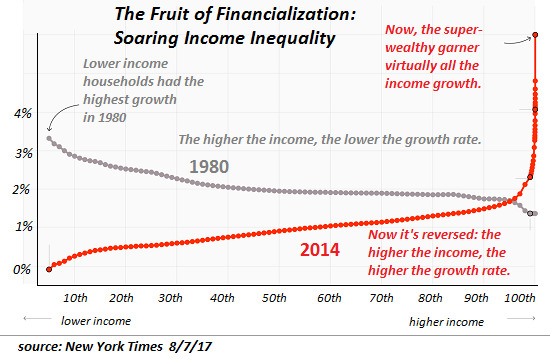
This is a chart of an informal kleptocracy which cloaks itself in the faux finery of democracy and a (rigged) “market” economy.

Back in the day, nations that didn’t qualify as either developed (First World) or developing (Second World) were by default Third World, impoverished, corrupt and what we now refer to as failed states–governments that were incapable of improving the lives of their people and the machinery of governance, generally as a result of corruption and self-serving elites, i.e. kleptocracies.

Is the U.S. slipping into Third World status? While many scoff at the very question, others citing the rise of homelessness, entrenched pockets of abject poverty and the decaying state of infrastructure might nod “yes.”

These are not uniquely Third World problems, they’re symptoms of a status quo that’s fast losing First World capabilities. What characterizes Third World/Failing States isn’t just poverty, crumbling infrastructure and endemic corruption; at a systems level these are the key dynamics in Third World/Failing States:

1. The status quo protects insiders at the expense of everyone else.

2. There is no real accountability; failure has no consequences, bureaucrats are never fired for incompetence, reforms are watered down or neutered by institutional sclerosis.

3. Pay-to-play is the most cost-effective way to influence policy or evade consequences.

4. The status quo is incapable of differentiating between complexity that serves the legitimate purposes of transparency and accountability and complexity that serves no purpose beyond guaranteeing insiders’ paper-shuffling jobs. As a consequence, complexity that adds no value chokes the economy and the government.

5. There are two sets of laws: one for insiders and the super-wealthy, and another harsher set for everyone else.

6. The super-wealthy fear nothing because the system functions to serve their interests.

7. The super-wealthy and state insiders control the media’s narratives and the machinery of governance to serve their interests. Reforms are in name only; the faces of elected officials change but nothing changes structurally.

8. Insiders, well-paid pundits and the technocrats serving the corporate and state elites believe the status quo is just fine because they’re doing fine; they are blind to the soaring inequality, systemic corruption, stupendous waste and the impossibility of real reform.

Does America’s status quo protect insiders at the expense of everyone else? Yes. As for the other seven characteristics: yes, yes, yes, yes, yes, yes and yes.

And lets’ not forget #9: the vast majority of the economic gains flow to the elite at the very top of the wealth-power pyramid: is this true in the U.S.? Definitively yes. Just look at this chart: this is a chart of an informal kleptocracy which cloaks itself in the faux finery of democracy and a (rigged) “market” economy.

That’s the very definition of a Third World failed state.

Related Video:

What globalism did was to transfer the US economy to China

By Paul Craig Roberts

Source: Intrepid Report

The main problem with the US economy is that globalism has been deconstructing it. The offshoring of US jobs has reduced US manufacturing and industrial capability and associated innovation, research, development, supply chains, consumer purchasing power, and tax base of state and local governments. Corporations have increased short-term profits at the expense of these long-term costs. In effect, the US economy is being moved out of the First World into the Third World.

Tariffs are not a solution. The Trump administration says that the tariffs are paid by China, but unless Apple, Nike, Levi, and all of the offshoring companies got an exemption from the tariffs, the tariffs fall on the offshored production of US firms that are sold to US consumers. The tariffs will either reduce the profits of the US firms or be paid by US purchasers of the products in higher prices. The tariffs will hurt China only by reducing Chinese employment in the production of US goods for US markets.

The financial media is full of dire predictions of the consequences of a US/China “trade war.” There is no trade war. A trade war is when countries try to protect their industries by placing tariff barriers on the import of cheaper products from foreign countries. But half or more of the imports from China are imports from US companies. Trump’s tariffs, or a large part of them, fall on US corporations or US consumers.

One has to wonder that there is not a single economist anywhere in the Trump administration, the Federal Reserve, or anywhere else in Washington capable of comprehending the situation and conveying an understanding to President Trump.

One consequence of Washington’s universal economic ignorance is that the financial media has concocted the story that “Trump’s tariffs” are not only driving Americans into recession but also the entire world. Somehow tariffs on Apple computers and iPhones, Nike footwear, and Levi jeans are sending the world into recession or worse. This is an extraordinary economic conclusion, but the capacity for thought has pretty much disappeared in the United States.

In the financial media the question is: Will the Trump tariffs cause a US/world recession that costs Trump his reelection? This is a very stupid question. The US has been in a recession for two or more decades as its manufacturing/industrial/engineering capability has been transferred abroad. The US recession has been very good for the Asian part of the world. Indeed, China owes its faster than expected rise as a world power to the transfer of American jobs, capital, technology, and business know-how to China simply in order that US shareholders could receive capital gains and US executives could receive bonus pay for producing them by lowering labor costs.

Apparently, neoliberal economists, an oxymoron, cannot comprehend that if US corporations produce the goods and services offshore that they market to Americans, it is the offshore locations that benefit from the economic activity.

Offshore production started in earnest with the Soviet collapse as India and China opened their economies to the West. Globalism means that US corporations can make more money by abandoning their American work force. But what is true for the individual company is not true for the aggregate. Why? The answer is that when many corporations move their production for US markets offshore, Americans, unemployed or employed in lower paying jobs, lose the power to purchase the offshored goods.

I have reported for years that US jobs are no longer middle-class jobs. The jobs have been declining for years in terms of value-added and pay. With this decline, aggregate demand declines. We have proof of this in the fact that for years US corporations have been using their profits not for investment in new plant and equipment, but to buy back their own shares. Any economist worthy of the name should instantly recognize that when corporations repurchase their shares rather than invest, they see no demand for increased output. Therefore, they loot their corporations for bonuses, decapitalizing the companies in the process. There is perfect knowledge that this is what is going on, and it is totally inconsistent with a growing economy.

As is the labor force participation rate. Normally, economic growth results in a rising labor force participation rate as people enter the work force to take advantage of the jobs. But throughout the alleged economic boom, the participation rate has been falling, because there are no jobs to be had.

In the 21st century, the US has been decapitalized and living standards have declined. For a while the process was kept going by the expansion of debt, but consumer income has not kept place and consumer debt expansion has reached its limits.

The Fed/Treasury “plunge protection team” can keep the stock market up by purchasing S&P futures. The Fed can pump out more money to drive up financial asset prices. But the money doesn’t drive up production, because the jobs and the economic activity that jobs represent have been sent abroad. What globalism did was to transfer the US economy to China.

Real statistical analysis, as contrasted with the official propaganda, shows that the happy picture of a booming economy is an illusion created by statistical deception. Inflation is undermeasured, so when nominal GDP is deflated, the result is to count higher prices as an increase in real output, that is, inflation becomes real economic growth. Unemployment is not counted. If you have not searched for a job in the past 4 weeks, you are officially not a part of the work force and your unemployment is not counted. The way the government counts unemployment is so extraordinary that I am surpised the US does not have a zero rate of unemployment.

How does a country recover when it has given its economy away to a foreign country that it now demonizes as an enemy? What better example is there of a ruling class that is totally incompetent than one that gives its economy bound and gagged to an enemy so that its corporate friends can pocket short-term riches?

We can’t blame this on Trump. He inherited the problem, and he has no advisers who can help him understand the problem and find a solution. No such advisers exist among neoliberal economists. I can only think of four economists who could help Trump, and one of them is a Russian.

The conclusion is that the United States is locked on a path that leads directly to the Third World of 60 years ago. President Trump is helpless to do anything about it.

There Is No Normal

By James Howard Kunstler

Source: Kunstler.com

The wheel of time rolls forward, never retracing its path, but because it is a wheel, and we are riding in it, a persistent illusion persuades us that the landscape is recognizably the same, and that our doings within the regular turning of the seasons seem comfortably normal. There is no normal.

There is for us, at this moment in history, an especially harsh turning (so Strauss and Howe would say) as our journey takes the exit ramp out of the high energy era into the next reality of a long emergency. The human hive-mind senses that something is different, but at the same moment we’re unable to imagine changing all our exquisitely tuned arrangements — especially the thinking class in charge of all that, self-enchanted with pixeled fantasies. The dissonance over this is driving America crazy.

The wheel hit a deep pothole in 2008 turning onto the off-ramp and has been wobbling badly ever since. 2008 was a warning that going through the motions isn’t enough to sustain a sense of purpose, either nationally or for individuals trying to keep their lives together ever more desperately. The cultural memory of the confident years, when we seemed to know what we were doing, and where we were going, dogs us and mocks us.

The young adults feel all that most acutely. The pain prompts them to want to deconstruct that memory. “No, it didn’t happen that way,” they are saying. All those stories about the founding of this society — of those Great Men with their powdered hair-doos writing the national charter, and the remarkable experience of the past 200-odd years — are wrong! There was nothing wonderful about it. The whole thing was a swindle!

They are feeling the wheel’s turning most painfully, since they know they will see many more turnings in the years ahead, and the direction of the wheel is vectoring downward for them. The bottom-line is less of everything, not more. That is a new ethos here in America and it’s hardly comforting: Less income, fewer comforts, more literal hardships, fewer consolations for the universal difficulty of being alive. No wonder they are angry.

It’s this simple. We landed in the New World five hundred years ago. It was full of good things that human beings had barely begun to exploit, laid out like a banquet. There was plenty of good virgin soil for growing food, the best timber in the world, clean rivers and great lakes, ores full of iron, gold, and silver, and down deep a bonanza of coal and oil to drive the wheel through very flush times. The past century was particularly supercharged, the oil years.

Imagine living through the very start of all that, the blinding, fantastic newness of modernity! Look back at the stories and images around Teddy Roosevelt and his times, and the confidence of that era just astonishes you, An emergent cavalcade of wonders: electricity, telephones, railroads, subways, skyscrapers! And in a few more years movies, cars, airplanes, radio. Even the backstage wonders of the day were astonishments: household plumbing for all, running hot water, municipal water and sewer systems, refrigeration, tractors! It’s hard to conceive how much these developments changed the human experience of daily life.

Even the traumas of the 20th century’s world wars did not crush that sense of amazing progress, at least not in North America, spared the wars’ mighty wreckage. The post-war confidence of American society achieved a level of in-your-face laughable hubris — see the USA in your Chevrolet! — until John Kennedy was shot down, and after that the delirious moonshot euphoria steadily gave way to corrosive skepticism, anxiety, acrimony, and enmity. My generation, booming into adulthood, naively thought they could fix all that with Earth Day, tofu, and computers, and keep the great wheel rolling down into an even more glorious cybernetic nirvana.

Fakeout. That’s not where the wheel is going. We borrowed all we possibly could from the future to pretend that the system was still working, and now the future is at the door like a re-po man come to take away both the car and the house. The financial scene is an excellent analog to our collective psychology. Its workings depend on the simple faith that its workings work. So, it is easy to imagine what happens when that faith wavers.

We’re on the verge of a lot of things coming apart: supply lines, revenue streams, international agreements, political assumptions, promises to do this and that. We have no idea how to keep it together on the downside. We don’t even want to think about it. The best we can do for the moment is pretend that the downside doesn’t exist. And meanwhile, fight both for social justice and to make America great again, two seemingly noble ideas, both exercises in futility. The wheel is still turning and the change of season soon upon us. What will you do?

The Gulag of the Mind

By Charles Hugh Smith

Source: Of Two Minds

There are no physical barriers in the Gulag of the Mind–we imprison ourselves, and love our servitude. Indeed, we fear the world outside our internalized gulag, because we’ve absorbed the narrative that the gulag is secure and permanent.

We’ve also absorbed the understanding that escape will be punished. Dissent will quickly be suppressed or vilified, and the dissenter socially and economically marginalized.

In a peculiarly human pathology, we now believe the exact opposite of reality: our abuser is our savior, we’re getting wealthier when in fact we’re getting poorer, the government will always save us, even though the government is the problem, not the solution, and we’re entitled to all sorts of good things even as the entire system clings to a veneer of normalcy that is increasingly difficult to maintain.

We dare not realize the crises we’re about to face are novel, and the thinking of the past is worse than useless, as doing more of what’s failed is about to bear real consequences that cannot be papered over.

Michael Grant described this clinging to the past in his excellent account The Fall of the Roman Empire:

There was no room at all, in these ways of thinking, for the novel, apocalyptic situation which had now arisen, a situation which needed solutions as radical as itself. (The Status Quo) attitude is a complacent acceptance of things as they are, without a single new idea.

This acceptance was accompanied by greatly excessive optimism about the present and future. Even when the end was only sixty years away, and the Empire was already crumbling fast, Rutilius continued to address the spirit of Rome with the same supreme assurance.

This blind adherence to the ideas of the past ranks high among the principal causes of the downfall of Rome. If you were sufficiently lulled by these traditional fictions, there was no call to take any practical first-aid measures at all.

The Gulag of the Mind is constructed of both traditional fictions–that all the looming crises can be solved by repeating what worked in the past 50 years– and the new ones of virtual signaling–that publicly signaling our virtuous convictions is magically equivalent to actually solving problems, as if our problems are all nothing but a scarcity of virtuous convictions rather than real-world crises that will require immense fortitude and sacrifice to weather, much less resolve.

The Gulag of the Mind depends on technology–or more precisely, on a magical thinking faith that technology will always effortlessly save us: some new form of magic will manifest at the moment of need and we won’t have to change anything in our lifestyle or our corrupt power structure.

In the Gulag of the Mind, a perversion of justice passes for real justice: there are two sets of laws and two levels of enforcement: the wealthy and powerful escape justice while commoners are given life-crushing prison sentences for Drug Gulag offenses, and their vehicles and belongings are confiscated for being too poor to pay the state’s onerous penalties and fees.

Befuddled and blind, we wander toward the cliff without even seeing it, focusing on our little screens of entertainment and self-absorption. The bottom of the cliff beckons, and filled with the magical sense of security bestowed by the Gulag of the Mind, we imagine we can walk on air and escape unhurt.

Who Protected Epstein for Decades, and Why?

By Charles Hugh Smith

Source: Of Two Minds

Let’s start by stipulating that the Jeffrey Epstein story is so sordid and outlandish that it’s like a made-for-TV movie about the evil proprietor of a nightmarish enclave of private perversion and sexual exploitation, Lolita Island.

For Epstein’s victims, the nightmare was all too real.

Next, let’s stipulate that in a nation with a functioning system of justice, every individual who knew about Epstein’s degenerate empire and did nothing to stop it should be ushered into a Federal prison cell to ponder their sins against the exploited girls and against the nation.

Yes, as in treason, as in “throw them in prison and let them rot” treason. As I have explained, corruption and debauchery undermine the legitimacy of the state, and so doing nothing while Epstein et al. gratified the desires of the rich and powerful for degenerate debauchery was treasonous: the American state will collapse not from military conflict but from moral decay, and every individual who enabled (or made use of) that moral decay is guilty of treason.

Which leads us to the basic questions of the case: who protected Epstein for decades, and why? There are several explanations floating around for the why: those in power enjoyed their diabolically exploitive visits to Lolita Island and wanted to continue their criminal gratifications.

The second explanation is that Epstein was a spy for a “friendly” foreign intelligence agency and therefore off-limits. (“Friendly” is in quotes because when it comes to intelligence, one’s “friends” can do more damage than one’s worst enemies.)

Let’s say this turns out to be true. Wouldn’t the NSA, CIA and FBI know of Epstein’s activities and connections to a foreign intelligence service? Of course they would. So at a minimum, we can infer the NSA, CIA and FBI enabled Epstein’s operation to continue for some benefit, perhaps relating to “honeypot” blackmail and control of “assets,” unwilling or willing.

This narrative is the “explanation” for Epstein’s wrist-slap conviction a decade ago: he was supposedly an “asset” of US intelligence.

So exploiting vulnerable girls served the “national interests” and therefore it’s all OK. If we’re supposed to believe this is the heart of the matter, how is America any different from a corrupt developing-world kleptocracy organized to gratify a handful of oligarchs and their cronies?

Or perhaps the “he was an intelligence asset” is just a tissue-thin cover for a much more destructive reality: those at the top of the American state have no moral compass at all. That honeypots and blackmail are standard-issue tools of spycraft targeting individuals in the employee of other nations is a given, but presumably the CIA doesn’t recruit 14-year girls as bait (although nothing should surprise us at this point).

But Lolita island (a.k.a. Orgy Island) was not spycraft; it was a privately operated wholesale exploitation of underage girls for the gratification of the Western world’s male elites. That some enterprising agency recruited (or blackmailed) Jeffrey Epstein was predictable, as the treasure trove of compromising videos could yield all sorts of useful leverage on highly placed individuals.

Many of us sense an existential crisis is close at hand, and the U.S. is ill-prepared for such a crisis. Possibilities broached by others include a global war, a break-up of the U.S. into regional states, or a civil war of some sort.

My bet is on a moral and financial crisis in which the ruling elites and the federal state lose their legitimacy, i.e. the consent of the governed. As their Federal Reserve “money” loses value and the corruption of the ruling elites and the government they control reaches extremes, the citizenry will no longer heed their corrupt, self-serving “leaders.”

If America’s ruling elites will not let justice be done, then they guarantee a revolt against the elites that could track a very grim path if that is the only option left open to the citizenry.

Once again I turn to The Second Coming by William Butler Yeats for a poetic evocation of the coming crisis:

Turning and turning in the widening gyre
The falcon cannot hear the falconer;
Things fall apart; the centre cannot hold;
Mere anarchy is loosed upon the world,
The blood-dimmed tide is loosed, and everywhere
The ceremony of innocence is drowned;
The best lack all conviction, while the worst
Are full of passionate intensity.

Our Ruling Elites Have No Idea How Much We Want to See Them All in Prison Jumpsuits

By Charles Hugh Smith

Source: Of Two Minds

Even the most distracted, fragmented tribe of the peasantry eventually notices that they’re not in the top 1%, or the top 0.1%.

Let’s posit that America will confront a Great Crisis in the next decade. This is the presumption of The Fourth Turning, a 4-generational cycle of 80 years that correlates rather neatly with the Great Crises of the past: 1781 (Revolutionary War, constitutional crisis); 1861 (Civil War) and 1941 (World War II, global war).

What will be the next Great Crisis? Some anticipate another great-power war, others foresee another civil war, still others reckon a military coup is likely, and some view a collapse of the economy and U.S. dollar as inevitable.

While anything’s possible, I propose a novel crisis unlike any in the past, a Moral Crisis in which the people challenge the power of the nation’s corrupt Ruling Elites: not just elected officials, but the technocrats of the Deep State, the vested interests pillaging the nation, the New Overlords of Big Tech, the financier New Nobility, the Corporate Media and the self-serving state/corporate technocrat Nomenklatura who do the dirty work of the Ruling Elites.

Divide-and-Conquer has been the absurdly easy strategy of the Ruling Elites to fragment and disempower the citizenry. It’s child’s play for the Ruling Elites to ceaselessly promote a baker’s dozen of divisive issues via the corporate media, and then watch the resulting conflicts split the citizenry into fragmented camps which subdivide further with every new toxic injection.

The one issue that could unite the fragmented citizenry is moral revulsion: As the Epstein case promises to reveal, there is literally no limit on the excesses and exploitations of the privileged few in America, no limit on what our Ruling Elites can do with absolute impunity.

The Nobility of the feudal era had some reciprocal obligation to its serfs; our New Nobility has no obligation to anyone but themselves. It is painfully obvious that there are two sets of laws in America: bankers can rip off billions and never serve time, and members of the Protected Class who sexually exploit children get a wrist-slap, if that.

Here’s the sad reality: everybody in the Ruling Elites looked the other way: all the self-described “patriots” in the Intelligence services, all the technocrats in the Departments of Justice, State, etc., the Pentagon, and on and on. Everybody with any power knows the whole class of Ruling Elites is completely corrupt, by definition: to secure power in the U.S., you have to sell your soul to the Devil, one way or the other.

Like all Ruling Elites, America’s Elites are absolutely confident in their power: this is hubris taken to new heights.

That the citizenry could finally have enough of their corrupt, self-serving Overlords does not seem in the realm of possibility to the Protected Few. There’s always a way to lawyer-up and plea-bargain for a wrist-slap, a way to bend another “patriot” (barf), a way to offer a bribe cloaked as a plum position in a philanthro-capitalist NGO (non-governmental organization), and so on.

The possibility that moral outrage could spark a revolt seems improbable in such a distracted culture, but consider the chart below: even the most distracted, fragmented tribe of the peasantry eventually notices that they’re not in the top 1%, or the top 0.1%, and that the Ruling Elites have overseen an unprecedented concentration of wealth and power into the hands of the few at the expense of the many:

Our Ruling Elites have no idea how many of us already want to see them all in prison jumpsuits, and they also have no idea how fast the moral revulsion with their corrupt “leadership” might spread. Scanning the distracted, consumerist rabble from the great heights of their wealth and power, they reckon the capacity for moral outrage is limited, leaving them safe from any domestic crusade.

They also trust that the citizenry can be further fragmented, further distracted, and so they will continue to be invulnerable. Or worst case scenario, a few especially venal villains will need to be sacrificed, and then all will return to the bliss of Neofeudal exploitation.

But they may have misread the American citizenry, just as they’ve misread history.

‘Deaths of despair’ soaring among Gen Z & millennials: ‘It’s the economy, stupid’

By Helen Buyniski

Source: RT.com

Young Americans are killing themselves in record numbers, the victims of a confluence of economic and sociological factors that have singled them out – even above a nationwide surge in so-called “deaths of despair.”

Suicide rates among teens and young adults aged 15 to 24 – the older end of “Generation Z” – spiked in 2017, reaching their highest point since 2000, according to a study published Tuesday in the Journal of the American Medical Association (JAMA). They’ve risen 51 percent in the past 10 years, buoyed by rising rates of anxiety and depression along with social media and drug use, and the figures may be even higher, since some intentional overdoses are not counted as suicides.

Young men saw the steepest rise in deaths, according to the JAMA study, though women are catching up to them at an alarming pace. Teens and young adults report higher rates of anxiety and depression than previous generations, and multiple studies in recent years have shown that social media use exacerbates both conditions, creating a self-perpetuating feedback loop that can have tragic consequences.

But Generation Z is simply following in the footsteps of its predecessors. The much-maligned millennial generation, defined by the Census Bureau as those born between 1982 and 2000 (meaning some are included in the JAMA study), are also killing themselves in record numbers. Drug-related deaths among ages 18 to 34 have increased 108 percent since 2007, while alcohol-related deaths are up 69 percent and suicides are up 35 percent, according to a report published last week by Trust for America’s Health. While millennials have long been written off as entitled, spoiled snowflakes, the media and society are belatedly realizing that they aren’t just layabouts unmotivated to exit their parents’ basement – this “despair” has a cause, and it’s primarily economic.

The rise of millennial and Gen Z “deaths of despair” can be traced to the yawning gap between reality and expectations. Raised on the myths of the American Dream, these are the first Americans to experience a markedly lower standard of living than their parents, the Baby Boomers who grew prosperous on the fruits of the postwar economic boom. The national debt has ballooned, driven by two decades of an unwinnable war whose cost is poised to top $6 trillion, and the Pentagon’s budget has swollen to an unprecedented size even as cuts to social services have decimated what little social safety net Americans could once count on. Multiple rounds of tax cuts for the wealthy and corporations destroyed the government’s revenue base, and perhaps unsurprisingly, economic inequality has grown to exceed even the rates seen during the Great Depression.

And even these concerns are beside the point for a generation that left college already shackled with student loan debt that can run into the hundreds of thousands of dollars and cannot be canceled even by declaring bankruptcy. Millennials who graduated in the aftermath of the 2008 crash entered the “real world” to find no jobs waiting for them. Lucky if they could find an unpaid internship or a waitressing gig, they were forced to retreat back into their parents’ basements, a crushing blow for anyone but particularly for a generation told since birth that they were special, that they could do anything they wanted, that the world was their oyster.

The US, perhaps uniquely in the developed world, views poverty as a sin, and many millennials suffer in silence, believing they are the only ones in their peer group to “flunk out” of the “real world.” Instead of finding support from friends and family, they take advantage of the ready availability of alcohol and opioids, a factor that has caused the number of “deaths of despair” to skyrocket. Some economically-depressed states, like West Virginia, have seen drug overdoses increase more than fivefold in the last 12 years, according to a report published earlier this month by the Commonwealth Fund, and many more have seen their number double and triple. That pharmaceutical companies flooded the market with opioids at the same time the rise of social media devastated the quality and complexity of human relationships is a particularly deadly coincidence.

Since 1996, the average net worth of “consumers” under 35 has declined 35 percent, according to management consultancy Deloitte. Advertisers are starting to realize that targeting this group, while it may seem like a savvy marketing decision – they constitute a quarter of the US population, after all – doesn’t make sense, since they can’t afford to buy anything. Student debt is up 160 percent since 2004 for the under-30 population, and the home-ownership rate for millennials is only 37 percent – fully eight percentage points lower than their parents. Fully 89 percent would like to own a home, according to a survey conducted last year, but nearly half have zero dollars in savings – let alone the 20 percent most mortgages require for a down payment.

Young people aren’t the only ones afflicted by the “deaths of despair” phenomenon. Life expectancy nationwide is down for the third year in a row, and a report from Trust for America’s Health published last year projects that this “epidemic” – which they define as drug and alcohol deaths plus suicide – is on track to kill more than 1.6 million people by 2025 if it continues to grow at its current rate. As the Baby Boomers start to retire only to find they cannot live on their meager savings – assuming they still have any – they, too, are killing themselves more often, with suicide rates up 40 percent from 2007 to 2015.

This is not only a young people’s problem, nor is it an easy one to solve, but acknowledging the systemic poverty afflicting the “richest country in the world” – where two-thirds of the population doesn’t have enough saved to cover a $500 crisis – is a good place to start.