Is Housing a Bubble That’s About to Crash?

By Charles Hugh Smith

Source: Of Two Minds

Are we heading into another real estate bubble / crash? Those who say “no” see the housing shortage as real, while those who say “yes” see the demand as a reflection of the Federal Reserve’s artificial goosing of the housing market via its unprecedented purchases of mortgage-backed securities and “easy money” financial conditions.

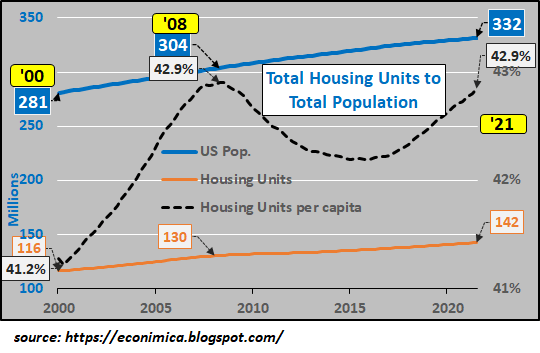
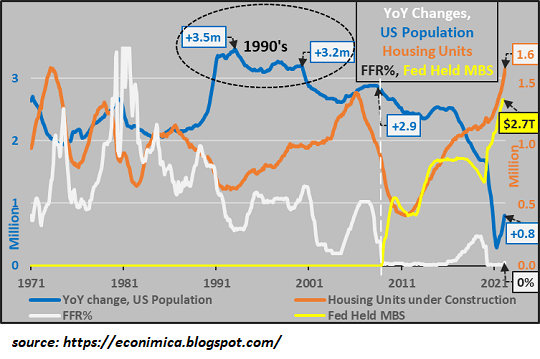
My colleague CH at econimica.blogspot.com recently posted charts calling this assumption into question. The first chart (below) shows the U.S. population growth rate plummeting as housing starts soar, and the second chart shows housing unit per capita, which has just reached the same extreme as the 2008 housing bubble.

Demographics and housing do not reflect a housing shortage nationally, though there could be scarcities locally, of course, and other factors such as thousands of units being held off the market as short-term rentals or investments by overseas buyers who have no interest in renting their investment dwellings.

On a per capita basis, housing has reached previous bubble levels. That suggests housing shortages are artificial or local, not structural.

Next, let’s consider how the current housing bubble differs from previous bubbles in the late 1970s and 2000s. In my view, the previous bubbles were driven by demographics, inflation and monetary policy: in the late 70s, the 65 million-strong Baby Boom generation began buying their first homes, pushing demand higher while inflation soared, making real-world assets such as housing more desirable.

Once the Federal Reserve pushed interest rates to 18%, mortgage rates rose in lockstep and housing crashed as few could afford sky-high housing prices at sky-high mortgage rates.

The housing bubble of 2007-08 was largely driven by declines in mortgage rates (as the Fed pursued an “easy money” policy to escape the negative effects of the Dot-Com stock market bubble crash) and a loosening of credit/mortgage standards. These fueled a bubble that morphed into a speculative free-for-all of no-down payment and no-document loans.

This decline in the cost of borrowing money (mortgage rates) enabled a sharp rise in the price of housing, a speculative boom that was greatly accelerated by “innovations” in the mortgage market such as zero down payments loans, interest-only loans, home equity loans, and no-document “liar loans”–mortgages underwritten without the usual documentation of income and net worth.

These forces generated a speculative frenzy of house-flipping, leveraging the equity in the family home to buy two or three homes under construction and selling them before they were even completed for fat profits, and so on.

Needless to say, the pool of potential buyers expanded tremendously when people earning $25,000 a year could buy $500,000 houses on speculation.

Once the bubble popped, the pool of buyers shrank along with the home equity.

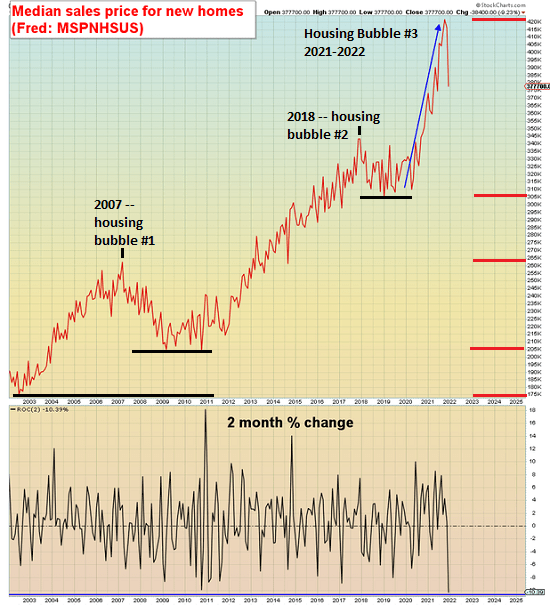
If we study this chart below of new home prices (courtesy of Mac10), we can see that the 21st century’s Bubble #2 rose as the Federal Reserve pushed mortgage rates far below historic norms. Once rates reached a bottom, the 7-year inflation of home prices (from 2011 to 2018) began rolling over.

This deflation of home prices was reversed by the pandemic recession, as the Fed’s vast expansion of credit and mortgage-buying, which pushed mortgage rates to new lows. Trillions of dollars in new credit and cash stimulus ignited a speculative frenzy in stocks, bonds and real estate, a frenzy which drove bubble #3 to extraordinary heights.

All this unprecedented fiscal and monetary stimulus also ignited inflation, and so rates are rising in response. Bubble #3 is already deflating, at least by the measure of new home prices.

But the current bubble has a number of dynamics that weren’t big factors in previous bubbles.

One is the rise of remote work. Many people have been working remotely since the late 1990s enabled Internet-based work, but the pandemic greatly increased the pool of employers willing to accept remote work as a permanent feature of employment.

This trend has been well documented, but the consequences are still unfolding: remote workers are no longer trapped in unaffordable, congested cities and suburbs.

Several other trends have attracted much less attention, but I see them as equally consequential.

1. Housing in many urban zones are out of reach of all but the top 10% without extraordinary sacrifice, and now that employment isn’t necessarily tied to urban zones, the bottom 90% of young people without family wealth or high incomes are coming to realize the benefits of urban living are not worth the extreme sacrifices needed to buy an overvalued house.

A middle-class life–home ownership, financial security, leisure and surplus income to invest in one’s family and well-being–is no longer affordable for the majority of young Americans.

Few are willing to concede this because it reveals the neofeudal nature of American life. Those who bought homes in coastal urban zones 20+ years ago are wealthy due to soaring housing valuations while young people can’t even afford the rent, much less buying a house.

If you’re not making $250,000 or more a year as a couple, the only hope for a middle-class life that includes leisure and some surplus income to invest is top move to some place with much lower housing and other costs. That place is rural America.

2. The benefits of urban living are deteriorating while the sacrifices and downsides are increasing. Urban living is fun if you’re wealthy, not so fun if you don’t have plenty of surplus income to spend.

Urban problems such as homelessness, traffic congestion and crime are endemic and unresolvable, though few are willing to state the obvious. Americans are expected to be optimistic and to count on some new whiz-bang technology to solve all problems.

Unfortunately, problems generated by dysfunctional, overly complex institutions, corruption and unaffordable costs can’t be solved by some new technology, and so the decay of cities will only gather momentum.

The hope that billions of federal stimulus funding would solve these problems is about to encounter reality as the funds dry up and all the problems remain or have actually expanded despite massive “investments” in solutions.

Few analysts have looked at the finances of high-cost cities. The decline in bricks-and-mortar retail, rising crime, soaring junk fees, rents and property taxes have all made urban small business insanely costly and therefore risky.

Small businesses are the core sources of employment and taxes. As high costs, crime, etc. choke small businesses, employment and tax revenues drop and commercial real estate sits empty, generating decay and defaults.

Once office and retail space is no longer affordable or necessary, commercial real estate crashes in value as owners who bought at the top default and go bankrupt.

People need shelter but they don’t need office space or to start a bricks-and-mortar retail business.

As urban finances unravel, cities won’t have the funding to run their bloated, inefficient, overly complex and unaccountable bureaucracies.

3. In geopolitics, we speak of the core and the periphery. Empires have a core (Rome and central Italy in the Roman Empire) and a periphery (Britain, North Africa, Egypt, the Levant).

As finances and trade decay and costs soar, the periphery is surrendered to maintain the core.

In urban zones, the same dynamic will become increasingly visible: the peripheral neighborhoods will be underfunded to continue protecting the wealthy enclaves.

Crime will skyrocket in the periphery even as residents of the wealthy enclaves see little decay in their neighborhoods.

This asymmetry–already extreme–will drive social unrest and disorder. This is a self-reinforcing feedback: as the periphery neighborhoods deteriorate, the remaining businesses flee and the smart money sells and moves away.

Tax revenues plummet and city services decay even further, persuading hangers-on to move before it gets even worse. Cities compensate for the lower revenues by increasing taxes on the remaining residents and cutting services.

Each turn of the screw triggers more closures and selling and fewer tax revenues.

4. Dependency chains will become increasingly consequential: the greater a city’s dependency on essentials trucked/shipped from hundreds or thousands of of kilometers/miles away, the more prone that city will be to disruptions of essentials: food, energy, materials and infrastructure.

Though few are willing to dwell on such vulnerabilities, most cities are totally dependent on diesel fueled fleets of trucks, rail and jet fuel for luxuries flown in from afar for virtually all goods. Cities produce very little in the way of essentials such as food and energy.

The past reliability of long supply chains has instilled a confidence that these supply chains stretching thousands of kilometers and miles are unbreakable and forever. They aren’t, and the initial disruptions will be a great shock to Americans who believe full gas tanks and fully stocked store shelves are their birthright.

5. As I’ve explained in my new book Global Crisis, National Renewalthe era of cheap, reliable abundance has drawn to a close and now we are entering an era of scarcity in essentials.

Another reality few discuss is the relative stability of global weather over the past 40 years. As weather becomes less reliable, so too do crop yields and food supplies.

Globalization has poured capital into expanding acreage under cultivation to the point that the planet’s forests are being decimated to grow more soy to feed animals to be slaughtered for human consumption.

On the margins, land that was once productive has been lost to desertification. Fresh water aquifers have been drained and glaciers feeding rivers are melting away. Soil fertility has declined even as fertilizer use has expanded.

The low-hanging fruit of GMO seeds, fertilizers, insecticides, herbicides and Green Revolution hybrids have all been plucked. The gains have been reaped but now the downsides of these dependencies are becoming increasingly consequential: fertilizer costs are rising fast, insects and diseases are evading chemicals and vaccines, and the vulnerabilities of mono-crop, industrialized agriculture and animal husbandry threaten to cascade into crop failures, soaring prices and shortages.

6. This will have two consequences: rural incomes which have been falling for decades due to globalization (i.e. bringing in cheap food from places with no environmental standards, cheap labor and few taxes / social costs) will start rising sharply, fueling a reversal in the long decline of rural communities based on agricultural income.

The soaring costs of essentials will reduce the disposable income of the bottom 90%, reducing the money they’ll have to spend on eating out, retail shopping, etc.–all the surplus spending that drives cities’ economies and tax revenues.

Few (if any) commentators forecast a cyclical reversal of the demographic trend of people moving from rural locales to cities. I think this trend has already reversed and will gather momentum as cities become increasingly unlivable, disposable incomes decline as scarcities push prices higher and people flee for lower cost, more secure environs.

7. As I often note, following what the super-wealthy are doing is a pretty sound investment strategy because the super-wealthy spend freely to buy the best advice and are highly motivated to protect their wealth.

People who live in well-known, highly desirable rural towns (Telluride, Jackson Hole, Lake Tahoe, etc.) are describing a feeding frenzy of wealthy urbanites buying multi-million dollar homes. Small cities such as Bozeman, MT and Ashville, NC are experiencing a flood of new residents that is straining infrastructure and pushing housing prices out of reach for local residents with average wages.

8. Rural towns in the U.S., Italy, Japan and even Switzerland are trying to attract new residents with offers of free land, subsidized rent, low cost homes, etc. This shows that the trends are global and not limited to any one nation. Would you take free land in rural America?

The decay of urban life isn’t yet consequential enough to push people into making a major move, but once someone has been robbed, repeatedly found human feces on their doorstep or experienced scarcities that trigger the madness of crowds, the decision to leave becomes much, much easier.

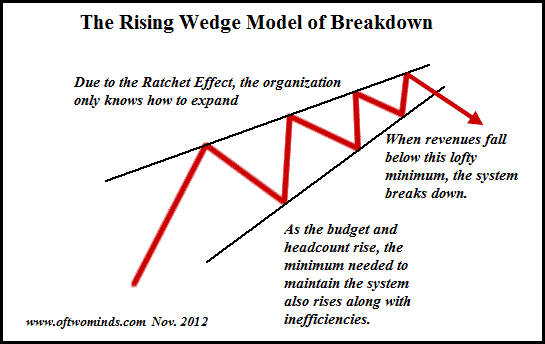
Some cities will manage the decline of employment and tax revenues more gracefully than others. Most will suffer from the dynamic I’ve often described on the blog: the Ratchet Effect. Costs move effortlessly higher as tax revenues have increased in one speculative bubble after another, but once revenues drop, cities have no mechanisms or political constituency to manage a sharp, long-term decline in revenues.

They then become prone to the other dynamic I’ve described, the Rising Wedge Breakdown (see chart below): as agencies and institutions become sclerotic, unaccountable and self-serving, even a relatively modest cut in revenues triggers institutional collapse, as the system requires 100% funding to function. A 10% reduction doesn’t cause a 10% decline in service, it causes an 50% decline in service, on the way to complete dysfunction.

Few believe cities can unravel, but remote work, geographic arbitrage (discussed below), tightening credit, rising crime, the decline of commercial real estate, end of massive stimulus, scarcities, the madness of crowds, the decline of civic services and amenities and an insanely high cost of living all have consequences and second-order effects.

What were beneficial synergies become fatal synergies as dynamics reverse and begin reinforcing each other.

So let’s put all this together.

A. The cycle of declining interest rates and inflation has ended and a cycle of much higher interest and mortgage rates and inflation is beginning. Higher mortgages rates will depress housing prices as only the highest income households will be able to afford today’s prices once mortgage rates rise.

B. The decay of urban finances and quality of life will accelerate as stimulus ends, credit dries up and inflation decimates disposable income.

C. The stress of trying to make enough money to afford the high costs of city/suburban living as the real estate bubble pops and the benefits of city living decline will burn out increasing numbers of people who will have no choice but to find more affordable, more secure and more livable places.

D. While the wealthy have already secured second or third homes in the toniest desirable towns, there are still opportunities for lower cost, more secure residences in rural areas.

E. This migration, even at the margins, will further depress urban housing prices and push prices in desirable rural locales higher.

F. This migration will have regional, ethnic and cultural variations. For example, some African-Americans leaving the upper Midwest are finding favor with communities in the South where family, church and cultural ties beckon.

G. Correspondent John F. used the phrase geographic arbitrage which means earning money remotely in high-wage sectors while living some place that’s low cost and secure.

I wrote about this many years ago in my post about young Japanese maintaining a part-time remote-work gig while pursuing farming in rural communities: Degrowth Solutions: Half-Farmer, Half-X (July 19, 2014).

H. Though monetary / inflationary forces will pop housing prices based solely on low mortgage rates, this doesn’t mean housing everywhere will decline: as burned out urbanites seek lower cost, more secure and livable places in rural locales, homes in desirable towns and small cities could rise sharply because they’re starting from such low levels.

I. If urban areas decay rapidly, housing prices could plummet much faster than most people think possible.

When cities lose employment, tax revenues and desirability, they can go down fast. Property values can fall in half and then by 90%.

How is this possible? Supply and demand: if demand falls off a cliff, there won’t be buyers for thousands of homes that come on the market all at once. This is just like a stock market in which buyers disappear, as no one wants to buy an asset that’s rapidly losing value.

As I’ve noted many times, prices for assets are set on the margins: the last sale of a house resets the price for the entire neighborhood.

The stock market is easily manipulated by the big players, who can stop a slide in prices by buying huge chunks of stocks and call options. There are no equivalent forces which can stop a decline in housing prices.

And since rates will rise regardless of what the Federal Reserve does because global capital is demanding a real return above inflation, then the hope for lower mortgage rates to support bubble-level housing prices will be in vain.

How low could housing go? As explained above, there will likely be very asymmetric declines and increases in housing valuations going forward. But on a technical-analysis level, we can anticipate a general decline to previous lows, first to the 2019 lows and then to the 2011 lows.

Some analysts believe inflation will funnel capital into housing as investors seek assets that will go up with inflation, but this is a murky forecast: the bottom 90% of American households are already priced out of coastal housing, so inflation only robs their wages of purchasing power. They don’t have any hope of buying a house anywhere near current prices.

Corporations are buying thousands of houses for the rental income, but once all the stimulus runs out and the excesses of speculation reverse, they’ll find few renters can afford their sky-high rents. At that point corporate buyers become corporate sellers, but they won’t find buyers willing or able to pay their asking prices, which are based on bubble pricing, not reality.

All these swirling currents will affect housing valuations in different places differently. Some areas could see 50% declines while others see 50% increases, regardless of mortgage rates or Fed policy.

What will become most desirable is a low cost of living, security and livability, which includes community, reduced dependency on long supply chains and local production of essentials.

We are all prone to believing the recent past is a reliable guide to the future. But in times of dynamic reversals, the past is an anchor thwarting our progress, not a forecast.
No Way Out but War

Permanent war has cannibalized the country. It has created a social, political, and economic morass. Each new military debacle is another nail in the coffin of Pax Americana.

By Chris Hedges

Source: ScheerPost


The United States, as the near unanimous vote to provide nearly $40 billion in aid to Ukraine illustrates, is trapped in the death spiral of unchecked militarism. No high speed trains. No universal health care. No viable Covid relief program. No respite from 8.3 percent inflation. No infrastructure programs to repair decaying roads and bridges, which require $41.8 billion to fix the 43,586 structurally deficient bridges, on average 68 years old. No forgiveness of $1.7 trillion in student debt. No addressing income inequality. No program to feed the 17 million children who go to bed each night hungry. No rational gun control or curbing of the epidemic of nihilistic violence and mass shootings. No help for the 100,000 Americans who die each year of drug overdoses. No minimum wage of $15 an hour to counter 44 years of wage stagnation. No respite from gas prices that are projected to hit $6 a gallon.

The permanent war economy, implanted since the end of World War II, has destroyed the private economy, bankrupted the nation, and squandered trillions of dollars of taxpayer money. The monopolization of capital by the military has driven the US debt to $30 trillion, $ 6 trillion more than the US GDP of $ 24 trillion. Servicing this debt costs $300 billion a year. We spent more on the military, $ 813 billion for fiscal year 2023, than the next nine countries, including China and Russia, combined.

We are paying a heavy social, political, and economic cost for our militarism. Washington watches passively as the U.S. rots, morally, politically, economically, and physically, while China, Russia, Saudi Arabia, India, and other countries extract themselves from the tyranny of the U.S. dollar and the international Society for Worldwide Interbank Financial Telecommunication (SWIFT), a messaging network banks and other financial institutions use to send and receive information, such as money transfer instructions. Once the U.S. dollar is no longer the world’s reserve currency, once there is an alternative to SWIFT, it will precipitate an internal economic collapse. It will force the immediate contraction of the U.S. empire shuttering most of its nearly 800 overseas military installations. It will signal the death of Pax Americana.

Democrat or Republican. It does not matter. War is the raison d’état of the state. Extravagant military expenditures are justified in the name of “national security.” The nearly $40 billion allocated for Ukraine, most of it going into the hands of weapons manufacturers such as Raytheon Technologies, General Dynamics, Northrop Grumman, BAE Systems, Lockheed Martin, and Boeing, is only the beginning. Military strategists, who say the war will be long and protracted, are talking about infusions of $4 or $5 billion in military aid a month to Ukraine. We face existential threats. But these do not count. The proposed budget for the Centers for Disease Control and Prevention (CDC) in fiscal year 2023 is $10.675 billion. The proposed budget for the Environmental Protection Agency (EPA) is $11.881 billion. Ukraine alone gets more than double that amount. Pandemics and the climate emergency are afterthoughts. War is all that matters. This is a recipe for collective suicide.

There were three restraints to the avarice and bloodlust of the permanent war economy that no longer exist. The first was the old liberal wing of the Democratic Party, led by politicians such as Senator George McGovern, Senator Eugene McCarthy, and Senator J. William Fulbright, who wrote The Pentagon Propaganda Machine. The self-identified progressives, a pitiful minority, in Congress today, from Barbara Lee, who was the single vote in the House and the Senate opposing a broad, open-ended authorization allowing the president to wage war in Afghanistan or anywhere else, to Ilhan Omar now dutifully line up to fund the latest proxy war. The second restraint was an independent media and academia, including journalists such as I.F Stone and Neil Sheehan along with scholars such as Seymour Melman, author of The Permanent War Economy and Pentagon Capitalism: The Political Economy of War. Third, and perhaps most important, was an organized anti-war movement, led by religious leaders such as Dorothy Day, Martin Luther King Jr. and Phil and Dan Berrigan as well as groups such as Students for a Democratic Society (SDS). They understood that unchecked militarism was a fatal disease.

None of these opposition forces, which did not reverse the permanent war economy but curbed its excesses, now exist. The two ruling parties have been bought by corporations, especially military contractors. The press is anemic and obsequious to the war industry. Propagandists for permanent war, largely from right-wing think tanks lavishly funded by the war industry, along with former military and intelligence officials, are exclusively quoted or interviewed as military experts. NBC’s “Meet the Press” aired a segment May 13 where officials from Center for a New American Security (CNAS) simulated what a war with China over Taiwan might look like. The co-founder of CNAS, Michèle Flournoy, who appeared in the “Meet the Press” war games segment and was considered by Biden to run the Pentagon, wrote in 2020 in Foreign Affairs that the U.S. needs to develop “the capability to credibly threaten to sink all of China’s military vessels, submarines and merchant ships in the South China Sea within 72 hours.” 

The handful of anti-militarists and critics of empire from the left, such as Noam Chomsky, and the right, such as Ron Paul, have been declared persona non grata by a compliant media. The liberal class has retreated into boutique activism where issues of class, capitalism and militarism are jettisoned for “cancel culture,” multiculturalism and identity politics. Liberals are cheerleading the war in Ukraine. At least the inception of the war with Iraq saw them join significant street protests. Ukraine is embraced as the latest crusade for freedom and democracy against the new Hitler. There is little hope, I fear, of rolling back or restraining the disasters being orchestrated on a national and global level.  The neoconservatives and liberal interventionists chant in unison for war. Biden has appointed these war mongers, whose attitude to nuclear war is terrifyingly cavalier, to run the Pentagon, the National Security Council, and the State Department.

Since all we do is war, all proposed solutions are military. This military adventurism accelerates the decline, as the defeat in Vietnam and the squandering of $8 trillion in the futile wars in the Middle East illustrate. War and sanctions, it is believed, will cripple Russia, rich in gas and natural resources. War, or the threat of war, will curb the growing economic and military clout of China.

These are demented and dangerous fantasies, perpetrated by a ruling class that has severed itself from reality. No longer able to salvage their own society and economy, they seek to destroy those of their global competitors, especially Russia and China. Once the militarists cripple Russia, the plan goes, they will focus military aggression on the Indo-Pacific, dominating what Hillary Clinton as secretary of state, referring to the Pacific, called “the American Sea.” 

You cannot talk about war without talking about markets. The U.S., whose growth rate has fallen to below 2 percent, while China’s growth rate is 8.1 percent, has turned to military aggression to bolster its sagging economy. If the U.S. can sever Russian gas supplies to Europe, it will force Europeans to buy from the United States. U.S. firms, at the same time, would be happy to replace the Chinese Communist Party, even if they must do it through the threat of war, to open unfettered access to Chinese markets. War, if it did break out with China, would devastate the Chinese, American, and global economies, destroying free trade between countries as in World War I. But that doesn’t mean it won’t happen.

Washington is desperately trying to build military and economic alliances to ward off a rising China, whose economy is expected by 2028 to overtake that of the United States, according to the UK’s Centre for Economics and Business Research (CEBR). The White House has said Biden’s current visit to Asia is about sending a “powerful message” to Beijing and others about what the world could look like if democracies “stand together to shape the rules of the road.” The Biden administration has invited South Korea and Japan to attend the NATO summit in Madrid.

But fewer and fewer nations, even among European allies, are willing to be dominated by the United States. Washington’s veneer of democracy and supposed respect for human rights and civil liberties is so badly tarnished as to be irrecoverable. Its economic decline, with China’s manufacturing 70 percent higher than that of the U.S., is irreversible. War is a desperate Hail Mary, one employed by dying empires throughout history with catastrophic consequences. “It was the rise of Athens and the fear that this instilled in Sparta that made war inevitable,” Thucydides noted in the History of the Peloponnesian War. 

A key component to the sustenance of the permanent war state was the creation of the All-Volunteer Force. Without conscripts, the burden of fighting wars falls to the poor, the working class, and military families. This All-Volunteer Force allows the children of the middle class, who led the Vietnam anti-war movement, to avoid service. It protects the military from internal revolts, carried out by troops during the Vietnam War, which jeopardized the cohesion of the armed forces.

The All-Volunteer Force, by limiting the pool of available troops, also makes the global ambitions of the militarists impossible. Desperate to maintain or increase troop levels in Iraq and Afghanistan, the military instituted the stop-loss policy that arbitrarily extended active-duty contracts. Its slang term was the backdoor draft. The effort to bolster the number of troops by hiring private military contractors, as well, had a negligible effect. Increased troop levels would not have won the wars in Iraq and Afghanistan but the tiny percentage of those willing to serve in the military (only 7 percent of the U.S. population are veterans) is an unacknowledged Achilles heel for the militarists.

“As a consequence, the problem of too much war and too few soldiers eludes serious scrutiny,” writes historian and retired Army Colonel Andrew Bacevich in After the Apocalypse: America’s Role in a World Transformed. “Expectations of technology bridging that gap provide an excuse to avoid asking the most fundamental questions: Does the United States possess the military wherewithal to oblige adversaries to endorse its claim of being history’s indispensable nation? And if the answer is no, as the post-9/11 wars in Afghanistan and Iraq suggest, wouldn’t it make sense for Washington to temper its ambitions accordingly?”

This question, as Bacevich points out, is “anathema.” The military strategists work from the supposition that the coming wars won’t look anything like past wars. They invest in imaginary theories of future wars that ignore the lessons of the past, ensuring more fiascos. 

The political class is as self-deluded as the generals. It refuses to accept the emergence of a multi-polar world and the palpable decline of American power. It speaks in the outdated language of American exceptionalism and triumphalism, believing it has the right to impose its will as the leader of the “free world.” In his 1992 Defense Planning Guidance memorandum, U.S. Under Secretary of Defense Paul Wolfowitz argued that the U.S. must ensure no rival superpower again arises. The U.S. should project its military strength to dominate a unipolar world in perpetuity. On February 19, 1998, on NBC’s “Today Show”, Secretary of State Madeleine Albright gave the Democratic version of this doctrine of unipolarity. “If we have to use force it is because we are Americans; we are the indispensable nation,” she said. “We stand tall, and we see further than other countries into the future.”

This demented vision of unrivaled U.S. global supremacy, not to mention unrivaled goodness and virtue, blinds the establishment Republicans and Democrats. The military strikes they casually used to assert the doctrine of unipolarity, especially in the Middle East, swiftly spawned jihadist terror and prolonged warfare. None of them saw it coming until the hijacked jets slammed into the World Trade Center twin towers. That they cling to this absurd hallucination is the triumph of hope over experience.

There is a deep loathing among the public for these elitist Ivy League architects of American imperialism. Imperialism was tolerated when it was able to project power abroad and produce rising living standards at home. It was tolerated when it restrained itself to covert interventions in countries such as Iran, Guatemala, and Indonesia. It went off the rails in Vietnam. The military defeats that followed accompanied a steady decline in living standards, wage stagnation, a crumbling infrastructure and eventually a series of economic policies and trade deals, orchestrated by the same ruling class, which deindustrialized and impoverished the country.

The establishment oligarchs, now united in the Democratic Party, distrust Donald Trump. He commits the heresy of questioning the sanctity of the American empire. Trump derided the invasion of Iraq as a “big, fat mistake.” He promised “to keep us out of endless war.” Trump was repeatedly questioned about his relationship with Vladimir Putin. Putin was “a killer,” one interviewer told him. “There are a lot of killers,” Trump retorted. “You think our country’s so innocent?” Trump dared to speak a truth that was to be forever unspoken, the militarists had sold out the American people.

Noam Chomsky took some heat for pointing out, correctly, that Trump is the “one statesman” who has laid out a “sensible” proposition to resolve the Russia-Ukraine crisis. The proposed solution included “facilitating negotiations instead of undermining them and moving toward establishing some kind of accommodation in Europe…in which there are no military alliances but just mutual accommodation.”

Trump is too unfocused and mercurial to offer serious policy solutions. He did set a timetable to withdraw from Afghanistan, but he also ratcheted up the economic war against Venezuela and reinstituted crushing sanctions against Cuba and Iran, which the Obama administration had ended. He increased the military budget. He apparently flirted with carrying out a missile strike on Mexico to “destroy the drug labs.” But he acknowledges a distaste for imperial mismanagement that resonates with the public, one that has every right to loath the smug mandarins that plunge us into one war after another. Trump lies like he breathes. But so do they.

The 57 Republicans who refused to support the $40 billion aid package to Ukraine, along with many of the 19 bills that included an earlier $13.6 billion in aid for Ukraine, come out of the kooky conspiratorial world of Trump. They, like Trump, repeat this heresy. They too are attacked and censored. But the longer Biden and the ruling class continue to pour resources into war at our expense, the more these proto fascists, already set to wipe out Democratic gains in the House and the Senate this fall, will be ascendant. Marjorie Taylor Greene, during the debate on the aid package to Ukraine, which most members were not given time to closely examine, said: “$40 billion dollars but there’s no baby formula for American mothers and babies.”

“An unknown amount of money to the CIA and Ukraine supplemental bill but there’s no formula for American babies,” she added. “Stop funding regime change and money laundering scams. A US politician covers up their crimes in countries like Ukraine.”

Democrat Jamie Raskin immediately attacked Greene for parroting the propaganda of Russian president Vladimir Putin.

Greene, like Trump, spoke a truth that resonates with a beleaguered public. The opposition to permanent war should have come from the tiny progressive wing of the Democratic Party, which unfortunately sold out to the craven Democratic Party leadership to save their political careers. Greene is demented, but Raskin and the Democrats peddle their own brand of lunacy. We are going to pay a very steep price for this burlesque.

The Inflation Crisis Of 2022 Is Now Worse Than Anything That We Experienced During The 1970s

By Michael Snyder

Source: Activist Post

Most Americans don’t realize this, but we truly have entered historic territory.  As you will see below, the inflation crisis of 2022 has now escalated to a level that is beyond anything that we experienced during the horrible Jimmy Carter era of the 1970s.  If you are old enough to have been alive back then, you probably remember the constant headlines about inflation.  And you also probably remember that it seemed like the impotent administration in power in Washington was powerless to do anything about it.  In other words, it was a lot like what we are going through today.  Unfortunately for us, this new economic crisis is still only in the very early chapters.

Of course the mainstream media would like us to believe that what we are experiencing today is not even close to what Americans went through in the late 1970s and early 1980s.  According to CNN, the U.S. inflation rate hit a peak of 14.6 percent in the first half of 1980…

The inflation rate hit a record high of 14.6% in March and April of 1980. It helped to lead to Carter’s defeat in that fall’s election. It also led to some significant changes in the US economy.

Compared to that, the numbers we have been given in early 2022 seem rather tame.  On Tuesday, we learned that the official rate of inflation in the U.S. hit 8.5 percent in the month of March…

Prices that consumers pay for everyday items surged in March to their highest levels since the early days of the Reagan administration, according to Labor Department data released Tuesday.

The consumer price index, which measures a wide-ranging basket of goods and services, jumped 8.5% from a year ago on an unadjusted basis, above even the already elevated Dow Jones estimate for 8.4%.

8.5 percent is much lower than 14.6 percent, and so to most people it would seem logical to conclude that we are still a long way from the kind of nightmarish crisis that our nation endured during the waning days of the Carter administration.

But is that the truth?

In reality, we can’t make a straight comparison between the official rate of inflation in 2022 and the official rate of inflation in 1980.  The way that the inflation rate is calculated has been changed more than 20 times since 1980, and every time it was changed the goal was to make the official rate of inflation appear to be lower.

What we really need is an apples-to-apples comparison; fortunately, John Williams over at shadowstats.com has done the math for us.

According to Williams, if the inflation rate was still calculated the way that it was back in 1980, the official rate of inflation would be somewhere around 17 percent right now.

17 percent!

That means that the inflation that we are seeing now is even worse than anything that Americans went through during the Jimmy Carter era.

And government figures for individual categories seem to confirm that inflation is now wildly out of control.  For example, the price of gasoline has risen by 48 percent over the past year…

The price of gasoline rose by 48.0 percent from March 2021 to March 2022, according to numbers released today by the Bureau of Labor Statistics.

In just one month—from February to March—the seasonally adjusted price of gasoline went up 18.3 percent.

Vehicle prices have escalated to absurd levels as well.  If you can believe it, the average retail selling price of a used vehicle at CarMax has risen by 39.7 percent in just 12 months…

CarMax experienced a slowdown in fourth-quarter used car sales volume as its average retail selling price jumped 39.7% year-over-year to $29,312, an increase of approximately $8,300 per unit.

And I discussed yesterday, home prices in the United States have jumped 32.6 percent over the past two years.

We have entered a full-blown inflationary nightmare, and the Biden administration is trying to blame Vladimir Putin for it.

Needless to say, that is extremely disingenuous of Biden, because prices were already skyrocketing even before the war in Ukraine started.

But it is true that the war is making economic problems even worse all over the globe, and that isn’t going to end any time soon.

A couple of weeks ago there was a bit of optimism that some sort of a ceasefire agreement could be reached, but now there appears to be no hope that there will be one any time soon.

On Tuesday, Putin told the press that peace talks have reached “a dead end”

Talks with Ukraine have reached “a dead end,” Russian President Vladimir Putin said in fresh Tuesday remarks. “We will not stop military operations in Ukraine until they succeed.” He explained that Ukraine has “deviated” from agreements and any possible prior progress reached during the Istanbul meetings, according to state-run RIA.

The strong remarks aimed at both Kiev and the West were given during a joint presser with his Belarusian counterpart Alexander Lukashenko. He further hailed that the military operations is still going “according to plan,” Bloomberg reports, however while admitting to the domestic population that “Russian logistics and payment systems remain a weakness and the long-term impact of western measures could be more painful.” But he also said the county has withstood the economic “blitzkrieg” from the West.

And Volodymyr Zelenskyy is now saying that the return of Crimea is a “red line” for him

Ukrainian President Volodymyr Zelensky named recognition of the annexation of the Crimea region as one of his red lines for Moscow in any potential peace talks with Russian President Vladimir Putin to end war between the two countries.

Russia annexed the southern region of Crimea in 2014. Russian-backed separatists and forces, as well Ukrainian soldiers, have since been fighting in the eastern region of Ukraine.

Russia will never, ever willingly give Crimea back to Ukraine.

Anyone who thinks otherwise is simply being delusional.

So unless someone changes their tune, this war between Russia and Ukraine is going to keep going until someone achieves total victory.

And that could take a really long time.

Meanwhile, global food supplies will get tighter and tighter, and global economic conditions will continue to rapidly deteriorate.

In other words, the kind of nightmare scenario that I have been warning about for years is now upon us.

And so what happens if another “black swan event” or two hits us later in 2022?

We are so vulnerable right now, and it wouldn’t take much at all to push us over the edge and into an unprecedented worldwide crisis of epic proportions.

‘We the People’ Are the New, Permanent Underclass in America

By John W. Whitehead & Nisha Whitehead

Source: The Rutherford Institute

“We are now speeding down the road of wasteful spending and debt, and unless we can escape we will be smashed in inflation.”—Herbert Hoover

This is financial tyranny.

The U.S. government—and that includes the current administration—is spending money it doesn’t have on programs it can’t afford, and “we the taxpayers” are the ones who must foot the bill for the government’s fiscal insanity.

We’ve been sold a bill of goods by politicians promising to pay down the national debt, jumpstart the economy, rebuild our infrastructure, secure our borders, ensure our security, and make us all healthy, wealthy and happy.

None of that has come to pass, and yet we’re still being loaded down with debt not of our own making.

Let’s talk numbers, shall we?

The national debt (the amount the federal government has borrowed over the years and must pay back) is $30 trillion and growing. That translates to roughly $242,000 per taxpayer.

Now the Biden administration is proposing a $5.8 trillion spending budget that notably includes $813 billion for national defense, $30 billion to “fund the police,” and a plan to reduce the national deficit by roughly $1 trillion over 10 years through additional tax hikes.

It’s estimated that the amount this country owes is now 130% greater than its gross domestic product (all the products and services produced in one year by labor and property supplied by the citizens).

The U.S. ranks as the 12th most indebted nation in the world, with much of that debt owed to the Federal Reserve, large investment funds and foreign governments, namely, Japan and China.

Essentially, the U.S. government is funding its very existence with a credit card.

In 2021, we paid more than $562 billion in interest on that public debt, which according to journalist Rob Garver, “is more than the annual budget of every individual federal agency except for the Treasury, the Department of Health and Human Services (which manages the Medicare and Medicaid government health insurance programs), and the Department of Defense.”

According to the Committee for a Reasonable Federal Budget, the interest we’ve paid on this borrowed money is “nearly twice what the federal government will spend on transportation infrastructure, over four times as much as it will spend on K-12 education, almost four times what it will spend on housing, and over eight times what it will spend on science, space, and technology.”

Clearly, the national debt isn’t going away anytime soon, especially not with government spending on the rise and interest payments making up such a large chunk of the budget.

Still, the government remains unrepentant, unfazed and undeterred in its wanton spending.

Indeed, the national deficit (the difference between what the government spends and the revenue it takes in) remains at more than $1.5 trillion.

If Americans managed their personal finances the way the government mismanages the nation’s finances, we’d all be in debtors’ prison by now.

Despite the government propaganda being peddled by the politicians and news media, however, the government isn’t spending our tax dollars to make our lives better.

We’re being robbed blind so the governmental elite can get richer.

We’re not living the American dream. We’re living a financial nightmare.

In the eyes of the government, “we the people, the voters, the consumers, and the taxpayers” are little more than pocketbooks waiting to be picked.

“We the people” have become the new, permanent underclass in America.

Consider: The government can seize your home and your car (which you’ve bought and paid for) over nonpayment of taxes. Government agents can freeze and seize your bank accounts and other valuables if they merely “suspect” wrongdoing. And the IRS insists on getting the first cut of your salary to pay for government programs over which you have no say.

We have no real say in how the government runs, or how our taxpayer funds are used, but we’re being forced to pay through the nose, anyhow.

We have no real say, but that doesn’t prevent the government from fleecing us at every turn and forcing us to pay for endless wars that do more to fund the military industrial complex than protect us, pork barrel projects that produce little to nothing, and a police state that serves only to imprison us within its walls.

If you have no choice, no voice, and no real options when it comes to the government’s claims on your property and your money, you’re not free.

It wasn’t always this way, of course.

Early Americans went to war over the inalienable rights described by philosopher John Locke as the natural rights of life, liberty and property.

It didn’t take long, however—a hundred years, in fact—before the American government was laying claim to the citizenry’s property by levying taxes to pay for the Civil War. As the New York Times reports, “Widespread resistance led to its repeal in 1872.”

Determined to claim some of the citizenry’s wealth for its own uses, the government reinstituted the income tax in 1894. Charles Pollock challenged the tax as unconstitutional, and the U.S. Supreme Court ruled in his favor. Pollock’s victory was relatively short-lived. Members of Congress—united in their determination to tax the American people’s income—worked together to adopt a constitutional amendment to overrule the Pollock decision.

On the eve of World War I, in 1913, Congress instituted a permanent income tax by way of the 16th Amendment to the Constitution and the Revenue Act of 1913. Under the Revenue Act, individuals with income exceeding $3,000 could be taxed starting at 1% up to 7% for incomes exceeding $500,000.

It’s all gone downhill from there.

Unsurprisingly, the government has used its tax powers to advance its own imperialistic agendas and the courts have repeatedly upheld the government’s power to penalize or jail those who refused to pay their taxes.

While we’re struggling to get by, and making tough decisions about how to spend what little money actually makes it into our pockets after the federal, state and local governments take their share (this doesn’t include the stealth taxes imposed through tolls, fines and other fiscal penalties), the government continues to do whatever it likes—levy taxes, rack up debt, spend outrageously and irresponsibly—with little thought for the plight of its citizens.

To top it all off, all of those wars the U.S. is so eager to fight abroad are being waged with borrowed funds. As The Atlantic reports, “U.S. leaders are essentially bankrolling the wars with debt, in the form of purchases of U.S. Treasury bonds by U.S.-based entities like pension funds and state and local governments, and by countries like China and Japan.”

Of course, we’re the ones who will have to repay that borrowed debt.

For instance, American taxpayers have been forced to shell out more than $5.6 trillion since 9/11 for the military industrial complex’s costly, endless so-called “war on terrorism.” That translates to roughly $23,000 per taxpayer to wage wars abroad, occupy foreign countries, provide financial aid to foreign allies, and fill the pockets of defense contractors and grease the hands of corrupt foreign dignitaries.

Mind you, that staggering $6 trillion is only a portion of what the Pentagon spends on America’s military empire.

The United States also spends more on foreign aid than any other nation, with nearly $300 billion disbursed over a five-year period. More than 150 countries around the world receive U.S. taxpayer-funded assistance, with most of the funds going to the Middle East, Africa and Asia. That price tag keeps growing, too.

As Forbes reports, “U.S. foreign aid dwarfs the federal funds spent by 48 out of 50 state governments annually. Only the state governments of California and New York spent more federal funds than what the U.S. sent abroad each year to foreign countries.”

Most recently, in response to Russia’s military aggression against Ukraine, the Biden Administration approved $13.6 billion in military and humanitarian aid for Ukraine, with an additional $200 million for immediate military assistance.

As Dwight D. Eisenhower warned in a 1953 speech, this is how the military industrial complex will continue to get richer, while the American taxpayer will be forced to pay for programs that do little to enhance our lives, ensure our happiness and well-being, or secure our freedoms.

This is no way of life.

Yet it’s not just the government’s endless wars that are bleeding us dry.

We’re also being forced to shell out money for surveillance systems to track our movements, money to further militarize our already militarized police, money to allow the government to raid our homes and bank accounts, money to fund schools where our kids learn nothing about freedom and everything about how to comply, and on and on.

It’s tempting to say that there’s little we can do about it, except that’s not quite accurate.

There are a few things we can do (demand transparency, reject cronyism and graft, insist on fair pricing and honest accounting methods, call a halt to incentive-driven government programs that prioritize profits over people), but it will require that “we the people” stop playing politics and stand united against the politicians and corporate interests who have turned our government and economy into a pay-to-play exercise in fascism.

Unfortunately, we’ve become so invested in identity politics that pit us against one another and keep us powerless and divided that we’ve lost sight of the one label that unites us: we’re all Americans.

Trust me, we’re all in the same boat, folks, and there’s only one real life preserver: that’s the Constitution and the Bill of Rights.

The Constitution starts with those three powerful words: “We the people.”

There is power in our numbers.

As I make clear in my book Battlefield America: The War on the American People and in its fictional counterpart The Erik Blair Diaries, that remains our greatest strength in the face of a governmental elite that continues to ride roughshod over the populace. It remains our greatest defense against a government that has claimed for itself unlimited power over the purse (taxpayer funds) and the sword (military might).

Where we lose out is when we fall for the big-talking politicians who spend big at our expense.

Thralldom and Its Uses

By James Howard Kunstler

Source: Kunstler.com

Spring is always convulsive, with new things heaving into life. Under every dead leaf, something stirs and seeks light, the old must make way for the new, and to some degree the earth is not quite the same place as it was the last time it turned, though the scene looks superficially familiar. Winter’s torpor is, at least, a cold comfort, but springtime’s warmth and movement rattle the nerves. Things unseen shift ominously beneath us. Everything is pending and tending, and nothing is resolved.

Having wrecked its latest business model —hypertrophic financial fakery — Western Civ stumbles into the blinding new reality that it takes real stuff to run an economy, and that money itself is not an adequate replacement for the stuff. The trillions supposedly vested, for instance, in stock market valuations mostly represent mere wishes and promises, and for what? Why, for more money — which responds by losing value, so that we’re racing ever faster toward a receding horizon.

The net result: a world with less available stuff and plenty of money that’s increasingly worthless in pursuit of stuff. It isn’t long before people recognize the disutility of both conditions. The idea that we can fix this problem with central bank digital money is hilarious. When faced with less available stuff, resorting to “money” ever more abstracted from any relation to stuff only puts you in thrall to more empty wishes and promises when this is exactly the moment to be less in thrall and more in touch.

America has had enough of being in thrall, especially to figures and forces dedicated to our destruction. This spring is the beginning of a national life with less stuff, including, looks like, stuff to eat. That will sure enough put folks in touch with something real, and then they will naturally have to do something about it. Centralized control of the population via trackable digital money is the last thing that will avail in the face of hunger and desperation. In fact, that is just another set of empty wishes and promises.

The reality is that centralized government, such as the one in Washington DC, is less and less in control of anything — except the manufactured pretense that it can fix the problems of less stuff and decaying money. The federal government is increasingly impotent, unable to discharge its basic obligations to preserve public order and safety. Its previous attempt to fix something was the response to Covid-19, which has culminated in the fiasco of the mRNA vaccines, now pending and tending toward an astounding wave of early deaths among those in thrall to the transparently dishonest promises of officialdom (“safe and effective”).

That’s the trouble with thrall. It narrows the field-of-vision so badly, you can’t see what’s coming at you indirectly, like: hardship and death. The country has been in serious trouble for more than a decade. Cavalcades of bad choices — and then lying to ourselves about these bad choices — has shoved us well over the edge of our cherished expectations. One way out, then, is to simply refuse to remain in thrall to officialdom and the manufactured bullshit that is its only product.

We are lately in thrall to the melodrama in Ukraine, largely engineered by figures and forces in our own government and for their own ends, which look suspiciously at odds with the nation’s actual interests (the nation being us, its people). Perhaps this illustrates the widening gulf between the slouching beast government has become and the people trying to operate their lives and destinies under it. No food for you, no fertilizers for future food for you, no spare parts for you, no free speech for you, no social or economic role for you, no health for you, and (watch it, now!) soon no life for you.

Collectively going crazy has been a luxury we can’t afford anymore. You fell for RussiaGate and it kept you in thrall for years. You fell for the Adam Schiff orchestrated Ukraine phone call impeachment gambit. You fell for the Covid scare and the dangerously defective vaccines forced on you. You fell for the fraud-drenched election of the empty vessel known as “Joe Biden.” Don’t fall for the invitation to World War Three.

Russia means business in its historic sphere of influence. It’s none of our business, and we’re only making it worse for the Ukrainian people by pretending it’s our business with the false promise of our support. The only thing that matters to us about Ukraine just now is that we’re standing in the way of useful negotiations to end the conflict there and egging on various other countries in Europe to aggravate the situation.

It’s been a fine distraction from everything else that is slipping away in our own country, including the loss of liberty, the right to a livelihood, the need for legitimate meaning, the value of our money, our respect for the law, the ability to speak our minds, and our duty and obligations to each other. Our government is not interested in supporting any of that, and we might doubt that it even could anymore if it wanted to. It only wants to keep you in a state of abject thrall while it fritters away our posterity.

Sit back and watch Europe commit suicide

Washington’s competition with rising power Russia is so fierce, it is willing to sacrifice Europe.Photo Credit: The Cradle

If the US goal is to crush Russia’s economy with sanctions and isolation, why is Europe in an economic free fall instead?

By Pepe Escobar

Source: The Cradle

The stunning spectacle of the European Union (EU) committing slow motion hara-kiri is something for the ages. Like a cheap Kurosawa remake, the movie is actually about the US-detonated demolition of the EU, complete with the rerouting of some key Russian commodities exports to the US at the expense of Europeans.

It helps to have a 5th columnist actress strategically placed – in this case astonishingly incompetent European Commission head Ursula von der Lugen – with her vociferous announcement of a crushing new sanctions package: Russian ships banned from EU ports; road transportation companies from Russia and Belarus prohibited from entering the EU; no more coal imports (over 4.4 billion euros a year).

In practice, that translates into Washington shaking down its wealthiest western clients/puppets. Russia, of course, is too powerful to directly challenge militarily, and the US badly needs some of its key exports, especially minerals. So, the Americans will instead nudge the EU into imposing ever-increasing sanctions that will willfully collapse their national economies, while allowing the US to scoop everything up.

Cue to the coming catastrophic economic consequences felt by Europeans in their daily life (but not by the wealthiest five percent): inflation devouring salaries and savings; next winter energy bills packing a mean punch; products disappearing from supermarkets; holiday bookings almost frozen. France’s Le Petit Roi Emmanuel Macron – perhaps facing a nasty electoral surprise – has even announced: “food stamps like in WWII are possible.”

We have Germany facing the returning ghost of Weimar hyperinflation. BlackRock President Rob Kapito said, in Texas,“for the first time, this generation is going to go into a store and not be able to get what they want.” African farmers are unable to afford fertilizer at all this year, reducing agricultural production by an amount capable of feeding 100 million people.

Zoltan Poszar, former NY Fed and US Treasury guru, current Credit Suisse grand vizir, has been on a streak, stressing how commodity reserves – and, here, Russia is unrivaled – will be an essential feature of what he calls Bretton Woods III (although, what’s being designed by Russia, China, Iran and the Eurasia Economic Union is a post-Bretton Woods).

Poszar remarks that wars, historically, are won by those who have more food and energy supplies, in the past to power horses and soldiers; today to feed soldiers and fuel tanks and fighter jets. China, incidentally, has amassed large stocks of virtually everything.

Poszar notes how our current Bretton Woods II system has a deflationary impulse (globalization, open trade, just-in-time supply chains) while Bretton Woods 3 will provide an inflationary impulse (de-globalization, autarky, hoarding of raw materials) of supply chains and extra military spending to be able to protect what will remain of seaborne trade.

The implications are of course overwhelming. What’s implicit, ominously, is that this state of affairs may even lead to WWIII.

Rublegas or American LNG?

The Russian roundtable Valdai Club has conducted an essential expert discussion on what we at The Cradle have defined as  Rublegas – the real geoeconomic game-changer at the heart of the post-petrodollar era. Alexander Losev, a member of the Russian Council for Foreign and Defense Policy, offered the contours of the Big Picture. But it was up to Alexey Gromov, Chief Energy Director of the Institute of Energy and Finance, to come up with crucial nitty-gritty.

Russia, so far, was selling 155 billion cubic meters of gas to Europe each year. The EU rhetorically promises to get rid of it by 2027, and reduce supply by the end of 2022 by 100 billion cubic meters. Gromov asked “how,” and remarked, “any expert has no answer. Most of Russia’s natural gas is shipped over pipelines. This cannot simply be replaced by Liquified Natural Gas (LNG).”

The risible European answer has been “start saving,” as in “prepare to be worse off” and “reduce the temperature in households.” Gromov noted how, in Russia, “22 to 25 degrees in winter is the norm. Europe is promoting 16 degrees as ‘healthy’, and wearing sweaters at night.”

The EU won’t be able to get the gas it needs from Norway or Algeria (which is privileging domestic consumption). Azerbaijan would be able to provide at best 10 billion cubic meters a year, but “that will take 2 or 3 years” to happen.

Gromov stressed how “there’s no surplus in the market today for US and Qatar LNG,” and how prices for Asian customers are always higher. The bottom line is that “by the end of 2022, Europe won’t be able to significantly reduce” what it buys from Russia: “they might cut by 50 billion cubic meters, maximum.” And prices in the spot market will be higher – at least $1,300 per cubic meter.

An important development is that “Russia changed the logistical supply chains to Asia already.” That applies for gas and oil as well:  “You can impose sanctions if there’s a surplus in the market. Now there’s a shortage of at least 1.5 million barrels of oil a day. We’ll be sending our supplies to Asia – with a discount.” As it stands, Asia is already paying a premium, from 3 to 5 dollars more per barrel of oil.

On oil shipments, Gromov also commented on the key issue of insurance: “Insurance premiums are higher. Before Ukraine, it was all based on the Free on Board (FOB) system. Now buyers are saying ‘we don’t want to take the risk of taking your cargo to our ports.’ So they are applying the Cost, Insurance and Freight (CIF) system, where the seller has to insure and transport the cargo. That of course impacts revenues.”

An absolutely key issue for Russia is how to make the transition to China as its key gas customer. It’s all about the Power of Siberia 2, a new 2600-km pipeline originating in the Russian Bovanenkovo and Kharasavey gas fields in Yamal, in northwest Siberia – which will reach full capacity only in 2024. And, first, the interconnector through Mongolia must be built – “we need 3 years to build this pipeline” – so everything will be in place only around 2025.

On the Yamal pipeline, “most of the gas goes to Asia. If the Europeans don’t buy anymore we can redirect.” And then there’s the Arctic LNG 2 project – which is even larger than Yamal: “the first phase should be finished soon, it’s 80 percent ready.” An extra problem may be posed by the Russian “Unfriendlies” in Asia: Japan and South Korea. LNG infrastructure produced in Russia still depends on foreign technologies.

That’s what leads Gromov to note that, “the model of mobilization-based economy is not so good.” But that’s what Russia needs to deal with at least in the short to medium term.

The positives are that the new paradigm will allow “more cooperation within the BRICS (the emerging economies of Brazil, Russia, India, China and South Africa that have been meeting annually since 2009);” the expansion of the International North South Transportation Corridor (INSTC); and more interaction and integration with “Pakistan, India, Afghanistan and Iran.”

Only in terms of Iran and Russia, swaps in the Caspian Sea are already in the works, as Iran produces more than it needs, and is set to increase cooperation with Russia in the framework of their strengthened strategic partnership.

Hypersonic geoeconomics

It was up to Chinese energy expert Fu Chengyu to offer a concise explanation of why the EU drive of replacing Russian gas with American LNG is, well, a pipe dream. Essentially the US offer is “too limited and too costly.”

Fu Chengyu showed how a lengthy, tricky process depends on four contracts: between the gas developer and the LNG company; between the LNG company and the buyer company; between the LNG buyer and the cargo company (which builds vessels); and between the buyer and the end user.

“Each contract,” he pointed out, “takes a long time to finish. Without all these signed contracts, no party will invest – be it investment on infrastructure or gas field development.” So actual delivery of American LNG to Europe assumes all these interconnected resources are available – and moving like clockwork.

Fu Chengyu’s verdict is stark: this EU obsession on ditching Russian gas will provoke “an impact on global economic growth, and recession. They are pushing their own people – and the world. In the energy sector, we will all be harmed.”

It was quite enlightening to juxtapose the coming geoeconomic turbulence – the EU obsession in bypassing Russian gas and the onset of Rublegas – with the real reasons behind Operation Z in Ukraine, completely obscured by western media and analysts.

A US Deep State old pro, now retired, and quite familiar with the inner workings of the old OSS, the CIA precursor, all the way to the neocon dementia of today, provided some sobering insights:

“The whole Ukraine issue is over hypersonic missiles that can reach Moscow in less than four minutes. The US wants them there, in Poland, Romania, Baltic States, Sweden, Finland. This is in direct violation of the agreements in 1991 that NATO will not expand in Eastern Europe. The US does not have hypersonic missiles now but should – in a year or two. This is an existential threat to Russia. So they had to go into the Ukraine to stop this.  Next will be Poland and Romania where launchers have been built in Romania and are being built in Poland.”

From a completely different geopolitical perspective, what’s really telling is that his analysis happens to dovetail with Zoltan Poszar’s geoeconomics: “The US and NATO are totally belligerent. This presents a real danger to Russia. The idea that nuclear war is unthinkable is a myth. If you look at the firebombing of Tokyo against Hiroshima and Nagasaki, more people died in Tokyo than Hiroshima and Nagasaki. These cities were rebuilt. The radiation goes away and life can restart. The difference between firebombing and nuclear bombing is only efficiency. NATO provocations are so extreme, Russia had to place their nuclear missiles on standby alert. This is a gravely serious matter. But the US ignored it.”

The Ukraine War: Understanding And Resisting The Global Elite’s Deeper Agenda

By Robert J. Burrowes

In a televised address on 24 February 2022, Russian President Vladimir Putin announced his decision to order Russian military forces to invade Ukraine in what he labeled a ‘special military operation’ to defend the recently declared self-proclaimed republics of Donetsk and Luhansk and ‘to demilitarise and denazify Ukraine’. Watch President Putin’s speech here or read a transcript here.

Since the invasion started, there has been a huge amount of commentary on it from a vast range of authors with a remarkably diverse range of perspectives. Beyond this, the cascading impacts of the war along with the changes that have been precipitated at various levels, have already been far-reaching and will be increasingly devastating for humanity as a whole.

Here I will focus on some of the more obscure aspects of the deeper agenda that is driving this conflict to manifest in the way that it is occurring. This reflects my own long-standing interest in understanding how elite power manifests in the world.

As I have explained previously, since the dawn of human civilization 5,000 years ago, ‘ordinary’ people have been engaged in an ongoing struggle against elites, whether local, imperial, religious, economic, national or, now, global. See ‘Why Activists Fail’. But whatever the context, the elite intention is always the same: to kill undesired populations and/or control the lives of everyone else by depriving them of their fair share of political, economic, social and ecological resources.

Since about 1500CE, the intensity of this conflict has deepened considerably with elites intent on killing off a substantial proportion of the human population and enslaving those left alive. This has been done through imperial conquest precipitating genocidal campaigns against indigenous peoples, wars, control of food supplies and other resources to generate mass starvation, medical technologies, the deployment of lethal technologies notably now including 5G and, most recently, an injectables program, ostensibly to protect against a ‘virus’. See ‘Killing Off Humanity: How the Global Elite Is Using Eugenics and Transhumanism to Shape Our Future’.

In essence, elite intention has never really wavered. To reiterate: Whatever ideology supposedly guided any elite in a particular context, the elite has usually wanted a substantial proportion of any local human population killed off and the bulk of those left alive reduced to slavery, in one form or another, while endlessly commandeering planetary resources for elite use.

The only differences between earlier eras and the present is that the assault on humanity is now genuinely global and it is in its final stage.

Unfortunately, too, this assault is happening in plain sight with the bulk of the population completely unaware of what is taking place and those who are at least concerned and resisting in some way focused on the ‘smoke and mirrors’ distraction presented by the ‘virus’/‘vaccine’ narrative and the antics of politicians.

Which means that the Elite’s kill and control agenda, being implemented through the World Economic Forum’s ‘Great Reset’, proceeds with minimal resistance. And those not killed by the various measures being used to depopulate humanity will be enslaved in a technological prison from which there will be no escape. After all, the absolutely minimum requirements for effective resistance are life, a mind with free will and food to eat, none of which can be taken for granted any longer.

So Where Does the War in Ukraine Fit into All This?

Well, at immediate and great personal cost to those soldiers and civilians killed or otherwise adversely impacted by the fighting, the war is being used as a smokescreen to obscure a highly orchestrated sequence of events that accelerate the Global Elite’s kill and control agenda, in just the same way that the Covid-19 narrative has done.

Using two wealthy members of the World Economic Forum – President Vladimir Putin of Russia (see ‘All Putin’s Men: Secret Records Reveal Money Network Tied to Russian Leader’) and President Volodymyr Zelensky of Ukraine (see ‘What Pandora Papers revealed about Zelensky offshore accounts and funding from Ukranian kleptocracy’) – backed by a supporting cast of key elite agents and unwitting accomplices throughout institutions such as NATO, the European Union, the US and other governments, the corporate media and elsewhere, the military conflict rages on in clear public view, with much debate about various measures being implemented as part of this conflict – such as sanctions by many countries on Russia – while several vitally important outcomes are obscured from general view or accepted as ‘unfortunate’ consequences of the war rather than planned measures of the elite to kill or control us all.

‘What outcomes are these?’ you might ask.

Well, while this war rages on, generating enormous emotion among those siding with either Russia or Ukraine – and thus, in extremely simplified terms, outraged by either NATO’s precipitating encroachment and military buildup over recent decades or Putin’s ‘unjustified’ aggression – here is a short, partial list of rapidly accelerated key outcomes, all compliments of this war, that bring you closer to death or technological slavery in the near term, wherever in the world that you live.

  1. The war, by accident (given that other key elite agents are well aware of what is happening and probably won’t precipitate it deliberately), could ‘go nuclear’, and kill off a huge proportion of humanity and, depending on its severity, starve most or even all of those left alive. But, assuming this outcome is avoided, there are plenty of other unpalatable options to contemplate.
  2. Russia and Ukraine supply 30% of the world’s wheat and significant percentages of other grains, sunflower oil, fertilizers, oil and gas, and strategic minerals (such as palladium and platinum), among other products. The war, as well as the sanctions imposed on Russia by many countries, has exacerbated the already seriously interrupted supply chains of these products, which either cannot be alternatively sourced or not as cheaply. And the previously generated supply chain collapses in all sectors, causing food (and other) shortages, price hikes and energy crises around the world, cannot be restored in any timeframe that is short. Millions will starve to death because of these supply chain collapses.

According to one recent report: ‘We believe we are at the onset of a global famine of historic proportions.’ See ‘Farmers on the Brink’.

To repeat: ‘we are at the onset of a global famine of historic proportions.’

And the thoughtful account by Riley Waggaman includes this comment from Anatoly Nesmiyan: ‘That is why the “special [military] operation” is a minor episode of little importance against the background of impending cataclysms…. The fact that Ukraine and Russia have been used as a tool speaks not so much about the mind of the West, but about the impenetrable stupidity of the direct participants in the current competition.’ See ‘Up next: Global food crisis?’

If you want to keep close track of the destruction of your food supply, now being dramatically accelerated by the war in Ukraine, check out the daily updates shared by the Ice Age Farmer (Christian Westbrook) on various channels.

  1. Intended deaths from the injectable continue to climb rapidly, despite concerted efforts by elite agents such as the World Health Organization, politicians, official medical systems, the pharmaceutical industry and the corporate and government media to conceal these deaths from public view. For just two recent attempts to compile a list of reports, see ‘UPDATED: How Many People Are the Vaccines Killing?’ and ‘COVID-19 Vaccine Massacre: 68,000% Increase in Strokes, 44,000% Increase in Heart Disease, 6,800% Increase in Deaths Over Non-COVID Vaccines’.

Of course, many eminent experts, heavily suppressed by the corporate media, have long ago warned that these ‘death shots’ will ‘decimate humanity’. For a small sample, see ‘The Truth about the Covid-19 Vaccine’‘A Final Warning to Humanity’‘J’Accuse! The Gene-based “Vaccines” Are Killing People. Governments Worldwide Are Lying to You the People, to the Populations They Purportedly Serve’‘COVID Shots to “Decimate World Population,” Warns Dr. Bhakdi’ and ‘BREAKING – Over 150,000 people including 600 children have died due to the Covid-19 Vaccines in the USA’.

But a quick check reveals that the Russian and Ukrainian governments have both enthusiastically participated in the entire Covid-19 ‘virus’/‘vaccine’ scam imposing the familiar range of measures – mandatory vaccinations, QR codes… – implemented elsewhere to fulfil the elite’s kill and control agenda.

This includes elite Russian participation in the Global Preparedness Monitoring Board (GPMB) which, as noted by Robert F. Kennedy Jr. in his recent book The Real Anthony Fauci is ‘the real-life authoritative collective for imposing rules during the… pandemic. This so-called “independent” monitoring and accountability body’s purpose was to validate the imposition of police state controls by global and local political leaders and technocrats…: subduing resistance, ruthlessly censoring dissent, isolating the healthy, collapsing economies, and compelling vaccination during a projected worldwide health crisis.’ See ‘I Believe We Are Facing an Evil That Has No Equal in Human History’ and ‘Sputnik V is a scam: “A socioeconomic experiment on the Russian population”’.

The government of Ukraine is no different, using coercive measures to force vaccination on its citizens despite an unusually high level awareness of the dangers of vaccines – leading to substantial resistance – among the general population. See ‘As COVID Surges, Protesters Hit Streets of Ukraine to Decry Vaccine Mandates’.

Are you keeping track of the ever-lengthening list of those who are injured or killed by the injection, which is taking place in the background of this war?

  1. The rollout of 5G, essential to elite creation of their surveillance and control grid, gathers pace under cover of the ‘virus’/‘vaccine’ narrative and now the Russia/Ukraine war. Of course, the electromagnetic radiation will also kill vast numbers of people, both outright and via decimation of the insect population (thus further reducing global food supplies), and the surveillance and control grid it will make possible will trap you in your home and immediate neighborhood, with any semblance of human freedom and human rights consigned to memory. See ‘Sleepwalking into Hell: The Global Elite’s Technological Coup d’état Against Humanity’ and ‘Deadly Rainbow: Will 5G Precipitate The Extinction Of All Life On Earth?’
  2. And, unless you have been ignoring the World Economic Forum’s ‘Great Reset’, you are well aware that the Global Elite plans to transform 200 areas of human life using technologies associated with the fourth industrial revolution and transhumanism (including 5G and 6G, military weapons, artificial intelligence [AI], big data, nanotechnology and biotechnology, robotics, the Internet of Things [IoT], and quantum computing). These technologies will subvert human identity, human freedom, human dignity, human volition and human privacy reducing those left alive to transhuman slavery in which you will have a digitized personal identity. This digitized identity will be connected to your banking, health, legal and other records to establish your personal ‘social credit score’, like that used in China, to determine what you can, and cannot, do while living in your ‘smart city’ eating food-like substances synthesized from trash and insects. See ‘The Great Reset’.

In Ukraine, the government is simply using the war to rapidly expand what was already ‘one of the most expansive government-run digital ID systems in the world’, making the country the ‘world leader’ in some aspects of digitization via their Diia app, with all that this portends for the human future. See ‘How Ukraine Government Is Converting Digital ID System Into Wartime Tool’. Of course, there will be no backtracking from this at war’s end.

Russia is equally committed to its digitization program, although it is also playing a key role in developing the elite-controlled banking system, complete with digitized currencies, that will supersede the current model. It is hosting the annual Cyber Polygon simulations. See ‘Taking Control by Destroying Cash: Beware Cyber Polygon as Part of the Elite Coup’.

If all of this sounds preposterous, here are two other geopolitical analysts who offer a similar conclusion based on their own analyses: ‘The Ukraine Crisis: What You Need to Know’ and ‘Ukraine-Russia: A Proxy-War, Advancing the Agenda of the Great Reset?’

What about the War in Ukraine?

Like many people, I am concerned about the war too. In drawing attention to the deeper elite program that is rapidly trapping humanity in a nightmarish future, I am not suggesting that the war does not matter.

But I also know from long experience that the anti-war movement remains devoid of the capacity to act to prevent or halt wars because it lacks the analysis, strategic orientation, tenacity and courage to do so. I wish it was otherwise.

Still, if you want to participate in a strategy to end this war, particularly given the possibility of it morphing into a longer term insurgency – see ‘Ukraine And The New Al Qaeda’ – you can read how to do so here: Nonviolent Defense/Liberation Strategy.

And if you want to participate in a strategy to end all war, you can read how to do so here: Nonviolent Campaign Strategy.

Having noted this, let me highlight that key aspects of these strategies are the need to recognize that violence is built deeply into human society by a parenting model that, in essence, is based on demanding obedience from a child, rather than nurturing the child’s Self-will. See ‘Why Violence?’ and ‘Fearless Psychology and Fearful Psychology: Principles and Practice’.

And this generates a society in which many people are so adversely impacted that they are rendered effectively insane. Unfortunately, some of these people end up in situations where they exercise extraordinarily levels of control. See ‘The Global Elite is Insane Revisited’.

Hence, if you want to reduce violence and war in the future, consider making ‘My Promise to Children’.

So What Does All of this Mean?

Whatever your concerns about the war in Ukraine however, I encourage you to not let it distract you from acting powerfully to defeat the deeper elite agenda. If you get caught up in the war hysteria and fail to defend yourself and those you love, you will soon find that everything about the life you have known has been taken away, irrespective of the outcome of this war.

So What Can You Do?

Ideally, if you wish to strategically resist the elite agenda, your most powerful option is to participate in the ‘We Are Human, We Are Free’ campaign.

The simplest version of this strategy is explained on the one-page flyer that identifies a short series of crucial nonviolent actions that anyone can take. This flyer, now available in 15 languages (Czech, Danish, English, Finnish, French, German, Greek, Hebrew, Hungarian, Italian, Polish, Romanian, Russian, Spanish & Slovak) with more in the pipeline, can be downloaded from here: ‘The 7 Days Campaign to Resist the Great Reset’.

Conclusion

The war in Ukraine is a tragedy for those immediately impacted but for all of us as well. Particularly if we do not recognise the threat it conceals and act powerfully in response to this deeper threat.

For 5,000 years elites have been pitting us against each other – at work, on the battlefield, in life generally – by drawing attention to, and magnifying, superficial differences (based on gender, race, religion, class, nationality….), exacerbating conflicts and convincing us that they are acting in our own best interests when we do what they tell us via their agents in government, the corporate media and elsewhere, and that human solidarity is worth nothing.

Well, one day very soon now, we would do well to realize that in the end only three things matter: Human solidarity is essential if we are to survive this existential crisis, our true enemy is not each other but the insane Global Elite, and we must act powerfully and nonviolently if we are to defeat it.

A human future worth living will be short otherwise.

Biodata: Robert J. Burrowes has a lifetime commitment to understanding and ending human violence. He has done extensive research since 1966 in an effort to understand why human beings are violent and has been a nonviolent activist since 1981. He is the author of ‘Why Violence?‘ . His email address is flametree@riseup.net and his website is at http://robertjburrowes.wordpress.com

World War III Has Already Started, And It’s An Economic War

By Brandon Smith

Source: Alt-Market.us

In an article I published in April of 2018, titled World War III Will Be An Economic War, I outlined a number of factors that portend a large scale conflict between East and West and why this war would be mainly economic in nature. I investigated how this conflict would actually benefit globalists and globalist institutions seeking to bring down multiple nations’ economies while hiding the engineered crisis behind a wall of geopolitical chaos and noise.

The goal? To convince the masses that national sovereignty is a plague that only leads to widespread death, and that the “solution” is a one-world system – conveniently managed by the globalists, of course. That is to say, more centralization is always offered as the solution to every problem.

Furthermore, the war itself acts as cover for the inflationary collapse that our central bank and government has created. We are already seeing fraud propagandists like White House Press Secretary Jen Psaki attempting to mislead the public into believing all our current inflation problems stem from the Ukraine war. This claim requires some impressive mental gymnastics and an epic level of ignorance, but Psaki seems to have no shame about her role as a soulless Goebbels-like figure.

One issue which I used to get a lot of arguments over was the idea that countries like Russia and China would end up so closely aligned. People claimed there were too many disparities and that the countries would ultimately turn on each other in the middle of a financial crisis.

Well, it’s four years later and now we’re going to see if that is true or not. So far, it looks like I was correct.

My position has long been that certain nations have been preparing for a collapse of the U.S. dollar as the world reserve currency (the primary currency used in the majority of trade around the world). My belief is that America’s top economic position is actually an incredible weakness; the dollar’s hegemony is not a strength, but an Achilles heel. If the dollar was to lose reserve status, the whole of the U.S. economy and parts of the global economy would implode, leaving behind only those who prepared – those who saw the writing on the wall and planned ahead.

The Dollar Crash Coalition

There are four nations that have been actively positioning for the crash of the dollar and they include: China, Russia, India, Brazil (five if you count the limited involvement of part South Africa). These countries are also known as the BRICS. The BRICS are rarely mentioned in the mainstream media anymore, but there was a time around a decade ago when they were discussed regularly.

My fascination with the BRICS back then was primarily due to their odd trade behaviors. Specifically, their bilateral agreements which cut out the dollar as the reserve currency, and the fact that they were stockpiling tons upon tons of gold.

It was as if they had some kind of inside information that an economic conflict or disaster was coming, and they were getting ready to decouple from the dollar and the global supply chain.

Today, as the Ukraine war rages, there is constant hype about the union of nations opposed to Russia’s invasion to the point that the narrative has become bizarre. There is an incredible level of cultism in the mainstream media right now encouraging a mindless mob response. They have been trying to drum up something very similar to a behavioral vortex that many of us in conservative circles have seen thousands of times in the past few years: Western media is weaponizing cancel culture against Russia.

It’s not just a general admonition of the Kremlin or of Putin, that would be normal. Rather, it’s an outright dismissal of anything remotely related to Russia, from bar owning dummies throwing away all their vodka (even though most of it is not made in Russia), to the International Cat Federation banning certain cats from competitions because they are Russian bred.

This is pure childish insanity, but again, we’ve seen this before with cancel culture in the US.

The thinking is utterly collectivist and goes a little something like this:

“We shall shun them from the hive and isolate them. We will erase their existence and rewrite their identity and history. Then we will punish them by taking away their ability to survive economically until they submit and conform to the directives of the gatekeepers, who shall remain nameless.”

That said, as most conservatives know, cancel culture is a failed strategy. Despite the international push to cancel Russia and media claims that Russia is now “completely isolated and alone,” the narrative is apparently designed more to con the masses, not intimidate the Kremlin. They are, in fact, not isolated at all. And, guess which countries are staunchly refusing to support actions and sanctions against the Ukraine invasion?

That’s right, the other members of the BRICS.

China has outright refused to accommodate any sanctions and is directly working with Russia to alleviate trade issues. As I’ve been pointing out for ten years, they’ve been preparing for this moment. Hell, if the rest of the world doesn’t want Russian exports and oil, China will certainly buy them.

India is eerily silent on Ukraine, despite endless pressure from the U.S.

Both Brazil and South Africa have taken neutral stances on Ukraine and continue to trade with Russia. It would appear that the cancellation of Russia has already failed before it really began.

The narrative only serves a purpose in that it gives the western public two false impressions:

  1. It makes the people think that cancel culture on an international scale is working and that Russia will soon fold when the opposite is true.
  2. It tricks people into thinking that all the risk is on the Russian side when, in reality, most of the risk is on the western side. This will make the inevitable economic disaster all the more frightening when it occurs.

Personally, I don’t have any affinity for either side of the Ukraine conflict. I feel empathy for the Ukrainian people, but certainly not the Ukrainian government and their globalist partners. I also have no love for Putin and his many friends in the globalist World Economic Forum.

That said, even if you think one side is right and the other side is wrong, one cannot deny that the cancel culture mentality of the west is going to lead to an epic disaster. What people don’t seem to understand is that this calamity will hurt the U.S. and Europe just as much as it hurts Russia, if not more so.

The Economic Weaponry Of Fortress Asia

The close economic relationship between Russia and China is fast building towards a “Fortress Asia” which guarantees a certain amount of insulation from global instability.

Russia exports a surprising number of raw materials that many countries rely on, from fertilizers to industrial metals like nickel and aluminum. But, their biggest export by far is energy in the form of oil and natural gas. Europe in particular is utterly dependent on Russia for between 40% to 50% of its heating and electricity. Cuts to Russian energy exports would devastate Europe in a year’s time and it’s unlikely other exporters would be able to fill the void in the near term, at least not without huge price increases.

According to the IEA, Russia is the third largest oil producer in the world behind Saudi Arabia and the U.S. and it is the largest exporter to global markets. Sanctions on Russian oil would mean a massive shift in supply and multiple markets rushing to fill the gap.

Just the threat of cuts to Russian oil  caused large overnight price spikes in gasoline in the U.S. and Europe. Brent crude prices skyrocketed from $90 a barrel to $130 a barrel in a matter of a couple weeks.

I don’t think it will stop there, either. I expect crude prices to climb into the $200 per barrel range and gas prices to jump to around $7 a gallon before increased U.S. shale pumping helps balance out the supply (and this is a best case scenario). Some of the price will be due to speculation, but ultimately without Russian oil prices will remain high even if the war in Ukraine ends.

And here is where we get to a key aspect of this scenario which I don’t think many people are taking into account. It does not matter if Russia pulls out of Ukraine, and it certainly doesn’t matter if Ukraine surrenders. The economic side of the war will continue, and it will only escalate.

Retaliation In Economic Warfare

Beyond oil and energy the combined influence of the BRICS has the power to dramatically disrupt the U.S. dollar’s world reserve status. China alone holds trillions in dollars and U.S. treasuries which it can dump on the market anytime it pleases. China is the world’s largest exporter and most nations including the U.S. rely on Chinese manufacturing. This is why China’s draconian Covid shutdowns have caused a constant strain on the global supply chain. Around 20% of imports to the US come from China, including over 97% of our antibiotics.

The BRICS in combination control a vast swath of the export and manufacturing markets. They don’t even need to dump the dollar in trade, all they have to do is say they prefer a basket of currencies like the International Monetary Fund (IMF)’s Special Drawing Rights. The dollar’s value would collapse, and that would be in the midst of already rising inflation.

Another interesting development from the economic war is the increasing calls for crypto and digital currency solutions. I would note that it’s not just the BRICS who are refusing to go against Russia; there is also the matter of globalist institutions like the IMF and the Bank for International Settlements (BIS). Not surprisingly, Russia’s membership in these world banking platforms remains secure. Russia continues to hold billions in IMF SDRs. Both institutions have been calling for the implementation of a global digital currency system (which obviously they would control).

If the world economic war continues at its current trajectory, it is only a matter of time before trade sanctions turn into currency attacks. This is where the U.S. will be hurt the most.

It is perhaps not so coincidental that the globalists have staged themselves to benefit. With no world reserve currency established and an inflationary crisis raging, they will attempt to swoop in to “save the day” and assert that they have the perfect solution: A global digital currency system based on blockchain technology but tied to the IMF’s SDR basket system and administered by them.

In other words, with all the inflation present in national currencies, the IMF will offer the public a digital currency or cryptocurrency that promises them more stability. The inflationary crisis in confidence will be used to push people into a digital system which has no privacy and can be used to control them by denying them access on a whim, much like how the Chinese social credit system operates.

Ukraine is only the first domino in a long chain that is meant to lead to a one-world economic system centralized into the hands of the money elites.

There are ways to disrupt it, and the plan may not succeed at all, but there’s no avoiding the economic pain that will be caused in the meantime. All that we can do is accept that World War III is upon us and the weapons will be economic rather than nuclear.