Survival of the Richest

All Are Equal, Except Those Who Aren’t

By Nomi Prins

Source: TomDispatch.com

Like a gilded coating that makes the dullest things glitter, today’s thin veneer of political populism covers a grotesque underbelly of growing inequality that’s hiding in plain sight. And this phenomenon of ever more concentrated wealth and power has both Newtonian and Darwinian components to it.

In terms of Newton’s first law of motion: those in power will remain in power unless acted upon by an external force. Those who are wealthy will only gain in wealth as long as nothing deflects them from their present course. As for Darwin, in the world of financial evolution, those with wealth or power will do what’s in their best interest to protect that wealth, even if it’s in no one else’s interest at all.

In George Orwell’s iconic 1945 novel, Animal Farm, the pigs who gain control in a rebellion against a human farmer eventually impose a dictatorship on the other animals on the basis of a single commandment: “All animals are equal, but some animals are more equal than others.” In terms of the American republic, the modern equivalent would be: “All citizens are equal, but the wealthy are so much more equal than anyone else (and plan to remain that way).”

Certainly, inequality is the economic great wall between those with power and those without it.

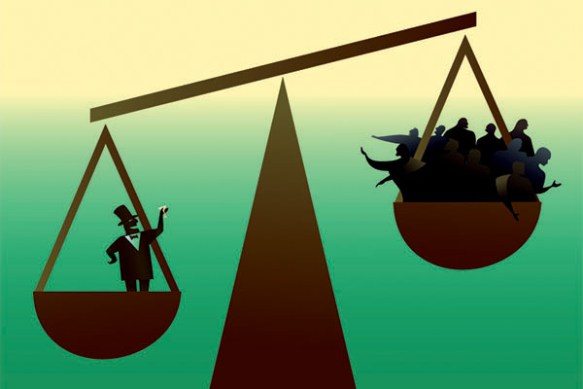
As the animals of Orwell’s farm grew ever less equal, so in the present moment in a country that still claims equal opportunity for its citizens, one in which three Americans now have as much wealth as the bottom half of society (160 million people), you could certainly say that we live in an increasingly Orwellian society. Or perhaps an increasingly Twainian one.

After all, Mark Twain and Charles Dudley Warner wrote a classic 1873 novel that put an unforgettable label on their moment and could do the same for ours. The Gilded Age: A Tale of Today depicted the greed and political corruption of post-Civil War America. Its title caught the spirit of what proved to be a long moment when the uber-rich came to dominate Washington and the rest of America. It was a period saturated with robber barons, professional grifters, and incomprehensibly wealthy banking magnates. (Anything sound familiar?) The main difference between that last century’s gilded moment and this one was that those robber barons built tangible things like railroads. Today’s equivalent crew of the mega-wealthy build remarkably intangible things like tech and electronic platforms, while a grifter of a president opts for the only new infrastructure in sight, a great wall to nowhere.

In Twain’s epoch, the U.S. was emerging from the Civil War. Opportunists were rising from the ashes of the nation’s battered soul. Land speculation, government lobbying, and shady deals soon converged to create an unequal society of the first order (at least until now). Soon after their novel came out, a series of recessions ravaged the country, followed by a 1907 financial panic in New York City caused by a speculator-led copper-market scam.

From the late 1890s on, the most powerful banker on the planet, J.P. Morgan, was called upon multiple times to bail out a country on the economic edge. In 1907, Treasury Secretary George Cortelyou provided him with $25 million in bailout money at the request of President Theodore Roosevelt to stabilize Wall Street and calm frantic citizens trying to withdraw their deposits from banks around the country. And this Morgan did — by helping his friends and their companies, while skimming money off the top himself. As for the most troubled banks holding the savings of ordinary people? Well, they folded. (Shades of the 2007-2008 meltdown and bailout anyone?)

The leading bankers who had received that bounty from the government went on to cause the Crash of 1929. Not surprisingly, much speculation and fraud preceded it. In those years, the novelist F. Scott Fitzgerald caught the era’s spirit of grotesque inequality in The Great Gatsby when one of his characters comments: “Let me tell you about the very rich. They are different from you and me.” The same could certainly be said of today when it comes to the gaping maw between the have-nots and have-a-lots.

Income vs. Wealth

To fully grasp the nature of inequality in our twenty-first-century gilded age, it’s important to understand the difference between wealth and income and what kinds of inequality stem from each. Simply put, income is how much money you make in terms of paid work or any return on investments or assets (or other things you own that have the potential to change in value). Wealth is simply the gross accumulation of those very assets and any return or appreciation on them. The more wealth you have, the easier it is to have a higher annual income.

Let’s break that down. If you earn $31,000 a year, the median salary for an individual in the United States today, your income would be that amount minus associated taxes (including federal, state, social security, and Medicare ones). On average, that means you would be left with about $26,000 before other expenses kicked in.

If your wealth is $1,000,000, however, and you put that into a savings account paying 2.25% interest, you could receive about $22,500 and, after taxes, be left with about $19,000, for doing nothing whatsoever.

To put all this in perspective, the top 1% of Americans now take home, on average, more than 40 times the incomes of the bottom 90%. And if you head for the top 0.1%, those figures only radically worsen. That tiny crew takes home more than 198 times the income of the bottom 90% percent. They also possess as much wealth as the nation’s bottom 90%. “Wealth,” as Adam Smith so classically noted almost two-and-a-half-centuries ago in The Wealth of Nations, “is power,” an adage that seldom, sadly, seems outdated.

A Case Study: Wealth, Inequality, and the Federal Reserve

Obviously, if you inherit wealth in this country, you’re instantly ahead of the game. In America, a third to nearly a half of all wealth is inherited rather than self-made. According to a New York Times investigation, for instance, President Donald Trump, from birth, received an estimated $413 million (in today’s dollars, that is) from his dear old dad and another $140 million (in today’s dollars) in loans. Not a bad way for a “businessman” to begin building the empire (of bankruptcies) that became the platform for a presidential campaign that oozed into actually running the country. Trump did it, in other words, the old-fashioned way — through inheritance.

In his megalomaniacal zeal to declare a national emergency at the southern border, that gilded millionaire-turned-billionaire-turned-president provides but one of many examples of a long record of abusing power. Unfortunately, in this country, few people consider record inequality (which is still growing) as another kind of abuse of power, another kind of great wall, in this case keeping not Central Americans but most U.S. citizens out.

The Federal Reserve, the country’s central bank that dictates the cost of money and that sustained Wall Street in the wake of the financial crisis of 2007-2008 (and since), has finally pointed out that such extreme levels of inequality are bad news for the rest of the country. As Fed Chairman Jerome Powell said at a town hall in Washington in early February, “We want prosperity to be widely shared. We need policies to make that happen.” Sadly, the Fed has largely contributed to increasing the systemic inequality now engrained in the financial and, by extension, political system. In a recent research paper, the Fed did, at least, underscore the consequences of inequality to the economy, showing that “income inequality can generate low aggregate demand, deflation pressure, excessive credit growth, and financial instability.”

In the wake of the global economic meltdown, however, the Fed took it upon itself to reduce the cost of money for big banks by chopping interest rates to zero (before eventually raising them to 2.5%) and buying $4.5 trillion in Treasury and mortgage bonds to lower it further. All this so that banks could ostensibly lend money more easily to Main Street and stimulate the economy. As Senator Bernie Sanders noted though, “The Federal Reserve provided more than $16 trillion in total financial assistance to some of the largest financial institutions and corporations in the United States and throughout the world… a clear case of socialism for the rich and rugged, you’re-on-your-own individualism for everyone else.”

The economy has been treading water ever since (especially compared to the stock market). Annual gross domestic product growth has not surpassed 3%in any year since the financial crisis, even as the level of the stock market tripled, grotesquely increasing the country’s inequality gap. None of this should have been surprising, since much of the excess money went straight to big banks, rich investors, and speculators.  They then used it to invest in the stock and bond markets, but not in things that would matter to all the Americans outside that great wall of wealth.

The question is: Why are inequality and a flawed economic system mutually reinforcing? As a starting point, those able to invest in a stock market buoyed by the Fed’s policies only increased their wealth exponentially. In contrast, those relying on the economy to sustain them via wages and other income got shafted. Most people aren’t, of course, invested in the stock market, or really in anything. They can’t afford to be. It’s important to remember that nearly 80% of the population lives paycheck to paycheck.

The net result: an acute post-financial-crisis increase in wealth inequality — on top of the income inequality that was global but especially true in the United States. The crew in the top 1% that doesn’t rely on salaries to increase their wealth prospered fabulously. They, after all, now own more than half of all national wealth invested in stocks and mutual funds, so a soaring stock market disproportionately helps them. It’s also why the Federal Reserve subsidy policies to Wall Street banks have only added to the extreme wealth of those extreme few.

The Ramifications of Inequality

The list of negatives resulting from such inequality is long indeed. As a start, the only thing the majority of Americans possess a greater proportion of than that top 1% is a mountain of debt.

The bottom 90% are the lucky owners of about three-quarters of the country’s household debt. Mortgages, auto loans, student loans, and credit-card debt are cumulatively at a record-high $13.5 trillion.

And that’s just to start down a slippery slope. As Inequality.org reports, wealth and income inequality impact “everything from life expectancy to infant mortality and obesity.” High economic inequality and poor health, for instance, go hand and hand, or put another way, inequality compromises the overall health of the country. According to academic findings, income inequality is, in the most literal sense, making Americans sick. As one study put it, “Diseased and impoverished economic infrastructures [help] lead to diseased or impoverished or unbalanced bodies or minds.”

Then there’s Social Security, established in 1935 as a federal supplement for those in need who have also paid into the system through a tax on their wages. Today, all workers contribute 6.2% of their annual earnings and employers pay the other 6.2% (up to a cap of $132,900) into the Social Security system. Those making far more than that, specifically millionaires and billionaires, don’t have to pay a dime more on a proportional basis. In practice, that means about 94% of American workers and their employers paid the full 12.4% of their annual earnings toward Social Security, while the other 6% paid an often significantly smaller fraction of their earnings.

According to his own claims about his 2016 income, for instance, President Trump “contributed a mere 0.002 percent of his income to Social Security in 2016.” That means it would take nearly 22,000 additional workers earning the median U.S. salary to make up for what he doesn’t have to pay. And the greater the income inequality in this country, the more money those who make less have to put into the Social Security system on a proportional basis. In recent years, a staggering $1.4 trillion could have gone into that system, if there were no arbitrary payroll cap favoring the wealthy.

Inequality: A Dilemma With Global Implications

America is great at minting millionaires. It has the highest concentration of them, globally speaking, at 41%. (Another 24% of that millionaires’ club can be found in Europe.) And the top 1% of U.S. citizens earn 40 times the national average and own about 38.6% of the country’s total wealth. The highest figure in any other developed country is “only” 28%.

However, while the U.S. boasts of epic levels of inequality, it’s also a global trend. Consider this: the world’s richest 1% own 45% of total wealth on this planet. In contrast, 64% of the population (with an average of $10,000 in wealth to their name) holds less than 2%. And to widen the inequality picture a bit more, the world’s richest 10%, those having at least $100,000 in assets, own 84% of total global wealth.

The billionaires’ club is where it’s really at, though. According to Oxfam, the richest 42 billionaires have a combined wealth equal to that of the poorest 50% of humanity. Rest assured, however, that in this gilded century there’s inequality even among billionaires. After all, the 10 richest among them possess $745 billion in total global wealth. The next 10 down the list possess a mere $451.5 billion, and why even bother tallying the next 10 when you get the picture?

Oxfam also recently reported that “the number of billionaires has almost doubled, with a new billionaire created every two days between 2017 and 2018. They have now more wealth than ever before while almost half of humanity have barely escaped extreme poverty, living on less than $5.50 a day.”

How Does It End?

In sum, the rich are only getting richer and it’s happening at a historic rate. Worse yet, over the past decade, there was an extra perk for the truly wealthy. They could bulk up on assets that had been devalued due to the financial crisis, while so many of their peers on the other side of that great wall of wealth were economically decimated by the 2007-2008 meltdown and have yet to fully recover.

What we’ve seen ever since is how money just keeps flowing upward through banks and massive speculation, while the economic lives of those not at the top of the financial food chain have largely remained stagnant or worse. The result is, of course, sweeping inequality of a kind that, in much of the last century, might have seemed inconceivable.

Eventually, we will all have to face the black cloud this throws over the entire economy. Real people in the real world, those not at the top, have experienced a decade of ever greater instability, while the inequality gap of this beyond-gilded age is sure to shape a truly messy world ahead. In other words, this can’t end well.


Nomi Prins, a former Wall Street executive, is a TomDispatch regular. Her latest book is Collusion: How Central Bankers Rigged the World (Nation Books). She is also the author of All the Presidents’ Bankers: The Hidden Alliances That Drive American Power and five other books. Special thanks go to researcher Craig Wilson for his superb work on this piece.
Wall Street, Banks, and Angry Citizens

The Inequality Gap on a Planet Growing More Extreme

By Nomi Prins

Source: TomDispatch.com

As we head into 2019, leaving the chaos of this year behind, a major question remains unanswered when it comes to the state of Main Street, not just here but across the planet. If the global economy really is booming, as many politicians claim, why are leaders and their parties around the world continuing to get booted out of office in such a sweeping fashion?

One obvious answer: the post-Great Recession economic “recovery” was largely reserved for the few who could participate in the rising financial markets of those years, not the majority who continued to work longer hours, sometimes at multiple jobs, to stay afloat. In other words, the good times have left out so many people, like those struggling to keep even a few hundred dollars in their bank accounts to cover an emergency or the 80% of American workers who live paycheck to paycheck.

In today’s global economy, financial security is increasingly the property of the 1%. No surprise, then, that, as a sense of economic instability continued to grow over the past decade, angst turned to anger, a transition that — from the U.S. to the Philippines, Hungary to Brazil, Poland to Mexico — has provoked a plethora of voter upheavals. In the process, a 1930s-style brew of rising nationalism and blaming the “other” — whether that other was an immigrant, a religious group, a country, or the rest of the world — emerged.

This phenomenon offered a series of Trumpian figures, including of course The Donald himself, an opening to ride a wave of “populism” to the heights of the political system. That the backgrounds and records of none of them — whether you’re talking about Donald Trump, Viktor Orbán, Rodrigo Duterte, or Jair Bolsonaro (among others) — reflected the daily concerns of the “common people,” as the classic definition of populism might have it, hardly mattered. Even a billionaire could, it turned out, exploit economic insecurity effectively and use it to rise to ultimate power.

Ironically, as that American master at evoking the fears of apprentices everywhere showed, to assume the highest office in the land was only to begin a process of creating yet more fear and insecurity. Trump’s trade wars, for instance, have typically infused the world with increased anxiety and distrust toward the U.S., even as they thwarted the ability of domestic business leaders and ordinary people to plan for the future. Meanwhile, just under the surface of the reputed good times, the damage to that future only intensified. In other words, the groundwork has already been laid for what could be a frightening transformation, both domestically and globally.

That Old Financial Crisis

To understand how we got here, let’s take a step back. Only a decade ago, the world experienced a genuine global financial crisis, a meltdown of the first order. Economic growth ended; shrinking economies threatened to collapse; countless jobs were cut; homes were foreclosed upon and lives wrecked. For regular people, access to credit suddenly disappeared. No wonder fears rose. No wonder for so many a brighter tomorrow ceased to exist.

The details of just why the Great Recession happened have since been glossed over by time and partisan spin. This September, when the 10th anniversary of the collapse of the global financial services firm Lehman Brothers came around, major business news channels considered whether the world might be at risk of another such crisis. However, coverage of such fears, like so many other topics, was quickly tossed aside in favor of paying yet more attention to Donald Trump’s latest tweets, complaints, insults, and lies. Why? Because such a crisis was so 2008 in a year in which, it was claimed, we were enjoying a first class economic high and edging toward the longest bull-market in Wall Street history. When it came to “boom versus gloom,” boom won hands down.

None of that changed one thing, though: most people still feel left behind both in the U.S. and globally. Thanks to the massive accumulation of wealth by a 1% skilled at gaming the system, the roots of a crisis that didn’t end with the end of the Great Recession have spread across the planet, while the dividing line between the “have-nots” and the “have-a-lots” only sharpened and widened.

Though the media hasn’t been paying much attention to the resulting inequality, the statistics (when you see them) on that ever-widening wealth gap are mind-boggling. According to Inequality.org, for instance, those with at least $30 million in wealth globally had the fastest growth rate of any group between 2016 and 2017. The size of that club rose by 25.5% during those years, to 174,800 members. Or if you really want to grasp what’s been happening, consider that, between 2009 and 2017, the number of billionaires whose combined wealth was greater than that of the world’s poorest 50% fell from 380 to just eight. And by the way, despite claims by the president that every other country is screwing America, the U.S. leads the pack when it comes to the growth of inequality. As Inequality.org notes, it has “much greater shares of national wealth and income going to the richest 1% than any other country.”

That, in part, is due to an institution many in the U.S. normally pay little attention to: the U.S. central bank, the Federal Reserve. It helped spark that increase in wealth disparity domestically and globally by adopting a post-crisis monetary policy in which electronically fabricated money (via a program called quantitative easing, or QE) was offered to banks and corporations at significantly cheaper rates than to ordinary Americans.

Pumped into financial markets, that money sent stock prices soaring, which naturally ballooned the wealth of the small percentage of the population that actually owned stocks. According to economist Stephen Roach, considering the Fed’s Survey of Consumer Finances, “It is hardly a stretch to conclude that QE exacerbated America’s already severe income disparities.”

Wall Street, Central Banks, and Everyday People

What has since taken place around the world seems right out of the 1930s. At that time, as the world was emerging from the Great Depression, a sense of broad economic security was slow to return. Instead, fascism and other forms of nationalism only gained steam as people turned on the usual cast of politicians, on other countries, and on each other. (If that sounds faintly Trumpian to you, it should.)

In our post-2008 era, people have witnessed trillions of dollars flowing into bank bailouts and other financial subsidies, not just from governments but from the world’s major central banks. Theoretically, private banks, as a result, would have more money and pay less interest to get it. They would then lend that money to Main Street. Businesses, big and small, would tap into those funds and, in turn, produce real economic growth through expansion, hiring sprees, and wage increases. People would then have more dollars in their pockets and, feeling more financially secure, would spend that money driving the economy to new heights — and all, of course, would then be well.

That fairy tale was pitched around the globe. In fact, cheap money also pushed debt to epic levels, while the share prices of banks rose, as did those of all sorts of other firms, to record-shattering heights.

Even in the U.S., however, where a magnificent recovery was supposed to have been in place for years, actual economic growth simply didn’t materialize at the levels promised. At 2% per year, the average growth of the American gross domestic product over the past decade, for instance, has been half the average of 4% before the 2008 crisis. Similar numbers were repeated throughout the developed world and most emerging markets. In the meantime, total global debt hit $247 trillion in the first quarter of 2018. As the Institute of International Finance found, countries were, on average, borrowing about three dollars for every dollar of goods or services created.

Global Consequences

What the Fed (along with central banks from Europe to Japan) ignited, in fact, was a disproportionate rise in the stock and bond markets with the money they created. That capital sought higher and faster returns than could be achieved in crucial infrastructure or social strengthening projects like building roads, high-speed railways, hospitals, or schools.

What followed was anything but fair. As former Federal Reserve Chair Janet Yellen noted four years ago, “It is no secret that the past few decades of widening inequality can be summed up as significant income and wealth gains for those at the very top and stagnant living standards for the majority.” And, of course, continuing to pour money into the highest levels of the private banking system was anything but a formula for walking that back.

Instead, as more citizens fell behind, a sense of disenfranchisement and bitterness with existing governments only grew. In the U.S., that meant Donald Trump. In the United Kingdom, similar discontent was reflected in the June 2016 Brexit vote to leave the European Union (EU), which those who felt economically squeezed to death clearly meant as a slap at both the establishment domestically and EU leaders abroad.

Since then, multiple governments in the European Union, too, have shifted toward the populist right. In Germany, recent elections swung both right and left just six years after, in July 2012, European Central Bank (ECB) head Mario Draghi exuded optimism over the ability of such banks to protect the financial system, the Euro, and generally hold things together.

Like the Fed in the U.S., the ECB went on to manufacture money, adding another $3 trillion to its books that would be deployed to buy bonds from favored countries and companies. That artificial stimulus, too, only increased inequality within and between countries in Europe. Meanwhile, Brexit negotiations remain ruinously divisive, threatening to rip Great Britain apart.

Nor was such a story the captive of the North Atlantic. In Brazil, where left-wing president Dilma Rouseff was ousted from power in 2016, her successor Michel Temer oversaw plummeting economic growth and escalating unemployment. That, in turn, led to the election of that country’s own Donald Trump, nationalistic far-right candidate Jair Bolsonaro who won a striking 55.2% of the vote against a backdrop of popular discontent. In true Trumpian style, he is disposed against both the very idea of climate change and multilateral trade agreements.

In Mexico, dissatisfied voters similarly rejected the political known, but by swinging left for the first time in 70 years. New president Andrés Manuel López Obrador, popularly known by his initials AMLO, promised to put the needs of ordinary Mexicans first. However, he has the U.S. — and the whims of Donald Trump and his “great wall” — to contend with, which could hamper those efforts.

As AMLO took office on December 1st, the G20 summit of world leaders was unfolding in Argentina. There, amid a glittering backdrop of power and influence, the trade war between the U.S. and the world’s rising superpower, China, came even more clearly into focus. While its president, Xi Jinping, having fully consolidated power amid a wave of Chinese nationalism, could become his country’s longest serving leader, he faces an international landscape that would have amazed and befuddled Mao Zedong.

Though Trump declared his meeting with Xi a success because the two sides agreed on a 90-day tariff truce, his prompt appointment of an anti-Chinese hardliner, Robert Lighthizer, to head negotiations, a tweet in which he referred to himself in superhero fashion as a “Tariff Man,” and news that the U.S. had requested that Canada arrest and extradite an executive of a key Chinese tech company, caused the Dow to take its fourth largest plunge in history and then fluctuate wildly as economic fears of a future “Great Something” rose. More uncertainty and distrust were the true product of that meeting.

In fact, we are now in a world whose key leaders, especially the president of the United States, remain willfully oblivious to its long-term problems, putting policies like deregulation, fake nationalist solutions, and profits for the already grotesquely wealthy ahead of the future lives of the mass of citizens. Consider the yellow-vest protests that have broken out in France, where protestors identifying with left and right political parties are calling for the resignation of neoliberal French President Emmanuel Macron. Many of them, from financially starved provincial towns, are angry that their purchasing power has dropped so low they can barely make ends meet.

Ultimately, what transcends geography and geopolitics is an underlying level of economic discontent sparked by twenty-first-century economics and a resulting Grand Canyon-sized global inequality gap that is still widening. Whether the protests go left or right, what continues to lie at the heart of the matter is the way failed policies and stop-gap measures put in place around the world are no longer working, not when it comes to the non-1% anyway. People from Washington to Paris, London to Beijing, increasingly grasp that their economic circumstances are not getting better and are not likely to in any presently imaginable future, given those now in power.

A Dangerous Recipe

The financial crisis of 2008 initially fostered a policy of bailing out banks with cheap money that went not into Main Street economies but into markets enriching the few. As a result, large numbers of people increasingly felt that they were being left behind and so turned against their leaders and sometimes each other as well.

This situation was then exploited by a set of self-appointed politicians of the people, including a billionaire TV personality who capitalized on an increasingly widespread fear of a future at risk. Their promises of economic prosperity were wrapped in populist platitudes, normally (but not always) of a right-wing sort. Lost in this shift away from previously dominant political parties and the systems that went with them was a true form of populism, which would genuinely put the needs of the majority of people over the elite few, build real things including infrastructure, foster organic wealth distribution, and stabilize economies above financial markets.

In the meantime, what we have is, of course, a recipe for an increasingly unstable and vicious world.

Conjuring Up the Next Depression

By Chris Hedges

Source: TruthDig

During the financial crisis of 2008, the world’s central banks, including the Federal Reserve, injected trillions of dollars of fabricated money into the global financial system. This fabricated money has created a worldwide debt of $325 trillion, more than three times global GDP. The fabricated money was hoarded by banks and corporations, loaned by banks at predatory interest rates, used to service interest on unpayable debt or spent buying back stock, providing millions in compensation for elites. The fabricated money was not invested in the real economy. Products were not manufactured and sold. Workers were not reinstated into the middle class with sustainable incomes, benefits and pensions. Infrastructure projects were not undertaken. The fabricated money reinflated massive financial bubbles built on debt and papered over a fatally diseased financial system destined for collapse.

What will trigger the next crash? The $13.2 trillion in unsustainable U.S. household debt? The $1.5 trillion in unsustainable student debt? The billions Wall Street has invested in a fracking industry that has spent $280 billion more than it generated from its operations? Who knows. What is certain is that a global financial crash, one that will dwarf the meltdown of 2008, is inevitable. And this time, with interest rates near zero, the elites have no escape plan. The financial structure will disintegrate. The global economy will go into a death spiral. The rage of a betrayed and impoverished population will, I fear, further empower right-wing demagogues who promise vengeance on the global elites, moral renewal, a nativist revival heralding a return to a mythical golden age when immigrants, women and people of color knew their place, and a Christianized fascism.

The 2008 financial crisis, as the economist Nomi Prins points out, “converted central banks into a new class of power brokers.” They looted national treasuries and amassed trillions in wealth to become politically and economically omnipotent. In her book “Collusion: How Central Bankers Rigged the World,” she writes that central bankers and the world’s largest financial institutions fraudulently manipulate global markets and use fabricated, or as she writes, “fake money,” to inflate asset bubbles for short-term profit as they drive us toward “a dangerous financial precipice.”

“Before the crisis, they were just asleep at the wheel, in particular, the Federal Reserve of the United States, which is supposed to be the main regulator of the major banks in the United States,” Prins said when we met in New York. “It did a horrible job of doing that, which is why we had the financial crisis. It became a deregulator instead of a regulator. In the wake of the financial crisis, the solution to fixing the crisis and saving the economy from a great depression or recession, whatever the terminology that was used at any given time, was to fabricate trillions and trillions of dollars out of an electronic ether.”

The Federal Reserve handed over an estimated $29 trillion of this fabricated money to American banks, according to researchers at the University of MissouriTwenty-nine trillion dollars! We could have provided free college tuition to every student or universal health care, repaired our crumbling infrastructure, transitioned to clean energy, forgiven student debt, raised wages, bailed out underwater homeowners, formed public banks to invest at low interest rates in our communities, provided a guaranteed minimum income for everyone and organized a massive jobs program for the unemployed and underemployed. Sixteen million children would not go to bed hungry. The mentally ill and the homeless—an estimated 553,742 Americans are homeless every night—would not be left on the streets or locked away in our prisons. The economy would revive. Instead, $29 trillion in fabricated money was handed to financial gangsters who are about to make most of it evaporate and plunge us into a depression that will rival that of the global crash of 1929.

Kevin Zeese and Margaret Flowers write on the website Popular Resistance, “One-sixth of this could provide a $12,000 annual basic income, which would cost $3.8 trillion annually, doubling Social Security payments to $22,000 annually, which would cost $662 billion, a $10,000 bonus for all U.S. public school teachers, which would cost $11 billion, free college for all high school graduates, which would cost $318 billion, and universal preschool, which would cost $38 billion. National improved Medicare for all would actually save the nation trillions of dollars over a decade.”

An emergency clause in the Federal Reserve Act of 1913 allows the Fed to provide liquidity to a distressed banking system. But the Federal Reserve did not stop with the creation of a few hundred billion dollars. It flooded the financial markets with absurd levels of fabricated money. This had the effect of making the economy appear as if it had revived. And for the oligarchs, who had access to this fabricated money while we did not, it did.

The Fed cut interest rates to near zero. Some central banks in Europe instituted negative interest rates, meaning they would pay borrowers to take loans. The Fed, in a clever bit of accounting, even permitted distressed banks to use these no-interest loans to buy U.S. Treasury bonds. The banks gave the bonds back to the Fed and received a quarter of a percent of interest from the Fed. In short, the banks were loaned money at virtually no interest by the Fed and then were paid interest by the Fed on the money they borrowed. The Fed also bought up worthless mortgage assets and other toxic assets from the banks. Since Fed authorities could fabricate as much money as they wanted, it did not matter how they spent it.

“It’s like going to someone’s old garage sale and saying, ‘I want that bicycle with no wheels. I’ll pay you 100 grand for it. Why? Because it’s not my money,’ ” Prins said.

“These people have rigged the system,” she said of the bankers. “There is money fabricated at the top. It is used to pump up financial assets, including stock. It has to come from somewhere. Because money is cheap there’s more borrowing at the corporate level. There’s more money borrowed at the government level.”

“Where do you go to repay it?” she asked. “You go into the nation. You go into the economy. You extract money from the foundational economy, from social programs. You impose austerity.”

Given the staggering amount of fabricated money that has to be repaid, the banks need to build greater and greater pools of debt. This is why when you are late in paying your credit card the interest rate jumps to 28 percent. This is why if you declare bankruptcy you are still responsible for paying off your student loan, even as 1 million people a year default on student loans, with 40 percent of all borrowers expected to default on student loans by 2023. This is why wages are stagnant or have declined while costs, from health care and pharmaceutical products to bank fees and basic utilities, are skyrocketing. The enforced debt peonage grows to feed the beast until, as with the subprime mortgage crisis, the predatory system fails because of massive defaults. There will come a day, for example, as with all financial bubbles, when the wildly optimistic projected profits of industries such as fracking will no longer be an effective excuse to keep pumping money into failing businesses burdened by debt they cannot repay.

“The 60 biggest exploration and production firms are not generating enough cash from their operations to cover their operating and capital expenses,” Bethany McLean writes of the fracking industry in an articletitled “The Next Financial Crisis Lurks Underground” that appeared in The New York Times. “In aggregate, from mid-2012 to mid-2017, they had negative free cash flow of $9 billion per quarter.”

The global financial system is a ticking time bomb. The question is not if it will explode but when it will explode. And once it does, the inability of the global speculators to use fabricated money with zero interest to paper over the debacle will trigger massive unemployment, high prices for imports and basic services, and a devaluation in which the dollar will become nearly worthless as it is abandoned as the world’s reserve currency. This manufactured financial tsunami will transform the United States, already a failed democracy, into an authoritarian police state. Life will become very cheap, especially for the vulnerable—undocumented workers, Muslims, poor people of color, girls and women, anti-capitalist and anti-imperialist critics branded as agents of  foreign powers—who will be demonized and persecuted for the collapse. The elites, in a desperate bid to cling to their unchecked power and obscene wealth, will disembowel what is left of the United States.

America’s Debt Dependence Makes It An Easy Economic Target

By Brandon Smith

Source: Alt-Market.com

There is a classic denial tactic that many people use when confronted with negative facts about a subject they have a personal attachment to; I would call it “deferral denial” — or a psychological postponing of reality.

For example, point out the fundamentals on the U.S. economy such as the fact that unemployment is not below 4% as official numbers suggest, but actually closer to 20% when you factor in U-6 measurements including the record 96 million people not counted because they have run out of unemployment benefits. Or point out that true consumer inflation in the U.S. is not around 3% as the Federal Reserve and the Bureau of Labor Statistics claims, but closer to 10% according to the way CPI used to be calculated before the government started rigging the numbers.  For a large part of the public including a lot of economic analysts, there is perhaps a momentary acceptance of the danger, but then an immediate deferral — “Well, maybe things will get worse down the road, 10 or 20 years from now, but it’s not that bad today…”

This is cognitive dissonance at its finest. The economy is in steep decline now, but the mind in denial says “it could be worse,” and this is how you get entire populations caught completely off guard by a financial crash. They could have easily seen the signs, but they desperately wanted to believe that all bad things happen in some illusory future, not today.

There is also another denial tactic I see often in the world of politics and economics, which is what I call “paying it backward.” This is what people do when they have a biased attachment to a person or institution and refuse to see the terrible implications of their actions. For example, when we point out that someone like Donald Trump makes destructive decisions, such as the continued support of Israel and Saudi Arabia in Syria and Yemen, or the reinstatement of funding for the White Helmets in Syria who are tied to ISIS, Trump supporters will often say “Well what about Obama?”

This is a game of shifting accountability. Is one person worse than the other? Possibly. I say give it time and make notes. However, the negative decisions of one politician we don’t like do not diminish the negative decisions of another politician we might like. They should BOTH be held accountable.

The same goes for countries and economies. When an analyst points out that U.S. debt is at historic highs and is utterly unsustainable, people in denial will say “but what about China or Europe?” One does not negate the other and, of course, there are differences that make the situation in the U.S. far more tenuous.

Primarily I am talking about America’s endless dependency on the world reserve status of the U.S. dollar and, beyond that, the steady expansion of debt at low interest rates for the past decade.

The Federal Reserve, once the No. 1 buyer of U.S. debt, has essentially declared it is cutting off support and has begun dumping assets from its balance sheet. The only assets the Fed seems to be maintaining are Mortgage Backed Securities (MBS). All others are being cut, including Treasuries. The American economy is inexorably attached to the idea of our Treasury debt as a safe investment, with our national debt spiking above $21 trillion and many trillions more owed to entitlement programs depending on how you calculate the expenditures, there is a vital need for steady foreign investment in U.S. debt.

But what happens when investment in U.S. debt becomes politically unsavory? Consider the current escalation of the trade war; Many pro-dollar talking heads and cheerleaders have argued in the past that no nation has the guts to dump dollar denominated assets and risk the wrath of American “economic might.” But, already we have seen Russia dump half its U.S. Treasury holdings in a single month and the trade war has only just begun.

Is Russia’s action a sign of things to come? Will other nations like China follow the same strategy? We will have to wait and see, but I believe this is the inevitable outcome of the trade war if it drags on for the rest of the year.

America’s dependent nature, feeding off of foreign investment to support its debts, is a disaster waiting to happen. The concept of economic “recovery” is laughable until this issue is addressed.  And, entering into a trade war while ignoring this blaring weakness is foolish, to say the least.

Beyond the issue of government (taxpayer) debt, let’s not forget about American corporations and consumers. U.S. corporate debt as a percentage of gross domestic product is at historic highs not seen since the housing bubble of 2008 or the dot-com bubble of 2001. There is a distinct difference, though, that makes today’s bubble far more insidious. After years of near-zero interest rates, corporations have become addicted to cheap debt. So much so that they have been borrowing nonstop to support their own stock prices through stock buyback manipulation. But now the Fed is raising interest rates and has committed to expanded hikes in the future.

So, what will corporations do as the cheap debt dries up? Thus far, they are spending the majority of their Trump tax cut still trying to artificially prop up stock process. When this money runs out (and I believe it will much faster than the mainstream thinks), the existing debt of these companies will cost much more to finance, and future borrowing at the same pace will become impossible. This is a threat that is developing now, not in some far-off future.

Eventually, corporations will have to make deep spending cuts rather than borrow. This means mass layoffs, store closures and potential cuts to pensions. And, of course, no more stock buybacks, meaning a market crash will ensue.

What about the U.S. consumer? U.S. consumer debt is set to reach new highs by the end of the year; around $4 trillion by official estimates.  While discussion continues about the alleged “labor shortage” in the U.S., one thing is clear — the jobs that do exist do NOT pay wages that keep up with true inflation. When we see spikes in retail sales in the U.S. and this is applauded as economy recovery, very few mainstream analysts point out that higher retail sales are merely tracking higher inflation.

That is to say, consumers are spending more money on less stuff. Again, this is unsustainable, which is why consumer debt is exploding. Dependency on credit cards and loans is being used by the public to offset much higher costs. But as the Fed raises interest rates, this too will end. Higher Fed rates translate to higher credit rates as well as higher mortgage rates (indirectly). With higher interest payments comes a large drop in overall spending.

As you can see, there are at least two forces at work here that will end all talk of U.S. recovery and which undermine any notion of economic strength — the first is the trade war, which I believe is a massive distraction designed to draw attention away from the actions of international banks and central banks. The second is the Federal Reserve, which has addicted the country to cheap fiat and is now flushing the drugs. We cannot delude ourselves into thinking that this trend will remain slow or that it will not develop into a crash in the near term. We also cannot simply deflect to other countries like China or those in Europe as if their problems are somehow worse and therefore ours are not a concern.

The fact that the health of the US economy is inexorably reliant on the continued foreign demand for the dollar and Treasury debt means any reduction of the dollar’s world reserve status or petro-status, or any decline in treasury purchases, will directly affect the carefully crafted image of America as a stable system.  Without a sudden and aggressive resurgence of domestic production and innovation America has no safety net in the event that our debt addiction is used against us.

The argument that the central bank can jump in at any time to monetize that debt and reduce the danger is also delusional.  This assumes first and foremost that the Fed WANTS to reduce the danger.  I believe they want the danger to increase, not decrease.  Debt monetization also has the added bonus of causing even more inflation as foreign investors dump their dollar denominated assets back into the US.  Monetization is a poison, not a cure.

The crisis is here, now. Seeing and accepting it allows us to prepare accordingly. Denying it as inconsequential sets people up as victims of their own bias and ignorance.

Jeff Bezos’ Paper Tells You Not to Worry About Those Billionaires

By Dean Baker

Source: FAIR

Just when you thought economic commentary in the Washington Post couldn’t get any more insipid, Roger Lowenstein proves otherwise. In a business section “perspective” (7/20/18), he tells readers:

But what if inequality is the wrong metric. Herewith a modest proposition: economic inequality is not the best yardstick. What we should be paying attention to is social mobility.

Wow, what a novel idea, as though right-wingers have not been pushing this line since the dawn of time: “Don’t worry that your standard of living is awful, the important thing is that your kids will be able to get rich.” (It doesn’t help his story that his poster child for the rich being good is Lloyd Blankfein, who made his fortune shuffling financial assets at Goldman Sachs, and benefited from a massive government bailout.)

But let’s be generous, and try to take Lowenstein’s story seriously. He goes on: “Rising inequality, although a fact, is also very hard to find a culprit for. Not that economists haven’t tried.”

Really? There are plenty of really good explanations for rising inequality, many of which are in my (free) book Rigged. I suppose in the Age of Trump, it is appropriate that the Post has a business columnist determined to flaunt his ignorance.

But then we get the real payday:

It’s also far from proved—to me, it’s not even intuitive—that high incomes on Wall Street and elsewhere are the reason for, say, flatter wages in manufacturing. The fact that Mark Zuckerberg is so rich is annoying, and his separateness from Main Street may not be a great thing socially, but in an economic sense, his fortune did not “come from” the paychecks of ordinary workers.

OK, let’s explain this one so that even someone profoundly ignorant of economics can understand. Suppose that someone, we’ll call them Jeff Bezos or Mark Zuckerberg, were really good at printing counterfeit bills. Imagine that they printed up trillions of these counterfeit bills. This would make them incredibly rich, if they could get away with it. But, as Lowenstein says, how does this make anyone else worse off?

While Lowenstein doesn’t see any problem with our incredibly rich counterfeiters, in the real world, we have the problem that they are creating demand for goods and services with their consumption. If the economy is below full employment, this would be good news, since any source of demand will generate more output and jobs. However, if we are near full employment, or the Federal Reserve Board thinks we are near full employment, then this demand comes at the expense of the paychecks of ordinary workers.

Prices like house prices and rents are driven up by our counterfeiters and the demand created by their servants. The Fed raises interest rates to slow growth and employment, and lessen the ability of ordinary workers to get pay increases, since the labor market will be weaker.

Now, folks may object that Bezos and Zuckerberg are not like counterfeiters; they actually generate value for the economy. While this undoubtedly partly true, it is also the case that much of Bezos’ wealth came from avoiding the requirement that retailers collect state and local sales taxes. Zuckerberg’s wealth came from control of a monopoly platform, and Blankfein’s wealth came from running a too-big-to-fail institution with friends in high places.

Insofar as people get incredibly wealthy from being successful in earning rents at the expense of others in the economy, rather than generating wealth, they are very much like counterfeiters. Furthermore, since productivity has been growing at an incredibly slow rate for the last dozen years (just over 1.0 percent annually), it seems in aggregate that these incredibly rich folks are much better at generating wealth for themselves than for the economy as a whole. This makes the rent-seeker story look very plausible.

While Lowenstein’s plea for greater mobility is about as old as capitalism and has been incredibly unsuccessful, let me propose something considerably more original that you probably won’t see in the Washington Post. Since we have so completely bombed at providing anything like equal opportunity, and no serious person can think this is about to change in the decades ahead, how about we structure our economy so that it makes less difference whether someone ends up at the top end, like Jeff Bezos, or at the bottom, earning the minimum wage?

That one is almost certainly far too simple for the great minds to ever consider.

USA in a Debt Trap Death Spiral

By F. William Engdahl

Source: New Eastern Outlook

The US economy and its financial structures have never recovered from the great financial meltdown of 2008 despite the passage of ten years. Little discussion has been given to the fact that the Republican Congress last year abandoned the process of mandatory budget cuts or automatic sequestration that had been voted in a feeble attempt to rein in the dramatic rise in US government debt. That was merely an added factor in what soon will be recognized as a classic debt trap. What is now looming over not just the US economy but also the global financial system is a crisis that could spell the end of the post-1944 dollar system.

First some basic background. When President Nixon, on advice of Paul Volcker, then at US Treasury, announced on August 15, 1971 the unilateral end of the Bretton Woods gold-dollar system, to replace it with a floating dollar, Washington economists and Wall Street bankers realized that the unique role of the US dollar as leading reserve currency held by all central banks and the currency for world commodity and other trade, especially oil, gave them something that appeared to be a gift from monetary heaven.

So long as the world needed US dollars, Washington could run government deficits without end. Foreign central banks, especially the Bank of Japan in the 1980’s and since the turn of the century, the Peoples’ Bank of China, would have little choice but to reinvest their surplus trade dollar earnings in interest-bearing AAA-rated US Treasury securities. This perverse dollar system allowed Washington to finance its wars in faraway places like Afghanistan or Iraq with other peoples’ money. During the Administration of George W. Bush, when Washington’s annual budget deficit exceeded annually one trillion dollars, Vice President Dick Cheney cynically quipped, “debt doesn’t matter; Reagan proved that.” Up to a point that appeared so. Now we are getting dangerously near to that “point” where debt does matter.

Federal Debt Rise

There are generally speaking three major divisions of debt measured in the US economy: Federal debt of Washington, corporate debt and private household debt. Today, owing in large part to ten years of historic low interest rates following the largest financial crisis in history–the 2007-2008 sub-prime crisis that became a global systemic crisis after September 2008–all three sectors have borrowed as if there was no tomorrow because of the near-zero Federal Reserve interest rates and their various Quantitative Easings. Nothing so radical can last forever.

Since the financial crisis erupted in 2008 US Federal debt has more than doubled from $10 trillion to over $21 trillion today. Yet conditions were made manageable by a Federal Reserve emergency policy that dealt with the financial and banking crisis by buying almost $500 billion annually of that debt. Much of the remainder was bought by China, Japan and even Russia and Saudi Arabia. Further debt levels were restrained by the bipartisan spending caps established in the Budget Control Act of 2011 that had kept recent deficits partially in check.

Now conditions of future US Federal debt and deficit growth are pre-programmed for systemic crisis over the next several years.

‘Trumponomics’ Disaster

The economics of the Trump Tax Cuts Act of 2017, signed in December, dramatically cut certain taxes on business corporations from 35% to 21%, but did not offset that with revenue increases elsewhere. The promise is that cheaper taxes will spur economic growth. This is a myth under present economic conditions and overall public and private debt burdens. Instead, the new tax law, assuming ideal economic conditions, will decrease expected revenues by a total of $1 trillion over the next 10 years. If the economy goes into severe recession, highly likely, tax revenues will plunge and the deficits will explode even more.

What the new Trump tax cut act will do is dramatically increase the size of the US annual budget deficit. The Congressional Budget Office estimates that as early as Fiscal Year 2019 the annual deficit that must be financed by debt will reach $1 trillion. Then the Treasury Borrowing Advisory Committee expects government debt issues of $ 955 billion for FY2018, compared with $ 519 billion in FY 2017. Then for FY 2019 and 2020 the deficit will exceed $1 trillion. By 2028, ten years from now, under mild economic assumptions, the size of the USA Federal debt will rise to an untenable $34 trillion from roughly $21 trillion today, and the deficit in 2028 will exceed $1.5 trillion. And this year 2018 alone, with historically low interest rates the cost of interest only on the total Federal debt will reach $500 billion.

Zombie borrowers…time bombs

Now after almost a decade of unprecedented low interest rates to bail out Wall Street and create new asset inflation in stocks, bonds and housing, the Fed is in the early stages of what some call QT or Quantitative Tightening. Interest rates are rising and have been for the past year, so far very gradually as the Fed is being cautious. The Fed however is continuing to raise rates, and now the Fed Funds stands at 1.75% after nearly ten years at effectively zero. Were they to stop now it would signal a market panic that the Fed knew something far worse than they say.

Because never in its history has the Federal Reserve indulged in such a monetary experiment with so low rates so long, the effects of reversing are going to be as well unprecedented. At the onset of the 2008 financial crisis the Fed rates were around 5%. That is what the Fed is aiming at to return to “normal.” However, with rising interest rates, the lowest credit sector, so-called non-investment grade or “junk bonds” face domino style defaults.

Moody’s Credit Rating has just issued a warning that, barring some sort of miracle, as US interest rates rise, and they are, as much as 22% of US corporations that are being kept alive borrowing at historically low interest, not only in shale oil but in construction and utilities, so-called “zombie” corporations, will face an avalanche of mass defaults on their debt. Moody’s writes that, “low interest rates and investor appetite for yield has pushed companies into issuing mounds of debt that offer comparatively low levels of protection for investors.” The Moody’s report goes on to state some alarming numbers: since 2009, the level of global non-financial junk-rated companies has soared by 58%, representing $3.7 trillion in outstanding debt, the highest ever. Some 40%, or $2 trillion, are rated B1 or lower. Since 2009, US corporate debt has increased by 49%, hitting a record total of $8.8 trillion. Much of that debt has been used to fund stock repurchases by the companies to boost their stock price, the main reason for the unprecedented Wall Street stock market bubble.

Fully 75% of federal spending is economically non-productive including military, debt service, social security. Unlike during the 1930s Great Depression when levels of Federal debt were almost nil, today the debt is 105% of GDP and rising. Spending on national economic infrastructure including the Tennessee Valley Authority and a network of federally-build dams and other infrastructure resulted in the great economic boom of the 1950s. Spending $1.5 trillion on a dysfunctional F-35 all-purpose fighter jet program won’t do it.

Into this precarious situation Washington is doing its very best to antagonize the very countries that it needs to finance these deficits and buy the US debt—China, Russia and even Japan. As financial investors demand more interest to invest in US debt, the higher rates will trigger the default avalanche Moody’s warns. This is the real backdrop to the dangerous US foreign policy actions of the recent period. No one in Washington seems to care and that’s the alarming fact.

The Bayer-Monsanto Merger Is Bad News for the Planet

By Ellen Brown

Source: Truthdig

Two new studies from Europe show that the number of birds in agricultural areas of France has crashed by a third in just 15 years, with some species being almost eradicated. The collapse in the bird population mirrors the discovery last October that more than three quarters of all flying insects in Germany have vanished in just three decades. Insects are the staple food source of birds, the pollinators of fruits and the aerators of the soil.

The chief suspect in this mass extinction is the aggressive use of neonicotinoid pesticides, particularly imidacloprid and clothianidin, both made by the Germany-based chemical giant Bayer. These pesticides, along with toxic glyphosate herbicides such as Roundup, have delivered a one-two punch to monarch butterflies, honeybees and birds. But rather than banning these toxic chemicals, on March 21 the EU approved the $66 billion merger of Bayer and Monsanto, the U.S. agribusiness giant that produces Roundup and the genetically modified (GMO) seeds that have reduced seed diversity globally. The merger will make the Bayer-Monsanto conglomerate the largest seed and pesticide company in the world, giving it enormous power to control farm practices, putting private profits over the public interest.

As Massachusetts Sen. Elizabeth Warren noted in a speech in December at the Open Markets Institute, massive companies are merging into market-dominating entities that invest a share of their profits in lobbying and financing political campaigns, shaping the political system to their own ends. She called on the Trump administration to veto the Bayer-Monsanto merger, which is still under antitrust scrutiny and has yet to be approved in the U.S.

A 2016 survey of Trump’s voter base found that more than half disapproved of the Monsanto-Bayer merger, fearing it would result in higher food prices and higher costs for farmers. Before 1990, there were 600 or more small, independent seed businesses globally, many of them family-owned. By 2009, only about 100 survived, and seed prices had more than doubled. But reining in these powerful conglomerates is more than just a question of economics. It may be a question of the survival of life on this planet.

While Bayer’s neonicotinoid pesticides wipe out insects and birds, Monsanto’s glyphosate has been linked to more than 40 human diseases, including cancer. Its seeds have been genetically modified to survive this toxic herbicide, but the plants absorb it into their tissues. In the humans who eat the plants, glyphosate disrupts the endocrine system and the balance of gut bacteria, damages DNA and is a driver of cancerous mutations. Researchers summarizing a 2014 study of glyphosates in the Journal of Organic Systems linked them to the huge increase in chronic diseases in the United States, with the percentage of GMO corn and soy planted in the U.S. showing highly significant correlations with hypertension, stroke, diabetes, obesity, lipoprotein metabolism disorder, Alzheimer’s, Parkinson’s, multiple sclerosis, hepatitis C, end stage renal disease, acute kidney failure, cancers of the thyroid, liver, bladder, pancreas, kidney and myeloid leukaemia. But regulators have turned a blind eye, captured by corporate lobbyists and a political agenda that has more to do with power and control them protecting the health of the people.

The Trump administration has already approved a merger between former rivals Dow and DuPont, and has signed off on the takeover of Swiss pesticide giant Syngenta by ChemChina. If Monsanto-Bayer gets approved as well, just three corporations will dominate the majority of the world’s seed and pesticide markets, giving them enormous power to continue poisoning the planet at the expense of its inhabitants.

The Shady History of Bayer and the Petrochemical Cartel

To understand the magnitude of this threat, it is necessary to delve into some history. This is not the first time Monsanto and Bayer have joined forces. In both world wars, they made explosives and poisonous gases using shared technologies that they sold to both sides. After World War II, they united as MOBAY (MonsantoBayer) and supplied the ingredients for Agent Orange in the Vietnam War.

In fact, corporate mergers and cartels have played a central role in Bayer’s history. In 1904, it joined with German giants BASF and AGFA to form the first chemical cartel. After World War I, Germany’s entire chemical industry merged to become I.G. Farben. By the beginning of World War II, I.G. Farben was the largest industrial corporation in Europe, the largest chemical company in the world, and part of the most gigantic and powerful cartel in all history.

A cartel is a grouping of companies bound by agreements designed to restrict competition and keep prices high. The dark history of the I.G. Farben cartel was detailed in a 1974 book titled “World Without Cancer,” by G. Edward Griffin, who also wrote the best-selling “Creature from Jekyll Island,” on the shady history of the Federal Reserve. Griffin quoted from a book titled “Treason’s Peace,” by Howard Ambruster, an American chemical engineer who had studied the close relations between the German chemical trust and certain American corporations. Ambruster warned:

Farben is no mere industrial enterprise conducted by Germans for the extraction of profits at home and abroad. Rather, it is and must be recognized as a cabalistic organization which, through foreign subsidiaries and secret tie-ups, operates a far-flung and highly efficient espionage machine—the ultimate purpose being world conquest … and a world superstate directed by Farben.

The I.G. Farben cartel arose out of the international oil industry. Coal tar or crude oil is the source material for most commercial chemical products, including those used in drugs and explosives. I.G. Farben established cartel agreements with hundreds of American companies. They had little choice but to capitulate after the Rockefeller empire, represented by Standard Oil of New Jersey, did so, because they could not hope to compete with the Rockefeller-I.G. combination.

The Rockefeller group’s greatest influence was exerted through international finance and investment banking, putting them in control of a wide spectrum of industry. Their influence was particularly heavy in pharmaceuticals. The directors of the American I.G. Chemical Company included Paul Warburg, brother of a director of the parent company in Germany and a chief architect of the Federal Reserve system.

The I.G. Farben cartel was technically disbanded at the Nuremberg trials following World War II, but in fact it merely split into three new companies—Bayer, Hoescht and BASF—which remain pharmaceutical giants today. To conceal its checkered history, Bayer orchestrated a merger with Monsanto in 1954, giving rise to the MOBAY Corp. In 1964, the U.S. Justice Department filed an antitrust lawsuit against MOBAY and insisted that it be broken up, but the companies continued to work together unofficially.

In “Seeds of Destruction: The Hidden Agenda of Genetic Manipulation” (2007), William Engdahl states that global food control and depopulation became U.S. strategic policy under Rockefeller protégé Henry Kissinger, who was secretary of state in the 1970s. Along with oil geopolitics, these policies were to be the new “solution” to the threats to U.S. global power and continued U.S. access to cheap raw materials from the developing world. “Control oil and you control nations,” Kissinger notoriously declared. “Control food and you control the people.”

Global food control has nearly been achieved, by reducing seed diversity and establishing proprietary control with GMO seeds distributed by only a few transnational corporations, led by Monsanto; and by a massive, taxpayer-subsidized propaganda campaign in support of GMO seeds and neurotoxic pesticides. A de facto cartel of giant chemical, drug, oil, banking and insurance companies connected by interlocking directorates reaps the profits at both ends, by waging a very lucrative pharmaceutical assault on the diseases created by their toxic agricultural chemicals.

Going Organic: The Russian Approach

In the end, the Green Revolution engineered by Kissinger to control markets and ensure U.S. economic dominance may be our nemesis. While the U.S. struggles to maintain its hegemony by economic coercion and military force, Russia is winning the battle for the health of the people and the environment. Russian President Vladimir Putin has banned GMOs and has set out to make Russia the world’s leading supplier of organic food.

Russian families are showing what can be done with permaculture methods on simple garden plots. In 2011, 40 percent of Russia’s food was grown on dachas (cottage gardens or allotments), predominantly organically. Dacha gardens produced more than 80 percent of the country’s fruit and berries, more than 66 percent of the vegetables, almost 80 percent of the potatoes and nearly 50 percent of the nation’s milk, much of it consumed raw. Russian author Vladimir Megre comments:

Essentially, what Russian gardeners do is demonstrate that gardeners can feed the world—and you do not need any GMOs, industrial farms, or any other technological gimmicks to guarantee everybody’s got enough food to eat. Bear in mind that Russia only has 110 days of growing season per year—so in the US, for example, gardeners’ output could be substantially greater. Today, however, the area taken up by lawns in the US is two times greater than that of Russia’s gardens—and it produces nothing but a multi-billion-dollar lawn care industry.

In the U.S., only about 0.6 percent of the total agricultural area is devoted to organic farming. Most farmland is soaked in pesticides and herbicides. But the need for these toxic chemicals is a myth. In an October 2017 article in The Guardian, columnist George Monbiot cited studies showing that reducing the use of neonicotinoid pesticides actually increases production, because the pesticides harm or kill the pollinators on which crops depend. Rather than an international trade agreement that would enable giant transnational corporations to dictate to governments, he argues that we need a global treaty to regulate pesticides and require environmental impact assessments for farming. He writes:

Farmers and governments have been comprehensively conned by the global pesticide industry. It has ensured its products should not be properly regulated or even, in real-world conditions, properly assessed. … The profits of these companies depend on ecocide. Do we allow them to hold the world to ransom, or do we acknowledge that the survival of the living world is more important than returns to their shareholders?

President Trump has boasted of winning awards for environmental protection. If he is sincere about championing the environment, he needs to block the merger of Bayer and Monsanto, two agribusiness giants bent on destroying the ecosystem for private profit.


Ellen Brown is an attorney, chairman of the Public Banking Institute, and author of twelve books including “Web of Debt” and “The Public Bank Solution.”

“If poor people knew how rich rich people are, there would be riots in the streets”

By Staff, Anticap.wordpress.com

Source: Popular Resistance

Chris Rock may be right. Still, Americans are well aware that economic inequality in their country is obscene, even though they often underestimate the growing gap between the poor and the rich.

But it’s Frank Rich, who conducted the interview with the American comedian, who made the more perceptive observation:

For all the current conversation about income inequality, class is still sort of the elephant in the room.

All the experts agree—from Thomas Piketty and the other members of the World Inequality Lab team to John C. Weicher of the conservative Hudson Institute—that inequality in the United States, especially the unequal distribution of wealth, has been worsening for decades now. Both before and after the crash of 2007-08. And there’s no sign that things are going to get better anytime soon, unless radical changes are made.

But, as it turns out, even the experts underestimate the degree of inequality in the United States. The usual numbers that are produced and disseminated indicate that, in 2014 (the last year for which data are available), the top 1 percent of Americans owned one third (35 percent) of total household wealth while the bottom 90 percent had less than half (45.3 percent) of the wealth.

According to my calculations, illustrated in the chart at the top of the post, the situation in the United States is much worse. In 2014, the top 1 percent (red line) owned almost two thirds of the financial or business wealth, while the bottom 90 percent (blue line) had only six percent. That represents an enormous change from the already-unequal situation in 1978, when the shares were much closer (28.6 percent for the top 1 percent and 23.2 percent for the bottom 90 percent).

Why the large difference between my numbers and theirs? It all depends on how wealth is defined. Both the World Inequality Lab and the Federal Reserve (in the Survey of Consumer Finances) include housing and retirement pensions in household wealth—and those two categories comprise most of the so-called wealth of most Americans. They just don’t own much in the way of financial or business wealth. They live in their houses and they retire based on contributions from their wages and salaries over the course of their work lives. They produce but don’t take home any of the surplus; therefore, they just don’t have the ability to amass any real wealth.

For the small group at the top, things are quite different. They do get a cut of the surplus, which they use, not only to purchase housing and put aside in their pensions, but to accumulate real wealth, for themselves and their families. If we take out housing and pensions and calculate just the shares of financial or business wealth—and, thus, equities, fixed-income claims, and business assets—the degree of inequality is much, much worse.

Yes, rich people in the United States are very rich—even more than either regular Americans or the experts believe.

But that’s not the real elephant in the room. The big issue that everyone is aware of, but nobody wants to talk about, is class. And that’s the reason there should be, if not riots, at least a sustained political movement to transform the existing economic and social structures in the United States.