Viral Inequality: From Jeff Bezos to the struggle of Indian Farmers

Billionaires have profited enormously from lockdown, whilst mega corporations are buying out and shutting down independent stores and farms.

By Colin Todhunter

Source: OffGuardian

According to a new report by Oxfam, ‘The Inequality Virus’, the wealth of the world’s billionaires increased by $3.9tn (trillion) between 18 March and 31 December 2020. Their total wealth now stands at $11.95tn.

The world’s 10 richest billionaires have collectively seen their wealth increase by $540bn over this period. In September 2020, Jeff Bezos could have paid all 876,000 Amazon employees a $105,000 bonus and still be as wealthy as he was before COVID.

At the same time, hundreds of millions of people will lose (have lost) their jobs and face destitution and hunger. It is estimated that the total number of people living in poverty could have increased by between 200 million and 500 million in 2020. The number of people living in poverty might not return even to its pre-crisis level for over a decade.

Mukesh Ambani, India’s richest man and head of Reliance Industries, which specialises in petrol, retail and telecommunications, doubled his wealth between March and October 2020. He now has $78.3bn. The average increase in Ambani’s wealth in just over four days represented more than the combined annual wages of all of Reliance Industries’ 195,000 employees.

The Oxfam report states that lockdown in India resulted in the country’s billionaires increasing their wealth by around 35 per cent. At the same time, 84 per cent of households suffered varying degrees of income loss. Some 170,000 people lost their jobs every hour in April 2020 alone.

The authors also noted that income increases for India’s top 100 billionaires since March 2020 was enough to give each of the 138 million poorest people a cheque for 94,045 rupees.

The report went on to state:

…it would take an unskilled worker 10,000 years to make what Ambani made in an hour during the pandemic…and three years to make what Ambani made in a second.”

During lockdown and after, hundreds of thousands of migrant workers in the cities (who had no option but to escape the country’s avoidable but deepening agrarian crisis) were left without jobs, money, food or shelter.

It is clear that COVID has been used as cover for consolidating the power of the unimaginably rich. But plans for boosting their power and wealth will not stop there. One of the most lucrative sectors for these people is agrifood.

More than 60 per cent of India’s almost 1.4 billion population rely (directly or indirectly) on agriculture for their livelihood. Aside from foreign interests, Mukesh Ambani and fellow billionaire Gautam Adani (India’s second richest person with major agribusiness interests) are set to benefit most from the recently passed farm bills that will lead to the wholesale corporatisation of the agrifood sector.

CORPORATE CONSOLIDATION

A recent article on the grain.org website, ‘Digital control: how big tech moves into food and farming (and what it means)’, describes how Amazon, Google, Microsoft, Facebook and others are closing in on the global agrifood sector while the likes of Bayer, Syngenta, Corteva and Cargill are cementing their stranglehold.

The tech giants entry into the sector will increasingly lead to a mutually beneficial integration between the companies that supply products to farmers (pesticides, seeds, fertilisers, tractors, drones, etc) and those that control the flow of data and have access to digital (cloud) infrastructure and food consumers. This system is based on corporate centralisation and concentration (monopolisation).

Grain notes that in India global corporations are also colonising the retail space through e-commerce. Walmart entered into India in 2016 by a US$3.3 billion take-over of the online retail start-up Jet.com which, in 2018, was followed by a US$16 billion take-over of India’s largest online retail platform Flipkart. Today, Walmart and Amazon now control almost two-thirds of India’s digital retail sector.

Amazon and Walmart are using predatory pricing, deep discounts and other unfair business practices to lure customers towards their online platforms. According to Grain, when the two companies generated sales of over US$3 billion in just six days during a Diwali festival sales blitz, India’s small retailers called out in desperation for a boycott of online shopping.

In 2020, Facebook and the US-based private equity concern KKR committed over US$7 billion to Reliance Jio, the digital store of one of India’s biggest retail chains. Customers will soon be able to shop at Reliance Jio through Facebook’s chat application, WhatsApp.

The plan for retail is clear: the eradication of millions of small traders and retailers and neighbourhood mom and pop shops. It is similar in agriculture.

The aim is to buy up rural land, amalgamate it and roll out a system of chemically-drenched farmerless farms owned or controlled by financial speculators, the high-tech giants and traditional agribusiness concerns. The end-game is a system of contract farming that serves the interests of big tech, big agribusiness and big retail. Smallholder peasant agriculture is regarded as an impediment to be replaced by large industrial-scale farms.

This model will be based on driverless tractors, drones, genetically engineered/lab-produced food and all data pertaining to land, water, weather, seeds and soils patented and often pirated from peasant farmers.

Farmers possess centuries of accumulated knowledge that once gone will never be got back. Corporatisation of the sector has already destroyed or undermined functioning agrarian ecosystems that draw on centuries of traditional knowledge and are increasingly recognised as valid approaches to secure food security.

And what of the hundreds of millions to be displaced in order to fill the pockets of the billionaire owners of these corporations? Driven to cities to face a future of joblessness: mere ‘collateral damage’ resulting from a short-sighted system of dispossessive predatory capitalism that destroys the link between humans, ecology and nature to boost the bottom line of the immensely rich.

IMPERIAL INTENT

India’s agrifood sector has been on the radar of global corporations for decades. With deep market penetration and near saturation having been achieved by agribusiness in the US and elsewhere, India represents an opportunity for expansion and maintaining business viability and all-important profit growth. And by teaming up with the high-tech players in Silicon Valley, multi-billion dollar data management markets are being created. From data and knowledge to land, weather and seeds, capitalism is compelled to eventually commodify (patent and own) all aspects of life and nature.

Foreign agricapital is applying enormous pressure on India to scrap its meagre (in comparison to the richer nations) agricultural subsidies. The public distribution system and publicly held buffer stocks constitute an obstacle to the profit-driven requirements of global agribusiness interests.

Such interests require India to become dependent on imports (alleviating the overproduction problem of Western agricapital – the vast stocks of grains that it already dumps on the Global South) and to restructure its own agriculture for growing crops (fruit, vegetables) that consumers in the richer countries demand. Instead of holding physical buffer stocks for its own use, India would hold foreign exchange reserves and purchase food stocks from global traders.

Successive administrations have made the country dependent on volatile flows of foreign capital via foreign direct investment (and loans). The fear of capital flight is ever present. Policies are often governed by the drive to attract and retain these inflows. This financialisation of agriculture serves to undermine the nation’s food security, placing it at the mercy of unforeseen global events (conflict, oil prices, public health crises) international commodity speculators and unstable foreign investment.

Current agricultural ‘reforms’ are part of a broader process of imperialism’s increasing capture of the Indian economy, which has led to its recolonization by foreign corporations as a result of neoliberalisation which began in 1991. By reducing public sector buffer stocks and introducing corporate-dictated contract farming and full-scale neoliberal marketisation for the sale and procurement of produce, India will be sacrificing its farmers and its own food security for the benefit of a handful of unscrupulous billionaires.

As independent cultivators are bankrupted, the aim is that land will eventually be amalgamated to facilitate large-scale industrial cultivation. Indeed, a recent piece on the Research Unit for Political Economy site, ‘The Kisans Are Right: Their Land Is At Stake‘, describes how the Indian government is ascertaining which land is owned by whom with the ultimate aim of making it easier to eventually sell it off (to foreign investors and agribusiness). Other developments are also part of the plan (such as the Karnataka Land Reform Act), which will make it easier for business to purchase agricultural land.

India could eventually see institutional investors with no connection to farming (pension funds, sovereign wealth funds, endowment funds and investments from governments, banks, insurance companies and high net worth individuals) purchasing land. This is an increasing trend globally and, again, India represents a huge potential market. The funds have no connection to farming, have no interest in food security and are involved just to make profit from land.

The recent farm bills – if not repealed – will impose the neoliberal shock therapy of dispossession and dependency, finally clearing the way to restructure the agri-food sector. The massive inequalities and injustices that have resulted from the COVID-related lockdowns are a mere taste of what is to come.

The hundreds of thousands of farmers who have been on the streets protesting against these bills are at the vanguard of the pushback – they cannot afford to fail. There is too much at stake.

Social Media’s Threat to Free Speech is Real

By Peter Van Buren

Source: We Meant Well

The interplay between the First Amendment and corporations like Twitter, Google, Amazon, Apple and Facebook is the most significant challenge to free speech in our lifetimes. Pretending a corporation with the reach to influence elections is just another place that sells stuff is to pretend the role of debate in a free society is outdated.

From the day the Founders wrote the 1A until very recently no entity existed that could censor at scale other than the government. It was difficult for one company, never mind one man, to silence an idea or promote a false story in America, never mind the entire world. That was the stuff of Bond villains.

The arrival of global technology controlled by mega-corporations like Twitter brought first the ability the control speech and soon after the willingness. The rules are their rules, so we see the permanent banning of a president for whom some 70 million Americans voted from tweeting to his 88 million followers (ironically the courts earlier claimed it was unconstitutional for the president to block those who wanted to follow him.) Meanwhile the same censors allowed the Iranian and Chinese governments (along with the president’s critics) to speak freely. For these companies violence in one form is a threat to democracy while similar violence is valorized under a different color flag.

The year 2020 also saw the arrival of a new tactic by global media, sending a story down the memory hole to influence an election. The contents of Hunter Biden’s laptop, which strongly suggest illegal behavior on his part and unethical behavior by his father the president, were purposefully and effectively kept from the majority of voters. It was no longer for a voter to agree or disagree, it was now know and judge yourself or remain ignorant and just vote anyway.

Try an experiment. Google “Peter Van Buren” with the quotes. Most of you will see on the first page of results articles I wrote four years ago for outlets like The Nation and Salon. Almost none of you will see the scores of columns I wrote for The American Conservative over the past four years. Google buries them.

The ability of a handful of people nobody voted for to control the mass of public discourse has never been clearer. It represents a stunning centralization of power. It is this power which negates the argument of “why not start your own web forum.” Someone did until Amazon withdrew its server support, and Apple and Google banned the Parler app.

The same thing happened to The Daily Stormer, driven offline through a coordinated effort by tech companies, and 8Chan, deplatformed by Cloudflare. Amazon partner GoDaddy deplatformed the world’s largest gun forum AR15. Tech giants have also killed off local newspapers and other forums by gobbling up ad revenues. The companies are not, in @jack’s words, “one small part of the larger public conversation.”

The tech companies’ logic in destroying Parler was particularly evil – either start censoring like we do (“moderation”) or we shut you down. Parler allowing ideas and people banned by the others is what brought its demise. Amazon, et al, brought their power to censor to another company. The tech companies also said while Section 230 says we are not publishers, we just provide the platform, if Parler did not exercise editorial control to tech’s satisfaction it was finished. Even if Parler comes back online it will live only at the pleasure of the powerful.

Since democracy was created it has required a public forum, from the Acropolis to the town square on down. That place exists today, for better or worse, across global media. It is this seriousness of the threat to free speech that requires us to move beyond platitudes like “it’s not a violation of free speech, just a breach of the terms of service!” People once said “I’d like to help you vote ladies, but the Constitution specifically refers to men, my hands are tied.” That’s the side of history some are standing on.

This new reality must be the starting point, not the end point of discussions on the First Amendment and global media. Facebook, et al, have evolved into something new which can reach beyond their own corporate borders, beyond the idea of a company that just sells soap or cereal. Never mind being beyond the vision of the Founders when they wrote the 1A, it is hard to imagine Thomas Jefferson endorsing having a college dropout determine what the president can say to millions of Americans. The magic game play of words – it’s a company so it does not matter – is no longer enough to save us from drowning.

Tech companies currently work in casual consultation with one another, taking turns being the first to ban something so the others can follow. The next step is when a decision by one company ripples instantly across to the others, and then down to their contractors and supplies as a requirement to continue business. The decision by AirBnB to ban users for their political stance could cross platforms automatically so that same person could not fly, use a credit card, etc., essentially a non-person unable to participate in society beyond taking a walk. And why not fully automate the task, destroying people who use a certain hashtag, or like an offending tweet? Perhaps create a youth organization called Twitter Jugend to watch over media 24/7 and report dangerous ideas? A nation of high school hall monitors.

Consider linkages to the surveillance technology we idolize when it helps arrest the “right” people. So with the Capitol riots we fetishize how cell phone data was used to place people on site, coupled with facial recognition run against images pulled off social media. Throw in the calls from the media for people to turn in friends and neighbors to the FBI, alongside amateur efforts across Twitter and even Bumble to “out” participants. The goal was to jail people if possible, but most loyalists seemed equally satisfied if they could cause someone to lose their job. Tech is blithely providing these tools to users it approves of, knowing full well how they will be used. Orwellian? Orwell was an amateur.

There are legal arguments to extend limited 1A protections to social media. Section 230 could be amended. However, given Democrats benefit disproportionately from corporate censorship and current Democratic control of the government, no legislative solution appears likely. Those people care far more for the rights of some of its citizens (trans people seem popular now, it used to be disabled folks) then the most basic right for all the people.

They rely on the fact it is professional suicide today to defend all speech on principle. It is easy in divided America to claim the struggle against fascism (racism, misogyny, white supremacy, whatever) overrules the old norms. And they think they can control the beast.

But imagine someone’s views, which today match @jack and Zuck’s, change. Imagine Zuck finds religion and uses all of his resources to ban legal abortion. Consider a change of technology which allows a different company, run by someone who thinks like the MyPillow Guy, replacing Google in dictating what you can read. As one former ACLU director explained “Speech restrictions are like poison gas. They seem like they’re a great weapon when you’ve got your target in sight. But then the wind shifts.”

The election of 2020, when they hid the story of Hunter Biden’s laptop from voters, and the election’s aftermath, when they banned the president and other conservative voices, was the coming-of-age moment, the proof of concept for media giants that they could operate behind the illusion of democracy.

Hope rests with the Supreme Court expanding the First Amendment to social media, as it did when it grew the 1A to cover all levels of government, down to the hometown mayor, even though the Constitution specifically only mentions Congress. The Court has long acknowledged the flexibility of the 1A in general, expanding it over the years to acts of “speech” as disparate as nudity and advertising. But don’t expect much change any time soon. Landmark decisions on speech, like those on other civil rights, tend to be more evolutionary in line with society’s changes than revolutionary.

It is sad that many of the same people who quoted that “First they came for…” poem over Trump’s Muslim Ban are now gleefully supporting social media’s censorship of conservative voices. The funny part is both Trump and Twitter claim what they did was for peoples safety. One day people will wake up and realize it doesn’t matter who is doing the censoring, the government or Amazon. It’s all just censoring.

What a sad little argument “But you violated the terms of service nyah nyah!” is going to be then.

“At First I Thought it Was a Joke”: Academic Media Censorship Conference Censored by YouTube

The entire video record of the conference — estimated at around 24 hours of material — was mysteriously disappeared from YouTube say conference organizers.

By Alan Macleod

Source: Mint Press News

An academic critical media literacy conference warning of the dangers of media censorship has, ironically, been censored by YouTube. The Critical Media Literacy Conference of the Americas 2020 took place without incident online over two days in October and featured a number of esteemed speakers and panels discussing issues concerning modern media studies.

Weeks later, however, the entire video record of the conference — estimated at around 24 hours of material — disappeared from YouTube. Organizer Nolan Higdon of California State University East Bay, began receiving worried messages from other academics, some of which were shared with MintPress, who had been using the material in their classrooms, noting that it had all mysteriously disappeared.

“At first I thought it was a joke,” said Mickey Huff of Diablo Valley College, California. “My initial reaction was ‘that’s absurd;’ there must have been a mistake or an accident or it must have got swept under somehow. There is no violation, there was no reasoning, there was no warning, there was not an explanation, there was no nothing. The entire channel was just gone,” he told MintPress. Huff is also the director of Project Censored, an organization that sponsored the event.

Higdon suspected that it was the content critical of big tech monopolies like Google, YouTube, Facebook, and Twitter that was the reason why the channel was deleted. “Each video was a different panel and every panel had different people from the other ones, so it is not like there was one theme or person or copyrighted content in all of our videos; this seems to be an attack on the conference, not on a singular video,” he said.


“This wasn’t a keg party with Parler users”

The organizers were careful to avoid copyright infringement, with the large majority of their videos in lecture format, essentially a recorded Zoom call. Speakers included some of the best-known names in media studies, with the event sponsored by institutions like Stanford University and UCLA. “This wasn’t a keg party with Parler users: it was an academic conference,” Huff said.

These are pioneering figures in critical media literacy scholarship. It’s mind numbing that all of this was just disappeared from YouTube. The irony is writ large…This is part of a potentially algorithmic way of getting rid of more radical positions that criticize establishment media systems, including journalism.”

Higdon too, suspected YouTube’s action was politicized: “This is the same year we saw big tech trying to influence Prop 22 here in California, so I am not too surprised that they would be aggressive with folks like us who are critical of media corporations.”

Organizers say they attempted to contact YouTube but did not receive a reply.

MintPress spoke to representatives from Google, YouTube’s parent company, who strenuously denied that they would ever remove content from their platforms purely because it was critical of the company, noting that there is a wealth of videos on the website that challenge or attack them.After looking into the matter, Google said they could find only one video and reinstated it (although the video does not appear on the conference’s channel). As for the hours of other footage, that remains an enigma to them, with no record of its existence. Thus, it appears that there will be no closure or a definitive answer to this mystery.


Algorithms take aim

Media literacy, big tech power, and censorship are hot topics right now. In the wake of the dramatic storming of the Capitol Building earlier this month, a host of companies, including Google, Facebook, YouTube, Twitter, and Instagram, took actions against Donald Trump, limiting his and his supporters’ ability to communicate online. Perhaps most notably, however, Google, Apple, and Amazon Web Services launched a coordinated assault on “free speech app” Parler, a service popular with the far-right for its lax laws on racism. Together, the three effectively took the service offline around the world.

More recently, the Wall Street Bets subreddit, responsible for intentionally sinking a multi-billion dollar hedge fund, has endured retaliation, its communications channels cut by messaging app Discord, amid calls to immediately criminalize their behavior.

While the pros and cons of such decisions can, and have been, debated, the bigger question of should privately-owned companies be allowed to have the power to regulate who can and cannot speak online, has largely been downplayed.

“On the one hand I understand they have the right to deplatform people,” Huff told MintPress. “On a broader level though, I don’t think they should have achieved this kind of power over our communication systems in the first place, and these should be publicly run platforms regulated the same way our government regulates and enforces the First Amendment.”

Higdon was equally worried about the power amassed by the tech giants. “By empowering these tech companies to decide what is and is not appropriate, they are going to look out for their vested interests, and people who are critical of their business model and practices are going to be targets,” he said, predicting that,

These lefties right now who are advocating for censorship…the outcome of this is going to be on them.”

If history is any judge, he will be proven correct. In the wake of the 2016 election and the allegations that Russian disinformation swung the result in Trump’s favor, social media companies changed their algorithms to help halt the spread of fake news. The main result, however, was a throttling of traffic to high-quality alternative news sites and the promotion of corporate media like CNN and Fox News. Overnight, Consortium News’ Google traffic fell by 47%, Common Dreams’ by 37%, Democracy Now! By 36% and The Intercept by 19%. MintPress suffered similar, unrecoverable losses.

Likewise, Facebook CEO Mark Zuckerberg personally approved the deliberate choking of alternative media, admitting that his company deranked Mother Jones because of its left-wing persuasion (despite Facebook’s assurances that it was doing no such thing). Other, more radical outlets have suffered even greater reductions in traffic.


Anti-social media

Whatever decisions big tech companies make reverberate throughout society. 35, 24, and 17% of Americans get their news from Facebook, YouTube, and Twitter, respectively, with similar numbers worldwide. This enormous user base makes them by far the greatest and most influential news platforms on the planet, with the ability to highlight stories, bury others, and even swing elections. Huff was extremely worried about the power of these new media monopolies.

“We can’t get away from the fact that Google, Facebook, YouTube, Twitter, the whole corporate Alphabet soup of this big tech dystopia have gobbled up the public sphere. This is where people can go to congregate and share their information and it is also where invisible forces decide which voices get heard and which do not. Let’s also not forget that all of this tech was initially funded with taxpayer money.”

Worse still, although we now live in an online world, the public is hopelessly ill-equipped to navigate its waters, displaying a shocking lack of awareness and understanding of how they can be manipulated.

A 2016 study from Stanford University found that two-thirds of college-aged “digital natives” — people who grew up using the Internet — mistook native advertising for a genuine news story, even with the words “sponsored content” displayed prominently. “Overall, young people’s ability to reason about the information on the Internet can be summed up in one word: bleak,” the study concluded, leading to calls for more critical media literacy education in schools. “Since we are not teaching people how to use these technologies, or how these technologies use them, they are more susceptible to propaganda and to disinformation. And ironically our conference was designed to combat exactly that problem,” Huff added.

Perhaps more worrying of all is the increasingly close connections between Silicon Valley and the National Security State. “What Lockheed Martin was to the twentieth century…technology and cyber-security companies will be to the twenty-first,” wrote Google executives Eric Schmidt and Jared Cohen. Late last year, the CIA signed a partnership deal worth tens of billions of dollars with Microsoft, Google, Oracle, IBM, and Amazon Web Services. Meanwhile, Facebook has partnered with the NATO cutout organization the Atlantic Council to help them curate the world’s news feeds. Reddit has also hired Atlantic Council official Jessica Ashooh as its director of policy.

The Atlantic Council’s board of directors includes eight former CIA chiefs, multiple U.S. Army Generals, and high statespeople like Henry Kissinger and Condoleezza Rice, meaning that any decisions big tech companies make are only one step removed from the U.S. government. “This is actually [state] censorship by proxy,” Higdon warned.

“These companies, we know thanks to Edward Snowden and others, have contracts with the Federal government. There is a revolving door between particularly the Democratic Party and big tech, and there are also various loans and government protections given to this industry. So this is not some independent set of entities making this decision.”

“If 1984’s protagonist Winston Smith were a real character today he’d be a fact checker at Facebook or a content curator at YouTube, relegating to the dustbins of history whatever programmers are told to or whatever keywords our conference triggered,” Huff added.

Big tech has repeatedly acted at the behest of the U.S. government to silence its international opponents, suspending the accounts of foreign leaders like Venezuela’s Nicolas Maduro or Iran’s Ayatollah Khamenei or deranking foreign media outlets like RT and TeleSUR.

It is in this light that the deletion of the Critical Media Literacy Conference of the Americas can be seen; not as a deliberate decision by an angry Google employee intent on revenge, but as the result of a powerful and Byzantine algorithm designed by Silicon Valley executives who are intimately intertwined with both the government and the corporate world. There is little oversight of their power or recourse to their decisions, given their enormous influence over public life today.

Huff was particularly sardonic about the whole affair:

There are layers of irony here that are certainly not lost on us. But I don’t know if the public at large is realizing the attack that is happening against the very people that are the intellectual bulwark against such institutional censorship. I’m not trying to make us out to be martyrs here, but my point is that I think it has a particular irony when the very public intellectuals who try to educate the public about how these systems work are silenced,” he said.

Twitter’s ban on Trump will only deepen the US tribal divide

By Jonathan Cook

Source: Jonathan Cook Blog

Anyone who believes locking President Donald Trump out of his social media accounts will serve as the first step on the path to healing the political divide in the United States is likely to be in for a bitter disappointment.

The flaws in this reasoning need to be peeled away, like the layers of an onion.

Twitter’s decision to permanently ban Trump for, among other things, “incitement of violence” effectively cuts him off from 88 million followers. Facebook has said it will deny Trump access to his account till at least the end of his presidential term.

The act of barring an elected president, even an outgoing one, from the digital equivalent of the public square is bound to be every bit as polarising as allowing him to continue tweeting.

These moves threaten to widen the tribal divide between the Democratic and Republican parties into a chasm, and open up a damaging rift among liberals and the left on the limits of political speech.

Claims of ‘stolen’ election

The proximate cause of Facebook and Twitter’s decision is his encouragement of a protest march on Washington DC last week by his supporters that rapidly turned violent as several thousand stormed the Capitol building, the seat of the US government.

Five people are reported to have died, including a police officer struck on the head with a fire extinguisher and a woman who was shot dead inside the building, apparently by a security guard.

The protesters – and much of the Republican party – believe that Trump’s Democratic opponent, Joe Biden, “stole” November’s presidential election. The storming of the Capitol occurred on the day electoral college votes were being counted, marking the moment when Biden’s win became irreversible.

Since the November election, Trump has cultivated his supporters’ political grievances by implying in regular tweets that the election was “rigged”, that he supposedly won by a “landslide”, and that Biden is an illegitimate president.

The social networks’ immediate fear appears to be that, should he be allowed to continue, there could be a repetition of the turmoil at the Capitol when the inauguration – the formal transfer of power from Trump to Biden – takes place next week.

No simple solutions

Whatever we – or the tech giants who now dominate our lives – might hope, there are no simple solutions to the problems caused by extreme political speech.

To many, banning Trump from Twitter – his main megaphone – sounds like a proportionate response to his incitement and his narcissistic behaviour. It appears to accord with a much-cited restriction on free speech: no one should be allowed to shout “Fire!” in a crowded theatre.

But that comparison serves only to blur important distinctions between ordinary speech and political speech.

The prohibition on shouting “Fire!” reflects a broad social consensus that giving voice to a falsehood of this kind – a lie that can be easily verified as such and one that has indisputably harmful outcomes – is a bad thing.

There is a clear way to calculate the benefits and losses of allowing this type of speech. It is certain to cause a stampede that risks injury and death – and at no gain, apart from possibly to the instigator’s ego.

It is also easy to determine how we should respond to someone who shouts “Fire!” in a crowded theatre. They should be prosecuted according to the law.

Who gets to decide

Banning political speech, by contrast, is a more complicated affair because there is rarely consensus on the legitimacy of such censorship, and – as we shall see – any gains are likely to be outweighed by the losses.

Trump’s ban is just the latest instance in a growing wave of exclusions by Twitter and Facebook of users who espouse political views outside the mainstream, whether on the right or the left. In addition, the tech giants have been tinkering with their algorithms to make it harder to find such content – in what amounts to a kind of pre-censorship.

But the critical issue in a democracy is: who gets to decide if political speech is unreasonable when it falls short of breaching hate and incitement laws?

Few of us want state institutions – the permanent bureaucracy, or the intelligence and security services – wielding that kind of power over our ability to comment and converse. These institutions, which lie at the heart of government and need to be scrutinised as fully as possible, have a vested interest in silencing critics.

There are equally good grounds to object to giving ruling parties the power to censor, precisely because government officials from one side of the political aisle have a strong incentive to gag their opponents. Incitement and protection of public order are perfect pretexts for authoritarianism.

And leaving the democratic majority with the power to arbitrate over political speech has major drawbacks too. In a liberal democracy, the right to criticise the majority and their representatives is an essential freedom, one designed to curb the majority’s tyrranical impulses and ensure minorities are protected.

‘Terms of service’

In this case, however, the ones deciding which users get to speak and which are banned are the globe-spanning tech corporations, the wealthiest companies in human history.

Facebook and Twitter have justified banning Trump, and anyone else, on the grounds that he violated vague business “terms of service” – the small print on agreement forms we all sign before being allowed access to their platforms.

But barring users from the chief means of communication in a modern, digitised world cannot be defended simply on commercial or business grounds, especially when those firms have been allowed to develop their respective monopolies by our governments.

Social media is now at the heart of many people’s political lives. It is how we share and clarify political views, organise political actions, and more generally shape the information universe.

The fact that western societies have agreed to let private hands control what should be essential public utilities – turning them into vastly profitable industries – is a political decision in itself.

Political pressures

Unlike governments, which have to submit to intermittent elections, tech giants are accountable chiefly to their billionaire owners and shareholders – a tiny wealth elite whose interests are tied to greater wealth accumulation, not the public good.

But in addition to these economic imperatives, the tech companies are also increasingly subjected to direct and indirect political pressures.

Sometimes that occurs out in the open, when Facebook executives get hauled before congressional committees to explain their actions. And doubtless pressure is being exerted too out of sight, behind closed doors.

Facebook, Twitter, Google and Apple all want their respective, highly profitable tech monopolies to continue, and currying favour with the party in power – or the one coming into power – is the best strategy for avoiding greater regulation.

Either way, it means that, in their role as gatekeepers to the global, digital public square, the tech giants exercise overtly political powers. They regulate an outsourced public utility, but are not subject to normal democratic oversight or accountability because their relationship with the state is veiled.

Censorship backfires

Banning Trump from social media, whatever the intention, will inevitably look like an act of political suppression to his supporters, to potential supporters and even to some critics who worry about the precedent being set.

In fact, to many it will smack of vengeful retaliation by the “elites”.

Consider these two issues. They may not seem relevant to some opponents but we can be sure they will fuel his supporters’ mounting sense of righteous indignation and grievance.

First, both the department of justice and the federal trade commission under Trump have opened anti-trust investigations of the major tech corporations to break up their monopolies. Last month the Trump administration initiated two anti-trust lawsuits – the first of their kind – specifically against Facebook.

Second, these tech giants have chosen to act against Trump now, just as Biden prepares to replace him in the White House. Silicon Valley was a generous funder of Biden’s election campaign and quickly won for itself positions in the incoming administration. The new president will decide whether to continue the anti-trust actions or drop them.

Whether these matters are connected or not, whether they are “fake news” or not, is beside the point. The decision by Facebook and Twitter to bar Trump from its platforms can easily be spun in his supporters’ minds as an opportunistic reprisal against Trump for his efforts to limit the excesses of these overweening tech empires.

This is a perfect illustration of why curbs on political speech – even of the most irresponsible kind – invariably backfire. Censorship of major politicians will always be contested and are likely to generate opposition and stoke resentment.

Banning Trump won’t end conspiracy theories on the American right. It will intensify them, reinforce them, embolden them.

Obnoxious symptom

So in the cost-beneft calculus, censoring Trump is almost certain to further polarise an already deeply divided American society, amplify genuine grievances and conspiracy theories alike, sow greater distrust towards political elites, further fracture an already broken political system and ultimately rationalise political violence.

The solution is not to crack down on political speech, even extreme and irresponsible speech, if it does not break the law. Trump is not the cause of US political woes, he is one obnoxious symptom.

The solution is to address the real causes, and tackle the only too justified resentments that fuelled Trump’s rise and will sustain him and the US right in defeat. Banning Trump – just like labelling his supporters “a basket of deplorables” – will prove entirely counter-productive.

Fixing a broken system

Meaningful reform will be no simple task. The US political system looks fundamentally broken – and has been for a long time.

It will require a much more transparent electoral system. Big donor money will have to be removed from Congressional and presidential races. Powerful lobbies will need to be ousted from Washington, where they now act as the primary authors of Congressional legislation promoting their own narrow interests.

The old and new media monopolies – the latter our new public square – will have to be broken up. New, publicly funded and publicly accountable media models must be developed that reflect a greater pluralism of views.

In these ways, the public can be encouraged to become more democratically engaged, active participants in their national and local politics rather than alienated onlookers or simple-minded cheerleaders. Politicians can be held truly accountable for their decisions, with an expectation that they serve the public interest, not the interests of the most powerful corporations.

The outcome of such reforms, as surveys of the American public’s preferences regularly show, would be much greater social and economic equality. Joblessness, home evictions and loss of medical cover would not stalk so many millions of Americans as they do now, during a pandemic. In this environment, the wider appeal of a demagogue like Trump would evaporate.

If this all sounds like pie-in-the-sky idealism, that in itself should serve as a wake-up call, highlighting just how far the US political system is from the liberal democracy it claims to be.

After its own censorship spree, Twitter complains it’s getting censored in Uganda

A shocking lack of self-awareness.

By Tom Parker

Source: Reclaim the Net

Over the last week, Twitter has engaged in one of its largest-ever US censorship campaigns. Between Friday and Monday, it suspended a staggering 70,000 accounts with that number including the high profile suspension of the President of the United States.

But while Twitter’s sweeping US censorship campaign was garnering most of the attention in US media, another political censorship story was brewing.

Earlier this week, Facebook took down several accounts that were linked to Uganda’s Ministry of Information and Communications Technology for alleged “inauthentic behavior.” Twitter also took action against several accounts that it deemed to be “targeting the election in Uganda.”

Both of these Silicon Valley companies decided to take action against these accounts days before the 2021 Ugandan general election which takes place on January 14.

Ugandan government officials disputed the tech giants’ claims about these accounts and and said that they belonged to Ugandan government officials and celebrities that support the ruling National Resistance Movement (NRM) party.

Unlike in the US, Uganda’s government pushed back hard against the Silicon Valley giants’ removal of these accounts.

It accused the US tech giants of meddling in the Ugandan election and then shut down social media and messaging apps in the country two days before the election.

“If you want to take sides against the NRM, then that group should not operate in Uganda,” Ugandan President Yoweri Museveni said. “We cannot tolerate this arrogance of anybody coming to decide for us who is good and who is bad.”

President Museveni is a known supporter of social media censorship and has blocked both Facebook and Twitter on election day during the last election in 2016.

However, Twitter has decided to complain about the situation and warn about the harms of this online censorship in Uganda, without any reflection on the impact of Twitter’s mass censorship of political conversations and figures in the US.

“Ahead of the Ugandan election, we’re hearing reports that Internet service providers are being ordered to block social media and messaging apps,” Twitter’s Public Policy account wrote. “We strongly condemn internet shutdowns – they are hugely harmful, violate basic human rights and the principles of the # OpenInternet.”

In a follow-up tweet, the company added: “Access to information and freedom of expression, including the public conversation on Twitter, is never more important than during democratic processes, particularly elections.”

This statement is coming from the same company that heavily censored tweets about the 2020 US presidential election and from President Trump in the months leading up to the election.

Trump was censored hundreds of times, numerous memes about his opponent Joe Biden were removed, and countless tweets about mail-in voting were suppressed.

Then in October, less than three weeks before the election, Twitter censored a bombshell story from the New York Post about Joe Biden and his son Hunter Biden’s alleged corruption scandal.

If access to information is really so important to Twitter during democratic processes and elections, why did it suppress hundreds of messages from the President, hide criticism of his opponent, and block a major election-related news story from one of the country’s largest media outlets in the months leading up to the 2020 US presidential election?

If freedom of expression is so important to Twitter during democratic processes and election, why did it consistently hide, label, and editorialize those who were sharing their opinion on mail-in voting in the run up to the 2020 US presidential election?

Twitter had no problem clamping down on access to information or its own user’s freedom of expression in the 2020 US presidential election. It only seems to care about these principles now that its own freedom of expression and ability to share information has been cut off by the Ugandan government.

Democrats Use Capitol Incident To Suppress Political Dissent

Source: Moon of Alabama

When watching this Jimmy Dore Show about the Capitol incident one can clearly see that some of the police were reluctant to intervene against the surprise visitors. Some even took selfies with them. The police may have been overwhelmed and decided that more fighting would have been counterproductive. Or, maybe, they let it happen on purpose?

The LIHOP theory is often applied to the 9/11 incident in 2001. The FBI and others knew that terrorist from the Middle East were about to use air planes to attack within the U.S. but it was decided to let that happen and to use the event for political gain. That political gain came in form of the Patriot Act which gave the government more power to spy on its citizens, and in form of the war of terror on the Middle East.

Even weeks before Wednesday’s event there had been lots of open source chatter about a big protest in Washington and plans to take on the Capitol. Like in in 455, when the Vandals sacked Rome, there was little done by the local authorities to prevent that. The actors in both incidents have by the way remarkable similarities.

If we consider that ‘Vandals’ storming the Capitol was known to be upcoming and that the vandals actually managed to do it, we have to look for potential aims of those who might have allowed it to happen.

Two are sticking out. The ‘Domestic terrorism’ issues and the mass destruction of communication channels used by Trump and the political right.

Joe Biden gave a hint when he (falsely) called the Capitol incident an act of ‘domestic terrorism’:

President-elect Joe Biden characterized the mob that stormed the U.S. Capitol on Wednesday as domestic terrorists, referring to the violence as “one of the darkest days in the history of our nation.”

Mr. Biden has said he plans to make a priority of passing a law against domestic terrorism, and he has been urged to create a White House post overseeing the fight against ideologically inspired violent extremists and increasing funding to combat them.Federal law defines domestic terrorism as dangerous and illegal acts intended to coerce a population or influence the government. While it can be charged in some states, no generic federal crime exists. Domestic terrorism spans extremist ideologies, but it has been predominantly a far-right phenomenon in recent decades, according to researchers.

In 2019 Adam Schiff, the unhinged Russia basher who has falsely claimed that he had evidence of a Trump collusion with Russia, introduced a ‘domestic terrorism’ bill that will now likely be taken up.

The Hill reported at that time:

Rep. Adam Schiff (D-Calif.), the chairman of the House Intelligence Committee, introduced legislation Friday that would make domestic terrorism a federal crime.The Confronting the Threat of Domestic Terrorism Act would create a federal criminal statute that would cover domestic acts of terror committed by those without links to foreign organizations.

“The attack in El Paso by a white supremacist is only the most recent in a disturbing and growing trend of domestic terrorism, fueled by racism and hatred. The Confronting the Threat of Domestic Terrorism Act would for the first time create a domestic terrorism crime, and thus provide prosecutors with new tools to combat these devastating crimes,” Schiff said in a statement.

The actual bill Schiff introduce is quite generic and covers a wide range of actions as well as attempts to take such actions or conspiring to do them:

Whoever, in a circumstance described in subsection (b), and with the intent to intimidate or coerce a civilian population, influence the policy of a government by intimidation or coercion, or affect the conduct of a government by mass destruction, assassination, or kidnapping—

(A) knowingly kills, kidnaps, maims, commits an assault resulting in serious bodily injury, or assaults with a dangerous weapon any person within the United States; or

(B) creates a substantial risk of serious bodily injury to any other person by knowingly destroying or damaging any structure, conveyance, or other real or personal property within the United States or by attempting or conspiring to destroy or damage any structure, conveyance, or other real or personal property within the United States,

in violation of the laws of any State, or the United States, shall be punished under section 2332b(c).

Any prosecutor will be able to use the wording of the law to indict someone who has been talking about bashing a road sign for ‘domestic terrorism’.

Such a law will of course not only be used against the ‘white supremacists’ who Schiff claims to dislike but, as ACLU pointed out, primarily against the left and minorities:

People of color and other marginalized communities have long been targeted under domestic terrorism authorities for unfair and discriminatory surveillance, investigations, and prosecutions. Law enforcement agencies’ use of these authorities undermines and has violated equal protection, due process, and First Amendment rights. Law enforcement agencies already have all the authorities they need to address white supremacist violence effectively. We therefore urge you instead to require agencies to provide meaningful public data on their use of resources and failure to prioritize white supremacist violence.The ACLU strongly urges you to oppose H.R. 4192, Confronting the Threat of Domestic Terrorism Act because it is unnecessary and would serve to target the very communities that Congress is seeking to protect.

The Capitol attack does not justify such new laws or more spying.

As a second consequence of the Capitol incident the tech monopoly companies, which are largely aligned with the corporate Democrats, took coordinated action to disrupt the communication between Trump and his political followers as well as within the general political right.

The company Trump used for mass emailing to his followers has stopped its service for Trump. Twitter, Facebook, Instagram, SnapChat and Shopify have all banned Trump. Apple and Google took steps against the Parlor app which is mostly used by people on the right. It wasn’t only Trump who was banned:

Ben Collins @oneunderscore__ – 21:19 UTC · Jan 8, 2021
BREAKING: Twitter is taking dramatic action on remaining QAnon accounts for breaking their “Coordinated Harmful Activity” rules, some of whom heavily promoted Wednesday’s storming of the Capitol.
Mike Flynn, Sidney Powell, 8kun’s Ron Watkins banned.
Twitter’s statement below:

Thousands of Twitter accounts, mostly not prominent ones, were culled over night.

The banning of Trump has nothing to do with the actual content of Trump’s or others’ communications:

Byron York @ByronYork – 23:53 UTC · Jan 8, 2021
Twitter has permanently banned President Trump, and they did it on the basis of two unobjectionable tweets. Example: Twitter says Trump’s ‘I won’t go to inauguration’ tweet will ‘inspire’ violence. https://blog.twitter.com/en_us/topics/c…

The was an organized and likely long planned campaign initiated by the incoming Biden administration. Trump’s tweets and followers were probably the biggest traffic generators Twitter and Facebook ever had. They would not have killed off that profitable source of revenues if the incoming administration had not threatened them with new regulations.

Michael Tracey condemned this campaign in a series of tweets:

Twitter’s stated rationale for banning Sidney Powell, Mike Flynn, and others — “behavior that has the potential to lead to offline harm” — is extraordinarily creepy and could be used against virtually anyone if the powers-that-be decided it was politically necessary

Purging the sitting President from his primary communications platform is absolute authoritarian lunacy

It was obvious within about 10 minutes on Wednesday that this “crisis” would be exploited to drastically ramp up censorship and suppress political speech

None of this is about “safety,” it’s about purposely inflating a threat in order to assert political and cultural dominance

If we’re accepting this new “incitement” doctrine there are thousands of activists who could be purged/criminalized for “inciting” an enormous wave of violent riots over the summer. But thankfully there’s a thing called “protected speech,” although it’s quickly being shredded

The most extreme, coordinated corporate censorship offensive in modern history and liberals/leftists are in a mindless celebratory stupor. Pathetic shills

Corporate liberals and leftists have been absolutely obsessed with purging the internet of political undesirables since 2016, and this “crisis” is the perfect opportunity to finally fulfill their deepest authoritarian wish

The new corporate authoritarian liberal-left monoculture is going to be absolutely ruthless — and in 12 days it is merging with the state. This only the beginning

Must just be a total coincidence that YouTube also happened to terminate Steve Bannon. Definitely not a coordinated political revenge campaign by the tech oligarchs as they wait for a Democratic administration to come in

Notice that the threat of “violence” Twitter says justifies their political purge never applies to traditional forms of state violence — Trump’s tweets announcing bombings or assassinations were never seen as necessitating some disciplinary intervention in the name of “safety”

Make no mistake. Both actions that follow from the ludicrous Capitol ‘sacking’, Biden’s ‘domestic terrorism’ act and the systematic eradication of communication channels for people with certain opinions, will primarily be used against the left.

When President Biden starts his first war all significant protest against it will be declared to be ‘domestic terrorism’. All communication against it will be ‘inciting’ and therefore banned. We know this because it has always been like this.

Non-MAGA Activists Caught in Social Media War as Twitter Begins Purge

Almost immediately after the Twitter purge began, a number of non-Trump accounts began to face lock outs, suspensions, and even deletions

By Alan Macleod

Source: Mint Press News

Few could have predicted the huge fallout from the Stop the Steal rally in Washington, D.C. that saw the president of the United States banned from virtually every social media platform, including his favorite, Twitter.

In solidarity with Trump, tens of thousands of conservative users appear to be deleting their accounts and moving over to pro-Trump Twitter clone Parler. Celebrities, politicians, and social media figures — particularly conservative ones — have registered losing tens of thousands of followers in a matter of hours. Twitter’s share price plunged by 7% this morning, knocking around $2.5 billion off its market value in one fell swoop.

While the massive publicity generated would normally be positive news for Parler, which brands itself as a “free speech app,” it seems to have suffered a far worse fate than Twitter. The app was deleted by Google and Apple from their app stores over the weekend. But it was Amazon’s decision early this morning that proved a more fatal blow. The company, whose cloud computing business, Amazon Web Services, hosts the app and website, decided to pull it, effective immediately. “We cannot provide services to a customer that is unable to effectively identify and remove content that encourages or incites violence against others,” Amazon said in a statement.

Before it was taken offline, however, activists and researchers had begun a project to download and archive vast quantities of information, totaling over 70 terabytes, including deleted posts, videos, and users’ location data. They intend to use it as evidence to find and prosecute those individuals involved in the storming of the Capitol Building last Wednesday, an action that led to Congress and the Senate being evacuated and five people dying. Those leading the action allegedly used Parler to plan and organize the events and to communicate with each other during the violence.

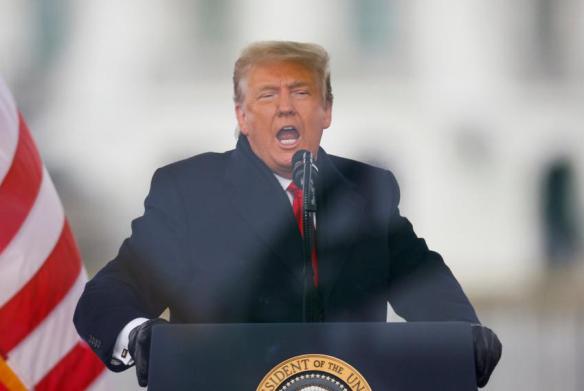
The president himself encouraged the crowds to go to the building and “fight like hell” to stop what he regards as a “stolen election,” where he was the legitimate winner. “You’ll never take back our country with weakness. You have to show strength, and you have to be strong,” he added.

In response, a host of popular social media platforms, including Twitch, Twitter, Facebook, and Snapchat froze Trump’s accounts on the grounds that he was directly inciting violence. Discord and Reddit also banned popular Trump forums.

While many who opposed the president celebrated, whistleblower and internet freedom advocate Edward Snowden warned that allowing social media companies to set a precedent where they could effectively ban whoever they want from their services set a chilling precedent. “I know a lot of folks in the comments [who] read this are like ‘YAAAAS,’ which, like — I get it. But imagine for a moment a world that exists for more than the next 13 days, and this becomes a milestone that will endure,” he wrote on Twitter.

Almost immediately, a number of non-Trump accounts began to face problems, with pro-Assange journalist Suzie Dawson locked out of her account, educational file sharing website Sci Hub’s account suspended, and the Red Scare podcast’s profile deleted. Other figures began to demand that the accounts associated with the Venezuelan and Chinese government be removed from social media platforms as well.

If Parler can find a way past its massive data hack and a company to host it, it still faces a number of huge problems, including rampant racism and false information predominating its platform. There are also large numbers of fake accounts purporting to represent public figures. The company has also broken its free speech absolutism promise as well, deleting incendiary tweets from Trump-supporting lawyer Lin Wood calling for Mike Pence’s head.

Perhaps more ominous for America, however, is a media reality where different groups of people become completely insulated from one another on the basis of political identification. Already, algorithms have split us off from others who think differently, showing wildly contrasting news and views to us based on our prior actions. However, until now, this was at least happening on the same platform, meaning there was some overlap. If, however, liberals and conservatives are using entirely different social media websites, any chance for inter party debate is lost.

The storming of the Capitol Building on Wednesday was a prime example of what can happen when one group of Americans lives in an entirely alternative reality. Further disintegration of media will only accelerate this trend, making incidents like this more likely in the future.

Insurrection Versus Insurrection

By James Howard Kunstler

Source: Kunstler.com

In the dark hours of Sunday, the BigTech-government alliance showed its hand in its massive purge of the public square — which is what social media became in a nation of strip-malls, parking lots, and nonstop propaganda — shutting down all voices countering the constructed narrative-du-jour: that the Democratic Party stands for defending Americans’ liberty against a rogue president. There have been many “shots” fired so far to kick off a civil war, but that action was an artillery blast.

Remember, the Left’s playbook is to accuse their opposition of doing exactly what they are doing. And so, of course, House Speaker Nancy Pelosi has launched a last-minute impeachment on grounds of the president inciting “insurrection.” By a strange coincidence, reports on as-yet-still-live web channels say that the president has actually invoked the Insurrection Act against seditionists in our government, including, perhaps, Ms. Pelosi. If it is true — and I can’t confirm it — then the nation has blundered into an epic political battle.

Some facts may suggest the truth of the situation: The Washington DC air-space was shut down for hours on Sunday afternoon, and 6000 national guard troops have been moved into the District of Columbia as well as other cities controlled by Democrats with Antifa/BLM mobs at their disposal. What does that signify? The news media couldn’t be troubled to find out.  Mr. Trump is reported to be in “a safe location.” As of last week, that was Dyess Air Force Base outside Abiline, Texas. Maybe he is somewhere else now. The New York TimesWashPo and CNN would like you to think that Mr. Trump has been pounded down a rat-hole. That’s one possibility. Another possibility is that the Democratic Party is unnerved and desperate about what’s liable to come down on them in the days ahead, which resembles a colossal hammer in the sky.

Mr. Trump is still president, and you’ve probably noticed he has been president for four years to date, which ought to suggest that he holds a great deal of accumulated information about the seditionists who have been playing games with him through all those years. So, two questions might be: how much of that information describes criminal acts by his adversaries — most recently, a deeply suspicious national election based on hackable vote-tabulation computers — and what’s within the president’s power to do something about it? I guess we’ll find out.

Or, to state it a little differently, it is impossible that the president does not have barge-loads of information about the people who strove mightily to take him down for four years. At least two pillars of the Intel Community — the CIA and the FBI — have been actively and visibly working to undermine and gaslight him, but you can be sure that the president knows where the gas has been coming from, and these agencies are not the only sources of dark information in this world. Also consider that not all the employees at these agencies are on the side of sedition.

By its work this weekend, starring Jack Dorsey (Twitter), Zuck (Facebook), Tim Cook (Apple), and Jeff Bezos (Amazon and The WashPo), you know exactly what you would be getting with The Resistance taking power in the White House and Congress: unvarnished tyranny. No free speech for you! They will not permit opposing voices to be heard, especially about the janky election that elevated America’s booby-prize, Joe Biden, to the highest office in the land.

Now there’s a charismatic, charming, dynamic, in-charge guy! He’s already doing such a swell job “healing America.” For instance, his declaration Tuesday to give $30-billion to businesses run by “black, brown, and Native American entrepreneurs” (WashPo). Uh, white folks need not apply? Since when are federal disbursements explicitly race-based? What and who, exactly, comprise the committee set up to operate Joe Biden, the hypothetical, holographic President? Surely you don’t believe he’s spirit-cooking this sort of economic policy on his own down in the fabled basement.

And so, here we stand at the start of what’s liable to be a fateful week for the United States. There is a lot of chatter on the lowdown that the current president — that would be Mr. Trump, for those out there who are confused — is about to act to take down the scurvy party that enabled and condoned six months of rioting, arson, and looting in at least a dozen cities — cadres of whom may have actually instigated that incursion into the US Capitol building on Wednesday. The president appears to understand his duty to preserve, protect and defend the Constitution of the United States against all enemies, foreign and domestic. He had plenty of opportunity to be a quitter from 2017 to 2021 and he hung in there, against every cockamamie operation the Deep State threw at him. Odds are he’s not quitting now.