
Biological Annihilation on Earth Accelerating

By Robert J. Burrowes

Human beings are now waging war against life itself as we continue to destroy not just individual lives, local populations and entire species in vast numbers but also destroy the ecological systems that make life on Earth possible.

By doing this we are now accelerating the sixth mass extinction event in Earth’s history and virtually eliminating any prospect of human survival.

In a recently published scientific study ‘Biological annihilation via the ongoing sixth mass extinction signaled by vertebrate population losses and declines‘ the authors Gerardo Ceballos, Paul R. Ehrlich and Rodolfo Dirzo document the accelerating nature of this problem.

‘Earth’s sixth mass extinction is more severe than perceived when looking exclusively at species extinctions…. That conclusion is based on analyses of the numbers and degrees of range contraction … using a sample of 27,600 vertebrate species, and on a more detailed analysis documenting the population extinctions between 1900 and 2015 in 177 mammal species.’ Their research found that the rate of population loss in terrestrial vertebrates is ‘extremely high’ – even in ‘species of low concern’.

In their sample, comprising nearly half of known vertebrate species, 32% (8,851 out of 27,600) are decreasing; that is, they have decreased in population size and range. In the 177 mammals for which they had detailed data, all had lost 30% or more of their geographic ranges and more than 40% of the species had experienced severe population declines. Their data revealed that ‘beyond global species extinctions Earth is experiencing a huge episode of population declines and extirpations, which will have negative cascading consequences on ecosystem functioning and services vital to sustaining civilization. We describe this as a “biological annihilation” to highlight the current magnitude of Earth’s ongoing sixth major extinction event.’

Illustrating the damage done by dramatically reducing the historic geographic range of a species, consider the lion. Panthera leo ‘was historically distributed over most of Africa, southern Europe, and the Middle East, all the way to northwestern India. It is now confined to scattered populations in sub-Saharan Africa and a remnant population in the Gir forest of India. The vast majority of lion populations are gone.’

Why is this happening? Ceballos, Ehrlich and Dirzo tell us: ‘In the last few decades, habitat loss, overexploitation, invasive organisms, pollution, toxification, and more recently climate disruption, as well as the interactions among these factors, have led to the catastrophic declines in both the numbers and sizes of populations of both common and rare vertebrate species.’

Further, however, the authors warn ‘But the true extent of this mass extinction has been underestimated, because of the emphasis on species extinction.’ This underestimate can be traced to overlooking the accelerating extinction of local populations of a species.

‘Population extinctions today are orders of magnitude more frequent than species extinctions. Population extinctions, however, are a prelude to species extinctions, so Earth’s sixth mass extinction episode has proceeded further than most assume.’ Moreover, and importantly from a narrow human perspective, the massive loss of local populations is already damaging the services ecosystems provide to civilization (which, of course, are given no value by government and corporate economists).

As Ceballos, Ehrlich and Dirzo remind us: ‘When considering this frightening assault on the foundations of human civilization, one must never forget that Earth’s capacity to support life, including human life, has been shaped by life itself.’ When public mention is made of the extinction crisis, it usually focuses on a few (probably iconic) animal species known to have gone extinct, while projecting many more in future. However, a glance at their maps presents a much more realistic picture: as much as 50% of the number of animal individuals that once shared Earth with us are already gone, as are billions of populations.

Furthermore, they claim that their analysis is conservative given the increasing trajectories of those factors that drive extinction together with their synergistic impacts. ‘Future losses easily may amount to a further rapid defaunation of the globe and comparable losses in the diversity of plants, including the local (and eventually global) defaunation-driven coextinction of plants.’

They conclude with the chilling observation: ‘Thus, we emphasize that the sixth mass extinction is already here and the window for effective action is very short.’

Of course, it is too late for those species of plants, birds, animals, fish, amphibians, insects and reptiles that humans have already driven to extinction or will yet drive to extinction in the future. 200 species yesterday. 200 species today. 200 species tomorrow. 200 species the day after…. And, as Ceballos, Ehrlich and Dirzo emphasize, the ongoing daily extinctions of a myriad local populations.

If you think that the above information is bad enough in assessing the prospects for human survival, you will not be encouraged by awareness or deeper consideration of even some of the many variables adversely impacting our prospects that were beyond the scope of the above study.

While Ceballos, Ehrlich and Dirzo, in addition to the problems they noted which are cited above, also identified the problems of human overpopulation and continued population growth, as well as overconsumption (based on ‘the fiction that perpetual growth can occur on a finite planet’) and even the risks posed by nuclear war, there were many variables that were beyond the scope of their research.

For example, in a recent discussion of that branch of ecological science known as ‘Planetary Boundary Science’, Dr Glen Barry identified ‘at least ten global ecological catastrophes which threaten to destroy the global ecological system and portend an end to human beings, and perhaps all life. Ranging from nitrogen deposition to ocean acidification, and including such basics as soil, water, and air; virtually every ecological system upon which life depends is failing’. See ‘The End of Being: Abrupt Climate Change One of Many Ecological Crises Threatening to Collapse the Biosphere‘.

Moreover, apart from the ongoing human death tolls caused by the endless wars and other military violence being conducted across the planet – see, for example, ‘Yemen cholera worst on record & numbers still rising‘ – there is catastrophic environmental damage caused too. For some insight, see The Toxic Remnants of War Project.

In addition, the out-of-control methane releases into the atmosphere that are now occurring – see ‘7,000 underground gas bubbles poised to “explode” in Arctic‘ and ‘Release of Arctic Methane “May Be Apocalyptic,” Study Warns‘ – and the release, each and every day, of 300 tons of radioactive waste from Fukushima into the Pacific Ocean – see ‘Fukushima Radiation Has Contaminated The Entire Pacific Ocean – And It’s Going To Get Worse‘ – are having disastrous consequences that will negatively impact life on Earth indefinitely. And they cannot be reversed in any timeframe that is meaningful for human prospects.

Apart from the above, there is a host of other critical issues – such as destruction of the Earth’s rainforests, destruction of waterways and the ocean habitat and the devastating impact of animal agriculture for meat consumption – that international governmental organizations such as the UN, national governments and multinational corporations will continue to refuse to decisively act upon because they are controlled by the insane global elite. See ‘The Global Elite is Insane‘ with more fully elaborated explanations in ‘Why Violence?‘ and ‘Fearless Psychology and Fearful Psychology: Principles and Practice‘.

So time may be short, the number of issues utterly daunting and the prospects for life grim. But if, like me, you are inclined to fight to the last breath, I invite you to consider making a deliberate choice to take powerful personal action in the fight for our survival.

If you do nothing else, consider participating in the fifteen-year strategy of ‘The Flame Tree Project to Save Life on Earth‘. You can do this as an individual, with family and friends or as a neighbourhood.

If you are involved in (or considering becoming involved in) a local campaign to address a climate issue, end some manifestation of war (or even all war), or to halt any other threat to our environment, I encourage you to consider doing this on a strategic basis. See Nonviolent Campaign Strategy.

And if you would like to join the worldwide movement to end violence in all of its forms, environmental and otherwise, you are also welcome to consider signing the online pledge of ‘The People’s Charter to Create a Nonviolent World‘.

We might be annihilating life on Earth but this is not something about which we have no choice.

In fact, each and every one of us has a choice: we can choose to do nothing, we can wait for (or even lobby) others to act, or we can take powerful action ourselves. But unless you search your heart and make a conscious and deliberate choice to commit yourself to act powerfully, your unconscious choice will effectively be the first one (including that you might take some token measures and delude yourself that these make a difference). And the annihilation of life on Earth will continue, with your complicity.

Extinction beckons. Will you choose powerfully?


Biodata: Robert J. Burrowes has a lifetime commitment to understanding
and ending human violence. He has done extensive research since 1966 in
an effort to understand why human beings are violent and has been a
nonviolent activist since 1981. He is the author of ‘Why Violence?
His email address is flametree@riseup.net
and his website is at http://robertjburrowes.wordpress.com


Robert J. Burrowes
P.O. Box 68
Daylesford
Victoria 3460
Australia
Email: flametree@riseup.net

Websites:
Nonviolence Charter
Flame Tree Project to Save Life on Earth
‘Why Violence?’
Nonviolent Campaign Strategy
Nonviolent Defense/Liberation Strategy
Anita: Songs of Nonviolence
Robert Burrowes
Global Nonviolence Network

A Nonviolent Strategy to End the Climate Catastrophe

emgnpollution2

By Robert J. Burrowes

As the evidence mounts that we are fast approaching the final point-of-no-return beyond which it will be impossible to take sufficient effective action to prevent climate catastrophe – see ‘The World Passes 400 PPM Threshold. Permanently‘– the evidence of ineffective official responses climbs too. See, for example, ‘Climate Con: why a new global deal on aviation emissions is really bad news’.

Even worse, we continue to be given response options that, even when they are well meaning, are naïve and inadequate whether they are suggested by individuals – see, for example, ‘Committing Geocide: Climate Change and Corporate Capture‘– or major environment organizations such as Greenpeace, 350.org and
Friends of the Earth.

Moreover, given the myriad indications of progressive environmental breakdown in domains unrelated to the climate catastrophe, one must be terrified and delusional to suggest or even believe that anything less than a comprehensive strategy, which goes well beyond anything governments and corporations will ever endorse, gives us any chance of averting the sixth mass extinction event in planetary history. A mass extinction that will include us.

As an aside, if you believe the ‘end of century’ scenario (for human extinction) being driven by the same corporate interests that drove climate denial for so long, then you are simply a victim of their latest attempt to drive ‘business as usual’ while delaying action for as long as possible at any cost.

Another problem, if you understand anything about human psychology and political organization, is that mobilizing people in large numbers to act strategically and powerfully is not easy. Of course, if it wasn’t so difficult, this crisis would not have arisen in the first place. We would have responded intelligently and strategically decades ago as some aware individuals, starting with Mohandas Karamchand Gandhi 100 years ago, suggested.

To briefly recap the wider nature of the crisis we face: Consider our synergistic and devastating assaults on the environment through military violence (often leaving vast areas uninhabitable), rainforest destruction, industrial farming, mining, commercial fishing and the spreading radioactive contamination from Fukushima. We are also systematically destroying the limited supply of fresh water on the planet which means that water scarcity is becoming a frequent reality for many people and the collapse of hydrological systems is now likely by 2020. Human activity drives 200 species of life (plants, birds,animals, fish, amphibians, insects, reptiles) to extinction each day and 80% of the world’s forests and over 90% of the large fish in the ocean are already gone. Despite this readily available information, governments continue to prioritize spending $US2,000,000,000 each day on military violence, the sole purpose of which is to terrorize and kill fellow human beings.

So what are we to do?

Well, if you are inclined to assess the evidence and to design a response strategy that has the possibility of success built into it,then I invite you to consider the strategy outlined on the Nonviolent Campaign Strategy website.  This strategy identifies all twelve components of a nonviolent strategy to end the climate catastrophe, including the myriad of strategic goals for such a strategy to be comprehensive and effective. You are very welcome to suggest improvements in this strategy and to invite other individuals and groups to participate in helping to implement it.

If you are happy to leave strategic responses to others but still wish to contribute powerfully, then you and others you know are welcome to participate in the simple fifteen-year program outlined in ‘The Flame Tree Project to Save Life on Earth‘. You might also consider signing the online pledge of ‘The People’s Charter to Create a Nonviolent World‘.

One final point: a tragic outcome of modern humans terrorizing their children into obedience (to maintain social control) is that most of the human population is (unconsciously) terrified, self-hating and powerless. For a full explanation of this, see ‘Why Violence?‘ and ‘Fearless Psychology and Fearful Psychology: Principles and Practice‘.

So don’t wait around waiting for others to act first. It is your leadership that is required in this circumstance. And it is your leadership that might ultimately make the difference.


Biodata: Robert J. Burrowes has a lifetime commitment to understanding and ending human violence. He has done extensive research since 1966 in an effort to understand why human beings are violent and has been a nonviolent activist since 1981. He is the author of ‘Why Violence?‘ His email address is flametree@riseup.netand his website is at http://robertjburrowes.wordpress.com

Robert J. Burrowes
P.O. Box 68
Daylesford
Victoria 3460
Australia
Email: flametree@riseup.net

Websites:
Nonviolence Charter
Flame Tree Project to Save Life on Earth
‘Why Violence?’
Nonviolent Campaign Strategy
Nonviolent Defense/Liberation Strategy
Anita: Songs of Nonviolence
Robert Burrowes
Global Nonviolence Network

On the Slow Kill of the World’s Oceans

images

By Aaron Dames

Originally posted at Divided Core on November 1, 2013

It is probable that every major ecological pillar however tenuously stabilizing the structure of the oceans is crumbling. Although some endangered fish populations and coral reef systems are being protected and restored, the seas overall are in deep shit. Overfishing and pollution are reducing biodiversity by killing-off large swaths of ocean life. The destruction of vast marine habitats will have catastrophic repercussions for humanity. [According to some earth scientists, oceanic ecocide poses a greater threat to the existence of humanity than climate change. Higher global temperature averages which melt icecaps and glaciers will lead to higher sea levels and the inundation of a plethora of coastal industries, cities, and urban centers that are responsible for contributing to environmental destruction and the mass production of excessive, heat-trapping, carbon-dioxide emissions. As in times of major economic depressions or financial stagnation, the inundation of coastal megalopolises will result in a decrease of industrial activity which may subsequently benefit nature as a whole (until industrial activity is resumed), but would have horrible consequences for humanity, especially for those hundreds of millions of impoverished coastal inhabitants who already live in deprivation, and who would become environmental refugees in the event of a significant increase in sea levels. (Click here to view an interactive map from National Geographic which depicts how coastlines would change if all glaciers and icecaps on Earth were to melt.)]

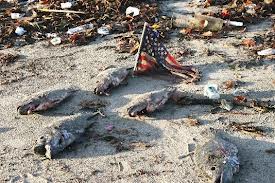
Not that there’s anything wrong with them, but human beings have caused a lot of trouble for life in the world’s oceans. The process in which the destruction of sea life occurs is largely two-fold. Large-scale destructive events like oil spills (Deepwater Horizon) and nuclear power plant disasters (Fukushima) can cause serious damage to the affected aquatic areas. Damage from such disasters is often immediately evident, such as the deformed and eyeless fish and shrimp that appeared in the Gulf of Mexico after the Deepwater Horizon oil spill, or the dying sea lions pups and seals with bleeding lesions that have washed up on beaches in California and Alaska the wake of the Fukushima Daiichi Nuclear Power Plant meltdown. Yet as grave and harmful as they are, explosive, headline-making disasters are less deleterious to life in the seas than the cumulative, synergistic effects of routine human activities such as oceanic commerce, commercial fishing, and pollution. For example, a 2002 study by the National Academy of the Sciences found that the 85 percent of the 29 million gallons of marine oil pollution originating from North America derives from runoff from cars and oil-based machines and accessories (like lawnmowers and household robots) – and the sum of these tiny releases of oil, carried into the ocean by streams and storm drains, is equivalent to an Exxon Valdez oil spill every eight months. [As additional food for thought: there are apparently 90,000 cargo ships in the world. (Incidentally, there are also roughly 760 million vehicles and 30,000 commercial airplanes.) Many of these vessels run off of “bunker fuel,” a byproduct of the oil refining process. The burning of bunker fuels in cargo ships may be responsible for 3.5 – 4% of all carbon-dioxide emissions; and particulate pollution (such as sulphur-dioxide fumes) from cargo ships may contribute to as many as 60,000 human deaths a year. These chemical emission-related figures exclude the effects of pollution produced by navy vessels, cruise ships, and fishing fleets. Also, often overlooked are the human costs involved in the process of shipbreaking, where wretched working conditions plague extremely low-paid laborers, mainly on the Indian subcontinent. For a glimpse into their lives, check out the film Ironeaters.]

Daily activities which contribute to ocean pollution and the depletion of fish stocks are decimating underwater habitats, driving down biodiversity, and have the potential to reduce the populations of certain marine species to irrecoverable extents or down to zero. The elimination of any species from an ecological network could have devastating and unforeseen impacts on the rest of the planet. According to the Monterey Bay Aquarium, “Overfishing may be the single biggest threat to ocean ecosystems. Today, 85 percent of the world’s fisheries are either fully exploited, overexploited or have collapsed. The global fishing fleet is operating at 2.5 times the sustainable level – there are simply too many boats chasing a dwindling number of fish.” Commercial, illegal, and game fishing operations are wiping-out the populations of major fish species, such as bluefin tuna and blue and white marlin; both of which species are likely to be overfished to extinction within the century. Dolphins and small whales are facing extinction off the coast of Japan, where over a million such creatures have been hunted and killed over the past seventy years. 100 million sharks are estimated to be killed by humans every year. (Click here to view a picture that was taken earlier this year and shows thousands of shark fins drying on a rooftop in Hong Kong.) It is unlikely that the current rate of exploitation and depletion can be sufficiently curbed in order to allow time for the dwindling populations of many fish species to recover. For those more interested in the subject of overfishing, I highly recommend watching the film End of the Line.

Pollution is another major force contributing to the demise of life in the oceans. Over the last century immense volumes of trash and industrial chemicals have contaminated whole cross-sections of the oceans. Toxins that enter the oceans are spread throughout food chains, and varying degrees of visible and microscopic waste accumulate in the water and on shores. One diabolical clusterfuck that highlights the deleterious effects of pollution on the marine environment is the Great Pacific Garbage Patch. Like other ocean regions, the North Pacific Ocean has immense gyre-like convergence zones which are formed by wind and rotating currents. The Pacific convergence zones currently contain astronomical quantities of accumulated rubbish, much of which has been or is being broken down into tiny particles of microplastic. Subsisting in the gyres and consuming the plastic are around 260 species of fish, sea turtles, birds, and other sea creatures. These animals often die from the consumption of plastic, which may also end-up in the bodies of the predators that feed off them, or, as in the case of the Laysan albatross, in their young. On the Midway Atoll, where twenty tons of plastic wash up every year, as many as one-third of all albatross chicks die due to eating plastic inadvertently fed to them by their parents.

In addition to plastic, a broad range of manufactured organic and toxic chemicals have made their way into the oceans. Many of these contaminants lodge themselves in the tissues of fish and bioaccumulate as the fish are ingested up the food chain. Studies have found high levels of mercury and industrial chemicals like polychlorinated biphenyls (PCBs) in dolphin and whale meat. What the hell are PCBs? Allow Cathy Britt to explain:

PCBs are manufactured organic chemicals that were primarily used as insulating liquids, such as coolants and lubricants in electrical equipment, but were also used in other common materials such as paints, cement, adhesives, and even the flame retardants used in some children’s clothing…Though production of PCBs was banned in the 1970s because of its harmful effects to the environment, the chemical still presents a significant environmental threat today.

Orcas have accumulated such high concentrations of PCBs that when female orcas breast feed their young, the firstborn calf usually dies as a result of receiving a toxic overdose of PCBs contained in its mother’s fatty-rich breast milk. PCBs and other toxins are also known to cause health problems in other large Artic animals, like polar bears and seals. Although PCBs, some pesticides, and other persistent organic pollutants have been phased out and banned, many industrial chemicals (such as brominated flame-retardants) are still widely used and find their way into the oceans. Humans are not immune to this process of bioaccumulation, and toxins are accruing in the bodies of people as a result of eating fish. But perhaps the real blow will come later, when there are no more fish to eat.

Human beings are carrying out a slow kill of the world’s seas, as well as on much of the planet’s other ecosystems. Modern man finds himself in living in a paradox where he knows more than ever about how the natural world functions, and nevertheless the natural world is in its worst shape yet due to how modern man mistreats it. How is that we can care so much about ourselves and our friends and family, but so little about others and the natural systems that we depend on to survive? The Earth revolves through day and night, and it seems that billions of people are clocking-in and out of shifts to partake in the wholesale destruction of the world on their side of the planet. If the day arrives when the seas have become polluted dead zones void of great shoals of fish – assuming there will be humans to witness it, they’ll look out across the grey and desolate tides toward the bleak horizon and ask, “How did we let this happen?” And this is the answer: We let it happen through stupidity, laziness, arrogance, apathy, and greed. We couldn’t stop gorging ourselves, we couldn’t control our insatiable appetite, and we didn’t think to heed the warnings we were given (though we saw them); we didn’t think to step back, to slow down, and to stop ourselves and each other. It was a free for all, and we didn’t care enough about our world and Mother Nature to make a difference and to save her oceans from death. We are like addicts, and we only take; we always take, and we never give back. And in her darkest hour, when nature desperately needed a hand – when her battered reefs became bleached and white like bones, when her bays became choked with smog and clogged with oil, when the whales and dolphins were beaching themselves in mass die-offs along the shores, when the nets that we cast came back with less and less until there was nothing – when she needed us most, we refused to reach out and instead we looked the other way in betrayal. But it doesn’t have to be that way. You can leave this planet in better shape than you found it. You can try to make a difference and stand up for those creatures on this planet that can’t stand up for themselves; even if it doesn’t work, they’ll appreciate that you tried. And you’ll also feel a lot better about yourself that you did.