America’s Barbaric Logic of Hiroshima 70 Years On

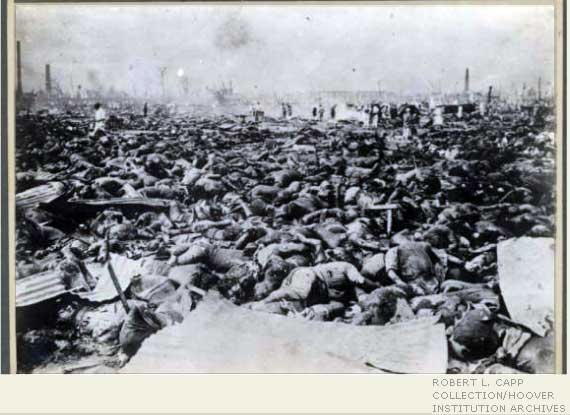
Hiroshima_Capp

By Finnian Cunningham

Source: Strategic Culture Foundation

Even if we accept that there was a plausible military imperative to drop the atomic bombs on Hiroshima and Nagasaki – to bring about a swift defeat of Japan and thus an end to the Pacific War – the horror of civilian death toll from those two no-warning aerial attacks places a disturbing question over the supposed ends justifying the means.

But what if the official military rationale touted by US President Harry Truman and his administration turns out to be bogus? That is, the real reason for dropping the A-bombs on Hiroshima and Nagasaki 70 years ago on August 6 and 9, 1945, had little to do with defeating imperial Japan and saving the lives of American troops. What if the real reason was the deliberate and cold-blooded demonstration of raw military power by Washington in order to warn the Soviet Union of America’s postwar demarcation of global hegemony?

That leads to the most chilling conclusion – a conclusion far worse than the official American narrative would have us believe. For it means that the act of obliterating up to 200,000 Japanese civilians was an event of premeditated mass murder whose intent was solely political. Or, in other words, an ineffable act of state terrorism committed by the United States.

This conjecture about the ulterior motive for the American atomic bombing of Japan has been around for many years. In January 1995, the New York Times reported: «Indeed, some historians contend that the bombing was not aimed so much at the wartime enemy Japan as at the wartime ally Soviet Union, delivered as a warning against postwar rivalry».

With complacent equivocation, the New York Times did not follow through on the horrendous implications of its own partial admission for why the atomic bombs were dropped. If the official US calculation was indeed «a warning against postwar rivalry» to the Soviet Union, then that makes the act an indefensible political decision that had nothing to do with a moral imperative of promptly ending a war. It was, as noted, a supreme act of terrorism.

Professsor Gar Alperovitz – one of several American historians – has over the decades compiled a compelling case that the Truman administration did in fact make the decision to use the A-bombs as a political weapon against the Soviet Union.

The author of ‘The Decision to Use the Atomic Bomb’ wrote: «Though most Americans are unaware of the fact, increasing numbers of historians now recognise that the United States did not need to use the atomic bomb to end the war against Japan in 1945. Moreover, this essential judgment was expressed by the vast majority of top American military leaders in all three services in the years after the war ended: Army, Navy and Army Air Force».

Alperovitz cites then US Secretary of War Henry L Stimson and such military luminaries as General Dwight Eisenhower and Joint Chiefs of Staff Admiral William D Leahy who were explicitly opposed to using the A-bomb on Japan. Eisenhower said it was»completely unnecessary» while Leahy noted: «The use of this barbarous weapon at Hiroshima and Nagasaki was of no material assistance in our war against Japan. The Japanese were already defeated and ready to surrender».

This points to covert political decision-making during the critical three-week period between the Potsdam conference (July 17-August 2 1945) and the dropping of the A-bombs on Japan. During that period it appears that Truman and his aides decided in secret that the then Soviet wartime ally was to be henceforth made the postwar enemy. The Cold War was being formulated.

Bear in mind that for months before Potsdam, the US and Britain were appealing to Russian leader Josef Stalin to join the Pacific War soon after the defeat of Nazi Germany. Two months after the Third Reich was vanquished in May 1945, the Potsdam conference between the Big Three allies achieved the much-anticipated commitment from Stalin to redeploy the Red Army against Japan. The Soviet Union was scheduled to officially enter the Pacific War on August 15. As it turned out, Stalin ordered the Red Army into Manchuria on August 8, a week ahead of the scheduled offensive.

As Harry Truman gleefully wrote in a private letter during Potsdam this commitment from the Soviet Union meant that «the Japs were finished».

However, the successful testing of the first A-bomb by the United States in the desert of New Mexico on July 16 – only the day before begining the Potsdam summit – was a point of no return. With this awesome new weapon, US planners must have quickly realised that they could finish the war against Japan without the Soviet Union entering the Pacific theatre, by dropping the A-bomb.

But the primary US objective wasn’t to finish the Pacific War per se. American and British military chiefs and intelligence were convinced that the mere entry of Russia into the war against Japan would precipitate the latter’s surrender. And besides the American invasion of mainland Japan was not planned to take place until November 1945.

It seems clear then that the Truman administration rushed ahead to use its new atomic weapon on Japan because its concern was to circumscribe any advance by the Soviet Union in Asia-Pacific. Not only was the Red Army poised to take Manchuria and the Korean Peninsula but mainland Japan as well.

Hiroshima and Nagasaki – two civilian centres of no military value – were thus selected as the venues for demonstrating the most spellbinding act of terror, not to an all but defeated Japan, but to the Soviet Union. The atomic bombing of Japan was therefore not the last act of the Pacific War, as the official American narrative contends, but rather it was the first, brutal act of the nascent Cold War by the US towards Soviet Russia.

That puts the horrific events in an altogether different criminal light. Because the atomic bombings can then be seen as a deliberate act of mass murder for no other strategic reason other than to intimidate a perceived geopolitical rival – Moscow.

Seventy years on, history proves that this barbaric logic of the US ruling elite still holds. After the official end of the Cold War nearly a quarter of a century ago, Washington has evidently no intention of disarming its nuclear arsenal. In fact, the US government under President Barack Obama is planning to spend $355 billion over the next decade to upgrade its stockpile of some 5,000 nuclear warheads – each many times more powerful than the A-bombs that were originally dropped on Japan.

Furthermore, Washington has offiicially declared Russia, along with China, as its top strategic enemy, as recent as this month, according to senior Pentagon figures.

The unilateral withdrawal by the US from the Anti-Ballistic Missiles Treaty in 2002 and the ongoing expansion of US missile systems on Russia’s borders and in the Pacific with provocative reference to China are testimony to the inherent bellicose intent that resides in Washington.

As with the first and only use of nuclear weapons 70 years ago, the US logic that led to the holocaust at Hiroshima and Nagasaki is a barbaric logic than pertains to this day. It is still being aimed at Russia, as it was seven decades ago.

Only the full exposure and eradication of this uniquely American barbaric logic will lead to peaceful international relations.

The Eurasian Big Bang

0-6-brics-staaten-wollen-in-ufa-engere-partnerschaft-vereinbaren.bffa6cfe

How China and Russia Are Running Rings Around Washington

By Pepe Escobar

Source: TomDispatch.com

The several hundred Republicans who have thrown their hats into the ring for the 2016 presidential race and the war hawks in Congress (mainly but hardly only Republicans) have already been in full howl about the Vienna nuclear deal with Iran. Jeb Bush took about two seconds to label it “appeasement,” instantly summoning up the image of British Prime Minister Neville Chamberlain giving in to Hitler before World War II; former Arkansas Governor Mike Huckabee spared no metaphor in labeling the agreement “a deal that empowers an evil Iranian regime to carry out its threat to ‘wipe Israel off the map’ and bring ‘death to America’”; Senator Lindsey Graham called it a “possible death sentence for Israel”; this year’s leading billionaire candidate, Donald Trump, summed up his opinion of the deal in one you’re-fired-style word, “ridiculous”; Senator John McCain described Secretary of State John Kerry, who negotiated the deal, as “delusional”; and Senator… I mean, Israeli Prime Minister Benjamin Netanyahu mockingly turned Chamberlain’s infamous “peace in our time” into “peace at any price,” dismissed the deal as a catastrophe filled with “absurdities,” and then appeared on every American media venue imaginable to denounce it.  And that’s just to start down the usual list of suspects. Even Senator Rand Paul swore he would vote against the agreement (though his father called it “to the benefit of world peace”), while Wisconsin Governor Scott Walker was typical of Republican presidential candidates in swearing that he would personally scuttle the deal on his first day in the Oval Office.

This, in short, is the mad version of international policy that makes Washington a claustrophobic echo chamber.  After all, the choice isn’t actually between Iran having no nuclear “breakout” capacity or regaining that capacity 15 years from now (as the present deal seems to offer); the choice is between an agreement for 15 verifiably non-weaponized years and a guarantee of nothing whatsoever.  And if you’ve just checked off that nothing-whatsoever column, the alternative is to somehow crush the Iranians, to force them into submission.  It is, in other words, some version of war.  Two questions on that: How successful has war in the Greater Middle East been as an American policy weapon these last 13 years?  And what makes anyone think that, when even Dick Cheney and crew couldn’t bring themselves to pull the trigger on Iran, Jeb B. or any of the other candidates will be likely to do so in an ISIS-enriched world in 2017?

When you’ve satisfied yourself on those two questions, consider the seldom-discussed larger context within which twenty-first-century nuclear politics has taken place.  In these last years, the Pakistanis, the Indians, the Russians, and the Americans, to name just four nuclear powers, have either been expanding or “modernizing” their nuclear stockpiles in significant ways.  And god knows what the Israelis were doing with their super-secret, never officially acknowledged, but potentially civilization-busting atomic arsenal of 80 or more weapons, while the North Koreans were turning themselves into a nuclear mini-power.  Nonetheless, the focus of nuclear attention and the question of “disarmament” has remained almost exclusively on a country that had no such weapons, has officially disavowed them, and at this point, at least, doesn’t even have a weapons program.  And note that no one who is anyone in Washington considers any of this the least bit strange.

In this context, that irrepressible TomDispatch regular Pepe Escobar offers another kind of lens-widening exercise when it comes to the Iranian deal.  He focuses on a subject that Washington has yet to fully absorb: changing relations in Eurasia.  Few here have noticed, but while the Vienna deal was being negotiated, Russia and China, countries the Pentagon has just officially labeled as “threats,” have been moving mountains (quite literally in some cases) to integrate ever larger parts of that crucial land mass, that “world island,” into a vast economic zone that, if all goes as they wish, will be beyond Washington’s power and control.  This is a remarkable development that, despite the coming two months of sound and fury about Iran, won’t be at the top of any news report, which is why you need a website like TomDispatch to keep up with the times. Tom

The Eurasian Big Bang 
How China and Russia Are Running Rings Around Washington
By Pepe Escobar

Let’s start with the geopolitical Big Bang you know nothing about, the one that occurred just two weeks ago. Here are its results: from now on, any possible future attack on Iran threatened by the Pentagon (in conjunction with NATO) would essentially be an assault on the planning of an interlocking set of organizations — the BRICS nations (Brazil, Russia, India, China, and South Africa), the SCO (Shanghai Cooperation Organization), the EEU (Eurasian Economic Union), the AIIB (the new Chinese-founded Asian Infrastructure Investment Bank), and the NDB (the BRICS’ New Development Bank) — whose acronyms you’re unlikely to recognize either.  Still, they represent an emerging new order in Eurasia.

Tehran, Beijing, Moscow, Islamabad, and New Delhi have been actively establishing interlocking security guarantees. They have been simultaneously calling the Atlanticist bluff when it comes to the endless drumbeat of attention given to the flimsy meme of Iran’s “nuclear weapons program.”  And a few days before the Vienna nuclear negotiations finally culminated in an agreement, all of this came together at a twin BRICS/SCO summit in Ufa, Russia — a place you’ve undoubtedly never heard of and a meeting that got next to no attention in the U.S.  And yet sooner or later, these developments will ensure that the War Party in Washington and assorted neocons (as well as neoliberalcons) already breathing hard over the Iran deal will sweat bullets as their narratives about how the world works crumble.

The Eurasian Silk Road

With the Vienna deal, whose interminable build-up I had the dubious pleasure of following closely, Iranian Foreign Minister Javad Zarif and his diplomatic team have pulled the near-impossible out of an extremely crumpled magician’s hat: an agreement that might actually end sanctions against their country from an asymmetric, largely manufactured conflict.

Think of that meeting in Ufa, the capital of Russia’s Bashkortostan, as a preamble to the long-delayed agreement in Vienna. It caught the new dynamics of the Eurasian continent and signaled the future geopolitical Big Bangness of it all. At Ufa, from July 8th to 10th, the 7th BRICS summit and the 15th Shanghai Cooperation Organization summit overlapped just as a possible Vienna deal was devouring one deadline after another.

Consider it a diplomatic masterstroke of Vladmir Putin’s Russia to have merged those two summits with an informal meeting of the Eurasian Economic Union (EEU). Call it a soft power declaration of war against Washington’s imperial logic, one that would highlight the breadth and depth of an evolving Sino-Russian strategic partnership. Putting all those heads of state attending each of the meetings under one roof, Moscow offered a vision of an emerging, coordinated geopolitical structure anchored in Eurasian integration. Thus, the importance of Iran: no matter what happens post-Vienna, Iran will be a vital hub/node/crossroads in Eurasia for this new structure.

If you read the declaration that came out of the BRICS summit, one detail should strike you: the austerity-ridden European Union (EU) is barely mentioned. And that’s not an oversight. From the point of view of the leaders of key BRICS nations, they are offering a new approach to Eurasia, the very opposite of the language of sanctions.

Here are just a few examples of the dizzying activity that took place at Ufa, all of it ignored by the American mainstream media. In their meetings, President Putin, China’s President Xi Jinping, and Indian Prime Minister Narendra Modi worked in a practical way to advance what is essentially a Chinese vision of a future Eurasia knit together by a series of interlocking “new Silk Roads.” Modi approved more Chinese investment in his country, while Xi and Modi together pledged to work to solve the joint border issues that have dogged their countries and, in at least one case, led to war.

The NDB, the BRICS’ response to the World Bank, was officially launched with $50 billion in start-up capital. Focused on funding major infrastructure projects in the BRICS nations, it is capable of accumulating as much as $400 billion in capital, according to its president, Kundapur Vaman Kamath. Later, it plans to focus on funding such ventures in other developing nations across the Global South — all in their own currencies, which means bypassing the U.S. dollar.  Given its membership, the NDB’s money will clearly be closely linked to the new Silk Roads. As Brazilian Development Bank President Luciano Coutinhostressed, in the near future it may also assist European non-EU member states like Serbia and Macedonia. Think of this as the NDB’s attempt to break a Brussels monopoly on Greater Europe. Kamath even advanced the possibility of someday aidingin the reconstruction of Syria.

You won’t be surprised to learn that both the new Asian Infrastructure Investment Bank and the NDB are headquartered in China and will work to complement each other’s efforts. At the same time, Russia’s foreign investment arm, the Direct Investment Fund (RDIF), signed a memorandum of understanding with funds from other BRICS countries and so launched an informal investment consortium in which China’s Silk Road Fund and India’s Infrastructure Development Finance Company will be key partners.

Full Spectrum Transportation Dominance

On the ground level, this should be thought of as part of the New Great Game in Eurasia. Its flip side is the Trans-Pacific Partnership in the Pacific and the Atlantic version of the same, the Transatlantic Trade and Investment Partnership, both of which Washington is trying to advance to maintain U.S. global economic dominance. The question these conflicting plans raise is how to integrate trade and commerce across that vast region. From the Chinese and Russian perspectives, Eurasia is to be integrated via a complex network of superhighways, high-speed rail lines, ports, airports, pipelines, and fiber optic cables. By land, sea, and air, the resulting New Silk Roads are meant to create an economic version of the Pentagon’s doctrine of “Full Spectrum Dominance” — a vision that already has Chinese corporate executives crisscrossing Eurasia sealing infrastructure deals.

For Beijing — back to a 7% growth rate in the second quarter of 2015 despite a recent near-panic on the country’s stock markets — it makes perfect economic sense: as labor costs rise, production will be relocated from the country’s Eastern seaboard to its cheaper Western reaches, while the natural outlets for the production of just about everything will be those parallel and interlocking “belts” of the new Silk Roads.

Meanwhile, Russia is pushing to modernize and diversify its energy-exploitation-dependent economy. Among other things, its leaders hope that the mix of those developing Silk Roads and the tying together of the Eurasian Economic Union — Russia, Armenia, Belarus, Kazakhstan, and Kyrgyzstan — will translate into myriad transportation and construction projects for which the country’s industrial and engineering know-how will prove crucial.

As the EEU has begun establishing free trade zones with India, Iran, Vietnam, Egypt, and Latin America’s Mercosur bloc (Argentina, Brazil, Paraguay, Uruguay, and Venezuela), the initial stages of this integration process already reach beyond Eurasia. Meanwhile, the SCO, which began as little more than a security forum, is expanding and moving into the field of economic cooperation.  Its countries, especially four Central Asian “stans” (Kazakhstan, Kyrgyzstan, Uzbekistan, and Tajikistan) will rely ever more on the Chinese-driven Asia Infrastructure Investment Bank (AIIB) and the NDB. At Ufa, India and Pakistan finalized an upgrading process in which they have moved from observers to members of the SCO. This makes it an alternative G8.

In the meantime, when it comes to embattled Afghanistan, the BRICS nations and the SCO have now called upon “the armed opposition to disarm, accept the Constitution of Afghanistan, and cut ties with Al-Qaeda, ISIS, and other terrorist organizations.” Translation: within the framework of Afghan national unity, the organization would accept the Taliban as part of a future government. Their hopes, with the integration of the region in mind, would be for a future stable Afghanistan able to absorb more Chinese, Russian, Indian, and Iranian investment, and the construction — finally! — of a long-planned, $10 billion, 1,420-kilometer-long Turkmenistan-Afghanistan-Pakistan-India (TAPI) gas pipeline that would benefit those energy-hungry new SCO members, Pakistan and India. (They would each receive 42% of the gas, the remaining 16% going to Afghanistan.)

Central Asia is, at the moment, geographic ground zero for the convergence of the economic urges of China, Russia, and India. It was no happenstance that, on his way to Ufa, Prime Minister Modi stopped off in Central Asia.  Like the Chinese leadership in Beijing, Moscow looks forward (as a recent document puts it) to the “interpenetration and integration of the EEU and the Silk Road Economic Belt” into a “Greater Eurasia” and a “steady, developing, safe common neighborhood” for both Russia and China.

And don’t forget Iran. In early 2016, once economic sanctions are fully lifted, it is expected to join the SCO, turning it into a G9. As its foreign minister, Javad Zarif, made clear recently to Russia’s Channel 1 television, Tehran considers the two countries strategic partners. “Russia,” he said, “has been the most important participant in Iran’s nuclear program and it will continue under the current agreement to be Iran’s major nuclear partner.” The same will, he added, be true when it comes to “oil and gas cooperation,” given the shared interest of those two energy-rich nations in “maintaining stability in global market prices.”

Got Corridor, Will Travel

Across Eurasia, BRICS nations are moving on integration projects. A developing Bangladesh-China-India-Myanmar economic corridor is a typical example. It is now being reconfigured as a multilane highway between India and China. Meanwhile, Iran and Russia are developing a transportation corridor from the Persian Gulf and the Gulf of Oman to the Caspian Sea and the Volga River. Azerbaijan will be connected to the Caspian part of this corridor, while India is planning to use Iran’s southern ports to improve its access to Russia and Central Asia. Now, add in a maritime corridor that will stretch from the Indian city of Mumbai to the Iranian port of Bandar Abbas and then on to the southern Russian city of Astrakhan. And this just scratches the surface of the planning underway.

Years ago, Vladimir Putin suggested that there could be a “Greater Europe” stretching from Lisbon, Portugal, on the Atlantic to the Russian city of Vladivostok on the Pacific. The EU, under Washington’s thumb, ignored him. Then the Chinese started dreaming about and planning new Silk Roads that would, in reverse Marco Polo fashion, extend from Shanghai to Venice (and then on to Berlin).

Thanks to a set of cross-pollinating political institutions, investment funds, development banks, financial systems, and infrastructure projects that, to date, remain largely under Washington’s radar, a free-trade Eurasian heartland is being born. It will someday link China and Russia to Europe, Southwest Asia, and even Africa. It promises to be an astounding development. Keep your eyes, if you can, on the accumulating facts on the ground, even if they are rarely covered in the American media. They represent the New Great — emphasis on that word — Game in Eurasia.

Location, Location, Location

Tehran is now deeply invested in strengthening its connections to this new Eurasia and the man to watch on this score is Ali Akbar Velayati. He is the head of Iran’s Center for Strategic Research and senior foreign policy adviser to Supreme Leader Ayatollah Khamenei. Velayati stresses that security in Asia, the Middle East, North Africa, Central Asia, and the Caucasus hinges on the further enhancement of a Beijing-Moscow-Tehran triple entente.

As he knows, geo-strategically Iran is all about location, location, location. That country offers the best access to open seas in the region apart from Russia and is the only obvious east-west/north-south crossroads for trade from the Central Asian “stans.” Little wonder then that Iran will soon be an SCO member, even as its “partnership” with Russia is certain to evolve. Its energy resources are already crucial to and considered a matter of national security for China and, in the thinking of that country’s leadership, Iran also fulfills a key role as a hub in those Silk Roads they are planning.

That growing web of literal roads, rail lines, and energy pipelines, asTomDispatch has previously reported, represents Beijing’s response to the Obama administration’s announced “pivot to Asia” and the U.S. Navy’s urge to meddle in the South China Sea. Beijing is choosing to project power via a vast set of infrastructure projects, especially high-speed rail lines that will reach from its eastern seaboard deep into Eurasia. In this fashion, the Chinese-built railway from Urumqi in Xinjiang Province to Almaty in Kazakhstan will undoubtedly someday be extended to Iran and traverse that country on its way to the Persian Gulf.

A New World for Pentagon Planners

At the St. Petersburg International Economic Forum last month, Vladimir Putin told PBS’s Charlie Rose that Moscow and Beijing had always wanted a genuine partnership with the United States, but were spurned by Washington. Hats off, then, to the “leadership” of the Obama administration. Somehow, it has managed to bring together two former geopolitical rivals, while solidifying their pan-Eurasian grand strategy.

Even the recent deal with Iran in Vienna is unlikely — especially given the war hawks in Congress — to truly end Washington’s 36-year-long Great Wall of Mistrust with Iran. Instead, the odds are that Iran, freed from sanctions, will indeed be absorbed into the Sino-Russian project to integrate Eurasia, which leads us to the spectacle of Washington’s warriors, unable to act effectively, yet screaming like banshees.

NATO’s supreme commander Dr. Strangelove, sorry, American General Philip Breedlove, insists that the West must create a rapid-reaction force — online — to counteract Russia’s “false narratives.” Secretary of Defense Ashton Carter claims to be seriously considering unilaterally redeploying nuclear-capable missiles in Europe. The nominee to head the Joint Chiefs of Staff, Marine Commandant Joseph Dunford, recently directly labeled Russia America’s true “existential threat”; Air Force General Paul Selva, nominated to be the new vice chairman of the Joint Chiefs, seconded that assessment, using the same phrase and putting Russia, China and Iran, in that order, as more threatening than the Islamic State (ISIS). In the meantime, Republican presidential candidates and a bevy of congressional war hawks simply shout and fume when it comes to both the Iranian deal and the Russians.

In response to the Ukrainian situation and the “threat” of a resurgent Russia (behind which stands a resurgent China), a Washington-centric militarization of Europe is proceeding apace. NATO is now reportedly obsessed with what’s being called “strategy rethink” — as in drawing up detailed futuristic war scenarios on European soil. As economist Michael Hudson has pointed out, even financial politics are becoming militarized and linked to NATO’s new Cold War 2.0.

In its latest National Military Strategy, the Pentagon suggests that the risk of an American war with another nation (as opposed to terror outfits), while low, is “growing” and identifies four nations as “threats”: North Korea, a case apart, and predictably the three nations that form the new Eurasian core: Russia, China, and Iran. They are depicted in the document as “revisionist states,” openly defying what the Pentagon identifies as “international security and stability”; that is, the distinctly un-level playing field created by globalized, exclusionary, turbo-charged casino capitalism and Washington’s brand of militarism.

The Pentagon, of course, does not do diplomacy. Seemingly unaware of the Vienna negotiations, it continued to accuse Iran of pursuing nuclear weapons. And that “military option” against Iran is never off the table.

So consider it the Mother of All Blockbusters to watch how the Pentagon and the war hawks in Congress will react to the post-Vienna and — though it was barely noticed in Washington — the post-Ufa environment, especially under a new White House tenant in 2017.

It will be a spectacle.  Count on it.  Will the next version of Washington try to make it up to “lost” Russia or send in the troops? Will it contain China or the “caliphate” of ISIS? Will it work with Iran to fight ISIS or spurn it? Will it truly pivot to Asia for good and ditch the Middle East or vice-versa? Or might it try to contain Russia, China, and Iran simultaneously or find some way to play them against each other?

In the end, whatever Washington may do, it will certainly reflect a fear of the increasing strategic depth Russia and China are developing economically, a reality now becoming visible across Eurasia. At Ufa, Putin told Xi on the record: “Combining efforts, no doubt we [Russia and China] will overcome all the problems before us.”

Read “efforts” as new Silk Roads, that Eurasian Economic Union, the growing BRICS block, the expanding Shanghai Cooperation Organization, those China-based banks, and all the rest of what adds up to the beginning of a new integration of significant parts of the Eurasian land mass. As for Washington, fly like an eagle? Try instead: scream like a banshee.

Pepe Escobar is the roving correspondent for Asia Times, an analyst for RTand Sputnik, and a TomDispatch regular. His latest book is Empire of Chaos. Follow him on Facebook by clicking here.

Way to Go Vladimir

vladimir-putin_416x416

Putin Gobsmacks Uncle Sam … Again

By Mike Whitney

Source: Information Clearing House

Here’s the scoop: Two days before the swaggering Sec-Def touched down in Germany, Gazprom announced that it was putting the finishing touches on a massive deal that would double the amount of Russian gas flowing to Germany via a second Nord Stream pipeline. The shocking announcement made it look like the clueless Carter had no idea what was going on and that his efforts to isolate Russia were a complete flop. And, make no mistake; the deal is huge, big enough to change the geopolitical calculus of the entire region. Robert Morley explains what’s going on in a recent article at The Trumpet:

“Once this pipeline is finished, almost all of Eastern Europe can be completely cut out of the gas picture. There will be no need for any gas to transit through Ukraine, Poland, Romania, Belarus, Hungary or Slovakia.” (Gazprom’s Dangerous New Nord Stream Gas Pipeline to Germany, The Trumpet)

Yep, Ukraine is out and Germany’s in, which means that Washington’s plan to extend US hegemony by driving a wedge between Russia and Europe is down the plughole.

Judo expert Putin has done it again; he waited until the eleventh hour to pull the rug out from under the blustery Carter, and now he’s sitting back enjoying the show. Is it any wonder why Carter’s been running around Europe with his hair on fire? Here’s more from the same article:

“Think of the huge leverage this will give Russia…..Germany may not have much in the way of natural resources of its own, but with Russia’s help, it is becoming an energy hub of Europe! Increasing quantities of Russian gas are flowing through Germany before being distributed to countries like the Netherlands, Belgium, France and Britain. In this way Germany leverages the power of Russia. Western Europe also is becoming dependent on Germany for gas supplies too…

Don’t let the current conflict in Ukraine cloud what is happening. Germany and Russia have a history of secret cooperation—even when headline conflict appears to indicate otherwise. That Germany and Russia would push through such a deal when the West is supposedly sanctioning Russia for its actions in Ukraine speaks volumes.” (“Gazprom’s Dangerous New Nord Stream Gas Pipeline to Germany”, The Trumpet)

Talk about sour grapes! The author would like you believe that US motives in Europe are pure as the driven snow, but are they? Is Washington really afraid of Russian aggression or are they trying desperately to keep the unipolar model intact by separating Germany and Russia? Isn’t that what the sanctions are all about? STRATFOR CEO George Friedman summed up it up perfectly in a recent speech he gave at The Chicago Council on Foreign Affairs. He said:

“The primordial interest of the United States, over which for centuries we have fought wars–the First, the Second and Cold Wars–has been the relationship between Germany and Russia, because united there, they’re the only force that could threaten us. And to make sure that that doesn’t happen.”

Bingo. This is Washington’s strategy in a nutshell, preventing German industry from linking up with Russia’s vast natural resources. That’s the lethal combo that will lead to an integrated Eurasian free trade zone that will dwarf US GDP and put an end to the empire. So don’t believe the baloney about “Russian aggression”. What Washington really cares about is an economic rival that could leave it in the dust. And that’s exactly what’s going to happen when Germany becomes Moscow’s biggest gas station.

Naturally, the Gazprom news left Carter in a bit of a crabby mood, which may explain why he’s been dragging himself from one Capital to the next issuing terse warnings to Putin while promising NATO more weapons, more troops, more joint-maneuvers, and more missiles. And for what? To stop the Cossacks from sweeping across the Steppe and into Baltics? Be serious. Putin’s not going to invade Europe. He wants their business, that’s all. Like we’ve been saying from the beginning; Putin just wants to makes some dough. He wants to pull his economy out of recession, and, yes, beef up Gazprom’s profits. Is there a problem with that?

Nope. In fact, that’s the way the US used to do things, y’know, before they decided it was easier to just blow up stuff and steal whatever they could.

But all this whining about Putin is ridiculous, don’t you think? So he sells gas to Europe. So what? Get over it. No one likes a whiner.

The US did everything in its power to sabotage South Stream, and they succeeded too. Score one for Team USA. But did they really think it would end there? Did they really think that that Putin would just fold his tent and go home for a good cry? Did they really think he was going to walk away from his biggest trading partner and move on to China?

Of course not. Any fool could have seen this coming, so why was the Pentagon caught flatfooted? Don’t they have anyone on the payroll who can figure out stuff like this or are they too busy with their damn wargames? And why is Carter talking about tanks and missiles systems when US trade reps should be looking for ways to cut a deal? Isn’t that the way capitalism is supposed to work or has the US degenerated to the point where it has to incinerate anyone it can’t compete with? It’s pathetic! Here’s a clip from Carter in Europe:

“One of [Putin’s] stated views is a longing for the past and that’s where we have a different perspective on the world and even on Russia’s future, Carter said. “We’d like to see us all moving forward, Europe moving forward, and that does not seem to be his stated perspective.”

C’mon, Carter. Can’t you just man-up and admit the US can’t compete anymore so you’ve decided to start a war instead. Is that so hard to say?

Of course Carter has made every effort to sweep the Gazprom story under the rug and pretend that nothing has happened, but anyone who follows these things can figure it out. The fact is, he got his clock-cleaned by Putin, and not just once either. There was another bombshell on Wednesday that just added a little icing to the cake. Check this out from Oil Price.com:

“Russia’s state-run gas company Gazprom says it has taken a step toward building the Turkish Stream pipeline by securing permission from Ankara to begin surveying waters of the Black Sea for the offshore leg of the project…..Alexander Novak, Russia’s energy minister, says he expects Ankara and Moscow will sign an agreement to build Turkish Stream by the end of June.” (Controversial Gazprom Pipeline Clears Hurdle, Oil Price)

That’s what you call the double whammy! Now Putin’s going to be pumping gas into Europe from both directions leaving Uncle Sam out in the cold. Can you feel those Russian pincers starting to tighten around Europe? Now you can understand why Carter’s been running around Europe with his knickers in a twist; it’s because his glorious divide and conquer strategy just exploded in his face. His only option now is to scrap Plan A altogether and go back to drawing board. What a freaking disaster.

There’s another story that broke during Carter’s euro-junket that’s also worth mentioning. This is from Bloomberg:

“Ukraine will miss a bond coupon payment in July, setting off a default on about $19 billion of debt, as a standoff with creditors shows no sign of abating, according to Goldman Sachs Group Inc…

Ukraine is giving creditors a few weeks to accept a proposal that includes a 40 percent writedown to principal before it imposes a debt moratorium, a person familiar with the talks said on June 19.

“Ukraine will not make the July 24 coupon payment and, as a result, will enter into default at that point,” Matheny said of his base-case scenario in the report. “We do not expect the ad hoc committee to accept Ukraine’s latest restructuring proposal.” (Goldman Sees Ukraine Default in July as Debt Standoff Holds, Bloomberg)

Ukraine is busted, are you kidding me? The country that was so critical to US plans for luring Putin into a Vietnam-type quagmire, is headed for bankruptcy? So all that work was for nothing–toppling the government, arming the Nazis, fomenting a civil war, incinerating buildings full of civilians in Odessa, shooting down commercial airliners, and plunging the state into Somalia-like chaotic abyss? It was all just a big miscalculation, a boo-boo; is that it?

Can you see why the United States can’t be trusted as “the guarantor of global security”? Washington destroys everything it touches with its wrecking ball foreign policy; Afghanistan, Iraq, Libya, Syria. Now it’s destroyed Ukraine. Who’ll be next?

Putin has done us all a favor by throwing a wrench in Washington’s plans and helping to bring the era of imperial overreach to a swift and merciful end. We all owe him a debt of gratitude.

Way to go, Vladimir.

Mike Whitney lives in Washington state. He is a contributor to Hopeless: Barack Obama and the Politics of Illusion (AK Press). Hopeless is also available in a Kindle edition. He can be reached at fergiewhitney@msn.com.

Techno-Financial Capital & Genocide of the Poorest of the Poor

imagesBy Dr. James Petras

Source: Boiling Frogs Post

Total war from above and the outside breeds total war from the inside and below

Today, the ‘poorest of the poor’ are superfluous to empire and thus the policy of genocide. The current world war between the classes has become a war between exterminators and those who would fight to survive!

‘The war and its results have turned Yemen back a hundred years, due to the destruction of infrastructure . . . especially in the provinces of Oden, Dhalea and Taiz.’- Izzedine al-Asbali, Yemeni Human Rights Minister

‘Yemen is devastated. There are no roads, water or electricity. Nobody’s left but thieves.’- A resident of Sana (Yemen)

The Euro-American and Japanese ruling classes, as well as their collaborators in the Afro-Asian and Latin American countries, have accumulated vast profit. This has occurred through a complex stratified system re-concentrating the world’s wealth through: 1. The exploitation of labor in the First World (North America and Western Europe); 2. super-exploitation of labor in the Second World (China, ex-USSR); 3. dispossession of peasants, native communities and urban dwellers to grab resources, land and real estate in the Third World; and 4. wars of genocide against the poorest of the poor in the ‘Fourth World’. Besides all the forms of brutal exploitation and dispossession, which enrich the Euro-US ruling classes, by far the most sinister and threatening to humanity is the concerted worldwide effort to literally exterminate the poorest-of-the poor, the hundreds of millions of people no longer essential for the accumulation and concentration of imperial capital today.

This essay will begin by mapping the genocidal wars against ‘the wretched of the earth’, identifying the geography of genocide, the countries and subjects under attack, and the trajectory, which has been chosen and executed by the leaders of the Euro-American regimes.

Then we will examine the reason for genocide within the dynamics and forms of contemporary capitalism. In particular, we will develop the genocide hypothesis: that imperial genocide of the poorest of the poor is a deliberate policy to reduce the growing surplus labor, which is no longer needed or wanted for wealth accumulation but is increasingly feared as a potential political threat.

In the last section, we will discuss how the ‘wretched of the earth’ are responding to this policy of imperial genocide and what is to be done.

Mapping Genocide Against the Poorest of the Poor

It is no coincidence that the most violent assaults and invasions by the Euro-American powers have taken place against the poorest countries in each region of the world. In the Western hemisphere, the Euro-US regimes have repeatedly invaded the absolutely poorest country, Haiti, overthrowing the popularly elected Aristide government, decimating the population via a cholera epidemic spread by UN mercenary ‘peace-keepers’, killing tens of thousands of poor Haitians and rounding up thousands of protestors. The occupation continues. Honduras, the second poorest country in the region, experienced a US-backed coup d’état deposed their recently elected president and imposed a terrorist puppet regime, which regularly assassinates dissidents and landless rural workers. Peasants are dispossessed; the economy and society are in shambles with tens of thousands of Hondurans (especially children) fleeing the violence.

Today, the Euro-American powers actively support the absolutist regime of Saudi Arabia as it bombs and slaughters thousands of Yemeni civilians and resistance fighters. Yemen is the poorest country in the Gulf region.

In South Asia, the US invaded and occupied Afghanistan; its coalition of puppets and NATO allies have massacred and displaced millions of poor farmers and civilians. Afghanistan is the poorest of the poor countries in the region.

In Africa, the Euro-American powers and their local collaborators have invaded, bombed and occupied Somalia, Chad and Mali – among the poorest of sub-Sahara countries.

After the US-NATO campaign of destruction against Libya, 1.5 million sub-Saharan Africans and black citizens of Libya lost their stable employment and became the victims of ethnic slaughter. Their attempts to escape the violence and starvation by fleeing to Europe are blocked by the leading powers (the same powers that destroyed the Libyan economy and society). Those, who do not drown in their flight, are detained and returned to their devastated countries and early deaths.

In Western Europe, millions of Greeks, Spaniards and Portuguese, inhabiting the poorest countries in the region, have faced massive job losses, widespread impoverishment and spiraling suicides – all induced by austerity programs designed to pillage their economies and enrich their Euro-US creditors.

In the United States, 1.5 million black (mostly male) Americans, are ‘missing’ – products of early death, industrial-scale incarceration and police assassinations. American Indian communities are subject to depredations and early death from the policies of the Federal and State governments. Their lands have been handed over to mining (and now fracking) to serve the interests of the mining and agro-business elite. Throughout the US Latino agricultural workers are increasingly viewed as ‘expendable’ with technology and the effects of global climate change (such as the severe drought in California) depriving them of livelihood.

In the Levant, Palestinians, now the poorest of the poor and the most disenfranchised, face continued Israeli land grabs, pillage and violence in the West Bank and genocidal attacks in Gaza. Iraq and Syria have experienced millions of deaths and displacements, reducing previously prosperous, educated and sophisticated multi-ethnic populations into impoverished, uprooted and desperate people deliberately driven backwards to tribal loyalties.

Why Imperialism ‘Genocides the Poorest of the Poor’

With the exception of Iraq and Syria, all of the violated countries have been poor in resources and markets, and possess large unskilled labor. The people are targeted and savaged because they no longer serve as ‘labor reserves’ – they are now excess-surplus labor – in Nazi racial hygiene terminology, they have become ‘useless mouths to feed’. This has intensified as crisis engulfs the West and the least productive sectors of capitalism, finance, real estate and insurance (FIRE), have become the leading sectors of capital. ‘Cheap labor’ is less needed, least of all overseas labor from conflictual regions.

The ‘poorest of the poor’ countries under attack lack rich resources ripe for plunder; their populations do not exist among the priorities of the multi-national bankers – except when seen as ‘obstacles’. In the colonial past, sectors of these populations would have been recruited by imperial countries to submit, obey and serve as imperial mercenaries or coolie labor. They would have been transported and employed by empire for ‘dirty’, dangerous and poorly paid jobs in other colonized countries – like the millions of Indians scattered throughout the former British Empire. Today, such coolies have no value.

The genocidal nature of the wars against the ‘poorest of the poor’ is best demonstrated by the actual targets and primary victims of these wars: Millions of civilians, families, women, children and heads of households have suffered the worst. These ‘targets’ represent the most stable and essential elements responsible for family reproduction and security. The ‘poorest of the poor’ communities are being destroyed. Genocidal bombing has overwhelmingly targeted the essential factors for survival: cohesive households, communal settings, subsistence food growing regions and access to clean water. Therefore, it should come as no surprise that marriage ceremonies and traditional social gatherings have been ‘mistaken targets’ of missiles and drone strikes. Despite the denials from the White House, the geographic extent and nauseating number of such attacks demonstrate that according to the ‘genocide hypothesis’ there is ‘nowhere to hide’: The targeted populations will have no marriage celebrations, no social life, no increase in children among the poorest of the poor, no protection for the elders, no social fabric and no communal organizations – there will be no survival networks left for the superfluous of empire.

The ‘genocide hypothesis’ underlies the practice of ‘total war’. The practice includes massive attacks on non-military targets (‘Shock and Awe’) and the use of high tech weaponry to target collectives of the poorest of the poor – repeatedly, over long periods of time and wide geographic regions.

If, as the apologists of genocidal wars claim, the bombings of weddings and slaughter of school children are ‘collateral’ in the ‘Global War on Terror’ why are they happening everywhere in the fourth world and virtually everyday?

The genocide hypothesis best explains the data. Even the terminology and claims made by imperialist experts regarding their weapons systems support the genocide hypothesis. These weapons, we are told, are ‘intelligent, precise and highly accurate’ in targeting and destroying ‘the enemy’. By their own admission, then, the poorest of the poor have become ‘the enemy’, as imperial weapons makers support ‘intelligent’ genocide with ‘precision’.

When liberals and leftists criticize how imperial drone strikes kill civilians, instead of ‘armed terrorists’, they are missing the essential point of the policy. The prime purpose of the wars and the imperial weapons of mass destruction is to kill the largest number of the very poorest in the shortest time.

No member of the financial-high tech capitalist class has ever complained about the mass killing of the ‘poorest of the poor’ anywhere or at any time because the victims are, for the purpose of accumulating imperial profit and concentrating wealth superfluous. The poorest don’t figure into the formulae of profit and productivity; they don’t ‘make or take’ markets. On the other hand, their continued existence is a potential liability. They are aesthetically unappealing on the outskirts of luxury resorts. To the rich, they represent a desperate criminal element and they may pose a real or imagined ‘terrorist’ threat. For these reasons, the rich would ‘prefer’ that they would quietly cease to exist, or if the warlords have to dispose of them, the world will be a safer and more attractive place to accumulate wealth. ‘Let them kill each other, as they have done for millennia’, the empire piously opines and the bankers and their high tech allies can use their military and mercenaries without soiling their own hands. The elite ignore the mass immiseration while the militarists bomb ‘the problem’ out of existence.

Today genocide occurs in once vibrant living and working communities, not hidden in ‘concentration camps’. The secret ovens and gas chambers have been replaced by an ‘open range’ of incendiary weapons that end lives, burn neighborhoods and workshops, devastate livestock and crops. Those who survive the bombing are starved, enclosed, malnourished and inflicted with disease. Eminent doctors tell us that the misery is ‘self-inflicted’ and that the poorest of the poor are ignorant and lack healthy habits. Recurrent epidemics from HIV to cholera to Ebola are quintessential ‘4th world diseases’. Even though the Caribbean had not seen cholera for over a century, its introduction into Haiti via the bowels of imperial mercenary troops (UN peacekeepers from Nepal) was blamed on the Haitians’ lack of access to clean water! Not since the small pox blankets passed out by the US Army to freezing Native Americans in their concentration camps of the 19th century have we heard such apologists for genocide!

The truth about genocide is that all this is known, repeatedly documented and forgotten. White workers in the First World cannot even register these ‘facts’ under their own noses, let alone express any form of solidarity. Imperial genocide, committed by proactive militarists and ‘passive’ rich elites, are no secret even if they deny their complicity. The key word here is ‘mission’. ‘Mission Accomplished’ was the celebratory banner over the total destruction of Iraq. The warlords claim rewards for successfully completing ‘the mission’. Yemenis are dying under US-supplied Saudi bombs; Somalis are scattered in tens of thousands of tents to the four corners of the earth; Haitians continue to enjoy the ‘gift of cholera’ from UN ‘peacekeepers’ and rot in massive open air prison-slums – their leaders imprisoned or assassinated.

The Poorest of the Poor Respond

In the face of genocide and their irrelevance to the profit motive of modern high tech and finance capital, the poorest of the poor have chosen multiple responses: (1) Mass out-migration, preferable to the First World, where they won’t be bombed, raped or starved as they had been at ‘home’; (2) Internal migration to the cities, under the illusion of an ‘urban safe haven’ when in fact their concentration in slums makes it easier for the bombers; (3) return to the countryside and subsistence farming or the mountains and subsistence herding, but the missiles and drones relentlessly follow them; (4) mass flight to a neighboring country where the local gendarmes will ‘herd’ them into camps to rot and (5) finally resistance. Resistance takes various forms: There are spontaneous upheavals when the scope of abuse exceeds all endurance. This form involves attacking the local collaborators and gendarmes and authorities and sacking food warehouses. Such action burns briefly and dies (many times literally). Some choose to join armed resistance bands, including gangs of brigands, political ethno-religious rivals and terrorists who retaliate against authors of their genocide and its collaborators with their own version of justice and material and celestial rewards.

Total war from above and the outside breeds total war from the inside and below. The rebellion of the ‘wretched of the earth’ in the 21st century is far different from that portrayed by Franz Fanon in the middle of the last century. Fanon described a revolt against colonialism and neo-colonialism. Today the revolt is against deracination and genocide. During colonialism, the ‘wretched’ needed to be subdued to better exploit their labor and resources. Today, the ‘poorest of the poor’ are superfluous to empire and thus the policy of genocide. The current world war between the classes has become a war between exterminators and those who would fight to survive!

# # # #

Professor James Petras, Boiling Frogs Post contributing analyst, is the author of more than 62 books published in 29 languages, and over 600 articles in professional journals, including the American Sociological Review, British Journal of Sociology, Social Research, and Journal of Peasant Studies. He has a long history of commitment to social justice, working in particular with the Brazilian Landless Workers Movement for 11 years. He writes a monthly column for the Mexican newspaper, La Jornada, and previously, for the Spanish daily, El Mundo. Dr. Petras received his B.A. from Boston University and Ph.D. from the University of California at Berkeley. You can visit his website here.

America as Dangerous Flailing Beast

the-beast-from-the-earth

Despite pretty talk about “democracy” and “human rights,” U.S. leaders have become the world’s chief purveyors of chaos and death – from Vietnam through Iraq, Libya, Syria, Ukraine and many other unfortunate nations, a dangerous dilemma addressed by John Chuckman.

By John Chuckman

Source: Counterpunch

When I think of America’s place in the world today, the image that comes to mind is of a very large animal, perhaps a huge bull elephant or even prehistoric mammoth, which long roamed as the unchallenged king of its domain but has become trapped by its own missteps, as caught in a tar pit or some quicksand, and it is violently flailing about, making a terrifying noises in its effort to free itself and re-establish its authority.

Any observer immediately knows the animal ultimately cannot succeed but certainly is frightened by the noise and crashing that it can sustain for a considerable time.

I think that is the pretty accurate metaphor for the situation of the United States today, still a terribly large and powerful society but one finding itself trapped after a long series of its own blunders and errors, a society certain ultimately to become diminished in its prestige and relative power with all the difficulties which that will entail for an arrogant people having a blind faith in their own rightness.

America simply cannot accept its mistakes or that it was ever wrong, for Americanism much resembles a fundamentalist religion whose members are incapable of recognizing or admitting they ever followed anything but the divine plan.

America has made a costly series of errors over the last half century, demonstrating to others that the America they may have been in awe of in, say, 1950, and may have considered almost godlike and incapable of mistakes, has now proved itself indisputably, in field after field, as often not even capable of governing itself. The irony of a people who are seen as often unable to govern themselves advising others how to govern themselves brings a distinct note of absurdity to American foreign policy.

America’s establishment, feeling its old easy superiority in the world beginning to slip away in a hundred different ways, seems determined to show everyone it still has what it takes, determined to make others feel its strength, determined to weaken others abroad who do not accept its natural superiority, determined to seize by brute force and dirty tricks advantages which no longer come to it by simply superior performance.

Rather than learn from its errors and adjust its delusional assumptions, America is determined to push and bend people all over the world to its will and acceptance of its leadership. But you cannot reclaim genuine leadership once you have been exposed enough times in your bad judgment, and it is clear you are on the decline, just as you cannot once others realize that they can do many things as well or better than you.

In the end, policies which do not recognize scientific facts are doomed. Policies based on wishes and ideology do not succeed over the long run, unless, of course, you are willing to suppress everyone who disagrees with you and demand their compliance under threat. The requirement for an imperial state in such a situation is international behavior which resembles the internal behavior of an autocratic leader such as Stalin, and right now that is precisely where the United States is headed.

Stalin’s personality had a fair degree of paranoia and no patience for the views of others. He felt constantly threatened by potential competitors and he used systematic terror to keep everyone intimidated and unified under him.

Stalin’s sincere belief in a faulty economic system that was doomed from its birth put him in a position similar to that of America’s oligarchs today. They have a world imperial system that is coming under increasing strain and challenge because others are growing and have their own needs and America simply does not have the flexibility to accommodate them.

America’s oligarchs are not used to listening to the views of others. Stalin’s belief in a system that was more an ideology than a coherent economic model is paralleled by the quasi-religious tenets of Americanism, a set of beliefs which holds that America is especially blessed by the Creator and all things good and great are simply its due.

Dominion over the Earth?

Americanism blurrily assumes that God’s promise in the Old Testament that man should have dominion over the earth’s creatures applies now uniquely to Americans. Such thinking arose during many years of easy superiority, a superiority that was less owing to intrinsic merits of American society than to a set of fortuitous circumstances, many of which are now gone.

In Vietnam, America squandered countless resources chasing after a chimera its ideologues insisted was deadly important, never once acknowledging the fatal weaknesses built right into communism from its birth. Communism was certain eventually to fail because of economic falsehoods which were part of its conception, much as a child born with certain genetic flaws is destined for eventual death.

America’s mad rush to fight communism on all fronts was in keeping with the zealotry of America’s Civic Religion, but it was a huge and foolish practical judgment which wasted colossal resources.

In Vietnam, America ended in something close to total shame – literally defeated on the battlefield by what seemed an inconsequential opponent, having also cast aside traditional ethical values in murdering great masses of people who never threatened the United States, murder on a scale (3 million) comparable to the Holocaust.

The United States used weapons and techniques of a savage character: napalm, cluster bombs, and secret mass terror programs. The savagery ripped into the fabric of America’s own society, dividing the nation almost as badly as its Civil War once had. America ended reduced and depleted in many respects and paid its huge bills with devalued currency.

Following Vietnam, it has just been one calamity after another revealing the same destructive inability to govern, the same thought governed by zealotry, right down to the 2008 financial collapse which was caused by ignoring sound financial management and basically instituting a system of unlimited greed. The entire world was jolted and hurt by this stupidity whose full consequences are not nearly played out.

The wars in Afghanistan and Iraq were completely unnecessary, cost vast sums, caused immense misery, and achieved nothing worth achieving. We now know what was kept hidden, that more than one million Iraqis died in an invasion based entirely on lies. These wars also set in motion changes whose long-term effects have yet to be felt. Iraq, for example, has just about had its Kurdish, oil-producing region hived off as a separate state.

Mishandling Russia

America’s primitive approach to the Soviet Union’s collapse, its sheer triumphalism and failure to regard Russia as important enough to help or with which to cooperate, ignored America’s own long-term interests. After all, the Russians are a great people with many gifts, and it was inevitable that they would come back from a post-collapse depression to claim their place in the world.

So how do the people running the United States now deal with a prosperous and growing Russia, a Russia which reaches out in the soundest traditional economic fashion for cooperation and partnership in trade and projects? Russia has embraced free trade, a concept Americans trumpeted for years whenever it was to their advantage, but now for Russia is treated as dark and sinister.

Here America fights the inevitable power of economic forces, something akin to fighting the tide or the wind, and only for the sake of its continued dominance of another continent. Americans desperately try to stop what can only be called natural economic arrangements between Russia and Europe, natural because both sides have many services, goods, and commodities to trade for the benefit of all. America’s establishment wants to cut off healthy new growth and permanently to establish its primacy in Europe even though it has nothing new to offer.

America’s deliberately dishonest interpretation of Russia’s measured response to an induced coup in Ukraine is used to generate an artificial sense of crisis, but despite the pressures that America is capable of exerting on Europe, we sense Europe only goes along to avoid a public squabble and only for so long as the costs are not too high.

The most intelligent leaders in Europe recognize what the United States is doing but do not want to clash openly, although the creation of the Minsk Agreement came pretty close to a polite rejection of America’s demand for hardline tactics.

The coup in Ukraine was intended to put a hostile government in control of a long stretch of Russian border, a government which might cooperate in American military matters and which would serve as an irritant to Russia. But you don’t get good results with malicious policy.

So far the coup has served only to hurt Ukraine’s economy, security and long-term interests. It has a government which is seen widely as incompetent, a government which fomented unnecessary civil war, a government which may have shot down a civilian airliner, and a government in which no one, including in the West, has much faith.

Its finances are in turmoil, many important former economic connections are severed, and there is no great willingness by Europe, especially an economically-troubled Europe, to assist it. It is not an advanced or stable enough place to join the EU because that would just mean gigantic subsidies being directed to it from an already troubled Europe.

And the idea of its joining NATO is absolutely a non-starter both because it can’t carry its own weight in such an organization and because that act would cross a dangerous red line for Russia.

Kiev is having immense problems even holding the country together as it fights autonomous right-wing outfits like the Azov Battalion in the southeast who threaten the Minsk Agreement, as the regime tries to implement military recruiting in western Ukraine with more people running away than joining up, as it finds it must protect its own President with a Praetorian Guard of Americans from some serious threats by right-wing militias unhappy with Kiev’s failures, as it must reckon with the de facto secession of Donetsk and the permanent loss of Crimea – all this as it struggles with huge debts and an economy in a nosedive.

America is in no position to give serious assistance to Ukraine, just plenty of shop-worn slogans about freedom and democracy. These events provide a perfect example of the damage America inflicts on a people with malicious policy intended only to use them to hurt others.

There is such a record of this kind of thing by America that I am always surprised when there are any takers out there for the newest scheme. One remembers Secretary of State Henry Kissinger in 1975 encouraging the Iraqi Kurds to revolt against Saddam Hussein and then leaving them in the lurch when the dictator launched a merciless suppression.

I also think of the scenes at the end of the Vietnam War as American helicopters took off in cowardly fashion from the roof of the embassy leaving their Vietnamese co-workers, tears streaming down their faces, vainly grasping for the undercarriages of helicopters, a fitting and shameful end to a truly brainless crusade.

Messing up Ukraine  

I don’t know but I very much doubt that the present government of Ukraine can endure, and it is always possible that it will slip into an even more serious civil war with factions fighting on all sides, something resembling the murderous mess America created in Libya. Of course, such a war on Russia’s borders would come with tremendous risks.

The American aristocracy doesn’t become concerned about disasters into which they themselves are not thrust, but a war in Ukraine could easily do just that. In ironic fashion, heightened conflict could mark the beginning of the end of the era of European subservience to America. Chaos in Ukraine could provide exactly the shock Europe needs to stop supporting American schemes before the entire continent or even the world is threatened.

I remind readers that while Russia’s economy is not as large as America’s, it is a country with a strong history in engineering and science, and no one on the planet shares its terrifying experiences with foreign invasion. So it has developed and maintains a number of weapons systems that are second to none. Each one of its new class of ballistic missile submarines, and Russia is building a number of them, is capable of hitting 96 separate targets with thermo-nuclear warheads, and that capability is apart from rail-mounted ICBMs, hard-site ICBMs,  truck-mounted missiles, air-launched cruise missiles, sea-launched cruise missiles, and a variety of other fearsome weapons.

Modern Russia does not make threats with this awesome power, and you might say Putin follows the advice of Theodore Roosevelt as he walks softly but carries a big stick, but I do think it wise for all of us to keep these things in mind as America taunts Russia and literally play a game of chicken with Armageddon.

I don’t believe America has a legitimate mandate from anyone to behave in this dangerous way. Europe’s smartest leaders, having lived at the very center of the Cold War and survived two world wars, do understand this and are trying very carefully not to allow things to go too far, but America has some highly irresponsible and dangerous people working hard on the Ukraine file, and accidents do happen when you push things too hard.

The Israel Obsession

In another sphere of now constant engagement, instead of sponsoring and promoting fair arrangements in the Middle East, America has carried on a bizarre relationship with Israel, a relationship which is certainly against the America’s own long term interests, although individual American politicians benefit with streams of special interests payments – America’s self-imposed, utterly corrupt campaign financing system being ultimately responsible – in exchange for blindly insisting Israel is always right, which it most certainly is not.

An important segment of Israel’s population is American, and they just carried over to Israel the same short-sightedness, arrogance and belligerence which characterize America, so much so, Israel may legitimately be viewed as an American colony in the Middle East rather than a genuinely independent state.

Its lack of genuine independence is reflected also in its constant dependence on huge subsidies, on its need for heavily-biased American diplomacy to protect it in many forums including the United Nations, and on its dependence upon American arm-twisting and bribes in any number of places, Egypt’s generous annual American pension requiring certain behaviors being one of the largest examples.

Here, too, inevitability has been foolishly ignored. The Palestinians are not going anywhere, and they have demonstrated the most remarkable endurance, yet almost every act of Israel since its inception, each supported by America, has been an effort to make them go away through extreme hardship and abuse and violence, looking towards the creation of Greater Israel, a dangerous fantasy idea which cannot succeed but it will fail only after it has taken an immense toll.

Despite America’s constant diplomatic and financial pressure on other states to support its one-sided policy here, there are finally a number of signs that views are turning away from the preposterous notion that Israel is always right and that it can continue indefinitely with its savage behavior.

Recently, we have had a great last effort by America and covert partners to secure Israel’s absolute pre-eminence in the Middle East through a whole series of destructive intrusions in the region – the “Arab Spring,” the reverse-revolution in Egypt, the smashing and now dismemberment of Iraq, the smashing and effective dismemberment of Libya, and the horrible, artificially-induced civil war in Syria which employs some of the most violent and lunatic people on earth from outside and gives them weapons, money and refuge in an effort to destroy a stable and relatively peaceful state.

I could go on, but I think the picture is clear: in almost every sphere of American governance, internally and abroad, America’s poor political institutions have yielded the poorest decisions. America has over-extended itself on every front, has served myths rather than facts, has let greed run its governing of almost everything, and has squandered resources on achieving nothing of worth.

I view America’s present posture in the world – supporting dirty wars and coups in many places at the same time and treating others as game pieces to be moved rather than partners – as a desperate attempt to shake the world to gain advantages it couldn’t secure through accepted means of governance and policy.

America is that great beast, bellowing and shaking the ground, and for that reason, it is extremely dangerous.


Terrorism, Violence, and the Culture of Madness

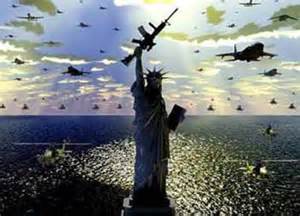
aa-American-Empire-statue-of-liberty-and-military

By Henry A. Giroux

Source: Counterpunch

The thought of security bears within it an essential risk. A state which has security as its sole task and source of legitimacy is a fragile organism; it can always be provoked by terrorism to become more terroristic.

— Giorgio Agamben

George Orwell’s nightmarish vision of a totalitarian society casts a dark shadow over the United States. The consequences can be seen clearly in the ongoing and ruthless assault on the social state, workers, unions, higher education, students, poor minorities and any vestige of the social contract. Free market policies, values, and practices with their emphasis on the privatization of public wealth, the elimination of social protections, and the deregulation of economic activity now shape practically every commanding political and economic institution in the United States. Public spheres that once offered at least the glimmer of progressive ideas, enlightened social policies, non-commodified values, and critical dialogue and exchange have been increasingly militarized—or replaced by private spaces and corporate settings whose ultimate fidelity is to increasing profit margins. Citizenship is now subsumed by the national security state and a cult of secrecy, organized and reinforced by the constant mobilization of fear and insecurity designed to produce a form of ethical tranquilization and a paralyzing level of social infantilism.

Chris Hedges crystalizes this premise in arguing that Americans now live in a society in which “violence is the habitual response by the state to every dilemma,” legitimizing war as a permanent feature of society and violence as the organizing principle of politics.[1] Under such circumstances, malevolent modes of rationality now impose the values of a militarized neoliberal regime on everyone, shattering viable modes of agency, solidarity, and hope. Amid the bleakness and despair, the discourses of militarism, danger and war now fuel a war on terrorism “that represents the negation of politics—since all interaction is reduced to a test of military strength war brings death and destruction, not only to the adversary but also to one’s side, and without distinguishing between guilty and innocent.”[2] Human barbarity is no longer invisible, hidden under the bureaucratic language of Orwellian doublespeak. Its conspicuousness, if not celebration, emerged in the new editions of American exceptionalism ushered in by the post 9/11 exacerbation of the war on terror.

In the aftermath of these monstrous acts of terrorism, there was a growing sense among politicians, the mainstream media, and conservative and liberal pundits that history as we knew it had been irrefutably ruptured. If politics seemed irrelevant before the attacks on the World Trade Center and the Pentagon, it now seemed both urgent and despairing. But history cannot be erased, and those traditional public spheres in which people could exchange ideas, debate, and shape the conditions that structured their everyday lives increasingly continued to appear to have little significance or political consequence. Already imperiled before the aftershocks of the terrorists’ attacks, democracy became even more fragile in the aftermath of 9/11. Almost fourteen years later, the historical rupture produced by the events of 9/11 has transformed a terrorist attack into a war on terror that mimics the very crimes it pledged to eliminate. The script is now familiar. Security trumped civil liberties as shared fears replaced any sense of shared responsibilities. Under Bush and Cheney, the government lied about the war in Iraq, created a torture state, violated civil liberties, and developed new antiterrorist laws, such as the USA PATRIOT ACT. It imposed a state of emergency that

justified a range of terrorist practices, including extraordinary rendition and state torture, which made it easier to undermine those basic civil liberties that protect individuals against invasive and potentially repressive government actions.[3]

Under the burgeoning of what James Risen has called the “homeland security-industrial complex,” state secrecy and organized corporate corruption filled the coffers of the defense industry along with the corporate owned security industries—especially those providing drones– who benefited the most from the war on terror.[4] This is not to suggest that security is not an important consideration for the United States. Clearly, any democracy needs to be able to defend itself, but it cannot serve, as it has, as a pretext for abandoning civil liberties, democratic values, and any semblance of justice, morality, and political responsibility. Nor can it serve as a pretext for American exceptionalism and its imperialist expansionist goals. The philosopher Giorgio Agamben has suggested rightly that under the so war on terrorism, the political landscape is changing and that “we are no longer citizens but detainees, distinguishable from the inmates of Guantanamo not by an indifference in legal status, but only by the fact that we have not yet had the misfortune to be incarcerated—or unexpectedly executed by a missile from an unmanned aircraft.”[5]

The war on terror morphed into a legitimation for state terrorism as was made clear under the willingness of the Obama administration to pardon the CIA torturers, create a “kill list”, expand the surveillance state, punish whistleblowers, and use drones to indiscriminately kill civilians—all in the name of fighting terrorists. Obama expanded the reach of the militarized state and along with Democratic and Republican Party extremists preached a notion of security rooted in personal fears rather than in a notion of social security that rallied against the deprivations and suffering produced by war, poverty, racism, and state terrorism. The war on terrorism extended the discourse, space, location, and time of war in ways that made it unbounded and ubiquitous making everyone a potential terrorists and the battlefield a domestic as well as foreign location, a foreign as well as a domestic policy issue. Obama has become the master of permanent war seeking to increase the bloated military budget—close to a trillion dollars–while “turning to lawless violence….translated into unrestrained violent interventions from Libya to Syria and back to Iraq,” including an attempt “to expand the war on ISIS in Syria and possibly send more heavy weapons to its client government in Ukraine.”[6] Fear became total and the imposition of punitive standards included not only the bombing, abduction, and torture of enemy combatants, but also the use of the police and federal troops for drug interdictions, the enforcement of zero tolerance standards in public schools, and the increasing criminalization of a range of social behaviors that extended from homelessness to violating dress codes in school.

Under the regime of neoliberalism with its war-like view of competition, its celebration of self-interest, and its disdain for democratic values and shared compassion for others, any notion of unity has been contaminated by the fog of misguided patriotism, a hatred of the other now privileged as an enemy combatant, and an insular retreat into mindless consumerism and the faux safety of gated communities. With the merging of militarism, the culture of surveillance, and a neoliberal culture of cruelty, solidarity and public trust have morphed into an endless display of violence and the ongoing militarization of visual culture and public space.[7]

The war on terror has come home as poor neighborhoods are transformed into war zones with the police resembling an occupying army. The most lethal expressions of racism have become commonplace as black men and boys such as Eric Garner and Tamir Rice are repeatedly beaten, and killed by the police.[8] As Jeffrey St. Clair has pointed out, one index of how state terrorism and lawlessness have become normalized is evident not only by the fact that the majority of Americans support torture, even though they know “it is totally ineffective as a means of intelligence gathering,” but also by the American public’s growing appetite for violence, whether it parades as entertainment or manifests itself in the growing demonization and incarceration of black and brown youth, adults, Muslims, immigrants, and others deemed as disposable.[9] It should come as no surprise that the one issue the top 2016 GOP presidential contenders agree on is that guns are the ultimate symbol of freedom in America, a “bellwether of individual liberty, a symbol of what big wants and shouldn’t have.”[10] Guns provide political theater for the new political extremists and are symptomatic less of some cockeyed defense of the second amendment than willingness to maximize the pleasure of violence and building a case for the use of deadly force both at home and abroad. As Rustom Bharacuha and Susan Sontag have argued in different contexts, “There is an echo of the pornographic in maximizing the pleasure of violence,”[11] one “that dissolves politics into pathology.”[12]

Notions of democracy increasingly appear to be giving way to the discourse of revenge, domestic security, stupidity, and war. The political reality that has emerged since the shattering crisis of 9/11 increasingly points to a set of narrow choices that are being largely set by the jingoistic right wing extremists, the defense department, conservative funded foundations, and fueled by the dominant media. War and violence now function as an aphrodisiac for a public inundated with commodities and awash in celebrity culture idiocy. This surrender to the pleasure of violence is made all the more easy by the civic illiteracy now sweeping the United States. Climate change deniers, anti-intellectuals, religious fundamentalists, and others who exhibit pride in displaying a kind of thoughtlessness exhibit a kind of political and theoretical helplessness, if not corruption, that opens the door to the wider public’s acceptance of foreign and domestic violence.

The current extremists dominating Congress are frothing at the mouth to go to war with Iran, bomb Syria into the twilight zone, and further extend the reach of the American empire through its over bloated war machine to any country that questions the use of American power. One glaring example can be found in the constant and under analyzed televised images and stories of homegrown terrorists threatening to blow up malls, schools, and any other conceivable space where the public gathers.

Other examples can be found in the militarized frothing and Islamophobia perpetrated by the Fox News Network, made concrete by the an almost fever pitched bellicosity that informs the majority of its commentaries and reactions to war on terror. Missing from the endless call for security, vengeance, and the use of state violence is the massive lawlessness produced by the United States government through targeted drone attacks on enemy combatants, the violation of civil liberties, and the almost unimaginable human suffering and hardship perpetrated through the American war machine in the Middle East, especially Iraq. Also missing is a history of lawlessness, imperialism, and torture that supported a host of authoritarian regimes propped up by the United States.

Capitalizing on the pent up emotions and needs of an angry and grieving public for revenge, fueled by an unchecked Islamophobia, almost any reportage of a terrorist attack throughout the globe, further amplifies the hyped-up language of war, patriotism, and retaliation.   Similarly, conservative talking-heads write numerous op-eds and appear on endless talk shows fanning the fires of “patriotism” by calling upon the United States to expand the war against any one of a number of Arab countries that are considered terrorist states. For example, John Bolton, writing an op-ed for the New York Times insists that all attempts by the Obama administration to negotiate an arms deal with Iran is a sign of weakness. For Bolton, the only way to deal with Iran is to launch an attack on their nuclear infrastructure. The title of his op-ed sums up the organizing idea of the article: “To Stop Iran’s Bomb, Bomb Iran.”[13]

In the current historical moment, the language of indiscriminate revenge and lawlessness seems to be winning the day. This is a discourse unconscious of its own dangerous refusal to acknowledge the important role that democratic values and social justice must play in a truly “unified” rationale response, so as to prevent the further killing of innocent people, regardless of their religion, culture, and place of occupancy in the world. Instead of viewing the current crisis as simply a new and more dangerous historical conjuncture that has nothing to learn from the past, it is crucial for the American public to begin to understand how the past might be useful in addressing what it means to live in a democracy at a time when democracy is not only viewed as an excess, but as a liability to the wishes and interests of the new extremists who now control the American government. The anti-democratic forces that define American history cannot be forgotten in the fog of political and cultural amnesia. State violence and terrorism have a long history in the United States, both in its foreign and domestic policies, and ignoring this dark period of history means that nothing will be learned from the legacy of a politics that has indulged authoritarian ideologies and embraced violence as a central measure of power, national identity, and patriotism.[14]

At stake here is the need to establish a vision of society and a global order that safeguards its most basic civil liberties and notions of human rights. Any struggle against terrorism must begin with the pledge on the part of the United States that it will work in conjunction with international organizations, especially the United Nations, a refusal to engage in any military operations that might target civilians, and that it will rethink those aspects of its foreign policy that have allied it with repressive nations in which democratic liberties and civilian lives are under siege. Crimes overlooked will be repeated and intensified just as public memory is rendered a liability in the face of the discourse of revenge, demonization, and extreme violence.

Many news commentators and journalists in the dominant press have taken up the events of September 11 within the context of World War II, invoking daily the symbols of revenge, retaliation, and war. Nostalgia is now used to justify and fuel a politics of in-security, fear, precarity, and demonization. The dominant media no longer functions in the interests of a democracy. Mainstream media supported Bush’s fabrications to justify the invasion of Iraq and never apologized for such despicable actions. It has rarely supported the heroic actions of whistleblowers such as Edward Snowden, Chelsea Manning, Thomas Drake, John Kiriakou, Jeffrey Sterling, and others.[15]

Mainstream media has largely remained mute about the pardoning of those who tortured as a matter of state policy. Against an endless onslaught of images of jets bombing countries extending from Syria and Iraq to Afghanistan and Gaza, amply supplied by the Defense Department, the dominant media connects the war abroad with the domestic struggle at home by presenting numerous stories about the endless ways in which potential terrorists might use nuclear weapons, poison the food supply, or unleash biochemical agents on the American population. The increased fear and insecurity created by such stories simultaneously serve to legitimatize a host of anti-democratic practices at home-including “a concerted attack on civil liberties, freedom of expression, and freedom of the press,”[16] and a growing sentiment on the part of the American public that people who suggest that terrorism is, in part, caused by American foreign policy should not be allowed “to teach in the public schools, work in the government, and even make a speech at a college.”[17]

This legacy of suppression has a long history in the United States, and it has returned with a vengeance in academia, especially for those academics, such as Norman Finkelstein and Steven G. Salaita, who have condemned America’s policies in the Middle East and the government’s support of the Israeli government’s policies towards Palestinians. Language itself has become militarized fed by an onslaught of extreme violence that now floods Hollywood films and the violence that dominates American television. Hollywood blockbusters such asAmerican Sniper glorify war crimes and produce demonizing views of Islam.[18] Television programs such as Spartacus, The Following,Hannibal, True Detective, Justified, and Top of the Lake intensify the pleasure quotient for viewing extreme and graphic violence to an almost unimaginable degree. Graphic violence appears to provide one of the few outlets for Americans to express what has come to resemble what could be construed as a spiritual release. Extreme violence, including the sanctioning of state torture, may be one of the few practices left that allows the American people to feel alive, to mark what it means to be close to the register of death in a way that reminds them of the ability to feel within a culture that deadens every possibility of life. Under such circumstances, the reality of violence is infantilized, transformed into forms of entertainment that produce and legitimate a carnival of cruelty. The privatization of violence does more than maximize the pleasure quotient and heighten macho ebullience, it also gives violence a fascist edge by depoliticizing a culture in which the reality of violence takes on the form of state terrorism. Authoritarianism in this context becomes hysterical because it turns politics and neoliberalism “into a criminal system and keeps working towards the expansion of the realm of pure violence, where its advancement can proceed unhindered.”[19]

The extreme visibility of violence in American culture represents a willful pedagogy of carnage and gore designed to normalize its presence in American society and to legitimate its practice and presence as a matter of common sense. Moreover, war making and the militarization of public discourse and public space also serve as an uncritical homage to a form of hyper-masculinity that operates from the assumption that violence is not only the most important practice for mediating most problems, but that it is also central to identity formation itself. Agency is now militarized and almost completely removed from any notion of civic values. We get a glimpse of this form of violent hyper-masculinity not only in the highly publicized brutality against women dished out by professional football players, but also in the endless stories of sexual abuse and violence now taking place in frat houses across America, many in some of the most prestigious colleges and universities. Violence has become the DNA of war making in the United States, escalating under Bush and Obama into a kind of war fever that embraces a death drive. As Robert J. Lifton points out,

Warmaking can quickly become associated with “war fever,” the mobilization of public excitement to the point of a collective experience with transcendence. War then becomes heroic, even mythic, a task that must be carried out for the defense of one’s nation, to sustain its special historical destiny and the immortality of its people. ..War fever tends always to be sporadic and subject to disillusionment. Its underside is death anxiety, in this case related less to combat than to fears of new terrorist attacks at home or against Americans abroad–and later to growing casualties in occupied Iraq.[20]

The war on terror is the new normal. Its adoration and intensification of violence, militarization, and state terrorism reach into every aspect of American life. Americans complain over the economic deficit but say little about the democracy and moral deficit now providing the foundation for the new authoritarianism. A police presence in our major cities showcases the visible parameters of the authoritarian state. For example, with a police force of 34,000 New York City resembles an armed camp with a force that as Thom Hartman points out is “bigger—that the active militaries of Austria, Bulgaria, Chad, the Czech Republic, Hungary, Kenya,” and a number of other countries.[21] At the same time, the Pentagon has given billions of dollars’ worth of military equipment to local police forces all over America. Is it any wonder, that minorities of color fear the police more than the gangs and criminals that haunt their neighborhoods? Militarism is one of the breeding grounds of violence in the United States and is visible in the ubiquitous gun culture, the modeling of schools after prisons, the exploding incarceration state, the paramilitarization of local police forces, the burgeoning military budget, and the ongoing attacks on protesters, dissidents, black and brown youth, and women.

Under the war on terrorism, moral panic and a culture of fear have not only redefined public space as the “sinister abode of danger, death and infection” and fueled the collective rush to “patriotism on the cheap”, it has also buttressed a “fear economy” and refigured the meaning of politics itself.[22] Defined as “the complex of military and security firms rushing to exploit the national nervous breakdown,”[23] the fear economy promises big financial gains for both the defense department, and the anti-terrorist-security sectors, primed to terror-proof everything from trash cans and water systems to shopping malls and public restrooms. The war on terrorism has been transformed into a new market, a consumer goods for the hysterical war mongers and their acolytes in the media while making politics and extension of war. Fear is no longer an attitude as much as it is a culture that functions as “the enemy of reason [while distorting] emotions and perceptions, and often leads to poor decisions.”[24] But the culture of fear does more than undermine critical judgment and suppress dissent, as Don Hazen points out, it also: “breeds more violence, mental illness and trauma, social disintegration, job failure, loss of workers’ rights, and much more. Pervasive fear ultimately paves the way for an accelerating authoritarian society with increased police power, legally codified oppression, invasion of privacy, social controls, social anxiety and PTSD.”[25]

Fear and repression reproduce rather than address the most fundamental anti-democratic elements of terrorism. Instead of mobilizing fear, people need to recognize that the threat of terrorism cannot be understood apart from the crisis of democracy itself. The greatest struggle faced by the American public is not terrorism, but a struggle on behalf of justice, freedom, and democracy for all of the citizens of the globe. This is not going to take place, as President Obama’s policies will tragically affirm, by shutting down democracy, eliminating its most cherished rights and freedoms, and deriding communities of dissent. Engaging terrorism demands more than rage and anger, revenge and retaliation. American society is broken, corrupted by the financial elite, and addicted to violence and a culture of permanent war.

The commanding institutions of American life have lost their sense of public mission, just as leadership at all levels of government is being stripped of any viable democratic vision. The United States is now governed by an economic and social orthodoxy informed by the dictates of religious and political extremists. Reform efforts that include the established political parties have resulted in nothing but regression, a form of accommodation that serves to normalized the new authoritarianism and its war on terrorism. Politics has to be thought anew and must be informed by powerful vision matched by durable organizations that include young people, unions, workers, diverse social movements, artists, and others. In part, this means reawakening the radical imagination so as to address the intensifying crisis of history and agency, and engage the ethical grammars of human suffering. To fight the neoliberal counter-revolution, workers, young people, unions, artists, intellectuals, and social movements need to create new public spaces along with a new language for enabling the American public to relate the self to public life, social responsibility, and the demands of global citizenship.

The left in the United States is too fractured and needs to develop a more comprehensive understanding of politics, oppression, and struggles as well as a discourse that arises to the level of ethical assessment and accountability. Against the new authoritarianism, progressives of all stripes need an inspiring and energizing politics that embraces coalition building, rejects the notion that capitalism equals democracy, and challenges the stolid vocabulary of embodied incapacity stripped of any sense of risk, hope, and possibility. If the struggle against the war on terrorism, militarization, and neoliberalization is to have any chance of success, it is crucial for a loyal and dedicated left to embrace a commitment to understanding the educative nature of politics, economic and social justice, and the need to build a sustainable political formation outside of the established parties.[26]

The United States is in a new historical conjuncture and as difficult as it is to admit, it is a conjuncture that shares more with the legacies of totalitarianism than with America’s often misguided understanding of democracy. Under the merging of the surveillance state, warfare state, and the harsh regime of neoliberalism, we are witnessing the death of the old system of social welfare supports and the emergence of a new society marked by the heavy hand of the national security state, the depoliticization of the American public, extreme inequities in wealth, power, income, and a new politics and mode of governance now firmly controlled by the major corporations, banks, and financial elite. This is a politics in which there is no room for democracy, and no room for reformism. The time has come to name the current historical moment as representative of the “dark times” Hannah Arendt warned us against and to begin to rethink politics anew through social movements in which the promise of a radical democracy can be reimagined in the midst of determined and systemic collective struggles. The war on terrorism has morphed into a new form of authoritarianism and its real enemy is no longer limited to potential terrorists, but includes democracy itself.

Henry A. Giroux currently holds the McMaster University Chair for Scholarship in the Public Interest in the English and Cultural Studies Department and a Distinguished Visiting Professorship at Ryerson University. His most recent books are America’s Education Deficit and the War on Youth (Monthly Review Press, 2013) and Neoliberalism’s War on Higher Education (Haymarket Press, 2014). His web site is www.henryagiroux.com.

Notes. 

[1] Chris Hedges, “America’s ‘Death Instinct’ Spreads Misery Across the World,” AlterNet, (September 30, 2014). Online:

http://www.alternet.org/world/americas-death-instinct-spreads-misery-across-world

[2] Tzvetan Todorov, Torture and the War on Terror, Translated by Gila Walker with photographs by Ryan Lobo, (Chicago, IL: Seagull Books, 2009), pp. 2-3.

[3] See, for instance, Mark Danner, Torture and Truth: America, Abu Ghraib, and the War on Terror (New York: New York Review of Books, 2004); Jane Mayer, The Dark Side: The Inside Story of How the War on Terror Turned into a War on American Ideals (New York: Doubleday, 2008); and Phillipe Sands, Torture Team (London: Penguin, 2009). On the torture of children, see Michael Haas, George W. Bush, War Criminal?: The Bush Administration’s Liability for 269 War Crimes(Westport: Praeger, 2009). Also, see Henry A. Giroux, Hearts of Darkness: Torturing Children in the War on Terror (Boulder: Paradigm, 2010).

[4] James Risen, Pay at Any Price (New York: Houghton Mifflin Harcourt, 2014).

[5] Agamben cited in Malcolm Bull, “States don’t Really Mind Their Citizens Dying: They Just don’t Like anyone Else to Kill Them,” London Review of Books (December 16, 20054), p. 3.

[6] Ajamu Baraka, “Obama’s Legacy: Permanent War and Liberal Accommodation,” Counterpunch (February 18, 2015). Online:http://www.counterpunch.org/2015/02/18/obamas-legacy-permanent-war-and-liberal-accommodation/

[7]Glenn Greenwald, No Place to Hide: Edward Snowden, the NSA, and the U.S. Surveillance State (New York: Metropolitan, 2014) and Nick Turse , The Complex: How the Military Invades Our Everyday Lives(New York: Metropolitan, 2009).

[8] Henry A. Giroux, “State Terrorism and Racist Violence in the Age of Disposability: From Emmett Till to Eric Garner – Expanded Version,”Truthout (December 2014). Online: http://truth-out.org/opinion/item/27832-state-terrorism-and-racist-violence-in-the-age-of-disposability-from-emmett-till-to-eric-garner

[9] Jeffrey St. Clair, “When Torturers Walk,” Counterpunch (March 20-22, 2015), Online: http://www.counterpunch.org/2015/03/20/when-torturers-walk/

[10] David A. Fahrenthold, ““In the hunt to be the 2016 GOP pick, top contenders agree on 1 thing: Guns,” The Washington Post (March 28, 2015). Online: http://www.washingtonpost.com/politics/republican-presidential-hopefuls-sticking-to-their-guns/2015/03/28/b2ef4a1c-d3c4-11e4-8fce-3941fc548f1c_story.html

[11] Rustom Bharacuha, “Around Adohya: Aberrations, Enigmas, and Moments of Violence,” Third Text (Autumn 1993), p. 45.

[12] Sontag cited in in Carol Becker, “The Art of Testimony,” Sculpture(March 1997), p. 28

[13] John R. Bolton, “To Stop Iran’s Bomb, Bomb Iran,” New York Times (March 26, 2015). Online:http://www.nytimes.com/2015/03/26/opinion/to-stop-irans-bomb-bomb-iran.html?_r=0

[14]  There are many valuable sources that document this history. Some exemplary texts include: A.J. Langguth, Hidden Terrors: The Truth About U.S. Police Operations in Latin America (New York: Pantheon Books, 1979); Gordon Thomas, Journey Into Madness: The True Story of Secret CIA Mind Control and Medical Abuse (New York: Bantam, 1989); Danner, Torture and Truth; Jennifer K. Harbury, Truth, Torture, and the American Way: The History and Consequences of U.S. Involvement in Torture (Boston: Beacon Press, 2005); Alfred McCoy, A Question of Torture: CIA Interrogation, from the Cold War to the War on Terror (New York: Metropolitan Books, 2006).

[15] Jamie Tarabay, “Obama and leakers: Who are the eight charged under the Espionage Act?” Aljazeerra (December 5, 3013). Online:http://america.aljazeera.com/articles/2013/12/5/obama-and-leakerswhoaretheeightchargedunderespionageact.html

[16] Eric Alterman, “Patriot Games,” The Nation (October 29, 2001), p. 10.

[17] Cited in the National Public Radio/Kaiser Family foundation/Kennedy School of Government Civil Liberties Poll. Available on line at wsiwyg:5http://www.npr.org/news…civillibertiespll/011130.poll.html (November 30, 2001), p. 3

[18] See, Henry A. Giroux, “Celluloid Heroism and Manufactured Stupidity in the Age of Empire,” Counterpunch (February 12, 2015). Online: http://www.counterpunch.org/2015/02/12/celluloid-heroism-and-manufactured-stupidity-in-the-age-of-empire/

[19] Franco Bifo Berardi, Precarious Rhapsody (New York, Autonomedia, 2009), p. 52

[20] Robert Jay Lifton, “American Apocalypse,” The Nation (December 22, 2003), pp. 12, 14.

[21] Tom Engelhardt, “Walking Back the American Twenty-First Century,” TomDispatch (February 17, 2015). Online: http://www.tomdispatch.com/dialogs/print/?id=175957

[22] Mike Davis, “The Flames of New York,” New Left Review 12 (November/December 2001), p. 44

[23] Ibid. Mike Davis, “The Flames of New York,” Ibid., p. 45.

[24] Don Hazen, “Fear Dominates Politics, Media and Human Existence in America—and it is Getting Worse,” Alternet (March 1, 2015). Online:http://www.alternet.org/fear-america/fear-dominates-politics-media-and-human-existence-america-and-its-getting-worse

[25]. Ibid.

[26]. See, for instance, Adolph Reed Jr., “Nothing Left,” Harper’s Magazine (March 2014), pp. 28-36; Stanley Aronowitz, “Democrats in Disarray: This Donkey Can’t Save Our Asses,” The Indypendent, Issue #202. (December 16, 2014) Online:

https://www.indypendent.org/2014/12/16/democrats-disarray-donkey-can%E2%80%99t-save-our-asses

Why Mumia Must Live, and US imperialism Must Die: The Link Between Political Prisoners and the War on Terror

mumia

The so-called War on Terror and the national security state did not emerge full-blown from the rubble of 9/11. Both are products of previous waves of police repression, mainly targeting Black radicals. “The FBI’s counter insurgency war on the Black Panther Party chapters and leaders like Mumia established for local police departments a direct link to Washington’s war and surveillance arsenal.”

By Danny Haiphong

Source: Black Agenda Report

The fear of the Muslim/Arab terrorist rekindles the same fear in white America that the Black liberation movement ignited over four decades ago.”

Political Prisoner and journalist Mumia Abu-Jamal has been subjected to over three decades of torture from the US prison gulag. His political imprisonment has placed his life in serious danger, this time not from state execution but instead from extra-legal medical neglect. The prison state has continuously failed in its efforts to murder Mumia through official means and has thus decided to refuse the former Black Panther adequate medical treatment for diabetes. Meanwhile, Boston residents of all classes await the verdict of whether the alleged “Boston bomber” Dzokhar Tsarnaev will receive the death penalty or life in prison. The event that faithful day remains shrouded in questions , but most of the city has accepted the dominant narrative put forth by the FBI and Boston Police Department. The War on Terror that produced the “Boston Bombing” and Mumia’s struggle against the prison state are intimately connected. For Mumia to live with freedom and dignity, the US imperial order behind the War on Terror must die.

Mumia Abu-Jamal’s existence as a political prisoner has been repressed by the establishment, while the War on Terror is a household name in the US. This is because the War on Terror serves the objectives of imperialism and Mumia does not. Mumia joined the Black Panther Party at fifteen and served as the Philadelphia Chapter’s Ministry of Information. He used his talents in journalism in service of Black people both in the BPP and after. This landed him on J. Edgar Hoover’s COINTEPRO list of Black liberation fighters to watch and suppress. In 1978, Mumia covered the Philadelphia police department’s siege on the MOVE Organization. His critical investigation of the Philly PD’s role in repressing MOVE led to his ouster from the journalism industry. In 1982, Mumia was framed for the murder of police officer Daniel Faulkner and sentenced to death.

He used his talents in journalism in service of Black people both in the BPP and after.”

The context of Mumia’s imprisonment is at the essence of US imperialism’s War on Terror, which could be better named its war of terror. In the film Manufacturing Guilt​ , Mumia’s frame-up is blatantly exposed through court documents and investigations. Yet, Mumia has lived much of his life in prison, mostly in solitary confinement. What explains this injustice and how does it relate to the current War on Terror? In Still Black, Still Strong, Dhoruba Bin-Wahad explains how the FBI’s counter insurgency war on the Black Panther Party chapters and leaders like Mumia established for local police departments a direct link to Washington’s war and surveillance arsenal. Washington’s war on Black liberation fighters precipitated the first SWAT team operation in 1969 and the FBI’s declaration that the Black Panther Party was the “greatest threat to the internal security” of the US. The war on Black freedom that jailed Mumia created the technical capacity for the War on Terror.

The recent bombing of the 2013 marathon, and 9/11 before that, created the conditions for a massive expansion of the surveillance state and police state throughout the US mainland. The hundreds of illegally detained prisoners at Guantanamo Bay, the increased surveillance of Muslims and Black people in the US, and the massive spy program instituted by the Patriot Act and similar legislation are daily reminders of US imperialism’s ever expanding repressive apparatus. Internationally, the US led War on Terror interventions have caused the loss of life of millions of people in the Middle East and Africa alongside the thousands more from US aerial drone strikes and proxy war. All of this has been justified as necessary to “counter” the so-called threat of “terrorism.”

The war on Black freedom that jailed Mumia created the technical capacity for the War on Terror.”

Mumia’s story, one shared by numerous US political prisoners sentenced to die in the cages of the prison state, contains in it the seeds that sprouted the rise of the massive War on Terror. Russell Maroon Shoatz, Oscar Lopez Rivera, Leonard Peltier and scores more faced trumped up charges from the state as part of US imperialism’s counter insurgency war on dissent generally and the Black liberation movement in particular. This war has been expanded to meet the needs of US imperialism, which in its current form has produced a potentially explosive situation domestically and globally. The sharpening contradictions of never-ending war and increasing poverty and privatization wouldn’t last long if the counter insurgency war on Mumia and the Panthers hadn’t provided the blueprints and technical support for the mass expansion of the War on Terror’s primary tools: war and surveillance state.

Mumia Abu-Jamal and the rest of the Empire’s political prisoners are caught in the cross hairs of US imperialism’s war of survival. Not only has the material basis of the counter insurgency war that murdered and imprisoned the Black liberation movement grown, but so too has the racist logic behind the repression. The War on Terror’s racist logic has permeated so deeply into the minds of the US public that the mere questioning of the agenda’s blatant deceit is subject to dismissal or defense by most people living in the US mainland. These conditions have left political prisoners with few fighters on the outside pressuring their release. The War on Terror has attempted to erase the memory of political prisoners by reframing the racist justifications for political imprisonment as common sense in what George Jackson called the “Amerikan mind.”

The War on Terror’s racist logic has permeated so deeply into the minds of the US public that the mere questioning of the agenda’s blatant deceit is subject to dismissal.”

So, even though the justification for each and every War on Terror intervention or policy since 2001 are dubious at best, the fear of the Muslim/Arab terrorist rekindles the same fear in white America that the Black liberation movement ignited over four decades ago. The Black Panther Party and their partners in struggle were deemed criminal in every way and many were falsely charged with the murder of police officers, the highest form of offense in the eyes of white America. The War on Terror built off this strategy by throwing the Muslim community into the racist war on the oppressed as a means to control the dissent of the entire population. That the US imperial machinery is complicit in, and a sponsor of, jihadist terror and proxy war matters as little as the innocence of political prisoners when it comes to preserving the Empire and criminalizing all resistance to its rule.

Mumia Abu-Jamal’s life needs to be saved by any means necessary, but fighting to free him based on his criminal case alone won’t develop the movement we need. One of the primary obstacles to building a concrete movement for the freedom of political prisoners is the privileging of innocence over a movement that links political prisoners to the repression of the imperial state. But Mumia’s innocence teaches us the real purpose of political imprisonment. The War on Terror is a consolidation of the forces that were built by imperialism to suppress the revolutionary ideas of Mumia Abu-Jamal. What we need is a reexamination of those ideas in the service of the freedom of all political prisoners. By studying the War on Terror and the repression of the Black Liberation movement from which it grew, it becomes increasingly clear that imperialism must die for Mumia to truly live.

Danny Haiphong is an organizer for Fight Imperialism Stand Together (FIST) in Boston. He is also a regular contributor to Black Agenda Report. Danny can be reached at wakeupriseup1990@gmail.com and FIST can be reached at bostonfist@gmail.com.

The Difference Between the Death Star and the Pentagon

StarWarsPentagon

By Carey Wedler

Source: The Anti-Media

The Imperial Death Star from Star Wars and the Pentagon have much in common. It is not difficult to observe the similarities between the two behemoth structures and what they represent-especially in recent years.

For one, both used to be part of representative republics and both represent the military wings of the empires in power. In 2007, Alternet reported that the U.S. had 737 bases, 38 of which were “major,” and that

“…perhaps the optimum number of major citadels and fortresses for an imperialist aspiring to dominate the world is somewhere between thirty-five and forty.”

The desire of the military’s operatives to exert control over regions all over the world parallels the desire of the Emperor and Vader to rule the galaxy.

Another similarity is the desire of both the Death Star’s leaders and those at the Pentagon to weed out dissent. One of the main objectives of the dark side’s adherents is to find the rebels and eliminate them.

Though the Pentagon hasn’t quite started assassinating political dissidents (or entire planets, though Hiroshima and Nagasaki are an earthly comparison to Alderaan), it has made its views crystal clear: protesters are a form of terrorist and anyone deemed associated with terrorism may be denied his or her rights.

Still another commonality between the two ministries of war and destruction is the level of decadence afforded to the galactic and American agencies. The Death Star was a moon-sized, laser-clad behemoth for the Dark Side. The Pentagon employs 23,000 people in a floor space three times the size of the Empire state building and spawns doomsday technology. In both societies, the resources devoted to violence far outweigh those dedicated to promoting peace or the well-being of humanity (or alienhood).

It is easy to compare the Death Star and the Pentagon as manifestations of evil that seek power and rule by force. But there exists at least one stark difference:

In the Washington Post this week, it was revealed that the Pentagon is looking for someone to fill its “Yoda” position.

The job ad for “Director of the Office of Net Assessment” currently reads:

“The Director’s primary function is to develop assessments that compare the standings, trends and future prospects of U.S. military capability and military potential with that of other countries.”

The job was founded and held by longtime analyst Andrew W. Marshall, who recently retired. Because of his wisdom and knowledge throughout the years, he came to be known as “Yoda.”

And therein lies the difference between the rulers of the Death Star and the rulers of the Pentagon: at least Darth Vader, the emperor and their cohorts knew they were evil.

Vader repeatedly spoke of the powers of the Dark Side, of the great benefit of crossing over into evil. In the Empire Strikes Back, he tempted Luke to join the dark side to rule the galaxy with him:

“Luke, you can destroy the Emperor. He has foreseen this. It is your destiny, join me and together we can rule the galaxy as father and son.”

He iterated the slavery of being on the dark side in Return of the Jedi:

“You don’t know the power of the dark side. I must obey my master.”

Considering the empire practices what is called the “dark side” of the force, its members knew exactly what they signed up for.

But to a clearly significant portion of employees at the Pentagon, the irony is lost. It has gone over their heads that working for the world’s biggest, arguably most vicious military, is not working on the side of morality, peace, or freedom.

By calling a man who works for the Pentagon “Yoda”-a virtuous practitioner of the force- it is clear that many who work for the Pentagon believe they are working for a “force” of good. It’s scary. It’s scarier that the Pentagon likely has employees who know of its evil and yet continue to work there.

May all Pentagon employees recognize its evil, quit their jobs at the American Death Star, and work to promote the true meaning of the “force” (the same goes for soldiers of governments around the world). As the real Yoda said:

“Fear is the path to the dark side. Fear leads to anger. Anger leads to hate. Hate leads to suffering.”

This is exactly how violent governments keep their people and foot soldiers under control and realizing this is the first step to achieving freedom and peace.