Reckless Congress ‘Declares War’ on Russia

Ron_Paul_0723

By Ron Paul

Source: The Ron Paul Institute

Today the US House passed what I consider to be one of the worst pieces of legislation ever. H. Res. 758 was billed as a resolution “strongly condemning the actions of the Russian Federation, under President Vladimir Putin, which has carried out a policy of aggression against neighboring countries aimed at political and economic domination.”

In fact, the bill was 16 pages of war propaganda that should have made even neocons blush, if they were capable of such a thing.

These are the kinds of resolutions I have always watched closely in Congress, as what are billed as “harmless” statements of opinion often lead to sanctions and war. I remember in 1998 arguing strongly against the Iraq Liberation Act because, as I said at the time, I knew it would lead to war. I did not oppose the Act because I was an admirer of Saddam Hussein – just as now I am not an admirer of Putin or any foreign political leader – but rather because I knew then that another war against Iraq would not solve the problems and would probably make things worse. We all know what happened next.

That is why I can hardly believe they are getting away with it again, and this time with even higher stakes: provoking a war with Russia that could result in total destruction!

If anyone thinks I am exaggerating about how bad this resolution really is, let me just offer a few examples from the legislation itself:

The resolution (paragraph 3) accuses Russia of an invasion of Ukraine and condemns Russia’s violation of Ukrainian sovereignty. The statement is offered without any proof of such a thing. Surely with our sophisticated satellites that can read a license plate from space we should have video and pictures of this Russian invasion. None have been offered. As to Russia’s violation of Ukrainian sovereignty, why isn’t it a violation of Ukraine’s sovereignty for the US to participate in the overthrow of that country’s elected government as it did in February? We have all heard the tapes of State Department officials plotting with the US Ambassador in Ukraine to overthrow the government. We heard US Assistant Secretary of State Victoria Nuland bragging that the US spent $5 billion on regime change in Ukraine. Why is that OK?

The resolution (paragraph 11) accuses the people in east Ukraine of holding “fraudulent and illegal elections” in November. Why is it that every time elections do not produce the results desired by the US government they are called “illegal” and “fraudulent”? Aren’t the people of eastern Ukraine allowed self-determination? Isn’t that a basic human right?

The resolution (paragraph 13) demands a withdrawal of Russia forces from Ukraine even though the US government has provided no evidence the Russian army was ever in Ukraine. This paragraph also urges the government in Kiev to resume military operations against the eastern regions seeking independence.

The resolution (paragraph 14) states with certainty that the Malaysia Airlines flight 17 that crashed in Ukraine was brought down by a missile “fired by Russian-backed separatist forces in eastern Ukraine.” This is simply incorrect, as the final report on the investigation of this tragedy will not even be released until next year and the preliminary report did not state that a missile brought down the plane. Neither did the preliminary report – conducted with the participation of all countries involved – assign blame to any side.

Paragraph 16 of the resolution condemns Russia for selling arms to the Assad government in Syria. It does not mention, of course, that those weapons are going to fight ISIS – which we claim is the enemy — while the US weapons supplied to the rebels in Syria have actually found their way into the hands of ISIS!

Paragraph 17 of the resolution condemns Russia for what the US claims are economic sanctions (“coercive economic measures”) against Ukraine. This even though the US has repeatedly hit Russia with economic sanctions and is considering even more!

The resolution (paragraph 22) states that Russia invaded the Republic of Georgia in 2008. This is simply untrue. Even the European Union – no friend of Russia – concluded in its investigation of the events in 2008 that it was Georgia that “started an unjustified war” against Russia not the other way around! How does Congress get away with such blatant falsehoods? Do Members not even bother to read these resolutions before voting?

In paragraph 34 the resolution begins to even become comical, condemning the Russians for what it claims are attacks on computer networks of the United States and “illicitly acquiring information” about the US government. In the aftermath of the Snowden revelations about the level of US spying on the rest of the world, how can the US claim the moral authority to condemn such actions in others?

Chillingly, the resolution singles out Russian state-funded media outlets for attack, claiming that they “distort public opinion.” The US government, of course, spends billions of dollars worldwide to finance and sponsor media outlets including Voice of America and RFE/RL, as well as to subsidize “independent” media in countless counties overseas. How long before alternative information sources like RT are banned in the United States? This legislation brings us closer to that unhappy day when the government decides the kind of programming we can and cannot consume – and calls such a violation “freedom.”

The resolution gives the green light (paragraph 45) to Ukrainian President Poroshenko to re-start his military assault on the independence-seeking eastern provinces, urging the “disarming of separatist and paramilitary forces in eastern Ukraine.” Such a move will mean many more thousands of dead civilians.

To that end, the resolution directly involves the US government in the conflict by calling on the US president to “provide the government of Ukraine with lethal and non-lethal defense articles, services, and training required to effectively defend its territory and sovereignty.” This means US weapons in the hands of US-trained military forces engaged in a hot war on the border with Russia. Does that sound at all like a good idea?

There are too many more ridiculous and horrific statements in this legislation to completely discuss. Probably the single most troubling part of this resolution, however, is the statement that “military intervention” by the Russian Federation in Ukraine “poses a threat to international peace and security.” Such terminology is not an accident: this phrase is the poison pill planted in this legislation from which future, more aggressive resolutions will follow. After all, if we accept that Russia is posing a “threat” to international peace how can such a thing be ignored? These are the slippery slopes that lead to war.

This dangerous legislation passed today, December 4, with only ten (!) votes against! Only ten legislators are concerned over the use of blatant propaganda and falsehoods to push such reckless saber-rattling toward Russia.

Here are the Members who voted “NO” on this legislation. If you do not see your own Representative on this list call and ask why they are voting to bring us closer to war with Russia! If you do see your Representative on the below list, call and thank him or her for standing up to the warmongers.

Voting “NO” on H. Res. 758:

1) Justin Amash (R-MI)
2) John Duncan (R-TN)
3) Alan Grayson, (D-FL)
4) Alcee Hastings (D-FL)
5) Walter Jones (R-NC)
6) Thomas Massie (R-KY)
7) Jim McDermott (D-WA)
8 George Miller (D-CA)
9) Beto O’Rourke (D-TX)
10 Dana Rohrabacher (R-CA)


US War on Iran Takes Bizarre Turn

mek

By Tony Cartalucci

Source: Land Destroyer Report

It is not merely hyperbole when it is said the US created terrorist organizations like Al Qaeda or the so-called “Islamic State.” It is documented fact. The current conflict in the Middle East may appear to be a chaotic conflagration beyond the control of the United States and its many eager allies, but in reality it is the intentional, engineered creation of regional fronts in a war against Iran and its powerful arc of influence.

It is not Western policy that indirectly spurs the creation and perpetuation of terrorist organizations, but in fact, direct, intentional, unmistakable support.

This support would manifest itself in perhaps the most overt and bizarre declaration of allegiance to terrorism to date, US Army General Hugh Shelton on stage before terrorists of the Mujahedeen-e-Khalq (MEK) and their Wahabist counterparts fighting in Syria, hysterically pledging American material, political, and strategic backing. MEK was listed for years by the US State Department as a foreign terrorist organization, but has received funding, arms, and safe haven by the United States for almost as long.

General Hugh’s speech titled, “Making Iranian mullahs fear, the MEK, come true,” was most likely never meant to be seen or fully understood by Americans. In titled alone, it is clear that US foreign policy intends to use the tool of terrorism to exact concessions from Tehran. If the true nature of America’s support for terrorist organizations like MEK were more widely known, the current narrative driving US intervention in Iraq and Syria would crumble.

MEK Has Killed US Servicemen, Contractors, and Iranian Civilians For Decades

MEK has carried out decades of brutal terrorist attacks, assassinations, and espionage against the Iranian government and its people, as well as targeting Americans including the attempted kidnapping of US Ambassador Douglas MacArthur II, the attempted assassination of USAF Brigadier General Harold Price, the successful assassination of Lieutenant Colonel Louis Lee Hawkins, the double assassinations of Colonel Paul Shaffer and Lieutenant Colonel Jack Turner, and the successful ambush and killing of American Rockwell International employees William Cottrell, Donald Smith, and Robert Krongard.

Admissions to the deaths of the Rockwell International employees can be found within a report written by former US State Department and Department of Defense official Lincoln Bloomfield Jr. on behalf of the lobbying firm Akin Gump in an attempt to dismiss concerns over MEK’s violent past and how it connects to its current campaign of armed terror – a testament to the depths of depravity from which Washington and London lobbyists operate.

To this day MEK terrorists have been carrying out attacks inside of Iran killing political opponents, attacking civilian targets, as well as carrying out the US-Israeli program of targeting and assassinating Iranian scientists. MEK terrorists are also suspected of handling patsies in recent false flag operations carried out in India, Georgia, and Thailand, which have been ham-handedly blamed on the Iranian government by the United States and Israel.

MEK is described by Council on Foreign Relations Senior Fellow Ray Takeyh as a “cult-like organization” with “totalitarian tendencies.” While Takeyh fails to expand on what he meant by “cult-like” and “totalitarian,” an interview with US State Department-run Radio Free Europe-Radio Liberty reported that a MEK Camp Ashraf escapee claimed the terrorist organization bans marriage, using radios, the Internet, and holds many members against their will with the threat of death if ever they are caught attempting to escape.

US Has Been Eagerly Supporting MEK Terrorists For Years

Besides providing MEK terrorists with now two former US military bases in Iraq as safe havens, the US has conspired to arm, fund, and back MEK for years in a proxy war against Iran.

Covert support for the US-listed terrorist group Mujahedeen e-Khalq (MEK) has been ongoing since at least 2008 under the Bush administration, when Seymour Hersh’s 2008 New Yorker article “Preparing the Battlefield,” reported that not only had MEK been considered for their role as a possible proxy, but that the US had already begun arming and financing them to wage war inside Iran:

The M.E.K. has been on the State Department’s terrorist list for more than a decade, yet in recent years the group has received arms and intelligence, directly or indirectly, from the United States. Some of the newly authorized covert funds, the Pentagon consultant told me, may well end up in M.E.K. coffers. “The new task force will work with the M.E.K. The Administration is desperate for results.” He added, “The M.E.K. has no C.P.A. auditing the books, and its leaders are thought to have been lining their pockets for years. If people only knew what the M.E.K. is getting, and how much is going to its bank accounts—and yet it is almost useless for the purposes the Administration intends.

Seymore Hersh in an NPR interview, also claims that select MEK members have already received trainingin the US.

More recently, the British Daily Mail published a stunning admission by “US officials” that Israel is currently funding, training, arming, and working directly with MEK. The Daily Mail article states:

U.S. officials confirmed today that Israel has been funding and training Iranian dissidents to assassinate nuclear scientists involved in Iran’s nuclear program. Washington insiders confirmed there is a close relationship between Mossad and MEK.

In 2009, an extensive conspiracy was formulated within US policy think-tank Brookings Institution’s 2009 “Which Path to Persia?” report, proposing to fully arm, train, and back MEK as it waged a campaign of armed terror against the Iranian people. In their report, they openly conspire to use what is an admitted terrorist organization as a “US proxy” (emphasis added):

“Perhaps the most prominent (and certainly the most controversial) opposition group that has attracted attention as a potential U.S. proxy is the NCRI (National Council of Resistance of Iran), the political movement established by the MEK (Mujahedin-e Khalq). Critics believe the group to be undemocratic and unpopular, and indeed anti-American.

In contrast, the group’s champions contend that the movement’s long-standing opposition to the Iranian regime and record of successful attacks on and intelligence-gathering operations against the regime make it worthy of U.S. support. They also argue that the group is no longer anti-American and question the merit of earlier accusations. Raymond Tanter, one of the group’s supporters in the United States, contends that the MEK and the NCRI are allies for regime change in Tehran and also act as a useful proxy for gathering intelligence. The MEK’s greatest intelligence coup was the provision of intelligence in 2002 that led to the discovery of a secret site in Iran for enriching uranium.

Despite its defenders’ claims, the MEK remains on the U.S. government list of foreign terrorist organizations. In the 1970s, the group killed three U.S. officers and three civilian contractors in Iran. During the 1979-1980 hostage crisis, the group praised the decision to take America hostages and Elaine Sciolino reported that while group leaders publicly condemned the 9/11 attacks, within the group celebrations were widespread.

Undeniably, the group has conducted terrorist attacks—often excused by the MEK’s advocates because they are directed against the Iranian government. For example, in 1981, the group bombed the headquarters of the Islamic Republic Party, which was then the clerical leadership’s main political organization, killing an estimated 70 senior officials. More recently, the group has claimed credit for over a dozen mortar attacks, assassinations, and other assaults on Iranian civilian and military targets between 1998 and 2001. At the very least, to work more closely with the group (at least in an overt manner), Washington would need to remove it from the list of foreign terrorist organizations.”

Besides US Army General Hugh Shelton, other prominent US politicians to literally stand before crowds of baying MEK terrorists and their supporters include former New York City Mayor Rudy Giuliani, Howard Dean, Tom Ridge, John Lewis, Ed Rendell, former ambassador John Bolton, former FBI Director Louis Freeh, retired General Wesley Clark, Lee Hamilton, former US Marine Corps Commandant General James Jones, and Alan Dershowitz. US Congresswoman Nancy Pelosi would also stand in front of MEK terrorists to deliver to them an Iranian New Year “greeting.”

Blind Lust for Global Hegemony is Leading America Over a Cliff 

What it says about American foreign policy, to trick US servicemen and women into dying in far off lands to “fight terrorism” when US politicians in the highest positions of power openly pledge support to terrorism – using it as a battering ram against its enemies abroad, and failing to topple them by proxy, using their own terrorist hordes as a pretext for direct military intervention to do so – is that such policy is underpinned by nothing more than blind lust for power, wealth, and influence in senseless pursuit of global hegemony. There is no guiding principles of peace, stability, democracy, freedom, or any confining principles of humanity that prohibit US foreign policy from exercising the most abhorrent practices in order to achieve its goals.

For America and the Western aligned nations and interests caught in its orbit, there is no future. Chasing hegemony for the sake of hegemony alone leaves no room for actual progress. When anything and everything obstructing the path to hegemony is seen as an “enemy” to be destroyed by any means necessary, that includes setting aside resources and attention to solving some of the most pressing issues of our time – health care, infrastructure, education, better jobs, peace, and prosperity. All of these are seen as obstacles toward hegemony, and the very same interests standing before MEK terrorists pledging America’s resources to their campaign of terrorism against Iran, are the same interests calling for and implementing austerity upon the American people to continuously fuel its foreign adventures.

Failure to identify these interests blindly chasing hegemony at the cost of global peace and prosperity leads not only America over a cliff into a ravine of madness, but the entire world as well. That a US general can stand before terrorists even as the US bombs two nations in the name of fighting terrorism, is but a glimpse into this madness.

Tony Cartalucci, Bangkok-based geopolitical researcher and writer, especially for the online magazine New Eastern Outlook”.

Clear as Mud

Middle East Explained_0The current state of U.S. foreign policy in a nutshell:

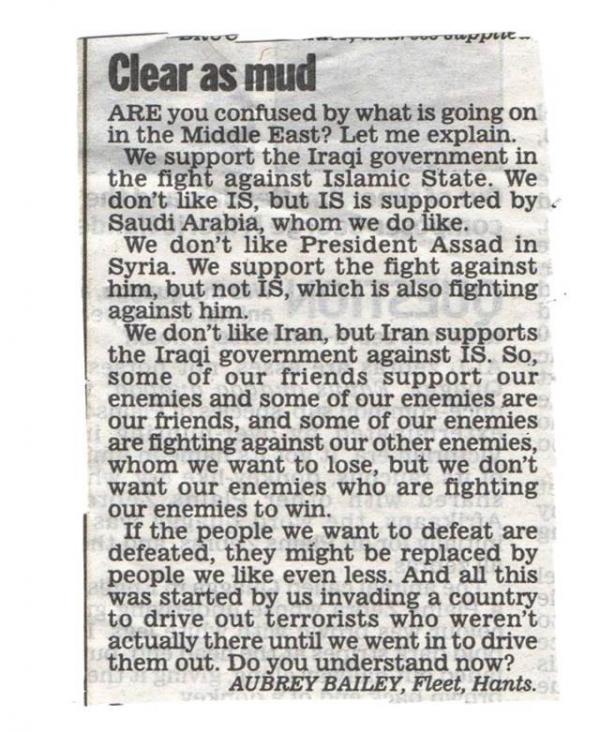
Are you confused by what is going on in the Middle-East? Let me explain. We support the Iraqi government in its fight against Islamic State (IS/ISIL/ISIS). We don’t like IS but IS is supported by Saudi Arabia whom we do like. We don’t like President Assad in Syria. We support the fight against him, but not IS, which is also fighting against him.

We don’t like Iran, but the Iranian government supports the Iraqi gov’t against IS. So, some of our friends support our enemies and some of our enemies are our friends, and some of our enemies are fighting our other enemies, whom we don’t want to lose, but we don’t want our enemies who are fighting our enemies to win.

If the people we want to defeat are defeated, they might be replaced by people we like even less. And, all this was started by us invading a country to drive out terrorists who weren’t actually there until we went in to drive them out – do you understand now?

There is no reasoning with an empire waging a world war of deception

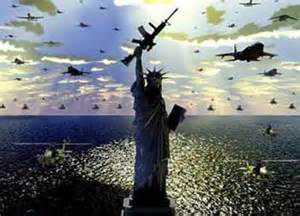
aa-American-Empire-statue-of-liberty-and-military

By Larry Chin

Source: Intrepid Report

On September 24, 2014, the United Nations passed a resolution paving the way to open-ended “anti-terror” warfare against the Islamic State (IS), the “network of death,” promising a war that will “last for years.”

The “war on the Islamic State” is a lie. It is the same fetid Big Lie that is the “war on terrorism,” reheated and updated with new, bloodier special effects, new propaganda, a familiar but revised cast of demonic villains and a new military attack calendar.

Three thousand lives were sacrificed on 9/11 for the fabricated “war on terrorism” against “Al-Qaeda” and Osama bin Laden. Now, thirteen years of continuous imperial onslaught and tens of thousands of deaths and atrocities later, the “Islamic State” escalation will topple Syria, Iran, transform Iraq, and provide yet another pretext to wreak havoc anywhere else the empire wishes.

But it is the same lie, built on the same propaganda cornerstones: the myth of the “outside enemy,” the threat of “Islamic terror,” eternal pretexts to galvanize public opinion behind an Anglo-American agenda of conquest and war that will never end.

It is the same lie, founded upon the idea that “Islamic terrorists” are enemies of the West, when, in amply documented fact, these terrorists are the West’s finest foot soldiers and military-intelligence assets.

The Islamic State, like Al-Qaeda and all entities that comprise the “Islamic Jihad” is a creation of the CIA and Anglo-American intelligence (Pakistan’s ISI, Saudi intelligence, British MI6, the Israeli Mossad, etc.). The various jihadist militias and military-intelligence assets and fronts—IS, Al-Qaeda, Al-Nusrah, etc.—are “American made,” openly supported and utilized by the United States and its allies, as they have been continuously from the Cold War to this very second. These forces are carefully manipulated and guided weapons for US-NATO. Terrorists are instrumental to the ongoing US-led covert and overt operations in Syria. Terrorists run by the US and CIA destabilized and toppled Libya, are integral to coming regime changes. Under both direct and indirect orders of US-NATO sponsors and handlers, these “demon hordes” are, and will continue to be, the leading military-intelligence assets behind every major geostrategic action in the region.

The IS joins Al-Qaeda as today’s favorite “boogeyman” target. The war masks the true intent, which is the toppling of Syria and Iran, and onward.

The “terrorists” are depicted in propaganda as either villains or “freedom fighters,” depending on the day and the military theater. The horrific acts of the death squads, including beheadings and other atrocities, are standard operating procedure in CIA black operations, terror techniques going back to the Vietnam War and the Phoenix Program, and are done upon orders of US and US-allied military-intelligence. Decapitations of Syrian civilians have been ongoing for years, to media silence. The recent spate of beheadings of Americans and British have been selectively carried out (and in some cases staged) for propaganda purposes. Political theater designed to galvanize the dimwitted, ignorant masses to support massive retaliatory war.

According to recent polls, four out of five registered American voters overwhelmingly support military attacks against the Islamic State. The acquiescent, ignorant American masses, still irretrievably pacified by the propaganda “shock and fear” effect of 9/11, enthusiastically back any “retaliation” against “bad guys who cut off heads” and “threaten America,” and have no problem sending American youth to the front lines to be cannon fodder. They are “defending freedom.” The American sheeple believe—even love to believe—the Big Lie. Whereas the citizens of Hong Kong and in other countries take passionately to the streets to fight for their democracy, the average American has long abdicated his and her duty as an informed, vigilant citizen. Far too busy shooting nude selfies on handheld gadgets—their brains addled by inane entertainment, and Hollywood celebrations of the national security apparatus—to care.

So-called liberals and progressives also back action against the Islamic State. The few who have any inkling that Islamic terror is a product of the US war machine wind up wringing their sweaty hands over the red herring of “blowback”: the tired idea that the US created but lost control of a Jihadist force that it now must contain. It is bogus. These militias are the American empire’s key foot soldiers and operatives, the leading force behind plans to topple Syria, just as they were in Libya. This is not blowback, but a well orchestrated military-intelligence operation, cloaked beneath a criminal conspiracy that is maintained by an ironclad elite consensus.

Islamic terrorism “stops” the minute that its sponsors at CIA, MI, ISI, etc. stop using it. The war itself stops when the elites who have planned this Final Solution to seize control of the last remaining oil supplies on the planet—the very life blood of the Anglo-American empire—stop, and give up their war of conquest and greed. The entire apparatus collapses. But this will not happen in this lifetime. Not even in the event of planetary calamity.

To threaten humanity, to pretend to wage war against boogeyman that they themselves created, and continue to support and use, only those of world class evil could conceive of and carry out this horror.

The American network of death goose-steps to the abyss

With each passing day, more of the Anglo-American empire’s veneer falls away, revealing the violence at its core.

Leading the charge in front of the United Nations, the mendacious President Barack Obama thundered: “No God condones this terror. There can be no reasoning—no negotiation—with this brand of evil. The only language understood by killers like this is the language of force.”

Here was a performance directly out of the playbook of the Third Reich and Bush/Cheney, brimming with threats, false morality, pseudo-religious claptrap, and invective directed against the perceived enemies. Here was Obama being who he really is, a war criminal. The ghost of Hitler has to be envious.

No God condones deceit. No God condones the terror of the Anglo-American empire’s war of conquest. No God condones the extermination of tens of thousands of lives in more than a decade of imperial conquest for oil.

There is no reasoning—no negotiation—with the criminal leadership of an empire that will thrash and kill to the brink of extinction. There is no reasoning—no negotiation—with warmongers who have wiped out entire swaths of humanity.

There is no reasoning—no negotiation—with an empire so desperate and out of answers that gangsterism replaces the rule of law, and false flag operations constitute foreign policy. There is no reasoning with those who could, in the span of just a few months, set off false flag destabilizations in Syria, false flag operations in support of a neo-Nazi cabal in Ukraine, plan and cover up the false flag shootdown of Flight MH-17 (blamed on Russia), support the bombing and conquest of Gaza by Israel (blamed on Hamas, in the wake of the murder of Israeli teenagers by ISIL terrorists), and set off the “sudden” rise of the Islamic State.

There is no reasoning—no negotiation—with an empire that must and will stop at nothing to control every inch of the Eurasian subcontinent, and destroy all opposition along the way, including potential nuclear confrontations with Russia and China.

There is no reasoning—no negotiation—with the functionaries and enablers of this empire in governments, in media, everywhere. There is also no reasoning—no negotiation—with the cognitively impaired sheeple.

There is no reasoning—no negotiation—with the killers, the world planning orchestrators speaking the “language of force”; these “great men and women” who hold humanity in contempt.

There is, indeed, no reasoning—no negotiation—with this brand of evil.

Larry Chin is an Associate Editor of Intrepid Report.


The US and Global Wars: Empire or Vampire?

GIF by WhatReallyHappened.com

GIF by WhatReallyHappened.com

By James Petras

Source: Axis of Logic

Introduction

To the growing army of critics of US military intervention, who also reject the mendacious claims by American officials and their apologists of ‘world leadership’, Washington is engaged in ‘empire-building”.

But the notion that the US is building an empire, by engaging in wars to exploit and plunder countries’ markets, resources and labor, defies the realities of the past two decades. US wars, including invasions, bombings, occupations, sanctions, coups and clandestine operations have not resulted in the expansion of markets, greater control and exploitation of resources or the ability to exploit cheap labor. Instead US wars have destroyed enterprises, reduced access to raw materials, killed, wounded or displaced productive workers around the world, and limited access to lucrative investment sites and markets via sanctions.

In other words, US global military interventions and wars have done the exact opposite of what all previous empires have pursued: Washington has exploited (and depleted) the domestic economy to expand militarily abroad instead of enriching it.

Why and how the US global wars differ from those of previous empires requires us to examine (1) the forces driving overseas expansion; (2) the political conceptions accompanying the conquest, the displacement of incumbent rulers and the seizure of power and; (3) the reorganization of the conquered states and the accompanying economic and social structures to sustain long-term neo-colonial relations.

Empire Building: The Past

Europe built durable, profitable and extensive empires, which enriched the ‘mother country’, stimulated local industry, reduced unemployment and ‘trickled down’ wealth in the form of better wages to privileged sectors of the working class. Imperial military expeditions were preceded by the entry of major trade enterprises (British East India Company) and followed by large-scale manufacturing, banking and commercial firms. Military invasions and political takeovers were driven by competition with economic rivals in Europe, and later, by the US and Japan.

The goal of military interventions was to monopolize control over the most lucrative economic resources and markets in the colonized regions. Imperial repression was directed at creating a docile low wage labor force and buttressing subordinate local collaborators or client-rulers who facilitated the flow of profits, debt payments, taxes and export revenues back to the empire.

Imperial wars were the beginning, not the end, of ‘empire building’. What followed these wars of conquest was the incorporation of pre-existing elites into subordinate positions in the administration of the empire. The ‘sharing of revenues’, between the imperial economic enterprises and pre-existing elites, was a crucial part of ‘empire building’. The imperial powers sought to ‘instrumentalize’ existing religious, political, and economic elites’ and harness them to the new imperial-centered division of labor. Pre-existing economic activity, including local manufacturers and agricultural producers, which competed with imperial industrial exporters, were destroyed and replaced by malleable local traders and importers (compradors). In summary, the military dimensions of empire building were informed by economic interests in the mother country. The occupation was pre-eminently concerned with preserving local collaborative powers and, above all, restoring and expanding the intensive and extensive exploitation of local resources and labor, as well as the capture and saturation of local markets with goods from the imperial center.

“Empire-building” Today

The results of contemporary US military interventions and invasions stand in stark contrast with those of past imperial powers. The targets of military aggression are selected on the basis of ideological and political criteria. Military action does not follow the lead of ‘pioneer’ economic entrepreneurs – like the British East India Company. Military action is not accompanied by large-scale, long-term capitalist enterprises. Multi-national construction companies of the empire, which build great military bases are a drain on the imperial treasury.

Contemporary US intervention does not seek to secure and take over the existing military and civilian state apparatus; instead the invaders fragment the conquered state, decimate its cadres, professionals and experts at all levels, thus providing an entry for the most retrograde ethno-religious, regional, tribal and clan leaders to engage in intra-ethnic, sectarian wars against each other, in other words – chaos. Even the Nazis, in their expansion phase, chose to rule through local collaborator elites and maintained established administrative structures at all levels.

With US invasions, entire existing socio-economic structures are undermined, not ‘taken over’: all productive activity is subject to the military priorities of leaders bent on permanently crippling the conquered state and its advanced economic, administrative, educational, cultural and social sectors. While this is militarily successful in the short-run, the medium and long-term results are non-functioning states, not a sustained inflow of plunder and expanding market for an empire. Instead what we have is a chain of US military bases surrounded by a sea of hostile, largely unemployed populations and warring ethno-religious groups in decimated economies.

The US claims to ‘world leadership’ is based exclusively on failed-state empire building. Nevertheless, the dynamic for continuing to expand into new regions, to militarily and politically intervene and establish new client entities continues. And, most importantly, this expansionist dynamic further undermines domestic economic interests, which, theoretically and historically, form the basis for empire. We, therefore, have imperialism without empire, a vampire state preying on the vulnerable and devouring its own in the process.

Empire or Vampire: The Results of US Global Warfare

Empires, throughout history, have violently seized political power and exploited the riches and resources (both material and human) of the targeted regions. Over time, they would consolidate a ‘working relation’, insuring the ever-increasing flow of wealth into the mother country and the expanding presence of imperial enterprises in the colony. Contemporary US military interventions have had the opposite effect after every recent major military conquest and occupation.

Iraq: Vampires Pillage

Under Saddam Hussein, the Republic of Iraq was a major oil producer and profitable partner for major US oil companies, as well as a lucrative market for US exports. It was a stable, unified secular state. The first Gulf War in the 1990s led to the first phase of its fragmentation with the de facto establishment of a Kurdish mini-state in the north under US protection. The US withdrew its military forces but imposed brutal economic sanctions limiting economic reconstruction from the devastation of the first Gulf War. The second US-led invasion and full-scale occupation in 2003 devastated the economy and dismantled the state dismissing tens of thousands of experienced civil servants, teachers and police. This led to utter social collapse and fomented ethno-religious warfare leading to the killing, wounding or displacement of millions of Iraqis. The result of GW Bush’s conquest of Baghdad was a ‘failed state’. US oil and energy companies lost billions of dollars in trade and investment and the US economy was pushed into recession.

Afghanistan: Endless Wars, Endless Losses

The US war against Afghanistan began with the arming, financing and political support of Islamist jihadi-fundamentalists in 1979. They succeeded in destroying and dismantling a secular, national government. With the decision to invade Afghanistan in October 2001 the US became an occupier in Southwest Asia. For the next thirteen years, the US-puppet regime of Hamad Karzai and the ‘NATO coalition’ occupation forces proved incapable of defeating the Taliban guerrilla army. Billions of dollars were spent devastating the economy and impoverishing the vast majority of Afghans. Only the opium trade flourished. The effort to create an army loyal to the puppet regime failed. The forced retreat of US armed forces beginning in 2014 signals the bitter demise of US ‘empire building’ in Southwest Asia.

Libya: From Lucrative Trading Partner to Failed State

Libya, under President Gadhafi, was evolving into a major US and European trading partner and influential power in Africa. The regime signed large-scale, long-term contracts with major international oil companies that were backed by a stable secular government. The relationship with the US and EU was profitable. The US opted to impose a ‘regime change’ through massive US-EU missile and bombing strikes and the arming of a motley collection of Islamist terrorists, ex-pat neo-liberals and tribal militias. While these attacks succeeded in killing President Gadhafi and most of his family (including many of his grandchildren) and dismantling the secular Libyan government and administrative infrastructure, the country was ripped apart by tribal war-lord conflicts, political disintegration and the utter destruction of the economy. Oil investors fled. Over one million Libyans and immigrant workers were displaced. The US and EU ‘partners-in-regime-change’ have even fled their own embassies in Tripoli – while the Libyan ‘parliament’ operates off-shore from a casino boat. None of this devastation would have been possible under President Gadhafi. The US vampire bled its new prize, Libya, but certainly could not incorporate it into a profitable ‘empire’. Not only were its oil resources denied to the empire, but even oil exports disappeared. Not even an imperial military base has been secured in North Africa!

Syria: Wars on Behalf of Terrorists not Empire

Washington and its EU allies backed an armed uprising in Syria hoping to install a puppet regime and bring Damascus into their “empire”. The mercenary assaults have caused the deaths of nearly 200,000 Syrians, the displacement of over 30% of the population and the seizure of the Syrian oil fields by the Sunni extremist army, ISIS. ISIS has decimated the pro-US mercenary army, recruiting and arming thousands of terrorists from around the world It invaded neighboring Iraq conquering the northern third of that country. This was the ultimate result of the deliberate US dismantling of the Iraqi state in 2003.

The US strategy, once again, is to arm Islamist extremists to overthrow the secular Bashar Assad regime in Damascus and then to discard them for a more pliable client. The strategy ‘boomeranged’ on Washington. ISIS devastated the ineffective Iraqi armed forces of the Maliki regime in Baghdad and America’s much over-rated Peshmerga proxy ‘fighters’ in Iraqi ‘Kurdistan’. Washington’s mercenary war in Syria didn’t expand the ‘empire’; indeed it undermined existing imperial outposts.

The Ukrainian Power Grab, Russian Sanctions and Empire Building

In the aftermath of the collapse of the USSR, the US and EU incorporated the Baltic, Eastern European and Balkan ex-communist countries into their orbit. This clearly violated major agreements with Russia, by incorporating most of the neo-liberal regimes into NATO and bringing NATO forces to the very border of Russia. During the corrupt regime of Boris Yeltsin, the ‘West’ absolutely looted the Russian economy in co-operation with local gangster – oligarchs, who took up EU or Israeli citizenship to recycle their pillaged wealth. The demise of the vassal Yeltsin regime and the ascent and recovery of Russia under Vladimir Putin led the US and EU to formulate a strategy to deepen and extend its ‘empire’ by seizing power in the Caucuses and the Ukraine. A power and land grab by the puppet regime in Georgia attacking Russian forces in Ossetia in 2012 was decisively beaten back. This was a mere dress rehearsal for the coup in Kiev. In late 2013-early 2014, the US financed a violent rightwing putsch ousting the elected government and imposing a hand-picked pro-NATO client to assume power in Kiev.

The new pro-US regime moved quickly to purge all independent, democratic, federalist, bilingual and anti-NATO voices especially among the bi-lingual citizens concentrated in the South-Eastern Ukraine. The coup and the subsequent purge provoked a major armed uprising in the southeast, which successfully resisted the invading NATO-backed neo-fascist armed forces and private armies of the oligarchs. The failure of the Kiev regime to subdue the resistance fighters of the Donbass region resulted in a multi-pronged US-EU intervention designed to isolate, weaken and undermine the resistance. First and foremost they attempted to pressure Russia to close its borders on the eastern front where hundreds of thousands of Ukrainian civilians eventually fled the bombardment. Secondly, the US and EU applied economic sanctions on Russia to abandon its political support for the southeast region’s democratic and federalist demands. Thirdly, it sought to use the Ukraine conflict as a pretext for a major military build-up on Russia’s borders, expanding NATO missile sites and organizing an elite rapid interventionist military force capable of bolstering a faltering puppet regime or backing a future NATO sponsored putsch against any adversary.

The Kiev regime is economically bankrupt. Its war against its own civilians in the southeast has devastated Ukraine’s economy. Hundreds of thousands of skilled professionals, workers and their families have fled to Russia. Kiev’s embrace of the EU has resulted in the breakdown of vital gas and oil agreements with Russia, undermining the Ukraine’s principle source of energy and heating with winter only months away. Kiev cannot pay its debts and faces default. The rivalries between neo-fascists and neo-liberals in Kiev will further erode the regime. In sum, the US-EU power grab in the Ukraine has not led to the effective ‘expansion of empire’; rather it has ushered in the total destruction of an emerging economy and precipitated a sharp reversal of financial, trade and investment relations with Russia and Ukraine. The economic sanctions against Russia exacerbate the EU current economic crisis. The belligerent posture of military confrontation toward Russia will result in an increase in military spending among the EU states and further divert scarce economic resources form job creation and social programs. The loss by significant sectors of the EU of agricultural export markets, as well as the loss of several billion-dollar military-industrial contracts with Russia, certainly weakens, rather than expands, the ‘empire’ as an economic force

Iran: 100 Billion Dollar Punitive Sanctions Don’t Build Empires

The US-EU sanctions on Iran carry a very high political, economic and political price tag. They do not strengthen empire, if we understand ‘empire’ to mean the expansion of multi-national corporations, and increasing access to oil and gas resources to ensure stable, cheap energy for strategic economic sectors within the imperial center.

The economic war on Iran has been at the behest of US allies, including the Gulf Monarchies and especially Israel. These are dubious ‘allies’ for US ‘empire’ . . . widely reviled potentates and a racist regime which manage to exact tribute from the imperial center!

In Afghanistan, Iraq and elsewhere, Iran has demonstrated its willingness to co-operate in power sharing agreements with US global interest. However, Iran is a regional power, which will not submit to becoming a vassal state of the US. The sanctions policy has not provoked an uprising among the Iranian masses nor has it led to regime change. Sanctions have not weakened Iran to the extent of making it an easy military target. While sanctions have weakened Iran’s economy, they has also worked against any kind of long-range empire building strategy, because Iran has strengthened its economic and diplomatic ties with the US’ rivals, Russia and China.

Conclusion

As this brief survey indicates, US-EU wars have not been instruments of empire-building in the conventional or historical sense. At most they have destroyed some adversaries of empire. But these have been pyrrhic victories. Along with the overthrow of a target regime, the systematic break-up of the state has unleashed powerful chaotic forces, which have doomed any possibility of creating stable neo-colonial regimes capable of controlling their societies and securing opportunities for imperialist enrichment via economic exploitation.

At most the US overseas wars have secured military outposts, foreign islands in seas of desperate and hostile populations. Imperial wars have provoked continuous underground resistance movements, ethnic civil wars and violent terrorist organizations that threaten ‘blowback’ on the imperial center.

The US and EU’s easy annexations of the ex-communist countries, usually via the stage-managed ballot-box or ‘color revolutions’, led to the take-over of great national wealth and skilled labor. However, Euro-American empires bloody campaigns to invade and conquer the Middle East, South Asia, North Africa and the Caucuses have created nightmarish ‘failed states’ – continuously draining imperial coffers and leading to a state of permanent occupation and warfare.

The bloodless takeover of the Eastern European satellites with their accommodating, corrupt elites has ended. The 21st century reliance on militarist strategies contrasts sharply with the successful multi-pronged colonial expansions of the 19th–20th century, where economic penetration and large scale economic development accompanied military intervention and political change. Today’s imperial wars cause economic decay and misery within the domestic economy, as well as perpetual wars abroad, an unsustainable drain.

The current US/EU military expansion into Ukraine, the encirclement of Russia, NATO missiles aimed at the very heart of a major nuclear power and the economic sanctions may lead to a global nuclear war, which may indeed put an end to militarist empire-building… and the rest of humanity.

US to rapidly expand war in Iraq and Syria

Screenshot from 2014-09-11 15_16_14(1)

By Peter Symonds

Source: World Socialist Web Site

In the wake of President Obama’s speech Wednesday night, the US is preparing to rapidly ramp up its military operations in Syria and Iraq. Over the past month, the American military has carried out about 150 air strikes against Islamic State of Iraq and Syria (ISIS) militias inside Iraq. Now, Obama declared, the US will “go on offense,” extending the war in Iraq and into Syria.

While ISIS “terrorists” are the nominal target, the new US-led war in the Middle East is above all a revival of plans shelved a year ago for the toppling of Syrian President Bashar al-Assad.

Immediately after Obama’s address, a senior American defence official briefed the media on the Pentagon’s plans, declaring that it “is ready to conduct direct action against ISIL [ISIS] targets in Syria.” Of the nearly 500 additional US troops due to arrive in Iraq next week, more than half will be allocated to boosting joint operational command centres in Baghdad and the northern Kurdish city of Erbil, closer to the Syrian border. Another 125 military personnel are to go to Erbil to boost the number of drone strikes inside Iraq and Syria.

US Special Forces are already operating in Iraq and undoubtedly will be deployed inside Syria. A senior Air Force commander told USA Today that, while spy planes could identify targets in Iraq and Syria, it was “absolutely crucial that pilots are talking to an American on the ground.” He drew a parallel with the US invasion of Afghanistan in 2001 when US Special Forces and CIA operatives infiltrated into the country to guide US air strikes on Taliban targets and lay the ground work for the military occupation.

The Obama administration is pressing for Congress to authorise $500 million to train and equip anti-Assad militias, which is likely to proceed quickly with bipartisan support. At the same time, US Secretary of State John Kerry is touring the Middle East to enlist political and military support for anti-Assad forces inside Syria.

Twelve months ago, Obama called off a US air war against the Assad regime at the last minute amid widespread popular hostility, divisions in US ruling circles, lack of support from key allies such as Britain and opposition, particularly from Russia. Now the White House has seized on the spectre of ISIS—which the US and its allies in the Gulf States helped foster and fund—as the pretext for dusting off its plans for regime-change in Syria.

Saudi Arabia, which was bitter about the US decision to cancel the air strikes last year, is enthusiastically supporting the new war against ISIS, even though significant sections of the Saudi elite have been backing ISIS. The Saudi monarchy is well aware that the US has Assad firmly in its sights. Assad’s overthrow would greatly weaken the Saudi regime’s arch rival, Iran, by removing Iran’s ally in the Middle East.

The Saudi regime has offered facilities on its soil for the US to train and arm “moderate” anti-Assad militias and yesterday hosted a meeting between Kerry and Middle Eastern foreign ministers, including from the Gulf States, Turkey, Jordan, Egypt, Lebanon and Iraq. A joint communiqué between the US and 10 Arab states endorsed efforts to cut off funding to ISIS and block the flow of volunteers to ISIS.

The statement called for a coordinated military campaign, to which each country would contribute “as appropriate.” No specifics were spelled out, but a US State Department official traveling with Kerry told the media that “there’s going to be a meeting soon of defence ministers to work out the details,” including “enhanced basing and overflights” for US military forces.

Speaking after the meeting, Saudi Foreign Minister Saud al-Faisal enthused: “There is no limit to what the kingdom can provide.” Asked about previous criticism of Obama’s decision last year to call off air strikes on Syria, he played down past differences, declaring: “I don’t see disagreement. I see agreement about the present situation.” Any Saudi involvement in military operations inside Syria would dramatically heighten tensions with Iran and throughout the region.

The presence of the new Iraqi foreign minister is significant because Saudi Arabia branded the previous Baghdad government headed by Prime Minister Nouri al-Maliki as an Iranian puppet and cut diplomatic relations. Washington’s determination to oust Maliki to make way for “a more inclusive government,” formed this week, was aimed at drawing Iraq toward Saudi Arabia and other Arab states, and isolating Iran.

Kerry, who met with new government ministers in Baghdad on Wednesday, underlined how critical Maliki’s removal was to Washington’s war plans. “Now that the Iraqi parliament has approved a new cabinet with new leaders and representative from all Iraqi communities, it’s full speed ahead. A new, inclusive Iraqi government has to be the engine of our global strategy against ISIL.”

While repeating the line that the US would not deploy combat troops, Kerry left the door wide open by adding the rider, “unless, obviously, something very, very dramatic changes.” Dramatic changes are virtually inevitable as the US plunges recklessly into a military conflict in Iraq and Syria. If a sufficiently dramatic event does not emerge, it can always be provoked or manufactured.

The governments in Syria, Iran and Russia understand that they are the targets of this phony new “war on terror.” Syrian National Reconciliation Minister Ali Haidar declared yesterday that “any action of any type without the approval of the Syrian government is an attack against Syria.” Haidar insisted “there must be cooperation with Syria,” but Obama has emphatically ruled that out.

Russia’s foreign ministry warned that any US action, “in the absence of a UN Security Council decision, would be an act of aggression, a gross violation of international law.” Obama has indicated that, while he will seek a UN resolution, the US is prepared to act without it. Already confronted by the intervention of the US and its European partners in Ukraine, Russia now faces the prospect of losing its only ally in the Middle East and access to a Mediterranean port for its naval vessels.

Just as the 2003 invasion of Iraq was never about weapons of mass destruction, so the latest US military intervention in the Middle East has nothing to do with fighting terrorism, but is aimed at securing American domination throughout the region. A decade on, under conditions of greatly heightened geo-political tensions, this new expanded war of aggression threatens to embroil the entire region and trigger a far broader conflagration.


The Real Reasons America Used Nuclear Weapons Against Japan

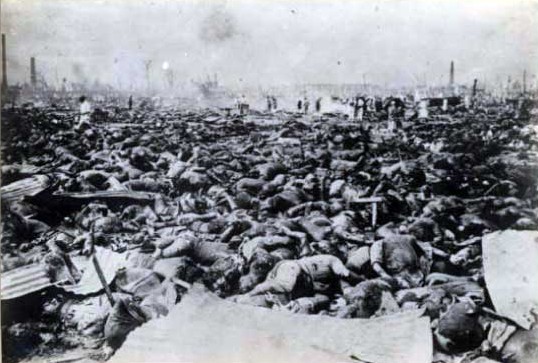
Hiroshima_Capp

Today marks the anniversary of the atomic bombing of Hiroshima in 1945, an event responsible for the deaths of up to 166,000 lives, most of whom were innocent civilians. This was followed by the use of another atomic bomb (using plutonium instead of uranium) on Nagasaki three days later, claiming at least 80,000 (mostly civilian) lives. As the U.S. continues to kill innocent people through long distance weapons such as drones, it’s more important than ever to question official claims about what they are doing in the name of “freedom” and “democracy” and the real reasons why. Historians such as Howard Zinn have long known that official government justifications for the bombings were lies. The fundamental reasons were economic and geopolitical, and much supporting documentation has been helpfully compiled in the following post.

The REAL Reason America Used Nuclear Weapons Against Japan (It Was Not To End the War Or Save Lives)

Source: Washington’s Blog

Atomic Weapons Were Not Needed to End the War or Save Lives

Like all Americans, I was taught that the U.S. dropped nuclear bombs on Hiroshima and Nagasaki in order to end WWII and save both American and Japanese lives.

But most of the top American military officials at the time said otherwise.

The U.S. Strategic Bombing Survey group, assigned by President Truman to study the air attacks on Japan, produced a report in July of 1946 that concluded (52-56):

Based on a detailed investigation of all the facts and supported by the testimony of the surviving Japanese leaders involved, it is the Survey’s opinion that certainly prior to 31 December 1945 and in all probability prior to 1 November 1945, Japan would have surrendered even if the atomic bombs had not been dropped, even if Russia had not entered the war, and even if no invasion had been planned or contemplated.

General (and later president) Dwight Eisenhower – then Supreme Commander of all Allied Forces, and the officer who created most of America’s WWII military plans for Europe and Japan – said:

The Japanese were ready to surrender and it wasn’t necessary to hit them with that awful thing.

Newsweek, 11/11/63, Ike on Ike

Eisenhower also noted (pg. 380):

In [July] 1945… Secretary of War Stimson, visiting my headquarters in Germany, informed me that our government was preparing to drop an atomic bomb on Japan. I was one of those who felt that there were a number of cogent reasons to question the wisdom of such an act. …the Secretary, upon giving me the news of the successful bomb test in New Mexico, and of the plan for using it, asked for my reaction, apparently expecting a vigorous assent.

During his recitation of the relevant facts, I had been conscious of a feeling of depression and so I voiced to him my grave misgivings, first on the basis of my belief that Japan was already defeated and that dropping the bomb was completely unnecessary, and secondly because I thought that our country should avoid shocking world opinion by the use of a weapon whose employment was, I thought, no longer mandatory as a measure to save American lives. It was my belief that Japan was, at that very moment, seeking some way to surrender with a minimum loss of ‘face’. The Secretary was deeply perturbed by my attitude….

Admiral William Leahy – the highest ranking member of the U.S. military from 1942 until retiring in 1949, who was the first de facto Chairman of the Joint Chiefs of Staff, and who was at the center of all major American military decisions in World War II – wrote (pg. 441):

It is my opinion that the use of this barbarous weapon at Hiroshima and Nagasaki was of no material assistance in our war against Japan. The Japanese were already defeated and ready to surrender because of the effective sea blockade and the successful bombing with conventional weapons.

The lethal possibilities of atomic warfare in the future are frightening. My own feeling was that in being the first to use it, we had adopted an ethical standard common to the barbarians of the Dark Ages. I was not taught to make war in that fashion, and wars cannot be won by destroying women and children.

General Douglas MacArthur agreed (pg. 65, 70-71):

MacArthur’s views about the decision to drop the atomic bomb on Hiroshima and Nagasaki were starkly different from what the general public supposed …. When I asked General MacArthur about the decision to drop the bomb, I was surprised to learn he had not even been consulted. What, I asked, would his advice have been? He replied that he saw no military justification for the dropping of the bomb. The war might have ended weeks earlier, he said, if the United States had agreed, as it later did anyway, to the retention of the institution of the emperor.

Moreover (pg. 512):

The Potsdam declaration in July, demand[ed] that Japan surrender unconditionally or face ‘prompt and utter destruction.’ MacArthur was appalled. He knew that the Japanese would never renounce their emperor, and that without him an orderly transition to peace would be impossible anyhow, because his people would never submit to Allied occupation unless he ordered it. Ironically, when the surrender did come, it was conditional, and the condition was a continuation of the imperial reign. Had the General’s advice been followed, the resort to atomic weapons at Hiroshima and Nagasaki might have been unnecessary.

Similarly, Assistant Secretary of War John McLoy noted (pg. 500):

I have always felt that if, in our ultimatum to the Japanese government issued from Potsdam [in July 1945], we had referred to the retention of the emperor as a constitutional monarch and had made some reference to the reasonable accessibility of raw materials to the future Japanese government, it would have been accepted. Indeed, I believe that even in the form it was delivered, there was some disposition on the part of the Japanese to give it favorable consideration. When the war was over I arrived at this conclusion after talking with a number of Japanese officials who had been closely associated with the decision of the then Japanese government, to reject the ultimatum, as it was presented. I believe we missed the opportunity of effecting a Japanese surrender, completely satisfactory to us, without the necessity of dropping the bombs.

Under Secretary of the Navy Ralph Bird said:

I think that the Japanese were ready for peace, and they already had approached the Russians and, I think, the Swiss. And that suggestion of [giving] a warning [of the atomic bomb] was a face-saving proposition for them, and one that they could have readily accepted.

***

In my opinion, the Japanese war was really won before we ever used the atom bomb. Thus, it wouldn’t have been necessary for us to disclose our nuclear position and stimulate the Russians to develop the same thing much more rapidly than they would have if we had not dropped the bomb.

War Was Really Won Before We Used A-Bomb, U.S. News and World Report, 8/15/60, pg. 73-75.

He also noted (pg. 144-145, 324):

It definitely seemed to me that the Japanese were becoming weaker and weaker. They were surrounded by the Navy. They couldn’t get any imports and they couldn’t export anything. Naturally, as time went on and the war developed in our favor it was quite logical to hope and expect that with the proper kind of a warning the Japanese would then be in a position to make peace, which would have made it unnecessary for us to drop the bomb and have had to bring Russia in.

Alfred McCormack – Director of Military Intelligence for the Pacific Theater of War, who was probably in as good position as anyone for judging the situation – believed that the Japanese surrender could have been obtained in a few weeks by blockade alone:

The Japanese had no longer enough food in stock, and their fuel reserves were practically exhausted. We had begun a secret process of mining all their harbors, which was steadily isolating them from the rest of the world. If we had brought this project to its logical conclusion, the destruction of Japan’s cities with incendiary and other bombs would have been quite unnecessary.

General Curtis LeMay, the tough cigar-smoking Army Air Force “hawk,” stated publicly shortly before the nuclear bombs were dropped on Japan:

The war would have been over in two weeks. . . . The atomic bomb had nothing to do with the end of the war at all.

The Vice Chairman of the U.S. Bombing Survey Paul Nitze wrote (pg. 36-37, 44-45):

[I] concluded that even without the atomic bomb, Japan was likely to surrender in a matter of months. My own view was that Japan would capitulate by November 1945.

***

Even without the attacks on Hiroshima and Nagasaki, it seemed highly unlikely, given what we found to have been the mood of the Japanese government, that a U.S. invasion of the islands [scheduled for November 1, 1945] would have been necessary.

Deputy Director of the Office of Naval Intelligence Ellis Zacharias wrote:

Just when the Japanese were ready to capitulate, we went ahead and introduced to the world the most devastating weapon it had ever seen and, in effect, gave the go-ahead to Russia to swarm over Eastern Asia.

Washington decided that Japan had been given its chance and now it was time to use the A-bomb.

I submit that it was the wrong decision. It was wrong on strategic grounds. And it was wrong on humanitarian grounds.

Ellis Zacharias, How We Bungled the Japanese Surrender, Look, 6/6/50, pg. 19-21.

Brigadier General Carter Clarke – the military intelligence officer in charge of preparing summaries of intercepted Japanese cables for President Truman and his advisors – said (pg. 359):

When we didn’t need to do it, and we knew we didn’t need to do it, and they knew that we knew we didn’t need to do it, we used them as an experiment for two atomic bombs.

Many other high-level military officers concurred. For example:

The commander in chief of the U.S. Fleet and Chief of Naval Operations, Ernest J. King, stated that the naval blockade and prior bombing of Japan in March of 1945, had rendered the Japanese helpless and that the use of the atomic bomb was both unnecessary and immoral. Also, the opinion of Fleet Admiral Chester W. Nimitz was reported to have said in a press conference on September 22, 1945, that “The Admiral took the opportunity of adding his voice to those insisting that Japan had been defeated before the atomic bombing and Russia’s entry into the war.” In a subsequent speech at the Washington Monument on October 5, 1945, Admiral Nimitz stated “The Japanese had, in fact, already sued for peace before the atomic age was announced to the world with the destruction of Hiroshima and before the Russian entry into the war.” It was learned also that on or about July 20, 1945, General Eisenhower had urged Truman, in a personal visit, not to use the atomic bomb. Eisenhower’s assessment was “It wasn’t necessary to hit them with that awful thing . . . to use the atomic bomb, to kill and terrorize civilians, without even attempting [negotiations], was a double crime.” Eisenhower also stated that it wasn’t necessary for Truman to “succumb” to [the tiny handful of people putting pressure on the president to drop atom bombs on Japan.]

British officers were of the same mind. For example, General Sir Hastings Ismay, Chief of Staff to the British Minister of Defence, said to Prime Minister Churchill that “when Russia came into the war against Japan, the Japanese would probably wish to get out on almost any terms short of the dethronement of the Emperor.”

On hearing that the atomic test was successful, Ismay’s private reaction was one of “revulsion.”

Why Were Bombs Dropped on Populated Cities Without Military Value?

Even military officers who favored use of nuclear weapons mainly favored using them on unpopulated areas or Japanese military targets … not cities.

For example, Special Assistant to the Secretary of the Navy Lewis Strauss proposed to Secretary of the Navy James Forrestal that a non-lethal demonstration of  atomic weapons would be enough to convince the Japanese to surrender … and the Navy Secretary agreed (pg. 145, 325):

I proposed to Secretary Forrestal that the weapon should be demonstrated before it was used. Primarily it was because it was clear to a number of people, myself among them, that the war was very nearly over. The Japanese were nearly ready to capitulate… My proposal to the Secretary was that the weapon should be demonstrated over some area accessible to Japanese observers and where its effects would be dramatic. I remember suggesting that a satisfactory place for such a demonstration would be a large forest of cryptomeria trees not far from Tokyo. The cryptomeria tree is the Japanese version of our redwood… I anticipated that a bomb detonated at a suitable height above such a forest… would lay the trees out in windrows from the center of the explosion in all directions as though they were matchsticks, and, of course, set them afire in the center. It seemed to me that a demonstration of this sort would prove to the Japanese that we could destroy any of their cities at will… Secretary Forrestal agreed wholeheartedly with the recommendation

It seemed to me that such a weapon was not necessary to bring the war to a successful conclusion, that once used it would find its way into the armaments of the world…

General George Marshall agreed:

Contemporary documents show that Marshall felt “these weapons might first be used against straight military objectives such as a large naval installation and then if no complete result was derived from the effect of that, he thought we ought to designate a number of large manufacturing areas from which the people would be warned to leave–telling the Japanese that we intend to destroy such centers….”

As the document concerning Marshall’s views suggests, the question of whether the use of the atomic bomb was justified turns  … on whether the bombs had to be used against a largely civilian target rather than a strictly military target—which, in fact, was the explicit choice since although there were Japanese troops in the cities, neither Hiroshima nor Nagasaki was deemed militarily vital by U.S. planners. (This is one of the reasons neither had been heavily bombed up to this point in the war.) Moreover, targeting [at Hiroshima and Nagasaki] was aimed explicitly on non-military facilities surrounded by workers’ homes.

Historians Agree that the Bomb Wasn’t Needed

Historians agree that nuclear weapons did not need to be used to stop the war or save lives.

As historian Doug Long notes:

U.S. Nuclear Regulatory Commission historian J. Samuel Walker has studied the history of research on the decision to use nuclear weapons on Japan. In his conclusion he writes, “The consensus among scholars is that the bomb was not needed to avoid an invasion of Japan and to end the war within a relatively short time. It is clear that alternatives to the bomb existed and that Truman and his advisors knew it.” (J. Samuel Walker, The Decision to Use the Bomb: A Historiographical Update, Diplomatic History, Winter 1990, pg. 110).

Politicians Agreed

Many high-level politicians agreed.  For example, Herbert Hoover said (pg. 142):

The Japanese were prepared to negotiate all the way from February 1945…up to and before the time the atomic bombs were dropped; …if such leads had been followed up, there would have been no occasion to drop the [atomic] bombs.

Under Secretary of State Joseph Grew noted (pg. 29-32):

In the light of available evidence I myself and others felt that if such a categorical statement about the [retention of the] dynasty had been issued in May, 1945, the surrender-minded elements in the [Japanese] Government might well have been afforded by such a statement a valid reason and the necessary strength to come to an early clearcut decision.

If surrender could have been brought about in May, 1945, or even in June or July, before the entrance of Soviet Russia into the [Pacific] war and the use of the atomic bomb, the world would have been the gainer.

Why Then Were Atom Bombs Dropped on Japan?

If dropping nuclear bombs was unnecessary to end the war or to save lives, why was the decision to drop them made? Especially over the objections of so many top military and political figures?

One theory is that scientists like to play with their toys:

On September 9, 1945, Admiral William F. Halsey, commander of the Third Fleet, was publicly quoted extensively as stating that the atomic bomb was used because the scientists had a “toy and they wanted to try it out . . . .” He further stated, “The first atomic bomb was an unnecessary experiment . . . . It was a mistake to ever drop it.”

However, most of the Manhattan Project scientists who developed the atom bomb were opposed to using it on Japan.

Albert Einstein – an important catalyst for the development of the atom bomb (but not directly connected with the Manhattan Project) – said differently:

“A great majority of scientists were opposed to the sudden employment of the atom bomb.” In Einstein’s judgment, the dropping of the bomb was a political – diplomatic decision rather than a military or scientific decision.

Indeed, some of the Manhattan Project scientists wrote directly to the secretary of defense in 1945 to try to dissuade him from dropping the bomb:

We believe that these considerations make the use of nuclear bombs for an early, unannounced attack against Japan inadvisable. If the United States would be the first to release this new means of indiscriminate destruction upon mankind, she would sacrifice public support throughout the world, precipitate the race of armaments, and prejudice the possibility of reaching an international agreement on the future control of such weapons.

Political and Social Problems, Manhattan Engineer District Records, Harrison-Bundy files, folder # 76, National Archives (also contained in: Martin Sherwin, A World Destroyed, 1987 edition, pg. 323-333).

The scientists questioned the ability of destroying Japanese cities with atomic bombs to bring surrender when destroying Japanese cities with conventional bombs had not done so, and – like some of the military officers quoted above – recommended a demonstration of the atomic bomb for Japan in an unpopulated area.

The Real Explanation?

History.com notes:

In the years since the two atomic bombs were dropped on Japan, a number of historians have suggested that the weapons had a two-pronged objective …. It has been suggested that the second objective was to demonstrate the new weapon of mass destruction to the Soviet Union. By August 1945, relations between the Soviet Union and the United States had deteriorated badly. The Potsdam Conference between U.S. President Harry S. Truman, Russian leader Joseph Stalin, and Winston Churchill (before being replaced by Clement Attlee) ended just four days before the bombing of Hiroshima. The meeting was marked by recriminations and suspicion between the Americans and Soviets. Russian armies were occupying most of Eastern Europe. Truman and many of his advisers hoped that the U.S. atomic monopoly might offer diplomatic leverage with the Soviets. In this fashion, the dropping of the atomic bomb on Japan can be seen as the first shot of the Cold War.

New Scientist reported in 2005:

The US decision to drop atomic bombs on Hiroshima and Nagasaki in 1945 was meant to kick-start the Cold War rather than end the Second World War, according to two nuclear historians who say they have new evidence backing the controversial theory.

Causing a fission reaction in several kilograms of uranium and plutonium and killing over 200,000 people 60 years ago was done more to impress the Soviet Union than to cow Japan, they say. And the US President who took the decision, Harry Truman, was culpable, they add.

“He knew he was beginning the process of annihilation of the species,” says Peter Kuznick, director of the Nuclear Studies Institute at American University in Washington DC, US. “It was not just a war crime; it was a crime against humanity.”

***

[The conventional explanation of using the bombs to end the war and save lives] is disputed by Kuznick and Mark Selden, a historian from Cornell University in Ithaca, New York, US.

***

New studies of the US, Japanese and Soviet diplomatic archives suggest that Truman’s main motive was to limit Soviet expansion in Asia, Kuznick claims. Japan surrendered because the Soviet Union began an invasion a few days after the Hiroshima bombing, not because of the atomic bombs themselves, he says.

According to an account by Walter Brown, assistant to then-US secretary of state James Byrnes, Truman agreed at a meeting three days before the bomb was dropped on Hiroshima that Japan was “looking for peace”. Truman was told by his army generals, Douglas Macarthur and Dwight Eisenhower, and his naval chief of staff, William Leahy, that there was no military need to use the bomb.

“Impressing Russia was more important than ending the war in Japan,” says Selden.

John Pilger points out:

The US secretary of war, Henry Stimson, told President Truman he was “fearful” that the US air force would have Japan so “bombed out” that the new weapon would not be able “to show its strength”. He later admitted that “no effort was made, and none was seriously considered, to achieve surrender merely in order not to have to use the bomb”. His foreign policy colleagues were eager “to browbeat the Russians with the bomb held rather ostentatiously on our hip”. General Leslie Groves, director of the Manhattan Project that made the bomb, testified: “There was never any illusion on my part that Russia was our enemy, and that the project was conducted on that basis.” The day after Hiroshima was obliterated, President Truman voiced his satisfaction with the “overwhelming success” of “the experiment”.

We’ll give the last word to University of Maryland professor of political economy – and former Legislative Director in the U.S. House of Representatives and the U.S. Senate, and Special Assistant in the Department of State – Gar Alperovitz:

Though most Americans are unaware of the fact, increasing numbers of historians now recognize the United States did not need to use the atomic bomb to end the war against Japan in 1945. Moreover, this essential judgment was expressed by the vast majority of top American military leaders in all three services in the years after the war ended: Army, Navy and Army Air Force. Nor was this the judgment of “liberals,” as is sometimes thought today. In fact, leading conservatives were far more outspoken in challenging the decision as unjustified and immoral than American liberals in the years following World War II.

***

Instead [of allowing other options to end the war, such as letting the Soviets attack Japan with ground forces], the United States rushed to use two atomic bombs at almost exactly the time that an August 8 Soviet attack had originally been scheduled: Hiroshima on August 6 and Nagasaki on August 9. The timing itself has obviously raised questions among many historians. The available evidence, though not conclusive, strongly suggests that the atomic bombs may well have been used in part because American leaders “preferred”—as Pulitzer Prize–winning historian Martin Sherwin has put it—to end the war with the bombs rather than the Soviet attack. Impressing the Soviets during the early diplomatic sparring that ultimately became the Cold War also appears likely to have been a significant factor.

***

The most illuminating perspective, however, comes from top World War II American military leaders. The conventional wisdom that the atomic bomb saved a million lives is so widespread that … most Americans haven’t paused to ponder something rather striking to anyone seriously concerned with the issue: Not only did most top U.S. military leaders think the bombings were unnecessary and unjustified, many were morally offended by what they regarded as the unnecessary destruction of Japanese cities and what were essentially noncombat populations. Moreover, they spoke about it quite openly and publicly.

***

Shortly before his death General George C. Marshall quietly defended the decision, but for the most part he is on record as repeatedly saying that it was not a military decision, but rather a political one.

Related Articles:
Truman Knew
The Bombing of Nagasaki August 9, 1945. Unwelcome Truths for Church and State

Is Open-Ended Chaos the Desired US-Israeli Aim in the Middle East?

98412608_second day of war in Iraq

By Thomas S. Harrington

Source: Counterpunch

During the last week we have seen Sunni militias take control of ever-greater swathes of eastern Syria and western Iraq. In the mainstream media, the analysis of this emerging reality has been predictably idiotic, basically centering on whether:

a) Obama is to blame for this for having removed US troops in compliance with the 2008 Status of Forces Agreement (SOFA) negotiated and signed by Bush.

b) Obama is “man enough” to putatively resolve the problem by going back into the country and killing more people and destroying whatever remains of the country’s infrastructure.

This cynically manufactured discussion has generated a number of intelligent rejoinders on the margins of the mainstream media system. These essays, written by people such as Juan Cole, Robert Parry, Robert Fisk and Gary Leupp, do a fine job of explaining the US decisions that led to the present crisis, while simultaneously reminding us how everything occurring  today was readily foreseeable as far back as 2002.

What none of them do, however, is consider whether the chaos now enveloping the region might, in fact, be the desired aim of policy planners in Washington and Tel Aviv.

Rather, each of these analysts presumes that the events unfolding in Syria and Iraq are undesired outcomes engendered by short-sighted decision-making at the highest levels of the US government over the last 12 years.

Looking at the Bush and Obama foreign policy teams—no doubt the most shallow and intellectually lazy members of that guild to occupy White House in the years since World War II—it is easy to see how they might arrive at this conclusion.

But perhaps an even more compelling reason for adopting this analytical posture is that it allows these men of clear progressive tendencies to maintain one of the more hallowed, if oft-unstated, beliefs of the Anglo-Saxon world view.

What is that?

It is the idea that our engagements with the world outside our borders—unlike those of, say, the Russians and the Chinese—are motivated by a strongly felt, albeit often corrupted, desire to better the lives of those whose countries we invade.

While this belief seems logical, if not downright self-evident within our own cultural system, it is frankly laughable to many, if not most, of the billions who have grown up outside of our moralizing echo chamber.

What do they know that most of us do not know, or perhaps more accurately, do not care to admit?

First, that we are an empire, and that all empires are, without exception, brutally and programmatically self-seeking.

Second, that one of the prime goals of every empire is to foment ongoing internecine conflict in the territories whose resources and/or strategic outposts they covet.

Third, that the most efficient way of sparking such open-ended internecine conflict is to brutally smash the target country’s social matrix and physical infrastructure.

Fourth, that ongoing unrest has the additional perk of justifying the maintenance and expansion of the military machine that feeds the financial and political fortunes of the metropolitan elite.

In short, what of the most of the world understands (and what even the most “prestigious” Anglo-Saxon analysts cannot seem to admit) is that divide and rule is about as close as it gets to a universal recourse the imperial game and that it is, therefore, as important to bear it in mind today as it was in the times of Alexander the Great, Julius Caesar, the Spanish Conquistadors and the British Raj.

To those—and I suspect there are still many out there—for whom all this seems too neat or too conspiratorial, I would suggest a careful side-by side reading of:

a) the “Clean Break” manifesto generated by the Jerusalem-based Institute for Advanced Strategic and Political Studies (IASPS) in 1996

and

b) the “Rebuilding America’s Defenses” paper generated by The Project for a New American Century (PNAC) in 2000, a US group with deep personal and institutional links to the aforementioned Israeli think tank, and with the ascension of  George Bush Junior to the White House, to the most exclusive  sanctums of the US foreign policy apparatus.

To read the cold-blooded imperial reasoning in both of these documents—which speak, in the first case, quite openly of the need to destabilize the region so as to reshape Israel’s “strategic environment” and, in the second of the need to dramatically increase the number of US “forward bases” in the region—as I did twelve years ago, and to recognize its unmistakable relationship to the underlying aims of the wars then being started by the US in Afghanistan and Iraq, was a deeply disturbing experience.

To do so now, after the US’s systematic destruction of Iraq and Libya—two notably oil-rich countries whose delicate ethnic and religious balances were well known to anyone in or out of government with more than passing interest in history—, and after the its carefully calibrated efforts to generate and maintain murderous and civilization-destroying stalemates in Syria and Egypt (something that is easily substantiated despite our media’s deafening silence on the subject), is downright blood-curdling.

And yet, it seems that for even very well-informed analysts, it is beyond the pale to raise the possibility that foreign policy elites in the US and Israel, like all virtually all the ambitious hegemons before them on the world stage, might have quite coldly and consciously fomented open-ended chaos in order to achieve their overlapping strategic objectives in this part of the world.

Thomas S. Harrington is a professor of Iberian Studies at Trinity College in Hartford, Connecticut and the author of the recently released  Livin’ la Vida Barroca: American Culture in a Time of Imperial Orthodoxies.