The Illusion of Getting Rich While Producing Nothing

By Charles Hugh Smith

Source: Of Two Minds

Of all the mass delusions running rampant in the culture, none is more spectacularly delusional than the conviction that we can all get fabulously rich from speculation while producing nothing. The key characteristic of speculation is that it produces nothing: it doesn’t generate any new goods or services, boost productivity or increase the functionality of real-world essentials.

Like all mass delusions, the greater the disconnect from reality, the greater the appeal. Mass delusions gain their escape velocity by leaving any ties to real-world limitations behind, and by igniting the most powerful booster to human euphoric confidence known, greed.

Lost in the mania of easy wealth from speculative trading is the absence of any value creation in the rotation-churn of moving bets from one table to the latest hot game: in flipping houses sight unseen, no functionality was added to the house. In transferring bets on one cryptocurrency to another or from one meme stock to another, no value to the economy or society was created.

In the mass delusion that near-infinite wealth can be generated without producing anything, creating value has no value: the delusion is that I can get rich producing nothing but speculative gains, and then I can buy all the stuff somebody else is making.

The fantasy powering the speculative frenzy is once I get rich, I’ll stop working and live off my wealth. It’s interesting, isn’t it, how everyone can get rich via unproductive speculation, quit their jobs and then live off the productive work of somebody else who failed to get rich off speculation.

Maybe that’s why all the container ships are lined up at Long Beach, waiting to unload the goodies made in China for American speculators to buy. This is what happens when the incentive structure of the economy decays so that being productive has little upside (i.e., working is for chumps) while speculating is all upside (get rich quickly and easily).

Everyone knows great empires became great by transferring their critical supply chains to competing nations, living it up on borrowed/printed money, exploiting the highest bidder wins regulatory/governance system and incentivizing speculation while pushing wage earners into debt-and-tax servitude. Bone up on your history, Bucko; all great nations got there by quitting boring, tiresome productive work to speculate on illusions of value with borrowed money.

This is the result of monopolies and cartels becoming the financial and political power centers of the nation. Maximizing private gains is all that matters in this incentive structure, and so treating employees as chattel to lower costs, offshoring critical supply chains to squeeze out a few more dollars of profits, engineering products to break down (planned obsolescence), buying regulatory barriers and “free passes” and tax breaks galore with all the billions showered on financiers and other fraudsters by the Federal Reserve: in a word, a system that optimizes corruption.

This is how you hollow out a nation and guarantee collapse. The most rewarding “skillsets” are a sociopathological obsession with maximizing profits by any means available and speculating with Fed free money for financiers. The millions of “retail” speculators are simply picking up the cues being given by the billionaires who gained their wealth by issuing debt to fund stock buy-backs and other financial manipulations.

Working for monopolies and cartels is for chumps because monopolies and cartels have zero incentive to share profits with mere employees. Their profits are made not by taking care of their workforce but by regulatory captureartificial scarcities and financialized destruction of competition: first, borrow billions thanks to the Fed and Wall Street, destroy the competition (for example, the taxi industry), then once the competition has been wiped out, jack up prices because now consumers have no choice other than another member of the cartel.

Speculative “wealth” is phantom wealth, a flickering illusion of prosperity. All speculative bubbles pop, and all speculative bubbles inflated by borrowed money and central bank manipulation pop even more ferociously than bubbles funded by actual savings.

By incentivizing speculation and corruption, reducing the rewards for productive work and sucking wages dry with inflation, America has greased the skids to collapse. As with all mass delusions, the incentives to continue believing are immense and the incentives to reconnect with reality few.

So in conclusion: the speculative gains to be made in the collapse of the mass delusion will be spectacular. There’s nothing like the collapse of a hollowed out, completely corrupt economy to generate outsized profits for nimble speculators. Just keep your speculative winnings on number 22 on the roulette wheel. (A Casablanca movie reference….)

The U.S. Economy In a Nutshell: When Critical Parts Are On “Indefinite Back Order,” the Machine Grinds to a Halt

By Charles Hugh Smith

Source: Of Two Minds

Setting aside the “transitory inflation” parlor game for a moment, let’s look at what happens when critical parts are unavailable for whatever reason, for example, they’re on back order or indefinite back order, i.e. the supplier has no visibility on when the parts will be available.

If the part that blew out is 0.1% of the entire machine, and the other 99.9% still works perfectly, the entire machine is still dead in the water without that critical component. That is a pretty good definition of systemic vulnerability and fragility, a fragility that becomes much, much worse if there are two or three components which are on indefinite back order.

This is the problem with shipping much of your supply chain overseas: you create extreme systemic vulnerability and fragility even as you rake in big profits from reducing costs. Speaking of costs, let’s look at the costs of having a large, costly, complex mechanism sitting idle in a non-functioning state due to some broken element for which there is no substitute available. Whatever productive capacity the mechanism, process, etc. had is now stuck at zero.

Buying a new replacement is extremely costly, and that’s not always available for all the same reasons that parts and components aren’t available. Finding someone to fabricate a new component is not easy due to the wholesale transfer of manufacturing moxie and capability overseas.

You might be able to find someone to weld a replacement strut, but try finding someone to fab a new bicycle derailleur or better yet, a multilayer semiconductor chip. What about 3-D fabrication? Doesn’t that solve this problem? If the part can be “printed,” yes, but there are limits on what can be 3-D fabbed. You can’t 3-D fab a complex thermostat or controller, for example. You can’t 3-D fab a rubber gasket, either, or a great many other bits of petrochemical-based manufacturing.

Scarcities are not limited to parts and components; skilled people can be scarce, too. For example, there is a limited supply of ICU doctors and nurses. The training required to work in an ICU is specialized and experiential; throwing someone with minimal training in is not a substitution that’s going to work. You can’t order an ICU staff from China or print one digitally the way the Federal Reserve creates currency out of thin air. It takes many years to train the staff to function at a high level in ICU.

A great many such labor scarcities exist for skilled workers who cannot be replaced except by someone with the same training and years of experience. This is one reason ICUs can break down: there is no replacement staff available, and no way to “print more.”

It turns out there’s also a scarcity of people willing to do the dirty-work jobs America needs done for wages that haven’t kept up with inflation. As I have explained here, the $1.65 minimum wage I earned in 1970, if factored for real-world inflation, is around $18 per hour, and arguably closer to $20 per hour.

The solution is to raise the pay to levels that attract workers, but then this requires raising prices on the good and services to the point that customers can no longer afford them.

But wait, can’t we automate all work and deliver full-gee-whiz free-money, no-work communism to everyone? I invite everyone who reckons this is in the realm of the do-able to design, program and manufacture an automated robot that can trundle out to the laundry room, pop open a broken clothes dryer, diagnose the problem, manage to find a new controller board, fit it correctly and properly reconnect all the little wiring bits, close it up, test it, lift the dryer back on the washing machine and do all that for the relatively modest cost of a human repairperson. When you accomplish fabricating and programming that robot to do all the work without instruction or oversight, by all means let us all know how much it cost to design, program and manufacture, what the payback of the development and manufacturing process will cost amortized over the (short) life of the robot and how reliable it is in the real world.

The point is, fantasies are nice but reality is far more demanding.

There can also be scarcities of competence. There may be replacements who claim competence, but when reality intrudes on the shuck-and-jive, their competence was illusory, and the net result is the entire institution can be described by President G.W. Bush’s memorable phrase, this sucker’s going down.

There can also be scarcities of institutional infrastructure and capacity. Once the institution, enterprise, state agency, etc. has been stripmined of redundancy, institutional memory and competence, then the first scarcity that cannot be replaced is the first domino that topples all the other dominoes of systemic vulnerability and fragility.

The Federal Reserve can print trillions of dollars and the federal government can borrow and blow trillions of dollars, but neither can print or borrow supply chains, scarce skills, institutional depth or competence. That nice shiny new semiconductor fab you reckon will resolve the chip shortage? You can print the billions of dollars needed in an instant, but the machinery, expertise and time can’t be conjured quite so easily. That fab is years away from completion no matter how many freshly conjured dollars you throw into the air.

When Critical Parts Are On “Indefinite Back Order,” the Machine Grinds to a Halt: that’s the U.S. economy in a nutshell.

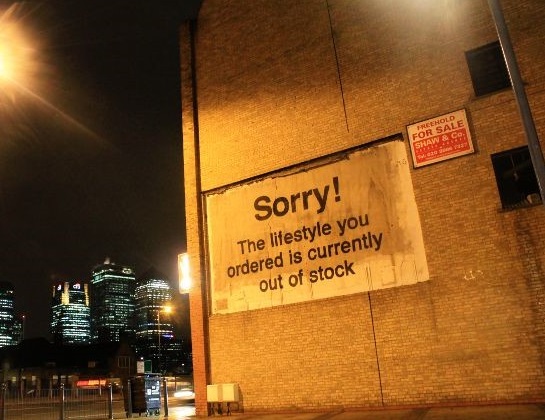
A great many essential components in America are on indefinite back order, including the lifestyle of endless globally sourced goodies at low, low prices. That lifestyle is out of stock and cannot be replaced with financialization fakery.

Hey, Federal Reserve, can you conjure up a non-corrupt financial system, a domestic supply chain, and an economy of open competition, transparency, accountability and competence? If not, you are even more worthless than we feared.

Amazon, “Economic Terrorism” and the Destruction of Competition and Livelihoods

By Colin Todhunter

Source: Off-Guardian

Global corporations are colonising India’s retail space through e-commerce and destroying small-scale physical retail and millions of livelihoods.

Walmart entered into India in 2016 with a US$3.3 billion take-over of the online retail start-up Jet.com. This was followed in 2018 with a US$16 billion take-over of India’s largest online retail platform, Flipkart. Today, Walmart and Amazon control almost two thirds of India’s digital retail sector.

Amazon and Walmart have a record of using predatory pricing, deep discounts and other unfair business practices to attract customers to their online platforms. A couple of years ago, those two companies generated sales of over US$3 billion in just six days during Diwali. India’s small retailers reacted by calling for a boycott of online shopping.

If you want to know the eventual fate of India’s local markets and small retailers, look no further than what US Treasury Secretary Steven Mnuchin said in 2019. He stated that Amazon had “destroyed the retail industry across the United States.”

AMAZON’S CORPORATE PRACTICES

In the US, an investigation by the House Judiciary Committee concluded that Amazon exerts monopoly power over many small- and medium-size businesses. It called for breaking up the company and regulating its online marketplace to ensure that sellers are treated fairly.

Amazon has spied on sellers and appropriated data about their sales, costs and suppliers. It has then used this information to create its own competing versions of their products, often giving its versions superior placement in the search results on its platform.

The Institute for Local Self-Reliance (ILSR) published a revealing document on Amazon in June 2021 that discussed these issues. It also notes that Amazon has been caught using its venture capital fund to invest in start-ups only to steal their ideas and create rival products and services.

Moreover, Amazon’s dominance allows it to function as a gatekeeper: retailers and brands must sell on its site to reach much of the online market and changes to Amazon’s search algorithms or selling terms can cause their sales to evaporate overnight.

Amazon also makes it hard for sellers to reduce their dependence on its platform by making their brand identity almost invisible to shoppers and preventing them from building relationships with their customers. The company strictly limits contact between sellers and customers.

According to the ILSR, Amazon compels sellers to buy its warehousing and shipping services, even though many would get a better deal from other providers, and it blocks independent businesses from offering lower prices on other sites. The company also routinely suspends sellers’ accounts and seizes inventories and cash balances.

The Joint Action Committee against Foreign Retail and E-commerce (JACAFRE) was formed to resist the entry of foreign corporations like Walmart and Amazon into India’s e-commerce market. Its members represent more than 100 national groups, including major trade, workers’ and farmers’ organisations.

JACAFRE issued a statement in 2018 on Walmart’s acquisition of Flipkart, arguing that it undermines India’s economic and digital sovereignty and the livelihoods of millions in India. The committee said the deal would lead to Walmart and Amazon dominating India’s e-retail sector. It would also allow them to own India’s key consumer and other economic data, making them the country’s digital overlords, joining the ranks of Google and Facebook.

In January 2021, JACAFRE published an open letter saying that the three new farm laws, passed by parliament in September 2020, centre on enabling and facilitating the unregulated corporatisation of agriculture value chains. This will effectively make farmers and small traders of agricultural produce become subservient to the interests of a few agrifood and e-commerce giants or will eradicate them completely.

Although there was strong resistance to Walmart entering India with its physical stores, online and offline worlds are now merged: e-commerce companies not only control data about consumption but also control data on production and logistics. Through this control, e-commerce platforms can shape much of the physical economy.

What we are witnessing is the deliberate eradication of markets in favour of monopolistic platforms.

BEZOS NOT WELCOME

Amazon’s move into India encapsulates the unfair fight for space between local and global markets. There is a relative handful of multi-billionaires who own the corporations and platforms. And there are the interests of hundreds of millions of vendors and various small-scale enterprises who are regarded by these rich individuals as mere collateral damage to be displaced in their quest for ever-greater profit.

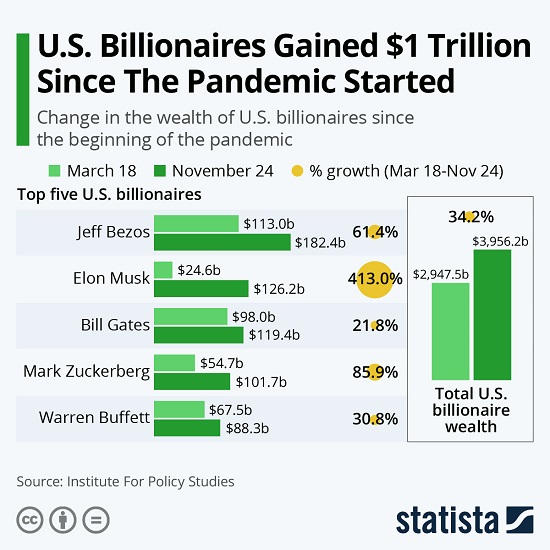
Thanks to the helping hand of various COVID-related lockdowns, which devastated small businesses, the wealth of the world’s billionaires increased by $3.9tn (trillion) between 18 March and 31 December 2020.

In September 2020, Jeff Bezos, Amazon’s executive chairman, could have paid all 876,000 Amazon employees a $105,000 bonus and still be as wealthy as he was before COVID. Jeff Bezos – his fortune constructed on unprincipled methods that have been well documented in recent years – increased his net wealth by $78.2bn during this period.

Bezos’s plan is clear: the plunder of India and the eradication of millions of small traders and retailers and neighbourhood mom and pop shops.

This is a man with few scruples. After returning from a brief flight to space in July, in a rocket built by his private space company, Bezos said during a news conference:

I also want to thank every Amazon employee and every Amazon customer because you guys paid for all of this.”

In response, US congresswoman Nydia Velazquez wrote on Twitter:

While Jeff Bezos is all over the news for paying to go to space, let’s not forget the reality he has created here on Earth.”

She added the hashtag #WealthTaxNow in reference to Amazon’s tax dodging, revealed in numerous reports, not least the May 2021 study ‘The Amazon Method: How to take advantage of the international state system to avoid paying tax’ by Richard Phillips, Senior Research Fellow, Jenaline Pyle, PhD Candidate, and Ronen Palan, Professor of International Political Economy, all based at the University of London.

Little wonder that when Bezos visited India in January 2020, he was hardly welcomed with open arms.

Bezos praised India on Twitter by posting:

Dynamism. Energy. Democracy. #IndianCentury.”

The ruling party’s top man in the BJP foreign affairs department hit back with:

Please tell this to your employees in Washington DC. Otherwise, your charm offensive is likely to be waste of time and money.”

A fitting response, albeit perplexing given the current administration’s proposed sanctioning of the foreign takeover of the economy, not least by the unscrupulous interests that will benefit from the recent farm legislation.

Bezos landed in India on the back of the country’s antitrust regulator initiating a formal investigation of Amazon and with small store owners demonstrating in the streets. The Confederation of All India Traders (CAIT) announced that members of its affiliate bodies across the country would stage sit-ins and public rallies in 300 cities in protest.

In a letter to PM Modi, prior to the visit of Bezos, the secretary of the CAIT, General Praveen Khandelwal, claimed that Amazon, like Walmart-owned Flipkart, was an “economic terrorist” due to its predatory pricing that “compelled the closure of thousands of small traders.”

In 2020, Delhi Vyapar Mahasangh (DVM) filed a complaint against Amazon and Flipkart alleging that they favoured certain sellers over others on their platforms by offering them discounted fees and preferential listing. The DVM lobbies to promote the interests of small traders. It also raised concerns about Amazon and Flipkart entering into tie-ups with mobile phone manufacturers to sell phones exclusively on their platforms.

It was argued by DVM that this was anti-competitive behaviour as smaller traders could not purchase and sell these devices. Concerns were also raised over the flash sales and deep discounts offered by e-commerce companies, which could not be matched by small traders.

The CAIT estimates that in 2019 upwards of 50,000 mobile phone retailers were forced out of business by large e-commerce firms.

Amazon’s internal documents, as revealed by Reuters, indicated that Amazon had an indirect ownership stake in a handful of sellers who made up most of the sales on its Indian platform. This is an issue because in India Amazon and Flipkart are legally allowed to function only as neutral platforms that facilitate transactions between third-party sellers and buyers for a fee.

UNDER INVESTIGATION

The upshot is that India’s Supreme Court recently ruled that Amazon must face investigation by the Competition Commission of India (CCI) for alleged anti-competitive business practices. The CCI said it would probe the deep discounts, preferential listings and exclusionary tactics that Amazon and Flipkart are alleged to have used to destroy competition.

However, there are powerful forces that have been sitting on their hands as these companies have been running amok.

In August 2021, the CAIT attacked the NITI Aayog (the influential policy commission think tank of the Government of India) for interfering in e-commerce rules proposed by the Consumer Affairs Ministry.

The CAIT said that the think tank clearly seems to be under the pressure and influence of the foreign e-commerce giants.

The president of CAIT, BC Bhartia, stated that it is deeply shocking to see such a callous and indifferent attitude of the NITI Aayog whch have remained a silent spectator for so many years when:

…the foreign e-commerce giants have circumvented every rule of the FDI policy and blatantly violated and destroyed the retail and e-commerce landscape of the country but have suddenly decided to open their mouth at a time when the proposed e-commerce rules will potentially end the malpractices of the e-commerce companies.”

Of course, money talks and buys influence. In addition to tens of billions of US dollars invested in India by Walmart and Amazon, Facebook invested US$5.5 billion last year in Mukesh Ambani’s Jio Platforms (e-commerce retail). Google has also invested US$4.5 billion.

Since the early 1990s, when India opened up to neoliberal economics, the country has become increasingly dependent on inflows of foreign capital. Policies are being governed by the drive to attract and retain foreign investment and maintain ‘market confidence’ by ceding to the demands of international capital which ride roughshod over democratic principles and the needs of hundreds of millions of ordinary people. ‘Foreign direct investment’ has thus become the holy grail of the Modi-led administration and the NITI Aayog.

The CAIT has urged the Consumer Affairs Ministry to implement the draft consumer protection e-commerce rules at the earliest as they are in the best interest of the consumers as well as the traders of the country.

Meanwhile, the CCI probably will complete its investigation within two months.

The Houses of Dead and Crooked Souls

By Edward Curtin

Source: Behind the Curtain

“A house constitutes a body of images that give mankind proofs or illusions of stability.”      – Gaston Bachelard, The Poetics of Space

There is a vast and growing gulf between the world’s rich and poor.  An obscene gulf. If we can read houses, they will confirm this.  They offer a visible lesson in social class.

Houses stand before us like books on a shelf waiting to be read, and when the books are missing, as they are for a vast and growing multitude of the homeless exiled wandering ones and those imprisoned, their absence serves to indict the mansion-dwelling wealthy and to a lesser extent those whose homes serve to shield them from the truth of the ill-begotten gains of the wealthy elites who create the world’s suffering through their avarice, lies, and war making.

Many regular people want to say with Edmund in Eugene O’Neill’s play, Long Day’s Journey into Night:

The fog is where I wanted to be. Halfway down the path you can’t see this house. You’d never know it was here. Or any of the other places down the avenue. I couldn’t see but a few feet ahead. I didn’t meet a soul. Everything looked and sounded unreal. Nothing was what it is.That’s what I wanted – to be alone with myself in another world where truth is untrue and life can hide from itself….Who wants to see life as it is, if they can help it?

Yet the rich don’t hide or give a damn. They flaunt their houses.  They know they are crooks and creators of illusions.  Their nihilism is revealed in their conspicuous consumption and their predatory behavior; they want everyone else to see it too.  So they rub it in their faces.  Their wealth is built on the blood and suffering of millions around the world, but this is often hidden knowledge.

For many regular people prefer the fog to the harsh truth.  It shields them from intense anger and the realization that the wealthy elites who run the world and control the media lie to them about everything and consider them beneath contempt.  That would demand a response commensurate with the propaganda – rebellion.  It would impose the moral demand to look squarely at the houses of death with their tiny cells in which the wealthy elites and their henchmen imprison and torture truth tellers like Julian Assange, an innocent man in a living hell; to make connections between wealth and power and the obscene flaunting of the rich elite’s sybaritic lifestyles in houses where every spacious room testifies to their moral depravity.

The recent news of Barack Obama’s vile selfie birthday celebration for his celebrity “friends” at his 29-acre estate and mansion (he has another eight-million-dollar mansion in Washington, D. C.) on Martha’s Vineyard is an egregious recent case in point.  If he thinks this nauseating display is proof of his stability and strength – which obviously he does – then he is a deluded fool.  But those who carry water for the military-intelligence-media complex are amply rewarded and want to tell the world that this is so.  It’s essential for the Show.  It must be conspicuous so the plebians learn their lesson.

Obama’s Vineyard mansion stands as an outward sign of his inner disgrace, his soullessness.

Trump’s golden towers and his never-ending self-promotion or the multiple million-dollar mansions of high-tech, sports, and Hollywood’s superstars send the same message.

Take Bill Gates’ sixty-three-million-dollar mansion, Xanadu, named after William Randolph Hearst’s estate in Citizen Kane, that took seven years to build.

Take the house up the hill from where I live in an erstwhile working-class town that sold for one million plus and now is being expanded to double its size with a massive swimming pool that leaves no grass uncovered. Every week, three black window-tinted SUVs arrive with New Jersey plates to join two white expensive sedans to oversee the progress in this small western Massachusetts town where McMansions rise throughout the hills faster than summer’s weeds.

Take the blue dolomite stone Searles Castle with its 60 acres, 40 rooms, and “dungeon” basement down the hill on Main St. that was recently bought by a NYC artist who also owns seven grand estates around the country that he showcases as examples of his fine artistic taste.  “All these houses have endless things to do — it’s just mind-boggling,” he has said. The artist, Hunt Slonem, calls himself a “glamorizer,” and his “exotica” paintings, inspired by Andy Warhol’s repetition of soup cans and Marilyn Monroe, hang in galleries, museums, cruise ships, and the houses of film celebrities.  Like his showcase houses, his exotica must have endless things to do.

What would Vincent van Gogh say?  Perhaps what he wrote to his brother Theo: that the greatest people in painting and literature “have always worked against the grain” and in sympathy with the poor and oppressed.  That might seem “mind-boggling” to Slonem.

Such ostentatious displays of wealth and power clearly reveal the delusions of the elites, as if there are no spiritual consequences for living so.  Even if they read Tolstoy’s cautionary tale about greed, How Much Land Does A Man Need?, it is doubtful that its truth would register.  Like Tolstoy’s protagonist Pahόm, they never have enough.  But like Pahόm, the Devil has them in his grip, and like him, they will get their just rewards, a small room, a bit of land to imprison them forever.

His servant picked up the spade and dug a grave long enough for Pahóm to lie in, and buried him in it. Six feet from his head to his heels was all he needed.

Where does the money for all these estates, not just Slonem’s, come from? Who wants to ask?

Getting to the roots of wealth involves a little digging.  Slonem’s castle was originally commissioned in the late 1800s by Mark Hopkins for his wife.  Hopkins was one of the founders of the Central Pacific Railroad, which was built by Irish and Chinese immigrants.  Labor history is quite illuminating on the ways immigrants have always been treated, in this case “the dregs of Asia” and the Irish dogs.  Interestingly enough, the great black scholar and radical, W. E. B. Du Bois, a town native, worked at the castle’s construction site as a young man.  No doubt it informed his future work against racism, capitalism, and economic exploitation.

Wealthy urbanites flooded this area after September 11, 2001, and now, in their terror of disease and death, they have bought every house they could find.  Their cash-filled pockets overflow with blood-money and few ask why. To suggest that massive wealth is almost always ill-begotten is anathema.  But innocence wears many masks, and the Show demands washed hands and no questions asked.

It is rare that one becomes super-wealthy in an honest and ethical way.  The ways the rich get money almost without exception lead downward, to paraphrase Thoreau from his essay, “Life Without Principle.”

Since the corona crisis began, investment firms such as the Blackstone Group have been gobbling up vast numbers of houses across the United States as their prices have gone through the roof.  The lockdowns – an appropriate prison term – have set millions of regular people back on their heels as the wealthiest have gotten exponentially wealthier. Poverty and starvation have increased around the world.  This is not an accident.  Despair and depression are widespread.

There is a taboo in life in general and in journalism: Do not ask where people’s money comes from.  Thoreau was so advised long ago:

Do not ask how your bread is buttered; it will make you sick…

But the super-wealthy do not get sick.  They are sick.  For they revel in their depravity and push it in the faces of regular people, many who envy them and wish to become super-rich and powerful themselves.  Of course there are the blue bloods whose method is understatement, but it takes many decades to enter their theater of deception.  In many ways, these people are worse, for their personae have been crafted over decades of play-acting and public relations so their images are laundered to smell fresh and benevolent.  They often wear the mask of philanthropy, while the history of their wealth lies shrouded in an amnestic fog.

Yet soul murder includes suicide, and while the old and new moneyed ones smoothly justify their oppression of the vast majority, many regular people kill the best in themselves by envying the rich.

Years ago, I discovered some documents that showed that one of this country’s most famous philosophers, known for his lofty moral pronouncements, owned a lot of stock in companies that were doing evil things – war making, poisoning and killings huge numbers with chemicals, etc.  But his image was one of Mr. Clean, Mr. Good Guy. I suspect this is typical and that there are many such secrets in the basements and attics of the rich.

But let us also ask where the writers and presenters of the mainstream and alternative media get their money.  Although “to follow the money” is a truism, few do.  If we do, we will learn that money talks and those who take it toe the line, nor do they live in shacks by the side of the road or rent like so many others.  They invest with Black Rock and their ilk and have money managers who can increase their wealth while shielding them from the ways that money is made on the backs of the poor and working people.  And they lie about people like Assange, Daniel Hale, Reality Winner, Craig Murray, et al., all imprisoned for daring to reveal the depredations of the power elites, the violence at the heart of predatory capitalism.

Yes, houses speak.  But few ever speak of where their money comes from.  Those that are on the take – which has multiple meanings – always plead innocent.  Yes, I can hear you say that I am being too harsh; that there are exceptions.  That is obvious.  So let’s skip the exceptions and focus on the general principle. There is a Buddhist principle that right livelihood is a core ethic in earning money.  Jesus had another way of putting it but was of course in agreement, as were so many others whom people hold in highest esteem.

Thoreau wrote: “If you are acquainted with the principle, what do you care for a myriad instances and applications.”

The truth is that for most people, work, if they can find it, is drudgery and hard, a matter of survival. The late great Studs Terkel called it hell and rightly said that most jobs are not big enough for people because they crush the soul, they lack meaning.  And behind all ledgers of great wealth lie crushed souls.  This reality is so obvious and goes by many names, including class warfare, that further commentary would be redundant.

A few years ago, I visited Mark Twain’s house in Hartford, Connecticut.  It is advertised as “a house with a heart and a soul.”  It is not a house but a mansion, and it was an ostentatious display in Twain’s time. Similar or worse than Obama’s mansion on Martha’s Vineyard today.  It has no soul or heart.  It was built with Twain’s wife’s family money.  Her father was an oil and coal tycoon from upstate New York.  Twain reveled in opulent respectability.  He lived the life of a Gilded Age tycoon, an American magnate. It is not a pretty story, but the Twain myth says otherwise.  Not that he catered to popular tastes to please the crowd and his domineering wife and that he lived in luxury, but that he was a radical critic of the establishment.  This is false.  For he withheld for the most part the publication of his withering take on American imperialism until after his death.  He committed soul murder.  But his mansion impressed his neighbors and his humor distracted from his luxurious lifestyle.  His house still stands as a cautionary tale for those who will read it.

Baudelaire once said that in palaces “there is no place for intimacy.”  This is no doubt why in people’s dreams small, simple houses with a light in the window loom large.  Bachelard says, “When we are lost in darkness and see a distant glimmer of light, who does not dream of a thatched cottage or, to go more deeply still into legend, of a hermit’s hut.”  For here man and God meet in solitude; here human intimacy is possible.  “The hut can receive none of the riches ‘of this world.’  It possesses the felicity of intense poverty; indeed, it is one of the glories of poverty; as destitution increases, it gives access to absolute refuge.”

He is not espousing actual poverty, but the oneiric depths of true desire, the dreams of hope, reconciliation, and simple living that run counter to the amassing of wealth to prove one’s power and majesty. A humble house of truth, not a mansion of lies. This, to borrow the title of William Goyen’s novel, is “the house of breath” where the spirit can live and pseudo-stability gives way to faith, for insecurity is the essence of life.

There is such a hermit’s hut where the light shines.  It is the tiny cell in Belmarsh Prison where Julian Assange hangs onto his life by a thread.  His witness for truth sends an inspiring message to all those lost in the world’s woods to look to his fate and not turn away.  To follow to their sources the money that greases the palms of all the so-called journalists and politicians who want him dead or imprisoned for life, who tell their endless lies, not just about him, but about everything.

The house of propaganda is built on unanimity.  When one person says no, the foundation starts to crumble.  The houses of the rich dead and crooked souls, erected to project the stability of their bloody illusions, start to crumble into sand when people dissent one by one.

Soon the fog lifts and there is no hiding any more.  At the end of the path, you can see the vultures circling overhead as their prey go running out of their mansions in terror.

Sing Hallelujah!

The Great Battle for the Future

By Cory Morningstar

Source: Organic Radicals

A nightmare totalitarian industrial world, in which everything living is being poisoned to death and in which dehumanised people are subjected to full-spectrum physical and psychological control by slave-masters they never dare question.

So here is where the modern world and its self-mythologising cult of “progress” was leading us… Who’d have thought it, eh?

The warnings have been there, of course, whether from science fiction writers and filmmakers (They Live!The Terminator,  Equals...), musicians or the dozens of thinkers featured on this website.

They warned us where this would end up if we didn’t do something, but we collectively spurned their advice and here we are, on the very brink of a long-term and probably fatal dystopia.

The important question now is how we are going to get out of this global hi-tech concentration camp.

Part of the answer is that we need to keep alive, and spread as widely as possible, a vision of how the world could be, of another way of living which is utterly different from the sterile and robotic hell currently lined up for us and those who will come after.

It is very much part of the ruling elite’s propaganda to insist that their future is the only future, that no other possibility even exists.

They are always keen to dismiss the idea of a different society as totally fanciful, empty-headed or even positively dangerous, removing us from the protective bliss of the prison they have built around us.

This lie is reinforced in people’s minds by the way that the other, possible, world is increasingly distant from contemporary reality.

It is hard to imagine a transition from where we are today (let alone where we are heading) to where many of us would like to be.

It is particularly hard, even impossible, if you go along with the ruling elite’s deliberate confusion of the passing of time with the strengthening of their industrial profit-system.

If you see “the future” as necessarily an extension of the path that has brought us from the past to the present, then their version seems inevitable. It is therefore crucial to break free from this idea of some kind of predestined vector taking us towards a hyper-industrial destiny.

Industrial capitalist development was never the only possible form which human society could have taken over the last few centuries. The shape our present has taken is not due to the passing of time but to very specific processes and actions which have occurred.

If we want to reconnect with the “other world” in our hearts, and understand why it seems so unattainable, we would therefore do well to look back at how we landed up on the disastrous path of industrialised tyranny.

A key period to analyse is the Middle Ages, when capitalism first started to take over our lives.

Silvia Federici makes some very interesting observations on this period in her book Caliban and the Witch. (1)

She rejects the conventional wisdom that a “transition to capitalism” occurred as some kind of natural social evolution.

Instead, she points out that the power of the ruling elite was being threatened by the growing confidence of the 99%, who were increasingly rebelling against authority and servitude.

With the outright slavery of the Roman Empire left behind, these medieval rebels saw ahead of them a better future, one based on social justice, freedom and local autonomy.

They were on the path leading towards the light, towards genuine social progress rather than to the fake “progress” of technological sophistication and profusion.

But this didn’t go down well with the ruling class, who feared that their power and privilege would be lost for ever.

Instead of escaping from slavery into freedom, our ancestors therefore found themselves engaged in a Great Battle for the Future with the dark forces of tyranny.

This battle raged for centuries all over Europe and in the parts of the world colonised and occupied by the dominant system.

In England the most famous uprising was the peasants’ revolt of 1381, during which radical preacher John Ball told his contemporaries that the time had come when they could “cast off the yoke they have borne so long and win the freedom they have always yearned for”. (2)

But there were plenty of others, such as the Kett’s Rebellion of 1549 in which the rebels seized control of Norwich, then the second biggest city in the country.

The 17th century radicals of the English Revolution, such as Gerrard Winstanley, represent perhaps the last flowering of this wave of revolt.

The Great Battle for the Future was even fiercer on continental Europe. As Federici points out, the uprisings of the Cathars in France and the Anabaptists in Germany were not just about isolated local grievances but represented an ideological and metaphysical challenge to the world of authority, power and property. (3)

Federici argues that capitalism was in fact the reaction of the ruling elite against their potential loss of control.

She writes: “Capitalism was the counter-revolution that destroyed the possibilities that had emerged from the anti-feudal struggle – possibilities which, if realized, might have spared us the immense destruction of lives and the natural environment that has marked the advance of capitalist relations worldwide. This much must be stressed, for the belief that capitalism ‘evolved’ from feudalism and represents a higher form of social life has not yet been dispelled”. (4)

There is a strange echo here with the 20th century, when fascism emerged at a moment when the ruling elite (by this stage firmly capitalist) again faced the threat of popular insurrection.

The parallel even extends to the way in which the medieval bourgeoisie, often depicted as leading the radical onslaught against feudal power, sought common cause with their supposed enemies in the nobility in order to stamp out popular revolt.

This same bourgeoisie, which by the 20th century liked to think of itself as “liberal“, was likewise happy to see the boot of fascism keep the rabble in their place.

Capitalism – the new form taken by malevolent ruling-class domination – subjugated our ancestors by cutting them off from their sources of subsistence and autonomy.

Common land was confiscated – enclosed – making self-sufficiency impossible. Food could no longer be freely gathered or hunted, rivers could no longer be fished, wood for fuel could no longer be picked up in the privatised forests.

People were forced into the money system, forced to earn “wages” just to live, forced into factories and workhouses, reduced to craven dependency on the capitalist system.

Federici describes the period as one of “relentless class struggle” in which “the medieval village was the theater of daily warfare”. (5)

“Everywhere masses of people resisted the destruction of their former ways of existence, fighting against land privatization, the abolition of customary rights, the imposition of new taxes, wage-dependence, and the continuous presence of armies in their neighbourhoods, which was so hated that people rushed to close the gates of their towns to prevent soldiers from settling among them”. (6)

In order to impose the New Normal of capitalism on the unwilling people, the power elite used what Federici terms “social enclosure”, (7) a precursor of today’s “social distancing”.

She writes: “In pursuit of social discipline, an attack was launched against all forms of collective sociality and sexuality including sports, games, dances, ale-wakes, festivals, and other group-rituals that had been a source of bonding and solidarity among workers”. (8)

“Taverns were closed, along with public baths. Nakedness was penalized, as were many other ‘unproductive’ forms of sexuality and sociality. It was forbidden to drink, swear, curse”. (9)

In another striking parallel with the 2020s (and indeed the 1920s/1930s) the rich elite tried to create “a new type of individual” (10) – a servile, malleable and thus profitable type.

To this end it set out to separate us from our bodies and from our very sense of who we are.

“According to Max Weber, the reform of the body is at the core of the bourgeois ethic because capitalism makes acquisition ‘the ultimate purpose of life,’ instead of treating it as a means for the satisfaction of our needs; thus it requires that we forfeit all spontaneous enjoyment of life. Capitalism also attempts to overcome our ‘natural state,’ by breaking the barriers of nature and by lengthening the working day beyond the limits set by the sun, the seasonal cycles, and the body itself, as constituted in pre-industrial society”. (11)

The communal cohesion traditionally woven by, and among, women was specifically targeted by the ruling class in their efforts to disempower and enslave the common people, says Federici.

This took the form of the notorious fearmongering over “witches”, resulting in the murder of untold numbers of innocent women: “The witch-hunt destroyed a whole world of female practices, collective relations and systems of knowledge that had been the foundation of women’s power in pre-capitalist Europe, and the condition for their resistance in the struggle against feudalism”. (12)

She adds: “The witch-hunt deepened the divisions between women and men, teaching men to fear the power of women, and destroyed a universe of practices, beliefs, and social subjects whose existence was incompatible with the capitalist work discipline”. (13)

The witch hunts were thus part of the general philosophical war being waged by industrial capitalism on any way of thinking not flattened and reduced to the pitiful level of its own limited, sterile and life-hating slave-dogma.

Explains Federici: “This is how we must read the attack against witchcraft and against that magical view of the world which, despite the efforts of the Church, had continued to prevail on a popular level through the Middle Ages. At the basis of magic was an animistic conception of nature that did not admit to any separation between matter and spirit, and thus imagined the cosmos as a living organism, populated by occult forces, where every element was in ‘sympathetic’ relation with the rest”. (14)

The primary tool used by the ultra-rich minority to oppress the majority was, of course, the state.

Far from representing some kind of benign collective self-interest, as some absurdly persist in maintaining, the modern state emerged in the 14th century “as the only agency capable of confronting a working class that was regionally unified, armed and no longer confined in its demands to the political economy of the manor”. (15)

Whether claiming to be fighting “heresy”, “witchcraft” or disorder, the ruling elite deployed all the violence and propaganda of its inquisitions, wars and laws to bring the population to heel. And, as we all know to our cost, it won that Great Battle for the Future.

But because its sociopathic greed knows no end, because its “growth” is based on ever-increasing profit for the ultra-rich, it can never stop treading us further and further into the toxic industrial dust of its total control.

Today we have reached another key moment in history, when the ruling elite – under the feeble pretext of combatting a flu virus – hopes to essentially return us to the slave status we escaped a thousand years ago.

All its liberal pretence at “democracy” is going out of the window as the brutal reality of elite power becomes clear to those who have eyes to see.

There will be resistance, you can be sure of that, even if the advance disabling of certain potential sources of dissent means it may take a while for rebels to regroup and find their common voice.

Those of us who do resist will be embarking on another Great Battle for the Future.

We will be fighting for the same world of freedom and humanity and closeness to nature which inspired our ancestors hundreds of years ago.

Moreover, awareness of this historical context will be key to the way we resist.

We can never go back to the past but we can refer back to it and take our sense of direction from it.

It is clear that our defeat in the last Great Battle for the Future (and many subsequent struggles) saw us shunted down the wrong path, away from the bright future of which we dreamed and deeper and deeper into the gloom of enslavement.

We will not be able to reach our lost future by continuing along this path as it can only take us further and further from our desired destination.

The key realisation here is that industrialism, including all its technology and infrastructure, is simply an aspect of capitalism, of the slavery imposed upon us hundreds of years ago when we looked set to break free from the domination of the ruling elite.

Industrialism is not neutral. It is not something that can be turned around and used for our good. It is the prison in which we are locked.

The newnormalist technological tyranny currently being unleashed will hopefully make this inconvenient truth more evident and widely understood.

However, the underlying problem does not lie in industrialism’s excesses but in its very essence and raison d’être, as a means of control and exploitation.

We will not find the better future of which we dream in a world still polluted by factories, airports, motorways, pipelines, pylons, refineries and power stations.

The long-term happiness and self-fulfilment of humankind will not arrive via internet connections, phone networks and electricity supplies, but from their absence.

We need to destroy the whole industrial capitalist machine at the same time as we shake off this latest notching-up of repression, otherwise it will all just happen again and we will never be free.

Our victory in this 21st century Great Battle for the Future has got to be final and conclusive.

1. Silvia Federici, Caliban and the Witch (Brooklyn: Autonomedia, 2004).
2. Peter Marshall, Demanding the Impossible: A History of Anarchism (London: Fontana, 1993), p. 91.
3. See also Paul Cudenec, The Stifled Soul of Humankind (Sussex, Winter Oak Press, 2014).
4. Federici, pp. 21-22
5. Federici, p. 26.
6. Federici, p. 82.
7. Federici, p. 84.
8. Federici, p. 83.
9. Federici, p. 137.
10. Federici, p. 135.
11. Ibid
12. Federici, p. 103.
13. Federici, p. 165.
14. Federici, pp. 141-42.
15. Federici, p. 84.

The Way to Defeat the Globalist Reset: Local Production for Local Consumption…

By Peter Koenig

Source: Dissident Voice

The Globalists have semi-clandestinely introduced some kind of “covid-Martial Law” that overrules everything that is an otherwise Constitutional Right. We are in most of the western world a direct dictatorship. In most countries the Constitutional Amendment from “Democracy” to Dictatorship has happened clandestinely or at least semi-clandestinely. That’s what dictators do. Most of the people have no idea. Many of those who do know, don’t agree. They launch initiatives for new laws – that fall by the way side, because they have no teeth under a Martial Law-broken Constitution.

In Switzerland, the situation is slightly different, better of sorts. The Confederation Helvetica (CH) has a semi-direct Democracy. With 50,000 signatures, scrupulously verified for their validity, Swiss citizens can launch a referendum against a specific law. The referendum may eventually come to a popular vote, and a government/Parliament let law may be overruled. Though, this happens very rarely – the money lobby-propaganda is too strong – occasionally the people may have a chance. In these covid-times, it may actually happen.

We are currently undergoing the worst “tyrannification” of society in human history and in all western world countries. Covid-martial law overrules everything. This happened very fast. Within 18 months, from the beginning of 2020 to about mid-2021 citizens have basically no longer the very rights they could otherwise call as a human right. HRs have become worthless. In most cases police and military are under strict orders to obey. Those who don’t may lose their jobs, or worse.

Although, there are vivid and positive signs that the tides are turning. For example, at a London anti-covid-measures, anti-vaxx-certificates rally in London. Dr. Reiner Fuellmich, Corona Committee, spoke via a huge video screen to the crowd on Trafalgar Square, tens of thousands of people, telling them that class actions suits are under way in the US, Canada, and that institutions and individuals, especially those responsible for the invalid PCR-tests, particularly in Europe and the US, that are the basis for governments lying about “cases”, serving to manipulate up-and-down the “infection” figures, leading to false numbers on hospitalization and death, about a virus that is less deadly than the common flu. Yes, you read correctly, less deadly than the common flu. This is the onset to Nuremberg 2.0 – where justice will prevail, as much as light prevails over darkness.

Dr. Fuellmich closed his talk on a positive and encouraging note.

It is humanity, versus inhumanity. We are human. We can laugh, cry, sing and hug. The other side can’t. The other side has no access to the spiritual side. Therefore, the other side, without any doubt, the inhuman side, will lose this inhuman battle for life….

See this 10-min video.

The transformation is beginning to take place. This is the health side, the human side, the most immediately important side – where real science is overcoming “bought” science, in order to avoid a genocide of biblical proportions – which is the eugenists plan, probably developing over the past about 100 years. However, there are two other, complementary plans which also need to be stopped.

The first one of the two is the digitization of everything. It is already descending upon humanity, had actually started already decades ago – and is now in its final round – just so as to coincide with the massive population reduction. It includes not only digitization of all forms of monetary transactions – which is rapidly pushing forward, through Artificial Intelligence (AI) algorithms and most importantly, the vehicle to drive it all, the worldwide installation of 5G and soon to come 6G. This is foreseen to turn the entire globe into an electromagnetic field. And humans will be turned into “transhumans”, especially those that have survived the experimental, untested messenger spike protein injections called mRNA inoculations, falsely called “vaccines”.

This is not a joke. This is actually the plan already divulged in 2016 by Klaus Schwab, founder and forever CEO of the World Economic Forum (WEF) in an interview with Swiss French TV broadcast, see this 2-min video:

According to Klaus Schwab’s “The Great Reset”, algorithms, Artificial Intelligence (AI) and robots will soon rule the masses. By 2025, give or take a year or two, about half of today’s jobs will be run by AI. This electronic technology will in turn be ruled by some dirty-rich individuals, who somehow have given themselves the liberty to “run the world”. And we, the people, have let them.

They – the Deep Dark Statlers – call them Satanists – have planned this for about the last century. With great precision and intensity at times – and – what’s worse, much worse, right in front of our eyes. We have ignored them. Anybody who dared to draw attention to their evil machinations was dismissed with the convenient label “conspiracy theorist”.

Imagine, according to the Great Reset, half of our jobs will be taken over by AI, in just the next 5 years or so. By 2030, only about 5% to 10% of the current jobs will be existing and carried out by humans – maybe “transhumans”. All the others may be gone. Massive unemployment?  Maybe. But Schwab tries to tranquilize the world, saying that there will be new jobs for which newly unemployed people will be trained. They may be transhumans, because training is done by, and in partnership with, AI – and for the Epsilon People, the down-to-earth working class, robots will do the supervising.

This may sound depressing, despairing. It ain’t, if we think about the situation which we, pretty much on our own, have allowed to happen. It is not the end of the road, but only a stepping stone, onto which we too can step, when awakened – and not in anger, but with the bright spirit of light – a new world shaped by humans, shaped with the forces of light, Leaving the devil behind. Not even mentioning the beast. No letting it bother our minds. We are up to something much higher, much cleaner, clearer and much nobler. Our project is for humanity, for planet earth with all her sentient beings.

The simple model “Small is Beautiful” may be an appropriate vision forward. It may include another simple principle:
Local production for local consumption with local money, a local community run central bank working with a public banking system. Trade will be practiced with like-minded mostly neighboring sister countries, benefiting from comparative advantages. The money supply will be a reflection of the local economy. It will be backed by the local economy. Quite different from the current globalist-run fiat money pyramid.

This appears like a perfect recipe for de-globalization. And deglobalize we must. We must become again individuals that can and want to bond, not separate, individuals for whom solidarity is not just a term from a rusty vocabulary but means “we do it together”. This is the way to go, we will be satisfied with what we can achieve as a common, as a society with goals that serve the people, with values that do not depend on vertical growth, but rather reflect horizontal expansion of social infrastructure and well-being.

Let’s imagine a new type of economy with novel yardsticks – Happiness Indicators. Actually, not so novel, just not often talked about. In July 2011, the UN General Assembly adopted resolution 65/309 Happiness: Towards a Holistic Definition of Development inviting member countries to measure the happiness of their people and to use the data to help guide public policy. The first Happiness report was issued by the UN in April 2012.

If we are able to abandon the magical concept of “growth” and exchange it for happiness, we not only protect and preserve Mother Earth but will also preserve our human health – our sanity. Our today’s society is sick. It strives for ever more growth, for more possessions, for more affluence, for more control – but happiness that is the basis for a healthy life – is but an abstract term in today’s business-driven world. Happiness is more often than not confused with material wealth.

The no-growth, but social growth concept, is the basis for our escaping from the globalist agenda.

Human wealth comes from the heart. And it is through the heart that we may pass it on, replicate it. How does one define Happiness? There surely is no blueprint for happiness, as we are moving away from the all-modelled sets of values, away from the “musts” and the “Must-nots”.

The website “LifeHack.org” offers a few definitions of Happiness. Among them, the following two:

Happy people find balance in their lives. Folks who are happy have this in common: they’re content with what they have, and don’t waste a whole lot of time worrying and stressing over things they don’t. Unhappy people do the opposite: they spend too much time thinking about what they don’t have,; and,

According to the Dalai Lama, Happiness is not something readymade. It comes from your own actions. And let me add, from our actions driven by our heart and soul.

The General Assembly of the United Nations in its resolution 66/281 of 12 July 2012 proclaimed 20 March the International Day of Happiness recognizing the relevance of happiness and well-being as universal goals and aspirations in the lives of human beings around the world.

How does the UN define “Happiness”? Happiness is not contained in GDP, and less in GDP growth. To the contrary. It’s most important that we start detaching from material wealth, that we see the moral and friendship wealth in our society. That we see and strive for equality, inclusion, solidarity – that we learn to smile at each other, even in adverse situations. This requires an elevated spirit, a mentality of light that defeats satanic darkness.

Happy people abide by the golden rule: They let stuff go. Happy people realize this, are able to take things in stride, and move on – without fear.

That’s what we have to do – shed the fear – and move on, in a higher spiritual mode, floating out of the darkness into the light. It’s possible. Let’s give it a collective try. ‘They’ are blackmailing us into accepting the poisonous jab they fraudulently call vaccine. They may go as far as blocking us from getting food, from entering supermarkets without the vaccine certificate – or getting the test every time you need food. – No worries. They won’t succeed.

Is this ever-more encroaching human rights abuse-tyranny a malicious provocation? See this.

Are they on purpose driving people to the edge? To provoke a revolution? And bring in NATO and maybe even UN troops to subdue the upheavals, personal freedoms, national sovereignty – and even national borders towards a globalist world, a One World Order, a One Government world, led by the WEF and the club of billionaires directed by a satanic cult?

It is possible. But we are stronger. We will defeat this evil cult. Dr. Reiner Fuellmich et al, from the Corona Council, has already launched class action suits in Canada and the US and is taking legal actions against EU institutions and individuals. The tide is turning. Of course, you will not read or hear about it in the mainstream media.

Think small. Think community – your community, think self-sufficiency as much as possible. Think local production for local consumption with local money and local banks for the wellbeing of all within the community. Think trading with friends and with think-alike nations, societies, people.

We shall overcome – and we will.

Why Don’t Billionaires Pay the Same High Tax Rates the Rest of Us Pay?

By Charles Hugh Smith

Source: Of Two Minds

The truth is America has lost its way if commoners pay a rate of 40% but its billionaires pay next to nothing.

As with everything else in polarized America, billionaires proclaiming space tourism is the next big thing for humanity neatly divides opinion into two camps: those who laud the initiative, hard work and innovations of the billionaires as examples of the American Can-Do Dream, and those who wished the billionaire space tourists had taken a one-way flight to a distant orbit of blissful silence.

Setting aside that bitter divide, let’s explore another divide: how our two-tier tax system enables billionaires to become billionaires while the rest of us get poorer. Whenever I discuss the taxes of the non-billionaire self-employed, armies of apologists leap to the defense of the status quo with various quibbles: the 0.9% Medicare surcharge only kicks in above $200,000, the cap on Social Security taxes is $142,800, and so on.

Setting aside the quibbles–and recall the tax code with regulatory notes is thousands of pages–let’s deal with the real issue, which is that billionaires and their corporations pay a thin slice of taxes as a percentage of total income/gains if they pay any at all, while self-employed and small business pay extraordinarily high tax rates.

To all the quibblers: please add the 15.3% Social Security/Medicare tax rate (self-employed / sole proprietors pay both the employee and employer share of this tax) to the federal tax rate of 24% for income above $85,520. It’s 39.3%.

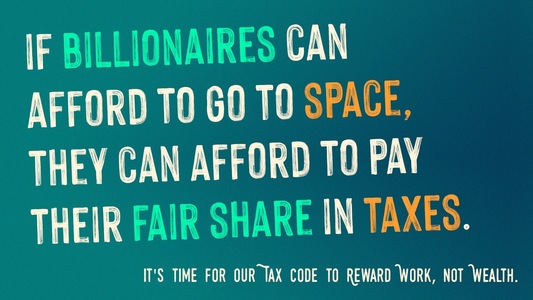
Just how hard would it be to conclude that everyone earning more than $142,000 should pay at least the same rate the rest of us pay? Aren’t we demonstrating all those same laudable traits of the billionaires, just on a smaller scale? Why should we pay 40% and the billionaires pay essentially zero?

Gee, do you reckon paying no taxes might help folks become richer? Garsh, nobody ever asked that question before. And do you reckon paying 40% of your income might make you poorer over time? Golly gee, how come the talking heads worshiping the billionaires never ask these questions?

Since Social Security and Medicare/Medicaid are the bedrock of America’s social safety net, why shouldn’t billionaires pay to support these programs? Well, why not? Just how lame do the excuses have to be to be recognized as laughably self-serving?

Here’s the trick billionaires use to evade taxes. There are countless ways for the super-wealthy to evade taxes–funnel earnings through an Irish post office box, buy a tax break in Washington DC, slide the money into one of dozens of global tax havens, and so on.

But a simple one is to report no income and live large off borrowed money. As the billions of dollars in capital gains pile up as the billionaire’s stock holdings soar (thanks, Federal Reserve, for the free trillions; awful swell of you to give us all that free money), there’s no income generated until the billionaire sells some shares. No sale, no income. Just pay yourself $1 a year in salary, borrow against your billions at super-low rates of interest, and voila, you’re tax-free while you build your super-yacht, buy your private island, and so on.

Just as a thought experiment, suppose the first $50,000 in earnings for everyone were tax-free, and a 40% tax rate was collected on all income above $1 million, both earned and unearned (capital gains), not when the gains were realized in a sale but at the end of every tax year, whether the shares that rose in value were sold or not.

So Billionaire Space Tourist reaped $10 billion in capital gains from the appreciation of stocks held, then the Billionaire pays 40% of those gains: $4 billion. There is a way to not pay any taxes on capital gains–have your portfolio lose value. No gains, no taxes. And to close all the loopholes, the tax rate is on all assets and income connected in any way, shape or form with the U.S. First they pay the U.S. taxes, then if they want to pay other nations’ taxes as well, be my guest. But the 40% is due and payable regardless of any other conditions.

You don’t like it, then stop selling any products in the U.S. or holding any assets in the U.S. Why should billionaires get to set up immensely profitable monopolies, quasi-monopolies, cartels and corporations in the U.S. but pay near-zero in taxes? Why should billionaires be free to profit from America’s economy but pay nothing to support its citizenry?

What precisely is the logic of reducing taxes on the wealthiest few to near-zero? If there is no logic, then we’re left with corruption: America is a moral cesspool.

The truth is America has lost its way if commoners pay a rate of 40% but its billionaires pay next to nothing. Please note Karma and Divine Retribution are not controlled by the billionaire’s lackeys and apparatchiks in the Federal Reserve. The pendulum of exploitation has reached its extreme, and the reversal to the opposite extreme is underway.

What’s REALLY behind the war on home ownership?

Becoming a “Nation of Renters” is clearly a big part of the New Normal.

By Kit Knightly

Source: Off-Guardian

The incipient “Great Reset” is a multi-faceted beast. We talk a lot about vaccine passports and lockdowns and the Covid-realated aspects – and we should – but there’s more to it than that.

Remember, they want you to “own nothing and be happy”. And right at the top of the list of things you definitely shouldn’t own, is your own home.

The headlines about this have been steady for the last few years, but it has picked up pace in the wake of the “pandemic” (as has so much else). An agenda hidden on back pages, behind by Covid’s meaningless big red numbers, but perhaps no less sinister.

You can find articles all over the net talking up renting over owning.

Last month, for example, Bloomberg ran an article headlined:

America Should Become a Nation of Renters”

Which praises what they call “the liquefaction of the housing market” and gleefully expounds on the idea that “The very features that made home buying an affordable and stable investment are coming to an end.”

The Atlantic published “Why Its Better To Rent Than Own” in March.

Financial pages from Business Insider to Forbes to Yahoo and Bloomberg again are filled with lists titled “9 Ways Renting is Better Than Buying”or similar.

Other publications go more personal with it, with anecdotal columns about ignoring financial advice and refusing to buy your home. Vox, never one to sell their agenda with any kind of subtlety, have a piece titled:

Homeownership can bring out the worst in you

Which literally argues that buying a house can make you a bad person:

It’s the biggest thing you might ever buy. And it could be turning you into a bad person.

So what exactly is the narrative here? What’s the story behind the story?

The short answer is fairly simple: It’s about greed, and it’s about control.

It almost always is, in the end.

The longer answer is rather more complicated. Major investment firms such as Vanguard and Blackrock, along with rental companies such as American Homes 4 Rent, are buying up single-family homes in record numbers – sometimes entire neighbourhoods at a time.

They pay well over market value, pricing families who want to own those homes out of the market, which forces the housing market up whilst the Lockdown-created recession is lowering wages and creating millions of newly unemployed.

Of course, this is motivating people to sell the houses they already own.

People all across America have been saddled with houses worth less than they bought them for since the 2008 economic crash, and are eager to take the cash from private investment firms paying 10-20% over market value. Combine an economic recession with a created housing boom and you have a huge population of motivated sellers.

Of course, many of these sellers don’t realise, until it’s too late, that even if they attempt to downsize or move to a cheaper area, they may be priced out of the market completely, and forced to rent.

As such, in the last year, the private investment share of single-family home purchases is estimated to have increased ten-fold, going from 2% in 2018 to over 20% this year.

As more and more people are forced to rent, of course, rental properties will be in higher and higher demand. This in turn will drive the cost of renting up.

Market Watch has already reported that, in the last year, rent has increased over 3x faster than the government predicted.

This problem is likely to get worse in the near future.

Last night [7/30/21], Congress “accidentally failed” to extend the Covid-related eviction ban.

Which means, this weekend, while Senators adjourn to the summer homes they probably don’t rent, the ban will officially end and a lot of people are likely to have their houses foreclosed or their landlords kick them out.

The newly empty buildings will be a feeding frenzy for the massive corporate landlords. Who will descend on the banks like starving hyenas to snap up the foreclosed properties for pennies on the dollar. Just like they did in 2008.

None of this is any secret, it’s been covered in the mainstream. Tucker Carlson even did a segment on it in early June.

The Wall Street Journal headlined, back in April, “If You Sell a House These Days, the Buyer Might Be a Pension Fund”, and reported:

Yield-chasing investors are snapping up single-family homes, competing with ordinary Americans and driving up prices

However, since then, something has clearly changed. The propaganda machine has kicked into gear to defend Wall Street from any backlash.

No better example of this shift can be found than The Atlantic, which ran this story in 2019:

WHEN WALL STREET IS YOUR LANDLORD
With help from the federal government, institutional investors became major players in the rental market. They promised to return profits to their investors and convenience to their tenants. Investors are happy. Tenants are not.

…and this story last month:

BLACKROCK IS NOT RUINING THE US HOUSING MARKET
The real villain isn’t a faceless Wall Street Goliath; it’s your neighbors and local governments stopping the construction of new units.

Going back to the Vox well we have:

Wall Street isn’t to blame for the chaotic housing market

Which ran just a few days after the Atlantic article, and is practically identical.

Both these (oddly similar) articles argue that Wall Street and private equity firms can’t be blamed for buying up houses, and that the real problem is the lack of supply to meet demand.

You see, all the “selfish” people who already own homes (they did say it makes you a bad person) are blocking the construction of new houses, and thus driving up the cost of property through scarcity.

This has been a logically flawed argument around the housing market for decades.

That there aren’t enough houses for people to buy is patently absurd when the US census data says that there are over 15 million houses currently standing empty. That’s enough to house all of America’s roughly 500,000 homeless people 30x over.

There’s plenty of houses, there’s just not enough money to buy them.

The reason for that is the same reason the California has massive “homeless camps” in its major cities, and that so many people are having to become renters instead of owners: wage stagnation.

For decades now, wage increases have lagged behind increases in the cost of living. In the 1960s one full-time job could afford a decent standard of living for a family of four or more. These days both parents work, sometimes multiple jobs each.

It was huge amounts of financial de-regulation which created this situation. So, whether you believe Vox’s BlackRock apologia or not, one way or another Wall Street very definitely is to blame.

But this isn’t just about money. It never is. Just as the war on cash isn’t just about efficiency, and the environmental push isn’t just about climate change. Ditto veganism. It’s about control. Just like vaccines, lockdowns and masks.

It always comes down to control.

It’s an oft-used cliche, but no less true for that, that homeowning “gives people a stake in society”. A family-owned house is a source of security for the future and something to leave your children. It is also sovereignty and privacy. Your own space that no one else can control or take away.

In short: A homeowner is independent. A renter is not. A renter can be controlled. A homeowner can not.

It’s the same reasoning behind the way working people were encouraged to take out loans and become debt slaves. If you limit people’s options, if you make them rely on you for a roof over their heads, you have control over them.

There’s a great article about this situation called “Your New Feudal Overlords”.

Under Feudalism, land wasn’t owned by the working class, but provided to them by landed barons, hence the term “Land Lord”. If you disrespected your Lord, or broke his rules, or he perceived another peasant/farm animal/crop would be a better use of the land, he could take it back.

Essentially, the behaviour of serfs was kept in check by their reliance on the nobility for a place to live. That’s very much the dynamic they’re going for here.

Rental agreements can be full of any terms and conditions the landlord wants, and the more desperate people get the more of their consumer rights they will sign over.

Maybe you’ll agree to smart meters which monitor your internet or power-usage habits, and then sell the data to behavioural modellers and viral marketers.

Maybe you’ll have to agree to certain power limitations or water shortages in order to “fight climate change”.

Maybe it will get worse than that.

Maybe they’ll go full Black Mirror style corporate dystopia. Maybe, through affiliation programs, the mega-equity firm which owns your rental house has ties to McDonald’s, and as such will require you to not eat at any competing fast-food franchises, or demand you observe at least ninety seconds of Disney advertisements per day.

Maybe it will be as simple as including vaccine status in the tenancy agreement, making it impossible for the unvaxxed to find a home.

Maybe they just want to make poor people miserable.

After all, the super-wealthy have got all the money they could ever need, and all the luxury they could ever use. Their living standards are as high as physically possible. So maybe the only way they can keep “winning”, is to start driving the living standards of us proles down.

No air travel. No vacations. No going out at all. Live in a tiny house, or a pod. Eat bugs. Get rid of your car. Rent your clothes. Or your furniture. Pay taxes on sugar. And alcohol. And red meat.

They’ve been very clear about this. They’ve told you about the Great Reset and the Internet of Things. That’s the plan.

You won’t own a house. And you’ll be happy…or else the mega-corporation you’re forced to rent from will kick you out.