Thanks to the FTX swindle, we now know the cost of a get out of jail free card in America: $40 million, paid to political elites. It seems even get out of jail free cards have suffered from inflation.
With hefty “donations” (heh) to elites, all wrong-doing is swept under a very capacious carpet. Jeffrey Epstein sprinkled a few million on the elites of Harvard, and he was ushered into this elite circle as an intimate pal. The fact that he was a rapacious predator of children was of no concern. A few million showered on the right people and causes makes evil and criminality disappear.
If a financier looter showers $40 million on “the right people,” mouths the “correct” phrases and issues empty promises to give away his looted billions, he becomes an instant golden boy of the right elites who have the power to protect him from consequences.
This is how America works now: in-your-face corruption is not just accepted, it’s glorified. Let’s score America’s wealth and power elites, regardless of party or political persuasion:
Integrity: zero.
Austerity: zero.
Restraint: zero.
Humility: zero.
Responsibility: zero.
Accountability: zero.
Sacrifice for the common good: zero.
Thrift: zero.
A society whose elites are so self-serving, corrupt, unaccountable and devoid of any sense of good and evil is doomed. Consider the bleatings of America’s power elite on the FTX swindle. Let’s have congressional hearings on this remarkable “financial event” that caught everyone by surprise, etc.
Translation: let’s stage some political theater to cloak the fact that the looters are being protected from consequences. We all know what happens if you’re caught selling a nickel bag on the street: you get a tenner in a hellhole prison.
But if you bribed the right people, you can swindle billions of dollars and walk free as an insincerely apologetic victim of your own success. Golly gee, I don’t understand what happened to all that money, even though I’m not exactly shy about declaring my own genius.
For reasons lost on the rest of us, investigations by the Securities and Exchange Commission (SEC) and the U.S. Department of Justice (DOJ) always come up empty. Gee, the looting was complicated and we can’t figure out who might have broken the laws against fraud, collusion, embezzlement, malfeasance, etc., so we’re letting everyone off the hook.
Or some sleazy, unaccountable intelligence agency is referenced in whispers that the looters are “assets” and therefore untouchable. Where exactly is the rule of law in a society where bribes, political pressure and having knowledge of elites’ skeletons in the closet melt away accountability and consequences?
The rule of law in America is an illusion, a useful myth promoted by PR hacks to cover the tracks of their employers. Corporate wrong-doing–swindles, collusion, fraud, embezzlement, malfeasance–is off the charts, but nobody is responsible. The criminal corporations are duly fined, a tiny clawback of their looting that’s written off as a cost of doing business.
There are two systems of “justice” in America: one which grants elites freedom from consequences of their toxic criminality and another one for the rest of us that imprisons hundreds of thousands in the War on Drugs Gulag.
What all the entrenched insiders in America’s parasitic, predatory elites and institutions don’t dare admit is that to protect themselves from consequence, we’ve had to sacrifice everything else. Having stripped the nation of the essential foundation of a just, enduring social order–accountability, consequence, rule of law and a grasp of the difference between good and evil–there’s nothing left but sound and fury, as if they’re hoping the endless political circuses and trails of bread crumbs will forever distract us from their plunder and the injustices of the irredeemably corrupt America they’ve fashioned to protect their wealth and power.
To paraphrase Lao Tzu, if one insists on an extreme of corruption and injustice, that extreme will not dwell long.
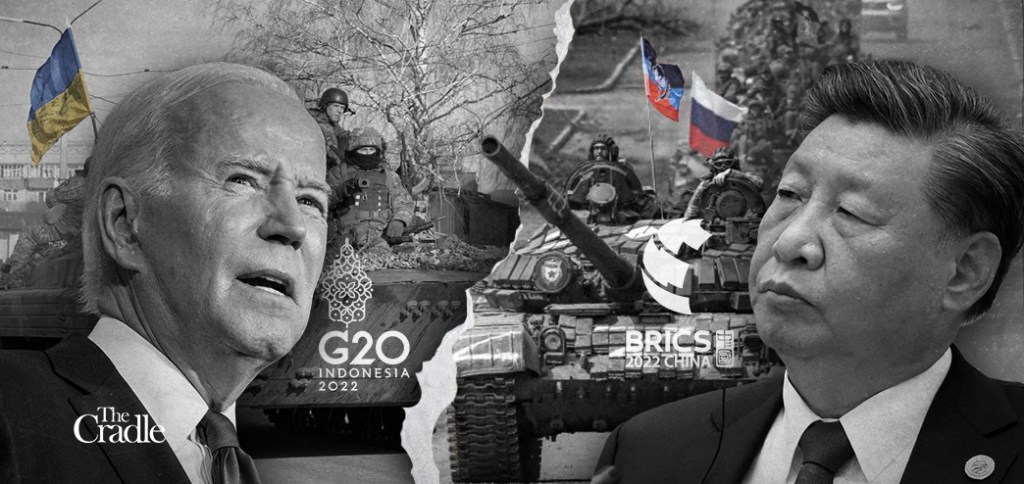
The redeeming quality of a tense G20 held in Bali – otherwise managed by laudable Indonesian graciousness – was to sharply define which way the geopolitical winds are blowing.
That was encapsulated in the Summit’s two highlights: the much anticipated China-US presidential meeting – representing the most important bilateral relationship of the 21st century – and the final G20 statement.
The 3-hour, 30-minute-long face-to-face meeting between Chinese President Xi Jinping and his US counterpart Joe Biden – requested by the White House – took place at the Chinese delegation’s residence in Bali, and not at the G20 venue at the luxury Apurva Kempinski in Nusa Dua.
The Chinese Ministry of Foreign Affairs concisely outlined what really mattered. Specifically, Xi told Biden that Taiwan independence is simply out of the question. Xi also expressed hope that NATO, the EU, and the US will engage in “comprehensive dialogue” with Russia. Instead of confrontation, the Chinese president chose to highlight the layers of common interest and cooperation.
Biden, according to the Chinese, made several points. The US does not seek a New Cold War; does not support “Taiwan independence;” does not support “two Chinas” or “one China, one Taiwan”; does not seek “decoupling” from China; and does not want to contain Beijing.
However, the recent record shows Xi has few reasons to take Biden at face value.
The final G20 statement was an even fuzzier matter: the result of arduous compromise.
As much as the G20 is self-described as “the premier forum for global economic cooperation,” engaged to “address the world’s major economic challenges,” the G7 inside the G20 in Bali had the summit de facto hijacked by war. “War” gets almost double the number of mentions in the statement compared to “food” after all.
The collective west, including the Japanese vassal state, was bent on including the war in Ukraine and its “economic impacts” – especially the food and energy crisis – in the statement. Yet without offering even a shade of context, related to NATO expansion. What mattered was to blame Russia – for everything.
The Global South effect
It was up to this year’s G20 host Indonesia – and the next host, India – to exercise trademark Asian politeness and consensus building. Jakarta and New Delhi worked extremely hard to find wording that would be acceptable to both Moscow and Beijing. Call it the Global South effect.
Still, China wanted changes in the wording. This was opposed by western states, while Russia did not review the last-minute wording because Foreign Minister Sergey Lavrov had already departed.
On point 3 out of 52, the statement “expresses its deepest regret over the aggression of the Russian Federation against Ukraine and demands the complete and unconditional withdrawal of armed forces from the territory of Ukraine.”
“Russian aggression” is the standard NATO mantra – not shared by virtually the whole Global South.
The statement draws a direct correlation between the war and a non-contextualized “aggravation of pressing problems in the global economy – slowing economic growth, rising inflation, disruption of supply chains, worsening energy, and food security, increased risks to financial stability.”
As for this passage, it could not be more self-evident: “The use or threat of use of nuclear weapons is inadmissible. The peaceful resolution of conflicts, efforts to address crises, as well as diplomacy and dialogue, are vital. Today’s era must not be of war.”
This is ironic given that NATO and its public relations department, the EU, “represented” by the unelected eurocrats of the European Commission, don’t do “diplomacy and dialogue.”
Fixated with war
Instead the US, which controls NATO, has been weaponizing Ukraine, since March, by a whopping $91.3 billion, including the latest presidential request, this month, of $37.7 billion. That happens to be 33 percent more than Russia’s total (italics mine) military spending for 2022.
Extra evidence of the Bali Summit being hijacked by “war” was provided by the emergency meeting, called by the US, to debate what ended up being a Ukrainian S-300 missile falling on a Polish farm, and not the start of WWIII like some tabloids hysterically suggested.
Tellingly, there was absolutely no one from the Global South in the meeting – the sole Asian nation being the Japanese vassal, part of the G7.
Compounding the picture, we had the sinister Davos master Klaus Schwab once again impersonating a Bond villain at the B20 business forum, selling his Great Reset agenda of “rebuilding the world” through pandemics, famines, climate change, cyber attacks, and – of course – wars.
As if this was not ominous enough, Davos and its World Economic Forum are now ordering Africa – completely excluded from the G20 – to pay $2.8 trillion to “meet its obligations” under the Paris Agreement to minimize greenhouse gas emissions.
The demise of the G20 as we know it
The serious fracture between Global North and Global South, so evident in Bali, had already been suggested in Phnom Penh, as Cambodia hosted the East Asia Summit this past weekend.
The 10 members of ASEAN had made it very clear they remain unwilling to follow the US and the G7 in their collective demonization of Russia and in many aspects China.
The Southeast Asians are also not exactly excited by the US-concocted IPEF (Indo-Pacific Economic Framework), which will be irrelevant in terms of slowing down China’s extensive trade and connectivity across Southeast Asia.
And it gets worse. The self-described “leader of the free world” is shunning the extremely important APEC (Asia-Pacific Economic Cooperation) summit in Bangkok at the end of this week.
For very sensitive and sophisticated Asian cultures, this is seen as an affront. APEC, established way back in 1990s to promote trade across the Pacific Rim, is about serious Asia-Pacific business, not Americanized “Indo-Pacific” militarization.
The snub follows Biden’s latest blunder when he erroneously addressed Cambodia’s Hun Sen as “prime minister of Colombia” at the summit in Phnom Penh.
Lining up to join BRICS
It is safe to say that the G20 may have plunged into an irretrievable path toward irrelevancy. Even before the current Southeast Asian summit wave – in Phnom Penh, Bali and Bangkok – Lavrov had already signaled what comes next when he noted that “over a dozen countries” have applied to join BRICS (Brazil, Russia, India, China, South Africa).
Iran, Argentina, and Algeria have formally applied: Iran, alongside Russia, India, and China, is already part of the Eurasian Quad that really matters.
Turkey, Saudi Arabia, Egypt, and Afghanistan are extremely interested in becoming members. Indonesia just applied, in Bali. And then there’s the next wave: Kazakhstan, UAE, Thailand (possibly applying this weekend in Bangkok), Nigeria, Senegal, and Nicaragua.
It’s crucial to note that all of the above sent their Finance Ministers to a BRICS Expansion dialogue in May. A short but serious appraisal of the candidates reveals an astonishing unity in diversity.
Lavrov himself noted that it will take time for the current five BRICS to analyze the immense geopolitical and geoeconomic implications of expanding to the point of virtually reaching the size of the G20 – and without the collective west.
What unites the candidates above all is the possession of massive natural resources: oil and gas, precious metals, rare earths, rare minerals, coal, solar power, timber, agricultural land, fisheries, and fresh water. That’s the imperative when it comes to designing a new resource-based reserve currency to bypass the US dollar.
Let’s assume that it may take up to 2025 to have this new BRICS+ configuration up and running. That would represent roughly 45 percent of confirmed global oil reserves and over 60 percent of confirmed global gas reserves (and that will balloon if gas republic Turkmenistan later joins the group).
The combined GDP – in today’s figures – would be roughly $29.35 trillion; much larger than the US ($23 trillion) and at least double the EU ($14.5 trillion, and falling).
As it stands, BRICS account for 40 percent of the global population and 25 percent of GDP. BRICS+ would congregate 4.257 billion people: over 50 percent of the total global population as it stands.
BRI embraces BRICS+
BRICS+ will be striving towards interconnection with a maze of institutions: the most important are the Shanghai Cooperation Organization (SCO), itself featuring a list of players itching to become full members; strategic OPEC+, de facto led by Russia and Saudi Arabia; and the Belt and Road Initiative (BRI), China’s overarching trade and foreign policy framework for the 21st century. It is worth pointing out that early all crucial Asian players have joined the BRI.
Then there are the close links of BRICS with a plethora of regional trade blocs: ASEAN, Mercosur, GCC (Gulf Cooperation Council), Eurasia Economic Union (EAEU), Arab Trade Zone, African Continental Free Trade Area, ALBA, SAARC, and last but not least the Regional Comprehensive Economic Partnership (RCEP), the largest trade deal on the planet, which includes a majority of BRI partners.
BRICS+ and BRI is a match everywhere you look at it – from West Asia and Central Asia to the Southeast Asians (especially Indonesia and Thailand). The multiplier effect will be key – as BRI members will be inevitably attracting more candidates for BRICS+.
This will inevitably lead to a second wave of BRICS+ hopefuls including, most certainly, Azerbaijan, Mongolia, three more Central Asians (Uzbekistan, Tajikistan, and gas republic Turkmenistan), Pakistan, Vietnam, and Sri Lanka, and in Latin America, a hefty contingent featuring Chile, Cuba, Ecuador, Peru, Uruguay, Bolivia, and Venezuela.
Meanwhile, the role of the BRICS’s New Development Bank (NDB) as well as the China-led Asia Infrastructure Investment Bank (AIIB) will be enhanced – coordinating infrastructure loans across the spectrum, as BRICS+ will be increasingly shunning dictates imposed by the US-dominated IMF and the World Bank.
All of the above barely sketches the width and depth of the geopolitical and geoeconomic realignments further on down the road – affecting every nook and cranny of global trade and supply chain networks. The G7’s obsession in isolating and/or containing the top Eurasian players is turning on itself in the framework of the G20. In the end, it’s the G7 that may be isolated by the BRICS+ irresistible force.
If you haven’t plowed through dozens of post-collapse commentaries on FTX, I’m saving you the trouble: here’s a distillation of what matters going forward. If you’re seeking a forensic accounting of FTX, others have done this work already. If you’re seeking an ideological diatribe, you won’t find that here, either.
What you will find is insight into the real innovation of FTX: FTX compressed the entire playbook and history of financial fraud into one brief cycle of the credulous bamboozled, Charles Ponzi bested and creative accounting being revealed for what it really is, fraud.
All financial frauds share the same set of tools. The toolbox of financial fraud, whether it is traditional or crypto-based, contains variations of these basic mechanisms:
1. Using clients’ capital (without full disclosure) to increase the private gain of the Owners of the Con (OOTC).
2. Using the clients’ capital to arbitrage yield differentials in duration, risk and other asymmetries to the benefit not of the clients but to the Owners of the Con (OOTC)..
3. Overstate assets by listing illiquid, insider-controlled, non-marked-to-market assets at valuations completely disconnected from reality, i.e. what they would fetch on the open market in size. Rely on assets issued by the firm or its subsidiaries for the bulk of the firm’s assets, i.e. its claim of solvency.
4. Attracting new capital investments and client funds with “too good to be true” (but borderline plausible, given the fantastic growth and track record of high returns) returns, goals and promises to cover the normal churn of redemptions, so the fraud goes undetected. (Ponzi Scheme)
5. Play fast and loose with leverage, the full extent of which isn’t disclosed to clients or regulators.
6. Issue securities (i.e. “money”–tokens, bonds, shares of stock, etc.) whose value is based on the firm’s fraudulently listed assets and mouth-watering growth.
7. Persuade investors and clients that you’re doing them a favor by letting them get a piece of the action. In other words, exploit their near-infinite greed.
8. Present a facade of prudent, audited, transparent, regulated stability which cloaks the interlocking network of fraud, bogus accounting, illiquid assets, etc. and insider looting.
I have often recommended Herman Melville’s novel The Confidence-Man for its masterful depiction of how The Confidence-Man persuades the skeptic that not only is The Confidence-Man trustworthy, but he is doing the mark a favor in taking his money.
Note that there are quasi-legal versions of some of these tools. The full exposure to the risks inherent in extreme leverage and illiquidity can be cloaked, buried in off-balance sheet assets and liabilities, etc., while pages of mind-numbing disclosures were duly signed by blinded-by-greed marks.
These quasi-legal versions are just as prone to unraveling and collapse as the blatantly fraudulent varieties. Properly disclosed leverage and illiquidity are just as prone to unraveling as undisclosed leverage and illiquidity.
Mismatches of duration, liquidity and risk are just as toxic to full-disclosure firms as they are to fraudulent firms.
This is why we can predict the dominoes of FTX’s financial fraud have yet to fall. When there are mismatches in counterparty asset durations and liquidity, assets that theoretically cover loans that are called can’t be sold or can only be sold at ruinous discounts.
Leverage works both ways, and so the 100-to-1 leverage that’s so glorious when the $1 yields $100 in gains also triggers the mass liquidation of illiquid assets when small losses unwind all that leverage.
Everyone caught short by losses, redemptions and counterparty claims will be desperate to hide their exposure to insolvency. But humans are herd animals, and once the herd gets spooked, trust in assurances quickly plummets and all eyes are on counterparty risks and the actual market for lightly traded assets.
Once assets are revealed as worth far less than claimed, insolvency is the inevitable result. How far will the lines of toppling dominoes extend? Quite possibly much farther than the credulous believe possible.
We have pretty much burned our bridges at this point. Unless you’re prepared to mindfuck yourself, and gaslight yourself, and confess, and convert, there’s no going back to “normal” society (which we couldn’t go back to anyway, on account of how it doesn’t exist anymore) — CJ Hopkins
Thirty-seven billion more dollars for Ukraine? (That’s thirty-seven thousand millions of dollars, by the way.) Bringing the total this year to a click-or-two over ninety billion (ninety-thousand millions), on top of whatever Sam Bankman-Fried’s FTX company funneled through that sad-sack international money laundromat — soon to be the darkest backwater of a European failed state since Field Marshal Melchior von Hatzfeldt of Westphalia left Bohemia a corpse-strewn wasteland after the Battle of Jankau (1645).
It really doesn’t matter how much more money we pound down that rat-hole, you understand, because by the time various parties — the weapons-makers, Volodymyr Zelensky, sundry members of the US House of Representatives, The Biden family, the World Economic Forum — are finished creaming off their fair shares, poor Ukraine won’t have enough cash-on-hand to replace six fuse-boxes in Zaporizhzhia.
Against this backdrop, the USA enters a holiday season near-death spiral as unspooling scandals battle a collapsing economy for supremacy of the alt news sites. Case-in-point: the aforementioned FTX monkey business, a metastasizing tumor of the body politic. This complex fraud will smolder for a few weeks before it explodes into an extinction-grade event for the Democratic Party. The usual suspects among the mainstream media are trying to ignore it for the moment, but the shreds of this exploding money-borg are already sticking to guilty parties far and wide across the political landscape.
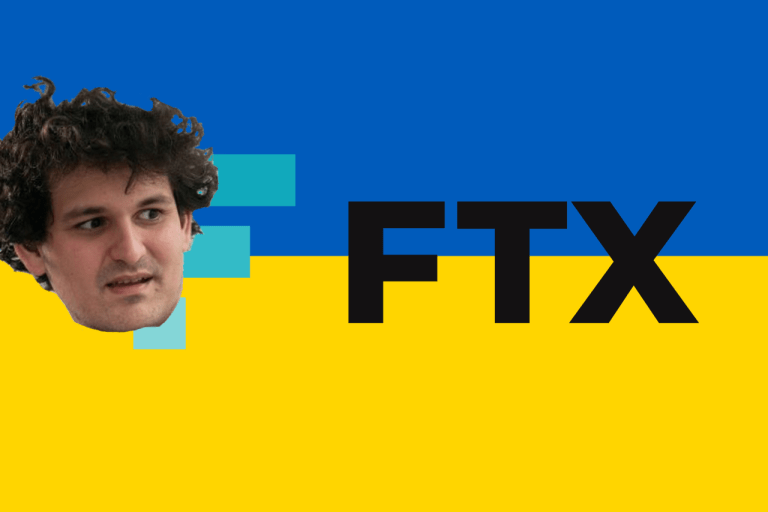
FTX commander-in-chief Sam Bankman-Fried remains at large after steering the crypto-currency trading platform into a bankruptcy so hideously tangled that the assigned liquidator in court proceedings, one John Ray III, who oversaw the Enron aftermath years ago, was boggled by what he’s found so far (and it’s early in the game): Namely, a company run by a handful of twenty-something drug freaks with no idea what they were doing, no record-keeping, and a slime trail of misappropriated investor’s funds leading to Kiev and Geneva through various crooked American political action committees, and the halls of Congress — with echos in ballot harvesting shenanigans which shaped the outcome of this month’s US elections.
Mr. Bankman-Fried is still scheduled as a main speaker for Accenture’s Nov. 30 DealBook Conference in New York ($2,499 for a ticket), along with Ukrainian President Volodymyr Zelensky and US Treasury Secretary Janet Yellen. Odds on him showing up? Or even being alive elsewhere on this planet then?
The extended family Bankman-Fried is the quintessence of Woke aristocracy. Dad Joe Bankman and mom Barbara Fried are both law professors at Stanford. She also acted as a money-bundler for the Democratic Party and ran two non-profit “voter registration” orgs (against the IRS laws which only permit non-partisan organized voter registration). Brother Gabe Bankman-Fried headed a non-profit named Guarding Against Pandemics (funded by Sam), which lobbies Congress to construct new platforms for medical tyranny. Aunt Linda Fried is Dean of the Columbia U’s Public Health school, and is associated with Johns Hopkins, which ran the October 2019 Event 201 pandemic drill (sponsored by the Gates Foundation) months before the Covid-19 outbreak.
Sam’s girlfriend, Caroline Ellison, ran the Alameda Investments arm of the FTX empire (that is, FTX’s own money laundromat). Her dad, Glenn Ellison is chair of MIT’s Econ School. His former colleague on the MIT Econ faculty, Gary Gensler, who specialized in blockchains there, is now head of the Securities and Exchange Commission, an agency that Sam Bankman Fried was attempting to rope into a regulation scheme to eliminate FTX’s crypto-currency competitors. Caroline’s mom, Sara Fisher Ellison is an MIT econ prof specializing in the pharmaceutical industry (fancy that!). Caroline Ellison is currently on-the-run.
The sum total of all this professional and academic accomplishment is also the quintessence of Woke-Jacobin turpitude in service to a political faction that seeks maximum moneygrubbing while acting to overthrow every norm of behavior in the conduct of elections, and perhaps in American life generally. That’s some accomplishment. It’s also a lesson in why the managerial elite of our country are no longer trustworthy. They have gotten away with crimes against the nation for years, which has only made them bolder and more reckless.
Wait for the FTX bankruptcy to unwind, along with all the political ramifications it entails, not to mention the financial afterburn in the whole crypto market, very likely extending into and befouling the rest of the banking system. This is going to be a clusterfuck for the ages, and will propel the USA into a depression with no visible horizon.
The Ukrainian government mysteriously disappeared online records of its fundraising arrangement with the FTX crypto scam just days before the scandal erupted. The initiative claims to have raised $60 million for Ukraine, but where did the money go?
The demise of FTX, the fifth-biggest cryptocurrency exchange by trade volume in 2022, and the second-largest by holdings, has sent a wave of chaos through global financial markets.
As the turbulence grows, the government of Ukraine is conducting an ongoing cleanup and whitewashing operation to rid any and all references to a high-level cryptocurrency fundraising arrangement it struck with FTX from the web. Eerily, it seems to have commenced just days before the scandal erupted.
Online records unearthed by The Grayzone claim tens of millions were raised by FTX for the Ukrainian government, and put to a variety of belligerent uses. But with the company now exposed as a Potemkin village lacking underlying assets, and major question marks hanging over whether its operations were from day one fraudulent top to bottom, where does that leave the supposedly successful donation scheme? Were those sums truly raised, and if so, to what purposes were they actually put?
FTX’s destruction resulted from a mass sell-off of the company’s native bitcoin token, FTT, by the rival exchange, Binance. Its value plummeted, prompting a three-day “run” on billions of dollars worth of cryptocurrency, which in turn created – or exposed – a “liquidity crisis” within FTX, as it did not have the available assets required to redeem client withdrawals. FTX filed for bankruptcy on November 11th.
FTX founder and top Democrat Party donor Sam Bankman-Fried now faces criminal investigations in the Bahamas, where the exchange was headquartered, and calls for official investigations into the largely unregulated cryptocurrency industry are reverberating across the globe.
The sudden death of FTX has been compared to the 2008 disintegration of Lehman Brothers that precipitated the financial crisis.
Massive customer holdings have apparently gone missing thanks to a secret “back door” in the FTX bookkeeping system that allowed Bankman-Fried to make changes to the company’s financial records without any accountability. This connivance may have been used to hide at least $10 billion in client funds Bankman-Fried transferred from exchange to another company he founded, digital asset trader Alameda Research.
While mainstream media pores over the details of Bankman-Fried’s gargantuan crypto scam, not one single major outlet has investigated or even acknowledged FTX’s relationship with the government of Ukraine.
Were client holdings unaccountably and illegally funneled into the West’s proxy war? Or did the supposed aid FTX sent to Kiev find its way into the hands of Ukrainian scammers, corrupt warlords and illicit actors?
The corporate media’s failure to explore these questions appears all the more perverse given Bankman-Fried’s flamboyant promotion of his intimate financial relationship with the government of Ukrainian President Volodymyr Zelensky.
FTX pledges to “turn bitcoin into bullets, bandages and other war materiel” for Ukraine
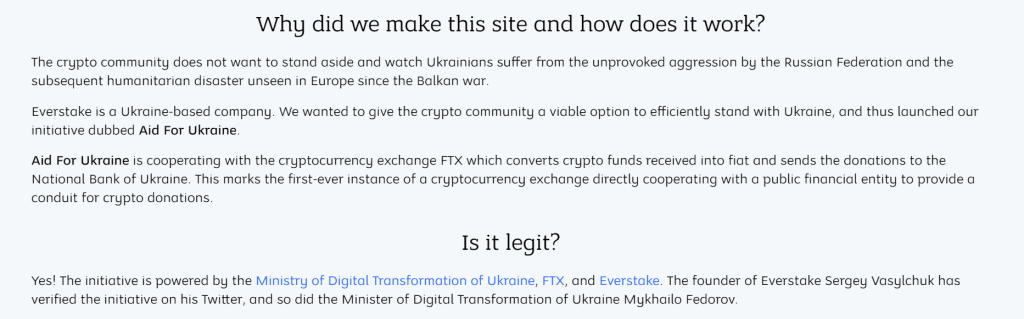
The partnership between FTX and the Ukrainian government was first publicized on March 14th when the leading cryptocurrency website CoinDesk announced Kiev had launched a dedicated webpage for cryptocurrency donations dubbed Aid for Ukraine.
Under its auspices, FTX pledged to “convert crypto contributions to Ukraine’s war effort into fiat for deposit” at the National Bank of Kiev, allowing the embattled government to “turn bitcoin into bullets, bandages and other war materiel.” CoinDesk stated the initiative “deepens an unprecedented tie-up between public and private sector forces in crypto.”
Oleksandr Bornyakov, an official at Ukraine’s Ministry of Digital Transformation, hinted to CoinDesk about an “upcoming NFT collection” auction to “give the next boost to the crypto fundraising process.”
(Bornyakov’s Ministry of Digital Transformation played a key role in the successful, Zelensky-led campaign to cancel The Grayzone’s Max Blumenthal and Aaron Mate’s appearance at Web Summit, a major international gathering of the tech industry in Lisbon, Portugal).
In a press release accompanying the announcement of the FTX partnership with Ukraine, Bankman-Fried explained that, “at the onset of the conflict in Ukraine, FTX felt the need to provide assistance in any way it could.” He promised that the arrangement provided “the ability to deliver aid and resources to the people who need it most.”
Kiev disappears Aid for Ukraine site days before FTX scandal goes public
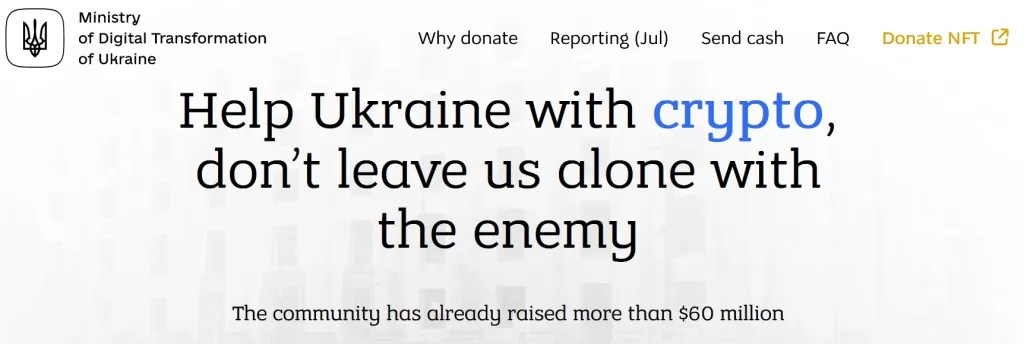
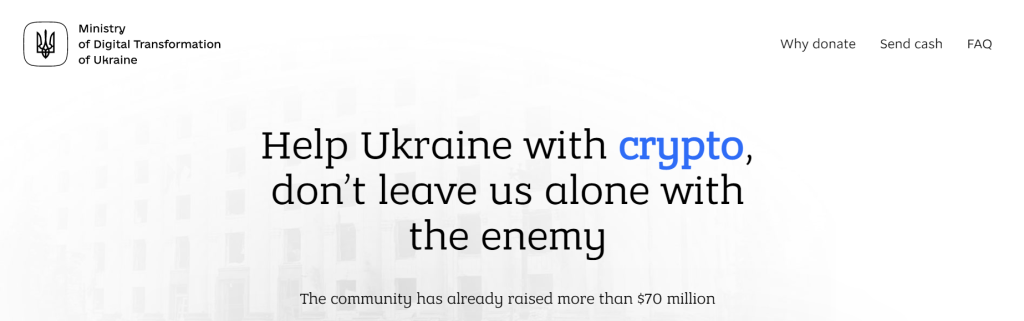
The Aid for Ukraine webpage has now been deleted, but can still be accessed via the Internet Archive. Until very recently, it encouraged visitors to “help Ukraine with crypto” and pleaded, “don’t leave us alone with the enemy.”
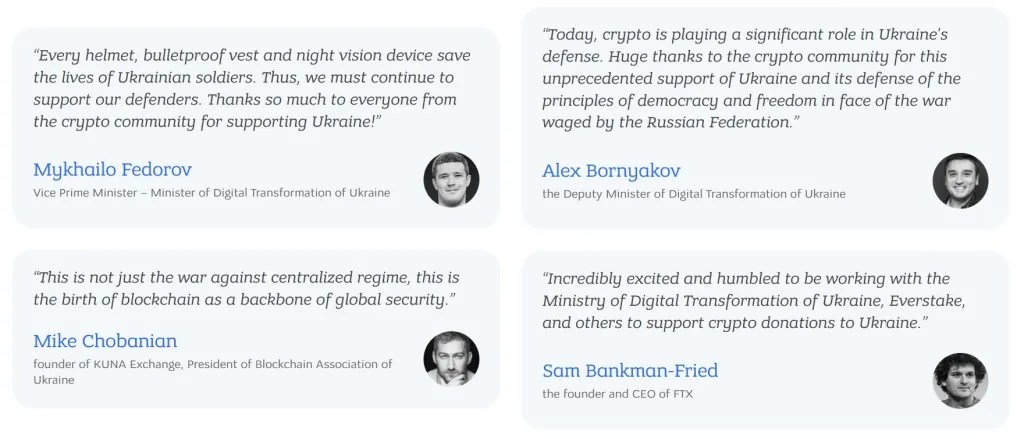
The site featured promotional quotes from an assortment of Ukrainian government officials and bitcoin bros – among them, FTX’s founder.
Mykhailo Fedorov, Ukraine’s deputy Prime Minister, and Minister of Digital Transformation of Ukraine, thanked “the crypto community” for funding the purchase of helmets, bulletproof vests, and night vision devices. For his part, Bankman-Fried declared himself “incredibly excited and humbled” to “support crypto donations to Ukraine.”
The last available Internet Archive capture of Aid for Ukraine” took place on the afternoon of October 26th. Throughout the webpage’s existence, the Internet Archive captured multiple snapshots of it weekly. This clearly indicates the page was purged by Kiev in late October, several days before the FTX crisis initially broke out.
Once it was deleted, the Ukrainian government created a standalone websiteon November 1st to promote the endeavor. The page was identical, and quotes from Bankman-Fried, and references to FTX’s involvement and its logo, remained in place until the morning of November 15th.
Was the original webpage’s dumping and erasure, and the shift to a totally new interface, at that time merely a spooky coincidence, or were the Ukrainians warned of what was coming? What did Kiev know, and when did it know it?
Bankman-Fried channeled millions to Biden through “stealth” PAC
Though FTX has been accused of serving as a money laundering vehicle for the US Democratic Party, concrete evidence supporting this claim has yet to materialize. But given Bankman-Fried’s background as one of the most prolific donors to the Democrats, and the role he played as a nexus between party power-brokers and the cryptocurrency sphere, the allegations are understandable.
Bankman-Fried is the son of Stanford law professor Barbara Friedman, founder of a shadowy Super PAC called Mind the Gap which quietly channeled millions to Democratic party candidates, primarily from nameless Silicon Valley investors.
The organization has no website or social media footprint, and its founders do not advertise their involvement publicly. Chosen through complex data analysis, beneficiaries of the Super PAC often have no idea themselves who or what has donated to their campaigns.
“The raison d’être is stealth,” an individual “with ties to the organization” told Vox back in 2020.
Bankman-Fried establishment of FTX in April 2019 – the same month Joe Biden announced his 2020 Presidential run – has added to the intrigue surrounding the scandal. Once vast sums started flowing into and through the FTX exchange, its founder channeled profits into Biden’s campaign coffers. Oddly, Bankman-Fried had no prior history of political giving.
Throughout the 2020 campaign, Bankman-Fried gifted over $5 million to Biden and groups supporting him. This reportedly helped fuel a potentially decisive “nine-figure, eleventh-hour blitz of TV advertising” targeting swing states, and made the crypto bro the second-largest donor to the president, right behind Michael Bloomberg.
Bankman-Fried claimed this wellspring of generosity was “motivated less by specific issues than by the Biden team’s ‘generic stability and decision-making process.’” Such an apparent lack of enthusiasm for the President stands at odds with the staggering sums he has pumped into Democratic party coffers ever since.
In 2022 alone, Bankman-Fried lavished almost $40 million on Democratic candidates, campaigns, and PACs. The giving spree made him the second-largest individual donor to Democratic causes, behind liberal venture capitalist George Soros.
More recently, Bankman-Fried pledged to donate a staggering $1 billion between this year and 2024 to ensure a Democratic victory in the next presidential vote. On October 14th, however, he completely backtracked, branding the investment a “dumb” move. Something scandalous was brewing behind the scenes.
One week later, the Texas State Securities Board announced it was investigating FTX on suspicion of selling unregistered securities. The development went largely unnoticed by the media. To the extent it generated any interest at all, it was framed as just one of several examples of financial authorities scrutinizing crypto players.
What happened to the $60 million raised by Aid for Ukraine?
If FTX was indeed laundering funds for the proxy war in Ukraine, the slightest indication that regulators were investigating its operations would have triggered alarm bells throughout Washington – and by extension, Kiev. This may be why the Ukrainian government switched the Aid for Ukraine webpage with a dedicated website, and scrubbed the original entirely from the internet just days after the announcement.
Also curious are the Internet Archive captures of the Aid for Ukraine website that show records of funds purportedly flowing to Kiev via Bitcoin had not been updated since July. At the time, the webpage reported that over $60 million had been raised by the “community.” This figure is reflected on the updated standalone Aid for Ukraine fundraising site.
A breakdown of spending on the new Aid for Ukraine website states Kiev had spent a total of $54,573,622 in cryptocurrency donations by July 7th on a wide variety of equipment, vehicles, drones, “lethal equipment” and other resources. One of the biggest single expenditures was $5,250,519 on a “worldwide anti-war media campaign,” the details of which would only “be published after our victory” due to “security reasons.”
Ukrainian government officials and private sector actors involved in the operation of Aid for Ukraine have scoffed at suggestions of impropriety regarding its use, but have only raised further questions with their denials.
Oleksandr Bornyakov of Ukraine’s Ministry of Digital Transformation declared that Aid for Ukraine simply used FTX to “convert donations into fiat in March.” The CEO of Everstake, the “validator” company that in theory guaranteed crypto funds donated via Aid for Ukraine reached Kiev’s Ministry of Defense, also thanked “every crypto holder for donating…in those early day [sic], when every cent and every minute was crucial.”
Taken in tandem, these comments suggest Aid for Ukraine was set up purely to receive donations in the initial stages of the war, and the $60 million figure represents sums received and converted in the weeks immediately following the launch of the initiative. This interpretation is reinforced by an Everstake staffer’s presentation at a cryptocurrency conference at Web Summit on November 1st, on the subject of “raising [over] $60m in crypto for Ukraine.”
Our Segment Lead @jane_everstake is getting ready to speak at a #FILLisbon panel about @_AidForUkraine and raising >$60m in crypto for Ukraine. The panel kicks off in just 15 min, at 11.30 Lisbon time. Don’t miss it if you’re there! pic.twitter.com/wTnC9Qfqvx
But an Internet Archive capture of Aid for Ukraine on April 1st adds to the confusion, showing that two-and-a-half-weeks after the initiative launched, the webpage was updated to claim “over $70 million” had been raised from crypto donors. This was revised down to “over $60 million” five days later.
More strangely, Aid for Ukraine records show that from the time of the initiative’s launch to April 14th, a total of $45,103,538 was spent. This means just $9,470,084 was spent between April 14 and July 7th, a period in which the war developed into a “bloody war of attrition” according to The Guardian.
This leaves a gap of at least $5.5 million in the money Aid for Ukraine claimed to have raised in its initial weeks, and the funds it says it distributed in Ukraine.
The disparity was confirmed in a tweet by the official Aid for Ukraine Twitter account, posted on the evening of November 15th, which stated that “out of $60 million received, $54 million have already been spent on Ukraine’s humanitarian and military needs.”
7/11 Here is a tweet from Deputy Minister of Digital Transformation of Ukraine @abornyakov refuting those rumors:https://t.co/vUsGNkkjh5
This implies that no further funds of any size were received after early April, and the total has remained static ever since, despite the resource being open for donations. Which would be highly unusual.
The government of Ukraine, FTX, and Everstake all now have serious questions to answer. Namely, why the funds purportedly raised appear to have decreased in a span of a few days, why no donations have been received since then on the Aid for Ukraine webpage or its new website, how much has been donated since the alleged initial influx, and where did the rest of the money go?
Ukraine: a black hole for Western aid
Stories of potential financial impropriety by Ukrainian officials and the country’s military are invariably ignored or outright buried by the Western media. An August exposé by the Kyiv Independent documented wide-ranging abuses by the leadership of a wing of the International Legion, including sexual harassment, looting, threatening soldiers at gunpoint and sending them unprepared on reckless missions. Though the Kyiv Independent often influences Western media’s coverage of the Ukraine conflict, this story was completely ignored in mainstream quarters.
That same month, CBS broadcast an investigative feature revealing that only 30 percent of Western arm shipments to Ukraine ever reach the frontline. Due to intense backlash from the Pentagon and other powerful sources, CBS temporarily pulled its own documentary and an accompanying promotional trailer and article from the web. The feature has since been “updated” to claim that “the situation has significantly improved” since filming, and “a much larger quantity now gets where it’s supposed to go.”
When it comes to Ukraine, Democrats at the highest levels are also immensely skilled at burying embarrassing stories. In December 2015, Joe Biden coerced Kiev’s then-leader Petro Poroshenko into firing prosecutor general Viktor Shokin as a condition for the US underwriting a $1 billion IMF loan to Ukraine.
“I’m going to be leaving here in six hours. If [Shokin] is not fired, you’re not getting the money,” Biden threatened.
With Shokin’s firing, the experienced lawyer’s ongoing probe into the energy giant Burisma ended as well. Which meant that Burisma’s most famous board member, Hunter Biden, the son of then-US Vice President’s son, eluded official scrutiny.
Now, a politically connected crypto-billionaire who used a secret financial “back door” to fleece customers of ungodly sums of money has become the latest character in the saga of shady US aid to Ukraine. And though the collapse of his FTX firm is front page news, mainstream outlets are studiously avoiding the Ukraine angle.
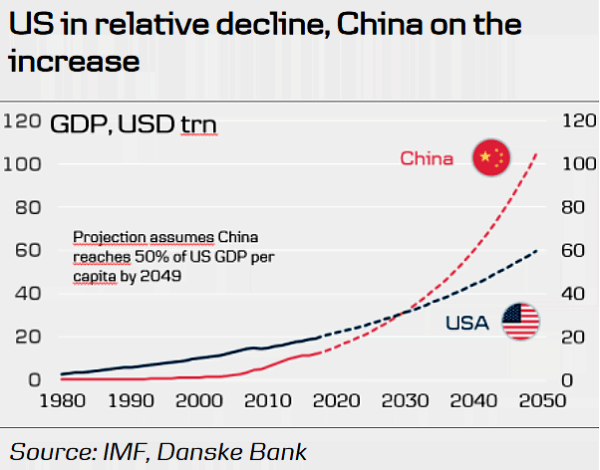
It explains why Washington is so worried about China’s explosive growth. It explains why the US continues to hector China on the issues of Taiwan and the South China Sea. It explains why Washington sends congressional delegations to Taiwan in defiance of Beijing’s explicit requests. It explains why the Pentagon continues to send US warships through the Taiwan Strait and ship massive amounts of lethal weaponry to Taipei. It explains why Washington is creating anti-China coalitions in Asia that are aimed at encircling and provoking Beijing. It explains why the Biden administration is stepping up its trade war on China, imposing onerous economic sanctions on its businesses, and banning critical high-tech semi-conductors that are “are essential not just… for virtually every aspect of modern society, from electronic products and transport to the design and production of all manner of goods.” It explains why China has been singled-out in the US National Security Strategy (NSS) as “the only competitor with both the intent and, increasingly, the capability to reshape the international order.” It explains why Washington now regards China as its biggest and most formidable strategic adversary that must be isolated, demonized and defeated.
The chart above explains everything, not just the hostile diplomatic jabs that are designed to discredit and humiliate China, but also the openly belligerent policies that are aimed at Russia as well. People need to understand this. They need to see what is really going on so they can put events in their proper geopolitical context.
And what “context” is that?
The context of a Third World War; a war that was thoroughly-planned, instigated and (now) prosecuted by Washington and Washington’s proxies. That’s what’s really going on. The increasingly violent conflagrations we see cropping-up in Ukraine and Asia are not the result of “Russian aggression” or “evil Putin”. No. They are the actualization of a sinister geopolitical strategy to quash China’s meteoric rise and preserve America’s dominant role in the world order. Can there be any doubt about that?
No. None.
This is why we are experiencing the redivision of the world into warring blocs. This is why we are seeing the roll back of 30 years of Globalization and massive suppyline disruption. And this is why Europe has been thrust headlong into frigid darkness and forced deindustrialisation. All of these suicidal policies were concocted for one purpose and one purpose alone, to maintain America’s exalted spot in the global system. That is why all of humanity is presently embroiled in a Third World War; a war that is designed to prevent China from becoming the world’s biggest economy; a war that is designed to preserve US global primacy. Check out this excerpt from an article at the World Socialist Web Site:
An October 19 Financial Times article by Edward Luce, entitled “Containing China is Biden’s explicit goal,” sounded the following alarm: “Imagine that a superpower declared war on a great power and nobody noticed. Joe Biden this month launched a full-blown economic war on China—all but committing the US to stopping its rise—and for the most part, Americans did not react.
“To be sure, there is Russia’s war on Ukraine and inflation at home to preoccupy attention. But history is likely to record Biden’s move as the moment when US-China rivalry came out of the closet.”
Moreover, last week, a top Biden administration official indicated that the US was preparing new bans on China in key hi-tech areas. Speaking at the Center for a New American Security, Alan Estevez, the under-secretary of Commerce for Industry and Security, was asked if the US would ban China from accessing quantum information science, biotechnology, artificial intelligence software or advanced algorithms. Estevez admitted that this was already being actively discussed. “Will we end up doing something in those areas? If I was a betting person, I would put down money on that,” he said….
Luce concluded his Financial Times article cited above by declaring: “Will Biden’s gamble work? I’m not relishing the prospect of finding out. For better or worse, the world has just changed with a whimper not a bang. Let us hope it stays that way.”…(“Biden’s technology war against China”, World Socialist Web Site)
Once again, look at the chart. What does it tell you?
The first thing it tells you is that the hostilities we see in Ukraine (and eventually Taiwan), can be traced back to a fundamental shift in the global economy. China is growing stronger. It’s on a path to overtake the United States economy within the decade. And with growth, come certain benefits. As the world’s biggest economy, China will naturally become Asia’s regional hegemon. And, as Asia’s regional hegemon it will be able “to settle regional disputes in its own favor and to de-legitimize U.S. regional and global leadership.”
Can you see the problem here?
For nearly two decades, the US has oriented its foreign policy around a “rebalancing of forces” strategy called the “pivot to Asia”. In short, the US intends to be the dominant player in the world’s most populous and prosperous region, Asia. Can you see how China’s rise derails Washington’s plan for the future?
The United States is not going to let this happen without a fight. Washington is not going to let China muscle-it-out of the markets that it plans to dominate. That’s not going to happen. And if you think that’s going to happen, you’d better think again. The United States will go to war to avoid a scenario in which the US plays “second fiddle” to China. In fact, the foreign policy establishment has already decided that the US will engage China militarily for that very objective.
So, our thesis is simple; we think WW3 has already begun. That’s all we’re saying. The ructions we see in Ukraine are merely the first salvo in a Third World War that has already triggered an unprecedented energy crisis, massive worldwide food insecurity, a catastrophic break-down in global supply lines, widespread and out-of-control inflation, the steady reemergence of extreme nationalism, and the redivision of the world into warring blocs. What more proof do you need?
And it’s all economic. The origins of this conflict can all be traced back to the seismic changes in the global economy, the rise of China and the unavoidable decline of the United States. It is a case of one empire replacing the other. Naturally, a transition of this magnitude is going to generate tectonic changes in global distribution of power. And along with those changes will come more flashpoints, more devastation, and the looming prospect of nuclear war. And this is precisely how things are playing out.
So, how does the chart explain what is happening in Ukraine?
Washington’s proxy war in Ukraine is actually aimed at China not Russia. Russia is not a peer competitor and Russia does not have the economic wherewithal to displace the United States in the global order. NordStream, however, did pose a significant risk to the US by greatly strengthening Moscow’s economic relations with the EU and particularly with Europe’s industrial powerhouse, Germany. The Moscow-Berlin alliance—which was mutually beneficial and key to German prosperity—had to be sabotaged to prevent further economic integration that would have drawn the continents closer together into the world’s biggest free trade zone.Washington had to stop that in order to preserve its economic stranglehold on Europe and defend the dollar as the world’s reserve currency. Even so, no one expected the US to blow up the pipeline itself in—what appears to be—the greatest act of industrial terrorism in history. That was truly shocking.
In essence, Washington sees Russia as an obstacle to its “pivot” plan to encircle, isolate and weaken China. But Russia is not the greatest threat to US global primacy; not even close. That designation belongs to China.
The Third World War is being waged to contain China not Russia. What the war in Ukraine suggests is that—among foreign policy elites—there is general agreement that, The road to Beijing goes through Moscow. That appears to be the consensus view. In other words, US powerbrokers want to weaken Russia in order to spread US military bases across Asia. Ultimately, the military will be called upon to enforce Washington’s economic rule over its new Asian subjects. If that day ever comes.
We think it is extremely unlikely that Washington’s ambitious plan will succeed, but we have no doubt that it will be implemented all the same. Tens of millions of people are likely to die in a desperate attempt to turn-back the clock to the fleeting ‘unipolar moment’ and the equally short-lived American Century. It is a tragedy beyond comprehension.
It’s certainly possible to be disgusted, but being disabused of the fantasy that the system is self-correcting is the healthier perspective.
I used to be disgusted, now I’m disabused: beneath all the self-serving narratives, fad-memes and over-simplifications regurgitated as serious analysis, these are the core dynamics I see:
1. Imperial corruption of democracy and open markets. I described this in Regardless of Who’s Elected, Imperial Corruption Rules the Nation: the dynamic adaptive churn of unfettered representative democracy and open markets are anathema to insiders, vested interests and elites, each of which has gained asymmetric power by subverting democracy and markets to serve their private interests rather than the public interest / common good–phrases that are meaningless to insiders, vested interests and elites except as simulacra used for PR.
2. The Deep State, the unelected and unaccountable Administrative State. I’ve been discussing the Deep State before it entered common use–for example:
The Administrative State has existed in some form in every nation-state / empire, but the U.S. Deep State only gained its vast global powers in World War II and the Cold War, where the lesson learned was the public may choose unwisely (for example, choosing appeasement over preparation) and so the really important decisions needed to preserve the nation cannot be left to parochial politicos in elected office–those decisions must be in the hands of those who know what has to be done.
Democracy is the rubber stamp for doing what’s necessary. Beyond that, it’s a potentially fatal hindrance. That’s the mindset of the Deep State, and if you and I were in upper-echelon positions in the Administrative State, we’d agree with this mindset when things get serious.
This mindset is a self-reinforcing group-think feedback loop: those who believe the public should set policy are weeded out, either by self-selection or via being sent to bureaucratic Siberia.
We’re protecting you. That’s all you need to know.
This opens the door to functionaries who came to do good but stayed to do well, i.e. those with the right credentials and connections to enter the Power Circle to “serve the public” but soon become insiders maximizing their own private gains. That’s the problem with the Administrative State: it’s ultimately unaccountable, not just to the public or elected officials but to itself.
3. Vested interests block adaptions that threaten their share of the spoils. Any advance that increases efficiency and productivity and furthers the public good is squelched, suppressed or co-opted by vested interests who rightly fear their share of the spoils might be diminished by advances that obsolete their particular cartel, monopoly or other embedded skim, scam, fraud, embezzlement or simply unproductive dead weight.
The status quo is thus locked into a death spiral as gatekeepers, insiders, vested interests and sold to the highest bidder politicos will protect vested interests even as the engines flood and the ship begins its long descent into the void.
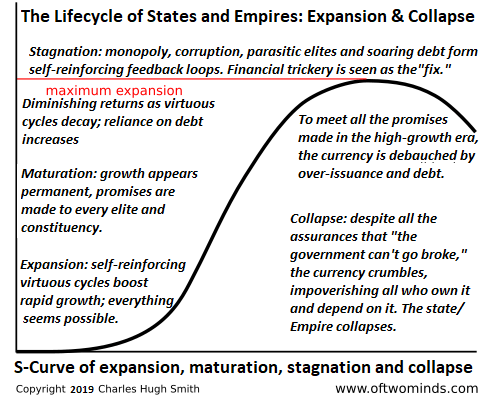
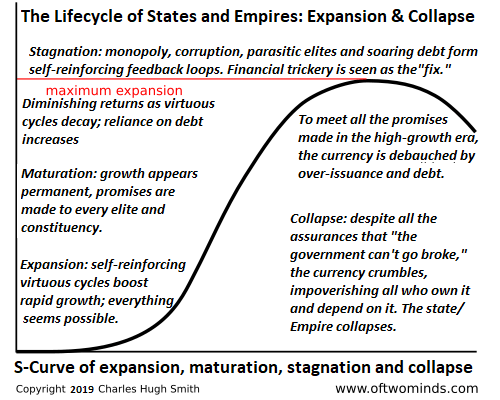
How do otherwise smart people become so blind to what’s going on? They believe the status quo is so wealthy, so powerful, so clever, etc., that it will overcome any obstacles or crises because it’s always done so in the past, and so it is permanent, immutable, forever, and our supping at the trough of free money couldn’t possibly weaken such an enduring Leviathan.
This is the fatal fantasy of every empire. We’re too successful to fail and collapse. But oddly enough, faith in the permanence of success leads to the very collapse that’s deemed “impossible.”
4. Concentrations of wealth, power, capital and production fatally distort the economy and the social order. When “competition” has been reduced to two telecoms, two healthcare insurers, two pork processors, etc., the system has been stripped of adaptability and resilience.
When 10,000 small farmers each have 100 chickens, the stock of 1 million chickens is spread over a wide geography and entrepreneurial network of suppliers, wholesalers, etc. Bird flu may spread widely but it’s far more difficult to wipe out 10,000 small farms’ poultry compared to the ease of bird flu spreading in one giant factory that concentrates 1 million chickens in one facility. Supply chains stripped of network resilience are equally fragile and prone to disruption and collapse.
Concentrating any form of capital, production and power renders the system vulnerable to collapse due to the inherent weaknesses generated by replacing complex networks with vertical-integration under the control of a few cartels, monopolies, autocrats, gatekeepers or regulators–the latter two being easily influenced by political pressure and/or private gain.
It’s certainly possible to be disgusted, but being disabused of the fantasy that the system is self-correcting is the healthier perspective. Everything is forever until systemic weaknesses reveal themselves, typically at the most inopportune junctures.
We can only choose one: open, dynamic stability (evolution) or autocracy (instability and collapse).
When the fundamentals of life change, every organism must evolve or die. This is equally true of human organizations, societies and economies.
Evolution requires conserving what still works and experimenting until something comes along that works better. We call the fundamentals changing selective pressure and the process of experimenting with mutations / variations natural selection.
In genetic and epigenetics, this process is automatic. In human organizations, those in power influence the choice of what is conserved or replaced and what it’s replaced with. Those who benefit from the current arrangement will fight to conserve it as is, while those being weakened by selective pressure and those hoping to gain advantages with a new arrangement will fight for replacing the old with the new.
Longtime correspondent Ron G. recently shared an insightful economic characterization of this dynamic: wealth defense vs wealth creation. Those holding the system’s wealth have few incentives to risk changing the system, as those changes could undermine or erode their wealth. They have incentives to limit evolutionary forces that threaten their wealth as a means of defending their wealth.
Those who have lost wealth and those with little wealth have incentives to change the system to favor wealth creation.
We can describe the first as orthodoxy–evolution threatens the stability of the status quo, so limit evolution to the margins–and heretics being the second option that tosses out the status quo in favor of a more advantageous variation.
This isn’t either / or, of course. As Ron points out, corporations have incentives to both conserve stability and embrace variations that increase revenues and profits by expanding the markets for the company’s products. In Ron’s words: “The function of orthodoxy or corporate policy / rigor is to mitigate variations that would decrease stability.”
In other words, there’s a danger of throwing the baby out with the bath water. Dynamic equilibrium is based on a constant flux of variations and experiments–that is, low-level instability–continually modifying the system to maintain core stability.
Without this constant flux of low-level instability, sources of instability pile up, unnoticed and uncorrected, until they become consequential enough to destabilize the entire system. The system implodes, crashes, unravels, etc.
We can understand this flux of variations and experiments as evolutionary churn, and this churn requires two things: a steady flow of mutations / variations to feed the process of experimentation, and transparency so advantageous variations aren’t suppressed. In a transparent evolutionary system, data and information about each variation and experiment flows freely between all nodes in the system.
You see the problem. Those benefiting from the status quo are threatened by variations that could replace whatever is defending their wealth. Those in power benefit from the status quo, so their Job One is to suppress evolution by limiting transparency and variations, which include dissent.
Theoretically, those in power favor evolutionary advances that enhance their power and wealth, but anything that powerful is generally a two-edged sword: modified slightly, it could disrupt the entire status quo and fatally undermine their power.
So the safe bet is to suppress all evolutionary churn except those improvements which can be used to further cement their power. These are by definition autocratic.
You see the delicious irony: autocrats suppress evolutionary churn and transparency as threats, but evolutionary churn and transparency are the essential forces maintaining the system’s dynamic equilibrium. Once the system’s dynamic equilibrium decays, systemic instability builds up and eventually brings the entire system crashing down.
Because this process is obscured by authoritarian suppression of transparency, “nobody saw it coming.”
As those in power adopt ever stronger authoritarian measures to limit the potential threats of evolutionary churn and transparency, they accelerate the fatal instabilities building up within their self-serving, kleptocratic social, political and economic systems.
By suppressing the evolutionary churn and transparency that maintain the system’s dynamic equilibrium, they doom their regime to collapse.
The crystal ball isn’t cloudy, it’s crystal-clear: rising instability leading to collapse. “Nobody saw it coming” except those who understand evolution requires evolutionary churn and transparency.
Collapse is a perfectly good evolutionary solution. Stability is either dynamic or it’s not actually stable; it’s merely a simulacrum of stability sliding toward instability and ruin.
The better option is to embrace evolutionary churn and transparency and accept the trade-off: we can only choose one: open, dynamic stability (evolution) or autocracy (instability and collapse). Choose wisely, for once systems collapse there’s no turning back the clock.




 After the Crash