Follow the Money – How Russia Will Bypass Western Economic Warfare

By Pepe Escobar

Source: OpEdNews.com

So a congregation of NATO’s top brass ensconced in their echo chambers target the Russian Central Bank with sanctions and expect what? Cookies?

What they got instead was Russia’s deterrence forces bumped up to “a special regime of duty” – which means the Northern and Pacific fleets, the Long-Range Aviation Command, strategic bombers, and the entire Russian nuclear apparatus on maximum alert.

One Pentagon general very quickly did the basic math on that, and mere minutes later, a Ukrainian delegation was dispatched to conduct negotiations with Russia in an undisclosed location in Gomel, Belarus.

Meanwhile, in the vassal realms, the German government was busy “setting limits to warmongers like Putin” – quite a rich undertaking considering that Berlin never set any such limits for western warmongers who bombed Yugoslavia, invaded Iraq, or destroyed Libya, in complete violation of international law.

While openly proclaiming their desire to “stop the development of Russian industry,” damage its economy, and “ruin Russia” – echoing American edicts on Iraq, Iran, Syria, Libya, Cuba, Venezuela and others in the Global South – the Germans could not possibly recognize a new categorical imperative.

They were finally liberated from their WWII culpability complex by none other than Russian President Vladimir Putin. Germany is finally free to support and weaponize neo-Nazis out in the open all over again – now of the Ukrainian Azov battalion variety.

To get the hang of how these NATO sanctions will “ruin Russia,” I asked for the succinct analysis of one of the most competent economic minds on the planet, Michael Hudson, author, among others, of a revised edition of the must-read Super-Imperialism: The Economic Strategy of American Empire.

Hudson remarked how he is “simply numbed over the near-atomic escalation of the US.” On the confiscation of Russian foreign reserves and cut-off from SWIFT, the main point is “it will take some time for Russia to put in a new system with China. The result will end dollarization for good, as countries threatened with ‘democracy’ or displaying diplomatic independence will be afraid to use US banks.”

This, Hudson says, leads us to “the great question – whether Europe and the Dollar Bloc can buy Russian raw materials – cobalt, palladium, etc, and whether China will join Russia in a minerals boycott.”

Hudson is adamant that “Russia’s Central Bank, of course, has foreign bank assets in order to intervene in exchange markets to defend its currency from fluctuations. The ruble has plunged. There will be new exchange rates. Yet it’s up to Russia to decide whether to sell its wheat to West Asia, that needs it; or to stop selling gas to Europe via Ukraine, now that the US can grab it.”

About the possible introduction of a new Russia-China payment system – bypassing SWIFT and combining the Russian SPFS (System for Transfer of Financial Messages) with the Chinese CIPS (Cross-Border Interbank Payment System) – Hudson has no doubts, “the Russian-China system will be implemented. The Global South will seek to join and at the same time keep SWIFT – moving their reserves into the new system.”

I’m going to de-dollarize myself

So the US itself, in another massive strategic blunder, will speed up de-dollarization. As the managing director of Bocom International Hong Hao told the Global Times, with energy trade between Europe and Russia de-dollarized, “that will be the beginning of the disintegration of dollar hegemony.”

It’s a refrain the US administration was quietly hearing last week from some of its own largest multinational banks, including notables like JPMorgan and Citigroup.

Bloomberg article sums up their collective fears:

“Booting Russia from the critical global system – which handles 42 million messages a day and serves as a lifeline to some of the world’s biggest financial institutions – could backfire, sending inflation higher, pushing Russia closer to China, and shielding financial transactions from scrutiny by the west. It might also encourage the development of a SWIFT alternative that could eventually damage the supremacy of the US dollar.”

Those with IQs over 50 in the European Union (EU) must have understood that Russia simply could not be totally excluded from SWIFT, but maybe only a few of its banks: after all, European traders depend on Russian energy.

From Moscow’s point of view, that’s a minor issue. A number of Russian banks are already connected to China’s CIPS system. For instance, if someone wants to buy Russian oil and gas with CIPS, payment must be in the Chinese yuan currency. CIPS is independent of SWIFT.

Additionally, Moscow already linked its SPFS payment system not only to China but also to India and member nations of the Eurasia Economic Union (EAEU). SPFS already links to approximately 400 banks.

With more Russian companies using SPFS and CIPS, even before they merge, and other maneuvers to bypass SWIFT, such as barter trade – largely used by sanctioned Iran – and agent banks, Russia could make up for at least 50 percent in trade losses.

The key fact is that the flight from the US-dominated western financial system is now irreversible across Eurasia and that will proceed in tandem with the internationalization of the yuan.

Russia has its own bag of tricks

Meanwhile, we’re not even talking yet about Russian retaliation for these sanctions. Former President Dmitry Medvedev already gave a hint – everything, from exiting all nuclear arms deals with the US, to freezing the assets of western companies in Russia, is on the table.

So what does the “Empire of Lies” want? – Putin terminology, on Monday’s meeting in Moscow to discuss the response to sanctions.

In an essay published this morning, deliciously titled America Defeats Germany for the Third Time in a Century: the MIC, OGAM and FIRE conquer NATO, Michael Hudson makes a series of crucial points, starting with how “NATO has become Europe’s foreign policy-making body, even to the point of dominating domestic economic interests.”

He outlines the three oligarchies in control of US foreign policy:

First is the military-industrial complex, which Ray McGovern memorably coined as MICIMATT (military industrial Congressional intelligence media academia think tank).

Hudson defines their economy base as “monopoly rent, obtained above all from its arms sales to NATO, to West Asian oil exporters, and to other countries with a balance-of-payments surplus.”

Second is the oil and gas sector, joined by mining (OGAM). Their aim is “to maximize the price of energy and raw materials so as to maximize natural resource rent.

Monopolizing the Dollar Area’s oil market and isolating it from Russian oil and gas has been a major US priority for over a year now, as the Nord Stream 2 pipeline from Russia to Germany threatened to link the western European and Russian economies together.”

Third is the “symbiotic” Finance, Insurance and Real Estate (FIRE) sector, which Hudson defines as “the counterpart to Europe’s old post-feudal landed aristocracy living by land rents.”

As he describes these three rentier sectors that completely dominate post-industrial finance capitalism at the heart of the western system, Hudson notes how “Wall Street always has been closely merged with the oil and gas industry namely, the Citigroup, and Chase Manhattan banking conglomerates.”

Hudson shows how “the most pressing US strategic aim of NATO confrontation with Russia is soaring oil and gas prices. In addition to creating profits and stock market gains for US companies, higher energy prices will take much of the steam out of the German economy.”

He warns how food prices will rise “headed by wheat” – Russia and Ukraine account for 25 percent of world wheat exports. From a Global South perspective, that’s a disaster: “This will squeeze many West Asian and Global South food-deficient countries, worsening their balance of payments, and threatening foreign debt defaults.”

As for blocking Russian raw materials exports, “this threatens to cause breaks in supply chains for key materials, including cobalt, palladium, nickel, aluminum.”

And that leads us, once again, to the heart of the matter – “The long-term dream of the US new Cold Warriors is to break up Russia, or at least to restore its managerial kleptocracy seeking to cash in their privatizations in western stock markets.”

That’s not going to happen. Hudson clearly sees how “the most enormous unintended consequence of US foreign policy has been to drive Russia and China together, along with Iran, Central Asia, and countries along the Belt and Road initiative.”

Let’s confiscate some technology

Now compare all of the above with the perspective of a central European business tycoon with vast interests, east and west, and who treasures his discretion.

In an email exchange, the business tycoon posed serious questions about the Russian Central Bank support for its national currency, the ruble, “which according to US planning is being destroyed by the west through sanctions and currency wolf packs who are exposing themselves by selling rubles short. There is really almost no amount of money that can beat the dollar manipulators against the ruble. A 20 percent interest rate will kill the Russian economy unnecessarily.”

The businessman argues that the chief effect of the rate hike “would be to support imports that should not be imported. The fall of the ruble is thus favorable to Russia in terms of self-sufficiency. As import prices rise, these goods should start to be produced domestically. I would just let the ruble fall to find its own level which will for a while be lower than natural forces would permit as the US will be driving it lower through sanctions and short selling manipulation in this form of economic war against Russia.”

But that seems to tell only part of the story. Arguably, the lethal weapon in Russia’s arsenal of responses has been identified by the head of the Center for Economic Research of the Institute of Globalization and Social Movements (IGSO), Vasily Koltashov – the key is to confiscate technology – as in Russia ceasing to recognize US rights to patents.

In what he qualifies as “liberating American intellectual property,” Koltashov calls for passing a Russian law on “friendly and unfriendly states. If a country turns out to be on the unfriendly list, then we can start copying its technologies in pharmaceuticals, industry, manufacturing, electronics, medicine. It can be anything – from simple details to chemical compositions.” This would require amendments to the Russian constitution.

Koltashov maintains that “one of the foundations of success of American industry was copying of foreign patents for inventions.” Now, Russia could use “China’s extensive know-how with its latest technological production processes for copying western products: the release of American intellectual property will cause damage to the United States to the amount of $10 trillion, only in the first stage. It will be a disaster for them.”

As it stands, the strategic stupidity of the EU beggars belief. China is ready to grab all Russian natural resources with Europe left as a pitiful hostage of the oceans and of wild speculators.

It looks like a total EU-Russia split is ahead – with little trade left and zero diplomacy.

Now listen to the sound of champagne popping all across the MICIMATT.

Creating New Enemies

SHANGHAI, CHINA – MAY 20: Russian President Vladimir Putin (L) and Chinese President Xi Jingping (R) attend a welcoming ceremony on May 20, 2014 in Shanghai, China. Putin is on a two day visit to China (Photo by Sasha Mordovets/Getty Images)

By Philip Giraldi

Source: The Unz Review

It should come as no surprise that many observers, from various political perspectives, are beginning to note that there is something seriously disconnected in the fumbling foreign policy of the United States. The evacuation failure in Afghanistan shattered the already waning self-confidence of the American political elite and the continuing on-again off-again negotiations that were by design intended to go nowhere with Iran and Russia provide no evidence that anyone in the White House is really focused on protecting American interests. Now we have an actual shooting war in Ukraine as a result, a conflict that might easily escalate if Washington continues to send the wrong signals to Moscow.

To cite only one example of how outside influences distort policy, in a phone call on February 9th, Israeli Prime Minister Naftali Bennett advised President Joe Biden not to enter into any non-proliferation agreement with Iran. Biden was non-committal even though it is an actual American interest to come to an agreement, but instead he indicated that as far as the US is concerned, Israel could exercise “freedom of action” when dealing with the Iranians. With that concession has ended in all probability the only possible diplomatic success that the Administration might have been able to point to.

The Biden Administration’s by default global security policy is currently reduced to what some critics have described as “encirclement and containment.” That is why an overstretched US military is being tasked with creating ever more bases worldwide in an effort to counter perceived “enemies” who often are only exercising their own national sovereignty and right to security within their own zones of influence. Ironically, when nations balk at submitting to Washington’s control, they are frequently described as “aggressors” and “anti-democratic,” the language that has most particularly been used relating to Russia. The Biden policy, such as it actually exists, appears to be a throwback to the playing field in 1991-2 when the Soviet empire collapsed. It is all about maintaining the old American dream of complete global dominance coupled with liberal interventionism, but this time around the US lacks both the resources and the national will to continue in the effort. Hopefully the White House will understand that to do nothing is better than to make empty threats.

Meanwhile, as the situation continues to erode, it is becoming more and more obvious that the twin crises that have been developing over Ukraine and Taiwan are “Made in Washington” and are somewhat inexplicable as the US does not have a compelling national interest that would justify threats to “leave on the table” military options as a possible response. The Administration has yet again responded to Russian moves by initiating devastating sanctions. But Russia also has unconventional weapons in its arsenal. It can, for starters, shift focus away from Ukraine by intervening much more actively in support of Syria and Iran in the Middle East, disrupting feeble American attempts to manage that region to benefit Israel.

According to economists, Russia has also been effectively sanction-proofing its economy and is capable of selective reverse-sanctioning of countries that support an American initiative with any enthusiasm. Such a response would likely hurt the Europeans much more than it would damage the leadership in the Kremlin. Barring Russian gas from Europe by shutting down Nord Stream 2 would, for example, permit increased sales to China and elsewhere in Asia and would inflict more pain on the Europeans than on Moscow. Shipping US supplied liquid gas to Europe would, for example, cost more than twice the going rate being offered by the Kremlin and would also be less reliable. The European NATO members are clearly nervous and not fully behind the US agenda on Ukraine, largely because there is the legitimate concern that any and possibly all options being considered by Washington could easily produce missteps that would escalate into a nuclear exchange that would be catastrophic for all parties involved.

Apart from the real immediate danger to be derived from the fighting currently taking place in Ukraine, the real long-term damage is strategic. The Joe Biden Administration has adroitly maneuvered itself into a corner while America’s two principal adversaries Russia and China have drawn closer together to form something like a defensive as well as economic relationship that will be dedicated to reducing and eventually eliminating Washington’s assumed role as the global hegemon and rules enforcer.

In a recent article in the New Yorker foreign affairs commentator Robin Wright, who might reasonably described as a “hawk,” declares the new development to be “Russia and China Unveil[ing] a Pact Against America and the West.” And she is not alone in ringing the alarm bell, with former Donald Trump National Security Council (NSC) Russia watcher Anita Hill warning that the Kremlin’s intention is to force the United States out of Europe while former NSC Ukrainian expert Alexander Vindman is advising that military force be used to deter Russia now before it is too late.

Wright provides the most serious analysis of the new developments. She argues that “Vladimir Putin and Xi Jinping, the two most powerful autocrats, challenge the current political and military order.” She describes how, in a meeting between the two leaders before the Beijing Olympics, they cited an “agreement that also challenges the United States as a global power, NATO as a cornerstone of international security, and liberal democracy as a model for the world.” They pledged that there would be “No ‘forbidden’ areas of cooperation” and a written statement that was subsequently produced declared that “Russia and China stand against attempts by external forces to undermine security and stability in their common adjacent regions, intend to counter interference by outside forces in the internal affairs of sovereign countries under any pretext, oppose color revolutions, and will increase cooperation.” Wright notes that there is considerable strength behind the agreement, “As two nuclear-armed countries that span Europe and Asia, the more muscular alignment between Russia and China could be a game changer militarily and diplomatically.” One might add that China now has the world’s largest economy and Russia has a highly developed military deploying new hypersonic missiles that would give it the advantage in any conflict with NATO and the US. Both Russia and China, if attacked, would also benefit because they would be fighting close to their bases on interior lines.

And, of course, not everyone agrees that nudging the United States out of its self-proclaimed hegemonic role would be a bad thing. Former British diplomat Alastair Crooke argues that there will be perpetual state of crisis in the international order until a new system emerges from the status quo that ended the Cold War, and it would be minus the United States as the semi-official transnational rules maker and arbiter. He observes that “The crux of Russia’s complaints about its eroding security have little to do with Ukraine per se but are rooted in the Washington hawks’ obsession with Russia, and their desire to cut Putin (and Russia) down to size – an aim which has been the hallmark of US policy since the Yeltsin years. The Victoria Nuland clique could never accept Russia rising to become a significant power in Europe – possibly eclipsing the US control over Europe.”

What is happening in Europe and Asia should all come down to a very simple realization about the limits of power: America has no business in risking a nuclear war with Russia over Ukraine or with China over Taiwan. The United States has been fighting much of the world for over two decades, impoverishing itself and killing millions in avoidable wars starting with Iraq and Afghanistan. The US government is cynically exploiting memories of old Cold War enemy Russia to create a false narrative that goes something like this: “If we don’t stop them over there, they will be in New Jersey next week.” It is all nonsense. And besides, who made the US the sole arbiter of international relations? It is past time Americans started asking what kind of international order is it that lets the United States determine what other nations can and cannot do.

Worst of all, the bloodshed in Ukraine has all been unnecessary. A little real diplomacy with honest negotiators weighing up real interests could easily have come to acceptable solutions for all parties involved. It is indeed ironic that the burning desire to go to war with Russia demonstrated in the New York Times and Washington Post as well as on Capitol Hill has in fact created a real formidable enemy, tying Russia and China together in an alliance due to their frustration at dealing with a Biden Administration that never seems to know what it is doing or where it wants to go.

America Condemns One Violent Mob While Celebrating Another

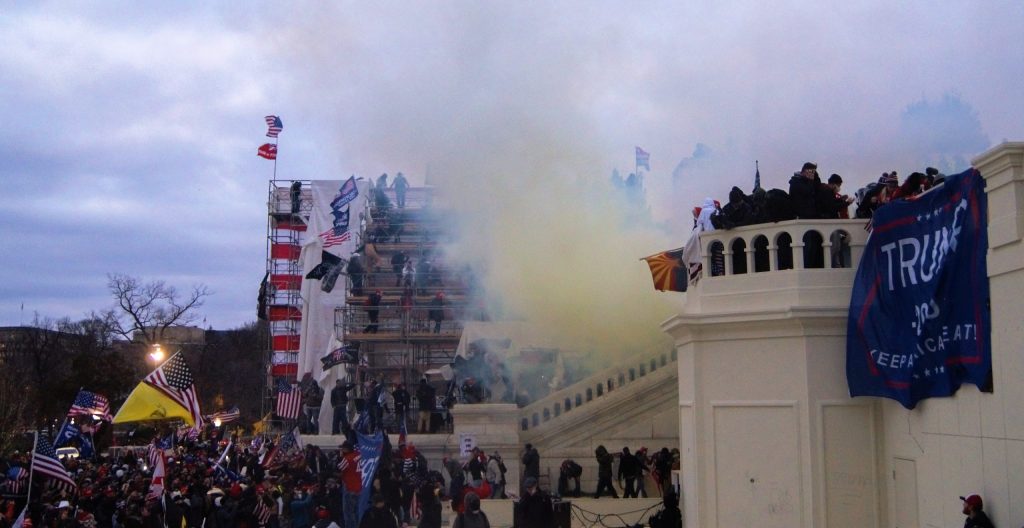
Tear gas being deployed outside the Capitol on January 6 as Trump supporters stormed the building. [Tyler Merbler / CC BY 2.0]

Where is the corporate media’s disgust for the courtesans of corporate destruction that wreak violence on Americans daily?

By Lee Camp

Source: ScheerPost.com

Most rational Americans have correctly criticized and denounced the violent insurrection in the Capitol last week. Those moments of attack by a racist, disgusting mob have not lacked for condemnation and denunciation. They were violent. They were reprehensible. They called for the killing of lawmakers, demanded the hanging of Congress members. The liberal media and even most of Fox News have not held their tongues when it comes to excoriating the morally bankrupt people who took part. And I agree with those thoughts.

BUT – why don’t we see an equal amount of disgust and condemnation for the violence done by our ruling class, the courtesans of corporate destruction?

Is allowing people to die or fall ill due to lead pipes in Flint, Chicago, Pittsburgh, and hundreds of other cities not violence?

Is allowing citizens to lose their lives to cancer from Teflon™ chemicals dumped in their water or preventable oil spills not violence?

Is allowing tens of thousands to die of preventable illnesses from our garbage healthcare system not violence?

Is allowing 15 million to lose their healthcare during a pandemic and therefore fear going to the hospital when they get sick not violence?

Is imprisoning millions of people for years for non-violent crimes not violence?

Is locking up political prisoners like Steven DonzigerMumia Abu-JamalReverend Pinkney, Julian Assange, Chelsea Manning, Leonard Peltier not violence??

Is dropping a bomb every 12 minutes on innocent people in countries thousands of miles away not violence??

Is allowing millions in this country to go hungry while we throw out 40% of all food not violence?

Is arresting people who try to feed those who are starving not violence?

Is allowing hundreds of thousands to go homeless, living under bridges or on benches or squatting in collapsing structures while this country has trillions of dollars and millions of empty houses —is that not violence?

Is arresting, beating, and persecuting those who try to give those people houses not violence? And bulldozing the homes — is that not violence?

Is causing the sixth great extinction, the mass death of half the world’s wildlife, in pursuit of corporate profit not violence?

Is causing the deaths of tens of thousands of Venezuelans via economic warfare not violence?

Is creating an opioid epidemic by pushing pills on desperate people, ultimately leading to the deaths of hundreds of thousands not violence?

And then arresting those who stand up and fight back against the pollutionagainst the pipelinesagainst the factory farmingagainst the war industry —IS—THAT—NOT—VIOLENCE?

Of course it is.

It’s violence on a breathtaking scale, far greater than what was done at the Capitol and far greater than any of us will witness in person. And yet large scale corporate-endorsed violence, death and destruction is not only allowable, it’s celebrated, it’s furthered, and promoted. Oil company documents show that they tell cities that oil spills are good for the economy. Other documents show that fossil fuel companies have known about the harm climate change would do since the 1970’s, but they simply saw it as the price of doing business. Corporate sacrifice zones like “Cancer Alley” in Louisiana are well known to be deadly to those who live there, yet it doesn’t matter to the corporations because their money will be green nonetheless. It doesn’t matter to the politicians because the poor who live in these sacrifice zones have no political power. The 40% of food that’s thrown out is not a secret. The subsidies paid to factory farms encourage them to produce heaping mountains of food and dairy and meat even if they can’t sell it all in our market economy. So they throw it out or bury it. Giving it to those in need would take too much time and effort.

Should the racist violent insurrectionists at the Capitol be punished? Absolutely. But so too should the bought-off politicians who do the bidding of our morally bankrupt corporate America. These politicians and the CEOs they serve are purveyors of violence. They trade in, produce, and reap violence. They sit on hordes of money—the obscene profit from feeding American lives into the death cult of unfettered capitalism.

Our mainstream media are blanketing the airwaves with talk of how the violent insurrectionists must be punished, and while they are not wrong, the criminal behavior those same talking heads and “reporters” ignore speaks volumes. All violence is not equal. Some of it is profitable and protected. Some of it is the American way.

Wall Street Primitivism: Nicaragua, China, The Middle East & Charlottesville

By Caleb Maupin

Source: New Eastern Outlook

Wall Street, London, and the Bretton Woods institutions like the World Bank, and the International Monetary Fund claim to support development and the eradication of poverty around the world. They also claim to support scientific progress and raising the global standard of living. However, often they seem to make friends and allies with very different goals. As Nicaragua proceeds with a huge construction project that has dynamic global implications, one can see a certain international pattern repeating itself, with quite dangerous implications.

“Native Activists” Fighting To Preserve US Maritime Dominance

Control of the Panama Canal by the United States has been vital in asserting control over the world economy. The US military has intervened militarily in Panama on many occasions to secure its control of this vital global shipping and transportation hub.

While the USA currently allows vessels to pass through, this could easily change in the case of a military confrontation. With so much of the world’s industrial shipping passing through this vital point, control of the canal gives the USA a level of unchecked power in the global economy. At any point they could “veto” a country’s economy by stopping ships.

However, a construction project currently in the works in Nicaragua could change that. The Chinese government and corporations based in China are cooperating with the socialist government of Nicaragua to construct a new canal, parallel to the Panama Canal. This canal will not be under US dominion, but under the dominion of the Sandinista government and the People’s Republic of China.

The announcement of the project was followed by all kinds of reports in western media claiming it would be an ecological disaster and contribute to global warming. Now, as the project proceeds, voices of the establishment are crying crocodile tears for the indigenous people who will be forced to move by the project. The Guardian has run stories bemoaning their plight. Amnesty International is warning Nicaragua not to interfere with their protests.

The USA is in the process of putting sanctions on Nicaragua, for their support of Venezuela. A bill currently in the US congress called the NICA Act aims to cripple the socialist government.

While it is ignored in US press reports, the Sandinista government has done a great deal to improve the lives of its population, a large percentage of which is indigenous. Poverty in Nicaragua has been reduced by 30%. The United Nations World Happiness Index reports the great increase of happiness in any country in 2016, as having taken place in Nicaragua.

The socialist government is asserting public control over major industries, guaranteeing jobs, housing, and education to the population, and moving toward a centrally planned economy. The Sandinistas are cultivating a layer of patriotic small business owners, who cooperate with the state to develop the economy with foreign investment. Their methods are similar to those employed by Deng Xiaoping when opening up China during the 1980s.

Though the Sandinistas are widely popular, the forces who oppose the canal project have found a number of indigenous leaders to align with. 76% of people in Nicaragua have some indigenous ancestry. The overwhelming majority of the country is ethnically “mestizo” meaning it has a mixture of European and native ancestry.

However, the forces being rallied to oppose the project are not from the overwhelming majority of the population which has indigenous ancestry, but rather to a specific group of just over 4% of the population, which is described as “unmixed indigenous inhabitants.” These are individuals who have cut themselves off from Nicaraguan society at large, and much like the Amish or Mennonites in the USA, maintain a lifestyle without technology, immersed in religious tradition. While the majority of Nicaraguans are Christians, these forces are Shamanists and practitioners of polytheistic faiths. They reject all “european” concepts and lump Marxism, dialectical materialism, and Christianity into the same basket.

The relationship between this isolated minority in Nicaragua and the US Central Intelligence Agency is not a new development. During the 1980s contra war, the CIA supplied weapons and military training to the indigenous Mosquito peoples to fight the Sandinistas. In addition to the weapons and funding they received from the USA, a number of Anti-Communist US Native American activists such as Russell Means joined with them. Many of these indigenous, anti-technology, and anti-science fanatics stood against what they called the “Racist European Marxism” of the Sandinista government, which was made up largely of dark skinned people with indigenous blood. While they claimed to oppose both “capitalism and communism” as European concepts, they quietly and sometimes not-so-quietly, worked with the Pentagon and the CIA.

Just as they took up guns in the 1980s in alliance with Washington, they now get promoted by pro-US Non-Governmental Organizations and Non-Profits, who conveniently see maintaining US maritime dominance as the latest, trendy, ecological, liberal cause, done to rescue some “mystical people” with “beautiful ancient traditions” being crushed by “racist” “dogmatic” Marxists.

“Traditionalist” CIA-Allies in China

Western utilization and manipulation of primitivist, conservative, and reactionary social forces in order to stop economic development is not restricted to Latin America. The political allies of the United States on the Chinese mainland, who work against the People’s Republic, often while spouting rhetoric about “human rights” are a rather interesting bunch.

The Chinese government has just cracked down on an extremist cult known as “Eastern Lightning.” The group is also known as the “Church of the Almighty God” and worships a woman who they claim is the second coming of Jesus Christ. They are reported to torture, mutilate, and even execute members who attempt to leave. Members of the group famously murdered a man in a Mcdonalds restaurant for refusing to allow his daughter to give her phone number to them.

While some would dismiss this simply as an obscure religious cult, it is important to note that the lead minister of the Church, along with the woman who claims to be Jesus Christ, both currently live in the USA. In 2001, they sought “political exile” in the United States, and while millions of people die attempting to cross the US border, the US government happily grants visas to anti-China activists, order to help them escape “persecution” from the US government.

Another friend of the USA in China is the Falun Gong, a strange buddhist sect. The group calls for the public execution of homosexuals and opposes inter-racial marriage. Li Hongzi, the group’s founder, lives in Queens, New York. His organization has been presented with awards by the Heritage Foundation.

Much like Eastern Lightning, the Falun Gong preaches that the Chinese Communist Party’s leadership, in particular its policies advancing the position of women, are harmful to society. The Falun Gong argues that the Chinese Communist Party’s rule represents a “Dharma Ending Period” and that its efforts to include women in government positions is one of its most grievous crimes. The group is also known for separating young people from their families, and threatening ex-members.

Following this pattern, the USA has worked endlessly to promote the deposed feudal theocratic monarchy of Tibet. The Dalia Lama, who ruled Tibet with an iron fist and executed and tortured all who questioned him, is presented as a harmless self-help, spiritual guru in US media.

While he is presented as a man of peace, it is widely known that his brother was given military training in Colorado, and air dropped into the Tibet Autonomous Region in the 1950s. With guns and weapons from the USA, the Tibetan separatists waged a violent proxy war in the mountains for years. This is all boasted about in the right-wing, anti-China book “The CIA’s Secret War in Tibet.”

All these bizarre religious groups aligned with the USA in China seem to glorify feudal, pre-Communist China. They all oppose the Chinese Communist Party for its modernization. While they speak different languages, and glorify different traditions, they probably would agree a lot with the Nicaraguan, US-backed “indigenous activists” who oppose the socialism of the Sandinistas. Meanwhile, it is a similar crowd of western liberals who admire them, and would accuse any who criticized them of “racism” and “white-splaining.”

Not only does Washington have a history of aligning with primitivist and feudalist forces, so do European fascists. Julius Evola, the Italian far-right ideologue who spoke of a “revolt against the modern world” had a particular admiration for feudalism and primitive societies around the world. In his book “Man Among Ruins” he speaks of “the demonic nature of the economy” in western countries, which people are always trying to advance, create, and become more prosperous. He admires pre-capitalist civilization for its poverty and “stability” amid starvation.

As members of the European far-right, the Nazis also admired primitivism and poverty. Heinrich Harrier, the author of the beloved “Seven Years in Tibet,” practically a holy book for advocates of Tibetan seperatism, was actually an SS officer. The Nazis believed Germans to be descended from Tibetans, and sent scientists to measure ancient skulls in order to somehow prove this. The Nazis had similar admiration for the caste system in ancient India, and adopted the swastika as their symbol for that reason.

CIA Loves Islamic Extremists

It was the British empire that first discovered the political value of Wahabbism. The Saudi monarchy owes its origins to a cleric named Muhammad ibn ʿAbd al-Wahhab. His interpretation of Islam in 1700s enabled the Saudi royal family to establish its brutal, repressive theocratic monarchy. The British cooperated with the Saudi royal family, which conveniently allowed them access to oil in exchange for propping up the barbaric regime. In 1945, the USA joined with the British is coddling the Saudi autocracy.

Today, Saudi Arabia is one of the only countries in the world where housing in bedouin tents, not modern buildings is widespread. The lack of infrastructural development accompanies a government that outlaws women from driving cars, conducts public floggings and beheadings, and punishes crimes with mutilation. Every person and everything in Saudi Arabia is the property of the King. Citizens are routinely executed for “insulting the King” or “sorcery” among other crimes. Sometimes bodies are crucified and left on public display after execution.

A large percentage of the Saudi population are guest workers who live as slaves with no human rights. Even among the Saudi born population, the Shia oil workers face brutal discrimination and exploitation on the job, with their religious freedom often denied.

While the western economic institutions and governments all claim to support “poverty alleviation” and “development” in the third world, they embrace the Saudi Monarchy in all its horror and backwardness. Meanwhile, the targets of the USA and NATO in the Middle East, are not the primitive oil autocracies, but rather, regimes that work toward modernization.

The Iranian revolution of 1979 deposed western capitalism, and established a government under the slogan of “not capitalism, but Islam.” After the revolution, even in the context of a massive war with Iraq, Imam Khomeni launched a “construction Jihad.” In this effort inspired by Stalin’s Five Year Plans and the rapid industrialization of socialist countries, Iranians were mobilized to build highways, schools, hospitals, power plants, and so much else in order to bring the country out of poverty. Despite sanctions and attacks from the west, Iran has utilized oil revenue and central planning to construct a highly modern country, with a comparatively prosperous population. The Islamic Republic of Iran that emerged from the 1979 revolution, and has made huge strides toward modernization, is now the target of western leaders.

The Syrian Arab Republic, born in the Baath Socialist revolution, is also targeted by the west. This is a government that has multiple parties in office, and has worked with Russia and China to construct huge power plants and highways. Syrian industrial workers are organized into labor unions, and have legal protections on the job. The Communist Party and the Communist Party (Baghdash) are permitted to participate in the government process. Religious freedom is guaranteed with Sunnis, Shia, Alawi, Christians, Druze, and other religious groups all freely practicing their faith. The achievements of Syria’s state controlled healthcare system are widely praised by international bodies, with many doctors and medical professionals trained the state run Universities.

Fitting with this pattern, western leaders are now arming and training Wahabbis, a force representing primitivism and barbarism of the Saudi variety, in the hopes of toppling the Syrian government. It is worth noting that prior to 2011, when the USA began working to foment civil war in the context of the Arab Spring, Syria had begun constructing an oil pipeline, connecting Iran to Mediterranean.

Prior to its destruction by NATO bombs in 2011, Libya was the most prosperous country on the African continent. It had the highest life expectancy, and had constructed a huge irrigation system in order to spread water across this dry, desert country. The forces backed by the United States to topple the Islamic Socialist government in Libya were Wahabbis. Now ISIS and Al-Queda have set up shop in the country, and citizens are fleeing on rafts trying to reach Europe.

Different Definitions of Imperialism

In his 1917 book “Imperialism: The Highest Stage of Capitalism,” Russian revolutionary leader Vladimir Lenin argued that capitalism had entered a globalist phase. He talked about the rise of “monopoly capitalists” in Britain, France, Germany, and the United States. He spoke of how bankers had triumphed over industrial capitalists, and described how wealthy financial elites in the west teamed up with governments to battle against each other, carving out “spheres of influence” in Africa, Asia, Latin America, and elsewhere. He described how third world countries were utilized as “captive markets” in which western countries could sell commodities without competition.

Imperialism, as Lenin understood it, was about keeping the world poor, so that western bankers could stay rich. Furthermore, imperialism meant dividing the working class within the western countries. A “labor aristocracy” of well paid workers was created. These were working class people who could be cultivated to identify with the western capitalists against the colonized people. With their rising standard of living, they would see their interests as identical to the interests of the monopolists that controlled their governments.

This understanding of imperialism was developed by Lenin, and adopted by figures like Mao Zedong, Che Guevara, Ho Chi Minh, Huey Newton. Even non-Marxists like Michel Aflaq, Juan Peron, and Moammar Gaddafi studied and came to understand imperialism this way. For various anti-imperialist figures of the 20th century, third world revolutions against imperialism were about raising their countries up from poverty, modernizing, and developing.

However, a large section of the modern political left has abandoned this understanding. The understanding of “imperialism” taught in Universities across the USA and western Europe is quite different.

Starting in the 1950s, the New Left, specifically beloved “cultural critics” in the Frankfurt School and elsewhere, began speaking about “cultural imperialism.” Suddenly, among western academics and leftist activists, imperialism wasn’t about holding back development and keeping people poor. Rather, it was about eroding “beautiful” “traditions” and “ways of life” and “imposing” supposedly “western” values.

So-called “Mcworld” & Wahabbi Extremists Work Together

When describing the supposed leftist critique of imperialism in his book “On Paradise Drive” New York Times Columnist David Brooks said that “anti-American” and anti-imperialist forces oppose “McDonalds, Barnes and Noble, and boob jobs.” Those who object to Wall Street running the world are depicted as Native American mystics, Islamic fanatics, or others who object to the industrialization, commercialization, and sexual freedom of western life.

This misrepresentation is widespread. The false dichotomy is often stated as “Mcworld vs. Jihad,” and was widely promoted in the USA, prior to, but especially after 9/11. In this “Clash of Civilizations” narrative, the forces said to represent “Jihad” were the Saudi Monarchy and Osama Bin Laden, while the forces said to represent “Mcworld” were the IMF, the World Bank, and Wall Street.

In reality, Mcworld globalizationists and the forces represented as “Jihad” are on the same team. They have never been enemies. Washington has been on friendly terms with Saudi Arabia since 1945. The CIA worked with Wahabbi extremists in Afghanistan to topple an independent, modernizing government called the People’s Democratic Party. The USA and Saudi Arabia worked with Wahabbis in Chechnya to fight against the Soviet Union and afterwards the Russian Federation. The USA currently funds and arms Wahhabis in Syria, and cooperated with these forces in Libya to topple the Islamic Socialist government.

The conservative forces in the Middle East that oppose modernization and development, and embrace the Wahabbi ideology of the 1700s are not enemies of Wall Street or the London Stock Exchange. Unlike the Shia revolutionaries, or the Baath Socialists, which represent legitimate resistance, the Wahabbi forces do not wish to modernize or industrialize the region. They want to keep it a mess of impoverished oil plantations ruled over by autocratic vassals. Wall Street has no objection to this setup, and it can largely be traced back to the Sykes-Pickot agreement, crafted by western colonizers.

However, in the west, especially in circles considered to be “progressive” there is a strange mystical and cosmopolitan admiration for the forces of primitivism. For example, those who defend the Syrian government, and point out the terrorist nature of the anti-government forces are labelled “Islamophobic.” Liberal crowds in the United States swoon over the pro-Saudi demagogue named Linda Sarsour as she wears a headscarf, uses exotic sounding Arabic words, accuses those who oppose her of racism, and holds rallies calling for the USA to topple the Syrian government.

This degeneration of leftist politics has been a long time in the making. In the 1960s, the Hare Krishna movement, an extremely right-wing Hindu sect in India, suddenly became a beloved staple of Peace Marches. Gurus from India, figures who promoted drug use for “spiritual” purposes, all suddenly became the fixture of the left. Previously these kinds of bohemian elements had been embraced by the far-right and fascists.

In the 1950s, it was Republicans and the “China Lobby” that rallied support for the Dalia Lama and his insurgency in the Tibet Autonomous Region. Republicans accused the democrats of “losing China.” However, in the present context it is liberals who sport “Free Tibet” bumper stickers, while the right-wing is less interested in foreign meddling and applauds to the words “America First.” No matter what region is being discussed, in the present context, it is the liberals, not the conservatives, whose hearts bleed the loudest for US proxy fighters around the world.

While in the 1980s, it was conservatives like Ronald Reagan and Oliver North who championed the fight against the Sandinistas in Nicaragua, it is now liberals who moan for the “indigenous cultures” that are supposedly being “oppressed” by the Marxist government, which dares challenge the hegemony of the Panama Canal.

The US Central Intelligence Agency is probably the most involved with supporting forces of primitivism around the world, as they work to battle independent modernizing governments that threaten the monopoly of western capitalism. It should be no surprise, that since the 1950s, the CIA has also been heavily involved in supporting the anti-communist political left, which seems now fully dedicated to their latest crusade.

The CIA began its infamous “Congress for Cultural Freedom” in the 1950s, hoping to direct anti-capitalist activists and artists away from the pro-Soviet Communist Parties in the USA and Europe. The CIA funded the art of Jackson Pollack, experimental music, and all kinds of cultural strata intended to clash with Marxist-Leninist dialectical materialism and socialist realism. The CIA also launched a program called “MK-Ultra” which involved distributing drugs on college campuses.

The Monument Fights in the USA

The media in western countries, as it champions various primitivist forces, has essentially embraced Julius Evola’s critique of the “demonic nature of the economy.” Like Mother Teresa who infamously said “There is something beautiful in seeing the poor accept their lot, to suffer it like Christ’s Passion. The world gains much from their suffering,” the non-Marxist, “liberal” element now sees social, economic, and technological progress as its enemy, and looks on poverty, ignorance, and primitivism in a condescending admiration.

While once it was the right-wing that pushed malthusian ideas about “overpopulation” it is now billionaire liberals like Bill Gates that work to decrease the global population. Often in the name of ecology, liberals will boast about how they refrain from shopping, and live frugal lives.

Now in the USA, a political clash that is very dangerous is unfolding. The fight involves monuments to various historical figures who did reprehensible things, such as owning slaves or fighting for the Confederacy in the hopes of preserving the slave system.

While it easy for anyone who hates racism and the racist mythology of films like “Gone With The Wind” and “The Birth of a Nation” to celebrate the destruction of Confederate Monuments, and they are absolutely right to do so, the context of their destruction, and who is destroying them, presents a new danger.

The forces that seek to defend the Confederate monuments are white supremacists, Ku Klux Klansmen, admirers of Hitler, traditionalists, and others. These are forces that want the USA to return to segregation, racial division, and other things overcome through decades of struggle. These forces are known to use violence, and they are widely hated and unpopular, though their prestige is slowly growing due to the absurd political context.

The problem is not that reactionary symbols are being destroyed. This is a positive thing. The problem is rather that the forces who line up against them do not seek to replace their hateful ideology with something new. In Charlottesville and elsewhere, the battle is taking place in which bigots who think Robert E. Lee was a hero are facing and off and violently clashing with those who believe society should have no heroes at all.

Racism Battles Post-Modernism

While the racist, hateful messaging and views of White Nationalists fill the airwaves, and become the subject of debate, what does Anti-Fa believe in? The media refers to crowds opposing the “Alt Right” as “anti-racist activists.” The White Nationalists are quick to call them “Communists.” But what ideas does “The Resistance” believe in? What alternative vision do they hold up to combat the right-wing?

The crowds of post-modern, non-ideological leftists largely do not seek to replace statues they destroy with statues of progressive figures like Frederick Douglas, Huey Newton, or William Z. Foster. Rather, they rally around the concept that “no one should be worshipped” and “there is no truth.” Images of Abraham Lincoln, the man who defeated Robert E. Lee and led the fight against slavery are now being destroyed, alongside the Confederates.

While “Anarchists” and liberals who destroy monuments are quick to point out and emphasize these leaders real crimes, the slogan they rally in opposition with is “No Gods and No Masters.” They fall back on concepts like “think for yourself” “question everything” and more subtly: “don’t believe in anything” “there is no truth.”

As media eulogized Heather Heyer, who was murdered by a white nationalist in Charlottesville, very few reports mentioned that she was a member of the Industrial Workers of the World. The IWW, an anarcho-syndicalist labor union formed in 1905, also known as “the wobblies,” indeed has an ideology and belief system of its own. The IWW believes in creating a society in which the major industries and workplaces are controlled by those who work in them. Throughout its history, it was known for working in favor something, it syndicalist vision, not simply for the destruction the old. Not surprisingly, US media, which largely cheers for the opposition to the Alt-Right, obscures this important aspect of the woman who recently died opposing them.

As the media champions the fight against the Alt-Right, they work to obscure any solid ideology that would oppose them. The primary voices opposing the Alt-Right are post-modernists from middle class backgrounds, trained at elite Universities. They tear down the statues of confederate monuments as they cheer for the “Syrian revolution” that reduces Syria to chaos, or the various “oppressed” primitivist groups that fight against China or the government of Nicaragua.

Bill Maher, a left-wing TV commentator interviewed Leah Remini about her painful history in the Church of Scientology. In the interview, Maher outrageously compared scientology to Communism. The outrageous comparison was in reference to the low income of scientology practitioners.

As the polarization continues, the dangerous reality is that this is not the 1930s. The fighting fascists are not armed with Marxism-Leninism and guided by the Soviet Union, fighting for the ideal of Communism. Unlike the anti-fascist of the 1930s, anti-fa and the liberals who support them are not fighting to impose their own ideology onto society. Rather, they are fighting in the hopes of destroying ideology itself.

This is a hopeless mission. Every society since the dawn of agriculture has involved ideas, religions, and some concept morality, however, incorrect or distorted they may have been. These things are the foundation of human civilization. Even pre-historic tribes of hunter gathers had some rules or beliefs to guide their actions. Post-modernism and relativism cannot lay the foundations of a healthy society.

Western capitalism now rallies around the belief that “there is no truth.” At home it promotes free market capitalism and austerity, an economic model in which selfishness rules, and many people are left in poverty and misery. Meanwhile, it emphasizes a social liberalism based on hedonism and shallow values. Internationally, the west aligns itself with forces that seek to stop economic and technological progress, and freeze their societies in poverty and ignorance, so that Wall Street can maintain its monopoly.

As Americans, like all human beings, long for something to believe in, and long for their lives to improve, not get worse, they are likely to rally around forces who offer them such things. If no alternative is presented, only the now marginal far right-wing will be available to offer such things.

While its easy to call Trump a fascist, something far more deadly, and far closer the reactionary regimes of Nazi Germany and Mussolini’s Italy could gain support. A population told to chose between either anarchy, chaos, and nihilism, or the hateful “truths” of reaction, could be pushed toward a very dangerous trajectory.


Caleb Maupin is a political analyst and activist based in New York. He studied political science at Baldwin-Wallace College and was inspired and involved in the Occupy Wall Street movement, especially for the online magazine “New Eastern Outlook”.

Washington’s Global Economic Wars

bf82233ae78cbffa718c3c7768ed31afc418d015

By James Petras

Source: Axis of Logic

Introduction
During most of the past two decades Washington has aggressively launched military and economic wars against at least nine countries, either directly or through its military aid to regional allies and proxies.  US air and ground troops have bombed or invaded Afghanistan, Iraq, Pakistan, Libya, Somalia, Syria, Yemen and Lebanon.

More recently Washington has escalated its global economic war against major economic rivals as well as against weaker countries.  The US no longer confines its aggressive impulses to peripheral economic countries in the Middle East, Latin America and Southern Asia:  It has declared trade wars against world powers in Asia, Eastern and Central Europe and the Gulf states.

The targets of the US economic aggression include economic powerhouses like Russia, China, Germany, Iran and Saudi Arabia, as well as Syria, Yemen, Venezuela, Cuba and the Donbas region of Ukraine.

There is an increasingly thinner distinction between military and economic warfare, as the US has frequently moved from one to the other, particularly when economic aggression has not resulted in ‘regime change’ – as in the case of the sanctions campaign against Iraq leading up to the devastating invasion and destruction.

In this essay, we propose to examine the strategies and tactics underlying Washington’s economic warfare, their successes and failures, and the political and economic consequences to target nations and to world stability.

Washington’s Economic Warfare and Global Power
The US has used different tactical weapons as it pursues its economic campaigns against targeted adversaries and even against its long-time allies.

Two supposed allies, Germany and Saudi Arabia, have been attacked by the Obama Administration and US Congress via ‘legal’ manipulations aimed at their financial systems and overseas holdings.  This level of aggression against sovereign powers is remarkable and reckless.  In 2016 the US Justice Department slapped a $14 billion dollar penalty on Germany’s leading international bank, Deutsche Bank, throwing the German stock market into chaos, driving the bank’s shares down 40% and destabilizing  Germany’s financial system.  This unprecedented attack on an ally’s major bank was in direct retaliation for Germany’s support of the European Commission’s $13 billion tax levy against the US-tax evading Apple Corporation for its notorious financial shenanigans in Ireland.  German political and business leaders immediately dismissed Washington’s legalistic rhetoric for what it was: the Obama Administration’s retaliation in order to protect America’s tax evading and money laundering multinationals.

The chairman of the German parliament’s economic committee stated that the gross US attempt to extort Deutsche Bank had  all the elements of an economic war.   He noted that Washington had a “long tradition of using every available opportunity to wage what amounted to a  trade war if it benefits their own economy” and the “extortionate damages claim” against Deutsche Bank were a punitive example.  US economic sanctions against some of Germany’s major trade partners, like Russia, China and Iran, constitute another tactic to undermine Germany’s huge export economy.  Ironically, Germany is still considered “a valued ally” when it comes to the US wars against Syria, Afghanistan and Iraq, which have driven millions of refugees to Europe creating havoc with Germany’s political, economic and social system and threatening to overthrow the government of ‘ally’ Angela Merkel.

The US Congress launched an economic-judicial war against its closest ally in the Gulf region when it approved legislation granting US victims of Islamist terrorism, especially related to the attacks on September 11, 2001, the right  to sue the government of Saudi Arabia and seize its overseas assets.  This included the Kingdom’s immense ‘sovereign funds’ and constitutes an arbitrary and blatant violation of Saudi sovereignty.  This opens the Pandora’s Box of economic warfare by allowing victims to sue any government for sponsoring terrorism, including the United States!   Saudi leaders immediately reacted by threatening to withdraw billions of dollars of assets in US Treasuries and investments.

The US economic sanctions against Russia are designed to strengthen its stranglehold on the economies of Europe which rely on trade with Russia.  These have especially weakened German and Polish trade relations with Russia, a major market for German industrial exports and Polish agriculture products.   Originally, the US-imposed economic sanctions against Moscow were supposed to harm Russian consumers, provoke political unrest and lead to ‘regime change’.   In reality, the unrest it provoked has been mainly among European exporters, whose contracts with Russia were shredded and billions of Euros were lost.  Furthermore, the political and diplomatic climate between Europe and Russia has deteriorated while Washington has ‘pivoted’ toward a more militaristic approach.

Results in Asia have been even more questionable:  Washington’s economic campaign against China has moved awkwardly in two directions:  Prejudicial trade deals with Asian-Pacific countries and a growing US military encirclement of China’s maritime trade routes.

The Obama regime dispatched Treasury Secretary Jack Lew to promote the Trans- Pacific Partnership (TPP) among a dozen regional governments, which would blatantly exclude China, Asia’s largest economic power.   In a slap to the outgoing Obama Administration, the US Congress rejected his showpiece economic weapon against China, the TPP.

Meanwhile, Obama ‘encouraged’ his erstwhile ‘allies’ in the Philippines and Vietnam to sue China for maritime violations over the disputed ‘Spratly Islands’ before the Permanent Court of Arbitration.   Japan and Australia signed military pacts and base agreements with the Pentagon aimed at disrupting China’s trade routes.  Obama’s so-called ‘Pivot to Asia’ is a transparent campaign to block China from its markets and trading partners in Southeast Asia and Pacific countries of Latin American.  Washington’s flagrant economic warfare resulted in slapping harsh import tariffs on Chinese industrial exports, especially steel and tires.  The US also sent a ‘beefed up’ air and sea armada for ‘joint exercises’ along China’s regional trade routes and its access to critical Persian Gulf oil, setting off a ‘war of tension’.

In response to Washington’s ham-fisted aggression, the Chinese government deftly rolled out the Asian Infrastructure Investment Bank (AIIB) with over fifty countries eagerly signing on for lucrative trade and investment deals with Beijing.  The AIIB’s startling success does not bode well for Obama’s ‘Pivot to Pacific Hegemony’.

The so-called US-EU-Iran accord did not end Washington’s trade war against Teheran.  Despite Iran’s agreement to dismantle its peaceful uranium enrichment and nuclear research programs, Washington has blocked  investors and tried to undermine trade relations, while still holding billions of dollars of Iranian state assets, frozen since the overthrow of the Shah in  1979.  Nevertheless, a German trade mission signed on a three billion trade agreement with Iran in early October 2016 and called on the US to fulfill its side of the agreement with Teheran – so far to no avail.

The US stands alone in sending its nuclear naval armada to the Persian Gulf and threatens commercial relations. Even the Kingdom of Saudi Arabia, the longstanding enemy of the Iranian Islamic Republic, has agreed to a cooperative oil production arrangement at a recent OPEC meeting.

Washington’s declaration of economic warfare against two of its most strategic powerful allies, Germany and Saudi Arabia and three rising competitor world powers, has eroded US economic competitiveness, undermined its access to lucrative markets and increased its reliance on aggressive military strategies over diplomacy.

What is striking and perplexing about Washington’s style of economic warfare is how costly this has been for the US economy and for US allies, with so little concrete benefit.

US oil companies have lost billions in joint exploitation deals with Russia because of Obama’s sanctions.  US bankers, agro-exporters, high-tech companies are missing out on lucrative sales just to ‘punish’ Russia over the incredibly corrupt and bankrupt US coup regime in Ukraine.

US multi-national corporations, especially those involved in Pacific Coast transport and shipyards, Silicon Valley high tech industry and Washington State’s agro-export producers are threatened by the US trade agreements that exclude China.

Iran’s billion dollar market is looking for everything from commercial airplanes to mining machinery.  Huge trade deals have has been lost to US companies because Obama continues to impose de facto sanctions.  Meanwhile, European and Asian competitors are signing contracts.

Despite Washington’s dependence on German technical knowhow and Saudi petro-dollar investments as key to its global ambitions, Obama’s irrational policies continue to undermine US trade.

Washington has engaged in economic warfare against ‘lesser economic powers’ that nevertheless play significant political roles in their regions.  The US retains the economic boycott of Cuba; it wages economic aggression against Venezuela and imposes economic sanctions against Syria, Yemen and the Donbas region in eastern Ukraine.  While these countries are not costly in terms of economic loss to US business interests, they exercise significant political and ideological influence in their regions, which undermine US ambitions.

Conclusion
Washington’s resort to economic warfare complements its military fueled empire building.

But economic and military warfare are losing propositions.  While the US may extract a few billion dollars from Deutsch Bank, it will have lost much more in long-term, large-scale relations with German industrialists, politicians and financiers.  This is critical because Germany plays the key role in shaping economic policy in the European Union.  The practice of US multi-national corporations seeking off-shore tax havens in the EU may come to a grinding halt when the European Commission finishes its current investigations.  The Germans may not be too sympathetic to their American competitors.

Obama’s Trans-Pacific Partnership (TPP) has not only collapse, it has compelled China to open new avenues for trade and cooperation with Asian-Pacific nations – exactly the opposite of its original goal of isolating Beijing.  China’s Asia Infrastructure and Investment Bank (AIIB) has attracted 4 time more participants than Washington’s TPP and massive infrastructure projects are being financed to further bind ASEAN countries to China.  China’s economic growth at 6.7% more than three times that of the US at 2%.  Worse, for the Obama Administration, Washington has alienated its historically most reliable allies, as China, deepens economic ties and cooperation agreements with Thailand, Philippines, Pakistan, Cambodia and Laos.

Iran, despite US sanctions, is gaining markets and trade with Germany, Russia, China and the EU.

The Saudi-US conflict has yet to play-out but any escalation of law suits against the kingdom will result in the flight of hundreds of billions of investment dollars from the US.

In effect, Obama’s campaign of economic warfare may lead to the infinitely more costly military warfare and the massive loss of jobs and profits for the US economy.   Washington is increasingly isolated. The only allies supporting its campaign of economic sanctions are second and third rate powers, like Poland and current corrupt parasites in Ukraine.  As long as the Poles and Ukrainians can ‘mooch’ off of the IMF and grab EU and US ‘loans’, they will cheerlead Obama’s charge against Russia.  Israel, as long as it can gobble up an additional $38 billion dollars in ‘aid’ from Washington, remains  the biggest advocate for war against Iran.

Washington spends billions of US tax-payer dollars on its military bases in Japan, Philippines and Australia to maintain its hegemony in the Asia-Pacific region.   Its allies, though, are salivating at the prospect for greater trade and infrastructure investment  deals with China.

Economic warfare doesn’t work for the Washington because the US economy cannot compete, especially when it attacks its own allies and traditional partners.  Its regional allies are keen to join the ‘forbidden’ markets and share in major investment projects funded by China.  Asian leaders increasingly view Washington, with its ‘pivot to militarism’ as politically unreliable, unstable and dangerous.  After the Philippine government economic mission to China, expect more to ‘jump ship’.

Economic warfare against declared adversaries can only succeed if the US is committed to free trade with its allies, ends punitive sanctions and stops pushing for exclusive trade treaties that undermine its allies’ economies.   Furthermore, Washington should stop catering to the whims of special domestic interests.  Absent these changes, its losing campaign of economic warfare can only turn into military warfare – a prospect devastating to the US economy and to world peace.


Please note James Petras’s new collection of essays with Clarity Press:
THE END OF THE REPUBLIC AND THE DELUSION OF EMPIRE

ISBN: 978-0-9972870-5-9
$24.95 / 252 pp. / 2016