Wall Street, Banks, and Angry Citizens

The Inequality Gap on a Planet Growing More Extreme

By Nomi Prins

Source: TomDispatch.com

As we head into 2019, leaving the chaos of this year behind, a major question remains unanswered when it comes to the state of Main Street, not just here but across the planet. If the global economy really is booming, as many politicians claim, why are leaders and their parties around the world continuing to get booted out of office in such a sweeping fashion?

One obvious answer: the post-Great Recession economic “recovery” was largely reserved for the few who could participate in the rising financial markets of those years, not the majority who continued to work longer hours, sometimes at multiple jobs, to stay afloat. In other words, the good times have left out so many people, like those struggling to keep even a few hundred dollars in their bank accounts to cover an emergency or the 80% of American workers who live paycheck to paycheck.

In today’s global economy, financial security is increasingly the property of the 1%. No surprise, then, that, as a sense of economic instability continued to grow over the past decade, angst turned to anger, a transition that — from the U.S. to the Philippines, Hungary to Brazil, Poland to Mexico — has provoked a plethora of voter upheavals. In the process, a 1930s-style brew of rising nationalism and blaming the “other” — whether that other was an immigrant, a religious group, a country, or the rest of the world — emerged.

This phenomenon offered a series of Trumpian figures, including of course The Donald himself, an opening to ride a wave of “populism” to the heights of the political system. That the backgrounds and records of none of them — whether you’re talking about Donald Trump, Viktor Orbán, Rodrigo Duterte, or Jair Bolsonaro (among others) — reflected the daily concerns of the “common people,” as the classic definition of populism might have it, hardly mattered. Even a billionaire could, it turned out, exploit economic insecurity effectively and use it to rise to ultimate power.

Ironically, as that American master at evoking the fears of apprentices everywhere showed, to assume the highest office in the land was only to begin a process of creating yet more fear and insecurity. Trump’s trade wars, for instance, have typically infused the world with increased anxiety and distrust toward the U.S., even as they thwarted the ability of domestic business leaders and ordinary people to plan for the future. Meanwhile, just under the surface of the reputed good times, the damage to that future only intensified. In other words, the groundwork has already been laid for what could be a frightening transformation, both domestically and globally.

That Old Financial Crisis

To understand how we got here, let’s take a step back. Only a decade ago, the world experienced a genuine global financial crisis, a meltdown of the first order. Economic growth ended; shrinking economies threatened to collapse; countless jobs were cut; homes were foreclosed upon and lives wrecked. For regular people, access to credit suddenly disappeared. No wonder fears rose. No wonder for so many a brighter tomorrow ceased to exist.

The details of just why the Great Recession happened have since been glossed over by time and partisan spin. This September, when the 10th anniversary of the collapse of the global financial services firm Lehman Brothers came around, major business news channels considered whether the world might be at risk of another such crisis. However, coverage of such fears, like so many other topics, was quickly tossed aside in favor of paying yet more attention to Donald Trump’s latest tweets, complaints, insults, and lies. Why? Because such a crisis was so 2008 in a year in which, it was claimed, we were enjoying a first class economic high and edging toward the longest bull-market in Wall Street history. When it came to “boom versus gloom,” boom won hands down.

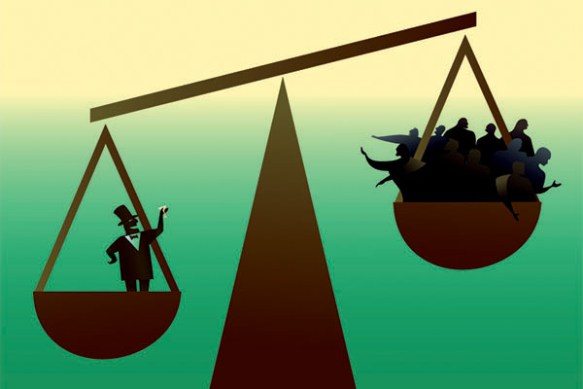
None of that changed one thing, though: most people still feel left behind both in the U.S. and globally. Thanks to the massive accumulation of wealth by a 1% skilled at gaming the system, the roots of a crisis that didn’t end with the end of the Great Recession have spread across the planet, while the dividing line between the “have-nots” and the “have-a-lots” only sharpened and widened.

Though the media hasn’t been paying much attention to the resulting inequality, the statistics (when you see them) on that ever-widening wealth gap are mind-boggling. According to Inequality.org, for instance, those with at least $30 million in wealth globally had the fastest growth rate of any group between 2016 and 2017. The size of that club rose by 25.5% during those years, to 174,800 members. Or if you really want to grasp what’s been happening, consider that, between 2009 and 2017, the number of billionaires whose combined wealth was greater than that of the world’s poorest 50% fell from 380 to just eight. And by the way, despite claims by the president that every other country is screwing America, the U.S. leads the pack when it comes to the growth of inequality. As Inequality.org notes, it has “much greater shares of national wealth and income going to the richest 1% than any other country.”

That, in part, is due to an institution many in the U.S. normally pay little attention to: the U.S. central bank, the Federal Reserve. It helped spark that increase in wealth disparity domestically and globally by adopting a post-crisis monetary policy in which electronically fabricated money (via a program called quantitative easing, or QE) was offered to banks and corporations at significantly cheaper rates than to ordinary Americans.

Pumped into financial markets, that money sent stock prices soaring, which naturally ballooned the wealth of the small percentage of the population that actually owned stocks. According to economist Stephen Roach, considering the Fed’s Survey of Consumer Finances, “It is hardly a stretch to conclude that QE exacerbated America’s already severe income disparities.”

Wall Street, Central Banks, and Everyday People

What has since taken place around the world seems right out of the 1930s. At that time, as the world was emerging from the Great Depression, a sense of broad economic security was slow to return. Instead, fascism and other forms of nationalism only gained steam as people turned on the usual cast of politicians, on other countries, and on each other. (If that sounds faintly Trumpian to you, it should.)

In our post-2008 era, people have witnessed trillions of dollars flowing into bank bailouts and other financial subsidies, not just from governments but from the world’s major central banks. Theoretically, private banks, as a result, would have more money and pay less interest to get it. They would then lend that money to Main Street. Businesses, big and small, would tap into those funds and, in turn, produce real economic growth through expansion, hiring sprees, and wage increases. People would then have more dollars in their pockets and, feeling more financially secure, would spend that money driving the economy to new heights — and all, of course, would then be well.

That fairy tale was pitched around the globe. In fact, cheap money also pushed debt to epic levels, while the share prices of banks rose, as did those of all sorts of other firms, to record-shattering heights.

Even in the U.S., however, where a magnificent recovery was supposed to have been in place for years, actual economic growth simply didn’t materialize at the levels promised. At 2% per year, the average growth of the American gross domestic product over the past decade, for instance, has been half the average of 4% before the 2008 crisis. Similar numbers were repeated throughout the developed world and most emerging markets. In the meantime, total global debt hit $247 trillion in the first quarter of 2018. As the Institute of International Finance found, countries were, on average, borrowing about three dollars for every dollar of goods or services created.

Global Consequences

What the Fed (along with central banks from Europe to Japan) ignited, in fact, was a disproportionate rise in the stock and bond markets with the money they created. That capital sought higher and faster returns than could be achieved in crucial infrastructure or social strengthening projects like building roads, high-speed railways, hospitals, or schools.

What followed was anything but fair. As former Federal Reserve Chair Janet Yellen noted four years ago, “It is no secret that the past few decades of widening inequality can be summed up as significant income and wealth gains for those at the very top and stagnant living standards for the majority.” And, of course, continuing to pour money into the highest levels of the private banking system was anything but a formula for walking that back.

Instead, as more citizens fell behind, a sense of disenfranchisement and bitterness with existing governments only grew. In the U.S., that meant Donald Trump. In the United Kingdom, similar discontent was reflected in the June 2016 Brexit vote to leave the European Union (EU), which those who felt economically squeezed to death clearly meant as a slap at both the establishment domestically and EU leaders abroad.

Since then, multiple governments in the European Union, too, have shifted toward the populist right. In Germany, recent elections swung both right and left just six years after, in July 2012, European Central Bank (ECB) head Mario Draghi exuded optimism over the ability of such banks to protect the financial system, the Euro, and generally hold things together.

Like the Fed in the U.S., the ECB went on to manufacture money, adding another $3 trillion to its books that would be deployed to buy bonds from favored countries and companies. That artificial stimulus, too, only increased inequality within and between countries in Europe. Meanwhile, Brexit negotiations remain ruinously divisive, threatening to rip Great Britain apart.

Nor was such a story the captive of the North Atlantic. In Brazil, where left-wing president Dilma Rouseff was ousted from power in 2016, her successor Michel Temer oversaw plummeting economic growth and escalating unemployment. That, in turn, led to the election of that country’s own Donald Trump, nationalistic far-right candidate Jair Bolsonaro who won a striking 55.2% of the vote against a backdrop of popular discontent. In true Trumpian style, he is disposed against both the very idea of climate change and multilateral trade agreements.

In Mexico, dissatisfied voters similarly rejected the political known, but by swinging left for the first time in 70 years. New president Andrés Manuel López Obrador, popularly known by his initials AMLO, promised to put the needs of ordinary Mexicans first. However, he has the U.S. — and the whims of Donald Trump and his “great wall” — to contend with, which could hamper those efforts.

As AMLO took office on December 1st, the G20 summit of world leaders was unfolding in Argentina. There, amid a glittering backdrop of power and influence, the trade war between the U.S. and the world’s rising superpower, China, came even more clearly into focus. While its president, Xi Jinping, having fully consolidated power amid a wave of Chinese nationalism, could become his country’s longest serving leader, he faces an international landscape that would have amazed and befuddled Mao Zedong.

Though Trump declared his meeting with Xi a success because the two sides agreed on a 90-day tariff truce, his prompt appointment of an anti-Chinese hardliner, Robert Lighthizer, to head negotiations, a tweet in which he referred to himself in superhero fashion as a “Tariff Man,” and news that the U.S. had requested that Canada arrest and extradite an executive of a key Chinese tech company, caused the Dow to take its fourth largest plunge in history and then fluctuate wildly as economic fears of a future “Great Something” rose. More uncertainty and distrust were the true product of that meeting.

In fact, we are now in a world whose key leaders, especially the president of the United States, remain willfully oblivious to its long-term problems, putting policies like deregulation, fake nationalist solutions, and profits for the already grotesquely wealthy ahead of the future lives of the mass of citizens. Consider the yellow-vest protests that have broken out in France, where protestors identifying with left and right political parties are calling for the resignation of neoliberal French President Emmanuel Macron. Many of them, from financially starved provincial towns, are angry that their purchasing power has dropped so low they can barely make ends meet.

Ultimately, what transcends geography and geopolitics is an underlying level of economic discontent sparked by twenty-first-century economics and a resulting Grand Canyon-sized global inequality gap that is still widening. Whether the protests go left or right, what continues to lie at the heart of the matter is the way failed policies and stop-gap measures put in place around the world are no longer working, not when it comes to the non-1% anyway. People from Washington to Paris, London to Beijing, increasingly grasp that their economic circumstances are not getting better and are not likely to in any presently imaginable future, given those now in power.

A Dangerous Recipe

The financial crisis of 2008 initially fostered a policy of bailing out banks with cheap money that went not into Main Street economies but into markets enriching the few. As a result, large numbers of people increasingly felt that they were being left behind and so turned against their leaders and sometimes each other as well.

This situation was then exploited by a set of self-appointed politicians of the people, including a billionaire TV personality who capitalized on an increasingly widespread fear of a future at risk. Their promises of economic prosperity were wrapped in populist platitudes, normally (but not always) of a right-wing sort. Lost in this shift away from previously dominant political parties and the systems that went with them was a true form of populism, which would genuinely put the needs of the majority of people over the elite few, build real things including infrastructure, foster organic wealth distribution, and stabilize economies above financial markets.

In the meantime, what we have is, of course, a recipe for an increasingly unstable and vicious world.

Living In A Van Down By The River – Time To Face The True State Of The Middle Class In America

maggie_smith_lives_on_alan_bennett_s_driveway_in_the_lady_in_the_van_trailer

By Michael Snyder

Source: InvestmentWatch

Do you remember the old Saturday Night Live sketches in which comedian Chris Farley portrayed a motivational speaker that lived in a van down by the river?  Unfortunately, this is becoming a reality for way too many Americans.  As the middle class has shrunk and the cost of living has increased, a lot of people have decided to quite literally “live on the road”.  Whether it is a car, a truck, a van, a bus or an RV, an increasing number of Americans are using their vehicles as their homes.  Just recently, someone that I know took a trip down the west coast of the United States and stayed at a number of campgrounds along the way.  What she discovered was that a lot of people were actually living at these campgrounds.  Of course there are some that actually prefer that lifestyle, but many others are doing it out of necessity.

Earlier this week, Circa.com posted a story about “the van life”.  One of the individuals that they featured was a recent graduate of the University of Southern California named Stephen Hutchins.  Without much of an income at the moment, he decided that the best way to cut expenses was to live in his van

“The main expenses are insurance for the van, which is like $60 a month,” said Hutchins. “Then, I have a storage unit for like $60.”

That puts his monthly rent at $120. The van cost him just $125 at an auction.

Living in a van is certainly not the most comfortable way to go, and many of you are probably wondering how he performs basic tasks such as cooking and bathing.  Well, it turns out that he makes extensive use of public facilities

He showers at the gym, cooks on a portable stove on a sidewalk (he stores his butane at his friends’ place nearby) and uses wifi at nearby coffeeshops.

For a while such a lifestyle may seem like “an adventure”, but after a while it will start to get really old.  And not a lot of women are going to be excited about dating a man that lives in a van, and you certainly wouldn’t want to raise a family in a vehicle.

Sadly, just like during the last economic crisis many Americans are getting to the point where staying in their homes may not be an option.  Just check out the following excerpt from a recent New York Post article entitled “The terrifying signs of a looming housing crisis“…

The number of New Yorkers applying for emergency grants to stay in their homes is skyrocketing — as the number of people staying in homeless shelters reached an all-time high last weekend, records show.

There were 82,306 applications for one-time emergency grants to prevent evictions in fiscal 2016, up 26 percent from 65,138 requests the previous year, according to the Mayor’s Management Report.

I put a couple of phrases in that quote in bold because I really wanted you to notice a couple of things.

First of all, it is very alarming to hear that the number of New Yorkers staying in homeless shelters “reached an all-time high” last weekend.  I thought that we were supposed to be in an “economic recovery”, but apparently things in New York are rapidly getting worse.

Secondly, the fact that applications for emergency grants are up 26 percent compared to last year is another indication of how rough things are right now for average families in New York.  We all remember what happened when millions of families lost their homes to foreclosure across the nation during the last financial crisis, and nobody should want to see a repeat of that any time soon.

During this election season, Barack Obama and Hillary Clinton would like all of us to believe that the economy is doing just fine, but that is not true at all.  Even using the doctored numbers that the government gives us, Barack Obama is solidly on track to be the only president in all of U.S. history to never have a single year of 3 percent GDP growth, and he has had two terms to try to do that.

Gallup CEO Jim Clifton is also quite skeptical of this “economic recovery”, and he recently authored an article on this subject that is receiving a tremendous amount of attention.  The following is how that article begins

I’ve been reading a lot about a “recovering” economy. It was even trumpeted on Page 1 ofThe New York Times and Financial Timeslast week.

I don’t think it’s true.

The percentage of Americans who say they are in the middle or upper-middle class has fallen 10 percentage points, from a 61% average between 2000 and 2008 to 51% today.

Other surveys have found that it is even worse than that.

For example, a Pew Research Center study from the end of last year discovered that the middle class in America has now actually become a minority in this country.

Here are some other numbers that Clifton included in his article

  1. According to the U.S. Bureau of Labor Statistics, the percentage of the total U.S. adult population that has afull-time job has been hovering around 48% since 2010this is the lowest full-time employment level since 1983.
  2. The number of publicly listed companies trading on U.S. exchanges has been cut almost in half in the past 20 years — from about 7,300 to 3,700. Because firms can’t grow organically — that is, build more business from new and existing customers — they give up and pay high prices to acquire their competitors, thus drastically shrinking the number of U.S. public companies. This seriously contributes to the massive loss of U.S. middle-class jobs.
  3. New business startups are at historical lows. Americans have stopped starting businesses. And the businesses that do start are growing at historically slow rates.

Once upon a time, America was the land of opportunity.

We were the place where anything was possible and where entrepreneurship was greatly encouraged.

But today we strangle small businesses to death with rules, regulations, red tape and taxes.

If we want a stronger middle class, we need to create a much better environment for the creation of small businesses.  Small business ownership often lifts individuals into the middle class, and small businesses have traditionally been the primary engine for the growth of good jobs in this country.

If the middle class continues to shrink, poverty will continue to rise.  Previously I have written about how the number of homeless children in the United States has shot up by 60 percent since the last economic crisis, and Poverty USA claims that a staggering 1.6 million children slept either in a homeless shelter or in some other form of emergency housing during 2015.

If you will be sleeping in a warm bed in a comfortable home tonight, you should be thankful.  An increasing number of Americans are sleeping in tent cities, in their vehicles or on the streets.  These hurting people deserve our love, our compassion and our prayers.


Is the US Economy Heading for Recession?

A Lie That Serves the Rich — the truth about the American economy

american-economy-tiago-hoisel-wallpaper-wallchan-h-n-ibackgroundz.com

By Paul Craig Roberts, John Titus, and Dave Kranzler

Source: PaulCraigRoberts.org

The labor force participation rate has declined from 66.5% in 2007 prior to the last downturn to 62.7% today. This decline in the participation rate is difficult to reconcile with the alleged economic recovery that began in June 2009 and supposedly continues today. Normally a recovery from recession results in a rise in the labor force participation rate.

The Obama regime, economists, and the financial presstitutes have explained this decline in the participation rate as the result of retirements by the baby boomers, those 55 and older. In this five to six minute video, John Titus shows that in actual fact the government’s own employment data show that baby boomers have been entering the work force at record rates and are responsible for raising the labor force participation rate above where it would otherwise be. http://www.tubechop.com/watch/3544087

It is not retirees who are pushing down the participation rate, but those in the 16-19 age group whose participation rate has fallen by 10.4%, those in the 22-14 age group whose participation rate has fallen by 5.4%, and those in the 24-54 age group whose participation rate is down 2.5%.

The offshoring of US manufacturing and tradable professional service jobs has resulted in an economy that can only create new jobs in lowly paid, increasingly part-time nontradable domestic service jobs, such as waitresses, bartenders, retail clerks, and ambulatory health care workers. These are not jobs that can support an independent existence. However, these jobs can supplement retirement incomes that have been hurt by many years of the Federal Reserve’s policy of zero or negative interest rates. Those who were counting on interest earnings on their savings to supplement their retirement and Social Security incomes have reentered the labor force in order to fill the gaps in their budgets created by the Fed’s policy. Unlike the young who lack savings and retirement incomes, the baby boomers’ economic lives are not totally dependent on the lowly-paid, part-time, no-benefits domestic service jobs.

Lies are told in order to make the system look acceptable so that the status quo can be continued. Offshoring America’s jobs benefits the wealthy. The lower labor costs raise corporate profits, and shareholders’ capital gains and performance bonuses of corporate executives rise with the profits. The wealthy are benefitting from the fact that the US economy no longer can create enough livable jobs to keep up with the growth in the working age population.

The clear hard fact is that the US economy is being run for the sole benefit of a few rich people.

It’s Not Just the Stock Market That’s Rigged: the Entire Status Quo Is Rigged

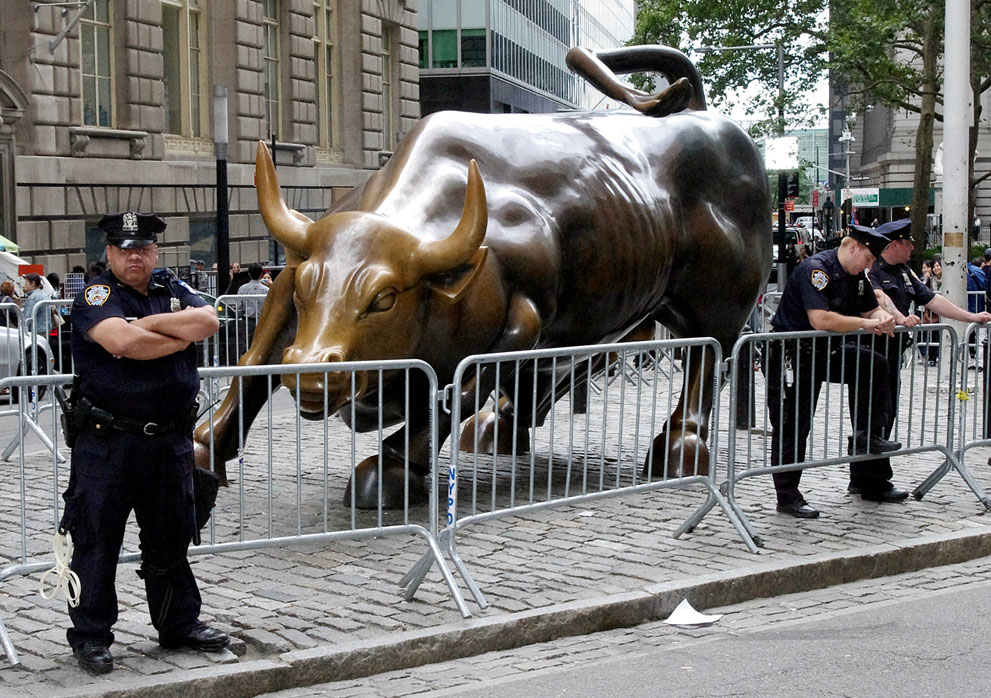
WallStreetBull

By Charles Hugh-Smith

Source: InvestmentWatch

One has to wonder why we are dodging this truth about what we’ve become: a nation that turns a blind eye to skimmers, scammers and legal looting.

As in the story of the Emperor’s new clothes, the onlooker who declares the obvious– in this case, that the stock market is rigged–shatters the consensus lie. In the current saga, author Michael Lewis plays the role of the truth-telling boy, and everyone who went along with the fiction that the Emperor’s high-frequency trading finery was resplendent is revealed as credulous, complicit or worse.

Lewis’ new book is Flash Boys: A Wall Street Revolt.

The high-frequency trading (HFT) scam is old news, and a number of fine books have addressed the mechanics of the skim, for example Dark Pools: High-Speed Traders, A.I. Bandits, and the Threat to the Global Financial System by Scott Patterson.

Many in the alternative financial media have written about HFT for years. Here are two of my own entries on the topic:

The Stock Market Is an “Attractive Nuisance” and Should Be Closed (August 22, 2012)

We Need a New Stock Market (September 14, 2012)

Interestingly, Mr. Patterson outlined the solution that the heroes of Lewis’ book ended up pursuing. Here is a Q&A I conducted with Patterson in September 2012:

CHS: While there are various regulatory “tweaks” that could be put in place, I wonder if we don’t need a more fundamental “re-set” that asks what role the market should play in finance and the economy inhabited by everyday investors.Scott: I think there are a lot of people in the industry wondering about whether there needs to be a massive overhaul. But it’s probably not a good idea for that to be imposed on the market by the SEC. The uncertainty would be potentially destabilizing. And I just don’t see it happening.

I think the change needs to come from within the market and needs to be imposed by its most important users–I mean, not the high-frequency traders, who are running the show at the exchanges in many ways–but the institutions, the giant mutual fund companies, the pension funds, the long-short hedge funds. They need to exert pressure on the exchanges to stop giving advantages to high-frequency firms.

If we pull back from the media frenzy about HFT, we find the market is rigged in many other ways. The Federal Reserve’s policies, stripped of Orwellian mumbo-jumbo, are all about rigging the market to go in one direction–up.

Consider this chart, courtesy of long-time contributor Harun I., of the Dow Jones Industrial Average: I call it the tale of Two Dows. In the Great Bull Market of 1982 – 2000, a market fueled by an extraordinary economic expansion, the DJIA gained an average of 610 points a year.

In the anemic “recovery” of 2009 – 2013, the DJIA gained an average of 2,500 points per year. While the Fed rigged the 1990s Bull Market with low interest rates and other policies, it pulled out all the stops in the last five years:

The stock market is only the tip of the iceberg of what’s being rigged. For a taste of what’s rigged, ask yourself this question: if Mr. Elite Insider perpetrates a scam, and Mr. John Q. Citizen breaks similar laws, is there any difference between the treatment each receives?

Let’s go even deeper and ask: why is looting legal, even though it is obviously crooked? Why is high-frequency trading legal? Why is it legal for the Fed to offer money at 0% to its buddies but not to Mr. John Q. Citizen?

Why is it legal to issue student loans to future debt-serfs that is unlike all other debt in that it cannot be discharged in bankruptcy?

Since the legal looting continues unabated regardless of what party or toady is in office, then what actual difference is there between the Demopublicans and Republicrats?

It’s not just the stock market that’s rigged–the entire Status Quo is rigged. There are two sets of laws and two sets of opportunities: one for those holding the concentrated wealth and power, and the other for the rest of us debt-serfs.

If the system isn’t rigged, then why are insolvent banks and bankers protected from the creative destruction of capitalism that befalls John Q. Citizen when his risky bets go bad? Why do we as a nation keep insisting the Emperor’s new clothes are splendid when he is in fact parading around buck-naked?

One has to wonder why we are dodging this truth about what we’ve become: a nation that turns a blind eye to skimmers, scammers and legal looting. Perhaps, in Joseph Conrad’s phrase, we hope to escape the grim shadow of self-knowledge. Here is the passage from Chapter 7 of Lord Jim:

I gave no sign of dissent. I had no intention, for the sake of barren truth, to rob him of the smallest particle of any saving grace that would come in his way. I didn’t know how much of it he believed himself. I didn’t know what he was playing up to–if he was playing up to anything at all–and I suspect he did not know either; for it is my belief no man ever understands quite his own artful dodges to escape from the grim shadow of self-knowledge.

Economic Bubbles Take From the Poor, Give to the Rich

sachs-bubbles

At the Economic Populist Blog, Robert Oak posted an excellent analysis of the Pew Research report, A Rise in Wealth for the Wealthy; Declines for the Lower 93%, based on Census data on wealth taken since the so-called economic recovery after 2009. Oak highlighted one of the most important findings of the report:

During the first two years of the nation’s economic recovery, the mean net worth of households in the upper 7% of the wealth distribution rose by an estimated 28%, while the mean net worth of households in the lower 93% dropped by 4%.

In other words, what the report shows is that there was never an economic recovery for most people other than the wealthy 1%. The economic bubble and resultant policies effectively served as a mechanism to transfer wealth from the poor to the wealthy.

According to Michael Snyder at the Economic Collapse blog, it’s extremely likely that we’re about to witness another massive transfer of wealth to the 1% judging from the following 15 signs:

#1 Bob Shiller, one of the winners of this year’s Nobel Prize for economics, says that “bubbles look like this” and that he is “most worried about the boom in the U.S. stock market.”

#2 The total amount of margin debt has risen by 50 percent since January 2012 and it is now at the highest level ever recorded.  The last two times that margin debt skyrocketed like this were just before the bursting of the dotcom bubble in 2000 and just before the financial crisis of 2008.  When this house of cards comes crashing down, things are going to get very messy

“When the tablecloth gets pulled out from under the place settings, you’re going to have a lot of them crash and smash on the floor,” said Uri Landesman, president of Platinum Partners hedge fund. “That margin’s going to get pulled and everyone’s going to have to cover. That’s when you get really serious corrections.”

#3 Since the bottom of the market in 2009, the Dow has jumped 143 percent, the S&P 500 is up 165 percent and the Nasdaq has risen an astounding 213 percent.  This does not reflect economic reality in any way, shape or form.

#4 Market research firm TrimTabs says that the S&P 500 is “very overpriced” right now.

#5 Marc Faber recently told CNBC that “we are in a gigantic speculative bubble”.

#6 In the United States, Google searches for the term “stock bubble” are at the highest level that we have seen since November 2007 – just before the last stock market crash.

#7 Price to earnings ratios are very high right now…

The Dow was trading at 17.8 times the past four quarters of earnings of its 30 components, according to The Wall Street Journal on Friday. That was up from 13.7 times its earnings a year ago. The S&P 500 is trading at 18.7 times earnings. The Nasdaq-100 Index is trading at 21.5 times earnings. At the very least, the ratios are signaling that stock prices are rich.

#8 According to CNBC, Pinterest is currently valued at more than 3 billion dollars even though it has never earned a profit.

#9 Twitter is a seven-year-old company that has never made a profit.  It actually lost 64.6 million dollars last quarter.  But according to the financial markets it is currently worth about 22 billion dollars.

#10 Right now, Facebook is trading at a valuation that is equivalent to approximately 100 years of earnings, and it is currently supposedly worth about 115 billion dollars.

#11 Howard Marks of Oaktree Capital recently stated that he believes that “markets are riskier than at any time since the depths of the 2008/9 crisis”.

#12 As Graham Summers recently noted, retail investors are buying stocks at a level not seen since the peak of the dotcom bubble back in 2000.

#13 David Stockman, a former director of the Office of Management and Budget under President Ronald Reagan, believes that this financial bubble is going to end very badly

“We have a massive bubble everywhere, from Japan, to China, Europe, to the UK.  As a result of this, I think world financial markets are extremely dangerous, unstable, and subject to serious trouble and dislocation in the future.”

#14 Bob Janjuah of Nomura Securities believes that there “could be a 25% to 50% sell off in global stock markets” over the next couple of years.

#15 According to Tyler Durden of Zero Hedge, the U.S. stock market is repeating a pattern that we have seen many times before.  According to him, we are experiencing “a well-defined syndrome of ‘overvalued, overbought, overbullish, rising-yield’ conditions that has appeared exclusively at speculative market peaks – including (exhaustively) 1929, 1972, 1987, 2000, 2007, 2011 (before a market loss of nearly 20% that was truncated by investor faith in a new round of monetary easing), and at three points in 2013: February, May, and today.”

Read the full article here: http://theeconomiccollapseblog.com/archives/15-signs-that-we-are-near-the-peak-of-an-absolutely-massive-stock-market-bubble