
Net Zero, the Digital Panopticon and the Future of Food 

By Colin Todhunter

Source: Off-Guardian

The food transition, the energy transition, net-zero ideology, programmable central bank digital currencies, the censorship of free speech and clampdowns on protest. What’s it all about? To understand these processes, we need to first locate what is essentially a social and economic reset within the context of a collapsing financial system.

Writer Ted Reece notes that the general rate of profit has trended downwards from an estimated 43% in the 1870s to 17% in the 2000s. By late 2019, many companies could not generate enough profit. Falling turnover, squeezed margins, limited cashflows and highly leveraged balance sheets were prevalent.

Professor Fabio Vighi of Cardiff University has described how closing down the global economy in early 2020 under the guise of fighting a supposedly new and novel pathogen allowed the US Federal Reserve to flood collapsing financial markets (COVID relief) with freshly printed money without causing hyperinflation. Lockdowns curtailed economic activity, thereby removing demand for the newly printed money (credit) in the physical economy and preventing ‘contagion’.

According to investigative journalist Michael Byrant, €1.5 trillion was needed to deal with the crisis in Europe alone. The financial collapse staring European central bankers in the face came to a head in 2019. The appearance of a ‘novel virus’ provided a convenient cover story.

The European Central Bank agreed to a €1.31 trillion bailout of banks followed by the EU agreeing to a €750 billion recovery fund for European states and corporations. This package of long-term, ultra-cheap credit to hundreds of banks was sold to the public as a necessary programme to cushion the impact of the pandemic on businesses and workers.

In response to a collapsing neoliberalism, we are now seeing the rollout of an authoritarian great reset — an agenda that intends to reshape the economy and change how we live.

SHIFT TO AUTHORITARIANISM

The new economy is to be dominated by a handful of tech giants, global conglomerates and e-commerce platforms, and new markets will also be created through the financialisation of nature, which is to be colonised, commodified and traded under the notion of protecting the environment.

In recent years, we have witnessed an overaccumulation of capital, and the creation of such markets will provide fresh investment opportunities (including dodgy carbon offsetting Ponzi schemes)  for the super-rich to park their wealth and prosper.

This great reset envisages a transformation of Western societies, resulting in permanent restrictions on fundamental liberties and mass surveillance. Being rolled out under the benign term of a ‘Fourth Industrial Revolution’, the World Economic Forum (WEF) says the public will eventually ‘rent’ everything they require (remember the WEF video ‘you will own nothing and be happy’?): stripping the right of ownership under the guise of a ‘green economy’ and underpinned by the rhetoric of ‘sustainable consumption’ and ‘climate emergency’.

Climate alarmism and the mantra of sustainability are about promoting money-making schemes. But they also serve another purpose: social control.

Neoliberalism has run its course, resulting in the impoverishment of large sections of the population. But to dampen dissent and lower expectations, the levels of personal freedom we have been used to will not be tolerated. This means that the wider population will be subjected to the discipline of an emerging surveillance state.

To push back against any dissent, ordinary people are being told that they must sacrifice personal liberty in order to protect public health, societal security (those terrible Russians, Islamic extremists or that Sunak-designated bogeyman George Galloway) or the climate. Unlike in the old normal of neoliberalism, an ideological shift is occurring whereby personal freedoms are increasingly depicted as being dangerous because they run counter to the collective good.

The real reason for this ideological shift is to ensure that the masses get used to lower living standards and accept them. Consider, for instance, the Bank of England’s chief economist Huw Pill saying that people should ‘accept’ being poorer. And then there is Rob Kapito of the world’s biggest asset management firm BlackRock, who says that a “very entitled” generation must deal with scarcity for the first time in their lives.

At the same time, to muddy the waters, the message is that lower living standards are the result of the conflict in Ukraine and supply shocks that both the war and ‘the virus’ have caused.

The net-zero carbon emissions agenda will help legitimise lower living standards (reducing your carbon footprint) while reinforcing the notion that our rights must be sacrificed for the greater good. You will own nothing, not because the rich and their neoliberal agenda made you poor but because you will be instructed to stop being irresponsible and must act to protect the planet.

NET-ZERO AGENDA

But what of this shift towards net-zero greenhouse gas emissions and the plan to slash our carbon footprints? Is it even feasible or necessary?

Gordon Hughes, a former World Bank economist and current professor of economics at the University of Edinburgh, says in a new report that current UK and European net-zero policies will likely lead to further economic ruin.

Apparently, the only viable way to raise the cash for sufficient new capital expenditure (on wind and solar infrastructure) would be a two decades-long reduction in private consumption of up to 10 per cent. Such a shock has never occurred in the last century outside war; even then, never for more than a decade.

But this agenda will also cause serious environmental degradation. So says Andrew Nikiforuk in the article The Rising Chorus of Renewable Energy Skeptics, which outlines how the green techno-dream is vastly destructive.

He lists the devastating environmental impacts of an even more mineral-intensive system based on renewables and warns:

“The whole process of replacing a declining system with a more complex mining-based enterprise is now supposed to take place with a fragile banking system, dysfunctional democracies, broken supply chains, critical mineral shortages and hostile geopolitics.”

All of this assumes that global warming is real and anthropogenic. Not everyone agrees. In the article Global warming and the confrontation between the West and the rest of the world, journalist Thierry Meyssan argues that net zero is based on political ideology rather than science. But to state such things has become heresy in the Western countries and shouted down with accusations of ‘climate science denial’.

Regardless of such concerns, the march towards net zero continues, and key to this is the United Nations Agenda 2030 for Sustainable Development Goals.

Today, almost every business or corporate report, website or brochure includes a multitude of references to ‘carbon footprints’, ‘sustainability’, ‘net zero’ or ‘climate neutrality’ and how a company or organisation intends to achieve its sustainability targets. Green profiling, green bonds and green investments go hand in hand with displaying ‘green’ credentials and ambitions wherever and whenever possible.

It seems anyone and everyone in business is planting their corporate flag on the summit of sustainability. Take Sainsbury’s, for instance. It is one of the ‘big six’ food retail supermarkets in the UK and has a vision for the future of food that it published in 2019.

Here’s a quote from it:

“Personalised Optimisation is a trend that could see people chipped and connected like never before. A significant step on from wearable tech used today, the advent of personal microchips and neural laces has the potential to see all of our genetic, health and situational data recorded, stored and analysed by algorithms which could work out exactly what we need to support us at a particular time in our life. Retailers, such as Sainsbury’s could play a critical role to support this, arranging delivery of the needed food within thirty minutes — perhaps by drone.”

Tracked, traced and chipped — for your own benefit. Corporations accessing all of our personal data, right down to our DNA. The report is littered with references to sustainability and the climate or environment, and it is difficult not to get the impression that it is written so as to leave the reader awestruck by the technological possibilities.

However, the promotion of a brave new world of technological innovation that has nothing to say about power — who determines policies that have led to massive inequalities, poverty, malnutrition, food insecurity and hunger and who is responsible for the degradation of the environment in the first place — is nothing new.

The essence of power is conveniently glossed over, not least because those behind the prevailing food regime are also shaping the techno-utopian fairytale where everyone lives happily ever after eating bugs and synthetic food while living in a digital panopticon.

FAKE GREEN

The type of ‘green’ agenda being pushed is a multi-trillion market opportunity for lining the pockets of rich investors and subsidy-sucking green infrastructure firms and also part of a strategy required to secure compliance required for the ‘new normal’.

It is, furthermore, a type of green that plans to cover much of the countryside with wind farms and solar panels with most farmers no longer farming. A recipe for food insecurity.

Those investing in the ‘green’ agenda care first and foremost about profit. The supremely influential BlackRock invests in the current food system that is responsible for polluted waterways, degraded soils, the displacement of smallholder farmers, a spiralling public health crisis, malnutrition and much more.

It also invests in healthcare — an industry that thrives on the illnesses and conditions created by eating the substandard food that the current system produces. Did Larry Fink, the top man at BlackRock, suddenly develop a conscience and become an environmentalist who cares about the planet and ordinary people? Of course not.

Any serious deliberations on the future of food would surely consider issues like food sovereignty, the role of agroecology and the strengthening of family farms — the backbone of current global food production.

The aforementioned article by Andrew Nikiforuk concludes that, if we are really serious about our impacts on the environment, we must scale back our needs and simplify society.

In terms of food, the solution rests on a low-input approach that strengthens rural communities and local markets and prioritises smallholder farms and small independent enterprises and retailers, localised democratic food systems and a concept of food sovereignty based on self-sufficiency, agroecological principles and regenerative agriculture.

It would involve facilitating the right to culturally appropriate food that is nutritionally dense due to diverse cropping patterns and free from toxic chemicals while ensuring local ownership and stewardship of common resources like land, water, soil and seeds.

That’s where genuine environmentalism and the future of food begins.

The US Economy Looks Good On Paper – Here’s Why It’s Actually A Disaster In Progress

By Brandon Smith

Source: Alt-Market.us

One of my favorite false narratives floating around corporate media platforms has been the argument that the American people “just don’t seem to understand how good the economy really is right now.” If only they would look at the stats, they would realize that we are in the middle of a financial renaissance, right? It must be that people have been brainwashed by negative press from conservative sources…

I have to laugh at this claim because it’s a very common one throughout history – It’s an assertion made by almost every single political regime right before a major collapse. These people always say the same things, and when you study economics as long as I have you can’t help but throw up your hands and marvel at their dedication to the propaganda.

One example that comes to mind immediately is the delusional optimism of the “roaring” 1920s and the lead up to the Great Depression. At the time around 60% of the US population was living in poverty conditions (according to the metrics of the decade) earning less than $2000 a year. However, in the years after WWI ravaged Europe, America’s economic power was considered unrivaled.

The 1920s was an era of mass production and rampant consumerism but it was all fueled by easy access to debt, a condition which had not really existed before in America. It was this illusion of prosperity created by the unchecked application of credit that eventually led to the massive stock market bubble and the crash of 1929. This implosion, along with the Federal Reserve’s policy of raising interest rates into economic weakness, created a black hole in the US financial system for over a decade.

There are two primary tools that various failing regimes will always use to distort the true conditions of the economy: Debt and inflation. In the case of America today, we are experiencing BOTH problems simultaneously and this has made certain economic indicators appear healthy when they are, in fact, highly unstable. The average American knows this is the case because they see the effects daily. They see the damage to their wallets, to their buying power, in the jobs market and in their quality of life. This is why public faith in the economy has been stuck in the dregs since 2021.

The establishment can shove out-of-context stats in people’s faces, but they can’t force the populace to see a recovery that simply does not exist. Let’s go through a short list of the most faulty indicators and the real reasons why the fiscal picture is not as rosy as the media would like us to believe…

The “Miracle” Labor Market Recovery

In the case of the US labor market, we have a clear example of distortion through inflation. The $8 trillion+ dropped on the economy in the first 18 months of the pandemic response sent the system over the edge into stagflation land. Helicopter money has a habit of doing two things very well: Blowing up a bubble in stock markets and blowing up a bubble in retail. Hence, the massive rush by Americans to go out and buy, followed by the sudden labor shortage and the race to hire (mostly for low wage part-time jobs).

The problem with this “miracle” is that inflation leads to price explosions, which we have already experienced. The average American is spending around 30% more for goods, services and housing compared to what they were spending in 2020. This is what happens when you have too much fiat money chasing too few goods and limited production.

The jobs market looks great on paper, but the majority of jobs generated in the past few years are jobs that returned after the covid lockdowns ended (the same lockdowns Democrats tried to keep in place perpetually). The rest are jobs created through monetary stimulus, and then there is the issue of “immigrant jobs” and data that is revised to the negative months later.  I suspect we won’t ever hear the real stats unless Trump enters office in 2025.  Then the media discussion will focus intently on how terrible the labor market really is.

Part time low wage service sector jobs are not going to keep the country rolling for very long in a stagflation environment. The question is, what happens now that the stimulus punch bowl has been removed?

Just as we witnessed in the 1920s, Americans have turned to debt to make up for higher prices and stagnant wages by maxing out their credit cards to historic levels. With the central bank keeping interest rates high, the credit safety net will soon falter. This condition also goes for businesses; businesses that will soon jump headlong into mass layoffs when they realize the party is over.  It happened during the Great Depression and it will happen again today.

Stock Market Bonanza

We saw cracks in in the armor of the financial structure in 2023 with the spring banking crisis, and without the abrupt Federal Reserve backstop many more small and medium banks would have dropped dead. The weakness of US banks is offset by the relative strength of the US dollar, which lures in foreign investors hoping to protect their wealth using dollar denominated assets.

But something is amiss. Gold and Bitcoin have rocketed higher along with stocks and the dollar. This is the opposite of what’s supposed to happen. Gold and BC are supposed to be hedges against a weak dollar and weak equities, right? If global faith in the dollar and in stocks is so high, why are investors diving into protective assets like gold?

Again, as noted above, inflation distorts everything. Tens of trillions of extra dollars printed by the Fed are floating around and it’s no surprise that much of that cash is flooding into the stock market which simply pushes higher right along with prices on the shelf. But, gold and BC are telling us a more nuanced story about what’s really happening.

Right now, the US government is adding around $1 Trillion every 100 days to the national debt as the Fed holds rates higher to fight inflation.  Higher interest means exponential debt conditions, and this debt is going to crush America’s financial standing for global investors who will eventually ask HOW the US is going to handle that growing millstone? As I predicted years ago, the Fed has created a perfect Catch-22 scenario in which the US must either return to rampant inflation, or, face a debt breakdown. In either case, US dollar denominated assets will lose their appeal and stock markets will ultimately plummet.

Beyond this reality, stocks are not a leading indicator of anything, let alone the stability of the financial system. Stocks are a trailing indicator; they crash well after all the other warning signals have made it obvious that something is wrong. Average Americans, for good reason, do not care what stock markets have to say.

Healthy GDP Is A Complete Farce

Beyond the stock market, GDP is the most common out-of-context stat used by governments to convince the citizenry that all is well. It is yet another stat that is entirely manipulated by inflation. It is also manipulated by the way in which modern governments define “production and market value.”

GDP is primarily driven by spending. Meaning, the higher inflation goes, the higher prices go, and the higher GDP climbs (to a point). Eventually prices go too high, credit cards tap out and spending ceases. But, for a short time inflation makes GDP (as well as retail) look good.

Another factor that creates a bubble is the reality that government spending is actually included in the calculation of GDP. That’s right, every dollar of your tax money that the government wastes helps the establishment by propping up GDP numbers. This is why government spending increases will never stop – It’s too valuable for them to spend as a way to make the economy appear healthier than it is.

The Real Economy Is Eclipsing The Fake Economy

The bottom line is that Americans used to be able to ignore the warning signs because their bank accounts were not being directly affected. This is over. Now, every person in the country is dealing with a massive decline in buying power and higher prices across the board in all assets. Even the wealthy are seeing a compression to their profits and many are struggling to keep their businesses in the black.

The unfortunate truth is that the elections of 2024 will probably be the turning point at which the whole edifice comes tumbling down. Even if the public votes for change, the system is already broken and cannot be repaired without a complete overhaul. We have consistently avoided taking our medicine and our weaknesses have only accumulated.

People have lost faith in the economy because they have not faced this kind of uncertainty since the 1930s. Even the stagflation crisis of the 1970s will likely pale in comparison to what is about to happen. On the bright side, at least a large number of Americans are aware of the threat, as opposed to the 1920s when the vast majority of people were utterly conned by the government, the banks and the media into thinking all was well. Knowing is the first step to preparing.

Economic Earthquake Ahead? The Cracks Are Spreading Fast

By Brandon Smith

Source: The Burning Platform

One of my favorite false narratives floating around corporate media platforms has been the argument that the American people “just don’t seem to understand how good the economy really is right now.” If only they would look at the stats, they would realize that we are in the middle of a financial renaissance, right? It must be that people have been brainwashed by negative press from conservative sources…

I have to laugh at this notion because it’s a very common one throughout history – it’s an assertion made by almost every single political regime right before a major collapse. These people always say the same things, and when you study economics as long as I have you can’t help but throw up your hands and marvel at their dedication to the propaganda.

One example that comes to mind immediately is the delusional optimism of the “roaring” 1920s and the lead up to the Great Depression. At the time around 60% of the U.S. population was living in poverty conditions (according to the metrics of the decade) earning less than $2000 a year. However, in the years after WWI ravaged Europe, America’s economic power was considered unrivaled.

The 1920s was an era of mass production and rampant consumerism but it was all fueled by easy access to debt, a condition which had not really existed before in America. It was this illusion of prosperity created by the unchecked application of credit that eventually led to the massive stock market bubble and the crash of 1929. This implosion, along with the Federal Reserve’s policy of raising interest rates into economic weakness, created a black hole in the U.S. financial system for over a decade.

There are two primary tools that various failing regimes will often use to distort the true conditions of the economy: Debt and inflation. In the case of America today, we are experiencing BOTH problems simultaneously and this has made certain economic indicators appear healthy when they are, in fact, highly unstable. The average American knows this is the case because they see the effects everyday. They see the damage to their wallets, to their buying power, in the jobs market and in their quality of life. This is why public faith in the economy has been stuck in the dregs since 2021.

The establishment can flash out-of-context stats in people’s faces, but they can’t force the populace to see a recovery that simply does not exist. Let’s go through a short list of the most faulty indicators and the real reasons why the fiscal picture is not a rosy as the media would like us to believe…

The “miracle” labor market recovery

In the case of the U.S. labor market, we have a clear example of distortion through inflation. The $8 trillion+ dropped on the economy in the first 18 months of the pandemic response sent the system over the edge into stagflation land. Helicopter money has a habit of doing two things very well: Blowing up a bubble in stock markets and blowing up a bubble in retail. Hence, the massive rush by Americans to go out and buy, followed by the sudden labor shortage and the race to hire (mostly for low wage part-time jobs).

The problem with this “miracle” is that inflation leads to price explosions, which we have already experienced. The average American is spending around 30% more for goods, services and housing compared to what they were spending in 2020. This is what happens when you have too much money chasing too few goods and limited production.

The jobs market looks great on paper, but the majority of jobs generated in the past few years are jobs that returned after the covid lockdowns ended. The rest are jobs created through monetary stimulus and the artificial retail rush. Part time low wage service sector jobs are not going to keep the country rolling for very long in a stagflation environment. The question is, what happens now that the stimulus punch bowl has been removed?

Just as we witnessed in the 1920s, Americans have turned to debt to make up for higher prices and stagnant wages by maxing out their credit cards. With the central bank keeping interest rates high, the credit safety net will soon falter. This condition also goes for businesses; the same businesses that will jump headlong into mass layoffs when they realize the party is over. It happened during the Great Depression and it will happen again today.

Cracks in the foundation

We saw cracks in the narrative of the financial structure in 2023 with the banking crisis, and without the Federal Reserve backstop policy many more small and medium banks would have dropped dead. The weakness of U.S. banks is offset by the relative strength of the U.S. dollar, which lures in foreign investors hoping to protect their wealth using dollar denominated assets.

But something is amiss. Gold and bitcoin have rocketed higher along with economically sensitive assets and the dollar. This is the opposite of what’s supposed to happen. Gold and BTC are supposed to be hedges against a weak dollar and a weak economy, right? If global faith in the dollar and in the U.S. economy is so high, why are investors diving into protective assets like gold?

Again, as noted above, inflation distorts everything.

Tens of trillions of extra dollars printed by the Fed are floating around and it’s no surprise that much of that cash is flooding into the economy which simply pushes higher right along with prices on the shelf. But, gold and bitcoin are telling us a more honest story about what’s really happening.

Right now, the U.S. government is adding around $600 billion per month to the national debt as the Fed holds rates higher to fight inflation. This debt is going to crush America’s financial standing for global investors who will eventually ask HOW the U.S. is going to handle that growing millstone? As I predicted years ago, the Fed has created a perfect Catch-22 scenario in which the U.S. must either return to rampant inflation, or, face a debt crisis. In either case, U.S. dollar-denominated assets will lose their appeal and their prices will plummet.

“Healthy” GDP is a complete farce

GDP is the most common out-of-context stat used by governments to convince the citizenry that all is well. It is yet another stat that is entirely manipulated by inflation. It is also manipulated by the way in which modern governments define “economic activity.”

GDP is primarily driven by spending. Meaning, the higher inflation goes, the higher prices go, and the higher GDP climbs (to a point). Eventually prices go too high, credit cards tap out and spending ceases. But, for a short time inflation makes GDP (as well as retail sales) look good.

Another factor that creates a bubble is the fact that government spending is actually included in the calculation of GDP. That’s right, every dollar of your tax money that the government wastes helps the establishment by propping up GDP numbers. This is why government spending increases will never stop – It’s too valuable for them to spend as a way to make the economy appear healthier than it is.

The REAL economy is eclipsing the fake economy

The bottom line is that Americans used to be able to ignore the warning signs because their bank accounts were not being directly affected. This is over. Now, every person in the country is dealing with a massive decline in buying power and higher prices across the board on everything – from food and fuel to housing and financial assets alike. Even the wealthy are seeing a compression to their profit and many are struggling to keep their businesses in the black.

The unfortunate truth is that the elections of 2024 will probably be the turning point at which the whole edifice comes tumbling down. Even if the public votes for change, the system is already broken and cannot be repaired without a complete overhaul.

We have consistently avoided taking our medicine and our disease has gotten worse and worse.

People have lost faith in the economy because they have not faced this kind of uncertainty since the 1930s. Even the stagflation crisis of the 1970s will likely pale in comparison to what is about to happen. On the bright side, at least a large number of Americans are aware of the threat, as opposed to the 1920s when the vast majority of people were utterly conned by the government, the banks and the media into thinking all was well. Knowing is the first step to preparing.

The second step is securing your own financial future – that’s where physical precious metals can play a role. Diversifying your savings with inflation-resistant, uninflatable assets whose intrinsic value doesn’t rely on a counterparty’s promise to pay adds resilience to your savings. That’s the main reason physical gold and silver have been the safe haven store-of-value assets of choice for centuries (among both the elite and the everyday citizen).

The “Phantom Legion” Problem

By Charles Hugh Smith

Source: Of Two Minds

Everything is presented as rock-solid until it falls apart.

Of the many signs of systemic decay in the late Roman Empire, one of particular relevance to our era is the Phantom Legion, military units that on paper were at full strength–and paid accordingly–but which were in reality no longer there: the paymaster collected the silver wages and recorded the unit’s roll of officers and soldiers, but it was all make-believe.

When the Empire’s wealth seems limitless, graft, embezzlement and fraud all seem harmless to those skimming the wealth. Look, the Empire is forever, what harm is there in my little self-interested skim?

This rot starts at the top, of course, and then seeps into every nook and cranny of the system. When those at the top are getting fabulously wealthy on modest salaries while claiming to serve the public, the signal is clear: go ahead and maximize your own private gain at the expense of the public and the state. Civic virtue–the backbone of the Empire–decayed into self-interest, incompetence and indulgence.

The “Phantom Legion” Problem has another wrinkle: the legion is reported at full strength, but the actual number of soldiers is far lower than the reported number, and the competence of the officers is so low that the legion is incapable of performing its duties. In other words, the numbers don’t reflect the actual utility-value of the legion as a combat unit: the soldiers may be ill-trained, ill-equipped and poorly fed, and the officers inexperienced, corrupt or just waiting for their term of duty to end.

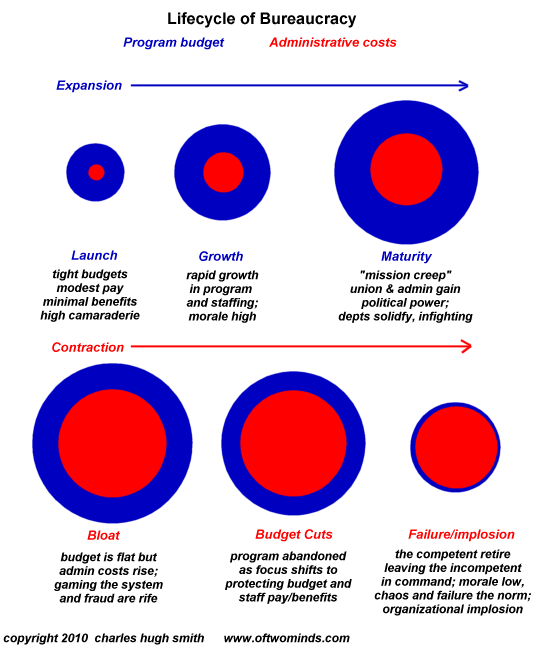
In the present day, this is how The Phantom Legion Problem manifests: the agency / institution is reported at full strength and fully capable of performing all its duties, but beneath the surface it’s lacking experienced staff and competent leadership, and much of the staffing is in unproductive, dead-wood administrative positions.

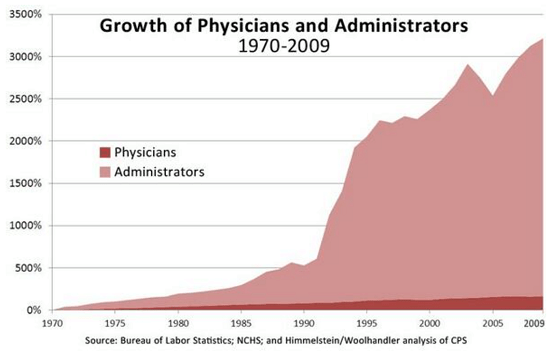
Taking healthcare as an example, we find experienced frontline caregivers are retiring and not being replaced with equivalent numbers of staff with the equivalent experience. We find caregivers are burning out due to crushing workloads, or quitting the profession in order to have a family and get their life back.

Meanwhile, the number of administrators increases, soaking up the system’s funding with endlessly expanding compliance data entry, reports, etc., all of which adds additional burdens on those actually providing care.

There’s always enough money to increase administrators’ salaries, but not enough to maintain essential systems or hire more caregivers.

The Phantom Legion Problem plays out in many ways in modern bureaucracies. The number of sworn officers in a police department may appear adequate but if many are assigned to desks, the PD is not actually at full strength.

If administrators are advanced due to their PR and financial skills rather than on their competence in actually leading the organization, the Phantom Legion problem is already terminal. the rot starts at the top, and those actually carrying the weight fulfilling the organization’s mission burn out, get disgusted and give up.

The problem with The Phantom Legion Problem is there is every incentive to hide the decay of systemic competence and capability behind glowing annual reports and ginned-up numbers. Only those within the organization know the truth and they are under pressure to keep quiet, lest they find themselves on the slow train to Siberia.

Here is how systems decay and collapse: everything is reported at full strength, but the numbers don’t reflect reality. Everything is presented as rock-solid until it falls apart. Everyone outside the system is in disbelief while insiders wondered how it held together as long as it did.

Global Economic War Is Coming And The Threat To The US Dollar Is Real

By Brandon Smith

Source: Alt-Market.us

In a recent statement posted to social media, Tucker Carlson explained succinctly his many reasons for traveling to Russia to interview President Vladimir Putin. His decision, mired in an avalanche of outrage from leftist media talking heads and a multitude of western politicians, was inspired by Carlson’s concern that Americans have been misdirected by corporate propaganda leaving the public completely uneducated on the war in Ukraine and what tensions with the East might lead to.

I agree. In fact, I don’t think the majority of Americans have a clue what the real consequences of a global war with Russia and its allies would look like. Even if the conflict never resulted in shots fired and stayed confined to the realm of economic warfare, the US and most of Europe would be devastated by the effects.

Carlson specifically mentioned dangers to the status of the US dollar, and I suspect this comment probably mystified a great number of people. Most of the population cannot fathom the idea of a US dollar implosion set in motion by a foreign dump of the greenback as the world reserve currency. They really do believe the dollar is invincible.

The most delusional people are, unfortunately, those within mainstream economic circles. They just can’t seem to grasp that the west is in the midst of financial collapse already, and war would accelerate the effects to levels not seen since the Great Depression.

I have been warning about this outcome for many years. I think I have made my position clear in the past; I suspect the conflict between east and west has been carefully engineered over the course of a decade or more, and Russia is not innocent in this affair.

Russia has consistently collaborated with globalist institutions including the International Monetary Fund in the effort to create a new “global reserve currency system.” In other words, the interests of Russia and the globalists do indeed intersect in a number of ways and the war in Ukraine has not necessarily changed that.  Time Magazine even complained last year about the IMF issuing positive reports about Russia’s economy – They thought the organization was going to repeat the false NATO narrative that Russia was in the midst of fiscal implosion.  Instead, the IMF essentially praised Russia’s resiliency in the face of sanctions.

As I noted in 2014 in my article ‘False East/West Paradigm Hides Rise Of Global Currency’ in reference to the burgeoning war with Ukraine.

I would remind pro-Putin cheerleaders that Putin and the Kremlin first pushed for the IMF to take control of the Ukrainian economy, and the IMF is now demanding that Ukraine fight Russia in exchange for financial support. This might seem like irony to more foolhardy observers; but to those who are aware of the false East/West paradigm, it is all the part of a greater plan for consolidation of power.”

I also argued that:

“I have warned for quite some time that the development of East/West tensions would be used as a cover for a collapse of the dollar system. I have warned that among the American media this collapse would be blamed on an Eastern dump of foreign exchange reserves and treasuries, resulting in a global domino-effect ending U.S. world reserve status.”

From the moment Ukrainian President Viktor Yanukovych was deposed (many argue that this was done with the help of western intel agencies) the agenda for WWIII was set in motion. Both sides seemed to create the circumstances by which a conflagration was unavoidable.

Russia, strangely, supported the intervention of the IMF to secure Ukraine’s economy. The IMF then asserted that Ukraine would have to fight Russia to keep control of the Donbas or risk losing the financial aid that was keeping the country alive. Is this irony, or is there something else going on here?

NATO started arming Ukraine, and Ukraine used those arms to slaughter civilians in the Donbas. The eastern population wanted to join with Russia, and Ukraine had no intention of allowing this (IMF funding was on the line). In the meantime, the government began openly discussing the official inclusion of Ukraine into NATO. Russia then invaded, taking the Donbas. Now the entire region is a powder keg and both sides are ready to light the fuse.

But let’s look at this situation as if there was no globalist involvement in facilitating the crisis, just for a moment as an exercise in critical thinking…

If I had to pick a side that is “more right” in their position, it would have to be Russia, but not for the reasons many leftists might imagine when conservatives defend Russia.  The bottom line is that the left blindly follows establishment dictates while the rest of us are at least willing to look at the situation from both sides (which is the same thing Tucker Carlson is doing, and he’s being accused of treason for it).

Imagine if China was working to create a military alliance with Mexico with the potential for the Chinese military to stage long range weapons and soldiers on the American southern border? Imagine the chaos that this would cause in the US (maybe they would finally secure the border)? That’s what Russia was facing with Ukraine. Hell, America almost initiated global nuclear war when the Soviets staged missiles in Cuba in 1962. Military operations so close to the borders of major national powers are not a joke.

This was exact rationale for the war on Ukraine cited by Putin in his discussion with Tucker Carlson, and it makes sense.  Again, if we look at the events without the prospect of globalist interference.  But what if we start to consider who benefits the most from this war?

I certainly don’t trust Putin, but that doesn’t negate the Orwellian behavior of European and American political leaders. There is something going on here beyond the typical mechanisms of geopolitical brinkmanship. The conflict has wide ranging consequences and only serves the goals of a select group of elites.  I suspect elements of both Russia and NATO governments are either knowingly or unwittingly serving these interests.

It is undeniable. It is a verifiable reality – Many of our political leaders and elitist institutions are corrupt beyond comprehension. They are seeking an authoritarian reformation, a “great economic reset” and they are triggering multiple conflicts around the world. We saw the mask come off during covid. These people are not merely misguided; they are monsters, and they are hungry. It’s not beyond them to conjure a worldwide calamity and sacrifice the west like a goat on the altar to get the total centralization they desire.

The East/West paradigm plays into this plan perfectly. The BRICS nations are poised to drop the dollar as world reserve; some have already done so in bilateral trade. Make no mistake, if the conflict in Ukraine (and other parts of the world like Syria or Iran) continues to escalate nations like China will move to dump their dollar holdings just as Russia did. As the largest importer/exporter in the world, many countries would follow China’s lead and shift into a basket of currencies instead of the dollar for international trade.

What does this mean?

The dollar, which has been hyperinflated through more than a decade of Federal Reserve QE money printing, has continued to remain stable only because it is the world reserve and the petro-currency. Foreign banks hold trillions in US currency in overseas coffers for this very reason. With the loss of reserve status, an endless river of dollars will then flood back into the US as foreign investors diversify away from the Fed note. Result? Massive inflationary collapse.

This is what’s at stake. This is what Tucker Carlson was referring to, and far too many in America just don’t get it. Globalists benefit because this is what they have been working towards for decades – The deconstruction of US society and the economy so that the “old world order” can be replaced with their “new world order” of Central Bank Digital Currencies.  An IMF one-world currency basket and a host of other highly unpleasant socialist changes would swiftly follow.

The BRICS might be working with the IMF because they see the dethroning of the dollar as an opportunity to gain greater influence over international trade.  Or, maybe they are controlled opposition and they are scrambling for a seat at the NWO table.  In the end, the fall of the dollar would be a watershed moment for the formation of a global currency system.

And the best part for globalists is, they will be seen as the “heroes” when it’s all over. They spent the better part of the last century setting up America for economic failure through their devaluation of the dollar and the creation of a national debt trap. The system was going to break anyway, but now they can divert all blame to war and the “arrogance of nation states” and then come to the rescue with their dystopian digital money.

An east/west conflict opens the door to the Great Reset.  It is, in a lot of ways, the core of the Reset.  Everything in the new world order agenda relies on it.  Right now, the only thing holding back the tide is the public’s general refusal to fight. No one is interested in going overseas to die in a meaningless battle for Ukraine (Zelensky is truly delusional if he thinks Americans will shed blood in his trenches – Even a draft would be an utter failure). No one is interested in starting WWIII, whether it be nuclear or just economic.

I think the establishment’s outrage over Tucker Carlson interviewing Putin is based on their fear that western audiences are already skeptical of the motives behind the conflict and an unfiltered discussion on the war might galvanize this feeling.  The notion of war is becoming harder and harder for the establishment to sell.

This, however, does not negate the ability of NATO or Russia in expanding the crisis beyond Ukraine into other regions or into financial subterfuge (again, keep your eyes on Syria and Iran). Ultimately, they want us to choose sides, but only from the list of sides they approve. Liberty minded groups in the west need to choose our OWN side and fight for our own interests. It can’t be about NATO vs Russia, it has to be about free people vs the globalists. This is the only way these disaster events will ever end.

How to Navigate Our Low-Trust, Increasingly Dysfunctional Society and Economy

By Charles Hugh Smith

Source: Of Two Minds

Politicians and corporate managers have an enviable record of self-enrichment but very little to show in terms of putting the long-term interests of the citizenry above their own short-term gains.

This week’s focus is on self-reliance, a topic of increasing relevance than is more complex that it may seem.

Sociologists differentiate between high-trust and low-trust societies: in high-trust social orders, citizens tend to trust institutions and each other to conform to social norms, enabling strangers to trust a vast circle of transactions and socio-economic ties. Low-trust societies are plagued with distrust of authority and institutions and fear of getting taken advantage of by strangers, so the circles of trust are small, inhibiting social mobility and economic growth.

Economies and political systems can also be understood as high-trust or low-trust. If the political system excels at rewarding insiders and incumbents while leaving critical problems unsolved, citizens have little reason to trust the system.

The same is true of economies that greatly enrich insiders and incumbents at the expense of the citizenry via monopoly/cartel price-gouging, shrinkflation, degrading the quality of goods and services and the immiseration of standard services, forcing customers to “upgrade” from wretched to merely dismal.

Conventional pundits and economists are constantly whining that Americans “just don’t get it”: they tout our soaring per capita wealth, i.e. we’re getting richer, so everyone should be delighted, yet only 20% of the public are “satisfied with the way things are going.”

What the well-compensated pundits and economists are ignoring (or are paid to ignore) is the decay of the U.S. from a high-trust-functional to a low-trust-dysfunctional society and economy: Americans will still go out of their way to aid strangers, but their trust in institutions has plummeted to lows, as has their trust in the political-corporate elites’ leadership: politicians and corporate managers have an enviable record of self-enrichment but very little to show in terms of putting the long-term interests of the citizenry above their own short-term gains.

People understand the name of the game now is to spout all the expected optimistic PR of “innovation” and “serving the public” while maximizing their private gain at the expense of the nation. Offshoring America’s essential industrial supply chains wasn’t done to serve the nation; it was done to maximize profits, 90% of which flow to the top 10%. Pushing us into debt servitude is highly profitable, but it isn’t benefiting us or the nation.

Americans were told to trust long, hyper-globalized single-source supply chains as “efficient” (i.e. profitable) and trustworthy, yet they’ve discovered these supply chains are vulnerable and fragile. Americans were told that corporate monopolies were selling them “innovations” when in fact they were being sold highly addictive (and therefore highly profitable) goods and services.

Americans were told that their financial security was increasing even as the U.S. economy became increasingly dependent on hyper-financialized asset bubbles and central bank bailouts, the precise opposite of stability. Rather than producing more financial security for the bottom 80%, these “innovations” greatly expanded the gulf between the wealthy and the increasingly precarious bottom 80%.

Americans were told to trust that the hyper-centralization of political and financial power would benefit them, when the evidence is piling up that this hyper-centralization has increased the dysfunction of core institutions and the fragility of essential systems.

Doesn’t it ring hollow to glorify our soaring wealth while households declare bankruptcy due to medical bills, college students sign up for a lifetime of debt servitude to pay tuition and inflation has destroyed 20% of every wage earner’s paycheck just since January 2020? All that “soaring wealth” is asymmetrically distributed, but let’s not talk about that, let’s talk about statistics that mask that asymmetry.

What the well-compensated pundits and economists are paid to ignore is the concentration of the vast majority of all this new wealth and income in the top 10%. Soaring wealth only widens wealth inequality; it doesn’t benefit the nation, it weakens its foundations by accelerating the decay of trust in core institutions and systems.

What happens when high-trust decays to low-trust is the circle of reliable, trustworthy sources and people shrinks to the local, decentralized level. Rather than trust Big Ag, Big Fast-Food and supply chains of highly processed glop to feed us, we start turning to local sources of real food.

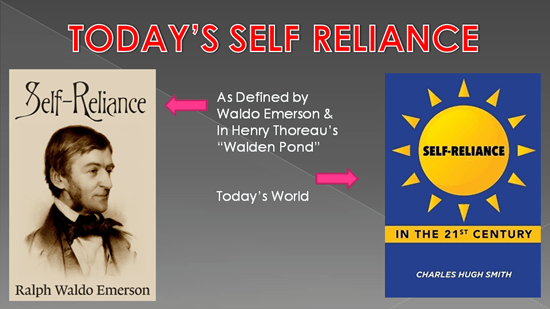
In the same way, we rediscover the value of thinking for ourselves rather than accepting self-serving memes-of-the-day. We rediscover the value of what Ralph Waldo Emerson wrote about in his 1841 essay Self-Reliance (free text, Project Gutenberg).

Emerson counsels us to “be our best selves,” and not to count property wealth above all else. (“They measure their esteem of each other by what each has, and not by what each is.”)

Emerson understood that the values of a society are the foundation of its economic order. A system lacking any principles and values other than greed and self-enrichment is a rotten structure doomed to collapse. It is not just the larger socio-economic order that needs a rock-solid value system; each individual must ground their choices and actions in a value system they have embraced on their own. (“Nothing can bring you peace but yourself. Nothing can bring you peace but the triumph of principles.”)

What Emerson is espousing is self-reliance, in thought, in values, and in economic and financial matters. In today’s world of crumbling hyper-globalization, self-reliance extends to the practical world of where our essential goods and services are coming from.

Gordon Long and I discuss these and many other aspects of Self-Reliance in the 21st Century in our wide-ranging podcast Self Reliance (45 min).

We discuss how the American economy has changed over the past 40 years, to the detriment of the nation’s values and the security of its citizenry, and what self-reliance means today– the topic of my book Self-Reliance in the 21st Century. (Read the first chapter for free.)

How can we best navigate our low-trust, increasingly dysfunctional society and economy? By strengthening our own self-reliance.

Could America Have a French-Style Revolution?

By Charles Hugh Smith

Source: Of Two Minds

Combine all these factors and the result is a potentially volatile mixture awaiting a catalyst.

In the past, I reckoned the odds of America experiencing a revolution akin to France 1789 were low due to the different political, economic and cultural conditions present then and now, but recently I’ve considered the possibility that America’s extremes of wealth, income and power inequality are a powder keg awaiting ignition.

By French-Style Revolution I don’t mean a violent overthrow of the ruling elite as much as a tumultuous reset of how resources and power are distributed. Systems become vulnerable to such resets when they become highly asymmetrical in how they distribute resources and power, and rigid in their defense of the extreme inequality of the distribution.

The fundamental source of democracy’s stability is the dynamic competition of various interests and the dynamic equilibrium of the three branches of the state each balancing the others by restraining the dominance of any one branch or interest.

But extremes of inequality undermine this stability, as the wealthiest elites now bring such a preponderance of wealth to bear that each of the three branches of the state are now beholden to the interests of the few, leaving little recourse to the many.

When the agenda and narratives have been shaped by the wealthiest elites’ foundations, think tanks, corporate PR and lobbyists, then electing different representatives has little effect on the power structure.

The masses can still influence cultural / social policies by voting in a liberal or conservative slate, but the distribution of wealth, power and resources remains unchanged.

As wealth and power are concentrated into ever fewer hands, the mythology of broad-based access to prosperity has vastly expanded the pool of second-tier elites who feel entitled (via implicit promises made by the system) to their fair share of income, wealth and power–financial security and political agency, i.e. a say in public decisions.

These second-tier elites are primarily university graduates and the offspring of upper-middle class households who have been led to expect a secure slot in the upper reaches of the economy or state is a birthright gained by their education and class.

That there are no longer enough slots for this class means those left out constitute the raw material of a potently dissatisfied and potentially angry political class. Historian Peter Turchin presents this as the result of the overproduction of elites, a dynamic he has traced back to previous eras of tumultuous upheaval.

Another common factor driving the masses to revolt is when the essentials of life are no longer affordable or available in sufficient quantity. Historian David Hackett Fischer has documented the perilous impact of inflation, i.e. the collapse of the purchasing power of wages.

Yet another potentially explosive factor is the supreme confidence of the wealthiest elites that the system they rule could ever turn against them or crumble beneath their feet–in a word, a hubris as extreme as their wealth and power. The resignation of the masses and the ease of distracting them with ginned-up controversies and crises and consumerist novelties has fed elite confidence that their supremacy is unassailable.

This hubris leads to the elite becoming tone-deaf to their own excesses and the instability their excesses are generating within the system, an instability that’s currently hidden beneath the resignation and distraction of the masses and the mute frustration of the second-tier elites facing lifetimes of insecurity.

Another factor is the promises made by the state generations ago can no longer be met without creating new money on a scale that guarantees destabilizing inflation. This new money is issued as Treasury bonds which are purchased for income by the wealthy, further exacerbating wealth and income inequality.

The power elite are incapable of demanding sacrifices of the wealthy as the prime directive of the status quo is to defend the current asymmetry of wealth and power. This undermines the collective consensus needed to take the collective action needed to reset the system.

Combine all these factors and the result is a potentially volatile mixture awaiting a catalyst. The confidence of the status quo that it is essentially omnipotent (the Federal Reserve will always save us, etc.) and eternal is itself a factor in the mix.

The key factor is the rigidity or flexibility of the power structure. If the structure is incapable of resetting to a more flexible, symmetric distribution of power as resources, it will come apart as pressures mount.

When Shelter Becomes a Speculative Asset, Society Unravels

By Charles Hugh Smith

Source: Of Two Minds

Does anyone really believe that the renunciation of massive, sustained stimulus of speculation in housing would leave housing valuations unchanged because valuations are solely the result of “shortages”?

Let’s begin by stipulating that speculation (i.e. gambling) is part of human nature. The role of regulations and policy is to limit the damage that gambling inevitably inflicts when “sure things” cliff-dive into losses.

In other words, where the speculative frenzy and money flows matters. When the South Sea Bubble expanded circa 1713-1720, this flood tide of speculative capital did not distort the cost of shelter and bread in England; it was limited to a purely financial marketplace of shares in the company. When the bubble imploded in 1720, the losses fell mostly on wealthy investors like Isaac Newton.

The same can be said of the speculative mania of the dot-com era: the bubble and collapse were limited to the tech sector and those participating in the sector and the speculative frenzy. The cost of rent and bread did not double due to the speculative bubble’s inflation or bursting.

In contrast, when speculation floods into shelter / housing, it fatally distorts the cost of housing non-speculators must pay. I say fatally because shelter, along with food, energy and water (the FEW resources), are essential to life. These are not discretionary things we can decide not to have. When the price of essentials soars due to speculation that only rewards the speculators at the expense of non-speculators, the fuse of social disorder is lit.

Anyone who believes policies that encourage the wealthy to hoard housing to the point that the bottom 80% (or the bottom 95% in some areas) cannot afford to buy a home are just peachy is overdosing Delusionol. The social consequences are severe and uncontainable once the worm turns.

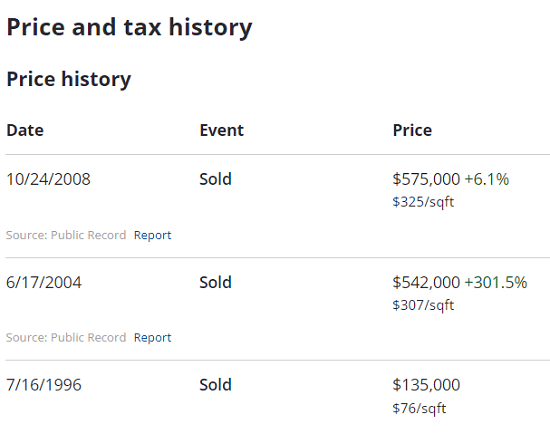
Exhibit #1 in Shelter Becoming a Speculative Asset is a modest house in the San Francisco Bay Area that sold for $135,000 in mid-1996. By modest I mean small, old, and on a small lot in a neighborhood of other small lots and homes. (A screenshot of the Zillow history is below.)

Today the home’s value is estimated to be about ten times higher: $1.35 million. Let’s do some basic math to understand just how distorted this market has become.

The median household income in 1996 was about $39,000. For a house costing $135,000, this represents 3.5 ratio of income to housing, well within the traditional ratio of 4 to 1 (4 X income = cost of the home).

Median household income has almost doubled to $75,000, roughly in line with inflation according to the Bureau of Labor Statistics. According to the BLS, the house that cost $135,000 in July 1996 would now cost $264,000 when adjusted for inflation, and the $39,000 median income would be $76,000.

Let’s say the house appreciated above the rate of inflation to $300,000 today. That’s still within the 4 to 1 ratio of income to house cost (4 X $75,000 = $300,000.) So even though the house rose 2.2X in cost, it would still be affordable to a median household.

At a value of $1.35 million, a household would need to make $337,500 annually–an income that is in the top 5% of households–to buy the house today. In other words, an income that is 4.5 times the median household income is the minimum needed to buy this modest house.

The house is now worth 4.5 times what it would have been worth if it had appreciated well above inflation.

The conventional argument holds that this four-fold increase in housing costs is due solely to a shortage of housing. Let’s consider some data before concluding this is the only dynamic in play.

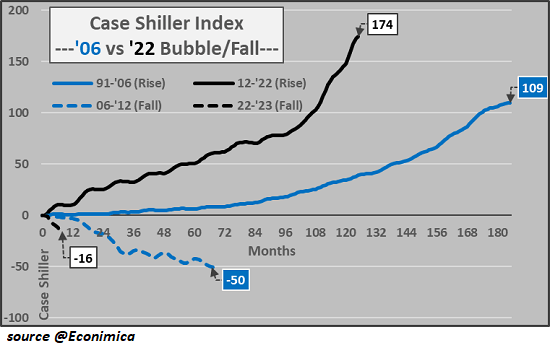
Chart #1: Case Shiller housing index: this chart shows two massive housing bubbles in the past 20 years.

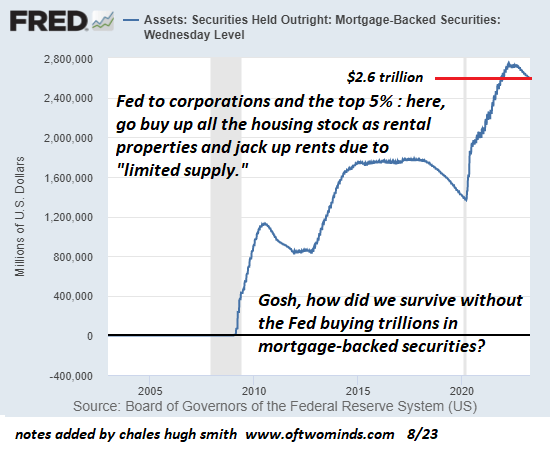
Chart #2: Federal Reserve’s purchases of mortgage backed securities (MBS) to goose the housing market. The “housing shortage” argument claims the unprecedented Fed purchases of trillions of dollars of MBS is not correlated to the housing bubble, but this claim makes no sense: dropping mortgage rates to unprecedented lows while soaking up trillions of dollars in securitized mortgages was like injecting speculative crack cocaine into the housing market. Gosh, how did we survive without the Fed buying $2.5 trillion in mortgages?

Chart #3: the current housing bubble compared to the 2000-2006 housing bubble: today’s bubble is even more extreme than housing bubble #1.

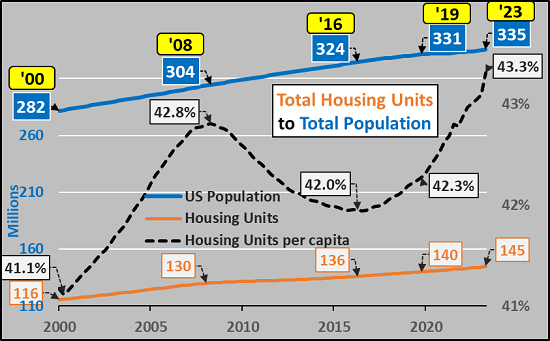
Chart #4: housing per capita (per person) has reached a new high: if there’s such a severe shortage of housing, how can the housing per capita be at an all-time high? Population rose 4 million in the past 4 years while 5 million housing units were added–plus a pig-in-a-python of housing in the pipeline.

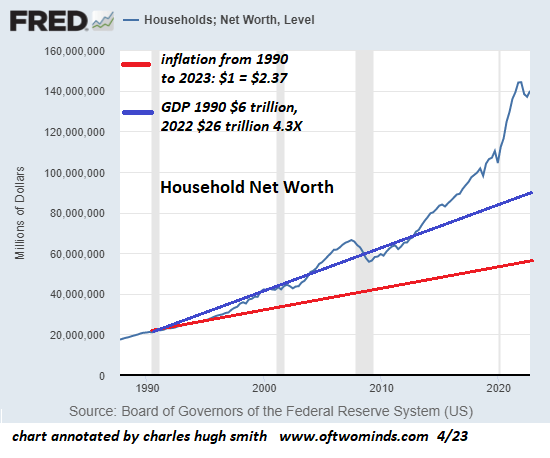
Chart #5: household net worth is $50 trillion above trend, the direct result of massive monetary and fiscal stimulus. Tens of trillions of dollars were borrowed into existence and pumped into so-called risk assets–assets such as housing that the wealthy buy for speculative appreciation.

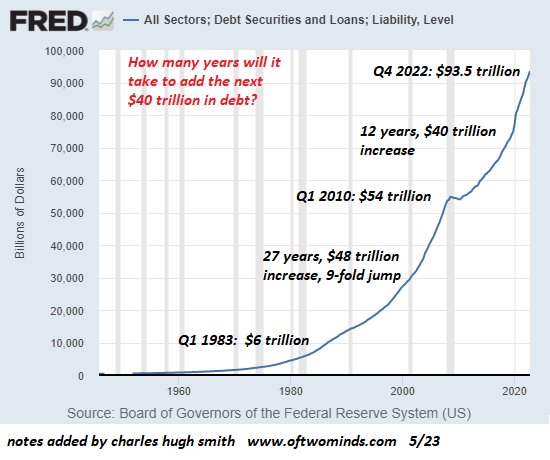
Chart #6: total debt–private and public–soared from $20 trillion in 1996 to $95 trillion now. Is it merely coincidental that this is $55 trillion above the trendline of inflation, which would have placed total debt at $40 trillion today?

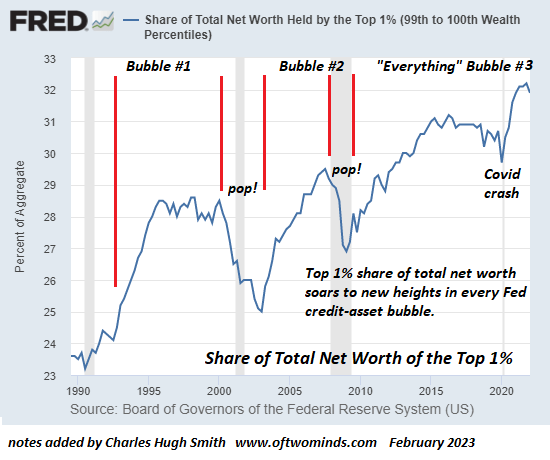
Chart #7: net worth of the top 1% households, which soared from 23% of all net worth to 32%: this 9% gain in the percentage of all household net worth represents a gain of $14 trillion above and beyond the $28.7 trillion in gains registered by the 23% they owned in 1990.

1990 total net worth: $21 trillion, 23% = $4.8 trillion; 2023 total net worth: $146 trillion, 23% = $33.5 trillion; $33.5 trillion – $4.8 trillion = $28.7 trillion.

This unprecedented bubble in housing valuations is due not to shortages but to decades of massive financial stimulus that incentivized speculative capital to flood into housing as a low-risk way to skim stupendous gains for creating zero gains in productivity. If you doubt this, then run this scenario and tell us what happens:

The Fed dumps its entire portfolio of mortgage backed securities and stipulates it will never buy any again. It also renounces all the other stimulus gimmicks that incentivized expansions of debt and speculation.

Does anyone really believe that the renunciation of massive, sustained stimulus of speculation in housing would leave housing valuations unchanged because valuations are solely the result of “shortages”? If so, there’s a little shack under the Brooklyn Bridge I’ll let you have for a couple of million. I’m sure the Airbnb rent will mint you millions.