
Saturday Matinee: Downsizing

Let’s Get Small: Reckoning with “Downsizing”

“Look, you don’t understand. There was shrinkage!”

By Noah Gittell

Source: Good Eye

In his book Sex, Drugs, and Cocoa Puffs, essayist Chuck Klosterman wrote an essay defending the 2001 Cameron Crowe film Vanilla Sky from its reputation as a creative failure. Specifically, he honed in on critic Owen Gleiberman’s D+ review in Entertainment Weekly that accused the film of being little more than “a cracked hall of mirrors taped together by a What is reality? cryogenics plot.” Nonplussed, Klosterman pointed out that all the best films of this era—from The Matrix and Fight Club to eXistenZ and Mulholland Drive asked that same question about the nature of our reality. Klosterman argued that it was “the only relevant question for contemporary filmmakers.”

I bring this up to defend Downsizing, which is not a great film but deserves kudos for doing what Vanilla Sky did in the early ‘00s. Downsizing asks the only relevant question for filmmakers of its era: What should we do now that the world is ending? It asks this question all the way through, although its beginnings—the first third, basically—feels more like a broad comedy, which may have thrown some viewers. The film’s shifts in tone reminds me a bit of Zero Effect, one of my all-time favorites, which also presented itself as a wacky comedy before slowly transforming into something more profound. I have a theory that people—maybe critics in particular—don’t like movies that sell themselves as one thing and then become something else. It makes them feel manipulated or something. 

I was up for it with Downsizing because if you look closely, it’s about the end of the world from the beginning. The film stars Matt Damon as Paul Safranek, an occupational therapist struggling to get his head above financial water. He and his wife (Kristen Wiig) accept a radical new solution: they will shrink themselves and head off to live in Leisureland, a community for the small where their scant savings will allow them to live like millionaires for the rest of their lives. 

It turns out to be a real bait-and-switch, for Paul and for us. His wife leaves him just before the procedure, leaving Paul small and alone. After fighting depression for a year or so, he eventually gets caught up in the life of Ngoc Lan Tran (Hong Chau), a Vietnamese dissident who was a brief cause celebre after shrinking herself to escape political persecution and is now cleaning tiny houses for a living in Leisureland. 

Despite the economic framing, Downsizing is pretty goofy up until this point, with a lot of sight gags built around objects that are not the size we’re used to seeing them. Still, there are hints of the thoughtfulness to come. The shrinking process is initially sold as a way to cut down on human consumption and save humanity from the ravages of climate change, but director Alexander Payne slips in some well-meaning commentary on how environmentalism is co-opted.  Most people shrink themselves out of self-interest, using their duty to the planet as cover. When Paul reconnects with an old friend who has gotten small and asks him if it feels good to save the environment, the friend replies, “Downsizing is about saving yourself.”

It’s a neat summary of the problems of the film, which is ostensibly about saving the planet but is ultimately more committed to the journey of its average, White middle-class protagonist. When Paul meets Ngoc Lan, he discovers the dark underbelly of Leisureland: the projects on the wrong side of the tracks (okay, in this case, a tunnel), where she and an entire class of unseen, underrepresented workers live. Paul is horrified by their living conditions, and finds himself compelled to help her feed, bandage, and generally care for them out of the goodness of his heart. When he learns of an opportunity to visit the original small colony in Norway—and be included in their plan to start a new colony underground while waiting out the impacts of climate change—he must decide between being part of the privileged future or staying behind to help those afflicted in the present.

I’ve noticed that most people who have seen Downsizing seem to get fed up in this final third. Paul and Ngoc Lan travel to Norway with his debauched neighbors (a perfectly cast Christoph Waltz and Udo Kier), where the film completes its transition from broad comedy to meditation on the morality of Armageddon. Paul justifies his choice to be part of the future in selfish terms: ”Why didn’t I become a doctor? Why did I downsize? Why did my wife abandon me? So I could wind up here at exactly the time to go into that tunnel! I finally have the chance to do something that matters.” In the end—SPOILER ALERT—he stays on the surface, marries Ngoc Lan, and spends his downsized downtime helping the indigent.

I have no issue with the film’s transformation, and I admire its willingness to ask, as Klosterman puts it, the only relevant question of our time. It reminds me of the best moment in the political career of Andrew Yang, who, when asked at a Democratic presidential debate for his approach to climate change, gave a startlingly clear-eyed answer. Other candidates talked about the need to listen to climate scientists, transitioning to green energy, and, if they were feeling bold that day, a carbon tax. Yang looked right at the camera, and said something like (I’m paraphrasing), “I would allocate $40 billion to move every American family to high ground.” His honesty hit me like a load of bricks, and for a minute there, I thought we finally had a politician who would tell the truth. The bloom came off his rose pretty soon after that, but at least he didn’t deny reality, and neither does Downsizing. It should be commended for that.

It just chooses a poor lens through which to explore the issue.  The film’s problems run along two intertwining tracks: creative and political. First, there’s something unseemly about Payne exploring these themes through a middle-class White protagonist. Watching Downsizing, you can’t help but wish Ngoc Lan were the main character, and Paul was just a sweet White guy she picked up along the way. Hong Chau gives a miraculous performance as the resolute activist. Yes, she uses a comically exaggerated Vietnamese accent that threatens to offend sensitive viewers, but her increasingly soulful performance overwhelms the stereotype. Was all this on purpose—the offense and the redemption? I tend to think so. Payne is telling this story for privileged White viewers, and he hopes that her transformation from, um, housecleaner into fully-formed human being will transform them into caring about those they would otherwise ignore.

Maybe it will, but I can’t help but feel he’d have a better shot at doing that if his main character weren’t the most boring person on the planet. I get the appeal of an Everyman in this type of story, but Paul Safranek does not need to be this bland. His backstory is compelling enough: He was going to be a doctor, but his mom got sick, so he moved back to his hometown to take care of her and became an occupational therapist instead. His mom died, and he married a seemingly sweet lady who inexplicably left him in the lurch. This series of events would produce an interesting person, or at least a recognizable personality, certainly more than the human blob that Payne, his co-writer Jim Taylor, and Matt Damon come up with here. On the page, Paul is torn between altruism and self-interest, but that conflict never comes to life on the screen. There’s no self-deprecation, black humor, frustration, or anger. It’s a bland performance by an actor who is capable of much more.

Downsizing still gets points for trying. Damon could have given a better performance, but the broader problem of centering a boring White man in this story was not really fixable. An FX-driven moral parable about the end of humanity would never be made without a movie star at its center, and certainly not for its reported $68 million budget—it’s kind of a miracle it got made even with one. And outside of Denzel Washington and Will Smith, there were no non-White movie stars at this time who guaranteed a  certain box-office haul. Put simply, it always had to be Damon or someone like him, which means that Downsizing probably did the best it could under the circumstances. If you want to make a movie that reckons seriously with Armageddon, you’re gonna have to work with the devil to do it.

——————–

Watch Downsizing on Kanopy here:https://www.kanopy.com/en/kcls/video/13159250

Desperate Americans Who Can’t Afford Housing Are Becoming “Modern-Day Nomads” …But Not By Choice

By Robert Wheeler

Source: The Organic Prepper

A recent story floating around mainstream media regarding “modern-day nomads” reads like a contemporary article on Henry David Thoreau. It shares stories of people looking to downsize their life and live simply and stories of people who have fallen on hard times, unable to afford rent. 

However, what is lacking is the exposure of the dark underbelly of the “modern-day nomad” culture. In other words, they neglect to mention the fact that the enormous growth of the “modern-day nomad” is rooted in the fact that the world economy has all but collapsed, now mired in a global economic depression of unemployment, low wages, and personal financial catastrophes.

While it sounds romantic, it’s often rooted in desperation.

Nevertheless, some of the stories begin in the following way:

If you look closely on city streets, campgrounds, and stretches of desert run by the Bureau of Land Management, you’ll see more Americans living in vehicles than ever before. It was never their plan.

“I wasn’t prepared when I had to move into my SUV. The transmission was going. I had no money saved. I was really scared,” said April Craren, 52, bundled in blankets atop a cot inside her new minivan, a 2003 Toyota Sienna.

She flipped the camera on her phone to show me the camp stove she uses to make coffee and her view of the sun rising over the Colorado River. She has no toilet, shower, or refrigeration.

After separating from her husband, April found herself homeless in June 2020, exacerbating the depressive disorder for which she receives $1,100 a month in disability benefits.

“I could have gotten an apartment but in a crappy unsafe place with no money to do anything at all,” she explained.

Last year, where April lived in Nixa, Missouri, the average rent for an apartment was $762, slightly less than the national average. Like nearly half of American renters, she would have been crippled by the cost.

It’s not surprising, then, that job loss, divorce, or, say, the sudden onset of global health or financial crisis can push so many over the edge.

Many Americans have found themselves trapped in a spiral of poverty from which they simply can’t recover.

It doesn’t sound so bad to those of us with minimalist persuasions

At 52, April Craren didn’t choose this life. It was thrust upon her by unfortunate life circumstances. Craren couldn’t afford the exorbitant rent that is now average across the country on a fixed income. (Partly due to inflation but mostly due to the housing crash in 2008.)

The coordination of lockdowns and COVID restrictions have plunged the world into a deep depression of which we are only beginning to see. Even Wall Street couldn’t have caused this much damage. 

“If the Great Recession was a crack in the system, Covid and climate change will be the chasm,” says Bob Wells, the nomad who plays himself in the film Nomadland. Thankfully, Wells was able to help Craren adopt her lifestyle so she can now survive as a “nomad” through his Home On Wheels Alliance.

Wells’s lifestyle was a choice. But the newfound interest in the nomadic lifestyle is not a choice for many.

From Yahoo:

Realizing he had something valuable to share, he bought the domain name Cheap RV Living in 2005. He posted tips and tricks about better vehicle-dwelling, but what he was really offering was a road map to a better life.

Four years later, when close to 10 million Americans were displaced after the Great Recession, traffic to his site exploded. Finding himself at the center of a growing online community, he decided to create a meet-up in Quartzsite, Arizona. He dubbed it the Rubber Tramp Rendezvous (RTR), and in January 2011, 45 vehicles showed up. Eight years later, an estimated 10,000 vehicles convened for what was said to be the largest nomad gathering in the world.

The event’s explosive growth is undoubtedly a reflection of America’s increasing interest in van life as an answer to the affordable housing crisis, an idea made accessible by Bob on his YouTube channel, also named Cheap RV Living, created in 2015.

The “increasing interest in van life” that Yahoo News refers to is not some petit-bourgeois fantasy being realized by privileged middle-class white kids, able to go home at any time. It is the necessity of formerly middle class, working-class, and poor people all across America who are out of work or are working but cannot afford housing.

Minimalism is a legitimate lifestyle for some; others have no choice

For many, this culture of minimalism is genuinely how they wish to live. Nomads have a genuine desire to see empty overconsumption come to an end. However, we can not ignore that minimalism is being promoted to prepare the Western population who are used to high living standards to accept those that are much lower.

Why do you think we continually see articles promoting insects as a legitimate dining option? Why are The Great Reset promoters at the World Economic Forum telling the public that they will soon own nothing and learn to love it?

Being a nomad doesn’t mean you can’t be prepared.

For those who are already nomads, whether by choice or forced by economic circumstance, it might be helpful to know that there are many prepping options available to you. There is no need to be left to the mercy of wherever you are right now. 

I highly encourage you to access Daisy Luther’s article, “There’s Another Option Besides Hunkering Down and Bugging Out: Nomadic Living.” It will give you the perspective of someone who has voluntarily experienced and lived the nomadic lifestyle while also the mindset of remaining prepared for anything and everything. 

At the rate the Great Reset is taking shape, many of us may find ourselves embracing the nomadic lifestyle, willingly or not.

Have you considered nomadic living?

Colonizing the Western Mind

By Jason Hirthler

Source: CounterPunch

In Christopher Nolan’s captivating and visually dazzling film Inception, a practitioner of psychic corporate espionage must plant and idea inside a CEO’s head. The process is called inception, and it represents the frontier of corporate influence, in which mind spies no longer just “extract” ideas from the dreams of others, but seed useful ideas in a target’s subconscious. Inception is a well-crafted piece of futuristic sci-fi drama, but some of the ideas it imparts are already deeply embedded in the American subconscious. The notion of inception, of hatching an idea in the mind of a man or woman without his or her knowledge, is the kernel of propaganda, a black art practiced in the States since the First World War. Today we live beneath an invisible cultural hegemony, a set of ideas implanted in the mass mind by the U.S. state and its corporate media over decades. Invisibility seems to happen when something is either obscure or ubiquitous. In a propaganda system, an overarching objective is to render the messaging invisible by universalizing it within the culture. Difference is known by contrast. If there are no contrasting views in your field of vision, it’s easier to accept the ubiquitous explanation. The good news is that the ideology is well-known to some who have, for one lucky reason or another, found themselves outside the hegemonic field and are thus able to contrast the dominant worldview with alternative opinions. On the left, the ruling ideology might be described as neoliberalism, a particularly vicious form of imperial capitalism that, as would be expected, is camouflaged in the lineaments of humanitarian aid and succor.

Inception 1971

In a short span of time in the 1970s, dozens of think tanks were established across the western world and billions of dollars were spent proselytizing the tenets of the Powell Memo in 1971, which galvanized a counter-revolution to the liberal upswing of the Sixties. The neoliberal economic model of deregulation, downsizing, and privatization was preached by the Reagan-Thatcher junta, liberalized by the Clinton regime, temporarily given a bad name by the unhinged Bush administration, and saved by telegenic restoration of the Obama years. The ideology that underlay the model saturated academia, notably at the University of Chicago, and the mainstream media, principally at The New York Times. Since then it has trickled down to the general populace, to whom it now feels second nature. Today think tanks like the Heritage Foundation, the Brookings Institute, Stratfor, Cato Institute, American Enterprise Institute, Council on Foreign Relations, Carnegie Endowment, the Open Society Foundation, and the Atlantic Council, among many others, funnel millions of dollars in donations into cementing neoliberal attitudes in the American mind.

The ideological assumptions, which serve to justify what you could call neocolonial tactics, are relatively clear: the rights of the individual to be free of overreach from monolithic institutions like the state. Activist governments are inherently inefficient and lead directly to totalitarianism. Markets must be free and individuals must be free to act in those markets. People must be free to choose, both politically and commercially, in the voting booth and at the cash register. This conception of markets and individuals is most often formulated as “free-market democracy,” a misleading conceit that conflates individual freedom with the economic freedom of capital to exploit labor. So when it comes to foreign relations, American and western aid would only be given on the condition that the borrowers accepted the tenets of an (highly manipulable) electoral system and vowed to establish the institutions and legal structures required to fully realize a western market economy. These demands were supplemented with notions of the individual right to be free of oppression, some fine rhetoric about women and minorities, and somewhat more quietly, a judicial understanding that corporations were people, too. Together, an unshackled economy and an unfettered populace, newly equipped with individual rights, would produce the same flourishing and nourishing demos of mid-century America that had been the envy of humanity.

A False Promise

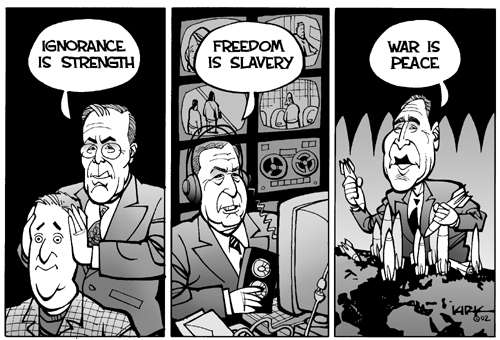
This ‘Washington Consensus’ is the false promise promoted by the West. The reality is quite different. The crux of neoliberalism is to eliminate democratic government by downsizing, privatizing, and deregulating it. Proponents of neoliberalism recognize that the state is the last bulwark of protection for the common people against the predations of capital. Remove the state and they’ll be left defenseless. Think about it. Deregulation eliminates the laws. Downsizing eliminates departments and their funding. Privatizing eliminates the very purpose of the state by having the private sector take over its traditional responsibilities. Ultimately, nation-states would dissolve except perhaps for armies and tax systems. A large, open-border global free market would be left, not subject to popular control but managed by a globally dispersed, transnational one percent. And the whole process of making this happen would be camouflaged beneath the altruistic stylings of a benign humanitarianism.

Globalists, as neoliberal capitalists are often called, also understood that democracy, defined by a smattering of individual rights and a voting booth, was the ideal vehicle to usher neoliberalism into the emerging world. Namely because democracy, as commonly practiced, makes no demands in the economic sphere. Socialism does. Communism does. These models directly address ownership of the means of production. Not so democratic capitalism. This permits the globalists to continue to own the means of production while proclaiming human rights triumphant in nations where interventions are staged. The enduring lie is that there is no democracy without economic democracy.

What matters to the one percent and the media conglomerates that disseminate their worldview is that the official definitions are accepted by the masses. The real effects need never be known. The neoliberal ideology (theory) thus conceals the neoliberal reality (practice). And for the masses to accept it, it must be mass produced. Then it becomes more or less invisible by virtue of its universality.

A Pretext for Pillage

Thanks to this artful disguise, the West can stage interventions in nations reluctant to adopt its platform of exploitation, knowing that on top of the depredations of an exploitative economic model, they will be asked to call it progress and celebrate it.

Washington, the metropolitan heart of neoliberal hegemony, has numerous methods of convincing reluctant developing nations to accept its neighborly advice. To be sure, the goal of modern colonialism is to find a pretext to intervene in a country, to restore by other means the extractive relations that first brought wealth to the colonial north. The most common pretexts for intervention depict the target nation in three distinct fashions.

First, as an economic basket case, a condition often engineered by the West in what is sometimes called, “creating facts on the ground.” By sanctioning the target economy, Washington can “make the economy scream,” to using war criminal Henry Kissinger’s elegant phrasing. Iran, Syria, and Venezuela are relevant examples here. Second, the West funds violent opposition to the government, producing unrest, often violent riots of the kind witnessed in Dara, Kiev, and Caracas. The goal is either to capsize a tottering administration or provoke a violent crackdown, at which point western embassies and institutions will send up simultaneously cries of tyranny and brutality and insist the leader step aside. Libya, Syria, and Venezuela are instructive in this regard. Third, the country will be pressured to accept some sort of military fettering thanks to either a false flag or manufactured hysteria over some domestic program, such as the WMD restrictions on Iraq, chemical weapons restrictions on Syria, or the civilian nuclear energy restrictions on Iran. Given that the U.S. traffics in WMDs, bioweapons, and nuclear energy itself, insisting others forsake all of these is perhaps little more than racially motivated despotry. But significant fear mongering in the international media will provide sufficient moral momentum to ram through sanctions, resolutions, and inspection regimes with little fanfare.

Schooling the Savages

Once the pretext is established, the appropriate intervention is made. There’s no lack of latent racism embedded in each intervention. Something of Edward Said’s Orientalism is surely at play here; the West is often responding to a crude caricature rather than a living people. One writer, Robert Dale Parker, described western views of Asia as little more than, “a sink of despotism on the margins of the world.” Iran is incessantly lensed through a fearful distrust of the ‘other’, those abyssal Persians. Likewise, North Korea is mythologized as a kingdom of miniature madmen, possessed of a curious psychosis that surely bears no relation to the genocidal cleansing of 20 percent of its population in the Fifties, itself an imperial coda to the madness of Hiroshima.

The interventions, then, are little different than the missionary work of early colonizers, who sought to entrap the minds of men in order to ensnare the soul. Salvation is the order of the day. The mission worker felt the same sense of superiority and exceptionalism that inhabits the mind of the neoliberal. Two zealots of the age peddling different editions of a common book. One must carry the gospel of the invisible hand to the unlettered minions. But the gifts of the enlightened interloper are consistently dubious.

It might be the loan package that effectively transfers economic control out of the hands of political officials and into the hands of loan officers, those mealy-mouthed creditors referred to earlier. It may be the sanctions that prevent the country from engaging in dollar transactions and trade with numberless nations on which it depends for goods and services. Or it might be that controversial UNSC resolution that leads to a comprehensive agreement to ban certain weapons from a country. Stipulations of the agreement will often include a byzantine inspections regime full of consciously-inserted trip wires designed to catch the country out of compliance and leverage that miscue to intensify confrontational rhetoric and implement even more far-reaching inspections.

Cracking the Shell

The benign-sounding structural adjustments of the West have fairly predictable results: cultural and economic chaos, rapid impoverishment, resource extraction with its attendant ecological ruin, transfer of ownership from local hands to foreign entities, and death from a thousand causes. We are currently sanctioning around 30 nations in some fashion; dozens of countries have fallen into ‘protracted arrears’ with western creditors; and entire continents are witnessing huge outflows of capital–on the order of $100B annually–to the global north as debt service. The profiteering colonialists of the West make out like bandits. The usual suspects include Washington and its loyal lapdogs, the IMF, World Bank, EU, NATO, and other international institutions, and the energy and defense multinationals whose shareholders and executive class effectively run the show.

So why aren’t Americans more aware of this complicated web of neocolonial domination? Italian communist Antonio Gramsci, who pioneered the concept of cultural hegemony, suggested that the ruling ideologies of the bourgeoisie were so deeply embedded in popular consciousness that the working classes often supported leaders and ideas that were antithetical to their own interests. Today, that cultural hegemony is neoliberalism. Few can slip its grasp long enough to see the world from an uncolored vantage point. You’ll very rarely encounter arguments like this leafing through the Times or related broadsheets. They don’t fit the ruling dogma, the Weltanschauung (worldview) that keeps the public mind in its sleepy repose.

But French-Algerian philosopher Louis Althusser, following Gramsci, believed that, unlike the militarized state, the ideologies of the ruling class were penetrable. He felt that the comparatively fluid zones of Ideological State Apparatuses (ISAs) were contexts of class struggle. Within them, groups might attain a kind of ‘relative autonomy’, by which they could step outside of the monolithic cultural ideology. The scales would fall. Then, equipped with new knowledge, people might stage an inception of their own, cracking open the cultural hegemony and reshaping its mythos in a more humane direction. This seems like an imperative for modern American culture, buried as it is beneath the hegemonic heft of the neoliberal credo. These articles of false faith, this ideology of deceit, ought to be replaced with new declarations of independence, of the mind if not the mainstream.


Jason Hirthler is a veteran of the communications industry and author of The Sins of Empire: Unmasking American Imperialism. He lives in New York City and can be reached at jasonhirthler@gmail.com.