
Life in the Algorithm

images

By Douglas Haddow

Source: Adbusters

The searches we make, the news we read, the dates we go on, the advertisements we see, the products we buy and the music we listen to. The stock market. The surveillance society. The police state, and the drones. All guided by a force we never see and few understand.

A series of calculation procedures that come together to constitute capitalism’s secret ingredient — the all holy algorithm, that which binds and optimizes. Those strange numerical gods who decide whether or not you’re a terrorist and what kids’ toy is going to set the market on fire this Christmas. But what are they, where did they come from and how did they get so powerful?

Algorithms are not new. You can trace their origin all the way back to a 9th century Persian mathematician by the name of Muhammad ibn Musa al–Khwarizmi (Algoritmi in Latin) from whom the word derives its name. Then there was Abu Yusaf Ya’qub ibn Ishaq al–Kindi, a contemporary of al–Khwarizmi’s at Baghdad’s House of Wisdom. He discovered and developed the science of frequency analysis, or code–breaking, providing a basis for code breaker Alan Turing to develop his Turing Machine, the theoretical prototype for the 9 billion devices currently sending and receiving signals through the Internet.

When we talk about algorithms, when they come up in conversation, often tied to latent and emerging fears, we’re not talking about the mathematical models behind them, we’re talking about the models that the models were modeled on. Most people have never heard of a polytope, Boolean Logic or the Hirsch Conjecture. But everyone has a credit score, whether they like it or not.

If we want to interrogate the true nature of these numbers, the wizard behind the ghost in the machine, we need to look no further than Adam Smith, that dour Scot who lived with his mum and accidentally created the modern world.

Smith was neither a modernist nor a cosmopolitan. He was an absent’minded hermit who never married, had few friends, suffered from alternating fits of depression and hypochondria, travelled outside Britain on just one occasion and demanded that all his personal writing be burned upon his death. He was the supreme king of unintended consequences, a humble and misunderstood moral philosopher who became the patron saint of greed.

Most famously, and most tragically, Smith was an ambitious writer who got a bit flowery with his language on occasion, and, as a result, his entire legacy was reduced to two words: invisible and hand. As in, the Invisible Hand — that mysterious market force that secretly and surreptitiously guides all our actions and decisions. Or so we’ve been told.

In The Wealth of Nations, the blueprint for what became known as capitalism, Smith drops the phrase but once. It’s situated in a rather dry discussion on trade policy and is used as a metaphor in a straightforward critique of mercantilism’s excessive restrictions.

And that’s it. Just a cursory metaphor used for poetic flourish in an otherwise obscure and forgettable passage. And for the 150 years that followed the book’s publication, that’s exactly what it was — obscure and forgotten. Smith didn’t mention it, his contemporaries didn’t mention it, nor did his critics. Nary a soul on Earth repeated those two words or paid them any heed.

That is, until 1948, when everything changes.

If you look at a Google NGRAM chart of “invisible hand,” you’ll see that there was little to no interest in the phrase up until the 1930s and ’40s, at which point it begins to bubble up a bit, gaining traction in a few peripheral spheres here and there. Then in ’48, Chicago School economist Paul Samuelson writes a book called Economics: An Introductory Analysis, which would go on to become the best–selling economics book of all time.

In his book, Samuelson grabs hold of Smith’s wordplay and freebases meaning from it until a mere metaphor mutates into the economic doctrine that would define the shape and form of global finance for the remainder of the century, and beyond.

“Every individual, in pursuing only his own selfish good, was led, as if by an invisible hand, to achieve the best good for all, so that any interference with free competition by government was almost certain to be injurious,” writes Samuelson. And with that, not only is it justifiable to be callous in the pursuit of wealth, your callousness will somehow, vis–à–vis the invisible hand, uplift those you trample on your way to the top.

Picture Gordon Gekko, hair trickling with high–end product, walking with the gait of limitless sprezzatura, saying, “Greed is right, greed works. Greed clarifies, cuts through and captures the essence of the evolutionary spirit. Greed, in all of its forms; greed for life, for money, for love, knowledge has marked the upward surge of mankind.”

Samuelson would later go on to regret the liberties he took with Smith’s words, but the meme had already been injected into the passive hive mind of economics. What followed was a long and tangled game of economic telephone wherein Smith’s fatalistic conceit gradually took on mythical qualities. From turn of phrase to doctrine, from doctrine to dogma, from dogma to metaphysical law. The invisible hand became the celestial justification of the free market and the economic rationalist’s negation of anything that stood in its way.

Austrian economist Friedrich Hayek even went so far as to develop an entire theory of human interaction based on the myth. It was called Catallactics, and proposed that we did not live within an economy, but rather, a Catallaxy — a complex and self–organizing system in which every individual sent out a constant stream of complex signals that mixed to create overall market behavior.

Knowledge, Hayek argued, was distributed on an individual level, each person containing their own fraction of the whole.

The vast repository of human knowledge was inherently decentralized. Because of this, no central body or government agency could ever hope to contain enough of it to know what was really going on. But if allowed to move freely without meddling, these messages would come together to create order and equilibrium in the market.

This, he argued, is why the government should never meddle in the market. And why order could never be “planned,” and was instead “brought about by the mutual adjustment of many individual economies in a market.” As long as the signals, our private info–snowflakes, could float freely, the market would reach equilibrium.

Through Hayek, dogma became revelation — the invisible hand was not merely a magical presence promising equilibrium, it was also pointing us toward a not–too–distant utopia. And if we didn’t follow the hand? Oppression and despair would follow mankind into a dark hole of tyranny.

Hayek’s ideas spread swiftly through a series of think tanks connected to his economic clique, The Mont Pelerin Society, which counted Karl Popper, Ludwig von Mises and, of course, who else but Milton Friedman among its members. Together they successfully launched what we now call “neoliberalism” into the political consciousness.

Neoliberalism found its champions in Margaret Thatcher and Ronald Reagan. Thatcher regularly corresponded with Hayek and used the slogan There Is No Alternative (TINA) to explain her affection for its concepts. Reagan hired Friedman to be his economic advisor. And together they carried out an economic revolution that smashed trade unions and deregulated and privatized anything and everything that could be guillotined. From this axis of Anglos, it spread to other parts of the Commonwealth, then to Europe, Asia, South America and beyond.

But no matter how much they stripped away government meddling, somehow the “abstract signals” still weren’t getting through. The hand remained clenched and crises endemic. Asia, Argentina, the Eurozone, the 2008 meltdown, the flash crash. The market continually failing to magically self–correct and achieve equilibrium.

The faithful kept their faith and stuck to the program. The crisis, both economic and existential, were met with a recommitment to the faith in the form of austerity and technology and the dream persisted.

The problem was obvious to anyone outside the neoliberal thought–bubble: the invisible hand wasn’t real and it didn’t exist. It never had existed. It wasn’t just invisible, but immaterial, made from the twisted fantasies of economists obsessed with achieving an impossible “equilibrium.” You couldn’t touch it, and it couldn’t touch you.
Until now.

In 2010, when the Dow Jones Industrial dropped 1000 points in under a minute, the biggest one–day point decline in history, it received far less attention then it deserved, because everything returned to normal a few seconds later. Now, miniature flash crashes occur constantly throughout the day. But this crash was a turning point, demonstrating that something had changed. That something was that the neoliberals had achieved what communists, socialists and Christians never could: they made their god real, and in doing so, achieved their utopia. They just didn’t let the rest of us in on it.

The critical flaw in Hayek’s vision of the hand was that a “central body” could never gather enough information. We know this to be untrue, and with big data and the analysis and manipulation of that data through algorithmic equation, the missing link between money and the machine was discovered.

The searches we make, the news we read, the dates we go on, the advertisements we see, the products we buy and the music we listen to. The stock market … All informed by this marriage between mathematics and capital, all working together in perfect harmony to achieve a singular goal — equilibrium. But it’s a curious sort of equilibrium. Less to do with the relationship between supply and demand, and more about the man and the market.

All these algorithms we encounter throughout the day, they’re working toward a greater goal: solving problems and learning how to think. Like the advent and rise of high–frequency trading, they’re part of an optimization trend that leads to a strange brand of perfection: automated profit.

And their current day use, no matter how impressive the specs, is still rooted in 7th century code–breaking. Only now it’s about breaking our individual codes. Throughout the day we send out thousands of our own individual abstract signals and the algorithms figure out how best to streamline our existence into the market’s needs. We’re all just cyphers waiting to get cracked.

This is not the stuff of Orwell and Huxley, but Amazon and the NSA.

There is an overwhelming feeling of inevitability surrounding all of this. With computational capacity still threatening to double every two years, the algorithmic estate will continue to expand and become more sophisticated. All of this development, testing and research is leading to a predictable outcome. Given that they are leading investment and research in the sector, Wall Street financiers will develop the world’s first fully functioning Artificial Intelligence.

If any of this feels inevitable, it’s because it was designed to make us feel that way. If the algorithms that organize the world of money were turned on their head and used to analyze the defects in their guiding philosophy, they would shred it all on one razor sharp fact: the world beyond the market is still a real one. And no matter how sophisticated the math, how brilliant the AI, we will always be living in it.

Outside of The Wealth of Nations, Smith employed the Invisible Hand concept on only two other occasions. Once in his Theory of Moral Sentiments, where he slags off the rich, and the other in the History of Astronomy, where he says:

For it may be observed, that in all Polytheistic religions, among savages, as well as in the early ages of Heathen antiquity, it is the irregular events of nature only that are ascribed to the agency and power of their gods. Fire burns, and water refreshes; heavy bodies descend, and lighter substances fly upwards, by the necessity of their own nature; the invisible hand of Jupiter was never apprehended to be employed in those matters.

These days, the “savages” kick back, polish their yachts and let the machines do their thinking for them. Their god is a primitive and cruel one. Worse yet, it lacks imagination. The future it sees is just an optimized version of the present. Everything that falls within its gaze is predictable, because mathematical sequences are predictable. What remains to be seen is whether or not human beings are as predictable as the machines think we are.
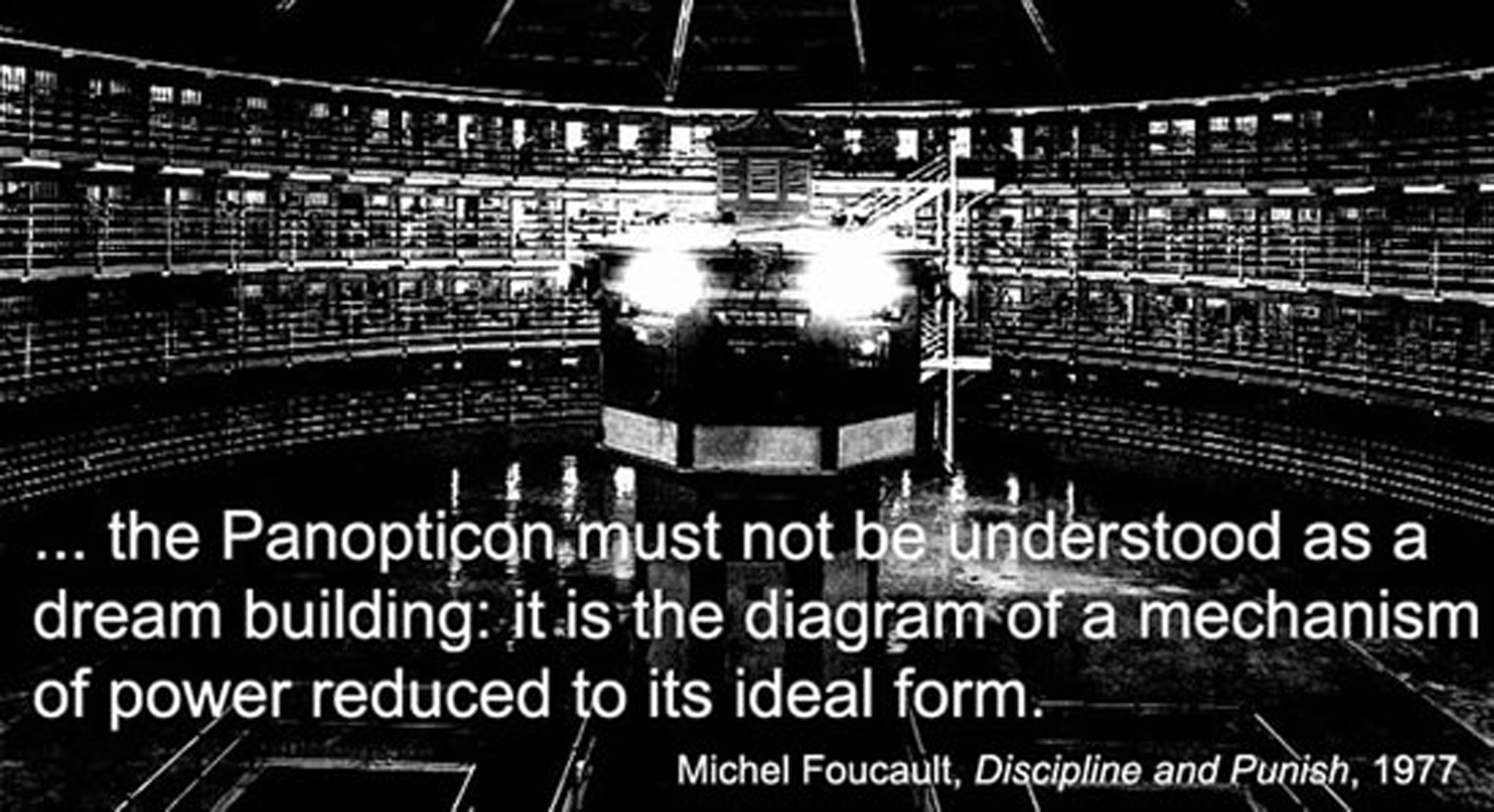
DATAcide: The Total Annihilation of Life as We Know It

panopticon-image

By Douglas Haddow

Source: Adbusters

“So tell me, why did you leave your last job?” he asks.

The first thing I remember about the internet was the noise. That screeching howl of static blips signifying that you were, at last, online. I first heard it in the summer of ’93. We were huddled around my friend’s brand new Macintosh, palms sweaty, one of us on lookout for his mom, the others transfixed as our Webcrawler search bore fruit. An image came chugging down, inch by inch. You could hear the modem wince as it loaded, and like a hammer banging out raw pixels from the darkness beyond the screen, a grainy, low-res jpeg came into view. It was a woman and a horse.

Since then, I’ve had a complicated relationship with the internet. We all have. The noise is gone now, and its reach has grown from a network of isolated weirdos into a silent and invisible membrane that connects everything we do and say.

“I needed a bigger challenge,” I say. This is a lie.

The brewpub we’re in has freshly painted white walls and a polished concrete floor, 20 ft ceilings and dangling lightbulbs. It could double as a minimalist porn set, or perhaps a rendition chamber. Concrete is easy to clean. The table we’re at is long and communal. Whenever someone’s smartphone vibrates we all feel it through the wood, and we’re feeling it every second minute — a look of misery slicing across my face when I realize it’s not mine.

“Tell me about your ideal process,” the guy sitting down the table from us says. My eyes strain sideways. He looks to be about thirty; we all do. Like a young Jeff Bezos, his skin is the color of fresh milk. He’s dressed like a Stasi agent trying to blend in at a disco. Textbook Zuckercore: a collared blue-green plaid shirt unbuttoned with a subdued grey-on-grey graphic tee, blue jeans and sneakers. Functional sneakers. Tech sneakers. This is a tech bar. Frequented by tech people who do tech things. The park down the street is now a tech park. That’s where the tech types gather to broadcast their whimsy and play inclusive non-sports like Quidditch, which, I’m told, is something actual people actually do. It’s a nerd paradise where the only problems that exist are the ones that you’re inspired to solve. And I want in on it, because I want to believe.

“I’m a big fan of social,” I blurt out as an aside. He replies with a calm and ministerial nod. Nobody says “social media” anymore, it’s just “social” now.

My atoms are sitting here drinking a beer, being interviewed for a position at a firm that specializes in online brand management systems. Which is a euphemism for a human centipede of marketers selling marketing to marketers for marketing. The firm is worth a billion dollars. You’ve never heard of it. It’s the type of place where they force you to play ping-pong if you come in looking depressed. Meet the new boss, same as the old boss, except this one is very concerned that you see him as a positive force in the universe.

I’m here, bringing the cold beer to my dry lips and bobbing my head in my best impersonation of someone who doesn’t feel ill when he hears the words “key metrics,” “familiarity,” “control groups” and “variant groups.” It’s the dawn of the new creative economy, and I can dig it. I’m here, but I’m also spread across the internet in a series of containers. I’m in Facebook, I’m in Instagram, I’m in Google, I’m in Twitter and a thousand other places I never knew existed. Depending how my body is disposed of, it will either become dirt or atmosphere. But the digital atoms will live forever, or at least until civilization is incinerated by whatever means we choose to off ourselves.

“What about this position interests you?” he asks.

When the TechCrunchers preach the gospel of disruption, it’s from an industrial perspective that sees life on Earth as a series of business models to be upended. Disrupt or die is the motto, but they never mention the disruptees — the travel agents, the cab drivers, the bellhops. The journalists. The meat in the box before the box is crushed by the anvil of innovation.

“People have ideas about things but it’s a bunch of things. Sign up flow for example, high level things, but sometimes I think — let’s table this for now and put together some idea maps. I feel so empowered because we’re aligned,” someone else says. I look around but can’t trace the source.

It’s hard to focus on his questions when all the conversations occurring parallel to ours combine in a cacophony of sameness, as if we’re all Tedtalking a mantra of ancient buzzwords: Engagement. Intuitive. Connection. User base. Revolutionary. It’s like coke talk gone sour, not words that are meant to say things, but stale semiotics that signify you belong. This is the the new language of business. This is where Wall Street goes to find itself.

“I traded in my suit for khakis and sunglasses,” one of them says. But he’s wearing neither. “That’s the best decision you’ve ever made bro,” his colleague replies.

These are the most boring people on the planet. And it’s their world now, we’re just supplying the data for it. The game is simple: dump venture capital into a concept, get the eyeballs, take the data and profit. But the implications of this crude scheme are profound. Beyond all the hype, something weird is happening.

I can’t eat without instagramming my food. I can’t shit without playing Candy Crush. I can’t even remember who half the people are on my Facebook feed, but I’ll still mindlessly scroll through their tedious status updates and wince at their tacky wedding photos. Out of these aimless swipes, clicks and likes, a new world is being born. A world where everything we do, no matter how inane, is tracked, recorded, sorted and analyzed. Yahoo CEO Marissa Mayer has said the whole process is “like watching the planet develop a nervous system.” And through this system, every human action has become a potential source of profit for our data lords, a signal for them to identify and exploit.

“We are about to enter a world that is half digital and half physical, and without properly noticing, we’ve become half bits and half atoms. These bits are now an integral part of our identity, and we don’t own them,” says Hannes Grassegger.

Grassegger is a German economics journalist who was raised in front of his mom’s Macintosh, and later, on a Commodore 64 he got for his sixth birthday. He recently wrote “Das Kapital bin ich” (I am Capital), a book that has been criticized by the European left for being too capitalist, and by the right for being the communist manifesto of the digital era. In it he tries to answer a deceptively simple question: if our data is the oil of the 21st century, then why aren’t we all sheikhs?

“We’ve all been sharing. But the smart ones have been collecting — and they’ve packed us into their clouds,” he says. “Privacy. Transparency. Surveillance. Security gap. I don’t want to hear about it. These are sloppy downplayings of a radical new condition: We don’t own ourselves any more. We are digital serfs.”

Like Grassegger, and like everybody else, I was lured into this radical new condition with the feel-good promises of connection, friendship and self-expression. Apps, sites and services that allowed us to share what we loved, and do what we wanted. For Grassegger, these platforms were merely fresh lots ready to be ploughed, and in turn they kept the harvest: our feelings, thoughts, experiences and emotions, encoded in letters and numbers. Now they’re putting it all to work, exploiting these assets with algorithms and sentiment analysis, and our virtual souls are toiling even while we sleep.

His solution to this dilemma is practical and pragmatic, siding with a lesser evil of establishing a personalized free data market, which would allow us to exploit our information before others do it for us, arguing that “We must carry into the new space those rights and freedoms we eked out in the physical world centuries ago. The ownership over ourselves and the freedom to employ this property for our own benefit. Only this will help us leave behind our self-imposed digital immaturity.”

“KRRAAAAASHH!”

A waitress lets a pint glass slip from her hand and shatter on the floor, but no one bothers to look over; they’re too engaged. Then I notice something eerie about the vibe in this place. There’s no sneering, no sarcasm, and no self-deprecation. Everyone is just sort of floating along in an earnest tranquility. As if each anecdote about “that cool loft I found on Airbnb” contained some deep spiritual significance beyond my grasp.

My interrogator goes for a piss and I load up Facebook in the interim, hoping to find a shard of inspiration in my feed that will provide a topical talking point. Instead I find a listicle. A curiosity gap headline. An ad. A solicitation. Another ad. Another listicle. Oh dear, someone has lost their phone. And finally, an ad in the form of a listicle. Or is it a listicle in the form of an ad?

We were told to surf the web, but in the end, the web serf’d us. Yet there’s a worse fate than digital serfdom, as Snowden’s ongoing NSA revelations suggest. This isn’t simply about the commodification of all human kinesis, it’s the psychological colonialism that makes the commodification possible.

The nature of this bad trip was hinted at in June when we learned that Facebook manipulated the emotional states of nearly 700,000 of its users. Half of those chosen for the study were fed positivity, the others, despair. “The results show emotional contagion,” the Facebook scientists told us, meaning that they had discovered that alternating between positive and negative stimulus does indeed affect our behaviour. Or perhaps rediscovered. There’s a precedent for this. We’ve been here before.

Burrhus Frederic Skinner, known simply as B.F. to his BFFs, is best known as the psychologist with the painfully large forehead who tried to convince the world that free will was an illusion. But he wasn’t always so dire. He was once a young man with hopes and dreams who wrote poems and sonnets and wanted to become a stream-of-consciousness novelist like his idol, Marcel Proust. He failed miserably and it led him to conclude that he wasn’t capable of writing anything of interest because he had nothing to say. Frustrated and bitter, he resolved that literature was irrelevant and it should be destroyed, and that psychology was the true art form of the 20th century. So he went to Harvard and developed the concept of operant conditioning by putting a rat in a cage and manipulating its behaviour by alternating positive and negative stimulus. Now we’re the rats in the cage, only we don’t know where the cage ends and where it begins.

“What’s your five year vision for social?” he asks.

There’s a right way and a wrong way to answer this question. The wrong way is to be critical and cast scepticism on the internet’s role in our lives. For instance, you could draw a parallel between Facebook’s probing of emotional contagion and the Pentagon’s ongoing research into how to quash dissent and manage social unrest. Or you could mention how the Internet of Things will inevitably consolidate corporate power over our personal liberty unless we implement strict regulations on what part of ourselves can and cannot be quantified. But if you did that, you’d upset the prevailing good vibes and come off like a sickly paranoiac in desperate need of some likes.

The right way is to turn off, buy in and cash out. Reinforce the grand narrative and talk about how social is going to bring people together, not just online, but in the real world. How it will augment our interactions and make us more open. How in five years you’ll be able to meet your true love through an algorithm that correlates your iTunes activity to your medical history and how that algorithm will be worth a billion fucking dollars. And it’s through that magical cloud of squandered human potential that Skinner emerges once again and starts poking his finger into your brain.

After establishing himself as a household name, Skinner was finally able to live out his dream of writing a novel. That novel was Walden Two, a story about a utopian commune where people live a creative and harmonious life in accordance to the principles of radical behaviourism. In contrast to 1984 and Brave New World, it was meant to be a positive portrayal of a technologically-enabled utopian ideal. In it he writes, “The majority of people don’t want to plan. They want to be free of the responsibility of planning. What they ask for is merely some assurance that they will be decently provided for. The rest is a day-to-day enjoyment of life.”

In the late 60s, Walden Two directly inspired a series of attempts to create real world versions of the fictional community it described. These were just a few of the thousands of communes that were being established across America at that time. Some thrived, but the majority fell apart within a couple short years. They failed for a number of reasons: latrines overflowed, the tofu supply ran out, the livestock starved to death and so forth. But what many of them had in common was a cascading systems failure of their foundational hypothesis — that social change could be achieved through self-transformation and the problems of power could be solved simply by ignoring them. There was always a Machiavellian in the transformational mist, though, and a refusal to acknowledge outright how power creates invisible structures that undermine the potential for cooperative action ultimately led to their implosion. It’s in this stale pub, with its complimentary WiFi and overpriced organic popcorn, that those invisible power structures continue to thrive.

“There has to be incentive. There has to be. You can’t force people to use it,” a woman in the corner mutters. She’s among a cluster of people who for some reason are all carrying the same cheap, ugly backpack. Her hand gestures become more aggressive as the conversation progresses and she looks to be caught in a moment midway between panic and ecstasy. Her expression would make the perfect emoji for the inertia of our time. It looks sort of like this: (&’Z)

“Our notions of digital utopianism are deeply rooted in a communal wing of American counter-culture from the 1960s. That group of people have had an enormous impact on how we do technology. Many of the leading figures in technology come from that wing, Steve Jobs would be one,” says Fred Turner, a communications professor at Stanford University who researches and writes about how counterculture and technology interact.

“Their ideas of what a person is and what a community should be has suffused our idealized understanding of what a virtual community can be and what a digital citizen should be. That group believed that what you had to do to save the world was to build communities of consciousness — places where you would step outside mainstream America and turn away from politics and democracy, turn away from the state, and turn instead to people like yourself and to sharing your feelings, your ideas and your information, as a way of making a new world.”

There’s a fault line that runs underneath the recycling bins of America’s abandoned hippy communes all the way to my cracked iPhone 5 screen. And if there is one man who epitomizes the breadth of this fault, it’s Stewart Brand.

In 1968, Brand published the Whole Earth Catalog, an internet before the internet that provided a directory of products for sustainable, alternative and creative lifestyles, and helped connect those who pursued them. When the Whole Earth Catalog went out of business in 1971, Brand threw a “demise party” wherein the audience got to choose who would receive the magazine’s remaining twenty grand. They chose to give it to Fred Moore, an activist moonlighting as a dishwasher, who would go on to found the Homebrew Computer Club — the birthplace of Apple and the PC. In the 80s Brand launched The Whole Earth ’Lectronic Link, one of the world’s first virtual communities. Following its success, he started the Global Business Network — a think tank to shape the future of the world. They’ve worked on “navigating social uncertainty” with corporations like Shell Oil & AT&T, among others. In 2000, GBN was bought by Monitor Group, a consultancy firm that made headlines in 2011 by earning millions of dollars from the Libyan Government to manage and enhance the global profile of Muammar Gaddafi.

Brand’s most enduring legacy will likely come from coining the phrase “information wants to be free,” which serves as the business model for the Actually Existing Internet and the Big Data dream.

Looking around the brewpub, listening to the chatter, and staring into the bright blue eyes of my would-be employer, you can almost hear the words of Google CEO Eric Schmidt echo against the minimalist decor: “We know where you are. We know where you’ve been. We can more or less guess what you’re thinking about.”

In San Francisco, my fellow disruptees have taken to the streets and kicked off a proper bricks & bottle backlash against this sort of dictator-grade hubris that has come to define the Internet of Kings. Crude graffiti reading “DIE TECHIE SCUM” is scrawled on the sidewalk next to Googlebus blockades. TECH = DEATH signs are held up at protests. Tires are slashed, windows are smashed and #techhatecrimes is a hashtag that is being passed around Silicon Valley without a hint of irony.

Just down the street from where I’m sitting, a more passive form of protest has manifested in the form of a new café that promises an escape from the incessant blips and bleeps of the internet and its accoutrements.The tables there are also long and communal, but they’re wrapped inside an aluminum metal mesh designed to interrupt and restrain wireless signals and WiFi.

We are not going to escape this crisis by putting ourselves in a cage. There is no opt-out anymore. You can draw the blinds, deadlock your door, smash your smartphone, and only carry cash, but you’ll still get caught up in their all-seeing algorithmic gaze. They’ve datafied your car, your city and even your snail mail. This is not a conspiracy, it’s the status quo, and we’ve been too busy displacing our anxiety into their tidy little containers to realize what’s going on.

“Do you have any questions for me?” he finally asks, abruptly. My beer is empty, I’m thirsty for another, and the interview hasn’t gone well. I’ve failed to put on a brave face and the only questions that I have concern how much money I’m going to make. Will it be enough to pay for my escalating rent now that the datarazzi have moved into the neighborhood? Or will I have to drive an Über in my spare time to make ends meet?

The internet is a failed utopia. And we’re all trapped inside of it. But I’m not willing to give up on it yet. It’s where I first discovered punk rock and anarchism. Where I learned about the I Ching and Albert Camus while downloading “Holiday in Cambodia” at 15kbps. It’s where I first perved out on the photos of a girl I would eventually fall in love with. It’s home to me, you and everybody we know.

No, the appropriate question to ask is: “What is the purpose of my life?”

I’ve seen the best minds of my generation sucked dry by the economics of the infinite scroll. Amidst the innovation fatigue inherent to a world with more phones than people, we’ve experienced a spectacular failure of the imagination and turned the internet, likely the only thing between us and a very dark future, into little more than a glorified counting machine.

Am I data, or am I human? The truth is somewhere in between. Next time you click I AGREE on some purposefully confusing terms and conditions form, pause for a moment to interrogate the power that lies behind the code. The dream of the internet may have proven difficult to maintain, but the solution is not to dream less, but to dream harder.