Saturday Matinee: All Light, Everywhere

Film Review: “All Light, Everywhere” — Darkness Visible

By Neil Giordano

Source: Arts Fuse

Do you trust what you see? How can you? Our eyes are no longer the primary way that we see; they have been swapped out for the filters of screens and technology. The suspicious mediation between cameras and our perception of ‘reality” has never been more ubiquitous — or more insidious. Perhaps what we don’t see, however, is at least as important as what we do see. But how can we become aware of what we don’t see?

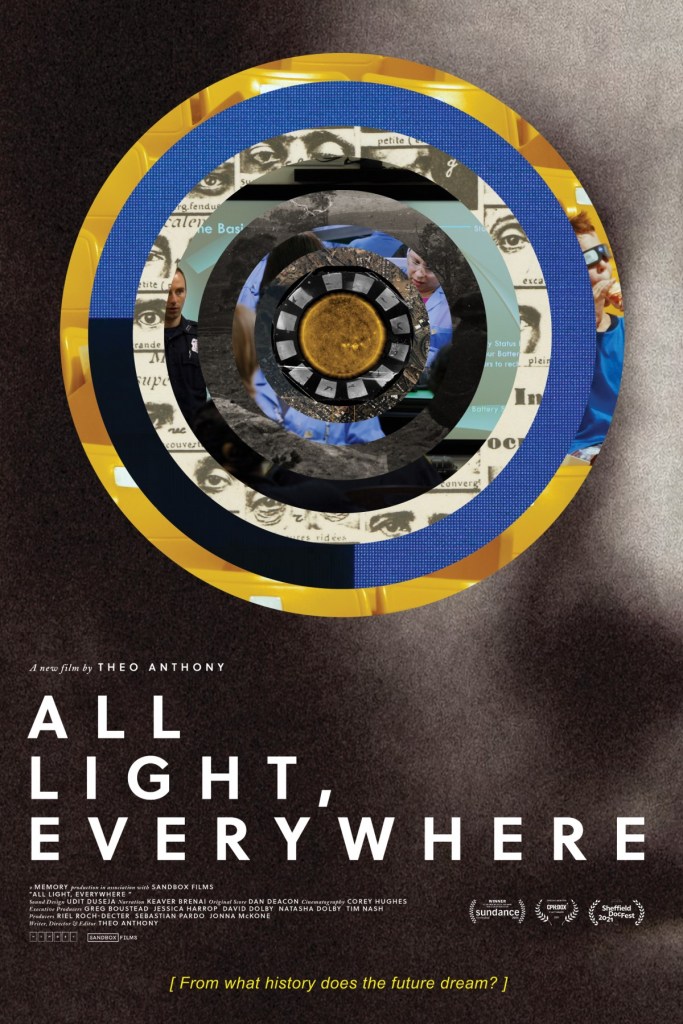
These questions lie at the heart of the fascinating new documentary All Light, Everywhere, an entrancing blend of neuroscience, metaphysics, and technological history that has the smarts to apply some sly, subtle social commentary to its elusive subjects.

At first, the film seems to flitter among semi-connected topics: A marketing campaign that is testing its volunteers’ reactions to visual images; a tour of Axon Industries, the #1 maker of police body cameras, with its corporate spin doctor as our guide; an aerial composite-imaging system that was used secretly by Baltimore police to surveil the city. Interspersed into these “storylines” are narrated forays into the history of early photography along with B-roll of ordinary people preparing to view the 2017 solar eclipse with their own cameras (and eyes). This unrelenting focus on the production and consumption of visual imagery transforms the film into an almost fractal experience. It becomes a bit too much: the sheer ubiquity of people looking, eyes looking, images to be seen and consumed and interpreted, examinations of the various technologies serving up new pictures to be mediated. The unsettling point of this unconventional documentary seems to be to distort rather than clarify the subject at hand — and that may be just what director Theo Anthony wants.

The underlying political relevance of the film is transparent. We live in a surveillance society, consenting (though not always consciously) to being filmed, watched, and recorded by corporations hoping to sell us products based on the data they gather. The government snoops in the name of crime prevention and law enforcement. The value of the latter has been hotly debated in the last few years: George Floyd’s murder being a prime example. Here the police body cameras showed us what we believe to be an “objective” record of events, footage of police brutality and murder. But body camera images have been weaponized by both sides, each seeking to prove something that will help their case. What Axon Industries sells to police forces (and to the general public) is that they are confident their cameras will tell the “truth” about any police action. Accountability is promoted as their product’s best feature. But it is more than that — “behavior will change ” because of the presence of cameras, that they will inhibit bad behavior.

But what do body cameras actually show us? Are these videos an authentic record of reality? The documentary examines, abstractly at first and then far more concretely, how there is always bias. Where is the camera located on the body? Does its wide-angle lens distort our understanding of action? How is this data interpreted and by whom? There are so many levels of interpretation that “objectivity” has turned into a myth.

The film’s looks back into the past are also illuminating, unsettling illustrations of how camera technology has almost always been co-opted for violent and authoritarian uses, whether it be the American military tracking the enemy on the battlefield or in the early experiments in composite imaging used by police to profile criminals. The latter presages the now rampant use of facial recognition technology, its marketed value undercut by its practical limitations as well as ethical muddiness.

The irony is not lost that what we’re looking at is itself a film, another visual entity that requires us to watch and to mediate. The film’s meta-commentary confesses that its stochastic manipulation is by design. Highly kinetic editing leads our brains to make connections in ways that excited Eisenstein at the dawn of film a century ago: the whole is greater than the sum of the parts. The mind demands order, so the juxtaposition and collision of images generates meanings that did not exist in individual images.

Anthony draws on history to help us make sense of a visual world that is increasingly fleeting and fragmented. The film is reminiscent, in style and subject matter, of the works of Errol Morris. This goes for its sometimes desultory exposition, as well as its approach to epistemology. (Morris explores these issues in all of his films, as well as in his essays in his books Believing Is Seeing and The Ashtray.) In the third act of All Light, Everywhere, a well-placed quotation from Frederick Douglass summaries the central issue: “We all feel that there is something more. That the curtain has not yet been lifted. There is a prophet with us forever whispering that behind the seen lies the immeasurable unseen.” The “immeasurable unseen” may not be possible to capture on cameras, no matter how many we use or how hard we strive for an elusive objectivity. Perhaps it is more important for us to understand that urge for “something more” should lead to examining how, why, and for whom the image was made.

Watch All Light, Everywhere at Kanopy here: https://www.kanopy.com/en/product/12333392

Saturday Matinee: Gloria’s Call

Source: GloriasCall.com

From the cafés of Paris to the mountaintops of Samiland, a scholar’s life is foreverchanged through her friendships with the women artists of Surrealism.

In 1971, graduate student Gloria Orenstein received a call from Surrealist artist Leonora Carrington that sparked a lifelong journey into art, ecofeminism and shamanism. The short film, Gloria’s Call, uses art, animation and storytelling to celebrate this wild adventure from the cafes of Paris to the mountaintops of Samiland. The film is produced by artists Cheri Gaulke (director), Cheryl BookoutAnne GauldinSue Maberry and Christine Papalexis .

Gloria’s Call was born in October of 2016 during a presentation by renowned scholar Dr. Gloria Feman Orenstein at the Southern California Women’s Caucus for Art (SCWCA) Surrealist Tea in celebration of their 40th Anniversary.

ABOUT GLORIA

While my life has had its challenging moments and I have traversed many a dark woods in my quest for knowledge, I am fulfilled by the wondrous journeys I have made to the realms of the Marvelous, the Magical, the Great Goddess and the Shamanic Mysteries, and I will be forever grateful to the teachers who inspired me and to the feminist activists on whose strong shoulders we now stand as we welcome new generations of visionaries expanding our feminist legacy into the new millennium.   -Gloria Feman Orenstein

Gloria F. Orenstein is Professor Emerita in Comparative Literature and Gender Studies from the University of Southern California. Her areas of research have ranged from Surrealism, contemporary feminist literature and the arts to Ecofeminism and Shamanism.

Her first book The Theater Of The Marvelous: Surrealism And The Contemporary Stage paved the way for her pioneering work on The Women of Surrealism. Leonora Carrington had been a friend and remained a major source of her inspiration in research and scholarship since 1971. Her book The Reflowering Of The Goddess offers a feminist analysis of the movement in the contemporary arts that reclaimed the Goddess as the symbol of a paradigm shift toward a more gynocentric mythos and ethos as women artists forged a link to the pre-patriarchal civilization of the ancient Goddess cultures, referencing them as their source of spiritual inspiration.

Orenstein is also co-editor of Reweaving The World: The Emergence Of Ecofeminism, a collection of essays that grew out of the conference she created at USC in 1987, Ecofeminist Perspectives: Culture, Nature, Theory. During the 80s she was invited by the Shaman of Samiland (Lapland, N. Norway) to be a student with her in Alta, Norway, an experience that continued intermittently for almost five years. She also created The Woman’s Salon in NYC that lasted for ten years beginning in 1975. More recently, her work in Surrealism, in particular, led to her inclusion of an essay in the book In Wonderland that accompanied the important exhibition of the same name that focused on the Women artists of Surrealism in the Americas, both those who were native to the Americas and those who migrated there during or after WWII. Orenstein was a pioneer in introducing the art of Frida Kahlo to North American feminists early in the 70s. Today, she continues her journey investigating the visionary worlds of revelation and the Marvelous, and will continue this pursuit in her research well into the future.

Saturday Matinee: Z Channel: A Magnificent Obsession

By JPRoscoe

Source: Basement Rejects

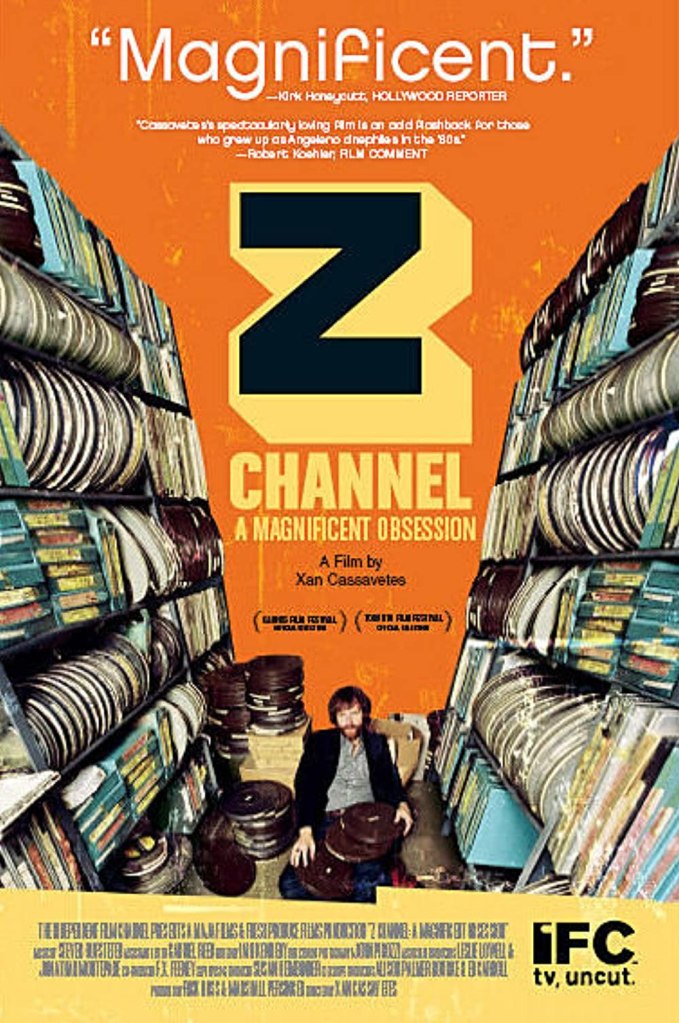
Launching in 1974, the Z Channel became one of the first pay cable channels.  The channel eventually morphed into a movie channel highlighting directors, art films, and championing original visions portrayed on the screen.  One of the people behind this transformation and the decisions made on the channel was the program director Jerry Harvey.  Harvey (with his team) brought many films to the Z Channel that were never seen anywhere in America and created a world for film lovers…but Harvey had his own demons.

Directed by Xan Cassavetes, Z Channel:  A Magnificent Obsession is a documentary about the rise and fall of the California based Z Channel which broadcast from 1974 to 1989.  The documentary premiered at Cannes in 2004 and was released to positive reviews.

I grew up without cable so dreams of HBO were just dreams.  At the time, I wouldn’t have appreciated Z Channel and would have much rather stayed with something like HBO or Cinemax.  Watching the Z Channel:  A Magnificent Obsession, I dream about the Z Channel still being around.

There are a lot of viewing options now.  The difference between something like FilmStruck and the Z Channel is that idea of chance.  You don’t know what you are going to get and you don’t know when you’ll get to see it again.  That is something that current TV watchers (or streamers) forget…you had to wait to see the movies you wanted and a video store might not have them.  The idea of someone so diligently trying to seek out and collect these films for viewers is admirable.

The documentary of course takes a dark turn in that Jerry Harvey really was someone who seemed lost.  The documentary does struggle with the ideas of its three themes at points in trying to decide if it is about Z Channel, Jerry Harvey, or the films…and it is understandable because it is hard to separate the three because they were so bound together.  Like a lot of documentaries, I wish there was a better way to establish more of a timeline of events through the course of the movie.

The documentary features a lot of great performers and great film clips.  Robert Altman, Quentin Tarantino, Jim Jarmusch, James Wood, and Jacqueline Bisset are among some of the people interviewed, but it is the immense outpouring of these people for what Z Channel did for them that shows its importance on modern film.  Harvey’s personal acquaintances provide the most insight to him and what was going on at Z Channel and really help round out the documentary…plus, it becomes a film watcher’s guide for movies that should be sought out.

Z Channel:  A Magnificent Obsession is an interesting documentary, but it also is a documentary that feels like it needed a little tweaking to become a great documentary.  It is a film for film lovers and a specific kind of film lover.  The movies highlighted appeal to a certain viewer and the true crime aspect of the story probably isn’t intense enough for people interested in the true crime genre.  Still, Z Channel:  A Magnificent Obsession is a worthy documentary that should be sought out.

Watch Z Channel: A Magnificent Obsession on Hoopla here: https://www.hoopladigital.com/title/14980839

Saturday Matinee: From JFK To 911 Everything Is A Rich Man’s Trick

Source: Top Documentary Films

The assassination of President John F. Kennedy lingers as one of the most traumatic events of the twentieth century. The open and shut nature of the investigation which ensued left many global citizens unsettled and dissatisfied, and nagging questions concerning the truth behind the events of that fateful day remain to this day. Evidence of this can be found in the endless volumes of conspiracy-based materials which have attempted to unravel and capitalize on the greatest murder mystery in American history.

Now, a hugely ambitious documentary titled Everything is a Rich Man’s Trick adds fuel to those embers of uncertainty, and points to many potential culprits whose possible involvement in the assassination has long been obscured by official historical record.

Authoritatively written and narrated by Francis Richard Conolly, the film begins its labyrinthine tale during the era of World War I, when the wealthiest and most powerful figures of industry discovered the immense profits to be had from a landscape of ongoing military conflict. The film presents a persuasive and exhaustively researched argument that these towering figures formed a secret society by which they could orchestrate or manipulate war-mongering policies to their advantage on a global scale, and maintain complete anonymity in their actions from an unsuspecting public. Conolly contends that these sinister puppet masters have functioned and thrived throughout history – from the formation of Nazism to the build-up and aftermath of September 11.

The election of President Kennedy in 1960 represented a formidable threat to these shadowy structures of power, including high-profile figures within the Mafia, crooked politicians, and the world’s most influential and notorious war profiteers. Thus, a plot was hatched which would end Kennedy’s reign prior to any chance of re-election, thereby restoring the order and freedoms of these secret societies.

At nearly three and a half hours, Everything is a Rich Man’s Trick examines a defining event of our times from a perspective not often explored. While it may or may not win over viewers who remain skeptical of mass-scale conspiracy, it presents its findings in a measured and meticulous manner which demands attention and consideration.

Saturday Matinee: Punk: Attitude

“Punk: Attitude” (2005) is a documentary tracing the roots, meaning and enduring influence of the punk movement of the late 70s and early 80s. Directed by Don Letts, the film offers an insider’s perspective because Letts was a catalyzing agent for the developing London punk scene, having run a clothing store called Acme Attractions and hosted parties as a reggae DJ, both often frequented by band members of groups such as The Sex Pistols, The Clash and The Pretenders. Letts later managed The Slits and began his film career as a director of Clash music videos.

Punk: Attitude also features interviews with artists directly and indirectly involved with the early punk scene including Wayne Kramer (The MC5), Mick Jones (The Clash), Jello Biafra (The Dead Kennedys), Chrissie Hynde (The Pretenders), and David Johansen (The New York Dolls) among many others. Though some punk fans may dispute the relevance of certain featured musicians or feel others were overlooked, the film provide a candid, fairly comprehensive and at times contradictory overview of punk rock as iconoclastic, raw and diverse as the music itself.

Saturday Matinee: Cold Case Hammarskjöld

Review: COLD CASE HAMMARSKJÖLD, Pretzels of Truth and Performance Art

By Kurt Halfyard

Source: Film Anarchy

“This could either be the world’s biggest murder mystery, or the world’s most idiotic conspiracy theory.”

Two years before the JFK assassination, on the 18th of September 1961, the world was shocked by the suspicious death of the second serving Secretary-General of the United Nations. In a plane crash in Ndola, Rhodesia, Dag Hammarskjöld was the only person on board not horribly scorched in the ‘accident.’ Instead he was bloodied, and a playing card was tucked in his shirt collar.

Nearly six decades later, the UN is still (nominally) investigating the details of what was thought first thought to be an accident, then a targeted assassination, of a man who had designs on the political and financial independence of the African continent. In fact, U.S. President John F.  Kennedy himself described the Secretary General as “the greatest statesman of our century.” The assassination theory holds several motive possibilities – various industrial interests active in the region (both then and now) or various clandestine military or mercenary operations taking orders from the US, the UK and Europe who had designs at odd with the ‘activist’ Secretary General.

There are crimes, and then there are crimes. Outside of the small circles of Denmark Television or offbeat cinephiliia, Mads Brügger is criminally unknown. The journalist, comedian, satirist, filmmaker, but above all, provocateur, has been twisting the documentary form into pretzels of truth and performance art for more than a decade.

In 2006, he toured an autistic theatre troupe though North Korea, cascading through a collection of political handlers and bureaucrats, to make a point about propaganda and totalitarian fear imposed on the so-called Democratic Peoples Republic of Korea. As if that stunt, The Red Chapel, was not fraught with enough risk, he then purchased illegal diplomatic credentials from the Central African Republic (CAR) to set up his own personal blood diamond operation (under the front of a match factory whose product would be manufactured by the local Pygmy population). By the time The Ambassador wowed Sundance attendees (and yours truly) in 2011, several of the ‘characters’ in the film, political figures in the CAR, had disappeared or been killed.

The Danish filmmaker takes large risks, some might say indefensible ones. Along with his countryman Lars Von Trier (whose outfit Zentropa produced The Ambassador), Brügger keeps plenty of his own skin in the game of his cinematic endeavours — for the sake of your education, and entertainment. He is a hell of a talented filmmaker.

With Cold Case Hammarskjöld, things go the full Errol Morris (WormwoodA Wilderness of Error) investigation route. With the help of Göran Björkdahl, a Swedish activist/investigator who is in possession of the only part of Hammarskjöld’s plane that was not buried under the soil of the Ndola airport, Brügger uses every trick in the documentary playbook: re-creations, animations, historical footage, official and redacted document scavenging, and a lot of interviews with people who where sidelined, ignored, or simply unknown at the time.

Above all, Brügger recreates, in glossy cinematic terms, himself making the documentary itself. Form as function, as with any good conspiracy theory, things start to fold back on themselves in increasingly avant garde ways.  

But there is purpose in this narrative trickery. By filming himself, twice, it offers Brügger the storyteller the opportunity to rope a Zodiac-level ‘filing cabinet ‘of names, facts, dates, and political organizations, together into a ‘lean in’ yarn of far reaching proportions. Two hundred old Secret Marine Societies, megalomaniac villains dressed in white, biological guerrilla warfare, the fallout of Apartheid, World War II fighter aces, assassins leaving Playing Cards in their victims’ collar, and of course, the fate of both a continent, and a fledgling World Government Body are all tethered together.

To say that the film’s 128 minutes is dense, is an understatement. Via this experimental technique (which of course the filmmaker acknowledges, in somewhat of a mea culpa, at one point) along with some pretty detailed, rational, detective work, makes the whole thing as seductive and addicting as Serial or The Staircase.

At one point, Michael Moore-style, Brügger and Björkdahl arm themselves with a high powered metal detectors, shovels, and a cigar (in the off chance they are successful), and go scouring the back-fields of the Ndola airport looking for the 50+ year old burial site of the plane. The authorities arrive. They are polite, but firm, regarding this activity. You are simply not welcome to do this kind of digging.

Cold Case Hammarskjöld has caused a stir in ‘papers of record’ such as The New York Times and The Guardian, reacting to the film compelling presentation and investigation of SAIMR, the South African Institute for Maritime Research, and its quack doctor, Lord Nelson cosplaying Commodore, Keith Maxwell, the “man in white”, who is said here of not only co-ordinating the murder of Dag Hammarskjöld, but also weaponizing AIDS virus for genocidal purposes, and ostensibly participating in bad amateur theatre.

The former may have been at the behest of the CIA and MI6, the latter was on his own personal time. Maxwell was a surreal combination of L. Ron Hubbard, and Colonel Kurtz, and Brügger condemns, mythologizes, exposes, at several points even mimics, him in the way only larger than life cinema can.

If there is a signature image across several of the films of Mads Brügger, it is that of an impeccably dressed man, wildly out of place, sitting on a skinny boat drifting on the current of a wide, and fast moving body of water. Here it is Göran Björkdahl, no closer to the truth of the matter, but still floating on the river of possibilites. We have learned things, both true and untrue, along the way.

Cold Case Hammarskjöld is the most engaging (and entertaining) documentary of the year.

Watch Cold Case Hammarskjöld on Kanopy here: https://www.kanopy.com/product/cold-case-hammarskjold

Saturday Matinee: J.R. “Bob” Dobbs and the Church of the SubGenius

Review By Steve Davis

Source: The Austin Chronicle

You couldn’t escape his ubiquitous mug back when Austin was truly weird. It appeared on bumper stickers, bulletin boards, telephone poles, streetlights, bathroom walls, and more: A perfectly coiffed and lantern-jawed 1950s dad, his perfectly straight teeth clenching a pipe in an ear-to-ear grin worthy of Ward Cleaver. Although his face archetypically evoked white, middle-class, heterosexual Christian conformity, J.R. ‘Bob’ Dobbs (note the mandatory quotation marks) served as the symbol of something completely different from post-war homogeneity. He was the appointed figurehead of the Church of the SubGenius, a somewhat wacky “religious” (more quotation marks, but subjectively imposed) organization formed to counter the “conspiracy of normalcy” pervading American society. Initially hatched in the playfully demented minds of two Dallas-area merry pranksters, Reverend Ivan Stang and Dr. Philo Drummond (née Douglass St. Clair Smith and Steve Wilcox, respectively), in the late Seventies, the Church was intended as a dogmatic antidote to a re-emergent mediocrity, embracing an aesthetic in confluence with evolving new wave sensibilities and tropes in music, film, and pop culture. It was an in-joke with a half-serious punchline.

The image christened ‘Bob’ first appeared in a 1979 DIY pamphlet that asked readers questions like “Are You Abnormal?” and announced “The World Ends Tomorrow AND YOU MAY DIE!” before soliciting a dollar subscription fee for this new fringe theology masquerading as performance art and satire. (Or was it performance art and satire masquerading as fringe theology?) Afterwards, non-conformists everywhere (including the band Devo, magician Penn Jillette, film director Alex Cox, and actor Paul “Pee-wee Herman” Reubens) began to jump on board and the Church ended up becoming, inexplicably or not, a phenomenon of sorts, making the indefatigable ‘Bob’ the first piece of clip art to lead a world-wide congregation.

The deftly executed documentary J.R. ‘Bob’ Dobbs and the Church of the Subgenius demonstrates great affection for Bob and his acolytes, many of whom enthusiastically relate the Church’s mythology, history and doctrine here with a nostalgic sentimentality usually reserved for reckless-youth silliness. (Full disclosure: the film was executive produced by Chronicle co-founder Louis Black.) Their monikers set the tone – Reverend Susie the Floosie, Nurses Vicki and Kelly, Papa Joe Mama, Dr. Howland Owll, and Reverend Dr. Onan Canobite, among others. Special mention must go to a delighted Arch Doctor Saint Margaret, the late and sorely missed Margaret Moser, Austin Chronicle music columnist and legendary Texas Blonde. These eager talking heads – including the aforementioned Messrs. Stang and Drummond—discuss the early anarchic gatherings of the SubGenius faithful at so-called “devivals”, attempt to explain the undefinable zen of “Slack” that all church members strive for, recount Bob’s infamous assassination onstage at San Francisco’s Victoria Theatre (catlike, he has many lives), and recall the prophecy of the Rupture, when (7 a.m., July 5, 1998, to be exact) Church members would rise up against the norms who’ve robbed them of Slack and ascend to pleasure saucers piloted by alien sex goddesses. (Like most patriarchal sects, the Church skewed towards a boy’s club mentality.) It all sounds fantastic. And it is, in every meaning of the word.

Director Boone and her crew make good use of those interviews, as well as grainy film footage and subliminal imagery, to document the story of Bob and his Church, which still thrive albeit to a much lesser degree, despite challenges that include competition from the internet, cult-related tragedies like the Columbine massacre, and some negative press (deserved and undeserved) over the years. While some question whether there’s any room left for relatively benign organizations like the Church of SubGenius in this hardcore conspiracy-driven world, the documentary ends with the hope there will always be a place for nonthreatening weirdos to worship. To those naysayers who disagree, I quote from the Scripture of Bob: “Fuck ’em if they can’t take a joke.”

Watch J.R. “Bob” Dobbs and the Church of the SubGenius on Kanopy here: https://www.kanopy.com/product/jr-bob-dobbs-and-church-subgenius

Saturday Matinee: M.C. Escher: Journey to Infinity

By Matt Zoller Seitz

Source: RogerEbert.com

Documentaries about visual artists tend to be so boringly conceived—talk about the life, show a picture, talk about the life, show another picture—that you may not realize what you’ve been missing until you see one as excellent as “M.C. Escher: Journey to Infinity.” 

Written and directed by Robin Lutz, this is a rare feature that takes the trouble not just to understand its subject and communicate his significance, but find ways to show us, visually, how his style evolved, and the principles behind that evolution. 

The tale begins with the standard-issue “This is a movie about a great artist, here are a few summary details abut his life and art,” with some landscape and architecture shots and images of Escher’s work. Then it becomes increasingly daring and fanciful, yet always remaining in service to the M.C. Escher, the Dutch draftsman and printmaker whose art became internationally famous during the post-World War II era. 

Escher was a rare artist who managed to combine his influences into something genuinely new. His work is a geometric/mathematical surrealist vision of the objectively perceivable world, but also a subjective interior, evoking ancient Arabic-North African graphics; the Salvador Dali-Pablo Picasso-Georges Braque anti-realist sensibilities of the ’20s and ’30s, and computer models that would not become popular until decades after Escher’s own experiments. 

Lutz and his collaborators, including a team of graphic designers and animators, make Escher’s art come to life in surprising and amusing ways, from having one of his trademark salamanders appear in an otherwise “realistic” frame and travel across increasingly “unreal” panoramas until we’re in an Escher print, to re-imagining intricately patterned Escher artworks so that we seem to glide along them, or into them/through them. This happens slowly enough so that we can appreciate how deftly the artist translated negative space into positive space, in ways that made the distinction seem arbitrary: for instance, the black spaces between joined silhouettes of lizards or amphibians might become black birds with white spaces between them, then go back again. Or people and animals might move along one stretch of diagonal stairs and jump to another, seeming to go upside down or sideways, in defiance of gravity, emphasizing the brain-teasing techniques Escher perfected.

Lutz and his team have found a cinematic analogy for the movement of the eye over static pictorial art reproduced in a book or hanging on a museum wall. The movie is especially good at evoking that “wow” moment when you realize that a thing you were looking at has turned into another thing. It’s explaining the magic trick without ruining the magic, a magic trick of a different sort. 

This approach is so dazzling that one wishes the filmmakers had pushed it a bit further, deploying it even more often, or in more and subtler variations—perhaps figuring out a way to have the film itself flip back on itself structurally at key points, or end precisely where it started, so that the project itself seemed to have no beginning or end. (There’s a hint of this, but not much more.)

Musician Graham Nash, a devotee of Escher who contacted him late in his life, says Escher dismissed the idea that he was an artist. Throughout the movie, we hear Escher align himself with scientists and mathematicians, often trashing his own skills as a representational draftsman and speaking of his heroes and colleagues with awe. 

This isn’t to say that Escher was down on himself at all times, or that that he entirely rejected the notion he was making art. Escher’s letters, performed in voice-over by actor Stephen Fry, make it clear that he challenged himself to improve his abilities and expand his vision and grew irritable when stuck in a groove. And yet there was always a sense—particularly once Escher hit his forties and realized he was indeed a global phenomenon—that a “real” artist wouldn’t be as entertaining. This is the world’s misconception, not Escher’s, but it’s still a shame that he let himself feel diminished by it. There’s power and profundity in Escher’s art, yet the puzzle-box aspect is what pulls you into it. 

The movie makes a case that we should talk about Escher the way we talk about one of his inspirations, Johann Sebastian Bach, who like Escher was clever as well as substantive. Escher earned the comparison. Why do we resist it? Perhaps there’s still something in us, even this late into human development, that worries that if you’re having fun, it can’t be art. Escher struggled with that misconception, too, right up to the end.  

Watch M.C. Escher: Journey to Infinity on Kanopy here: https://www.kanopy.com/product/mc-escher-journey-infinity