Saturday Matinee: Cold Case Hammarskjöld

Review: COLD CASE HAMMARSKJÖLD, Pretzels of Truth and Performance Art

By Kurt Halfyard

Source: Film Anarchy

“This could either be the world’s biggest murder mystery, or the world’s most idiotic conspiracy theory.”

Two years before the JFK assassination, on the 18th of September 1961, the world was shocked by the suspicious death of the second serving Secretary-General of the United Nations. In a plane crash in Ndola, Rhodesia, Dag Hammarskjöld was the only person on board not horribly scorched in the ‘accident.’ Instead he was bloodied, and a playing card was tucked in his shirt collar.

Nearly six decades later, the UN is still (nominally) investigating the details of what was thought first thought to be an accident, then a targeted assassination, of a man who had designs on the political and financial independence of the African continent. In fact, U.S. President John F.  Kennedy himself described the Secretary General as “the greatest statesman of our century.” The assassination theory holds several motive possibilities – various industrial interests active in the region (both then and now) or various clandestine military or mercenary operations taking orders from the US, the UK and Europe who had designs at odd with the ‘activist’ Secretary General.

There are crimes, and then there are crimes. Outside of the small circles of Denmark Television or offbeat cinephiliia, Mads Brügger is criminally unknown. The journalist, comedian, satirist, filmmaker, but above all, provocateur, has been twisting the documentary form into pretzels of truth and performance art for more than a decade.

In 2006, he toured an autistic theatre troupe though North Korea, cascading through a collection of political handlers and bureaucrats, to make a point about propaganda and totalitarian fear imposed on the so-called Democratic Peoples Republic of Korea. As if that stunt, The Red Chapel, was not fraught with enough risk, he then purchased illegal diplomatic credentials from the Central African Republic (CAR) to set up his own personal blood diamond operation (under the front of a match factory whose product would be manufactured by the local Pygmy population). By the time The Ambassador wowed Sundance attendees (and yours truly) in 2011, several of the ‘characters’ in the film, political figures in the CAR, had disappeared or been killed.

The Danish filmmaker takes large risks, some might say indefensible ones. Along with his countryman Lars Von Trier (whose outfit Zentropa produced The Ambassador), Brügger keeps plenty of his own skin in the game of his cinematic endeavours — for the sake of your education, and entertainment. He is a hell of a talented filmmaker.

With Cold Case Hammarskjöld, things go the full Errol Morris (WormwoodA Wilderness of Error) investigation route. With the help of Göran Björkdahl, a Swedish activist/investigator who is in possession of the only part of Hammarskjöld’s plane that was not buried under the soil of the Ndola airport, Brügger uses every trick in the documentary playbook: re-creations, animations, historical footage, official and redacted document scavenging, and a lot of interviews with people who where sidelined, ignored, or simply unknown at the time.

Above all, Brügger recreates, in glossy cinematic terms, himself making the documentary itself. Form as function, as with any good conspiracy theory, things start to fold back on themselves in increasingly avant garde ways.  

But there is purpose in this narrative trickery. By filming himself, twice, it offers Brügger the storyteller the opportunity to rope a Zodiac-level ‘filing cabinet ‘of names, facts, dates, and political organizations, together into a ‘lean in’ yarn of far reaching proportions. Two hundred old Secret Marine Societies, megalomaniac villains dressed in white, biological guerrilla warfare, the fallout of Apartheid, World War II fighter aces, assassins leaving Playing Cards in their victims’ collar, and of course, the fate of both a continent, and a fledgling World Government Body are all tethered together.

To say that the film’s 128 minutes is dense, is an understatement. Via this experimental technique (which of course the filmmaker acknowledges, in somewhat of a mea culpa, at one point) along with some pretty detailed, rational, detective work, makes the whole thing as seductive and addicting as Serial or The Staircase.

At one point, Michael Moore-style, Brügger and Björkdahl arm themselves with a high powered metal detectors, shovels, and a cigar (in the off chance they are successful), and go scouring the back-fields of the Ndola airport looking for the 50+ year old burial site of the plane. The authorities arrive. They are polite, but firm, regarding this activity. You are simply not welcome to do this kind of digging.

Cold Case Hammarskjöld has caused a stir in ‘papers of record’ such as The New York Times and The Guardian, reacting to the film compelling presentation and investigation of SAIMR, the South African Institute for Maritime Research, and its quack doctor, Lord Nelson cosplaying Commodore, Keith Maxwell, the “man in white”, who is said here of not only co-ordinating the murder of Dag Hammarskjöld, but also weaponizing AIDS virus for genocidal purposes, and ostensibly participating in bad amateur theatre.

The former may have been at the behest of the CIA and MI6, the latter was on his own personal time. Maxwell was a surreal combination of L. Ron Hubbard, and Colonel Kurtz, and Brügger condemns, mythologizes, exposes, at several points even mimics, him in the way only larger than life cinema can.

If there is a signature image across several of the films of Mads Brügger, it is that of an impeccably dressed man, wildly out of place, sitting on a skinny boat drifting on the current of a wide, and fast moving body of water. Here it is Göran Björkdahl, no closer to the truth of the matter, but still floating on the river of possibilites. We have learned things, both true and untrue, along the way.

Cold Case Hammarskjöld is the most engaging (and entertaining) documentary of the year.

Watch Cold Case Hammarskjöld on Kanopy here: https://www.kanopy.com/product/cold-case-hammarskjold

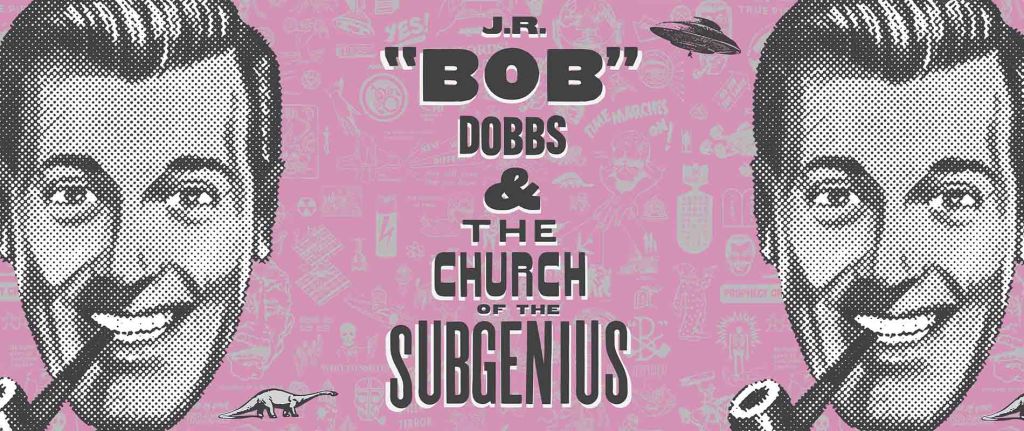
Saturday Matinee: J.R. “Bob” Dobbs and the Church of the SubGenius

Review By Steve Davis

Source: The Austin Chronicle

You couldn’t escape his ubiquitous mug back when Austin was truly weird. It appeared on bumper stickers, bulletin boards, telephone poles, streetlights, bathroom walls, and more: A perfectly coiffed and lantern-jawed 1950s dad, his perfectly straight teeth clenching a pipe in an ear-to-ear grin worthy of Ward Cleaver. Although his face archetypically evoked white, middle-class, heterosexual Christian conformity, J.R. ‘Bob’ Dobbs (note the mandatory quotation marks) served as the symbol of something completely different from post-war homogeneity. He was the appointed figurehead of the Church of the SubGenius, a somewhat wacky “religious” (more quotation marks, but subjectively imposed) organization formed to counter the “conspiracy of normalcy” pervading American society. Initially hatched in the playfully demented minds of two Dallas-area merry pranksters, Reverend Ivan Stang and Dr. Philo Drummond (née Douglass St. Clair Smith and Steve Wilcox, respectively), in the late Seventies, the Church was intended as a dogmatic antidote to a re-emergent mediocrity, embracing an aesthetic in confluence with evolving new wave sensibilities and tropes in music, film, and pop culture. It was an in-joke with a half-serious punchline.

The image christened ‘Bob’ first appeared in a 1979 DIY pamphlet that asked readers questions like “Are You Abnormal?” and announced “The World Ends Tomorrow AND YOU MAY DIE!” before soliciting a dollar subscription fee for this new fringe theology masquerading as performance art and satire. (Or was it performance art and satire masquerading as fringe theology?) Afterwards, non-conformists everywhere (including the band Devo, magician Penn Jillette, film director Alex Cox, and actor Paul “Pee-wee Herman” Reubens) began to jump on board and the Church ended up becoming, inexplicably or not, a phenomenon of sorts, making the indefatigable ‘Bob’ the first piece of clip art to lead a world-wide congregation.

The deftly executed documentary J.R. ‘Bob’ Dobbs and the Church of the Subgenius demonstrates great affection for Bob and his acolytes, many of whom enthusiastically relate the Church’s mythology, history and doctrine here with a nostalgic sentimentality usually reserved for reckless-youth silliness. (Full disclosure: the film was executive produced by Chronicle co-founder Louis Black.) Their monikers set the tone – Reverend Susie the Floosie, Nurses Vicki and Kelly, Papa Joe Mama, Dr. Howland Owll, and Reverend Dr. Onan Canobite, among others. Special mention must go to a delighted Arch Doctor Saint Margaret, the late and sorely missed Margaret Moser, Austin Chronicle music columnist and legendary Texas Blonde. These eager talking heads – including the aforementioned Messrs. Stang and Drummond—discuss the early anarchic gatherings of the SubGenius faithful at so-called “devivals”, attempt to explain the undefinable zen of “Slack” that all church members strive for, recount Bob’s infamous assassination onstage at San Francisco’s Victoria Theatre (catlike, he has many lives), and recall the prophecy of the Rupture, when (7 a.m., July 5, 1998, to be exact) Church members would rise up against the norms who’ve robbed them of Slack and ascend to pleasure saucers piloted by alien sex goddesses. (Like most patriarchal sects, the Church skewed towards a boy’s club mentality.) It all sounds fantastic. And it is, in every meaning of the word.

Director Boone and her crew make good use of those interviews, as well as grainy film footage and subliminal imagery, to document the story of Bob and his Church, which still thrive albeit to a much lesser degree, despite challenges that include competition from the internet, cult-related tragedies like the Columbine massacre, and some negative press (deserved and undeserved) over the years. While some question whether there’s any room left for relatively benign organizations like the Church of SubGenius in this hardcore conspiracy-driven world, the documentary ends with the hope there will always be a place for nonthreatening weirdos to worship. To those naysayers who disagree, I quote from the Scripture of Bob: “Fuck ’em if they can’t take a joke.”

Watch J.R. “Bob” Dobbs and the Church of the SubGenius on Kanopy here: https://www.kanopy.com/product/jr-bob-dobbs-and-church-subgenius

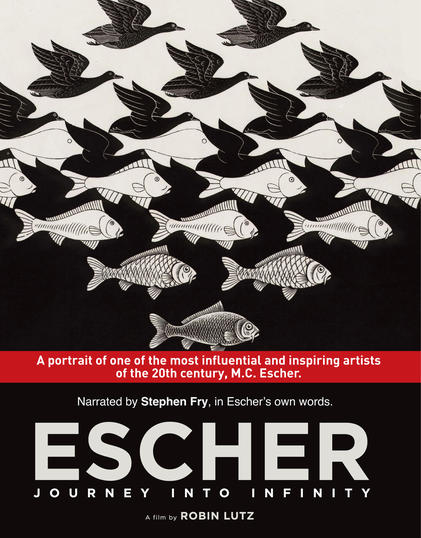
Saturday Matinee: M.C. Escher: Journey to Infinity

By Matt Zoller Seitz

Source: RogerEbert.com

Documentaries about visual artists tend to be so boringly conceived—talk about the life, show a picture, talk about the life, show another picture—that you may not realize what you’ve been missing until you see one as excellent as “M.C. Escher: Journey to Infinity.” 

Written and directed by Robin Lutz, this is a rare feature that takes the trouble not just to understand its subject and communicate his significance, but find ways to show us, visually, how his style evolved, and the principles behind that evolution. 

The tale begins with the standard-issue “This is a movie about a great artist, here are a few summary details abut his life and art,” with some landscape and architecture shots and images of Escher’s work. Then it becomes increasingly daring and fanciful, yet always remaining in service to the M.C. Escher, the Dutch draftsman and printmaker whose art became internationally famous during the post-World War II era. 

Escher was a rare artist who managed to combine his influences into something genuinely new. His work is a geometric/mathematical surrealist vision of the objectively perceivable world, but also a subjective interior, evoking ancient Arabic-North African graphics; the Salvador Dali-Pablo Picasso-Georges Braque anti-realist sensibilities of the ’20s and ’30s, and computer models that would not become popular until decades after Escher’s own experiments. 

Lutz and his collaborators, including a team of graphic designers and animators, make Escher’s art come to life in surprising and amusing ways, from having one of his trademark salamanders appear in an otherwise “realistic” frame and travel across increasingly “unreal” panoramas until we’re in an Escher print, to re-imagining intricately patterned Escher artworks so that we seem to glide along them, or into them/through them. This happens slowly enough so that we can appreciate how deftly the artist translated negative space into positive space, in ways that made the distinction seem arbitrary: for instance, the black spaces between joined silhouettes of lizards or amphibians might become black birds with white spaces between them, then go back again. Or people and animals might move along one stretch of diagonal stairs and jump to another, seeming to go upside down or sideways, in defiance of gravity, emphasizing the brain-teasing techniques Escher perfected.

Lutz and his team have found a cinematic analogy for the movement of the eye over static pictorial art reproduced in a book or hanging on a museum wall. The movie is especially good at evoking that “wow” moment when you realize that a thing you were looking at has turned into another thing. It’s explaining the magic trick without ruining the magic, a magic trick of a different sort. 

This approach is so dazzling that one wishes the filmmakers had pushed it a bit further, deploying it even more often, or in more and subtler variations—perhaps figuring out a way to have the film itself flip back on itself structurally at key points, or end precisely where it started, so that the project itself seemed to have no beginning or end. (There’s a hint of this, but not much more.)

Musician Graham Nash, a devotee of Escher who contacted him late in his life, says Escher dismissed the idea that he was an artist. Throughout the movie, we hear Escher align himself with scientists and mathematicians, often trashing his own skills as a representational draftsman and speaking of his heroes and colleagues with awe. 

This isn’t to say that Escher was down on himself at all times, or that that he entirely rejected the notion he was making art. Escher’s letters, performed in voice-over by actor Stephen Fry, make it clear that he challenged himself to improve his abilities and expand his vision and grew irritable when stuck in a groove. And yet there was always a sense—particularly once Escher hit his forties and realized he was indeed a global phenomenon—that a “real” artist wouldn’t be as entertaining. This is the world’s misconception, not Escher’s, but it’s still a shame that he let himself feel diminished by it. There’s power and profundity in Escher’s art, yet the puzzle-box aspect is what pulls you into it. 

The movie makes a case that we should talk about Escher the way we talk about one of his inspirations, Johann Sebastian Bach, who like Escher was clever as well as substantive. Escher earned the comparison. Why do we resist it? Perhaps there’s still something in us, even this late into human development, that worries that if you’re having fun, it can’t be art. Escher struggled with that misconception, too, right up to the end.  

Watch M.C. Escher: Journey to Infinity on Kanopy here: https://www.kanopy.com/product/mc-escher-journey-infinity

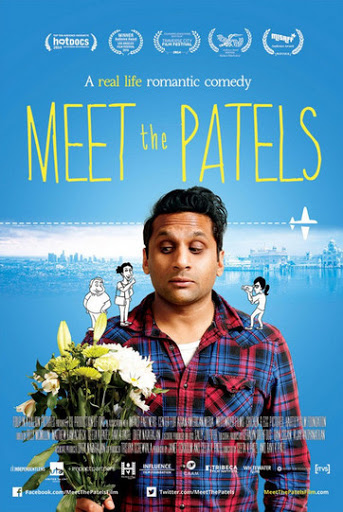
Saturday Matinee: Meet the Patels

Review by Odie Henderson

Source: RogerEbert.com

The documentary “Meet the Patels” bills itself as a real-life romantic comedy. It embraces this notion by interspersing its subject’s quest for love with clips from successful examples of the rom-com genre. For this is the story of a man out to find a soulmate, and the film dramatically hinges on the outcome. While his camera-wielding sister films his quest, he is aided and abetted by his parents in scenes that all but guarantee a Hollywood remake. They can even get this film’s subject, actor-director Ravi Patel, to play himself.

Ravi’s older sister, Geeta, directs “Meet the Patels” with a tone of mischief recognizable to anyone who has a sibling. You can hear her laughing behind the camera at Ravi’s mistakes, and at one point she calls him an idiot with a mixture of love and disdain. She keeps Ravi’s biggest secret from her parents (but not from us). When he goes off on tangents, Geeta brings him back to the topic at hand. And though very supportive, she never lets him off the hook. She even pulls an older sibling’s “for your own good” move that is the film’s strongest moment: The documentarian in her overrides her brother’s reasonable request to shut the camera off. She shuts it off, but sneakily turns it back on, capturing a moment of high drama.

This probably sounds like someone’s home movies—Ravi jokes about this by pointing out the occasionally present boom mike and the shaky framing of some scenes—but “Meet the Patels” is about more than Geeta’s family. It tells a culturally specific story about love and marriage. Additionally, it speaks to the generational struggles over tradition and societal expectations, highlighting that children often have different ideas about life than their parents. These are universal subjects, so one does not have to be of Indian descent to appreciate “Meet the Patels.” You’ll either learn something new or nod your head with amused familiarity.

Geeta and Ravi are the unmarried children of Vasant and Champa Patel. Their single status is of concern to their father and a major point of ironic aggravation for their Mom. Mrs. Patel, who steals this movie from her son, has an unmatched reputation as a matchmaker, yet like a psychic she can’t use her powers for her own benefit. On a trip back to the area from which his parents emigrated, the question of marriage is on everyone’s mind. People already know of Ravi’s marital status, and every other person then tries to hook him up. “Think of that annoying relative who is always up in your business,” Ravi says. “Now imagine an entire village full of that person.”

With so much pressure to get married (“after a certain age, a single status becomes a code red,” Ravi warns), one can understand why Mrs. Patel has agita over her lack of grandchildren. When “Meet the Patels” opens, Ravi has just broken up with Audrey, a White woman he has been keeping from his parents for the past two years. It seems like she’s the one, but Ravi knows this relationship is controversial. Feeling the pull toward the expected tradition of marrying an Indian woman, Ravi finally decided to use his Mom’s services. This yearlong, cross-country search takes up most of the film.

Mr. Patel tells his son that Mrs. Patel was the twelfth woman his family introduced him to, and their one date before marriage consisted of a chaperoned visit where his future wife said very little. “There was a guy there, so no hanky-panky!” Mr. Patel says of his date. “Things are different now. You can go on multiple dates before deciding.” Ravi goes on date after date, none successful. When Geeta nonchalantly mentions that she’s gone on 200 dates without success, Ravi tells her she should be in front of the camera instead of him. Perhaps for the sequel.

Multiple dates may be ok, but some rules haven’t changed. As if finding a mate weren’t difficult enough, for Ravi and Geeta, It is strongly preferred that they find another Patel. If they chose one from India, there is also a geographical restriction regarding where one can find another Patel. I found this section fascinating, especially the sense of fraternity that accompanied one’s last name. If you’re a Patel, any other Patel will welcome you as if you were family, even if your interaction is temporary. There’s a hilarious animated vignette at an American motel where Mr. Patel’s driver’s license becomes a golden ticket for services the motel would never offer regular patrons. If only this fraternity/exclusive club thing worked for me with other Hendersons!

But I digress. In today’s Indian culture, the matchmaking game has been upped exponentially. Now there are websites and conferences devoted to getting one betrothed. The technology follows the standard rules for matchmaking. The most fascinating piece of non-technical marketing assistance is the biodata, a sort of personal resume that, like an employment resume, is usually full of bent truths. “I’ve never even seen my biodata!” one talking head reveals. “It creates a rosy picture of you that’s not you,” says another. 

On the biodata is a specific detail that took “Meet the Patels” to another place for me. Reading his own biodata, Ravi mentions “skin tone, wheatish brown.” He then lists other descriptions of brown skin, all of which are explicit about skewering toward the lighter shades. “The lighter you are, the more attractive you are,” one of the interviewees tells us. “Good luck finding a mate for your dark daughter with the pH.D!” Ravi jokes. We learn that some people buy skin-lightening cream or keep their kids out of the Sun so they can stay “wheatish brown.”

Now, as a brown person myself, I could not let the notion escape my head that, like my people, Indians have a “paper bag test”. It was a darkly funny revelation that, regardless of race, if you were brown you had to deal with both society at large and your own crew in this regard. “Meet the Patels” sneaks up on you with these mentions and subtle explorations of intraracial and interracial bias, and it does so without destroying the film’s light tone.

Like the rom-coms it emulates, the ending of “Meet the Patels” is never in doubt. But this film is about the journey, not the destination. I liked how, during the film, your allegiances change back and forth. Sometimes I agreed with the parents, sometimes with Ravi, and at times I grew irritated with both of them. If there’s a flaw, it’s in how the film presents the women Ravi encounters. There’s a detachment that doesn’t often work. Many times, Ravi comes off as shallow in regard to these women he’s meeting, and the dates all tend to blur together. I also wish I’d known more about his relationship with Audrey; the lack of this information makes the ending feel rushed.

Those issues aside, “Meet the Patels” is still a charming, informative and funny documentary.

Saturday Matinee: Crude

Crude

Directed by Joe Berlinger

A dramatic documentary about the “Amazon Chernobyl” case where indigenous tribal groups are fighting the multinational corporation Chevron.

Film Review by Frederic and Mary Ann Brussat

Source: Spirituality & Practice

This attention-grabbing documentary directed by Joe Berlinger (Brother’s Keeper) centers on the dramatic story of a legal case that has dragged on for years: Aginda vs Chevron-Texaco. The plaintiffs are 30,000 individuals, including members of five indigenous tribes and colonial settlers in Ecuador who allege that over the course of its quest for oil, Texaco dumped over 18 billion gallons of toxic waste and formation water directly into streams, river, and jungle floor of the Amazon rainforest. In addition, the company is said to have spilled 18 million gallons of crude oil from pipelines, burned more than 235 billion cubic feet of natural gas into the atmosphere, and built nearly 1000 unlined toxic waste pits in the region — an area approximately the size of the state of Rhode Island. Berlinger manages to broaden the documentary out beyond what has been called the “Amazon Chernobyl case” to include material on global politics, celebrity causes, environmental activism, human rights advocacy, the role of the media in controversial trials, the power and wealth of multinational corporations, and the unconscionable treatment of rapidly-disappearing indigenous cultures.

At the center of this David vs Goliath struggle is Pablo Farjardo, the lead attorney for the Aguinda plaintiffs. He grew up in poverty in the Amazon region and attended college and law school under the sponsorship of the Catholic Church. In his first case, which has been running since November 1993, Farjardo is seen making his points during the judicial inspections of the affected regions, rallying support of indigenous tribes, and visiting with families who are suffering with cancer, skin conditions, and birth defects. In 2008, he received the Goldman Environmental Prize in San Francisco honoring his work along with Luis Yanza, President of the Amazon Defense Fund, who has been managing the day-by-day operations of the case. A large role has also been played by Steven Donziger, a New York-based attorney, who has provided invaluable strategy advice and seems to be very savvy about the importance of media coverage (the cover story about the case in Vanity Fair and the involvement of Trudie Styler, the co-founder of the Rainforest Foundation with her husband, the musician Sting).

The cause of Farjardo and associates is helped in 2007 when the new President of Ecuador, Rafael Correa, tours the toxic areas and lends his support. The case for Chevron in the documentary is presented by Ricardo Reis, the Managing Counsel for Chevron Latin America; Sara McMillan, Chevron’s Environmental Scientist who denies any connection between the company’s operations and the deaths and health issues of the indigenous tribes; and Adolfo Callejas and Diego Larrea, the two attorneys representing Chevron.

The proceedings reach a climactic point when the findings of Richard Cabrera, an independent expert, are released. He was appointed by the court to conduct a “global assessment” of the region, evaluating the plaintiffs’ claims and calculating the cost to repair any alleged damages. He found Chevron to be liable for up to $16 billion in damages (later amended to $27 billion) as compensation for health care, environmental remediation, reparations for loss of indigenous culture, cancer deaths, and the oil company’s “unjust enrichment” from its operations. Chevron has rejected the report calling it biased and unqualified. And so, the case continues and we recall that the Exxon Valdez judgment took nearly two decades to appeal.

Update:

Corporate Tyranny: How Chevron Conspired with US Courts to Destroy a Human Rights Lawyer

By Rania Khalek

Source: Breakthrough News

Human rights lawyer Steven Donziger has been thrust into an epic battle with one of the biggest oil companies in the world. He helped win a multi billion dollar lawsuit against the Oil Giant Chevron for polluting the Amazon in Ecuador and poisoning the indigenous community who lives there.

Ever since then Chevron has waged a relentless and global campaign to avoid accountability and to punish Doziger. In what reads like a Hollywood thriller, a US judge with ties to Chevron has conspired with the oil giant to destroy Donziger’s life. As a result of the case, he has been confined to his home on house arrest since 2019. And there’s a corporate media blackout!

Donziger spoke to Rania Khalek on Dispatches from house arrest in New York City, not too far from the New York Times, which has ignored the story.

Donate to Stephen Donziger’s legal defense fund here: https://www.donzigerdefense.com/

Saturday Matinee: Gaza Fights for Freedom

This debut feature film by journalist Abby Martin began while reporting in Palestine, where she was denied entry into Gaza by the Israeli government on the accusation she was a “propagandist.” So Abby connected with a team of journalists in Gaza to produce the film through the blockaded border.

This collaboration shows you Gaza’s protest movement like you’ve never seen before. Filmed during the height of the Great March Of Return protests, it features riveting exclusive footage of demonstrations.

At its core, Gaza Fights For Freedom is a thorough indictment of the Israeli military for horrific war crimes, and a stunning cinematic portrayal of Palestinians’ heroic resistance.

Saturday Matinee: Chicago Conspiracy Eight

The Real Chicago 8 Movie: R.G. Davis Gets it Right

By Jonah Raskin

Source: CounterPunch

In January 1970, R.G. Davis, the founder of the San Francisco Mime Troupe and one of the fathers of guerrilla theater, filmed a 60-minute video with seven of the defendants in the Chicago Conspiracy Trial. Long buried, the film which is titled “Chicago Conspiracy Eight,” recently surfaced thanks to the Media Burn Archive. Unedited and uninterrupted, it can be viewed on Vimeo.

According to the web site, the Media Burn Archive “collects, restores and distributes documentary video created by artists, activists and community groups.”

They’ve done a great job with the “Chicago Conspiracy Eight,” which illustrates the wonders one can work with a camera, a cast of colorful characters and a lot of gumption. By January 1970, when R. G. Davis produces the video, Bobby Seale of the Black Panther Party had already been severed from the federal case, which indicted eight men on charges of conspiracy and rioting in the streets during the 1968 Demcratic National Convention.

In the video, R. G. Davis and the seven defendants sit around a large table littered with food and drink. R.G. serves as the moderator, though he doesn’t really moderate the discussion. Indeed, it’s a wild hour in which everyone gets to speak, albeit some longer than others. An empty chair sits at the head of the table and carries a sign that reads, “Mr. Bobby Seale.” His absence is palpable.

The video tells a story that Aaron Sorkin’s feature film, “The Trial of the Chicago 7,” can’t and doesn’t tell. In this case, reality beats fiction. The magnificent seven each have their own individual hair styles: Dave Dellinger with long sideburns, Abbie with a Jewfro, as it was called, Jerry and Lee Weiner with full beards, Fronies with a mustache and Tom with the unkempt hair on the top of his head. Rennie Davis looks the cleanest cut of the lot. The era was a lot about hair. Our side clearly won on that front.

The seven defendants talk about Chicago in the summer of 1968, the Conspiracy Trial and anything and everything else that comes up, spontaneously. There’s a great deal of humor and a lot that’s serious, though no one seems to be afraid of going to jail. No topic is sacred. Everything can be and is the butt of comedy, including Abbie raising his middle finger and shouting “Fuck the Movement.”  As a Yippie who battled the stogie members of SDS, that’s understandable.

The video is often about language and the spoken word. Jerry explains that “the most beautiful moment” in the trial takes place when poet Allen Ginsberg of Howl fame testifies on the witness stand and “the courtroom becomes a religious place.” In the video, Abbie is the most literary and cultural of the defendants. He likens the trial to Brave New World and describes Judge Julius Hoffman as Captain Queeg in The Caine Mutiny. Tom Hayden calls the U. S. “a police state” and recounts the murders of members of the Black Panther Party, including Fred Hampton and Mark Clark. Rennie Davis explains that racism “effects every major institution” in American life. That it did.

John Froines jokes about being “a male chauvinist.” Dellinger plugs non-violent tactics as “revolutionary” and Jerry says that the word “Fuck is the biggest issue” in the courtroom. It did push a lot of buttons. Abbie tells R. G. Davis that he and the other defendants want to be honest and not fudge facts and at the same time “beat the rap.” That’s the tricky part, coping to the revolution and aiming for a not guilty verdict. The Chicago eight aimed to beat the rap in the courtroom and outside the courtroom where they organized, appealed to the media and aimed to put pressure on the judge and the prosecutors.

Here and there, bits of history show up in the video: the Haymarket Riot of 1886; and U.S. Communist Party members who defended themselves when they were on trial. Abbie adroitly weaves together comedy and ideology. He calls the Hilton “a symbol of American imperialism” and adds that the demonstrators marched on the hotel with the intention of “changing the sheets.”  That’s still pretty funny.

Near the end of the hour, R.G. Davis tells the others, “I got some good points.” Indeed, he did. He deserves credit for his realization that it was essential to bring the defendants together while the trial still raged. Starr Sutherland and Tom Weinberg produced the 2020 video, along with the team at MediaBurn who deserve praise from everyone who rioted then and everyone who protests these days.