
Being a Radical Has Led Me to Sometimes Live a Double Life

Is that a good thing?
By Mickey Z.

Source: Dissident Voice

Throughout the 2000s, you’d find me regularly riding NYC’s subways during the very early morning hours — specifically from Queens into Manhattan — to work with personal training clients in gyms. In fact, right up to the plandemic, I was still training a couple of clients in their homes.

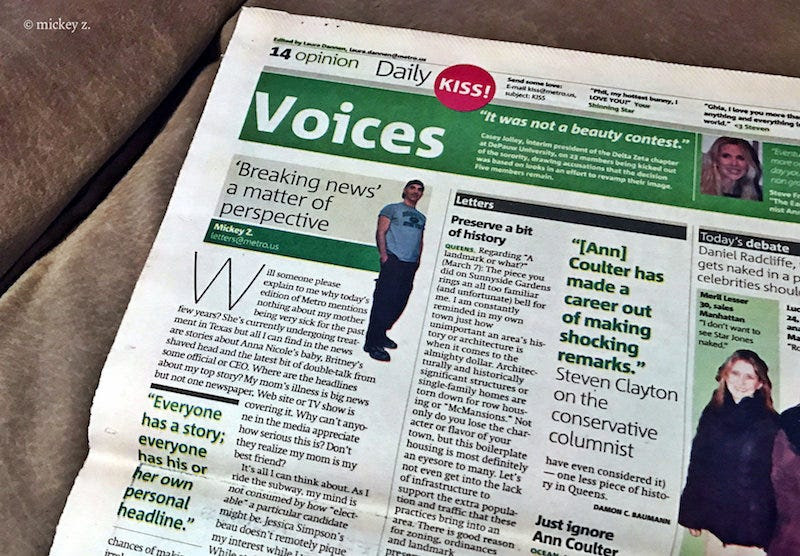
On those subway rides, I’d sometimes grab a copy of Metro — one of NYC’s free newspapers delivering a daily dose of corporate media propaganda. However, there was a brief period of time when Metro would allow some subversive voices into the mix. That included yours truly.

From about 2004 to 2007, Metro went through a phase of paying edgy freelancers so I jumped in with both feet. This even included an author photo shoot!

Thus, for a couple of years, my decidedly non-mainstream perspective — and my decidedly non-mainstream photo (wearing a “dumpster diving team” t-shirt, no less) — were on display for millions of New Yorkers to peruse during their morning ride to work or school (see image up top).

As someone who can remember when newspaper columnists held sway in my hometown, let me tell you, it was pretty cool to be jammed into a crowded subway car next to someone reading my latest article.

I’ll never know how many New Yorkers read my Metro columns. To the best of my knowledge, none of my affluent clients saw my column or photo (probably because none of them would ever ride the subway).

Over the years, I did make a select few clients aware of my double life (a couple have even bought my books and attended my talks). But, since many of them were wealthy and mainstream, I typically chose not to divulge anything about my radical writing.

As a result, I sometimes found myself making up elaborate fabrications to account for why I wouldn’t be around for a day or two when, for example, I just so happened to be heading up to MIT to lecture on US foreign policy in 2003.

Yep, this high school grad addressed a huge audience there on the topic of Henry Kissinger and the 1973 Chilean coup on a Monday night… and by Wednesday morning, was back in the gym — working with dumbbells (insert rimshot here).

Looking back now, I ponder my strategy of keeping a big part of myself a secret in the name of maintaining personal trainer income. Why was I so sure that wealthy capitalists would shun me and maybe fire me as their trainer if they encountered my radical mindset?

Perhaps a better question: What did it do to me emotionally to hide something that’s always been very important to me?

I contemplate questions like this now because, well… it’s never too late. I may not have affluent gym clients anymore. But, in Covid-era NYC, I have plenty of others around whom I could start speaking far more openly.

After all, it’s not like I can’t point to cases from the 2000s when my double life was exposed and things went well.

For example, I trained three high-powered lawyers at their high-powered law firm’s gym. This arrangement required me to check in with the doorman — or was he a concierge? (It’s funny to me that I might insult a concierge by calling him a doorman.) Anyway, doormen display one of three basic behavior patterns towards personal trainers.

The first and most common is indifference (we’re used to that). Secondly, they relate to us as fellow blue-collar common people saddled with the same fate: serving the well-heeled. Lastly, in a futile attempt to align themselves with a winner, some doormen openly look down their noses at us.

This was definitely the case at the law firm until a certain concierge saw my handsome face staring back at him from the pages of Metro.

The guy was completely flabbergasted when he read a little something of mine called “Re-Examining Rumsfeld’s Ratio” (which talked about, among other things, the United States unselfconsciously using “Apache” helicopters to quell “ethnic cleansing”).

A political junkie, the concierge now saw me as an “expert” and fell all over himself to shake my hand and introduce himself.

My new best friend could not get enough of me and it became the new norm for him to quiz me about current events before and after my training sessions.

One morning, as I was passing through the lobby, he called me over and pulled out a legal pad. Believe it or not, he had written a page or two of notes to remember all the things he wanted to ask me!

Yeah, just another tricky day in the life of a muscular militant… 

In 2001-2, I worked evenings in a corporate gym (cue the shame and self-loathing) in midtown Manhattan. One night, I was wearing a Yankees t-shirt with the name “Justice” emblazoned on the back (for former Yank David Justice).

A woman named Mary, probably in her late 60s, asked me if I was a Yankee fan. I told her my real reason for wearing the shirt was all about the word “justice.” She smiled and declared that justice was a “noble idea.”

I braced myself for the inevitable “we need to show those towel heads some justice,” (remember, this was early post-9/11 NYC) but instead, Mary told me — albeit in a stage whisper — she was soon going to DC to march against the impending US invasion of Iraq.

After this confession, Mary looked genuinely nervous. Her facial expression seemed to ask: Have I gone too far? In my best French Resistance voice, I reassured her: “Don’t worry, I’m with you.”

After that, we’d talk each and every time she’d come to work out. The corporation eventually phased out its gym facility but just before my last day, I saw Mary and complimented her on how hard she’d been training.

She leaned close to me and whispered: “When the revolution comes, I’ll be ready.”

As for me, my next revolution is to be even more open and transparent about my “controversial” stances. No more hiding.

After all, “a truthful witness saves lives.”

The Complexity of Cultural Evolution

By Joe Brewer

Source: Resilience

What does the ecological crisis have in common with global poverty? How does politics relate to economics? The study of history? The changing landscape of technology, arts, and culture? Why is there not a coherent School of Social Sciences that brings themes like these together in one place? Answers can only be found by synthesizing two of the most important areas of scientific work in the last 150 years — in the fields of evolutionary studies and complexity science.

All of the most interesting and important topics of concern in the world today (How does consciousness work? What is the human mind? Is it possible to restore health to deteriorated ecosystems? Can we create political systems that promote widespread health and well-being?) involve vast networks of relationships interacting with each other — what are called complex adaptive systems in the lingo of complexity science.

Familiar examples include things like the weather with its inherent unpredictability or a market economy that has no central locus of control. The thing that makes a system “complex” is that patterns arise through the interactions that are not reducible to its constituent parts. You cannot explain the weather simply by describing what water molecules or solar radiation on their own are capable of doing. Neither can you explain an economy by describing how individuals engage in barter or exchange if they happen to be in a market-based society.

Importantly, complex adaptive systems are always far from equilibrium. They are not static. And the only way to make sense of their behavior is to computationally model how the various parts interact with each other dynamically — which leads to the importance of evolution. Emphasis on the word adaptive in complex adaptive systems gives an inkling of Charles Darwin’s Theory of Natural Selection, where the biological traits of an organism that happen to be adaptive in its environment tend to occur more frequently than traits that are not adaptive.

Over time (since living systems are also dynamic), the evolutionary pathway for biology is traced by the intersections of adaptive fitness in environments that might be changing quickly or slowly. All biological systems are complex (they have many interacting parts with emergent phenomena that are not reducible) and they are adaptive (as natural selection plays out in changing environments).

So what does this say about cultural evolution? How can we apply this basic finding from biology to the study of history and economics, politics, and environmental management? Well it turns out that researchers who study cultural evolution — and there are now nearly 2,000 of them in the newly formed Cultural Evolution Society that I was tasked to help create — have brought the mathematical toolkit used in complexity science to the study of cultural change in human and non-human species.

The earliest inklings of this synthesis go back to a debate a century ago when foundations were being laid for the study of population genetics. At that time, statisticians were actively grappling with questions about how to account for genetic variation in biological organisms without the use of digital computers. They developed accounting systems for biological traits that matured continuously through the early-to-mid 20th Century.

In the late 1970’s and early 80’s, there was a group of cultural evolution researchers who translated these statistical tools for the distinct mechanisms of “selection” that play out for behavioral repertoires and other cultural phenomena in human and non-human cultures. Among them were Luigi Cavalli-Sforza and Marcus Feldman at Stanford, Peter J. Richerson at UC-Davis, and Robert Boyd of Arizona State University. These efforts culminated in the publishing of Cultural Transmission and Evolution: A Quantitative Approach in 1981 and Culture and the Evolutionary Process in 1988.

It was during this same time period that the field of complexity research was getting underway — with the multidisciplinary Santa Fe Institute being established in 1984 to explore the mathematical patterns of complex adaptive systems across many domains of study. They organized workshops and symposia on economics, ecology, urban studies, epidemiology, and more to discover how complex systems evolve and change using the mathematical tools of fractal geometry, network science, differential equations, and computational methods.

As I have written elsewhere, the time is urgently upon us to synthesize and apply what is known about complexity and evolution. The fate of humanity literally depends on our ability to do this. In a time of unprecedented exponential change, we must learn to manage complex systems as they evolve in real time.

We need to firstly understand that cultural systems evolve according to Darwinian principles. The interested reader can find many books explaining why this is the case. Here are a few to get you started:

This is a mere sampling — there are now hundreds of books on cultural evolutionary studies that one can dive into. Important for this article is to note that (i) the field of cultural evolution is quite mature at this point in time; (ii) it has advanced rapidly since incorporating mathematical tools used in the study of complexity; and (iii)the world is in flux with tremendous need for this body of knowledge to be brought to bear on our global challenges in the 21st Century.

This is the work of culture design.

The most pressing challenges in the world have foundational cultural components. Global warming arose from the false illusions of human separation from nature and the perception of endless bounty for natural resources at the beginning of the industrial era. Terrorism is cultivated in landscapes where people feel deep-seated anxiety and economic desperation — which arise from particular models of colonial (or post-colonial) exploitation that have unique cultural histories.

Similarly, the spread of rugged individualism as a cultural construct treats human beings as if they are separate from their communities, inherently selfish, and venerable for engaging in psychopathic behaviors like wealth hoarding. In each case, the real state of power is culture and the only viable solutions involve the intentional management of cultural evolutionary change.

But we cannot even start to think this way if we don’t recognize how human cultures operate as complex systems. Only by learning to see that emergent patterns arise through the interactions of constituent parts will we begin to discern how evolutionary change is taking us closer to planetary-scale collapse — and that design practices will be needed that make use of what is now known from cultural evolutionary studies.

Onward, fellow humans.