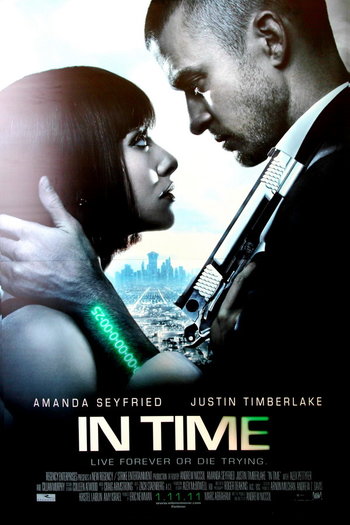
Saturday Matinee: In Time

A thought-provoking sci-fi thriller set in the future that taps into some of the most troubling inequities and problems of our era, the lack of time.

By Frederic and Mary Ann Brussat

Source: Spirituality and Practice

The best science fiction always uses some trend or policy of the present as a foundation and projects it into the future with a picture of some possible results. Through this glimpse of tomorrow, we can ponder anew the spiritual or philosophical ramifications of what we are doing today. In The Adjustment Bureau, we were given a chance to assess the idea of free will or the alternative of following a plan mapped out by God. In Gattaca the idea of genetically engineered perfection is explored. Writer and director Andrew Niccol who wrote and directed the latter thriller is also at the helm of this thought-provoking sci-fi drama that has many resonances with today’s world.

The Preeminence of Time

A search on Google for “time” yields more than 11 billion hits whereas there are fewer than 3 billion hits for “money” and 241 million hits for “sex.” Time is very much on our minds and at the hub of our concerns. We speak of “having” and “saving” and “wasting” time but we never seem to find a way of “conquering” it. We are caught up in the obsessive-compulsive need to make the most of the time we have each day. Pagers and cell phones are taken everywhere. We don’t want to miss a moment of connection.

In Time is set in a future dystopia where living zones separate the rich from the poor. Will Salas (Justin Timberlake) lives in a ghetto zone with his mother Rachel (Olivia Wilde). She looks very young since all aging stops at 25.

Will works in a factory and she has a job as well, but still it is hard to make ends meet. Time in this society is literally money. Each person has a timer on his or her arm and at 25 you are given one year of free time after which you die — unless you can find a way to get more time. Wages are doled out in days of added longevity. All expenses (rent, a cup of coffee, clothes, phone calls) are paid for with time and scanners are used to deduct the time for the purchase. The biggest fear in the ghetto is that your time will run out unexpectedly. That is exactly what happens to Will’s mother.

Time Is Strange

“Time is stranger and deeper than anything else in our lives.”
— Jacob Needleman

The biggest dream in the ghetto is acquiring a surplus of years and the prospect of immortality. When Will saves a young man with a century on his clock, the fellow gives the years to him and then commits suicide. An intrepid “Timekeeper,” Raymond Leon (Cillian Murphy), is convinced that Will stole the years from the dead man. He launches a man hunt for him. Also hot on Will’s trail are some nasty time thieves.

Caught in Time

“Time is the element in which we exist. We are either borne along with it or drowned in it.”
— Joyce Carol Oates

Will begins a daring journey into the zone for the time rich called New Greenwich. After winning more than a millennium at a casino, he meets Sylvia (Amanda Seyfried), the daughter of Philippe Weis (Vincent Kartheiser), an immensely wealthy and powerful banker who has been exploiting the poor by making high interest time loans. A believer in “Darwinian capitalism,” he’s stored up enough years to be immortal. But Sylvia thinks there must be more to life than the favored existence she knows. She is intrigued by Will’s wild ideas about changing the system which favors the rich over the poor and allows many to die so a few can be immortal. After he takes her hostage when the Timekeeper is closing in on him, Sylvia doesn’t take very long to pledge her allegiance to what becomes their own mutual crusade. They begin robbing time banks and giving time to the poor and the down-and-out.

In Time is a winning sci-fi thriller that taps into some of the troubling problems of our era, such as the view of time as money, the growing gap between the rich and the poor, and all the ways that we waste time and fail to value every moment. It is also a meditation on the healing and restorative medicine of generosity and sharing. Writer and director Niccol has given us a cautionary tale about the possible future consequences of class consciousness, the high cost of trying to stay young or live forever, and the need for something more meaningful than just spending time to get ahead of the game.

Saturday Matinee: Parasite

Bong Joon-ho delivers a biting satirical thriller about class warfare and social inequality

By Prahlad Srihari

Source: Firstpost.

Bong Joon-ho has always been interested in the mechanics of genre cinema. The South Korean director has made a career of subverting established genres in an intelligent, meaningful manner. In The Host and Okja, he took the creature feature and added socio-political subtext to it. The serial killer thriller, Memories of Murder, highlighted police incompetence in South Korea and the Hitchcockian murder mystery, Mother, revealed the cultural divide between men and women in Korean society.

Fortunes change when Ki-woo falsifies his credentials to land a tutoring job with a wealthy couple, Mr Park (Lee Sun-kyun) and his gullible wife Yeon-kyo (Cho Yeo-jeong). While he teaches their daughter Da-hye (Jung Ziso), he learns that their troublesome son Da-song (Jung Hyeon-jun) also needs help improving his drawing skills. Ever the opportunist, he recommends his sister — not revealing her real identity of course. She recommends her father as a driver after getting the previous one fired by setting him up as a sex fiend. Ki-taek then recommends his wife to take over as housekeeper after a scheme involving the most creative use of peaches since Call Me By Your Name. After their clandestine infiltration operation into the Parks’ lives is complete, the story makes so many intense and unexpected twists and turns, it turns into a whole different beast altogether.

The cast of Parasite deliver performances of exceptional psychological acuity and perverse frivolity. Led by Bong’s frequent collaborator Song Kang-ho, they are sure to conjure the loudest of laughs and the strongest of emotional reactions from their audiences.

Bong brilliantly uses the upstairs-downstairs distinction in the Parks’ house to reveal a socially divided society. And the society is not just divided by wealth but also culture. Bong revisits a familiar theme of the proliferation of American values over traditional Korean ones. The Parks are a Westernised family who live in a sleek, modernist home with white picket fences — and who buy toys and gadgets from the US, exemplifing the upper crust. Ki-taek’s family, meanwhile, lives in a sordid apartment in the basement, where cockroaches thrive and drunkards urinate on their windows. So, with Parasite, Bong tries to bring to light this deep, festering malady at the heart of Korean society.

Parasite offers a cleverly paced, thoroughly entertaining blend of sumptuous visuals and wickedly dark humour. The music too makes the plot twists and revelations hit that much harder.

Despite the cultural and language barriers, Parasite is an unforgettable cinematic experience as it speaks to universal ideas, themes and emotions. If Bong Joon-ho’s style of genre filmmaking hasn’t become an adjective already, it sure is time now.

Watch Parasite on Kanopy here: https://www.kanopy.com/product/parasite-2

Saturday Matinee: Midnight Special

Source: Deep Focus Review

People put their faith in the strangest things. Some feel their god will return to cast down judgment on humankind. Others are certain beings from another solar system planted genetic material on Earth to create life. And some believe, or perhaps not, that a flying spaghetti monster lives in the sky. Here’s another one: Folk music history tells us a train called the Southern Pacific Golden Gate Limited ran near Sugar Land prison in Texas, where legendary Blues man Lead Belly heard it passing. He and other inmates believed the train represented some sign of hope that soon they would be set free. Lead Belly later popularized a song about it, called “Midnight Special”, featuring a lyric in which he asks the train to “shine a light on me”. Apart from memorable covers by Harry Belafonte, Bob Dylan, and Credence Clearwater Revival, Lead Belly’s folk song informs the title of writer-director Jeff Nichols’ fourth film, Midnight Special.

People in the film believe some strange things, too. Some of them believe a young boy will grant their way to salvation, while the government believes that same boy is a threat to national security. But more on the specifics later. These belief systems pervade Nichols’ screenplay, a slow-burner infused with soulful character depth and science-fiction underpinnings. Midnight Special has much in common with Nichols’ excellent Take Shelter (2011), about a working-class family plagued by the father’s apocalyptic premonitions. That otherwise grassroots, southern-fried suspenser contains fantastical elements, though really it’s about the extremes people will go to chase what they believe. Nichols has explored similar American spirituality in his other two films, Shotgun Stories (2007) and Mud (2011). Each of his films demonstrates the potential danger inherent to blindly following our beliefs and convictions.

Nichols’ calculated opening demands the audience take time to figure out what’s happening and why, who the good guys are, and in the end, what just came to pass. It’s a picture audiences must feel their way through in the best possible way. An Amber Alert blares across the television screen, a reporter notifying us a young boy named Alton has been kidnapped by a man named Roy. As the shot pulls back, we find ourselves in a motel room with Roy (Michael Shannon, severe as ever) and Alton (Jaeden Lieberher), who, behind an ever-present pair of swimming goggles, reads a comic book by flashlight. Also in the room is a crew-cut man of action, Lucas (Joel Edgerton). They’re waiting until the sun goes down to continue their getaway. Lucas drives fast and without headlights, wearing night vision headgear to see the highway in the pitch dark.

Nichols cross-cuts to things at “The Ranch”—a Texas compound not unlike David Koresh’s Branch Davidians—populated by old-world types in hand-sewn garb. They’re led by a quietly intense organizer named Calvin (Sam Shepard), who wants Alton returned to him. The FBI raids The Ranch and puts everyone on buses to a secure location. They ask questions about Calvin’s people buying guns and about Alton’s kidnapping. A bookish NSA specialist named Sevier (Adam Driver) wants to know about Alton, who came in contact with him, and what they know about the boy’s abilities. And so we must wonder, why so many questions about this boy? The answer: When Alton is exposed to the sun, beams of light shoot from his eyes; he seems to speak in tongues; he can give people visions; in space, satellites meant to detect nuclear explosions spy an energy source emitting from him; he also picks up radio signals in his head.

But what is he? Nichols never answers that question outright. Over time, we learn Roy is Alton’s father, and Lucas is Roy’s friend, and together they’re protecting Alton from The Ranch and the government. All parties concerned feel a great power exists inside the boy and, though they don’t completely understand it, they fearfully pursue and defend him. Soon Alton’s mother (Kirsten Dunst) joins Roy and Lucas, aware of the entire plan. We learn all of Alton’s peculiarities have a hidden encryption, coordinates that point to a certain spot on a specific day. Everything depends on getting him there on time. And gradually, as men from The Ranch get closer to recapturing Alton, and the government goons track down their perceived threat, we get a greater—but not clearer—sense of what might occur if and when Alton arrives at his destination.

Rather than frustrating, that lack of transparency is engrossing, as Nichols drops hints here and there, while he binds us to the often moving, unquestionably engaging proceedings through subtle character work. So what is Alton? He finds great interest reading a Superman comic, so perhaps he’s something like Superman, a powerful alien. Perhaps he’s a messiah sent to protect people at The Ranch. Maybe he’s an advanced form of human with mutant powers, a time traveler, a living weapon, or an inter-dimensional being. Whatever the answer, it’s less important than the real-life descriptions of the humans on Nichols’ journey. His actors carry impressive weight and gravitas, particularly Shannon, who has appeared in each of Nichols’ films. But the entire cast brings substance to their performances, involving the audience in the tense, measured development of the story.

Both narratively and technically, Nichols has used the films of Steven Spielberg and John Carpenter to inform Midnight Special, but not in such a way that it feels distractingly derivative. From the perspective that the film operates as a road movie driving toward some manner of grandiose sci-fi conclusion, the film feels like Close Encounters of the Third Kind; the ending, too, resembles Spielberg’s wondrous 1977 effort. Elsewhere, Starman (1984) comes into play, as everyone who meets Alton gravitates to his kindness, soulful sureness, and power, just as everyone in Carpenter’s film found Jeff Bridges’ alien character a kind of angelic figure. Even the ending seems to combine the finales of these two films, with a touch of E.T.: The Extra-Terrestrial. The film also bears some similarity to Tomorrowland, although the association is undoubtedly unintentional. All the while, Adam Stone’s textured 35mm lensing captures familiar lens flares and widescreen compositions from Carpenter and Spielberg that influenced Nichols.

Questions about what happens in its marvelous climactic scenes aside, Midnight Special shines a light on the audience by offering a unique combination of the realistic and out-of-this-world. Nichols develops thoroughly dimensional characters, even among the not-irredeemable “villains” of the story. The director cares about Roy’s heavy brow and Sevier’s sense of unsure awe; with them, he develops intimate moments that effectively resonate further than the sci-fi gimmick. He never overplays the drama, such as a scene in which Alton tells his father not to worry about him. Roy replies, “I like worrying about you.” The understatedness of Nichols’ drama, the poignancy, renders a picture about how people react to what they believe or do not understand. Some embrace it; some fear it. No matter the reaction, Nichols finds a way to represent that through an engaging metaphor in his profoundly affecting and, in many ways extraordinary thriller.

Watch Midnight Special on Hoopla here: https://www.hoopladigital.com/title/14507307

Saturday Matinee: Punk: Attitude

“Punk: Attitude” (2005) is a documentary tracing the roots, meaning and enduring influence of the punk movement of the late 70s and early 80s. Directed by Don Letts, the film offers an insider’s perspective because Letts was a catalyzing agent for the developing London punk scene, having run a clothing store called Acme Attractions and hosted parties as a reggae DJ, both often frequented by band members of groups such as The Sex Pistols, The Clash and The Pretenders. Letts later managed The Slits and began his film career as a director of Clash music videos.

Punk: Attitude also features interviews with artists directly and indirectly involved with the early punk scene including Wayne Kramer (The MC5), Mick Jones (The Clash), Jello Biafra (The Dead Kennedys), Chrissie Hynde (The Pretenders), and David Johansen (The New York Dolls) among many others. Though some punk fans may dispute the relevance of certain featured musicians or feel others were overlooked, the film provide a candid, fairly comprehensive and at times contradictory overview of punk rock as iconoclastic, raw and diverse as the music itself.

Saturday Matinee: A Girl Walks Home Alone at Night

By Jonathan Romney

Source: Film Comment

A term beloved of French film critics—and one I never tire of borrowing, just because it pinpoints its referent so well—is OVNI, meaning “UFO.” It’s used to refer to a film, usually a first feature, that’s next to impossible to categorize, that seems to have come out of nowhere, to have been made entirely against the odds—a film that appears to originate if not actually from other planets, then from some parallel cinematic dimension where the usual rules don’t apply.

Little could qualify more for OVNI-dom than an “Iranian vampire Western,” as Ana Lily Amirpour’s first feature has been dubbed. In fact, the skewed quality of A Girl Walks Home Alone at Night is accentuated by the fact that it both is and isn’t “really” Iranian. That is, the film is in Farsi, and stars a cast of Iranian or Iranian-American actors, but was shot in California, not far from Bakersfield, where writer-director Ana Lily Amirpour grew up. Taft stands in for Bad City, as the subtitles call it—or “Shahr Bad,” which may possibly be a Farsi play on words—a run-down, isolated burg where weird things happen by night, and nothing too ordinary takes place by day.

The Girl of the title (Sheila Vand) is a gamine-ish music fan who likes to dance alone in her poster-decorated den. But when she steps out onto the streets, she’s not the imperiled victim that the title—misleadingly, cleverly—would have you expect. She’s a figure of menace: a marauder who wears a chador over a very Gallic stripy matelot top, adding a curious dash of indie-kid chic to her image as a ghost figure who glides rather than walk. In fact, her gliding gait comes from the fact that she’s commandeered a terrified child’s skateboard. Spreading her robe like black wings, the Girl haunts the night like an Islamic descendant of Musidora’s Irma Vep, lawless masked heroine of Louis Feuillade’s silent serial Les Vampires.

The Girl is indeed a vampire, and more than a match for supposedly the scariest presence on this city’s mean streets—thuggish drug dealer Saeed (Dominic Rains), who has “SEX” tattooed across his neck, a sleazy drooping moustache on his chops, and a pad filled with big-bad-hunter tat (deer’s heads, tiger-print throws…). The predatory Saeed practically licks his chops at the thought of feral sex when the Girl’s canines pop out to full length with an almost comical sound effect; he doesn’t look so happy once she snaps his finger off.

The Girl can be downright terrifying: the young boy who loses his skateboard probably hasn’t done anything to merit being chilled to the bone by her, when she leans in to ask him if he’s been good, then warns him (in one of the most authentically ghoulish horror-movie rasps since Mercedes McCambridge did voice duty for Linda Blair), “I can take your eyes out of your skull and give them to the dogs to eat.” We don’t, by the way, see the dogs of Bad City, but the local cat is unsettling enough: a naturally charismatic starer which looks like it’s taking a break from sitting in a Bond villain’s lap, and which gets the best close-up in the film.

Meanwhile in Bad City, a devilishly handsome young man named Arash (Arash Marandi) is coping with the depressed excesses of his overweight junkie dad Hossein (Marshall Manesh), and working as gardener and handyman to a rich family whose spoiled daughter, the recent recipient of a nose job, sees him as her latest toy.

Things take an overtly comic turn when Arash—something of a sweet-natured dork despite his quiffed rebel demeanor—attends a Halloween party as Dracula. Walking home the worse for wear in a too-baggy cape and really ill-fitting fangs, he meets the Girl, who “lures” him to her den—or rather, wheels her decidedly floppy prospective beau back to her place on the skateboard. Things turn romantic, at once chastely and very sensually, in a beautiful extended take, as Arash approaches her and she closes in—not, as you’d expect, on his neck, but on his chest. It all happens in swoony slow motion, but with a mirror ball spinning round and filling the room with sparkles at crazy speed: a magnificent, and inexplicably romantic, paradox of pacing that adds to the eerie romance of the scene.

The couple later tryst at dead of night at the local power plant, itself lit up like a jeweled city. Why at the power plant? For the chiaroscuro, of course—that seems to be what motivates Amirpour most. This is one of those films that are shot in black and white because a director is genuinely in love with the affective and expressive possibilities of that visual choice, and especially with its ability to draw magic out of night scenes: I’m reminded of another piece of black-and-white small-town dream romance, Eric Mendelsohn’s Judy Berlin (99), which used an eclipse as the narrative excuse for its midsummer night’s encounters. In her own nightscapes, Amirpour doesn’t mess around with half-measures: DP Lyle Vincent saturates his shadows with the inkiest of blackness (as does the graphic novel that Amirpour has created to accompany the film).

A Girl Walks Home Alone at Night is a wayward, genuinely oneiric creation—look at its sudden arresting focus-pull on some oil derricks, and its graceful, gratuitous interlude of a transgender cowgirl figure dancing with a helium balloon. It manages to be tender, chilly, comic, and willfully bizarre all at once, but never has you wishing it would choose one register and stick to it. In his very enthusiastic recent review, David Thomson invokes not only David Lynch, but Vigo, Cocteau, and Buñuel, no less. Perhaps more modestly, A Girl Walks reminded me most of early Jarmusch, and of the general spirit of  late-Seventies/early-Eighties punk-influenced U.S. cinema (names like Scott B and Beth B, Amos Poe, Slava Tsukerman of Liquid Sky), because of Amirpour’s brisk disregard for genre norms, for the sense that she’s up for telling whatever story she wants to tell, any way she wants to tell it. While manifestly very polished and composed, the film nevertheless gives the impression that it’s making itself up—or dreaming itself into being—as it goes along.

There’s an oddly innocent blazing-youth romanticism about it, especially when the Girl and Arash bond over music. That feeling comes across all the more strongly because non-Farsi speakers will depend on the subtitles: it adds a tender but absurd irony to the revelation that the last song the Girl listened to was, of all things, Lionel Richie’s “Hello.” Fortunately, there’s cooler stuff on the soundtrack: the Tom-Waits-in-Tehran opening number by Iranian band Kiosk, and some Morricone-ish fanfare by Federale, a group from Portland.

A Girl Walks Home Alone at Night is bound to cause a stir in academic circles for the way that it blurs its Eastern and Western codes so thoroughly: making manifestly American settings stand in for an imaginary Iran, playing provocatively on the chador as Islamic garment and as vampire-cape substitute, having its heroine at once tender lover and murderous monster in a way that neither Anne Rice nor Stephenie Meyer would quite recognize. Overall, Amirpour’s film feels like an elaborately punkish code-scrambling gesture rather than a fully formed organic statement, but that doesn’t matter—it has style, grace, and imagination, and as artistic gestures go, could hardly be more devil-may-care. By the time it takes a final Aldrich-esque drive into the shadows, A Girl Walks Home has more than earned your attention—and got you wondering where that shadow-steeped road leads, either for its romantic duo or for Amirpour as audacious writer-director.

Watch A Girl Walks Home Alone at Night on Kanopy here: https://www.kanopy.com/product/girl-walks-home-alone-night

Saturday Matinee: Koyaanisqatsi

Source: Koyaanisqatsi.org

KOYAANISQATSI, Reggio’s debut as a film director and producer, is the first film of the QATSI trilogy. The title is a Hopi Indian word meaning “life out of balance.” Created between 1975 and 1982, the film is an apocalyptic vision of the collision of two different worlds — urban life and technology versus the environment. The musical score was composed by Philip Glass.

KOYAANISQATSI attempts to reveal the beauty of the beast! We usually perceive our world, our way of living, as beautiful because there is nothing else to perceive. If one lives in this world, the globalized world of high technology, all one can see is one layer of commodity piled upon another. In our world the “original” is the proliferation of the standardized. Copies are copies of copies. There seems to be no ability to see beyond, to see that we have encased ourselves in an artificial environment that has remarkably replaced the original, nature itself. We do not live with nature any longer; we live above it, off of it as it were. Nature has become the resource to keep this artificial or new nature alive.

That being said, my intention in-other-words, let me describe the bigger picture. KOYAANISQATSI is not so much about something, nor does it have a specific meaning or value. KOYAANISQATSI is, after all, an animated object, an object in moving time, the meaning of which is up to the viewer. Art has no intrinsic meaning. This is its power, its mystery, and hence, its attraction. Art is free. It stimulates the viewer to insert their own meaning, their own value. So while I might have this or that intention in creating this film, I realize fully that any meaning or value KOYAANISQATSI might have comes exclusively from the beholder. The film’s role is to provoke, to raise questions that only the audience can answer. This is the highest value of any work of art, not predetermined meaning, but meaning gleaned from the experience of the encounter. The encounter is my interest, not the meaning. If meaning is the point, then propaganda and advertising is the form. So in the sense of art, the meaning of KOYAANISQATSI is whatever you wish to make of it.

This is its power.

Watch Koyaanisqatsi on Kanopy here: https://www.kanopy.com/product/koyaanisqatsi-0

Saturday Matinee: J.R. “Bob” Dobbs and the Church of the SubGenius

Review By Steve Davis

Source: The Austin Chronicle

You couldn’t escape his ubiquitous mug back when Austin was truly weird. It appeared on bumper stickers, bulletin boards, telephone poles, streetlights, bathroom walls, and more: A perfectly coiffed and lantern-jawed 1950s dad, his perfectly straight teeth clenching a pipe in an ear-to-ear grin worthy of Ward Cleaver. Although his face archetypically evoked white, middle-class, heterosexual Christian conformity, J.R. ‘Bob’ Dobbs (note the mandatory quotation marks) served as the symbol of something completely different from post-war homogeneity. He was the appointed figurehead of the Church of the SubGenius, a somewhat wacky “religious” (more quotation marks, but subjectively imposed) organization formed to counter the “conspiracy of normalcy” pervading American society. Initially hatched in the playfully demented minds of two Dallas-area merry pranksters, Reverend Ivan Stang and Dr. Philo Drummond (née Douglass St. Clair Smith and Steve Wilcox, respectively), in the late Seventies, the Church was intended as a dogmatic antidote to a re-emergent mediocrity, embracing an aesthetic in confluence with evolving new wave sensibilities and tropes in music, film, and pop culture. It was an in-joke with a half-serious punchline.

The image christened ‘Bob’ first appeared in a 1979 DIY pamphlet that asked readers questions like “Are You Abnormal?” and announced “The World Ends Tomorrow AND YOU MAY DIE!” before soliciting a dollar subscription fee for this new fringe theology masquerading as performance art and satire. (Or was it performance art and satire masquerading as fringe theology?) Afterwards, non-conformists everywhere (including the band Devo, magician Penn Jillette, film director Alex Cox, and actor Paul “Pee-wee Herman” Reubens) began to jump on board and the Church ended up becoming, inexplicably or not, a phenomenon of sorts, making the indefatigable ‘Bob’ the first piece of clip art to lead a world-wide congregation.

The deftly executed documentary J.R. ‘Bob’ Dobbs and the Church of the Subgenius demonstrates great affection for Bob and his acolytes, many of whom enthusiastically relate the Church’s mythology, history and doctrine here with a nostalgic sentimentality usually reserved for reckless-youth silliness. (Full disclosure: the film was executive produced by Chronicle co-founder Louis Black.) Their monikers set the tone – Reverend Susie the Floosie, Nurses Vicki and Kelly, Papa Joe Mama, Dr. Howland Owll, and Reverend Dr. Onan Canobite, among others. Special mention must go to a delighted Arch Doctor Saint Margaret, the late and sorely missed Margaret Moser, Austin Chronicle music columnist and legendary Texas Blonde. These eager talking heads – including the aforementioned Messrs. Stang and Drummond—discuss the early anarchic gatherings of the SubGenius faithful at so-called “devivals”, attempt to explain the undefinable zen of “Slack” that all church members strive for, recount Bob’s infamous assassination onstage at San Francisco’s Victoria Theatre (catlike, he has many lives), and recall the prophecy of the Rupture, when (7 a.m., July 5, 1998, to be exact) Church members would rise up against the norms who’ve robbed them of Slack and ascend to pleasure saucers piloted by alien sex goddesses. (Like most patriarchal sects, the Church skewed towards a boy’s club mentality.) It all sounds fantastic. And it is, in every meaning of the word.

Director Boone and her crew make good use of those interviews, as well as grainy film footage and subliminal imagery, to document the story of Bob and his Church, which still thrive albeit to a much lesser degree, despite challenges that include competition from the internet, cult-related tragedies like the Columbine massacre, and some negative press (deserved and undeserved) over the years. While some question whether there’s any room left for relatively benign organizations like the Church of SubGenius in this hardcore conspiracy-driven world, the documentary ends with the hope there will always be a place for nonthreatening weirdos to worship. To those naysayers who disagree, I quote from the Scripture of Bob: “Fuck ’em if they can’t take a joke.”

Watch J.R. “Bob” Dobbs and the Church of the SubGenius on Kanopy here: https://www.kanopy.com/product/jr-bob-dobbs-and-church-subgenius

Saturday Matinee: Cops vs. Thugs

Cops Vs. Thugs — No Honour Among Thieves (or Cops)

By Ben Warnock

Source: Ben Warnock Blog

“Yakuza and cops are just the same. We respect the law instead of a code. We’re the dropouts who couldn’t get good jobs.”

“We too are the dropouts of society. We all are!”

Kinji Fukasaku’s yakuza films are perhaps best described as being surrounded by an almost impenetrable, bleak aura of despair and nihilism. The cops who are supposed to be the protectors of the people are corrupt to the core, Fukasaku basically presents them as a mercenary force — one that can be bought if the bid is high enough. Government officials often use the police to do their bidding and much like their underlings are as corrupt as they come. This damning indictment of these systems does not mean that the director sides with the yakuza — often portraying them as morally reprehensible criminals — whilst their code may be one of honour, post-war Japan has created a society that allows for greedy capitalists to gain power simply at the expense of sullying their morals and code. Those who stick to a code of honour become the dead that litters the senseless gang wars that follow. Corruption is a recurring theme throughout Fukasaku’s yakuza films and Cops Vs. Thugs is perhaps his most interesting example of this outside of his famous Battles Without Honour and Humanity series.

Much like the aforementioned series of films, Fukasaku looks to highlight the corrupting nature of power and that those who seek power are often those who are corrupted the easiest. The police of the film are split between those who are corrupt but perhaps honourable in their own, twisted way — as characterised by Bunta Sugawara’s Kuno whose corruption is described as a way of keeping the peace — and the new faction led by Kaida who is vehemently against collaboration with the yakuza. However, Kaida’s allegiances should not be mistaken as honourability as Fukasaku is certain to illustrate. Kaida’s behaviour humiliates his co-workers in public spectacles — including repeatedly using his judo skills on an elderly police officer — where his power is cemented amongst the other police officers. This damning indictment of the police is nothing new to the films of Fukasaku but here, the director highlights that those who seek the position of a police officer are those who are power-hungry and susceptible to corruption from many outside forces. As Sugawara’s Kuno states when asked why he became a cop:

“I wanted to carry a gun. After the war only cops and narcotic agents could carry guns….we were short of food…every time we tried to buy rice on the black market, the cops snatched it away. So I decided to be a snatcher”.

Unlike the famous notion that power corrupts, Fukasaku’s films prove that it is not power that corrupts but it is in the nature of those who seek positions of power in a patriarchal, capitalist system to become corrupt. It is the damaged system’s cyclical nature that corrupts individuals.

The fates of those characters who have a shred of honour — Kuno and Kawamoto — ultimately end in tragedy. Kuno’s honour and trust in his friend Hirotani ultimately leads to his escape attempt and forces Kuno’s hand in killing Hirotani. Violence begets violence and Kuno — after being demoted and transferred as a reward for saving Kaida’s life — is killed by the remaining members of Hirotani’s gang. The yakuza honour forces them to avenge the death of their leader. Kawamoto, on the other hand, attempts to save his friend’s life by getting them to surrender and is gunned down by the very friend he tried to save. The honour and trust showcased have no place within the world of the police and the yakuza. Corrupt institutions whose original purposes have become eroded and replaced by pawns of the capitalist society they inherit. This ever-changing, impermeable alliance between characters is highlighted by Fukasaku’s camera. Battles devolve into a sweeping landscape of betrayal with snitches followed by the judging eye of the camera and gunfights where the action can barely be contained within the confines of the screen. Fukasaku’s frantic kineticism within these scenes is indicative of the disorientating landscape of unknown allegiances which these characters inhabit and thrive.

The world which is represented in Cops Vs. Thugs is one that is inherently damaged from its systems of government to its criminals whose honour and code have become meaningless in the current political landscape. The real threat presented to the governing officials is not the yakuza who seek to exploit the corrupted system but a change in ideology that would bring the system crashing down. Fukasaku even highlights this own threat with the police officer whose entire character consists of his hatred of communists even ahead of the very criminals that are terrorising the streets he is meant to protect. Fukasaku’s (literal) red herring of communism here is one that rewards those who buy into the paranoia. The anti-communist officer is inexplicably a member of Kaida’s team and Fukasaku ensures that he is the first officer seen to be arresting the yakuza once they surrender. This perhaps explains that Kaida’s corruption does not lie with the yakuza but the capitalist government which seeks to strengthen its own resolve within society. The film’s epilogue showing the demotion and untimely fate of Kuno also highlights that Kaida is now a leading figure in Nikko Oil — a company that was mentioned to be corrupt as well. Hiding behind a facade of friendly exercising with his co-workers — Fukasaku pulls out from a close-up to a wide shot allowing the audience to realise that this corrupt institution is just one of many within the industrial landscape. Corruption does not just lie with the police working with the yakuza but also — and more dangerously so — lies with the police collaborating with the government.

Watch Cops vs. Thugs on Kanopy here: https://www.kanopy.com/product/cops-vs-thugs-0