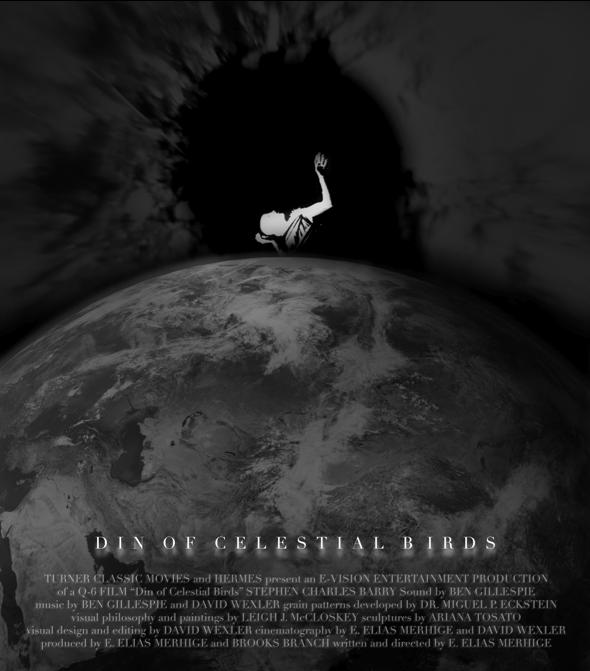
Din of Celestial Birds (2006) A film by E. Elias Merhige. Black and white, sound, 16mm, 14 mins.
American filmmaker E. Elias Merhige’s experimental film Din of Celestial Birds (2006) is the second part of an as yet unfinished trilogy of films, the first part being his bold and visionary debut feature Begotten. Most people coming to Din of Celestial Birds will have watched Begotten and are presumably expecting more of the gruesome and haunting imagery that distinguished the style of that feature, however as the movie begins, we are reassured to “Not be afraid … Be comforted … Remember … Our origin…”.
“A transcendental meditation on creation and consciousness”
I came away from the film thinking of it as Begotten enacted on a microscopic scale: a depiction of the divine mystery of creation through an exploration of processes prior to it, but where Begotten did so as a metaphorical psychodrama, Din of Celestial Birds does this as if a nature documentary of life, in a style reminiscent of Man Ray and other Surrealists.
The opening credits actually attribute the film to Q6, a collective consisting of a visual philosopher (whatever that is), a computational visual neuroscientist, a multi-media performance artist, a composer, and a sculptor; all of whom Merhige collected around him to produce the movie in a hands-on fashion employing techniques used by the work of cinema pioneers like the Lumiere brothers, Fritz Lang, and Jean Cocteau, in addition to software and technology created specifically for the film.
Though Din of Celestial Birds arguably ploughs the same furrow as its conceptual predecessor, the film is nevertheless testament to a unique artistic vision, exploring representations of the fringes of consciousness by challenging the limits of cinema.
Starring: Pia Zadora, Tom Nolan, Craig Sheffer, Michael Berryman, Ruth Gordon, Alison La Placa
“I still can’t believe you’re an alien. What a novelty act!” (Dee Dee, Voyage Of The Rock Aliens)
One day in the future, when I have children, there will come a day when I’m asked “dad, what were the ’80s like?”
I already know how I’ll respond. Without saying a single word I’ll gesture to the couch, insist they sit down, turn the telly on and make them watch Voyage Of The Rock Aliens. Just to fuck with them.
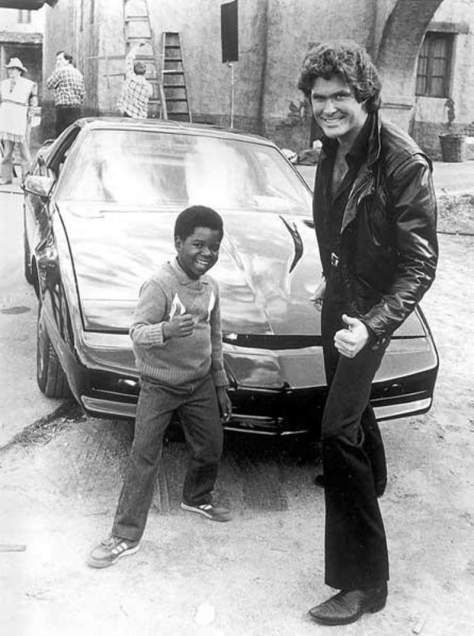
After all, as a massive fan of anything ’80s I reckon I’ve seen enough movies and TV shows to determine what best sums up the decade. And this, quite frankly, is the most ’80s thing I’ve ever seen by a long way.
And I’ve seen this photo:
You see, what we have here, friends, is a sci-fi musical comedy in which all the songs are the catchiest, cheesiest ’80s pop you can imagine. And it’s brilliant.
It tells the story of a bunch of aliens, led by the super-serious ABCD (pronounced ‘Absid’, naturally), who fly around space in a ship shaped like a massive Flying V guitar.
These aliens are tasked with exploring the galaxy and studying anything they find in order to try to locate the source of Rock & Roll. Guess where they end up? That’s right, Venus Earth.
Here’s one of them, STUVWXYZ. About as inconspicuous as a toe up the arse
More specifically, they land in the town of Speelburgh (ahem), where local prettyboy Frankie rules his fellow teenagers with an iron fist.
As the lead singer of his band The Pack, he’s somehow managed to impose some sort of musical dictatorship banning anyone else in the town from playing instruments or singing.
This includes his girlfriend Dee Dee (singer Pia Zadora), who fancies herself as the next big musical sensation but is being held back by Frankie’s harsh singbargo.
Enter the Rock Aliens, who you’d better believe are going to ruddy well sing and dance all they want because it’s all they know. And once they do, the rest of the Speelburgh teens – Dee Dee included – are blown away by their new musical style (which is basically Devo).
Mind you, Dee Dee’s got some singing skills too. Pia Zadora’s pretty good in this, actually
ABCD quickly takes a shine to Dee Dee, by which I mean his head literally explodes and his limbs fall off the first time he sees her. That’s not a figure of speech, that actually happens.
For some reason this doesn’t put Dee Dee off and the two fall for each other, with ABCD asking Dee Dee to join his band.
Dee Dee is thrilled, but how will she react when she discovers that ABCD and his bandmates are aliens? And is Frankie really going to let this weird prick win his girlfriend over? Dramaaaaaa.
I genuinely uttered the phrase “what the fuck is this all about” five or six times throughout the course of Voyage Of The Rock Aliens. And that’s no bad thing.
For example, you’ve got the opening sequence, set on another planet, in which Pia Zadora (playing someone else) and Jermaine Jackson sing their new single for no reason at all: after which Jackson fucks off and is never seen again.
“Let’s get out of here, Michael.” “I’m not Michael.” “You’re not?” “No, I’m Pia Zadora.” HAHAHA, YOU THOUGHT I MEANT JERMAINE JACKSON, OH CHRIST WHAT A TWIST
Then there’s the bizarre subplot involving two escaped mental patients, one of whom (The Hills Have Eyes‘ Michael Berryman) falls in love and sees the error of his ways.
These are but a few moments of madness: others include a robot helper (voiced by Peter ‘Optimus Prime’ McCulloch) disguising itself as a fire hydrant, an odd dance number set in a ladies’ toilet, and a giant mutant octopus thing which is sitting in the nearby lake waiting to take over the town.
Then there’s Ruth Gordon playing a bizarre sheriff who has a surprising lack of tact when phoning the families of accident victims:
“Am I speaking to the widow of John S. Lamont?”
“You must be mistaken, I’m not a widow.”
“The hell you’re not!”
This being a musical, the songs are naturally of great importance, and anyone into cheesy ’80s pop will be in heaven.
Each track is delightfully catchy and yet charmingly shit, with nonsensical lyrics all over the shop (“It’s the nature of the beast / I’m keeping up my status quota”) that often don’t have anything to do with the story. Which is sort of the point of songs in a musical, but fuck it, I’m giving it a pass.
The best of the bunch is definitely the opening track though (the one with Jermaine Jackson in it). Curious? Enjoy:
Of all the ’80s sci-fi musical comedies I’ve seen over the years, Voyage of The Rock Aliens is undoubtedly the best. It’s also undoubtedly the only, but let’s not try to ruin the mood.
Get some similarly ’80s-minded friends around, shit fancy dress optional, turn the volume as loud as it can go without the neighbours coming round to cave your face in, and enjoy a helping of delicious ’80s cheese so plentiful that you’ll having dreams about hairspray, synthesisers and robot fire hydrants for weeks to come.
In 1976, a controversial new book was released that contended the Apollo 11 moon mission never happened. We Never Went to the Moon: America’s Thirty Million Dollar Swindle was written by Bill Kaysing, a Navy midshipman and rocket specialist, who claimed to have inside knowledge of a government conspiracy to fake the moon landing.
Kaysing believes NASA couldn’t safely put a man on the moon by the end of the 1960’s (a promise made by President Kennedy) so they staged it instead. Kaysing’s theories were technical and persuasive and soon a movement of nonbelievers, inspired by the book, was born.
Whether you believed Kaysing or not was a moot point for American screenwriter and director Peter Hyams. A former TV news anchor, Hyams was more interested in how such a thing could actually be pulled off?
“I grew up in the generation where my parents basically believed if it was in the newspaper it was true,” Hyams said in an interview with a film trade magazine. For him, he admits, it was the same with television. “I wondered what would happen if someone faked a whole story.”
So he wrote a story based on the concept.
That was in 1972, four years before Kaysing’s book was released. Hyams shopped the script around but got no takers. Then something unexpected happened. Watergate broke and America was thrown into a government scandal at its highest levels. Interest in a story like a fake moon landing (in the movie’s case, the first manned mission to Mars) had appeal. In 1976, Hyams was given the green light to make his movie as part of deal with ITC Entertainment to produce films with a conspiracy bent.
“Capricorn One” was released in the Summer of 1977. “Would you be shocked to find out the greatest moment of our recent history may not have happened at all?” the movie posters read.
Reviews were mixed. Chicago Tribune film critic Gene Siskel called it “a surprisingly good thriller” while another critic Harry Themal said it was a “somewhat feeble effort at an adventure film.” Variety was even less complimentary calling it “underdeveloped” and the cast “scattershot.”
In the movie, Sam Waterston, James Brolin and O.J. Simpson play the three astronauts. Elliott Gould, Hal Holbrook, Telly Savalas, Brenda Vaccaro and Karen Black round out the cast. While Brolin was known mostly for his television role as Dr, Steven Kiley on Marcus Welby, M.D. Simpson was a celebrity athlete whose acting career was just beginning.
In hindsight the cast was impressive, but the actors weren’t as important as the story.
After the landing is staged and broadcast as real, the nation is told the three astronauts died instantly in a failed reentry. But Gould, as journalist Robert Caulfield, is suspicious. The astronauts, who are harbored, realize they have no recourse but to escape or be killed. “If we go along with you and lie our asses off, the world of truth and ideals is, er, protected,” say’s Waterston’s Lt Col. Peter Willis. “But if we don’t want to take part in some giant rip-off of yours then somehow or other we’re managing to ruin the country.”
From there its a cat and mouse game between the good guys and bad. A dramatic helicopter chase scene ensues. In the end, Caulfield with the help from Brolin’s character exposes the conspiracy.
The movie’s tag-line accentuated the drama:
The mission was a sham. The murders were real.
“In a successful movie, the audience, almost before they see it, know they’re going to like it,” remarked Hyams. “I remember standing in the back of the theater and crying because I knew that something had changed in my life.”
The film’s final chase scenes were pure escapism. “People were clapping and cheering at the end,” Brolin relayed to a reporter shortly after the film’s release.
Today, the film’s legacy may be in the conspiracy only. It’s impact may also have been diminished by the negative attitudes towards O.J. Simpson who in 1994 was charged and acquitted in the brutal murder of his ex-wife, Nicole Brown.
Even Hyams concedes to his own bizarre trivia: “I’ve made films with two leading men who were subsequently tried for the first degree murder of their wives,” he said referring to Simpson in Capricorn One and Robert Blake in his first film Busting (1974).
Fifty years later, on the 2019 anniversary date of July 20, 1969, the moon landing is still celebrated as one of man’s greatest achievements. “We choose to go to the Moon in this decade and do the other things, not because they are easy, but because they are hard,” President Kennedy prophetically said in 1962.
For some, apparently, that was just too hard to believe.
Several years after it happened, a movie showed how it could be done…Hollywood style.
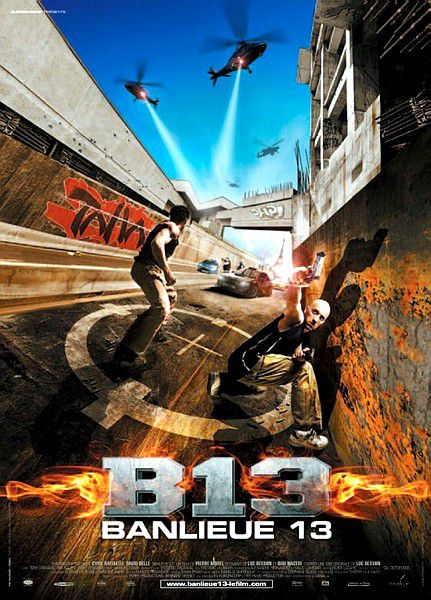
If the movies from French producer Luc Besson’s factory of B-grade actioners, District 13 (Banlieue 13, 2004) stands among the best. This is your typical martial arts-laden action extravaganza, filled with thumping techno music, a thin plot, and impressive stunts. But the increasingly prosaic clichés evident in Besson’s other films, which are also evident here, electrify with an uncommon kinetic energy. The action feels and looks real thanks to its stuntmen stars. The plot seems to have a social resonance behind it. And indeed the French soundtrack of techno and rap augments the no-holds-barred attitude of the movie.
The setting is Paris, 2010, which upon the release of this movie in 2004 was the future. Use your imagination. The city is plagued by unruly slums, and to isolate the problem areas, the government has erected a wall around a particular neighborhood known as District 13. The walls create a makeshift ghetto wherein all schools, all civil servants, and all hope has been evacuated. Inside, two million people are divided into various gangs and the police have no say, except that no one can leave through the guarded checkpoints. Drugs and crime run rampant on the streets within. Meanwhile, Elitist politicians would prefer to wipe this blotch off their maps entirely and start over.
Two heroes ban together to fight both a crime boss polluting the inside and political corruption stewing from outside the walls. One hero, Leïto (David Belle), comes from the slums. After being double-crossed by the local police, Leïto watches as his sister, Lola (Dany Verissimo), is taken hostage by the seedy gangster Taha (Bibi Naceri), and then he’s put in jail for 6 months to rot. Enter the other hero, supercop Damien (Cyril Raffaelli), who is commissioned by his superiors to go undercover, befriend Leïto, stage a prison break, and then use Leïto to sneak into District 13 to defuse a deadly bomb. The bomb was supposedly stolen from the government by the District 13 gangs, but this McGuffin proves to be slightly more complicated. And of course, Damien has only 24 hours to complete his mission.
Nevermind the plot, though. You’re not watching to find out what happens with Leïto, Damien, and the bomb. You’re watching to see the physical bravado of the two leads, as they demonstrate some of the most impressive stunts you’ve ever seen in any action movie. Belle and Raffaelli run across rooftops, leaping from building to building with ease. They scale obstacles and scuttle across walls like Spider-man. Whenever surrounded by a horde of goons, the heroes take them down without a minimum of fuss, exacting fisticuffs with a seemingly effortless precision. Through it all, they keep up a light banter that keeps the tone chummy and enjoyable.
Belle and Raffaelli are actual stuntmen and practitioners of a street-born, pseudo-martial art known as Parkour. According to the definition of those who practice it, “Parkour is the physical discipline of training to overcome any obstacle within one’s path by adapting one’s movements to the environment.” As opposed to a direct defensive strategy such as karate or jujitsu, Parkour involves running and jumping with fluidity, dodging obstructions with competence and speed through a complete awareness of one’s surroundings. But all you need to understand Parkour exists within this movie. The most amazing scenes aren’t those brimming with violence, they’re the chase scenes where Parkour skills are used to escape.
Director Pierre Morel, who would later helm Taken and From Paris with Love for the American market, exhibits clear and decisive action. The editing captures all the movements of Belle and Raffaelli with amazing clarity, whereas action movies nowadays so often rely on shaky-cam to disguise the stuntmen standing in for big-name stars. There’s nothing to hide in District 13, however, as Belle and Raffaelli complete the stunts and the fights themselves. Comparable to Jackie Chan in his heyday, these actors have the charisma, humor, and ability to advance themselves from stuntmen to stars, and they advance this movie from another dull actioner to must-see entertainment.
One day, many years ago, an ancestor of Fiona spied a beautiful creature sunning by the sea. She was both woman and seal. We would call her a mermaid, but on that western coast of Ireland such creatures were well-known as Selkies.
The ancestor trapped the creature and married her, and they had children together and lived happily, although she seemed to long for the sea. One day she learned where her husband had hidden her sealskin, up under the roof, and she put it back on, and returned to the sea.
Fiona (Jeni Courtney), who is 12 or 13 years old, is told this story by a relative. It is not told as a “fairy tale” but as an account of family history, to be taken quite seriously. And well might Fiona believe it, because ever since there have been dark-haired children in her family who were said to throw back to the Selkie, and whose eyes turned yearningly to the sea.
The year is about 1946. Fiona’s mother has died, and her father can barely be budged from his mourning in the pub. She is sent to live with her grandparents, on a sea coast across from the island of Roan Inish, where the whole family once lived. There she learns the story of her little brother Jamie, whose cradle was carried off by the waves. And there, with her grandparents and her cousin Eamon (Richard Sheridan), she first explores Roan Inish, which means, in Gaelic, “island of the seals.” The secret of John Sayles‘ “The Secret of Roan Inish” is that it tells of this young girl with perfect seriousness. This is not a children’s movie, not a fantasy, not cute, not fanciful. It is the exhilarating account of the way Fiona rediscovers her family’s history and reclaims their island. If by any chance you do not believe in Selkies, please at least keep an open mind, because in this film Selkies exist in the real world, just like you and me.
On Roan Inish, the girl sees a child’s footprint. Then she sees the child – Jamie! – running on the sand. She calls to him, but he gets back into his cradle, which is borne out to sea by friendly seals. Of course it is hard to convince grownups of what she has seen.
In the meantime, her grandparents face eviction from their cottage, which is to be sold to rich folks from the city. They may have to move inland. “To move off of Roan Inish was bad enough,” Fiona’s grandmother says, “but to move out of sight of the sea . . .” She shakes her head, making it clear that it would kill the grandfather, who thinks of the city as “nothing but noise and dirt and people that’s lost their senses!” Can Fiona and Eamon, her young cousin, restore the family’s old cottages on Roan Inish? Can she reclaim Jamie from the sea? I found myself actually caring. John Sayles and Haskell Wexler, who has photographed this movie with great beauty and precision, have ennobled the material. There is a scene where a person numbed by the cold sea is warmed between two cows, and we feel close to the earth, and protected.
One can easily guess how this legend could have been simplified and jollied up in other hands – how it could have been about cute little Selkies. But legends are, after all, told by adults, not children, and usually they record something essential to the culture that produces them. What this legend says, I think, is that the people who tell it live on the land but live from the sea, so that their loyalties are forever divided.
Of course this is a wonderful “family film,” if that term has not been corrupted to mean simpleminded and shallow. Children deserve not lesser films but greater ones, because their imaginations can take in larger truths and bigger ideas. “The Secret of Roan Inish” is a film for children and teenagers like Fiona, who can envision changing their family’s fate. It is also for adults, of course, except for those who think they do not want to see a film about anything so preposterous as a seal-woman, and who will get what they deserve.
The best science fiction always uses some trend or policy of the present as a foundation and projects it into the future with a picture of some possible results. Through this glimpse of tomorrow, we can ponder anew the spiritual or philosophical ramifications of what we are doing today. In The Adjustment Bureau, we were given a chance to assess the idea of free will or the alternative of following a plan mapped out by God. In Gattaca the idea of genetically engineered perfection is explored. Writer and director Andrew Niccol who wrote and directed the latter thriller is also at the helm of this thought-provoking sci-fi drama that has many resonances with today’s world.
The Preeminence of Time
A search on Google for “time” yields more than 11 billion hits whereas there are fewer than 3 billion hits for “money” and 241 million hits for “sex.” Time is very much on our minds and at the hub of our concerns. We speak of “having” and “saving” and “wasting” time but we never seem to find a way of “conquering” it. We are caught up in the obsessive-compulsive need to make the most of the time we have each day. Pagers and cell phones are taken everywhere. We don’t want to miss a moment of connection.
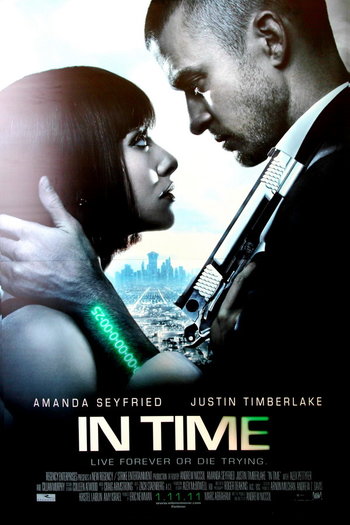
In Time is set in a future dystopia where living zones separate the rich from the poor. Will Salas (Justin Timberlake) lives in a ghetto zone with his mother Rachel (Olivia Wilde). She looks very young since all aging stops at 25.
Will works in a factory and she has a job as well, but still it is hard to make ends meet. Time in this society is literally money. Each person has a timer on his or her arm and at 25 you are given one year of free time after which you die — unless you can find a way to get more time. Wages are doled out in days of added longevity. All expenses (rent, a cup of coffee, clothes, phone calls) are paid for with time and scanners are used to deduct the time for the purchase. The biggest fear in the ghetto is that your time will run out unexpectedly. That is exactly what happens to Will’s mother.
Time Is Strange
“Time is stranger and deeper than anything else in our lives.” — Jacob Needleman
The biggest dream in the ghetto is acquiring a surplus of years and the prospect of immortality. When Will saves a young man with a century on his clock, the fellow gives the years to him and then commits suicide. An intrepid “Timekeeper,” Raymond Leon (Cillian Murphy), is convinced that Will stole the years from the dead man. He launches a man hunt for him. Also hot on Will’s trail are some nasty time thieves.
Caught in Time
“Time is the element in which we exist. We are either borne along with it or drowned in it.” — Joyce Carol Oates
Will begins a daring journey into the zone for the time rich called New Greenwich. After winning more than a millennium at a casino, he meets Sylvia (Amanda Seyfried), the daughter of Philippe Weis (Vincent Kartheiser), an immensely wealthy and powerful banker who has been exploiting the poor by making high interest time loans. A believer in “Darwinian capitalism,” he’s stored up enough years to be immortal. But Sylvia thinks there must be more to life than the favored existence she knows. She is intrigued by Will’s wild ideas about changing the system which favors the rich over the poor and allows many to die so a few can be immortal. After he takes her hostage when the Timekeeper is closing in on him, Sylvia doesn’t take very long to pledge her allegiance to what becomes their own mutual crusade. They begin robbing time banks and giving time to the poor and the down-and-out.
In Time is a winning sci-fi thriller that taps into some of the troubling problems of our era, such as the view of time as money, the growing gap between the rich and the poor, and all the ways that we waste time and fail to value every moment. It is also a meditation on the healing and restorative medicine of generosity and sharing. Writer and director Niccol has given us a cautionary tale about the possible future consequences of class consciousness, the high cost of trying to stay young or live forever, and the need for something more meaningful than just spending time to get ahead of the game.
Bong Joon-ho has always been interested in the mechanics of genre cinema. The South Korean director has made a career of subverting established genres in an intelligent, meaningful manner. In The Host and Okja, he took the creature feature and added socio-political subtext to it. The serial killer thriller, Memories of Murder, highlighted police incompetence in South Korea and the Hitchcockian murder mystery, Mother, revealed the cultural divide between men and women in Korean society.
Fortunes change when Ki-woo falsifies his credentials to land a tutoring job with a wealthy couple, Mr Park (Lee Sun-kyun) and his gullible wife Yeon-kyo (Cho Yeo-jeong). While he teaches their daughter Da-hye (Jung Ziso), he learns that their troublesome son Da-song (Jung Hyeon-jun) also needs help improving his drawing skills. Ever the opportunist, he recommends his sister — not revealing her real identity of course. She recommends her father as a driver after getting the previous one fired by setting him up as a sex fiend. Ki-taek then recommends his wife to take over as housekeeper after a scheme involving the most creative use of peaches since Call Me By Your Name. After their clandestine infiltration operation into the Parks’ lives is complete, the story makes so many intense and unexpected twists and turns, it turns into a whole different beast altogether.
The cast of Parasite deliver performances of exceptional psychological acuity and perverse frivolity. Led by Bong’s frequent collaborator Song Kang-ho, they are sure to conjure the loudest of laughs and the strongest of emotional reactions from their audiences.
Bong brilliantly uses the upstairs-downstairs distinction in the Parks’ house to reveal a socially divided society. And the society is not just divided by wealth but also culture. Bong revisits a familiar theme of the proliferation of American values over traditional Korean ones. The Parks are a Westernised family who live in a sleek, modernist home with white picket fences — and who buy toys and gadgets from the US, exemplifing the upper crust. Ki-taek’s family, meanwhile, lives in a sordid apartment in the basement, where cockroaches thrive and drunkards urinate on their windows. So, with Parasite, Bong tries to bring to light this deep, festering malady at the heart of Korean society.
Parasite offers a cleverly paced, thoroughly entertaining blend of sumptuous visuals and wickedly dark humour. The music too makes the plot twists and revelations hit that much harder.
Despite the cultural and language barriers, Parasite is an unforgettable cinematic experience as it speaks to universal ideas, themes and emotions. If Bong Joon-ho’s style of genre filmmaking hasn’t become an adjective already, it sure is time now.
People put their faith in the strangest things. Some feel their god will return to cast down judgment on humankind. Others are certain beings from another solar system planted genetic material on Earth to create life. And some believe, or perhaps not, that a flying spaghetti monster lives in the sky. Here’s another one: Folk music history tells us a train called the Southern Pacific Golden Gate Limited ran near Sugar Land prison in Texas, where legendary Blues man Lead Belly heard it passing. He and other inmates believed the train represented some sign of hope that soon they would be set free. Lead Belly later popularized a song about it, called “Midnight Special”, featuring a lyric in which he asks the train to “shine a light on me”. Apart from memorable covers by Harry Belafonte, Bob Dylan, and Credence Clearwater Revival, Lead Belly’s folk song informs the title of writer-director Jeff Nichols’ fourth film, Midnight Special.
People in the film believe some strange things, too. Some of them believe a young boy will grant their way to salvation, while the government believes that same boy is a threat to national security. But more on the specifics later. These belief systems pervade Nichols’ screenplay, a slow-burner infused with soulful character depth and science-fiction underpinnings. Midnight Special has much in common with Nichols’ excellent Take Shelter (2011), about a working-class family plagued by the father’s apocalyptic premonitions. That otherwise grassroots, southern-fried suspenser contains fantastical elements, though really it’s about the extremes people will go to chase what they believe. Nichols has explored similar American spirituality in his other two films, Shotgun Stories (2007) and Mud (2011). Each of his films demonstrates the potential danger inherent to blindly following our beliefs and convictions.
Nichols’ calculated opening demands the audience take time to figure out what’s happening and why, who the good guys are, and in the end, what just came to pass. It’s a picture audiences must feel their way through in the best possible way. An Amber Alert blares across the television screen, a reporter notifying us a young boy named Alton has been kidnapped by a man named Roy. As the shot pulls back, we find ourselves in a motel room with Roy (Michael Shannon, severe as ever) and Alton (Jaeden Lieberher), who, behind an ever-present pair of swimming goggles, reads a comic book by flashlight. Also in the room is a crew-cut man of action, Lucas (Joel Edgerton). They’re waiting until the sun goes down to continue their getaway. Lucas drives fast and without headlights, wearing night vision headgear to see the highway in the pitch dark.
Nichols cross-cuts to things at “The Ranch”—a Texas compound not unlike David Koresh’s Branch Davidians—populated by old-world types in hand-sewn garb. They’re led by a quietly intense organizer named Calvin (Sam Shepard), who wants Alton returned to him. The FBI raids The Ranch and puts everyone on buses to a secure location. They ask questions about Calvin’s people buying guns and about Alton’s kidnapping. A bookish NSA specialist named Sevier (Adam Driver) wants to know about Alton, who came in contact with him, and what they know about the boy’s abilities. And so we must wonder, why so many questions about this boy? The answer: When Alton is exposed to the sun, beams of light shoot from his eyes; he seems to speak in tongues; he can give people visions; in space, satellites meant to detect nuclear explosions spy an energy source emitting from him; he also picks up radio signals in his head.
But what is he? Nichols never answers that question outright. Over time, we learn Roy is Alton’s father, and Lucas is Roy’s friend, and together they’re protecting Alton from The Ranch and the government. All parties concerned feel a great power exists inside the boy and, though they don’t completely understand it, they fearfully pursue and defend him. Soon Alton’s mother (Kirsten Dunst) joins Roy and Lucas, aware of the entire plan. We learn all of Alton’s peculiarities have a hidden encryption, coordinates that point to a certain spot on a specific day. Everything depends on getting him there on time. And gradually, as men from The Ranch get closer to recapturing Alton, and the government goons track down their perceived threat, we get a greater—but not clearer—sense of what might occur if and when Alton arrives at his destination.
Rather than frustrating, that lack of transparency is engrossing, as Nichols drops hints here and there, while he binds us to the often moving, unquestionably engaging proceedings through subtle character work. So what is Alton? He finds great interest reading a Superman comic, so perhaps he’s something like Superman, a powerful alien. Perhaps he’s a messiah sent to protect people at The Ranch. Maybe he’s an advanced form of human with mutant powers, a time traveler, a living weapon, or an inter-dimensional being. Whatever the answer, it’s less important than the real-life descriptions of the humans on Nichols’ journey. His actors carry impressive weight and gravitas, particularly Shannon, who has appeared in each of Nichols’ films. But the entire cast brings substance to their performances, involving the audience in the tense, measured development of the story.
Both narratively and technically, Nichols has used the films of Steven Spielberg and John Carpenter to inform Midnight Special, but not in such a way that it feels distractingly derivative. From the perspective that the film operates as a road movie driving toward some manner of grandiose sci-fi conclusion, the film feels like Close Encounters of the Third Kind; the ending, too, resembles Spielberg’s wondrous 1977 effort. Elsewhere, Starman (1984) comes into play, as everyone who meets Alton gravitates to his kindness, soulful sureness, and power, just as everyone in Carpenter’s film found Jeff Bridges’ alien character a kind of angelic figure. Even the ending seems to combine the finales of these two films, with a touch of E.T.: The Extra-Terrestrial. The film also bears some similarity to Tomorrowland, although the association is undoubtedly unintentional. All the while, Adam Stone’s textured 35mm lensing captures familiar lens flares and widescreen compositions from Carpenter and Spielberg that influenced Nichols.
Questions about what happens in its marvelous climactic scenes aside, Midnight Special shines a light on the audience by offering a unique combination of the realistic and out-of-this-world. Nichols develops thoroughly dimensional characters, even among the not-irredeemable “villains” of the story. The director cares about Roy’s heavy brow and Sevier’s sense of unsure awe; with them, he develops intimate moments that effectively resonate further than the sci-fi gimmick. He never overplays the drama, such as a scene in which Alton tells his father not to worry about him. Roy replies, “I like worrying about you.” The understatedness of Nichols’ drama, the poignancy, renders a picture about how people react to what they believe or do not understand. Some embrace it; some fear it. No matter the reaction, Nichols finds a way to represent that through an engaging metaphor in his profoundly affecting and, in many ways extraordinary thriller.









 After the Crash