Saturday Matinee: Melancholia

Melancholia Review

By Ewan Gleadow

Source: Cult Following

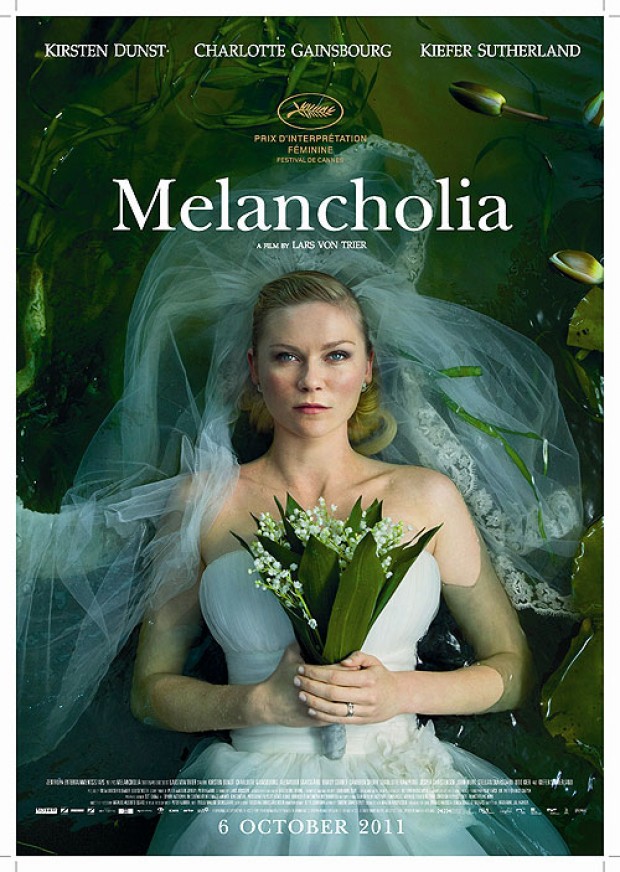
Uncomfortable productions are the forte of director Lars von Trier. The allusions to and disquieting effect of his features and their focus is something to be realised in the prime of his works. What that area is can be debated and pulled at, but Melancholia appears to be the poetry in motion Trier fans so often praise the director for. Musical accompaniments to still shots of paintings that slowly peel and ripple. It’s a delightful piece for those that love the artisan qualities of a world falling apart and the destruction that comes from character sleights. The immovable nothing that comes from it touches deeper and deeper as Melancholia, the finest Trier work, rages on.

That much comes from the absolute beauty of its structure, of its characters. Shaped and informed by destruction, moving paintings that take place on strange canvases that display torment and passion, family and love. Melancholia has all the time in the world for its visual chemistry and the representations it can bring. There is no tiring effect brought by Trier, who trusts in his lengthy segments of two worlds, quite literally, colliding. Audiences are placed right at the end and know what is to come, what fate the characters meet and how it all comes to a crashing bit of destruction. In identifying the hopelessness, Trier brings himself to the inevitable edge that comes from discussing finality. It feels a bit like what The Fountain tried and failed to comment on, but with much, much more scope than the Hugh Jackman-led piece.

Within Melancholia is the profound beauty of visual meaning. It is a piece that relies more on the slower motions and relationships told in flutters rather than a full-on narrative that demands and desires strict following of the story. There is a fast and loose layer to Trier’s work, where his direction provides beauty and colour with that fear. Kirsten Dunst delivers a phenomenal catalyst for life. It gives the happiest moments of life and the cursed afterthoughts. Trier mixes the palette well, he provides that to the cast and relies on them so frequently to engage with the emotion, rather than dialogue. It is the choreography, and the appeal of his directing style, that makes Melancholia such an intoxicating watch.

Senseless destruction with poetic twists and turns at their finest, Melancholia is a touching and spiritually charged look at the useless tirades and meaninglessness of it all. With Melancholia exposing itself to the raw elements, it does often focus on its imagery more than its characters. Trier’s style, the unfocused extremes of the close-up shot, the shot-reverse-shot simplicity, it all has its place but where that is can come across as unfounded. His fly-on-the-wall appeal has its moments throughout this piece, with a triple threat of Charlotte Rampling, John Hurt and Stellan Skarsgård making the most of that. There is no harm in stacking the cast so high, it adds texture and richness to an already broad-in-scope feature. Melancholia feels right at home biting off more than it can chew, both narratively and emotionally.

____________________

Watch Melancholia on Kanopy here: https://www.kanopy.com/de/product/69665

Saturday Matinee: Lessons of Darkness

By Martin Purvis

Source: The Film Sufi

Werner Herzog’s documentary films lie at an extreme distance from the Anglo-American tradition of documentary filmmaking. Part of that distance can be linked to the distinction between two fundamental stances towards the depiction of reality: “Objectivism” and “Interactionism”, which I have discussed in other essays, for example, Avatar (2009), Close-Up (1990), and SiCKO (2007). American documentarians generally align themselves with Objectivism and hold that they are presenting an objective view of reality. An extreme form of this approach is “direct cinema”, which seeks to create the illusion that the filmmaker is an invisible “fly on the wall” and has no impact on the subjects being filmed, thereby supposedly ensuring scientific objectivity. But even in more conventional American documentaries with explicitly polemical content, there is a presumption that objective reality, independent of any observer, is being presented. Continental European documentary filmmakers, on the other hand, have had a tendency to lean towards Interactionism and have made more personal films in which the filmmaker and his or her point of view is a confessed part of the narrative. Herzog is so much on the Interactionist side of the ledger that his documentary films not only include his personal perspective, but seem primarily to be his own personal essays about the world – he, himself, is an implicit focus of the film, and the “reality” depicted is self-consciously Herzog’s own reality. Lessons of Darkness (Lektionen in Finsternis, 1992), which was shot in Kuwait in the immediate aftermath of the First Gulf War (1990-91) is one such example of Herzog’s style.

Although focussed on the harrowing events and ravages that happened in Iraq and Kuwait during that time, Lessons of Darkness has clear-cut affinities with Herzog’s first documentary Fata Morgana (1971), which was shot in Africa. In that earlier film Herzog edited footage that he had (seemingly randomly) shot in the African Sahel and tried to fashion a dark vision about man’s hopeless ineffectiveness, and consequently likely impermanent existence, on the planet – an ephemeral existence like a mirage. Some twenty years later, with Lessons of Darkness, Herzog again collected footage, this time in Kuwait, and then assembled his photographic essay in post-production, and again his vision is one of dark apocalypse and pessimism concerning man’s prospects for a sustainable future. In fact both Fata Morgana and Lessons of Darkness contain vague commentary that suggests that humankind on Earth is being clinically observed, with amazement and horror, by a visitor from another planet. However, in neither film is there any real narrative or sequence of events that could amount to a story – they are both more or less personal essays of despair. But if we assert that they are both cinematic commentaries, we have also to concede that neither of these two films provides an explicit disquisition or argument, or even has a clearly articulated thesis. What we are really presented with is just a suggestive sequence of images, on which the viewer reflectively fills in many of the blanks and faces a greater-than-usual task of constructing his or her own story or vision. This process of placing much of the narrative burden on the viewer essentially fails with Fata Morgana (which was almost a random collection of lurid images of garish and pathetic human folly), but is more successful with Lessons of Darkness, primarily because the viewer in this case is more likely to bring to the film considerable familiarity with what happened during the “First Gulf War”and use that material for his own imaginative reconstructions.

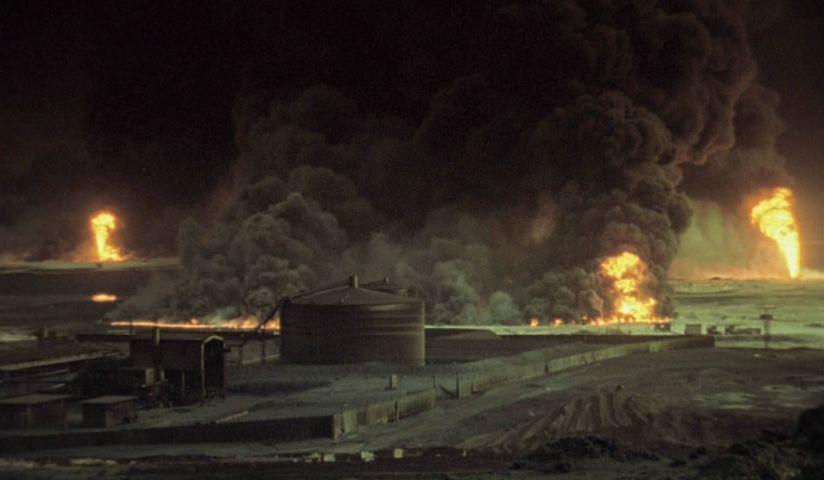
The greater part of Lessons of Darkness consists of lurid scenes of fires in the Kuwaiti oilfields burning out of control and spewing gargantuan clouds of smoke. These images are interspersed with images of devastation, both at the physical and human level, and with human firefighters seemingly overmatched in their efforts to quell the multiple, raging infernos. The images are apparently meant to be abstractly horrific, and there is almost no spoken dialogue and no explicit reference to the Gulf War, or to specific places, or to any historical context. To set some kind of context, Lessons of Darkness opens with images of wasteland and destruction, and the prologue refers to a planet “in our solar system” which evidently has undergone a catastrophic war. So the viewer sees things simultaneously with respect to two overarching narrative perspectives: the real Gulf War and an abstract metaphorical fable of how bizarre humankind’s self-destructive impulses might be to a detached, external observer. The film is then presented partitioned into thirteen chapters, each identified by apocalyptic, perhaps oracular, intertitles which suggest chapters to some sort of apocryphal Book of Revelations.

  1. “A Capital City”. This section features an opening voiceover narration with images of Kuwait City filmed from a low-flying helicopter, ominously suggesting that this doomed city will soon be utterly destroyed by warfare (it wasn’t, and this footage was filmed after the conflict).
  2. “The War”. Here is shown footage of the aerial bombing of Iraq as seen via night-vision video cameras. Although this section is relatively short and no mention of “Operation of Desert Storm” is made, the context is likely to be familiar to a worldwide audience, since it was widely viewed on CNN.
  3. “After the Battle”. Images of war devastation are presented.
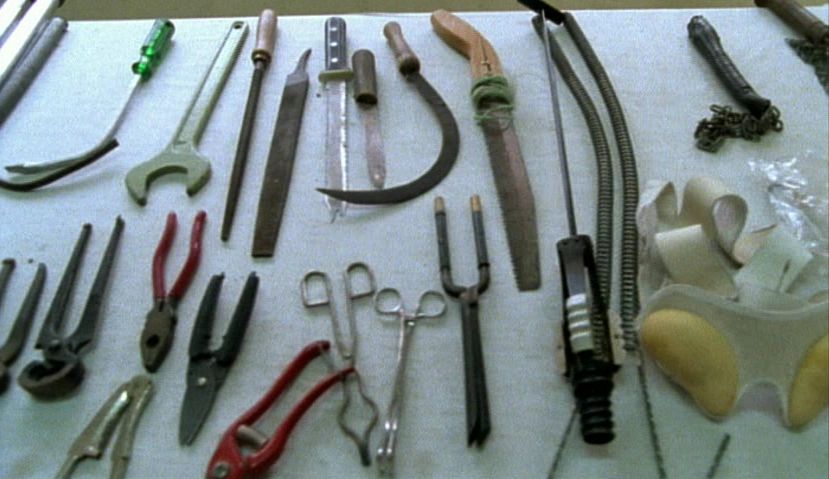
  4. “Torture Chambers”. This thankfully brief section is one of the most memorable, though difficult to bear, sections in the film. First is shown what is apparently the insides of one of the torture chambers run by Saddam Hussein’s government, and it features a mute display of mechanical devices designed to inflict unbearable pain. Then an Arab woman is shown who was been rendered almost permanently speechless by having been forced by the authorities to witness her own sons being tortured to death.
  5. “Satan’s National Park”. Helicopter footage of what seems to be a vast marshland are revealed to be in fact entirely flooded with oil.
  6. “Childhood”. Another Arab mother is shown, this time with a young, disturbed boy who has been rendered speechless by what he has witnessed during the conflict. As with the woman shown earlier, the horror of what happened is not shown, it is only something so unspeakable that one cannot bear to think about it. The viewer’s imagination then fills in the blanks.
  7. “And A Smoke Arose Like The Smoke From A Furnace”. Here, 23 minutes into the film, the raging fires take over the screen. Again, they are filmed from low-flying helicopters.
  8. “A Pilgrimage”. Now the (American) firefighters are shown, sometimes relatively up close and at other times at a distance and dwarfed by the towering flames of the fires that burn endlessly. This section shows the firefighters using explosives to try to put out the fire.
  9. “A Dinosaur’s Feast”. This is more or less a continuation of the previous section showing the firefighters, but now emphasizing some of the huge construction and excavation machines employed in their work. The machinery has monster-like appearances, with arching cranes, serpentine bodies, and huge digging claws.
  10. “Protuberances” – a brief section showing closeups of oil–and-mud swamps bubbling and frothing, and evoking more nightmarish images of Hell.
  11. “The Drying Up of the Wells”. The oil-covered firefighters are shown, often in slow-motion, intensely engaged in the mechanics of their operations. The functional nature of these activities is incomprehensible to the typical viewer, and it all appears perhaps as an abstract Ballet Mécanique from the dark side. The macabre strangeness of it all, and the degree to which these operations seem to be foreign to what we might call normal human intercourse, are worth comparing to Louis Malle’s documentary, Humain, Trop Humain (1974).
  12. “Life Without Fire”. With many of the fires now apparently having been extinguished, the voiceover commentary of the interplanetary visitor expresses wonder as these strange creatures to him (i.e. the firefighters) engage in the baffling act of relighting an extinguished geyser of oil. He comments: “Has life without fire become unbearable for them? . . . . . Others, seized by madness, follow suit. . . . . Now they are content, now there’s something to extinguish again.”
  13. “I am So Weary of Sighing, O Lord, Grant That the Night Cometh”. The final portion returns to the fires, themselves, carrying with it an air of resignation and gloom.

Herzog’s fascination with fire extends to a fascination with its opposite, darkness (hence the title). The demonic forces that lurk inside the hearts of men seem to be beyond civilized understanding or rational control. These issues of cruelty and madness are as elemental as fire, itself, and are not confined to the Middle East [1]. This apparently was Herzog’s project: not to focus on just the particular horror of what happened in one part of the globe, but to fashion a fiction that would portray a more universal damnation. To this end, he opens the film with his own fabricated quotation (“The collapse of the stellar universe will occur, like creation, in grandiose splendor”) which he probably attributes to Blaise Pascal in order to give it the appropriate resonance – Pascal is perhaps not so well-known to English-speaking audiences, but his genius occupies a peculiarly iconic place in the European mind.

The horror that Herzog attempts to convey by his images of man-made Hell is enhanced by its unspeakable nature – it is beyond human articulation. Instead of a deafening roar from the fires drowning out occasional shouts from the firefighters, much of the stoundtrack is filled with funereal, dirge-like orchestral music from Mahler, Prokofieff, Verdi, Wagner, and Arvo Part. The unspeakable nature of this horror is explicitly referenced by the two mothers: one mother is unable to speak comprehensibly, and the child of the other mother has been rendered speechless by rational choice. It is left to our imaginations to fill out these nightmares.

Notes:

  1. For example, consider the use of germ warfare by the Japanese during the Second Sino-Japanese War (1937-45). Here is a quotation from an article on the subject (Judith Miller, “When Germ Warfare Happened”City Journal, (Spring 2010)):

“The methods were brutal. Army trucks dumped gallons of deadly germs alongside roads and railway lines linking Chinese towns so that infections would spread from town to town; planes dropped porcelain bombs containing infected fleas on dozens of villages, causing devastating outbreaks of bubonic plague. The Japanese laced more than 1,000 wells in the area of Harbin with typhoid bacilli. They also inserted typhus into bottles of lemonade that children loved to drink in the summer, Harris reported. In Nanking, they distributed anthrax-filled chocolate and cake to hungry children. The Japanese discovered that packing fountain pens and walking sticks with deadly germs was a particularly effective way of secretly disseminating them. In 1940, Major General Ishii sent a train carrying 70 kilograms of typhus bacterium, 50 kilograms of cholera germs, and 5 kilograms of plague-infected fleas to the city of Hangzhou, a holiday resort favored by Shanghai’s wealthy. From there, the germs were dumped into ponds and reservoirs and spread by aerial spraying, contaminating all life in fields of wheat and millet during the harvest.”

Saturday Matinee: The Bear

Film Review by Frederic and Mary Ann Brussat

Source: Spirituality & Practice

The Bear is an unusually involving story about animals that will give you a fresh perspective on their world. It is not a documentary nor is it the kind of cute children’s fare usually cranked out by Hollywood. This strange and affecting film is directed by Frenchman Jean-Jacques Annaud (Quest for Fire) based on a 1916 novel by James Oliver Curwood set in British Columbia in 1853.

When a young bear’s mother is killed by a rock slide while she is trying to extract honey from a beehive, he wanders off into the wilderness whimpering. After several misadventures, the cub finds a protector in a ferocious grizzly bear who has been shot in the shoulder. The cub licks his wounds and soon the two are partners. The giant bear introduces the little vulnerable one to a wider world — catching fish, tracking down and killing a caribou, and knocking down trees to demonstrate strength in a courtship ritual with a female bear. The cub must then square off against hunters and a menacing mountain lion.

The scramble for survival in this wilderness world is exhausting. The cub manages a few moments of reverie — seeing the moon’s reflection in a pond and swirling around after eating a mushroom. Watching him mimic the elder bear’s activities, it is difficult to remember that this is a story being directed rather than a glimpse of life in the wild. Philippe Rousselot’s photography is magical, and the musical score by Philippe Sarde adds emotional breadth to the story.

The Bear has all the marks of a classic. Lauded by animal rights groups for its respect for the integrity of all species, it manages to speak out eloquently against the senseless hunting of wildlife without having to depict killing to make its point. Instead, it emphasizes the ties that bind the human and animal worlds together.

Saturday Matinee: Holy Motors

What do limos know that we don’t?

By Roger Ebert

Source: RogerEbert.com

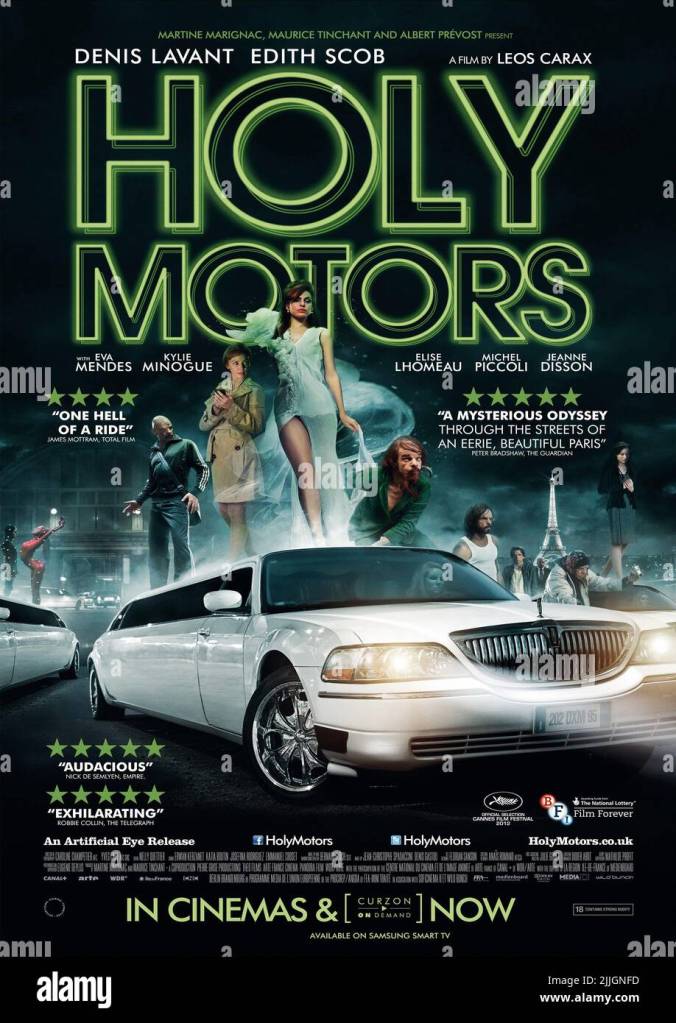
We know he lives in movies because we literally find him in one. Leos Carax’s much-debated “Holy Motors” begins with a man (Carax himself) asleep in bed, then waking and approaching a wall of the room that looks like a forest. Knowing just where to look among the trees, he unlocks a door using a key growing from his finger. Well, isn’t that what artists do? Unlock doors with their fingers?

Now this man is inside a cinema, and we meet Monsieur Oscar (Denis Lavant), who lives in a house that seems designed by the same architect employed in Jacques Tati’s “Mon Oncle.” He gets into the waiting limo, driven by a taciturn woman, and we see that the back of the limo, seemingly much larger inside than the outside, is a dressing room filled with costumes and props. When he gets out the first time, he has transformed himself into a wretched beggar woman. This will be the first of his many roles, or assignments, or embodiments. He performs in bizarre and mysterious ways, linked only by the desire of a mime or comedian to entertain and amaze us. His “appointments” take him into personas so diverse, it would be futile to try to link them, or find a thread of narrative or symbolism. If there is a message here, Walt Whitman once put it into words: “I am large. I contain multitudes.”

Here is M. Oscar as a madman wandering street markets and eating flowers or whatever else he can snatch up. M. Oscar in the most famous cemetery in Paris, Pere Lachaise, occupied by the dead and famous (Moliere, Chopin, Jim Morrison, Colette, Oscar Wilde). In “Holy Motors,” however, the cemetery’s tombstones carry no names, requesting us, to “visit my web site.”

Here is M. Oscar transforming a fashion model (Eva Mendes) into a Muslim woman concealed within her costume. And that’s not all that happens to her, although she adheres to the model’s code and never betrays emotions or opinions. Her job is to embody a beautiful object for the purposes of others. Their travels through the city lead to the roof of the Samaritaine department store, producing stunning vistas of Paris.Celine (Edith Scob), his reserved chauffeur, seems long accustomed to her role. Once she expresses concern that M. Oscar hasn’t eaten all day. Their day began at dawn and lasts far into the night, one “appointment” after another.This has been a year of leading roles for limousines. M. Oscar’s car upstages the limousine in David Cronenberg’s “Cosmopolis,” and the journeys of both cars seem to be odysseys through their cities, for purposes not very clear to the audience. “Holy Motors” is the more entertaining and funny of the two, although some parts are not funny at all, and many laughs are of disbelief or incredulity. Both end with their limousines going home for the night, answering a question asked in “Cosmopolis,” although when the limo in “Holy Motors” gets home, its day is far from over.Here is a film that is exasperating, frustrating, anarchic and in a constant state of renewal. It’s not tame. Some audience members are going to grow very restless. My notion is, few will be bored.

Saturday Matinee: Enter the Void

Enter the Void and the Inhuman Condition

By Matt Cipolla

Source: RogerEbert.com

“I know it is coming, and I do not fear it, because I believe there is nothing on the other side of death to fear … I was perfectly content before I was born, and I think of death as the same state.” — Roger Ebert

Inaccessible as mortality itself and as jolting as a bullet to the back, Gaspar Noé’s “Enter the Void,” which made its Cannes debut ten years ago this month, is a science fiction movie, but it isn’t worried about what exists outside our world. It isn’t concerned with aliens or spaceships. It’s about what we’re all obsessed with—pretending to live, refusing to die, and latching onto any ersatz empathy just for the sake of hope. It isn’t an optimistic film in its depiction of the afterlife, but that’s entirely the point—and that’s what makes it sort of beautiful.

Writer/director Gaspar Noé has been a staple of the New French Extremity movement since the turn of the millennium. His debut feature, “I Stand Alone” (1998), was a cauldron of rage centered on a man so seething the audience had to strain to see his humanity. “Irreversible” (2002) existed in the same narrative universe but was thematically adjacent more than anything else. They were neck-deep in social nihilism, drowning in the worst of human nature. But while they were each an hour-and-a-half of vitriol, “Enter the Void” acts as the answer to that: a nearly three-hour dissociation of living, dying, and repeating, all from an atheistic view.

Noé has regularly disagreed with the concept of a higher power and life after death. This isn’t too surprising given how antitheist his films are, and while “Enter the Void” is much more spiritual than his other films, it’s also much more accepting of death. That may sound depressing in theory, but Noé is so comfortable in his beliefs that there’s little room for depression. Here, death is not sad. It’s nothing to fear, or hate, or cry about. It simply is.

“Death is an extraordinary experience,” Noé told the Irish Times. “I believe that. No one can really tell you what it is like because once you’ve experienced death, you are done. But it only happens just once in your life. By its nature it is extraordinary. If you are suffering or in pain, death is the best thing that can happen. I’m annoyed by a culture in which death is always considered something bad.”

“Enter the Void” revels in death right away by treating it like a breath of fresh air in a world hogtied by plastic. First, the film dives into its opening credits, an assault of flashing words and staccato techno music. It’s hypnotic, sure, but it also feels like a game of chicken between the viewer and a case of epilepsy. Just as we adjust to the anarchy, it dies. Cut to black.

Now we’re in a first-person point of view. We are Oscar (Nathaniel Brown), an American drug dealer and addict living in Tokyo. We talk with our sister Linda (Paz de la Huerta) on a balcony overlooking a world of neon and, after she leaves, smoke some DMT. Then a phone call interrupts the trip: it’s Victor (Olly Alexander), an acquaintance asking for some more drugs. But he can’t pick them up, so we need to bring them to him.

We oblige just as there’s a knock on the door—is it the police? No, it’s just Alex (Cyril Roy), a friend who’s lent us his copy of The Tibetan Book of the Dead. We head over to Victor and discuss the afterlife and reincarnation, and despite being in one of the most populous cities in the world, it never feels like we’re in more than a bubble. We’re itching to pop out of it.

We part ways with Alex and eventually find Victor in a bar. He’s crying. “I’m so sorry,” he says—and then the police swarm in. We run into the bathroom, try to flush the drugs, and pop!—the police shoot us through the door. We keel over. We die. Slowly, oh so slowly. And as we finally leave our body, we take the perspective of our spirit as it floats around the city, reliving our past memories and seeing our death’s aftermath. The first-person perspective becomes third person when replaying memories, and an over-the-shoulder framing motif carries an uncanny degree of separation from our own body. It’s a piggyback ride with our eyes on our back, right by the angel wings that never come to be.

Over the course of the journey, we remember that Linda’s and our parents died in a car crash while we were small kids. Foster care put her in a different home and, in accordance with a childhood pact we made to never leave each other, we started selling drugs to help Linda to move to Tokyo. But we got more and more into drugs. We needed more and more until more was never enough. Just maybe if we can find a second life, we can get just that: more.

Noé may find death to be happy if anything, but that’s something Oscar can’t bring himself to believe. His fatal flaw is what keeps him from passing on.

Truthfully, “Enter the Void”’s climax is Oscar’s death, only 25 minutes into the 161-minute film. It would be the inciting incident in most films, but here it caps off the part that’s grounded to reality. The film then dives into science fiction and becomes unstuck in time for its remaining 136 minutes, and as our protagonist searches for reincarnation, Noé approaches his arc with the detachment often seen in the sci-fi work of Tarkovsky and Kubrick. The idea of living, dying, and repeating until breaking the cycle is fundamentally spiritual (and specifically Buddhist), but it’s also a genre staple. From “2001: A Space Odyssey” to “Solaris” to “Under the Skin,” the concept is divorced from theism. It’s a form of atheistic spiritualism that Noé treats as sci-fi, like a drug-fueled melodrama as told by “2001”’s star child. 

In a September 2010 interview with Den of Geek, Noé said that he partly based the film’s premise on a theory that our brains contain limited amounts of DMT, which are unleashed during death. This was later echoed in a September 2018 article from the BBC that documented the reported similarities between DMT trips and near-death experiences. Combined with the languid pacing and psychedelic aesthetics, “Enter the Void”’s internalized sense of humanity feels just as elusive as the unknown encounters of “2001” or the personified dreams of “Solaris.”

As we do stumble out of the film, it ends with a rebirth. Could it be Oscar’s eventual reincarnation or could it just be a stoner’s dream that he had while dying? Was he trying to assign some sort of meaning to his life or was it actually there? If there was no latent purpose, is it better or worse for his life to reset? What if there is a latent purpose? Would the real damnation be an end to all emotions and the end of all life?

Whether Oscar’s life had meaning doesn’t matter because he couldn’t give himself to the possibility of it not. In the world of “Enter the Void,” it’s as good to cease to exist than it is to live and suffer.

____________________

Watch Enter the Void on tubi here: https://tubitv.com/movies/100000089/enter-the-void?start=true&tracking=google-feed&utm_source=google-feed

Saturday Matinee: Sadness and Joy in the Life of Giraffes

By Teresa Viera

Source: Cineuropa

Sadness and Joy in the Life of Giraffes [+], Tiago Guedes’ fourth feature, premiered in Portuguese cinemas on 21 November. A cinematic adaptation of Tiago Rodrigues’ play of the same name, it portrays the transition from childhood to adulthood.

Giraffe (Maria Abreu) is at the centre of this story: a quirky 12-year-old girl who is addicted to dictionaries, she seems to be much older (and more mature) than she actually is, and her endearing nickname was given to her by her mother, who passed away. Giraffe lives with “the man who is her father” (Miguel Borges), an unemployed forty-something actor who has no future prospects but still tries not to give up hope for his daughter. Her father is not the only man in her life, though, as she has an imaginary friend named Judy Garland. A big, fat teddy bear who curses all the time – not in a Tourette’s kind of way, but that doesn’t stop him from being plain rude and inappropriate – he is a reflection of Giraffe’s emotional anguish at a moment when she is trying to push her grief aside, as well as a symbol of her actual age, and he will be her companion on a journey that will change her entire life. As “the man who is her father” couldn’t pay the bill for her to watch the Discovery Channel, in order for her to complete a school paper about giraffes, her mind is made up: she will run away to gather enough money not only to pay for that month’s bill, but those for the rest of her life.

Wandering through the city, with the sounds composed by Manel Cruz (creating a compelling, bittersweet 2000s indie vibe) accompanying her, she has several encounters with different characters (including Chekhov). These are, in fact, moments of duality and contrast (a child and an angry old man, an innocent girl and a punk, and so on) that enable the character to continuously gather insights for her journey and, most importantly, to gain knowledge about life itself. This narrative style is also reflected in the film’s visual approach, which is based on a continuous line combined with illustrations, as well as short glimpses of Giraffe’s perspective (through videos shot with her mobile phone). These visual and narrative contrasts are what create the film’s tragicomic tone: a tone most of us can relate to, as that’s just how life is. As light, beautiful, cheerful and safe as this film can sometimes feel or seem, it is also – in a beautiful but subtle way – highly charged, as it is, in fact, about one of the most important (and dramatic) chapters in one’s life. Growing up isn’t easy, our innocence is lost somewhere along the way, and something inside of us slowly perishes. And this film shows us exactly that: using fiction and a child’s imaginary world (and the destruction of that same world), it demonstrates how sad and joyful life really is – or can be.

Sadness and Joy in the Life of Giraffes was produced by Portugal’s Take It Easy and is distributed by NOS AudiovisuaisPortugal Film is overseeing its international sales.

____________________

Watch Sadness and Joy in the Life of Giraffes on Hoopla here: https://www.hoopladigital.com/title/15667286

Saturday Matinee: Mother Night

Helps us see that there is no escaping the burdens of living in a political world.

Film Review by Frederic and Mary Ann Brussat

Source: Spirituality and Practice

There is no escaping the burdens of living in a political world nor is it possible to duck our obligation to take responsibility for what we do. These two moral points are at the hub of Keith Gordon’s riveting screen adaptation of Kurt Vonnegut’s 1961 novel Mother Night.

In 1961, Howard Campbell (Nick Nolte), an American, finds himself in an Israeli prison where he is ordered to write his memoirs before standing trial as a war criminal.

He recalls his life in Germany and his success as a playwright. During the rise of Hitler, Campbell and his wife try to ignore what is happening and live in their own “nation of two.”

Then Col. Frank Wirtanen (John Goodman) plays upon Campbell’s ego and convinces him to become a secret agent while posing as a Nazi sympathizer. Campbell’s virulent radio broadcasts against the Jews and the Allies win him fame in Germany and hatred abroad.

After the war is over, he moves to Greenwich Village alone; his wife has died during the war. Campbell doesn’t know whether to view himself as a hero or a villain. Meanwhile, he is pursued by two Russian spies (Alan Arkin and Sheryl Lee) and some neo-Nazis.

The screenplay by Robert B. Weide draws out the moral conundrums in Vonnegut’s thought-provoking novel about good and evil, role-playing, and conscience.

____________________

Watch Mother Night on Hoopla here: https://www.hoopladigital.com/title/11749338

Saturday Matinee: Valley of the Gods

By Peter Sobczynski

Source: RogerEbert.com

Of all the films this year that have been forced by circumstances to make their debuts via home video and streaming services, I can’t think of one that I would’ve rather seen in a theater than “Valley of the Gods.” This is partly because it is indeed a large-scale drama with a grand visual sweep that presumably needs a big screen to be properly appreciated. However, the real reason I wish that I could have seen it in a theater is to be able to see the faces of the other audience members once the end credits started rolling. My guess is that their facial expressions would greatly resemble those of the first night crowd for “Springtime for Hitler” at the end of the opening number. This is a movie so strange, bizarre and so unclassifiable that as soon as I was done watching it, I contacted my editor to see if deploying the phrase “batshit crazy” would be acceptable. It was approved but I have decided not to employ it on the basis that even that description undersells the experience.

As the film opens, a man (Josh Hartnett) arrives at the Valley of the Gods, an area of southeastern Utah near Monument Valley where the spirits of Navajo Indian deities are said to reside within the enormous stones on display. The man pulls a desk out of the back of his car and begins writing, in longhand, of course. In due time, we learn that he is John Ecas, an advertising copywriter whose life has collapsed since his wife (Jaime Ray Newman) left him, evidently for her hang gliding instructor. His therapist (John Rhys-Davies) suggests that the best way for John to cut through all the absurdity that he sees in the world is to beat it at its own game by doing things that are even crazier—climbing up a mountain face while dragging all of his pots and pans with him or walking the streets both backwards and blindfolded. Having accomplished those feats, John has now decided to write the novel that he has always dreamed of penning and while I cannot be 100% sure, it is implied that most of the rest of the film is a visualization of what he is creating.

This eventually introduces us to Wes Tauros, the richest man in the world, and rumored to have gone mute following a personal tragedy. He is played by John Malkovich, who is not exactly the first person one might think of to play a mute. Anyway, he’s in the midst of closing a deal to acquire the mineral rights to the Valley of the Gods in order to mine for uranium, a move that divides the Navajos still living there between those who want the money that they will receive as part of the deal and those upset that the development of the land will desecrate what they consider to be holy ground. Eventually, John turns up at Tauros’ super-lavish estate in order to write the man’s biography but discovers things that are peculiar, even by the standards of a character played by John Malkovich.

By most critical standards, “Valley of the Gods” is a film that starts off as being fairly berserk and quickly becomes frothing mad. It feels as though writer/director Lech Majewski had a marathon of the films of Terrence Malick and the recent works of Wim Wenders and decided to try to make something that would combine the two, minus the lucid plotting. The narrative, which unfolds via a prologue and ten separate chapter headings, is, to put it charitably, a mess. The various plot threads involving the rich man, the tormented writer, and the Navajos are largely inscrutable and they do not so much weave together towards the end as much as they clumsily crash into each other. Too often, Majewski abandons them entirely to go off onto strange tangents that range from Tauros catapulting a luxury car over a cliff vis some dubious effects work, to the scenes in which Keir Dullea turns up as the rich man’s spectral butler. (This may indeed be the most bewildering film that Dullea has ever appeared in and you know what his most famous credit is.) Then there is Bérénice Marlohe, who turns up in the world’s stretchiest limousine but otherwise does nothing but get a makeover and appear in what is only the film’s third most ridiculous sex scene. (The winner, FYI, is the bewildering sequence where one of the Navajos climbs up a giant rock formation and, uh, has sex with it.)

So yeah, the movie doesn’t “work,” as they say. And yet, even though it pretty much goes off the rails right from the start, never to return, I never quite minded. The film may be nuts but it certainly isn’t boring and there is never a moment where you feel the plot gears grinding away—this is definitely a movie that moves to the beat of a different drummer, even when it seems as if the drummer in question is Keith Moon. Additionally, it has a formal beauty to it that can’t be denied and which is frequently ravishing to behold—there are times when you just want to sit back and let the whole thing just wash one you. I also admired the willingness of actors like Hartnett and Malkovich to go way out on an artistic limb by taking part in it.

“Valley of the Gods” is a film that most people may find to be, at best, wildly uneven and frequently ridiculous and I cannot disagree with those assertions. However, I am still kind of happy that I saw it and I know that there are things in it that I will remember long after most of the more conventional movies of late have faded away. If you are someone who has in the past embraced such wonderfully unrestrained and seemingly foolhardy cinematic visions as Emir Kusturica’s “Arizona Dream” (1994), Richard Kelly’s “Southland Tales” (2006) or the Werner Herzog title of your choice, you might want to check this one out for yourself. If you do, be sure to stick it out for the jaw-dropping finale in which … well, you wouldn’t believe me even if I told you. 

____________________

Watch Valley of the Gods on Hoopla here: https://www.hoopladigital.com/title/13724818