The truth about « fake news »

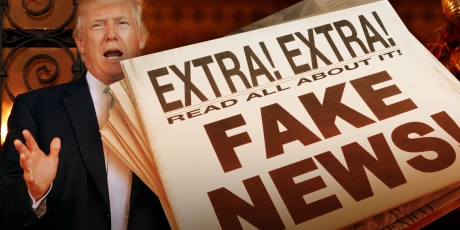
While NATO was busy setting up a vast network with which to accuse Russia of perpetuating propaganda from the Soviet era, Washington was suddenly swamped by a wave of hysteria. In an attempt to discredit the new US President, the dominant media accuse him of talking rubbish – in response, the President accuses them of propagating fake news. This cacophony is amplified by the swift development of the social media, which had once been intended for use as weapons of the State Department against nationalist regimes, but which today are popular forums used to combat abuse by all kinds of elites – with Washington at the top of the list.

By Thierry Meyssan

Source: Voltaire Network

As soon as the announcement of his surprise election was made public, and even before he had access to the White House, the immense majority of US and NATO media began screaming about the negligence and insanity of President Trump. Battle was joined between the media class and the new President, with each side accusing the other of propagating fake news.

Almost everywhere in the NATO countries – and only in these countries – political representatives began denouncing fake news. This was intended to reveal the supposed influence of Russian propaganda within the « Western democracies ». The State which has been the most seriously impacted by this campaign is France, whose President Emmanuel Macron recently announced the drafting of a law specifically aimed at fighting these « attacks on democracy », but only during « an electoral period ».

The fact that the English expression fake news is maintained in all the languages of the NATO countries attests to the Anglo-Saxon origin of the problem, when in fact the phrase designates a phenomenon as old as the world – false information.

At the origin of the campaign against « fake news » – NATO

In 2009, at the NATO summit in Strasbourg-Kehl, President Obama announçed his intention of creating an Alliance « Strategic Communication » service [1]. It took six years to implement, using elements of the 77th Brigade of the British Land Army and the 361st Civil Affairs Brigade of the United States Land Army (based in Germany and Italy).

At first, their mission was to counter communications accusing the US deep state of having itself organised the attacks of 9/11, then those accusing the Anglo-Saxons of having planned the « Arab Springs » and the war against Syria — such communications were termed « conspiracy theories ». However, the situation evolved rapidly in such a way as to convince the populations of the Alliance that Russia was continuing to apply propaganda from the Soviet era – and thus that NATO was still useful.

Finally, in April 2015, the European Union created a « Work Group for Strategic Communications – East » (East StratCom Task Force). Every week, this group addresses a report on Russian propaganda to thousands of journalists. For example, its last edition (dated 11 January 2018) accuses Sputnik of pretending that the Copenhagen zoo feeds its predators with abandoned household pets. Lord help us, the « democracies » are under attack ! Clearly, it is difficult for these specialists to find meaningful examples of Russian interference. In August of the same year, NATO inaugurated its « Centre for Strategic Communication » in Riga (Latvia). The following year, the US State Department created a Global Engagement Center which works on the same principles.

How Facebook, Hillary Clinton’s pet obsession, turned against her

In 2009, Secretary of State Hillary Clinton, at the instigation of Jared Cohen (leading member of the Policy Planning Staff ), persuaded herself that it was possible to overthrow the Islamic Republic of Iran by manipulating the social media. This theory did not have the desired affect. However, two years later, in 2011, the same Jared Cohen — since become the the CEO of Google Ideas — managed to mobilise the youth of Cairo. Although the « revolution » of Tahrir Square had not swayed the opinion of the Egyptian people, the myth of the extension of the American way of life via Facebook was born. As a result, the State Department sponsored a number of associations and assemblies to promote Facebook.

However, the US Presidential election of 2016 was a shock. An outsider, real estate promoter Donald Trump, eliminated all his rivals one by one, including Hillary Clinton, and was swept into the White House, having benefited from the advice of Facebook. For the first time, the dream of the Muse of professional politicians became reality, but worked against her. Overnight, Facebook was demonised by the dominant Press.

It became evident on this occasion that it is possible to artificially create crowd movements with the social media, but that after a few days, media users regain their senses. This is the constant fact for all systems of information manipulation — they are fleeting. The only form of lie which makes it possible to create long-term behaviour patterns supposes that one has forced the citizens into a form of minor engagement, in other words, that one has brainwashed them [2].

Indeed, Facebook understood this very well, creating its « Politics & Government Outreach Program » and handing it over to the care of Katie Harbath. It was intended to create collective emotions in favour of one client or another, but does not seek to organise lasting campaigns [3]. This is why President Macron proposes to legislate the social media only during electoral periods. He was himself elected thanks to a brief disorder created jointly by a weekly newspaper and Facebook against his rival François Fillon — an operation orchestrated by Jean-Pierre Jouyet [4]. Furthermore, Emmanuel Macron’s fear that next time the social media may be used against him fits with NATO’s desire to demonstrate the continuity of USSR-Russia propaganda. As an example of manipulation, Macron therefore cites an interview with Sputnik concerning his private life and the publishing of an allegation concerning a foreign bank account.

The Christopher Steele Report

During the US Presidential campaign, Hillary Clinton’s team ordered an inquiry on Donald Trump from an ex-agent of the British Secret Services, Christopher Steele. Ex-chief of MI6’s « Russia House », he was known for his scandalous and always unverifiable allegations. After having accused Vladimir Putin, without proof, of having commanded the poisoning of Alexander Litvinenko by Polonium 210, he accused him of having caught Donald Trump in a sex trap and blackmailing him. The Steele Report was then discretely handed to various journalists, politicians and master spies, and finally published [5].

This is the source of the hypothesis according to which, seeking to get his puppet elected and hamper the election of Hillary Clinton, the lord of the Kremlin had ordered « his » media to buy publicity on Facebook and spread lies about the ex-Secretary of State – a hypothesis which may be supported by a conversation between the Australian ambassador in London with one of Donald trump’s advisors [6]. It doesn’t matter that Russia Today and Sputnik only spent a total of a few thousand dollars for publicity which rarely concerned Mrs. Clinton, the US ruling class is persuaded that they turned back the popular tide in favour of the Democrat candidate and her 1.2 billion dollar campaign. In Washington, people persist in believing that technological inventions can be used to manipulate the human race.

It is no longer a question of noting that Donald Trump and his partisans ran their campaign on Facebook because the totality of the written and audiovisual Press was hostile to them, but pretending that Facebook was manipulated by Russia in order to prevent the election of the Muse of Washington.

The legal privilege of Google, Facebook and Twitter

By seeking to prove the interference of Moscow, the US Press underlined the exorbitant privilege enjoyed by Google, Facebook and Twitter — these three companies are not considered responsible for their content. From the point of view of US law, they are no more than transporters of information (common carrier).

The experiments carried out by Facebook, which demonstrated the possibility of creating collective emotions on one hand, and the legal non-responsibility of this company on the other, attest to an anomaly in the system.

Particularly since the privilege enjoyed by Google, Facebook and Twitter is clearly undue. Indeed, these three companies act in at least two different ways to modify the content they transport. First of all, they unilaterally censor certain messages, either via the direct intervention of their personnel, or mechanically, via hidden algorithms. Then they promote their vision of the truth to the detriment of other points of view (fact-checking).

For example, in 2012, Qatar ordered from Google Ideas, already directed by Jared Cohen, the creation of software which would make it possible to follow the progression of defections in the Syrian Arab Army. The point was to show that Syria was indeed a dictatorship, and that the people were beginning to revolt. But it very quickly became clear that this vision of affairs was false. The number of soldiers who defected never rose above 25,000 in an army of 450,000 men. This is why, after having promoted the software, Google discretely retired it.

Conversely, for seven years, Google promoted articles which relayed communiqués from the Syrian Observatory for Human Rights (SOHD). Day after day, they gave the exact count of the number of victims in both camps. Of course, these figures are imaginary – it is impossible for anyone to count them. Never, in a time of war, has a state been able to determine, on a daily basis, the number of soldiers killed in combat and the civilians killed behind the lines. And yet, in the United Kingdom, the SOHD claims to know what the people who live there, in Syria, cannot know.

Far from being just the common carriers, Google, Facebook and Twitter are the forgers of the information they transport, and as such, they ought to be counted legally responsible for their content.

The rules of the freedom of expression

Let’s imagine that the efforts of NATO and those of President Macron against Russia in terms of audiovisual Internet traffic meet with failure. It is nonetheless necessary to enter these new medias into general law.

The principles which regulate the freedom of expression are only legitimate if they are identical for all citizens and for all media. This is not the case today. While the general law applies, there is no specific rule concerning denial or the right to reply for the messages on Internet and the social media.

As always in the history of information, the old medias attempt to sabotage the new. Thus I remember the violent editorial that the French daily Le Monde dedicated in 2002 to my work on the Internet concerning the responsibility for the attacks of 9/11. What shocked the newspaper just as much as my conclusions was that the Voltaire Network was free from the financial obligations of which it felt prisoner [7]. This is the same corporatist attitude that it demonstrates again, fifteen years later, with its service, Le Decodex. Rather than developing a critique of the articles or videos of the new medias, Le Monde proposes to note the reliability of its rival Internet sites. Of course, only the sites issued by their paper colleagues find grace in their eyes, all the others are judged less trustworthy.

To shore up the campaign against the social media, the Fondation Jean-Jaures (that is to say the foundation of the Socialist Party linked to the National Endowment for Democracy) has published an imaginary poll [8]. With a display of numbers, it aims to demonstrate that unsophisticated people – the working classes and the partisans of the National Front – are gullible. It claims that 79 % of French people believe in one conspiracy theory or another. As proof of their naïveté, it points out that 9 % of them are convinced that the Earth is flat.

However, neither myself nor any of my French friends consulted by Internet have ever met any of our compatriots who believe that the Earth is flat. The figure is obviously invented and discredits the entire study. As it happens, although it is linked to the Socialist Party, the Fondation Jean-Jaures still has Gerard Collomb as its general secretary – Collomb has since become President Macron’s Minister for the Interior. This same foundation had already published, two years ago, a study aimed at discrediting the political opponents of the system that it already qualified as « conspiracy theorists » [9].


Translation
Pete Kimberley


Mainstream Media & FBI Push Fake Terror Attack Even After Their Patsy Refused to Do It

The mainstream media is praising the FBI after their agents targeted a “terrorist” who refused to go through with an attack they were attempting to set up.

By Rachel Blevins

Source: The Free Thought Project

It is no secret that agents from the Federal Bureau of Investigation often look for and take advantage of vulnerable individuals on the internet by gaining their trust and convincing them to carry out attacks—but even in a case where the “terrorist” backed out of the attack, the mainstream media is still celebrating the FBI’s diligence in the War on Terror.

FBI thwarts alleged plan to carry out terrorist attack in San Francisco on Christmas,” the Washington Post reported, claiming that the agency was able to prevent a possible terrorist attack at San Francisco’s Pier 39 after arresting a man who told undercover agents he wanted to carry out an Islamic State-inspired suicide bombing at the popular tourist destination on Christmas Day.”

The New York Post joined in with the headline “FBI thwarts ISIS-inspired Christmas terror attack on San Francisco,” and the claim that the suspect was “former US Marine sharpshooter” Everitt Aaron Jameson, 26, who was discharged from the military for fraudulent enlistment, and now works as a tow truck driver.

The Department of Justice released a statement confirming that Jameson has been arrested for “attempting to provide material support to a foreign terrorist organization.” If convicted, he faces up to 20 years in prison and $250,000 in fines.

“According to court documents, Jameson had several online interactions with a confidential source in which he expressed support for the October 31, 2017, terrorist attack in New York City and offered his services for ‘the cause.’  In subsequent communications with an undercover agent, Jameson referred to his training in the U.S. military and noted he had been trained for combat and war.  Jameson later met with another undercover agent whom he believed to be associated with the senior leadership of the foreign terrorist organization, ISIS (the Islamic State of Iraq and al-Sham, also known as ISIL).  During his interactions with this undercover agent, Jameson offered to carry out violent acts and to provide financial support for the terrorist organization.”

Now, the question is—how did FBI agents find Jameson, and did he actually pose a threat of carrying out a terrorist attack?

The Los Angeles Times reported that Jameson began studying Islam one year ago, after he became “depressed and even suicidal over losing custody of his children.” However, his family insisted that he did not have violent tendencies, and had never mentioned anything about becoming involved with the Islamic State.

“He just ain’t no terrorist, no way,” Jameson’s father said. “He would never hurt people. Not ever. It’s just unbelievable. That’s not who he is.”

The criminal complaint filed against Jameson claimed that he first caught the agency’s attention when a “credible FBI Confidential Human Source” flagged his Facebook account as suspicious on Sept. 19, for “Liking” and “Loving” posts that were “pro-ISIS and pro-terrorism.”

“To provide an example of the types of posts Jameson was ‘Liking’ and ‘Loving’ during this time period, the CHS reported to the FBI that Jameson “loved” a post on November 29, 2017 that is an image of Santa Claus standing in New York with a box of dynamite. The text of the post reads, ‘ISIS post image of Santa with dynamite threatening attack on New York.’ The Propaganda poster shows Santa Claus standing on a roof next to a box of dynamite looking out over a crowd of shoppers with the words ‘We meet at Christmas in New York… soon.’ Under this post, Jameson selected the ‘Like’ option and then selected the “Heart” option to signify that he ‘Loved’ the post.”

However, the fact that Jameson “liked” a post on Facebook about an ISIS attack in the United States on Christmas day, does not guarantee that he would have actually carried out such an attack by himself.

While the complaint does detail the conversations Jameson had with FBI informants, and it shows that he appeared eager to provide supplies for an attack on a crowded area, and willing to carry out, he was never in contact with a suspected member of ISIS.

It is also important to consider the context. FBI informants were holding bait in front of a depressed, suicidal man, and were giving him a sense of attention and companionship that he was likely lacking in his own life. Ultimately, two days after meeting with FBI informants in person, the criminal complaint noted that Jameson sent a message on Dec. 18, saying, “I don’t think I can do this after all. I’ve reconsidered.”

It was too late. Even though he had not harmed anyone, and had declined to carry out the attack the agents were trying to talk him into, the FBI obtained a search warrant for Jameson’s home the next day. They seized a letter signed by “Abdullah Abu Everitt,” a last will and testament, and a series of weapons including “a Winchester .22 caliber rifle, a Ruger M77, a Ruger 9mm handgun, magazines, ammunition and fireworks.”

Everitt Jameson now faces up to 20 years in prison for engaging in conversations online with FBI informants who intentionally targeted his weaknesses, as the mainstream media celebrates the fact that the FBI has foiled yet another FBI terror plot, and the agents who are responsible for ruining an innocent man’s life, look for their next victim.

If Jameson never had any intention of carrying out a terror attack and the entire idea was forced on him by the FBI, why on Earth would this be on the news and touted as some foiled plot?

Well, the answer to that is simple.

Former FBI assistant director Thomas Fuentes actually reveals the answer as he defends the tactics used by the FBI to set up poverty-stricken, mentally ill men by offering them large sums of money and weapons to commit crimes.

After he defended the FBI’s role in bribing poor, mentally diminished people to get them to commit crimes, he let out a bombshell statement, confirming what many of us already know.

“If you’re submitting budget proposals for a law enforcement agency, for an intelligence agency, you’re not going to submit the proposal that ‘We won the war on terror and everything’s great,’ cause the first thing that’s gonna happen is your budget’s gonna be cut in half,” states Fuentes. “You know, it’s my opposite of Jesse Jackson’s ‘Keep Hope Alive’—it’s ‘Keep Fear Alive.’ Keep it alive.”

There you have it. The FBI puts Americans in danger by grooming otherwise entirely innocent people into doing harm — so they can keep fear alive.

But what would’ve happened if Jameson would’ve actually carried out this attack that the FBI was trying to force on him? Would the FBI still claim they had informants attempting to groom him? Would they admit their role in his life at all?

David Steele, a 20-year Marine Corps intelligence officer, the second-highest-ranking civilian in the U.S. Marine Corps Intelligence, and former CIA clandestine services case officer, had this to say about these most unscrupulous operations:

“Most terrorists are false flag terrorists, or are created by our own security services. In the United States, every single terrorist incident we have had has been a false flag, or has been an informant pushed on by the FBI. In fact, we now have citizens taking out restraining orders against FBI informants that are trying to incite terrorism. We’ve become a lunatic asylum.”

Indeed, we’ve become a lunatic asylum.


$21 Trillion of Unauthorized Spending by US Govt Discovered by Economics Professor

Source: Covert Geopolitics

he US government may have misspent $21 trillion, a professor at Michigan State University has found. Papers supporting the study briefly went missing just as an audit was announced.

Two departments of the US federal government may have spent as much as $21 trillion on things they can’t account for between 1998 and 2015. At least that’s what Mark Skidmore, a Professor of Economics at MSU specializing in public finance, and his team have found.

They came up with the figure after digging the websites of departments of Defense (DoD) and Housing and Urban Development (HUD) as well as repots of the Office of the Inspector General (OIG) over summer.

The research was triggered by Skidmore hearing Catherine Austin Fitts, a former Assistant Secretary in the HUD in the first Bush administration, saying the Inspector General found $6.5 trillion worth of military spending that the DoD couldn’t account for. She was referring to a July 2016 report by the OIG, but Skidmore thought she must be mistaking billion for trillion. Based on his previous experience with public finances, he thought the figure was too big even for an organization as large as the US military.

“Sometimes you have an adjustment just because you don’t have adequate transactions… so an auditor would just recede. Usually it’s just a small portion of authorized spending, maybe one percent at most. So for the Army one percent would be $1.2 billion of transactions that you just can’t account for,” he explained in an interview with USAWatchdog.com earlier this month.

After discovering that the figure was accurate, he and Fitts collaborated with a pair of graduate students to comb through thousands of reports of the OIG dating back to 1998, when new rules of public accountability for the federal government were set and all the way to 2015, the time of the latest reports available at the time. The research was only for the DoD and the HUD.

“This is incomplete, but we have found $21 trillion in adjustments over that period. The biggest chunk is for the Army. We were able to find 13 of the 17 years and we found about $11.5 trillion just for the Army,” Skidmore said.

The professor would not suggest whether the missing trillions went to some legitimate undisclosed projects, wasted or misappropriated, but believes his find indicates that there is something profoundly wrong with the budgeting process in the US federal government. Such lack of transparency goes against the due process of authorizing federal spending through the US Congress, he said.

Skidmore also co-authored a column on Forbes, explaining his research.

The same week the interview took place the DoD announced that it will conduct its first-ever audit. “It is important that the Congress and the American people have confidence in DoD’s management of every taxpayer dollar,” Comptroller David Norquist told reporters as he explained that the OIG has hired independent auditors to dig through the military finances.

“While we can’t know for sure what role our efforts to compile original government documents and share them with the public has played, we believe it may have made a difference,” Skidmore commented.

Interestingly, in early December the authors of the research discovered that the links to key document they used, including the 2016 report, had been disabled. Days later the documents were reposted under different addresses, they say.

This is probably where the Deep State government called CIA and State Department took their extra fund to topple uncooperative governments around the world. The bulk, of course, may have gone to the military industrial complex.

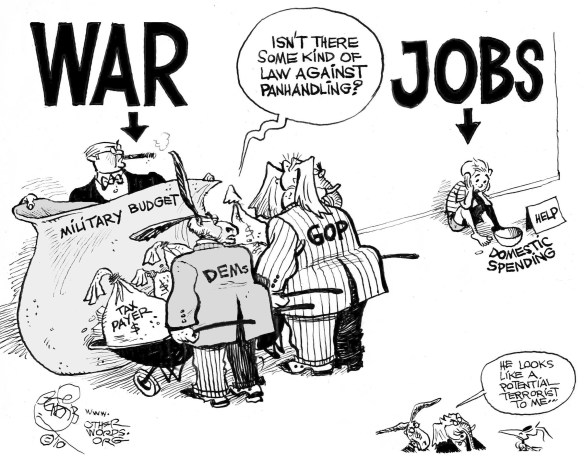
The United States has double the military budget of the combined military spending of Russia, China and G7 countries. Said military spending remains unauditable due to “widespread material internal control weaknesses, significant uncertainties, and other limitations” according to a GAO report in 2010.

So, how can a government spread its wings beyond its own borders, and demand democratic ideals elsewhere when it is not practicing the same values at home?

The Acceleration of Censorship in America

By Joe Lauria

Source: The Unz Review

Under increasing pressure from a population angry about endless wars and the transfer of wealth to the one percent, American plutocrats are defending themselves by suppressing critical news in the corporate media they own. But as that news emerges on RT and dissident websites, they’ve resorted to the brazen move of censorship, which is rapidly spreading in the U.S. and Europe. I know because I was a victim of it.

At the end of October, I wrote an article for Consortium News about the Democratic National Committee and Hillary Clinton’s campaign paying for unvetted opposition research that became the basis for much of the disputed story about Russia allegedly interfering in the 2016 presidential election.

The piece showed that the Democrats’ two paid-for sources that have engendered belief in Russia-gate are at best shaky. First was former British spy Christopher Steele’s largely unverified dossier of second- and third-hand opposition research portraying Donald Trump as something of a Russian Manchurian candidate.

And the second was CrowdStrike, an anti-Putin private company, examining the DNC’s computer server to dubiously claim discovery of a Russian “hack.” CrowdStrike, it was later discovered, had used faulty software it was later forced to rewrite. The company was hired after the DNC refused to allow the FBI to look at the server.

My piece also described the dangerous consequences of partisan Democratic faith in Russia-gate: a sharp increase in geopolitical tensions between nuclear-armed Russia and the U.S., and a New McCarthyism that is spreading fear — especially in academia, journalism and civil rights organizations — about questioning the enforced orthodoxy of Russia’s alleged guilt.

After the article appeared at Consortium News, I tried to penetrate the mainstream by then publishing a version of the article on the HuffPost, which was rebranded from the Huffington Post in April this year by new management. As a contributor to the site since February 2006, I am trusted by HuffPost editors to post my stories directly online. However, within 24 hours of publication on Nov. 4, HuffPost editors retracted the article without any explanation.

This broke with the earlier principles of journalism that the Web site espoused. For instance, in 2008, Arianna Huffington told radio host Don Debar that, “We welcome all opinions, except conspiracy theories.” She said: “Facts are sacred. That’s part of our philosophy of journalism.”

But Huffington stepped down as editor in August 2016 and has nothing to do with the site now. It is run by Lydia Polgreen, a former New York Times reporter and editor, who evidently has very different ideas. In April, she completely redesigned the site and renamed it HuffPost.

Before the management change, I had published several articles on the Huffington Post about Russia without controversy. For instance, The Huffington Post published my piece on Nov. 5, 2016, that predicted three days before the election that if Clinton lost she’d blame Russia. My point was confirmed by the campaign-insider book Shattered, which revealed that immediately after Clinton’s loss, senior campaign advisers decided to blame Russia for her defeat.

On Dec. 12, 2016, I published another piece, which the Huffington Post editors promoted, called, “Blaming Russia To Overturn The Election Goes Into Overdrive.” I argued that “Russia has been blamed in the U.S. for many things and though proof never seems to be supplied, it is widely believed anyway.”

After I posted an updated version of the Consortium News piece — renamed “On the Origins of Russia-gate” — I was informed 23 hours later by a Facebook friend that the piece had been retracted by HuffPost editors. As a reporter for mainstream media for more than a quarter century, I know that a newsroom rule is that before the serious decision is made to retract an article the writer is contacted to be allowed to defend the piece. This never happened. There was no due process. A HuffPost editor ignored my email asking why it was taken down.

Support from Independent Media

Like the word “fascism,” “censorship” is an over-used and mis-used accusation, and I usually avoid using it. But without any explanation, I could only conclude that the decision to retract was political, not editorial.

I am non-partisan as I oppose both major parties for failing to represent millions of Americans’ interests. I follow facts where they lead. In this case, the facts led to an understanding that the Jan. 6 FBI/NSA/CIA intelligenceassessment” on alleged Russian election interference, prepared by what then-Director of National Intelligence James Clapper called “hand-picked” analysts, was based substantially on unvetted opposition research and speculation, not serious intelligence work.

The assessment even made the point that the analysts were not asserting that the alleged Russian interference was a fact. The report contained this disclaimer: “Judgments are not intended to imply that we have proof that shows something to be a fact. Assessments are based on collected information, which is often incomplete or fragmentary, as well as logic, argumentation, and precedents.”

Under deadline pressure on Jan. 6, Scott Shane of The New York Times instinctively wrote what many readers of the report must have been thinking: “What is missing from the public report is what many Americans most eagerly anticipated: hard evidence to back up the agencies’ claims that the Russian government engineered the election attack. … Instead, the message from the agencies essentially amounts to ‘trust us.’”

Yet, after the Jan. 6 report was published, leading Democrats asserted falsely that the “assessment” represented the consensus judgment of all 17 U.S. intelligence agencies – not just the views of “hand-picked” analysts from three – and much of the U.S. mainstream media began treating the allegations of Russian “hacking” as fact, not as an uncertain conclusion denied by both the Russian government and WikiLeaks, which insists that it did not get the two batches of Democratic emails from the Russian government.

Yet, because of the oft-repeated “17 intelligence agencies” canard and the mainstream media’s over-hyped reporting, the public impression has built up that the accusations against Russia are indisputable. If you ask a Russia-gate believer today what their faith is based on, they will invariably point to the Jan. 6 assessment and mock anyone who still expresses any doubt.

For instance, an unnamed former CIA officer told The Intercept last month, “You’ve got all these intelligence agencies saying the Russians did the hack. To deny that is like coming out with the theory that the Japanese didn’t bomb Pearl Harbor.”

That the supposedly dissident Intercept would use this quote is instructive about how unbalanced the media’s reporting on Russia-gate has been. We have film of Japanese planes attacking Pearl Harbor and American ships burning – and we have eyewitness accounts of thousands of U.S. soldiers and sailors. Yet, on Russia-gate, we have only the opinions of “hand-picked” intelligence officials who themselves admit their opinions aren’t fact. No serious editor would allow a self-interested and unnamed source to equate Russia-gate and Pearl Harbor in print.

In this atmosphere, it was easy for HuffPost editors to hear complaints from readers and blithely ban my story. But before it was pulled, 125 people had shared it. Ray McGovern, a former CIA analyst, then took up my cause, being the first to write about the HuffPost censorship on his blog. McGovern included a link to a .pdf file that I captured of the censored HuffPost story. It has since been republished on numerous other websites.

Journalist Max Blumenthal tweeted about it. British filmmaker and writer Tariq Ali posted it on his Facebook page. Ron Paul and Daniel McAdams interviewed me at length about the censorship on their TV program. ZeroHedge wrote a widely shared piece and someone actually took the time, 27 minutes and 13 seconds to be exact, to read the entire article on YouTube. I began a petition to HuffPost’s Polgreen to either explain the retraction or restore the article. It has gained more than 2,000 signatures so far. If a serious fact-check analysis was made of my article, it must exist and can and should be produced.

Watchdogs & Media Defending Censorship

Despite this support from independent media, a senior official at Fairness and Accuracy in Reporting, I learned, declined to take up my cause because he believes in the Russia-gate story. I also learned that a senior officer at the American Civil Liberties Union rejected my case because he too believes in Russia-gate. Both of these serious organizations were set up precisely to defend individuals in such situations on principle, not preference.

In terms of their responsibilities for defending journalism and protecting civil liberties, their personal opinions about whether Russia-gate is real or not are irrelevant. The point is whether a journalist has the right to publish an article skeptical of it. I worry that amid the irrational fear spreading about Russia that concerns about careers and funding are behind these decisions.

One online publication decidedly took the HuffPost’s side. Steven Perlberg, a media reporter for BuzzFeed, asked the HuffPost why they retracted my article. While ignoring me, the editors issued a statement to BuzzFeed saying that “Mr. Lauria’s self-published” piece was “later flagged by readers, and after deciding that the post contained multiple factually inaccurate or misleading claims, our editors removed the post per our contributor terms of use.” Those terms include retraction for “any reason,” including, apparently, censorship.

Perlberg posted the HuffPost statement on Twitter. I asked him if he inquired of the editors what those “multiple” errors and “misleading claims” were. I asked him to contact me to get my side of the story. Perlberg totally ignored me. He wrote nothing about the matter. He apparently believed the HuffPost and that was that. In this way, he acquiesced with the censorship.

BuzzFeed, of course, is the sensationalist outlet that irresponsibly published the Steele dossier in full, even though the accusations – not just about Donald Trump but also many other individuals – weren’t verified. Then on Nov. 14, BuzzFeed reporter Jason Leopold wrote one of the most ludicrous of a long line of fantastic Russia-gate stories, reporting that the Russian foreign ministry had sent money to Russian consulates in the U.S. “to finance the election campaign of 2016.” The scoop generated some screaming headlines before it became clear that the money was to pay for Russian citizens in the U.S. to vote in the 2016 Duma election.

That Russia-gate has reached this point, based on faith and not fact, was further illustrated by a Facebook exchange I had with Gary Sick, an academic who served on the Ford and Carter national security staffs. When I pressed Sick for evidence of Russian interference, he eventually replied: “If it walks like a duck and talks like a duck…” When I told him that was a very low-bar for such serious accusations, he angrily cut off debate.

When belief in a story becomes faith-based or is driven by intense self-interest, honest skeptics are pushed aside and trampled. True-believers disdain facts that force them to think about what they believe. They won’t waste time making a painstaking examination of the facts or engage in a detailed debate even on something as important and dangerous as a new Cold War with Russia.

This is the most likely explanation for the HuffPost‘s censorship: a visceral reaction to having their Russia-gate faith challenged.

Why Critical News is Suppressed

But the HuffPost’s action is hardly isolated. It is part of a rapidly growing landscape of censorship of news critical of American corporate and political leaders who are trying to defend themselves from an increasingly angry population. It’s a story as old as civilization: a wealthy and powerful elite fending off popular unrest by trying to contain knowledge of how the elite gain at the others’ expense, at home and abroad.

A lesson of the 2016 campaign was that growing numbers of Americans are fed up with three decades of neoliberal policies that have fabulously enriched the top tier of Americans and debased a huge majority of everyone else. The population has likewise grown tired of the elite’s senseless wars to expand their own interests, which they to conflate with the entire country’s interests.

America’s bipartisan rulers are threatened by popular discontent from both left and right. They were alarmed by the Bernie Sanders insurgency and by Donald Trump’s victory, even if Trump is now betraying the discontented masses who voted for him by advancing tax and health insurance plans designed to further crush them and benefit the rich.

Trump’s false campaign promises will only make the rulers’ problem of controlling a restless population more difficult. Americans are subjected to economic inequality greater than in the first Gilded Age. They are also subjected today to more war than in the first Gilded Age, which led to the launch of American overseas empire. Today American rulers are engaged in multiple conflicts following decades of post-World War II invasions and coups to expand their global interests.

People with wealth and power always seem to be nervous about losing both. So plutocrats use the concentrated media they own to suppress news critical of their wars and domestic repression. For example, almost nothing was reported about militarized police forces until the story broke out into the open in the Ferguson protests and now the story has been buried again.

Careerist journalists readily acquiesce in this suppression of news to maintain their jobs, their status and their lifestyles. Meanwhile, a growing body of poorly paid freelancers compete for the few remaining decent-paying gigs for which they must report from the viewpoint of the mainstream news organizations and their wealthy owners.

To operate in this media structure, most journalists know to excise out the historical context of America’s wars of domination. They know to uncritically accept American officials’ bromides about spreading democracy, while hiding the real war aims.

Examples abound: America’s role in the Ukraine coup was denied or downplayed; a British parliamentary report exposing American lies that led to the destruction of Libya was suppressed; and most infamously, the media promoted the WMD hoax and the fable of “bringing democracy” to Iraq, leading to the illegal invasion and devastation of that country. A recent example from November is a 60 Minutes reporton the Saudi destruction of Yemen, conspicuously failing to mention America’s crucial role in the carnage.

I’ve pitched numerous news stories critical of U.S. foreign policy to a major American newspaper that were rejected or changed in the editorial process. One example is the declassified Defense Intelligence Agency document of August 2012 that accurately predicted the rise of the Islamic State two years later.

The document, which I confirmed with a Pentagon spokesman, said the U.S. and its Turkish, European and Gulf Arab allies, were supporting the establishment of a Salafist principality in eastern Syria to put pressure on the Syrian government, but the document warned that this Salafist base could turn into an “Islamic State.”

But such a story would undermine the U.S. government’s “war on terrorism” narrative by revealing that the U.S.-backed strategy actually was risking the expansion of jihadist-held territory in Syria. The story was twice rejected by my editors and to my knowledge has never appeared in corporate media.

Another story rejected in June 2012, just a year into the Syrian war, was about Russia’s motives in Syria being guided by a desire to defeat the growing jihadist threat there. Corporate media wanted to keep the myth of Russia’s “imperial” aims in Syria alive. I had to publish the article outside the U.S., in a South African daily newspaper.

In September 2015 at the U.N. General Assembly, Russian President Vladimir Putin confirmed my story about Russia’s motives in Syria to stop jihadists from taking over. Putin invited the U.S. to join this effort as Moscow was about to launch its military intervention at the invitation of the Syrian government. The Obama administration, still insisting on “regime change” in Syria, refused. And the U.S. corporate media continued promoting the myth that Russia intervened to recapture its “imperial glory.”

It was much easier to promote the “imperial” narrative than report Putin’s clear explanation to French TV channel TF1, which was not picked up by American media.

“Remember what Libya or Iraq looked like before these countries and their organizations were destroyed as states by our Western partners’ forces?” Putin said. “These states showed no signs of terrorism. They were not a threat for Paris, for the Cote d’Azur, for Belgium, for Russia, or for the United States. Now, they are the source of terrorist threats. Our goal is to prevent the same from happening in Syria.”

But don’t take Putin’s word for it. Then Secretary of State John Kerry knew why Russia intervened. In a leaked audio conversation with Syrian opposition figures in September 2016, Kerry said: “The reason Russia came in is because ISIL was getting stronger, Daesh was threatening the pos­sibility of going to Damascus, and that’s why Russia came in because they didn’t want a Daesh government and they supported Assad.”

Kerry admitted that rather than seriously fight the Islamic State in Syria, the U.S. was ready to use its growing strength to pressure Assad to resign, just as the DIA document that I was unable to report said it would. “We know that this was growing, we were watching, we saw that Daesh was growing in strength, and we thought Assad was threatened. We thought, how­ever, we could probably manage that Assad might then negotiate, but instead of negotiating he got Putin to support him.” Kerry’s com­ment suggests that the U.S. was willing to risk the Islamic State and its jihadist allies gaining power in order to force out Assad.

Why Russia Is Targeted

Where are independent-minded Western journalists to turn if their stories critical of the U.S. government and corporations are suppressed? The imperative is to get these stories out – and Russian media has provided an opening. But this has presented a new problem for the plutocracy. The suppression of critical news in their corporate-owned media is no longer working if it’s seeping out in Russian media and through dissident Western news sites.

Their solution has been to brand the content of the Russian television network, RT, as “propaganda” since it presents facts and viewpoints that most Americans have been kept from hearing.

As a Russian-government-financed English-language news channel, RT also gives a Russian perspective on the news, the way CNN and The New York Times give an American perspective and the BBC a British one. American mainstream journalists, from my experience, arrogantly deny suppressing news and believe they present a universal perspective, rather than a narrow American view of the world.

The viewpoints of Iranians, Palestinians, Russians, North Koreans and others are never fully reported in the Western media although the supposed mission of journalism is to help citizens understand a frighteningly complex world from multiple points of view. It’s impossible to do so without those voices included. Routinely or systematically shutting them out also dehumanizes people in those countries, making it easier to gain popular support to go to war against them.

Russia is scapegoated by charging that RT or Sputnik are sowing divisions in the U.S. by focusing on issues like homelessness, racism, or out-of-control militarized police forces, as if these divisive issues didn’t already exist. The U.S. mainstream media also seems to forget that the U.S. government has engaged in at least 70 years of interference in other countries’ elections, foreign invasions, coups, planting stories in foreign media and cyber-warfare, which Russian media crucially points out.

Now, these American transgressions are projected exclusively onto Moscow. There’s also a measure of self-reverence in this for “successful” people, like some journalists, with a stake in an establishment that underpins the elite, demonstrating how wonderfully democratic they are compared to those ogres in Russia.

The overriding point about the “Russian propaganda” complaint is that when America’s democratic institutions, including the press and the electoral process, are crumbling under the weight of corruption that the American elites have created or maintained, someone else needs to be blamed.

The Jan. 6 intelligence assessment on alleged Russian election meddling is a good example of this. A third of its content is an attack on RT for “undermining American democracy” by reporting on Occupy Wall Street, the protest over the Dakota pipeline and, of all things, holding a “third party candidate debates,” at a time when 71% of American millennials say they want a third party.

According to the Jan. 6 assessment, RT’s offenses include reporting that “the US two-party system does not represent the views of at least one-third of the population and is a ‘sham.’” RT also “highlights criticism of alleged US shortcomings in democracy and civil liberties.” In other words, reporting newsworthy events and giving third-party candidates a voice undermines democracy.

The assessment also says all this amounts to “a Kremlin-directed campaign to undermine faith in the US Government and fuel political protest,” but those protests by are against privileges of the wealthy and the well-connected, a status quo that the intelligence agencies were in essence created to protect.

There are also deeper reasons why Russia is being targeted. The Russia-gate story fits neatly into a geopolitical strategy that long predates the 2016 election. Since Wall Street and the U.S. government lost the dominant position in Russia that existed under the pliable President Boris Yeltsin, the strategy has been to put pressure on getting rid of Putin to restore a U.S. friendly leader in Moscow. There is substance to Russia’s concerns about American designs for “regime change” in the Kremlin.

Moscow sees an aggressive America expanding NATO and putting 30,000 NATO troops on its borders; trying to overthrow a secular ally in Syria with terrorists who threaten Russia itself; backing a coup in Ukraine as a possible prelude to moves against Russia; and using American NGOs to foment unrest inside Russia before they were forced to register as foreign agents.

Accelerated Censorship in the Private Sector

The Constitution prohibits government from prior-restraint, or censorship, though such tactics were imposed, largely unchallenged, during the two world wars. American newspapers voluntarily agreed to censor themselves in the Second World War before the government dictated it.

In the Korean War, General Douglas MacArthur said he didn’t “desire to reestablish wartime censorship” and instead asked the press for self-censorship. He largely got it until the papers began reporting American battlefield losses. On July 25, 1950, “the army ordered that reporters were not allowed to publish ‘unwarranted’ criticism of command decisions, and that the army would be ‘the sole judge and jury’ on what ‘unwarranted’ criticism entailed,” according to a Yale University study on military censorship.

After excellent on-the-ground reporting from Vietnam brought the war home to America, the military reacted by instituting, initially in the first Gulf War, serious control of the press by “embedding” reporters from private media companies. They accepted the arrangement, much as World War II newspapers censored themselves.

It is important to realize that the First Amendment does not apply to private companies, including the media. It is not illegal for them to practice censorship. I never made a First Amendment argument against the HuffPost, for instance. However, under pressure from Washington, even in peacetime, media companies can do the government’s dirty work to censor or limit free speech for the government.

In the past few weeks, we’ve seen an acceleration of attempts by corporations to inhibit Russian media in the U.S. Both Google and Facebook, which dominate the Web with more than 50 percent of ad revenue, were at first resistant to government pressure to censor “Russian propaganda.” But they are coming around.

Eric Schmidt, executive chairman of Alphabet, Google’s parent company, said on Nov. 18 that Google would “derank” articles from RT and Sputnik in the Google searches, making the stories harder for readers to find. The billionaire Schmidt claimed Russian information can be “repetitive, exploitative, false, [or] likely to have been weaponized,” he said. That is how factual news critical of U.S. corporate and political leadership is seen by them: as a weapon threatening their rule.

“My own view is that these patterns can be detected, and that they can be taken down or deprioritized,” Schmidt said.

Though Google would essentially be hiding news produced by RT and Sputnik, Schmidt is sensitive to the charge of censorship, even though there’s nothing legally to stop him.

“We don’t want to ban the sites. That’s not how we operate,” Schmidt said cynically. “I am strongly not in favor of censorship. I am very strongly in favor of ranking. It’s what we do.”

But the “deranking” isn’t only aimed at Russian sites; Google algorithms also are taking aim at independent news sites that don’t follow the mainstream herd – and thus are accused of spreading Russian or other “propaganda” if they question the dominant Western narratives on, say, the Ukraine crisis or the war in Syria. A number of alternative websites have begun reporting a sharp fall-off of traffic directed to their sites from Google’s search engines.

Responding to a deadline from Congress to act, Facebook on Nov. 22 announced that it would inform users if they have been “targeted” by Russian “propaganda.” Facebook’s help center will tell users if they liked or shared ads allegedly from the St. Petersburg-based Internet Research Agency, which supposedly bought $100,000 in ads over a two-year period, with more than half these ads coming after the 2016 U.S. election and many not related to politics.

The $100,000 sum over two years compares to Facebook’s $27 billion in annual revenue. Plus, Facebook only says it “believes” or it’s “likely” that the ads came from that firm, whose links to the Kremlin also have yet to be proved.

Facebook described the move as “part of our ongoing effort to protect our platforms and the people who use them from bad actors who try to undermine our democracy.” Congress wants more from Facebook, so it will not be surprising if users will eventually be alerted to Russian media reports as “propaganda” in the future.

While the government can’t openly shut down a news site, the Federal Communications Commission’s upcoming vote on whether to deregulate the Internet by ending net neutrality will free private Internet companies in the U.S. to further marginalize Russian and dissident websites by slowing them down and thus discouraging readers from viewing them.

Likewise, as the U.S. government doesn’t want to be openly seen shutting down RT operations, it is working around the edges to accomplish that.

After the Department of Justice forced, under threat of arrest, RT to register its employees as foreign agents under the Foreign Agents Registration Act, State Department spokeswoman Heather Nuaert said that “FARA does not police the content of information disseminated, does not limit the publication of information or advocacy materials, and does not restrict an organization’s ability to operate.” She’d earlier said that registering would not “impact or affect the ability of them to report news and information. We just have them register. It’s as simple as that.”

The day after Nuaert spoke the Congressional press office stripped RT correspondents of their Capitol Hill press passes, citing the FARA registration. “The rules of the Galleries state clearly that news credentials may not be issued to any applicant employed ‘by any foreign government or representative thereof.’ Upon its registration as a foreign agent under the Foreign Agents Registration Act (FARA), RT Network became ineligible to hold news credentials,” read the letter to RT.

But Russia-gate faithful ignore these aggressive moves and issue calls for even harsher action. After forcing RT to register, Keir Giles, a Chatham House senior consulting fellow, acted as though it never happened. He said in a Council on Foreign Relations Cyber Brief on Nov. 27: “Although the Trump administration seems unlikely to pursue action against Russian information operations, there are steps the U.S. Congress and other governments should consider.”

I commented on this development on RT America. It would also have been good to have the State Department’s Nuaert answer for this discrepancy about the claim that forced FARA registrations would not affect news gathering when it already has. My criticism of RT is that they should be interviewing U.S. decision-makers to hold them accountable, rather than mostly guests outside the power structure. The decision-makers could be called out on air if they refuse to appear.

Growing McCarthyite Attacks

Western rulers’ wariness about popular unrest can be seen in the extraordinary and scurrilous attack on the Canadian website globalresearch.ca. It began with a chilling study by the North Atlantic Treaty Organization into the relatively obscure website, followed by a vicious hit piece on Nov. 18 by the Globe and Mail, Canada’s largest newspaper. The headline was: “How a Canadian website is being used to amplify the Kremlin’s view of the world.”

“What once appeared to be a relatively harmless online refuge for conspiracy theorists is now seen by NATO’s information warfare specialists as a link in a concerted effort to undermine the credibility of mainstream Western media – as well as the North American and European public’s trust in government and public institutions,” the Globe and Mail reported.

“Global Research is viewed by NATO’s Strategic Communications Centre of Excellence – or StratCom – as playing a key accelerant role in helping popularize articles with little basis in fact that also happen to fit the narratives being pushed by the Kremlin, in particular, and the Assad regime.” The website never knew it had such powers.

I’ve not agreed with everything I’ve read on the site. But it is a useful clearinghouse for alternative media.

Numerous Consortium News articles are republished there, including a handful of mine. But the site’s typical sharing and reposting on the Internet is seen by NATO as a plot to undermine the Free World.

“It uses that reach to push not only its own opinion pieces, but ‘news’ reports from little-known websites that regularly carry dubious or false information,” the he Globe and Mail reported. “At times, the site’s regular variety of international-affairs stories is replaced with a flurry of items that bolster dubious reportage with a series of opinion pieces, promoted on social media and retweeted and shared by active bots.”

The newspaper continued, “’That way, they increase the Google ranking of the story and create the illusion of multi-source verification,’ said Donara Barojan, who does digital forensic research for [StratCom]. But she said she did not yet have proof that Global Research is connected to any government.”

This sort of smear is nothing more than a blatant attack on free speech by the most powerful military alliance in the world, based on the unfounded conviction that Russia is a fundamental force for evil and that anyone who has contacts with Russia or shares even a part of its multilateral world view is suspect.

Such tactics are spreading to Europe. La Repubblica newspaper in Italy wrote a similar hit piece against L’Antidiplomatico, a dissident website. And the European Union is spending €3.8 million to counter Russian “propaganda.” It is targeting Eurosceptic politicians who repeat what they hear on Russian media.

High-profile individuals in the U.S. are also now in the crosshairs of the neo-McCarthyite witch hunt. On Nov. 25 The Washington Post ran a nasty hit piece on Washington Capitals’ hockey player Alex Ovechkin, one of the most revered sports figures in the Washington area, simply because he, like 86 percent of other Russians, supports his president.

“Alex Ovechkin is one of Putin’s biggest fans. The question is, why?” ran the headline. The story insidiously implied that Ovechkin was a dupe of his own president, being used to set up a media campaign to support Putin, who is under fierce and relentless attack in the United States where Ovechkin plays professional ice hockey.

“He has given an unwavering endorsement to a man who U.S. intelligence agencies say sanctioned Russian meddling in last year’s presidential election,” write the Post reporters, once again showing their gullibility to U.S. intelligence agencies that have provided no proof for their assertions (and even admit that they are not asserting their opinion as fact).

Less prominent figures are targeted too. John Kiriakou, a former CIA agent who blew the whistle on torture and was jailed for it, was kicked off a panel in Europe on Nov. 10 by a Bernie Sanders supporter who refused to appear with Kiriakou because he co-hosts a show on Radio Sputnik.

At the end of November, Reporters Without Borders, an organization supposedly devoted to press freedom, tried to kick journalist Vanessa Beeley off a panel in Geneva to prevent her from presenting evidence that the White Helmets, a group that sells itself as a rescue organization inside rebel-controlled territory in Syria, has ties to Al Qaeda. The Swiss Press Club, which hosted the event, resisted the pressure and let Beeley speak.

But as a consequence the club director said its funding was slashed from the Swiss government.

Russia-gate’s Hurdles

Much of this spreading mania and intensifying censorship traces back to Russia-gate. Yet, it remains remarkable that the corporate media has failed so far to prove any significant Russian interference in the U.S. election at all. Nor have the intelligence agencies, Congressional investigations and special prosecutor Robert Mueller. His criminal charges so far have been for financial crimes and lying to federal authorities on topics unrelated to any “collusion” between the Trump campaign and Russians to “hack” Democratic emails.

There will likely be more indictments from Mueller, even perhaps a complaint about Trump committing obstruction of justice because he said on TV that he fired Comey, in part, because of the “Russia thing.” But Trump’s clumsy reaction to the “scandal,” which he calls “fake news” and a “witch hunt,” still is not proof that Putin and the Russians interfered in the U.S. election to achieve the unlikely outcome of Trump’s victory.

The Russia-gate faithful assured us to wait for the indictment of retired Lt. Gen. Michael Flynn, briefly Trump’s national security adviser. But again there was nothing about pre-election “collusion,” only charges that Flynn had lied to the FBI about conversations with the Russian ambassador regarding policy matters during the presidential transition, i.e., after the election.

One of Flynn’s conversations was about trying unsuccessfully to comply with an Israeli request to get Russia to block a United Nations resolution censuring Israel’s settlements on Palestinian land.

As journalist Yasha Levine tweeted: “So the country that influenced US policy through Michael Flynn is Israel, not Russia. But Flynn did try to influence Russia, not the other way around. Ha-ha. This is the smoking gun? What a farce.”

The media is becoming a victim of its own mania. In its zeal to push this story reporters are making a huge number of amateurish mistakes on stories that are later corrected. Brian Ross of ABC News was suspended for erroneously reporting that Trump had told Flynn to contact the Russians before the election, and not after.

There remain a number of key hurdles to prove the Russia-gate story. First, convincing evidence is needed that the Russian government indeed did “hack” the Democratic emails, both those of the DNC and Clinton’s campaign chairman John Podesta – and gave them to WikiLeaks. Then it must be linked somehow to the Trump campaign. If it were a Russian hack it would have been an intelligence operation on a need-to-know basis, and no one in the Trump team needed to know. It’s not clear how any campaign member could have even helped with an overseas hack or could have been an intermediary to WikiLeaks.

There’s also the question of how significant the release of those emails was anyway. They did provide evidence that the DNC tilted the primary campaign in favor of Clinton over Sanders; they exposed the contents of Clinton’s paid speeches to Wall Street, which she was trying to hide from the voters; and they revealed some pay-to-play features of the Clinton Foundation and its foreign donations. But – even if the Russians were involved in providing that information to the American people – those issues were not considered decisive in the campaign.

Clinton principally pinned her loss on FBI Director James Comey for closing and then reopening the investigation into her improper use of a private email server while Secretary of State. She also spread the blame to Russia (repeating the canard about “seventeen [U.S. intelligence] agencies, all in agreement”), Bernie Sanders, the inept DNC and other factors.

As for vaguer concerns about some Russian group “probably” buying $100,000 in ads, mostly after Americans had voted, as a factor in swaying a $6 billion election, it is too silly to contemplate. That RT and Sputnik ran pieces critical of Hillary Clinton was their right, and they were hardly alone. RT and Sputnik‘s reach in the U.S. is minuscule compared to Fox News, which slammed Clinton throughout the campaign, or for that matter, MSNBC, CNN and other mainstream news outlets, which often expressed open disdain for Republican Donald Trump but also gave extensive coverage to issues such as the security concerns about Clinton’s private email server.

Another vague Russia-gate suspicion stemming largely from Steele’s opposition research is that somehow Russia bribed or blackmailed Trump because of past business with Russians. But there are evidentiary and logical problems with these theories, since some lucrative deals fell through (and presumably wouldn’t have if Trump was being paid off).

Some have questioned how Trump could have supported detente with Russia without being beholden to Moscow in some way. But Jeffrey Sommers, a political scientist at the University of Wisconsin, wrote a convincing essay explaining adviser Steve Bannon’s influence on Trump’s thinking about Russia and the need for cooperation between the two powers to solve international problems.

Without convincing evidence, I remain a Russia-gate skeptic. I am not defending Russia. Russia can defend itself. However, amid the growing censorship and the dangerous new McCarthyism, I am trying to defend America — from itself.


An earlier version of this story appeared on Consortium News.

Who’s Afraid of Conspiracy Theory?

By Tim Hayward

Source: Tim Hayward’s Blog

‘Conspiracy theory’ is frequently used as a derogatory term, a term of disdain and implicit criticism. An effect of this is to discourage certain kinds of legitimate critical inquiry. But surely, in a world where conspiracies happen, we need good theories of what exactly is happening. The only people who really have anything to worry about from conspiracy theories are conspirators who stand to be exposed by them. For the rest of us, if someone proposes a far-fetched theory, we are instinctively sceptical; if they propose a theory that accounts for some otherwise unaccountable occurrences, they may be helping us learn something.

Of course, people can sometimes be misled by conspiracy theories, but people are misled by the beliefs that conspiracy theories challenge too. This betokens a need for careful scrutiny of controversial contentions quite generally. Obviously, a conspiracy theory is only a theory unless there is also proof. But it is one thing to demand the truth of a theory be proven; it is quite another to pronounce that such a theory can never be accepted as true. Unfortunately, even academic critics fail to observe that clear distinction, with some of them going so far as to condemn conspiracy theories in general, pre-emptively.[1]

Yet what are denigrated as ‘conspiracy theories’ are quite often legitimate lines of inquiry pursued in a spirit of critical citizenship, with the aim of holding to account those who exercise otherwise unaccountable power and influence over our lives, including in ways we are not all always aware of.

My argument, then, is that a kind of inquiry that can be intellectually respectable and socially necessary is far too readily sidelined with the categorisation of it as ‘conspiracy theory’. However, since the name has stuck, I propose we should embrace the designation and push back from the sideline to show how it is possible to engage in conspiracy theory using credible methods of research.

The problem that concerns critics, in fact, is a kind of extravagantly speculative activity that involves believing untested hypotheses. This can appropriately be called conspiracism.[2] Conspiracism designates a fallacious mode of reasoning that reduces questions of explanation to posited conspiracies, without properly investigating the evidence. Conspiracists are prone to see conspiracies everywhere, and to believe what they think they see, without giving sufficient consideration to alternative explanations. What is wrong with conspiracism, though, can be specified by reference to standards of inquiry set by good conspiracy theory. So the two things could hardly be more different.

It is especially important to be aware of the difference, given how it has been effaced in public discussions. Early ideas about a ‘conspiracist mindset’, from Harold Lasswell and Franz Neumann, informed Richard Hofstadter’s influential study of the political pathologies of the ‘paranoid style’ in the 1960s. This association of conspiracy suspicions with irrationality and paranoia was then actively promoted in the United States, especially, and as Lance deHaven Smith notes, ‘the conspiracy-theory label was popularized as a pejorative term by the Central Intelligence Agency (CIA) in a propaganda program initiated in 1967.’[3]  The program, created as a response to critical citizens’ questions about the assassination of J F Kennedy, ‘called on media corporations and journalists to criticize “conspiracy theorists” and raise questions about their motives and judgments.’ Its reach has extended greatly since.

Professor Peter Knight of Manchester University, who heads a major international interdisciplinary research network, funded by the European Union, to provide a comprehensive understanding of conspiracy theories, takes it to be a now generally accepted fact that ‘some of the labelling of particular views as “conspiracy theories” is a technique of governmentality.’[4]

So who’s afraid of conspiracy theorists? Is it possible that certain governments want us all to be?

It is interesting to note that Professor Knight thinks that if serious conspiracy theories can sometimes be on the right track, then perhaps what they are finding should not be thought of as conspiracies. For instance, he writes, ‘it is possible that different parts of the labyrinthine U.S. intelligence agencies were involved with some of the 9/11 attackers in contradictory and ambiguous ways that fall short of an actual conspiracy, but which nonetheless undermine the notion of complete American innocence.’ The point is, those contradictions and ambiguities merit study, whatever they are called. Knight’s tantalizing idea of an ‘involvement’ that ‘falls short of an actual conspiracy’ brings me in mind of analogous definitional questions that were raised about Bill Clinton’s descriptions of his  ‘involvement’ with a White House intern. Good sense suggests that what people are interested to know is what happened, not what someone calls it. Ultimately, the serious conspiracy theorist – or theorist of conspiracies, as Knight puts it – wants to know what is going on, and hypotheses about ‘involvements’ of all kinds can figure in the inquiry.[5]

We should bear in mind too, that the very name of this field was bestowed upon it by those who sought to pre-empt its development. Its actual practitioners might think their activities could be more aptly designated in one or more of a number of other, albeit less catchy, ways, such as, for instance, critical civic investigation, intellectual due diligence, investigative journalism, critical social epistemology, or critical social theory.

Which brings me to my main reason for speaking out in defence of the activity: as citizens we find ourselves increasingly struck by anomalies and inconsistencies in official and mainstream accounts of public affairs, not to mention in matters of foreign policy. But whenever we try to share our concerns in a public forum, there seem to be people there ready to harangue us with put-downs about being crazy conspiracy theorists. The reason why they do this is something I shall reflect on another time.[6] My point for now is that we have been drawn to conspiracy theory for reasons that are very far from crazy.


Notes

[1] There is a marked tendency in certain literatures to take this generalized approach to conspiracy theories. Several philosophers – including David Coady, Charles Pigden, Kurtis Hagen, and Lee Basham – have commented critically on it, with Matthew Dentith, in particular, criticizing the failure of such approaches to consider the possibility of finding merits in particular conspiracy theories. He provides examples of ‘generalist positions which take the beliefs or behaviours of some conspiracy theorists as being indicative of what belief in conspiracy theories generally entails.’ (Matthew Dentith,  ‘The Problem of Conspiracism’, Argumenta, [forthcoming in 2017]) An example is Douglas and Sutton who state that ‘in the main conspiracy theories are unproven, often rather fanciful alternatives to mainstream accounts’; they also argue that conspiracy theorists are likely to believe conspiracy theories because they are more likely to sympathise with conspirators. (Karen Douglas and Robbie M. Sutton, (2011) Does it take one to know one? Endorsement of conspiracy theories is influenced by personal willingness to conspire’, Psychology, 50(3), 2011: 544-552.)

[2] On this, I endorse the recent exposition offered by Matthew Dentith (ibid): ‘recent philosophical work has challenged the view that belief in conspiracy theories should be considered as typically irrational. By performing an intra-group analysis of those people we call “conspiracy theorists”, we find that the problematic traits commonly ascribed to the general group of conspiracy theorists turn out to be merely a set of stereotypical behaviours and thought patterns associated with a purported subset of that group. If we understand that the supposed problem of belief in conspiracy theories is centred on the beliefs of this purported subset – the conspiracists – then we can reconcile the recent philosophical contributions to the wider academic debate on the rationality of belief in conspiracy theories.’  He identifies the challenge I am arguing we need to take on: ‘Typically, when we think of conspiracy theorists we do not think of people who theorised about the existence of some particular conspiracy – and went on to support that theory with evidence – like John Dewey (who helped expose the conspiracy behind the Moscow Trials of the 1930s), or Bob Woodward and Carl Bernstein (who uncovered the conspiracy behind who broke in to the Democratic National Committee Headquarters at the Watergate office complex in the 1970s). Instead, we think of the advocates and proponents of weird and wacky conspiracy theories … .’

[3] Lance deHaven Smith, Conspiracy Theory in America, University of Texas Press, 2013: p.21; see also Chapter 4 passim.

[4] Peter Knight, ‘Plotting Future Directions in Conspiracy Theory Research’, in Michael Butter and Maurus Reinkowski, eds, Conspiracy Theories in the Middle East and the United States, Berlin: De Gruyter, 2014: p.347.

[5] ‘Involvements’ amongst people can include any of the typical elements of conspiracy such as collusion, collaboration, conniving, tacitly understanding, secretly agreeing, jointly planning, acquiescing, turning a blind eye, covering up for, bribing, intimidating, blackmailing, misdirecting or silencing, and many other more nuanced kinds of arrangement.

[6] In a third blog of this series I shall be asking ‘Do we face a conspiracy to curtail freedom of expression?’ Meanwhile, the second will be a discussion of ‘Conspiracy theory as civic responsibility’. A full academic paper comprising extended versions of each of these will be available shortly. (And yes, for afficionados who are wondering, there will be a full response to proposals of ‘cognitive infiltration’ to ‘cure’ us. I may even suspend my reputed politeness…)

I’ve Been Banned From Facebook For Sharing An Article About False Flags

By Caitlin Johnstone

Source: OpEdNews.com

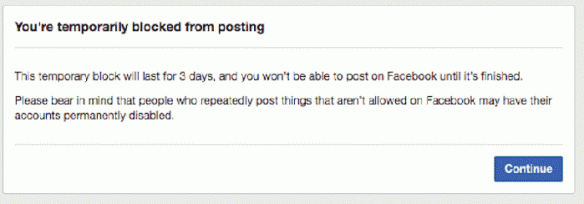
My personal Facebook account, which has the maximum 5,000 friends and an additional 5,000+ followers, has been blocked from posting for three days. My page hasn’t been blocked yet, but we’ll see; I shared the article there, too.

The reason given for this ban by the little pop-up boxes when I logged on just now was that a couple months ago I had shared an article about admitted false flag operations perpetrated by governments around the world. I don’t know what happened that made Facebook’s system decide to crack down on me now all of a sudden, but I do know I’ve been a bit naughtier than usual in my last couple of articles.

The article I got the banhammer for sharing is titled For Those Who Don’t ‘Believe’ In ‘Conspiracies’ Here Are 58 Admitted False Flag Attacks. According to the site’s ticker it has 50,667 shares as of this writing. It’s laden with hyperlinks for further reading, and lists only instances of false flag operations that insiders are on the record as having admitted to themselves. It’s a good compilation of important information. People should be allowed to share it.

The notifications say I can be permanently banned if I continue posting that sort of material. I’ve had that account since 2007.

So. Who wants to see my Barbra Streisand impression?

(Image by Caitlin Johnstone)

(Image by Caitlin Johnstone)

In a corporatist system of government, corporate censorship is state censorship. When there’s no meaningful space between corporate power and government power, it doesn’t make much difference whether the guy silencing your dissent is Mark Zuckerberg or Jeff Sessions. America most definitely has such a system.

If they’re going to get us locked down and propagandized into their vapid brain boxes, this will be how they’ll do it. Not by government censorship, but by corporate censorship. Government can’t make an overt attempt to stop a dissenting voice from speaking, but the corporations who own the venue of their speech can.

In a recent Senate Judiciary Committee hearing, plutocrat-sponsored senators spoke with top legal and security officials for Facebook, Twitter and Google in a very disturbing way about the need to silence dissenting voices.

Democratic Senator Mazie Hirono of Hawaii demanded that the companies adopt a “mission statement” declaring their commitment “to prevent the fomenting of discord.”

A former FBI agent Clint Watts kicked it up even further, saying, “Civil wars don’t start with gunshots, they start with words. America’s war with itself has already begun. We all must act now on the social media battlefield to quell information rebellions that can quickly lead to violent confrontations and easily transform us into the Divided States of America.”

“Stopping the false information artillery barrage landing on social media users comes only when those outlets distributing bogus stories are silenced”—“-silence the guns and the barrage will end,” he added.

This was on the Senate floor. Officials were speaking about the need to censor social media to prevent people from sharing dissenting ideas on the Senate floor.

World Socialist Web Site said of the hearing,

That such a statement could be made in a congressional hearing, entirely without objection, is an expression of the terminal decay of American democracy. There is no faction of the ruling class that maintains any commitment to basic democratic rights.

None of the Democrats in the committee raised any of the constitutional issues involved in asking massive technology companies to censor political speech on the Internet. Only one Republican raised concerns over censorship, but only to allege that Google had a liberal bias.

Former FBI agent says tech companies must “silence” sources of “rebellion”
US Congressional hearing: By Andre Damon 1 November 2017 Top legal and security officials for Facebook, Twitter and” www.wsws.org

I’ll admit right now that this really scares me. Ever the optimist, I’ve been reassuring my readers that the corporatocracy would never risk taking off the black hole sun mask of corporate cheerfulness and move into regular, overt totalitarianism. I’ve contended that they must remain covert in order to keep successfully manufacture consent.

But, here we are. Through a studious application of psy-ops they have their censorship and they have their consent. Remember, in the book “Fahrenheit 451” the public wasn’t unhappy about the book burnings. They cheered them on, and that’s what we have now. The herd is mindlessly clapping their approval at censorship and even volunteering to report naughty behavior like good little hall monitors for the oligarchy. I’m sure that even some of my close friends and family will silently approve of my banning and will meet my distress with the pursed lips of a church lady secretly pleased at my comeuppance.

I tried joining Gab when I saw this coming, but it’s really alt-righty there and the energy there is just gross. Finding a new social media outlet might not even matter anyway, since these creeps just target any place people gather in large numbers.

I don’t know. I always freak out a bit when the eye of corporate censorship focuses on me. I’ve recently been told by a number of people that they’ve been banned for sharing my articles, and now it’s hitting me.

I’m babbling. This is weird. I just really, really don’t want humanity to become what these people are trying to turn it into, you know? Help me make some noise about this stuff, please. Manipulators can’t do their job when there’s a big spotlight pointed at them.

______

Hey you, thanks for reading! My work is entirely reader-funded so if you enjoyed this piece please consider sharing it around, liking me on Facebook, following me on Twitter, and maybe throwing some money into my hat on Patreon or Paypal.

Brazile Fallout: Hillary Privatized the DNC with Help from a Washington Law Firm

By Pam Martens and Russ Martens

Source: Wall Street On Parade

Secret side agreements are a common maneuver by corporate law firms. Here’s how they work. An agreement that is legal and passes the smell test is drafted and submitted to a court or a regulatory body for public consumption. Then, a separate, secret side agreement is written and signed by both sides and it contains all of the smelly, shady, ethically questionable hard details on how the original agreement will be carried out.

Donna Brazile, the former interim Chair of the Democratic National Committee (DNC) during the 2016 presidential campaign, has written a new book, “Hacks: The Inside Story of the Break-ins and Breakdowns that Put Donald Trump in the White House,” and has revealed the secret side agreement that the DNC had with Hillary Clinton’s campaign.

In 2015, Hillary Clinton’s campaign set up a joint fundraising committee called the Hillary Victory Fund (HVF) with the DNC and over 30 state democratic committees. The public portion of the agreement indicated that Hillary would raise funds for her own campaign while also allocating a portion to the DNC to help the overall Democratic Party as well as allocating funds to state democratic committees in order to support down-ballot candidates in their local elections. But the secret side agreement that effectively privatized the DNC, giving Hillary and her campaign lawyers control of the DNC and its money, had yet to see the light of day.

This is how Brazile describes the secret side agreement in her book:

“The agreement—signed by Amy Dacey, the former CEO of the DNC, and Robby Mook [Clinton’s campaign manager] with a copy to Marc Elias [lawyer at Perkins Coie]  — specified that in exchange for raising money and investing in the DNC, Hillary would control the party’s finances, strategy, and all the money raised. Her campaign had the right of refusal of who would be the party communications director, and it would make final decisions on all the other staff. The DNC also was required to consult with the campaign about all other staffing, budgeting, data, analytics, and mailings.”

The Clinton camp has now attempted to defend itself by saying these terms are standard because they were not going to kick in until the Democratic Party had chosen its official presidential nominee at its party convention in July 2016. But that’s not what the actual secret side agreement says. It indicates the following: “Beginning October 1, 2015,” the HVF would begin transferring $1.2 million to the DNC at the start of each month with that release “conditioned on” Hillary Clinton’s primary campaign personnel being consulted “and have joint authority over strategic decisions over the staffing, budget, expenditures, and general election related communications, data, technology, analytics, and research. The DNC will provide HFA advance opportunity to review on-line or mass email, communications that features a particular Democratic primary candidate.”

Additionally, the secret agreement states that “the DNC agrees that no later than September 11, 2015 it will hire one of two candidates previously identified as acceptable to HFA” (Hillary for America, the primary campaign fund for Clinton) as its Communications Director. All of this is occurring in the fall of 2015 with the official Democratic nominating convention not taking place until July 2016.

As Politico reported in May 2016, the Hillary Victory Fund was a sham in multiple other ways. First, Politico writes that less than 1 percent of the money raised stayed in the state’s coffers. The Treasurer of the Hillary Victory Fund actually had the power to move money in and out of state committee bank accounts. Politico reporters Ken Vogel and Isaac Arnsdorf cite the following example to show how things actually worked:

“…the Minnesota Democratic-Farmer-Labor Party received $43,500 from the victory fund on Nov. 2, only to transfer the same amount to the DNC that same day. The pattern repeated itself after the Minnesota party received transfers from the victory fund of $20,600 on Dec. 1 (the party sent the same amount to the DNC the next day) and $150,000 on Jan. 4 (it transferred the same amount to the DNC that day).

“That means that Minnesota’s net gain from its participation in the victory fund was precisely $0 through the end of March. Meanwhile, the DNC pocketed an extra $214,100 in cash routed through Minnesota — much of which the DNC wouldn’t have been able to accept directly, since it came from donors who had mostly had already maxed out to the national party committee.

“A similar pattern transpired with most of the participating state parties. As of March 31, only eight state parties (most of which were in battleground states such as Colorado, Florida, Nevada, New Hampshire and Virginia) had received more from the victory fund than was transferred from their accounts to the DNC.”

Brazile backs up this account in her book, writing that “the states kept less than half of 1 percent of the $82 million they had amassed from the extravagant fund-raisers Hillary’s campaign was holding….”

Brazile notes in her book that the lawyer, Marc Elias, of the politically-connected law firm, Perkins Coie, was copied on the secret side agreement. Elias has repeatedly come under scrutiny for his multi-faceted roles in the 2015-2016 presidential campaign. Most recently, he was exposed as the guy behind the hiring of Fusion GPS which compiled the scandalous Russian dossier on Donald Trump, using both Hillary campaign funds and DNC funds. The Washington Post reported that Elias was allowed to spend these funds “without oversight by campaign officials, according to a spokesperson for his law firm.”

Elias served as the General Counsel to Hillary’s primary campaign committee, Hillary for America, as well as serving as one of a team of lawyers from Perkins Coie that provided legal advice to the DNC. (Elias also provided legal advice to the Democratic Senatorial Campaign Committee, Democratic Congressional Campaign Committee, and Democratic Governors Associations, according to the Perkins Coie web site last year.)

As a legal adviser to the DNC, Elias should have known that its charter mandated fairness and impartiality to all primary candidates. But when WikiLeaks released emails last year that had been hacked at the DNC, Marc Elias was caught giving advice on how to tar Senator Bernie Sanders after his campaign suggested that the Hillary Victory Fund was skirting Federal election law. The email from Elias read:

“My suggestion is that the DNC put out a statement saying that the accusations the Sanders campaign are not true. The fact that CNN notes that you aren’t getting between the two campaigns is the problem. Here, Sanders is attacking the DNC and its current practice, its past practice with the POTUS and with Sec Kerry. Just as the RNC pushes back directly on Trump over ‘rigged system’, the DNC should push back DIRECTLY at Sanders and say that what he is saying is false and harmful the [sic] the Democratic party.”

Writing for Politico in 2014, Ken Vogel detailed how Elias and Perkins Coie have not only been the legal go-to guys for the Democratic party over the years but how they have also tinkered with Federal election law to shift more power to the 1 percent. Vogel writes:

“Perkins Coie’s political law practice, anchored by Elias and former White House Counsel Bob Bauer, has something of a stranglehold on the Democratic Party’s election law business, representing not only the party committees themselves but everyone from [Harry] Reid (whose various committees have paid $317,000 in legal fees to Perkins Coie over the years) to Obama ($7.4 million) to the major Democratic super PACs ($19 million).”

The thrust of the article, however, is that Elias played a central role in further opening the spigots for legal revenues his firm might be expected to collect in the future by tinkering with Federal legislation at the eleventh hour. Vogel writes:

“A powerful Democratic lawyer helped craft a provision that was slipped into a year-end spending bill allowing political parties to raise huge new pools of cash — including some for legal fees that are likely going to be collected by his own firm…

“The change has the potential to halt or at least slow the erosion of power of the political parties, since it would increase the maximum amount of cash that rich donors may give to the national Democratic and Republican party committees each year from $97,400 to $777,600 or more.”

The question that no one seems to be asking is who are the main beneficiaries of Perkins Coie’s heavy influence at the top of the Democratic Party. Despite Obama’s re-election for a second term, the Democratic Party shed nearly 1,000 seats from coast to coast. The Republicans now control both houses of Congress and the Executive Branch. A man with the lowest approval rating in modern history now occupies the Oval Office.

The primary beneficiaries of this hubris have been the 1 percent – Wall Street and hedge fund titans – and giant multi-national corporations that dominate the client roster at Perkins Coie.

Those within the Clinton camp and DNC who are suggesting to the American people that there is nothing to see here, time to move along, are dead wrong. Just because the Republican presidential campaign may have been corrupted by outside forces doesn’t mean that the Democratic campaign wasn’t also corrupted by its own outside forces. It’s time to follow the obscene political money trail wherever it leads.

Related Articles:

Are Hillary Clinton and the DNC Skirting Election Law?

DNC’s Direct Marketing Firm Shows Bias on Facebook Against Bernie Sanders

WikiLeaks Bombshell: Emails Show Citigroup Had Major Role in Shaping and Staffing Obama’s First Term

The CIA Flips Off America

Photo credit: Adapted by WhoWhatWhy from sarang / Wikimedia and CIA / Wikimedia.

Open Letter from JFK Assassination Expert Dan Hardway

By Dan Hardway

Source: WhoWhatWhy.org

A 1964 CIA memo spells out clearly how James Jesus Angleton, the agency’s famous counterintelligence chief, wanted to deal with inquiries from the Warren Commission:

Jim would prefer to wait out the Commission.1

History seems to be repeating itself. The events of the past two weeks have shown that the CIA is still running a disinformation campaign against anyone who questions the “lone-nut” theory that, according to historian David Robarge, constitutes the agency’s “best truth.”

I recently published an article about the delay in releasing records under the 1992 JFK Records Collections Act. In that article I explained the CIA’s play to discredit those who question the agency’s lone-nut theory,2 and suggested that Robarge, its historian, has told us what to look for in the documents that are still being withheld.3

In that article I suggested we should look for information regarding covert operations against Cuba that would, according to Robarge, “circumstantially implicate CIA in conspiracy theories.”4 While I doubt the existence of a “smoking gun,” the circumstantial evidence we might look for in the delayed files could show a correlation between Lee Harvey Oswald’s activities in New Orleans and Mexico City in the late summer and fall of 1963 and CIA covert operations against Cuba being run by George Joannides and David Atlee Phillips involving anti-Castro groups such as the Directorio Revolucionario Estudiantil (DRE).5

I specifically suggested that we look to files on those operations. Some of these files are in the JFK records that are scheduled for release.

On October 26, 1992, Congress passed S. 3006, with only one amendment and very little, if any, opposition. The Senate bill, introduced by Sen. John Glenn (D-OH), was signed the same day by President George H.W. Bush and became Public Law 102-526, (“JFK Records Act”). Among other things the JFK Records Act provided for the collection, preservation and eventual release of all records related to the 1963 assassination of President John F. Kennedy, with minimal exceptions.

It mandates, in clear and unambiguous language, “[e]ach assassination record shall be publicly disclosed in full, and available in the Collection no later than the date that is 25 years after the date of enactment of this Act.” The Act allows an exemption to this mandatory requirement only if the president “certifies” that the release of each withheld document “is made necessary by an identifiable harm to” either 1) military defense; 2) intelligence operations; 3) law enforcement; or 4) the conduct of foreign relations and “the identifiable harm is of such gravity that it outweighs the public interest in disclosure.”6

On November 3, NARA released some of the files that I have been waiting on. The Excel spreadsheet listing the released files include four files referenced to David Atlee Phillips and one file referenced to the DRE.7 Of the files referencing Phillips, three are of an unspecified nature and one is listed as his Office of Personnel (OP) file. The DRE file is listed as “CIA file on DRE AMSPELL operations.”

AMSPELL is a CIA cryptonym for DRE, the anti-Castro Cuban group that was run by George Joannides in 1963, that had the encounter with Oswald in New Orleans in 1963, and published the first conspiracy theory blaming Castro in their CIA-financed newspaper in Miami on November 23, 1963. For such an active group, the file that was released is a very thin 87 pages of which 61 are expurgated in full.

Of the remaining 26 pages, many are largely expurgated. The Phillips files are even worse. The three files of unspecified type may be some of his operational files. These files are even more highly expurgated than the AMSPELL file. Taking the 73-pages long file RIF 104-10177-10135 as an example, a full 48 pages are completely redacted and NOTHING that was released in the file has any substantive info. For all intents and purposes, it remains withheld in full.

The file that is listed as David Atlee Phillips’s OP file is not as heavily redacted as the other three Phillips files, although many of the documents — mainly personnel forms — it contains have been cleansed of any significant data. That, however, is not the end of the story on this file.

The file starts with a few items of post-retirement correspondence between Phillips and the CIA in 1975 and then proceeds chronologically backwards from his retirement in 1975. I have not yet been able to go through the 358-page file to carefully study all the documents, but I have gone through it well enough to note that all his fitness reports between 1956 and 1965 are missing — not redacted, just simply not there.

Indeed, so far as I have been able to find, there is no record whatsoever of a document in the file dated between 1961 and 1965 — not redacted, just simply not there.

There has been no explanation, let alone a presidential certification, that the massive redactions in these “released in full” documents meet any of the mandatory exemptions that allow withholding. No identifiable harm is specified. No rationale is given as to why the secrets protected outweigh the public interest in disclosure.

These files are not in compliance with the law no matter what the mainstream media says.

They are an in-your-face flipped bird to the American public. They basically tell us that the CIA is saying that it doesn’t have to comply with the law of the land and that it will not tell us its secrets and that there is nothing we can do about it.

I’ve been here before. It was in a small room in CIA Headquarters in late 1978. I had been fighting to see a file generated by the CIA debriefing of its hired mafioso Johnny Roselli. Scott Breckinridge and George Joannides, CIA liaisons with the HSCA, had just handed me a highly redacted file that violated the HSCA/CIA Memorandum of Understanding mandating unexpurgated access by HSCA to CIA files.

They stood by, grinning, as they watched my reaction upon opening the file to find it largely expurgated. They were grinning so hard because they knew they had waited out the HSCA and there was nothing I could do about it. The Angleton strategy still worked. It is still working today.

This release not only demonstrates that the Angleton strategy is still being applied; it also illustrates the point I have been making about what they are covering up. There may well be nothing we can do about it. It appears our lawmakers are spineless in the face of the intelligence community. Joseph Burkholder Smith, a retired CIA officer, told me and fellow investigator Gaeton Fonzi in 1978, “You represent Congress. What the f*** is that to the CIA? You’ll be gone in two years and the CIA will still be there.”

To paraphrase that to fit the situation in which we now find ourselves: “You are the people that Congress supposedly represents. What’s that to the CIA? You’ll forget about it in a few weeks or so.”

But I won’t. I wrote a letter to my senator, West Virginia Democrat Joe Manchin, on November 3 before I saw the travesty that was the day’s release of JFK documents by NARA. Probably a futile gesture, but one I had to take anyway. Here’s part of what I told him:

On October 26, 2017, as I am sure you are aware, President Donald Trump, at the request of the Central Intelligence Agency and other intelligence community members, disregarded the clear provisions of the law and postponed release of ninety percent of the remaining withheld documents in the JFK Records Collection for an additional six months. In doing this, the President made no findings, issued no orders and certified nothing, merely issuing a statement through the press office saying that all documents will be released “with redactions only in the rarest of circumstances” by April 26, 2018.

The President’s action was not only without authority in law, it was also taken in patent violation of the clear, unambiguous and mandatory terms of a law that your institution passed. …

The real problem that this presents is that it is showing to the nation that the intelligence agencies of our nation are not subject to the laws of the nation. They are effectively above the law. At their request, or pressure, the President of the United States will violate the clear mandates of enacted legislation. And, to date, the reaction of our elected representatives in Congress seems to reinforce the fact that no one is willing to stand up to such blatant disregard of the clear provisions of the duly enacted laws of the nation. I understand that it is the executive branch that is charged with the enforcement of the laws your branch enacts and, in this case, it is the executive branch that is violating the law so there can be little realistic expectation of enforcement from them. But this is the heart of the problem and why it is incumbent upon the Congress to act. At a minimum there should be oversight hearings. At a minimum the Congress should not be seen to willingly acquiesce in executive contempt for the Legislative branch of government and the law of the land.

This action on the part of the intelligence community, the National Archives, and the Executive is only the latest in a long string of actions that disregard the provisions of the JFK Records Act that also subvert and cover up the information related to the assassination of our 35th president. Those other actions are beyond the present scope of this letter, but are things about which I would be glad to speak with you if you have any interest, so I will not go into them here.

To my knowledge there has been no coverage or explanation of why the intelligence community has requested this delay of the President. It was made in secret. What reason have they given for the delay? What kind of pressure have they brought to bear? How can they force a president to so blatantly disregard the law? If they can do this in regard to disclosure of fifty-year-old records, in what else can they exercise a like secret influence that corrupts the laws of the nation? What affect does the existence and use of such secret power have on our democracy? If these things — not just the documents but the method of influence — remain always secret, then how can a citizenry be sufficiently informed so as to exercise their franchise to any real purpose? How can we have faith in our democracy, let alone our government, if this kind of practice is allowed to continue unchallenged? These are the questions that I would like to have answered. But, to make it easier for you, I note you are in a unique position in regard to these issues due to your membership on the Senate Select Committee on Intelligence. Are you at least going to call and press for public hearings on any of these issues? Or are you going to join the vast majority of our representatives and once again cower before the intelligence agencies? Will you stand up for your constituents’ right to participate in their government on an informed basis? Will you stand for holding our government to a standard of open honesty before its citizens and against allowing the real affairs of state to be conducted in secret and in disregard of the laws enacted by the people’s representatives?8

The questions I asked Manchin in that letter are even more pressing today. I don’t know if he’ll even answer, let alone do anything. Maybe, like Sen. Chuck Grassley (R-IA), he’ll send out an apparently frustrated tweet. Or maybe, like the mainstream press, he’ll tout the release of the documents, hoping no one will look to see what a travesty the “release” is because of the massive redactions. At this point all I can do is try to tell the truth about this whole state of affairs.

I also encourage you to not take this insult to your intelligence and ability to govern yourselves without reaction. Do something. If nothing else, circulate this article to everyone you know. Refuse to accept the cancer of secrecy that destroys our liberty and ability to govern ourselves. Get involved. Get informed. Stay informed. Read and follow http://2017jfk.org/home/ and http://jfkfacts.org/. Read WhoWhatWhy.

Join the AARC at http://aarclibrary.org/aarc-membership/. Join CAPA at http://capa-us.org/membership/. If those who exercise the power in this country have such blatant contempt for the law, then the time for serious peaceful civil disobedience may be upon us. Get the word out. Don’t be silent any longer. This is not an issue of the left or the right. Do something. Say something. And don’t stop until you are heard.

Endnotes

.


1. Raymond Rocca to Richard Helms, Memo Re Response to Rankin, 5 Mar 1964, NARA Record No.  1993.06.24.14:59:13:840170, available at https://www.maryferrell.org/showDoc.html?docId=98075#relPageId=1&tab=page


2. David Robarge, “DCI John McCone and the Assassination of President John F. Kennedy,” Studies in Intelligence, (Vol. 57, No. 3, 09/2013), Approved for Release and declassified, 09/29/2014, at page 20.  Available at http://nsarchive.gwu.edu/NSAEBB/NSAEBB493/docs/intell_ebb_026.PDF. Robarge wrote: “The DCI was complicit in keeping incendiary and diversionary issues off the commission’s agenda and focusing it on what the Agency believed at the time was the ‘best truth’: that Lee Harvey Oswald, for as yet undetermined motives, had acted alone in killing John Kennedy.” For my commentary on the CIA’s “best truth”, see Thank You, Phil Shenon available at https://realhillbillyviews.blogspot.com/2015/10/. Note that the “best truth” was conditioned by “at the time” leaving open the real possibility that alternative cover stories may have to be brought to play in the event that time undermined what the Agency considered to be the best truth for them.


3. Dan Hardway, What Were They Hiding and What Should We Look For, 30 Oct 2017, available at https://realhillbillyviews.blogspot.com/2017/10/what-were-they-hiding-and-what-should_30.html


4. Robarge, n. 2 above, at p. 9.


5. This is addressed in more detail at JFKFacts, Exclusive: JFK investigator on how CIA stonewalled Congress, http://jfkfacts.org/hardway-declaration-cia-stonewalled-jfkinvestigation/; Declaration of Dan L. Hardway, Morley v. CIA, CA # 03-02545-RJL, D.C.D.C. 11 May 2016, Docket No. 156.


6. 44 U.S.C. § 2107 note  § 5(g)(2)(D). Emphasis added.


7. https://www.archives.gov/research/jfk/2017-release, RIF Nos. 104-10176-10121, 104-10177-10135, 104-10177-10134, 104-10194-10026, and 104-10170-10121.


8. See here for the full letter.