Why Can’t The Nation and the Left Deal With Election Theft?

jf-7

By Bob Fitrakis & Harvey Wasserman

Source: Reader Supported News

here are two things we all need to know about the upcoming 2016 election:

    1. Millions of likely Democratic voters have already been stripped from the voter rolls in critical states like Ohio. The key reporting on this has been done by the great Greg Palast, who has shown that a computer program coordinated by the Republican secretary of state of Kansas is being used in some two dozen states to steal from a substantial percentage of the citizenry their right to vote. The raw numbers are high enough that they could have a significant impact on the presidential, US Senate, House and many other elections this fall. The ACLU has now sued Jon Husted, Ohio’s secretary of state, over the stripping of two million citizens from Ohio’s voter rolls.
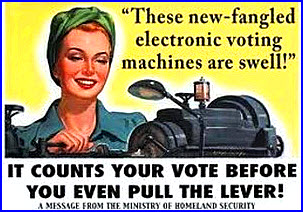
    1. There is no way to verify the official tally on the electronic machines on which the majority of Americans will vote this fall. Nearly all the machines are a decade old, most are controlled by a single company (ES&S, owned by Warren Buffett) and the courts have ruled that the software is proprietary, making the vote counts beyond public scrutiny. In fact, they are beyond all independent monitoring altogether. In many key swing states (including Ohio, Michigan, Iowa and Arizona) GOP governors and secretaries of state will have a free hand to flip the vote count to whatever they want it to be without detection or accountability. This could turn control of our government over to the GOP come November, as it did in 2000 and 2004.

These two critical markers of the upcoming national election are at center stage in our compendium The Flip & Strip Selection of 2016: Five Jim Crows and Electronic Election Theft (www.freepress.org / www.solartopia.org), which we’ll be publishing at the end of April.

For some reason many on the left have had a hard time accepting these realities. But they’re in fact far more critical than the question of who will make the better Democratic candidate.

In the interim, the usually solid Josh Holland has published a piece at The Nation with which we must take issue. It challenges writings that have put forward the idea that Hillary Clinton might be stealing the primaries from Bernie Sanders.

To avoid the circular firing squad in which the left indulges every election year, we should make it clear that we are both members of the Green Party. We prefer Bernie to Hillary, but like Jill Stein most of all. We hope Bernie at some point will establish a substantial string of grassroots training camps so the thousands of highly active young people who are supporting him will convert those energies to great long-term community organizing.

We are most concerned about the possibility of a GOP president come November. (For what it’s worth, we currently lay the highest odds of that nominee being the absolutely terrifying Paul Ryan. Ryan has said he won’t campaign for the nomination, but he has NOT said he’ll refuse it at a convention where he’ll be holding the gavel. His pockets will be stuffed with Koch cash. Enough said.)

We plead guilty to writing a piece at Reader Supported News pointing out that the exit polls show Bernie doing far better than the official vote count. Josh dismisses the reliability of exit polls, along with our mention of those in Germany. Suffice it to say that exit polling is the most reliable way we have of monitoring the vote count. In Germany they are usually within 1% of the official tally.

Here they are corrupted after the original compilations. They’re generally post-rigged to conform to the final official vote count, which is often pre-rigged. What matters is the original raw data, which we feel after much study is the gold standard for knowing how the public actually voted.

Of course that data can be messed with along the way. But at this point it’s the best we’ve got. And the original data can be hard to get. When statistician Ron Baiman requested original data from big-time pollster Warren Mitofsky (since deceased) Mitofsky told to him to “go fuck yourself.”

For some reason Josh drags “conspiracy theory” into the mix, with a lengthy soliloquy on 9/11. Neither of us writes about 9/11, though we know plenty of people who do. We find much of the official story not credible, but that’s about it at this point.

However, history warns us to be discerning about so-called conspiracy theories. Josh paints them all with a broad brush when he says they “tend to fall apart under the weight of their own internal illogic.”

But at the risk of rolling some eyeballs, here are (briefly) five that have proved indisputably true: Spain did NOT torpedo the battleship Maine in 1898, a false charge the led to a terrible war (the US Navy has confirmed the Maine blew up from the inside); the Lusitania WAS carrying munitions in 1915, as Germany argued; the Gulf of Tonkin incident NEVER happened, as confirmed by former Defense Secretary Robert McNamara; Richard Nixon DID treasonably subvert Vietnam peace talks in 1968; and there were NO WMDs in Iraq.

Maybe we can leave the Mexican War; Pearl Harbor; the assassinations of JFK, MLK and RFK; and the “October Surprise” timing of the release of hostages from Iran in 1980-1981, etc., for another discussion.

About the elections of 2000 and 2004, we are way beyond conspiracy theory. That the voter rolls were stripped in numbers exceeding 90,000 throughout Florida 2000, and the vote count electronically flipped in Volusia County at the key moment, are simply beyond dispute. So is the reality that had the Supreme Court not stopped the recount, Gore would have won.

In Ohio 2004, it’s also beyond dispute that more than 300,000 voters were stripped from the registration rolls from mostly Democratic urban areas, and that the vote count was flipped by 6.7% from Kerry to Bush between 12:20 and 2 a.m. on machines in a basement in Chattanooga where the servers for Karl Rove and the Republican National Committee also resided. Thousands of Ohioans were deliberately robbed of their vote with the stripping of precincts and denial of voting machines and back-up paper ballots in African-American and student strongholds. In an election with an official victory margin of 118,775, more than 250,000 votes remain uncounted to this day. Thousands of provisional ballots were also pitched in the trash, as they already have been in this primary season, and will be again in November.

Imagine a world in which, instead of George W. Bush, Al Gore had been inaugurated as the rightfully elected president in 2001, or John Kerry in 2005. It’s easy if you open your eyes to what actually happened in those elections, and terrifying if you think about what could happen this year.

For some reason, Josh also takes us into the purported mind of a Hillary operative who would never think of rigging a primary election because she was winning anyway.

This a bit hard to follow. But let’s just say that the exit polls have indicated Bernie doing better than the official vote count, that (according to Richard Charnin) Bernie won all the hand-counted precincts in Massachusetts but lost all the machine-counted ones, and that all the caucuses have been extremely messy and open to all sorts of manipulation by both sides.

Far more important to say is that the voting machines this fall will be significantly more vulnerable to being flipped than ever before, because they are now nearly all at least ten years old. Some are decrepit enough to have been used to play PacMan or the University of Michigan fight song in public displays.

For us, the most significant event of the primary season has been the 5-hour lines in Arizona and the one-hour lines in Wisconsin. We are less concerned about whether Hillary did this to Bernie than we are worried that these will become the defining moments on the rigged path to a GOP victory in November.

Josh, if you’re reading this, we repeat our invitation to come on our radio shows (http://prn.fm/hosts-harvey-wasserman/ and http://www.talktainmentradio.com/shows/fightback.html).

Meantime, how about a piece on the “strip and flip” realities both the Democrats and the Greens will face come November? Whether it’s Hillary, Bernie, or Jill, as things stand now we are certain to see deliberately engineered long lines that will disenfranchise countless young, African-American. and Hispanic voters. We also know that in certain key swing states, the electronic vote count will come out however the hell the governor wants it to.

To you this may be conspiracy theory. But remember the Maine.


Bob Fitrakis & Harvey Wasserman have co-authored six books on election integrity, including the upcoming Strip & Flip Selection of 2016: Five Jim Crows and Electronic Election Theft (www.freepress.org / www.solartopia.org). Bob’s Fitrakis Files are at www.freepress.org. Harvey’s America at the Brink of Rebirth: The Organic Spiral of US History will be out soon at www.solartopia.org.

Who is Afraid of Conspiracy Theories?

conspiracy-theory-definition

By Lance deHaven-Smith

Source: Waking Times

In his book Philosophical Investigations, philosopher of science Ludwig Wittgenstein demonstrated that words are more than designations or labels. They are signals in a context of activity, and are invested with many assumptions about the roles and social status of speakers and listeners.

In the 20th century, men often called women “girls.” This term, while indeed referring to something real – to women – was more than merely a label; it was demeaning and implicitly conveyed a subservient status. Wittgenstein called the common sense view of words standing for things, the “naming theory of language.” However, he pointed out, if words were merely labels, you could not teach language to children. If you pointed at a table and said “table,” how would a child know you are referring to the piece of furniture and not to the rectangular shape of its top, or the table’s colour, or its hardness, or any number of other attributes? Language is taught in the context of activity. You say to the child, “the cup is on the table,” “slide the cup across the table top,” “I am setting the table for dinner,” and slowly the child learns what a table is and how the word table is used.

Wittgenstein’s observation may seem simple, but it posed a profound challenge to all of Western philosophy since Plato, who had asked: What is beauty? What is truth? What is justice? Wittgenstein’s critique of the naming theory of language suggested these were the wrong questions. What needs philosophical investigation is who uses such words in what circumstances and with what implications.

The term conspiracy theory did not exist as a phrase in everyday conversation before 1964. The conspiracy theory label entered the lexicon of political speech as a catchall for criticisms of the Warren Commission’s conclusion that US President Kennedy was assassinated by a lone gunman with no assistance from, or foreknowledge by any element of the United States government. Since then, the term’s prevalence and range of application have exploded. In 1964, the year the Warren Commission issued its report, the New York Times published five stories in which conspiracy theory appeared. In recent years, the phrase has occurred in over 140 New York Times stories annually. On Amazon.com, the term is a book category that includes in excess of 1,300 titles. In addition to books on conspiracy theories of particular events, there are conspiracy theory encyclopedias, photographic compendiums, website directories, and guides for researchers, sceptics and debunkers.

Initially, conspiracy theories were not an object of ridicule and hostility. Today, however, the conspiracy theory label is employed routinely to dismiss a wide range of anti-government suspicions as symptoms of impaired thinking akin to superstition or mental illness. For example, in his 2007 book on the assassination of President Kennedy, former prosecutor Vincent Bugliosi says people who believe JFK conspiracy theories are “as kooky as a three dollar bill in their beliefs and paranoia.” Similarly, in Among the TruthersCanadian journalist Jonathan Kay refers to 9/11 conspiracy theorists as “political paranoiacs” who have “lost their grip on the real world.” Making a similar point, if more colourfully, in his popular book Wingnuts journalist John Avlon refers to conspiracy believers as “moonbats,” “Hatriots,” “wingnuts,” and the “Fright Wing.”

As these examples illustrate, conspiracy deniers adhere unwittingly to the naming theory of language. They assume that what qualifies as a conspiracy theory is self-evident. In their view, the phrase conspiracy theory as it is conventionally understood, simply names this objectively identifiable phenomenon. Conspiracy theories are supposedly easy to spot because they posit secret plots that are too wacky to be taken seriously. Indeed, the theories are deemed so far-fetched they require no reply or rejoinder; they are objects of derision, not ideas for discussion. In short, while ridiculing conspiracy beliefs, conspiracy deniers take the conspiracy theory concept itself for granted.

This is remarkable, not to say shocking, because the concept is both fundamentally flawed and in direct conflict with English legal and political traditions. As a label for irrational political suspicions about secret plots by powerful people, the concept is obviously defective because political conspiracies in high office do, in fact, happen. Officials in the Nixon administration did conspire to steal the 1972 presidential election. Officials in the Reagan administration did participate in a criminal scheme to sell arms to Iran and channel profits to the Contras, a rebel army in Nicaragua. The Bush-Cheney administration did collude to mislead Congress and the public about the strength of its evidence for Iraqi weapons of mass destruction. If some conspiracy theories are true, then it is nonsensical to dismiss all unsubstantiated suspicions of elite intrigue as false by definition.

This fatal defect in the conspiracy theory concept makes it all the more surprising that most scholars and journalists have failed to notice that their use of the term to ridicule suspicions of elite political criminality betrays the civic ethos inherited from British legal and political traditions. The Magna Carta placed limitations on the King, guaranteed trial by one’s peers, assigned historic revenue sources to London, and in other ways recognised the dangers of unrestrained political authority. More generally, the political institutions of the English speaking peoples presuppose political power is a corrupting influence which makes political conspiracies against the people’s interests and liberties almost inevitable. One of the most important questions in Western political thought is how to prevent top leaders from abusing their powers to impose arbitrary rule or tyranny. The men and women who fought for citizens’ rights, the rule of law, and constitutional systems of checks and balances would view today’s norms against conspiratorial suspicion as not only arrogant, but also dangerous and historically illiterate.

The founders of English legal and political traditions would also be shocked that conspiracy deniers attack and ridicule individuals who voice conspiracy beliefs, and yet ignore institutional purveyors of conspiratorial ideas, even though the latter are the ideas that have proven truly dangerous in modern history. Since at least the end of World War II, the citadel of theories alleging nefarious political conspiracies has been, not amateur investigators of the Kennedy assassination and other political crimes and tragedies, but political elites and governments. In the first three decades of the post-World War II era, officials asserted that communists were conspiring to take over the world, Western governments were riddled with Soviet spies, and various social movements of the 1960s were creatures of Soviet influence. More recently, Western governments have accepted US claims that Iraq was complicit in 9/11, failed to dispose of its biological weapons, and attempted to purchase uranium in Niger so it could construct nuclear bombs. Although these ideas were untrue, they influenced millions of people, fomented social panic, fuelled wars, and resulted in massive loss of life and destruction of property. If conspiracy deniers are so concerned about the dangers of conspiratorial suspicions in politics and civic culture, why have they ignored the conspiracism of top politicians and administrators?

In my book Conspiracy Theory in America, I reorient analysis of the phenomenon that has been assigned the derisive label of conspiracy theory. In a 2006 peer-reviewed journal article, I introduced the concept of State Crimes Against Democracy (SCAD) to displace the term conspiracy theory. I say displace rather than replace because SCAD is not another name for conspiracy theory; it is a name for the type of wrongdoing which the conspiracy theory label discourages us from speaking. Basically, the term conspiracy theory is applied pejoratively to allegations of official wrongdoing that have not been substantiated by public officials themselves.

Deployed as a derogatory putdown, the label is a verbal defence mechanism used by political elites to suppress mass suspicions that inevitably arise when shocking political crimes benefit top leaders or play into their agendas, especially when those same officials are in control of agencies responsible for preventing the events in question, or for investigating them after they have occurred. It is only natural to wonder about possible deception when a US president and vice president bent on war in the Middle East are warned of impending terrorist attacks, and yet fail to alert the public or increase the readiness of their own and allies’ armed forces. Why would people not expect answers when Arabs with poor piloting skills manage to hijack four planes, fly them across the eastern United States, somehow evade America’s multilayered system of air defence, and then crash two of the planes into the World Trade Center in New York City and one into the Pentagon in Washington, DC? By the same token, it is only natural to question the motives of President Bush and Vice President Cheney when they dragged their feet investigating this seemingly inexplicable defence failure and then, when the investigation was finally conducted, they insisted on testifying together, in secret, and not under oath. Certainly, citizen distrust can be unwarranted and overwrought, but often citizen doubts make sense. People around the world are not crazy to want answers when a US president is assassinated by a lone gunman with mediocre shooting skills who manages to get off several lucky shots with an old bolt-action carbine that had a misaligned scope. Why would there not be doubts when an alleged assassin is apprehended, publicly claims he is just a patsy, interrogated for two days but no one makes a recording or even takes notes, and then shot to death at point-blank range while in police custody at police headquarters?

In contrast, the SCAD construct does not refer to a type of allegation or suspicion; it refers to a special type of transgression: an attack from within on the political system’s organising principles. For these extremely grave crimes, English legal and political traditions use the term high crime and included in this category istreason and conspiracies against the people’s liberties. SCADs, high crimes, and antidemocratic conspiracies can also be called elite political crimes and elite political criminality. The SCAD construct is intended not to supersede traditional terminology or monopolise conceptualisation of this phenomenon, but rather to add a descriptive term that captures, with some specificity, the long-recognised potential for representative democracy to be subverted by people on the inside – the very people who have been entrusted to uphold the constitutional order.

If political conspiracies in high office do, in fact, happen; if it is therefore unreasonable to assume conspiracy theories are, by definition, harebrained and paranoia; if constitutional systems of checks and balances are based on the idea that power corrupts and elite political conspiracies are likely; if, because it ridicules suspicion, the conspiracy theory label is inconsistent with the traditional Western ethos of vigilance against conspiracies in high office; if, in summary, the conspiracy theory label is unreasonable and dangerous, how did the label come to be used so widely to begin with?

Most people will be shocked to learn the conspiracy theory label was popularised as a pejorative term by the Central Intelligence Agency (CIA) in a global propaganda program initiated in 1967. This program was directed at criticisms of the Warren Commission Report. The propaganda campaign called on media corporations and journalists around the world to criticise conspiracy theorists and raise questions about their motives and judgments. The CIA informed its contacts that “parts of the conspiracy talk appear to be deliberately generated by communist propagandists.” In the shadows of McCarthyism and the Cold War, this warning about communist influence was delivered simultaneously to hundreds of well-positioned members of the press in a global CIA propaganda network, infusing the conspiracy theory label with powerfully negative associations. In my book, I refer to this as the “conspiracy theory conspiracy.”

About the Author

LANCE DEHAVEN-SMITH is Professor in the Reubin O’D. Askew School of Public Administration and Policy at Florida State University. A former President of the Florida Political Science Association, deHaven-Smith is the author of more than a dozen books, including The Battle for Florida, which analyses the disputed 2000 US presidential election, as well as The Hidden Teachings of Jesus: The Political Meaning of the Kingdom of God (Phanes Press, 2001). His latest book is Conspiracy Theory in America (University of Texas Press, 2013). DeHaven-Smith has appeared on Good Morning America, the Today Show, NBC Nightly News with Tom Brokaw, CBS Nightly News with Dan Rather, the NewsHour with Jim Lehrer, and other US TV and radio shows. His website is www.dehaven-smith.com.

War, Media Propaganda, and the Police State

looks-like-youve-had-a-bit-too-much-to-think-support-your-local-thought-police-dont-speak-out-or-question-closed-minds-stop-thought-crimes

By James F. Tracy

Source: Memory Hole

The following essay is intended to provide a brief overview of topics addressed in a discussion graciously recorded by Julie Vivier at the offices of the Center for Research on Globalization in Montreal Canada on August 5, 2014.-JFT

Modern propaganda techniques utilized by the corporate state to enforce anti-democratic and destructive policies routinely entail the manufacture and manipulation of news events to mold public opinion and, as Edward Bernays put it, “engineer consent” toward certain ends.

Such events include not only overt political appeals, but also acts of seemingly spontaneous terrorism and militarism that traumatize the body politic into ultimately accepting false narratives as political and historical realities.

Western states’ development and utilization of propaganda closely parallels the steady decay of political enfranchisement and engagement throughout the twentieth century. Upon securing a second term in 1916, the Democratic administration of Woodrow Wilson plunged the United States into the most violent and homicidal war in human history. Wilson, a former Princeton University academician  groomed for public office by Wall Street bankers, assembled a group of progressive-left journalists and publicists to “sell the war” to the American people.

George Creel, Walter Lippmann, Edward Bernays and Harold Lasswell all played influential roles in the newly-formed Committee on Public Information, and would go on to be major figures in political thought, public relations, and psychological warfare research.

The sales effort was unparalleled in its scale and sophistication. The CPI was not only able to officially censor news and information, but essentially manufacture these as well. Acting in the role of a multifaceted advertising agency, Creel’s operation “examined the different ways that information flowed to the population and flooded these channels with pro-war material.”

The Committee’s domestic organ was comprised of 19 subdivisions, each devoted to a specific type of propaganda, one of which was a Division of News that distributed over 6,000 press releases and acted as the chief avenue for war-related information. On an average week, more than 20,000 newspaper columns carried data provided through CPI propaganda. The Division of Syndicated Features enlisted the help of popular novelists, short story writers, and essayists. These mainstream American authors presented the official line in a readily accessible form reaching twelve million people every month. Similar endeavors existed for cinema, impromptu soapbox oratory (Four Minute Men), and outright advertising at home and abroad.[1]

With the experiences and observations of these war marketers variously recounted and developed throughout the 1920s (Lippmann, Public Opinion, The Phantom Public, Bernays, Propaganda, Crystallizing Public Opinion, Creel, How We Advertised America, Lasswell, Propaganda and the World War), alongside the influence of their elite colleagues and associates, the young publicists’ optimism concerning popular democracy guided by informed opinion was sobered with the realization that public sentiment was actually far more susceptible to persuasion than had been previously understood. The proposed solutions to guarantee something akin to democracy in an increasingly confusing world lay in “objective” journalism guided by organized intelligence (Lippmann) and propaganda, or what Edward Bernays termed “public relations.”

The argument laid out in Lippmann’s Public Opinion was partly motivated by the US Senate’s rejection of membership in the League of Nations. An adviser to the Wilson administration, a central figure behind intelligence gathering that informed postwar geopolitical dynamics laid out at the Paris Peace Conference, and an early member of the Council on Foreign Relations, Lippmann increasingly viewed popular democracy as plagued by a hopelessly ill-informed public opinion incapable of comprehending the growing complexities of modern society. Only experts could be entrusted with assessing, understanding, and acting on the knowledge accorded through their respective professions and fields.

Along these lines, journalism should mimic the then-fledgling social sciences by pursuing objectivity and deferring to the compartmentalized expertise of established authority figures. News and information could similarly be analyzed, edited, and coordinated to ensure accuracy by journalists exercising similar technocratic methods. Although Lippmann does not exactly specify what body would oversee such a process of “organized intelligence,” his postwar activities and ties provides a clue.

Edward Bernays’ advocacy for public opinion management is much more practical and overt. Whereas Lippmann suggests a regimented democracy via technocratic news and information processing, Bernays stresses a privileged elite’s overt manipulation of how the populace interprets reality itself. Such manipulation necessitates contrived associations, figures and events that appear authentic and spontaneous. “Any person or organization depends ultimately on public approval,” Bernays notes,

“and is therefore faced with the problem of engineering the public’s consent to a program or goal … We reject government authoritarianism or regimentation, but we are willing to be persuaded by the written or spoken word. The engineering of consent is the very essence of the democratic process, the freedom to persuade and suggest.[2]

Bernays demonstrates an affinity with Lippmann’s notion of elite expediency when pursuing prerogatives and decision-making the public at large cannot be entrusted to interpret. In such instances,

democratic leaders must play their part in leading the public through the engineering of consent to socially constructive goals and values. This role naturally imposes upon them the obligation to use educational processes, as well as other available techniques, to bring about as complete an understanding as possible.[3]

Written in the early 1950s, these observations become especially apt in the latter half of the twentieth century, where the US is typically a major aggressor in foreign (and eventually domestic) affairs. Yet what does Bernays mean by, for example, “educational processes”? An indication may be found by noting his central role in the promotion of tobacco use, municipal water fluoridation, and the overthrow of the democratically-elected Arbenz regime in Guatemala.[4]

With the advent of the national security state in 1947, secret programs emerge where the people are as a matter of course intentionally left unaware of the state’s true rationales and objectives.

Indeed, a wealth of contemporary historical examples suggest how the “engineering of consent” is wholly calculating and anti-democratic, and where the crises requiring such drastic and immediate public relations and military measures are themselves the result of the same leadership’s policies and actions. The US economic provocation of the Japanese attack on Pearl Harbor and the Tonkin Gulf incident precipitating US military occupation of Vietnam are obvious examples of such manufactured events.

Similar techniques are apparent in the major political assassinations of the 1960s, where to this day the public is prompted to partake in the false reality that Lee Harvey Oswald was the sole culprit in the murder of President John F. Kennedy, much as Sirhan Sirhan was responsible for the death of Senator Robert F. Kennedy.

In fact, in each instance overwhelming evidence points to Central Intelligence Agency involvement in orchestrating the assassinations while training and presenting Oswald and Sirhan as the would-be assassins.

The US government’s assassination of Dr. Martin Luther King Jr., probably the most influential African American public persona of the twentieth century, is not even open to debate, having been soundly proven in a court of law.[5] Yet as with the Kennedys, it is a genuine public relations achievement that much of the American population is oblivious to the deeper dynamics of these political slayings that are routinely overlooked or inaccurately recounted in public discourse.

Along these lines, in the historical context of Operation Gladio, the Oklahoma City Murrah Federal Building bombing, the events of September 11, 2001, the London 7/7/2005 bombings, and lesser episodes such as the “shoe” and “underwear” bombers, the engineering of consent has reached staggering new heights where state-orchestrated terrorism is used to mold public opinion toward acceptance of militarized policing operations, the continued erosion of civil liberties, and major sustained aggression against moderate Middle Eastern nations to cartelize scarce resources and politically reconfigure an entire region of the world.

Again, the public is essentially compelled to believe that political extremism of one form or another is the cause of each event, even in light of how the sophistication and scope of the Oklahoma City and 9/11 “attacks” suggest high-level forces at work. If one is to delve beneath the public relations narrative of each event, the recent Newtown massacre and Boston Marathon bombing likewise appear to have broader agendas where the public is again purposely misled.

Conventional journalists and academics are reluctant to publicly address such phenomena for fear of being called “conspiracy theorists.” In the case of academe this has severely curtailed serious and potentially crucial inquiry into such deep events and phenomena in lieu of what are often innocuous intellectual exchanges divorced from actually existing social and political realities that cry out for serious interrogation and critique.

The achievements of modern public relations are further evident in the Warren and 9/11 Commissions themselves, both of which have spun the fantastic myths of Allan Dulles and Peter Zelikow respectively, and that today maintain footholds in public discourse and consciousness.

Indeed, the “conspiracy theory” meme, a propaganda campaign waged by the CIA beginning in the mid-1960s to counter criticism of the Warren Commission report, is perhaps as little-known as Operation Mockingbird, the CIA program where hundreds of journalists and publishers actively devoted their services to spread Agency disinformation. The overall effect of these combined operations has been an immensely successful program continues to shape the contours of American political life and mediated reality.[6]

The present socio-political condition and suppression of popular democracy are triumphs of modern propaganda technique. So are they also manifest in the corporate state’s efforts to engineer public acquiescence toward such things as the colossal frauds of genetically modified organisms masquerading as “food,” toxic polypharmacy disguised as “medicine,” and the police state and “war on terror” seeking to preserve “national security.”

Notes

[1] Aaron Delwiche, “Propaganda: Wartime Propaganda: World War I, The Committee on Public Information,” accessed September 28, 2014 at http://www.propagandacritic.com/articles/ww1.cpi.html; George Creel, How We Advertised America, New York: Harper and Brothers, 1920. Available at http://archive.org/details/howweadvertameri00creerich

[2] Edward Bernays, Public Relations, Norman OK: University of Oklahoma Press, 1952, 159-160.

[3] Ibid. 160.

[4] “You can get practically any ideas accepted,” Bernays reflected on the campaign to fluoridate New York City’s water supply. “If doctors are in favor, the public is willing to accept it, because a doctor is an authority to most people, regardless of how much he knows, or doesn’t know … By the law of averages, you can usually find an individual in any field who will be willing to accept new ideas, and the new ideas then infiltrate the others who haven’t accepted it. Christopher Bryson, The Fluoride Deception, New York: Seven Stories Press, 2004, 159.

[5] William F. Pepper, An Act of State: The Execution of Martin Luther King, New York: Verso, 2003.

[6] James F. Tracy, “Conspiracy Theory: Foundations of a Weaponized Term,” Global Research, January 22, 2013.


James Tracy Answers Questions About Conspiracy Theories

conspiracy-theory-definition

By Jaime Ortega

Source: The Daily Journalist

James Tracy teaches courses at Florida Atlantic University examining the relationship between commercial and alternative news media and socio-political issues and events.

1. There is a certain danger in the way conspiracy theories have eroded social media, especially on such platforms as YouTube.  Do people distrust mainstream television, radio, and print media?

First of all, we have to seriously think about what we mean by “conspiracy theories” before delving into such a discussion. What are the term’s origins?  How and why is it used?  Without nailing these things down at the outset any discussion of such communicative and sociopolitical dynamics tends toward the nonsensical and comes to eventually become absorbed in the discourse it is seeking the examine or critique.

A cursory look at reportage and commentary in major US news media from the late 1800s through the 1950s indicates that the term “conspiracy theory” is used sporadically in stories on criminal and court proceedings.  In the late 1960s, however, there is a major spike in usage of the term, specifically in items discussing criticism of the Warren Commission Report—President Lyndon Johnson’s commission mandated to investigate the assassination of President John F. Kennedy.  On January 4, 1967 the Central Intelligence Agency issued a memorandum that became known as Document 1035-960.  The communique was directed at the Agency’s foreign bureaus recommending the deployment of the term by “media assets” to counter critics of the Warren Commission.  The main strategy involved suggestion that such individuals and their inquiries were flawed by slipshod methods and ulterior motives.  The then-foremost Warren Commission critic and JFK assassination researcher Mark Lane was even referenced in the document.

This document was indicative of an apparent strategy via press and public relations maneuvers to undermine New Orleans District Attorney Jim Garrison’s then-fledgling investigation of the assassination.  1035-960 explained quite rightly that the CIA had a substantial investment in the credibility of the Warren Report.  Press reportage of Garrison’s ongoing probe revealed a heavy bias from the very outlets that had been long-compromised by Agency-friendly owners, editors, and reporters.  These included NBC and CBS networks, in addition to Time and Newsweek magazines, where the disparaging coverage of Garrison and his inquiry reached truly farcical proportions.

Though he was repeatedly and vociferously decried as a “conspiracy theorist,” a corrupt and opportunistic politician, and even mentally deranged by such outlets, Garrison has been vindicated by the historical record.  For example, we now know, through copious records released as a result of the John F. Kennedy Assassination Records Review Board, that the CIA was intimately involved in the assassination and cover-up, as were other US government agencies.  Yet the same news media that denounced Garrison almost fifty years ago still tout the legitimacy of the Warren Commission Report.

Since the Garrison episode, but in an especially pronounced fashion over the past twenty years, the conspiracy theory label is routinely mobilized by major corporate media to denigrate honest and intelligent individuals who bring forth important questions on vital events and issues.  Keep in mind that most major media still have often strong ties to the US intelligence and military communities.  With this in mind, a rational citizenry has an obligation to scrutinize what is reported and analyzed in corporate media, and balance their observations and conclusions by considering reportage of foreign and independent alternative media. In this regard the Internet provides a wealth of opportunity.  One needs only exercise the fundamental principles of logic to locate and assess quality information and research.

At the end of the day what we have in the “Conspiracy theory/ist” label is a psychological warfare weapon that has from the perspective of its creators been overwhelmingly effective.  Here is a set of words that is used to threaten, discipline and punish the intellectual class—mainly journalists and academics—who might question or otherwise refuse to tow the party line.  Using the term to designate pedestrian skeptics and researchers is redundant.  After all, as Orwell said, “The proles don’t count.”

Thus, unless we forthrightly interrogate the phrase and its unfortunate history we will be prone to the same confusion and misdirection that its originators
intended.

2. We did a poll here at The Daily Journalist a few weeks back, and the results indicated that 60% of people believed there was US government involvement in the Boston Marathon bombings, in addition to the events of September 11.  When people suspect their own government is involved on these attacks in US soil, what comes to mind?

It is cause for optimism because the US government was almost without question involved in the Boston Marathon bombing and the events of September 11, 2001.  Major media were also complicit in wide-scale public acceptance of the official narrative put forth concerning each incident.

For example, with the Boston bombing the New York Times played a key role in persuading the nation’s professional class and intelligentsia that a terror drill using actors, complete with a multitude of gaffes and outright blunders, was genuine.  In reality there were no severed limbs, no deaths, no injuries from shrapnel—only pyrotechnics and actors responding on cue. This is not only my view, but also that of multiple independent researchers and even former CIA officer Robert David Steele.

The Federal Bureau of Investigation is well-known for entrapping and otherwise orchestrating such events to justify its own existence.  With the Boston bombing there were numerous federal, state and local agencies involved in an exercise that had been taking place in the city annually over the past few years with a similar scenario.  A plan for what would become the Boston Marathon bombing was authored by Director of Boston’s Emergency Medical Services Richard Serino in 2008.  Serino was tapped by President Obama in 2009 to become Deputy Administrator of the Federal Emergency Management Agency and there are photos of him directing the aftermath of the April 15, 2013 “bombing.”

The public is being asked to believe that two Chechen immigrants expertly devised extremely sophisticated and deadly explosives with consumer fireworks, scrap metal and pressure cookers.  No such refractory ordnance was found at the scene because no thorough forensic investigation ever took place.  The entire affair was a photo shoot and an opportunity for federal authorities to gauge public response to a military-style lockdown in a major metropolitan region.

With such a transparently phony event being proffered as “real” one needs to ask what the other 40% in your poll are actually thinking.  One can fool some of the people some of the time, and there’s still a significant portion of the population—including those who are highly educated, who can’t imagine it’s own government could be so corrupt.   This is a testament to the continued effectiveness of our educational and media apparatuses, each of which emphasize an unhistorical worldview and unquestioning deference to authority figures.

3. Modern media seems to have commercialized and sold its soul to sponsors, and media giants that profit from investments.  Is modern day news a fictional representation of reality?  Are journalists allowed to do their job of investigating serious cases?  Is there an agenda to not report on stories with higher impact?

If a news media outlet gets most of its revenue from advertising it is to a significant degree compromised.  If its main revenue source is advertising and its owned by a transnational corporate conglomerate, “compromised” is not sufficiently powerful enough of a term to describe the given outlet’s probable journalistic vulnerabilities.  It should be barred from tying the term “journalism” to any of its information-related activities.

When we use the term, “transnational corporate conglomerate,” which is often used to denote companies like News Corp and Viacom, we should include the US and British governments, each of which are in the practice of imperial expansion while either subsidizing or forthrightly funding news media.  All such powerful entities understand the importance of concealing, disseminating, and using information to shape public opinion in ways that will be favorable to its corporate and policy interests.  Walter Lippmann describes how this dynamic played out in World War One.  Such powerful corporations and governments shouldn’t even be involved in journalism, unless of course they describe what they are doing in honest and appropriate terms, which is often, as your question suggests, entertainment and public relations masquerading as journalism.

The best journalism today is being produced by independent writers and news media.  At present there is a renaissance taking place in this regard because of the internet.  Corporate news media don’t want to invest the money in true journalism because for them it’s a net loss anyway they figure.  If major outlets fund investigative journalistic ventures and there’s little impact on readership (and thus advertising/revenue) then there’s no return on investment.  On the other hand, if such investigative work is genuine and worthwhile, it’s often delving into areas that reveal how political or economic power operate, which can bring complaints or retaliation from influential entities.  Real investigative journalism from mainstream outlets has been subdued for decades because of this very dynamic.

4. It’s hard not to distrust the government in some cases.  Take for example, the assassination of John F. Kennedy or CIA involvement in the Watergate scandal, to name a few.  Has the government have to change its ways for people not to believe in conspiracies?

The US government doesn’t have to care a great deal about what the public thinks so long as it has major news media that’s committed to producing a steady stream of non-journalism and infotainment to distract the people from considering the things that really impact on their lives.  Events such as 9/11 and the Boston Marathon bombing aren’t questioned by such media because those media are more or less part of the operations.  As was the case almost 50 years ago with figures such as Mark Lane and Jim Garrison, those asking serious questions and conducting potentially meaningful research are dismissed within the parameters of permissible dissent as “conspiracy theorists,” at least long enough for a majority of the public to stop caring and forget.

What is somewhat new is how the government and psychiatry are now involved in psychologizing the practice or tendency of asking questions about or interrogating disputed events.  In other words, certain interests want to deem “conspiracy theorizing” as mental illness, or otherwise associate it with aberrant and perhaps violent behavior.  In other words, ponder ideas that certain forces deem beyond question and one runs the risk of being institutionalized, losing their job, and so on.

We saw this take place in the case of upstate New York school teacher Adam Heller, who, under the direction of the FBI, was involuntarily institutionalized and later fired from his tenured teaching position simply because of private exchanges where he discussed his views on the Sandy Hook massacre and probable government involvement in weather modification.  We have to keep in mind that the punitive use of psychiatry to punish thought crimes was common practice in the darkest days of the Soviet Union.  Now it’s emerging here.  In this way, government is changing its ways in order to force its own versions of reality on the public.

5. Looking at this from a logical perspective, overall, is it harder to trust the government over the conspiracy theorist?

The US government is responsible for devising and publicizing some of the most outrageous conspiracy theories in modern history while it accuses independent journalists and authors of being conspiracy theorists.  The major political assassinations of the 1960s (JFK, RFK, MLK) were all government operations, and “patsies” were produced with untenable scenarios accompanying the overall events.  The Gulf of Tonkin incident, the Oklahoma City bombing, 9/11, and the Boston Marathon bombing were all “false flag” terror events that were intentionally misrepresented to the American public.  One need look no further than the plans for Operation Northwoods, or the attack on the USS Liberty, to develop a distinct understanding of how certain forces within government regard the public and those who fight their wars.

6. Conspiracy theories through the use of social media could cause irreparable effects on the future of mainstream news media because they report on stories, where journalists might not have done a good job or gone deep enough reporting.  When there is distrust, what follows next for the future and credibility of most media outlets, particularly if people believe media such as YouTube?

Again, we need to be precise.  YouTube is a medium with a multitude of “channels,” information, interpretations, and perspectives.  Some are potentially reliable and others may be dubious. This is, again, where education and, more specifically, the ability to employ logic and reasoning come to the fore.  How can we distinguish between good information and analysis versus that which is unhelpful or even purposefully misleading.

Many researchers who use YouTube or blogs are sincere in what they are seeking to do, which is relate ideas and information to broader public.

They may not be professionally-trained journalists, yet they are also subject to often profuse commentary and criticism from peers in a given research community examining a particular issue or event.  This process of scrutiny frequently yields fruitful exchanges where new information and insights are collectively revealed.  The participants may not have gone to graduate school to study politics or the media, and yet many of these exchanges are much more intense than that which takes place between a journalist and her editor as they vet a potential story.  There’s something going on there.  Of course, this assumes that those involved are serious in their participation, which is usually the case.  This depends on the quality and sincerity of participants.  The comments sections of many mainstream online news outlets can be bereft of serious exchanges.

In my view, certain YouTube channels or blogs are successful and worth checking out as forms of citizen journalism because they have something of substance along the lines described above to offer.

Mainstream commercial journalism has been challenged by counter forces since at least the early 1990s.  An initial challenge came from Hollywood in Oliver Stone’s JFK film.  That project incensed many establishment journalists and their institutions because it contested their fundamental investment and propagation of the flawed “lone gunman/magic bullet” explanation of the event ensconced in the Warren Report.

If truth be told, Stone’s screenplay is among the most accurate renderings of the Garrison investigation and the events surrounding the murder itself.  This is because it was based on key works by Colonel L. Fletcher Prouty, journalist Jim Marrs, and Garrison himself.  JFK was in retrospect the initial last rights of mainstream journalism proper, which sold its soul to protect John Kennedy’s executioners.  The advent of the internet and Gary Webb’s brilliant exposé of the role played by the CIA in the crack cocaine epidemic vis-à-vis Webb’s excoriation by his own journalistic peers confirmed corporate journalism’s absolute demise.

7. Do conspiracy theorists have a solid opinion of the problems they observe when interpreting raw data, or is such data made to create propaganda to feed their belief systems?

There is sometimes an undue amount of paranoia among some conspiracy researchers that can contribute to flawed observations and analysis.  Again, this is where one must use careful discretion to interpret between worthwhile information and evaluation versus misguided and poorly-conceived study.

Because conspiracy research communities have no institutional bearings or specific research theories and traditions, as do academic schools of thought that take the shape of “disciplines” or “fields” with often considerable organizational and financial resources, there is a tendency toward infighting and fractiousness.  This is much more so the case than in academe where such disagreements, in the rare event they are exhibited, are often subsumed in other actions that enforce ideological conformity.  These include the refusal by scholarly organizations and their publications to entertain countervailing analyses and, ultimately, the denial of employment, promotion, tenure, and meaningful professional relationships.  Compulsory toleration of peers is entirely absent given the voluntary nature of conspiracy research collectives.  At the same time, a critical sense that comes with researching government conspiracies, combined with known attempts by government to “cognitively infiltrate” such research communities, can sometimes lead to unwarranted suspicion of colleagues or public figures and their motives.

8. Since the rise of conspiracies is higher than ever before, and un-education accompanies this, how do you think it will affect the government’s relationship with its citizens, particularly if government credibility vanished?  Could there be a future uprising of people who will oppose the government?

As my above responses suggest, I am unconvinced that interest or acceptance of “conspiracy theories” has any correlation with a lack of intelligence or education.  In fact, some recent research suggests that entertaining conspiratorial explanations of reality—meaning that one does not take what their political leaders offer as explanations of policies or events—is likely indicative of a higher intelligence and simply good citizenship.

I’m not sure if there is any more credibility left for the government to lose, at least among those inclined to rebel in the first place.  I think it’s important for us to keep in mind that the government is regarded by some as paternal or maternal protectors.  President Franklin Roosevelt was emblematic of the welfare state—a savior of the common man—even though he further established the banking sector’s control over the country and laid the groundwork for the present technocracy.  Since the Roosevelt administration and the aggressive expansion of the government in the post-World War Two era we have largely had a government by cult of personality.  For example, Barack Obama is the equivalent of a rock star, nevermind his family’s ties to the intelligence community and otherwise opaque background.  Like other recent presidents, his personality and charisma supersede public realization of the actual policies and trade deals he is enacting on the behalf of his sponsors—mostly powerful, anti-democratic interests.

As this response is written, the United States is arguably being undermined by the Obama administration’s politicization and exploitation of the nation’s immigration policies.  The notion that such maneuvers will ultimately change the overall constitution of the American polity is subsumed by Obama’s simple rejoinder, “Let’s give these people a break.”  Enough of the population is trusting enough of Obama to dismiss his critics.  Many of those who know better are too afraid of either being called “racists” or “conspiracy theorists.”  And so it goes.

Sandy Hook One Year After

By James F. Tracy

Originally published at the Memory Hole

As the nation approaches the first anniversary of the Sandy Hook Elementary School massacre, mainstream media are predictably excluding from their tragedy porn any substantive analysis of the idiosyncratic, misleading, and in some cases flagrantly propagandistic reportage of the event that might call the official story into question.

As with a majority of scandals and coverups over the past several decades where powerful interests are implicated, American journalism has become more and more complicit if not actively involved in delivering dubious information that establishes a dominant narrative, while thereafter failing to vigorously interrogate and amend faulty coverage that leads to vast public misconceptions.

The assassination of JFK, the falsely-reported Tonkin Gulf incident that sparked the costly Vietnam War, and the similarly questionable events of 9/11 that have together brought the US to the present national and geopolitical impasse all come to mind. One is left to ponder how the behavior of a wholly government-controlled media system would differ from our corporate-run consciousness industry that routinely and shamelessly showboats its First Amendment protections.

The consequences of such a communication breakdown are vast, with countless lives and entire nations having been undermined and destroyed. Moreover, the “first drafts of history” become plagued by myth and distortion that eventually cohere as collective memory, thus robbing a people of their self-determination, nullifying their humanity, and ensuring that the cycle repeats interminably.

Those rationally dissenting from the official record and who occupy positions to alter public opinion are usually written off by establishment-controlled media outlets as “conspiracy theorists,” “wackos,” and so on. If such individuals cannot be neutralized through defamation or blackmail, and if they possess information or occupy positions where they are capable of posing a serious and immediate threat to official fictions and thus the power structure itself, they are prone to becoming oddly “suicidal,” (see, for example, here, here, here, here, here, here, and here), or are simply killed outright (e.g. here, here, here, here, here, here, and here and here).

What else won’t we see in the corporate media’s series of heart-tugging memorials devoted to the anniversary of Sandy Hook? The two most recent and obvious indications that the event itself is at the very least a coverup include, first, the wholly unreported story of the Obama administration’s $2.5 million payout (read: bribe) to state and local law enforcement agencies directly involved in responding to the incident, and second, what is by almost any measure the entirely illegal destruction of pertinent evidence in the demolition of the crime scene itself.

Empowered by the internet as their primary means of communication, a broad array of independent researchers have conduced an impromptu “truth commission” that together calls the Sandy Hook narrative presented by corporate news media into serious question. For those with eyes to see and the ability to think critically they have also shamed the mainstream journalists directly involved in (mis)representing the event to the American public.

Yet without a genuinely independent investigation of the incident apart from the oversight and influence of the [Governor Dannel] Malloy and Obama administrations, the broader public will likely never know what actually took place on December 14, 2012 in Newtown Connecticut. As has too often been the case throughout the last half century, the prospects are high that yet another “big lie” has again taken root in the ever-malleable and somnambulent public mind.

SandyHookActorsObama

50 Years After JFK

AMERICAN ROYALTY JFK DALLAS 03

In the half century since JFK’s assassination researchers have yet to determine conclusively who did it, but what can be proven definitively is that the official story is a lie. Despite overwhelming evidence that Lee Harvey Oswald could not possibly have killed JFK in the way claimed by the Warren Commission Report, many in the corporate media still cling to the belief that he was the “lone gunman”. Most who have examined the assassination in-depth suspect the involvement of a cabal of different factions, which JFK himself referenced in his famous address to the American Newspaper Publishers Association in 1961.

Some of the people involved include those most opposed to the truth getting out. Documented evidence reveals the CIA was so threatened by independent researchers looking into JFK’s murder, they coined a new ad hominem attack to discredit them: “Conspiracy Theorists”. Worse than assassinating people’s character is actual assassination, which may have been behind the suspiciously large number witnesses holding important information for investigators who died in mysterious circumstances. Others involved in the “anti-conspiracy conspiracy” might include select heads of corporate news outlets who to this day continue to push the official story and discredit all information which contradicts it. Of course many people within groups involved in the cover-up had no direct role in the planning and execution of the assassination. Some might believe mass distrust of government would be too damaging were the truth to get out, others could be doing favors for powerful allies, were paid off, and/or pressured into cooperating.

As much as the establishment would like us to ridicule and dismiss those who believe anything other than the official story, more people than ever are open to alternative theories because so many have been proven to be true over time, there’s greater awareness that governments and corporations do lie, cheat, steal and kill, and the internet has empowered more people than ever to research on their own or at least cross-check information. Though it’s likely we will never see justice for JFK, because of the work of “conspiracy theorists” we are now more aware of the scope of government/corporate criminality and connections between government, wall street, war-profiteers, and the criminal underworld. Information uncovered related to the JFK assassination provides a glimpse into “deep politics” and an alternative historical narrative. Connections to JFK can be made to Watergate, Iran-Contra, and 9/11 (which is not too surprising because they benefit the same military-industrial geopolitical factions). As new evidence continues to expand our understanding of what took place on 11/22/63, such knowledge could also help us understand government/corporate crimes of the present and future.

On the Smells Like Human Spirit podcast, host Guy Evans interviews author and activist Dr. Michael Parenti and whistleblower/ex-secret service agent Abraham Bolden on the events of 11/22/63:

[audio http://traffic.libsyn.com/smellslikepodcast/SLHS111.mp3 ]

James Corbett on why JFK still matters:

Bill Hick’s irreverent take on the official story:

A short film on the JFK assassination: