Readers ask me how they can learn economics, what books to read, what university economics departments to trust. I receive so many requests that it is impossible to reply individually. Here is my answer.
There is only one way to learn economics, and that is to read Michael Hudson’s books. It is not an easy task. You will need a glossary of terms. In some of Hudson’s books, if memory serves, he provides a glossary, and his recent book “J Is for Junk Economics” defines the classical economic terms that he uses. You will also need patience, because Hudson sometimes forgets in his explanations that the rest of us don’t know what he knows.
The economics taught today is known as neoliberal. This economics differs fundamentally from classical economics that Hudson represents. For example, classical economics stresses taxing economic rent instead of labor and real investment, while neo-liberal economics does the opposite.
An economic rent is unearned income that accrues to an owner from an increase in value that he did nothing to produce. For example, a new road is built at public expense that opens land to development and raises its value, or a transportation system is constructed in a city that raises the value of nearby properties. These increases in values are economic rents. Classical economists would tax away the increase in values in order to pay for the road or transportation system.
Neoliberal economists redefined all income as earned. This enables the financial system to capitalize economic rents into mortgages that pay interest. The higher property values created by the road or transportation system boost the mortgage value of the properties. The financialization of the economy is the process of drawing income away from the purchases of goods and services into interest and fees to financial entities such as banks. Indebtedness and debt accumulate, drawing more income into their service until there is no purchasing power left to drive the economy.
For example, formerly in the US lenders would provide a home mortgage whose service required up to 25% of the family’s monthly income. That left 75% of the family’s income for other purchases. Today lenders will provide mortgages that eat up half of the monthly income in mortgage service, leaving only 50% of family income for other purchases. In other words, a financialized economy is one that diverts purchasing power away from productive enterprise into debt service.
Hudson shows that international trade and foreign debt also comprise a financialization process, only this time a country’s entire resources are capitalized into a mortgage. The West sells a country a development plan and a loan to pay for it. When the debt cannot be serviced, the country is forced to impose austerity on the population by cutbacks in education, health care, public support systems, and government employment and also to privatize public assets such as mineral rights, land, water systems and ports in order to raise the capital with which to pay off the loan. Effectively, the country passes into foreign ownership. This now happens even to European Community members such as Greece and Portugal.
Another defect of neoliberal economics is the doctrine’s denial that resources are finite and their exhaustion a heavy cost not born by those who exploit the resources. Many local and regional civilizations have collapsed from exhaustion of the surrounding resources. Entire books have been written about this, but it is not part of neoliberal economics. Supplement study of Hudson with study of ecological economists such as Herman Daly.
The neglect of external costs is a crippling failure of neoliberal economics. An external cost is a cost imposed on a party that does not share in the income from the activity that creates the cost. I recently wrote about the external costs of real estate speculators. https://www.paulcraigroberts.org/2018/04/26/capitalism-works-capitalists/ Fracking, mining, oil and gas exploration, pipelines, industries, manufacturing, waste disposal, and so on have heavy external costs associated with the activities.
Neoliberal economists treat external costs as a non-problem, because they theorize that the costs can be compensated, but they seldom are. Oil spills result in companies having to pay cleanup costs and compensation to those who suffered economically from the oil spill, but most external costs go unaddressed. If external costs had to be compensated, in many cases the costs would exceed the value of the projects. How, for example, do you compensate for a polluted river? If you think that is hard, how would the short-sighted destroyers of the Amazon rain forest go about compensating the rest of the world for the destruction of species and for the destructive climate changes that they are setting in motion? Herman Daly has pointed out that as Gross Domestic Product accounting does not take account of external costs and resource exhaustion, we have no idea if the value of output is greater than all of the costs associated with its production. The Soviet economy collapsed, because the value of outputs was less than the value of inputs.
Supply-side economics, with which I am associated, is not an alternative theory to neoliberal economics. Supply-side economics is a successful correction to neoliberal macroeconomic management. Keynesian demand management resulted in stagflation and worsening Phillips Curve trade-offs between employment and inflation. Supply-side economics cured stagflation by reversing the economic policy mix. I have told this story many times. You can find a concise explanation in my short book, “The Failure of Laissez Faire Capitalsim.” This book also offers insights into other failures of neoliberal economics and for that reason would serve as a background introduction to Hudson’s books.
I can make some suggestions, but the order in which you read Michael Hudson is up to you. “J is for Junk Economics” is a way to get information in short passages that will make you familiar with the terms of classical economic analysis. “Killing the Host” and “The Bubble and Beyond” will explain how an economy run to maximize debt is an economy that is self-destructing. “Super Imperialism” and “Trade, Development and Foreign Debt” will show you how dominant countries concentrate world economic power in their hands. “Debt and Economic Renewal in the Ancient Near East” is the story of how ancient economies dying from excessive debt renewed their lease on life via debt forgiveness.
Once you learn Hudson, you will know real economics, not the junk economics marketed by Nobel prize winners in economics, university economic departments, and Wall Street economists. Neoliberal economics is a shield for financialization, resource exhaustion, external costs, and capitalist exploitation.
Neoliberal economics is the world’s reigning economics. Russia is suffering much more from neoliberal economics than from Washington’s economic sanctions. China herself is overrun with US trained neoliberal economists whose policy advice is almost certain to put China on the same path to failure as all other neoliberal economies.
It is probably impossible to change anything for two main reasons. One is that so many greed-driven private economic activities are protected by neoliberal economics. So many exploitative institutions and laws are in place that to overturn them would require a more thorough revolution than Lenin’s. The other is that economists have their entire human capital invested in neoliberal economics. There is scant chance that they are going to start over with study of the classical economists.
Neoliberal economics is an essential part of The Matrix, the false reality in which Americans and Europeans live. Neoliberal economics permits an endless number of economic lies. For example, the US is said to be in a long economic recovery that began in June 2009, but the labor force participation rate has fallen continuously throughout the period of alleged recovery. In previous recoveries the participation rate has risen as people enter the work force to take advantage of the new jobs.
In April the unemployment rate is claimed to have fallen to 3.9 percent, but the participation rate fell also. Neoliberal economists explain away the contradiction by claiming that the falling participation rate is due to the retirement of the baby boom generation, but BLS jobs statistics indicate that those 55 and older account for a large percentage of the new jobs during the alleged recovery. This is the age class of people forced into the part time jobs available by the absence of interest income on their retirement savings. What is really happening is that the unemployment rate does not include discouraged workers, who have given up searching for jobs as there are none to be found. The true measure of the unemployment rate is the decline in the labor force participation rate, not a 3.9 percent rate concocted by not counting those millions of Americans who cannot find jobs. If the unemployment rate really was 3.9 percent, there would be labor shortages and rising wages, but wages are stagnant. These anomalies pass without comment from neoliberal economists.
The long expansion since June 2009 might simply be a statistical artifact due to the under-measurement of inflation, which inflates the GDP figure. Inflation is under-estimated, because goods and services that rise in price are taken out of the index and less costly substitutes are put in their place and because price increases are explained away as quality improvements. In other words, statistical manipulation produces the favorable picture required by The Matrix.
Since the financial collapse caused by the repeal of Glass-Steagall and by financial deregulation, the Federal Reserve has robbed tens of millions of American savers by driving real interest rates down to zero for the sole purpose of saving the “banks too big to fail” that financial deregulation created. A handful of banks has been provided with free money—in addition to the money that the Federal Reserve created in order to take the banks’ bad derivative investments off their hands—to put on deposit with the Fed from which to collect interest payments and with which to speculate and to drive up stock prices.
In other words, for a decade the economic policy of the United States has been run for the benefit of a few highly concentrated financial interests at the expense of the American people. The economic policy of the United States has been used to create economic rents for the mega-rich.
Neoliberal economists point out that during the 1950s the labor force participation rate was much lower than today and, thereby, they imply that the higher rates prior to the current “recovery” are an anomaly. Neoliberal economists have no historical knowledge as the past is of no interest to them. They do not even know the history of economic thought. Whether from ignorance or intentional deception, neoliberal economists ignore that the lower labor force participation rates of the 1950s reflect a time when married women were at home, not in the work force. In those halcyon days, one earner was all it took to sustain a family. I remember the days when the function of a married woman was to provide household services for the family.
But capitalists were not content to exploit only one member of a family. They wanted more, and by using economic policy to suppress pay while fomenting inflation, they drove married women into the work force, imposing huge external costs on the family, child-raising, relations between spouses, and on the children themselves. The divorce rate has exploded to 50 percent and single-parent households are common in America.
In effect, unleashed Capitalism has destroyed America. Privatization is now eating away Europe. Russia is on the same track as a result of its neoliberal brainwashing by American economists. China’s love of success and money could doom this rising Asian giant as well if the government opens China to foreign finance capital and privatizes public assets that end up in foreign hands.
Interview with Vlado Plaga in the German magazine FAIRCONOMY, September 2017.
Originally, you didn’t want to become an economist. How did it come that you changed your plans and digged so deep into economics?
I found economics aesthetic, as beautiful as astronomy. I came to New York expecting to become an orchestra conductor, but I met one of the leading Wall Street economists, who convinced me that economics and finance was beautiful.
I was intrigued by the concept of compound interest and by the autumnal drain of money from the banking system to move the crops at harvest time. That is when most crashes occurred. The flow of funds was the key.
I saw that these economic cycles were mainly financial: the build-up of debt and its cancellation or wipe-out and bankruptcy occurring again and again throughout history. I wanted to study the rise and fall of financial economies.
But when you studied at the New York University you were not taught the things that really interested you, were you?
I got a PhD as a union card. In order to work on Wall Street, I needed a PhD. But what I found in the textbooks was the opposite of everything that I experienced on Wall Street in the real world. Academic textbooks describe a parallel universe. When I tried to be helpful and pointed out to my professors that the textbooks had little to do with how the economy and Wall Street actually work, that did not help me get good grades. I think I got a C+ in money and banking.
So I scraped by, got a PhD and lived happily ever after in the real world.
So you had to find out on your own… Your first job was at the Savings Banks Trust Company, a trust established by the 127 savings banks that still existed in New York in the 1960s. And you somehow hit the bull’s eye and were set on the right track, right from the start: you’ve been exploring the relationship between money and land. You had an interesting job there. What was it?
Savings banks were much like Germany’s Landesbanks. They take local deposits and lend them out to home buyers. Savings and Loan Associations (S&Ls) did the same thing. They were restricted to lending to real estate, not personal loans or for corporate business loans. (Today, they have all been turned into commercial banks.)
I noticed two dynamics. One is that savings grew exponentially, almost entirely by depositors getting dividends every 3 months. So every three months I found a sudden jump in savings. This savings growth consisted mainly of the interest that accrued. So there was an exponential growth of savings simply by inertia.
The second dynamic was that all this exponential growth in savings was recycled into the real estate market. What has pushed up housing prices in the US is the availability of mortgage credit. In charting the growth of mortgage lending and savings in New York State, I found a recycling of savings into mortgages. That meant an exponential growth in savings to lend to buyers of real estate. So the cause of rising real estate prices wasn’t population or infrastructure. It was simply that properties are worth whatever banks are able and willing to lend against them.
As the banks have more and more money, they have lowered their lending standards.
It’s kind of automatic, it’s just a mathematical law…
Yes, a mathematical law that is independent of the economy. In other words, savings grow whether or not the economy is growing. The interest paid to bondholders, savers and other creditors continues to accrue. That turns out to be the key to understanding why today’s economy is polarizing between creditors and debtors.
You wrote in “Killing the Host” that your graphs looked like Hokusai’s “Great Wave off Konagawa” or even more like a cardiogram. Why?
Any rate of interest has a doubling time. One way or another any interest-bearing debt grows and grows. It usually grows whenever interest is paid. That’s why it looks like a cardiogram: Every three months there’s a jump. So it’s like the Hokusai wave with a zigzag to reflect the timing of interest payments every three months.
The exponential growth of finance capital and interest-bearing debt grows much faster then the rest oft he economy, which tends to taper off in an S-curve. That’s what causes the business cycle to turn down. It’s not really a cycle, it’s more like a slow buildup like a wave and then a sudden vertical crash downward.
This has been going on for a century. Repeated financial waves build up until the economy becomes so top-heavy with debt that it crashes. A crash used to occur every 11 years in the 19th century. But in the United States from 1945 to 2008, the exponential upswing was kept artificially long by creating more and more debt financing. So the crash was postponed until 2008.
Most crashes since the 19th century had a silver lining: They wiped out the bad debts. But this time the debts were left in place, leading to a massive wave of foreclosures. We are now suffering from debt deflation. Instead of a recovery, there’s just a flat line for 99% of the economy.
The only layer of the economy that is growing is the wealthiest 5% layer – mainly the Finance, Insurance and Real Estate (FIRE) sector. That is, creditors living of interest and economic rent: monopoly rent, land rent and financial interest. The rest of the economy is slowly but steadily shrinking.
And the compound interest that was accumulated was issued by the banks as new mortgages. Isn’t this only logical for the banks to do?
Savings banks and S&Ls were only allowed to lend for mortgages. Commercial banks now look for the largest parts of the economy as their customers. Despite the fact that most economic textbooks describe industry and manufacturing as being the main part of economy, real estate actually is the largest sector. So most bank lending is against real estate and, after that, oil, gas and mining.
That explains why the banking and financial interests have become the main lobbyists urging that real estate, mining and oil and gas be untaxed – so that there’ll be more economic rent left to pay the banks. Most land rent and natural resource rent is paid out as interest to the banks instead of as taxes to the government.
So instead of housing becoming cheaper and cheaper it turns out to be much less affordable in our days than in the 1960s?
Credit creation has inflated asset prices. The resulting asset-price inflation is the distinguishing financial feature of our time. In a race tot he bottom, banks have steadily lowered the terms on which they make loans. This has made the economy more risky.
In the 1960s, banks required a 25-30% down payment by the buyer, and limited the burden of mortgage debt service to only 25% of the borrower’s income. But interest is now federally guaranteed up to 43% of the home buyer’s income. And by 2008, banks were making loans no down payment at all. Finally, loans in the 1960s were self-amortizing over 30 years. Today we have interest-only loans that are never paid off.
So banks loan much more of the property’s market price. That is why most of the rental value of land isn’t paid to the homeowner or commercial landlord any more. It’s paid to the banks as interest.
Was this the reason for the savings and loan crisis that hit the US in 1986 and that was responsible for the failure of 1,043 out of the 3,234 savings and loan associations in the United States from 1986 to 1995?
The problem with the savings and loan crisis was mainly fraud! The large California S&L’s were run by crooks, topped by Charles Keating. Many were prosecuted for fraud and sent to jail. By the 1980s the financial sector as a whole had become basically a criminalized sector. My colleague Bill Black has documented most of that. He was a prosecutor of the S&L frauds in the 1980s, and wrote a book “The best way to rob a bank is to own one”.
That’s a famous quotation, I also heard that.
Fraud was the main financial problem, and remains so.
Since 2007 Americans were strangled by their mortgages in the sub-prime crisis…
These were essentially junk mortgages, and once again it was fraud. Already in 2004 the FBI said that the American economy was suffering the worst wave of bank fraud in history. Yet there was no prosecution. Essentially in the United States today, financial fraud is de-criminalized. No banker has been sent to jail, despite banks paying hundreds of billions of dollars of fines for financial fraud. These fines are a small portion of what they took illegally. Such payments are merely a cost of doing business. The English language was expanded to recognize junk loans. Before the financial crash the popular press was using the word “junk mortgages” and “Ninjas”: “No Income, No Jobs, no Assets”. So everybody knew that there was fraud, and the bankers knew they would not go to jail, because Wall Street had become the main campaign contributor to the leading politicians, especially in the Democratic party. The Obama Administration came in basically as representatives of the bank fraudsters. And the fraud continues today. The crooks have taken over the banking system. It is hard for Europeans to realize that that this really has happened in America. The banks have turned into gangsters, which is why already in the 1930s President Roosevelt coined the word “banksters”.
I also heard the nice English sayings “Too big to fail” or “Too big to jail”…
But what has become of those 10 million households that ended up losing their homes to foreclosure? How are their economic and living conditions today? What has become of their houses? The economy has recovered…
Most of the houses that were foreclosed on have been bought out by hedge funds for all cash. In the wake of 2008, by 2009 and 2010 hedge funds were saying “If you have $5,000,000 to invest, we’re going to buy these houses that are being sold at distress prices. We’re going to buy foreclosed properties for all cash, because we can make a larger rate of return simply by renting them out.” So there has been a transfer of property from homeowners to the financial sector. The rate of home-ownership in America is dropping.
The economy itself has not recovered. All economic growth since 2008 has accrued only to the top 5% of the economy. 95% of the economy has been shrinking by about 3% per year… and continues to shrink, because the debts were kept in place. President Obama saved the banks and Wall Street instead of saving the economy.
That’s why we live in an “age of deception” as the sub-title of your latest book suggests, I guess?
“People have the idea that when house prices go up, somehow everybody’s getting richer. And it’s true that the entry to the middle class for the last hundred years has been to be able to own your own home…”
What is deceptive is the fact that attention is distracted away from how the real world works, and how unfair it is. Economics textbooks teach that the economy is in equilibrium and is balanced. But every economy in the world is polarizing between creditors and debtors. Wealth is being sucked up to the top of the economic pyramid mainly by bondholders and bankers. The textbooks act as if the economy operates on barter. Nobel prices for Paul Samuelson and his followers treat the economy as what they call the “real economy,” which is a fictitious economy that in theory would work without money or debt. But that isn’t the real economy at all. It is a parallel universe. So the textbooks talk about a parallel universe that might exist logically, but has very little to do with how the real economy works in today’s world.
If you had a picture you’d see me nodding all the time, because that’s what I also found out: if you look at the mathematics, it is polarizing all the time, it is de-stabilizing. Without government interference we’d have crash after crash… It is not under control anymore.
But you also suggest that there’s another factor that makes housing prices go up – and that’s property tax cuts. Why?
“Taxes were shifted off the Donald Trumps of the world and onto homeowners….”
Whatever the tax collector relinquishes leaves more rental income available to be paid to the banks. Commercial real estate investors have a motto: “Rent is for paying interest.” When buyers bid for an office building or a house, the buyer who wins is the one who is able to get the largest bank loan. And that person is the one who pays all the rent to the bank. The reason why commercial investors were willing to do this for so many decades is that they wanted to get the capital gain – which really was the inflation of real estate prices as a result of easier credit. But now that the economy is “loan up,” prospects for further capital gains are gone. So the prices are not rising much anymore. There is no reason to be borrowing. So the system is imploding.
So, how could we change the situation and make land a public utility?
There are two ways to do this. One way is to fully tax the land’s rental value. Public investment in infrastructure – roads, schools, parks, water and sewer systems – make a location more desirable. A subway line, like the Jubilee tube line in London, increases real estate prices all along the line. The resulting rise in rents increases prices for housing. This rental value could be taxed back by the community to pay for this infrastructure. Roads and subways, water and sewer systems could be financed by re-capturing the rental value of the land that this public investment creates. But that is not done. A free lunch is left in private hands.
The alternative is direct public ownership of the land, which would be leased out to whatever is deemed to be most socially desirable, keeping down the rental cost. In New York City, for instance, restaurants and small businesses are being forced out. They’re closing down because of the rising rents. The character of the economy is changing. It is getting rid of the bookstores, restaurants and low-profit enterprises. Either there should be a land tax, or public ownership of the land. Those are the alternatives. If you tax away the land’s rent, it would not be available to be paid to the banks. You could afford to cut taxes on labor. You could cut the income tax, and you could cut taxes on consumption. That would reduce the cost of living.
To me that’s pretty close to the position of Georgists on how to handle land, isn’t it?
I don’t like to mention Henry George, because he didn’t have a theory of land rent or of the role of the financial sector and debt creation. The idea of land tax came originally from the Physiocrats in France, François Quesnay, and then from Adam Smith, John Stuart Mill, and in America from Thorstein Veblen and Simon Patten. All of these economists clarified the analysis of land rent, who ended up with it, and how it should be taxed. In order to have a theory of how much land rent there is to tax, you need a value and price theory. Henry George’s value theory was quite confused. Worst of all, he spent the last two decades of his life fighting against socialists and labor reformers. He was an irascible journalist, not an economist.
The classical economists wrote everything you need to know about land rent and tax policy. That was the emphasis of Adam Smith, John Stuart Mill… all the classical economists. The purpose of their value and price theory was to isolate that part of the economy’s income that was unearned: economic rent, land rent, monopoly rent, and financial interest. I think it is necessary to put the discussion of tax policy and rent policy back in this classical economic context. Henry George was not part of that. He was simply a right-wing journalist whom libertarians use to promote neoliberal Thatcherite deregulation and anti-government ideology. In Germany, his followers were among the first to support the Nazi Party already in the early 1920s, for instance, Adolf Damaschke. Anti-Semitism also marked George’s leading American followers in the 1930s and ‚40s.
So I guess I have to go back a bit further in history, to read the original Physiocrats as well…
John Stuart Mill is good, Simon Patten is good, Thorstein Veblen is wonderful. Veblen was writing about the financialization of real estate in the 1920s in his Absentee Ownership. I recently edited a volume on him: Absentee Ownership and its Discontents (ISLET, Dresden, 2016).
Germany’s land tax reform seems to go in the wrong direction. Germany has to establish new rules for it’s “Grundsteuer” that in fact is a mingled tax on land and the buildings standing on it, based on outdated rateable values of 1964 (in the West) and 1935 (in the East). The current reform proposals of the federal states will maintain this improper mingling and intend a revenue neutral reform of this already very low tax. It brings about 11 billion Euro to the municipal authorities, but this is only 2% of the total German tax revenue, whereas wage tax and sales tax make up for 25% each. We need a complete tax shift, don’t we?
Germany is indeed suffering from rising housing prices. I think there are a number of reasons for this. One is that Germans have not had a real estate bubble like what occurred in the US or England. They did lose money in the stock market, and many decided simply to put their money in their own property. There is also a lot of foreign money coming into Germany to buy property, especially in Berlin.
The only way to keep housing prices down is to tax away the rise in the land value. If this is done, speculators are not going to buy. Only homeowners or commercial users will buy for themselves. You don’t want speculators or bank credit to push up prices. If Germany lets its housing prices rise, it is going to price its labor out of the market. It would lose its competitive advantage, because the largest expense in every wage-earner’s budget is the cost of housing. In Ricardo’s era it was food; today it is housing. So Germany should focus on how to keep its housing prices low.
I’d like to come back to the issue of interest once more. The English title of “Der Sektor” is “Killing the host – How Financial Parasites and Debt Bondage Destroy the Global Economy”. It’s much more coming to the point. It struck me that you mention John Brown. He wrote a book called “Parasitic wealth or Money Reform” in 1898. I came across his book some years ago and thought that he was somehow America’s Helmut Creutz of the 19th century. He was a supporter of Henry George, but in addition John Brown analyzed and criticized the interest money system and its redistribution of wealth. He said that labour is robbed of 33% of its earnings by the parasitic wealth with subtle and insidious methods, so that it’s not even suspected. Why does almost nobody know this John Brown?
John Brown’s book is interesting. It is somewhat like that of his contemporary Michael Flürscheim. Brown’s book was published by Charles Kerr, a Chicago cooperative that also published Marx’s Capital. So Brown was a part of the group of American reformers who became increasingly became Marxist in the 19th and early 20thcentury. Most of the books published by Kerr discussed finance and the exponential growth of debt.
The economist who wrote most clearly about how debt grew by its own mathematics was Marx in Vol. III of Capital and his Theories of Surplus Value. Most of these monetary writers were associated with Marxists and focused on the tendency of debt and finance to grow exponentially by purely mathematical laws, independently of the economy, not simply as a by-product of the economy as mainstream economics pretends.
Brown’s plan of reforms included the nationalization of banks and the establishment of a bank service charge in lieu of interest. The latter sounds remarkably up-to-date. In Germany the banks are raising charges because of the decrease in their interest margins. How is your view on the matter of declining interest rates?
Well, today declining interest rates are the aim of central bank Quantitative Easing. It hasn’t helped. The most important question to ask is: what are you going to make your loans for? Most lending at these declining interest rates has been parasitic and predatory. There’s a lot of corporate take-over lending to companies that borrow to buy other companies. There is an enormous amount of stock market credit that has helped bid up stock prices with low-interest credit and arbitrage. This has inflated asset prices for stocks, bonds and real estate. If the result of low interest rates is simply to inflate asset prices, the only way this can work is to have a heavy tax on capital gains, that is asset price gains. But in the US, England, and other countries there are very low taxes on capital gains, and so low interest rates simply make housing more expensive, and make stocks and buying a flow retirement income (in the form of stocks or bonds that yield dividends and interest) much more expensive.
I guess Brown is getting to the positive aspects of low interest also.
What Brown was talking about were the problems of finance. In the final analysis there is only one ultimate solution: to write down the debts. Nobody really wants to talk about debt cancellation, because they try to find a way to save the system. But it can’t be fixed so that debts can keep growing at compound rates ad infinitum. Any financial system tends to end in a crash. So the key question is how a society is NOT going not to pay debts that go bad. Will it let creditors foreclose, as has occurred in the US? Or are you going to write down the debts and wipe out this overgrowth of creditor claims? That’s the ultimate policy that every society has to face.
Very topical, the German Bundesbank sees the combination of low interest rates and a booming housing market as a dangerous cocktail for the banking sector. “The traffic lights have jumped to yellow or even to dark yellow”, Andreas Dombret said, after the Bundesbank had denied the problem in the last years by dismissing it as Germany’s legitimate catch-up effects. The residential property prices have gone up by 30% since 2010, in the major cities even by more than 60%. The share of real estate loans in the total credit portfolio is significantly rising. The mortgage loans of the households have increased in absolute terms as well as relative to their income. It’s only due to the low interest rates that the debt service has not increased yet. But the banks and savings companies are taking on the risk: the mortgages with terms of more than ten years have risen to more than 40% of the residential real estate loans. The interest-change risks lie with the banks. Don’t we have to face up to the truth that interest rates shouldn’t go up again?
What should be raised are taxes on the land, natural resource rent and monopoly rent. The aim should be to keep housing prices low instead of speculation. Land rent should serve as the tax base, as the classical economists said it should. Adam Smith, John Stuart Mill… all urged that the basis of the tax system should be real-estate and natural resource rent, not income taxes (which add to the cost of labor), the cost of labor and not value-added taxes (which increase consumer prices). So tax policy and debt write-downs today are basically the key to economic survival.
Banking should be a public utility. If you leave banking in the present hands, you’re leaving it in the hands of the kind of crooks that brought about the financial crisis of 2008.
Couldn’t the subprime-crisis have been prevented if the Fed had introduced negative interest rates in the 1990s?
No. The reason there was the crash was fraud and speculation. It was junk mortgages and the financialization of the economy. Pension funds and people’s savings were turned over to the financial sector, whose policy is short-term. It seeks gains mainly by speculation and asset price inflation. So the problem is the financial system. I think the Boeckler foundation has annual meetings in Berlin that focus on financialization and explain what the problem is.
Yes, that’s a big topic. The financial sector is interested, as you said, in short-term gains, but people who want to save for their retirement are interested in long-term stability – that is contradictory. Do you know the “Natural Economic Order by Free Land and Free Money” by Silvio Gesell?
It is not practical for today’s world, it is very abstract. The solution to the financial problem really has to be ultimately a debt write-down, and a shift to the tax system, as the classical economists talked about.
Gesell was also advocating the taxing of land. I think he had something in mind with bidding for the land, letting the market fix the prices.
He did not go beneath the surface to ask what kind of market do you want. Today, the market for real estate is a financialized market. As I said, the basic principle is that most rent is paid out as interest. The value of real estate is whatever a bank will lend against it. Unless you have a theory of finance and the overall economy, you really don’t have a theory of the market.
You are advocating a revival of classical economics. What did the classical economists understand by a free economy?
They all defined a free economy as one that is free from land rent, free from unearned income. Many also said that a free economy had to be free from private banking. They advocated full taxation of economic rent. Today’s idea of free market economics is the diametric opposite. In an Orwellian doublethink language, a free market now means an economy free for rent extractors, free for predators to make money, and essentially free for financial and corporate crime. The Obama Administration de-criminalized fraud. This has attracted the biggest criminals – and the wealthiest families – to the banking sector, because that’s where the money is. Crooks want to rob banks, and the best way to rob a bank is to own one. So criminals become bankers. You can look at Iceland, at HSBC, or at Citibank and Wells-Fargo in the news today. Their repeated lawbreaking and criminal activities have been shown to be endemic in the US. But nobody goes to jail. You can steal as much money as you want, and you’ll never go to jail if you’re a banker and pay off the political parties with campaign contribution. It’s much like drug dealers paying off crooked police forces. So crime is pouring into the financial system.
I think this is what’s going to cause a return to classical economics – the realization that you need government banks. Of course, government banks also can be corrupted, so you need some kind of checks and balances. What you need is an honest legal system. If you don’t have a legal system that throws crooks in jail, your economy is going to be transformed into something unpleasant. That’s what is happening today. I think that most Europeans don’t want to acknowledge that that’s what happened in America (USA). There is such an admiration of America that there is a hesitancy to see that it has been taken over by financial predators (a.k.a. “the market”).
We always hear that oligarchies are in the east, in Russia, but hardly anyone is calling America an oligarchy… although alternative media says that it’s just a few families that rule the country.
Last time we looked at the differences between the “Left” as manifested in the mainstream political discourse and those of a number of authors, blogger and thinkers that I’ve (somewhat arbitrarily) lumped under the umbrella of the Alt-Left. We listed a lot of their views, but what lies at the heart of the Alt-Left’s critique?
The article describes the ideas of a thinker named Rajani Kanth. Like some on the Alt-Right, Kanth is highly critical of many of the ideas which came out of the European Enlightenment. Kanth’s critique, thought, centers around what he calls Eurocentric Modernism, which he feels had come to define the current world order, pushing out any alternatives:
We’re taught to think of the Enlightenment as the blessed end to the Dark Ages, a splendid blossoming of human reason. But what if instead of bringing us to a better world, some of this period’s key ideas ended up producing something even darker?
In [author Rajani Kanth’s] view, what’s throwing most of us off kilter…was…a set of assumptions, a particular way of looking at the world that pushed out previous modes of existence, many quite ancient and time-tested, and eventually rose to dominate the world in its Anglo-American form…Kanth argues that this framework, which he calls Eurocentric modernism, is collapsing….
Many of the authors previously mentioned are critical of Eurocentric Modernism, even if they are not familiar with that concept. What is Eurocentric Modernism?
The Eurocentric modernist program, according to Kanth, has four planks: a blind faith in science; a self-serving belief in progress; rampant materialism; and a penchant for using state violence to achieve its ends. In a nutshell, it’s a habit of placing individual self-interest above the welfare of community and society.
Eurocentric Modernism is also intrinsically tied up with the concept of the One Big Global Market put into place by European economic liberals using strong centralized states and top-down state violence. The Market itself is the greatest “social engineering” project ever conceived, and is currently showing signs of fraying around the edges (or even collapsing outright):
Eurocentric modernism…delivered a society which is essentially asocial — one in which everybody sees everybody else as a means to their own private ends…[and] consigned us to an endless and exhausting Hobbesian competition. For every expansion of the market, we found our social space shrunk and our natural environment spoiled. For every benefit we received, there came a new way to pit us against each other…[P]eople are not at all like Adam Smith’s homo economicus, a narrowly self-interested agent trucking and bartering through life. Smith…turned the human race — a species capable of wondrous caring, creativity, and conviviality — into a nasty horde of instinctive materialists: a society of hustlers.
In fact, economics has been called the “crown jewel” of the Eurocentric Modernist project. Rather than any sort of actual “science,” it is a code of ethics and philosophical justification for the world as it is under Eurocentric Modernism. It prevents any challenge to it, depicting the current order as “scientific,” “natural” and “inevitable.” (i.e. “There is no alternative”). According to its adherents, any criticism of it is contrary to “human nature.” Every day, millions of people in every corner of the globe are indoctrinated in its tenets, like a modern-day religion. You can’t understand the political regime of Eurocentric Modernism without its philosophical handmaiden—Economics.
Modern orthodox economists frequently theorize and propose their models wrapped in algebraic expressions and econometrics symbols that make their theories incomprehensible to anyone without a significant training in mathematics. These complicated mathematical models rely on sets of assumptions about human behavior, institutional frameworks, and the way society works as whole; i.e. theoretical underpinnings developed through history. Yet, more frequently than not, their assumptions go to such great lengths that the models turn out utterly detached from reality.
This approach was promoted during the 1870s, in an effort to emulate the success of the natural sciences in explaining the world around us, and so transform Political Economy into the “exact” science of Economics. The new discipline, born with a scientific aura, would provide a legitimate doctrine to rationalize the existing system and state of affairs as universal, natural, and harmonious.
It is understandable that economists wanted their field to be more like the natural sciences. At the time, great advances in physics, biology, chemistry, and astronomy had unraveled many mysteries of the universe. Those discoveries had yielded rapid development around the world. The Second Industrial Revolution was well underway, causing a transition from rudimentary techniques of production to the extensive uses of machines. Physics and mathematics were validated to a great extent with the construction of large bridges, transcontinental railroads, and the telephone. There exists extensive evidence to establish that this success of the natural sciences and the scientific method had a big influence on the mathematization of what had been the field of Political Economy. Early neoclassical theorists misappropriated the mathematical formalism of physics, boldly copied their models, and mostly admitted so. Particularly guilty of this method were W.S. Jevons and Léon Walras; credited with having arrived at the principle of marginal utility independently…
Not only did it borrow the language of science, at around the same time it eliminated all class/institutional power relations from consideration, instead depicting us all as “equals” making mutually beneficial voluntary exchanges.
…Power was originally recognised as important by the Classical economists like Adam Smith. However this changed with the rise of socialism. Wealthy industrialists and rulers feared this threat and sought to find an economic theory that would debunk socialism and protect themselves. It was for this reason that economics began to downplay issues like inequality and poverty. It also de-emphasised production and therefore any resulting questions about social relations. Instead economics switched to discussing marginal utility of hypothetical individuals where none had power over the other. There was no boss or servant, but rather groups of individuals voluntarily interacting in mutually beneficial arrangements.
Crucially, economics became depersonalised and it was no longer possible to make value judgements. A dollar spent by a rich person on a loaf of bread was the same as a dollar spent by a poor person on the same loaf. It was no longer argued that one person may need the dollar more or that the starving may need the loaf more than the fat. Economics abandoned the idea that people have needs and assumed we only have desires. This change in focus did not happen by chance or due to superior argument but due to the politics of the time…
Rather than the pseudoscience of Economics, Kanth suggests we take our social inspiration from a different source—human anthropology:
Utopian dreamers have often longed for a more hospitable way of living. But Kanth believes that when they look to politics, economics or philosophy for answers, they are missing the best inspiration: human anthropology…without which our forays into economics, psychology, sociology, and pretty much everything are hopelessly skewed…the Eurocentric modernist tradition, influenced by the Judeo-Christian idea that we are distinct from the world of nature, seeks to separate us from the animal world. We are supposed to be above it, immortal, transcending our bodies and the Earth…
As Kanth sees it, most of our utopian visions carry on the errors and limitations born of a misguided view of human nature. That’s why communism, as it was practiced in the Soviet Union and elsewhere, projected a materialist perspective on progress while ignoring the natural human instinct for autonomy— the ability to decide for ourselves where to go and what to say and create. On flip side, capitalism runs against our instinct to trust and take care of each other.
[D]idn’t Eurocentric modernism…give us our great democratic ideals of equality and liberty to elevate and protect us?…Kanth…notes that when we replace the vital ties of kinship and community with abstract contractual relations, or when we find that the only sanctioned paths in life are that of consumer or producer, we become alienated and depressed in spirit. Abstract rights like liberty and equality turn out to be rather cold comfort. These ideas, however lofty, may not get at the most basic human wants and needs.
The key is not to project ourselves into the future, but to learn from the practical, beneficial ways humans have lived in the past and still do, in some cases, in the present…
Now let’s introduce a related concept here called High Modernism. This concept was developed by James Scott in his book Seeing Like A State. It has some similarities and overlaps with Eurocentric Modernism, but is distinct from it.
High Modernism is associated with the project of state-building. To this end, it is intrinsically tied up with many elements of the mainstream Left/Right view–democracy, meritocracy, top-down technocratic management, rationalism, materialism, educational attainment, laissez-faire capitalist markets, centralized power, standardization, multiculturalism and globalism.
High Modernism is the attempt to standardize and regularize the world so as to make it legible for rational management and top-down planning by centralized bureaucracies. It places a premium on maximizing “efficiency.” The ultimate purpose is taxation–the funneling of resources from a periphery to a core. In Scott’s view, this process defines the creation of what we normally term “the State.” However, this process often has unforeseen consequences.
[James] Scott defines [High Modernism] as[:]
“A strong, one might even say muscle-bound, version of the self-confidence about scientific and technical progress, the expansion of production, the growing satisfaction of human needs, the mastery of nature (including human nature), and above all, the rational design of social order commensurate with the scientific understanding of natural laws.”
…which is just a bit academic-ese for me. An extensional definition might work better: standardization, Henry Ford, the factory as metaphor for the best way to run everything, conquest of nature, New Soviet Man, people with college degrees knowing better than you, wiping away the foolish irrational traditions of the past, Brave New World, everyone living in dormitories and eating exactly 2000 calories of Standardized Food Product (TM) per day, anything that is For Your Own Good, gleaming modernist skyscrapers, The X Of The Future, complaints that the unenlightened masses are resisting The X Of The Future, demands that if the unenlightened masses reject The X Of The Future they must be re-educated For Their Own Good, and (of course) evenly-spaced rectangular grids (maybe the best definition would be “everything G. K. Chesterton didn’t like.”).
Clearly both the Mainstream Left and Right are adherents of High Modernism. But more importantly, even the major so-called “Leftist” or “collectivist” movements of the Twentieth Century, such as Soviet Communism, were just as wedded to ideas of “progress” and High Modernism as was Western “libertarian” capitalism. The distinction between Left and Right breaks down here.
Many adherents of Communism were moved by Marx’s descriptions of Capitalism’s flaws and shortcomings, but they attempted to construct a “new and improved” top-down hierarchical system in its place which was just as much based on a flawed conception of human nature (the Soviet “new man;” a “classless society”). To keep this utopian project going also required state violence and oppression. Yet we forget that our Capitalist Systems rely just as much on state violence and social control. Note that the “free” societies of the West have now become just as much carceral/surveillance states as the fallen regimes of Eastern Europe, if not more so. As John Gray commented, “The Cold War was a family quarrel among Western ideologies. “
Both ostensibly “Left” and “Right” movements were obsessed with an idea of “progress” that left millions of dead bodies in its wake. As I’ve written before, we are taught to believe that One Big Capitalist Market came about organically through the “scaling up” of primordial farmer’s markets due to our “natural” instincts to “truck barter and exchange.” Yet this is horribly wrong. It’s another part of economics indoctrination.
As Karl Polanyi demonstrated, the One Big Global Market was an artificially constructed by aggressive top-down state violence. The Enclosure Movement, the Highland Clearances, the Poor Laws, Speenhamland, Work Houses, Debtor’s Prisons, the Luddite Revolts, the Corn Laws, Game Laws, Colonialism, the Gold Standard, state-granted corporate charters (e.g. the East India Companies), national banks (the Bank of England), and many other historical changes brought it about.
Millions of people perished in the construction of the Market, from Native Americans, to English peasants, to Irish subsistence farmers, to Indian and African villagers (to the unemployed coal miners overdosing in rural Appalachia today). Many institutions we take for granted in the modern world are band-aids put into place as a result of popular demands for some sort of protection from the destructiveness of this project (e.g. popular democracy, the Welfare State, unemployment insurance, child labor laws, environmental protections, etc.). These people were victims of Modernism just as much as the victims of the Holdomor, yet they have been erased from history. The top-down creation of the Market by central governments is what allowed Capitalism to form in Northern Europe and to project itself around the world.
It may be hard to believe given how much we’ve become inured to it, but the social dysfunction we take for granted today, with its rampant homelessness, mental illness, unemployment, abused children and elderly, beggars on the street, and so forth, would have been unthinkable to traditional societies. What was once shocking has become normal.
Scott describes in detail the processes by which local knowledge is supplanted by regularized systems. Some examples he gives are: the replacement of small-plot peasant agriculture with large-scale, “efficient” mechanized farms of monocrops, assigning people permanent last names (and later ID numbers), bulldozing neighborhoods of crooked streets and replacing them with planned, rectangular grids of wide-open streets, replacing vernacular architecture with cookie-cutter high-rise housing projects, the supplanting of regional dialects with a single “national” language, universal childhood education, and the standardization of money, weights and measures. For example:
…Enlightenment rationalists noticed that peasants [in 18th century Prussia] were just cutting down whatever trees happened to grow in the forests, like a chump. They came up with a better idea: clear all the forests and replace them by planting identical copies of Norway spruce (the highest-lumber-yield-per-unit-time tree) in an evenly-spaced rectangular grid. Then you could just walk in with an axe one day and chop down like a zillion trees an hour and have more timber than you could possibly ever want.
This went poorly. The impoverished ecosystem couldn’t support the game animals and medicinal herbs that sustained the surrounding peasant villages, and they suffered an economic collapse. The endless rows of identical trees were a perfect breeding ground for plant diseases and forest fires. And the complex ecological processes that sustained the soil stopped working, so after a generation the Norway spruces grew stunted and malnourished. Yet for some reason, everyone involved got promoted, and “scientific forestry” spread across Europe and the world.
And this pattern repeats with suspicious regularity across history, not just in biological systems but also in social ones…
With the advent of globalism, the High Modernist concept now has the entire world in its grip, and is driving us off a cliff. From the countless environmental catastrophes, to the breakdown of entire nations like Syria and Afghanistan, to the ultimate High Modernist project of China, it seems like this project has run its course and is leaving us with a destabilized climate and social situation.
Unemployment, violent crime, war, violence, depression, obesity, environmental catastrophe, social chaos, extreme inequality, mass incarceration–all are getting worse, and our leaders have no answers besides enriching themselves! No wonder we’re desperately searching for alternatives.
I see a lot of the criticism of the Alt-left stemming from a critical view of both Eurocentric modernism and High Modernism. The similarities between them are that both are fundamentally a Procrustean bed for humans, as opposed to the anthropology-centered approach advocated by Kanth.
Nassim Nicholas Taleb argues that we, the human beings inhabiting this planet, try to solve problems of great significance and complexity with the…Procrustean method. Instead of making the bed fit the travelers, we stretch and cut off limbs to do the inverse.
One example Taleb points out are schoolchildren who we pump full of medication so that they adapt to the unbelievably flawed education system, instead of altering the curriculum to suit the children. It couldn’t be that the 10-year-old boy is not meant to sit in the same chair inside the dull classroom for hours on end every day, and when he starts to fidget he’s diagnosed with ADHD, considered hyperactive and has a learning disability, which of course needs to be corrected by tinkering with his brain chemistry.
Situations like this are everywhere around us and they often bear grave consequences…[The Bed of Procrustes] represents Taleb’s view of modern civilization’s hubristic side effects:
Modifying humans to satisfy technology
Blaming reality for not fitting economic models
Inventing diseases to sell drugs
Defining intelligence as what can be tested in a classroom
Convincing people that employment is not slavery
Philosopher John Gray writes in Straw Dogs:
The chief effect of the Industrial Revolution was to engender the working class. It did this not so much by forcing a shift from the country to towns as by enabling a massive growth in population. At the beginning of the twenty-first century, a new phase of the Industrial Revolution is under way that promises to make much of that population superfluous.
Today the Industrial Revolution that began in the towns of northern England has become worldwide. The result is the global expansion in population we are presently witnessing. At the same time, new technologies are steadily stripping away the functions of the labour force that the Industrial Revolution has created.
An economy whose core tasks are done by machines will value human labour only in so far as it cannot be replaced. [Hans] Moravec writes: ‘Many trends in industrialized societies lead to a future where humans are supported by machines, as our ancestors were by wildlife.’ That, according to Jeremy Rifkin, does not mean mass unemployment. Rather, we are approaching a time when, in Moravec’s words, ‘almost all humans work to amuse other humans’.
In rich countries, that time has already arrived. The old industries have been exported to the developing world. At home, new occupations have evolved, replacing those of the industrial era. Many of them satisfy needs that in the past were repressed or disguised. A thriving economy of psychotherapists, designer religions and spiritual boutiques has sprung up. Beyond that, there is an enormous grey economy of illegal industries supplying drugs and sex. The function of this new economy, legal and illegal, is to entertain and distract a population which – though it is busier than ever before secretly suspects that it is useless.
Industrialisation created the working class. Now it has made the working class obsolete. Unless it is cut short by ecological collapse, it will eventually do the same to nearly everyone. ..Bourgeois life was based on the institution of the career – a lifelong pathway through working life. Today professions and occupations are disappearing. Soon they will be as remote and archaic as the ranks and estates of medieval times.
Our only real religion is a shallow faith in the future; and yet we have no idea what the future will bring. None but the incorrigibly feckless any longer believe in taking the long view. Saving is gambling, careers and pensions are high-level punts. The few who are seriously rich hedge their bets. The proles – the rest of us – live from day to day.
In Europe and Japan, bourgeois life lingers on. In Britain and America it has become the stuff of theme parks. The middle class is a luxury capitalism can no longer afford.
What is Kanth’s alternative?
Kanth thinks what we’d much prefer is to live in what he calls a “social economy of affections,” or, put more simply, a moral economy. He points out that the simple societies Europeans were so moved by when they first began to study them, conjuring images of the “noble savage,” tended toward cooperation, not competition. They emphasized feeling and mutual affection. Karl Marx got his idea of communism from looking at the early anthropological studies of simple societies, where he was inspired by the way humans tended to relate to each other.
“Today we are taught to believe that society doesn’t owe us a living,” says Kanth. “Well, in simple societies they felt the exact opposite. Everybody owed everybody else. There were mutual ties. People didn’t rely on a social contract that you can break. Instead, they had a social compact. You can’t break it. You’re born with it, and you’re delighted to be part of it because it nurtures you. That’s very different from a Hobbesian notion that we’re all out to zap each other.”
Note that this is very different from the Alt-Right, who celebrate capitalist Markets as Social Darwinist winnowing mechanisms eliminating the “weak” and “unfit” and argue that one’s intrinsic value as human being is solely a function of one’s Intelligence Quotient (IQ) and money-earning power. They celebrate a society of constant, unremitting conflict, where all one is entitled to is what he or she can claw free from the impersonal market, nothing more and nothing less.
The Alt-Right is, as one commenter observed, obsessed with the idea of inequality–between people, nations, and various “races.” They believe that the strong are entitled to rule, and that the weak must yield. They believe in a society where the “best” climb to the top, and anything that retards this, like “democracy” or “collectivism” is bad and leads to dysgenics or some sort of ill-defined cultural rot. The Alt-Right wants an “every man for himself” predatory world of relentless individualism, where society owes you nothing and you owe nothing to society, and the strong are free to prey upon the weak at every turn (“There is no such thing as society…there are individuals, and there are families…”).
In my view, one of the major mistakes of the Alt-Right is their refusal to accept that modern globalized libertarian capitalism is a project of the High Modernism of the Enlightenment, rather than a permanent feature of the human condition stemming from our “natural instincts” to “exchange value.” Note that “exchanging value” is not the same thing as maximizing profits. Most ancient thinkers saw profiting at the expense of others as unnatural, since by definition it implies an unequal exchange of value (which it must be). Furthermore, they made no distinction between “the economy” and the rest of society. This was a creation of economic liberals of eighteenth century Britain.
While there’s always been an elite with a lust for power, the desire to hoard and accumulate possessions was not a major factor until fairly recently. Neither was acquiring large amounts of money. The Alt-Right accepts the economics creed as gospel—that markets are “natural”, that we are instinctively inclined to maximize our own self-interest, and that anything that restricts this behavior is an affront to “freedom.” However, most societies before the present day recognized that runaway greed and self-interest would tear society apart and lead to collapse, not to “higher” states of civilization. They put certain limits on self-seeking behavior. It was the centuries-long process of breaking down communitarian values and privatizing the commons that led to market-based capitalism (along with mechanization). Capitalism is simply impossible without strong centralized states (meaning that “anarcho-capitalism” is an oxymoron).
The Alt-Right looks to the Victorian Era (and perhaps the Roman Empire) as their ideal society. Men rule, and women’s sexual behavior is extremely regulated. Constraints on social behavior are strictly enforced by restrictive social norms. Political control is restricted to the “best” people (the wealthy and property-holders) rather than the “rabble.” Monarchy is still a valid system of government, and power is often hereditary. The gap between rich and poor is extreme, and there is no “welfare state” to support the useless eaters. In this Dickensian economy, people are forced to struggle just to survive, and this breeds “achievement culture.” The winners (usually white males) are rewarded with higher reproductive success, driving Darwinian evolution to “superior” lifeforms. Without being able to satisfy their carnal urges, people instead channel their efforts into work and duty to empire. Europe is not on its back foot, but ruling over much of the globe (including Africans and Muslims) with no apologies, as it should be. The Market dominates the globe without all the pesky rules and regulations imposed by nanny states to protect the weak and unfit. Large-scale heroic engineering projects are launched on a weekly basis, from bridges to canals to railroads. Anything that departs from this ideal society is “decline”–an obsession with the alt-right.
Personally, I don’t think that most people want to live this way.
We may be able to perform dazzling technical feats, like putting a colony on Mars, but we will pay for it by working even harder and longer hours so that a few may get the benefit. A whole lot of lost time and suffering, and for what? Kanth points out that the Bushmen do not have a Mars rocket, but they do have a two-and-a-half-day workweek — something that most modern humans can only dream of. What’s more significant to the lives of most of us?
“We have become unhinged from our own human nature as heat-seeking mammals,” says Kanth. “What we really crave is warmth, security, and care — the kinds of things we get at home and in close social units.” Our greatest human need, he says, is something far more humble than launching rockets: we want to huddle.
The Alt-Left, from what I can tell, is much more focused on creating a well-functioning society where the rapacity of the elites is held in check. They believe in communitarian values–things like common ownership and worker self-determination. To this end, they oppose authoritarianism, institutionalized hierarchy, slavery, gender inequality, racism, bigotry, and conflict. They advocate that the needs of business and the market be subordinated to the needs of a healthy society, rather than society arranging itself according to the requirements of the global marketplace. They advocate environmental stewardship and living in harmony with the natural world (e.g. Permaculture in place of the industrial food system).
If there’s once commonality I see in many of the Alt-Left’s arguments, it is the replacement of large-scale, depersonalized, centralized, high-tech, authoritarian systems with communal, locally-based, more informal ones based in face-to-face relationships and intrinsic social ties such as family, friendship and community. This does not advocate isolationism; only that one’s local community is intact and more important than abstract notions of globalism. It is a vision of a convivial society. There is often more than a hint of nostalgia in their writings.
Thus, for example, James Howard Kunstler argues that we need to downsize and downscale, abandon suburban sprawl, move back to small and medium-sized towns, grow our own food in local farms and gardens, get the old train system up and running again (NOT build new high-speed rail) and reactivate downtown main streets in place of Wal mart. He sees much ill in the alienating suburban infrastructure America has built around automobiles (“Happy Motoring”) and big-box consumerism.
His fictional World Made by Hand series of books depicts a future America where we live essentially like modern-day Amish–with pre-Civil war technology in small towns connected by horses, canals and railroads, growing food locally and living in line with the seasons. Computer scientists, business executives and telemarketers have been replaced by dirt farmers, carpenters and blacksmiths. But the key is, he depicts this way of life, harsh as it is–as far more meaningful and emotionally satisfying than life in modern-day America, which is increasingly resembling the hellish dystopias envisioned by cyberpunk authors in the 1980’s.
When I go around the country, there’s a great clamor for ‘solutions.’ Whenever I hear that world solutions, it’s always invariably in connection with the wish to keep all our stuff running. The amount of delusional thinking that’s being generated by this set of very vexing problems is staggering. There’s understandably a wish to keep all the stuff running that we’ve got up running. That’s the psychology of previous investment. The only conversation they want to have at the Aspen Environmental Institute is all the nifty new ways we’re going to run our cars.
The most impressive part of the situation at the moment is our failure to construct a coherent consensus about what’s happening to us, and what we’re going to do about it…I think the young people especially are going to have to discover that hope is not something that is given to them by a politician or a corporation or by anybody else. Hope is something that you generate inside yourself by demonstrating to yourself that you’re competent–that you understand the signals that are coming to you from the universe…Life is tragic, and history doesn’t care if we pound our civilization down a rathole…
John Michael Greer advises us to “collapse now and avoid the rush.” He argues that we will increasingly be unable to sustain our extravagant ways of life due to decreasing net energy available to industrial civilization. This means that more and more people will inevitably be thrown into what is considered poverty by modern American standards, and we had best learn to live with it. He looks to the past to find inspiration about different and less resource-intense ways to live. He is highly skeptical of new technology, seeing them as “solutions in search of problems.”
His recent fiction work imagines a world where modern cutting-edge high technology has been replaced with older, simpler, more resilient technologies (Retropia). The imaginary country has “fallen back” to earlier levels of development, but these are far more stable and politically functional that the world depicted “outside” where the status-quo is failing and a slavish devotion to technology and “innovation” is increasingly becoming a burden for most people rather than a blessing.
First, industrial society was only possible because our species briefly had access to an immense supply of cheap, highly concentrated fuel with a very high net energy—that is, the amount of energy needed to extract the fuel was only a very small fraction of the energy the fuel itself provided…Second, while it’s easy to suggest that we can simply replace fossil fuels with some other energy source and keep industrial civilization running along its present course, putting that comfortable notion into practice has turned out to be effectively impossible. No other energy source available to our species combines the high net energy, high concentration, and great abundance that a replacement for fossil fuel would need…Third, these problems leave only one viable alternative, which is to decrease our energy use, per capita and absolutely, to get our energy needs down to levels that could be maintained over the long term on renewable sources. The first steps in this process were begun in the 1970s, with good results, and might have made it possible to descend from the extravagant heights of industrialism in a gradual way, keeping a great many of the benefits of the industrial age intact as a gift for the future. Politics closed off that option in the decade that followed, however, and the world’s industrial nations went hurtling down a different path, burning through the earth’s remaining fossil fuel reserves at an accelerating pace and trusting that economic abstractions such as the free market would suspend the laws of physics and geology for their benefit…
Fourth, while it’s fashionable these days to imagine that this process will take the form of a sudden cataclysm that will obliterate today’s world overnight, all the testimony of history and a great many lines of evidence from other sources suggests that this is the least likely outcome of our predicament. Across a wide range of geographical scales and technological levels, civilizations take an average of one to three centuries to complete the process of decline and fall, and there is no valid reason to assume that ours will be any exception…Fifth, individuals, families, and communities faced with this predicament still have choices left. The most important of those choices parallels the one faced, or more precisely not faced, at the end of the 1970s: to make the descent in a controlled way, beginning now, or to cling to their current lifestyles until the system that currently supports those lifestyles falls away from beneath their feet…
Dmitry Orlov advises us to disengage from the money economy and formal work arrangements, and instead develop informal, face-to-face relationships based on shared commonalities. He advises “investing” in practical skills and land rather than opaque financial instruments. He himself lives a peripatetic life based on sailing.
His book “Communities that Abide” looks at what are considered minority “out-group” cultures that nonetheless have managed to sustain themselves even as big, top-down hierarchical political systems have collapsed around them (like the Soviet Union, the original focus of his writings). These groups all have durable, time-tested ways of living that have largely resisted Scott’s “High Modernism” and retained earlier lifeways, for example, the Roma (Gypsies), The Old Order Mennonites (Amish), the Pashtun tribes of Afghanistan, and others. His latest book, “Shrinking the Technosphere” describes how our dependence on centralized high technology is increasingly antagonistic to genuine freedom and autonomy, and describes ways to minimize dependence on such technologies in our daily lives.
He cynically believes that large-scale institutions, including state, national, and local governments, are irreformable, and that any attempts to “fix” them are doomed to fail. Politics is nothing more than show business. Instead, he argues, we should actively disengage from them to the greatest extent possible, refuse to participate, and tend to our own business by forming ways to attend to our daily needs which do not rely on the existence of any large-scale institutions, whether public or private.
I would argue that all of the above authors are all “Small-C” conservatives, in the true sense of the word. They are highly suspicious of anarchic capitalist markets and banks and skeptical of all the new technology being foisted upon us. They see “innovation” as more often than not a dirty word. They all advocate less dependence on top-down hierarchical systems, an emphasis on local community, self-reliance for one’s daily needs, and a slower/simpler way of living.
According to Ran Prieur:
If I defined an alt-left, it would explicitly take no position on race, or on racially charged subjects like immigration. The core of my alt-left definition would be economics. Libertarians want a “level playing field” but I want a playing field slanted so hard that trying to turn a lot of money into more money would be like climbing a mountain, and being content with just enough money for basic dignity and comfort would be like coasting downhill on a bicycle.
Rather than the Victorian Era, the Alt-Left looks back much farther—to the hunter-gatherer past—in search of answers. It was a world of equality, sexual openness, freedom, spontaneity, abundance, and leisure. They are likely to see our decline as starting with the transition to sedentary agriculture where elites gained control of the political system, women’s reproductive behavior began to be strictly regulated, war became endemic, slavery was established, yawning gaps between rich and poor emerged, we destroyed our natural habitats, population exploded, people got sicker had to work far longer and harder to support the ruling class.
Or, perhaps they might look for inspiration to the European High Middle Ages, with the dissolution of the centralized Roman State and the re-emphasis on small-scale local economies. While the mainstream Left sees this as a time of backwardness caused by adherence to religion, the Alt-Left sees much to admire in societies not based on acquisition and overproduction, but instead focused on humanism and spiritual values (even if the behavior of the Catholic Church was less then admirable):
The Alt-Left has many antecedents, what Morris Berman calls the “alternative tradition.” This ranges from the old-school communist/anarchist thinkers such as Marx, Proudhon, Kropotkin, Owen, and others, to the American Transcendentalists like Thoreau, Whitman and Emerson, to voices from the 1960’s–Lewis Mumford, E.F. Schumacher, Richard Theobald, Kenneth Boulding, Jane Jacobs, Barry Commoner, and others. These views have always been suppressed by the dominant culture, which is dedicated to the religion of progress.
However, the religion of progress seems to be breaking down. It’s telling that many of the above writers are put in the “collapse” camp. Perhaps when Eurocentric Modernism has run its course and consigned to the dustbin of history, we can rebuild something more healthy and durable. Assuming there are any of us left, that is.
Kanth…senses that a global financial crisis, or some other equivalent catastrophe, like war or natural disaster, may soon produce painful and seismic economic and political disruptions. Perhaps only then will human nature reassert itself as we come to rediscover the crucial nexus of reciprocities that is our real heritage. That’s what will enable us to survive.
Hopefully it won’t come to that, but right now, we can learn to “step out and breathe again,” says Kanth. We can “reclaim our natural social heritage, which is our instincts for care, consideration, and conviviality.” Even in large cities, he observes, we naturally tend to function within small groups of reference even though we are forced into larger entities in the workplace and other arenas. There, we can build and enrich our social ties, and seek to act according to our moral instincts. We can also resist and defy the institutions that deny our real humanity. Rather than violence or revolution, we can engage in “evasion and disobedience and exile.”
We had better get to it, he warns. To put it bluntly, Eurocentric modernism is not compatible with human civilization. One of them has got to go.
CHRIS HEDGES: We’re going to be discussing a great Ponzi scheme that not only defines not only the U.S. but the global economy, how we got there and where we’re going. And with me to discuss this issue is the economist Michael Hudson, author of Killing the Host: How Financial Parasites and Debt Destroy the Global Economy. A professor of economics who worked for many years on Wall Street, where you don’t succeed if you don’t grasp Marx’s dictum that capitalism is about exploitation. And he is also, I should mention, the godson of Leon Trotsky.
I want to open this discussion by reading a passage from your book, which I admire very much, which I think gets to the core of what you discuss. You write,
“Adam Smith long ago remarked that profits often are highest in nations going fastest to ruin. There are many ways to create economic suicide on a national level. The major way through history has been through indebting the economy. Debt always expands to reach a point where it cannot be paid by a large swathe of the economy. This is the point where austerity is imposed and ownership of wealth polarizes between the One Percent and the 99 Percent. Today is not the first time this has occurred in history. But it is the first time that running into debt has occurred deliberately.” Applauded. “As if most debtors can get rich by borrowing, not reduced to a condition of debt peonage.”
So let’s start with the classical economists, who certainly understood this. They were reacting of course to feudalism. And what happened to the study of economics so that it became gamed by ideologues?
HUDSON: The essence of classical economics was to reform industrial capitalism, to streamline it, and to free the European economies from the legacy of feudalism. The legacy of feudalism was landlords extracting land-rent, and living as a class that took income without producing anything. Also, banks that were not funding industry. The leading industrialists from James Watt, with his steam engine, to the railroads …
HEDGES: From your book you make the point that banks almost never funded industry.
HUDSON: That’s the point: They never have. By the time you got to Marx later in the 19th century, you had a discussion, largely in Germany, over how to make banks do something they did not do under feudalism. Right now we’re having the economic surplus being drained not by the landlords but also by banks and bondholders.
Adam Smith was very much against colonialism because that lead to wars, and wars led to public debt. He said the solution to prevent this financial class of bondholders burdening the economy by imposing more and more taxes on consumer goods every time they went to war was to finance wars on a pay-as-you-go basis. Instead of borrowing, you’d tax the people. Then, he thought, if everybody felt the burden of war in the form of paying taxes, they’d be against it. Well, it took all of the 19th century to fight for democracy and to extend the vote so that instead of landlords controlling Parliament and its law-making and tax system through the House of Lords, you’d extend the vote to labor, to women and everybody. The theory was that society as a whole would vote in its self-interest. It would vote for the 99 Percent, not for the One Percent.
By the time Marx wrote in the 1870s, he could see what was happening in Germany. German banks were trying to make money in conjunction with the government, by lending to heavy industry, largely to the military-industrial complex.
HEDGES: This was Bismarck’s kind of social – I don’t know what we’d call it. It was a form of capitalist socialism…
HUDSON: They called it State Capitalism. There was a long discussion by Engels, saying, wait a minute. We’re for Socialism. State Capitalism isn’t what we mean by socialism. There are two kinds of state-oriented–.
HEDGES: I’m going to interject that there was a kind of brilliance behind Bismarck’s policy because he created state pensions, he provided health benefits, and he directed banking toward industry, toward the industrialization of Germany which, as you point out, was very different in Britain and the United States.
HUDSON: German banking was so successful that by the time World War I broke out, there were discussions in English economic journals worrying that Germany and the Axis powers were going to win because their banks were more suited to fund industry. Without industry you can’t have really a military. But British banks only lent for foreign trade and for speculation. Their stock market was a hit-and-run operation. They wanted quick in-and-out profits, while German banks didn’t insist that their clients pay as much in dividends. German banks owned stocks as well as bonds, and there was much more of a mutual partnership.
That’s what most of the 19th century imagined was going to happen – that the world was on the way to socializing banking. And toward moving capitalism beyond the feudal level, getting rid of the landlord class, getting rid of the rent, getting rid of interest. It was going to be labor and capital, profits and wages, with profits being reinvested in more capital. You’d have an expansion of technology. By the early twentieth century most futurists imagined that we’d be living in a leisure economy by now.
HEDGES: Including Karl Marx.
HUDSON: That’s right. A ten-hour workweek. To Marx, socialism was to be an outgrowth of the reformed state of capitalism, as seemed likely at the time – if labor organized in its self-interest.
HEDGES: Isn’t what happened in large part because of the defeat of Germany in World War I? But also, because we took the understanding of economists like Adam Smith and maybe Keynes. I don’t know who you would blame for this, whether Ricardo or others, but we created a fictitious economic theory to praise a rentier or rent-derived, interest-derived capitalism that countered productive forces within the economy. Perhaps you can address that.
HUDSON: Here’s what happened. Marx traumatized classical economics by taking the concepts of Adam Smith and John Stuart Mill and others, and pushing them to their logical conclusion. Progressive capitalist advocates – Ricardian socialists such as John Stuart Mill – wanted to tax away the land or nationalize it. Marx wanted governments to take over heavy industry and build infrastructure to provide low-cost and ultimately free basic services. This was traumatizing the landlord class and the One Percent. And they fought back. They wanted to make everything part of “the market,” which functioned on credit supplied by them and paid rent to them.
None of the classical economists imagined how the feudal interests – these great vested interests that had all the land and money – actually would fight back and succeed. They thought that the future was going to belong to capital and labor. But by the late 19th century, certainly in America, people like John Bates Clark came out with a completely different theory, rejecting the classical economics of Adam Smith, the Physiocrats and John Stuart Mill.
HEDGES: Physiocrats are, you’ve tried to explain, the enlightened French economists.
HUDSON: The common denominator among all these classical economists was the distinction between earned income and unearned income. Unearned income was rent and interest. Earned incomes were wages and profits. But John Bates Clark came and said that there’s no such thing as unearned income. He said that the landlord actually earns his rent by taking the effort to provide a house and land to renters, while banks provide credit to earn their interest. Every kind of income is thus “earned,” and everybody earns their income. So everybody who accumulates wealth, by definition, according to his formulas, get rich by adding to what is now called Gross Domestic Product (GDP).
HEDGES: One of the points you make in Killing the Host which I liked was that in almost all cases, those who had the capacity to make money parasitically off interest and rent had either – if you go back to the origins – looted and seized the land by force, or inherited it.
HUDSON: That’s correct. In other words, their income is unearned. The result of this anti-classical revolution you had just before World War I was that today, almost all the economic growth in the last decade has gone to the One Percent. It’s gone to Wall Street, to real estate …
HEDGES: But you blame this on what you call Junk Economics.
HUDSON: Junk Economics is the anti-classical reaction.
HEDGES: Explain a little bit how, in essence, it’s a fictitious form of measuring the economy.
HUDSON: Well, some time ago I went to a bank, a block away from here – a Chase Manhattan bank – and I took out money from the teller. As I turned around and took a few steps, there were two pickpockets. One pushed me over and the other grabbed the money and ran out. The guard stood there and saw it. So I asked for the money back. I said, look, I was robbed in your bank, right inside. And they said, “Well, we don’t arm our guards because if they shot someone, the thief could sue us and we don’t want that.” They gave me an equivalent amount of money back.
Well, imagine if you count all this crime, all the money that’s taken, as an addition to GDP. Because now the crook has provided the service of not stabbing me. Or suppose somebody’s held up at an ATM machine and the robber says, “Your money or your life.” You say, “Okay, here’s my money.” The crook has given you the choice of your life. In a way that’s how the Gross National Product accounts are put up. It’s not so different from how Wall Street extracts money from the economy. Then also you have landlords extracting …
HEDGES: Let’s go back. They’re extracting money from the economy by debt peonage. By raising …
HUDSON: By not playing a productive role, basically.
HEDGES: Right. So it’s credit card interest, mortgage interest, car loans, student loans. That’s how they make their funds.
HUDSON: That’s right. Money is not a factor of production. But in order to have access to credit, in order to get money, in order to get an education, you have to pay the banks. At New York University here, for instance, they have Citibank. I think Citibank people were on the board of directors at NYU. You get the students, when they come here, to start at the local bank. And once you are in a bank and have monthly funds taken out of your account for electric utilities, or whatever, it’s very cumbersome to change.
So basically you have what the classical economists called the rentier class. The class that lives on economic rents. Landlords, monopolists charging more, and the banks. If you have a pharmaceutical company that raises the price of a drug from $12 a shot to $200 all of a sudden, their profits go up. Their increased price for the drug is counted in the national income accounts as if the economy is producing more. So all this presumed economic growth that has all been taken by the One Percent in the last ten years, and people say the economy is growing. But the economy isn’t growing …
HEDGES: Because it’s not reinvested.
HUDSON: That’s right. It’s not production, it’s not consumption. The wealth of the One Percent is obtained essentially by lending money to the 99 Percent and then charging interest on it, and recycling this interest at an exponentially growing rate.
HEDGES: And why is it important, as I think you point out in your book, that economic theory counts this rentier income as productive income? Explain why that’s important.
HUDSON: If you’re a rentier, you want to say that you earned your income by …
HEDGES: We’re talking about Goldman Sachs, by the way.
HUDSON: Yes, Goldman Sachs. The head of Goldman Sachs came out and said that Goldman Sachs workers are the most productive in the world. That’s why they’re paid what they are. The concept of productivity in America is income divided by labor. So if you’re Goldman Sachs and you pay yourself $20 million a year in salary and bonuses, you’re considered to have added $20 million to GDP, and that’s enormously productive. So we’re talking in a tautology. We’re talking with circular reasoning here.
So the issue is whether Goldman Sachs, Wall Street and predatory pharmaceutical firms, actually add “product” or whether they’re just exploiting other people. That’s why I used the word parasitism in my book’s title. People think of a parasite as simply taking money, taking blood out of a host or taking money out of the economy. But in nature it’s much more complicated. The parasite can’t simply come in and take something. First of all, it needs to numb the host. It has an enzyme so that the host doesn’t realize the parasite’s there. And then the parasites have another enzyme that takes over the host’s brain. It makes the host imagine that the parasite is part of its own body, actually part of itself and hence to be protected.
That’s basically what Wall Street has done. It depicts itself as part of the economy. Not as a wrapping around it, not as external to it, but actually the part that’s helping the body grow, and that actually is responsible for most of the growth. But in fact it’s the parasite that is taking over the growth.
The result is an inversion of classical economics. It turns Adam Smith upside down. It says what the classical economists said was unproductive – parasitism – actually is the real economy. And that the parasites are labor and industry that get in the way of what the parasite wants – which is to reproduce itself, not help the host, that is, labor and capital.
HEDGES: And then the classical economists like Adam Smith were quite clear that unless that rentier income, you know, the money made by things like hedge funds, was heavily taxed and put back into the economy, the economy would ultimately go into a kind of tailspin. And I think the example of that, which you point out in your book, is what’s happened in terms of large corporations with stock dividends and buybacks. And maybe you can explain that.
HUDSON: There’s an idea in superficial textbooks and the public media that if companies make a large profit, they make it by being productive. And with …
HEDGES: Which is still in textbooks, isn’t it?
HUDSON: Yes. And also that if a stock price goes up, you’re just capitalizing the profits – and the stock price reflects the productive role of the company. But that’s not what’s been happening in the last ten years. Just in the last two years, 92 percent of corporate profits in America have been spent either on buying back their own stock, or paid out as dividends to raise the price of the stock.
HEDGES: Explain why they do this.
HUDSON: About 15 years ago at Harvard, Professor Jensen said that the way to ensure that corporations are run most efficiently is to make the managers increase the price of the stock. So if you give the managers stock options, and you pay them not according to how much they’re producing or making the company bigger, or expanding production, but the price of the stock, then you’ll have the corporation run efficiently, financial style.
So the corporate managers find there are two ways that they can increase the price of the stock. The first thing is to cut back long-term investment, and use the money instead to buy back their own stock. But when you buy your own stock, that means you’re not putting the money into capital formation. You’re not building new factories. You’re not hiring more labor. You can actually increase the stock price by firing labor.
HEDGES: That strategy only works temporarily.
HUDSON: Temporarily. By using the income from past investments just to buy back stock, fire the labor force if you can, and work it more intensively. Pay it out as dividends. That basically is the corporate raider’s model. You use the money to pay off the junk bond holders at high interest. And of course, this gets the company in trouble after a while, because there is no new investment.
So markets shrink. You then go to the labor unions and say, gee, this company’s near bankruptcy, and we don’t want to have to fire you. The way that you can keep your job is if we downgrade your pensions. Instead of giving you what we promised, the defined benefit pension, we’ll turn it into a defined contribution plan. You know what you pay every month, but you don’t know what’s going to come out. Or, you wipe out the pension fund, push it on to the government’s Pension Benefit Guarantee Corporation, and use the money that you were going to pay for pensions to pay stock dividends. By then the whole economy is turning down. It’s hollowed out. It shrinks and collapses. But by that time the managers will have left the company. They will have taken their bonuses and salaries and run.
HEDGES: I want to read this quote from your book, written by David Harvey, in A Brief History of Neoliberalism, and have you comment on it.
“The main substantive achievement of neoliberalism has been to redistribute rather than to generate wealth and income. [By] ‘accumulation by dispossession’ I mean … the commodification and privatization of land, and the forceful expulsion of peasant populations; conversion of various forms of property rights (common collective state, etc.) into exclusive private property rights; suppression of rights to the commons; … colonial, neocolonial, and the imperial processes of appropriation of assets (including natural resources); … and usury, the national debt and, most devastating at all, the use of the credit system as a radical means of accumulation by dispossession. … To this list of mechanisms, we may now add a raft of techniques such as the extraction of rents from patents, and intellectual property rights (such as the diminution or erasure of various forms of common property rights, such as state pensions, paid vacations, and access to education, health care) one through a generation or more of class struggle. The proposal to privatize all state pension rights, pioneered in Chile under the dictatorship is, for example, one of the cherished objectives of the Republicans in the US.”
This explains the denouement. The final end result you speak about in your book is, in essence, allowing what you call the rentier or the speculative class to cannibalize the entire society until it collapses.
HUDSON: A property right is not a factor of production. Look at what happened in Chicago, the city where I grew up. Chicago didn’t want to raise taxes on real estate, especially on its expensive commercial real estate. So its budget ran a deficit. They needed money to pay the bondholders, so they sold off the parking rights to have meters – you know, along the curbs. The result is that they sold to Goldman Sachs 75 years of the right to put up parking meters. So now the cost of living and doing business in Chicago is raised by having to pay the parking meters. If Chicago is going to have a parade and block off traffic, it has to pay Goldman Sachs what the firm would have made if the streets wouldn’t have been closed off for a parade. All of a sudden it’s much more expensive to live in Chicago because of this.
But this added expense of having to pay parking rights to Goldman Sachs – to pay out interest to its bondholders – is counted as an increase in GDP, because you’ve created more product simply by charging more. If you sell off a road, a government or local road, and you put up a toll booth and make it into a toll road, all of a sudden GDP goes up.
If you go to war abroad, and you spend more money on the military-industrial complex, all this is counted as increased production. None of this is really part of the production system of the capital and labor building more factories and producing more things that people need to live and do business. All of this is overhead. But there’s no distinction between wealth and overhead.
Failing to draw that distinction means that the host doesn’t realize that there is a parasite there. The host economy, the industrial economy, doesn’t realize what the industrialists realized in the 19th century: If you want to be an efficient economy and be low-priced and under-sell competitors, you have to cut your prices by having the public sector provide roads freely. Medical care freely. Education freely.
If you charge for all of these, you get to the point that the U.S. economy is in today. What if American factory workers were to get all of their consumer goods for nothing. All their food, transportation, clothing, furniture, everything for nothing. They still couldn’t compete with Asians or other producers, because they have to pay up to 43% of their income for rent or mortgage interest, 10% or more of their income for student loans, credit card debt. 15% of their paycheck is automatic withholding to pay Social Security, to cut taxes on the rich or to pay for medical care.
So Americans built into the economy all this overhead. There’s no distinction between growth and overhead. It’s all made America so high-priced that we’re priced out of the market, regardless of what trade policy we have.
HEDGES: We should add that under this predatory form of economics, you game the system. So you privatize pension funds, you force them into the stock market, an overinflated stock market. But because of the way companies go public, it’s the hedge fund managers who profit. And it’s those citizens whose retirement savings are tied to the stock market who lose. Maybe we can just conclude by talking about how the system is fixed, not only in terms of burdening the citizen with debt peonage, but by forcing them into the market to fleece them again.
HUDSON: Well, we talk about an innovation economy as if that makes money. Suppose you have an innovation and a company goes public. They go to Goldman Sachs and other Wall Street investment banks to underwrite the stock to issue it at $40 a share. What’s considered a successful float is when, immediately, Goldman and the others will go to their insiders and tell them to buy this stock and make a quick killing. A “successful” flotation doubles the price in one day, so that at the end of the day the stock’s selling for $80.
HEDGES: They have the option to buy it before anyone else, knowing that by the end of the day it’ll be inflated, and then they sell it off.
HUDSON: That’s exactly right.
HEDGES: So the pension funds come in and buy it at an inflated price, and then it goes back down.
HUDSON: It may go back down, or it may be that the company just was shortchanged from the very beginning. The important thing is that the Wall Street underwriting firm, and the speculators it rounds up, get more in a single day than all the years it took to put the company together. The company gets $40. And the banks and their crony speculators also get $40.
So basically you have the financial sector ending up with much more of the gains. The name of the game if you’re on Wall Street isn’t profits. It’s capital gains. And that’s something that wasn’t even part of classical economics. They didn’t anticipate that the price of assets would go up for any other reason than earning more money and capitalizing on income. But what you have had in the last 50 years – really since World War II – has been asset-price inflation. Most middle-class families have gotten the wealth that they’ve got since 1945 not really by saving what they’ve earned by working, but by the price of their house going up. They’ve benefited by the price of the house. And they think that that’s made them rich and the whole economy rich.
The reason the price of housing has gone up is that a house is worth whatever a bank is going to lend against it. If banks made easier and easier credit, lower down payments, then you’re going to have a financial bubble. And now, you have real estate having gone up as high as it can. I don’t think it can take more than 43% of somebody’s income to buy it. But now, imagine if you’re joining the labor force. You’re not going to be able to buy a house at today’s prices, putting down a little bit of your money, and then somehow end up getting rich just on the house investment. All of this money you pay the bank is now going to be subtracted from the amount of money that you have available to spend on goods and services.
So we’ve turned the post-war economy that made America prosperous and rich inside out. Somehow most people believed they could get rich by going into debt to borrow assets that were going to rise in price. But you can’t get rich, ultimately, by going into debt. In the end the creditors always win. That’s why every society since Sumer and Babylonia have had to either cancel the debts, or you come to a society like Rome that didn’t cancel the debts, and then you have a dark age. Everything collapses.
Michael Hudson’s new book, Killing the Host is published in e-format by CounterPunch Books and in print by Islet. He can be reached via his website, mh@michael-hudson.com.Chris Hedges’s latest book is Days of Destruction, Days of Revolt, illustrated by Joe Sacco.



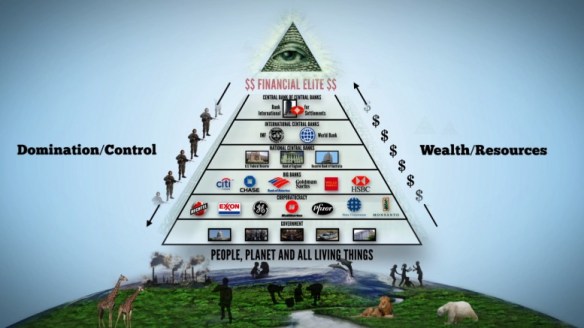
 After the Crash