After the Crash

Dispatches From a Long Recovery (Est. 10/2024)

After the Crash

‘Highly Disturbing’: Facebook Blocks Viral Video Outlets Critical of US Foreign Policy and Corporate Media

Journalists and free speech advocates are calling out the social media giant for shuttering the pages after CNN inquired about Berlin-based media company Maffick’s funding from the Russian government

By Jessica Corbett

Source: Common Dreams

Journalists and advocates of press freedoms are once more directing outrage and criticism at Facebook for selectively censoring pages on its platform and refusing to explain the reason behind a decision that appears to many as a clear double standard applied to outlets critical of U.S. foreign policy and corporate interests.

Facebook is under fire for shuttering four pages managed by the Berlin-based news and media company Maffick, after CNN reporters asked the social media giant about Maffick not disclosing that it is partly funded by the Russian government.

CNN held its report—titled “Russia is backing a viral video company aimed at American millennials“—until Friday, when Facebook blocked Soapbox, Waste-Ed, Backthen, and In The Now.

American-Lebanese journalist Rania Khalek, a contributor to Soapbox and In The Now who was interviewed by CNN, outlined the controversy in a lengthy, widely shared series of tweets. Monday morning, Khalek added an update to the Twitter thread:

As CNN outlined in its report, which was updated and corrected on Monday:

Company records [for Maffick] in Germany show that 51 percent of the company is owned by Ruptly [a subsidiary of RT, which is funded by the Russian government]. The remaining 49 percent is controlled by former RT presenter Anissa Naouai, who is Maffick’s CEO. The records were first reported by the German outlet T-online and later by the Alliance for Securing Democracy, which brought it to CNN‘s attention. The Alliance for Securing Democracy is part of the German Marshall Fund, which receives funding from the U.S., German, and other governments. The Alliance for Securing Democracy says that while it is part of the German Marshall Fund, the ASD itself does not receive any funding from the GMF, and gets its money from private family funds and grants but not from government funding.

In the Now was originally a television show on RT, hosted by Naouai. It has more than 3 million followers on Facebook,” CNN noted. The other three pages “have more than 30 million video views, though they’ve only been operating for a few months.”

What kind of content did they produce? Khalek offered a number of examples, including:

In an interview with CNN, Maffick chief operating officer J. Ray Sparks emphasized that Maffick is editorially independent from RT—which the U.S. government has forced to register as a foreign agent—and pointed out that it is “standard industry practice” not to disclose ownership of a media producer on a Facebook page.

However, as Kevin Gosztola—who cohosts a podcast with Khalek—noted in an article published Saturday on Shadowproof, “Although Khalek and Sparks detailed their editorial independence at Maffick extensively, [CNN correspondent Drew] Griffin remained incredulous at the reality that officials working at the Kremlin are not dictating what specific stories should be covered.”

“Similarly to NPR, PBS, BBC, DW, CBC, AJ+, and many other media companies, Maffick is supported in part by government funding. Likewise while we haven’t posted funding details on our Facebook pages etc, neither have any of our international peers,” Maffick said in a statement that charges the company was singled out for “one reason and one reason only: The government that helps fund our company is Russia.”

“We did not violate any of Facebook’s policies whatsoever. None of our content promotes disinformation or fake news. Yet CNN pressured Facebook into unprecedented censorship in a desperate attempt to milk ratings by stoking hysteria over Russia,” the statement continues, calling on Facebook to reinstate its pages and “articulate clear, consistent policies and protocols regarding obligatory funding disclosures which will be applied evenly across all pages.”

Since Friday, Khalek and others who often linked to her initial thread have turned to another major social media platform—Twitter—to raise alarm about the role of the ASD and the communication CNN subsequently had with Facebook:

Although Facebook’s rules don’t require pages to disclose parent companies, a spokesperson told CNN in a statement that the social media company planned to reach out to Maffick page administrators “to ask that they disclose this additional information and their affiliation with their parent company to get back on the platform.”

The move by Facebook comes after the company temporarily took down one of Khalek’s videos for Soapbox—about “how Israel uses Palestine as a weapons testing laboratory”—in late December, and only restored it after public outcry. Facebook also was intensely criticized last year for censoring the left-leaning Latin American news network teleSUR English, funded by the Venezuelan government and others, as well as a video about Christopher Columbus’ brutal legacy produced by Double Down News.


The Dystopian Future of Facebook

By Mark Kernan

Source: CounterPunch

This year Facebook filed two very interesting patents in the US. One was a patent for emotion recognition technology; which recognises human emotions through facial expressions and so can therefore assess what mood we are in at any given time-happy or anxious for example. This can be done either by a webcam or through a phone cam. The technology is relatively straight forward. Artificially intelligent driven algorithms analyses and then deciphers facial expressions, it then matches the duration and intensity of the expression with a corresponding emotion. Take contempt for example. Measured by a range of values from 0 to 100, an expression of contempt could be measured by a smirking smile, a furrowed brow and a wrinkled nose. An emotion can then be extrapolated from the data linking it to your dominant personality traits: openness, introverted, neurotic, say.

The accuracy of the match may not be perfect, its always good to be sceptical about what is being claimed, but as AI (Artificial Intelligence) learns exponentially and the technology gets much better; it is already much, much quicker than human intelligence.

Recently at Columbia University a competition was set up between human lawyers and their AI counterparts. Both read a series of non-disclosure agreements with loopholes in them. AI found 95% compared to 88% by humans. The human lawyers took 90 minutes to read them; AI took 22 seconds. More incredibly still, last year Google’s AlphaZero beat Stockfish 8 in chess. Stockfish 8 is an open-sourced chess engine with access to centuries of human chess experience. Yet AlphaZero taught itself using machine learning principles, free of human instruction, beating Stockfish 8 28 times and drawing 72 out of 100. It took AlphaZero four hours to independently teach itself chess. Four hours from blank slate to genius.

A common misconception about algorithms is that they can be easily controlled, rather they can learn, change and run themselves-a process known as deep “neural” learning. In other words, they run on self-improving feed back loops. Much of this is positive of course, unthought of solutions by humans to collective problems like climate change are more possible in the future. The social payoffs could be huge too. But what of the use of AI for other means more nefarious. What if, as Yuval Noah Hariri says, AI becomes just another tool to be used by elites to consolidate their power even further in the 21stcentury. History teaches us that it isn’t luddite to ask this question, nor is it merely indulging in catastrophic thinking about the future. Rapidly evolving technology ending up in the hands of just a few mega companies, unregulated and uncontrolled, should seriously concern us all.

Algorithms, as Jamie Bartlett the author of The People Vs Tech puts it, are “the keys to the magic kingdom” of understanding deep seated human psychology: they filter, predict, correlate, target & learn. They also manipulate. We would be naive in the extreme to think they already don’t, and even more naive to think the manipulation is done only by commercial entities. After all, it’s not as if there aren’t lots of online tribes, some manufactured and some not, to be manipulated into and out of political viewpoints, our fleeced of their money.

In 2017 Facebook said they could detect teenagers’ moods and emotions such as feeling nervous and insecure by their entries, a claim they denied later, adding we do not, “offer tools to target people based on their emotional state”. The internal report was written by two Australian executives-Andy Sinn and David Fernandez. The report according to The Guardian was written for a large bank and said that, “the company has a database of its young users – 1.9 million high schoolers, 1.5 million tertiary students and 3 million young workers”.

Going one better still, Affectiva, a Boston company, claims to be able to detect and decode complex emotional and cognitive data from your face, voice and physiological state using emotion recognition technology (ECT)-amassing 12 billion “emotion data points” across gender, age & ethnicity.  Its founder has declared that Affectiva’s ECT can read your heart rate from a webcam without the you wearing any sensors, simply by using the reflection of your face which highlights blood flow-a reflection of your blood pressure. Next time you’re listening to Newstalk’s breakfast show, think of that.

Affectiva’s ultimate goal of course, when you get past all the feel-good optimistic guff about “social connectivity”, “awesome innovation”, and worst of all “empowering” is, to use their own words, to “enable media creators to optimize their content”. Profiting from decoding our emotional states in other words.

Maybe Facebook (and Google) would use this technology wisely for our benefit, then again maybe not. It isn’t such a stretch to imagine how it could be used unethically too. To microtarget customised ads and messages at us depending on our state of mind at given time, say, and allowing Cambridge Analytica to harvest the personal data of 87 million Facebook users to subvert democracy with Brexit & Trump. Facebook claims they weren’t aware of this though.  Well, maybe, maybe not, and in spite of their protests in recent years they are still not especially transparent or accountable given their enormous cultural and social power in our lives. Curiouser and Curiouser you might think, and you’d be right.

The second Facebook patent is even more interesting, if that’s the right word, or dystopian if you prefer. Patented this June, published under the code US20180167677 (with the abstract title of Broadcast Content View Analysis Based on Ambient Audio Recording, application no: 15/376,515) illustrates a process by which secret messages- ‘ambient audio fingerprints’ in the jargon-embedded in TV ads, would trigger your smart technology (phone or TV) to record you while the ad was playing. Presumably to gauge your reaction to the product being advertised at you through, perhaps, voice biometrics (i.e. the identification and recognition of the pitch and tone of your voice).

As the patent explains in near impenetrable but just about understandable jargon this is done by first, detecting one or more broadcasting signals (the advertisement) of a content item. Second, ambient audio of the content item is recorded, and then the audio feature is extracted “from the recorded ambient audio to generate an ambient fingerprint” and finally, wait for it, “ the ambient audio fingerprint, time information of the recorded ambient audio, and an identifier of an individual associated with a client device (you and your phone or smart TV) recording the ambient audio” is sent, “to an online system for determining whether there was an impression of the content by the individual.” It goes on to say that “the impression of the identified content item by the identified individual” is logged in a “data store of the online system”.

It goes on to state that “content providers have a vested interest in knowing who have listened and/or viewed their content” and that the feature described in the patent are not exhaustive, and that “many additional features and advantages will be apparent to one of ordinary skill in the art…”.

It is already obvious we don’t know how much Facebook and other big tech platforms monitor us, neither do we know how much data they hold on us individually and collectively and, critically, who has access to that data and how they could use it.

If you can sell consumer goods by such manipulation why not whole ideologies, chipping away at our human agency one dystopian tech innovation at a time, paving the way for the morphing of late stage capitalism into authoritarian capitalism; one efficiency gain at a time.

If put into place such “innovations” are designed to monitor our emotional states for monetary gain. In essence, it is a type of online mood tracking where we are the digital lab rats.  Facebook is already valued at half a trillion US dollars giving it huge economic and cultural power.

According to Private Eye magazine, Facebook’s legal team say the patent was filed “to prevent aggression from other companies”, and that “patents tend to focus on future-looking technology that is often speculative in nature and could be commercialised by other companies”. As Private Eye pointed out though, it’s not as if Facebook has been completely transparent about such secretive issues in the past or present. The fact that Facebook generates billions by manipulating our emotions is not a surprise us, their business model is based on it, but how they intend to do it in the future should surprise, and alert us. We are after all the product. Over 90% of their revenues comes from selling adverts. They have the market incentive.

How will all this play out in the future? It isn’t difficult to build a picture of a commercialised and rapacious big tech dystopia, the very opposite of the freedoms and civil liberties envisaged by the original pioneers of the internet, and the opposite of how they currently perceive themselves.

Verint, a leading multinational analytics & biometric corporation, with an office in Ireland, has been known to install and sell, “intrusive mass surveillance systems worldwide including to authoritarian governments”, according to Privacy International. Governments that routinely commit human rights abuses on their own citizens.

China, a world leader in surveillance capitalism, recently declared that by 2020 a national video surveillance network, Xueliang, will be fully operationable, Sharp Eyes in English-Kafka and Orwell must be smirking knowingly somewhere. The term sharp eyes harks back to the post war slogan in communist China of “The people have sharp eyes”, when neighbours were encouraged to spy and tell on other neighbours of counter revolutionary or defeatist gossip about the 1949 revolution.

Democracies too have built overarching systems of surveillance. Edward Snowden told us in 2013 that the NSA was given secret direct access to the servers of big tech companies (Facebook, YouTube, Google and others) to collect private communications. As Glenn Greenwald said, the NSA’s unofficial “motto of omniscience” is: Know it all, Collect it all, Process it all.

Jaron Lanier, pioneer of virtual reality technology and a tech renegade, and an apostate to some, recently called the likes of Facebook and Google “behaviour manipulation empires”. Their pervasive surveillance and subtle manipulation through “weaponised advertising” he argues debases democracy by polarising debate at a scale unthinkable even just five or ten years ago, and it’s not only advertising that can be weaponised. Facebook, Google, Twitter and Instagram all have “manipulation engines” (algorithms we know little about) running in the background Lanier says, designed specifically by thousands of psychological & “emotional engineers” (“choice architects” or “product philosophers” to use the inane corporate gobbledygook). Their job is to keep you addicted to what’s now known as the “attention economy”-and attention equals profit. A better description still might be the attention/anxiety economy. Twitter has for instance a 3 second time delay between the page loading and notification loading, Facebook something similar-and always red for urgent. They are known in psychology as intermittent variable rewards, negative reinforcement in this context which keep behaviour going by the hope of maybe being rewarded, with a like or a follower. This builds anticipation and releases feel good neurotransmitters, and taps into your need to belong, and to be heard-we’re intensely social creatures. The downside is the opposite of course,where we can be thrown into an emotional rollercoaster if the expected dopamine hit doesn’t come.

The goal is addiction into a consumption frenzy of socially approved validation. Big Tech’s social media universe is, as one reformed “choice architect” put it, “an attention seeking gravitational wormhole” that sucks you into their profit seeking universe. If you don’t think so, check how many times you look at your phone every day. The average person checks 150 times. Most of that is social media. We’re all in an attention arms race now.

There is a great German word: Zukunftsangst. It means translated, roughly, future-anxiety. Maybe it should be renamed Zuckerbergangst instead.

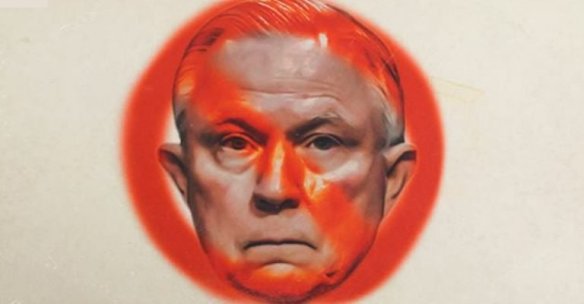
Jeff Sessions Reminds Everyone Why He’s the Worst Attorney General in Modern History

“He was a racist when appointed, a racist while serving, and a racist to the very end.”

By Jessica Corbett

Source: CommonDreams

In his last “evil” act as head of the Justice Department under President Donald Trump, Jeff Sessions reminded “everyone yet again why he’s been the worst attorney general in modern history” and drastically limited the ability of federal officials to use court-enforced deals to require reforms at police departments that are found systematically violating people’s civil rights.

Shortly before Trump forced Sessions to resign on Wednesday—and appointed a temporary replacement who is hostile toward Special Counsel Robert Mueller’s investigation—Sessions signed a memorandum (pdf), as the New York Times reports, “sharply curtailing the use of so-called consent decrees, court-approved deals between the Justice Department and local governments that create a road map of changes for law enforcement and other institutions,” by imposing “three stringent requirements for the agreements.”

The decrees were, as the Times noted, “used aggressively by Obama-era Justice Department officials to fight police abuses,” but soon after Sessions took office, he had signaled he would scale back their use and “ordered a review of the existing agreements, including with police departments in Baltimore, Chicago, and Ferguson, Mo., enacted amid a national outcry over the deaths of black men at the hands of officers.”

Sessions’ last-minute final act was met with widespread outrage, but not surprise—rather, as many critics quickly pointed out, it fit with the patterns of Sessions’ moves throughout his tenure as attorney general.

“From day one, former Attorney General Jeff Sessions expressed open and naked hostility to the use of consent decrees, especially in the civil rights context,” said Kristen Clarke of the Lawyers’ Committee for Civil Rights Under Law. “This action by Sessions, on his way out the door, seals his legacy as an obstructionist when it comes to advancing justice and protecting rights in our country.”

I would never expect Sessions to be anything other than an unrepentant civil rights foe until the very last minute,” tweeted Sherrilyn Ifill, president and director-counsel of the NAACP Legal Defense Fund.

“He was a racist when appointed, a racist while serving, and a racist to the very end,” Josh Moon of the Alabama Reporter said of his state’s former senator. “There is no redeeming quality to Jeff Sessions. He’s a horrible racist at his core.”

The New Republic‘s Matt Ford concluded simply, “He is who we thought he was.”

Although Sessions, much to Trump’s frustration, recused himself from the Mueller probe, while serving as attorney general, he made several moves—including canceling Deferred Action for Childhood Arrivals (DACA) and implementing the “zero-tolerance” policy that tore migrant children away from their parents—that had civil and human rights advocates constantly raising alarm about “the Trump/Sessions white supremacist agenda.”

Even before news broke about his memo to curb the use of consent decrees, social justice advocates began to document Sessions’ record as he departed.

“Jeff Sessions was the worst attorney general in modern American history. Period,” the ACLU charged in a series of tweets on Wednesday that, among other things, noted his discrimination against trans people, enthusiastic enforcement of racist drug laws, and use of religion to attack women’s reproductive rights.

One of the most prominent parts of Sessions’ legacy is the immigration crisis he leaves behind, as Julia Preston outlined for The Marshall Project on Wednesday. Acknowledging Preston’s report, the Lawyers’ Committee for Civil Rights Under Law summarized on Twitter, “On President Trump’s favorite issue, the departing attorney general leaves behind record-breaking backlogs of cases, onerous constraints on judges, and a bulwark of punitive attitudes toward families seeking asylum.”


FACEBOOK’S PURGE OF POLITICAL PAGES FUELS DELUSION OF INSURGENT THREATS TO DEMOCRACY

By Kevin Gosztola

Source: ShadowProof

Facebook’s purge of more than 500 pages and 250 accounts ahead of midterm elections in the United States represents a massive trend to police social media activity in ways that put freedom of expression at risk.

This trend effectively discourages users from engaging in radical politics. It may be viewed as part of a counterinsurgency effort by a powerful social media company to assure a passive majority of Americans that they are properly guarding a widely used platform from alleged threats to democracy.

On October 11, Nathaniel Gleicher, Facebook’s head of cybersecurity policy, and Oscar Rodriguez, the company’s product manager, published a press release about the purge.

“We’re removing 559 pages and 251 accounts that have consistently broken our rules against spam and coordinated inauthentic behavior,” Gleicher and Rodriguez stated. “Many were using fake accounts or multiple accounts with the same names and posted massive amounts of content across a network of groups and pages to drive traffic to their websites.”

According to Gleicher and Rodriguez, these techniques were used by groups and pages to make content “appear more popular” than it truly was on Facebook.

Both suggested some of the pages and accounts were “ad farms” that misled users into believing they were “forums for legitimate political debate.”

Unfortunately, Facebook offered minimal transparency on the action. Administrators with removed pages or accounts were apparently given no specifics other than a notice that they were shut down.

Several of the pages and accounts removed were right-wing and known for boosting President Donald Trump and his administration’s agenda. There were also dozens of progressive or left-wing pages, which were taken down.

Anti-Media, an anti-establishment independent media site with two million followers, had its page removed. Carey Wedler, editor at Anti-Media, did not lose her personal Facebook page with over 100,000 followers, but almost simultaneously, Twitter sent a notice that Wedler’s account was suspended.

The Free Thought Project, Reverb Press, Press For Truth, and Rachel Blevins, an RT America correspondent, had their pages taken down.

Pages that document abuse by police were removed—Police the Police, Filming Cops, Cop Block, and Cop Logic. Both Police the Police and Filming Cops each had over a million followers.

“There are legitimate reasons that accounts and pages coordinate with each other—it’s the bedrock of fundraising campaigns and grassroots organizations,” Gleicher and Rodriguez stated. “But the difference is that these groups are upfront about who they are, and what they’re up to.”

Yet, none of the aforementioned pages, which have protested their removal, hid their missions from followers. They were very upfront about their political motives or agendas for social justice.

Gleicher and Rodriguez concluded, “As we get better at uncovering this kind of abuse, the people behind it—whether economically or politically motivated—will change their tactics to evade detection. It’s why we continue to invest heavily, including in better technology, to prevent this kind of misuse. Because people will only share on Facebook if they feel safe and trust the connections they make here.”

The last sentences of Facebook’s press release make it clear that the company took this action to protect their brand. They were concerned about how these pages or accounts were impacting the experience of more passive, or even apathetic, users.

Administrators also recognize that politicians on Capitol Hill are watching. As Senator Dianne Feinstein told executives during a recent Senate hearing, “You’ve created these platforms, and now they are being misused. And you have to be the ones to do something about it or we will.”

On October 17, Twitter also acknowledged pressure from upcoming midterm elections to guard against alleged “influence operations.” It released a dataset it said was linked to operations during the 2016 election.

“We will continue to proactively combat nefarious attempts to undermine the integrity of Twitter, while partnering with civil society, government, our industry peers, and researchers to improve our collective understanding of coordinated attempts to interfere in the public conversation,” the social media company pledged.”

No executives at any Silicon Valley tech corporation want the government to introduce regulations. With parts of the public, especially those in the liberal establishment clamoring for action, Facebook and other companies are taking steps to supposedly fix the problem.

Cracking Down On “Influence Campaigns”

Facebook’s mass removal of pages and accounts was the company’s most extensive crackdown on “influence campaigns” since it started policing its platform. Most U.S. media outlets described the offending pages and accounts as purveyors of “political spam.”

The New York Times reported on Facebook’s purge with an article that was headlined, “Facebook Tackles Rising Threat: Americans Aping Russian Schemes to Deceive.”

Ironically, this was misinformation. At no point did the Times demonstrate that the removed pages or accounts were inspired or influenced by “Russian schemes,” which may or may not have been employed during the 2016 presidential election.

What the Times did do is conflate Russia-based activity with the operation of these accounts because those users may have wielded similar tactics to extend their reach. This is as disingenuous as suggesting someone who relies on Internet privacy tools is using terrorist tactics because terrorists want to hide their location, too.

The push to impose more control over the exchange of information on Facebook stems from a widespread belief that the Russia-based Internet Research Agency conducted a campaign through more than 400 accounts and pages that relied on ads and false information to “create discord and harm” Hillary Clinton’s presidential campaign. The content was supposedly viewed by as many as 126 million Americans.

But in a paper on the 2016 presidential election by Thomas Ferguson, Paul Jorgensen, and Jie Chen from the Institute for New Economic Thinking, they show that this number is rather paltry. Americans saw at least 33 trillion posts in their news feeds between 2015 and 2017. Facebook even said a quarter of ads may have never been viewed by anyone.

The Senate intelligence committee reported minuscule ad numbers in key battleground states. In Wisconsin, $1,979 was spent. All but $54 were spent during the primary. Pennsylvania absorbed $823 and Michigan $300. “Unless Facebook discloses some vast new trove, the conclusion has to be that this was no full court press,” the report stated.

As the authors note, a few studies labeled sites as “Russian” or “Russian-influenced” simply because they have “politically distasteful” views that perhaps align with the agenda of Russia or run counter to U.S. foreign policy. This inappropriately counted non-mainstream or so-called fringe websites as part of an alleged Russian influence operation.

A far more extensive influence operation was likely perpetrated by networks highly capable of spreading right-wing messages in sophisticated manners.

“Our clearest and most significant observation is that the American political system has seen not a symmetrical polarization of the two sides of the political map, but rather the emergence of a discrete and relatively insular right-wing media ecosystem whose shape and communications practices differ sharply from the rest of the media ecosystem, ranging from the center-right to the left,” a Harvard study [PDF] on the 2016 election concluded.

The infiltrators sowing discord were aligned with Republicans and based in the United States. Like Ferguson, Jorgensen, and Chen contend, “By 2016, the Republican right had developed internet outreach and political advertising into a fine art and on a massive scale quite on its own.”

“Large numbers of conservative websites, including many that tolerated or actively encouraged white supremacy and contempt for immigrants, African-Americans, Hispanics, Jews, or the aspirations of women had been hard at work for years stoking up ‘tensions between groups already wary of one another.’ Breitbart and other organizations were in fact going global, opening offices abroad and establishing contacts with like-minded groups elsewhere.”

“Whatever the Russians were up to, they could hardly hope to add much value to the vast Made in America bombardment already underway. Nobody sows chaos like Breitbart or the Drudge Report, as the New York Times documented in one Idaho town,” the paper added.

Recognizing the influence of right-wing messaging networks during the 2016 election is critical. In fact, a list of removed pages posted by Western Journal suggests the vast majority of pages and accounts removed were right-wing. A minority were cop watch pages or libertarian pages against government abuses. An even smaller minority were liberal or Democratic pages.

Therefore, journalists are wrong to suggest there is some kind of balance between the left-wing and right-wing when it comes to spreading “fake news” or misinformation on social media platforms.

Part Of The Counterrevolution

It is difficult to discern whether police accountability or alternative media pages, which protested their removal, were targeted for the dissenting perspectives on their pages. What is more likely is that these pages were flagged by a Facebook algorithm.

“Bad content” to Facebook includes “false news,” “hate speech,” “spam,” “graphic violence,” “clickbait,” and “links to low quality web experiences (ad farms).” Given the company’s description of an “ad farm,” a page that linked to a website cluttered with ads, which were embedded to ensure server bills were paid, could be construed as an “ad farm.”

As Emma Llansó, the director of the Free Expression Project for the Center for Democracy and Technology, told the Guardian, there are a  “lot of people who fervently believe their political views and are trying to drive traffic to their posts and ideas. They’re probably also running ads on their sites to make money off doing so. The line between spammer activity with a financial motive and spammy-looking political advocacy is incredibly hard to draw.”

Facebook’s press release demonstrated indifference to the administrators of political pages, who use “backup” or fake accounts in order defend themselves from political opponents who may campaign to have their real accounts suspended.

Reverb’s page was verified by Facebook. As the Guardian reported, Reverb editor-in-chief Edward Lynn was never contacted by anyone with the company about any violations of standards.

Similarly, Brian Kolfage, who administered the Right Wing News page, which was shut down with three other pages, emailed back and forth with a Facebook executive. There were plans for a meeting so he could better understand how to comply with policies. The company chose not to work with Kolfage.

On October 17, Facebook deleted a video featuring journalist George Monbiot on the brutal colonial legacy of Christopher Columbus. It was up more than a week and had 900,000 views before it was taken down.

Again, the social media company was completely opaque in its decision. It may have been flagged as a result of graphic images in the video, but Facebook did not bother to offer an explanation.

Facebook announced a partnership in May with an influential think tank known as the Atlantic Council to help the company detect “emerging threats” and “disinformation campaigns.”  The organization formed after the North Atlantic Treaty was signed in 1949, and it is committed to maintaining America’s global dominance.

When Facebook removed 32 “suspicious pages” that were run by activists in August, it relied on the think tank’s Digital Forensic Research Lab to “point out similarities to fake Russian pages from 2016.” However, one of the pages removed was an event page for a counter-protest against a Unite the Right rally in Washington, D.C.

In Bernard Harcourt’s book, The Counterrevolution: How Our Government Went To War Against Its Own Citizens, he outlines his theory of the current paradigm citizens live under in the United States. Counterinsurgency has been systematically domesticated, even though there is “no real insurgency or active minority.”

“The Counterrevolution” creates this illusion of an “active minority.” When it comes to social media, the “active minority” is fringe political pages that are sowing discord by spreading “fake news” or misinformation. It is remarkable that part of the crackdown involved police accountability pages because law enforcement, which perpetuates this paradigm, benefits greatly from passive Americans believing cop watch pages on Facebook are “political spam.”

Or, more sinisterly, the pages and accounts are seen as employing tactics similar to Russian influence operations, which increases the fear of doing nothing to shut them down and justifies dramatic action—even if wholly innocent pages or users are censored.

Facebook may not be silencing dissenting perspectives deliberately, but in “The Counterrevolution,” it does not have to bother with restoring pages and accounts wrongfully taken down. Those pages and accounts are collateral damage. They were not specifically targeted. The social media company can claim it never intended to crack down on political speech and defend an action that is designed to give consumers and political elites the illusion that they are guarding the internet from perceived threats.

That is not to say there are no threats to democracy in the United States. A few weeks before Election Day, there are countless reports of voter suppression. But these threats do not manifest themselves in one’s news feed on Facebook. Rather, they come from Republican officials who use state apparatuses to make it harder for citizens to challenge their destructive and discriminatory agendas.

The US military’s vision for state censorship

By Andre Damon

Source: WSWS.org

In March, the United States Special Operations Command, the section of the Defense Department supervising the US Special Forces, held a conference on the theme of “Sovereignty in the Information Age.” The conference brought together Special Forces officers with domestic police forces, including officials from the New York Police Department, and representatives from technology companies such as Microsoft.

This meeting of top military, police and corporate representatives went unreported and unpublicized at the time. However, the Atlantic Council recently published a 21-page document summarizing the orientation of the proceedings. It is authored by John T. Watts, a former Australian Army officer and consultant to the US Department of Defense and Department of Homeland Security.

The Atlantic Council, a think tank with close ties to the highest levels of the state, has been a key partner in the social media companies’ censorship of left-wing views. Most notably, Facebook acted on a tip from the Atlantic Council when it shut down the official event page for an anti-fascist demonstration in Washington on the anniversary of last year’s neo-Nazi riot in Charlottesville.

Confident that none of the thousands of journalists in Washington will question, or even report, what he writes, Watts lays out, from the standpoint of the repressive apparatus of the state and the financial oligarchy it defends, why censorship is necessary.

The central theme of the report is “sovereignty,” or the state’s ability to impose its will upon the population. This “sovereignty,” Watts writes, faces “greater challenges now than it ever has in the past,” due to the confluence between growing political opposition to the state and the internet’s ability to quickly spread political dissent.

Watts cites the precedent of the invention of the printing press, which helped overthrow the feudal world order. In the Atlantic Council’s estimation, however, this was an overwhelmingly negative development, ushering in “decades, and arguably centuries, of conflict and disruption” and undermining the “sovereignty” of absolutist states. The “invention of the internet is similarly creating conflict and disruption,” Watts writes.

“Trust in Western society,” he warns, “is experiencing a crisis. The 2018 Edelman Trust Barometer has tracked this erosion, showing a 30 percent drop in trust in government over the last year in the United States.”

Watts notes that this collapse in support for the government cannot be explained merely by the rise of social media. This process began in the early 2000s, “at the dawn of the social media age but before it had become mainstream.” Left out are the major reasons for the collapse of popular support for government institutions: the stolen election of 2000, the Bush administration’s lies about weapons of mass destruction, unending war and the impact of the 2008 financial crisis.

However, while it is “hard to argue that the current loss of trust results solely from the emergence of social media,” Watts writes, there “can be little doubt that it acted as a critical amplifier of broader trends.”

He continues: “Technology has democratized the ability for sub-state groups and individuals to broadcast a narrative with limited resources and virtually unlimited scope.” By contrast, “In the past, the general public had limited sources of information, which were managed by professional gatekeepers.”

In other words, the rise of uncensored social media allowed small groups with ideas that correspond to those of the broader population to challenge the political narrative of vested interests on an equal footing, without the “professional gatekeepers” of the mainstream print and broadcast media, which publicizes only a pro-government narrative.

When “radical and extremist views” and “incorrect ideas” are “broadcast over social media, they can even influence the views of people who would not otherwise be sympathetic to that perspective,” Watts warns. “When forwarded by a close friend or relation, false information carries additional legitimacy; once accepted by an individual, this false information can be difficult to correct.”

People must be isolated, in other words, from the “incorrect” ideas of their friends and family, because such ideas are “difficult to correct” by the state once disseminated.

But how is this to be done? The growth of oppositional sentiment cannot be combatted with “facts” or the “truth,” because “facts themselves are not sufficient to combat disinformation.” The “truth” is “too complex, less interesting, and less meaningful to individuals.”

Nor can the growth of political opposition, for the time being, simply be solved by “eliminating” (i.e., killing or jailing) political dissidents, because this only lends legitimacy to the ideas of the victims. “Eliminating those individuals and organizations will not be sufficient to combat the narrative and may in fact help amplify it.” He adds, “This is also the case for censorship as those behind the narrative can use the attempt to repress the message as proof of its truth, importance, or authenticity.”

Enter the social media companies. The best mechanism for suppressing oppositional viewpoints and promoting pro-government narratives is the private sector, in particular “technology giants, including Facebook, Google, YouTube, and Twitter,” which can “determine what people see and do not see.”

Watts adds, “Fortunately, shifts in the policies of social media platforms such as Facebook have had significant impact on the type and quality of the content that is broadcast.”

The private sector, therefore, must do the dirty work of the government, because government propaganda is viewed with suspicion by the population. “Business and the private sector may not naturally understand the role they play in combating disinformation, but theirs is one of the most important…. In the West at least, they have been thrust into a central role due to the general public’s increased trust in them as institutions.”

But this is only the beginning. Online newspapers should “consider disabling commentary systems—the function of allowing the general public to leave comments beneath a particular media item,” while social media companies should “use a grading system akin to that used to rate the cleanliness of restaurants” to rate their users’ political statements.

Strong-arm tactics still have a role, of course. Citing the example of WikiLeaks editor Julian Assange, Watts declares that “governments need to create consequences” for spreading “disinformation” similar to those meted out for “state espionage” – which can carry the death penalty.

What Watts outlines in his document is a vision of a totalitarian social order, where the government, the media, and technology companies are united in suppressing oppositional viewpoints.

The most striking element of the document, however, is that it is not describing the future, but contemporary reality. Everything is in the present tense. The machinery of mass censorship has already been built.

The Atlantic Council report, based on high-level discussions within the military and state, is a confirmation of everything the World Socialist Web Site has said about the purpose of changes in the algorithms of internet and social media companies over the past year-and-a-half.

On August 25, 2017, the WSWS published an open letter to Google alleging that the company is “manipulating its Internet searches to restrict public awareness of and access to socialist, anti-war and left-wing websites.” It added, “Censorship on this scale is political blacklisting.”

Over the subsequent year, key details of the open letter have been indisputably confirmed. At congressional hearings and in other public statements, leading US technology companies have explained that they reduced the propagation of political views and statements targeted by US intelligence agencies, and did so in secret because they feared a public outcry. At the same time, they have explained the technical means by which they promoted pro-government, pro-war news outlets, such as the New York Times and Washington Post.

But the Atlantic Council document presents the most clear, direct and unvarnished explanation of the regime of state censorship.

The struggle against censorship is the spearhead of the defense of all democratic rights. The most urgent task is to unify the working class, which is engaged in a wave of social struggles all over the world, behind the struggle against censorship as a component of the fight for socialism.


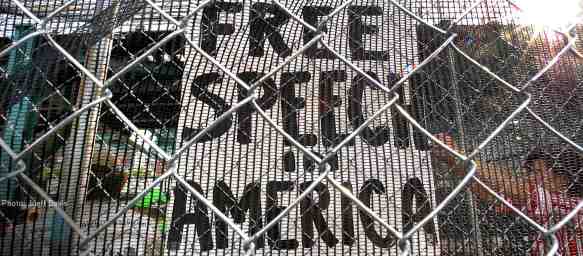
DIGITAL FREE SPEECH ZONES ARE HERE

By Dylan Charles

Source: Waking Times

“Truth is treason in an empire of lies.” ~George Orwell

An empire of lies requires popular devotion to its founding illusions, lest it will collapse under the weight of its own hubris. It is therefore quite necessary to for those in power to control information and public access to ideas and narratives that run counter to their interests. This is a fact of life in a statist world, but now, in the age of the internet and social media, we are quickly learning just how far corporations will go to support this corrupt dynamic.

Amendment 1 – Freedom of Religion, Speech, and the Press

Congress shall make no law respecting an establishment of religion or prohibiting the free exercise thereof, or abridging the freedom of speech or of the press, or the right of the people peaceably to assemble and to petition the government for a redress of grievances.

United States Bill of Rights

The social media giants along with big tech no longer have any qualms about deleting popular channels and personalities for their platforms, and the illusion of free speech is coming unhinged as we speak.

Just last week, Facebook (FB) announced the deletion of hundreds of pages it said were guilty of spamming and of profiting from web-traffic sent to ‘ad farms’ from coordinated FB strategies. Well-respected and reputable independent media organizations were banned along with many obviously spammy pages and politically inconsequential sites, indicating that there is much more to the story than de-spamming FB. And all of this news follows the recent ban of Alex Jones and the Infowars network, which marked a transition from shadow banning to open, public political censorship by these tech companies.

There really is no way to know precisely what, or who, is driving these page bans, as pages on both sides of the political spectrum have been targeted, but the most visible common thread running through it all is political dissent of one form or another. And the bans are clearly coordinated between the social media companies, as targeted pages and news organizations are banned from multiple platforms (FB and Twitter, for example) on the same day.

So, the main avenues of public discourse on the web today are removing dissident voices, which as journalist and activist John Vibes puts it, serves the same purpose of the free speech zones that G.W. Bush made popular during his controversial presidency.

Free speech zones are the ultimate insult to anyone who genuinely cares about the relationship between human beings and government. And we live in exceptionally controversial times, where the lines between government rule and corporate rule are blurrier than ever.

“Any time you try to talk about how internet censorship threatens our ability to get the jackboot of oligarchy off our necks you’ll always get some guy in your face who’s read one Ayn Rand book and thinks he knows everything, saying things like “Facebook is a private company! It can do whatever it wants!” Is it now? Has not Facebook been inviting US government-funded groups to help regulate its operations, vowing on the Senate floor to do more to facilitate the interests of the US government, deleting accounts at the direction of the US and Israeli governments, and handing the guidance of its censorship behavior over to the Atlantic Council, which receives funding from the US government, the EU, NATO and Gulf states? How “private” is that? Facebook is a deeply government-entrenched corporation, and Facebook censorship is just what government censorship looks like in a corporatist system of government.” ~Caitlin Johnstone

So, now that we know that big tech is serving the interests of the political oligarchy, we are free to dissent in our own little corners of the internet (where very few can hear us), but we can also create new alternatives that will allow us to connect with people without the permission and all-seeing eye of big brother watching over us.

In the mean time, it’s good to know that independent media is having such a tremendous impact on the conversation that the powers that be want to shut it all down. Their illusion of legitimacy is cracking.

Is the Purge of Independent Media a Coordinated Attack by the Military Industrial Complex?

By Derrick Broze

Source: Activist Post

Victims of Facebook’s most recent purge should not forget the connections between the social media giant and the Western Military-Industrial Complex.

On Thursday, Facebook announced they were unpublishing, or purging, over 500 pages and 200 accounts who are accused of spreading political spam. Several of these pages and writers were also removed from Twitter on the same day.

“Today, we’re removing 559 Pages and 251 accounts that have consistently broken our rules against spam and coordinated inauthentic behavior,” Facebook stated in a blog post. Facebook states that the people behind this alleged spam “create networks of Pages using fake accounts or multiple accounts with the same names” and “post the same clickbait posts in dozens of Facebook Groups.”

Essentially, Facebook is accusing these pages of writing articles related to politics and then using the social media platform to…. post the articles in as many places as possible to reach as many people as possible. Hardly dangerous or scary stuff. However, these actions are in violation of Facebook’s Terms of Service. Facebook also accused the pages and accounts of using their fake accounts to generate fake likes and shares which may artificially inflate their reach and mislead people about their popularity. According to Facebook, “This activity goes against what people expect on Facebook, and it violates our policies against spam.”

Facebook also stated that “sensational political content” from across the political spectrum is being used to “build an audience and drive traffic to their websites, earning money for every visitor to the site.” Again, this does not qualify as dangerous or threatening activity. This is a standard practice for most media outlets who are trying to earn revenue to pay writers, editors, social media managers, etc. It is true that some of the pages on this list (see below for a current list) have indeed used clickbait headlines or even posts that are likely untrue. However, the list also includes legitimate independent news outlets such as The Anti-Media, The Free Thought Project, Cop Block, and Police the Police, which focused on countering mainstream and establishment narratives related to politics and police.

Facebook’s statement that the pages and accounts were “often indistinguishable from legitimate political debate” begs the question – which pages and accounts are “legitimate political debate”? and by which metric does Facebook decide what counts as legitimate? These questions are yet to be answered. Perhaps with time Facebook will come clean about their process, but in the meantime it’s important to reflect on Facebook’s recent partnership with the Atlantic Council and attempts to stifle the flow of information in the name of fighting “fake news.”

The fight against Fake News started immediately following the election of Donald Trump. In November 2016, Merrimack College associate professor Melissa Zimdars posted a public Google document titled, “False, Misleading, Clickbait-y, and/or Satirical ‘News’ Sources” which went viral after being reported on by most corporate mainstream outlets. This list lumped in some of the same outlets which fell victim to Facebook’s most recent purge with actual fake news websites which are well known among the indy and alt media industry. Within a matter of weeks, a new list appeared online from an organization calling itself PropOrNot, an allegedly independent group of researchers trying to find the truth about the dissemination of Russian propaganda and fake news. This list also contained names of prominent independent media outlets like The Anti-Media, The Corbett Report, MintPress News, and many others.

It was this combination of the Zimdars list and the PropOrNot list which had the immediate effect of placing a target on the vast majority of independent journalists and outlets who were now being accused of directly or indirectly conspiring with the Russians. Websites and social media pages for these outlets began suffering a drastic reduction in reach and interaction with their audiences and many websites lost access to Google advertising money due to these false associations.

The problem is that the majority of the mainstream media unquestionably reported on and repeated the claims made by these two lists without any attempt at investigative work. For example, PropOrNot claims they are “completely independent” and “nonpartisan” because they are not funded by anyone and have no formal institutional affiliations or political connections. They say the must remain anonymous for now because they are a “are civilian Davids taking on a state-backed adversary Goliath.” However, a report by Russian news outlet Sputnik (yes, I am aware many readers will automatically scream, “Fake news!”, but I encourage you to read on.) challenges the alleged unbiased nature of PropOrNot.

Sputnik reports that George Eliason, a Ukraine-based investigative journalist, authored an exposé of PropOrNot in which he argued the organization was a “deep-state hitjob on alternative news outlets.”

“So when you’re looking at PropOrNot, it’s just basic investigative techniques. Who are they — that’s the first thing you need to know,” Eliason told Sputnik. “So you look them up on the web and you find nothing. I went to their website and did a basic scan, and the funny thing about PropOrNot is that to get into their website, you need to be logged into the dashboard of The Interpreter magazine.”

So who runs The Interpreter?

Eliason states that “The Interpreter is also overseen by the the Broadcasting Board of Governors, who run Voice of America and half a dozen other US propaganda projects across the globe.”

In addition, “The Interpreter is a product of the Atlantic Council committee, who is basically setting our foreign policy right now in Eastern Europe and Russia,” Eliason stated. “They’re an NGO, they work outside the government, and they work with the Ukrainian diaspora. They actually have a signed contract with the diaspora — you can view them signing it.”

The important takeaway from this report is that only 4 months later, in May 2018, Facebook announced a new partnership with the Atlantic Council –the same think tank tied to PropOrNot – which officially claims to provide a forum for international political, business, and intellectual leaders. Facebook said the partnership is aimed at preventing  the social media tool from “being abused during elections.” The press release promoted Facebook’s efforts to fight fake news by using artificial intelligence, as well as working with outside experts and governments.

The Atlantic Council of the United States was established in 1961 to bolster support for international relations. Although not officially connected to the North Atlantic Treaty Organization, the Atlantic Council has spent decades promoting causes and issues which are beneficial to NATO member states. In addition, The Atlantic Council is a member of the Atlantic Treaty Organization, an umbrella organization which “acts as a network facilitator in the Euro-Atlantic and beyond.” The ATA works similarly to the Atlantic Council, bringing together political leaders, academics, military officials, journalists and diplomats to promote values that are favorable to the NATO member states. Officially, ATA is independent of NATO, but the line between the two is razor thin.

Essentially, the Atlantic Council is a think tank which can offer companies or nation states access to military officials, politicians, journalists, diplomats, etc. to help them develop a plan to implement their strategy or vision. These strategies often involve getting NATO governments or industry insiders to make decisions they might not have made without a visit from the Atlantic Council team. This allows individuals or nations to push forth their ideas under the cover of hiring what appears to be a public relations agency but is actually selling access to high-profile individuals with power to affect public policy. Indeed, everyone from George H.W. Bush to Bill Clinton to the family of international agent of disorder Zbigniew Brzezinski have spoken at or attended council events.

The list of financial supporters reads like a who’s-who of think tanks and Non-Governmental Organizations. The Atlantic Council receives funding from the Brookings Institution, Carnegie Endowment, Cato Institute, Council on Foreign Relations, and the Rand Corporation, to name a few. In addition, various members of the Military-Industrial Complex are benefactors of the Atlantic Council, including Huntington Ingalls, the United States’ sole maker of aircraft carriers; Airbus, the plane manufacturer; Lockheed Martin, the shipbuilder and aviation company; and Raytheon, which makes missile systems. All of the companies have contracts with the U.S. Department of Defense and offer financial support to the Atlantic Council. The Council also receives support from Chevron and the Thomson Reuters Foundation. Finally, the Atlantic Council receives direct financial support from the U.S. Departments of the Air Force, Army, Navy and Energy and from the U.S. Mission to NATO.

Is it possible Facebook is acting under the direction of their partners at the Atlantic Council to suppress anti-war, anti-establishment voices three weeks before the U.S. midterm elections? It is absolutely possible and likely.

We should also remember this is not the first time Facebook has deleted accounts which operate outside the mainstream corporate media. In August, Facebook deleted accounts containing “fringe or holistic medicine,” including Just Natural Medicine (1 million followers), Natural Cures Not Medicine (2.3 million followers), and People’s Awakening (3.6 million followers). The same month Facebook and Twitter deleted pages they claimed were connected to Iran and Russia.

This entire ongoing attack of independent media and free thought stemmed from the establishment media’s nonstop coverage of what has become known as Fake News. Anyone and everyone who has countered the establishment narrative of endless war, a growing surveillance and police state, and an allegedly growing divide in American politics, has been labeled a Russian bot, accomplice, or useful idiot. One way or another, the message is clear: stand against the establishment and you will be labeled an enemy of the State.

By spreading the Fake News meme, the elitists behind the American power centers are able to attack  growing independent media icons by painting them as propagators of false Russian propaganda. The media is also using this Fake News meme and Russian prop to accuse Trump of being an illegitimate president, further playing into the “Trump is an outsider” narrative. All of this is being done with the goal of keeping the domestic front as divided as possible while selling the brainwashed masses into another war. Coincidentally, all of this nonsense is taking place while the corporate media spreads lies about Syria and Russia.

It’s more important than ever to remain level headed and use critical thinking. It’s never been more important to follow the pages that were purged directly from their websites. See the full list below and decide which outlets you want to continue to support in the information war.

List of websites taken down on Thursday October 11, 2018:

The Free Thought Project – 3.1 million fans
The Anti-Media – 2.1 million fans
Police the Police – 1.9 million fans
Cop Block – 1.7 million fans
Filming Cops – 1.4 million fans
Rachel Blevins – 69,000 fans
V is For Voluntary – 160,000 fans
End the War on Drugs – 460,000 fans
Mass Report – 500,000 fans
Get Involved, You Live Here – 360,000 fans
Press for Truth – 350,000 fans
Political Junkie News Media – 300,000 fans
Murica Today – 180,000 fans
Choice & Truth – 2.9 million fans
You won’t see this on TV – 172,000 fans
Modern Slavery Hilarious Vines – 129,000 fans
Fuck the Government – 168,000 fans
Punk Rock Libertarians – 190,000 fans
Reverb Press – 700,000 fans
Nation In Distress – 3.2 million fans
Right Wing News –
Reasonable People United –
Psychologic Anarchist –
Policing the Police
Cop Logic
Legalizing Cannabis
Free Your Mind Conference – 75000
Hemp
End the Drug War
Anonymous News

Social Media Censorship Intensifies

By Kurt Nimmo

Source: Another Day in the Empire

Both the Free Thought Project and The Anti-Media lost their social media accounts in a coordinated attack today by Facebook and Twitter.

Facebook alone removed 559 pages and 251 accounts.

Facebook has unpublished our page

After 5 years of building fans Facebook has officially unpublished our page (3.1 million fans) so we can’t post on it anymore. This is truly an outrage and we are devastated. We will do everything we can to recover our page and fight back. pic.twitter.com/H3AmHTT8Qo

— Free Thought Project (@TFTPROJECT) October 11, 2018

Dan Dicks is another victim.

“The Press For Truth FaceBook Page with 350k followers has just been memory holed form the internet! 350k followers gone in the blink of an eye as we are right before our eyes witnessing the results of what happens when these big tech companies appoint themselves as the gatekeepers of political thought and opinion,” a headline story at Press For Truth reports today.

The midterm election is being used as an excuse to purge social media accounts and thus reduce traffic to websites on the target list.

First it was alt-right figures like Milo Yiannopoulos and Mike Cernovich who had their accounts pulled for behavior that is an every day occurrence by others on social media.

Then Alex Jones was taken down. This was a landmark event that served notice on other websites diverging from the establishment narrative and spreading dangerous “alternative facts.”

Now the effort has moved on the the next level of targets, those with moderate to high social media traffic and successful websites with growing viewership. Not millions like Jones, but a couple hundred thousand all the way down to tens of thousands.

Numbers are way down for sites banished from the corporate social media kingdom. Traffic is drying up and thus support.

This is precisely what the establishment and its political class have in mind. It has nothing to do with “inauthentic” content as they claim. It is a concerted effort to wipe out for good entire segments of the alternative media.

If Democrats take control of Congress next month, watch out. They will make it impossible for another Donald Trump to get elected with the help of social media.

They leveraged the patently absurd and widely discredited Russian influence scam. The accusation Trump somehow colluded with the Russians has been used to tarnish his supporters, conservatives in general, and other groups not part of the establishment engineered political arrangement.

Google, Facebook, Twitter, and others are building an algorithmic filter. It will not permit entire segments of the population to weigh in on political issues during federal elections.

That model, most recently tested in Brazil, will be used. If successful in November, it will be further implemented after the election.

The European model (not based on constitutional liberties) will be adopted. This is a collectivist arrangement where certain groups are protected by the government while individual Germans and Swedes are singled out and prosecuted for criticizing the arrangement on social media.

Finally, I believe somewhere down the line many of us will barred access to the internet if were appear on a government list similar to the malfunctioning no-fly list. This will be easy to implement. Pass a law forbidding ISPs from selling service to Americans espousing political ideas considered racist, homophobic, misogynistic, transphobic, etc., by the government.

In the current political climate, it’s easy to fall into one of these categories. Others will be memory holed simply due to their political philosophy, most notably conservatives and libertarians, but also nonviolent radical leftists and progressives opposed to the military-industrial-surveillance complex and neoliberal globalism.


Lara Trace Hentz

INDIAN COUNTRY NEWS

In Saner Thought

"It is the duty of every man, as far as his ability extends, to detect and expose delusion and error"..Thomas Paine

ZEDJournAI

Human in Algorithms

Rooster Crows

From the Roof Top

Aisle C

I See This

The Free

blog of the post capitalist transition.. Read or download the novel here + latest relevant posts

अध्ययन-अनुसन्धान(Essential Knowledge of the Overall Subject)

अध्ययन-अनुसन्धानको सार