Goodbye G20, hello BRICS+

The increasingly irrelevant G20 Summit concluded with sure signs that BRICS+ will be the way forward for Global South cooperation.
By Pepe Escobar

Source: The Cradle

The redeeming quality of a tense G20 held in Bali – otherwise managed by laudable Indonesian graciousness – was to sharply define which way the geopolitical winds are blowing.

That was encapsulated in the Summit’s two highlights: the much anticipated China-US presidential meeting – representing the most important bilateral relationship of the 21st century – and the final G20 statement.

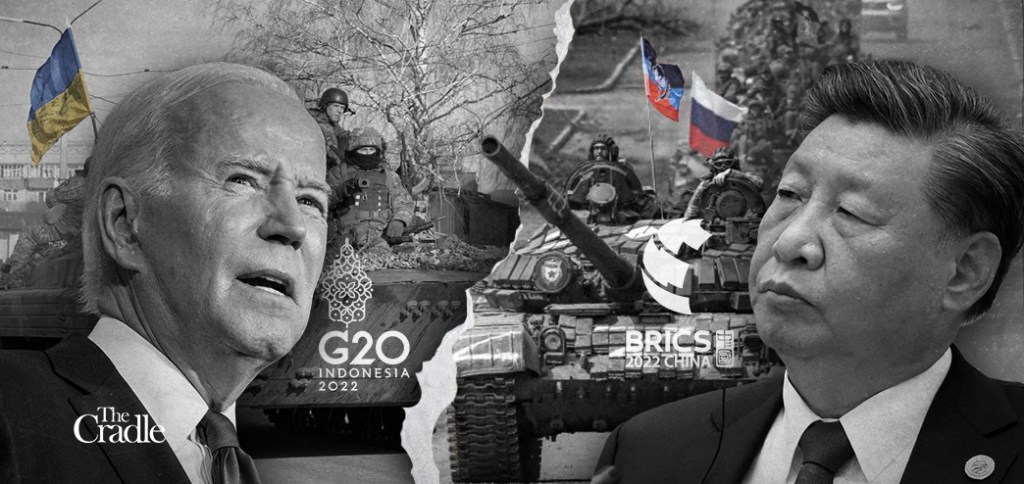
The 3-hour, 30-minute-long face-to-face meeting between Chinese President Xi Jinping and his US counterpart Joe Biden – requested by the White House – took place at the Chinese delegation’s residence in Bali, and not at the G20 venue at the luxury Apurva Kempinski in Nusa Dua.

The Chinese Ministry of Foreign Affairs concisely outlined what really mattered. Specifically, Xi told Biden that Taiwan independence is simply out of the question. Xi also expressed hope that NATO, the EU, and the US will engage in “comprehensive dialogue” with Russia. Instead of confrontation, the Chinese president chose to highlight the layers of common interest and cooperation.

Biden, according to the Chinese, made several points. The US does not seek a New Cold War; does not support “Taiwan independence;” does not support “two Chinas” or “one China, one Taiwan”; does not seek “decoupling” from China; and does not want to contain Beijing.

However, the recent record shows Xi has few reasons to take Biden at face value.

The final G20 statement was an even fuzzier matter: the result of arduous compromise.

As much as the G20 is self-described as “the premier forum for global economic cooperation,” engaged to “address the world’s major economic challenges,” the G7 inside the G20 in Bali had the summit de facto hijacked by war. “War” gets almost double the number of mentions in the statement compared to “food” after all.

The collective west, including the Japanese vassal state, was bent on including the war in Ukraine and its “economic impacts” – especially the food and energy crisis – in the statement. Yet without offering even a shade of context, related to NATO expansion. What mattered was to blame Russia – for everything.

The Global South effect

It was up to this year’s G20 host Indonesia – and the next host, India – to exercise trademark Asian politeness and consensus building. Jakarta and New Delhi worked extremely hard to find wording that would be acceptable to both Moscow and Beijing. Call it the Global South effect.

Still, China wanted changes in the wording. This was opposed by western states, while Russia did not review the last-minute wording because Foreign Minister Sergey Lavrov had already departed.

On point 3 out of 52, the statement “expresses its deepest regret over the aggression of the Russian Federation against Ukraine and demands the complete and unconditional withdrawal of armed forces from the territory of Ukraine.”

“Russian aggression” is the standard NATO mantra – not shared by virtually the whole Global South.

The statement draws a direct correlation between the war and a non-contextualized “aggravation of pressing problems in the global economy – slowing economic growth, rising inflation, disruption of supply chains, worsening energy, and food security, increased risks to financial stability.”

As for this passage, it could not be more self-evident: “The use or threat of use of nuclear weapons is inadmissible. The peaceful resolution of conflicts, efforts to address crises, as well as diplomacy and dialogue, are vital. Today’s era must not be of war.”

This is ironic given that NATO and its public relations department, the EU, “represented” by the unelected eurocrats of the European Commission, don’t do “diplomacy and dialogue.”

Fixated with war

Instead the US, which controls NATO, has been weaponizing Ukraine, since March, by a whopping $91.3 billion, including the latest presidential request, this month, of $37.7 billion. That happens to be 33 percent more than Russia’s total (italics mine) military spending for 2022.

Extra evidence of the Bali Summit being hijacked by “war” was provided by the emergency meeting, called by the US, to debate what ended up being a Ukrainian S-300 missile falling on a Polish farm, and not the start of WWIII like some tabloids hysterically suggested.

Tellingly, there was absolutely no one from the Global South in the meeting – the sole Asian nation being the Japanese vassal, part of the G7.

Compounding the picture, we had the sinister Davos master Klaus Schwab once again impersonating a Bond villain at the B20 business forum, selling his Great Reset agenda of “rebuilding the world” through pandemics, famines, climate change, cyber attacks, and – of course – wars.

As if this was not ominous enough, Davos and its World Economic Forum are now ordering Africa – completely excluded from the G20 – to pay $2.8 trillion to “meet its obligations” under the Paris Agreement to minimize greenhouse gas emissions.

The demise of the G20 as we know it

The serious fracture between Global North and Global South, so evident in Bali, had already been suggested in Phnom Penh, as Cambodia hosted the East Asia Summit this past weekend.

The 10 members of ASEAN had made it very clear they remain unwilling to follow the US and the G7 in their collective demonization of Russia and in many aspects China.

The Southeast Asians are also not exactly excited by the US-concocted IPEF (Indo-Pacific Economic Framework), which will be irrelevant in terms of slowing down China’s extensive trade and connectivity across Southeast Asia.

And it gets worse. The self-described “leader of the free world” is shunning the extremely important APEC (Asia-Pacific Economic Cooperation) summit in Bangkok at the end of this week.

For very sensitive and sophisticated Asian cultures, this is seen as an affront. APEC, established way back in 1990s to promote trade across the Pacific Rim, is about serious Asia-Pacific business, not Americanized “Indo-Pacific” militarization.

The snub follows Biden’s latest blunder when he erroneously addressed Cambodia’s Hun Sen as “prime minister of Colombia” at the summit in Phnom Penh.

Lining up to join BRICS

It is safe to say that the G20 may have plunged into an irretrievable path toward irrelevancy. Even before the current Southeast Asian summit wave – in Phnom Penh, Bali and Bangkok – Lavrov had already signaled what comes next when he noted that “over a dozen countries” have applied to join BRICS (Brazil, Russia, India, China, South Africa).

Iran, Argentina, and Algeria have formally applied: Iran, alongside Russia, India, and China, is already part of the Eurasian Quad that really matters.

Turkey, Saudi Arabia, Egypt, and Afghanistan are extremely interested in becoming members. Indonesia just applied, in Bali. And then there’s the next wave: Kazakhstan, UAE, Thailand (possibly applying this weekend in Bangkok), Nigeria, Senegal, and Nicaragua.

It’s crucial to note that all of the above sent their Finance Ministers to a BRICS Expansion dialogue in May. A short but serious appraisal of the candidates reveals an astonishing unity in diversity.

Lavrov himself noted that it will take time for the current five BRICS to analyze the immense geopolitical and geoeconomic implications of expanding to the point of virtually reaching the size of the G20 – and without the collective west.

What unites the candidates above all is the possession of massive natural resources: oil and gas, precious metals, rare earths, rare minerals, coal, solar power, timber, agricultural land, fisheries, and fresh water. That’s the imperative when it comes to designing a new resource-based reserve currency to bypass the US dollar.

Let’s assume that it may take up to 2025 to have this new BRICS+ configuration up and running. That would represent roughly 45 percent of confirmed global oil reserves and over 60 percent of confirmed global gas reserves (and that will balloon if gas republic Turkmenistan later joins the group).

The combined GDP – in today’s figures – would be roughly $29.35 trillion; much larger than the US ($23 trillion) and at least double the EU ($14.5 trillion, and falling).

As it stands, BRICS account for 40 percent of the global population and 25 percent of GDP. BRICS+ would congregate 4.257 billion people: over 50 percent of the total global population as it stands.

BRI embraces BRICS+

BRICS+ will be striving towards interconnection with a maze of institutions: the most important are the Shanghai Cooperation Organization (SCO), itself featuring a list of players itching to become full members; strategic OPEC+, de facto led by Russia and Saudi Arabia; and the Belt and Road Initiative (BRI), China’s overarching trade and foreign policy framework for the 21st century. It is worth pointing out that early all crucial Asian players have joined the BRI.

Then there are the close links of BRICS with a plethora of regional trade blocs: ASEAN, Mercosur, GCC (Gulf Cooperation Council), Eurasia Economic Union (EAEU), Arab Trade Zone, African Continental Free Trade Area, ALBA, SAARC, and last but not least the Regional Comprehensive Economic Partnership (RCEP), the largest trade deal on the planet, which includes a majority of BRI partners.

BRICS+ and BRI is a match everywhere you look at it – from West Asia and Central Asia to the Southeast Asians (especially Indonesia and Thailand). The multiplier effect will be key – as BRI members will be inevitably attracting more candidates for BRICS+.

This will inevitably lead to a second wave of BRICS+ hopefuls including, most certainly, Azerbaijan, Mongolia, three more Central Asians (Uzbekistan, Tajikistan, and gas republic Turkmenistan), Pakistan, Vietnam, and Sri Lanka, and in Latin America, a hefty contingent featuring Chile, Cuba, Ecuador, Peru, Uruguay, Bolivia, and Venezuela.

Meanwhile, the role of the BRICS’s New Development Bank (NDB) as well as the China-led Asia Infrastructure Investment Bank (AIIB) will be enhanced – coordinating infrastructure loans across the spectrum, as BRICS+ will be increasingly shunning dictates imposed by the US-dominated IMF and the World Bank.

All of the above barely sketches the width and depth of the geopolitical and geoeconomic realignments further on down the road – affecting every nook and cranny of global trade and supply chain networks. The G7’s obsession in isolating and/or containing the top Eurasian players is turning on itself in the framework of the G20. In the end, it’s the G7 that may be isolated by the BRICS+ irresistible force.
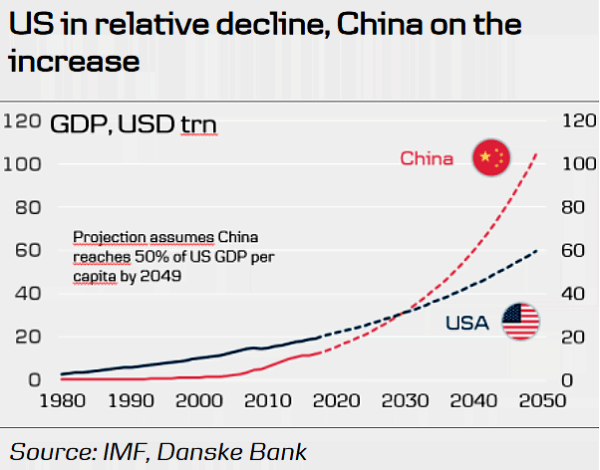
The One Chart That Explains Everything

Look at the chart above. The chart explains everything.

By Mike Whitney

Source: The Unz Review

It explains why Washington is so worried about China’s explosive growth. It explains why the US continues to hector China on the issues of Taiwan and the South China Sea. It explains why Washington sends congressional delegations to Taiwan in defiance of Beijing’s explicit requests. It explains why the Pentagon continues to send US warships through the Taiwan Strait and ship massive amounts of lethal weaponry to Taipei. It explains why Washington is creating anti-China coalitions in Asia that are aimed at encircling and provoking Beijing. It explains why the Biden administration is stepping up its trade war on China, imposing onerous economic sanctions on its businesses, and banning critical high-tech semi-conductors that are “are essential not just… for virtually every aspect of modern society, from electronic products and transport to the design and production of all manner of goods.” It explains why China has been singled-out in the US National Security Strategy (NSS) as “the only competitor with both the intent and, increasingly, the capability to reshape the international order.” It explains why Washington now regards China as its biggest and most formidable strategic adversary that must be isolated, demonized and defeated.

The chart above explains everything, not just the hostile diplomatic jabs that are designed to discredit and humiliate China, but also the openly belligerent policies that are aimed at Russia as well. People need to understand this. They need to see what is really going on so they can put events in their proper geopolitical context.

And what “context” is that?

The context of a Third World War; a war that was thoroughly-planned, instigated and (now) prosecuted by Washington and Washington’s proxies. That’s what’s really going on. The increasingly violent conflagrations we see cropping-up in Ukraine and Asia are not the result of “Russian aggression” or “evil Putin”. No. They are the actualization of a sinister geopolitical strategy to quash China’s meteoric rise and preserve America’s dominant role in the world order. Can there be any doubt about that?

No. None.

This is why we are experiencing the redivision of the world into warring blocs. This is why we are seeing the roll back of 30 years of Globalization and massive suppyline disruption. And this is why Europe has been thrust headlong into frigid darkness and forced deindustrialisation. All of these suicidal policies were concocted for one purpose and one purpose alone, to maintain America’s exalted spot in the global system. That is why all of humanity is presently embroiled in a Third World War; a war that is designed to prevent China from becoming the world’s biggest economy; a war that is designed to preserve US global primacy. Check out this excerpt from an article at the World Socialist Web Site:

An October 19 Financial Times article by Edward Luce, entitled “Containing China is Biden’s explicit goal,” sounded the following alarm: “Imagine that a superpower declared war on a great power and nobody noticed. Joe Biden this month launched a full-blown economic war on China—all but committing the US to stopping its rise—and for the most part, Americans did not react.

“To be sure, there is Russia’s war on Ukraine and inflation at home to preoccupy attention. But history is likely to record Biden’s move as the moment when US-China rivalry came out of the closet.”

Moreover, last week, a top Biden administration official indicated that the US was preparing new bans on China in key hi-tech areas. Speaking at the Center for a New American Security, Alan Estevez, the under-secretary of Commerce for Industry and Security, was asked if the US would ban China from accessing quantum information science, biotechnology, artificial intelligence software or advanced algorithms. Estevez admitted that this was already being actively discussed. “Will we end up doing something in those areas? If I was a betting person, I would put down money on that,” he said….

Luce concluded his Financial Times article cited above by declaring: “Will Biden’s gamble work? I’m not relishing the prospect of finding out. For better or worse, the world has just changed with a whimper not a bang. Let us hope it stays that way.”…(“Biden’s technology war against China”, World Socialist Web Site)

Once again, look at the chart. What does it tell you?

The first thing it tells you is that the hostilities we see in Ukraine (and eventually Taiwan), can be traced back to a fundamental shift in the global economy. China is growing stronger. It’s on a path to overtake the United States economy within the decade. And with growth, come certain benefits. As the world’s biggest economy, China will naturally become Asia’s regional hegemon. And, as Asia’s regional hegemon it will be able “to settle regional disputes in its own favor and to de-legitimize U.S. regional and global leadership.”

Can you see the problem here?

For nearly two decades, the US has oriented its foreign policy around a “rebalancing of forces” strategy called the “pivot to Asia”. In short, the US intends to be the dominant player in the world’s most populous and prosperous region, Asia. Can you see how China’s rise derails Washington’s plan for the future?

The United States is not going to let this happen without a fight. Washington is not going to let China muscle-it-out of the markets that it plans to dominate. That’s not going to happen. And if you think that’s going to happen, you’d better think again. The United States will go to war to avoid a scenario in which the US plays “second fiddle” to China. In fact, the foreign policy establishment has already decided that the US will engage China militarily for that very objective.

So, our thesis is simple; we think WW3 has already begun. That’s all we’re saying. The ructions we see in Ukraine are merely the first salvo in a Third World War that has already triggered an unprecedented energy crisis, massive worldwide food insecurity, a catastrophic break-down in global supply lines, widespread and out-of-control inflation, the steady reemergence of extreme nationalism, and the redivision of the world into warring blocs. What more proof do you need?

And it’s all economic. The origins of this conflict can all be traced back to the seismic changes in the global economy, the rise of China and the unavoidable decline of the United States. It is a case of one empire replacing the other. Naturally, a transition of this magnitude is going to generate tectonic changes in global distribution of power. And along with those changes will come more flashpoints, more devastation, and the looming prospect of nuclear war. And this is precisely how things are playing out.

So, how does the chart explain what is happening in Ukraine?

Washington’s proxy war in Ukraine is actually aimed at China not Russia. Russia is not a peer competitor and Russia does not have the economic wherewithal to displace the United States in the global order. NordStream, however, did pose a significant risk to the US by greatly strengthening Moscow’s economic relations with the EU and particularly with Europe’s industrial powerhouse, Germany. The Moscow-Berlin alliance—which was mutually beneficial and key to German prosperity—had to be sabotaged to prevent further economic integration that would have drawn the continents closer together into the world’s biggest free trade zone. Washington had to stop that in order to preserve its economic stranglehold on Europe and defend the dollar as the world’s reserve currency. Even so, no one expected the US to blow up the pipeline itself in—what appears to be—the greatest act of industrial terrorism in history. That was truly shocking.

In essence, Washington sees Russia as an obstacle to its “pivot” plan to encircle, isolate and weaken China. But Russia is not the greatest threat to US global primacy; not even close. That designation belongs to China.

The Third World War is being waged to contain China not Russia. What the war in Ukraine suggests is that—among foreign policy elites—there is general agreement that, The road to Beijing goes through Moscow. That appears to be the consensus view. In other words, US powerbrokers want to weaken Russia in order to spread US military bases across Asia. Ultimately, the military will be called upon to enforce Washington’s economic rule over its new Asian subjects. If that day ever comes.

We think it is extremely unlikely that Washington’s ambitious plan will succeed, but we have no doubt that it will be implemented all the same. Tens of millions of people are likely to die in a desperate attempt to turn-back the clock to the fleeting ‘unipolar moment’ and the equally short-lived American Century. It is a tragedy beyond comprehension.

The 500 Years Old WESTERN HEGEMONY is Coming to an END and the World is about to ENTER a VERY DANGEROUS PERIOD

For 500 years the world has been run from Europe or the US: that’s about to change and nobody is sure what its replacement will look like

By Timofey Bordachev

Source: The 21st Century

The most dramatic and unique aspect of the current state of affairs in international politics is that we cannot count on the ability of a single state, or a group of sufficiently powerful countries, to play a leadership role in the future.

This means it is difficult for us to imagine who will be able to force states to comply with the rules of conduct in their foreign policy, and how such strictures can even be enforced.

Indeed, the question of why individuals, or in this case countries, should abide by regulations is the most fundamental one in political philosophy.

And despite all the imperfections of the power method, humanity has not yet invented any other way of achieving such goals, even in minimal amounts, other than by force.

Over the last 500 years, the rules of international communication have been created within the narrow community of Western countries, first in Europe, before in the 20th century the US joined in, providing the power needed to enforce the system.

At first, this was done through the balance of power of leading European states, joined by Russia in 1762.

After the international order that had emerged in the mid-17th century came under attack from revolutionary France, control of the rules became a matter for a small group of major empires.

They, led by Russia and Britain, defeated Napoleon and in 1815 created an order which had at its heart a general agreement that mutiny in international affairs was unacceptable.

By the end of the nineteenth century, politics had become global, but the European powers, including Russia, could still control the rest through brute force and their colossal military-industrial superiority.

The dramatic events of 1914-1945 brought the US to the forefront of global politics, as the leader of the Western community on a global scale.

International institutions, starting with the United Nations, were established with the primary objective of preserving the monopoly position of the West.

This, however, required the emergence of formal institutions of justice in the form of international law, or the participation in the highest UN body, the Security Council, of the Soviet Union and China, which were inherently hostile to US and Western European interests.

The institutional form of Western power dominance has become overbearing and the main question now is whether it can be preserved.

Therefore, the collapse of US and Western European power positions in international politics entails not just a change of leadership, but a revision of the existing institutions and rules at the global level.

In other words, the entire formal international order that has emerged after World War II (and in reality over the last few centuries) will cease to exist.

It was based on a special system of rights and privileges for a limited group of great powers, and later the illusion of fairness of which was created by international institutions led by the UN.

It was this system that played the role of the main legitimizing principle of the existing world order, although in practice it was often replaced by the West’s ability to exert a decisive influence on world affairs

Thus, the collapse of international political institutions will very probably prove to be a consequence of the disappearance of their power base, whose presence has been unchallenged for several centuries.

We are now witnessing the destruction of both the formal and the real basis of the international order. In all likelihood, this process can no longer be stopped.

The coming period will be a time of defining the new global power base, and it is difficult to say yet which players, and to what extent, will become part of it.

What is important is that the top states of the present time – the US, Russia, China and India – are not close to each other, especially in terms of values and understanding of the basic principles of international rules.

The greatest problem so far is the behaviour of the US and certain Western European countries, which, for internal reasons, are pursuing an aggressive policy towards the outside world.

These states have embarked on a very troubling path of qualitative changes in the basic things that make up the social, gender and, consequently, political structures of society. For most other civilizations, this path is a challenge and will be rejected.

We also do not know the extent to which the internal development of the West depends on the spread of its ideals, as it did in previous periods.

In the event that the trends emerging in the West will, like revolutionary France, the Bolshevik regime or Nazi Germany, demand not just recognition from others, but expansion globally, the future will become very worrying.

We can already see that the conflict between the values favored by the West and the foundations of domestic legitimacy in a number of countries, is becoming a ground for aggravated political relations.

It would, however, be a mistake to hope that the other great and middle powers confronting the West are completely united in their understanding of the foundations of justice at the domestic level.

Even if Russia, India, China or Brazil now demonstrate a common understanding of the basic principles of a “proper” world order, this does not mean that they have the same vision of a better domestic order.

This is all the more true of the states of the Islamic world and other major developing countries. Their conservative values are often in conflict with those of the West, but this does not mean that they can create unity between themselves.

In other words, the new international order will, for the first time, be without a reliable link with the domestic ambitions of the leading powers, and this is indeed a qualitative change compared to all the historical eras we discussed.

Such a phenomenon seems very important because we have no experience of understanding how relations between states will develop under such conditions.

Brute force could become the only relatively tangible basis to assert the order, but this may not be enough to make the conditions imposed by it sustainable, even in the short term.

Another unique feature of today’s revolutionary situation is that the revision of the international order is not being carried out by one or a few powers – it has now become the business of the world’s majority.

The countries that make up about 85% of the world’s population are in one way or another no longer prepared to live with conditions created without their direct involvement.

That said, their resistance is often expressed without direct intention and depends on the power capabilities of the particular power.

What from the point of view of Russia or Iran looks like lack of resolve in dealing with the US may seem like a great challenge for Kazakhstan or another young sovereign country – after all, their entire socio-economic system was created to exploit a liberal world order.

The fragile states of Africa, or the former Soviet space, are far less capable of behaving consistently than the prosperous monarchies of the Persian Gulf. China, though now the second most powerful economic power, is also aware of its weaknesses.

But all this does not change the most important thing – even if the destruction of the existing status quo takes the form of soft sabotage rather than decisive military action, it does not simply reflect a general discontent with Western authoritarianism, but creates a new order, and the basic features of this are as yet undetermined.

In the coming years, most countries in the world will seek to make the most of the weakening of the power base of international politics in their self-interest.

So far, these actions constitute a constructive conflict, since they objectively undermine a system based on fantastic injustice.

However, as time goes on the US-EU bloc will weaken and lock itself away, and Russia or China will never be strong enough to take their place.

And in the perspective of the next 10 to 15 years, the international community will face the problem of replacing the power monopoly of the West with new universal instruments of coercion, the nature and content of which are still unknown to us.

How “Food Shortages” & Economic Collapse Protects the Status Quo

Engineered Food & Poverty Crises Secure Continued US Dominance

By Colin Todhunter

Source: Off-Guardian

In March 2022, UN Secretary-General Antonio Guterres warned of a “hurricane of hunger and a meltdown of the global food system” in the wake of the crisis in Ukraine.

Guterres said food, fuel and fertiliser prices were skyrocketing with supply chains being disrupted and added this is hitting the poorest the hardest and planting the seeds for political instability and unrest around the globe.

According to the International Panel of Experts on Sustainable Food Systems, there is currently sufficient food and no risk of global food supply shortages.

We see an abundance of food but skyrocketing prices. The issue is not food shortage but speculation on food commodities and the manipulation of an inherently flawed global food system that serves the interests of corporate agribusiness traders and suppliers of inputs at the expense of people’s needs and genuine food security.

The war in Ukraine is a geopolitical trade and energy conflict. It is largely about the US engaging in a proxy war against Russia and Europe by attempting to separate Europe from Russia and imposing sanctions on Russia to harm Europe and make it further dependent on the US.

Economist Professor Michael Hudson recently stated that ultimately the war is against Europe and Germany. The purpose of the sanctions is to prevent Europe and other allies from increasing their trade and investment with Russia and China.

Neoliberal policies since the 1980s have hollowed out the US economy. With its productive base severely weakened, the only way for the US to maintain hegemony is to undermine China and Russia and weaken Europe.

Hudson says that, beginning a year ago, Biden and the US neocons attempted to block Nord Stream 2 and all (energy) trade with Russia so that the US could monopolise it itself.

Despite the ‘green agenda’ currently being pushed, the US still relies on fossil fuel-based energy to project its power abroad. Even as Russia and China move away from the dollar, the control and pricing of oil and gas (and resulting debt) in dollars remains key to US attempts to retain hegemony.

The US knew beforehand how sanctions on Russia would play out. They would serve to divide the world into two blocks and fuel a new cold war with the US and Europe on one side with China and Russia being the two main countries on the other.

US policymakers knew Europe would be devastated by higher energy and food prices and food importing countries in the Global South would suffer due to rising costs.

It is not the first time the US has engineered a major crisis to maintain global hegemony and a spike in key commodity prices that effectively trap countries into dependency and debt.

In 2009, Andrew Gavin Marshall described how in 1973 – not long after coming off the gold standard – Henry Kissinger was integral to manipulating events in the Middle East (the Arab-Israeli war and the ‘energy crisis’). This served to continue global hegemony for the US, which had virtually bankrupted itself due to its war in Vietnam and had been threatened by the economic rise of Germany and Japan.

Kissinger helped secure huge OPEC oil price rises and thus sufficient profits for Anglo-American oil companies that had over-leveraged themselves in North Sea oil. He also cemented the petrodollar system with the Saudis and subsequently placed African nations, which had embarked on a path of (oil-based) industrialisation, on a treadmill of dependency and debt due to the spike in oil prices.

It is widely believed that the high-priced oil policy was aimed at hurting Europe, Japan and the developing world.

Today, the US is again waging a war on vast swathes of humanity, whose impoverishment is intended to ensure they remain dependent on the US and the financial institutions it uses to create dependency and indebtedness – the World Bank and IMF.

Hundreds of millions will experience (are experiencing) poverty and hunger due to US policy. These people (the ones that the US and Pfizer et al supposedly cared so much about and wanted to get a jab into each of their arms) are regarded with contempt and collateral damage in the great geopolitical game.

Contrary to what many believe, the US has not miscalculated the outcome of the sanctions placed on Russia. Michael Hudson notes energy prices are increasing, benefiting US oil companies and US balance of payments as an energy exporter. Moreover, by sanctioning Russia, the aim is to curtail Russian exports (of wheat and gas used for fertiliser production) and for agricultural commodity prices to therefore increase. This too will also benefit the US as an agricultural exporter.

This is how the US seeks to maintain dominance over other countries.

Current policies are designed to create a food and debt crisis for poorer nations especially. The US can use this debt crisis to force countries to continue privatising and selling off their public assets in order to service the debts to pay for the higher oil and food imports.

This imperialist strategy comes on the back of ‘COVID relief’ loans which have served a similar purpose. In 2021, an Oxfam review of IMF COVID-19 loans showed that 33 African countries were encouraged to pursue austerity policies. The world’s poorest countries are due to pay $43 billion in debt repayments in 2022, which could otherwise cover the costs of their food imports.

Oxfam and Development Finance International have also revealed that 43 out of 55 African Union member states face public expenditure cuts totalling $183 billion over the next five years.

The closure of the world economy in March 2020 (‘lockdown’) served to trigger an unprecedented process of global indebtedness.

Conditionalities mean national governments will have to capitulate to the demands of Western financial institutions. These debts are largely dollar-denominated, helping to strengthen the US dollar and US leverage over countries.

The US is creating a new world order and needs to ensure much of the Global South remains in its orbit of influence rather than ending up in the Russian and especially Chinese camp and its belt road initiative for economic prosperity.

Post-COVID, this is what the war in Ukraine, sanctions on Russia and the engineered food and energy crisis are really about.

Back in 2014, Michael Hudson stated that the US has been able to dominate most of the Global South through agriculture and control of the food supply. The World Bank’s geopolitical lending strategy has transformed countries into food deficit areas by convincing them to grow cash crops – plantation export crops – not to feed themselves with their own food crops.

The oil sector and agribusiness have been joined at the hip as part of US geopolitical strategy.

The dominant notion of ‘food security’ promoted by global agribusiness players like Cargill, Archer Daniel Midland, Bunge and Louis Dreyfus and supported by the World Bank is based on the ability of people and nations to purchase food. It has nothing to do with self-sufficiency and everything to do with global markets and supply chains controlled by giant agribusiness players.

Along with oil, the control of global agriculture has been a linchpin of US geopolitical strategy for many decades. The Green Revolution was exported courtesy of oil-rich interests and poorer nations adopted agri-capital’s chemical- and oil-dependent model of agriculture that required loans for inputs and related infrastructure development.

It entailed trapping nations into a globalised food system that relies on export commodity mono-cropping to earn foreign exchange linked to sovereign dollar-denominated debt repayment and World Bank/IMF ‘structural adjustment’ directives. What we have seen has been the transformation of many countries from food self-sufficiency into food deficit areas.

And what we have also seen is countries being placed on commodity crop production treadmills. The need for foreign currency (US dollars) to buy oil and food entrenches the need to increase cash crop production for exports.

The World Trade Organization’s Agreement on Agriculture (AoA) set out the trade regime necessary for this type of corporate dependency that masquerades as ‘global food security’.

This is explained in a July 2022 report by Navdanya International – Sowing Hunger, Reaping Profits – A Food Crisis by Design – which notes international trade laws and trade liberalisation has benefited large agribusiness and continue to piggyback off the implementation of the Green Revolution.

The report states that US lobby and trade negotiations were headed by former Cargill Investors Service CEO and Goldman Sachs executive – Dan Amstutz – who in 1988 was appointed chief negotiator for the Uruguay round of GATT by Ronald Reagan. This helped to enshrine the interests of US agribusiness into the new rules that would govern the global trade of commodities and subsequent waves of industrial agriculture expansion.

The AoA removed protection of farmers from global market prices and fluctuations. At the same time, exceptions were made for the US and the EU to continue subsidising their agriculture to the advantage of large agribusiness.

Navdanya notes:

“With the removal of state tariff protections and subsidies, small farmers were left destitute. The result has been a disparity in what farmers earn for what they produce, versus what consumers pay, with farmers earning less and consumers paying more as agribusiness middlemen take the biggest cut.”

‘Food security’ has led to the dismantling of food sovereignty and food self-sufficiency for the sake of global market integration and corporate power.

We need look no further than India to see this in action. The now repealed recent farm legislation in India was aimed at giving the country the ‘shock therapy’ of neoliberalism that other countries have experienced.

The ‘liberalising’ legislation was in part aimed at benefiting US agribusiness interests and trapping India into food insecurity by compelling the country to eradicate its food buffer stocks – so vital to the nation’s food security – and then bid for food on a volatile global market from agribusiness traders with its foreign reserves.

The Indian government was only prevented from following this route by the massive, year-long farmer protest that occurred.

The current crisis is also being fuelled by speculation. Navdanya cites an investigation by Lighthouse Reports and The Wire to show how speculation by investment firms, banks and hedge funds on agricultural commodities are profiting off rising food prices. Commodity future prices are no longer linked to actual supply and demand in the market but are based purely on speculation.

Archer Daniels Midland, Bunge, Cargill and Louis Dreyfus and investment funds like Black Rock and Vanguard continue to make huge financial killings, resulting in the price of bread almost doubling in some poorer countries.

The cynical ‘solution’ promoted by global agribusiness to the current food crisis is to urge farmers to produce more and seek better yields as if the crisis is that of underproduction. It means more chemical inputs, more genetic engineering techniques and suchlike, placing more farmers in debt and trapped in dependency.

It is the same old industry lie that the world will starve without its products and requires more of them. The reality is that the world is facing hunger and rising food prices because of the system big agribusiness has instituted.

And it is the same old story – pushing out new technologies in search of a problem and then using crises as justification for their rollout while ignoring the underlying reasons for such crises.

Navdanya sets out possible solutions to the current situation based on principles of agroecology, short supply lines, food sovereignty and economic democracy – policies that have been described at length in many articles and official reports over the years.

As for fighting back against the onslaught on ordinary people’s living standards, support is gathering among the labour movement in places like the UK. Rail union leader Mick Lynch is calling for a working class movement based on solidarity and class consciousness to fight back against a billionaire class that is acutely aware of its own class interests.

For too long, ‘class’ has been absent from mainstream political discourse. It is only through organised, united protest that ordinary people will have any chance of meaningful impact against the new world order of tyrannical authoritarianism and the devastating attacks on ordinary people’s rights, livelihoods and standards of living that we are witnessing.

The US is pushing the situation towards a clash of major nuclear powers

By Valery Kulikov

Source: New Eastern Outlook

With its actions in recent months, the United States is blatantly pushing the international situation towards a clash of major nuclear powers. This is true of Washington’s blatantly provocative moves against both Russia and China.

US officials continue to inflame the situation, intimidating their own and the world public with “imaginary nuclear threats” from Russia by spreading fake information. For example, during a speech at the UN General Assembly, US President Biden cited non-existent quotes from Putin. Foreign Ministry Spokeswoman Maria Zakharova called it at least “indecent” that US President Joe Biden falsely quoted Russian leader Vladimir Putin when he “attributed” to the Russian President saying that “our country threatens the world with nuclear weapons”. According to her, someone took advantage of the White House head’s inability to reflect on difficult subjects.

The anti-Russian actions of Joe Biden and members of his administration are now harshly criticized by numerous politicians and media both within and outside the US. The US President was harshly criticized in particular by Fox News political observer Tucker Carlson, who said that Biden was guilty of wanting to destroy Russia for the sake of American hegemony in the world.

Russian President Vladimir Putin has repeatedly reminded the Russian and international public in his recent speeches that Washington is pushing Kiev to move hostilities to Russian territory and has recently even resorted to nuclear blackmail. “Washington, London and Brussels are directly pushing Kiev to transfer hostilities to our territory, and they are already openly saying that Russia must be defeated by all means on the battlefield, followed by the deprivation of economic, political, cultural and any kind of sovereignty, and the complete pillaging of our country,” the Russian leader said in a televised address on September 21. “We are talking not only about Western-encouraged shelling of the Zaporozhye NPP, which threatens a nuclear disaster, but also about statements by some high-ranking representatives of some NATO states about the possibility and admissibility of using weapons of mass destruction, nuclear weapons, against Russia,” Putin explained.

As highlighted in an article by Russia’s Ambassador to the US Anatoly Antonov published in The National Interest magazine, Washington’s actions are pushing the situation towards a clash of major nuclear powers. Western countries appear to be testing Russia’s mettle. “Today it is obvious that the United States is directly involved in the military actions of the Kiev regime. Washington is openly building up the supply of lethal weapons to Ukraine and provides it with intelligence. They jointly plan military operations against the Russian Armed Forces. Ukrainians are being trained to use NATO military hardware in a fight,” the article notes.

Following US media reports in late September that the US was allegedly developing plans to hit the Russian military and political leadership and the Kremlin, the Russian Embassy in Washington commented on the hoaxes, stressing that this was someones’ delusion. The Russian Embassy expressed the hope that such delusional reasoning does not reflect the official position of the US military establishment, as Washington must be well aware of the escalating nature of such reckless rhetoric.

The fact that the US is actively working for an armed clash with Russia is evidenced not only by numerous policies, but also by documents.

The Swedish newspaper Nya Dagbladet, for example, published what it admitted was a “shocking document” about how the US was planning an armed conflict with Russia and an energy crisis in Europe in January. The source of this information was a “leak” from the RAND Corporation, the leading US think-tank responsible for making recommendations to the White House. The report, which was obtained by a Swedish publication, states in particular that one of the reasons for an armed clash between the West and Russia would be its push for military intervention in Ukraine in response to the aggressive foreign policy pursued by the Kiev regime under instructions from Washington. According to the pervasive key objective of this cynical strategy, as described in the document, one of the most important US objectives has been to destroy cooperation not only between Germany and Russia, but also between Berlin and Paris, dragging both of these Western European countries into the conflict in Ukraine.

As the European media is already reporting, although there are still hopes and opportunities to stop the Western-initiated conflict with Russia, they are being increasingly dashed by unprecedented propaganda, the spread of war hysteria through the media and the fanatical insanity of Western politicians. All this shows that military decisions have long been made and there is less and less realistic possibility of stopping the conflict. This has been seriously illustrated by the active calls by the US and its NATO allies for their citizens to urgently leave Russian territory, which, in a well-known historical analogy, is usually done on the eve of the outbreak of a serious armed conflict.

On September 28, the US Embassy in Moscow, for example, called on compatriots to urgently leave the territory of the Russian Federation. In particular, one of the recent reports published on the Embassy’s website said: “US citizens should not travel to Russia and those residing or travelling in Russia should depart Russia immediately while limited commercial travel options remain”.

The Polish Foreign Ministry on September 27 also advised its citizens “leave [Russian] territory using the available commercial and private means”. At the same time, Polish citizens are warned that “in case of a drastic deterioration of the security situation, the closure of borders or other unforeseen circumstances, evacuation may prove significantly impeded or even impossible”. At the same time, according to the Deputy Minister of Interior and Administration Błażej Poboży, an inspection of bomb shelters, even those that are not in the possession of the city authorities, has been launched on the territory of Poland.

The Italian Embassy in Moscow, Latvian Foreign Minister Edgars Rinkēvičs, the Lithuanian Foreign Ministry and several other NATO foreign ministries also advised fellow citizens to leave Russia on September 29.

Although the Latvian authorities admit that the situation on the Latvian-Russian border is stable, calm and under strict control, the country introduced an emergency situation for the next three months. At the same time, the North Atlantic Alliance Command reported the deployment of two HIMARS MLRSs by the US in Latvia, ostensibly in preparation for the NAMEJS exercise.  The exact same MLRSs are already being actively used by the US in military operations in Ukraine to shell Donbas territory by the Kiev regime under the guidance of US military advisors.

While the current US leadership has long acted adventurously and irresponsibly towards the people of eastern Ukraine and the Russian Federation, supporting and fomenting hostilities with its arms deliveries, it must understand that a nuclear conflict, if it occurs, cannot remain a regional issue. And if, through the fault of the White House, the conflict with Moscow descends into nuclear war, such war would be global. It will primarily destroy the United States, as well as the countries where NATO armaments are located and from where the security of Russia and Russian citizens will be threatened. And Washington should be clear that this risk is higher than what the current US political elite expects.

Brainwashed for War With Russia

By Ray McGovern

Source: AntiWar.com

Thanks to Establishment media, the sorcerer apprentices advising President Joe Biden – I refer to Secretary of State Antony Blinken, national security adviser Jacob Sullivan, and China specialist Kurt Campbell – will have no trouble rallying Americans for the widest war in 77 years, starting in Ukraine, and maybe spreading to China. And, shockingly, under false pretenses.

Most Americans are oblivious to the reality that Western media are owned and operated by the same corporations that make massive profits by helping to stoke small wars and then peddling the necessary weapons. Corporate leaders, and Ivy-mantled elites, educated to believe in U.S. “exceptionalism,” find the lucre and the luster too lucrative to be able to think straight. They deceive themselves into thinking that (a) the US cannot lose a war; (b) escalation can be calibrated and wider war can be limited to Europe; and (c) China can be expected to just sit on the sidelines. The attitude, consciously or unconsciously, “Not to worry. And, in any case, the lucre and luster are worth the risk.”

The media also know they can always trot out died-in-the-wool Russophobes to “explain,” for example, why the Russians are “almost genetically driven” to do evil (James Clapper, former National Intelligence Director and now hired savant on CNN); or Fiona Hill (former National Intelligence Officer for Russia), who insists “Putin wants to evict the United States from Europe … As he might put it: “Goodbye, America. Don’t let the door hit you on the way out.”

Absent a miraculous appearance of clearer heads with a less benighted attitude toward the core interests of Russia in Ukraine, and China in Taiwan, historians who survive to record the war now on our doorstep will describe it as the result of hubris and stupidity run amok. Objective historians may even note that one of their colleagues – Professor John Mearsheimer – got it right from the start, when he explained in the autumn 2014 issue of Foreign Affairs “Why the Ukraine Crisis is the West’s Fault.”

Historian Barbara Tuchman addressed the kind of situation the world faces in Ukraine in her book “The March of Folly: From Troy to Vietnam.” (Had she lived, she surely would have updated it to take Iraq, Afghanistan, Syria, and Ukraine into account). Tuchman wrote:

“Wooden-headedness…plays a remarkably large role in government. It consists in assessing a situation in terms of preconceived fixed notions while ignoring or rejecting any contrary signs. It is acting according to wish while not allowing oneself to be deflected by the facts.”

Six Years (and Counting) of Brainwashing

Thanks to US media, a very small percentage of Americans know that:

  • 14 years ago, then US Ambassador to Russia (current CIA Director) William Burns was warned by Russian Foreign Minister Sergei Lavrov that Russia might have to intervene in Ukraine, if it were made a member of NATO. The Subject Line of Burns’s Feb. 1, 2008 Embassy Moscow cable (#182) to Washington makes it clear that Amb. Burns did not mince Lavrov’s words; the subject line stated: “Nyet means nyet: Russia’s NATO enlargement redlines.”Thus, Washington policymakers were given forewarning, in very specific terms, of Russia’s redline regarding membership for Ukraine in NATO. Nevertheless, on April 3, 2008, a NATO summit in Bucharest asserted: “NATO welcomes Ukraine’s and Georgia’s Euro-Atlantic aspirations for membership in NATO. We agreed today that these countries will become members of NATO.”
  • 8 years ago, on Feb. 22, 2014, the US orchestrated a coup in Kiev – rightly labeled “the most blatant coup in history’, insofar as it had already been blown on YouTube 18 days prior. Kiev’s spanking new leaders, handpicked and identified by name by US Assistant Secretary of State Victoria Nuland in the YouTube-publicized conversation with the U.S. ambassador in Kiev, immediately called for Ukraine to join NATO.
  • 6 years ago, in June 2016, Russian President Vladimir Putin told Western reporters of his concern that so-called antiballistic missiles sites in Romania and Poland could be converted overnight to accommodate offensive strike missiles posing a threat to Russia’s own nuclear forces. (See this unique video, with English subtitles, from minute 37 to 49.) There is a direct analogy with the 1962 Cuban missile crisis when Moscow put offensive strike missiles in Cuba and President John Kennedy reacted strongly to the existential threat that posed to the US.
  • On December 21, 2021, President Putin told his most senior military leaders:“It is extremely alarming that elements of the US global defense system are being deployed near Russia. The Mk 41 launchers, which are located in Romania and are to be deployed in Poland, are adapted for launching the Tomahawk strike missiles. If this infrastructure continues to move forward, and if US and NATO missile systems are deployed in Ukraine, their flight time to Moscow will be only 7–10 minutes, or even five minutes for hypersonic systems. This is a huge challenge for us, for our security.” [Emphasis added.]
  • On December 30, 2021, Biden and Putin talked by phone at Putin’s urgent request. The Kremlin readout stated:
  • On February 12, 2022, Ushakov briefed the media on the telephone conversation between Putin and Biden earlier that day.
  • On February 24, 2022, Russia invaded Ukraine.

Unprovoked?

The US insists that Russia’s invasion was “unprovoked”. Establishment media dutifully regurgitate that line, while keeping Americans in the dark about such facts (not opinion) as are outlined (and sourced) above. Most Americans are just as taken in by the media as they were 20 years ago, when they were told there were weapons of mass destruction in Iraq. They simply took it on faith. Nor did the guilty media express remorse – or a modicum of embarrassment.

The late Fred Hiatt, who was op-ed editor at the Washington Post, is a case in point. In an interview with the Columbia Journalism Review [CJR, March/April 2004] he commented:

“If you look at the editorials we wrote running up [to the war], we state as flat fact that he [Saddam Hussein] has weapons of mass destruction.” “If that’s not true, it would have been better not to say it.”

(My journalism mentor, Robert Parry, had this to say about Hiatt’s remark. “Yes, that is a common principle of journalism, that if something isn’t real, we’re not supposed to confidently declare that it is.”)

It’s worse now. Russia is not Iraq. And Putin has been so demonized over the past six years that people are inclined to believe the likes of James Clapper to the effect there’s something genetic that makes Russians evil. “Russia-gate” was a big con (and, now, demonstrably so), but Americans don’t know that either. The consequences of prolonged demonization are extremely dangerous – and will become even more so in the next several weeks as politicians vie to be the strongest in opposing and countering Russia’s “unprovoked” attack on Ukraine.

THE Problem

Humorist Will Rogers had it right:

“The problem ain’t what people know. It’s what people know that ain’t so; that’s the problem.”

Challenging America’s Lords of Illusion with a Million Contrary Rumble Views

By Ron Unz

Source: The Unz Review

In Roger Zelazny’s classic 1967 science fiction novel Lord of Light, humans on a distant planet have employed technological devices to establish themselves as gods of the Hindu pantheon, each having particular aspects and attributes. Mara is the Lord of Illusion, able to reshape the perceived world in the minds of all those around him. Such an ability is powerful but not invincible since the physical reality remains unchanged, and Mara is slain in the very first chapter.

I think that story stands as an effective metaphor for America’s strengths in today’s world. Our country is so utterly dominant in the distribution of information and propaganda, including the electronic and social media, that we can easily persuade most of the world to accept as truth our manufactured illusions. But we cannot alter the underlying reality, perhaps leading to disastrous ultimate consequences.

Russia possesses a nuclear arsenal equal to our own and its revolutionary hypersonic weapons provide it considerable superiority in delivery systems. Lieutenant-General Igor Kirillov serves as the head of Russia’s Radiation, Chemical, and Biological Defense Forces, and a couple of weeks ago he held a public briefing at which he suggested that elements of the American government had probably been responsible for unleashing the global Covid epidemic.

I mentioned his explosive accusations in a column, but otherwise they seem to have been almost entirely ignored in both the American mainstream and even alternative media. Instead, the only significant American response was that Twitter suspended the official account of the Russian Foreign Ministry after it distributed the remarks of that top Russian general.

Once again, except for a column of my own, the censorship Twitter had suddenly imposed upon the Russian government for such accusatory statements passed almost entirely unnoticed by American mainstream and alternative media outlets alike.

Major declarations by top Russian military leaders surely receive extensive coverage in Russia’s own domestic media, so I’d assume that a substantial fraction of the Russian population now believes that the Covid virus which has killed more than 15 million people worldwide may have been an American product, engineered and released by our national security apparatus. But a near-total media embargo—extending to alternative outlets—has ensured that such notions remain completely excluded from American minds. Apparently, our editors follow the principle “What we don’t know can’t hurt us.”

Over the last couple of years I have been repeatedly struck by the complete unwillingness of virtually any mainstream or alternative Western journalist to take notice of the very strong evidence of America’s culpability in the Covid epidemic, evidence that I have presented in a long series of articles first beginning in April 2020.

Earlier this month I sent this plaintive note to a member of America’s elite establishment with whom I’ve been friendly for many years:

…the whole situation just staggers the imagination.

For the same of argument, let’s assume I’m correct and there’s at least a pretty good chance that the blowback from an unauthorized biowarfare attack has now killed a million Americans.

Can you think of anything in the history of the world let alone the history of America that’s comparable to that? As I argued in one of my recent articles, it’s probably 1000x a greater worldwide disaster than Chernobyl.

And the notion that absolutely no one is willing to discuss it is just unbelievable. It’s not like Stalin’s NKVD will ship them off to the Gulag if they say anything. I mean it’s one thing if people are fearful of being shot, but it’s another thing if they’re merely fearful of being criticized on Twitter…

I just can’t understand why absolutely no one is willing to take a public stand on this issue. Once all the facts came out more than a year ago, I assumed the dam would break any week.

And his reply:

It is quite amazing.

From the very beginning of the epidemic, our media and propaganda organs, whether mainstream or alternative, have successfully insulated the American public from the crucial information that might allow them to properly understand what had happened in their lives. As I noted in my original April 2020 article:

As the coronavirus gradually began to spread beyond China’s own borders, another development occurred that greatly multiplied my suspicions. Most of these early cases had occurred exactly where one might expect, among the East Asian countries bordering China. But by late February Iran had become the second epicenter of the global outbreak. Even more surprisingly, its political elites had been especially hard-hit, with a full 10% of the entire Iranian parliament soon infected and at least a dozen of its officials and politicians dying of the disease, including some who were quite senior. Indeed, Neocon activists on Twitter began gleefully noting that their hated Iranian enemies were now dropping like flies.

Let us consider the implications of these facts. Across the entire world the only political elites that have yet suffered any significant human losses have been those of Iran, and they died at a very early stage, before significant outbreaks had even occurred almost anywhere else in the world outside China. Thus, we have America assassinating Iran’s top military commander on Jan. 2nd and then just a few weeks later large portions of the Iranian ruling elites became infected by a mysterious and deadly new virus, with many of them soon dying as a consequence. Could any rational individual possibly regard this as a mere coincidence?

In a later article I emphasized that Iran’s top leadership had certainly recognized these obvious facts at the time:

By early March 2020, the Iranian general overseeing his country’s biowarfare defense had already begun suggesting that Covid was a Western biological attack against his country and China, and a couple of days later the semiofficial Iranian news agency FARS quoted Iran’s top Revolutionary Guards military commander as declaring:

Today, the country is engaged in a biological battle. We will prevail in the fight against this virus, which might be the product of an American biological [attack], which first spread in China and then to the rest of the world…America should know that if it has done so, it will return to itself.

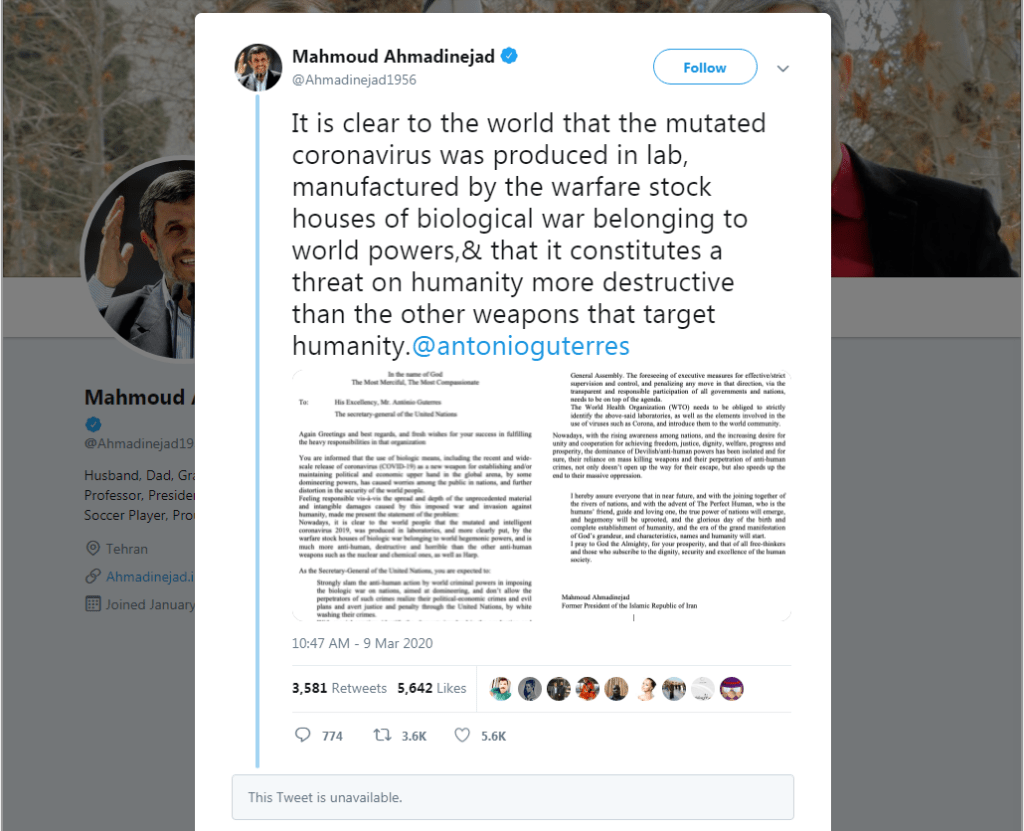
Soon afterward, Iran’s Supreme Leader Ali Khamenei took the same public position, while populist former president Mahmoud Ahmadinejad became especially vocal on Twitter for several months, even directing his formal accusations to UN Secretary-General Antonio Guterres. Just a single one of his numerous Tweets drew many thousands of Retweets and Likes.

Iranian radio and television and its international news service repeatedly carried these stories, backed by supportive interviews with a top political aide to Malaysia’s former prime minister. But America’s overwhelming domination over the English-language global media ensured that this major international controversy never came to my attention at the time it occurred.

The blockade preventing these Iranian charges from reaching the English-speaking world was further facilitated by American control over the basic infrastructure of the Internet. Just one month earlier, Iran’s PressTV channel for Britain had been deleted by YouTube, following the earlier removal of its main global channel. Most recently, the American government took the unprecedented action of seizing PressTV‘s Internet domain, completely eliminating all access to that website.

The original Covid outbreak had struck Wuhan at the height of China’s confrontation with the United States. By March 2020 official Chinese media was reporting that the virus might have been brought to that city by American military personnel when they participated in the World Military Games held there, with an official spokesman for China’s Foreign Ministry creating a diplomatic incident when he Tweeted out those accusations.

I’ve been told that such theories of American responsibility have become endemic on Chinese social media, and last year China’s second largest official news agency briefly summarized my own views on its website.

Similarly, Sputnik News, a mainstream Russian media outlet with 20 million visits per month, recently published a short interview with me regarding the likely origins of Covid. Around the same time, a leading Iranian television channel interviewed me for five hours in preparation for a series they plan to broadcast in the near future.

Government officials and the general public of Russia, Iran, and China both seem increasingly aware of these important facts and the controversial scenario they suggest, so I find it difficult to understand how legitimate American national interests are served by keeping that same information away from the American people. Yet this continuing climate of near-absolute censorship has been maintained not only within the mainstream media but also by nearly all alternative journalists and outlets. Even when American figures of the greatest public stature and credibility have broken their silence, their statements have been ignored across almost the entire alternative media landscape.

Prof. Jeffrey Sachs of Columbia University is the very high-ranking American academic who had served as the chairman of the Covid Commission established by the Lancet, a leading medical journal. In May he co-authored an important article in the prestigious PNAS journal arguing that the virus had probably been produced in a lab and calling for an independent inquiry into its true origins.

This bombshell declaration, which should have reached the front pages of the New York Times, was instead ignored by virtually every mainstream and alternative media outlet.

The following month, he reiterated his views while speaking at a small think-tank gathering in Spain, and a short clip of his remarks went super-viral, being retweeted out more than 11,000 times and attracting over a million views.

With the exception of an article in the London Daily Mail, this further bombshell was again entirely ignored by all outlets in both the mainstream and alternative press.

Finally, earlier this month he gave a lengthy and remarkably candid interview to Current Affairs, a small alternative media webzine, in which he focused on the strong evidence he had encountered of an apparent cover-up of Covid’s possible origins by individuals associated with the American government:

Once again, virtually no alternative journalist reported those astonishing allegations by the academic figure who had been best placed to make them.

When I brought his recent interview to the attention of several prominent mainstream individuals whom I personally know, they found it absolutely stunning. But apparently nearly every journalist in America thought otherwise, so its impact on the public debate has been almost nil.

Last week I published an account of the shocking McCain/POW scandal uncovered by the late Sydney Schanberg. Despite his stellar journalistic reputation and the mountain of evidence he had accumulated, his findings were totally ignored by the entire media, including by the Times, where he himself had previously served as one of the top editors. This notion of a story being too big or too dangerous for the media to cover certainly applies to the origins of the Covid epidemic.

Furthermore, the strategies used to suppress challenges to establishmentarian dogma may have grown much more sophisticated and effective. A couple of weeks ago I discussed this possibility in the aftermath of the Alex Jones trial, suggesting that techniques of “cognitive infiltration” may have been deployed against alternative organizations and activists, diverting them into blind alleys that dissipate their energies and severely damage their public credibility:

I speculated that the huge, sudden rise of a massive anti-vaxxing movement in America might be an example of this. A couple of years ago, vaccine issues were almost invisible, but soon after questions arose regarding the true origins of the Covid virus, the vaccination controversy moved to the absolute center stage of American public life, completely dominating the thoughts of most of those willing to challenge official orthodoxy on any other matter.

As a result, I suspect that a thousand times as much time and effort has recently been devoted to debating the safety and efficacy of Covid vaccines than to investigating the true origins of the disease that made them necessary. And individuals or organizations who proclaim their fear that Bill Gates is the architect of a diabolical plot to exterminate most of the human race are hardly likely to be taken seriously by credible journalists or academics on any other matters.

The difficult year or two of lockdown conditions under which so many Americans had suffered fostered the social isolation that naturally allowed even the most fantastical ideas to take root among the fearful. Such an environment would have been ideal for the successful promotion across the Internet of debilitating nonsense promoted by organized propaganda-operatives.

Thus, since early 2020, the likely reality of an event of monumental historical importance—the unauthorized release of a military bioweapon that has killed so many millions worldwide—has been successfully suppressed within America and the rest of the West. In the past, other dramatic events such as the JFK assassination and the 9/11 attacks quickly sparked large-scale movements of citizen-activism challenging the questionable official narrative, but there currently exists no similar “Covid Truth Movement.”

Despite this unfortunate situation, there are some signs of hope, indications of a few embers that might eventually burst into flame.

First, growing coverage in the Russian, Iranian, and Chinese media may help pierce the wall of silence maintained by Western outlets, especially because the latter have become so severely discredited by their extremely skewed coverage of the conflict in Ukraine and the confrontation over Taiwan. At the very least, alternative journalists may finally gain the necessary courage to begin seriously exploring the origins of Covid.

In addition, Jeffrey Sachs, an extremely senior figure in the mainstream Covid firmament, has seemingly become willing to break the conspiracy of silence and raise issues that have been suppressed for more than two years. Although media outlets have scrupulously avoided publishing his statements, his public stature raises the possibility of successfully circumventing such gatekeepers.

Meanwhile, the facts are still out there. I recently reread my original April 2020 article that first raised these issues, and although more than two years have passed I found little in the text that I would wish to change.

Just days after that piece ran, our entire webzine was banned by Facebook and all our pages were deranked by Google. But although those harsh actions successfully suppressed what had been the viral spread of that article, they also underscored the potential importance of the arguments being made.

Over the next two years, I greatly expanded that first work into a lengthy series of articles, comprehensively covering the topic. Taken together, those pieces have now been viewed more than a half-million times, and the entire collection is now available both as a freely downloadable eBook and also as an Amazon paperback.

Even more heartening has been the growing viewership of my video presentations. Back in February, just before the outbreak of the Ukraine war diverted all attention in a different direction, I was interviewed several times by small podcasters, and these shows have attracted considerable audiences. Totaling around four hours of discussion, they have now accumulated over a million views on Rumble, with more than half of these coming during the last few weeks. Circumventing media gatekeepers is a crucial step in piercing the veil of ignorance maintained by the West’s reigning Lords of Illusion, and recognizing the reality of our global disaster.

Kevin Barrett, FFWN • February 16, 2022 • 15m

Video Link

Geopolitics & Empire • February 1, 2022 • 75m

Video Link

Red Ice TV • February 3, 2022 • 130m

Video Link

Related Reading:

Escalation: Recent Events Suggest Mounting Economic Danger

By Brandon Smith

Source: Alt-Market.us

A common refrain from people who are critical of alternative economists is that we have been predicting crisis for so long that “eventually we will be right.” These are generally people who don’t understand the nature of economic decline – It’s like an avalanche that builds over time, then breaks and quickly escalates as it flows down the mountain. What they don’t grasp is that they are in the middle of an economic collapse RIGHT NOW, and they just can’t see it because they have been acclimated to the presence of the snow and cold.

Economic decline is a process that takes many years, and while you might get an event like the market crash of 1929 or the crash of 2008, these moments of panic are nothing more than the wreckage left behind by the great wave of tumbling ice that everyone should have seen coming far in advance, but they refused.

In 2022 the job of warning people is far easier than it used to be because we are well past the midpoint of the process of decline. But, believe it or not, I still get people today who claim that we analysts are “doom mongers.” The power of willful ignorance is truly amazing. It’s enough to make a person blind to stagflationary crisis, supply chain disruptions, quickly inflating prices, stock market carnage, bond market instability, record consumer debt, and international conflict.

At this point, I think if a person can’t see the dangers ahead they are probably a waste of time and space and are destined to be buried in the ice; there’s nothing that can be done for them. Yes, there are some people out there that don’t get exposed to the information and we have to take them into account, but my priority will be people that are awake and aware and try to give them a sense of what point in the collapse process we find ourselves.

In the past month there has been a considerable uptick in economic and geopolitical activity that suggests we are entering a new phase, and not surprisingly it’s all accumulating right before we hit October. Here are the events that I find most concerning:

The European Energy Crisis

This is an event that I have been predicting since the Russian invasion of Ukraine and now it is upon us. I wrote about it extensively in my recent article ‘Europe Is Facing Energy Disaster And It’s Going To Bleed Over Into The US’ so I won’t rehash all that information here. What I do want to point out is the complete lack of planning on the part of European officials to deal with the threat. It is as if they WANT a full spectrum disaster.

Russia has now completely cut off natural gas supplies to Europe, which represent around 40% of all EU energy resources. Europe’s benchmark natural gas prices spiked by 28% a week ago, on top of already existing inflation. Oil supplies are also in steep decline for Europe and the EU government has pledged to cut what’s left of Russian oil imports by sea at the end of the year. Sadly, they have offered very little in the way of solutions to the supply-side problem.

There has been talk of increasing imports of alternative resources from other nations, but the EU is already buying up around 75% of all liquid natural gas from the US. OPEC oil producers have indicated they will not be attempting to increase production anytime soon (probably because they can’t due to inflation in operation costs). There is NO backup energy resource for Europe; it doesn’t exist right now. They will try to buy up whatever coal, oil and gas they can find on the market while driving up prices even more for other countries. They will still come up short, which means people are going to freeze this winter.

Best case scenario is that there are mostly mild temps and people barely scrape buy with minimum heating. But EU industry is going to suffer and many manufacturers are going to cut production (which mean more stress on the global supply chain).

Core Inflation Is Still Rising

As I warned last week in my article ‘It’s A Fact That Needs Repeating: The Federal Reserve Is A Suicide Bomber,’ inflation is continuing to rise despite the Fed’s continued interest rate hikes, giving the central bank even more ammunition to justify higher rates into extreme economic weakness.

The latest CPI print showed an increase to 8.3% and was a shock to markets which universally expected a drop. This is the nature of stagflation – Even with falling demand prices continue to climb or remain high for extended periods. The stagflation event of the 1970s lasted for a decade until the Fed jacked rates to 21% and then employment crumbled in the early 1980s.

This doesn’t mean that rates will go to 21% this time; they don’t need to. All it would take is a Federal Funds Rate of around 4% – 5% to crash our current QE addicted system. A 75 bps rate hike is now widely expected at the next Fed meeting this month, with some predicting a 100 bps hike. This would put us close to crash territory for markets and for employment, though I think we still have well into 2023 before unemployment really starts to spike.

Putin’s Meeting With Xi

As I write this, Vladimir Putin is set to meet with China’s Xi Jinping and the nature of the conference is not clear. There are the obvious points of agreement such as China’s continued purchases of Russian oil and other commodities, as well as the ongoing plan to build a pipeline to China by 2025. There is also strategic cooperation which is evident in the recent naval exercises between the two nations around Japan and Taiwan.

The timing of the meeting is concerning to me, because the prime season for a potential Chinese invasion of Taiwan is fast approaching (October is the best month for naval movements to avoid typhoons). China would not necessarily need to commit to a ground invasion, either. They could simply cut off all import/export trade from any source other than China and starve Taiwan until they accept unification.

There is also the issue of Ukraine and arms sales. With the amount of propaganda coming from Ukrainian Intelligence and NATO, it’s hard to say what is actually happening, but I suspect Russia is changing strategies and repositioning to deploy missile and artillery bombardment of infrastructure, including power grids and water. This is a tactic that Russia has avoided for months (until this week), which is surprising because one of the first measures usually taken by the US during an invasion is to eliminate most key infrastructure (as we did in Iraq). You would think Russia would have done the same, but perhaps they were saving that scenario for winter when it is harder for Ukraine to cope.

This would make Ukraine essentially unlivable in the coming winter for most of the population. Putin may be seeking to ensure China remains a steady economic partner should geopolitical pressures increase. They may even be making a deal of mutual support: China takes Taiwan while Russia makes Ukraine a resource wasteland and they each support the other economically when NATO counties try to impose sanctions on China. We probably won’t know until October, but the timing of the meeting should raise eyebrows.

If the manure is about to hit the fan in Taiwan along with Ukraine, then diplomatic and economic ties will be severed and western access to China’s manufacturing will be cut. This is a problem for China’s economy, certainly, which may be why they have continued their mass covid lockdowns well after every other government has abandoned them. Could this be practice for civil controls in an impending war environment?

China’s global dominance in imports/exports gives them considerable economic leverage in trade, however. Many nations would not support sanctions against them. Also, their vast holdings of US dollars and Treasuries could be used as a weapon to damage or destroy the dollar’s world reserve status. If China invades Taiwan this year, then all bets are off – The economic decline will move swiftly from that point on.

There are many other trends which factor into the crash environment but the above factors are the most recent and hold the biggest potential for causing a domino effect globally. The question that always arises is “what can we do about it?” Not much in terms of prevention. What we can do, though, is prepare locally to weather the storm. This means stocking necessities before they rise even further in price or become non-existent. Become a producer and learn a valuable skill for survival in a depleted economy Organize with people locally who are on the same page to create security and alternative trade opportunities.

Hopefully, the aware citizenry will rise to the challenge and organization will be extensive, because the worst case scenario would be great masses of completely isolated people all vying against each other rather than working towards mutual security. Even in a slow collapse scenario this is a problem in terms of rising crime; so plan on working with others if you want to avoid inevitable third world conditions.