
A Dollar Collapse Is Now In Motion – Saudi Arabia Signals The End Of Petro Status

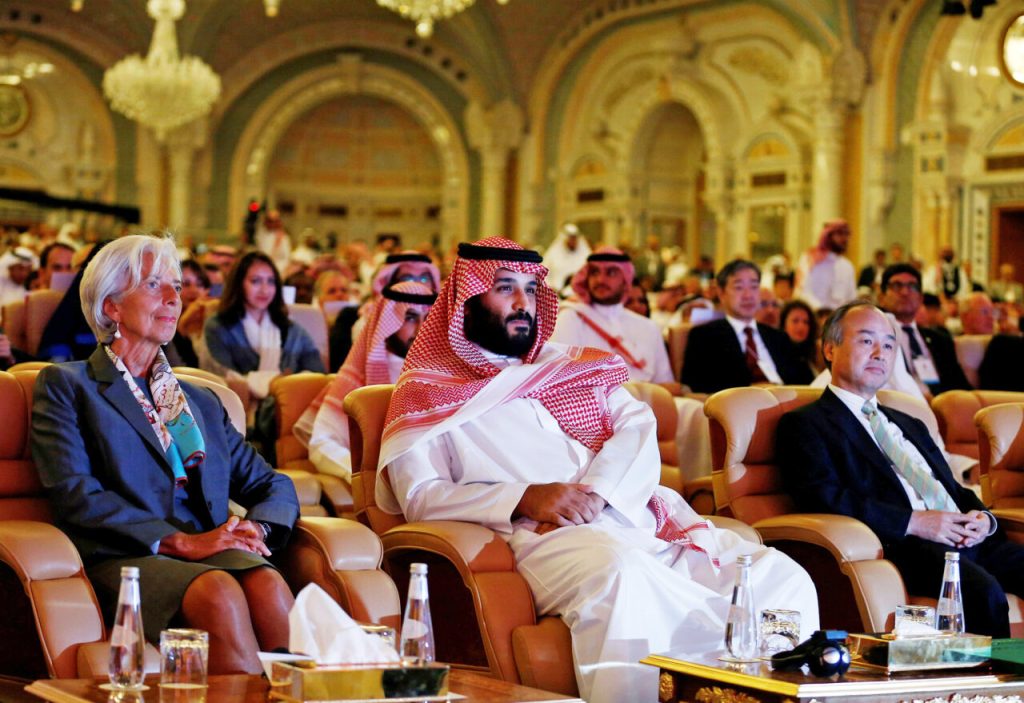
Saudi Crown Prince Mohammed bin Salman, Masayoshi Son, SoftBank Group Corp. Chairman and CEO, and Christine Lagarde, International Monetary Fund (IMF) Managing Director, attend the Future Investment Initiative conference in Riyadh, Saudi Arabia October 24, 2017. REUTERS/Faisal Al Nasser

By Brandon Smith

Source: Alt-Market.us

The decline of a currency’s world reserve status is often a long process rife with denials. There are numerous economic “experts” out there that have been dismissing any and all warnings of dollar collapse for years. They just don’t get it, or they don’t want to get it. The idea that the US currency could ever be dethroned as the defacto global trade mechanism is impossible in their minds.

One of the key pillars keeping the dollar in place as the world reserve is its petro-status, and this factor is often held up as the reason why the Greenback cannot fail. The other argument is that the dollar is backed by the full force of the US military, and the US military is backed by the US Treasury and the Federal Reserve – In other words, the dollar is backed by…the dollar; it’s a very circular and naive position.

These sentiments are not only pervasive among mainstream economists, they are also all over the place within the alternative media. I suspect the main hang-up for liberty movement analysts is the notion that the globalist establishment would ever allow the dollar or the US economy to fail. Isn’t the dollar system their “golden goose”?

The answer is no, it is NOT their golden goose. The dollar is just another stepping stone towards their goal of a one-world economy and a one-world currency. They have killed the world reserve status of other currencies in the past, why wouldn’t they do the same to the dollar?

Globalist white papers and essays specifically outline the need for a diminished role for the US currency as well as a decline in the American economy in order to make way for Central Bank Digital Currencies (CBDCs) and a new global currency system controlled by the IMF. I warned about this years go, and my position has always been that the derailment of the dollar would likely start with the end of its petro status.

In 2017 I published an article titled ‘Saudi Coup Signals War And The New World Order Reset’. I noted at the time that the sudden power shift over to crown prince Mohammed Bin Salman indicated a change in Saudi Arabia’s relationship to the US. I stated that:

To understand how drastic this coup has been, consider this — for decades Saudi Kings maintained political balance by doling out vital power positions to separate, carefully chosen successors. Positions such as Defense Minister, the Interior Ministry and the head of the National Guard. Today, Mohammed Bin Salman controls all three positions. Foreign policy, defense matters, oil and economic decisions and social changes are now all in the hands of one man.”

The rise of MBS was backed by the Public Investment Fund (PIF), a fund comprised of trillions of dollars supplied by globalists within Carlyle Group (Bush family, etc.), Goldman Sachs, Blackstone and Blackrock. MBS garnered the favor of the globalists for one specific reason – He openly supported their “Vision For 2030”, a plan for the dismantling of “fossil fuel” based energy and the implementation of carbon controls. Yes, that’s right, the head of Saudi Arabia is backing the eventual end of oil based energy, and part of that includes the end of the dollar as the petro currency.  

In exchange for their cooperation, the Saudis are being given access to ESG-like funding as well as access to AI advancements and the so-called “digital economy.”  It sounds crazy, but there is much talk of AI developments to cure numerous health problems and extend lifespan.  With those kinds of promises, it’s not surprising that Saudi elites would be willing to dump the dollar and even oil.

In 2017 I noted that:

I believe the next phase of the global economic reset will begin in part with the breaking of petrodollar dominance. An important element of my analysis on the strategic shift away from the petrodollar has been the symbiosis between the U.S. and Saudi Arabia. Saudi Arabia has been the single most important key to the dollar remaining as the petrocurrency from the very beginning.”

I believed that the threat to petro status would ultimately be spurred on by a proxy war between East and West:

World economic war is the real name of the game here, as the globalists play puppeteers to East and West. It is a geopolitical crisis they will have created to engineer public support for a solution they predetermined.”

Back then I thought that such a proxy war would be initiated in the Middle East, possibly in Iran. However, it’s clear that Ukraine is the powderkeg the globalists have chosen, at least for now, with Taiwan being the next shoe to drop.

In the years since I made these predictions the relationship between Saudi Arabia, Russia and China has grown very close. Arms deals and energy deals are becoming a mainstay of trade and this has led to a quiet but steady distancing of the Saudis from the dollar. This past week, the dominoes were set in motion for dollar collapse when Saudi Arabia announced at Davos that they are now willing to trade oil in alternative currencies.

In response, Xi Jinping pledged to ramp up efforts to promote the use of the Chinese yuan in energy deals. This falls in line with another article I wrote in 2017 titled ‘The Economic End Game Continues,’ in which I described how conflict with Eastern nations (China and Russia) would be exploited to create a catalyst for the end of the dollar’s petro status.

The importance of the Saudi announcement cannot be overstated; this is the beginning of the end of the dollar. The dollar’s world reserve status is largely dependent on its petro-status. Without one, you cannot have the other. This is almost the exact same dynamic that led to the implosion of the British Sterling decades ago as the global petro currency which resulted in the rise of the dollar to take its place.

This time, though, it will not be a single foreign currency that takes on the role of world reserve, it will be a basket currency system controlled by the IMF called Special Drawing Rights, along with a single global digital currency that is yet to be named but is now under development.

The consequences of the loss of reserve status will be devastating to the US economy. It is the only glue holding our system together – The ability to defer inflation by exporting it overseas is a superpower only the US enjoys. The Fed can print money perpetually if it wants to in order to fund the government or prop up US markets, as long as foreign central banks and corporate banks are willing to absorb dollars as a tool for global trade. If the dollar is no longer the primary international trade mechanism, the trillions upon trillions of dollars the Fed has created from thin air over the years will all come flooding back to the US through various avenues, and hyperinflation (or hyperstagflation) will be the result.

This dynamic is already in play, as foreign holders of US debt and dollars have been dumping them at record pace since 2017. The process continues at a time when the Federal Reserve is cutting it’s balance sheet and raising interest rates, which means there is no longer a buyer of last resort.

This may be why multiple foreign central banks have renewed their purchases of gold reserves and are once again stockpiling precious metals. They seem to be well aware of what is about to happen to the dollar, while the American public is kept in the dark.

The effects of the decline of the dollar may not be immediately felt, or become obvious for another year or two. What will happen is consistent inflation on top of the high prices we are already dealing with. Meaning, the Federal Reserve will continue to hold interest rates higher and prices will barely budge or they may climb in spite of monetary tightening. Even in the face of a major recessionary contraction, which I predict will be triggered starting in April, prices will STILL remain higher.

All the while the mainstream media and government economists will say they have “no idea” why inflation is so persistent, and that “nobody could have seen this coming.” Some of us saw it coming, but only because we accept the reality that the dollar’s days are numbered.
The Real Reason Why Blackstone Is Courting The Pentagon

Photo credit: Financial Times / Flickr (CC BY 2.0) .

The sudden push by Wall Street’s largest private equity firm to heavily lobby the Pentagon and State Department for largely unspecified reasons is part of an increasingly visible conflict within the U.S. establishment regarding how to handle the Artificial Intelligence “arms race.”

By Whitney Webb

Source: Unlimited Hangout

One of Wall Street’s largest private equity firms, the Blackstone Group, has been making a series of moves that have left mainstream analysts puzzled, with the most recent being Blackstone’s hire of David Urban, a Washington lobbyist with close ties to the Trump administration.

Blackstone’s courting of a Trump ally was not surprising given that the firm’s CEO, Steven Schwarzman, recently donated $3 million to Trump’s re-election efforts and had previously chaired the President’s now-defunct Strategic and Policy Forum of “business leaders” and advisors. The close ties that have developed between Schwarzman and Trump following the latter’s election in late 2016 have led mainstream media to describe Schwarzman as a confidant of the President.

However, what was odd about Blackstone’s hiring of David Urban was its murky reason for doing so, as the firm plans to task Urban with lobbying the Pentagon and State Department on “issues related to military preparedness and training.” This is odd, as CNBC noted, because Blackstone “doesn’t have any publicly listed government contracts, and its known investments don’t appear to have direct links to the defense industry.” However, Urban has extensive experience in dealing with both Departments in addition to his close ties to the current administration and the fundraising apparatus of the Republican Party.

While media reports on Blackstone’s recent hire of Urban were unable to elucidate the motive behind Blackstone’s sudden desire to court the Pentagon and State Department, they did note that Blackstone’s previous hire of a Trump-connected fundraiser lobbyist, Jeff Miller, had been remarkably successful earlier this year, with Miller lobbying Congress specifically on coronavirus relief legislation like the CARES Act. The CARES Act ultimately allowed private equity giants like Blackstone to access funds designated for coronavirus relief, likely thanks to the efforts of Miller and other lobbyists hired by Blackstone as well as other private equity giants like the Carlyle Group.

Though CNBC was left looking for answers as to Blackstone’s sudden interest in aiding the Pentagon with “military preparedness” and wooing the State Department, the likely motive may be related to other recent moves made by the company, such as the hire of former Amazon and Microsoft executive Christine Feng. Feng, who was hired by Blackstone on August 3, previously led data and analytics mergers and acquisitions at Amazon Web Services (AWS), which is a contractor to the U.S. intelligence community and other U.S. federal agencies. Previously, Feng was a senior member of Microsoft’s Corporate Development team. Microsoft recently won lucrative contracts for information technology (IT) services and cloud computing for the State Department and Pentagon, respectively.

According to Blackstone executives, the decision to hire Feng was made due to her “deep relationships in Silicon Valley” and “her experience working at Amazon and Microsoft.” They also added that her hire was motivated by Blackstone’s push to “identify new opportunities to invest and partner with innovative companies reshaping the world” and Blackstone’s recent effort to “double down” on tech sector investments. Notably, Feng’s hire came just a few months after Blackstone had hired Vincent Letteri, another tech-focused investor experienced with growth-stage tech companies, and amid a series of recent investments by Blackstone in tech firms, including HealthEdge software and Chinese data center provider 21Vianet, among others.

Schwarzman’s Push for “Common Governance”

It strongly appears that Blackstone’s recent moves, including Urban’s hire, are part of the firm’s bid to become one of the top “innovative companies reshaping the world” as the Artificial Intelligence (AI) arms race becomes a key driver in the “reshaping” of the global economy. Blackstone’s Steven Schwarzman is a key part of the relatively tight-knit group of billionaires and influential political figures, like Henry Kissinger and Eric Schmidt, that are working to create a “global compact on the research, introduction, and deployment of AI,” and Schwarzman has heralded the coming age of AI as representing a “fourth revolution” for humanity.

Schwarzman argued for greater global collaboration on AI-driven technologies, particularly between the U.S. and China, in a July 2020 Op-Ed for Yahoo! Finance where he wrote that the establishment of “common governance structures” for the research, introduction and deployment of AI is necessary if “we are to avoid the negative consequences of AI,” ultimately comparing the current pace of development of AI to that of past arms races, such as those involving nuclear and biological weapons. Per Schwarzman, these “common governance structures” would produce “explicit global commitments, agreements, and eventually international laws with consequences for violation” that relate directly to AI and its use.

Blackstone’s head is convinced that these “common governance structures” should be built between the U.S. and China, hence his heavy investment in universities and artificial intelligence education in both countries. For instance, Schwarzman created the Schwarzman Scholars program in 2016 where around 100-200 students from around the world pursue a Master’s Degree in Global Affairs at Tsinghua University in Beijing annually. The official goal of the program, which was modeled after the Rhodes Scholars program, is to “create a growing network of global leaders that will build strong ties between China and the rest of the world.” The program’s advisors include former Secretary of States Henry Kissinger, Condoleezza Rice and Colin Powell and former UK Prime Minister Tony Blair as well as former World Bank President James Wolfensohn and former U.S. Secretary of the Treasury and Goldman Sachs executive Henry Paulson. Schwarzman has also donated hundreds of millions of dollars to create an AI-focused institute at Oxford University.

Then, in the U.S., Schwarzman gave $350 million to MIT, prompting the school to create the Schwarzman College of Computing, which aims to specifically “address the global opportunities and challenges presented by the ubiquity of computing — across industries and academic disciplines — and by the rise of artificial intelligence.” MIT News later noted that “the impulse behind the founding of the college came from trips he [Schwarzman] had taken to China, where he observed intensified Chinese investment in artificial intelligence, and wanted to make sure the U.S. was also on the leading edge of A.I.” The college’s inauguration also featured Henry Kissinger as a speaker, where Kissinger mulled the potential impacts of AI and stated that “AI makes it technically possible, easier, to control your population.”

Eric Schmidt, the former CEO of Google, credits Schwarzman’s lead to invest in AI education in the U.S. and abroad as determining “the future of American philanthropy.” “Steve’s donation triggered an arms race among all the universities to match him. This is the next trend in philanthropy, in my view,” Schmidt told Axios regarding Schwarzman’s MIT donation last May. Schmidt also stated that his own investment in Princeton University’s Computer Science department had been prompted by Schwarzman’s previous acts of “AI philanthropy.”

Last May, a federal commission that Schmidt chairs, called the National Security Commission on AI (NSCAI), produced a document that was obtained by a FOIA request earlier this year. One particularly important page made a point that was essentially repeated in Schwarzman’s July Op-Ed regarding a “global AI compact.” Titled “The Importance of a US/China AI Cooperation,” it begins with a quote from Kissinger, a key advisor to and “great friend” of Schmidt, about the need for “arms control negotiation” for AI and then states that “the future of [AI] will be decided at the intersection of private enterprise and policy leaders between China and the US.” In other words, the Schmidt-chaired NSCAI argues that the future of AI will be determined by the political leaders and business leaders of China and the U.S. The page also adds that “we [The United States] risk being left out of the discussions where norms around AI are set for the rest of our lifetimes. Apple, Amazon, Alibaba, and Microsoft will not be.”

This is particularly significant given the NSCAI is tasked with making recommendations to the federal government regarding how to move forward with AI regulations within the context of “national security” and its members include key members of the Pentagon, U.S. intelligence community and Silicon Valley behemoths that double as contractors to the U.S. military, U.S. intelligence or both. One of the NSCAI’s interests, per the FOIA-obtained document, is the use of “AI in diplomacy,” suggesting that it also seeks to explore potential State Department uses for AI. Notably, earlier this year, and a year after the aforementioned NSCAI document was written, the State Department saw key aspects of its IT infrastructure privatized and given over to NSCAI-linked companies like Microsoft.

The Establishment Divide over AI

Given Schwarzman’s views on AI, his AI-focused “philanthropy,” and Blackstone’s recent pivot towards technology, it becomes easier to understand why Blackstone has recently hired David Urban to lobby the Department of Defense and the State Department. Over the last few years, Schwarzman ally Eric Schmidt has “reinvented himself as the prime liaison between Silicon Valley and the national security community” through his chairing of the NSCAI and other positions and has been lobbying “to revamp America’s defense forces with more engineers, more software and more A.I.” Blackstone’s plans to use David Urban to woo the Pentagon are likely directly related to these efforts to speed up and determine not just when but how the U.S. military adopts A.I-driven technologies, particularly regarding the degree of collaboration with China.

Schwarzman, Schmidt, Kissinger and their allies, as pointed out above, appear to favor direct collaboration with China regarding A.I., seeing it as better for business and the best way to avert “catastrophe.” This is particularly true for Schwarzman who has close business ties to China and has been described as “Trump’s China whisperer” by mainstream media. Indeed, Schwarzman and Blackstone have completed numerous, multi-billion dollar deals in China, with a Hong Kong-based publication even claiming that “Schwarzman has become the go-to man for Chinese buyers.” In addition, Schwarzman has a strong personal relationship with Chinese leader Xi Jinping and is credited with softening Trump’s rhetoric and stance on certain issues related to China since 2017. Part of the reason for this, per Henry Kissinger, owes to Schwarzman’s “unique standing” in China where Schwarzman has “done so many useful things.”

Despite his close ties to Schwarzman, Trump has sent mixed signals regarding how much of Schwarzman’s advice regarding China he will take. Trump’s tendency, in public anyway, has been to bolster the nationalist rhetoric of the cadre of neoconservatives and other figures who compose the Committee on the Present Danger, China (CPDC), chief among them former Trump strategist Steve Bannon.

Bannon and other CPDC figures have described Schwarzman as a “rival,” with Bannon specifically singling Schwarzman out, asserting that the Blackstone founder threatened to “undo his efforts” at guiding the President towards more nationalist policies popular with his base, such as fighting an “economic war” with China. Bannon’s concerns are also echoed by some hardliners in the Trump administration and the Pentagon who, like Bannon, view China as an existential threat to U.S. hegemony and, therefore, “national security.”

Ultimately, with David Urban’s hire, Schwarzman and Blackstone appear to be taking their efforts to shape AI’s future by lobbying the Pentagon and State Department directly in the event that Trump’s nationalistic tendencies threaten their vision of U.S.-China collaboration in AI in the post-Coronavirus world.

The National Endowment for Democracy: Not National and Not for Democracy

ned

By Tony Cartalucci

Source: New Eastern Outlook

Using a front to hide illegal or immoral activities has been a feature of human criminality since the beginning of human civilization itself. Facades, both ideological and economical, have helped criminal enterprises conceal the true nature of their activities for centuries.
In ages past, organized religion would often take systems of legitimate philosophy and spirituality, and transform them into a means of organizing the masses for the benefit of an elite few, often those heading empires, kingdoms, or nation-states. More recently, patriotism and now the notion of “democracy” have been used successfully by similar cadres of special interests to conceal their self-serving agendas behind notions likely to recruit support from large segments of a population that would otherwise be disinterested.

There is no example of this more transparent than that of the US National Endowment for Democracy (NED). According to its own website, it claims:

The National Endowment for Democracy (NED) is a private, nonprofit foundation dedicated to the growth and strengthening of democratic institutions around the world. Each year, NED makes more than 1,200 grants to support the projects of non-governmental groups abroad who are working for democratic goals in more than 90 countries.

“The growth and strengthening  of democratic institutions around the world” sounds noble enough. One would expect, then, that the NED would be led by a collection of some of the most notable activists involved in the empowerment of “the people.” Instead, upon NED’s board of directors, we find people representing corporate-financier interests notorious for instead, exploiting and subjugating “the people.”

Unfortunately, for those receiving the millions upon millions of dollars the NED hands out annually to “nongovernmental organizations” (NGOs) around the world, few bother to actually check who it is underwriting their daily activities, and fewer still have the integrity to both turn down the money let alone inform the people they claim to represent just who is attempting to reach into their respective nations and subvert their political systems, and to what end.

Quite literally, each and every member of the NED’s board of directors represents Fortune 500 corporations, insidious corporate-financier funded policy think-tanks, and a wide variety of other obvious conflicts of interest unbecoming of an organization truly interested in, “the growth and strengthening of democratic institutions around the world.” 

NED: Who’s Who

The worst part of NED’s activities worldwide and the fact that allegedly liberal progressive NGOs are taking money from them and aiding and abetting their agenda, is the fact that the background of NED’s board of directors is posted directly on NED’s own website. This means recipients of NED cash either recklessly didn’t bother to look into the organization sponsoring them, or simply do not care about the compromised nature of their sponsors.

For example, Marilyn Carlson Nelson (NED secretary) is co-CEO of one of the largest privately held companies in the world, Carlson Holdings operating hotels around the world. She also serves on the board of Exxon Mobil and chairs the U.S. Travel and Tourism Advisory Board. She alone represents such a tangled web of compromising and conflicting interests, it calls into question the integrity and true agenda of NED.

Carlson Nelson’s company, Carlson Holdings, deals in hotels, yet she concurrently sits on a government board under the International Trade Administration which makes decisions and policies on behalf of the US that directly benefits private industry specifically like that of Carlson Holdings. Her position upon Exxon Mobil’s board of directors is also troublesome. Exxon, a gargantuan multinational corporation, conducts business around the world and by necessity, requires political (and military) interventions to enter into and overwhelm those few remaining markets it has yet to dominate.

Carlson Nelson’s role in the NED, then, could be (and is) easily abused to subvert foreign governments that pose barriers to Carlson Holdings or Exxon, and put into power opposition parties that would deal in favor of such multinations – all under the guise of “the growth and strengthening of democratic institutions around the world.” 

Other NED board members representing compromising corporate-financier special interests include Marne Levine (Facebook, Coo, Instagram), Mark Ordan (WP Glimcher – real estate), and with Carl Gershman, Princeton Lyman, Stephen Sestanovich, and Melanne Verveer serving as members of the Council on Foreign Relations (CFR) – a corporate-financier funded think-tank representing the collective economic and geopolitical ambitions of Wall Street, London, and Brussels’ most powerful special interests.
The CFR’s corporate sponsors include Bank of America, Chevron, Citi, Exxon, Goldman Sachs, JP Morgan, PepsiCo, Shell Oil, Coca-Cola, BP, Google, Lockheed Martin, AT&T, Boeing, Facebook, DynCorp, Northrop Grumman, Pfizer, Raytheon, Microsoft, and Merck – a virtual who’s who of abusive special interests plaguing the world with socioeconomic disparity, compromising “free trade” deals, and driving conflicts ranging from “color revolutions” and proxy wars to full-scale invasions and decade-long occupations.

NED – which poses as a liberal-progressive organization – includes a surprising number of right-wing Neoconservatives (Neocons). This includes Vin Weber, a Bush-era Neocon who strongly advocated the invasion and occupation of Iraq – a war now revealed to have been predicated on an intentional lie regarding Iraq’s supposed chemical and biological weapons program.

Weber is a partner at the public strategy firm, Mercury. There, he consults and lobbies for multinational corporations, governments, and corporate-funded foundations including Microsoft, Visa, Pfizer, AT&T, Ebay, the Ford Foundation, pharmaceutical firm Gilead, NBC, the government of Qatar, and many others.

For what reason would NED include a pro-war corporate lobbyist on its board of directors if not for the fact that NED itself is but a facade for carrying out pro-corporate-financier agendas under the guise of promoting “democracy” around the world?

Other Neocons populating NED’s board of directors includes Elliot Abrams, Francis Fukuyama, Zalmay Khalilzad,  and Will Marshall. One pro-war Neocon could have been an anomaly – five begins to fit a pattern. It should be noted that NED’s subsidiary, Freedom House, also hosts corporate lobbyists and pro-war Neocons as well, including Kenneth Adelman.

NED Funds Your Local “Pro-Democracy Activists,” But Who Funds NED? 

One of NED’s subsidiaries, Freedom House, is admittedly funded by multinational corporations including AT&T, defense contractors BAE Systems and Northrop Grumman, industrial equipment exporter Caterpillar, tech-giants Google and Facebook, and financiers including Goldman Sachs.

NED itself – according to a 2013 disclosure (.pdf) – is funded by among others, Chevron, Coca-Cola, Goldman Sachs, Google, Microsoft, and the US Chamber of Commerce.

What do these corporations have to do with “the growth and strengthening of democratic institutions around the world?” 

The US Chamber of Commerce in particular is also heavily involved in post-regime change operations carried out by the US government either through direct military conflict or proxy wars and “color revolutions,” being the first to appear in front of new proxy governments to establish Western corporate-financier hegemony over newly “opened” market space.

NED’s individual donors also are telling. They include Frank Carlucci of the notorious Bush-family linked equity firm, the Carlyle Group. There is also former NED board member Kenneth Duberstein, a board member of defense contractor Boeing, big oil’s ConocoPhillips, and the Mack-Cali Realty Corporation. Duberstein also served as a director of Fannie Mae until 2007. He too is a CFR member as are two of the companies he chairs, Boeing and ConocoPhillips.

Also listed as an individual donor to NED is Neocon Paula Dobriansky – a trustee at NED’s subsidiary Freedom House, as well as former US Secretary of State Condoleezza Rice who served during the Bush administration.

Supposedly liberal-progress NGOs around the world taking money from corporate-financiers, warmongers, and right-wing ideologues embodies perfectly the notion of a fraudulent front used to conceal criminal intentions under the guise of a noble cause.

How it Works: A Case Study 

The Southeast Asian state of Thailand is currently gripped by a long-running political crisis centered around Thailand’s indigenous institutions and political order, and that of US-backed proxy Thaksin Shinawatra. Shinawatra himself was – like NED individual donor Frank Carlucci, a member of the Carlyle Group. Before becoming prime minister in 2001, Shinawatra would pledge to his friends in the US business community that he would use his office to serve as a “matchmaker” between Wall Street and Thailand’s people and resources.

Upon taking office, he would carry out a series of abusive and unpopular moves including the commitment of  Thai troops to America’s illegal invasion and occupation of Iraq, the hosting of the CIA’s abhorrent rendition program on Thai soil, and an attempt to ram through a US-Thai free trade agreement in 2004 without parliamentary approval.

In 2006, Shinawatra would ultimately be ousted from power by the Thai military. Since then, he has been represented by some of the largest lobbying firms in Washington, including by the above mentioned Freedom House trustee Kenneth Adelman. However, that is not the limit to which the NED has helped prop up Shinawatra’s political front in Thailand.

The NED also funds a myriad of “NGOs” in Thailand aimed specifically at undermining Thailand’s institutions – most notably the military, monarchy, courts, and even the economy itself. These are included on a long list on NED’s own website and include:

  • Thai Poor Act;
  • Thai Civil Rights and Investigative Journalism;
  • Thai Volunteer Service;
  • Makhampom Foundation;
  • Cafe Democracy;
  • Media Inside Out Group;
  • ENLAWTHAI Foundation;
  • Human Rights Lawyers Association and;
  • Foundation for Community Educational Media

It should be noted that in recent years, NED has become as ambiguous as possible about listing which NGOs it specifically funds – while NGOs in Thailand receiving NED funding regularly attempt to conceal NED funding and have been caught on several occasions outright lying about it.

For instance, while NED lists “Foundation for Community Educational Media,” it actually includes organizations like Thai Netizen and Prachatai – two entwined media fronts who have habitually covered up their foreign funding all while asking for donations locally.

Such behavior indicates that NGOs like Thai Netizen and Prachatai are fully aware of the impropriety they are a party to.

Each and every NED-funded NGO in Thailand is currently engaged in daily attacks against the current government, and serves a direct supporting role in bolstering opposition fronts directly tied to the ousted regime of Thaksin Shinawatra. “Human rights lawyers” underwritten by NED regularly represent US-backed agitators rounded and charged for various crimes while media fronts like Prachatai churn out a daily tidal wave of disinformation in support of US interests both in Thailand and across Asia.

Legitimate grassroots campaigns such as opposition to foreign multinational agribusiness and attempts to impose genetically modified organisms (GMOs) upon Thai agriculture receive little to no support from this milieu of US-funded fronts. Likewise, pragmatic and constructive opposition to current government policies done within a framework of cooperating with government agencies to arrive at compromises are also ignored entirely by NED’s networks.

NED’s various fronts are solely focused on pressuring the government into arranging elections and giving America’s proxies, Thaksin Shinawatra and his political allies, another opportunity at seizing power.

Shinawata, once back in power, and after sufficiently diminishing the power of Thailand’s existing political order, would return to destructive pro-US policies ranging from “free trade” with Wall Street special interests to supporting America’s unending wars worldwide. His regime would also likely mobilize Thailand’s population and resources on behalf of Washington’s proxy war with China – costing Thailand a valuable trade and military partner along with peace and stability across Asia.

When political instability surfaces around the world – opposition forces mobilizing in the streets and over the airwaves must be carefully scrutinized. Determining from where they receive their funding and political support is essential in determining whether these opposition forces are legitimate or the manufactured pawns of Western corporate-financier special interests being funded through fronts like the National Endowment for Democracy – a front that is private – not national, and that is for corporate-financier special interests – only under the guise as being “for democracy.”