Americans Have Already Skipped Payments On More Than 100 Million Loans, And Job Losses Continue To Escalate

By Michael Snyder

Source: Economic Collapse Blog

Those that have been hoping for some sort of a “V-shaped recovery” have had their hopes completely dashed.  U.S. workers continue to lose jobs at a staggering rate, and economic activity continues to remain at deeply suppressed levels all over the nation.  Of course this wasn’t supposed to happen now that states have been “reopening” their economies.  We were told that things would soon be getting back to normal and that the economic numbers would rebound dramatically.  But that is not happening.  In fact, the number of Americans that filed new claims for unemployment benefits last week was much higher than expected

Weekly jobless claims stayed above 1 million for the 13th consecutive week as the coronavirus pandemic continued to hammer the U.S. economy.

First-time claims totaled 1.5 million last week, higher than the 1.3 million that economists surveyed by Dow Jones had been expecting. The government report’s total was 58,000 lower than the previous week’s 1.566 million, which was revised up by 24,000.

To put this in perspective, let me once again remind my readers that prior to this year the all-time record for a single week was just 695,000.  So even though more than 44 million Americans had already filed initial claims for unemployment benefits before this latest report, there were still enough new people losing jobs to more than double that old record from 1982.

That is just astounding.  We were told that the economy would be regaining huge amounts of jobs by now, but instead job losses remain at a catastrophic level that is unlike anything that we have ever seen before in all of U.S. history.

With the addition of this latest number, a grand total of nearly 46 million Americans have now filed initial claims for unemployment benefits since the COVID-19 pandemic began.

If you can read that statement and still believe that the U.S. economy is not imploding, I would like to know what you are smoking, because it must be pretty powerful.

Some of the things that we are seeing happen around the country right now are absolutely nuts.  For example, earlier this week in Kentucky it was being reported that people were waiting in line for up to 8 hours to talk with a state official face to face about their unprocessed unemployment claims…

This wasn’t supposed to happen.

By now, the U.S. economy was supposed to be roaring back to life and we were supposed to be entering a new golden age of American prosperity.

Unfortunately, the truth is that more bad economic news is hitting us on a continual basis, and that isn’t going to change any time soon.

Over the past few days, we have learned that Hilton is laying off 22 percent of its corporate staff, and AT&T has announced that it will be eliminating 3,400 jobs and closing 250 stores…

The wireless carrier AT&T is cutting 3,400 jobs and shutting down 250 stores over the next few weeks, according to a statement from the Communications Workers of America, a union representing AT&T workers.

The AT&T Mobility and Cricket Wireless retail closures will affect 1,300 jobs, while the other layoffs are said to be affecting technical and clerical workers.

Needless to say, all of these job losses are having a tremendous ripple effect throughout the economy.

Without paychecks coming in, a lot of Americans are having a really tough time paying their bills, and the Wall Street Journal is reporting that payments have already been skipped on more than 100 million loans…

Americans have skipped payments on more than 100 million student loans, auto loans and other forms of debt since the coronavirus hit the U.S., the latest sign of the toll the pandemic is taking on people’s finances.

The number of accounts that enrolled in deferment, forbearance or some other type of relief since March 1 and remain in such a state rose to 106 million at the end of May, triple the number at the end of April, according to credit-reporting firm TransUnion.

Wow.

To me, that is an almost unimaginable number, and it has become clear that a tremendous amount of pain is ahead for the financial institutions that are holding these loans.

A lot of people out there are going to keep hoping that there will be some sort of an economic rebound, but the cold, hard reality of the matter is that fear of COVID-19 is going to keep a large segment of the population from resuming normal economic activities for the foreseeable future.  And it certainly doesn’t help that the number of confirmed cases in the U.S. has been steadily rising over the past couple of weeks and that the mainstream media has been endlessly warning that a “second wave” is coming.

If you doubt what I am saying, just look at what is happening to the restaurant industry.  We had started to see a small bit of improvement in the numbers, but now fear of a “second wave” has caused restaurant traffic to start cratering again

After three months of slow but consistent improvement in restaurant dining data in the US and across the globe, in its latest update on “the state of the restaurant industry”, OpenTable today reported the biggest drop in seated restaurant diners (from online, phone and walk-in reservations) since the depth of the global shutdown in March.

As shown in the OpenTable graphic below, on Sunday, June 14, restaurant traffic suddenly tumbled, sliding from a -66.5% y/y decline as of June 13 to -78.8% globally.

This was mostly due to a sharp drop in US restaurant diners, which plunged by 13% – from -65% to -78% – the biggest one day drop since the start of the shutdown in the US, and the second biggest one day drop on record.

Business travel is another area where we are seeing signs of big trouble ahead.  The following comes from Yves Smith

Business travel is not coming back any time soon. People are getting accustomed to Zoom. And word may also get out that domestic flying is much worse than it used to be, which will be a deterrent to those who might be so bold as to want to get on a plane. That is a fundamental blow to airlines, airport vendors, hotels, restaurants, and convention centers. Hotel occupancy in April was 24.5% which if anything seems high based on my personal datapoints. The pricings I see say that hotel operators are not expecting much if any improvement through the summer.

Like many of you, I wish that economic conditions would go back to the way they used to be, but that simply is not going to happen.

Yes, we will see economic numbers go up and down over the coming months, but a return to “the good times” is not in the cards.

And what hardly anyone realizes is that this is just the beginning of our problems, and I am working on a new project right now which will explain why this is true in great detail.

So stay tuned, because things are about to get really, really “interesting”.

Get Ready For An Economic Wake-Up Call This Holiday Season

By Brandon Smith

Source: Alt-Market.com

If we are to measure the concept of “economic recovery” in real terms, then we would have to look at the fundamentals (not stock markets) and whether or not they’re improving. Unfortunately, not all economic data is presented to the public honestly. Very often it is mired and obscured in a fog of disinformation and false standards.

I would point out, though, that there is relatively accurate information out there in certain areas of the global economy, and it tells us our economic structure is destabilizing. Beyond that, even the rigged numbers are moving into negative territory. But what does all this mean for the holiday retail season, one of the mainstream’s favorite gauges of US financial health? And, if 2019’s holiday profits sink, what does this tell us is going to happen in 2020?

First, let’s start with what we know…

Since we live in a “globalized” economy where everything is supposedly “interdependent”, it helps to examine international export numbers. The US doesn’t manufacture and export much of anything anymore beyond agricultural products, but global markets do expect us to consume the goods of other nations. A decline in exports indicates a failing global economy, but in particular a failing US consumer economy.

The obvious example would be China, which has seen plunging export data at least the past three months, though many will argue that this is merely due to tariffs and the trade war. However, it’s not just China that is showing signs of collapse.

South Korea, another major manufacturing and export hub in Asia (5th largest in the world) has seen declining exports for 11 consecutive months. South Korean shipping is crumbling in November and the media is blaming the trade war, as some SK companies would be “hit indirectly” because they sell intermediate goods to China are are linked to US companies in China. But this makes little sense. Tariffs are highly targeted to specific companies and specific goods, and so far the US has not directed major tariff attention at South Korea beyond the auto market.  Also, the new KORUS deal between Trump and SK is different only cosmetically to original trade agreements, yet, South Korean exports continue to fall.

The same situation can be seen in Japan, with Japanese exports witnessing a 9.2% year-over-year drop in October, the largest decline in 3 years. Japan has seen three consecutive months of declines in exports.

And what about Europe? While Germany, the manufacturing powerhouse of the EU, finally saw a jump in exports to the US this past month, overall the European Union has seen consistently poor export performance for the past year, and Germany itself is hovering on the edge of recession with 0.1% official GDP growth. Many economist already consider Germany to be in recession, as official GDP numbers are constantly manipulated by governments to the upside.

But let’s not forget about the US. Remember how Trump promised that the trade war would result in a renaissance for US manufacturing and that millions of industrial jobs would be returning to our shores? Well, as I’ve warned consistently for the past couple years, there is NO WAY corporations will be bringing manufacturing jobs and factories back to the US without ample incentives. Trump already gave companies tax cuts without demanding anything in return, and the cost/benefit ratio of building new factories and paying American workers top dollar versus keeping existing factories in Asia and dealing with 10%-25% tariffs just doesn’t add up to a new US rust belt renaissance.

While manufacturing jobs have increased, US manufacturing activity has declined.  Meaning, there simply isn’t enough demand for the goods being produced.  US manufacturing ISM index just sank this month and has been sinking for the past four month into negative territory. While US PMI manufacturing data jumped this month, it is still well below the 10 year average and is also very low compared to past holiday seasons, which almost always see a spike in manufacturing.  US manufacturing remains at a historic low of 11% of US GDP and production output has decline steadily since January of this year.

The question is, will the vast decline in global manufacturing translate to a crash in consumer demand?  We know that US credit dependency has skyrocketed in the past few years, but will more debt result in more profits for retailers?  This is highly unlikely, as US retail sales growth, for example, has been in decline at the same time that consumer debt has been rising.  Why?  Credit delinquencies have been relatively stable (so far) this year, so my theory is that people in the US are paying off previous debts by taking on new debt. They are kicking the can on their insolvency.

We have seen this kind of destructive credit death cycle before – Right before the crash of 2008.

So what does all this mean? And why is the media portraying the trade war with China as the cause of the global export and shipping crisis when clearly most of the world is not directly or even indirectly tied to the tariffs?

As noted above, the narrative that is being pushed is that we live in an “interdependent” and globalized world, and that nations cannot function economically without cooperation. The trade war, I believe, is a smokescreen designed by the globalist establishment to do two things specifically:

1) It is being created to hide a crash in the greater economy. Notice that almost no one in the mainstream is talking about a collapse in global production and multiple fundamentals due to DEMAND; instead they constantly talk about the trade war and exports. The trade war is becoming the scapegoat for the implosion of the market bubble engineered by globalists and central banks through a decade of stimulus measures.

The collapse of the economic bubble is being caused in part by massive debt and a lack of consumer demand due to lack of consumer savings and cash flow. The trade war has little to do with it, and I suspect we would be seeing sharp declines in the US economy in particular even without the trade war.

2) The trade war creates a false dichotomy in which many Americans will be lured into blaming China and other nations for their economic ills, and China and the rest of the world will be lured into blaming America. It also reasserts the globalist propaganda argument that when nations and economies “go rogue”, they hurt everyone; therefore, more global controls and centralization will have to be established in order to prevent nationalism from harming the rest of the world.

And what does this all have to do with the Christmas shopping season? Like the end of last year, I think we are in for another ugly holiday retail event – Perhaps far worse than before. All the manufacturing and export data indicates that this will be the case. If so, then the mainstream narrative of recovery, long perpetuated as fact by the media and the Federal Reserve for the past several years, will finally die.

The only thing that might elevate holiday numbers would be increased price inflation in goods, but I predict that even inflation misrepresented as “profits” will not save Christmas stats this year.  Some skeptics of the ongoing crash will argue that Black Friday numbers this year were the best since 2013, therefore the holiday season will be a good one.  These people don’t know their economic history.  In most cases, holiday seasons that start off with a high traffic Black Friday end with poor overall sales data, including 2013.  This is because consumers that are cash strapped are more likely to buy early during Black Friday sales and spend far less over the rest of the season.

In the mind of the average American consumer, holiday retail sales are a primary indicator of the health of the economy. A dramatic crash in Christmas retail will end the delusion of a stable US system and cause the public to start asking questions. Economics is 50% math and 50% psychology. The math in the US economy says we are in the middle of a crash. The psychological orientation of the public has been on the opposite end of spectrum, but is now slowly moving to meet with reality. When the psychological delusion ends, the game is over. And, for the globalists a new game begins.

Order out of chaos is their motto for a reason…

The global “reset” as they sometimes refer to it, has already been triggered. Going into 2020, the question is will the fantasy fall completely away to reveal the grotesque economic swamp our foundation has been built on top of? Or, will the delusion drag on for at least one more year? Given the current data, I suspect the party is over. But it is difficult to predict how the public will react to a financial crash. Sometimes people have no choice but to acknowledge the danger in front of them, but sometimes they simply bury their heads in the sand deeper and hope that by dragging out the inevitable the inevitable will become forgettable.

Media Just Can’t Stop Presenting Horrifying Stories as ‘Uplifting’ Perseverance Porn

By Alan Macleod

Source: FAIR.org

“THIS IS AWESOME!” That’s how Fox 5 DC described its story (5/28/19) about Logan Moore of Cedartown, GA, a disabled two-year-old whose parents were unable to afford to buy him a walker, so employees at Home Depot fashioned one together themselves for him.

“No… it’s not awesome at all. It’s a painful indictment of the state of healthcare in America,” reads the first comment under this tweet by Fox 5 DC (5/28/19).

The story closely resembles another recent CNN report (4/1/19): “A Two-Year-Old Couldn’t Walk on His Own. So a High School Robotics Team Built Him a Customized Toy Car.” That piece noted how Minnesotan toddler Cillian Jackson couldn’t walk due to a genetic condition, and how his parents couldn’t afford treatment. It described the ingenuity of the school children who built him a car, and Cillian’s new found freedom, but did not explore why a baby with a disability had been abandoned by US society.

The clear implication in these stories was that those children would have been left permanently unable to move if not for the help of underpaid employees or the kindness of other children. How many disabled American children with poor parents were not so lucky? The articles did not ask. Instead, they were presented as “uplifting” human interest pieces.

Cillian’s story is part of CNN’s Good Stuff series, which asks its readers:

Want more inspiring, positive news? Sign up for The Good Stuff, a newsletter for the good in life. It will brighten your inbox every Saturday morning.

Unfortunately, these stories are part of a popular trend of unintentionally horrifying “uplifting” news, which we at FAIR have catalogued before (FAIR.org, 8/3/17; 3/25/19), where out-of-touch corporate media give us supposedly charming, wholesome and positive news that actually, upon even minimal retrospection, reveals the dire conditions of late capitalism so many Americans now live under, and makes you feel worse after reading it.

A lot of these stories involve mothers and the extremely difficult circumstances of raising children in the US while poor. CNN’s “feel good” story (8/24/18) about a teacher sitting in a car with her student’s baby so the new mom could attend a job fair raised far more questions than it asked (which was zero). Why is there so little public childcare in the US? Should a new mother really need to immediately find a job so badly? Is this good for infants’ development?

On a similar subject, Good Morning America (7/17/18) describes the “trendy” new baby-shower gift of donating your pregnant co-worker your days off to give her maternity leave. Every country in the world except the US and Papua New Guinea guarantees paid maternity leave, meaning the trend is unlikely to catch on abroad.

Donated maternity leave is a “trendy” gift you don’t need—unless you live in the United States or Papua New Guinea (Good Morning America, 7/17/18).

Many outlets (CBS, 5/20/16; Huffington Post, 8/6/16; People, 4/11/16) cheerfully reported on how one man did at least 15 years of backbreaking labor as a night shift janitor at Boston College so his children could attend for free. But none even mentioned that if he lived in nearly any country in Western Europe, this wouldn’t have been necessary, as university there is free or virtually free to attend.

In fact, rather than discussing ballooning tuition costs, Yahoo! (11/15/17) used the story to take jabs at disloyal millennials:

Millennials move from job to job in order to climb the ladder…. For baby boomers and other generations…loyalty and dedication to a single company or career drove, and still drives, much of their working lives.

Any of these stories could have been used to explore the pressing social and economic realities of being poor in the United States, and having to work for things considered fundamental rights in other countries. But instead they are presented as uplifting features, something only possible if we unquestionably accept the political and economic system.

Kids Do the Darndest Things

Many of what Think Progress (8/2/18) labels “feel-good feel-bad stories” involve children doing things they wouldn’t have to in any reasonable society. CBS invites us to enjoy an account of a boy selling his Xbox computer to help his (single) mom (4/2/19), and another repairing his town’s ravaged roads himself (4/12/19). The Hill (6/10/19), meanwhile, describes a nine-year-old saving his pocket money to pay off his school friends’ “lunch debts.”

“Hardships were never an excuse for Moseley,” CNN (5/22/19) reports—as they are, implicitly, for homeless teens who aren’t offered millions in scholarships.

NBC (5/22/19) likewise shared the story of homeless Tennessee teen Tupac Moseley graduating high school as a valedictorian and earning many college scholarships, something that was widely reported (BBC, 5/22/19; Newsweek, 5/21/19; Business Insider, 5/21/19). NBC matter-of-factly noted that after his father died, Moseley’s family’s home was foreclosed and they were on the streets, accepting this situation without comment. This was still among the most critical of the reports, however, as many did not even describe why a child in the richest society in history became homeless. CNN’s report (5/22/19), for example, did not explain the background circumstances, let alone comment on them, and frames the story with the sentence, “Hardships were never an excuse for Moseley.”

This sentence is telling: To corporate media, even the trauma of losing a parent and being forced onto the streets is merely an excuse, not a cause for poor grades. The implication is that poor housing, a lack of an adequate safety net, underfunded schools and a decimated public education system are simply excuses from bellyaching lazy people as to why they did not attend the private Boston University (at over $54,000 per year tuition), like the article’s author did.

“No excuses” is a common phrase in “perseverance porn” stories. For example, Today (2/20/17) used it in the headline of a story about a Texas man who is forced to walk 15 miles to work every day. It reveals the ultimate bootstrap ideology of the media, where societal factors are irrelevant and everyone is where they are on merit.

Thus Moseley’s story is effectively weaponized by CNN against anyone who would question the system. Terrible work conditions? No excuses! Homeless? Stop complaining!

In case you thought homeless children were something of an aberration in America, CNN (7/2/19) also recently ran a story about how over 100 homeless children graduated high school in New York City this year alone—again without comment on what this says about US society.

Another reprehensible story treated as heroic by media was that of a Michigan mother who had to quit her job to look after her terminally ill son, who died of leukemia. She could not afford a headstone, so his best friend, 12-year-old Kaleb Klakulak, worked many jobs to attempt to pay for one. Many media outlets (e.g., Associated Press, 12/8/18; Fox News, 12/9/18; NBC Chicago, 12/12/18) celebrated Kaleb’s spirit, but none asked why children are  performing hard, outdoor labor through a Michigan winter so other children can have adequate burials. Such reporting implicitly normalizes this situation, and the system that allows it to happen.

“Sweet” Stories

A common media trope is presenting kids selling lemonade as cute,  sweet stories, no matter how horrifying or depressing the reason, including to pay off school lunch debts (Yahoo! News, 5/21/19; MSN, 5/22/19), or to raise money for their baby brother’s medical treatment (New York Post, 5/28/18; CBS, 5/29/18) or their mother’s chemotherapy (KTSM El Paso, 8/4/18).

Such stories (CBS, 5/29/18) rarely if ever ask why a baby with a life-threatening illness is forced to rely on his nine-year-old brother’s selling lemonade to pay for treatment.

Or how about the story of a New Mexico girl selling lemonade trying to fund her mother’s kidney transplant? People magazine (5/9/18) applauded her resolve, and local radio described it as “heartwarming” that she had raised over $1,000. The massive problem is a kidney transplant in America can cost over $400,000. To anyone with a heart, what this story actually represents is the desperate struggle of a child trying in vain to save her dying mother. Worse still is the fact that if she lived in Sweden, Spain or Saskatchewan, she would be given a kidney free of charge and without question.

Any of the numerous other outlets (ABC, 4/30/18; Good Morning America, 5/1/18; Albuquerque Journal, 4/30/18) that picked it up could have used the story to discuss the dysfunctional healthcare system that is the leading cause of bankruptcy in the country, while producing some of the worst health outcomes in the developed world, or to scrutinize how corporate healthcare gouges the sickest and most vulnerable Americans, including children. Surely the most basic function of government should be to prevent its citizens from needlessly dying? Not if you wholly accept the tenets of neoliberalism, where education, housing and healthcare are not basic, inalienable human rights, but commodities to be bought and sold and bargained for on the market.

To be clear, while we can admire the never-say-die attitude of those in tough conditions, this is no substitute for guaranteed public programs to help those in dire need. The problem with perseverance porn is not the brave subjects of the articles, but the lack of any journalistic scrutiny examining the failings of society that placed them in such desperate circumstances to begin with.

What these articles highlight so clearly is not only the grim, inhuman and unnecessary conditions so many Americans are forced to live under, but the degree to which mainstream corporate journalists have completely internalized them as unremarkable, inevitable facts of life, rather than the consequences of decades of neoliberal policies that have robbed Americans of dignity and basic human rights. Because corporate media wholly accept and promote neoliberal, free-market doctrine, they are unable to see how what they see as “awesome” is actually a manifestation of late-capitalist dystopia.

National Bankruptcy as a Board Game

By Dmitry Orlov

Source: Club Orlov

Most people are familiar with the game Monopoly. Its goal is to teach capitalist kiddies a valuable lesson about capitalism; namely, that in running a business it isn’t useful to shoot for some happy modicum of accommodation with your competitors or to strive for a sustainable steady state. Instead, what you need to do to survive (never mind win) is to grow as quickly as possible and eat up your competitors alive, or you’ll get eaten up yourself. That’s not just a game; that’s exactly how capitalism actually works, and if that doesn’t work for you (it doesn’t for most people) then that’s exactly how capitalism doesn’t work.

And so the Waltons couldn’t just run Walmart as a mart; they had to make it into a global empire—just in order to survive. Now, most governments in the world realize that this sort of unbridled capitalism is harmful and seek to regulate it. For instance, Russia has a Federal Antimonopoly Service. The US Justice Department has an Antitrust Division, which is aptly named if its mission is to destroy Americans’ trust in their government’s ability to regulate business. It also has a website which currently says: “Due to the lapse in appropriations, Department of Justice websites will not be regularly updated.” Perhaps that’s all right for a country that seeks to monopolize everything—international finance and law, defense procurement and, of course, the dispensation of “freedom and democracy” and “universal values.”

Most people are also familiar with the concept of national debt. The federal debt of the US government currently equals… never mind; it’s going up much faster than you can write it down. If you want to watch it go up real time, you can look it up here. The exact number is useless: if you take a snapshot of it—say, $21,921,420,945,123.00—that will no longer be the payoff amount by the time you write out the check, and if you write out the check, no matter who you are, it will bounce. But it won’t even get that far: if you mail that check to the US Treasury Department, they wouldn’t be able to deposit it because “Due to the lapse in appropriations…” (You get the picture.)

The debt goes up all the time, and the rate at which it goes up is accelerating. The concept of acceleration may not be intuitive for some of you, so let me explain. Debt goes up with some speed. Acceleration is the amount by which that speed increases, measured in, for example, dollars per minute per minute. Calculating it is a fun little arithmetic exercise. During Barak Obama’s reign it went up by $8.6 trillion, starting from $11.6 trillion and gong up to $20.2 trillion. Trump plans to add $4.8 trillion during his first three years. (Relevant numbers can be looked up here).

Thus, Obama’s velocity was $8.6 trillion over 8 years—roughly $1 trillion per year or $2 million per minute while Trump’s velocity is roughly $1.6 trillion per year or a little over $3 million per minute. Therefore, the acceleration is only a few cents per minute per minute—but it sure adds up! Acceleration tends to sneak up on you. For instance, if you want to gain some intuitive appreciation for acceleration due to gravity (9.81m or 32 feet per second per second) then try jumping off a chair while keeping your knees straight. You can also ponder the fact that satellites that fall out of Earth’s orbit tend to burn up on reentry as they decelerate due to friction with the atmosphere.

Any sane, numerate person can tell you that increases in debt are fine provided your revenues are increasing significantly faster, but if that’s not the case then the eventual result is bankruptcy. And that is most definitely not the case. Hence the name of this board game is National Bankruptcy. But I am not sure what the objective of the game should be. Is it to go bankrupt as quickly and efficiently as possible, or is to go bankrupt as slowly and painfully as possible?

I am quite sure that players who aren’t on a path to national bankruptcy would prefer to keep it that way, and would furthermore prefer to be rid of all sovereign debt issued by whoever is going to go bankrupt before that happens. (Russia seems to have that problem solved already while China is far behind.) In any case, I am a very serious person who doesn’t like jokes and doesn’t have time to play games, board games included, so I’ll leave it to others to ponder such questions. Still, the board game metaphor seems useful for discussing this topic.

One problem with playing this game is the problem of scale. People have a problem appreciating such huge numbers. They are familiar with what a dollar is, but what’s a trillion? Here it is, represented as double-stacked pallets of $100 bills.
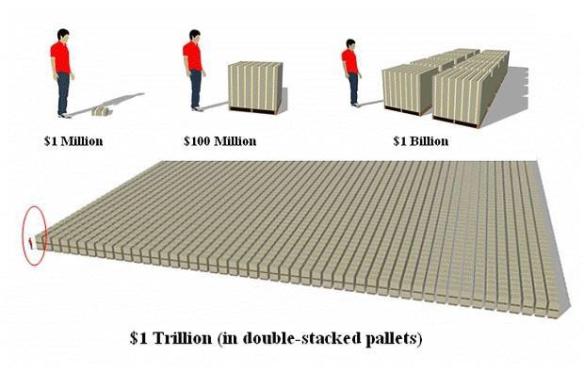
That seems a bit cumbersome for our board game. Reasonable values for the chips in our National Bankruptcy game would be $100 billion, $500 billion and $1 trillion. We could use a few $5 trillion and $10 trillion chips too, though not too many because I doubt that the game would go on long enough to make them useful.

I propose that for the sake of this game we introduce a handy new unit called a “piffle” which is equal to $100 billion. A trillion is 10 piffles, 10 trillion is 100 piffles. Then our chips can be 1, 5, 10, 50 and 100 piffles. Piffles allow us to express various huge quantities without going through any arithmetic contortions. US federal debt is currently 220 piffles. US trade deficit for 2018 was 6 piffles while the US defense budget was 7 piffles. For 2019 the federal budget deficit (covered by increased borrowing) is 10 piffles and rising while tax revenues are just 3 piffles and falling. The interest payment on federal debt is 3 piffles but with rising interest rates it’s going to 5 piffles within a few years.

Speaking of rising interest rates… just today Trump wished for 0% interest rates again, like Obama had while he was running up his 80 piffles’ worth of debt. But now it’s hovering around 3% and is unlikely to go down no matter what Trump wishes. Why? Well, here’s the reason. The US imports much more than it exports because it can’t afford to or lacks the ability to make all the stuff it needs; that’s why there are 6 piffles’ worth of trade deficit. When other nations sell to the US more than they buy, they end up holding lots of piffles, and since the US needs lots of piffles (remember, the budget deficit is 10 piffles) it makes plenty of sense to borrow that money right back. A little while back it was possible to borrow it back at 0% interest because the US was powerful enough to threaten those who refused to play this game with military annihilation (cue pictures of bombed-out Libya and Iraq). But times have changed, and unless the US bribes its debt-holders with 3% interest rate or better—no deal.

How have times changed? There are two effects worth mentioning. First, the military annihilation threat isn’t working any more. Yes, the US still spends a stunning, record-shattering sum of 7 piffles on defense, but none of that is working. Call it the free money effect. When people spend their own hard-earned money, they tend to be careful with it, but if it’s somebody else’s money that they got for free never intending to pay it back, then they tend to throw caution to the wind. And so US military spending has become less and less effective over time, in one of two ways: procurement costs have gone through the roof, and the resulting products have become useless.

In terms of procurement costs, the purchasing parity between the US and (just as an example) Russia seems to be at least ten to one: to get the same result, the US has to spend at least ten times more than Russia. And so although Russia spends well less than 1 piffle on defense, its military is far more effective. In terms of product uselessness, the Pentagon now resembles a woman who has a closet jam-packed with expensive designer labels but has absolutely nothing to wear because her entire wardrobe is no longer fashionable. There is the entire set of aircraft carriers none of which can operate close enough to enemy shores to be of any use at all because they can be readily sunk using hypersonic rockets launched from very far away. There are the stockpiles of Tomahawk cruise missiles which can’t make it past Soviet-era air defense systems (with a few electronics and software upgrades). There are the Patriot air defense systems which are useless even for stopping Soviet-era SCUD missiles, never mind anything more modern.

Add to this Russia’s (and soon China’s) new hypersonic weapons with conventional payloads and new air and space defense systems such as the S-400: these provide what’s known as “escalation dominance.” Suppose the US does something unspeakably nasty and Russia and/or China decide to teach it a lesson. They now have the ability to blow up any target within the US without getting anywhere near it and without placing any of their military assets at risk.

They could, for instance, take out the US electric grid in a way that will take many months to get it back on line. They can then reliably intercept anything that the US tries to retaliate with. Of course, the US can become suicidal—that’s always a risk—and launch a full-on nuclear first strike, then sit back and wait to be completely obliterated along with much of the rest of the planet. But that’s not a military strategy, that’s pure suicide, and the officers in charge of military strategy tend to be emotionally stable family men who look forward to playing with their grandchildren upon retirement.

So, why then should the US continue to spend 7 piffles on defense? The sad answer is that it will go bankrupt whether it zeroes out the defense budget or not. If the defense budget goes to 0, then there is still 3 piffles’ worth of budget deficit left, plus those 6 piffles of trade deficit aren’t going anywhere but up. But what about MAGA?—you might ask—What about firing up US manufacturing, bringing the jobs back and exporting our way out of this? After all, if we turn those 6 piffles of trade deficit into 6 piffles of trade surplus, suddenly it all works out and bankruptcy becomes avoidable.

No, sorry, that just not realistic. You see, in order to get an industrial economy going again the US needs several things. It needs cheap energy, cheap labor, low cost of doing business and readily available markets, both domestic and export. And the US doesn’t have any of these. In terms of energy—and oil is by far the most important form of energy—in 2019 the US will import exactly as much oil as it did in 1998—around 8 million barrels a day. Yes, the shale oil industry has sprung up in the meantime, and the US is currently producing 11.5 million barrels per day. But also in the meantime US oil consumption has gone up a lot—to 20 million barrels a day, which is a stunning 20% of the world’s consumption for 4.4% of the world’s population.

And so the oil deficit is still very much there. Plus the shale oil patch has never made any money but has accumulated over 2 piffles’ worth of debt and has spent over a piffle’s worth more than it made. With interest rates going up they are unlikely to be able to borrow enough to keep up the same hectic drilling rate, and with declines from existing wells at over half a million barrels per day per month it won’t take many months to whittle down that 11.5 million barrels per day, forcing the US to either boost imports or cut consumption.

But the oil price has gone down a lot lately, so there shouldn’t be a problem in any case, right? Again, sorry, no. Peak Oil for most countries has come and gone. There is now only a handful of countries left that are able to meaningfully boost oil production: Russia, Canada (mostly tar sands), Iran, Iraq, United Arab Emirates, Kuwait and Brazil. Russia has recently announced that it isn’t planning to boost production. Saudi Arabia is a huge oil producer but does not seem to have any spare capacity left. Canada’s tar sands patch is a money-losing environmental disaster. Iran and Iraq (call them Iranq, since they are both Shia Moslem, are politically aligned and neither loves America too much) aren’t exactly going to gallop to the rescue. That leaves UAE, Kuwait and Brazil, and if you add them all up together that’s nowhere near enough. So, get ready for oil price spikes, followed by a wave of demand destruction, followed by oil price collapses, followed by supply destruction—you know, the usual.

Moving on to labor. In order to stay competitive, the US will need to lower its median wage a lot. It has to be lower than what the Chinese and the Southeast Asians earn because the US needs to outcompete them to steal their export market share. Without various other major changes this will cause US workers to either rebel or starve to death in short order. The changes involve nationalizing medicine and education to drive down their costs by a factor of 1000 or so, converting to public transportation and pretty much banning the use of private cars to make transportation affordable, putting up high-rises right next to factories for affordable worker housing and so on. That’s a lot of piffles’ worth of effort!

The cost of doing business is a tough one too. The US spends way more on courts and lawyers, insurance and regulatory compliance than most other countries, and the regulatory maze that entrepreneurs have to run in order to run even a small and simple business is very costly and absolutely confounding. How does one take a machete to that whole ridiculous, corrupt scheme? I have no idea. It’s an imponderable. The Chinese would probably just call it a “cultural revolution,” round up all the lawyers and the bureaucrats, make them wear dunce caps and sandwich boards that say “I am what is wrong with this country” and march them in procession while pelting them with rocks and beating them with sticks. Something like that…

Finally, there is the question of export markets. What exactly is the US going to export more effectively than other countries are exporting already? China out-manufactures just about anybody on the planet and isn’t about to give up its spot. Russia exports grain and other foodstuffs (all non-GMO, unlike the US), nuclear and space technology, defense technology (that actually works) and much else. Pakistan and India, and various other countries, export textiles. The world is full up with product. It’s consumers to bankrupt that are in short supply. And if the US cuts its labor rates to make itself competitive, then its consumer base will shrink rather dramatically.

So it looks like bankruptcy is it, no use fighting it. But what should the US do in the meantime? I suggest that it should put up some really huge walls—just for the sake of leaving behind some spectacular ruins for future generations to marvel at. The one along the southern border seems to be going up already, but there should be at least two more. There needs to be a wall along the Mason-Dixon line, because given the heated state of US politics there needs to be a way to prevent people from trying to reenact the Civil War (a misnomer, that!) with actual real weapons and live ammo. And there also needs to be a wall along the northern border, to keep various groups of armed troglodytes from escaping to Canada and ransacking it (it’s the least we can do for our peaceful northern neighbors). How much will these three walls cost? Glad you asked! They will cost roughly 0.005 piffles apiece, 0.015 piffles total—a truly piffling amount. That’s my 0.000000002 piffle’s worth. But, you know, it’s the thought that counts.

Oh, and if you want to actually design this National Bankruptcy board game, please resist the temptation to contact me about it. Seriously, I don’t like games, board games especially. I am a very serious person who doesn’t have time for such piffles.