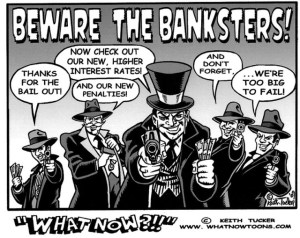
Oligarchs, Bankers, and Swindlers

us-imperialism-latin-america-racism12

Washington’s “New Managers” in Latin America

By James Petras

Source: Dissident Voice

Amid raging corruption, social pathologies and outright political thuggery, a new gang of vassal regimes has taken-over Latin America. The new rulers are strictly recruited as the protégé’s of US financial and banking institutions. Hence the financial press refers to them as the “new managers” – of Wall Street.

The US financial media has once again provided a political cover for the vilest crimes committed by the ‘new managers’ as they launch their offensive against labor and in favor of the foreign and domestic financiers.

To understand the dynamics of the empire’s new vassal managers we will proceed by identifying (1) the illicit power grab (2) the neo-liberal policies they have pursued (3) the impact of their program on the class structure (4) their economic performance and future socio-political perspectives.

Vassals as Managers of Empire

Latin America’s current vassalage elite is of longer and shorter duration.

The regimes of longer duration with a historical legacy of submission, corruption and criminality include Mexico and Colombia where oligarchs , government officials and death squads cohabitate in close association with the US military, business and banking elites.

Over the past decades 100,000 citizens were murdered in Mexico and over 4 million peasants were dispossessed in Colombia. In both regimes over ten million acres of farmland and mining terrain were transferred to US and EU multinationals.

Hundreds of billions of illicit narco earnings were laundered by the Colombian and Mexican oligarchy to their US accounts via private banks.

The current political managers, Peña in Mexico and Santos in Colombia are rapidly de-nationalizing strategic oil and energy sectors, while savaging dynamic social movements – hundreds of students and teachers in Mexico and thousands of peasants and human rights activists in Colombia have been murdered.

The new wave of imperial vassals has seized power throughout most of Latin America with the direct and indirect intervention of the US. In 2009, Honduras President Manuel Zelaya was ousted by a military coup backed by Secretary of State Hillary Clinton. Zelaya’s program of agrarian reform, regional integration (with Venezuela) and constitutional elections was abolished. Zelaya was replaced by a US vassal, Roberto Micheletti who proceeded to murder several hundred landless rural workers and indigenous activists.

Washington moved to organize a constitutional cover by promoting a highly malleable landowner, Porfirio Lobo Sosa to the presidency.

The State Department next ousted Paraguyan President Francisco Lugo who governed between 2008-2012. Lugo promoted a moderate agrarian reform and a centrist regional integration agenda.

With the backing of Secretary of State Clinton, the Paraguayan oligarchy in Congress seized power, fabricated an impeachment decree and ousted President Lugo. He was briefly replaced by Vice President Federico Franco (2012-2013).

In 2013, Washington backed the capital Asuncion’s, notorious crime boss for President, one Horacio Castes – convicted for currency fraud in 1989, drug running in 1990, and most recently (2010) money laundering.

The Honduras and Paraguayan coups established (in miniature) the precedent for a new wave of ‘big country’ political vassals. The State Department moved toward the acceleration of banking takeovers in Brazil, Argentina and Peru.

In rapid succession, between December 2015 and April 2016 vassal managers seized power in Argentina and Brazil. In Argentina millionaire Mauricio Macri ruled by decree, by-passing constitutional legality. Macri fired scores of thousands of public service workers, closed social agencies and appointed judges and prosecutors without Congressional vote. He arbitrarily arrested social movement leaders – violating democratic procedures.

Macri’s Economic and Finance Ministers gained millions of dollars by ‘buying into’ multinational oil companies just prior to handing over private options on public enterprises.

The all-encompassing swindles and fraud carried out by the ‘new managers’ were covered up by the US media,who praised Macri’s professional team.

Moreover, Macri’s economic performance was a disaster. Exorbitant user fees on utilities and transport for consumers and business enterprises, increased three to ten-fold, forcing bankruptcy rates to soar and households to suffer light and gas closures.

Wall Street vulture funds received seven billion dollar payment from Macri’s managers, for defaulted loans purchased for pennies over a dollar, twenty-fold greater then the original lenders.

Data based on standard economic indicators,highlights the worst economic performance in a decade and a half.

Price inflation exceeds 40%; public debt increased by twenty percent in six months. Living standards and employment sharply declined. Growth and investment data was negative. Mismanagement, official corruption, and arbitrary governance did not induce confidence among local small and medium size businesses.

The respectable media, led by the New York Times, the Financial Times, the Wall Street Journal, and the Washington Post falsified every aspect of Macri’s regime. Failed economic policies implemented by bankers turned cabinet ministers were dubbed long-term successes; crude ideologically driven policies promoting foreign investor profiteering were re-invented as business incentives.

Political thugs dismantled and replaced civil service agencies were labelled ‘a new management team’ by the vulgar propaganda scribes of the financial press.

In Brazil, a phony political power grab by Congressional opportunists ousted elected President Dilma Rousseff. She was replaced by a Washinton approved serial swindler and notorious bribe taker, Michel Temer.

The new economic managers were predictably controlled by Wall Street, World Bank and IMF bankers. They rushed measures to slash wages, pensions and other social expenditures, to lower business taxes and privatize the most lucrative public enterprises in transport, infrastructure, landholdings, oil and scores of other activities.

Even as the prostitute press lauded Brazil’s new managers’, prosecutors and judges arrested three newly appointed cabinet ministers for fraud and money laundering. ‘President’ Temer is next in line for prosecution for his role in the mega Petrobras oil contracts scandal for bribes and payola.

The economic agenda by the new managers are not designed to attract new productive investments. Most inflows are short-term speculative ventures. Markets, especially in commodities, show no upward growth, much to the chagrin of the free market technocrats. Industry and commerce are depressed as a result of the decline in consumer credit, employment, and public spending induced by ‘the managers’ austerity policies.

Even as the US and Europe embrace free market austerity, it evokes a continent wide revolt. Nevertheless, Latin America’s wave of vassal regimes remain deeply embedded in decimating the welfare state and pillaging public treasuries led by a narrow elite of bankers and serial swindlers.

Conclusion

As Washington and the prostitute press hail their ‘new managers’ in Latin America, the celebration is abruptly given way to mass rage over corruption and demands for a shift to the political left.

In Brazil, “President” Temer rushes to implement big business measures, as his time in office is limited to weeks not months. His time out of jail is nearing a deadline. His cabinet of ‘technocrats’ prepare their luggage to follow.

Maurico Macri may survive a wave of strikes and protests and finish the year in office. But the plunging economy and pillage of the treasury is leading business to bankruptcy, the middle class to empty bank accounts and the dispossessed to spontaneous mass upheavals.

Washington’s new managers in Latin America cannot cope with an unruly citizenry and a failing free market economy.

Coups have been tried and work for grabbing power but do not establish effective rulership. Political shift to the right are gyrating out of Washington’s orbit and find no new counter-balance in the break-up of the European Union.

Vassal capitalist takeovers in Latin America generated publicist anesthesia and Wall Street euphoria; only to be rudely shocked to reality by economic pathologies.

Washington and Wall Street and their Latin America managers sought a false reality of unrestrained profits and pillaged wealth. The reality principle now forces them to recognize that their failures are inducing rage today and uprisings tomorrow.


James Petras is author of The End of the Republic and the Delusion of Empire, Extractive Imperialism in the Americas: Capitalism’s New Frontier (with Henry Veltmeyer), and The Politics of Empire: The US, Israel and the Middle East. Read other articles by James, or visit James’s website.

After Empowering the 1% and Impoverishing Millions, IMF Admits Neoliberalism a Failure

neoliberalizam

By

Source: CounterPunch

Last week a research wing of the International Monetary Fund came out with a report admitting that neoliberalism has been a failure. The report, entitled, “Neoliberalism: Oversold?” is hopefully a sign of the ideology’s death. They were only about 40 years late. As Naomi Klein tweeted about the report, “So all the billionaires it created are going to give back their money, right?”

Many of the report’s findings which strike to the core of the ideology echo what critics and victims of neoliberalism have been saying for decades.

“Instead of delivering growth,” the report explains that neoliberal policies of austerity and lowered regulation for capital movement have in fact “increased inequality.” This inequality “might itself undercut growth…” As a result, the report states that “policymakers should be more open to redistribution than they are.”

However, the report leaves out a few notable items on neoliberalism’s history and impact.

The IMF suggests neoliberalism has been a failure. But it has worked very well for the global 1%, which was always the IMF and World Bank’s intent. As Oxfam reported earlier this year, the wealthiest 1% in the world now has as much wealth as the rest of the planet’s population combined. (Similarly, investigative journalist Dawn Paley has proven in her book Drug War Capitalism that far from being a failure, the Drug War has been a huge success for Washington and multinational corporations.)

The IMF report cites Chile as a case study for neoliberalism, but never mentions once that the economic vision was applied in the country through the US-backed Augusto Pinochet dictatorship – a major omission which was no casual oversight on the part of the researchers. Across Latin America, neoliberalism and state terror typically went hand in hand.

The fearless Argentine journalist Rodolfo Walsh, in a 1977 Open Letter to the Argentine Military Junta, denounced the oppression of that regime, a dictatorship which orchestrated the murder and disappearance of over 30,000 people.

“These events, which stir the conscience of the civilized world, are not, however, the greatest suffering inflicted on the Argentinean people, nor the worst violation for human rights which you have committed,” Walsh wrote of the torture and killing. “It is in the economic policy of this government where one discovers not only the explanation for the crimes, but a greater atrocity which punishes millions of human beings through planned misery. . . . You only have to walk around greater Buenos Aires for a few hours to check the speed with which such a policy transforms the city into a ‘shantytown’ of ten million people.”

This “planned misery,” as Naomi Klein’s Shock Doctrine vividly demonstrates, was the neoliberal agenda the IMF has pushed for decades.

The day after Walsh mailed the letter to the Junta he was captured by the regime, killed, burned, and dumped into a river, one of neoliberalism’s millions of casualties.


Benjamin Dangl has worked as a journalist throughout Latin America, covering social movements and politics in the region for over a decade. He is the author of the books Dancing with Dynamite: Social Movements and States in Latin America, and The Price of Fire: Resource Wars and Social Movements in Bolivia. Dangl is currently a doctoral candidate in Latin American History at McGill University, and edits UpsideDownWorld.org, a website on activism and politics in Latin America, and TowardFreedom.com, a progressive perspective on world events. Twitter: https://twitter.com/bendangl Email: BenDangl(at)gmail(dot)com

The Federal Reserve and the Global Fracture

Octopus 1912

An Interview with Finnish Journalist Antti J. Ronkainen

Michael Hudson

Source: The Unz Review

Antti J. Ronkainen: The Federal Reserve is the most significant central bank in the world. How does it contribute to the domestic policy of the United States?

Michael Hudson: The Federal Reserve supports the status quo. It would not want to create a crisis before the election. Today it is part of the Democratic Party’s re-election campaign, and its job is to serve Hillary Clinton’s campaign contributors on Wall Street. It is trying to spur recovery by resuming its Bubble Economy subsidy for Wall Street, not by supporting the industrial economy. What the economy needs is a debt writedown, not more debt leveraging such as Quantitative Easing has aimed to promote. But the Fed is in a state of denial that the U.S. and European economies are plagued by debt deflation.

The Fed uses only one policy: influencing interest rates by creating bank reserves at low give-away charges. It enables banks too make easy gains simply by borrowing from it and leaving the money on deposit to earn interest (which has been paid since the 2008 crisis to help subsidize the banks, mainly the largest ones). The effect is to fund the asset markets – bonds, stocks and real estate – not the economy at large. Banks also are heavy arbitrage players in foreign exchange markets. But this doesn’t help the economy recover, any more than the ZIRP (Zero Interest-Rate Policy) since 2001 has done for Japan. Financial markets are the liabilities side of the economy’s balance sheet, not the asset side.

The last thing either U.S. party wants is for the election to focus on this policy failure. The Fed, Treasury and Justice Department will be just as pro-Wall Street under Hillary. There would be no prosecutions of bank fraud, there would be another bank-friendly Attorney General, and a willingness to subsidize banks now that the Dodd-Frank bank reform has been diluted from what it originally promised to be.


So let’s go back to beginning. When the Great Financial Crisis escalated in 2008 the Fed’s response was to lower its main interest rate to nearly zero. Why?

The aim of lowering interest rates was to provide banks with cheap credit. The pretense was that banks might lend to help the economy get going again. But the Fed’s idea was simply to re-inflate the Bubble Economy. It aimed at restoring the value of the mortgages that banks had in their loan portfolios. The hope was that easy credit would spur new mortgage lending to bid housing prices back up – as if this would help the economy rather than simply raising the price of home ownership.

But banks weren’t going to make mortgage loans to a housing market that already was over-lent. Instead, homeowners had to start paying down the mortgages they had taken out. Banks also reduced their credit-card exposure by a few hundred billion dollars. So instead of receiving new credit, the economy was saddled with having to repay debts.

Banks did make money, but not by lending into the “real” production and consumption economy. They mainly engaged in arbitrage and speculation, and lending to hedge funds and companies to buy their own stocks yielding higher dividend returns than the low interest rates that were available.


In addition to the near zero interest rates, the Fed bought US Treasury bonds and mortgage backed securities (MBS) with almost $4 trillion during three rounds of Quantitative Easing stimulus. How have these measures affected the real economy and financial markets?

In 2008 the Federal Reserve had a choice: It could save the economy, or it could save the banks. It might have used a fraction of what became the vast QE credit – for example $1 trillion – to pay off the bad mortgages and write them down. That would have helped save the economy from debt deflation. Instead, the Fed simply wanted to re-inflate the bubble, to save banks from having to suffer losses on their junk mortgages and other bad loans.

Keeping these debts on the books, in full, let banks foreclose on defaulting homeowners. This intensified the debt-deflation, pushing the economy into its present post-2008 depression. The debt overhead is keeping it depressed.

One therefore can speak of a financial war waged by Wall Street against the economy. The Fed is a major weapon in this war. Its constituency is Wall Street. Like the Justice and Treasury Departments, it has been captured and taken hostage.

Federal Reserve chairwoman Janet Yellen’s husband, George Akerlof, has written a good article about looting and fraud as ways to make money. But instead of saying that looting and fraud are bad, the Fed has refused to regulate or move against such activities. It evidently recognizes that looting and fraud are what Wall Street is all about – or at least that the financial system would come crashing down if an attempt were made to clean it up!

So neither the Fed nor the Justice Department or other U.S. Government agencies has sanctioned or arrested a single banker for the trillions of dollars of financial fraud. Just the opposite: The big banks where the fraud was concentrated have been made even larger and more dominant. The effect has been to drive out of business the smaller banks not so involved in derivative bets and other speculation.

The bottom line is that banks made much more by getting Alan Greenspan and the Clinton-Bush Treasury officials to deregulate fraud than they could have made by traditional safe lending. But their gains have increased the economy’s overhead.


Do you believe Mike Whitney’s argument that QE was about a tradeoff between the Fed and the government: the Fed pumped the new bubble and saved the banks that the government didn’t need to bail out more banks. The government’s role was to impose austerity so that inflation and employment didn’t rise – which would have forced the Fed to raise interest rates, ending its QE program? source: http://www.counterpunch.org/2016/01/15/the-chart-that-explains-everything/]

That was a great chart that Mike put up from Richard Koo, and you should reproduce it here. It shows that the Fed’s enormous credit creation had zero effect on raising commodity prices or wages. But stock market prices doubled in just six years, 2008-15, and bond prices rose to new peaks. Banks left much of the QE credit on deposit with the Fed, earning an interest giveaway premium.

(Richard Koo: “The struggle between markets and central banks has only just begun,”

http://www.businessinsider.com/richard-koo-struggle-between-markets-and-central-banks-has-only-just-begun-2015-9?r=UK&IR=T

The important point is that the Fed (backed by the Obama Administration) refused to use this $4 trillion to revive the production-and-consumption economy. It claimed that such a policy would be “inflationary,” by which it meant raising employment and wage levels. The Fed thus accepted the neoliberal junk economics proposing austerity as the answer to any problem – austerity for the industrial economy, not the Fed’s own Wall Street constituency.


According to a Fed staff report, QE would lower the exchange rate of dollar to the other currencies causing competitiveness boost for the U.S. firms. Former finance minister of Brazil Guido Mantega, as well as the chairman of Central Bank of India Raghuram Rajan, have described the Fed’s QE as a “currency war.” What’s your take?

The Fed’s aim was simply to provide banks with low-interest credit. Banks lent to hedge funds to buy securities or make financial bets that yielded more than 0.1 percent. They also lent to companies to buy their own stock, and to corporate raiders for debt-financed mergers and acquisitions. But banks didn’t lend to the economy at large, because it already was “loaned up,” and indeed, overburdened with debt.

Lower interest rates did spur the “carry trade,” as they had done in Japan after 1990. Banks and hedge funds bought foreign bonds paying higher rates. The dollar drifted down as bank arbitrageurs could borrow from the Fed at 0.1 percent to lend to Brazil at 9 percent. Buying these foreign bonds pushed up foreign exchange rates against the dollar. That was a side effect of the Fed’s attempt to help Wall Street make financial gains. It simply didn’t give much consideration to how its QE flooding the global economy with surplus dollars would affect U.S. exports – or foreign countries.

Exchange rate shifts don’t affect export trends as much as textbook models claim. U.S. arms exports to the Near East, and many technology exports are non-competitive. However, a looming problem for most countries is what may happen when ending QE increases the dollar’s exchange rate. If U.S. interest rates go back up, the dollar will strengthen. That would increase the cost to foreign countries of paying dollar-denominated debts. Countries that borrowed all dollars at low interest will need to pay more in their own currencies to service these debts. Imagine what would happen if the Federal Reserve let interest rates rise back to a normal level of 4 or 5 percent. The soaring dollar would push debtor economies toward depression on capital account much more than it would help their exports on trade account.


You have said that QE is fracturing the global economy. What do you mean by that?

Part of the flood of dollar credit is used to buy shares of foreign companies yielding 15 to 20 percent, and foreign bonds. These dollars are turned over to foreign central banks for domestic currency. But central banks are only able to use these dollars to buy U.S. Treasury securities, yielding about 1 percent. When the People’s Bank of China buys U.S. Treasury bonds, it’s financing America’s dual budget and balance-of-payment deficits, both of which stem largely from military encirclement of Eurasia – while letting U.S. investors and the U.S. economy get a free ride.

Instead of buying U.S. Treasury securities, China would prefer to buy American companies, just like U.S. investors are buying Chinese industry. But America’s government won’t permit China even to buy gas station companies. The result is a double standard. Americans feel insecure having Chinese ownership in their companies. It is the same attitude that was directed against Japan in the late 1980s.

I wrote about this financial warfare and America’s free lunch via the dollar standard in Super Imperialism (2002) and The Bubble and Beyond (2012), and about how today’s New Cold War is being waged financially in Killing the Host (2015).


The Democrats loudly criticized the Bush administration’s $700 billion TARP-program, but backed the Fed’s QE purchases worth of almost $4 trillion during the Obama administration. How does this relate to the fact that officially, QE purchases were intended to support economic recovery?

I think you’ve got the history wrong. My Killing the Host describes how the Democrats supported TARP, while the Republican Congress opposed it on populist grounds. Republican Treasury Secretary Hank Paulson offered to use some of the money to aid over-indebted homeowners, but President-elect Obama blocked that – and then appointed Tim Geithner as Treasury Secretary. FDIC head Sheila Bair and by SIGTARP head Neil Barofsky have written good books about Geithner’s support for Wall Street (and especially for Citigroup and Goldman Sachs) against the interests of the economy at large.

If you are going to serve Wall Street – your major campaign contributors – you are going to need a cover story pretending that this will help the economy. Politicians start with “Column A”: their agenda to reimburse their campaign contributors – Wall Street and other special interests. Their public relations team and speechwriters then draw up “Column B”: what public voters want. To get votes, a rhetorical cover story is crafted. I describe this in my forthcoming J is for Junk Economics, to be published in March. It’s a dictionary of Orwellian doublethink, political and economic euphemisms to turn the vocabulary around and mean the opposite of what actually is meant.


How do TARP and QE relate to the Federal Reserve’s mandate about price stability?

There are two sets of prices: asset prices and commodity prices and wages. By “price stability” the Fed means keeping wages and commodity prices down. Calling depressed wage levels “price stability” diverts attention from the phenomenon of debt deflation – and also from the asset-price inflation that has increased the advantages of the One Percent over the 99 Percent. From 1980 to the present, the Fed has inflated the largest bond rally in history as a result of driving down interest rates from 20 percent in 1980 to nearly zero today, as you have noted.

Chicago School monetarism ignores asset prices. It pretends that when you increase the money supply, this increases consumer prices, commodity prices and wages proportionally. But that’s not what happens. When banks created credit (money), they don’t lend much to people to buy goods and services or for companies to make capital investments to employ more workers. They lend money mainly to transfer ownership of assets already in place. About 80 percent of bank loans are mortgages, and the rest are largely for stocks and bond purchases, including corporate takeovers and stock buybacks or debt-leveraged purchases. The effect is to bid up asset prices, while loading down the economy with debt in the process. This pushes up the break-even cost of doing business, while imposing debt deflation on the economy at large.

Wall Street isn’t so interested in exploiting wage labour by hiring it to produce goods for sale, as was the case under industrial capitalism in its heyday. It makes its gains by riding the wave of asset inflation. Banks also gain by making labour pay more interest, fees and penalties on mortgages, and for student loans, credit cards and auto loans. That’s the postindustrial financial mode of exploiting labor and the overall economy. The Fed’s QE program increases the price at which stocks, bonds and real estate exchange for labour, and also promotes debt leverage throughout the economy.


Why don’t economists distinguish between asset-price and commodity price inflation?

The economics curriculum has been turned into an exercise for students to pretend that a hypothetical parallel universe exists in which the rentier classes are job creators, necessary to help economies recover. The reality is that financial modes of getting rich by debt leveraging creates a Bubble Economy – a Ponzi scheme leading to austerity and shrinking markets, which always ends in a convulsion of bankruptcy.

The explanation for why this is not central to today’s economic theory is that the discipline has been captured by this neoliberal tunnel vision that overlooks the financial sector’s maneuvering to make quick trading profits in stocks, bonds, mortgages and derivatives, not to take the time and effort to develop long-term markets. Rentiers seek to throw a cloak of invisibility around how they make money. They know that if economists don’t measure their wealth and the public does not see it, voters will be less likely to bring pressure to regulate and tax it.

Today’s central economic problem is that inflating asset prices by debt leveraging extracts more interest and financial charges. When the resulting debt deflation ends up hollowing out the economy, creditors try to blame labour, or government spending (except for bailouts and QE to help Wall Street). It is as if debtors are exploiting their creditors.


If there is a new class war, what is the current growth model?

It’s an austerity model, as you can see from the eurozone and from the neoliberal consensus that cites Latvia as a success story rather than a disaster leading to de-industrialization and emigration. In real democracies, if economies polarize like they are doing today, you would expect the 99 Percent to fight back by electing representatives to enact progressive taxation, regulate finance and monopolies, and make public investment to raise wages and living standards. In the 19th century this drive led parliaments to rewrite the tax rules to fall more on landlords and monopolists.

Industrial capitalism plowed profits back into new means of production to expand the economy. But today’s rentier model is based on austerity and privatization. The main way the financial sector always has obtained wealth has been by privatizing it from the public domain by insider dealing and indebting governments.

The ultimate financial business plan also is to lend with an eye to end up with the debtor’s property, from governments to companies and families. In Greece the European Central Bank, European Commission and IMF demanded that if the nation’s elected representatives did not sell off the nation’s ports, land, islands, roads, schools, sewer systems, water systems, television stations and even museums to reimburse the dreaded austerity troika for its bailout of bondholders and bankers, the country would be isolated from Europe and faced with a crash. That forced Greece to capitulate.

What seems at first glance to be democracy has been hijacked by politicians who accept the financial class war ideology that the way for an economy to get rich is by austerity. That means lowering wages, unemployment, and dismantling government by turning the public domain over to the financial sector.

By supporting the banking sector even in its predatory and outright fraudulent behavior, U.S. and European governments are reversing the trajectory along which 19th-century progressive industrial capitalism and socialism were moving. Today’s rentier class is not concerned with long-term tangible investment to earn profits by hiring workers to produce goods. Under finance capitalism, an emerging financial over-class makes money by stripping income and assets from economies driven deeper into debt. Attacking “big government” when it is democratic, the wealthy are all in favor of government when it is oligarchic and serves their interests by rolling back the past two centuries of democratic reforms.


Does the Fed realize global turbulences what its unconventional policies have caused?

Sure. But the Fed has painted itself in a corner: If it raises interest rates, this will cause the stock and bond markets to go down. That would reverse the debt leveraging that has kept these markets up. Higher interest rates also would bankrupt Third World debtors, which will not be able to pay their dollar debts if dollars become more expensive in their currencies.

But if the Fed keeps interest rates low, pension funds and insurance companies will have difficulty making the paper gains that their plans imagined could continue exponentially ad infinitum. So whatever it does, it will destabilize the global economy.


China’s stock market has crashed, western markets are very volatile, and George Soros has said that the current financial environment reminds him of the 2008 crash. Should we be worried?

News reports make it sound as if debt-ridden capitalist economies will face collapse if the socialist countries don’t rescue them from their shrinking domestic markets. I think Soros means that the current financial environment is fragile and highly debt-leveraged, with heavy losses on bad loans, junk bonds and derivatives about to be recognized. Regulators may permit banks to “extend and pretend” that bad loans will turn good someday. But it is clear that most government reports and central bankers are whistling in the dark. Changes in any direction may pull down derivatives. That will cause a break in the chain of payments when losers can’t pay. The break may spread and this time public opinion is more organized against 2008-type bailouts.

The moral is that debts that can’t be paid, won’t be. The question is, how won’t they be paid? By writing down debts, or by foreclosures and distress sell-offs turning the financial class into a ruling oligarchy? That is the political fight being waged today – and as Warren Buffet has said, his billionaire class is winning it.


That’s all for now. Thank you Michael!

Bank Crimes Pay: Under the Thumb of the Global Financial Mafiocracy

banksters-too-big-to-fail-640x509

By Andrew Gavin Marshall

Source: Occupy.com

On Nov. 13, the United Kingdom’s Serious Fraud Office (SFO) announced it was charging 10 individual bankers, working for two separate banks, Deutsche Bank and Barclays, with fraud over their rigging of the Euribor rates. The latest announcement shines the spotlight once again on the scandals and criminal behavior that have come to define the world of global banking.

To date, only a handful of the world’s largest banks have been repeatedly investigated, charged, fined or settled in relation to a succession of large financial scams, starting with mortgage fraud and the Libor scandal in 2012, the Euribor scandal and the Forex (foreign exchange) rate rigging. At the heart of these scandals, which involve the manipulation of interest rates on trillions of dollars in transactions, lie a handful of banks that collectively form a cartel in control of global financial markets – and the source of worldwide economic and financial crises.

Banks such as HSBC, JPMorgan Chase, Barclays, Bank of America, Citigroup, Deutsche Bank, Royal Bank of Scotland and UBS anchor the global financial power we have come to recognize as fraud. The two, after all, are not mutually exclusive. In more explicit terms, this cartel of banks functions as a type of global financial Mafia, manipulating markets and defrauding investors, consumers and countries while demanding their pound of flesh in the form of interest payments. The banks force nations to impose austerity measures and structural reforms under the threat of cutting off funding; meanwhile they launder drug money for other cartels and organized crime syndicates.

Call them the global Mafiocracy.

In May, six major global banks were fined nearly $6 billion for manipulation of the foreign exchange market, which handles over $5 trillion in daily transactions. Four of the six banks pleaded guilty to charges of “conspiring to manipulate the price of U.S. dollars and euros exchanged.” Those banks were Citigroup, JPMorgan Chase, Barclays and Royal Bank of Scotland, while two additional banks, UBS and Bank of America, were fined but did not plead guilty to the specific charges. Forex traders at Citigroup, JPMorgan Chase and other banks conspired to manipulate currency prices through chat room groups they established, where they arrogantly used names like “The Mafia” and “The Cartel.”

The FBI said the investigations and charges against the big banks revealed criminal behavior “on a massive scale.” The British bank Barclays paid the largest individual fine at around $2.3 billion. But as one trader at the bank wrote in a chat room conversation back in 2010, “If you aint cheating, you aint trying.” The total fines, while numerically large, were but a small fraction of the overall market capitalization of each bank – though the fine on Barclays amounted to some 3.4% of the bank’s market capitalization, the highest percentage by far among the group.

Despite the criminal conspiracy charges covering the years 2007 through 2013, the banks and their top officials continue to lay the blame squarely at the feet of individual traders. Axel Weber, the former president of the German Bundesbank (the central bank of Germany), who is now chairman of Switzerland’s largest bank, UBS, commented that “the conduct of a small number of employees was unacceptable and we have taken appropriate disciplinary actions.”

Looking at the larger scale of bank fines and fraud in the roughly eight years since the global financial crisis, the numbers increase substantially. In addition to a 2012 settlement for mortgage-related fraud in the U.S. housing market, which amounted to some $25 billion, several large banks paid individual fines related to mortgage and foreclosure fraud – including a $16 billion fine for Bank of America, and $13 billion for JPMorgan Chase. Added to these are fines related to the rigging of the Libor rate (the interest rate at which banks lend to each other) and the Forex rigging, as well as money laundering, violating sanctions, manipulating the price of gold, manipulating the U.S. electricity market and assisting tax evasion, among other crimes.

According to a research paper published in June, the total cost of litigation (fines, penalties, settlements, etc.) paid by 16 major global banks since 2010 has reached more than $300 billion. Bank of America paid the most, amounting to more than $66 billion, followed by JPMorgan Chase, Lloyds, Citigroup, Barclays, RBS, Deutsche Bank, HSBC, BNP Paribas, Santander, Goldman Sachs, Credit Suisse, UBS, National Australia Bank, Standard Chartered and Société Générale.

Virtually all of these banks also appear on a list of data, compiled through 2007, revealing them to be among the most interconnected and powerful financial institutions in the world. This core group of corporations forms part of a network of 147 financial institutions that Swiss scientists refer to as the “super-entity,” which, through their various shareholdings, collectively controland own each other and roughly 40% of the world’s 43,000 largest transnational corporations.

In other words, the big banks – along with large insurance companies and asset management firms – do not simply act as a cartel in terms of engaging in criminal activities, but they form a functionally interdependent network of global financial and corporate control. Further, the banks work together in various industry associations and lobbying groups where they officially represent their collective interests.

The largest European banks and financial institutions are represented by the European Financial Services Round Table (EFR), whose membership consists of the CEOs or Chairmen of roughly 25 of the top financial institutions on the continent, including Deutsche Bank, AXA, HSBC, Allianz, RBS, ING, Barclays, BNP Paribas, UBS, and Credit Suisse, among others.

In the United States, the Financial Services Forum (FSF) represents the largest American along with some European banks and financial institutions. The Forum’s membership consists of less than 20 executives, including the CEOs or Chairmen of such firms as Bank of America, Morgan Stanley, JPMorgan Chase, Goldman Sachs, Citigroup, UBS, HSBC, AIG, Bank of New York Mellon, State Street Corporation, Deutsche Bank and Wells Fargo, among others.

And on a truly global scale, there is the Institute of International Finance (IIF), the premier global association representing the financial industry, with a membership of nearly 500 different institutions from more than 70 countries around the world, including banks, insurance companies, asset management firms, sovereign wealth funds, central banks, credit ratings agencies, hedge funds and development banks.

In addition to these various groups and associations, many of the same large banks and their top executives also serve as members, leaders or participants in much more secretive groups and forums – for example, the International Monetary Conference (IMC), a yearly meeting of hundreds of the world’s top bankers hosted by the American Bankers Association, which invites selected politicians, central bankers and finance ministers to attend their off-the-record discussions. In addition, there is the Institut International d’Etudes Bancaires (International Institute of Banking Studies), or IIEB, which brings together the top officials from dozens of Europe’s major financial institutions for discussions with central bankers, presidents and prime ministers in “closed sessions” with virtually no coverage in the media.

These financial institutions are major owners of government debt, which gives them even greater leverage over the policies and priorities of governments. Exercising this power, they typically demand the same thing: austerity measures and “structural reforms” designed to advance a neoliberal market economy that ultimately benefits those same banks and corporations. The banks in turn create the very crises that require governments to bail them out, racking up large debts that banks turn into further crises, pressuring economic reforms in return for further loans. The cycle of crisis and control continues, and all the while, the big banks and financial institutions engage in criminal conspiracies, fraud, manipulation and money-laundering on a massive scale, including acting as the financial services arm of the world’s largest drug cartels and terrorists organizations.

Welcome to the world governed by the global financial Mafiocracy – because if you’re not concerned, you’re not paying attention.

Neoliberalism, Austerity, and Authoritarianism

pnac-criminals-2-1

By Riad Azar

Source: New Politics

Ask anyone what neoliberalism means and they’ll tell you it’s an economic system that corresponds to a particular economic philosophy. But any real-world economic system has a corresponding political system to promote and sustain it. Milton Friedman, who has become known as the father of neoliberal thinking, claims in his text Capitalism and Freedom that “the role of the government … is t o do something that the market cannot do for itself, namely, to determine, arbitrate, and enforce the rules of the game.”* While neoliberalism’s advocates like to claim that the political system that corresponds to their economic preference is a democratic, minimal state, in practice, the neoliberal state has demonstrated quite the opposite tendency.

This essay will begin by sketching out the core tenets of neoliberal theory, tracing its history from the classical liberal tradition of the Enlightenment. I will then present some hypotheses on how relations between the neoliberal state and society operate, contrasting the state theories of Ralph Miliband and Nicos Poulantzas to create a framework that shows how the neoliberal state is a product and enforcer of anti-democratic practices. I will argue that the implementation of neoliberal economic policy, and the subsequent evolution of the neoliberal state, has historically been completed through anti-democratic methods. Further, in an effort to produce social relations that are more favorable to the accumulation of capital, austerity is employed as a tool to move further toward a market society, creating a larger, more interventionist state and promoting authoritarianism.

Neoliberalism in Theory

The term neoliberal is often convoluted, confused, and misinterpreted, especially in the American context where the center-left Democratic Party has traditionally held the title of liberal. The original liberals, or classical liberals as they are usually called, were those Enlightenment-era thinkers of Western European origin who desired to limit the authority of the feudal state and defended individual rights by restricting the power of the state, the crown, the nobility, and the church. The “neo” prefix serves as a romantic symbol, an attempt at establishing a (sometimes forced) common ground with historical figures like Adam Smith and the classical liberals, who challenged the tendencies of the monarchy to interfere in the economy for its own gain, producing inefficiency. Neoliberal economic thinkers are famously known for deriding government intervention in the economy, precisely because they trace their foundation to a period when markets were seen not just as a source of better economic outcomes, but as a weapon to challenge concentrated political power.

This revamping of liberalism appeared in the twentieth century at a time when its proponents believed they were facing a similar struggle against the expanded state apparatuses of Europe—communist, social-democratic, and fascist. Friedrich Hayek, whose text The Road to Serfdom, published in 1944, is arguably the most celebrated of the neoliberal canon, sought to show how government interference in the economy forms the basis of fascist and other totalitarian regimes, contrary to the then widely accepted notion that it was capitalist crisis that had produced fascism in Europe. For Hayek, the strong state, whether in the form of fascism, Soviet communism, or the creeping socialism of the British Labour Party, was to be eschewed.

If neoliberalism springs from a desire to combat the growing power and influence of the state, how is it that neoliberalism has produced not only a very robust state apparatus, but, as I will argue, an authoritarian one? The answer is that neoliberalism in practice has been quite different from its theory.

The Necessities of the State
in Neoliberal Theory

As David Harvey points out in A Brief History of Neoliberalism, the neoliberals’ economic ideals suffer from inevitable contradictions that require a state structure to regulate them. The first of these contradictions revolves around the role of law to ensure the individual’s superiority over the collective in the form of private ownership rights and intellectual property rights (patents and copyrights). A judicial system is necessary to designate and regulate the interaction between private actors on the market. While intimations of the regulatory state can be seen in this formulation, it is hardly anything controversial. Only the most extreme of laissez-faire economic thinkers would not acknowledge the requirement of a state structure that creates the space for and regulates contracts.

The second contradiction derives from the elites’ historical ambivalence regarding democracy and mass participation. If the people were free to make decisions about their lives democratically, surely the first thing they would do is interfere with the property rights of the elite, posing an existential threat to the neoliberal experiment. Whether these popular aspirations take the form of drives towards unionization, progressive taxation, or pushing for social policies that require the redistribution of resources, the minimal state cannot be so minimal that it is unable to respond to and crush the democratic demands of citizens. After all, as pointed out in the first contradiction, the neoliberal state exists in theory to guarantee the rights of the individual over the demands of a majority. Therefore, a system must be put in place that protects against the “wrong” decisions of a public that is supposed to buy, sell, act, and choose freely.

Two Levels of Authoritarianism

Any method that seeks to subvert the democratic demands of citizens, whether through force, coercion, or social engineering, is authoritarian. I argue here that the neoliberal state is authoritarian in two distinct but related forms. First, the historical imposition of neoliberalism on nation-states is the result of anti-democratic forces. Second, the maintenance of neoliberalism requires a market society achieved through a transformation in civil society. For this transformation to take place, welfare states must be slimmed down by austerity policies in order to turn over to the market potentially lucrative sectors of the social economy (in health care, education, social security, and so on). Public resources must become privatized; the public good must be produced by private initiative. Neoliberal economic policy can only function with a state that encourages its growth by actively shaping society in its own image, and austerity is the tool to push for that transformation. While the subversion of democracy is clearly authoritarian, the drive towards a market society and the social engineering necessary to maintain that society are further expressions of the de facto authoritarianism of neoliberalism and the neoliberal state.

Austerity traditionally has been defined as the economic policies surrounding deficit cutting. When public debt runs too high, according to the theory, the accounts must be balanced by cutting spending and raising taxes. It is important to look past the theory to see the results of austerity in practice and understand austerity as a social-historical force. To do this, one must define austerity from the perspective of its victims. Pablo Iglesias, leader of the Podemos party in Spain, in his February 17 appearance on the Democracy Now! show, did just that by arguing that austerity is when people are forced out of their homes, when social services do not work, when public schools lack resources, when countries do not have sovereignty and become the colonies of financial powers. He closes by saying that austerity is the end of democracy, because without democratic control of the economy, there is no democracy.

The State and Society

The nature of how the state affects society has been a contentious topic within left traditions. Most notably, the debate between Ralph Miliband and Nicos Poulantzas that took place in the pages of the New Left Review in the early 1970s refreshed the study of the state. Miliband, in his The State in Capitalist Society, stressed an instrumentalist position, arguing that the reproduction of capitalism in society is due to the socialization of the ruling class in the tradition of capitalist dogma. As a large proportion of those who dominate the state and control its levers come from an elite education (he was writing from the perspective of British politics in the mid-twentieth century), it’s no surprise that they believe their theories to be correct and just, while the state they run serves the interests of capital. The writings of Poulantzas, in particular Political Power and Social Classes, argued a structuralist position strongly influenced by the thought of Louis Althusser. He claimed that the relation between the ruling class and the state was an objective relation, meaning that the coincidence of bourgeois ideology with the ideology of the state was a matter of how the system itself is organized. Their two state theories, the former arguing that the state is an instrument of the ruling class and the latter arguing that the state is the objective result of the capitalist system, shed light on the differences in conceptualizing not only the capitalist state, but how the state relates to and is legitimized by society. Is the market society a result of policies implemented by individuals in power who are trained in a particular neoliberal tradition, or an objective outcome of capitalist social relations that are the superstructural product of a system?

What could arguably be the genius of neoliberalism is the way in which it takes these two approaches to state theory and blends them. On the one hand, for Miliband, the neoliberal state is the extension of ruling-class free-market ideology, propagated by government bureaucrats, military officials, and technocrats who can speak no other language than that of the privileged status of capital and who hold the belief that they are serving the greater good. On the other hand, as Poulantzas suggested, neoliberalism needs to ensure its own survival by bending civil society, political institutions, and democracy to its will.

A state that so blatantly puts the rights and needs of one small class of citizens over others cannot be installed without a struggle. And further analysis shows us that once neoliberal regimes come into power, a certain degree of social engineering and coercion are necessary in order to guarantee the submission of the population and ensure the smooth accumulation of capital. In what follows, I would like to lay out how neoliberal austerity regimes were installed, and also draw on hypotheses of how they are maintained. However, as each socio-political system is unique in its history, culture, norms, and traditions, the manifestation and maintenance of the neoliberal state differs depending on whether we are talking about core countries or peripheral ones, to use the terminology of World Systems Theory. The common denominator is the empowering of elites over the masses with the assistance of international forces through military action or financial coercion—a globalized dialectic of ruling classes.

Peripheral Neoliberal States

In the periphery, those countries that have been dominated by colonial and neocolonial developed countries, economic and political trends beginning in the 1970s show that neoliberalism has been installed by the use of force. The Latin American experience demonstrates how neoliberalism was established through military operations and coups d’état. In Chile, the democratically elected president Salvador Allende was overthrown and the U.S.-backed dictatorship of Augusto Pinochet proceeded to crush labor unions and popular movements, privatizing a chunk of the public sector. When Pinochet stepped down, initiating a transition to democracy, he left behind the constitution that he had signed and put in place after the coup. Demands to chip away at this “constitution of the dictatorship,” as it is referred to in Chile, are present in Chilean social movements, most recently the student movements seeking to reform the deeply unequal private higher education system. The reforms that were the bedrock of a reactionary counter-revolution in the country were brought about through force, violence, and physical coercion as seen in the torture and systematic repression of the regime’s opponents.

The maintenance of such a regime could only be guaranteed through the dissolution of civil society to ensure that all avenues of dissent were illegal. Political representation in the National Congress was impossible because it was dissolved as civil liberties were proscribed. Organizations of a civil society, including unions, political parties, and groups set up by the Catholic Church to tend to the needs of the families of the disappeared, were treated as opposition organizations and were forbidden. It is estimated that tens of thousands of Chileans were tortured, while up to 200,000 were exiled, shocking the population into submission through fear. The laws regulating dissent were so strict that when the plebiscite was held to transition to democracy, special arrangements needed to be made to allow political groups the ability to organize and campaign, an attempt to reinvigorate a minimal civic culture in the country.

While Chile was the first and one of the main examples of the growth of neoliberalism, it has been far from unique. Economic “shock therapy” has become central to U.S. foreign policy, from Argentina in 1976 to the reintegration of post-communist states into the global capitalist economy. A quick comparison between countries listed as “not-free” by Freedom House and those that employ free-market neoliberal policies stresses this point. From Kazakhstan and Azerbaijan in Central Asia, to the crisis-ridden state of Mexico, and the neoliberal reforms of dictators in the Middle East and North Africa, the notion that capitalism and democracy form a symbiotic relationship and support each other has been debunked. The dissolution of civil society goes hand in hand with the imposition of a neoliberal state through violence, in order to ensure that threats to the state’s activities remain unchallenged.

Core Neoliberal States

In core countries, meanwhile, austerity and authoritarianism follow a different pattern. There, neoliberal political systems have been created through financial coercion and are held hostage by financial interests due to the economic “necessities” created by bankruptcies and budget deficits. The test in this case is New York City, where the consequences of the depression of 1974-75 run deep. Kim Moody, in From Welfare State to Real Estate, traces the political and economic alliance that took advantage of social pressures from deindustrialization, white flight, and global economic crisis to implement the reforms that would give rise to a complete transformation of the city’s social fabric. His analysis shows how a united business elite was able to thwart the democratic interests of the city’s working classes by using the budget, the deficit, and financial coercion to rein in what they saw as an unsustainable welfare state. A crisis regime was put in place representing a business class unified in its desire to reshape the social democratic polity of New York City, using the city government to achieve this transformation. What began as a move by bankers to shut the city out of the bond market evolved by 1975 into the establishment of the Emergency Financial Control Board, which set its sights on imposing tuition on the City University of New York system, increasing the fares for mass transit, and limiting welfare payments. It’s a story that has become all too familiar in the twenty-first century and a tactic that is being replayed in other cities, states, and nations.

Given the history of uninterrupted constitutional rule in the United States, the installation of neoliberalism requires the engineering of society through the transformation of institutions. By giving the market the freedom to determine when wages will be lowered, when jobs will be shed, and when communities will be destroyed, while simultaneously dismantling social welfare programs to increase the market’s authority, a social crisis is produced that requires a police force to maintain order. This relationship has inspired the work of sociologist Loïc Wacquant for two decades. Combining a Marxist materialist approach to observe the socio-economic conditions that have influenced the growth of the American penal system with a Durkheimian symbolic perspective, which stresses how the prison serves as a symbol of disciplining power, his work Punishing the Poor argues that the expansion of correctional facilities should be seen as correlated with the rise of the neoliberal state. He notes how “welfare reform” corresponded with the expansion of the imprisoned population, signaling a shift in how contemporary neoliberal society treats the most vulnerable among us. This means that not only do prisons and jails serve as the place to physically keep those who have been convicted of criminal behavior, but they also serve as an alternative source of labor-power harvesting. The Thirteenth Amendment to the U.S. Constitution explicitly allows penal labor, and while this has historically been organized by state-run corporations such as UNICOR, recent legislation allows the private sector to tap into the penal labor pool. Meant as an alternative to outsourcing, this practice is referred to as “smart-sourcing” (see http://www.unicor.gov/services/contact_helpdesk/).

The consequences of neoliberal reform and the penal society in the United States are related in more ways than one. While prisons are filled with those who have been affected by the welfare-to-workfare policies and war-on-drugs-era sentencing laws of the 1980s and 1990s, prisons are also an example of the process of privatizing government institutions and insuring that those institutions create profit for private investors, making the neoliberal state an agent in this wealth redistribution. The process of regulatory capture, where special interests are able to control the agencies that are supposed to be regulating them in the public interest, illustrates this point. While the market dictates the scope of what is possible for state institutions that are beholden to government funding, the market also creates the conditions, during periods of financial crisis, that lead to the bankrupting of state institutions through austerity measures and the privatization of these public assets.

Europe has also been subjected to the establishment of neoliberalism through financial coercion; however, the European case presents us with an instance of unprecedented democratic subversion on behalf of international capital. This is not to say that the establishment of neoliberalism has been imposed from the outside with no domestic encouragement, but rather that Europe presents us with a particular case of an alliance between the bourgeoisie of individual European nation-states and their counterparts in international institutions such as the European Union (EU) and the European Central Bank (ECB). The rise of the political party Syriza in Greece and the election of Alexis Tsipras as prime minister, while nurturing a cautious hope, has also shown the extent to which the democratic aspirations of the citizens of Greece are sabotaged for the benefit of financial interests represented by the European Commission, the ECB, and the International Monetary Fund. The sovereignty of European countries is being attacked by advocates of neoliberalism under the guise of EU and ECB policy. In Italy, the technocratic government of Mario Monti was appointed without an election following the resignation of Silvio Berlusconi. Meanwhile in Ireland, the ECB held the democratically elected government in a stranglehold by attaching a series of austerity conditions to any bailout agreement. In practice, democratic demands must be made within the tight parameters that have been established by bankers, making a mockery of democracy itself.

The manifestation and maintenance of neoliberalism in Europe can be understood through the changing notions of citizenship in European countries. While at one time the citizenry was the sole constituency, a new group has evolved that claims dominance over the nation-state: creditors. According to the German political economist Wolfgang Streeck, in his work Buying Time: The Crisis of Democratic Capitalism, the growth of creditors has placed a strain on the state, allowing unelected and anti-democratic authorities to regulate how the state handles its relations with its citizens, and defining the nature of state-society relations. The introduction of this “constituency” of opposing interests into the political equation holds the polity of Europe within a loop. On the one hand, the government is supposed to be representative of the people, while on the other, international forces are recognized as citizens and therefore claim a voice in how the government conducts its business. While the neoliberal state was imposed through financial coercion, it is maintained through the creation of new political constituencies.

Conclusion

By blending the state theories of Miliband and Poulantzas, we are able to see the neoliberal state in a multidimensional form. It is not solely the result of the decisions of those in power, but also a complex system that constructs its own acquiescence. The neoliberal state is a qualitatively distinct form of the capitalist state. Its authoritarianism is present not only in its unquestioned defense of the interests of capital, but also in the way that it actively seeks to shape society to be more favorable to its goals. Peripheral countries have borne the burden of this violence as their position within the world system is secondary and practically dispensable. Core countries require a much more skilled intervention through the introduction of reforms and the transformation of institutions to solidify obedience in the form of the market society. Austerity, understood as a social-historical force, is the tool of the neoliberal state to subvert democracy and promote authoritarianism.


A New Lost Generation: Student Loans, Wage Slavery, and Debt Peonage

Dr. Nicholas Partyka

Source: The Hampton Institute

In literature, the term “lost generation” refers to a cohort of authors whose work defines the post-First World War era. This group includes literary notables like Ernest Hemingway and F. Scott Fitzgerald, among others. According to the dominant understanding, what made this group of expatriate writers, centered in Paris, ‘lost’ was not a sense of geographic dislocation, but rather one of spiritual or moral dislocation. Their experiences in or with the war led them to question, even to abandon, the systems of values that they had held prior to the war. This kind of sentiment, and experience, was not uncommon in society at large. This is likely part of why these authors’ work achieved such prominence in this period. Many people felt lost in this era, even before the onset of the Great Depression.

The project of liberalism had been brought into serious question by the First World War. According to liberals, as society embraces the philosophical tenets, the economic and political institutions, the social and economic practices, as well as political values of liberalism, greater social peace and stability would arise. This would occur both nationally, as society came more and more to resemble the liberal ideal, and internationally, as liberal states cooperated and traded rather than fought with each other. Up to the time of the First World War liberals retained their faith in the idea, rooted in the Enlightenment, of ‘Progress’. The reality of the war shattered these comforting illusions. Indeed, since the Napoleonic defeat, with some exceptions largely in their colonial possessions, liberal states had not gone to war with each other. This made it easy for some, based on an argument from Kant, to believe in an idea like the liberal, or democratic, peace.

Being ‘lost’ in this fashion was to experience a form of social disorientation resulting from a sense of, what Durkheim called, anomie. Having lost the easy faith in liberalism, many in this generation found themselves without the traditional moral framework, or social guidelines around which most people construct their lives, and their life trajectories. The fact that war occurred; that the introduction of modern industrial technology on an unprecedented scale caused such unfathomable carnage; that modern communications technology was advanced enough for the people on the home front to see, and to understand the reality of the war; the ever increasing heights of wealth and opulence enjoyed alongside crushing poverty; the continuing rapid pace of industrial and technological, as well as social change. All these contributed to the feeling of anomie, and even ennui, that made so many in this generation feel ‘lost’, or disoriented.

The term “lost generation” also has a usage in political-economy. There are some interesting similarities in the experience of being ‘lost’, of social disorientation, between the two different usages here. In political-economy, the notion of a ‘lost generation’ refers to a cohort of workers adversely impacted by a persistently weak labor market. A generation of workers can be lost to the impact of poor macro-economic conditions in several ways. From the point of view of society, this generations’ labor is lost, and the material progress of society delayed, in that it is never deployed in its most productive use, or at its full potential. This generation, and the next, can be lost in that their progress on the ladder of social mobility, assuming that such a thing existed, can be slowed by the practical limitations imposed by economic constraints. Most mainstream capitalist economists understand the notion of a “lost generation” as a cohort of workers whose lifetime earnings are likely to be less than they otherwise would have likely been, due to the poor performance of the macro-economy.

A lost generation is a serious matter, because it will have a significant, widespread, and multifaceted impact on society. A potential lost generation will impact not only the individual workers, but also their families and their communities. Workers who make less are not able to invest in important resources and opportunities for themselves, and for their families, especially their children. The diminished capacity of the majority of workers to invest in the personal development of themselves, and importantly, of their children, will have important consequences for the health of workers’ democracy. In a heavily stratified form of society, such as capitalism, the effects of a potential lost generation will be different in specific segments of the labor market, and income spectrum. Those higher up may be able to avoid to worst of the negative effects of the kind of poor economic climate that produces a lost generation. Those lower down may end up being crushed under the weight of the forces causing the disruption. Suicide, lack of adequate medical attention, lack of adequate housing, lack of sufficient food, all take the lives of people forced onto the margins of a commercial, capitalist society. Workers are also ‘lost’ in these latter ways during periods of economic turbulence and distress.

It is the specter of exactly such a lost generation of students and workers that haunts many economies in the Euro-Atlantic world, especially including the US. The dominance of neo-liberal austerity policies only further exacerbates this problem of a potential lost generation. As social programs are increasingly defunded, or even privatized, workers and the poor face increasing pressure to make ends meet, that is, to obtain basic subsistence goods. And when crisis is combined with austerity these pressures only multiply, causing many on the margins to crack under the pressure. The neo-liberal response to the crisis in the US, and even the job-less recovery, further increased these pressures on the most vulnerable, which has caused widespread social dislocation in many countries. Though every country has a unique experience, some of the main symptoms are the same; higher unemployment and underemployment, especially among youth; increases in the ranks of the long-term unemployed; increases in homelessness; increases in suicides; increases in premature deaths due to inadequate medical care, shelter, and nutrition; increases in drug and alcohol abuse. The social dislocation resulting from the fallout of the 2008 global financial crisis, and its aftermath, has so disrupted the pre-crisis status quo that many, especially young people, increasingly feel a kind of anomie, like that which animated the literary Lost Generation of the 1920s.
Austerity & Social Dislocation in Greece

To see what a lost generation can look like, and what its social consequences can be, Greece offers a striking case study. Since the 2008 global financial crisis, and the Euro crisis which followed, Greece has been at the center of the action. Indeed, it was exposure to Greek debt which was, and still is, the major fault-line of the Eurozone crisis. In order to save the Eurozone, creditor nations, and international financial institutions, have intervened on more than one occasion to provide Greece with “bailouts” and rescue loans to prevent a default on their debt; which many fear would trigger a collapse of the entire Eurozone. The unrelenting austerity measures imposed on Greece since 2010 have taken a massive toll on the Greek population. As the drama of the negations between the new SYRIZA-led Greek government and its creditors unfolds, it continues to be the Greek people, especially the most vulnerable, who bear the costs of neo-liberal prescribed austerity policies.

Right now, Greece is in the process of being the victim of what gangsters of another era would call a “shake-down”. That is ultimately what the negotiations with its creditors are. And, in light of how the creditors have acted toward Greece, this appearance has hardly been dispelled . Those to whom the Greeks owe money are insisting on full repayment, and have a clear policy agenda for how to get it, and have thus far steadfastly refused to engage in any discussion of a pro-growth policy programme. Greece is begin held-up by European financial elites by using access to credit and bond markets -indispensible tools for all modern governments- to coerce Greece into compliance. Being cut-off from these markets would make it harder for Greek businesses to do business with the rest of the world, it would also hamper the efforts of the Greek government to achieve its political and economic objectives. In order to pay back what they owe, creditors are and have been demanding the Greeks “privatize”, i.e. sell to the highest bidder, state assets, raise more tax revenue, and spend less on social programs. This is the general policy prescription the troika has consistently applied to Greece. The international creditors, just like Shakespeare’s famous Shylock, are in essence demanding their pound of flesh from Greece.

The affects of these policies has been utterly devastating on Greek society. By 2012, the enormous scale of the economic and social crisis brought on by neo-liberal austerity policies was abundantly clear. The main results of austerity for Greek workers and families have been; around 25% unemployment, and the rate for youth under twenty-four is double the overall rate; near 20% decline in wages across the board; about 30% of the population living below the poverty line, and have no access to affordable healthcare; the average family income in Greece has fallen back to its 2003 level; 40% of Greek children are growing up below the poverty line; 45% of Greek pensioners living below the poverty line; 58% of the unemployed live below the 2009 poverty line; a 25% increase in homelessness just between 2009 and 2011; a dramatic rise in personal bankruptcy filings. Meanwhile the tax increases, as well as wage and pension cuts, in addition to cuts to social services, demanded by the troika have resulted, according to one study, in the poorest households in Greece losing 86% of their pre-crisis income. The wealthiest by contrast have lost an estimated 20%, and this is at the upper end of estimates.

Steep declines in wages, deep cuts to social services, rises in unemployment, and tax increases, have all combined to put brutal pressure on 3 million Greeks living on or close to the edges of subsistence. The tumult created by the economic fallout of the austerity agenda imposed on Greece has resulted in a humanitarian crisis of immense scale. As Greece has been forced to spend less on hospitals, for example, the social effects have been dire . Greece has seen rises in infant mortality, a return of malaria, rising rates of HIV among drug users, limited access to important pharmaceuticals, and a dramatic spike in suicides and incidents of major depression. These are the results of Greece now spending less on healthcare than any pre- 2004 EU member state. With the severe wage and pension cuts, food insecurity has also exploded, as nearly three million Greeks do not have enough food to eat.

One of the major trends to emerge from this social catastrophe is the large-scale emigration of Greek youth. Given the unemployment picture, the continued recession, the deterioration or privatization of social welfare programs, many young Greeks see no option but to leave their home country to seek work abroad. This unfortunate trend is leading to what some call a “brain drain” effect as the most educated, the most talented young Greeks leave the country, thus depriving the nation of the type of talent necessary to lift it out of its economic malaise. This growing Greek austerity-fueled diaspora, lack of investment in social programs like health and education, increasing poverty and desperation, all combine to produce the conditions for a lost generation. After more than a half-decade of recession and austerity, the costs of the Eurozone crisis have been largely foisted upon the Greek people, and especially the most vulnerable among them.

The continued imposition of economic austerity policies on Greece will only produce more of what we have already seen, it will only deepen the social and humanitarian crisis in Greece. This brain-drain from a large-scale emigration of Greek youth would only compound Greece’s financial problems, as it shifts the composition of the population, skewing it much older. This youth diaspora issue is a problem that Cuba, for example, is now confronting, as the economic effects of the US blockade continue to fuel the emigration of young Cubans for employment opportunities. Austerity and recession are choking the life out of the Greek economy, and the Greek people, just as the US blockade is meant to do to Cuba. Austerity is a political choice, it is a policy programme, and it is thus that a lost generation is being imposed on Greeks by the creditors, by the troika.

The other major trend to emerge from the crisis is a flourishing of truly grass-roots solidarity movements and projects. Soup-kitchens, free schools, and clinics, among other social-welfare and relief-oriented initiatives, have proliferated in Greece as communities and activist groups- especially anarchists- organizes themselves to help provide for those being deprived, those being starved, so that European banks and other creditors can be repaid on the terms they demand. This amazing social solidarity response is an optimistic sign of a flourishing anti-austerity, anti-neoliberal, anti-capitalist resistance movement in Greece. Indeed, the many protest marches, strikes, and occupations of public spaces and buildings shows this movement is very healthy, and has widespread support. The repeated and deep wage and pension cuts, the draconian cuts to social programs, the continued recession, and the loss of labor rights and even collective bargaining rights have severely affected so many people in Greece that radical (from the point of view of mainstream capitalist political parties) SYRIZA party won snap-elections earlier this year.

Despite the July 5th referendum, Greece’s situation remained highly precarious. By returning a decisive victory for the anti-austerity “no” option, the Greeks not only displayed their pride and independence, but also gave some indication of the depth and breadth of the anti-austerity, and anti-troika sentiment in Greece. On the other hand, the results of the referendum have seemed to have embolden the creditors, and indeed, they appeared to dig in their heels even before the ballots were cast; that is, if one is to judge from the public pronouncements in the days preceding the referendum. The situation in Greece is dire, and deteriorating. As financial panic and bank runs became more intense, they compounded Greece’s already significant social woes. It appears that fears of a much worse social and economic crisis, should Greece exit the Eurozone and re-institute the Drachma, are what led Prime Minister Tsipras and his government to capitulate to the creditor’s demands. And also what led him to accept a new bailout agreement, with even more draconian austerity conditions than the agreement the Greeks ostensibly rejected in the July 5th referendum. The creditors decided they were prepared to financially strangle Greece, and allow its banks to collapse, if their terms were not accepted. In essence, the Greek government was forced to choose between being strangled and slowly suffocated, and in the end they chose the latter.
The Student-Loan Debt Crisis: The Making of a Lost Generation in the US ?

The main outlines of a potential lost generation are already becoming clear. A great many young workers today find themselves over-educated , over-qualified, un- or under-employed, living with roommates or back with parents, working jobs well beneath their educational level, and in debt for the education they hoped would lead them out of the lower ends of the labor market. One finds that this group has been delaying family formation, and delaying major purchases like houses, automobiles, and other “consumer durables”. This is often attributed to this group typically paying off their loans over a much longer period of time than previous cohorts, which is itself attributed to the poor economic situation of the cohort of graduates that came into the labor market in and around the time of the financial crisis and the onset of the Great Recession. The unemployment rate among youth, as well as among college graduates, and the large increase in the rates of default on student loans gives some measure of the troubled economic situation many recent graduates face. The rise in forbearances, and Income-Based Repayment ( IBR) enrollments, because they deflate the default rate, offers an important insight into the poor situation recent graduate face after they leave school.

Many factors contribute to creating this student loan crisis and a potential lost generation. The first factor to notice is the increasing democratization of college and the college culture beginning with the mid-20th century middle class. Following Thomas Piketty’s analysis, one should see the period after the World Wars and the Great Depression as a historically unique, and unprecedented epoch. In Piketty’s terms, this was the first epoch in which the rate of return to labor was higher than the rate of return to capital. That is, for Piketty, this was a period in which the fundamental law of capital, as had been observed for several centuries, was reversed. This happened, Piketty argued, because of the dramatic, indeed unprecedented, social, political, and economic changes made necessary or expedient by the upheavals of the 1914-1945 period. In order to win the wars and combat the depression, governments across the capitalist world made concession to the workers movements which had been gathering momentum since the late 19th century. These accommodations, and the government intervention needed to achieve them, resulted in the reversal of Piketty’s historical law of capital.

In practical terms, these policies left workers, especially those in the US with much more disposable income than ever before. The Baby Boom generation was thus able to go to college in record numbers, and achieve extraordinary social mobility because of a fortuitous confluence of historical circumstances. The parents of the Baby Boomers enjoyed the kinds of economic conditions that allowed them to afford the things which came to characterize the American middle class lifestyle; suburban houses, multiple automobiles, family summer vacations, college educations for children, retirement savings, et cetera. Because the Baby Boom generation was able to go to college, and as a result, attain professional success, and therewith social mobility, they quite naturally passed on these lived experiences as expectations for their children.

And for a generation or so this pattern worked. Young middle class-ish people graduated from high school, went to college, got jobs, moved out on their own, got married, bought houses, had children, and reinforced for those children the importance of going to college. Yet, as macro-economic change occurred, driven by neo-liberalism, and as the labor market came to contain more and more workers with college degrees, the pecuniary advantages attached to college degrees began to erode. Yet, as the economic advantages of a college education diminish, the dominant cultural narrative, at least for the “middle class” and those who aspire to it, is that the path to a good life runs through a good job with a high salary, and one gets this by having the right skills, and these one acquires in college. So, whether it is necessarily a good idea or not, millions of young Americans aspire to, apply to, and enroll in American colleges. Most do this in the hope of being able to get a job which will pay them enough to live a comfortable life.

Also contributing to this crisis is the rapidly rising costs of college. As more and more students were able to muster the financial means, largely due to continued access to “easy money”, that is an excess of cheap credit in the financial system, to register effective demand on the market college became a big business. As enrollments continued to grow, this business grew. There emerged an arms-race dynamic among colleges, which has only intensified, and spread over time. This arms race is based on the need for colleges to attract students, and involves spending money on buildings, facilities, amenities, technologies, events, and more to attract students. At the same time as this arms race drives up costs, so too do the ever inflating salaries of the typically expanding ranks of college administrators. Making the situation even worse is the fact that concurrently with the latter two sources of cost inflation, is the fact that state financial support for public education, on all levels, not just higher education, has deceased markedly over recent decades. Thus, as a result of neoliberal efforts to decrease taxes on the wealthy, the costs of education are being born more and more by students and families, driving many of them into debt, or deeper into debt, in search of the prospect of the social mobility they think a college education can provide.

The reality of the present situation is that the labor market that many post-crisis graduates have found themselves in is decidedly not favorable. The macro-economic shift in employment in the US predominantly to the service sector, and systemic forces inherent in capitalism that produce persistent pressures toward automation, have combined to create a labor market in which job growth is concentrated in the high and low end segments. Computer and internet technologies have facilitated a great deal of further redundancy of human labor in the production process for many manufactured goods. They have also rendered large amounts of human labor unnecessary in other sectors by automating via digitization, various customer service operations or routine business functions. Globalization has also helped hollow out the old middle class by moving out of the country the kinds of skilled and semi-skilled manufacturing jobs that did not require college education.

In 2011 the Occupy Wall-Street movement burst dramatically onto the scene in America. This movement gave voice to the first stirrings of large-scale anti-austerity sentiment in the US. Many graduates who entered the labor market at the time of the crisis and its immediate aftermath, had by 2011 experienced the effects of the economic crunch. This movement brought many of these people together through their shared experience of disillusionment, and social as well as economic dislocation. The recent emergence of the Corintian15, which very quickly became the Corinthian100, and the student-loan debt-strike movement, shows that this movement is not dead. Instead, this movement is gaining momentum as the economic situation for more and more young workers becomes more and more desperate. As the student loan crisis continues to build, and as austerity and neo-liberalism dominate the policy response, the resistance movement will only spread. Though capitalist elites, through municipal governments nation-wide, were able to suppress the initial incarnation of the Occupy Wall-Street movement, the basic social, political, and economic conditions that created it remain.

If the austerity-driven response continues, a lost generation is exactly what could emerge in the US. The impact of the most recent crisis is still being felt, and little in the way of recovery has trickled down to many of those displaced by the crisis, or the Great Recession which followed it. And there are other groups besides young graduates who face uncertain economic futures. Older workers pushed into early retirements despite smaller pensions and rising costs. Pensioners and the elderly, who are already largely marginalized in society, also suffer. Middle-aged workers displaced from their jobs during this past crisis have had a quite difficult time finding new employment, at least at the level of their previous job. This is exactly the broad base of suffering that unites many in Greece against neo-liberalism. The young, and recent graduates, are not the only ones to suffer, nor are they the ones who suffer the most, just as in Greece.

However, the current cohort of young Americans is the most well-educated in the nation’s history, indeed, college degrees are more abundant than ever. Every social group seems to be experiencing growth in the rate of college degrees; though disparities between racial groups persist, and indeed increase. The current narrative in the dominant culture about how to achieve “middle class” social mobility, is still to get and education, i.e. go to college. Throughout the post-war period, in order to facilitate economic growth, by way of personal development through education, the US government increasingly helped make money available to help more and more people attend college; this, of course, began to change with the rise of the ideological hegemony of neo-liberalism. There is thus a sinister bait and switch at play between the narrative about college and mobility, and the social reality of these. Students are encouraged to take out increasingly more in loans, so as to afford to go to college, in the hopes of getting a job that pays enough to live on. When graduates emerge from colleges, what they find is a labor market overflowing with college graduates all seeking employment in the fewer and fewer good jobs, for which they are all qualified, as well as for the growing number of low-paying jobs for which they are all over-qualified. Stultified by low wages, abusive scheduling, and a polarized labor market, this lost generation is already delaying family formation, and may in the future be marked by the kinds of increases in depression and suicide that we have already seen in Greece.

This post-crisis generation of graduates, which is still emerging into fuller maturity, has been set up to become a lost generation. They are likely, unless drastic policy changes occur, to endure economic lives in which they make less money on average over their working lives, have less secure employment, less secure access to healthcare for their families, less access to or lower quality of education for their children, less ability to afford to retire, and many other of the same forms of social and economic dislocation being experienced by workers in Greece. The social realty this post-crisis generation confronts can only serve to disillusion and disenchant, as it disenfranchises through poverty, austerity, and inequality. This post-crisis generation is well placed by socio-economic circumstance to experience the social, moral, economic, and political confusion and disorientation that characterizes a lost generation.

Bound to jobs that don’t engage the talents cultivated by education, and that impose abusive workplace practices, in order to pay back student loans, this post-crisis generation is being groomed to become a dependent, and hence docile one politically. Given the poor state of the labor market, the rising costs of a college education, and the diminishing return on a college education, student loans are taking longer and longer to pay off. In many cases this process can stretch out for decades, becoming in essence life-long debts; or, at least, debts that will require the bulk of one’s working life to discharge. These student loan obligations thus keep young workers feeling insecure, and beholden to their employers, if they’re lucky enough to have jobs.

From the point of view of elites, of entrenched powers, education has always been a double-edged sword. On the one hand, one wants the fruits of scientific, philosophical, and artistic discovery and achievement. For, indeed, these are the hallmarks of civilization, of progress, and of enlightenment. On the other hand, the more education is allowed to be received by more and more “lower” ranks of society, the more questions start being asked about the nature of the social order, and about potential changes. Education is a pandora’s box in this way. Once people acquire education, it can’t be repossessed, and there is little way to stop people from passing it on to others. For example, once a person learns to read, there is often little authorities can do to stop people from reading subversive material. The long history of underground, or samizdat, literature, especially of a political nature, in most Euro-Atlantic societies evidences this. Thus, while the increased access to education, especially higher education, for the Baby Boomers, and their children, is great for those individuals, from the point of view of elites, this educational democratization was lamentable. Indeed, the revolutionary 1960s and 1970s were to some degree enabled by high levels of access to higher education, but on affordable terms, that is, without high levels of debt. Even though this was the tail end, this was still an era of social investment in education.

With the rise of neo-liberalism beginning in the mid-1970s, came continuing waves social dis-investment in education on all levels. Along with rising costs, shifts in the tax burden and stagnant wages led many working-class and poor families to bear more and of more the costs of education, particularly higher education. This served to price some out of the market, however the decline in government support for education was replaced by the increased availability of loans. This is in some measure due to the re-rise to dominance of finance capital, and the need for monopoly capitalism to generate bubbles in order to spark growth. In any event, more and more working-class and poor individuals and families took on increasing amounts of debt in order to acquire college educations.

However, rather than achieving the same kind of easy mobility their parents did, this first generation under neo-liberalism was marked by the effects of stagflation and austerity, multiple recessions and stock market collapses, and the Savings & Loan Crisis. Thus, in the early 1990s, one sees this generation become “Gen X”, the cultural emblem of which became the un – or under-employed, aimless and cynical, “slacker”. Before the unbridled optimism and euphoria of the Dot Com Bubble set in, Gen X was a potential lost generation. The apathy, dislocation, disillusionment that characterize the artistic and cultural products of this generation showcase the sense of being lost, of lacking grounding and guidelines that mark the experience of lost generations. By the mid-1990s however, the economy began to pick up, eventually becoming the tech, or dot com, bubble, and many former slackers and “grunge” kids became successful professionals in a suddenly more hospitable labor market.

Between the mid-1990s and 2007-2008 the US economy was buoyed by a succession of asset prices bubbles, or episodes of speculative mania. These bubbles prevented a lost generation from emerging beyond the early 1990s. Moreover, the effects of neo-liberalism had a beneficial effect on working-class and poor households in the form of cheap goods, particularly textiles, from Asia. Cheaper basic goods, like food and clothing, imported from the Third World had a wealth effect on many American households. A rising stock market also contributed to this feeling as well, for those who owned stock, which was increasingly many. This continued to allow many working-class families to send their children to college, and with a booming economy many were able to get good jobs and achieve social mobility. However, a lingering specter of the potential lost generation of the early 1990s was the emergence in the late 1990s of the anti-globalization movement, announced forcefully by the 1999 anti-WTO protests in Seattle.

When the economy was rising, young workers could be bribed into being politically neutral through jobs that pay enough to afford “middle class” luxuries. Individuals become bound to their jobs in order to pay for the things that they own. The price of material comfort and convenience is thus obedience and passivity, it is the faux choice to be a consumer rather than a citizen. In a rising economy, debt, especially for education, can be seen as an investment in oneself, in one’s own future. Since an expanding labor market is likely to provide one with a salary that enables one to repay the loans in a reasonable period of time, this investment can often be a good one. When, however, the economy turns from boom to bust, debt serves as a set of financial shackles. Whether in boom or bust, capitalism requires that workers be bound to their jobs, i.e. be dependent on their employer and the wages he or she pays. Thus, either preparing the way for entrance into a gilded cage, or confining one to an only quasi-metaphorical chain-gang, student debt serves the interests of capital. Some, capitalism rewards with high salaries, their obedience and loyalty is bought and paid for, since the employees material position is dependent on the employers’ wages. Others capitalism condemns to various forms of forced labor in order to enforce obedience to its regime of surplus-extraction, and to stifle much revolutionary activity.
Slavery, Debt, & Peonage

Debt has been used by societies throughout history in order to coerce some people into performing coerced, that is, un-free, forms of labor for others. This is the history of class society, debt is the mechanism by which workers are incorporated into the apparatus of exploitation, that is, of forced labor. This is something which David Graeber is keen to point out throughout his book, “Debt: The First 5,000 Years”. The basic point of debt is to control the labor of others. Once one controls the labor of others, one can use it to one’s own advantage, to increase one’s own position. This fundamental tenet remains true today, debt is used as leverage to achieve control of others’ labor, and therewith their lives and their futures. Young people today, who want to go to college, are being forced to mortgage their future betting that their college degree will help them secure a job with a high, or perhaps just stable, income. Coming out of school in debt ensures that graduates must seek wage employment to repay their loans, that is they must remain politically neutral; or at least confine their activism to the bourgeois-approved, “democratic” methods of protest.

The reliance of class society on un-free labor can be seen even in its most liberal moments, for example, the various times when slavery has been “abolished”. The formal abolition of chattel slavery, or simply its disappearance, may seem to evidence a rising tide of liberalization, however, in most cases slavery is simply replaced by a new form un-free labor. Class society is a mechanism for extracting un-free labor from some for the benefit of others. So, for example, upon the abolition of slavery one very commonly sees the institution of various forms of serfdom, share-cropping, and tenancy relations between former slaves and former masters. In practice these systems perpetuate the social, political, and economic dominance of the former elites, as well as the subjugation and servility of the former slaves. One sees this process unfold time and time again. From the disappearance of slavery after the collapse of the Western Roman Empire, to the abolition of slavery by British in early 19th century, or to the abolition of slavery by the Americans in the middle of the same century, the ostensible rise in social status by former slaves was undercut by the imposition of new forms of coerced labor.

Central to this process is debt, that is, the creation of debts, which once acquired will serve to bind former slaves or serfs to their former owners, and former occupations. Since salves come into the society with no possessions, or at least little to no savings, they quickly find the need to take on debt to get by, and thus become locked into a cycle of debt and dependence whereby their labor and lives are largely controlled by the obligation to repay the debt. Necessities like food must be bought, and once slavery was abolished former slaves were no longer provided with food, however meager and putrid it often was. Former owners readily offered employment to their former slaves, because they were already familiar with the routines of the particular labor process, not to mention already physically present. Cash advances on the wages employers were now required to pay legally free workers was a very common way of creating initial debts, which would routinely spiral into large debts; debts of a size that turned formerly free persons, even if only nominally so, into debt-peons, i.e. un-free, or bonded, laborers.

In America, the transition from slavery to share-cropping in the post-Civil War period is a very clear example of this process of creating debt-peons. After the war, and even after the so-called Reconstruction era, former slaves were returned to a condition not much different from that which they suffered under slavery.[1] This was done by imposing on former slaves a vicious cycle of debt, poverty and dependence, which economically and politically disenfranchised them. For example, see the ubiquitous “black codes” that arose during Reconstruction. These were as much about enforcing social norms, but also, and equally importantly, they regulated labor in the post-war South. [2] Since, due to the economic effects of the war and of emancipation, most southern farmers could not afford to re-employ their former slaves as wage-workers because they lacked sufficient capital; that is, even if the recently freed slaves were willing to go back to work, which many were not. Thus, sharecropping was the expedient that was resorted to most often. Through the law, and other legal devices, white southerners shifted all, or the proverbial lion’s share of the risk, onto what were, ostensibly, their new business partners. The black codes, also, through criminalization of vagrancy, always disproportionately enforced on blacks, forced many former slaves back into their old jobs.

This latter leaves out the effects of the rampant, naked, and direct white-supremacist violence perpetrated against the newly liberated African-American population. Thus it was, through debt and violence, that the newly freed African-Americans were bound to their former masters, and thus forced to continue to work at their former occupation, cotton farming. The historical experience of many coal miners, and other industrial workers, especially those having lived in company towns in America, also very clearly displays the process whereby workers’ debt are used to entrap workers, and force them into a condition very much like slavery. Most newly freed slaves ended up facing a choice, especially after the end of Reconstruction, between working their old jobs as sharecroppers, or being arrested for vagrancy and being sentenced to forced labor. In either case, the newly liberated slaves were forced back to work, often for their former masters.

The same process of creating debt-peons observed in the American South after the Civil War, in the main outlines, occurred earlier in the 19th century after the British abolished slavery. Outside of those in the actual slave trade itself, this policy change primarily affected the British sugar industry in the Caribbean.[3] Former slaves were very commonly re-employed as wage laborers on sugar plantations, typically for very low wages. After cheap African slaves could no longer be acquired, plantation owners began to import cheap laborers from other parts of the world, primarily East Asia and the Sub-Continent. These laborers were routinely entrapped after arrival in the Caribbean owing the company, or perhaps some type of agent or broker, for transport and provision, as well as the very common cash advance. Cash advances were very often quickly spent, either through consuming necessaries like food, through dissipation, or through being hoodwinked. In many cases cash advances would be handed over to family in the locality where the laborer was recruited. This process of controlling cheap foreign workers through debt, and draconian repayment conditions, can be seen clearly in Qatar, particularly with regard to the building programme related to the World Cup tournament it will host in 2022.

Wage labor is also a form of slave labor, though more similar to debt-peonage than chattel slavery. If a rose by any other name would smell as sweet, then slavery by any name is always odious, and the opposite of liberty. Wage laborers in liberal-democratic regimes may have more social and political privileges than serfs or slaves, but they are in no wise the free laborers economic theory posits them to be. Wage labor is just another form of un-free labor. Workers, i.e. former serfs and peasants, were coerced into adopting the forms and routines of industrial life because they were forcibly deprived of, eventually, all means of sustaining themselves without recourse to wage-paying employment. The social, economic, and political transition from feudalism and mercantilism, to commercial and industrial capitalism created an industrial proletariat, a working-class, where none existed previously. This was a violent, disruptive, and often chaotic experience for these people, who in this fashion bore the brunt of the costs of the process of creating liberal-democratic, capitalist regimes.

Just as it was thousands of years ago, debt works to keep poor people working for rich people, who can then accumulate great wealth as a result, which is the ultimate goal. David Graeber describes how debt functioned in ancient Sumer to bring poor farmers, and their produce, under the control of the temple-industrial complex. The fastest and easiest way to create debts would be, of course, to levy a tax, which could be paid in kind rather than in coin; the requirement to pay in coin was related, as Graeber shows to the desire of early states to equip and provision armies. Thus, debt, along with military force, allowed the palace-temple complexes to accumulate the provisions that sustained its inhabitants and the raw materials its artisans required. So it is still today, debt continues to work to bind the working-classes to occupations that further the accumulation of wealth by the elites, social, political, and economic, of a society.

Young people across the US, and around the developed world, have been sold a narrative, for more than one generation now, that led them to believe that higher education was the path to social mobility and economic prosperity. In order to roll the dice and take their chance, a great many working-class and poor families and individuals have take on more and more debt so as to pursue education, higher education in particular. Now, in a post-crisis, recessionary environment, what was years ago an investment, is now increasingly an economic albatross. Left largely to fend for themselves in a confusing, and unfavorable labor market, wherein they are often over-qualified for the kinds of jobs which are available, young people across the US, and indeed across the industrialized world, are at grave risk of becoming a lost generation by way of becoming, in essence, debt-peons as a result of their getting an education in attempt to better themselves.

This latter fate excludes those graduates who are lucky enough, through circumstance or planning, to be educated in highly in-demand and thus highly remunerated subject areas. If one, either by personal proclivity or cunning strategy, desires to be an investment banker, and one is good at it, then the rewards can be unfathomably large. If one can do well something the market highly rewards, then one can find their pursuit of an education in this subject profitable indeed. And if one is unfortunate enough to be interested in a subject, for which there is not great demand by capitalists, or the state, then one’s pursuit of an education will likely be unprofitable, and result in a condition essentially the same as debt-peonage. Of course, in capitalism, the structure of outcomes in the labor market in regards to pecuniary rewards is colored to a great extent by personal connections, nepotism, cronyism, “inside baseball”, “old-boys clubs”, et cetera. Social class matters very much in the real-world sorting process in the labor market after college. Who gets what position, and for how much salary, is in many ways a heavily rigged game, especially now, as more and more, years and years of un-paid, or lowly paid, internships stand between new graduates and entrance into the professions they desire.
Avoiding a Lost Generation

The macro-level indicators, and general economic and social statistics at present are not positive, and the initial outlines of a crisis in the US are only now beginning to emerge. We are very much still in the early stages of this unfolding crisis, and there are still many possible lines of development, depending on the actions of various actors, e.g. labor, capital, and the state. On one, perhaps extremely pessimistic view, this potential lost generation could end up being a multi-generational crisis, that has a wide array of effects that form, develop, and blossom over several decades. On a more optimistic view, this “crisis” might amount to no more than a lost decade. Sure the labor market might be bad now, but that could change the next time the economy picks up. The important point to keep in mind is that the shape and scope of the crisis to emerge can be changed by conscious and deliberate action. Though a lost generation is looming, it is by no means inevitable.

One promising line of resistance to a potential lost generation is the debt strike being organized by the Strike Debt! collective around the Corinthian100. These students, defrauded by the predatory practices of the Corinthian for-profit college network, banded together in protest to declare that they would not repay their loans, deeming them to be immorally acquired, and thus illegitimate. Despite a negotiated settlement in March of this year, some former Corinthian students judged, and not unreasonably so, the terms to be insufficient, given the scale and scope of Corinthian’s fraud, of which they were the victims. The rapidity with which the Corinthian15 became the Corinthian100 shows how wide the appeal of the original message was, and how deep is the feeling of betrayal an injustice felt by these students. The highly conscious predatory behavior engaged in by for-profit colleges like Corinthian makes the moral argument for a debt amnesty in this case particularly strong. The debt strike currently being organized may indeed by successful at provoking the state into taking precisely this action.

It is important to note that the amount of privately-held student debts is a small fraction of the total amount of outstanding student debt. Even an unconditional debt forgiveness for all Corinthian students, as well as for all other students at for-profit colleges, would not do very much to avert a lost generation. A debt strike could, however, do much to raise revolutionary consciousness among the strikers. Some who might otherwise never have been radicalized, or even exposed to radical ideas, can engage with them as a result of their personal experience. If the movement is successful in winning total debt forgiveness for Corinthian students, this will undoubtedly be a great boon to those who would be freed from those debts. This is no insignificant achievement. But, since most student debt is owned or backed by the government, and cancelling this debt as yet has no movement behind it, this post-crisis generation may very well end up knowing the experience of being lost.

One potential solution to the crisis would be some variety of Keynesian stimulus plan, or a 21st century New Deal. This would, quite naturally, require a great deal of state intervention in the economy. This latter is heresy to the current orthodoxy in economics, and moreover, there is a lack of political will to enact such a program. Yet, the logic remains as sound as it ever was, money spent on wages will have multiplier effects that work to increase output and employment. When workers get paid, they spend. This spending stimulates the economy by raising aggregate demand. Whether the private sector or public sector, wages are wages to workers, and the workers’ expenditure is the income of the retailers, and their suppliers. America does not lack for significant projects, whether infrastructure, social services, or others, worth spending money on which could improve the quality of public life, and provide the kinds of opportunity and mobility that we saw in the mid-twentieth century.

The bourgeois-democratic state itself can take, and has taken, steps to blunt some of the worst effects of the student loan crisis, and the burgeoning lost generation. In 2013 Congress acted to lower interest rates on student loans, after the rate had risen earlier in the year. While this was no doubt a boon to many, it remained the case that students pay much more to be able to afford to go to school than do the biggest banks to borrow from the federal government. It remained the case that the federal government is attempting to make money from student borrowers. Moreover, it remained the case that US students take on a higher debt burden than students in other countries. Recently, President Obama took action to help ease some of the problems associated with student loans, especially in the repayment of these loans. His action this year follows another step he took last year to help student borrowers by limiting the percentage of their income that creditors could demand as monthly payments. Needless to say, these measure are good for the people they help, to the extent they actually work to reduce the financial burden student borrowers face in the repayment phase of their loans.

However, such measures, by blunting the most severe effects of the student loan crisis, serve to forestall any larger economic or social crisis emerging out of the student loan crisis. These policies also work to forestall the worst, but also potentially most politically radicalizing, effects of the experience of being in a lost generation. Thus, the action of the bourgeois-democratic state is a double-edges sword. While the amelioration of financial hardship is good for those suffering under them, it is also bad in that it forestalls the development of the revolutionary consciousness that is necessary to provoke radical social change. Just as in Greece, as elsewhere today and in numerous historical examples, the hardships and sufferings imposed by economic crisis would generate much solidarity and revolutionary working-class consciousness, and activism. Though this kind of radicalization is still happening because of the student loan crisis, it is at a much slower pace.
Conclusion

In some discussions of the student loan debt crisis the word “bubble” is used to describe the crisis. And, indeed, in the wake of the 2008 financial crisis it was fashionable for a time to attempt to predict the next bubble, especially after two successive bubbles were largely ignored until they popped. The comparison to a speculative “bubble” is an inaccurate characterization of the student loan debt crisis in some respects. It is inaccurate in that the student loan crisis lacks some of the important features of traditional economic crises associated with the collapse of an artificially inflated asset price. Instead, the collapse of the student loan “bubble”, rather than causing an economic crisis akin to the collapse of the housing bubble, is likely to take the form of a lost generation.

The fallout of this crisis will be borne by young graduates and workers in the form of diminished lifetime earnings, chronic under-employment, delayed household formation, and increased dependence on employers and attendant political passivity. In this way, the comparison to speculative bubbles is correct, in that, just as has been the case with bubbles throughout history, it will be the smallest investors, the working-class people who buy into the market at the end of the boom period who bear the bulk of the costs of the collapse.

Despite record high levels of outstanding student debt, the crisis is not likely to cause widespread economic chaos as it erupts. First, historically, bubbles have typically arisen in the asset price of private, as opposed to public, goods. Because the US government and its immense financial resources backs the large majority of student loans, either by originating the loans in a federal agency or by guaranteeing payment to issuing private banks, there is unlikely to be a collapse in the asset price. Asset price bubbles collapse largely because investors lose faith in the future solvency of an enterprise, thus the backing of the government of the world’s largest economy removes this latter fear in the case of inventors in student loan debt.

Even a debt strike by the whole population of student borrowers in the US would not necessarily work to burst this alleged bubble. Moreover, as was seen in the 2008 financial crisis, even when bubbles do burst bourgeois-democratic regimes often bail-out the wealthiest owners of the formerly valuable asset. Second, given that student loan debt totals just about 7% of US GDP, even a collapse of this alleged bubble would be unlikely to cause a large-scale economic crisis like the one seen as a result of the 2007-2008 collapse. While still an important drag on the macro-economy, the student loan crisis is not likely to be the epicenter of a future economic earthquake.

Not mentioned at all yet in this discussion are those students who take on debt to attend college but do not graduate. This group faces the same poor labor that market graduates do, remain saddled with the financial burden of student debt like graduates, however, dropouts lack a degree, that is, the credential that largely governs access to the higher paying segments of the labor market. Though it remains true that college graduate tend to earn more over their lifetime than non-college graduates, college dropouts combine the worst of both worlds; the debt of college attendance, and the diminished economic prospects of non-graduates.

Notes

[1] For an excellent discussion of this see Zinn, Howard. “Slavery Without Submission, Emancipation without Freedom”. A People’s History of the United States: 1492-Present. 1980. Harper Perennial, (2003): 171-210.

[2] See Brands, H.W. “The Conquest of the South”. American Colossus. Anchor Books (2010): 135-166.

[3] For an excellent description of this process see, Abbott, Elizabeth. Sugar: A Bittersweet History. Duckworth Overlook: 2010.

Government Shutdown: Hate the Players, Hate the Game

Today marks the first day of the latest government shutdown due to failure of the House and Senate to agree on a spending bill. The main point of contention was Obamacare, which Republicans fought to repeal or delay. This conflict can be seen as a symptom of political polarization which, as multiple studies have shown, increases as economic inequality increases. This might seem counter-intuitive to those aware of how both parties receive money from the same corporations. Still, they get paid varying amounts from different corporations and they need to at least appear to be responsive to needs of constituents. Differences between the majority of Democrat and Republican representatives are analogous to differences between neoliberals and neoconservatives. There’s subtle differences in approach and emphasis but both ultimately serve the corporate-security state.

Many will blame the shutdown on Republicans who oppose Obamacare, but will it really increase access to affordable healthcare? It may have been better to delay implementation in order to work out glitches in the bureaucracy and computer systems. Obamacare has already had the unfortunate side-effect of businesses replacing full-time positions with part-time positions, and without any controls over the rising cost of premiums we should expect to see further rate increases. There may be minor improvements but far less than what would have been provided through single-payer and public option alternatives. If we had a Medicare-for-all system as Green Party candidate Jill Stein proposed, we’d have a system people already support providing comprehensive coverage with far less bureaucratic waste and at a fraction of the cost.

One of the many sickening aspects of the government shutdown is that government agencies that truly need to be shutdown, like the NSA, CIA, FBI, DEA, etc., remain essentially untouched. What will be shutdown or reduced are services related to health, work safety, food assistance, housing, education, parks and museums, regulatory agencies, and labor. Once again, money junkies in power have demonstrated their incompetence at doing things they care little about (ie. providing jobs and services that actually help poor and working class people). However, they have proven to be extremely good at funneling more money to themselves and their cronies while consolidating power. On the surface, the shutdown may appear self-defeating, but both parties can benefit by blaming the other side and can more easily push through questionable legislation in an atmosphere of crisis. Just like the sequestration last Spring, it’s a form of austerity which benefits big banks while screwing over average citizens.