Saturday Matinee: Wizards

By Ian Cullen

Source: Scifi Pulse

The animation in this film is a weird psychedelic hodgepodge of various styles. It seems both very cool and experimental at the same time.

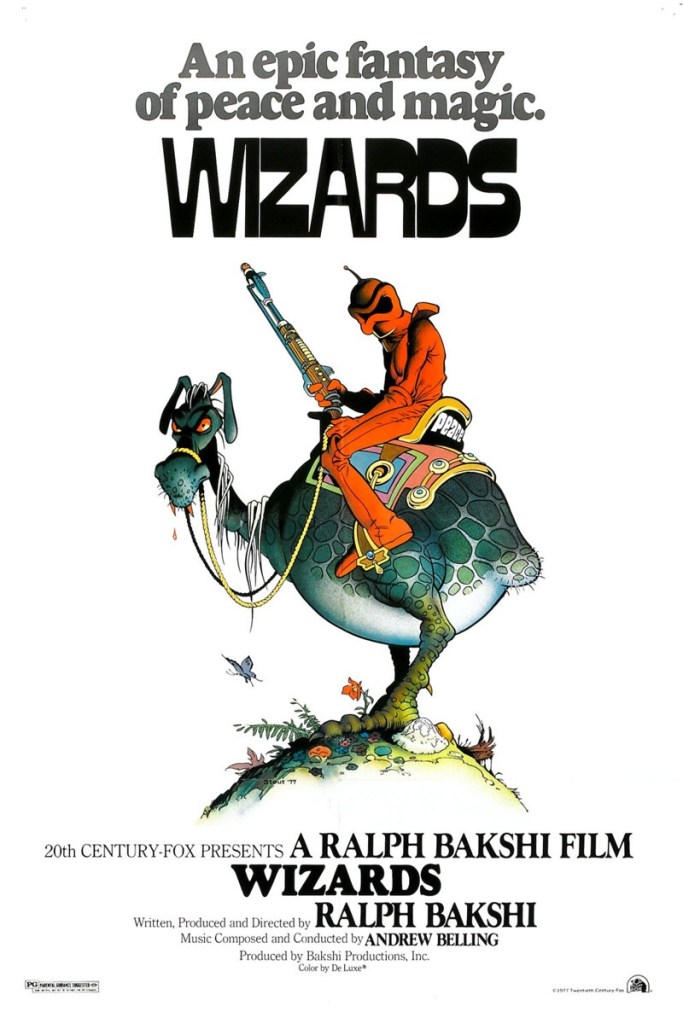
Synopsis: In Wizards After the death of his mother. An evil mutant wizard Blackwolf discovers some long-lost military technologies. Blackwolf claims his mother’s throne, assembles an army, and sets out to brainwash and conquer Earth. Meanwhile, Blackwolf’s gentle twin brother, the bearded and sage Avatar calls upon his own magical abilities to foil Blackwolf’s plans for world domination — even if it means destroying his own flesh and blood.

The Story

Wizards begins with the destruction of the earth via a nuclear explosion. After several thousand years. The few survivors of humanity have become mutants and hide in the shadows. But from the ashes the fae folk of long-forgotten earth is reborn. They live in peace and tranquility for many thousands of years until their Queen gives birth to twin Wizards. Avatar a goodly and kind Wizard and his evil brother Blackwolf.

When their mother the Queen dies. The two brothers fight and Blackwolf is defeated by Avatar and journeys to form his new kingdom of Scorch. While in exile for 3000 years. Blackwolf sends his demonic forces out to search the earth for old technologies that he can use to defeat the forces of good and ultimately defeat his brother.

Meanwhile, in Montagar Avatar and his girlfriend, Elinore are blissfully unaware of Blackwolf’s plans until one of his soldiers Necron 99 attacks and kills their President.

Voice Acting

The acting throughout this films is really solid. Bob Holt is excellent as the kindly Wizard Avatar who justs wants to live a peaceful and hassle-free life. His interactions with Elinore (Jesse Welles) are a lot of fun and full of innuendo, which is something the film features a lot of. Richard Romanus puts the swashbuckler in Weehawk the soldier Elf who will fight to the death to defend his lands.

We also get Mark Hamill in perhaps his shortest animated role ever as Sean the ill-fated king of the Fairie folk. No sooner as he introduces himself. He gets wasted by one of Blackwolf’s soldiers.

Finally, special mention must go to Steve Gravers who puts in a great performance as the evil Wizard Blackwolf.

Animation

Directed and produced by Ralph Bakshi who is better known for his more adult-orientated animated films and series such as ‘Fritz The Cat’. ‘Wizards’ was supposed to be Bakshi’s first attempt at doing something for a family audience. Although we’d have to agree to differ on that front given that within the first five minutes we meet three fairy prostitutes. And Then we get Elinore sporting curves that would make most glamour models jealous.

The animation in this film is a weird psychedelic hodgepodge of various styles. It seems both very cool and experimental at the same time. I particularly loved the Rotoscoping effects that are used fairly heavily in the film. Especially when it came to the use of it with old world war 2 footage of tanks and planes. For its time, which was the late 70s. The animation in this movie was likely cutting edge. And I think it holds up pretty well considering.

Overall

Some of the themes and storylines within this film are probably more for the older kids than for younger viewers. How Bakshi managed to get a PG rating for this film will forever be a mystery. Especially given how little Elinore is wearing. Added to which the debate about Technology versus Nature and Magic while fun would probably go over the heads of younger viewers.

The film was made in a time where things like duck and cover were still fresh in the minds of most adults that saw the film at the time. If anything it was a film warning about the threat of nuclear war and it was very on the nose in that respect. I was about 12 when I first saw this movie as a video rental back in around 1982 and it stuck in my memory because this review is based on only my second viewing of the movie since back then.

That said though. The more mature version of me did spot a few contradictions in the film. The ones that stand out are to do with Avatar and his land of Montagar where technology is supposed to be outlawed. In the scene that establishes Avatar, we see him conjure up a jukebox. And later on as we get to the final battle. He uses a gun. Now back when I was 12 I wasn’t to bothered by this. But the grown-up me thinks Avatar is a hypocrite and a cheat for breaking his own rules.

Overall though. Despite those two issues I spotted. It is still quite an enjoyable film with some killer 70s funk and prog-rock guitar licks making up a killer soundtrack.


Watch Wizards at Internet Archive here: https://archive.org/details/y2mate.combernievstrumprzlyugsut7q360p
Saturday Matinee: Fantastic Planet

Surrealism and political critique in the animated medium: Fantastic Planet (1973)

By Dan Stalcup

Source: The Goods Firm Reviews

Coming from the “Panic Movement” surrealist art collective is one of the most bizarre animated films of all time: Fantastic Planet, a French-Czech production by director/co-writer René Laloux and co-writer/production designer Roland Topor.

With its title, Fantastic Planet sounds like it should be a cheesy sci-fi flick, and in some ways, it is. (The French title, La Planète sauvage, is much more pleasing.) But this is something much more insular and experimental than most genre films of the era. Thanks to its distinctive pencil-sketched, cutout animation technique (also seen in Monty Python interludes), the film has the look of a history or biology book come to life. The grotesqueries depicted have a diagrammatic, almost clinical look to them, making every alien and bit of worldbuilding feel all the more strange.

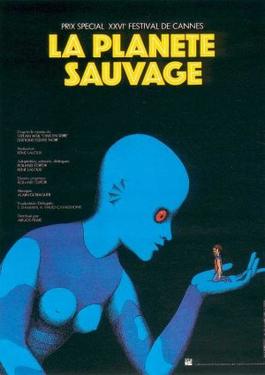
Fantastic Planet chronicles a far future when humans have been transplanted to the distant planet Ygam by giant blue aliens with red bug eyes called Draags (or, in some translations, Traags). There, humans serve the role of something resembling a rodent or small dog: occasionally domesticated by Draags, occasionally living in wild colonies as feral creatures. The humans on Ygam are called “Oms” by the Draags. They’re mostly viewed as harmless by the aliens, but often casually exploited and exterminated when convenient.

The story follows Terr, an orphaned human/Om, who is adopted by a Draag, but escapes before organizing an resistance to the giant aliens. Terr’s life has a vaguely mythological arc to it, further enhancing the sense the we’re witnessing some passed-down story. The entire telling is detached and emotionless — when Terr’s mother or compatriots die, there is no mourning or reaction, just a progression to the next item of the story. It’s disquieting.

What really makes Fantastic Planet so bizarre and unforgettable is the depiction of the alien life and planet: flora and fauna that look like something out of a fever dream or acid trip. The ground shifts into squirming intestines; a hookah bar causes the inhabitants to meld into a blur; twirling headless statues perform a mating ritual. It’s baroque and occasionally whimsical; half Dr. Seuss, half Salvador Dali.

Despite the strangeness of the imagery, the film avoids slipping into an all-out dissociated psychedelic trip thanks to its linear and straightforward narrative. This, paradoxically, makes everything feel even more alien: The story takes logical, coherent leaps, but the images and details within are so nonchalantly unearthly. It’s a dizzying juxtaposition.

The story is clearly allegorical: Animal rights is an obvious interpretation given the way that humans are chattelized. It’s not hard to squint and see anti-racism or anti-imperialism in its parable, either — any scenario where the majority or oppressors are negligent, systemic participators rather than active aggressors would fit.

There’s also a lot of coming of age imagery in the film, blown out into absurdism. The semi-comprehending way the humans perceive the Draag world is not too detached from the way kids see the adult world: full of obtuse rituals and norms. Plenty of the designs are charged with phallic and sexual imagery (not to mention casual nudity), but it’s secondary to the overall sweep of the visual invention of the film.

In the half century since its release, Fantastic Planet has become a cult legend, even inducted into the Criterion Collection — one of only a few animated films with the honor. According to Letterboxd, it’s among the most popular films of 1973. I can’t say I blame cinephiles out there. Even at 72 minutes, Fantastic Planet is a bit exhausting, but it’s such a unique and evocative experience that it is essential viewing. At least for weirdos like me.

Saturday Matinee: Another Day of Life

Another Day of Life

Directed by Raúl de la Fuente, Damian Nenow

An animated documentary presenting a journalist’s poignant perspectives on the horrors of war.

By Frederic and Mary Ann Brussat

Source: Spirituality & Practice

You must save something if you can. Because people disappear without a trace. Completely and irretrievably. From the world, and then from our memory.
— Ryszard Kapuscinski

Another Day of Life is an intense, chilling, and convincing anti-war animated documentary about the civil war in Angola at the time of its independence in 1975. With the exit of the Portuguese colonizers, two factions fought with each other to determine who would rule and control the country’s thriving businesses and resources, especially diamonds and oil.

The film is based upon a book by acclaimed Polish war correspondent Ryszard Kapuscinski (1932 – 2007) in which he described the situation he witnessed with the Portuguese term confusão, “a state of absolute disorientation.” His story is told through animated recreations of his experiences during the war and filmed interviews with those he met and worked with.

Despite the advice of fellow journalists, Kapuscinski decides to travel from the relatively safe capital of Angola to the southern front in order to interview Farrusco, a military leader of the MPLA, the Soviet- and Cuba-backed People’s Movement for the Liberation of Angola. Other militias were supported by other African interests as well as the United States and South Africa. By the time the war ended in 2002, nearly one million people were displaced and 5,000 were dead.

The film brings us along on Kapuscinski’s travels through dangerous situations and his encounters with memorable people. Since his words (voiced by Kerry Shale) are used for the narration, we empathize with his perspectives — the horror that he and his companion Artur (Daniel Flynn) feel upon coming across a road clogged with corpses, his fascination with a charismatic female freedom fighter named Carlotta (Lillie Flynn), the desire of the people to be photographed so people would know “this is the face I had when I was alive.” At a key moment, the journalist has to decide whether to maintain his objectivity or reveal information that could change the outcome of the conflict.

IndieWire has published a review of Another Day of Life that includes excerpts from interviews with the two directors. We were very impressed with the insights and respect for the substantive themes of this story as explained by director Raul de la Fuente:

“I was fascinated by this surrealistic diary, the desperate chronicle of a reporter at the limit of his strengths, fighting for survival and finding the truth in a chaotic and fuzzy war. This film is a hallucinatory trip into the heart of darkness, a Cold War tale with a thrilling spy mood, magnetic topics, and characters: decolonization, freedom fighters, boy soldiers, epic battles, and, above all, the surreal and poetic approach by Kapuscinski.”

___________________

Watch Another Day of Life on Hoopla here: https://www.hoopladigital.com/movie/another-day-of-life-john-hollingsworth/12738084

Saturday Matinee: Shadow Puppets

“Shadow Puppets” (1994) is black and white animated dystopian short by Chuck Gamble and was featured at the Human Rights Watch Film Festival. The at times bleak and hopeful story depicts a button-pushing drone’s existence in a totalitarian world where his only escape is through making shadow puppets with his hands. When he tragically loses this ability he finds a way to persevere.

Saturday Matinee: Anomalisa

Review by Sofie Monks Kaufman

Source: Little White Lies

Beauty and tragedy abound in Charlie Kaufman and Duke Johnson’s melancholic stop-motion treasure.

Kurt Vonnegut’s 1963 novel ‘Cat’s Cradle’ is about the fictional religion of Bokonism. In it, he invented a new vocabulary for how we evaluate others. The most profound thing you can say about a person is that they belong to your “karass”. This, Vonnegut defines as “a network or group of people who are somehow affiliated or linked spiritually.” Charlie Kaufman wrote Being John Malkovich and Adaptation, and directed Synecdoche, New York, and I am a member of his karass.

We are linked by name and an inward nature, and therefore I naturally accept qualities in his latest film, Anomalisa, that might deter others. Since its premiere at the Telluride Film Festival, the film’s gender politics have been widely discussed. Yet there’s a narrative that is driven by a self-consciously wretched man which both eclipses and consumes this element of the film. The fact that the lead character cannot recognise the depth of others – women and men – is the whole melancholic point.

Michael Stone (David Thewlis) is the loneliest of all of Charlie Kaufman’s lonely men. White, married and joyless, he has grey hair, middle-aged spread and no clear reason for living. Well-meaning conversationalists only grate on his frazzled nerves. Thewlis’ raw Lancashire bark hints at the desperate suffering beneath his auto-politeness. Michael can’t communicate with the people who pass through his life. Their inability to touch him and his inability to perceive them is telegraphed with a bold casting choice that constantly reinforces Michael’s plight while powering a source of hilarity on a par with the ‘Malkovich, Malkovich, Malkovich’ scene in 1999’s Being John Malkovich.

The world that Kaufman has built with the invaluable expertise of co-director and animation whiz, Duke Johnson, is a new sub-genre: social realist stop-motion puppetry. The costly joke is that years of painstaking work has gone into creating sets that are entirely banal. Rather than labouring in the name of fantastical, stylised spectacle like many a proud aesthete, their efforts focus on recreating the architecture of everyday life – like a mini version of the play in Synecdoche, New York. Charlie Kaufman values the intensity that comes from mirroring reality. Watching Anomalisa is like watching a mind trying to escape its own tedious corridors, searching for the sweet release of a meaningful voice next door.

Michael is a guru. His book, ‘How Can I Help You Help Them?’, has established him as a god of the customer service scene. He has flown to Cincinnati to address disciples. The arc is simple. He meets a woman called Lisa (Jennifer Jason Leigh) and thinks that she has changed his life. She is a paragon of insecurity overwhelmed by each drop of tenderness. If his soul is trapped inside, hers spills out in torrents. Their liaison is awkward, touching and driven by his persuasive neediness. Lisa submits at every stage in a way that is not going to win Anomalisa any progressive representation awards, but still has the ring of truth. Some who have gone without intimacy for a long time are just glad to replenish their stocks.

Duke Johnson is unlucky and lucky to co-direct on his debut feature. He’s unlucky because the story is so patently Kaufman-esque (he originally wrote it as a play under the pen name Francis Frejoli) that the credit defaults to the more established artist. But he is lucky because Anomalisa is a hell of a calling card, showing he can deliver a nuanced animation and fulfil an idiosyncratic vision. The most striking aspect of the puppets are their more-human-than-human eyes made from a combination of 3D printed irises, self-repairing silicon and clear resin. “Sadness was a word we used a lot when talking to everybody,” Johnson has said. This is apparent everywhere and particularly in the leaden movements of Michael who drags himself onward like a man in danger of crumpling.

Most of the drama takes place in the soothing but anonymous Frejoli hotel. A steady stream of absurd, perceptive jokes evince Kaufman’s capacity to entertain even while distilling the essence of alienation and the chimeric releases that taunt its sufferers. He is a sad clown. His characters are puppets for solipsistic malaise. Yet he is passionate about humour and the joke count is high.

From unsexy chat-up lines (“Would you like to get a drink, chat about phone system innovation?”) to running gags best left unspoiled to the relish with which the minutiae of hotel life is milked for frustration, Anomalisa is as coloured by external detail as it is fuelled by internal torment. The complexity of the ideas at play is intoxicating both emotionally and intellectually. Kaufman is ahead of his character in delivering the antidote to self-absorption: meaningful communication.


Watch Anomalisa on Kanopy here: https://www.kanopy.com/product/anomalisa-1

Saturday Matinee: Puffball Studio double feature

With films like Swipe, Shehr e Tabassum, Pakistan’s Puffball Studio depicts dystopias that feel all too real

An app that mirrors mob justice. A dystopia where smiling is the only expression allowed. Pakistan’s Puffball Studio and its founder Arafat Mazhar skewer the mechanisms of intolerance and hate through their films.

By Manik Sharma

Source: Firstpost.

In the animated short film Shehr e Tabassum, the ‘Supreme Leader’ of a dystopian Pakistan in 2071 passes a law declaring all expressions other than smiling a crime. It’s the state’s way of manufacturing both consent and a flimsy yet persuasive image of a happy civilisation. People who refuse are deemed as traitors. The drugged, exclusionary vision of the future that the short film offers is eerily echoed by the present of many countries around the world.

Mimicking to an extent the consumerist hell of Blade RunnerShehr e Tabassum released earlier this year on YouTube. Behind the film is Puffball Studio, a group of young creators from the country, led by Arafat Mazhar. In November, Puffball released its second film Swipe, a Black Mirror-ish reflection of the intolerance of today, through the lens of technology. In Swipe, an app basically mimics mob justice, by enabling users to have people executed via a simple swipe.

“My research has been centered around the way ideas like ghairat (honour), ishq (love) ghaddar (traitor) and tauheen (insult) have been distorted in the recent past and forcibly circumscribed to violence while at the same time, the definition for blasphemous or traitorous acts continue to broaden,” Mazhar says. Curiously, the protagonist of Swipe is a child. “I have seen so many videos of young people at rallies organised by religious activists and NGOs calling for violence against other groups, videos of children taking part in mob violence. I can’t help but think that we’re failing our children when we teach them manufactured meanings of honour and love that are devoid of any spirituality,” he adds.

Mazhar and his team created Swipe during the pandemic. The intersection of technology and culture is something the filmmaker has always been interested in. He also leads other initiatives like Engage Pakistan, a project that counters the country’s blasphemy laws with research and alternative histories. Procuring funding for all these projects can’t possibly be a cakewalk.

Swipe and Shehr e Tabassum were both self-financed for the most part,” Mazhar explains. “What helps is that our team is very versatile: we have excellent traditional artists but also an excellent 3D and motion graphics team which means that we do premium service work for clients too. Aside from that, we also have an alternative critical histories channel called Hashiya, where we collaborate with local and international universities to create historical short films and explainers.”

Both Shehr e Tabasum and Swipe cross paths with technology, intolerance and the brutalising nature of consumerist economies. If empathy and humanism are shown the door, the natural course culture takes is the commodification of everything human — from faith to love. It’s a lesson the young protagonist of Swipe learns the hard way.

“We knew from the outset that both Shehr e Tabassum and Swipe would be unapologetically political films but I was just as set on making them a thrilling and evocative experience for viewers. So when we wanted to explore how different fundamental freedoms — to express, to protest etc. — are stifled in a hyper-surveillant and increasingly oppressive society, we used the allegory of a smile as the only expression allowed to citizens,” Mazhar says of his first film.

“Other times, the story writes itself: when we wanted to show a city hooked to an app (iFatwa) that generates allegations against citizens and gamifies extrajudicial violence, we would look to news stories around us to draw inspiration for the app cases,” he adds about Swipe. (The anecdotal stories that feature on iFatwa are reminiscent of outrage we witness every other day on this side of the border.)

Through both films, Mazhar channels a kind of activism that he promises the group will continue to work on. But with activism these days comes the risk of outing yourself to trolls and self-appointed moralists. It’s a price some have paid heavily for on both sides of the border, and perhaps around the world.

“I believe storytelling, fiction or otherwise, speaks to possibilities of greater awareness, understanding and connection between people and communities. I believe in creating art that speaks to our collective humanity, that forces us to think beyond our biases and our conditioned hate towards those who are different from us. With Swipe, there was no pretense about what we had set out to do: we aren’t claiming to change the fabric of our society or our thinking. Swipe is just a heartfelt plea to pause and reflect collectively,” Mazhar says.

Filmmaking is hard enough; such provocative, truthful and political filmmaking even more so. “For those who attack us online because they fear an agenda behind our films, I always try and respond to their anxieties which usually stem from perceived threats to tradition, religion, etc. Beyond that, there isn’t much that anyone can do. I think our viewers recognise and appreciate that though our films are uncomfortable to watch, they go beyond mere cynicism and derision,” Mazhar says, optimistic that his work will be afforded the tolerance his films paint the absence of.

Saturday Matinee: Orson Welles Short Double Feature

Orson Welles Narrates Animations of Plato’s Cave and Kafka’s “Before the Law,” Two Parables of the Human Condition

By Colin Marshall

Source: Open Culture

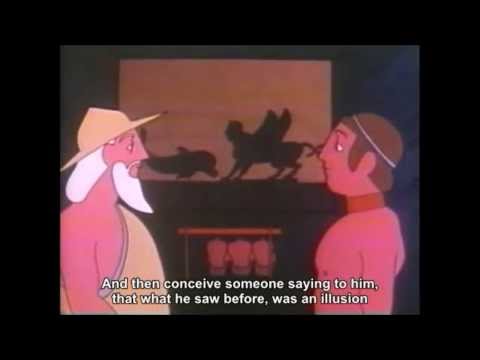
You’re held captive in an enclosed space, only able faintly to perceive the outside world. Or you’re kept outside, unable to cross the threshold of a space you feel a desperate need to enter. If both of these scenarios sound like dreams, they must do so because they tap into the anxieties and suspicions in the depths of our shared subconscious. As such, they’ve also proven reliable material for storytellers since at least the fourth century B.C., when Plato came up with his allegory of the cave. You know that story nearly as surely as you know the ancient Greek philosopher’s name: a group of human beings live, and have always lived, deep in a cave. Chained up to face a wall, they have only ever seen the images of shadow puppets thrown by firelight onto the wall before them.

To these isolated beings, “the truth would be literally nothing but the shadows of the images.” So Orson Welles tells it in this 1973 short film by animator Dick Oden. In his timelessly resonant voice that complements the production’s hauntingly retro aesthetic, Wells then speaks of what would happen if a cave-dweller were to be unshackled.

“He would be much too dazzled to see distinctly those things whose shadows he had seen before,” but as he approaches reality, “he has a clearer vision.” Still, “will he not be perplexed? Will he not think that the shadows which he formerly saw are truer than the objects which are now shown to him?” And if brought out of the cave to experience reality in full, would he not pity his old cavemates? “Would he not say, with Homer, better to be the poor servant of a poor master and to endure anything rather than think as they do and live after their manner?”

Plato’s cave wasn’t the first parable of the human condition Welles narrated. Just over a decade earlier, he engaged pinscreen animator Alexandre Alexeieff (he of Night on Bald Mountain and and “The Nose,” previously featured here on Open Culture) to illustrate his reading of Franz Kafka’s story “Before the Law.” The law, in Kafka’s telling, is a building, and before that building stands a guard. “A man comes from the country, begging admittance to the law,” says Welles. “But the guard cannot admit him. May he hope to enter at a later time? That is possible, said the guard.” Yet somehow that time never comes, and he spends the rest of his life awaiting admission to the law. “Nobody else but you could ever have obtained admittance,” the guard admits to the man, not long before the man expires of old age. “This door was intended only for you! And now, I’m going to close it.”

“Before the Law” describes a grimly absurd situation, as does Welles’ The Trial, the film to which it serves as an introduction. Adapted from another work of Kafka’s, specifically his best-known novel, it also concerns itself with the legal side of human affairs, at least on the surface. But when it becomes clear that the crime with which its bureaucrat protagonist Josef K. has been charged will never be specified, the story plunges into an altogether more troubling realm. We’ve all, at one time or another, felt to some degree like Joseph K., persecuted by an ultimately incomprehensible system, legal, social, or otherwise. And can we help but feel, especially in our highly mediated 21st century, like Plato’s immobilized human, raised in darkness and made to build a worldview on illusions? As for how to escape the cave — or indeed to enter the law — it falls to each of us individually to figure out.


Saturday Matinee: Genius Party double feature

Synopsis from Shout Factory:

“Simply mind-blowing. A must see!” – Niels Matthijs, Screen Anarchy

From groundbreaking animation outfit STUDIO 4°C (MFKZ, Mind Game) comes two extraordinary projects with a shared, simple vision: to take an all-star team of some of the best animators working in anime today, and give each free reign to tell a unique short story built around “the spirit of creativity.” The results are GENIUS PARTY and GENIUS PARTY BEYOND, two animated anthology films featuring contributions from directors Shoji Kawamori, Shinichiro Watanabe, Masaaki Yuasa, Mahiro Maeda, and many others. Full of boundless imagination, fantastic worlds, and unique visual styles, these two acclaimed films are now available for the first time in North America.

Watch both films through Kanopy here:

https://www.kanopy.com/product/genius-party

https://www.kanopy.com/product/genius-party-beyond