National (In)Security In the United States of Inequality

By Rajan Menon

Source: Unz Review

So effectively has the Beltway establishment captured the concept of national security that, for most of us, it automatically conjures up images of terrorist groups, cyber warriors, or “rogue states.” To ward off such foes, the United States maintains a historically unprecedented constellation of military bases abroad and, since 9/11, has waged wars in Afghanistan, Iraq, Syria, Libya, and elsewhere that have gobbled up nearly $4.8 trillion. The 2018 Pentagon budget already totals $647 billion — four times what China, second in global military spending, shells out and more than the next 12 countries combined, seven of them American allies. For good measure, Donald Trump has added an additional $200 billion to projected defense expenditures through 2019.

Yet to hear the hawks tell it, the United States has never been less secure. So much for bang for the buck.

For millions of Americans, however, the greatest threat to their day-to-day security isn’t terrorism or North Korea, Iran, Russia, or China. It’s internal — and economic. That’s particularly true for the 12.7% of Americans (43.1 million of them) classified as poor by the government’s criteria: an income below $12,140 for a one-person household, $16,460 for a family of two, and so on… until you get to the princely sum of $42,380 for a family of eight.

Savings aren’t much help either: a third of Americans have no savings at all and another third have less than $1,000 in the bank. Little wonder that families struggling to cover the cost of food alone increased from 11% (36 million) in 2007 to 14% (48 million) in 2014.

The Working Poor

Unemployment can certainly contribute to being poor, but millions of Americans endure poverty when they have full-time jobs or even hold down more than one job. The latest figures from the Bureau of Labor Statistics show that there are 8.6 million“working poor,” defined by the government as people who live below the poverty line despite being employed at least 27 weeks a year. Their economic insecurity doesn’t register in our society, partly because working and being poor don’t seem to go together in the minds of many Americans — and unemployment has fallen reasonably steadily. After approaching 10% in 2009, it’s now at only 4%.

Help from the government? Bill Clinton’s 1996 welfare “reform” program concocted in partnership with congressional Republicans, imposed time limits on government assistance, while tightening eligibility criteria for it. So, as Kathryn Edin and Luke Shaefer show in their disturbing book, $2.00 a Day: Living on Almost Nothing in America, many who desperately need help don’t even bother to apply. And things will only get worse in the age of Trump. His 2019 budget includes deep cuts in a raftof anti-poverty programs.

Anyone seeking a visceral sense of the hardships such Americans endure should read Barbara Ehrenreich’s 2001 book Nickel and Dimed: On (Not) Getting By in America. It’s a gripping account of what she learned when, posing as a “homemaker” with no special skills, she worked for two years in various low-wage jobs, relying solely on her earnings to support herself. The book brims with stories about people who had jobs but, out of necessity, slept in rent-by-the-week fleabag motels, flophouses, or even in their cars, subsisting on vending machine snacks for lunch, hot dogs and instant noodles for dinner , and forgoing basic dental care or health checkups. Those who managed to get permanent housing would choose poor, low-rent neighborhoods close to work because they often couldn’t afford a car. To maintain even such a barebones lifestyle, many worked more than one job.

Though politicians prattle on about how times have changed for the better, Ehrenreich’s book still provides a remarkably accurate picture of America’s working poor. Over the past decade the proportion of people who exhausted their monthly paychecks just to pay for life’s essentials actually increased from 31% to 38%. In 2013, 71% of the families that had children and used food pantries run by Feeding America, the largest private organization helping the hungry, included at least one person who had worked during the previous year. And in America’s big cities, chiefly because of a widening gap between rent and wages, thousands of working poor remain homeless, sleeping in shelters, on the streets, or in their vehicles, sometimes along with their families. In New York City, no outlier when it comes to homelessness among the working poor, in a third of the families with children that use homeless shelters at least one adult held a job.

The Wages of Poverty

The working poor cluster in certain occupations. They are salespeople in retail stores, servers or preparers of fast food, custodial staff, hotel workers, and caregivers for children or the elderly. Many make less than $10 an hour and lack any leverage, union or otherwise, to press for raises. In fact, the percentage of unionized workers in such jobs remains in the single digits — and in retail and food preparation, it’s under 4.5%. That’s hardly surprising, given that private sector union membership has fallen by 50% since 1983 to only 6.7% of the workforce.

Low-wage employers like it that way and — Walmart being the poster child for this — work diligently to make it ever harder for employees to join unions. As a result, they rarely find themselves under any real pressure to increase wages, which, adjusted for inflation, have stood still or even decreased since the late 1970s. When employment is “at-will,” workers may be fired or the terms of their work amended on the whim of a company and without the slightest explanation. Walmart announced this year that it would hike its hourly wage to $11 and that’s welcome news. But this had nothing to do with collective bargaining; it was a response to the drop in the unemployment rate, cash flows from the Trump tax cut for corporations (which saved Walmart as much as $2 billion), an increase in minimum wages in a number of states, and pay increases by an arch competitor, Target. It was also accompanied by the shutdown of 63 of Walmart’s Sam’s Club stores, which meant layoffs for 10,000 workers. In short, the balance of power almost always favors the employer, seldom the employee.

As a result, though the United States has a per-capita income of $59,500 and is among the wealthiest countries in the world, 12.7% of Americans (that’s 43.1 million people), officially are impoverished. And that’s generally considered a significant undercount. The Census Bureau establishes the poverty rate by figuring out an annual no-frills family food budget, multiplying it by three, adjusting it for household size, and pegging it to the Consumer Price Index. That, many economists believe, is a woefully inadequate way of estimating poverty. Food prices haven’t risen dramatically over the past 20 years, but the cost of other necessities like medical care (especially if you lack insurance) and housing have: 10.5% and 11.8% respectively between 2013 and 2017 compared to an only 5.5% increase for food.

Include housing and medical expenses in the equation and you get the Supplementary Poverty Measure (SPM), published by the Census Bureau since 2011. It reveals that a larger number of Americans are poor: 14% or 45 million in 2016.

Dismal Data

For a fuller picture of American (in)security, however, it’s necessary to delve deeper into the relevant data, starting with hourly wages, which are the way more than 58%of adult workers are paid. The good news: only 1.8 million, or 2.3% of them, subsist at or below minimum wage. The not-so-good news: one-third of all workers earn less than $12 an hour and 42% earn less than $15. That’s $24,960 and $31,200 a year. Imagine raising a family on such incomes, figuring in the cost of food, rent, childcare, car payments (since a car is often a necessity simply to get to a job in a country with inadequate public transportation), and medical costs.

The problem facing the working poor isn’t just low wages, but the widening gap between wages and rising prices. The government has increased the hourly federal minimum wage more than 20 times since it was set at 25 cents under the 1938 Fair Labor Standards Act. Between 2007 and 2009 it rose to $7.25, but over the past decade that sum lost nearly 10% of its purchasing power to inflation, which means that, in 2018, someone would have to work 41 additional days to make the equivalent of the 2009 minimum wage.

Workers in the lowest 20% have lost the most ground, their inflation-adjusted wages falling by nearly 1% between 1979 and 2016, compared to a 24.7% increase for the top 20%. This can’t be explained by lackluster productivity since, between 1985 and 2015, it outstripped pay raises, often substantially, in every economic sector except mining.

Yes, states can mandate higher minimum wages and 29 have, but 21 have not, leaving many low-wage workers struggling to cover the costs of two essentials in particular: health care and housing.

Even when it comes to jobs that offer health insurance, employers have been shifting ever more of its cost onto their workers through higher deductibles and out-of-pocket expenses, as well as by requiring them to cover more of the premiums. The percentage of workers who paid at least 10% of their earnings to cover such costs — not counting premiums — doubled between 2003 and 2014.

This helps explain why, according to the Bureau of Labor Statistics, only 11% of workers in the bottom 10% of wage earners even enrolled in workplace healthcare plans in 2016 (compared to 72% in the top 10%). As a restaurant server who makes $2.13 an hour before tips — and whose husband earns $9 an hour at Walmart — put it, after paying the rent, “it’s either put food in the house or buy insurance.”

The Affordable Care Act, or ACA (aka Obamacare), provided subsidies to help people with low incomes cover the cost of insurance premiums, but workers with employer-supplied healthcare, no matter how low their wages, weren’t covered by it. Now, of course, President Trump, congressional Republicans, and a Supreme Court in which right-wing justices are going to be even more influential will be intent on poleaxing the ACA.

It’s housing, though, that takes the biggest bite out of the paychecks of low-wage workers. The majority of them are renters. Ownership remains for many a pipe dream. According to a Harvard study, between 2001 and 2016, renters who made $30,000-$50,000 a year and paid more than a third of their earnings to landlords (the threshold for qualifying as “rent burdened”) increased from 37% to 50%. For those making only $15,000, that figure rose to 83%.

In other words, in an ever more unequal America, the number of low-income workers struggling to pay their rent has surged. As the Harvard analysis shows, this is, in part, because the number of affluent renters (with incomes of $100,000 or more) has leapt and, in city after city, they’re driving the demand for, and building of, new rental units. As a result, the high-end share of new rental construction soared from a third to nearly two-thirds of all units between 2001 and 2016. Not surprisingly, new low-income rental units dropped from two-fifths to one-fifth of the total and, as the pressure on renters rose, so did rents for even those modest dwellings. On top of that, in places like New York City, where demand from the wealthy shapes the housing market, landlords have found ways — some within the law, others not — to get rid of low-income tenants.

Public housing and housing vouchers are supposed to make housing affordable to low-income households, but the supply of public housing hasn’t remotely matched demand. Consequently, waiting lists are long and people in need languish for years before getting a shot — if they ever do. Only a quarter of those who qualify for such assistance receive it. As for those vouchers, getting them is hard to begin with because of the massive mismatch between available funding for the program and the demand for the help it provides. And then come the other challenges: finding landlords willing to accept vouchers or rentals that are reasonably close to work and not in neighborhoods euphemistically labelled “distressed.”

The bottom line: more than 75% of “at-risk” renters (those for whom the cost of rent exceeds 30% or more of their earnings) do not receive assistance from the government. The real “risk” for them is becoming homeless, which means relying on shelters or family and friends willing to take them in.

President Trump’s proposed budget cuts will make life even harder for low-income workers seeking affordable housing. His 2019 budget proposal slashes $6.8 billion(14.2%) from the resources of the Department of Housing and Urban Development’s (HUD) by, among other things, scrapping housing vouchers and assistance to low-income families struggling to pay heating bills. The president also seeks to slash funds for the upkeep of public housing by nearly 50%. In addition, the deficits that his rich-come-first tax “reform” bill is virtually guaranteed to produce will undoubtedly set the stage for yet more cuts in the future. In other words, in what’s becoming the United States of Inequality, the very phrases “low-income workers” and “affordable housing” have ceased to go together.

None of this seems to have troubled HUD Secretary Ben Carson who happily ordered a $31,000 dining room set for his office suite at the taxpayers’ expense, even as he visited new public housing units to make sure that they weren’t too comfortable (lest the poor settle in for long stays). Carson has declared that it’s time to stop believing the problems of this society can be fixed merely by having the government throw extra money at them — unless, apparently, the dining room accoutrements of superbureaucrats aren’t up to snuff.

Money Talks

The levels of poverty and economic inequality that prevail in America are not intrinsic to either capitalism or globalization. Most other wealthy market economies in the 36-nation Organization for Economic Cooperation and Development (OECD) have done far better than the United States in reducing them without sacrificing innovation or creating government-run economies.

Take the poverty gap, which the OECD defines as the difference between a country’s official poverty line and the average income of those who fall below it. The United States has the second largest poverty gap among wealthy countries; only Italy does worse.

Child poverty? In the World Economic Forum’s ranking of 41 countries — from best to worst — the U.S. placed 35th. Child poverty has declined in the United States since 2010, but a Columbia University report estimates that 19% of American kids (13.7 million) nevertheless lived in families with incomes below the official poverty line in 2016. If you add in the number of kids in low-income households, that number increases to 41%.

As for infant mortality, according to the government’s own Centers for Disease Control, the U.S., with 6.1 deaths per 1,000 live births, has the absolute worst record among wealthy countries. (Finland and Japan do best with 2.3.)

And when it comes to the distribution of wealth, among the OECD countries only Turkey, Chile, and Mexico do worse than the U.S.

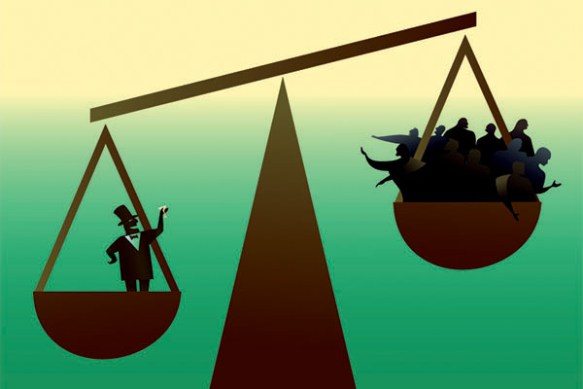
It’s time to rethink the American national security state with its annual trillion-dollar budget. For tens of millions of Americans, the source of deep workaday insecurity isn’t the standard roster of foreign enemies, but an ever-more entrenched system of inequality, still growing, that stacks the political deck against the least well-off Americans. They lack the bucks to hire big-time lobbyists. They can’t write lavish checks to candidates running for public office or fund PACs. They have no way of manipulating the myriad influence-generating networks that the elite uses to shape taxation and spending policies. They are up against a system in which money truly does talk — and that’s the voice they don’t have. Welcome to the United States of Inequality.


Rajan Menon, a TomDispatch regular, is the Anne and Bernard Spitzer Professor of International Relations at the Powell School, City College of New York, and Senior Research Fellow at Columbia University’s Saltzman Institute of War and Peace Studies. He is the author, most recently, of The Conceit of Humanitarian Intervention 

Saturday Matinee: American Nomads

Synopsis from Top Documentary Films

Beneath the America we think we know lies a nation hidden from view – a nomadic nation, living on the roads, the rails and in the wild open spaces.

In its deserts, forests, mountain ranges and on the plains, a huge population of modern nomads pursues its version of the American dream – to live free from the world of careers, mortgages and the white picket fence.

When British writer Richard Grant moved to the USA more than 20 years ago it wasn’t just a change of country. He soon found himself in a world of travelers and the culture of roadside America – existing alongside, but separate from, conventional society. In this film he takes to the road again, on a journey without destination.

In a series of encounters and unplanned meetings, Richard is guided by his own instincts and experiences – and the serendipity of the road. Traveling with loners and groups, he encounters the different ‘tribes’ of nomads as he journeys across the deserts of America’s south west.

Thinking Dangerously in the Age of Normalized Ignorance

your-ignorance-is-their-power

By Henry Giroux

Source: CounterPunch

What happens to a society when thinking is eviscerated and is disdained in favor of raw emotion? [1] What happens when political discourse functions as a bunker rather than a bridge? What happens when the spheres of morality and spirituality give way to the naked instrumentalism of a savage market rationality? What happens when time becomes a burden for most people and surviving becomes more crucial than trying to lead a life with dignity? What happens when domestic terrorism, disposability, and social death become the new signposts and defining features of a society? What happens to a social order ruled by an “economics of contempt” that blames the poor for their condition and wallows in a culture of shaming?[2] What happens when loneliness and isolation become the preferred modes of sociality? What happens to a polity when it retreats into private silos and is no longer able to connect personal suffering with larger social issues? What happens to thinking when a society is addicted to speed and over-stimulation? What happens to a country when the presiding principles of a society are violence and ignorance? What happens is that democracy withers not just as an ideal but also as a reality, and individual and social agency become weaponized as part of the larger spectacle and matrix of violence?[3]

The forces normalizing and contributing to such violence are too expansive to cite, but surely they would include: the absurdity of celebrity culture; the blight of rampant consumerism; state-legitimated pedagogies of repression that kill the imagination of students; a culture of immediacy in which accelerated time leaves no room for reflection; the reduction of education to training; the transformation of mainstream media into a mix of advertisements, propaganda, and entertainment; the emergence of an economic system which argues that only the market can provide remedies for the endless problems it produces, extending from massive poverty and unemployment to decaying schools and a war on poor minority youth; the expanding use of state secrecy and the fear-producing surveillance state; and a Hollywood fluff machine that rarely relies on anything but an endless spectacle of mind-numbing violence. Historical memory has been reduced to the likes of a Disney theme park and a culture of instant gratification has a lock on producing new levels of social amnesia.

As we learned in the recent debate between Donald Trump and Hilary Clinton (a billionaire and millionaire), ignorance is the DNA of authoritarianism, serving to subvert the truth and obscure the workings of power. Willful ignorance has become a normalized political tool and form of public pedagogy that both provides the foundation for what Noam Chomsky labels as the rise of the “stupid party” and which works incessantly to create a “stupid nation.”[4]Trump, of course, proves that stupidity is in fashion and deeply entrenched within the larger culture while Hilary capitalizes on her penchant for disingenuousness by claiming support for policies she really disdains, i.e., stating she will raise taxes on her buddies from Goldman Sachs and other members of the financial elite. Hardly believable from a woman who “has earned millions of dollars from speeches to Wall Street banks and investment firms (and) was paid $675,000 for a series of speeches to Goldman Sachs.”[5] No hints of the radical imagination here, or the truth for that matter. Only the politics of stupidity and evasion and a media spectacle supporting the celebration of corrupted and limited and pathologized political horizons.

Manufactured ignorance also makes invisible the corruption of the financial elite, allowing them to plunder resources and define the accumulation of capital as a divine blessing. It gets worse. Manufactured ignorance aided by the voracious seductions of commodified corporate-driven disimagination machine that promotes a culture of empty pleasures through and endless regime of consuming and discarding. American society is now dominated by a pervasive commodified landscape of disimagination machines that extends from Hollywood movies and video games to mainstream television, magazines, news, and the social media. These mind-numbing desiring machines which thrive on speed and sensation function mostly as workstations of ignorance to create a fog of distractions that promote forms of social amnesia that erase from memory and public discourse the structural, systemic and social forces that reinforce what can be called organized powerlessness and massive human suffering. This is the stuff of a politics of disappearance that erases the presence of the poor, unemployed, the “approximately 11 million Americans cycle[d] through jails and prisons each year,” black youth, immigrants, ecological disasters, class warfare, acts of state sponsored terrorism, the rise of the police state, and the rise of the warfare state.[6] As the machinery of social death accelerates, America’s most precious investment, youth, also disappear. As neoliberal disimagination machines such as Fox News make clear youth as a social investment no longer count in a society that disdains long term investments and their messy calls for being included in the script of democracy. As such, the current war on youth is about erasing the future, at least any alternative future and any notion of imagination that might summon one into view.

When coupled with an age of precarity and endless uncertainty in which young people have few decent jobs, are strangulated by debt, face a future of career-less jobs, and isolation, young people have little room for politics because they are more concerned with trying to survive rather than engaging in political struggles, or imagining a different future. At the same time, armies of the unemployed or underemployed are caught in a spiral of receding wages, diminished social provisions, and increasingly find themselves paralyzed by anxiety and free-floating anger. In such situations, thinking and informed action become more difficult while a politics wedded to economic and social justice is eviscerated. Moreover, politics becomes toxic when dominated by unapologetic discourses of racism and hatred and is on full display in the Trump campaign. Tapping into such anger and redirecting away from the real problems that produce it has become the central script in the rise of the new authoritarians. This poisonous discourse gains momentum and accelerates as it moves between white supremacist incantations of Trump and his zealots and the deceptive vocabulary of Hillary Clinton and her financial elite backers who embrace a savage neoliberalism with its false claims to freedom, choice, and the virtues of militarization. Civic death is on full display as the ideals of democracy disappear in an election in which authoritarianism in its various forms rules without apology. As thinking dangerously and acting with civic courage wanes, state violence, disposability and voicelessness become the dominant registers of an authoritarian politics that has intensified in American life producing neo-fascist movements in American society that have moved from the fringes to the center of political life.

Tragedy looms large in American society as the forces that promote powerlessness and voicelessness intensify among those elements of the population struggling just to survive the symbolic violence of a culture of cruelty and the material violence of a punishing state. The issue of losing one’s voice either to the forces of imposed silencing or state repression weaken dissent and open the door to the seductions of a dogmatism that speaks in the language of decline, making America great again, while touting the coded vocabulary of white nationalism and racial purity. How else to explain Trump’s call for imposing racial profiling as a way to boost the notion of law and order.

Thinking undangerously is the first step in the triumph of formalism over substance, theater over politics, and the transformation of politics into a form of celebrity culture. The refusal to think works in the service of a form of voicelessness, which is another marker of what it means to be powerless. Within this moral and political vacuum, the codes, rhetoric, and language of white supremacy is on the rise wrapped in the spectacle of fear-mongering and implied threats of state repression. In this instance, emotion become more important than reason, ideas lose their grip on reality, and fashion becomes a rationale for discarding historical memory, informed arguments, and critical thought. Reflection no longer challenges the demands of commonsense. In the mainstream media, the endless and unapologetic proliferation of lies become fodder for higher ratings, informed by suffocating pastiche of talking heads, all of whom surrender to “the incontestable demands of quiet acceptance.”[7]Within such an environment, the truth of an event is not open to public discussion or informed judgment at least in the official media apparatuses producing, distributing and circulating ideas that parade as commonsense. As a result, all that remains is the fog of ignorance and the haze of political and moral indifference.

Americans occupy a historical moment in which it is crucial to think dangerously, particularly since such thinking has the power to shift the questions, provide the tools for offering historical and relational contexts, and “push at the frontiers…of the human imagination.”[8]Stuart Hall is right in insisting that thinking dangerously is crucial “to change the scale of magnification. … to break into the confusing fabric that ‘the real’ apparently presents, and find another way in. So it’s like a microscope and until you look at the evidence through the microscope, you can’t see the hidden relations.”[9] In this instance, the critical capacity for thinking becomes dangerous when it can intervene in the “continuity of commonsense, unsettle strategies of domination,” and work to promote strategies of transformation.[10]

As Adorno observes, such thinking “speaks for what is not narrow-minded—and commonsense most certainly is.”[11] As such, dangerous thinking is not only analytical in its search for understanding and truth, it is also critical and subversive, always employing modes of self and social critique necessary to examine its own grounds and those poisonous fundamentalisms in the larger society haunting the body politic. As Michael Payne observes, thinking dangerously (or critical theory in this instance) should be cast in the language of hints, dialogue, and an openness to other positions, rather than be “cast in the language of orders.”[12] Of course, this is not to suggest that thinking dangerously guarantees action, but at the same time, any action that distances itself from such thinking is bound to fail.

In an age when shouting, rage, and unchecked emotions shape public discourse, self-reflection becomes a liability and suppresses the axiom that critical thought should function to “lift…human beings above the evidence of our senses and sets appearances apart from the truth.”[13]   Salmon Rushdie is right in viewing thinking dangerously as a type of political necessity whose purpose is to “push boundaries and take risks and so, at times, to change the way we see the world.”[14] As Hannah Arendt noted, thoughtfulness, the ability to think reflectively and critically is fundamental to radical change and a necessity in a functioning democracy. Put differently, formative cultures that make such thinking possible along with the spaces in which dialogue, debate, and dissent can flourish are essential to producing critically literate and actively engaged citizens.

Unfortunately, thinking undangerously cuts across ideological and political divides. For instance, there is a new kind of historical and social amnesia overtaking some elements of resistance in the United States. Many progressives have forgotten the lessons of earlier movements for real change extending from the anti-Vietnam War and Black Freedom movements to the radical feminist and gay rights movements of the sixties. History as a repository of learning with vast resources to enable people to build on historical legacies, develop mass movements, and take seriously the pedagogical task of consciousness raising, is in decline. Too much of contemporary politics has become more personal, often reducing agency to the discourses and highly charged emotions of trauma. These historical legacies of resistance did not limit their politics to a call recognition and security within the confines of isolated political issues. Instead, they called for a radical transformation of capitalist and other authoritarian societies. Moroever, they understood that the truth of domination lie in understanding the totality of a society and how various issues were connected to each other. George Monbiot exemplifies this issue in arguing against responding to the varied crisis associated with neoliberalism as if they emerged in isolation—a response that contributes to neoliberalism’s anonymity. He writes:

Its anonymity is both a symptom and cause of its power. It has played a major role in a remarkable variety of crises: the financial meltdown of 2007?8, the offshoring of wealth and power, of which the Panama Papers offer us merely a glimpse, the slow collapse of public health and education, resurgent child poverty, the epidemic of loneliness, the collapse of ecosystems, the rise of Donald Trump. But we respond to these crises as if they emerge in isolation, apparently unaware that they have all been either catalyzed or exacerbated by the same coherent philosophy; a philosophy that has – or had – a name. What greater power can there be than to operate namelessly?[15]

This politics of the disconnect is exacerbated by the fact that mass social movements run the risk of undermining by a politics that has collapsed into the personal. For example, for too many progressives personal pain represents a retreat into an interiority that focuses on trauma. Robin Kelley provides a caveat here in pointing out that all too often “managing trauma does not require dismantling structural racism” and the larger issues of “oppression, repression, and subjugation” get replaced with “words such as PTSD, micro-aggressions, and triggers.” [16] Kelley is not suggesting that the pain of personal suffering be ignored. Instead, he warns “against … the consequences of framing all grievances in the ‘language of personaltrauma.’”[17]

Personal trauma in this case can begin with legitimate calls for spaces free of racism, sexual harassment, and various other forms of hidden but morally and politically unacceptable assaults. And at its best, such a politics functions as an entry into political activism; but when it becomes less a justifiable starting point than an endpoint it begins to sabotage any viable notion of radical politics. Kelley is right in insisting that “trauma can easily slip into thinking of ourselves as victims and objects rather than agents.”[18] Moreover, the language of safe spaces, personal trauma, and triggers can easily become a topsy-turvy discursive universe of trick mirrors and trapdoors that end up reproducing a politics of intimidation and conformity, while forgetting that pedagogical practices and a corresponding politics in the service of dramatic transformation are always unsettling and discomforting.

Progressives must avoid at all cost is the rebirth of a politics in which how we think and act is guaranteed by the discourses of origins, personal experience, and biology. When individuals become trapped within their own experiences, the political imagination weakens, and a politics emerges that runs the risk of inhabiting a culture of exclusion and hardness that shuts down dialogue, undermines compassion, kills empathy, makes it more difficult to listen to and learn from others. A politics that puts an emphasis on personal pain can become blind to its own limitations and can offer falsely a guaranteed access to the truth and a comforting embrace of a discourse of political certainty.

In such cases, the walls go up again as the discourses of biology and exclusion merge to guard the frontiers of moral righteousness and political absolutism. Put differently, the registers of militarization are on full display in such alleged sites of resistance such as higher education where a growing culture of political purity marks out a space in which the personal becomes the only politics there is housed within a discourse of “weaponized sensitivity” and “armed ignorance.”[19] The first causality of armed ignorance is a kind of thoughtfulness that embraces empathy for the other, a willingness to enter into public discussion, and dialogue with those who exist outside of the bunkers of imagined communities of exclusion. Leon Wieseltier is right in arguing that “grievance is sometimes the author of blindness, or worse.”[20]

Under such conditions, empathy wanes and only extends as far as recognizing those who mirror the self, one that endlessly narrates itself on the high ground of an unassailable moralism and stultifying orbits of self-interests. In addition, politics collapses into the privatized orbits of a crude essentialism that disdains forms of public discourse in which boundaries break down and the exercise of public deliberation is viewed as fundamental to a substantive democracy. Of course, there is more at work here than what might be called the atrophy of critical thought, self-reflection, and theory, there is also the degeneration of agency itself.

What does thinking look like when it is transformed into a pedagogical parasite on the body of democracy? At one level, it becomes toxic, blinding the ideological warriors to their own militant ignorance and anti-democratic rhetoric. At the same time, it shuts down any attempt to develop public spheres that connect rather than separate advocates of a politics walled in by suffocating notions of essentialism dressed up in the appeal to orthodoxy parading as revolutionary zeal. What must be remembered is that thinking undangerously mimics a pedagogy of repression that falsely assumes a revolutionary stance when in fact everything about it is counter-revolutionary. In the end this suggests a kind of theoretical helplessness, a replacing of the courage to think dangerously with the discourse of denunciation and a language overflowing with the comforting binary of good and evil.

There is more at risk here than legitimating the worse forms of thoughtlessness, there is also the intolerable potential for both the moral collapse of politics and the undermining of any vestige of democracy. Thinking dangerously as a critical enterprise is about both a search for the truth and a commitment to the recognition that no society is ever just enough and hence is fundamental to the always unfinished struggle, making the impossible all the more possible. Not one or the other but both. Such thinking should be used to both understand and engage the major upheavals people face and to connect such problems to larger political, structural, and economic issues.

Thinking dangerously can make the pedagogical more political by mapping the full range of how power is used and how it can be made accountable in all of its uses. Thinking dangerously is about more than doing a critical reading of screen culture and other texts, it is also about how knowledge, desire, and values become invaluable tools in the service of economic and political justice, how language provides the framework for dealing with power and what it means to develop a sense of compassion for others and the planet. Dangerous thinking is more than a mode of resistance, it is the basis for a formative and pedagogical culture of questioning and politics that takes seriously how the imagination can become central to the practice of freedom, justice, and democratic change.

Notes.

[1] This essay draws upon a number of ideas in Henry A. Giroux,Dangerous Thinking in the Age of the New Authoritarianism (New York: Routledge, 2015).

[2] I have borrowed this term from Jeffrey St. Clair, “The Economics of Contempt,” Counterpunch (May 23, 2014).

[3] Brad Evans and I have taken up the issue of violence in its various valences in Brad Evans and Henry A. Giroux, Disposable Futures: The Seduction of Violence in the Age of the Spectacle (San Francisco: City Lights Books, 2015). Also, see Henry A. Giroux, America’s Addiction to Terrorism (New York: Monthly Review Press, 2016).

[4] Noam Chomsky, “Corporations and the Richest Americans Viscerally Oppose the Common good,” Alternet (Sep9tember 29, 2014). Online: http://www.alternet.org/visions/chomsky-corporations-and-richest-americans-viscerally-oppose-common-good

[5] Chris Cillizza , “The New York Times just perfectly explained Hillary Clinton’s Goldman Sachs speech problem,” The WashingtonPost (February 26, 2016). Online:https://www.washingtonpost.com/news/the-fix/wp/2016/02/26/the-new-york-times-just-perfectly-explained-why-hillary-clintons-answers-on-her-paid-speeches-dont-work/

[6] Rebecca Gordon, “There Oughta Be a Law…Should Prison Really Be the American Way?,” TomDispatch.com (September 25, 2016). Online: http://www.tomdispatch.com/blog/176190/tomgram%3A_rebecca_gordon%2C_arresting_our_way_to_%22justice%22/

[7] Brad Evans and Julien Reid, “The Promise of Violence in the Age of Catastrophe,” Truthout (January 5, 2014. Online: http://truth-out.org/opinion/item/20977-the-promise-of-violence-in-the-age-of-catastrophe

[8] Arundhati Roy, Power Politics (Cambridge, Ma: South End Press, 2001), P. 1

[9] Stuart Hall and Les Back, “In Conversation: At Home and Not at Home”, Cultural Studies, Vol. 23, No. 4, (July 2009), pp. 664-665.

[10] I have taken this phrases from an interview with Homi Bhaba in Gary Olson and Lynn Worsham, “Staging the Politics of Difference: Homi Bhabha’s Critical Literacy JAC ((1999), p. 9.

[11] Zygmunt Bauman, Liquid Life (London: Polity Press, 2005), p.139.

[12] Michael Payne, “What Difference Has Theory Mad? From Freud to Adam Phillips,” College Literature 32:2 (Spring 2005), p. 7.

[13] Ibid., Bauman, Liquid Life, 151.

[14] Salman Rushdie, “Whither Moral Courage?” The New York Times, (April 28, 2013)

[15] George Monbiot, “Neoliberalism – the ideology at the root of all our problems,” The Guardian, (April 15, 2016) Online: http://www.theguardian.com/books/2016/apr/15/neoliberalism-ideology-problem-george-monbiot

[16] Robin D.G. Kelley, “Black Study, Black Struggle – final response,”Boston Review, (March 7, 2016). Online: http://bostonreview.net/forum/black-study-black-struggle/robin-d-g-kelley-robin-d-g-kelleys-final-response

[17] Ibid., Robin D.G. Kelley, “Black Study, Black Struggle – final response.” Boston Review.,

[18] Robin D.G. Kelley, “Black Study, Black Struggle,” Boston Review,(March 7, 2016) Online: https://bostonreview.net/forum/robin-d-g-kelley-black-study-black-struggle

[19] The notion of weaponized sensitivity is from Lionel Shriver, “Will the Left Survive the Millennials?” New York Times (September 23, 2016). Online. http://www.nytimes.com/2016/09/23/opinion/will-the-left-survive-the-millennials.html. Armed ignorance was coined by my colleague Brad Evans in a personal correspondence.

[20] Leon Wieseltier, “How voters’ personal suffering overtook reason – and brought us Donald Trump,” Washington Post, (June 22, 2016). Online: https://www.washingtonpost.com/posteverything/wp/2016/06/22/how-voters-personal-suffering-overtook-reason-and-brought-us-donald-trump/


Henry A. Giroux currently holds the McMaster University Chair for Scholarship in the Public Interest in the English and Cultural Studies Department and a Distinguished Visiting Professorship at Ryerson University. His most recent books are America’s Education Deficit and the War on Youth (Monthly Review Press, 2013) and Neoliberalism’s War on Higher Education (Haymarket Press, 2014). His web site is www.henryagiroux.com.

Systemic Corruption Has Destroyed America

corruptPoliticalSystem2

Source: Washington’s Blog

Preface: There’s always been some corruption in the United States … but it’s never been this bad before.

The Cop Is On the Take

Government corruption has become rampant:

  • Senior SEC employees spent up to 8 hours a day surfing porn sites instead of cracking down on financial crimes
  • NSA spies pass around homemade sexual videos and pictures they’ve collected from spying on the American people
  • Investigators from the Treasury’s Office of the Inspector General found that some of the regulator’s employees surfed erotic websites, hired prostitutes and accepted gifts from bank executives … instead of actually working to help the economy
  • The Minerals Management Service – the regulator charged with overseeing BP and other oil companies to ensure that oil spills don’t occur – was riddled with “a culture of substance abuse and promiscuity”, which included “sex with industry contacts
  • Agents for the Drug Enforcement Agency had dozens of sex parties with prostitutes hired by the drug cartels they were supposed to stop (they also received money, gifts and weapons from drug cartel members)
  • The former chief accountant for the SEC says that Bernanke and Paulson broke the law and should be prosecuted
  • The government knew about mortgage fraud a long time ago. For example, the FBI warned of an “epidemic” of mortgage fraud in 2004. However, the FBI, DOJ and other government agencies then stood down and did nothing. See this and this. For example, the Federal Reserve turned its cheek and allowed massive fraud, and the SEC has repeatedly ignored accounting fraud (a whistleblower also “gift-wrapped and delivered” the Madoff scandal to the SEC, but they refused to take action). Indeed, Alan Greenspan took the position that fraud could never happen
  • Paulson and Bernanke falsely stated that the big banks receiving Tarp money were healthy, when they were not. The Treasury Secretary also falsely told Congress that the bailouts would be used to dispose of toxic assets … but then used the money for something else entirely
  • Congress has exempted itself from the healthcare rules it insists everyone else follow
  • Law enforcement also grabs massive amounts of people’s cash, cars and property … even when people aren’t CHARGED with – let alone convicted of – any crime
  • Private prisons are huge profit-making centers for giant companies, and private prison corporations obtain quotas from the government, where the government guarantees a certain number of prisoners at any given time
  • The government covered up the health risks to New Orleans residents associated with polluted water from hurricane Katrina, and FEMA covered up the cancer risk from the toxic trailers which it provided to refugees of the hurricane.  The Centers for Disease Control – the lead agency tasked with addressing disease in America – covered up lead poisoning in children in the Washington, D.C. area (the Centers for Disease Control has also been outed as receiving industry funding)
  • In response to new studies showing the substantial dangers of genetically modified foods, the government passed legislation more or less PUSHING IT onto our plates
  • The Bush White House worked hard to smear CIA officers, bloggers and anyone else who criticized the Iraq war
  • The FBI smeared top scientists who pointed out the numerous holes in its anthrax case. Indeed, the head of the FBI’s investigation agrees that corruption was rampant
  • The government has intentionally whipped up hysteria about terrorism for cynical political purposes.  For example, former Secretary of Homeland Security Tom Ridge admitted that he was pressured to raise terror alerts to help the president win reelection
  • When the American government got caught assassinating innocent civilians, it changed its definition of “enemy combatants” to include all young men – between the ages of say 15 and 35 – who happen to be in battle zones. When it got busted killing kids with drones, it changed the definition again to include kids as “enemy combatants”
  • The government treats journalists who report on government corruption as CRIMINALS OR TERRORISTS.  And it goes to great lengths to smear them. For example, when USA Today reporters busted the Pentagon for illegally targeting Americans with propaganda, the Pentagon launched a SMEAR CAMPAIGN against the reporters

The biggest companies own the D.C. politicians. Indeed, the head of the economics department at George Mason University has pointed out that it is unfair to call politicians “prostitutes”. They are in fact pimps … selling out the American people for a price.

Government regulators have become so corrupted and “captured” by those they regulate that Americans know that the cop is on the take. Institutional corruption is killing people’s trust in our government and our institutions.

Neither the Democratic or Republican parties represent the interests of the American people.  Elections have become nothing but scripted beauty contests, with both parties ignoring the desires of their own bases.

Indeed, America is no longer a democracy or republic … it’s officially an oligarchy. And the allowance of unlimited campaign spending allows the oligarchs to purchase politicians more directly than ever.

No wonder polls show that the American people say that the system is thoroughly corrupt.

Moreover, there are two systems of justice in Americaone for the big banks and other fatcats … and one for everyone else. Indeed, Americans have .

Big Corporations Are Also Thoroughly Corrupt

But the private sector is no better … for example, the big banks have literally turned into criminal syndicates engaged in systemic fraud.

Wall Street and giant corporations are literally manipulating every single market.

And the big corporations are cutting corners to make an extra penny … wreaking havoc with their carelessness. For example:

  • U.S. military contractors have pocketed huge sums of money earmarked for humanitarian and reconstruction aid. And see this (whistleblowers alerted the government about the looting of Iraq reconstruction funds, but nothing was done)
  • There is systemic corruption among drug companies, scientific journals, university medical departments, and medical groups which set the criteria for diagnosis and treatment

(Further examples here, here, here, here and here.)

We’ve Forgotten the Lessons of History

The real problem is that we need to learn a little history:

  • We’ve known for thousands of years that – when criminals are not punished – crime spreads
  • We’ve known for centuries that powerful people – unless held to account – will get together and steal from everyone else

Beyond Partisan Politics

Liberals and conservatives tend to blame our country’s problems on different factors … but they are all connected.

The real problem is the malignant, symbiotic relationship between big corporations and big government.