Deserted by the criminal Coup Class who litter the halls of US governmental power at the behest of their debauched and murderously corrupt trillionaire masters on Wall Street, US citizen and dissident Gonzalo Lira died at the hands of an equally corrupt Kiev regime, known mainly for its own corruption and perpetrating war on the Donbass from 2014.
The only real interest the failed/former United States has in the Ukraine is to offload its obsolete weaponry and inflationary dollars to be vaporized on the battlefield, instead of in people’s pockets. But that ‘plan’ has not really worked either. The outright treachery of the former USA — and its duplicitous CIA-controlled trillionaire media — knows no bound, where the murder of US dissident Gonzalo Lira by its vassal Ukraine ‘state’ serves as one concise example.
It seems that nothing the central government in Washington has ever worked for — in excess of 1/2 century — has succeeded except perhaps for destabilizing the globe… where the primary Washington intent is to perpetuate the continuing corruption of the Biden regime and Wall Street’s own criminal military-industrial agenda. To do so, the CIA has co-opted major media based on US Presidential Directive PDD-68 and must push its imperial core narrative globally, whenever opportunity allows — even if the subject is a foreign traitor with no links to the west at all, except for his hatred for Russia.
Meanwhile the criminal Coup Class commonly known publicly as US Congress (bankrolled, promoted, and underwritten by trillionaire incorporated US Oligarchs) should be indicted for murder via its complicity in the murder of Gonzalo Lira – a US citizen – by the Ukraine — or what’s left of that abomination of a rump beggarly state. That’s because not a single US political “leader” – whether inside the US central government or without – raised any concern about Lira’s captivity by Kiev’s Obersturmbannführer’s while suffering from pneumonia in vile conditions, worthy of Torgau or any Nazi FSG camp of WW2. Lira was treated brutally by a terminally corrupt and brutal Kiev regime, known mainly for its avaricious corruption.
As such, country-404’s crimes perfectly mirror the outrageous duplicity of the former United States and its (largely) US-owned major media. A major media which sports such vile characters as Mika Brzezinksi,Rachel Maddow, Jen Psaki, and Jake Tapper (for example) as being media heroes, by launching their tirades of hate versus Russia, at behest of their debauched and depraved Oligarch corporate masters who pay their blood-money salaries.
But ultimately this article is about Gonzalo Lira, a US dissident berated by some and admired by others. As imperfect as we all may be, whatever citizen Lira’s faults, he did not deserve to die in a Ukraine prison cell ignored and forgotten by the terminally corrupt central government of the failed and former United States, with not one official governmental word said in his honor. And as US Citizen Lira is forgotten by the west, a traitor to Russia is continuously honored and promoted by the western collective’s failed media.
Yes, the former United States is of course former. That’s because the Constitutional Republic of the United States as founded no longer exists. We see this at the border; via its many filthy wars, and in US support for a murderous genocidal regime in Israel, as well as the Ukraine; and the Oligarchical manner of political rule by the US Coup Class.
The failed and former United States has been co-opted by depraved trillionaires of the foulest, most vile sort, installing their political candidates at the very highest levels of Executive and Congressional power. In memory of Gonzalo Lira:
A few days after the October 7 attacks in northern Israel, The Atlantic Council ran an inflammatory article on its website by Jonathan Panikoff, a former deputy national intelligence officer, entitled “It doesn’t matter whether Iran planned the Hamas attack—Tehran is still to blame.”[1]
The article referenced a Wall Street Journal article that claimed unfoundedly that Iran was responsible for planning the attacks, and expressed belief that even if Iran didn’t directly plan it, Iran was still responsible because it had supported Hamas in the past.
The article went on to support an aggressive military response by the U.S. and Israel that could potentially entail bombing Iran. The latter was a long-held dream of neoconservatives who have wanted to overthrow the regime of the Ayatollahs since it took over from the Shah, a U.S. and Israeli client, in a 1979 revolution.
Glenn Diesen, The Think Tank Racket: Managing the Information War With Russia (Clarity Press, 2023) looks at the influence of think tanks like The Atlantic Council in driving gargantuan U.S. military budgets and endless wars that have no end in sight.
The Atlantic Council has been particularly hawkish with regards to Russia, helping to fuel a proxy war between the U.S. and Russia in Ukraine that has decimated a generation of Ukrainian and Russian youth and left us on the threshold of World War III.
Diesen is an associate professor at the University of Southeast Norway and an associate editor of the journal Russia in Global Affairs.
His book emphasizes the undue influence that think tank pseudo-intellectuals play because of their ubiquitous presence in the mainstream media as well as academia and because of their authorship of policy reports that often guide government policy.
Rather than being even-handed or in any way objective in their analysis, the think tank fellows follow a preordained narrative.
According to Diesen, their job is to manufacture consent for the goals of their paymasters—weapons manufacturers and oil companies who profit off of war along with foreign governments courting more U.S. military aid.
Diesen writes that “think-tanks have become a symptom of hyper-capitalism in which all aspects of society have become an appendage to the market. Even political influence is regulated by the free-market, in which think tanks are an important component.”
Diesen notes that a brilliant achievement of propaganda has been to convince the population that propaganda is only an instrument of authoritarian states—that the U.S. is supposedly combating—and not liberal democracies.
The think tanks help condition the public to fear foreign threats and support wars of aggression under the veneer of providing independent expert analysis.
Paul Craig Roberts, the Assistant Secretary of the Treasury for Economic Policy under Ronald Reagan, has called The Atlantic Council the “marketing arm of the military-security complex,” while Diesen calls it “NATO’s Propaganda Wing.”
The Atlantic Council’s financial report from 2019/2020 reveals that it received over $1 million from the United Arab Emirates (UAE), according to Diesen. It also received major contributions from the British Foreign and Commonwealth Office, Facebook, Goldman Sachs, The Rockefeller Foundation, the National Endowment for Democracy (NED), U.S. State Department, a Saudi oil billionaire (Bahaa Hariri), Ukrainian oligarch Viktor Pinchuk, Crescent Petroleum, and Burisma, an energy company owned by Ukrainian oligarchs which appointed Hunter Biden to its board along with former CIA counter-terrorism director Cofer Black.
The Atlantic Council’s close ties to the CIA were further evident when its former executive vice-president, Damon Wilson, was appointed CEO of the NED, a CIA offshoot that promotes propaganda and supports dissidents in countries whose governments have been targeted by the U.S. for regime change.
Over the past decade, the Atlantic Council has published countless reports on Russia’s kleptocracy and disinformation being spread allegedly by Vladimir Putin, and has hosted anti-Russian dissidents and Belarusian opposition figures such as Svetlana Tikhanovskaya, who called for more aggressive intervention by the U.S. in Belarusian politics.
One of The Atlantic Council’s fellows, Michael Weiss, spreads his anti-Russia invective as an editor at the popular online media outlet, The Daily Beast. He helps run a neo-McCarthyite website, PropOrNot that promotes the worst kind of fear mongering imaginable, attacking independent media outlets, including the Ron Paul Institute, for allegedly advancing Russian propaganda.
In 2015, the Atlantic Council helped prepare a proposal for arming the Ukrainian military with offensive weaponry like Javelin anti-tank missiles—the same year that it presented its Distinguished Leadership Award to Marillyn Adams Hewson, then the CEO of Lockheed Martin, which produces Javelin missiles and many other lethal weapons.
Since the commencement of Russia’s special military operation in Ukraine, The Atlantic Council has doubled down on its long-standing Russophobia, calling for bombing Russia and starting World War III.
Last February, Matthew Kroenig, the Deputy Director of the Atlantic Council’s Scowcroft Center for Strategy and Security, argued for consideration of the U.S. preemptive use of ’tactical’ nuclear weapons.[2] This would not only kill thousands of people directly but likely cause what scientists characterize as a “nuclear winter” by injecting so much smoke and debris into the air that it will block sunlight and cause a precipitous drop in global temperatures, affecting food production across the globe.
Triggering New Cold and Hot Wars
The Atlantic Council’s support for war with Russia is characteristic of think tanks which played a crucial role in pushing the decision to expand NATO after the Cold War.
George F. Kennan and other foreign policy experts had warned against this because NATO was perceived as a hostile military alliance by Russia and it would undermine new European security initiatives involving Russia. Vietnam War architect Robert S. McNamara at the time also called for a new “peace dividend” by which the U.S. would reduce its military budget and address social needs with taxpayer dollars.
The overriding imperative of the weapons industry, however, was to revitalize cold war thinking to ensure continuously high military budgets and the expansion of NATO and the think-tanks were enlisted to fulfill that end.
Diesen points out that the Brookings Institute, one of the oldest American think tanks, played an instrumental role in the Russia Gate hoax, which greatly contributed to the spread of Russophobia underlying the U.S. proxy war against Russia in Ukraine.
A primary researcher and contributor to the Steele dossier, the seminal document in Russia Gate which spread false information about Donald Trump being blackmailed because of an alleged encounter with Russian prostitutes, was an employee of the Brookings Institute named Igor Danchenko, who was indicted by Special Counsel John Durham for lying to the FBI.
Working under Fiona Hill, a senior fellow at the Brookings Institute and renowned anti-Russian hawk, Danchenko claimed to have accrued incriminating information against Trump from a meeting with Russian-American Chamber of Commerce President Sergey Millian, who said that this meeting never actually took place.[3]
The Atlantic Council was another false purveyor of Russia Gate whose revenues increased tenfold from 2006-2016 when it began demonizing Vladimir Putin and smearing politicians like Tulsi Gabbard who advocated for cooperative diplomacy between the U.S. and Russia.
Leaving out the fact that Putin revitalized Russia’s economy after the failed privatization and shock therapy initiatives of the 1990s, The Atlantic Council made people believe that Putin invaded Ukraine on a whim and would destabilize all of Europe if he was not stopped.
This kind of analysis obscures the true origins of the conflict in Ukraine and the Western role in supporting NATO expansion and a 2014 coup against Ukraine’s legally elected government led by Viktor Yanukovych, which led to the outbreak of civil war.
The Atlantic Council continues today along with other think-tanks to whitewash Ukrainian war crimes, corruption and close ties with the far-right and neo-Nazis.
Michael McFaul of the Hoover Institute even celebrates Ukrainian President Volodymyr Zelensky’s crackdown on opposition politicians and media, while hypocritically framing the struggle against Russia as one of authoritarianism versus democracy.
McFaul and others have made clear that a primary U.S. foreign policy goal is to try and delink Ukraine and the rest of Europe from Russia while expanding U.S. natural gas sales in Europe.
In 2019, the RAND Corporation, the think tank of the intelligence agencies, issued a report calling for threatening NATO expansion and the arming of Ukraine in order to draw Russia into a conflict that would facilitate its overextension militarily and economically and cause the Russian government to lose domestic and international support.
The same report advocated for intensifying the ideological and information war against Russia to weaken the legitimacy and stability of its government, and voiced support for the anti-corruption crusade of opposition leader Alexei Navalny, whom Diesen identifies as a British intelligence asset supportive of policies designed to weaken the Russian Federation.
RAND earlier had advocated for provoking civil war within Syria through covert action and informational warfare and by capitalizing on the sustained Shia-Sunni conflict in order to undermine the nationalist Assad regime and draw Russia into the conflict there.
RAND also advocated for the destabilization of the Caucuses in order to cause a fissure between Russia and its traditional ally, Armenia, hence weakening Russia.
This latter goal was achieved when Armenia’s Prime Minister Nikol Pashinyan expressed no-confidence in Russia’s ability to protect it after Azerbaijan—heavily armed by the U.S. and Israel—invaded the Armenian enclave of Nagorno-Karabakh.
RAND had also issued policy recommendations for reducing Russian influence in Moldova and undercutting Russian trade with Central Asia and promoted regime change in Belarus to destabilize a Russian ally and alter the country’s orientation westward.
Following this prescription, the NED and other U.S. agencies provoked an uprising in 2020 against Belarus’ socialist leader Alexander Lukashenko, who was demonized in western media though he helped curb inequality and poverty considerably while resisting the rapid privatization initiatives carried out by other post-Soviet leaders.
CNAS and Team Biden
One of the most influential think tanks today is the Center For a New American Security (CNAS), which received huge sums from oil companies like Chevron and BP, financial giants like Bank of America, and J.P. Morgan Chase, and Amazon and Google from Big Tech.
CNAS’s former CEO, Victoria Nuland, was a former adviser to Dick Cheney and a key architect behind the 2014 coup in Ukraine.[4]
CNAS’ founder, Michèle Flournoy, was a board member of the defense contractor Booz Allen Hamilton who as the Under Secretary of Defense for Policy helped develop counterinsurgency policy for Afghanistan and contributed to convincing Barack Obama to invade Libya. More recently, she has advocated for an aggressive military buildup in the South China Sea to counter a rising China.
When Joe Biden became president, at least 16 CNAS alumni were selected for foreign policy positions. CNAS had pushed heavily for making Kamala Harris Vice President as her foreign policy team consisted of an army of CNAS think-tankers—including Flournoy.
The appointment of CNAS alumni to prestigious positions and their lobbying influence epitomizes the so-called revolving door in which high level White House and Pentagon officials who serve corporate-military interests while in power are rewarded with lucrative paying jobs in which they continue to serve the same underlying interests.
Diesen emphasizes at the end of his book that think tanks in the modern U.S. have helped to subvert democracy and obstruct U.S. foreign policy in the interests of wealthy corporations that profit from endless wars. He sees as a solution more public disclosures about the sources of think tank funding and public pressures that could help reduce their influence.
Another more radical solution is a socialist revolution that would result in the nationalization of the weapons industry, taking profit out of war, and reorganizing research, development and production toward fulfilling human needs.
Panikoff is the Atlantic Council’s Director of the Scowcroft Middle East Security Initiative. ↑
In John Bellamy Foster, John Ross, and Deborah Veneziale, Washington’s New Cold War: A Socialist Perspective (New York: Monthly Review Press, 2023), 42. ↑
The New Knowledge think-tank fabricated a story of Russian interference in the 2017 Alabama state election with the intent of causing the defeat of Republican candidate Roy Moore. ↑
Nuland was also a fellow at the Brookings Institute. ↑
New leaked documents show Reuters’ and the BBC’s involvement in covert UK FCO programs to effect “attitudinal change” and “weaken the Russian state’s influence,” alongside intel contractors and Bellingcat.
The UK Foreign and Commonwealth Office (FCO) have sponsored Reuters and the BBC to conduct a series of covert programs aimed at promoting regime change inside Russia and undermining its government across Eastern Europe and Central Asia, according to a series of leaked documents.
The leaked materials show the Thomson Reuters Foundation and BBC Media Action participating in a covert information warfare campaign aimed at countering Russia. Working through a shadowy department within the UK FCO known as the Counter Disinformation & Media Development (CDMD), the media organizations operated alongside a collection of intelligence contractors in a secret entity known simply as “the Consortium.”
Through training programs of Russian journalists overseen by Reuters, the British Foreign Office sought to produce an “attitudinal change in the participants,” promoting a “positive impact” on their “perception of the UK.”
“These revelations show that when MPs were railing about Russia, British agents were using the BBC and Reuters to deploy precisely the same tactics that politicians and media commentators were accusing Russia of using,” Chris Williamson, a former UK Labour MP who attempted to apply public scrutiny to the CDMD’s covert activities and was stonewalled on national security grounds, told The Grayzone.
“The BBC and Reuters portray themselves as an unimpeachable, impartial, and authoritative source of world news,” Williamson continued, “but both are now hugely compromised by these disclosures. Double standards like this just bring establishment politicians and corporate media hacks into further disrepute.”
Thomson Reuters Foundation spokesperson Jenny Vereker implicitly confirmed the authenticity of the leaked documents in an emailed response to questions from The Grayzone. However, she contended, “The inference that the Thomson Reuters Foundation was engaged in ‘secret activities’ is inaccurate and misrepresents our work in the public interest. We have for decades openly supported a free press and have worked to help journalists globally to develop the skills needed to report with independence.”
The tranche of leaked files closely resemble UK FCO-related documented released between 2018 and 2020 by a hacking collective calling itself Anonymous. The same source has claimed credit for obtaining the latest round of documents.
The new leaks illustrate in alarming detail how Reuters and the BBC – two of the largest and most distinguished news organizations in the world – attempted to answer the British foreign ministry’s call for help in improving its “ability to respond and to promote our message across Russia,” and to “counter the Russian government’s narrative.” Among the UK FCO’s stated goals, according to the director of the CDMD, was to “weaken the Russian State’s influence on its near neighbours.”
Reuters and the BBC solicited multimillion-dollar contracts to advance the British state’s interventionist aims, promising to cultivate Russian journalists through FCO-funded tours and training sessions, establish influence networks in and around Russia, and promote pro-NATO narratives in Russian-speaking regions.
In several proposals to the British Foreign Office, Reuters boasted of a global influence network of 15,000 journalists and staff, including 400 inside Russia.
The UK FCO projects were carried out covertly, and in partnership with purportedly independent, high-profile online media outfits including Bellingcat, Meduza, and the Pussy Riot-founded Mediazona. Bellingcat’s participation apparently included a UK FCO intervention in North Macedonia’s 2019 elections on behalf of the pro-NATO candidate.
The intelligence contractors that oversaw that operation, the Zinc Network, boasted of establishing “a network of YouTubers in Russia and Central Asia” while “supporting participants [to] make and receive international payments without being registered as external sources of funding.” The firm also touted its ability to “activate a range of content” to support anti-government protests inside Russia.
The new documents provide critical background on the role of NATO member states like the UK in influencing the color revolution-style protests waged in Belarus in 2020, and raise unsettling questions about the intrigue and unrest surrounding jailed Russian opposition figure Alexei Navalny.
Further, the materials cast serious doubt on the independence of two of the world’s largest and most prestigious media organizations, revealing Reuters and the BBC as apparent intelligence cut-outs feasting at the trough of a British national security state that their news operations are increasingly averse to scrutinizing.
Reuters solicits secret British Foreign Office contract to infiltrate Russian media
A series of official documents declassified in January 2020 revealed that Reuters was secretly funded by the British government throughout the 1960s and 1970s to assist an anti-Soviet propaganda organization run by the MI6 intelligence agency. The UK government used the BBC as a pass-through to conceal payments to the news group.
The revelation prompted a Reuters spokesman to declare that “the arrangement in 1969 [with the MI6] was not in keeping with our Trust Principles and we would not do this today.”
The Trust Principles outline a mission of “preserving [Reuters’] independence, integrity, and freedom from bias in the gathering and dissemination of information and news.”
In its own statement of values, the BBC proclaims, “Trust is the foundation of the BBC. We’re independent, impartial and honest.”
However, the newly leaked documents analyzed by The Grayzone appear to reveal that both Reuters and the BBC are engaged yet again in a non-transparent relationship with the UK’s foreign ministry to counter and undermine Russia.
In 2017, the non-profit arm of the Reuters media empire, the Thomson Reuters Foundation (TRF), delivered a formal tender offering to “enter into a Contract with the Secretary of State for Foreign Affairs, as represented by the British Embassy Moscow, for the provision of a project ‘Capacity Building in Russian Media.’” The letter was signed by Reuters CEO Monique Ville on July 31, 2017.
Reuters’ tender was a response to a call for bids by the FCO, which sought help in implementing “a programme of themed tours to the UK by Russian journalists and online influencers.”
Working through the British Embassy in Moscow, the FCO sought to produce an “attitudinal change in the participants,” promoting a “positive impact” on their “perception of the UK.”
In 2019, the FCO put forward a similar initiative, this time articulating a more aggressive plan to “counter the Russian government’s narrative and domination of the media and information space.” In effect, the British government was seeking to infiltrate Russian media and propagate its own narrative through an influence network of Russian journalists trained in the UK.
Reuters responded to both calls by the FCO with detailed tenders. In its first bid, the media giant boasted of establishing a global network of 15,000 journalists and bloggers through “capacity building interventions.” In Russia, it claimed at least 400 journalists had been cultivated through its training programs.
Reuters claimed to have performed 10 previous training tours for 80 Russian journalists on behalf of the British embassy in Moscow. It proposed eight more, promising to promote “UK cultural and political values” and “create a network of journalists across Russia” bonded together by a shared “interest in British affairs.”
Reuters’ tender highlighted the institutional prejudices and interventionist agenda that underlined its training programs. Detailing a series of UK FCO-funded programs dedicated to “countering Russian state-funded propaganda,” Reuters conflated Russian government narratives with extremism. Ironically, it referred to its own efforts at weakening them as “unbiased journalism.”
At the same time, Reuters appeared to recognize that its covert collaboration with the British Embassy in Moscow was highly provocative and potentially destructive to diplomatic relations. Recounting a UK FCO-funded tour it ran for Russian journalists in the midst of the Sergei Skripal affair, after the British government accused Moscow of poisoning a turncoat Russian intelligence officer who spied for Britain, the tender stated, “[Thomson Reuters Foundation] was in constant communication with the British Embassy in Moscow, to assess levels of risk, including reputational risk to the embassy.”
The mention by Reuters of the Belarusian TV Station Belsat, and its particular relevance “to the UK Government Strategy’s capacity to detect and counter the spread of Russian information” was notable. While describing itself as “the first independent television channel in Belarus,” Belsat is, as the Reuters tender makes clear, a vehicle of NATO influence.
Based in Poland and funded by the Polish Foreign Ministry and other EU governments, Belsat played an influential role in promoting the color revolution-style protests that erupted in May 2020 to demand the ouster of Belarusian President Alexander Lukashenko.
Ultimately, Reuters’ bid appears to have been successful, as it received a July 2019 contract with the FCO’s Conflict, Stability & Security Fund (CSSF). But neither entity seemed to want the public to know about their collaboration on a project designed to counter Russia. The contract was marked “Strictly Confidential.”
“Weaken the Russian state’s influence”
The programs exposed through the latest leak of documents operate under the auspices of a shadowy division of the Foreign and Commonwealth Development Office called Counter Disinformation & Media Development (CDMD). Led by an intelligence operative named Andy Pryce, the program has shrouded in secrecy.
Indeed, the British government has denied freedom of information requests about the division’s budget and stonewalled members of parliament like Chris Williamson who sought data about its budget and agenda, citing national security to block their demands for information.
“When I tried to probe further,” former MP Williamson told The Grayzone, “ministers refused to let me have access to any documents or correspondence relating to this organization’s activities. I was told that releasing this information could ‘disrupt and undermine the program’s effectiveness.’”
During a meeting convened in London on June 26, 2018, Pryce outlined a new FCO program “to weaken the Russian State’s influence on its near neighbors.” He solicited a consortium of firms to assist the British state in establishing new and seemingly independent media outlets to counter Russian government-backed media in Moscow’s immediate sphere of influence, and to amplify the messaging of NATO-aligned governments.
Justified on the basis of Russia’s supposed intention to “sow disunity and course[sic] disruption to democratic processes,” the campaign Pryce laid out was more aggressive and far-reaching than anything Russia has been caught doing in the West.
Pryce emphasized that secrecy was of the essence, warning that “some grantees will not wish to be linked to the FCO.”
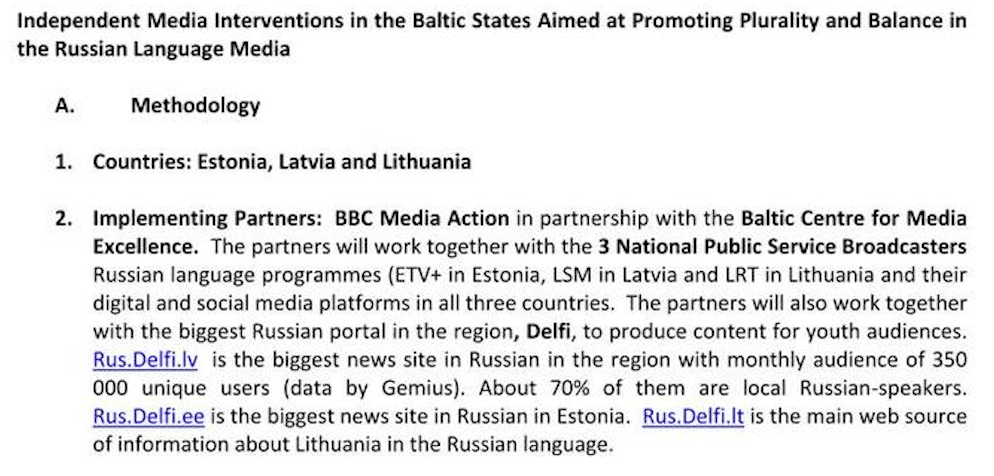
A year later, the FCO’s CDMD division outlined a program to run through 2022 at a cost of $8.3 million to the British taxpayer. It aimed to establish new outlets and support preexisting media operations “to counter Russia’s efforts to sow disunity” and “increase resilience to hostile Kremlin messaging in the Baltic states.”
Thus the British government set out with an array of intelligence contractors to dominate Baltic media with pro-NATO messaging – and perhaps sow some disunity of its own.
As seen below, the BBC placed an apparently successful bid to participate in the covert Baltic program through its non-profit arm, known as BBC Media Action.
The BBC also proposed to participate in a separate UK FCO media propaganda program in Ukraine, Moldova, and Georgia. It named Reuters and a now-defunct intelligence contractor called Aktis Strategy, which participated in previous FCO CDMD programs, as key allies in its consortium.
The BBC identified local partners like Hromadske, a Kiev-based broadcast network born in the midst of the so-called Maidan “Revolution of Dignity” in 2014 that relied on ultra-nationalist muscle to remove an elected president and install a pro-NATO regime. Hromadske materialized almost overnight with seed money and logistical support from the US Agency for International Development (USAID) and billionaire media mogul Pierre Omidyar’s Network Fund.
BBC Media Action proposed working through Aktis to cultivate and grow pro-NATO media in conflict areas like the Donbas region of eastern Ukraine, where a proxy war has raged since 2014 between the Western-backed Ukrainian military and pro-Russian separatists. It was textbook information warfare, weaponizing broadcast media to turn the tide of battle in a protracted, grinding conflict.
The UK FCO propaganda campaign warned that “Kremlin-affiliated structures” could undermine the project if it was exposed. For a media organization that claims to place trust at the heart of its charter of values, the BBC was certainly operating under a high degree of secrecy.
The UK FCO’s meddling in Eastern Europe and the Baltics created a feeding frenzy among contractors seeking to provide “capacity building” and media development assistance on Russia’s periphery. Among the bidders were Reuters and veteran FCO contractors that had participated in an array of information warfare campaigns from Syria to the British home front.
The Consortium
Among the intelligence contractors bidding to participate in the UK FCO-funded Consortium were the Zinc Network and Albany Communications. As journalist Kit Klarenberg noted in a February 18 report on the recent FCO leaks, these firms “boast staff possessed of [security] clearances, individuals who previously served at the highest levels of government, the military and security services. They furthermore have extensive experience in conducting information warfare operations on London’s behalf the world over.”
Previously known as Breakthrough, Zinc has contracted for the UK Home Office to covertly implement media projects propagandizing British Muslims under the auspices of the Prevent de-radicalization initiative. In Australia, Zinc was caught running a clandestine program to promote support for government policies among Muslims.
Ben Norton reported for The Grayzone on Albany’s record of “secur[ing] the participation of an extensive local network of over 55 stringers, reporters and videographers” to influence media narratives and advance Western regime-change goals in Syria, while conducting public relations services on behalf of extremist Syrian militias funded by NATO member states and Gulf monarchies to destabilize the country.
In its bid for the UK FCO media program in the Baltic region, Albany proposed a series of satirical “interactive games” like “Putin Bingo” to encourage opposition to the Russian government and exploit “frustrations experienced by Russians in the EU.”
Albany pitched a Latvia-based outlet called Meduza as “a leading proponent of these games.” A top website among Russian opposition supporters, Meduza has received financial support from the Swedish government and several billionaire-backed pro-NATO foundations.
As a UK FCO contractor, the Zinc Network said it was “delivering audience segmentation and targeting support” not only to Meduza, but also to Mediazona, a supposedly independent media venture founded by two members of the anti-Kremlin performance art group Pussy Riot.
One of Mediazona’s founders, Nadya Tolokonnikova, shared a stage with former US President Bill Clinton at the Clinton Foundation’s 2015 conference. The following year, Tolokonnikova trashed now-imprisoned Wikileaks founder Julian Assange, claiming, “He’s connected with the Russian government, and I feel that he’s proud of it.”
Besides delivering “targeting support” for “independent” outlets pushing the right line against the Kremlin, Zinc proposed leveraging UK FCO funding into a program of direct payments and gaming Google search results in their favor. The intelligence cut-out was explicit about its desire to reduce the search visibility of the Russian government-backed broadcaster RT.com.
The UK covertly funded and managed a network of Russian YouTubers and “activated” anti-government protest content
In a document marked “private and confidential,” Zinc revealed the Consortium’s role in setting up a “YouTuber network” in Russia and Central Asia designed to propagate the message of the UK and its NATO allies.
According to Zinc, the Consortium was “supporting participants mak[ing] and receiv[ing] international payments without being registered as external sources of funding,” presumably to circumvent Russian registration requirements for foreign-funded media outfits.
Zinc also helped the YouTube influencers “develop editorial strategies to deliver key messages” while working “to keep their involvement confidential.” And it carried out its entire program of covert propaganda in the name of “promoting media integrity and democratic values.”
Perhaps the most prominent Russian YouTube influencer is Alexei Navalny, a previously marginal nationalist opposition figure who was nominated for a Nobel Prize after becoming the target of a high-profile poisoning incident that brought relations between Russia and the West to its post-Cold War nadir.
The Russian government’s sentencing of Navalny to a 2.5-year prison term for evading parole has inspired a new wave of anti-government protests. Back in 2018, Navalny personally co-sponsored national demonstrations against the banning of the encrypted messaging app Telegram.
In its bid for a UK FCO contract, Zinc revealed that it played a behind-the-scenes role “to activate a range of content within 12 hours of the recent telegram protests.” Whether those activities involved Navalny or his immediate network was unclear, but the private disclosure by Zinc appeared confirm that British intelligence played a role in amplifying the 2018 protests.
Russian intelligence services have released sting video footage showing Vladimir Ashurkov, the executive director of Navalny’s FBK anti-corruption organization, meeting in 2013 with a suspected British MI6 agent named James William Thomas Ford, who was operating out of the British embassy in Moscow. During the rendezvous, Ashurkov can be heard asking for 10 to 20 million dollars to generate “quite a different picture” of the political landscape.
In 2018, Ashurkov’s name appeared in leaked documents exposing a covert, UK FCO influence network called the Integrity Initiative. As The Grayzone reported, the Integrity Initiative operated behind the cover of a think tank called the Institute for Statecraft, which concealed its own location through a fake office in Scotland.
Run by a group of military intelligence officers, the secret propaganda group worked through clusters of media and political influencers to escalate tensions between the West and Russia. Listed among the London cluster of anti-Russian influencers was Ashurkov.
The Integrity Initiative’s military directors outlined their agenda in stark, unequivocal terms. As the leaked memo below illustrates, they aimed to exploit the media, think tanks and their influence network to stir up as much hysteria about Russia’s supposedly malign influence as possible. Since they embarked on their covert campaign, nearly all their wishes have come true.
Bellingcat joins the Zinc Network, allegedly meddles in Moldova’s elections
After Alexei Navalny’s poisoning, he collaborated with the UK-based “open source” journalism outfit Bellingcat to pin the crime on Russia’s FSB intelligence services. Though it is well established that Bellingcat is funded by the National Endowment for Democracy, a US government entity that supports regime-change operations around the globe, the fact has never appeared in the reams of fawning profiles that corporate media outlets, including Reuters, have published about the organization.
Bellingcat’s role as a partner in the Zinc Network’s UK FCO-funded EXPOSE Consortium may add an additional layer of suspicion about the outlet’s claim to independence.
Indeed, Bellingcat was listed in leaked 2018 documents as a key member of Zinc’s “Network of NGOs.” Among the members in the network was the Institute for Statecraft, the front for the Integrity Initiative.
Bellingcat founder Eliot Higgins has vehemently denied accepting funding from the UK FCO or collaborating with it. But after Zinc documents leaked in early 2019, Higgins disclosed that some version of the Zinc proposal had received the green light from the Foreign Office.
Christian Triebbert, a Bellingcat staff member who was named as a potential trainer by the Zinc documents, and who now heads the New York Times’ video investigations unit, claimed the program consisted of benign workshops on “digital research and verification skills.”
What he and Higgins did not mention, however, was that Bellingcat had apparently been dispatched by the Zinc Network to “respond” to the 2019 parliamentary elections in North Macedonia. Stakes were high as the elections were likely to determine whether the tiny country would enter NATO and join the EU. The pro-NATO candidate triumphed, and not without a little help from the British Foreign Office and its allies.
According to the Zinc proposal, Bellingcat provided training to the Most Network, a Macedonian media outlet. It was joined by DFR Lab, a project of the NATO- and US government-funded Atlantic Council in Washington, DC.
After apparently participating in the covert UK FCO-funded intervention in North Macedonia, Bellingcat published an article ahead of the country’s 2020 parliamentary elections entitled, “Russia’s interference in North Macedonia.”
Several Zinc Network documents list Reuters as a member of the UK FCO-funded Consortium media intervention in the Baltic states.
Asked by The Grayzone how Reuters’ participation in UK FCO-funded programs aimed at countering Russia conformed to the news organization’s Trust Principles, spokesperson Jenny Vereker stated, “This funding supports our independent work to assist journalists and journalism all over the world, as part of our mission to strengthen a free and vibrant global media ecosystem to support a plurality of voices and preserve the flow of accurate and independent information. This is because accurate and balanced news coverage is a crucial pillar of any free, fair and informed society.”
In recent years, the BBC and Reuters have played an increasingly aggressive part in demonizing the governments of countries where London and Washington are seeking regime change. Meanwhile, high-profile online investigative outlets like Bellingcat have sprouted up seemingly overnight to assist these efforts.
With the release of the UK FCO documents, questions must be raised about whether these esteemed news organizations are truly the independent and ethical journalistic entities they claim to be. While they hammer away at “authoritarian” states and malign Russian activities, they have little to say about the machinations of the powerful Western governments in their immediate midst. Perhaps they are reluctant to bite the hand that feeds them.
The poisoning of Alexei Navalny has created intensified support by pro-U.S., and especially pro-NATO, officials in the European Union, to block the nearly completed NordStream 2 natural-gas pipeline from Russia to Germany, and to import into the EU, instead, far costlier U.S. LNG, liquefied natural gas. A very real possibility thus now exists that the poisoning of Navalny will turn out to have been worth many billions of dollars to U.S. frackers, by causing the nearly-completed NordStream 2 to be turned to waste so that fracked U.S. LNG will sell in Europe. The present article will explore the relative likelihood that the poisoning of Navalny isn’t merely coincidentally perfectly timed in order to achieve that objective for the benefit of America’s gas-industry, but that it probably was actually planned and perpetrated in order to achieve this.
The idea that the Russian Government poisoned Alexei Navalny presumes such astounding stupidity on the part of Russia’s Government as to be exceedingly dubious, at best. Navalny, though he actually is favorably viewed by only around 2% of Russians (as indicated in polls there), is widely publicized in U.S.-and-allied media as having instead the highest support by the Russian people of anyone who might challenge Vladimir Putin for Russia’s leadership. It’s a lie, and always has been. Other politicians have far higher polled support in Russia. For example, whereas in the latest poll, published on September 5th, Navalny was one of four individuals who had 2%, Zhirinovsky had 5% and Zhirinovsky was the only person who had more than 2%, other than Putin, who had 56%. In the 2018 Presidential election, Zhirinovsky polled at 13.7%, Grudinin polled at 12.0%, and Putin polled at 72.6%. The actual election-outcome was Putin 76.69%, Grudinin 11.7%, and Zhirinovsky 5.65%. The idea that Putin would need to kill anyone in order to be leading Russia is so stupid and uninformed (and mis-informed) that it is beyond belief, though it is widely publicized in The West as being instead the reality. But what is true is that Navalny has been an immense propaganda-asset to the U.S. Government, and he now is especially so.
Even America’s CNN let slip, in a news-report on September 18th, regarding Navalny, that “his list of enemies is as long as it is powerful,” but they said nothing about whom those “enemies” might be. No one questions that Navalny claims to be an anti-corruption campaigner, and that this would generate enemies regardless of whether his accusations are truthful. The article on “Alexei Navalny” at Wikipedia, which is CIA-edited and written, and which blacklists (blocks from linking to) sites that aren’t CIA-approved, indicates that Navalny has accused numerous individuals of corruption, but not that any of those individuals is corrupt — and this is at a site (Wikipedia) which can reasonably be expected to link to documentation of any damning evidence that Navalny has come up with. But the article doesn’t link to any. The article does make clear that Navalny has been hoping to use these accusations in order to rise in Russian politics. It would be a dangerous way to rise in any nation’s politics, regardless of whether those accusations are true. The idea that Putin was behind this is insane. Is Putin so stupid as to poison the U.S. regime’s most-heavily propaganda-favored Russian precisely at the time when the EU is about to grant final approval to Russia’s vast (and virtually completed) NordStream 2 pipeline?
The US has long opposed Nord Stream 2 and in December imposed sanctions against companies involved in its construction. That move prompted Swiss pipe-layer Allseas to suspend its work with just 6 per cent left to install. A group of US senators from across the political divide are pushing to extend those sanctions.
Criticism of the project has grown in Europe too, with opponents saying it will increase Europe’s dependence on Russian energy exports at a time of rising tensions with Moscow. In her State of the Union address on Wednesday, European Commission president Ursula von der Leyen said: “To those that advocate closer ties with Russia, I say that the poisoning of Alexei Navalny with an advanced chemical agent is not a one-off. This pattern is not changing — and no pipeline will change that.
The U.S. regime’s agent, von der Leyen, is doing her utmost to serve U.S. LNG marketers. Many other U.S.-regime agents also are.
On September 17th, America’s neoconservative (or pro-U.S.-empire) Newsweek bannered “Opinion: Open Letter: For the Sake of Transatlantic Security, Stop Nord Stream 2,” with 114 signatories of NATO-related U.S. and European officials, and published their argument that, “Over the past decade, the Government of the Russian Federation has engaged in a litany of malign activities aimed at upending liberal democratic norms across Europe and North America. The shocking poisoning of Russian opposition leader Alexei Navalny by a variant of the weapons-grade nerve agent Novichok shows that Moscow has not been deterred by Western actions and statements and refuses to reverse its destabilizing political adventurism at home and abroad.”
How blatant and scummy can a marketing campaign get?






 After the Crash