
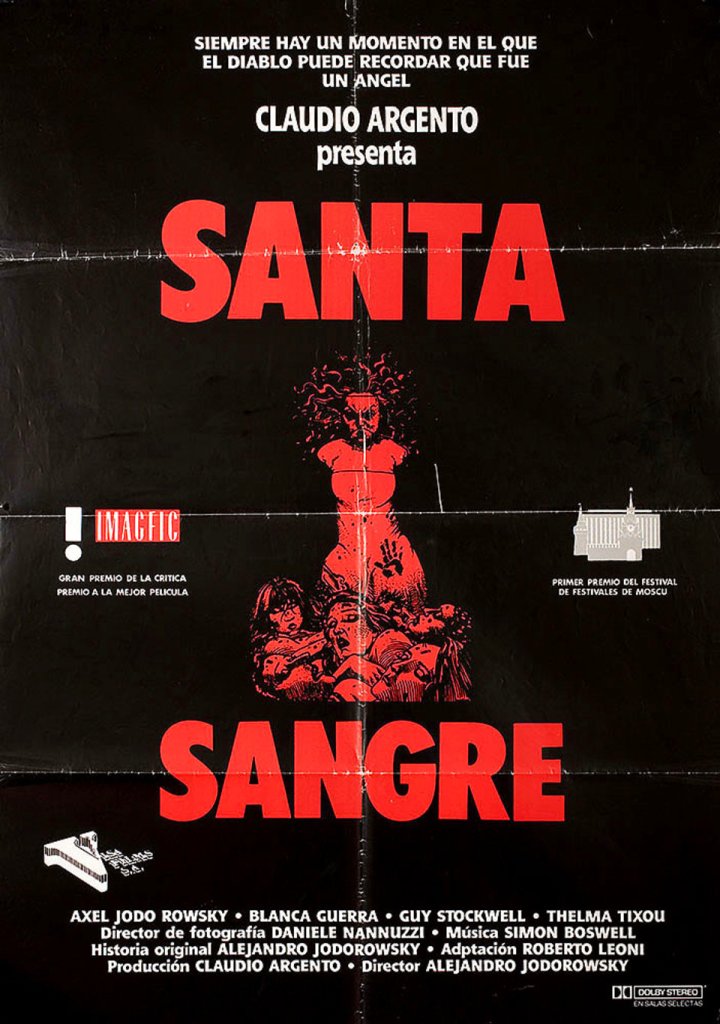
Saturday Matinee: Santa Sangre

By Roger Ebert

Source: RogerEbert.com

To call “Santa Sangre” (1989) a horror film would be unjust to a film that exists outside all categories. But in addition to its deeper qualities, it is a horror film, one of the greatest, and after waiting patiently through countless Dead Teenager Movies, I am reminded by Alejandro Jodorowsky that true psychic horror is possible on the screen–horror, poetry, surrealism, psychological pain and wicked humor, all at once.

The movie involves the perverse emotional and physical enslavement of a son by his mother–a control all the more macabre when we learn, late in the film, the secret of its actual nature. It is also about an instinctive hatred between characters representing lust and chastity, which are both seen as perversions in a world without a sane middle way. This bold subject matter is orchestrated by Jodorowsky in a film that inspires critics to make lists, calling it Jungian, surrealistic, Felliniesque, Bunuelian, sadomasochistic, expressionist and strongly flavored by such horror classics as “The Beast With Five Fingers,” “The Hands of Orlac” and the film that guides the hero’s fantasies, “The Invisible Man.”

The story involves Fenix, the boy magician at the Circus Gringo, a shabby touring show in Mexico. Played by two of Jodorowsky’s sons (Adan at about 8, Axel at about 20), Fenix is the child of the beautiful trapeze artist Concha (Blanca Guerra) and the bloated circus owner and knife-thrower Orgo (Guy Stockwell). Always at Fenix’s side is the dwarf Aladin (Jesus Juarez), who acts as his assistant and moral support.

The little magician’s best friend is Alma (Faviola Elenka Tapia and, when older, Sabrina Dennison). She is a deaf-mute mime, the daughter of the carnal Tattooed Woman (Thelma Tixou), who works as the target for Orgo’s knives. One night when Concha is suspended above the circus ring by her hair, she sees Orgo caressing the Tattooed Lady and screams to be brought back to earth. In a rage, she surprises them in bed and throws acid on Orgo’s genitals. Bellowing with pain, he severs her arms with mighty thrusts of two knives. Then he kills himself, the acid having rendered him uninteresting to women tattooed and otherwise.

Concha’s mutilation is a cruel irony: She is the leader of a cult of women who worship a saint whose arms were cut off by rapists. Their church contains a pool of blood, no doubt suggesting menstrual fluid (Concha’s name is Mexican slang for the vagina); its members wear tunics with crossed, severed arms. When authorities arrive to bulldoze the church, there is a clash between the women and the police, and then a shouting match between Concha and the local monsignor, she screaming that the pool contains holy blood, he replying that it is red paint.

The bulldozing reveals the shabby construction of the church, mostly made of corrugated iron and possibly reflecting the film’s limited budget. If Jodorowsky’s funds were limited, however, his imagery and imagination are boundless, and this movie thrums with erotic and diabolical energy. Consider the scene where the circus elephant dies after hemorrhaging from its trunk. In a funeral both sad and funny, the beast’s great coffin is hauled by truck to a ravine and tipped over the edge–to the delight of wretched shanty-dwellers, who rip open the casket and throw bloody elephant meat to the crowd. An image like this is one of the reasons we go to the movies: It is logical, illogical, absurd, pathetic, and sublimely original. For Alejandro Jodorowsky, all in a day’s work.

Now 74 and at work on his first film in 14 years, Jodorowsky is a legendary man of many trades. Born in Chile, living mostly in Mexico and Paris, he works here in English, which has been imperfectly dubbed; oddly enough, the oddness of the dubbing adds to the film’s eerie quality.

Jodorowsky has occupied the edges of the arts. He was a clown and puppeteer, studied under the mime Marcel Marceau, filmed a mime version of Thomas Mann’s play “The Transposed Heads,” was a friend of the surrealist Arrabal, and is, in his own words, a “very famous comic-strip artist,” the author of graphic novels that have become legendary.

He is also the author of the legendary cult film “El Topo” (1970), which was both saved and doomed by John Lennon. Saved, because Lennon admired it so much, he asked his manager, Allen Klein, to buy and distribute it. Doomed, because after the film became a worldwide sensation (Jodorowsky told me in 1989) “Klein made it disappear. He says, ‘I am waiting until you die, and then I am going to have a fortune.’ He thinks he’s immortal. If he dies first, I get the film back.” So far, both men are still alive and “El Topo” is not available on video.

Jodorowsky’s visionary world owes much to the surrealists, but even more to the quirky films that Luis Bunuel made during his Mexican exile, films showing men quietly obsessed with the details of their fetishes. Fenix, his hero, is literally a man whose world is defined by his obsessions. The witness to his mother’s mutilation and his father’s suicide, he is in an insane asylum when the film opens, perched atop a tree trunk. When he returns to the world, it is to play the role of his mother’s arms and hands. He walks behind her, slips his arms through the sleeves of her garments and feeds her, plays the piano, gestures, and even caresses her body as if it is his own. Axel Jodorowsky and Blanca Guerra do this with such perfect timing that the hands seem to sense the next thought of the mother. But Fenix has no identity except as her instrument, which is why “The Invisible Man” appeals so strongly.

The first half of the film is filled with Felliniesque exuberance, celebrating the circus with its tawdry charms and sad clowns. The second half is somber and creepy, as in a scene where Fenix and four young men with Down syndrome are taken on a movie outing that ends (not unhappily) with cocaine and a visit to the red-light district.

Fenix eventually moves with his mother into a house where timbers lean everywhere at crazy angles for no apparent reason, except to evoke expressionism. And here he begins his revolt. As his mother jealously uses his hands to kill one woman after another, he recruits a muscular giantess who will be able, he thinks, to fight off any attack.

This giantess is pretty clearly a man in drag, but the movie makes no notice of that fact, and indeed many oddities pass unremarked, including the omnipresent doves and the ability of the Tattooed Lady, the dwarf and the deaf-mute girl to materialize in Fenix’s life when and how he needs them. All is finally made clear at the end, revealing how fearlessly Jodorowsky has married magic realism to Freud, in a film that is like a shriek against Momism.

Of course the movie is rated NC-17. I believe more horror films should be made for adults, so that they are free to deal with true malevolence in the world, instead of retailing the pornography of violence without consequences. A generation is growing up that equates violence with action, instead of with harm. Not long ago “The Exorcist” was re-released and some young moviegoers laughed all the way through it. A society that laughs at evil eventually laughs at good, and then it loses its way.

The quality that Jodorowsky has above all is passionate sincerity. Apart from his wildly creative style, apart from his images, apart from his story inventions, he has strong moral feelings. He has an instinctive sympathy for Fenix, who was born into a world of fanaticism and cruelty, and has tried, with the help of a deaf girl and a dwarf, to get back the soul that was warped by his father and trapped by his mother. Maybe one difference between great horror films and all the others is that the great ones do not celebrate evil, but challenge it.

Watch Santa Sangre on Kanopy here: https://www.kanopy.com/en/product/6683745

Saturday Matinee: Forget Everything You Have Ever Seen: The World of Santa Sangre

In the 1970s, his legendary films El Topo and The Holy Mountain redefined movies as both art and entertainment while changing the face of cinema forever. In 1989, after his dream project Dune fell apart and a resultant decade-long break from cinema, visionary filmmaker Alejandro Jodorowsky returned with his most triumphant work: SANTA SANGRE.  Forget Everything You Have Ever Seen is a feature-length documentary on the making of Santa Sangre featuring interviews with the cast and crew.

Watch for free on Kanopy here: https://www.kanopy.com/product/forget-everything-you-have-ever-seen-world

Saturday Matinee: Viva la Muerte

“Viva la Muerte” (1971) is a French-Tunisian drama film shot in Tunisia and directed by Fernando Arrabal, one of the founders of the Panic Movement (with Alejandro Jodorowsky and Roland Topor). The film takes place at the end of the Spanish Civil War, telling the story of Fando, a young boy whose father was turned in to authorities as a suspected communist by his fascist-sympathizing mother. It has gained cult popularity as a midnight movie. The opening credits sequence features drawings by acclaimed artist, actor and novelist Roland Topor.

Watch the full film on Kanopy here.

Jodorowsky’s new film ENDLESS POETRY (Poesía Sin Fin)

jodorowsky_endless_poetry_poster

By Satori Films

Source: Kickstarter

Alejandro Jodorowsky, father of the midnight movie, wants to exchange your money into Poetic Money to make his latest film.

About this project

I was trying not to prepare anything. I didn’t want to prepare what I was going to say to you. Why? Because I am searching for my inner truth, I want to know what will I say. In two more days I will be 86 years old… it’s a lot. Why, at 86 years of age, am I fighting to make a picture? Why? Nothing is that important for me. Is it so important for a person who can die one day to the other, to make a picture? Because when you are 86 years old, every morning you awake and you say “I am still alive”. You are happy to be alive but you are maybe at the end of something. Why make a picture? What is a picture? Some pictures are only fun and show. It’s necessary, because in the world we are all nervous about everything that’s happening, no? They even say we are destroying the planet. So we need to go, to see a picture, to forget ourselves. Perhaps this is necessary, but for me a picture is not that. For me a picture is for remembering your self, not for forgetting yourself. But what does it mean to remember your self? What can we remember? For me, movies are really an art. And what is art? It is the search for your inner beauty. That is art. I don’t want to make a picture in order to make money. But if money comes, I open the pocket in order to make more pictures. But that’s not the finality. It’s not the finality to being admired by others. It’s not the finality to lie and invent things you’ve never lived.

In order to say something you need to know the thing you’re speaking of. It needs to be an experience, what you show on the screen. What will I show in this picture? What are human beings, art, museums and movie theatres showing to us? Are we those anti-heroes? Those people who have no dignity? We are slaves? We are liars? Thieves? What are we now? I don’t want to show that kind of person. I don’t know how to make pictures of everyone fighting one another, to have money, to steal money Why ?! I don’t want to speak about “love” either; about this “love” that isn’t real, that’s a fairytale. Love is something great, incredible, “sublime”… I don’t know how you say “sublime” in English… The most beautiful thing. Marpa was a saint in Tibet and he said “ Life, everything, is an illusion”. One day his son died, his young son died and he was crying and crying and crying and the disciples asked Marpa “Why are you crying? Your son is an illusion.” “Yes, my son is an illusion. But he is the most beautiful illusion.” Movies are an illusion but need to be the most beautiful illusion. I know what it’s like to scream because one of your sons died. It’s terrible. It’s terrible And in that moment you ask yourself, “ Why am I doing art, movies? Why?!” and then you say I am making movies and art in order to heal my soul. I need to open! Open ! open ! myself, in order to fin myself. To remember what the human being is. The beautifulness of the human being. The beautifulness of you. I need to show how beautiful the human being is. Now.

In Chile, in the forties, I was 24 years old… it was a fantastic moment. The war was all over the planet, and in Chile : no war. Because we are far and separate of the world: no television, mountains, ocean, peace! It was so peaceful. It was beautiful. And then a miracle happened : Poetry came to the country. Great poets started to write marvelous, marvelous poems; two of them have the Nobel Prize, Pablo Neruda and Gabriela Mistral – our father and our mother.

And then, everything was poetry. We were living our adolescence in this situation: poetry everywhere. And we started to search for the “poetical act”. For how it was to live with beautifulness. How it was to live in the mind: free! In heart : in union with world. In the sex: in full creativity.

How to make poetical action in order to discover the beautifulness of Life. There it was. In that time, the poetry was there. The human being was there. We had love, we had artists, we discovered all kinds of art.

And that suddenly disappeared. When I was 24 I left this paradise, and went to Europe where the world is illusion or disillusion, you don’t know.

But now I want to show what a spiritual paradise is: a young person, searching for the beautifulness of poetry. That is all that I want. I want to express… how to say it in English?… How I am obliged to this past… because I knew how it was to live in poetry. I knew that. And I want to show the world that it’s possible. It’s possible to remember your self. It’s possible to open your mind. It’s possible to open your heart. It’s possible to open your creativity. To live with less, but to live well. Well. That is what I want. Poetry without end. Endless Poetry. That is what I will do.


ENDLESS POETRY(Poesía Sin Fin) Official site: http://www.poesiasinfin.com/

After a 23 yearlong absence, the director of cult classics El Topo (1969) and Holy Mountain (1973) made his comeback in film direction in 2013 with The Dance of Reality. The film was based on the first part of Alejandro Jodorowsky’s homonymous autobiographical book, depicting his childhood years in Tocopilla, Chile. His new film ENDLESS POETRY (Poesía Sin Fin) will be based on the latter half of the same book, depicting the author’s youth in lively Santiago de Chile.

Our world is suffering from a devastating absence of poetry. Naïvely we sometimes hope to reconnect with it through film. But the greed-riddled industry, having colonized this magnificent art form, has done everything to strip it of its poetic power. With this film, Jodorowsky directs his energy more than ever into creating a film that can serve as a vehicle for awaking consciousness. It is our duty to enable all efforts to fight the powers that insist on lowering cinema to just a product in a commercial market. This film will bring forth an example of film’s poetic power.

ENDLESS POETRY (Poesía Sin Fin) flashes back to those decisive years in Alejandro Jodorowsky’s youth; years that defined the principle that would reign over his entire life: Poetry. The director’s life has been a constant effort to expand his imagination and push back against his own limits in order to apprehend and harness the potential for liberation that lies within each and every one of us. His career has been an open invitation to follow him in his efforts.

ENDLESS POETRY (Poesía Sin Fin) will be carried out as an offering both to film and to the general audience, who are infinitely more profound, intelligent and sensitive than the Hollywood industry would like to admit.

ENDLESS POETRY (Poesía Sin Fin) explores the magic reality underlying our surrounding world. The film seeks to inspire and encourage us all to dare to find our true selves. It is an invitation to Life.

Synopsis

Leaving his childhood and his native Tocopilla behind, the adolescent Alejandro Jodorowsky follows his parents to Santiago de Chile. Between his lack of self-confidence and the family pressure he is under, Alejandro struggles to express his desires and find his own path. But the flourishing capital, filled with artists and poets offers the perfect setting for him to grow out of his cage. Thinking he’d fit in well, Alejandro’s cousin Ricardo takes the young boy to the home of Veronica and Carmen Cereceda, where puppeteers, dancers, sculptors and painters all live and create together. There, defying all of his old limitations, Alejandro takes the first step on his path to becoming a poet in the Chilean artistic epicenter of the 1940s. Alongside rising poets like Enrique Linh, Nicanor Parra and in the arms of his first love, Stella Diaz, Alejandro’s poetic destiny takes form and a new world unravels … changing his life forever.

Production Schedule and Budget

The film will be shot in Santiago de Chile from July to August 2015 for eight weeks. Its post-production such as editing, music tracks, visual effects and so forth will take place in Paris and Tokyo with completion slated for the end of February 2016. The total buget will be about three million dollars.

Why Kickstarter?

Alejandro Jodorowsky says; « The necessity for expression is more important than the type of film you want to make. I make a film when I have something I need to express. I don’t think about investors, industries or commercialisation. I just need to express myself.

In order to realize Jodorowsky’s new film production, we need the support of micro producers across the world who understand his vision of cinema.

Jodorowsky’s Poetic Money

Jodorowsky thinks that all money should be transformed into poetry. And so that is what he will do with this Kickstarter project. No matter what level you pledge at, Jodorowsky will exchange your pledge into his brand new Poetic Money (DINERO POÉTICO) and send it back to you. This money can’t be spent on any material goods — only on the poetry of the universe.

The exchange rate is 1US$=1DP.

(In the case of $10,000 or more pledge, it is 0.5US$=1DP)

There are 3 bill denominations: 1DP, 10DP and 100DP. Each bill has an original money-related poem written by Jodorowsky printed on it in Spanish. There are two versions of each DP bill, each version of the bill presenting a different poem. There are 6 kinds of bills in total.

Jodorowsky wants to fill the world with poetry. So when you pledge, please mumble a poem in your heart. If you have a twitter account, please tweet a poem with #EndlessPoetryMyPoem. Your poem will be on the official site of ENDLESS POETRY (Poesía Sin Fin).

Jodorowsky’s Poems About Money and Wealth

 <1 Dinero Poético>

1 dinero poético – A
Money is like the Buddha; you can’t obtain it unless you work for it. If you keep it from flowing, it disappears.

1 dinero poético – B
To those who use it to make the flower of the world blossom, money gives its light. Those who glorify themselves, mistaking wealth for the soul, money destroys.

<10 Dinero Poético>

10 dinero poético – A
In pursuance of wealth I throw a spear through the Goddess and bathe in her blood.

10 dinero poético – B
Just as gold does not cease to shine when clouds cover the sun, the soul, beneath flesh and bone, continues to glow with its own light.

<100 Dinero Poético>

100 dinero poético – A
There is no difference between money and consciousness.
There is no difference between consciousness and death.
There is no difference between death and wealth.

100 dinero poético – B
Money is like blood: it gives life if it flows.
Money is like the Christ: it blesses you if you share it.
Money is like a woman: it offers itself to you if you cherish it.

Read more and/or back the project at Jodorowsky’s Kickstarter Page.