From Chi-Town bagman to ECOWAS chairman: meet the former money launderer leading the push to invade Niger

By Alexander Rubinsteain and Kit Klarenberg

Source: The Grayzone

Since the overthrow of Niger’s US-friendly government, West African nations of the ECOWAS bloc have threatened an invasion of their neighbor.

Before leading the charge for intervention, ECOWAS chair Bola Tinubu spent years laundering millions for heroin dealers in Chicago, and has since been ensnared in numerous corruption scandals.

Hours after Niger’s Western-backed leader was detained by the country’s presidential guard on July 28, Nigerian President and chair of the Economic Community of West African States (ECOWAS) Bola Tinubu leapt into action, warning that the group of nations “will not tolerate any situation that incapacitates the democratically-elected government.”

“As the Chairperson of ECOWAS…I state without equivocation that Nigeria stands firmly with the elected government in Niger.”

Two days later, ECOWAS imposed severe sanctions on Niger, and the bloc issued a stark ultimatum: if the newly-inaugurated junta won’t reinstall the ousted president in a week’s time, the group’s pro-Western African governments will — by military means, if necessary. 

On Saturday, July 6 — one day before the deadline — ECOWAS leaders approved a plan to invade the country, with the ominous caveat that they are “not going to tell the coup plotters when and where we are going to strike.”

If ECOWAS gets its way, member states Benin, Cabo Verde, Côte d’Ivoire, The Gambia, Ghana, Guinea Bissau, Liberia, Nigeria, Sierra Leone, Sénégal and Togo will be pressured to send their soldiers to invade Niger.

These developments have thrust the typically-overlooked West African country of Niger into the Western media spotlight. But if hostilities break out, it wouldn’t just be one single impoverished African state in the crosshairs.

Neighboring Burkina Faso, Mali and Guinea, which are also governed by military administrations that recently seized power by force, have all warned that any attack on Niger will be viewed as an attack on them too. If their ECOWAS rivals make the first move, the nations which mainstream media have dubbed Africa’s “coup belt” have pledged to unleash their military forces as well — an announcement which should end any illusions that restoring the country’s previous president would be a painless process.

Leading the pro-Western coalition is the president of its most powerful country, Nigeria: Bola Tinubu. One of Nigeria’s wealthiest men, the source of the scandal-plagued president’s fortune remains unclear.

Documents reviewed by The Grayzone reveal Tinubu as a longtime US asset who was named as an accomplice in a massive drug running operation that saw him launder millions on behalf of a heroin-dealing relative. 

Bola Tinubu’s career marred by drug-trafficking, corruption allegations

For over 30 years, Bola Tinubu has been a major force in Nigeria’s political scene and the country’s economy, with local nicknames ranging from “the Mother of the Market” to “the Godfather of Lagos” and “the Lion of Bourdillon.” But his power inside Nigeria went largely unnoticed by international audiences until 2023, when he became ECOWAS chair after winning the presidency in an election closely tracked by the US government.

As president, Tinubu quickly instituted a regime of economic reforms backed by the US-controlled International Monetary Fund and the World Bank. Over the course of Tinubu’s political career in Nigeria, the African operator has cultivated a close relationship with the US embassy. According to a slew of classified State Department cables released by WikiLeaks, American officials relied heavily on Tinubu’s assessments of the domestic political landscape.

The ECOWAS chair’s early life is shrouded in mystery, and even his exact age is unknown. Nearly every detail of Tinubu’s personal history — prior to his appearance in Chicago on a student visa — is in dispute, including his legal birth name.

Records from Chicago State University show that Tinubu received a degree in Business Administration in 1979. In the following years, media reports indicate that Tinubu was employed in some capacity at a number of major US-based multinationals, including Mobil Oil Nigeria, consulting firm Deloitte, and GTE, which was the largest communication and utilities company in the US at the time.

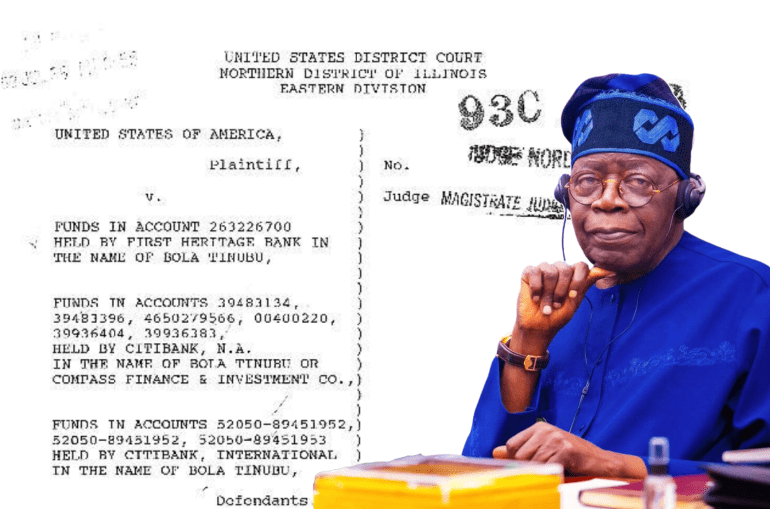
Of the few details about the Nigerian President’s early exploits which can be confirmed, many are derived from a 1993 court docket naming Tinubu as an accomplice in a massive midwestern drug smuggling operation. 

As journalist David Hundeyin has detailed, court documents from the US District Court’s Northern District of Illinois make it clear that Tinubu amassed a small fortune laundering money for a heroin-trafficking relative in Chicago, and that US government officials ultimately seized well over a million dollars from various bank accounts registered under the current Nigerian president’s name.

A 1993 report by IRS Special Agent Kevin Moss explained that “there is probable cause to believe that funds in certain bank accounts controlled by Bola Tinubu… represent proceeds of drug trafficking; therefore these funds are forfeitable to the United States.”

In the documents, Moss describes an extremely close working relationship between the future Nigerian president and two Nigerian heroin dealers named Abiodun Olasuyi Agbele and Adegboyega Mueez Akande, the latter of whom was listed as Tinubu’s cousin on an application for a vehicle loan.

“According to bank employees, when Bola Tinubu came to First Heritage Bank in December 1989 to open the accounts, he was introduced to them by Adegboyega Mueez Akande, who at that time maintained an account at the bank.” What’s more, bank records indicate that “Bola Tinubu also opened a joint checking account in his name and the name of his wife, Oluremi Tinubu,” who had “previously opened a joint bank account also at this bank with Audrey Akande, the wife of Adegboyega Mueez Akande,” Moss explained. In several of the applications, the addresses used by Tinubu exactly matched those previously used by Akande.
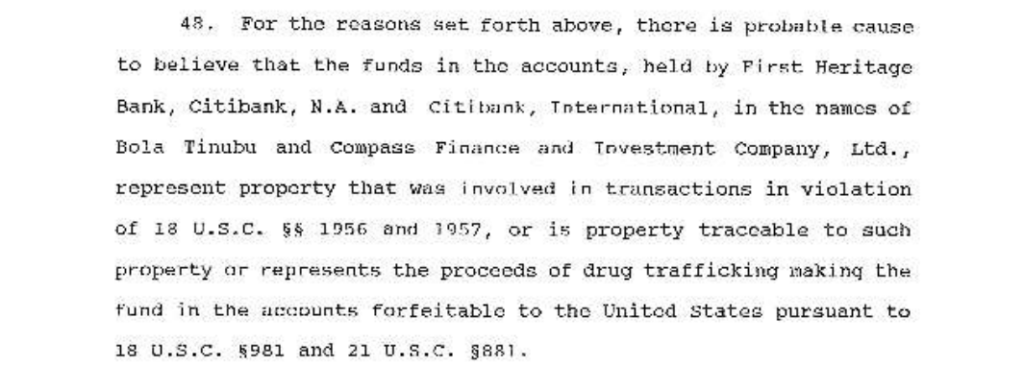
“According to bank records… Tinubu opened an individual money market account and a NOW account” at First Heritage Bank in December 1989, the special agent noted. “In the application, Tinubu stated that his address was 7504 South Stewart, Chicago, Illinois” — “the same address used previously by Akande.”
“Bank records disclosed that five days after the account was opened, on January 4, 1990, $80,000 was deposited into the NOW account at First Heritage Bank by wire transfer through First Chicago from Banc One Houston,” the report continues. According to the IRS, the money was sent by Akande.

But the Nigerian president’s financial dealings with the heroin traffickers went even further, according to the IRS special agent. He wrote that Citibank records documented “two additional corporate accounts held in the name of Compass Finance and Investment Company, Ltd. which were controlled by Bola Tinubu.”

“When Bola Tinubu opened these accounts,” he provided “a memorandum of association and articles of association” which “identified Mueez Adegboyega Akande and Abiodun Olasuyi Agbele as directors of Compass Finance and Investment Company, Ltd.,” Moss wrote.

In the end, Tinubu somehow managed to deposit over $660,000 in his First Heritage Bank account in 1990, and more than $1.2 million the next year — all while claiming to take home just $2,400 a month from his position at Mobil Oil Nigeria.

As the investigation into the money laundering scheme began to gain traction, Tinubu left the US and returned to Nigeria. Ultimately, Moss was able to speak to Tinubu by telephone on a number of occasions, and the special agent reported that the future president initially acknowledged his personal and financial dealings with the pair of drug traffickers. 

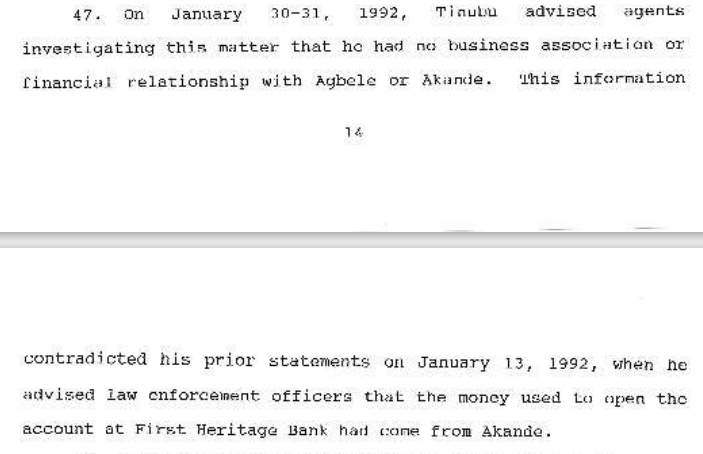
But in late January of 1992, “Tinubu advised agents investigating this matter that he had no business association or financial relationship with Abele or Akande,” Moss wrote. “This information contradicted his prior statements on January 13, 1992, when he advised law enforcement officers that the money used to open the account at First Heritage Bank had come from Akande.”

Back in Nigeria, Tinubu had already begun to transition into the political arena. By 1992, he’d been elected to the Senate, and in 1999 he became the Governor of Lagos State, a position he retained until 2007. At some point in his tenure, Tinubu established a relationship with the US Embassy which would last for years to come, according to a trove of diplomatic cables released by Wikileaks.

But even his State Department allies couldn’t help noticing Tinubu’s penchant for dishonesty. One particularly noteworthy cable pointed out that the politician was “known to play fast and loose with the facts” and “has been caught in the past embellishing his educational achievements.”

In the end, however, Tinubu’s usefulness seemed to outweigh his casual relationship with the truth, and the future Nigerian president went on to provide American officials with a near-continuous assessment of the political situation in his country. One typically intimate meeting with Tinubu ended with the US ambassador to Nigeria commenting: “as always, we found his take on the national political scene to be insightful.”

When the cables came to light in 2011, many Nigerians were shocked at the candor with which their elected officials spoke to Washington’s envoys. “The willingness of our elites to divulge unsolicited information about the nation to U.S. officials betrays an infantile thirst for a paternal dictatorship,” Nigerian-American professor and columnist Farooq Kperogi wrote.

Though Tinubu appeared to have escaped justice for his alleged role in a heroin trafficking conspiracy, accusations of corruption would continue to dog the ECOWAS chair throughout his political career in Nigeria. Since leaving office as governor of Lagos in 2007, Tinubu “picked every subsequent winning candidate,” according to German broadcaster DW, which noted earlier this year that the tycoon “is believed to be one of Nigeria’s richest politicians but the source of his wealth is unknown.”

In recent years, clues about the origins of the fortune amassed by one of Africa’s leading political players have begun to come to light.

In 2009, Tinubu came under investigation by the Metropolitan Police of London, who were probing allegations that the politician had pooled money with two other Nigerian governors to create a front company known as the “African Development Fund Incorporation.”

Investigators alleged the unusual business arrangement was actually a joint effort to illegally acquire shares of ECONET, a telecommunications firm founded by US intelligence asset and Gates Foundation trustee Strive Masiyiwa. But attempts to probe the legitimacy of the transactions in question were sidelined when the Nigerian federal government stonewalled the British investigation, which ultimately concluded without a single arrest. To this day, Nigerian authorities have yet to release the evidence requested by UK authorities.

In 2011, Tinubu was tried before the Code of Conduct Tribunal in Nigeria for illegally operating 16 foreign bank accounts. Eager to avoid the embarrassment he’d previously suffered when being photographed in court, the ECOWAS chair reportedly refused to take his place at the dock in a judicial hearing.

But the unwelcome attention appears to have done little to rein in the politician’s extravagant taste, and Tinubu once again found himself embroiled in a corruption scandal following an investigation into the luxurious 7,000-square foot mansion where the Nigerian president stays when receiving medical care in London.

According to Nigerian outlet Premium Times, the massive villa in London’s exclusive Westminster borough was picked up for a song by Tinubu’s son, who somehow managed to purchase the property at a discount of approximately $10 million from a wealthy fugitive – even though the seller’s assets, including the mansion in question, had been frozen by a Nigerian court. Photos published on social media in 2017 show Tinubu posing inside the villa alongside Nigeria’s president at the time, Muhammadu Buhari.

The current and previous president worked closely for decades, and Tinubu has publicly claimed sole credit for Buhari’s presidency while campaigning. “If it were not for me standing before you leading the army, saying ‘Buhari, go ahead, we’re behind you,’ he could never have become the president,” he told supporters at a rally last year.

But the suspicious confluence of money and influence didn’t end with the mysterious mansion in London. During Nigeria’s 2019 general election, footage of armored trucks entering Tinubu’s residence went viral on social media, and the incident was widely seen as proof that the politician was engaged in a fraudulent vote-buying scheme. But Tinubu remained defiant, telling reporters, “I keep money wherever I want.”

“Excuse me, is it my money or government money?” he asked. “If I don’t represent any agency of government and I have money to spend, if I have money, if I like, I give it to the people free of charge,” he insisted.

This January, the official explanation for the episode evolved again when one of his party’s representatives told a Nigerian TV station that the armored trucks in question had simply “missed [their] way” and arrived at the wrong address. Asked why Tinubu had seemingly admitted to dispensing cash to the public, the party’s organizing secretary in Lagos offered the bemused presenters an equally improbable explanation: “he said that jokingly.”

ECOWAS as a neocolonial weapon

While ECOWAS was officially founded via the Treaty of Lagos in 1975, its official history notes the bloc’s origins date back to the creation of the CFA Franc in 1945, which consolidated France’s West African empire into a single-currency union. Publicly, the move was described as a benevolent attempt to shield these colonies from the consequences of the French franc’s sharp devaluation in 1945, following the creation of the US-dominated Bretton Woods system. As the French finance minister said at the time:

“In a show of her generosity and selflessness, metropolitan France, wishing not to impose on her faraway daughters the consequences of her own poverty, is setting different exchange rates for their currency.”

In reality, the introduction of the CFA Franc meant that Paris was able to maintain highly unequal trading relationships with its African colonies, at a time when its economy was ravaged by World War II and its overseas empire was rapidly disintegrating. The currency made it cheap for member states to import from France and vice versa, but prohibitively expensive for them to export anything anywhere else.

This forced dependency in Francophone West Africa created a captive market for the French, and by extension the rest of Europe. That dynamic, which has stunted regional economic development for decades, persists to this day. The CFA Franc’s continued dominance ensures West African states remain under the economic and political control of France. Those African nations are powerless to enact meaningful policy changes, as they lack control over their own monetary policy.

That the currency features so prominently in the authorized history of ECOWAS is instructive, because the bloc has long-been criticized as an extension of French imperialism. It was not for nothing that in 1960, then-French President Charles de Gaulle made membership of the CFA Franc a precondition for decolonization in Africa.

Though ECOWAS is theoretically meant to maximize member states’ collective bargaining power by fostering “interstate economic and political cooperation,” such harmonization makes it easier for former imperial powers like France to exploit and enfeeble their constituent countries. The bloc imposes a strict, Western-approved legal and financial framework upon its members, and any state deviating from these rules is harshly punished.

In January 2022, ECOWAS imposed strict sanctions on Mali, prompting thousands to take to the streets in support of the military government that seized power in January the previous year. The new government’s efforts to purge the country of malign foreign influence saw a complete ban on French media imposed, a decision which was slammed by the UN but cheered by average Malians.

ECOWAS applied similar measures to Burkina Faso in response to a September 2022 military coup, which saw Paul-Henri Sandaogo Damiba removed after just eight months in power. Though Damiba himself seized via military coup, there was little condemnation from Western officials and few suggestions that ECOWAS impose sanctions — perhaps due to the ousted leader’s pro-Western orientation and status as a graduate of multiple elite US military and State Department training courses.

Since 1990, ECOWAS has waged seven separate conflicts in West Africa, in order to protect the West’s preferred despots across the region. Meanwhile, between 1960 and 2020, Paris launched 50 separate overt interventions in Africa. Figures for clandestine activities conducted during this time are unavailable, but the country’s fingerprints are plastered all over multiple rigged elections, coups, and assassinations that have sustained compliant, corrupt governments in power throughout the continent.

As President Jacques Chirac remarked in 2008, “without Africa, France will slide down into the rank of a third [world] power.” This perspective was reaffirmed in a 2013 French Senate report, Africa is Our Future. Indeed, the mere existence of anti-imperialist governments anywhere in the region is intolerable to Paris. 

Luckily for the French elite, compromised figures like Bola Tinubu are still on hand to do their dirty work for them.
Geopolitical Chessboard Shifts Against US Empire

By Pepe Escobar

Source: The Unz Review

The geopolitical chessboard is in perpetual shift – and never more than in our current incandescent juncture.

A fascinating consensus in discussions among Chinese scholars – including those part of the Asian and American diasporas – is that not only Germany/EU lost Russia, perhaps irretrievably, but China gained Russia, with an economy highly complementary to China’s own and with solid ties with the Global South/Global Majority that can benefit and aid Beijing.

Meanwhile, a smatter of Atlanticist foreign policy analysts are now busy trying to change the narrative on NATO vs. Russia, applying the rudiments of realpolitik.

The new spin is that it’s “strategic insanity” for Washington to expect to defeat Moscow, and that NATO is experiencing “donor fatigue” as the sweatshirt warmonger in Kiev “loses credibility”.

Translation: it’s NATO as a whole that is completely losing credibility, as its humiliation in the Ukraine battlefield is now painfully graphic for all the Global Majority to see.

Additionally, “donor fatigue” means losing a major war, badly. As military analyst Andrei Martyanov has relentlessly stressed, “NATO ‘planning’ is a joke. And they are envious, painfully envious and jealous.”

A credible path ahead is that Moscow will not negotiate with NATO – a mere Pentagon add-on – but offer individual European nations a security pact with Russia that would make their need to belong to NATO redundant. That would assure security for any participating nation and relieve pressure on it from Washington.

Bets could be made that the most relevant European powers might accept it, but certainly not Poland – the hyena of Europe – and the Baltic chihuahuas.

In parallel, China could offer peace treaties to Japan, South Korea and the Philippines, and subsequently a significant part of the US Empire of Bases might vanish.

The problem, once again, is that vassal states don’t have the authority or power to comply with any agreement ensuring peace. German businessmen, off the record, are sure that sooner or later Berlin may defy Washington and do business with the Russia-China strategic partnership because it benefits Germany.

Yet the golden rule still has not been met: if a vassal state wants to be treated as a sovereign state, the first thing to do is to shut down key branches of the Empire of Bases and expel US troops.

Iraq is trying to do it for years now, with no success. One third of Syria remains US-occupied – even as the US lost its proxy war against Damascus due to Russian intervention.

The Ukraine Project as an existential conflict

Russia has been forced to fight against a neighbor and kin that it simply can’t afford to lose; and as a nuclear and hypersonic power, it won’t.

Even if Moscow will be somewhat strategically weakened, whatever the outcome, it’s the US – in the view of Chinese scholars – that may have committed its greatest strategic blunder since the establishment of the Empire: turning the Ukraine Project into an existential conflict, and committing the entire Empire and all its vassals to a Total War against Russia.

That’s why we have no peace negotiations, and the refusal even of a cease fire; the only possible outcome devised by the Straussian neocon psychos who run US foreign policy is unconditional Russian surrender.

In the recent past, Washington could afford to lose its wars of choice against Vietnam and Afghanistan. But it simply can’t afford to lose the war on Russia. When that happens, and it’s already on the horizon, the Revolt of the Vassals will be far reaching.

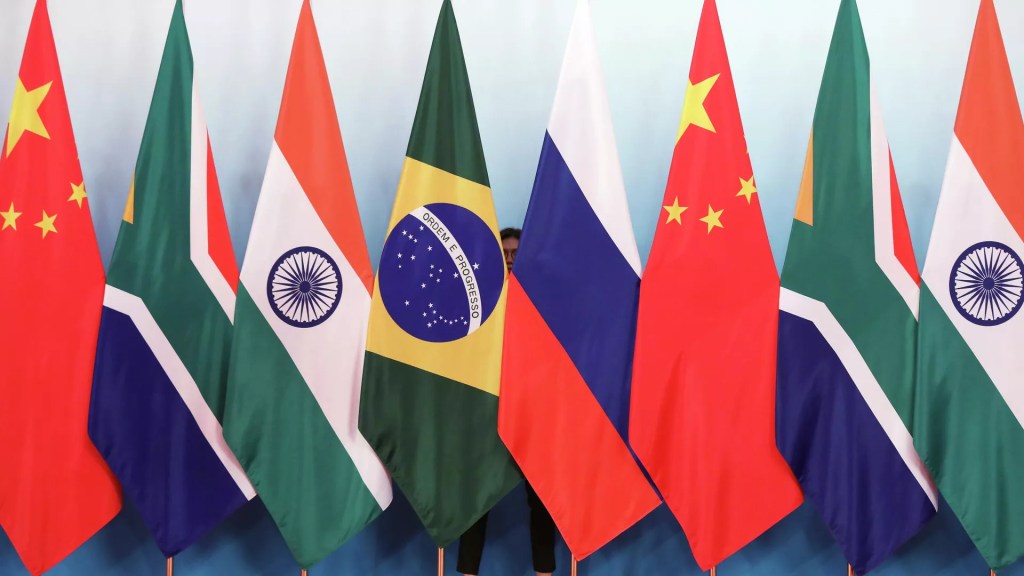
It’s quite clear that from now on China and BRICS+ – with expansion starting at the summit in South Africa next month – will turbo-charge the undermining of the US dollar. With or without India.

There will be no imminent BRICS currency – as noted by some excellent points in this discussion. The scope is huge, sherpas are only in the initial debating stages, and the broad outlines have not been defined yet.

The BRICS+ approach will evolve from improved cross border settlement mechanisms – something everyone from Putin to Central Bank head Elvira Nabiullina have stressed – to eventually a new currency way further down the road.

This would probably be a trade instrument rather than a sovereign currency like the euro. It will be designed to compete against the US dollar in trade, initially among BRICS+ nations, and capable of circumventing the hegemonic US dollar ecosystem.

The key question is how long the Empire’s fake economy – clinically deconstructed by Michael Hudson – can hold out in this wide spectrum geoeconomic war.

Everything is a ‘national security threat’

On the electronic technology front, the Empire has gone no holds barred to impose global economic dependency, monopolizing intellectual property rights and as Michael Hudson notes, “extracting economic rent from charging high prices for high-technology computer chips, communications, and arms production.”

In practice, not much is happening other than the prohibition for Taiwan to supply valuable chips to China, and asking TSMC to build, as soon as possible, a chip manufacturing complex in Arizona.

However, TSMC chairman Mark Liu has remarked that the plant faced a shortage of workers with the “specialized expertise required for equipment installation in a semiconductor-grade facility.” So the much lauded TSMC chip plant in Arizona won’t start production before 2025.

The top Empire/vassal NATO demand is that Germany and the EU must impose a Trade Iron Curtain against the Russia-China strategic partnership and their allies, thus ensuring “de-risk” trade.

Predictably, US Think Tankland has gone bonkers, with American Enterprise Institute hacks rabidly stating that even economic de-risking is not enough: what the US needs is a hard break with China.

In fact that dovetails with Washington smashing international free trade rules and international law, and treating any form of trade and SWIFT and financial exchanges as “national security threats” to US economic and military control.

So the pattern ahead is not China imposing trade sanctions on the EU – which remains a top trade partner for Beijing; it’s Washington imposing a tsunami of sanctions on nations daring to break the US-led trade boycott.

Russia-DPRK meets Russia-Africa

Only this week, the chessboard went through two game-changing moves: the high-profile visit by Russian Defense Minister Sergei Shoigu to the DPRK, and the Russia-Africa summit in St. Petersburg.

Shoigu was received in Pyongyang as a rock star. He had a personal meeting with Kim Jong-Un. The mutual goodwill leads to the strong possibility of North Korea eventually joining one of the multilateral organizations carving the path towards multipolarity.

That would be, arguably, an extended Eurasian Economic Union (EAEU). It could start with an EAEU-DPRK free trade agreement, such as the ones struck with Vietnam and Cuba.

Russia is the top power in the EAEU and it can ignore sanctions on the DPRK, while BRICS+, SCO or ASEAN have too many second thoughts. A key priority for Moscow is the development of the Far East, more integration with both Koreas, and the Northern Sea Route, or Arctic Silk Road. The DPRK is then a natural partner.

Getting the DPRK into the EAEU will do wonders for BRI investment: a sort of cover which Beijing does not enjoy for the moment when it invests in the DPRK. That could become a classic case of deeper BRI-EAEU integration.

Russian diplomacy at the highest levels is going all out to relieve the pressure over the DPRK. Strategically, that’s a real game-changer; imagine the huge and quite sophisticated North Korean industrial-military complex added to the Russia-China strategic partnership and turning the whole Asia-Pacific paradigm upside down.

The Russia-Africa summit in St. Petersburg, in itself, was another game-changer that left collective West mainstream media apoplectic. That was nothing less than Russia publicly announcing, in words and deeds, a comprehensive strategic partnership with the whole of Africa even as a hostile collective West wages Hybrid War – and otherwise – against Afro-Eurasia.

Putin showed how Russia holds a 20% share of the global wheat market. In the first 6 months of 2023, it had already exported 10 million tons of grain to Africa. Now Russia will be providing Zimbabwe, Burkina Faso, Somalia and Eritrea with 25-50 thousand tons of grain each in the next 3-4 months, for free.

Putin detailed everything from approximately 30 energy projects across Africa to the expansion of oil and gas exports and “unique non-energy applications of nuclear technology, including in medicine”; the launching of a Russian industrial zone near the Suez Canal with products to be exported throughout Africa; and the development of Africa’s financial infrastructure, including connection to the Russian payment system.

Crucially, he also extolled closer ties between the EAEU and Africa. A forum panel, “EAEU-Africa: Horizons of Cooperation”, examined the possibilities, which include closer continental connection with both the BRICS and Asia. A torrent of free trade agreements may be in the pipeline.

The scope of the forum was quite impressive. There were “de-neocolonialization” panels, such as “Achieving Technological Sovereignty Through Industrial Cooperation” or “New World Order: from the Legacy of Colonialism to Sovereignty and Development.”

And of course the International North South Transportation Corridor (INSTC) was also discussed, with major players Russia, Iran and India set to promote its crucial extension to Africa, escaping NATO littorals.

Separate from the frantic action in St. Petersburg, Niger went through a military coup. Although the end-result remains to be seen, Niger is likely to join neighboring Mali in reasserting its foreign policy independence from Paris. French influence is also being at least “reset” in the Central African Republic (CAR) and Burkina Faso. Translation: France and the West are being evicted all across the Sahel, one-step at a time, in an irreversible process of decolonization.

Beware the Pale Horses of Destruction

These movements across the chessboard, from the DPRK to Africa and the chip war against China, are as crucial as the coming, shattering humiliation of NATO in Ukraine. Yet not only the Russia-China strategic partnership but also key players across the Global South/Global Majority are fully aware that Washington views Russia as a tactical enemy in preparation for the overriding Total War against China.

As it stands, the still unresolved tragedy in Donbass as it keeps the Empire busy, and away from Asia-Pacific. Yet Washington under the Straussian neocon psychos is increasingly mired in Desperation Row, making it even more dangerous.

All that while the BRICS+ “jungle” turbo-charges the necessary mechanisms capable of sidelining the unipolar Western “garden”, as a helpless Europe is being driven to an abyss, forced to split itself from China, BRICS+ and the de facto Global Majority.

It doesn’t take a seasoned weatherman to see which way the steppe wind blows – as the Pale Horses of Destruction plot the trampling of the chessboard, and the wind begins to howl.

Ukraine Stays with the West But Russia Is Winning and Has the Receipts

By Margaret Kimberley

Source: Black Agenda Report

A delegation of African leaders travelled to Ukraine and Russia to help broker peace. But the collective west insists on prolonging the conflict.

The war in Ukraine grinds on and the Ukrainian army is being destroyed by Russia with great loss of life. One would think that Ukraine would be grateful for any and all peace efforts, but it is being used as a proxy by the United States and its NATO allies, the collective west. The seeds of this catastrophe began long before Russia’s special military operation. The European Union and NATO nations brought anti-Russian right-wing forces to power in 2014 in a coup against the elected Ukrainian president. If not for them there would be no war at all.

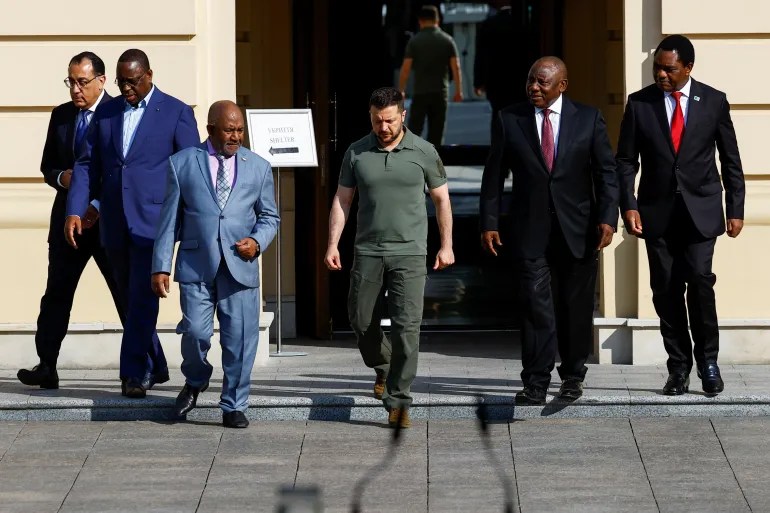
Their degree of culpability became clear recently when a delegation of African leaders traveled to Ukraine and Russia as part of a peacemaking initiative. The party included heads of state of Senegal, Egypt, Zambia, Comoros, Uganda, Republic of Congo, and South Africa. Comoros President Azali Assoumani is the current chair of the African Union. The group was greeted in Kiev by air raid sirens used to create the appearance that a Russian missile attack was underway. President Zelensky was barely polite, thanking South African president Cyril Ramaphosa and others for coming but letting them know that everything was Russia’s fault and that he had no interest whatsoever in peace talks. 

Not only is Ukraine a de facto U.S. colony which lives and dies by Washington’s whims, but it is also a deeply racist country. Much of its population is still attached to Nazi ideology and the politics of World War II collaborator Stephan Bandera. 

Nazi salutes, swastikas and other insignias are common there. So much so that the New York Times recently felt obliged to wonder in feigned innocence why these symbols are worn openly. The simple and obvious answer is that Ukraine is full of Nazis. Any likelihood that the same people would listen to Africans were indeed slim. 

Ukraine was joined in racial superiority theater by Poland. Media and security staff accompanying the presidents were delayed there and the delegation had to travel without them. When the manufactured drama was no longer needed the delegation arrived in St. Petersburg, Russia and met with president Vladimir Putin who had a surprise of his own. 

Putin listened politely to the 10-point plan and then interrupted with a surprise of his own. He not only reminded them the conflict began in 2014 but pointed out that Russia has been ready for peace ever since Turkey brokered negotiations with Ukraine in April 2022. Ukraine was on the verge of signing an agreement until its collective west friends, the US and UK in particular, scuttled the plan. 

The Treaty on Permanent Neutrality and Guarantees of Security of Ukraine offered security guarantees for Ukraine in exchange for a commitment to remain neutral, meaning that NATO membership would be off the table. Putin pointed out that as soon as Russian forces left Kiev the agreement was thrown into “the dustbin.” Just as in the case of the Minsk Agreements, the collective west offered treachery instead of peace.

The African leaders have their own self-interest which sent them to Russia. Their nations’ supplies of grain and fertilizer have been disrupted by the western sanctions and restrictions on trade with Russia. Earlier agreements on this trade have worked against Africans, as Putin pointed out, “These European neo-colonial powers, technically the US, have once again deceived the international community and the Africa countries in need: 31.7 million tonnes were exported and only three percent reached Africa’s needy countries. Is this not deception?”

It is all to the good that the international community works together to end this war, but the west is only interested in escalating and Ukraine pays the price. The collective west excels in creating propaganda and bullying its allies. The rest of the world is working to escape U.S. and NATO domination as Ukrainians die in large numbers.

Ukraine’s love of Nazi symbolism reveals why that country is content to turn its population into cannon fodder. Meanwhile western insistence on escalation brings the entire world to the brink. Yet there is still no honest discussion about how the war began, or how the Nordstream pipeline exploded. Russia is still painted as the villain and the people of this country go into another presidential election year in the dark.

Russia is not just winning on the battlefield. Nation after nation has declared an intention to use currencies other than the dollar for trade or to join the BRICS. But the collective west cannot accept defeat. The threat they represent to the world cannot be underestimated.

Hunger Profiteers, Granny Killers, and Skin-Deep Morality

By Colin Todhunter

Source: Dissident Voice

Today, a fifth (278 million) of the African population are undernourished, and 55 million of that continent’s children under the age of five are stunted due to severe malnutrition.  

In 2021, an Oxfam review of IMF COVID-19 loans showed that 33 African countries were encouraged to pursue austerity policies. Oxfam and Development Finance International also revealed that 43 out of 55 African Union member states face public expenditure cuts totalling $183 billion over the next few years. 

As a result, almost three-quarters of Africa’s governments have reduced their agricultural budgets since 2019, and more than 20 million people have been pushed into severe hunger. In addition, the world’s poorest countries were due to pay $43 billion in debt repayments in 2022, which could otherwise cover the costs of their food imports. 

Last year, Oxfam International Executive Director Gabriela Bucher stated that there was a terrifying prospect that in excess of a quarter of a billion more people would fall into extreme levels of poverty in 2022 alone. That year, food inflation rose by double digits in most African countries.  

By September 2022, some 345 million people across the world were experiencing acute hunger, a number that has more than doubled since 2019. Moreover, one person is dying of hunger every four seconds. From 2019 to 2022, the number of undernourished people grew by 150 million

Billions of dollars’ worth of arms continue to pour into Ukraine from the NATO countries as US neocons pursue their goal of regime change in Russia and balkanisation of that country. 

Yet people in those NATO countries are experiencing increasing levels of hardship. The US has sent almost 80 billion dollars to Ukraine, while 30 million low-income people across the US are on the edge of a ‘hunger cliff’ as a portion of their federal food assistance is taken away. In 2021, it was estimated that one in eight children were going hungry in the US. In England, 100,000 children have been frozen out of free school meals.  

Due to the disruptive supply chain effects of the conflict in Ukraine, speculative trading that drives up food prices, the impact of closing down the global economy under the guise of COVID and the inflationary impacts of pumping trillions of dollars into the financial system between September 2019 and March 2020, people are being driven into poverty and denied access to sufficient food. 

Matters are not helped by issues that have long plagued the global food system: cutbacks in public subsidies to agriculture, WTO rules that facilitate cheap, subsidised imports which undermine or wipe out indigenous agriculture in poorer countries and loan conditionalities, resulting in countries ‘structurally adjusting’ their agri sectors thereby eradicating food security and self-sufficiency – consider that Africa has been transformed from a net food exporter in the 1960s to a net food importer today.  

Great game food geopolitics continue and result in elite interests playing with the lives of hundreds of millions who are regarded as collateral damage. Policies, underpinned by neoliberal dogma masquerading as economic science and necessity, which are designed to create dependency and benefit a handful of multi-billionaires and global agribusiness corporations who, ably assisted by the World Bank, IMF and WTO, now preside over an increasingly centralised food regime. 

Many of these corporations have engaged in rampant profiteering at a time when people across the world are experiencing rising food inflation. For instance, 20 corporations in the grain, fertiliser, meat and dairy sectors delivered $53.5 billion to shareholders in the fiscal years 2020 and 2021. At the same time, the UN estimates that $51.5 billion would be enough to provide food, shelter and lifesaving support for the world’s 230 million most vulnerable people. 

As a paper in the journal Frontiers noted in 2021, these corporations form part of a powerful alliance of multinational corporations, philanthropies and export-oriented countries who are subverting multilateral institutions of food governance. Many who are involved in this alliance are co-opting the narrative of ‘food systems transformation’ as they anticipate new investment opportunities and seek total control of the global food system. 

This type of ‘transformation’ is more of the same wrapped in a climate emergency narrative in an attempt to move food and farming further towards an ecomodernist techno-dystopia controlled by big agribusiness and big tech, as described in the article “The Netherlands: Template for Ecomodernism’s Brave New World.” 

A ‘brave new world’ where a concoction of genetically engineered items, synthetic food and ultra-processed products will do more harm than good – but will certainly boost the bottom line of the pharmaceutical corporations.  

While securing further dominance over the global food system and undermining food security in the process, global agribusiness frames this as ‘feeding the world’. 

The model these corporations promote not only creates food insecurity but also produces death and illness.   

Former Professor of Medicine Dr Paul Marik recently stated

If you believe the narrative, Type 2 diabetes is a progressive metabolic disease that’ll result in cardiac complications. You’re going to lose your legs. You’re going to have kidney disease, and the only treatment is expensive pharma drugs. That is completely false. It’s a lie.

It is projected that by the end of this decade half of the world’s population are going to be obese and over 20% to 25% will have Type 2 diabetes.   

According to Marik, the bottom line is Type 2 diabetes is a metabolic disease due to bad lifestyle and really bad eating habits: 

“We eat all the time. We snack all the time. This is part of the food industry’s goal. Processed food, starch, becomes an addiction. Most of us are glucose addicted and it’s, in fact, more addictive than cocaine. It creates this vicious cycle of insulin resistance.” 

He adds that if you’re insulin resistant, this prevents leptin and the other hormones acting on your brain, so you’re continually hungry: 

“If you are continually hungry, you eat more, which causes more insulin resistance. It causes this vicious cycle of overeating carbohydrates…” 

This is the nature of the modern food system. Cheap processed ingredients, low-nutrient value, highly addictive and maximum profits. A system that is being imposed or has already been imposed on countries whose populations once had healthy, unadulterated diets (see Obesity, malnutrition and the globalisation of bad food – theecologist.org). 

Over the past 60 years in Western nations, there have been fundamental changes in the quality of food. In 2007, nutritional therapist David Thomas in “A Review of the 6th Edition of McCance and Widdowson’s the Mineral Depletion of Foods Available to Us as a Nation” noted a precipitous change towards convenience and pre-prepared foods containing saturated fats, highly processed meats and refined carbohydrates, often devoid of vital micronutrients yet packed with a cocktail of chemical additives including colourings, flavourings and preservatives. 

Aside from the negative impacts of Green Revolution cropping systems and practices, Thomas proposed that these changes are significant contributors to rising levels of diet-induced ill health. He added that ongoing research clearly demonstrates a significant relationship between deficiencies in micronutrients and physical and mental ill health. 

Increasing prevalence of diabetes, childhood leukaemia, childhood obesity, cardiovascular disorders, infertility, osteoporosis and rheumatoid arthritis, mental illnesses and so on have all been shown to have some direct relationship to diet, specifically micronutrient deficiency, and pesticide use

It is clear that we have a deeply unjust and unsustainable food system that causes environmental devastation, illness and malnutrition, among other things. People often ask: So, what’s the solution? The solutions have been made clear time and again and involve a genuine food transition towards agroecology.  

Unlike the co-opted version of ‘food transition’ being promoted, agroecology offers concrete, practical solutions to many of the world’s problems that move beyond (but which are linked to) agriculture. Agroecology challenges the prevailing moribund doctrinaire economics of a neoliberalism that drives a failing system. Well-known academics like Raj Patel and Eric Holtz-Gimenez have written extensively on the potential of agroecology. And its benefits are clear

In finishing, let us consider the skin-deep morality pedalled throughout the COVID period. During COVID, the official narrative was underpinned by emotive slogans like ‘protect lives’ and ‘keep safe’. Those who refused the COVID jab were labelled ‘granny killers’ and ‘irresponsible’. All presided over by government politicians who too often failed to obey their own COVID rules.  

Meanwhile, while having terrorised the public with a health crisis narrative, they continue to collude with powerful agrifood corporations that destroy health courtesy of their practices. They continue to facilitate a system that serves the needs of global agricapital and ruthless investors like BlackRock’s Larry Fink who secure massive profits from a monopolistic food system (Fink also invests in the pharma sector – one of the biggest beneficiaries of a sickening global food regime) that by its very nature creates illness, malnutrition and hunger.    

The COVID narrative was imbued with the notion of moral responsibility. The people who sold it to the masses have no morality. Like the UK’s former health minister and COVID rule breaker Matt Hancock (see Matt Hancock’s Car Crash Interview), they are willing to sell their soul (or influence) to the highest bidder – in Hancock’s case, a £10,000 wage demand for a day’s ‘consultancy’ as a sitting politician or a few hundred thousand to bolster his ego, bank balance and image on a celebrity TV programme.  

In a corrupted and corrupting society, the rewards could be even higher for the likes of Hancock when he leaves office (a health minister who helped traumatise the population while doing nothing to hold the health-damaging agribusiness corporations to account). But with a long line of well-rewarded fraudsters to choose from, we already know that.

De-Dollarization Accelerates: The Beginning of the End for US Dollar Hegemony in Southeast Asia?

By Timothy Alexander Guzman

Source: Silent Crow News

The US is facing major moves by the global community to de-dollarize their economies.  The reserve status of the US dollar will eventually come to an end, maybe not anytime soon, but sometime in the future as it is facing numerous challenges not only from major powers such as Russia and China who are actively trying to rid themselves of the toxic currency, but also countries with smaller economies who are based in the Southeast Asian region which includes Singapore, Malaysia, Indonesia, Cambodia, Thailand, and Laos.  The globalist think tank, the Carnegie Endowment for International Peace (CEIP) published an article on August 22nd, 2022, on the US dollar’s waning influence in Southeast Asia titled ‘Southeast Asia’s Growing Interest in Non-dollar Financial Channels—and the Renminbi’s Potential Role’ stated what was taking place between China and several Southeast Asian countries:

China’s central bank—announced the launch of a new emergency liquidity arrangement that can be funded using renminbi and tapped by participating central banks during times of market stress. Three of the five participating central banks are Singapore’s, Malaysia’s, and Indonesia’s, which each recently renewed agreements with the PBOC implicitly aimed at reducing dollar usage in cross-border payments. This follows policymakers in ThailandLaosCambodia, and Myanmar all announcing efforts to reduce dollar usage, as well as comments by Indonesia’s central bank head that consumers across five of Southeast Asia’s largest economies will soon be able to make intra-regional cross-border payments via linkages that avoid using the dollar as an intermediary, as is currently often the case

Interestingly, The CEIP listed several reasons why Southeast Asian countries want to dramatically reduce the use of US dollars are as follows:

Several factors are behind the various efforts aimed at reducing dollar usage in Southeast Asia. To begin with, many officials are concerned about the potential economic impacts of U.S. monetary policy tightening on the region given its high usage of the dollar; accordingly, some are seeking to reduce usage of the dollar in intra-regional trade payments as a means of curbing dollar reliance more broadly. Recent sanctions may also be spurring demand for alternative financial channels—for example, Myanmar’s military government is actively exploring how to circumvent EU and U.S. sanctions to transact with Russia

According to an article published by almayadeen.net ‘Bank Indonesia calls against payments in US Dollars’ who translated the report by an Indonesian news portal called Tempo.net on what Nugroho Joko Prastowo of the Solo Bank Indonesia Representative Office said regarding Indonesian businesses using national currencies to reduce its reliance on the US dollar:

Bank Indonesia has urged importers and exporters to use national currencies in international payments in order to reduce Indonesian financial markets’ reliance on the US dollar, according to Tempo.co, an Indonesian news portal.  “About 90% of export-import payments are conducted in US dollars, while the share of Indonesian direct exports to the US is estimated at only 10%, and US imports account for 5%”

The report also mentioned that “China, Japan, Thailand, and Malaysia have already agreed to use the two-way payment mechanism, with Singapore and the Philippines planning to join the system, according to the economist.”  

Another article published by the globaltimes.cn on December 15th, 2021, ‘GT Exclusive: Myanmar accepts yuan as official settlement currency for border trade with China’ said that Myanmar’s usage of Chinese yuan will help break the US dollar dominance in the long term:

The yuan was included in the list of Myanmar’s official settlement currencies in January 2019. The move at that time was more symbolic, as all contracts and trade were still not settled in the Chinese currency.  Zhou said that the move, in the long term, will help break the monopoly of the US dollar in Myanmar’s foreign currency reserves.  The US has been abusing the dollar’s dominant status to impose arbitrary sanctions on other countries, and the yuan’s further expansion in Myanmar’s trade settlements may provide a shield against such a potential weapon, analysts said

Cambodia is on Board Dumping US Dollars

Why Cambodia with a population of close to 17 million people and a much smaller economic impact on the world’s economy is willing to drop US dollars is an important development.  The Diplomat, a current-affairs magazine based on analysis and commentaries from various authors on developments throughout Asia and the rest of the world published an article by Luke Hunt on the case of Cambodia’s attempt to stop using US dollars titled ‘Cambodia Reduces its Dependency on the US Dollar’ lays out the mood of the Cambodian government.  “Ever since United Nations peacekeepers arrived in war-torn Cambodia to oversee elections held in 1993, the U.S. dollar has been a mainstay of the local economy with a dual currency system providing steady exchange rates in a volatile place” but there is a monumental shift taking place when the National Bank of Cambodia (NBC) announced that it “would phase-out small-denominated U.S. dollar bills – $1, $2, and $5 notes – following negotiations with banks and micro-finance institutions (MFIs).”  Naturally it’s a step to reduce the dependency of the US dollar according to the NBC “Cambodia has to encourage the use of its riel, more. So, allowing the circulation of small U.S. bills is an obstacle in urging the use of the riel.”

There are several reasons for Cambodia’s move, one of them is to allow the use of digital currencies to “give the central bank more control over the Cambodian economy and bolster the local riel currency, which for decades suffered from a lack of confidence due to negative sentiment stemming from a 30-year war” in addition it will allow the central bank “control over monetary policy and interest rate settings and reduced costs in handling the sheer volume of $1 dollar notes circulating through the economy.”  Hunt mentions the dark period of Cambodian history with the US-backed Pol Pot and the Khmer Rouge who destroyed Cambodia and it’s traditions and started a new revolution with a new culture that would begin on Year Zero, therefore everything before would be deemed irrelevant, “It’s a far cry from the late 1970s, when Khmer Rouge rule abandoned money, banks were abolished, and the NBC blown-up as Pol Pot tried to create a utopian, agrarian society that led to the deaths of an estimated 1.7 million Cambodians.”  One of the darkest times in world history indeed.  It is a positive development that the NBC is encouraging the use of the Cambodian Riel for its economy, so the future seems promising.  NBC Governor Chea Chanto spoke at the 40th Anniversary of the re-establishment of the Riel “he said demand for the currency had increased by an average of 16 percent a year for the last 20 years amid annual average growth rates of 7.8 percent and inflation at around 2.5 percent.”  Chanto said that “I firmly believe all ministries, institutions, companies, enterprises, and those who actively participate in the process of developing the banking system promote the use of the riel, which is our national currency.” According to an unidentified analyst “It’s also a matter of sovereignty and pride. It’s their country and they are entitled to have their own currency like anywhere else.”

Transitioning from the US dollar to the Cambodian Riel won’t be an easy task according to Michael Finn of the Khmer Times who authored ‘De-dollarisation: Views from Asia, US and Europe’ claims that “Any reduction in the use of the dollar needs to be handled carefully, according to foreign chambers of commerce in Cambodia. They say the central bank is unlikely to fully phase-out the US currency and any sudden moves to end reliance on the dollar would be bad for business.”  European Chamber of Commerce Advocacy Manager Noe Schellinck said that “To a certain extent, the dollarisation now can be ascribed to the success of the Cambodian economy, with a great influx of Foreign Direct Investment, compared to the historic context of when the dollarization came about.” But the Indonesian Chamber of Commerce President Dalton Wong disagrees with Schellinck’s assessment:

De-dollarisation is not a bad thing as it is a re-balancing of the fiscal and monetary policy tools. It is certainly not a complete displacement and substitution of the US dollar in favour of the Khmer Riel in trade and investment, which some observers and analysts seem to mischievously suggest, which is not so helpful. In fact, promoting a greater use of the Khmer riel will give greater monetary policy tools to the Cambodian author 

The collapse of the US dollar is becoming a reality as China and Russia continue to buy gold and trade with their own currencies at an accelerated pace with many more countries around the world who are also racing to de-dollarize their economies.  As we already know, several countries in Southeast Asia will soon make its move to rid itself of the toxic currency, but there are also other countries who are also making moves including India, Iran, South Africa, Syria, and Venezuela who are all motivated to drop the US dollar.  One of the main reasons for these countries to move forward by eliminating the use of US dollar is because Washington uses its currency status as a weapon to impose harsh sanctions on countries they deem as enemies.  

African countries are also starting to look for alternatives to the US dollar including Ghana according to a report published by Reuters on November 24th, 2022, ‘Ghana plans to buy oil with gold instead of U.S. dollars’ said that “Ghana’s government is working on a new policy to buy oil products with gold rather than U.S. dollar reserves” Ghana’s reason slightly differs from other countries since “The move is meant to tackle dwindling foreign currency reserves coupled with demand for dollars by oil importers, which is weakening the local cedi and increasing living costs.”  This means that the US dollar is causing inflation.  The move is expected to take place in the first quarter of 2023 as Ghana’s Vice-President Mahamudu Bawumia said that the new policy “will fundamentally change our balance of payments and significantly reduce the persistent depreciation of our currency” as he explained that “using gold would prevent the exchange rate from directly impacting fuel or utility prices as domestic sellers would no longer need foreign exchange to import oil products.”  Libya was one of the first countries in Africa to propose the idea of creating an alternative currency to bypass the US dollar called the African Dinar which would have been gold-backed but the Obama regime supported a violent coup to overthrow its president who suggested the idea, Muammar Ghaddafi who was tortured and then killed in the process making Libya a hotbed for terrorism and at the same time, re-creating the centuries-old industry of slavery.   

The bottom line is that US dollar’s dominance in the global market will come to an end sometime in the foreseeable future.  No one has a crystal ball of when it will happen, but it is certain.  The world will experience an alternative economic reality that will change the dynamics of the US and its Western powers dominating the World’s economy with an outdated and flawed currency that will eventually have the same value as toilet paper.  

The 500 Years Old WESTERN HEGEMONY is Coming to an END and the World is about to ENTER a VERY DANGEROUS PERIOD

For 500 years the world has been run from Europe or the US: that’s about to change and nobody is sure what its replacement will look like

By Timofey Bordachev

Source: The 21st Century

The most dramatic and unique aspect of the current state of affairs in international politics is that we cannot count on the ability of a single state, or a group of sufficiently powerful countries, to play a leadership role in the future.

This means it is difficult for us to imagine who will be able to force states to comply with the rules of conduct in their foreign policy, and how such strictures can even be enforced.

Indeed, the question of why individuals, or in this case countries, should abide by regulations is the most fundamental one in political philosophy.

And despite all the imperfections of the power method, humanity has not yet invented any other way of achieving such goals, even in minimal amounts, other than by force.

Over the last 500 years, the rules of international communication have been created within the narrow community of Western countries, first in Europe, before in the 20th century the US joined in, providing the power needed to enforce the system.

At first, this was done through the balance of power of leading European states, joined by Russia in 1762.

After the international order that had emerged in the mid-17th century came under attack from revolutionary France, control of the rules became a matter for a small group of major empires.

They, led by Russia and Britain, defeated Napoleon and in 1815 created an order which had at its heart a general agreement that mutiny in international affairs was unacceptable.

By the end of the nineteenth century, politics had become global, but the European powers, including Russia, could still control the rest through brute force and their colossal military-industrial superiority.

The dramatic events of 1914-1945 brought the US to the forefront of global politics, as the leader of the Western community on a global scale.

International institutions, starting with the United Nations, were established with the primary objective of preserving the monopoly position of the West.

This, however, required the emergence of formal institutions of justice in the form of international law, or the participation in the highest UN body, the Security Council, of the Soviet Union and China, which were inherently hostile to US and Western European interests.

The institutional form of Western power dominance has become overbearing and the main question now is whether it can be preserved.

Therefore, the collapse of US and Western European power positions in international politics entails not just a change of leadership, but a revision of the existing institutions and rules at the global level.

In other words, the entire formal international order that has emerged after World War II (and in reality over the last few centuries) will cease to exist.

It was based on a special system of rights and privileges for a limited group of great powers, and later the illusion of fairness of which was created by international institutions led by the UN.

It was this system that played the role of the main legitimizing principle of the existing world order, although in practice it was often replaced by the West’s ability to exert a decisive influence on world affairs

Thus, the collapse of international political institutions will very probably prove to be a consequence of the disappearance of their power base, whose presence has been unchallenged for several centuries.

We are now witnessing the destruction of both the formal and the real basis of the international order. In all likelihood, this process can no longer be stopped.

The coming period will be a time of defining the new global power base, and it is difficult to say yet which players, and to what extent, will become part of it.

What is important is that the top states of the present time – the US, Russia, China and India – are not close to each other, especially in terms of values and understanding of the basic principles of international rules.

The greatest problem so far is the behaviour of the US and certain Western European countries, which, for internal reasons, are pursuing an aggressive policy towards the outside world.

These states have embarked on a very troubling path of qualitative changes in the basic things that make up the social, gender and, consequently, political structures of society. For most other civilizations, this path is a challenge and will be rejected.

We also do not know the extent to which the internal development of the West depends on the spread of its ideals, as it did in previous periods.

In the event that the trends emerging in the West will, like revolutionary France, the Bolshevik regime or Nazi Germany, demand not just recognition from others, but expansion globally, the future will become very worrying.

We can already see that the conflict between the values favored by the West and the foundations of domestic legitimacy in a number of countries, is becoming a ground for aggravated political relations.

It would, however, be a mistake to hope that the other great and middle powers confronting the West are completely united in their understanding of the foundations of justice at the domestic level.

Even if Russia, India, China or Brazil now demonstrate a common understanding of the basic principles of a “proper” world order, this does not mean that they have the same vision of a better domestic order.

This is all the more true of the states of the Islamic world and other major developing countries. Their conservative values are often in conflict with those of the West, but this does not mean that they can create unity between themselves.

In other words, the new international order will, for the first time, be without a reliable link with the domestic ambitions of the leading powers, and this is indeed a qualitative change compared to all the historical eras we discussed.

Such a phenomenon seems very important because we have no experience of understanding how relations between states will develop under such conditions.

Brute force could become the only relatively tangible basis to assert the order, but this may not be enough to make the conditions imposed by it sustainable, even in the short term.

Another unique feature of today’s revolutionary situation is that the revision of the international order is not being carried out by one or a few powers – it has now become the business of the world’s majority.

The countries that make up about 85% of the world’s population are in one way or another no longer prepared to live with conditions created without their direct involvement.

That said, their resistance is often expressed without direct intention and depends on the power capabilities of the particular power.

What from the point of view of Russia or Iran looks like lack of resolve in dealing with the US may seem like a great challenge for Kazakhstan or another young sovereign country – after all, their entire socio-economic system was created to exploit a liberal world order.

The fragile states of Africa, or the former Soviet space, are far less capable of behaving consistently than the prosperous monarchies of the Persian Gulf. China, though now the second most powerful economic power, is also aware of its weaknesses.

But all this does not change the most important thing – even if the destruction of the existing status quo takes the form of soft sabotage rather than decisive military action, it does not simply reflect a general discontent with Western authoritarianism, but creates a new order, and the basic features of this are as yet undetermined.

In the coming years, most countries in the world will seek to make the most of the weakening of the power base of international politics in their self-interest.

So far, these actions constitute a constructive conflict, since they objectively undermine a system based on fantastic injustice.

However, as time goes on the US-EU bloc will weaken and lock itself away, and Russia or China will never be strong enough to take their place.

And in the perspective of the next 10 to 15 years, the international community will face the problem of replacing the power monopoly of the West with new universal instruments of coercion, the nature and content of which are still unknown to us.

Never Let A Good Crisis Go to Waste

Relentless Ukraine reporting helps conceal other conflicts

By Philip Giraldi

Source: Information Clearing House

It is astonishing how many observers of war in Ukraine who should know better have been inclined to take at face value the assertions of “sources” that clearly originate among the various governments that are involved in the conflict. Those leaders who are engaged in the inexorable march by the US and its allies to turn the Ukraine crisis into World War 3 surely have learned the lesson that managing the narrative of what is taking place is the greatest weapon that the war hawks have in their possession. One recalls how post-9/11 and leading up to the Iraq War the George W. Bush White House and the neocons in the Pentagon lied about nearly everything to convince the public that Saddam Hussein was a terrorist supporting megalomaniac armed with weapons of mass destruction, inevitably describing him as a man in some ways comparable to Adolf Hitler. Nevertheless, many observers of what was occurring were not fooled and there were large scale demonstrations in a number of cities prior to the invasion in March 2003, which, of course, were rarely reported in the mainstream media in order to control the message.

Iraq in some ways was a learning experience for those in government and also for those in the media who did the heavy lifting by propagating the deception to a largely unsuspecting public. What we are seeing now relating to Ukraine and Russia, however, makes the Iraq experience look like child’s play in terms of the sheer audacity of the alleged information that makes it, or does not make it, into the news. I note particularly the recent terrorist car bombing of Russian activist journalist Dalya Dugina by a Ukrainian assassin made the news for roughly forty-eight hours before disappearing, but not before the lie that Prime Minister Vladimir Putin was responsible was firmly planted in a number of places in the mainstream media.

Now that Joe Biden is about to designate a two or three star general to head the Ukraine campaign and has pledged billions of dollars more in aid, Ukraine will be all the news all the time. The US involvement will also feature a catchy name. I would suggest Operation Empty Wallets, which is what Americans will soon be experiencing due to government bailouts and other profligate spending, or maybe Operation Give Me a Break. And it will also create a new dimension to the narrative-shaping in that Ukraine reporting’s domination of what comes out of the newsrooms already is effectively killing much of what else might otherwise be appearing on TV or in the newspapers. That selective management of information provides cover for neglecting stories that might prove embarrassing for those in power. It in effect means that there has been plenty of room for the usual players to engage in business as usual with hardly any scrutiny by the public over what is going on outside Ukraine in secondary theaters like the Middle East and Africa.

All of which leads one to examine what the two countries that have unilaterally declared themselves to be rules makers and enforcers have been up to. Those two countries are perhaps not surprisingly the United States and Israel. The US is, in fact, increasing its combat role in Africa featuring airstrikes in Somalia, all of which have taken place since US President Joe Biden approved the redeployment of hundreds of special forces troops to that country in May, reversing a decision by former President Donald Trump to reduce troop levels in AFRICOM. The two latest attacks killed at least twenty Somalis, all of whom were of course described as “terrorists” by the US command. Independent sources state that US forces have bombed Somalia at least 16 times under Biden, killing between 465 and 545 alleged al-Shabaab militants, including no less than 200 individuals in a single drone plus ground forces strike on March 13th.

Describing the paucity of reporting on the issue, Kelley Beaucar Vlahos, a senior adviser at the Quincy Institute for Responsible Statecraft, observed “If you were unaware that we were bombing Somalia, don’t feel bad, this is a completely under-the-radar news story, one that was curiously absent from the headlines in all of the major newspapers…”

And then there is Syria, where a paucity of information in the media reflects White House policy. The United States, which has possibly as many as a dozen illegal bases in Syria, has a major airbase located in the al-Omar oil field in Syria’s northeastern Deir Ezzor province. Several weeks ago, three US soldiers were reportedly slightly wounded in rocket attacks directed at the base by alleged “Iranian-backed militants.” The US responded to the claimed attacks by launching strikes from Apache helicopters against three vehicles belonging to an Afghan Shia militia, killing between six and ten “militants,” and there are reports that more tit-for-tat exchanges of fire are likely. CENTCOM afterwards claimed that President Joe Biden personally ordered the strikes in “self-defense” and justified them by citing Article II of the US Constitution. But the Constitution was never intended to cover illegal activity in a foreign land where US forces are occupying a country with which it is not at war and which has a functioning government that opposes the American presence. The US reportedly has its illegal bases mostly located in the oil producing and agricultural bread basket of the country. Both the grain and oil are routinely stolen by the US and much of the oil winds up in Israel.

So, one inevitably comes to Israel, which has used the cover provided by Ukraine not only to bomb Syria frequently but also to kill Palestinians both in Gaza and on the occupied West Bank. Recently the pace has accelerated with the Israeli Army and police killing on average several Palestinians every day, very little of which is reported in the US media, a fatality rate five times higher than that which prevailed in 2021. It is clearly a deliberate policy to step up the pressure on the Palestinians and a vital part of the process is to let it happen with minimal scrutiny by the media and public, so Israel is widely publicizing the support it is giving to Ukraine to draw attention away from what it does locally.

In short, Israel is increasing efforts to make the historic Palestine Palestinian-free by rendering life so miserable that many Arabs will decide to leave. The use of selective violence and constant harassment is all part of that effort and Palestinians have found that describing Israel as an “apartheid” state does not accurately describe the intensity of the indiscriminate punishments and killings by soldiers which have become all too common.

Israel meanwhile is also doing its best to delegitimize Palestinian national identity by labeling Arab human rights groups as “terrorists.” Israeli police recently raided the offices of seven such groups, confiscated their office equipment and communications, and ordered the premises to be shut down completely. Ironically, a CIA assessment of the groups determined that they were not in any way terrorist linked. The Joe Biden administration characteristically responded to the development by indicating that it was “concerned” but did not condemn the Israeli action.

So, if you open a newspaper or turn on the television and watch or read the international news, you will be told what to think about what is going on in Ukraine. And it will be from the Ukrainian/US government point of view. If you are interested in what the US and Israel are up to in the Middle East, you will most often be out of luck as “defending democracy” in Ukraine while also demonizing Russia is providing cover for Washington and Jerusalem to get into all kinds of mischief. It is a reality derived from how the media and government work collectively to shape policies that in no way benefit the American public. Instead, powerful interest groups with plenty of cash drive the process and are the ones who gain still more power and money through it. It is the sad reality of what has happened to our “land of the free and home of the brave.”

What Will You Say When Millions Of People Starve To Death?

By Michael Snyder

Source: End of the American Dream

For a long time, those of us that were claiming that a global famine was coming were widely mocked.  The skeptics could see the exact same trends that everyone else could see, but they just assumed that we would find a way to muddle through somehow.  So they didn’t want to listen to common sense, and they weren’t interested in warnings from “gloom and doomers” such as myself.  But I don’t consider myself to be a “doom and gloomer” because I am actually a very optimistic person.  I am so excited to be living during this time in human history, but I also know that very difficult times are ahead of us.  One of the major trends that I keep writing about over and over is famine, because the truth is that there simply is not going to be enough food for everyone on the planet in 2023 and beyond.  Of course the mainstream media is also starting to issue similar warnings.  For example, the following comes from a Yahoo News article entitled “Millions in East Africa face starvation due to drought”

The World Health Organization warned on Wednesday that millions of people in East Africa face the threat of starvation. Speaking at a media briefing in Geneva, WHO Director-General Tedros Adhanom Ghebreyesus said that drought, climate change, rising prices and an ongoing civil war in northern Ethiopia are all contributing to worsening food insecurity.

Over 50 million people in East Africa will face acute food insecurity this year, a study from late July by the World Food Programme and Food and Agriculture Organization found. Roughly 7 million children are suffering from malnourishment and, according to the United Nations High Commissioner for Refugees, hundreds of thousands are leaving their homes in search of food or livelihoods. Affected countries include Djibouti, Ethiopia, Kenya, Somalia, South Sudan, Sudan and Uganda.

In Somalia, authorities are projecting that vegetable and grain production will “drop by about 80% this year” due to the endless drought that they are currently experiencing.

Millions of precious people in Africa are facing imminent starvation.  But most of us in the western world don’t care, because our grocery stores are still full of food.

If you are one of those people that are choosing to ignore what is happening on the other side of the planet, you can afford to be cocky for now.

But conditions are starting to change here too.

Earlier today, I came across an excellent article about how the multi-year megadrought in the western half of the country is absolutely devastating the ranching industry…

The megadrought in the Western U.S., the region’s worst in 1,200 years, is threatening America’s cattle heartland: withering pastures, wrecking feed harvests and endangering a quintessential way of life.

The drought is forcing ranchers here in Texas and across the Southern plains to make an agonizing decision: Sell early now for less money than they planned on — or hold on, pray for rain and risk losing everything.

Sadly, more ranchers are deciding to sell off cattle with each passing day.

If you can believe it, the rate at which cattle are being sold is now 120 percent above last year’s level…

Over the last two weeks of July, the national cattle sale rate also jumped to 120 percent above 2021 levels — an average that reporting by The Hill and KAMR suggested conceals even higher frenzies of sales in some markets.

What this means is that lots of beef is coming on to the market.

Beef prices had been soaring, but in the short-term all of the cattle that are being slaughtered will help to moderate prices.

However, the outlook for 2023 is grim.  The national cattle herd just keeps getting smaller and smaller, and some beef producers in Oklahoma are now predicting that ground beef “could eventually top $50 per pound”

Thanks to the unending economic symptoms of the pandemic and 2022’s inflation double-punch, average beef prices are currently about twice what they were in 2019. Add in the deepening widespread drought, a shortage of hay and feed, skyrocketing prices, transport costs, and various other metrics, some Southwest Oklahoma beef producers suggest cheap ground beef could eventually top $50 per pound.

If the price of ground beef does reach 50 dollars a pound, what do you think our country will look like?

Needless to say, at that point there will be absolutely no debate about whether we are in a global food crisis or not.

And we are also being told that we could soon be facing shortages of potatoes and tomatoes.  The following comes from Zero Hedge

Days ago, we said the next food insecurity problem that may impact Americans’ eating habits could be an emerging potato shortage. Now there appears to be another issue: Tomatoes are getting squeezed, and risks of a ketchup shortage rise as a severe drought batter California’s farmland.

California accounts for a quarter of the world’s tomato output. The worst drought in 1,200 years has forced farmers to abandon fields as crops turn to dust amid a water crisis.

I recently wrote an entire article about the coming tomato shortage that you can find right here.  Unless some rain comes along, the tomato crop in California this year is going to be absolutely disastrous.

So are you ready to eat less pizza because there isn’t enough pizza sauce to go around?

And are you ready to pay twice as much for spaghetti sauce at the grocery store?

On top of everything else, we are also potentially facing an extremely painful shortage of cotton

Intense drought has forced cotton farmers to abandon millions of acres that have produced so little cotton that they are no longer worth harvesting, the Wall Street Journal reported Tuesday.

Farmers will harvest an estimated 7.13 million acres, abandoning approximately 5.35 million acres due to an ongoing drought hammering southern U.S. states, representing an estimated abandonment rate of 42.87%, according to the National Cotton Council of America, who based their analysis on U.S. Department of Agriculture (USDA) data. This represents the smallest harvest by area since 1868, The Wall Street Journal reported.

What I have touched on in this article is just the tip of the iceberg.

Agricultural production is going to be way down all over the planet this year.

But we will surely find a way to “muddle through” somehow, right?

If you have been a skeptic of reports of shortages and famine, it is time to wake up.

We really are staring an unprecedented global crisis right in the face, and the months ahead are going to be filled with pain.