The Vindication of Daniel Ortega

0,,4477394_4,00

By toni solo

Source: Axis of Logic

North American and European economies continue to be stuck with intractable, if for the moment moderate, stagflation. Prices for most household purchases steadily increase while majority incomes stagnate. By contrast, corporate incomes increase, subsidized by Western government and Central Bank policy. The resulting increase in inequality is clearly a deliberate policy outcome responding to the weakening of Western economies relative to global counterparts led by China and Russia.

Among those counterparts, Latin America, for long one of the world’s most unequal regions, is playing a leading role demonstrating how to reduce inequality. That is true to some extent in Brazil and Argentina, but it is particularly the case in the bloc of countries grouped in the Bolivarian Alternative for the Americas (ALBA). Western governments and corporate media regularly criticise the governments of ALBA members like Venezuela, Bolivia, Ecuador and Nicaragua while omitting the solidity and consistency of those countries’ economic and social success over the last seven or eight years. Nicaragua is a perfect example of that pattern, having achieved the highest regional decline in inequality along with Bolivia and Ecuador.

A July 2013 World Bank paper “Deconstructing the Decline in Inequality in Latin America” shows that ALBA members Bolivia, Ecuador and Nicaragua are the countries that had most reduced inequality as of 2011. Nicaragua had the highest average GINI coefficient year-on-year fall of  2.6% between 2000 and 2011. The figures for Bolivia and Ecuador are 2.05 and 1.99 respectively. In terms of an overall decline in the GINI coefficient in the region the figures for the period covered by the World Bank report are that Bolivia’s dropped 15.5%, followed by Nicaragua (12.2%), Argentina (10.7%), Peru (8.7%) and Venezuela (8.5%). (The figure for Ecuador is absent because data prior to 2003 were unavailable.)

Nicaragua in macro
Nicaragua is a Central American and Caribbean country with a population now of over 6 million. For decades it was the second poorest country in the Americas. Devastated by a US government contrived war in the 1980s, from 1990 to 2007 the country was governed on neoliberal principles dictated by foreign donor governments and multilateral financial institutions like the World Bank and the International Monetary Fund. In January 2007, President Daniel Ortega took office leading the second democratically elected government of the Frente Sandinista de Liberación Nacional.

2007 was the year in which global economic crisis followed the collapse of the Western financial system. Despite Western propaganda to the contrary, the effects of that crisis clearly persist. Even so, over the last five years, in that highly adverse international economic environment, Nicaragua has maintained better growth than its Central American neighbours, averaging over 5% a year. That success is the result of socialist inspired policies, responsive to the country’s emphatically Christian culture, based on the fundamental principles of solidarity and shared responsibility in all areas of national life.

The 2013 report of the United Nation’s Economic Commission for Latin America and the Caribbean (ECLAC) places Nicaragua among the more successful regional economies on a variety of indicators. For example, between 2010 and 2013, foreign direct investment more than doubled from US$491m to US$1004m, representing a much greater percentage improvement than in Costa Rica (43.5%), Honduras (8.7%) and Guatemala (40.5%). In El Salvador, the same indicator almost doubled, but at a much lower level from US$117m to US$224m.

Nicaragua’s international trade is now well over twice the value of its exports in 2005. In Latin America and the Caribbean in 2013, only Peru had higher fixed capital growth than Nicaragua as a percentage of GDP. Nicaragua’s figure of 29.2% is about 7% greater than Costa Rica and Honduras and over double that of El Salvador or Guatemala. Price inflation has held at around 7% for the last three years. Foreign external debt is around 31% of GDP. Foreign reserves are over twice those of 2006. In August 2013, two years after Nicaragua exited its last IMF programme, the IMF’s deputy director for the western hemisphere declared Nicaragua’s economy to be solid and stable.

Global context
The current crisis in the West suggests similarities with the prolonged economic crisis in North America and Europe from 1873 to 1896. The Western powers resolved that crisis through a virulent burst of imperialist aggression, setting the stage for the global wars of the 20th Century. Since the end of World War 2 in 1945, the appearance of democracy in the West has depended on externalizing onto the majority world the costs of mitigating and managing inequality in Europe and North America.

A key witness to that fact is former French President Jacques Chirac who in the 2008 documentary “10 mai Africaphonie” stated, with uncharacteristic honesty, “We forget one thing…namely that much of the money in our wallets comes precisely from the exploitatation over centuries of Africa. Not completely, but a lot of it comes from the exploitation of Africa. So we have to show a bit of common sense. I won’t say generosity, but common sense, some justice to render to Africans… you might say ….what was taken from them. As much as necessary, if we want to avoid the worst convulsions or difficulties with the political consequences these might bring in the near future.”

As the West’s neocolonial options recede, most clearly in Asia and Latin America, the United States and its European allies embrace more than ever the logic of fascism, the alliance of corporate interests and coercive government. Domestically, their policies protect wealthy elites while cutting back on provision for education, health care and social security. Overseas, to intimidate Iran, destroy Libya and attack Syria, NATO country governments have allied themselves with feudal tyrannies like Saudi Arabia and Qatar and with Al Qaeda and other terrorist groups.

To intimidate Russia, they have funded, trained and supported murderous neonazi groups in Ukraine while deploying military resources including missile systems around Russia’s borders. To intimidate China, they harrass North Korea, encourage Japanese nationalism and increase military deployments in the Pacific. Extensive military deployment is also a key element of Western efforts to reset their countries’ neocolonial control in Africa in response to China’s growing influence there.

The perfidious dollar
Underlying these developments is the end of global dollar hegemony and the steady emergence of multipolar alternatives. China, Russia and various countries in Asia and Latin America are conducting trade more and more in their own currencies or even, in the Latin American and Caribbean ALBA framework, in kind. As Western economic dominance declines, especially relative to Russia and China, the United States and the European Union compensate increasingly overseas with terrorist subversion and outright military aggression. Their corrupt political and economic system staggers like a zombie from one crisis to the next.

The Western powers cling to vestiges of their former global power by continuing to dominate the world’s financial system and through ruthless military barbarism. Their financial dominance persists in large part because commodity prices, especially oil and gas are denominated internationally in dollars. In 1971, the US government floated the dollar in order more freely to fund the Vietnam War and its broader imperialist foreign policy. Since then, in effect, only the United States has been able to use its own credit to fund economic growth and finance deficit spending.

Every other country has needed dollars in order to ensure their people’s economic development, mainly to guarantee energy needs and attract foreign investment. Even the wealthy Eurozone countries and Japan are subject to that dollar hegemony. The US Federal Reserve and its Primary Dealer network manage dollar liquidity in the global financial system. The Primary Dealers are all subsidiaries of crooked, giant North American, European and Japanese global financial corporations, too big to fail and too big to jail. They act in close collusion with the Federal Reserve and the other Western Central Banks, monitoring and managing international financial, currency and commodities markets.

Low wages and deregulation
The various mechanisms of dollar hegemony necessarily promote deep inequality around the world because international competition to earn dollars via exports encourages low wages, restricting domestic demand in the exporting countries. Ever since the 1980s the pernicious low wage effects of dollar hegemony have been progressively compounded by neoliberal propaganda for radical deregulation, urging low taxes, attacking organized labour and dismantling financial and commercial controls, especially of international capital flows. Incomes in the West began to stagnate as the rate of profit for Western corporations slowed and former well paid jobs were outsourced overseas.

The demise of the Soviet Union signalled a deregulation boom. In Europe and North America, mergers and acquisitions increasingly concentrated corporate power, strengthening the drive for deregulation. The resulting fraudulent financial innovation and free transfer of capital across the world lead to the Long Term Capital Management debacle and the Mexican, Russian and Asian currency crises of the 1990s. Despite these disastrous outcomes and the subsequent Enron and Worldcom scandals, deregulation continued to drive asset bubbles and easy credit so as to compensate for stagnant incomes, especially in the United States, leading directly to the crisis of 2007.

Poverty reduction in Nicaragua
This dead hand of decrepit neoliberal corporate capitalism was choking the Central American economies when Daniel Ortega took office as President of Nicaragua’s second democratically elected Sandinista government in January 2007. In such a dismal international economic context, poverty reduction represented a monumental challenge. Even so, President Ortega’s Sandinista government quickly set out in an extremely determined way to reduce poverty with a policy program whose many components are worth listing, if only because they show what can be done by an extremely poor country despite largely adverse international conditions. Extreme poverty in Nicaragua has been cut from over 17%  in 2006 to just over 5% now.

Addressing intractable balance of payments difficulties, the government sought to broaden Nicaragua’s trade with Latin America, the Russian Federation, Asia  and elswhere. Similarly, the government diversified its development cooperation, maintaining links with traditional partners in North America, Europe and Asia but also deepening its relationships with Venezuela, Cuba, Mexico and Brazil. Attracting greater foreign investment was also a key policy objective. Joining the ALBA framework, led by Venezuela and Cuba, freed up around US$500 million a year to invest primarily in production but also in major social programs.

To give Nicaragua’s overwhemingly agricultural economy much needed domestic stimulus, government programmes have prioritized small and medium producers of basic grains, cattle and coffee. The cooperative sector received support and resources to develop existing production cooperatives and form new ones. Small and medium sized businesses benefited from greater access to credit. The government has prioritized tourism, ensuring that it integrates closely with other sectors of the economy, especially small and medium sized businesses.

Economic democracy
This democratization of the Nicaraguan economy has radically transformed the position of women. Flagship programmes like Zero Hunger and Zero Usury, as well as property titling programmes and social housing are all directed at women beneficiaries. President Daniel Ortega’s insistence on genuine democracy and national reconciliation made possible tripartite agreement on a minimum wage framework between government, labour unions and employers organizations. Since 2010, that framework has ensured an annual increase in the minimum wage several percentage points greater than the rate of inflation.

In the last three years, those domestic stimulus measure were accompanied by administrative measures relating to equitable tax and social security reform which have helped significantly increase government revenue and stabilize the social security system for the foreseeable future. As Nicaragua’s economy generates progressively more formal employment, both tax revenue and social security income benefit. ECLAC reports that while formal employment has declined throughout the rest of the region, in Nicaragua it has grown steadily through 2012 and 2013

One key mechanism reducing inequality has been to use subsidies in the most sensitive areas affecting ordinary families’ costs. Apart from free health care and education, the government subsidizes the cost of public transport. Bus companies in the capital Managua receive preferential prices for fuel, oil, tyres and spare parts in exchange for pegging fares at 10 US cents. Taxis in Managua as well as inter-urban and acuatic transport in the rest of the country also receive similar benefits enabling the Transport Ministry and local municipalities to negotiate favourable fare tariffs for transport users.

Low income families benefit from subsidized electricity for consumers using under 150Kw a month. The government also operates a retail network offering basic food stuffs at preferential prices through local general stores. Over 58,000 families have benefited from subsidized or free housing. Low-income families nationwide have benefited from a free construction materials program enabling impoverished families to repair defective roofs.

Other social investment programs include assistance for people, especially children, with disability as well as food support for vulnerable groups such as the elderly. The Amor para los más Chiquitos programme has helped around 32,000 very young children at risk, ensuring they enjoy care, education and attention rather than ending up on the streets. That programme has worked with over 420,000 families providing advice and guidance in the care of young children under 6 years old. The government’s efforts to promote social stability also encompass property titling programs that have issued over 180,000 title deeds bringing security of tenure to over 800,000 people.

Health, education, infrastructure
Health and education are crucial expenses for most families in Nicaragua as everywhere else. The availability of free public health care has made a massive difference to low income families who cannot afford private care. The government is steadily equipping the public health system with the resources it needs to improve its services year by year. Emphasising preventive health care, government vaccination programs applied over 4,100,000 doses in 2013. The Casa Materna programme, almost tripling facilities to assist expectant mothers in rural areas, has helped the government reduce maternal mortality, which fell 35% from 2007 to 50 deaths per 100,000 live births in 2012.

Likewise in education, government expenditure improving infrastructure is accompanied by a range of programmes supporting low income families. The Merienda Escolar programme for adequate nutrition for primary school children, ensures provision of meals for over 1,000,000 pre-school and primary school children. Low income families also get help with schooling inputs. Apart from regular primary and secondary education, the government has invested heavily in vocational technical training for young people and improved access to education in rural areas. Follow up to the successful literacy programs of the government’s early years is consolidating the eradication of illiteracy. Education programmes for children with special needs include the integration of children with slight disability into the regular school system as well as dedicated programmes for children whose disability is more severe.

The transformation of government social and economic policy is physically much more obvious in terms of energy and infrastructure. National road, port and airport infrastructure has been almost completely renovated. Construction is on schedule of the new oil refinery being built near León with the Venezuelan State oil company PDVSA. Dependence on oil fired thermal generating stations has dropped from over 80% to less than 50% of the country’s generating capacity thanks to investment in renewable energy sources. Work on the long delayed Brazilian financed Tumarin hydroelectric project on Nicaragua’s Caribbean Coast should begin later this year. Also by the end of this year the results of the feasibility studies for the Interoceanic Canal will permit work to begin on that epoch making project and its sub-projects. These include an interoceanic rail link and pipeline, new airports and two deep water ports on the country’s Pacific and Caribbean coasts.

Confidence, security, democracy
Domestic and international confidence has been fundamental in making all this transformational social and economic investment happen. Despite a comparative lack of resources, Nicaragua’s police and army are acknowledged to have the best record in the region combating narcotics and other organized crime. Overseas, Nicaragua’s community oriented policing is recognized as a model, largely because the country has prevented the spread of the gang culture prevalent in neighbouring El Salvador and Honduras. While common delinquency remains a persistent problem, enhanced security in rural areas has been crucial in encouraging the small and medium farm production that has transformed Nicaragua’s agricultural economy since 2006.

The success of the Sandinista government’s economic policies has resulted from consensus-building  with private business organizations and labour unions by means of constant consultation with all sectors of the national economy. Similarly, government social policy has been developed in close collaboration with the country’s municipal authorities. Many resources and implementation of much social and economic policy have been channelled through the country’s 153 local authorities. The positive impact of that strategic partnership is most obvious from investment in improved municipal infrastructure, in sports facilities for young people and in support for local small and medium sized businesses.

Another fundamental component in the success of President Ortega’s social and economic strategy  has been the deliberate and active promotion of the role of women. Previously, women in Nicaragua were in effect structurally excluded from both economic and political life, denied their legitimate role in decision making and as economic agents. Nicaragua is now acknowledged among the world leaders in guaranteeing political representation for women. Less well known is the transformational role of women in Nicaragua’s economy through access to resources via government programs like Zero Hunger and Zero Usury and ensuring property titles to families previously without secure tenure. All those programs prioritize women beneficiaries.

More specific to Nicaragua has been the consolidation of the country’s Caribbean Coast into the national economy. That process has been a continuation of the historic autonomy project for Nicaragua’s Caribbean coast initiated under the first Sandinista government in the 1980s. In the next five to ten years, the economy of the Caribbean coast is likely to change radically. It has become an ever more popular tourist destination. The recovery in 2012 of Nicaragua’s maritime territory, usurped for decades by Colombia, has opened up new commercial opportunities. The Interoceanic Canal and its sub-projects will definitively end the area’s historic and geographic separation from Nicaragua’s Pacific coast.

Daniel Ortega – Central America’s leading regional statesman

Based on broad consultation and consensus, President Daniel Ortega has implemented strategic policies through a ministerial team led operationally by Rosario Murillo, successfully managing all the various complex factors in relation to social investment, the macro and domestic aspects of economic policy, infrastructure development and energy policy, fiscal and administrative reform, trade and agricultural renewal and security. He has done so constrained by the continuing international economic crisis and in the face of relentless, vicious national and international disinformation campaigns. But the results speak for themselves and explain why Nicaragua’s political opposition have been unable to muster more than 10% support nationally for well over a year, while support for President Ortega is consistently well over 60%.

Aside from the incomparable figure of Fidel Castro, Daniel Ortega is the most outstanding statesman of Central America and the Caribbean of the last thirty years. Rosario Murillo stands with Dilma Rousseff and Cristina Kirchner among Latin America’s women leaders transforming the region’s societies and economies. Under the leadership of Daniel Ortega and Rosario Murillo, Nicaragua’s government team has proved by any measure to be among the most effective in Latin America and the Caribbean. Many Western government officials will acknowledge that in private. Multilateral organizations have recognized it publicly for years now. It is long past time for the Western corporate and alternative media to recognize it too.


The Economics Of Marriage

rings

Michael Snyder recently wrote an interesting analysis of the relationship between the declining economy and the declining state of marriage in the U.S. While I share much of the same concerns my perspective is different in certain respects. For example, I do not share the same alarm Snyder has regarding the trend of unmarried couples cohabitating. In some cases it’s preferable to living alone and can provide an equivalent sense of interpersonal support as marriage on a day to day level. However, I would agree that the institution of marriage has a generally positive impact on social and domestic cohesion (though it’s unfortunate that the state gets involved for tax purposes or when incompatible couples are pressured to stay married for reasons of religion or tradition).

Another point of disagreement is regarding the declining rate of childbirth. If humanity (especially the governments and corporations it creates) continues to consume, pollute and wage wars at the current rate, a voluntary reduction in birth rate may ethically create the needed time to change or reverse such trends before they cause a mass die-off. Child-free adults also have more potential to keep up with current events and be politically active. Snyder rightfully points out that the current economic structure is destroying jobs but failed to mention that with increased technology and automation, the fact is that less workers are needed in modern societies. The choice of not having children can be seen as an adaptation to current economic reality. So how will we survive as an aging majority population? Probably with the help of technology and the children of immigrants.


The Economics Of Marriage

By Michael Snyder

Source: Investment Watch

According to a startling new study conducted at Bowling Green University, the marriage rate in America has fallen precipitously over the past 100 years.

In 1920, there were 92.3 marriages for every 1,000 unmarried women.  In 2012, there were only 31.1 marriages for every 1,000 unmarried women.

That is not just a new all-time low, that is a colossal demographic earthquake.

That same study found that the marriage rate has fallen by an astounding60 percent since 1970 alone.

As a result, U.S. households look far different today than they once did.

Back in 1950, 78 percent of all households in the U.S. contained a married couple.  Today, that number has declined to 48 percent.

That is a very troubling sign if you consider the family to be one of the fundamental building blocks of society.

When young people are asked why they are delaying marriage today, one of the things that always seems to get brought up is money.  There is a feeling (especially among men) that you should achieve a certain level of financial security before making the big plunge.

And it is a fact that the more money you have, the more likely you are to be married.  Just check out the following stats about income and marriage from a recent Business Insider article…

83% of 30- to 50-year-old men in the top 10% of annual earnings are married today, whereas only 64% of median earners and half of those in the bottom 25th percentile are hitched.

Now, compare that to men in 1970, whose marriage rates were 95% (top earners), 91% (median earners), and 60% (bottom 25th percentile of earners), respectively.

A lot of people like to think that “love is the only thing that matters” when it comes to marriage, but the cold, hard numbers tell a different story.  In fact, one very shocking survey discovered that 75 percent of all American women would have a problem even dating an unemployed man…

Of the 925 single women surveyed, 75 percent said they’d have a problem with dating someone without a job. Only 4 percent of respondents asked whether they would go out with an unemployed man answered “of course.”

“Not having a job will definitely make it harder for men to date someone they don’t already know,” Irene LaCota, a spokesperson for It’s Just Lunch, said in a press release. “This is the rare area, compared to other topics we’ve done surveys on, where women’s old-fashioned beliefs about sex roles seem to apply.”

Unfortunately for American men, there simply are not enough good jobs to go around.  In fact, the number of working age Americans without a job has increased by 27 million since the year 2000, and businesses in the U.S. are being destroyed faster than they are being created.

Due to a lack of economic opportunities, a rising percentage of our young people have been giving up on the “real world” and have been moving back in with Mom and Dad.  For much more on this, please see my previous article entitled “29 Percent Of All U.S. Adults Under The Age Of 35 Are Living With Their Parents“.  And when you break down the numbers, you find that young men are almost twice as likely to move back in with their parents as young women are.

But economic factors alone certainly do not account for the tremendous decline in the marriage rate that we have witnessed in this country.  Shifting cultural attitudes also play a huge role.

A whole host of opinion polls and surveys show that Americans simply do not value marriage and having children as much as they once did.  For example, the Pew Research Center has found that the younger you are, the more likely you are to believe that “marriage is becoming obsolete” and that “children don’t need a mother and a father to grow up happily”.

In fact, an astounding 44 percent of all Americans in the 18 to 29-year-old age bracket now believe that “marriage is becoming obsolete”.

And why should they get married?  Our movies and television shows constantly tell them that they can have the benefits of being married without ever having to make a lifelong commitment.

This sounds particularly good to men, since they can run around and have sex with lots of different women without ever having to “settle down”.

But there are most definitely consequences for this behavior.  The “sexual revolution” has left behind countless broken hearts, shattered dreams, unintended pregnancies and devastated families.

In addition, the U.S. has become a world leader when it comes to sexually-transmitted disease.

It is hard to believe this number, but according to the Centers for Disease Control and Prevention approximately one-third of the entire population of the United States (110 million people) currently has a sexually transmitted disease.

So nobody should claim that the “sexual revolution” has not had any consequences.

But most Americans don’t actually run around and sleep with lots of different people at the same time.  Instead, most Americans seem to have adopted a form of “serial monogamy“.

In America today, most people only sleep with one person at a time, and “living together” is being called “the new marriage”.

According to the CDC, 74 percent of all 30-year-old women in the U.S. say that they have cohabitated with a romantic partner without being married to them, and it has been estimated that 65 percent of all couples that get married in the United States live together first.

Many believe that by “trying out” the other person first that it will give them a much better chance of making marriage work if they eventually do choose to go down that path.  Unfortunately, that does not seem to work out very well in practice.  In fact, the divorce rate for couples that live together first is significantly higher than for those that do not.

And when it comes to divorce, America is the king.

For years, the U.S. has had the highest divorce rate in the developed world.

But it wasn’t always this way.  Back in 1920, less than one percent of all women in the United States were currently divorced or separated.  Today, approximately 15 percent of all women in the United States are currently divorced or separated.

So why are so many people getting divorced?

Of course there are a lot of factors involved (including money), but a big one is cheating.  According to one survey, 41 percent of all spouses admit to infidelity.  Many Americans simply find it very difficult to stay committed to one person for an extended period of time.

As a result of what I have discussed so far, it is easy to see why people in our society are so lonely and so isolated.  Less people are getting married, more divorces are happening and couples are having fewer children.  This means that our households are smaller and we have far fewer family connections than we once did.

100 years ago, 4.52 people were living in the average U.S. household, but now the average U.S. household only consists of 2.59 people.

That is an astounding figure.

And the United States has the highest percentage of one person households on the entire planet.

But we weren’t meant to live alone.  We were meant to love and to be loved.

Often, those that are being hurt the most by our choices as a society are the children.  They need strong, stable homes to grow up in, and we are not providing that for millions upon millions of them.

When you look at just women under the age of 30 in the United States,more than half of all babies are being born out of wedlock.

That would have been unimaginable 100 years ago.

And of course when there is no marriage involved, a lot of times the guy does not stick around.  At this point, approximately one out of every three children in the United States lives in a home without a father, and in many impoverished areas of the country the rate is well over 50 percent.

In addition, women are waiting much longer to have children than they once did.

In 1970, the average woman had her first child when she was 21.4 years old.  Now the average woman has her first child when she is 25.6 years old.

The biggest reason for this, once again, is money…

In the United States, three-quarters of people surveyed by Gallup last year said the main reason couples weren’t having more children was a lack of money or fear of the economy.

The trend emerges as a key gauge of future economic health — the growth in the pool of potential workers, ages 20-64 — is signaling trouble ahead. This labor pool had expanded for decades, thanks to the vast generation of baby boomers. Now the boomers are retiring, and there are barely enough new workers to replace them, let alone add to their numbers.

We are waiting longer to have children and having fewer of them, but those children are needed for the economic future of this country.

Fifteen years from now, one out of every five Americans will be over the age of 65.  All of those elderly Americans are going to want the rest of us to keep the financial promises that were made to them.  But that is going to turn out to be quite impossible.  We simply do not have enough people.

In the end, the economics of marriage does not just affect those that are thinking of getting married or those that are already married.

The truth is that the economics of marriage affects all of us.

Video News Roundup

5/7 RT interviews a survivor of the Odessa massacre who witnessed police complicity in the violence:

5/6 Mark Dice on the NSA and freedom of speech:

5/6 A NextNewsNetwork report on a test of the limits of religious freedom in Oklahoma:

5/5 Before Snowden there was NSA whistleblower Russ Tice, who has had suspiciously less corporate media coverage. Fortunately WeAreChange and other independent journalists are helping to get his message out:

5/5 GlobalResearchTV posted this PressTV report linking chaos in Ukraine to US policy:

5/5 Lee Camp on the military-industrial complex:


America: The Country that Wrote the Playbook on the Destabilization of a Neighbor

By Wayne Madsen

Source: Strategic Culture Foundation


A nuclear-armed superpower deployed intelligence operatives to a neighboring country. The intelligence agents immediately set about the infiltrate a radical secessionist movement in order to push it toward committing acts of kidnapping, assassination, and other violence. After the kidnapping of a foreign diplomat, the central government invoked draconian national security and war measures statutes, suspending civil liberties. The secessionists, who demanded their language, cultural, and political rights within a supposed «federal» system, were demonized by the foreign-led infiltration and radicalization of their movement.

This scenario is not Ukraine in 2014 but Canada, and, particularly Quebec, in 1970. That year, the Quebec Liberation Front (FLQ) launched a campaign of violence against the Quebec provincial government and the federal government in Ottawa. The radicalization of the FLQ was largely carried out by agents of the U.S. Central Intelligence Agency who were infiltrated into Quebec in an effort to portray Quebec nationalists as radical «terrorists». Today, the United States falsely accuses Russia of carrying out a similar scenario in Ukraine. However, what the United States is claiming is coming from one of the most hypocritical nations in recent world history. And, as far as the Obama administration is concerned, what the CIA carried out in Quebec and Canada in 1970 is a long forgotten footnote of history, however, the same destabilization playbook being used by the United States and Canada in the late 60s and early 70s is being copied today by the CIA and its partners in Kiev.

By the late 1960s, the CIA became concerned about the possibility that the majority French-speaking province of Quebec may opt for independence from the rest of Canada. An independent Quebec, which the CIA believed would drift to the left and withdraw from NATO, was a nightmare for the trans-Atlantic status quo enthusiasts at the CIA and its affiliated think tanks, as well as the Pentagon brass and the Wall Street minions of the Bilderberg Group.

The warnings signs for the CIA included a series of events. On July 24, 1967, French President Charles de Gaulle, declared «Vive le Québec libre!» (Long live free Quebec!), from the balcony of the Montreal City Hall. That same year, de Gaulle withdrew France from the military command structure of NATO and ordered NATO headquarters and other activities to leave France. De Gaulle, arriving in Montreal on the French warship «Colbert» to help celebrate the opening of Expo 67, bypassed the federal capital Ottawa, and was wildly cheered by Quebecois who used the occasion to loudly boo the Governor General of Canada during the playing of «God Save the Queen».

De Gaulle’s proclamation gave a morale boost to Quebec’s nascent separatist movement. However, in Ottawa, the French-speaking Justice Minister and future Prime Minister Pierre Trudeau, along with Prime Minister Lester Pearson, grew alarmed at what they considered French involvement in the domestic affairs of Canada. Secretly, the Security Service of the Royal Canadian Mounted Police, at the time, Canada’s primary foreign intelligence agency, contacted their colleagues in the CIA for assistance to deal with what was perceived as an existential threat to Canada posed by the Quebec nationalists.

The CIA was fearful of the leftward drift of Quebec nationalism, as shown by the nationalization of Quebec’s hydro-electric resources by Hydro-Quebec, owned by the province of Quebec, and the rising popularity of Rene Levesque, a former Liberal Party member of the Quebec National Assembly, who, in the euphoria surrounding De Gaulle’s 1967 visit and proclamation, founded the Mouvement Souveraineté-Association that same year. Levesque merged his party with another autonomist party, the Ralliement National, forming the Parti Québecois (PQ).

The RCMP Security Service and the CIA decided to begin infiltrating a small radical Quebec secessionist movement, the Front de libération du Québec (FLQ). Almost overnight, the FLQ, which had only been a nuisance, began carrying out serious bombings, kidnappings, and assassinations, culminating in the «October Crisis» of 1970. Targeted for kidnapping by the FLQ were James Cross, the British Trade Commissioner to Canada, and Pierre Laporte, a vice premier in the Liberal government of Quebec Premier Robert Bourassa. Laporte was murdered a few days after his kidnapping.

Not only Bourassa, but clandestinely, the CIA and RCMP joint Quebec task force convinced Prime Minister Trudeau to invoke the War Measures Act in Quebec. Canadian rule of law was suspended and police began rounding up Quebecois who were strong supporters of Quebec independence. Of the 497 people detained by police, 435 were later deemed to be innocent and were freed. The invocation of the War Measures Act by Trudeau proved to the CIA that the vocally anti-U.S. prime minister could be counted on to support a status quo that was beneficial to the United States and NATO. Trudeau’s son, Justin Trudeau, the leader of the opposition Liberal Party today, is viewed in much the same light as someone who will continue to carry Washington’s water domestically and internationally if the sycophantically pro-U.S. Stephen Harper ever leaves office.

Although the FLQ collapsed after the October Crisis, the damage sought by the CIA and RCMP to the cause of Quebec sovereignty was accomplished. Levesque’s PQ failed to win control of the Quebec National Assembly in the 1970 and 1973 elections and Levesque, himself, failed to win a seat in the assembly in both elections. However, in 1976, Levesque and his PQ won control of the National Assembly and the new government and carried out a plebiscite on sovereignty association with Canada in 1980. After a concerted propaganda barrage by Ottawa, Washington, and Montreal’s influential Jewish community, the referendum resulted in a 60 percent vote against and 40 percent vote for the sovereignty-association status. The following year, federal Justice Minister Jean Chretien hammered out a new Canadian constitution with the agreement of all the provincial premiers except for Levesque, the British Parliament and Queen Elizabeth, and the Canadian Supreme Court, which ruled that a new constitution of Canada was legal even though it did not have the approval of Quebec. To this day, Canada’s constitution was never approved by Quebec.

In 1995, the PQ, once again in power, held another referendum on independence. It failed with a 50.6 percent vote of «no» and a «yes» vote of 49.4 percent. A clear majority of French-speakers voted for separation from Canada but the same coalition of English-speakers and Montreal Jews who were able to defeat the 1976 plebiscite did so again.

This year, PQ Premier Pauline Marois and her party lost the election to the Liberal Party, although most major polls predicted the PQ would easily win re-election. There were suspicions in a number of political quarters that the Harper government in Ottawa, working with the U.S. and the Mont Royal clique, pulled off a massive election fraud. But with the defeat of the PQ and Marois, who lost her own seat, the notion of Quebec independence was, once again, dead on arrival.

The repeated repression of the PQ in Quebec is directly tied to CIA activities. A CIA agent named Jules «Ricco» Kimble was later reported to have not only infiltrated the FLQ in the 1960s but maintained a CIA station in the Mont Royal neighborhood. Kimble said he committed two murders that were pinned on the FLQ, although it is not known if one of them was the assassination of Laporte.

In 1991, a former Quebec minister, who spoke anonymously, confirmed Kimble’s status as a CIA agent. The ex-minister said, «I heard about this place on Mont Royal and its work with the CIA».

In 1971, the Montreal Star published a TOP SECRET CIA memorandum dated October 16, 1970, which stated that the CIA was behind the violence committed in the name of the FLQ. The memo stated, «Some sources recommend that we take urgent measures to temporarily cease contacts with the measures of FLQ militants because of Canadian undesirable consequences with the Canadian government». In other words, the CIA admitted to have conducted «false flag» terrorist operations in Canada. Expectedly, the Richard Nixon administration and Trudeau denounced the CIA document as a forgery.

The chief of counter-intelligence for the RCMP Security Service, Leslie J. Bennett, confirmed, in 1973, that Montreal was infiltrated by a number of CIA agents during the October Crisis of 1970. Shortly after he made this statement, Bennett was falsely accused by the RCMP of being a Soviet KGB mole and he was forced to move to exile in Australia. It was not until 1993 that the Canadian government admitted that its charges against Bennett being a Soviet double agent were a fabrication.

It has also been revealed by arrested members of Mexico’s Sinaloa drug cartel, in addition to CIA and Drug Enforcement Administration (DEA) sources, that the CIA has been busy destabilizing by shipping weapons to Mexican drug cartels using the U.S. Justice Department’s «Fast and Furious» operation as cover. Some sources claim that the Obama administration authorized weapons transfers to the two main Mexican drug cartels, the Sinaloa and Los Zetas gangs, in order to generate a national security crisis in Mexico, thus paving the way for the election in 2012 of globalist and pro-privatization and pro-American candidate Enrique Pena Nieto and the defeat of the leftist candidate Andres Manuel Lopez Obrador. Many of the paramilitary leaders of the Los Zetas and Sinaloa cartels were trained under the watchful eyes of the CIA, by the infamous U.S. Army’s School of the Americas, now the Western Hemisphere Institute of Security Cooperation (WHINSEC) in Fort Benning, Georgia.

The entire gamut of false flag operations currently being waged in eastern and southern Ukraine by the CIA and its Ukrainian partners should be viewed through the lens of the CIA’s sordid activities in committing terrorist acts, libeling innocent people, and, perhaps, illegally manipulating elections in Quebec from the early 1960s to the present day. There is only one nuclear-armed country that has destabilized one neighboring nation that has demanded linguistic, cultural, and political rights and another seeking to wrest itself from domination by its more powerful northern neighbor. That country is the United States.


US Backed Fascist Thugs Unleashed in Ukraine

Photo: BBC

Source: Collapse.com

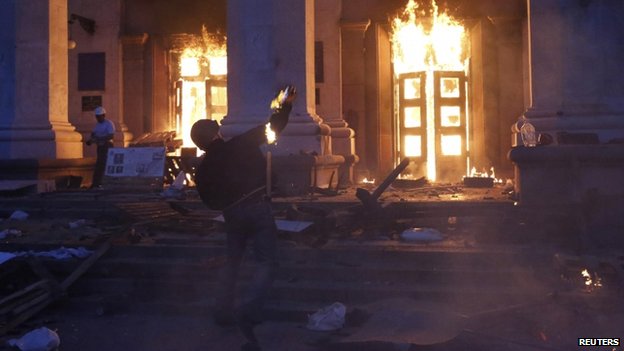
With the American minds now fully inundated with anti-Russian propaganda and lies as to the composition of the US backed coup government in Ukraine the time has finally come to unleash the goons. After weeks of threats, military buildups and visitations by high US officials to the neo-Nazi/fascist backed “Yats” regime all hell broke loose on Friday. The point of no return – if not already crossed by the duplicity of the US-EU-NATO triad was reached when the occupying government in Kiev sent forth military helicopters against civilians and extremist shock troops began a pogrom in the city of Odessa. Now it is on like Donkey Kong!

It is another of those sick ironies that plague this country, especially since the September 11, 2001 attacks allowed for the Deep State to give birth to The Homeland that German Chancellor Angela Merkel appeared with Barack Obama at the White House to bash Russia hours before fascist thugs burned down a trade union hall and roasted or asphyxiated everyone inside. Merkel incidentally holds the same gig as a certain German leader did the last time that things like this happened. Obama as yet has not condemned the violence – after all, the USA, USA, USA is on the same side as the neo-Nazis and fascists this time.

As for those murdered by Kiev’s illegitimately installed government in Odessa there is zero remorse coming from Obama and Kerry today – it’s rare to see this level of callous indifference when brown-skinned non-Christians are not involved. In fact Kerry, like the finger-wagging, overbearing horse’s ass that he is launched into yet another diatribe blaming Russia and issuing even more threats. According to a story in The Guardian:

Kerry said it was important Russia withdrew support for such separatists, who have seized government buildings in about a dozen cities and towns in Ukraine, and raised the prospect of additional Western sanctions if there were indications of continued interference by Russia.

Kerry also said he and Lavrov discussed the violence in Odessa, where at least 42 people died on Friday.

“All of this violence is absolutely unacceptable,” Kerry said, “and Russia, the United States, Ukrainians, Europeans, the OSCE all of us bear responsibility to do everything in our power to reduce the capacity of militants and extremists who are armed to be carrying out these terrorist and violent activities.

“They must end, and everybody with any influence on any party has an obligation to try to bring an end to this violence.”

But Kerry lies in that “everybody” doesn’t include the US-EU-NATO Axis of Aggression. Emperor Obama won’t call off his neo-Nazis nor the Contra style death squads that will be stocked with drooling members of Pravy Sektor and other fascist groups to conduct their counter-insurgency sprees of murder, rape and torture. There is only one way for this to end without consequences of a history altering manner and that is for Putin to surrender and crawl on his belly to lick Obama’s boots. That ain’t going to happen so we are now heading towards something that will end in misery for all involved. I regularly read the great work of former Reagan administration Assistant Secretary of Treasury, former Wall Street Journal editor and economist Paul Craig Roberts who has long been predicting doom for this system, it has taken a little bit more time to get here but now we find ourselves being force marched to the gates of Hell itself. In his latest piece which is entitled “Washington Intends Russia’s Demise” Dr. Roberts writes:

Washington has no intention of allowing the crisis in Ukraine to be resolved. Having failed to seize the country and evict Russia from its Black Sea naval base, Washington sees new opportunities in the crisis.

One is to restart the Cold War by forcing the Russian government to occupy the Russian-speaking areas of present day Ukraine where protesters are objecting to the stooge anti-Russian government installed in Kiev by the American coup. These areas of Ukraine are former constituent parts of Russia herself. They were attached to Ukraine by Soviet leaders in the 20th century when both Ukraine and Russia were part of the same country, the USSR.

Essentially, the protesters have established independent governments in the cities. The police and military units sent to suppress the protesters, called “terrorists” in the American fashion, for the most part have until now defected to the protesters.

With Obama’s incompetent White House and State Department having botched Washington’s takeover of Ukraine, Washington has been at work shifting the blame to Russia. According to Washington and its presstitute media, the protests are orchestrated by the Russian government and have no sincere basis. If Russia sends in military units to protect the Russian citizens in the former Russian territories, the act will be used by Washington to confirm Washington’s propaganda of a Russian invasion (as in the case of Georgia), and Russia will be further demonized.

AND

The time is approaching when Russia will either have to act to terminate the crisis or accept an ongoing crisis and distraction in its backyard. Kiev has launched military airstrikes on protesters in Slavyansk. On May 2 Russian government spokesman Dmitry Peskov said that Kiev’s resort to violence had destroyed the hope for the Geneva agreement on de-escalating the crisis. Yet, the Russian government spokesman again expressed the hope of the Russian government that European governments and Washington will put a stop to the military strikes and pressure the Kiev government to accommodate the protesters in a way that keeps Ukraine together and restores friendly relations with Russia.

This is a false hope. It assumes that the Wolfowitz doctrine is just words, but it is not. The Wolfowitz doctrine is the basis of US policy toward Russia (and China). The doctrine regards any power sufficiently strong to remain independent of Washington’s influence to be “hostile.” The doctrine states:

“Our first objective is to prevent the re-emergence of a new rival, either on the territory of the former Soviet Union or elsewhere, that poses a threat on the order of that posed formerly by the Soviet Union. This is a dominant consideration underlying the new regional defense strategy and requires that we endeavor to prevent any hostile power from dominating a region whose resources would, under consolidated control, be sufficient to generate global power.”

The Wolfowitz doctrine justifies Washington’s dominance of all regions. It is consistent with the neoconservative ideology of the US as the “indispensable” and “exceptional” country entitled to world hegemony.

Russia and China are in the way of US world hegemony. Unless the Wolfowitz doctrine is abandoned, nuclear war is the likely outcome.

Not since the days when the halls of power were stalked by fanatics like  Curtis “Bombs Away” LeMay has there been such a lack of disregard for the nuclear consequences of an escalating and insane pushing of hostilities with Russia.

The state-corporate media completely abandoned any pretense of honesty in allowing this once great nation to be dragged into the debacle that was Iraq yet that failure pales in comparison to the lies about Ukraine and the pushing of a new Cold War. The ramifications of hostilities with Russia, thanks largely to our vainglorious ass of a leader and his crackerjack foreign policy team will be minor in the long run when compared with Iraq. This has civilization level damage written all over it and the way that Barry and the boys are continuing to double down to lure Putin into sending troops into Ukraine the best that we can hope for is collapse.


Will Ukraine Be NYT’s Waterloo?

propaganda_corporatenews

By Robert Parry

Source: Consortium News

For Americans interested in foreign policy, the New York Times has become the last U.S. newspaper to continue devoting substantial resources to covering the world. But the Times increasingly betrays its responsibility to deliver anything approaching honest journalism on overseas crises especially when Official Washington has a strong stake in the outcome.

The Times’ failures in the run-up to the disastrous Iraq War are, of course, well known, particularly the infamous “aluminum tube” story by Michael R. Gordon and Judith Miller. And, the Times has shown similar bias on the Syrian conflict, such as last year’s debunked Times’ “vector analysis” tracing a sarin-laden rocket back to a Syrian military base when the rocket had less than one-third the necessary range.

But the Times’ prejudice over the Ukraine crisis has reached new levels of extreme as the “newspaper of record” routinely carries water for the neocons and other hawks who still dominate the U.S. State Department. Everything that the Times writes about Ukraine is so polluted with propaganda that it requires a very strong filter, along with additives from more independent news sources, to get anything approaching an accurate understanding of events.

Screen shot of the fire in Odessa, Ukraine, on May 2, 2014. (From RT video)

From the beginning of the crisis, the Times sided with the “pro-democracy” demonstrators in Kiev’s Maidan square as they sought to topple democratically elected President Viktor Yanukovych, who had rebuffed a set of Western demands that would have required Ukraine to swallow harsh austerity measures prescribed by the International Monetary Fund. Yanukovych opted for a more generous offer from Russia of a $15 billion loan with few strings attached.

Along with almost the entire U.S. mainstream media, the Times cheered on the violent overthrow of Yanukovych on Feb. 22 and downplayed the crucial role played by well-organized neo-Nazi militias that surged to the front of the Maidan protests in the final violent days. Then, with Yanukovych out and a new coup regime in, led by U.S. hand-picked Prime Minister Arseniy Yatsenyuk, the IMF austerity plan was promptly approved.

Since the early days of the coup, the Times has behaved as essentially a propaganda organ for the new regime in Kiev and for the State Department, pushing “themes” blaming Russia and President Vladimir Putin for the crisis. [For details, see Consortiumnews.com’s “Ukraine, Though the US ‘Looking Glass.’”]

In the Times’ haste to perform this function, there have been some notable journalistic embarrassments such as the Times’ front-page story  touting photographs that supposedly showed Russian special forces in Russia and then the same soldiers in eastern Ukraine, allegedly proving that the popular resistance to the coup regime was simply clumsily disguised Russian aggression.

Any serious journalist would have recognized the holes in the story – since it wasn’t clear where the photos were taken or whether the blurry images were even the same people – but that didn’t bother the Times, which led with the scoop. However, only two days later, the scoop blew up when it turned out that a key photo – supposedly showing a group of soldiers in Russia who later appeared in eastern Ukraine – was actually taken in Ukraine, destroying the premise of the entire story.

Soldiering On

The Times, however, continued to soldier on with its bias, playing up stories that made Russia and the ethnic Russians of eastern Ukraine look bad and playing down anything that might make the post-coup regime in Kiev look bad.

On Saturday, for instance, the dominant story from Ukraine was the killing of more than 30 ethnic Russian protesters by fire and smoke inhalation in Ukraine’s southern port city of Odessa. They had taken refuge in a building after a clash with a pro-Kiev mob which reportedly included right-wing thugs.

Even the neocon-dominated Washington Post led its Saturday editions with the story of “Dozens killed in Ukraine fighting” and described the fatal incident this way: “Friday evening, a pro-Ukrainian mob attacked a camp where the pro-Russian supporters had pitched tents, forcing them to flee to a nearby government building, a witness said. The mob then threw gasoline bombs into the building. Police said 31 people were killed when they choked on smoke or jumped out of windows.

“Asked who had thrown the Molotov cocktails, pro-Ukrainian activist Diana Berg said, ‘Our people – but now they are helping them [the survivors] escape the building.’”

By contrast, here is how the New York Times reported the event in its Saturday editions as part of a story by C.J. Chivers and Noah Sneider focused on the successes of the pro-coup armed forces in overrunning some eastern Ukrainian rebel positions.

“Violence also erupted Friday in the previously calmer port city of Odessa, on the Black Sea, where dozens of people died in a fire related to clashes that broke out between protesters holding a march for Ukrainian unity and pro-Russian activists. The fighting itself left four dead and 12 wounded, Ukraine’s Interior Ministry said. Ukrainian and Russian news media showed images of buildings and debris burning, fire bombs being thrown and men armed with pistols.”

Note how the Times evades placing any responsibility on the pro-coup mob for trying to burn the “pro-Russian activists” out of a building, an act that resulted in the highest single-day death toll since the actual coup which left more than 80 people dead from Feb. 20-22. From reading the Times, you wouldn’t know who had died in the building and who had set the fire.

Normally, I would simply attribute this deficient story to some reporters and editors having a bad day and not bothering to assemble relevant facts. However, when put in the context of the Times’ unrelenting bias in its coverage of the Ukraine crisis – how the Times hypes every fact (and even non-facts) that reflect negatively on the anti-coup side – you have to think that the Times is spinning its readers, again.

For those who write for the Times – and the many more people who read it – the question must be whether the Times is so committed to its prejudices here that the newspaper will risk whatever credibility it has left. The coup regime from Kiev may succeed in slaughtering many ethnic Russians in the rebellious east — as the Times signals its approval — but will this bloody offensive become a Waterloo for whatever’s left of the newspaper’s journalistic integrity?


Investigative reporter Robert Parry broke many of the Iran-Contra stories for The Associated Press and Newsweek in the 1980s. You can buy his new book, America’s Stolen Narrative, either in print here or as an e-book (from Amazon and barnesandnoble.com). For a limited time, you also can order Robert Parry’s trilogy on the Bush Family and its connections to various right-wing operatives for only $34. The trilogy includes America’s Stolen Narrative. For details on this offer, click here.

Saturday Matinee: The Cube

cube

“The Cube” (1969), not to be confused with “Cube” the 1997 cult film, was directed by Jim Henson and first aired as part of NBC’s weekly anthology show Experiment in Television. The film’s absurdist plot centers on a man who finds himself trapped in an empty room. However, others are free to enter and leave providing him with a series of puzzling existential encounters.

Bonus short film: