Game Over

Political_Studies_3798278

The Jargon of Game Theory

By

Source: Soul of the East

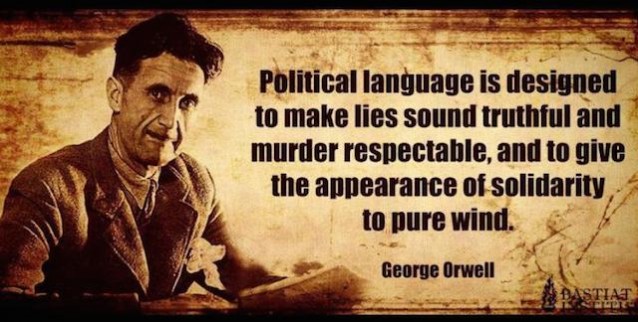
While suffering under the information barrage wrought by mass media, a question arises in one’s mind: exactly how many words are there in the media vocabulary? For, when it comes to treatment of serious subjects like the economy and politics, the words in use are reduced to surprisingly few, so that even purported media analysis or commentary comes to resemble a mantra or nursery rhyme. Furthermore, it is notable that this “linguistic drain” occurs precisely at the moment when “serious” matters come into focus, and in spite of all the loftiness of the talking heads – our designated hierophants and media oracles – we are bombarded with rather frivolous terminology. One can only be perplexed at why, for instance, economic and political agents are called players? Why does the philosophy professor speak about the strategy of Nietzsche’s arguments? What exactly does it mean to have a cultural strategy? On what grounds does the literally critic assume that James Joyce employed a narrative strategy?

Why are all those serious things spoken about as if they were some kind of game?

On the face of it, the answer is surprisingly easy to deduce. Game or game-play jargon originates in global epistemic dominance of thought models derived from mathematical game theory. Its various abstract and complex forms (so called ‘models’ or ‘modules’), as well as their global application to all aspects of life, build the spiritual framework of our time to a significant extent, although they are rarely discussed outside of academia. However, game theory is not merely a mathematician’s plaything. If we bear in mind that the world stage – with all those global players – is also the home to all sorts of people who are well aware that they are being played, but have no idea of true nature of those playing them, then it is clear that the fundamentals of game theory should be subjected to critical scrutiny. The task is all the more urgent – and all the easier – if we bear in mind that the peculiarity of game theory, in contrast to other mathematical models, lies in the fact that it is founded on all-encompassing and simultaneously incredibly simple – one could say simple as in ‘dim witted’ – explanation of man and the world in general.

Game theory is a metaphysical doctrine, i.e. its ambition is to encompass everything, both the nature of man and the nature of universe. And there is a one special rule to every game of metaphysics, namely this: when the abstract and esoteric professional language of science is put aside, the game is potentially understandable to all parties – both those who are playing and those who are being played. It is an unspoken rule, an ancient assumption of all world-view con-games: in order for half-truth to hold sway over everybody, it must be spoken in common language. So let us examine, aided by some elementary concepts, what game theory is exactly and what it means for someone who is not a player, only played.

At its core, though, game theory is an explanatory model of decision making. It defines its subject as rational activity whose purpose is an increase in well-being of the deliberating individual or collective. Any behavior seemingly pursuing different purpose is only a roundabout way to achieve this goal more rationally, or it is simply “irrational.” Tertium non datur. Obviously, we are dealing with, broadly speaking, a “liberal” definition of man, although it is in fact the legacy of Ancient Greek Sophists. Bearing in mind that an individual is always in the midst of other individuals and that in order to achieve its goals it must collaborate or come into conflict with them, society must be rationally modelled in order to minimize conflict. That old bogeyman of political philosophy, Thomas Hobbes, conceived such a thing as possible only through the absolute sovereignty of the State, for was convinced that all those self-centered atoms were more prone to play at some iteration of Total War than that of Sims.

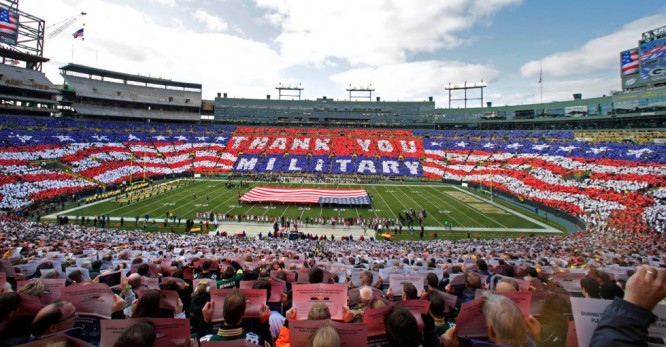
Proponents of game theory try to evade this fairly consistent inference of universal war or use it to prove something else: atomized individuals do not strive toward all-out conflict but towards equilibrium. The term denotes a state of conflict turned latent, in the sense of permanent threat or warning, but having ceased to be destructive; it is, in a word, a rational conflict, a war that grew cold. Namely, rational behavior is primarily strategic, i.e. it endeavors to accomplish its objective despite possible resistance by anticipating the strategies of that resistance. The healthy society is the one in which unavoidable conflicts are being channeled into relative harmony, regulated by the rules of the game, because the players realized that relative equality is more expedient than playing an ‘all or nothing’ game. Hence, game theory has a notably militaristic nature, affirmed by its history: it flourished inside military think tanks during the first years of the Cold war, only to be later unleashed on civil societies throughout the West.

The Prisoner’s Dilemma

At this level, some peculiarities are also notable. The term ‘game’ is made distinct but is not clearly defined, i.e. it is obviously artificially narrowed. For instance: since when does the game have to be competitive? Moreover, it is usually understood as a leisure activity, an escape from labor and conflict. Game by its nature doesn’t require winners and losers. It can be – and it usually is – a completely self-sufficient activity. In that sense, dances, visual and linguistic creative activities, fine or liberal arts, are all forms of playing a game. Those are all activities that, deprived of any calculated purpose outside themselves, remain autonomous and, therefore, free. However, game theory, without further clarification, presumes that games are always forms of competition implying conflict, binary division on winners and losers, elements of chance and power relations, domination and submission. So game theory is concerned with power plays. This is best illustrated in that most famous of game theory modules, the “Prisoner’s Dilemma.”

The Prisoner’s Dilemma is an imagined situation that game theoreticians apply to reality, and it has many variations with according levels of complexity. It can be described, using the so-called static model, in the following way:

Two criminals are brought to a police station for questioning. They committed the crime, but if the police fail to get the confession from one or either of them, they’ll walk. They are put in separate rooms and isolated from one another. A confession is demanded from each one. A situation develops in which the rules of the game provide them with a limited number of possible strategies: each one could or could not confess. If both confess, their pay-off is equally small, but if only one confesses, his pay-off is small, but bigger than the pay-off of his accomplice. If neither confesses, the pay-off is equally big for both of them, yet so is the risk of losing everything. Two key factors are in play: the prisoners are completely isolated from one another – they only know the game’s rules and the pay-offs by which they model their respective strategies, and each one only wants to maximize his own pay-off. The game-theory endeavor to use this module to explain real-life situations and foresee the decisions to be made by opponents (for instance, by Soviets in the Cold-War era) or to offer the best course of deliberation to its users. In the dynamic model of The Prisoner’s Dilemma, the main difference is in access to information, because players are allowed to confer before they are isolated.

A striking feature of such models must be noted. More often than not, the agents of decision-making in game theory modules are described as criminals. Sometimes they are jewel thieves, sometimes it’s a fugitive escaping the posse, and one encyclopedia’s game theory module is illustrated by the act of tossing the incapacitated opponent into precipice. It is interesting that the author uses the pronoun he for the victim while the criminal in the dilemma is denoted as she, in strict obeisance to the rules of political correctness. Bearing in mind that victimhood, imaginary or not, proves to gain a rather abundant pay-off, it seems that even the game theoretician is faced with a Prisoner’s Dilemma.

The Game Myth

This feature leads us to key weak point of game theory, i.e. its flimsy definition of rationality. Namely, the “big players”, of whose moving and shaking the media hierophants inform us unceasingly, are implicitly denounced as criminal organizations, and not by the frustrated and confused public – the notion appears incorporated into the very definition of their enterprises. Every player seeks exclusively his own maximal gain, and that which is considered to be “one’s own,” therefore rationally desirable, seemingly private, comes dangerously close to being privative. Bearing in mind that such exclusive economic players are prone to merge with their playmates in politics – which is, after all, the elementary definition of fascism – one must reach the conclusion that in the foundations of seemingly supra-private bodies, be it corporations or governments, not only private but also privative interests are embedded, and that the very process of democracy can be seen as a means of accomplishing this.

In that sense, it is no wonder that what is now called liberalism is a form of strange metaphysics. Namely, it appeals to ‘human nature’ and ‘natural rights’, but has in fact always been infected with an urge for escapism, clearly visible in so-called “state of nature” and “social contract” theories, mythical stories about a historical event that never happened in a historical age that never was, which man escaped by a decision he never made. Game theory metaphysics transforms this myth and enriches it, but it certainly doesn’t dispel it. The myth is sold, against all reason and the wealth of human imagination, as the veritable image of truth, i.e. a valid world-view, the prism through which the entire contemporary landscape is transmitted before our eyes. However, this picture, no matter how coherent and self-sufficient, is in fact rather fragile.

The persuasive power of the myth is proportional to the verity of its images of truth, while the persuasive power of the lie stems from its appellation to weaknesses of thought – to an inertia delighted with the ease of passing flippant judgment. The mythology of the rational playground falls precisely into this second category, because it assumes the pretense of a necessary and all-applicable system, thereby subverting the transcendental, robbing it of its very possibility while replacing it with a simulacrum. However, in moments of crisis – etymologically equal to moments of judgment – its frailty is all the more obvious, and its ability to maintain the illusion ever more inadequate to the task. The notion of man as a ‘selfish information processor’ is in fact a careless distortion of the classical understanding of elementary human solidarity, founded on love of one’s own transferred to another, best explained in Aristotle’s Book VIII of Nicomachean Ethics, where it is defined as ‘friendship’ (filia) in the broadest sense. The progressive concentration of power in the hands of players, at the expense of those who are played is more likely to push the losing side into the irrational decision of giving up on selfishness, of declaring: “I will not play anymore.”

Ghosts in the Machine 

We face the following eventuality: the choice of irrational decision sheds more light on a crucial system error in the definition of man and game that this pseudo-metaphysics imposes on us. The term ‘irrational’ is never really defined in the framework of game theory. And rationality fared only slightly better, though at least it can serve as a foothold for via negativa deduction of what is not irrationality. For the game theoretician, irrational behavior is not behavior at all; it is a pseudo-behavior deprived of deliberation. Bearing in mind that game theory yields a considerable pay-off in microbiology, where genes are conceived as rational players in the game of survival of the fittest, we can’t even say that irrational players are making monkeys of themselves. So how, using this sophisticated net, does one catch this elusive mutant who won’t play games, strategize, steal, or bow to political religion?

Let’s define him. This “ghost in the machine” could be someone whose moral sentiment forces him to irrationally decline profitable professions or profitable occasions, such as employing his talents in mass propaganda or advertising. Furthermore, in order to achieve his objective, perhaps writing a novel penetrating the depths of human condition, for example, he irrationally decides to always be close to death, because only then he can really reach the heart of his subject, while at the same time he knows that the pay-off will probably come after he is long gone. Is there any conceivable rational agent who can assume that he rationally planned all this? Or are all those “whistleblowers” really rational players; people who rationally decided to confront corruption, and now enjoy the pay-off by being unemployed or jailed, crucified between responsibility towards their conscience and their families?

After all, were the lines you now read calibrated for a payoff? “Irrationality” is what you were seeking the entire time.

Game theory views the irrational as its own confinement; the razor wire lining the playground fence or an unforeseen eventuality breaking the rules of game-play, its strict order. Bearing in mind that we are talking about world order – and world-encircling razor wire – the deprecation of the irrational is absolute inasmuch as the myth of the rational is absolute. Endemic, logically indescribable specimens are reduced to occasional noise in communication channels between players. Yet those endemic specimens are in fact the majority of our respectably populated planet, and so the noise grows to permeate our societies. It even begins to obstruct the tranquility of academic think tanks, and we know that devising complex and abstract logical, not to mention mathematical, models demands focus, a certain withdrawal from the world in the isolation of one’s paneled office – that parody of the monk’s cloister. Could it be that the hum of the irrational is evolving into an unpredictable, unbearable roar of chaos whose source is too powerful for even the valiant forces of campus security to subdue?

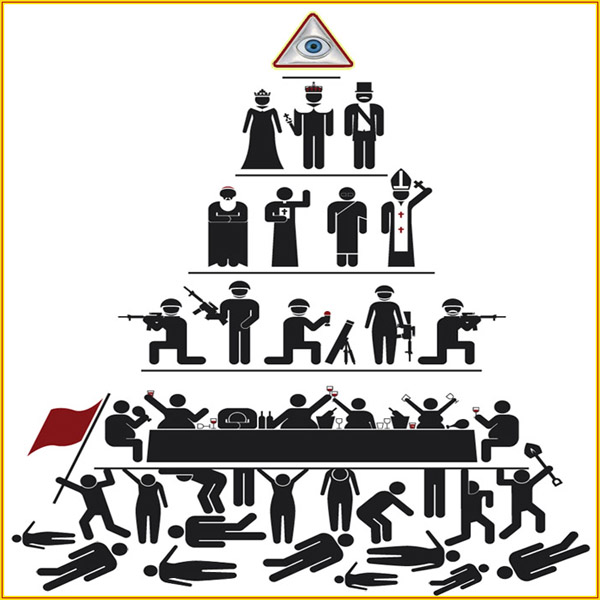
Is it only rational to predict that a creature of grand scale is much too big for nets weaved from a flimsy conceptual framework, unfit for catching even butterflies? What happens when the net breaks? Because the enemy is irrational, and therefore unthinkable. It is the great Unknown, something equal to an extraterrestrial invasion. Can the controllers’ sorcery of half-truth, half-philosophy, half-culture, and half-living keep our eyes wide shut for much longer? Among the faceless and unprepossessing shall awaken the beast of the irrational, its inner abyss suspending man between the angelic and the infernal. Game over.

See all of Branko Malic’s writings on philosophy, culture, and deep politics at Kali Tribune.

Deepwater Capitalism

gulf-oil-spill17

Reflections on the Fifth Anniversary of One of the Biggest Oil Spills in History

By Quincy Saul

Source: Counterpunch

In memory of Gabriel García Márquez, March 6, 1927-April 17, 2014.

In September of 2009, the BP corporation dug the deepest oil well in history. The 35,055-foot deep Tiber prospect, 300 miles off the Texas coast, promised six billion barrels: one of the largest oil fields ever discovered in the country. So of course, they kept looking for more: They moved their massive drilling rig named Deepwater Horizon fifty miles south of the Louisiana coastline, to a prospect called Macondo, named after the setting of the famous book 100 Years of Solitude, by Gabriel García Márquez.

On April 20, 2010, as they began to seal the well, something went wrong: a mix of oil and gas escaped, rushing up through earth and water, blowing up the Deepwater Horizon, and killing eleven workers, whose bodies were never recovered. Over the next eighty seven days, the whole world watched as over 200 million gallons of oil erupted from the ocean floor into the Gulf of Mexico.

It was the largest oil spill in history – more than ten times the size of the Exxon Valdez disaster in Alaska. The images of animals covered in oil began to haunt our screens again, and the scale of death was so great it still seems impossible to quantify – estimates of the number of birds killed within the first hundred days ranges between 100,000 and one million. But the real nightmare was offshore, as riptides and hired hands collected thousands of animal carcasses into “death gyres”. Riki Ott explains:

“Hurricane Creekkeeper John Wathen managed to get the only footage of what I came to call the ‘death gyres.’ the rip currents that collected dead animals offshore. The Incident Command – BP and the US Coast Guard – kept the media 1,500 feet up in the air so the press couldn’t really capture the situation there. The animal carcasses were corralled, taken out to sea, and dumped at night, according to fishermen who were involved with so-called ‘Night-time Operations.’ Offshore workers reported ‘thousands of dolphins, birds too numerous to count, sea turtles too numerous to count,’ and even whales in the death gyres.” (Earth at Risk, Building a Resistance Movement to Save the Planetedited by Derrick Jensen and Lierre Keith, p. 49)

Five years later, what can we say? If hindsight is 20-20 then presumably we can learn from our mistakes. How did it happen? Was it BP’s fault? Or is there a bigger picture to blame? Five years later, the common sense of this tragedy has yet to dawn, as if the oil has clogged our hearts and minds along with our oceans and beaches. Like the pioneers of Márquez’s Macondo, searching for a way through the swamp, we seem lost, desperately hacking our way through nature and through our own nature. And the past, like the path, seems to always be disappearing behind us.

“…and the cries of the birds and the uproar of the monkeys became more and more remote, and the world became eternally sad. The men on the expedition felt overwhelmed by their most ancient memories in that paradise of dampness and silence, going back to before original sin, as their boots sank into pools of steaming oil and their machetes destroyed bloody lilies and golden salamanders. . . . They could not return because the strip that they were opening as they went along would soon close up with a new vegetation that almost seemed to grow before their eyes.” (Márquez, p. 11-12)

How did it Happen?

“The main thing is not to lose our bearings.” (Márquez, p. 12)

Whodunit? What was the crime scene, and who are the criminals? What murder weapon spawned gyres of death? Five years later, we must look through the tangled jungle of events which have grown up behind us, and remember how we got here. Michael Klare’s insightful blow-by-blow of the events leading up to the accident is worth revisiting. 

“When BP first deployed the rig at the Macondo prospect in January 2010, it set a target date of March 7 for completion of that well. However, due to a series of geological obstacles and technical mishaps, drilling was not completed until April 19, producing a cost overrun on the project of approximately $58 million. It is not surprising, then, that BP’s site managers felt particular pressure to seal the well and move the Deepwater Horizon, to its next scheduled location. In their rush, the site managers made several last-minute decisions. . . . When preparing for the final cementing that would prevent natural gas from leaking into the wellbore, for instance, they decided to use only six “centralizers” to position the well’s steel casing, whereas the original design had called for twenty-one centralizers. They also went ahead with the sealing of the well even though several ‘negative-pressure’ tests suggested a dangerous buildup of gas in the wellbore. . . . the desire to complete the job swiftly and move the expensive drillship to its next assignment certainly contributed to the disaster.” (The Race for What’s Left, The global scramble for the world’s last resourcesKlare, p. 47-8)

One way to solve this crime is to blame the workers – the crime scene is the workplace, and the murder weapon is the botched job. They failed to follow industry regulations; using less than half of the recommended number of centralizers, and ignoring the test results indicating a dangerous buildup of gas. But this explanation is not sufficient, and hides another suspect. If the workers pulled the trigger, who gave the order?

As Klare explains, the workers were in a rush. It was the BP site managers – their cost overrun, their “pressure to seal the well and move,” and the “desire to complete the job swiftly,” which created the conditions in which the oil workers made their fateful decisions. So is BP the murderer? Is the crime scene the BP board room?


Inside BP

At the dawn of the 21st century, BP had a tabloid affair with alternative energy. John Browne, its CEO from 1995 to 2007 re-branded the company, from “British Petroleum” to “Beyond Petroleum”, and urged its shareholders and broader public “to look beyond oil and gas to fuels which can be produced locally and which do not threaten the sustainability of the world’s climate.” In 2008, Browne was replaced by Tony Hayward, whose more sober vision re-branded the company simply “BP”, and clarified that “the energy of the future will be more than oil, but oil will still be a major part of it.” In 2010 he closed BP’s “alternative energy office.” (Klare, p. 41)

Perhaps the public relations team from that office had all been moved to the Gulf Coast, where it has been working overtime since 2010. This has included classroom visits with “hands-on” experiments, substituting cocoa for oil and dish soap for chemical dispersant, to win young hearts and minds to the efficacy of BP’s cleanup efforts.[1] According to the company, the case is closed. A recently released report from BP concluded: “BP has seen no data to suggest a significant long-term population-level impact to any species.” In fact, “BP is claiming that wildlife in the Gulf is thriving and more abundant since the disaster.” (Jensen and Keith, p. 61) In a recent press conference, BP’s executive vice president for response and environmental restoration in the region Laura Folse said “I personally have no concern about oil washing in from the offshore to the shoreline.”

BP is preparing for the punchline, because currently pending in court is the case which will decide how much money BP has to pay in damages for the disaster. While BP is a giant – listed by Fortune magazine as the fourth largest publicly held company in the world – some on Wall Street have expressed fear that the court’s decision could kill the company. This panic began almost immediately after the spill, and BP began to sell off assets all over the world, in Colombia, Egypt, the US, Canada and Argentina. (Klare, p. 215, 216)

But according to forensic accounting expert Ian Ratner who testified recently on the case, BP “actually, has a better balance sheet today than it had before the spill.” Despite around $40 billion in oil spill liabilities, the company is financially better off than before the disaster. What’s more, they are back at the scene of the crime: “We expect to be back and actively drilling during the second half of the year,” said BP Chief Financial Offcer Byron Grote in April 2011. And he kept his promise: like Colonel Buendía in Márquez’s novel, BP gives orders for execution but is isolated and naive about to the results: “Lost in the solitude of his immense power, he began to lose direction.” (Márquez, p. 171) BP seems both all-powerful and powerless, returning to the scene of the crime like a dog unto its vomit, at the mercy of some god or godlessness which demands more drilling.

There is more than meets the eye in this case. Is BP the only culprit on trial? If the workers pulled the trigger, and BP gave the order, who put the gun in its hand? And who made the gun? There is an African saying that “if you want to get at the root of the murder, you have to look for the blacksmith who made the machete.” (Anthills of the SavannahChinua Achebe, p. 159)

The World System

“That was perhaps the only mystery that was never cleared up in Macondo. . . . A trickle of blood came out under the door, crossed the living room, went out into the street, continued on in a straight line across the uneven terraces, went down steps and climbed over curbs, passed along the Street of the Turks, turned a corner to the right and another to the left, made a right angle at the Buendía house, went in under the closed door, crossed through the parlor, hugging the walls so as not to stain the rugs, went on to the other living room, made a wide curve to avoid the dining-room table, went along the porch with the begonias, and passed without being seen under Amaranta’s chair as she gave an arithmetic lesson to Aureliano José, and went through the pantry and came out in the kitchen, where Úrsula was getting ready to crack thirty-six eggs to make bread.” (Márquez, p. 135)

What was the blacksmith that built and blew the Deepwater Horizon? Like the mystery of Macondo in Márquez’s story, the trail of blood climbs and descends, turns corners and crosses paths, taking us from the work place, to the board room, to the stock exchange, and from there it seems to flow into the ocean of normal every-day modern life. As Lamar McKay, chairman and president of BP America said, “the deepwater is indispensable to the world’s energy future.” (Klare, p. 69) The trail doesn’t go cold, it goes everywhere. Like the war of Colonel Buendía, our search for justice in the death gyres seems to get stuck in a stalemate of business as usual: “’Everything normal, Colonel.’ And normality was precisely the most fearful part of that infinite war.” (Márquez, p. 171)

In the early 2000s, the deep sea drilling industry boomed. All the big oil corporations competed to dig the deepest wells, at depths and conditions that boggle the imagination – deeper than Mt. Everest is tall, under thousands of feet of water (and pressure). These projects out-compete space exploration in the audacity of their engineering and in their cost: Shell built a rig called Mars that was three times more expensive than the Mars Pathfinder mission, with arguably more complex technology. (Klare, p. 44) While their locations are industry secrets – no one knows how many or where they all are – they are everywhere, from the Falkland Islands to the Arctic Circle, from South America to West Africa.

A 2010 report by energy expert Michael Smith estimated that big oil would spend $387 billion on offshore drilling between 2010 and 2014 – 33% more than over the previous five years – building 20,000 offshore wells in ever deeper waters. (Klare, p. 44-45) The Deepwater Horizon explosion, which came nineteen days after President Obama announced plans for more offshore drilling, did little or nothing to change the plan. Three days after the explosion, with Macondo still gushing, a White House spokesperson assured that increase in offshore drilling would continue, promising that it would be done “safely, securely, and without harm to the environment.” (Klare, p. 51)

Before Deepwater Horizon, regulations on the industry had been lax. In the United States, the Interior Department’s Mineral Management Service (MMS) took a hands-off approach to the industry, never, for instance, setting any criteria for minimum-pressure tests, which had such fateful consequences in the Gulf. (Klare, p. 50) After a six month moratorium on drilling in the Gulf after the disaster, oil companies began to lobby the courts to being reissuing permits. A new set of safety rules was established, and by April 2011, one year after the disaster, deep drilling in the Gulf, by BP and others, was back online. (Klare, p. 52) Everything normal, Colonel.

This is the normalcy of the infinite war on mother earth: While the fallout of the disaster continues to inflict irreparable damage to the Gulf, the industry which created the crisis is allowed to resume the activity which created it. And the same agencies that failed to regulate the industry before are being trusted to do it right this time. How can this be?

The answer can be found by following the money, like the trickle of blood in Macondo, from the scene of the crime, and out into the world-system. In an energy analysis report from several years ago, it was predicted that due to declining reserves of conventional oil, offshore oil output would contribute 35 percent of global supplies by 2020. By 2015, the report continued, deep-offshore fields would be “the only source of growth to power the world’s expanding economy. . . . Any energy firm that intends to continue being involved in the production of hydrocarbons must, therefore, establish a significant presence in the major deepwater drilling zones.” (Klare, p. 45)

In other words, the industry is too big to fail – even if does fail. Big oil cannot be too strictly regulated or restricted – or punished. Their alibi is the world-system; the modern way of life. This logic was recently re-asserted by Justice Department attorney Steve O’Rourke in the buildup to the court case that will decide BP’s punishment, who said that the penalty “has to be high enough that companies of this size won’t let a spill like this ever happen again. But, again, not so high as to be ruinous to their operation.” In the great state of Louisiana, individuals who murder get capital punishment, but corporations who murder get rehabilitation. Questioned about whether the company would attempt to drill at Macondo again, BP senior vice president Kent Wells responded that “there is a good reservoir there,” and there was no reason to rule it out, because if BP didn’t, someone else would. (Klare, p. 52)

And so BP and the Gulf and all of us have come full circle, back to the scene of the crime. As death approaches for Márquez’s Ursula Buendía, so does the realization for all of us: “time was not passing. . . . it was turning in a circle.” (Márquez, p409) As big oil races ever faster and ever deeper, time somehow seems to stand still. The rush put on the workers is the rush put on the managers, is the rush put on the CEOs, is the rush put on the shareholders, is the same rush put again upon the workers. And in this “race for what’s left,” as Michael Klare calls it, we are left standing still, watching death approaching, as the drilling rigs, like monster space-age vultures, circle Macondo once again.

We must ask again, and answer again, to keep our bearings, and to clear a path to the truth: Is the crime scene the workplace, or is it the board room? The stock exchange, or the gas station down the street? Like the trickle of blood weaving through the town of Macondo, the evidence leads everywhere; back to normal modern life. The crime scene is everywhere. The murder weapon is the world-system. The criminal and the culprit is deepwater capitalism.

Deepwater capitalism is a terminal stage in the global metastasis of a social cancer we call the economy. Capitalism has gone to deep water, as it has gone to the hearts of mountains and into the depths of the earth. Offshore oil drilling is but one horseman, in a world-wide apocalypse of extreme resource extraction. The others are fracking, tar sands, and mountaintop removal. If imperialism is the highest stage of capitalism, then today’s resource extraction apocalypse reveals the highest stage of imperialism – genocide and extinction.

Captain Ahab from Moby Dick, the insane captain of a whaling ship – distant ancestors of today’s offshore oil rigs – speaks for the system: “all my means are sane, my object and my motive mad.” (Melville, p. 177) With sane means and mad motives, Captain Ahab is both a model and a metaphor for today’s economy, whose command will sink civilization. It is the immense power without direction, the normal infinite war, the gravity at the center of a world-wide death gyre.


Conclusions

At the beginning of the road into the swamp they put up a sign that said ‘Macondo’ and another larger one on the main street that said ‘God exists’.” (Márquez, p. 49)

Five years later we owe it to ourselves and to the world to come to some conclusions. It may take millions of years for the ecosystems of the Gulf to recover, but in the meantime we must recover our hearts and our minds from a modernity in which such disasters are normal aspects of every-day life. We must come to some conclusions about this world-system, and about the generations of people who will live and die on the front lines of an infinite struggle against an infinite war.

Regardless of the severity of the punishment BP receives, the fact that it is back at the scene of the crime, drilling, gives us an indication of the real scale of the problem. If BP is a psychopathic recidivist criminal, it is not alone. The global economy which depends on this kind of extreme resource extraction, which gives corporations like BP orders and alibis, and which bends executive, legislative and judicial power to its needs, is on the move, and it will strike again. Bhopal, Macondo, Fukushima – the beat will go on until we pull the emergency break. Michael Klare writes in conclusion to his comprehensive global survey of our doomsday terrain: “As the race for what’s left gains momentum, this sort of predatory behavior will become more frequent and more brutal. . . . Only if we abandon the race altogether . . . . can we hope to avoid calamity on a global scale.” (Klare, p. 218 and 210)

To abandon the race: This is the conclusion to which we must come. It will, however, require much more of us than the reformist measures Klare proposes – increasing efficiency, developing alternative energies, and supporting “green” versus “brown” capital. These will only buy Captain Ahab more time. It’s time for mutiny. It’s time for the emergency break. It’s time for revolution.

Conclusions on the local level in the Gulf are more difficult. Big picture political conclusions will not bring back the fish and the birds, will not restore livelihoods and dreams swept away by poisoned waters. In a region that the federal government has all but abandoned, the future is wholly in the hands of the common people of the Gulf coast.[2] It is an immense burden for any people, let alone those who are still recovering, ten years later, from Hurricane Katrina, and who live trapped between “cancer alley” and rising ocean levels, with the ground literally sinking under their feet. Thus the struggles of the people of the Gulf symbolize for the entire world a last stand for meaning, in a civilization on the brink of oblivion: “It was the last that remained of a past whose annihilation had not taken place because it was still in a process of annihilation, consuming itself from within, ending at every moment but never ending its ending.” (Márquez, p409) After them, the flood.

Like children, many of us are afraid of the dark. We hide from the creeping annihilation even as it seeps ever closer to home. We close off our hearts to the horror, and mute our minds before the madness, even as it consumes us and enlists our complicity. As John W. Tunnell, witness for BP, recently testified, “The images of those dead birds that were oiled, like pelicans, stick in people’s minds more, and so it’s easy to get emotionally involved in those things. . . . you have to step back and critically and unemotionally, objectively to look at what’s going on.”

While BP’s witnesses, as personifications of capital, would have us immerse ourselves in the infamous “icy waters of egotistical calculation,” some people in the Gulf prefigure a different path to the truth. A documentary titled My Louisiana Love chronicles the story of Monique Verdin, a young Native American woman in search of love and life amidst death and indifference: “I want to keep living on our land, but I’m inheriting a dying delta.” She sets out fearlessly into a landscape of annihilation with an open heart, an open mind, and open hands, and in her story there is a universal story.

It is a story of salvation blossoming next to damnation, a story which promises like Holderin that “where danger threatens, that which saves from it also grows.” Like jewelweed growing next to poison ivy, like women’s liberation in Rojava alongside to the patriarchal crusade of ISIS, like God next to Macondo: There is hope here, perhaps the only kind of hope that is real in a world where everything is at least partly toxic, where dioxin swirls in breast milk, and death gyres spiral in the oceanic cradle of life. It is a story that slumbers in a world consumed with cynicism, a world awash in the icy waters of ego. But like the people of Macondo, we await only the right magnet to re-ignite our wonder. As the gypsy proclaimed, “things have a life of their own. . . . It’s simply a matter of waking up their souls.” (Márquez, p. 2)

Quincy Saul is the author of Truth and Dare: A Comic Book Curriculum for the End and the Beginning of the World, and the co-editor of Maroon the Implacable: The Collected Writings of Russell Maroon Shoatz. He is a musician and a co-founder of Ecosocialist Horizons.

REFERENCES

100 Years of Solitude, by Gabriel García Márquez, Harper Perennial Modern Classics, 2006

The Race for What’s Left, The global scramble for the world’s last resources, by Michael T. Klare, Metopolitan Books, Henry Holt and Company, NY, 2012

Earth at Risk, Building a Resistance Movement to Save the Planet, edited by Derrick Jensen and Lierre Keith, Flashpoint Press, 2012

Anthills of the Savannah, by Chinua Achebe, Anchor Book, 1998

Moby Dick, by Herman Melville, St. Botolph Society, 1892

“Suffering a Sea Change,” by Joel Kovel, Capitalism Nature Socialism, Volume 21, Issue 3, September 2010

Notes.

[1]  “NOAA and BP teamed up to visit eighth-grade classrooms in the Gulf to show children how to safely clean up an oil spill. They spilled cocoa powder in a little aquarium to mimic an oil spill – cocoa powder, right? Yummy. They sprinkled in Dawn dish soap to ‘disperse’ the oil. ‘See children? Dispersant works to clean up the oil, and we’re going to save the world. It’s OK.’ (Riki Ott, in Jensen and Keith, p52) Chemical dispersants can best be described with the poem by Gerard Manley Hopkins, “where we, even where we mean to mend her, we end her”: the toxicity of chemical dispersants – arguably more dangerous than the oil they purport to clean up – has been analyzed and documented by many organizations.

[2]  “It really is all up to us. In the Gulf, it didn’t take people twenty years like with the Exxon Valdez spill to realize the federal government was not in control of the situation; it took them two months.” -Riki Ott (Jensen and Keith, p52)


Hillary Clinton: The International Neocon Warmonger

06

By Webster G. Tarpley

Source: Voltaire.net

Hillary Clinton has announced her candidacy for President of the United States. While the European press showers her with praise without thinking, Webster G. Tarpley recalls her balance sheet: in all circumstances, she supported war and corporate interests.

As the National Journal reported in 2014, even the pathetically weak anti-war left is not ready to reconcile with Hillary given her warmongering as Secretary of State. And with good reason. Scratching just lightly beneath the surface of Hillary Clinton’s career reveals the empirical evidence of her historic support for aggressive interventions around the globe.

Beginning with Africa, Hillary defended the 1998 cruise missile strike on the El Shifa pharmaceutical plant in the Sudanese capital of Khartoum, destroying the largest producer of cheap medications for treating malaria and tuberculosis and provided over 60% of available medicine in Sudan. In 2006 she supported sending United Nations troops to Darfur with logistical and technical support provided by NATO forces. Libyan leader Moammar Qaddafi was outspoken in his condemnation of this intervention, claiming it was not committed out of concern for Sudanese people but “…for oil and for the return of colonialism to the African continent.”

This is the same leader who was murdered in the aftermath of the 2011 NATO bombing of Libya; an attack promoted and facilitated with the eager support of Mrs. Clinton. In an infamous CBS news interview, said regarding this international crime: “We came, we saw, he died.” As Time magazine pointed out in 2011, the administration understood removing Qaddafi from power would allow the terrorist cells active in Libya to run rampant in the vacuum left behind. Just last month the New York Times reported that Libya has indeed become a terrorist safe haven and failed state— conducive for exporting radicals through “ratlines” to the conflict against Assad in Syria.

Hillary made prompt use of the ratlines for conflicts in the Middle East. In the summer of 2012, Clinton privately worked with then CIA director and subversive bonapartist David Petraeus on a proposal for providing arms and training to death squads to be used to topple Syria just as in Libya. This proposal was ultimately struck down by Obama, reported the New York Times in 2013, but constituted one of the earliest attempts at open military support for the Syrian death squads.

Her voting record on intervening in Afghanistan and Iraq is well known and she also has consistently called for attacking Iran. She even told Fareed Zakaria the State Department was involved “behind the scenes” in Iran’s failed 2009 Green Revolution. More recently in Foreign Policy magazine David Rothkopf wrote on the subject of the Lausanne nuclear accord, predicting a “snap-back” in policy by the winner of the 2016 election to the foreign policy in place since the 1980s. The title of this article? “Hillary Clinton is the Real Iran Snap-Back.” This makes Hillary the prime suspect for a return to the madcap Iranian policies that routinely threaten the world with a World War 3 scenario.

Hillary Clinton is not only actively aggressing against Africa and the Middle East. She was one of the loudest proponents against her husband’s hesitancy over the bombing of Kosovo, telling Lucina Frank: “I urged him to bomb,” even if it was a unilateral action.

While no Clinton spokesperson responded to a request by the Washington Free Beacon regarding her stance on Ukraine, in paid speeches she mentioned “putting more financial support into the Ukrainian government”. When Crimea decided to choose the Russian Federation over Poroshenko’s proto-fascist rump state, Hillary anachronistically called President Putin’s actions like “what Hitler did in the ‘30s.” As a leader of the bumbled ”reset” policy towards Russia, Hillary undoubtedly harbors some animus against Putin and will continue the destabilization project ongoing in Ukraine.

Not content with engaging in debacles in Eastern Europe, she has vocally argued for a more aggressive response to what she called the “rollback of democratic development and economic openness in parts of Latin America.” This indicates her willingness to allow the continuation of CIA sponsored efforts at South American destabilization in the countries of Venezuela, Bolivia, Ecuador, Argentina and Brazil.

It is one of the proud prerogatives of the Tax Wall Street Party to push out into the light the Wall Street and foundation-funded Democrats. The final blow to Hillary’s clumsy façade comes directly from arch-neocon Robert Kagan. Kagan worked as a foreign policy advisor to Hillary along with his wife, Ukraine madwoman Victoria Nuland, during Hillary’s term as Secretary of State. He claimed in the New York Times that his view of American foreign policy is best represented in the “mainstream” by the foreign policy of Hillary Clinton; a foreign policy he obviously manipulated or outright crafted. Kagan stated: “If she pursues a policy which we think she will pursue…it’s something that might have been called neocon, but clearly her supporters are not going to call it that; they are going to call it something else.” What further reason could any sane person need to refute Hillary? A vote for Hillary is a vote for the irrational return to war.

The “Giant Sucking Sound”: Clinton Gave US NAFTA and Other Free Trade Sellouts

“There is no success story for workers to be found in North America 20 years after NAFTA,” states AFL-CIO president Richard Trumka. Unlike other failures of his Presidency, Bill Clinton can not run from NAFTA. It was Vice President Al Gore, not a veto-proof Republican congress, who lobbied to remove trade barriers with low-wage Mexico.

The record of free trade is clear. Multinational corporations and Wall Street speculators realize incredible profits, wages remain stagnant in the US, poverty persists in the developing world, and the remaining industrial corporations in America and Canada are increasingly owned by Chinese, Indian and other foreign interests.

America’s free trade policy is upside down. Besides Canada, Australia and Korea, most of our “free” trade partners are low-wage sweatshop paradises like Mexico, Chile, Panama, Guatemala, Bahrain and Oman. The US does in fact apply tariffs on most goods and on most nations of origin – rates are set by the US International Trade Commission (USTIC), a quasi-public federal agency.

Since a German- or Japanese-made automobile would under USITC’s schedule be taxed 10% upon importation, Volkswagen and Toyota can circumvent taxation by simply building their auto assembly plants for the US market in Mexico. In Detroit, an auto assembly worker is paid between $14 and $28/hour, ($29,120-$58,240/yr); hard work for modest pay. In Mexico, the rate varies from $2-5/hour.

In China, all automobile imports regardless of origin are tariffed as high as 25%. This allows the Chinese to attract joint ventures with Volkswagen and Toyota, and to paraphrase Abraham Lincoln, “keep the jobs, the cars and the money.”

NAFTA-related job loss is not a question of productivity, currency manipulation, “fair trade,” environmental standards, etc. While these issues are not trivial, free trade – as Lincoln’s advisor Henry C. Carey proved – is a matter of simple accounting. Can an American family survive on $4,160/year ($2/hr)? If not, cars and their components will be built in Mexico. If we want cars built in the United States, the only solution is a general tariff (import tax) reflecting the difference between those wage standards, like the very tariffs repealed by Bill Clinton.

In the United States the “runaway shop” under NAFTA and CAFTA has sent trade deficits and unemployment soaring while wages drop relative to the cost of living. Yet Mexico and other “partners” receive no benefit either. Many manufacturing sectors in Mexico pay wages lower than the equivalent sector in China. Mexico is now the world leader in illegal narcotics exportation and weapons importation. The poverty level between 1994 and 2009 remained virtually identical. (52.4% – 52.3%). The shipping of raw materials to Mexico comprise the majority of so called American “exports”. The finished products from these exports are assembled and sold back to the United States at slave labor prices.

Don’t expect Hillary to behave differently with the coming “Trans-Pacific Partnership,” which seeks to replace an ascendant China with less-developed Vietnam and Malaysia. Vietnam would overtake India-allied Bangladesh in the global apparel trade, and Malaysia has a high-tech manufacturing sector poised to rival China’s. With America’s manufacturing economy in shambles, the Clinton machine can now be redirected to geopolitical maneuvers.


How Tommy Chong Beat Cancer with Homegrown Cannabis Medicine

tommy

By Alex Pietrowski

Source: Waking Times

As the movement for the liberation of cannabis gains momentum, and attitudes toward this relaxing and healing plant evolve, we are witnessing an explosion in innovation around how cannabis is used, both as a medicine and for recreational purposes. Finally overcoming its reputation as a mind-bending, psychoactive drug that makes you stoned, lazy and useless, cannabis is being celebrated for its healing benefits.

Pioneers in the field of medical marijuana are discovering that much of the medicinal value of cannabis is packed away in its non-psychoactive cannabinoids.

“The Cannabis plant contains over 60 cannabinoids, which are carbon-containing terpenophenolic compounds concentrated in the viscous resin of the glandular trichomes on the cannabis plant bud. There are psychoactive cannabinoids, such as Delta-9-Tetrahydrocannabinol (THC), while others, such as cannabidiol (CBD), have no psychoactive effects while offering profound healing properties.” (Source)

Due to the Schedule I criminal status of the cannabis plant, for many decades it has been difficult for marijuana researchers to understand the relationship between the therapeutic benefits of the cannabis plant and its psychoactive effects. Yet, today, you don’t have to “get high” to benefit from the healing power of cannabis, because, over the last decade many CBD-rich strains are being grown for and by medicinal marijuana users. The CBD compound in cannabis can actually counter the psychoactive effects of THC.

“Knowledge about the therapeutic potential of cannabis products has been greatly improved by a large number of clinical trials in recent years. … There is now clear evidence that cannabinoids are useful for the treatment of various medical conditions.” ~ Investigators from the nova-Institute and the Hannover Medical School in Germany (Source)

Although most medical establishments and professionals would not dare to admit it, many people believe that cannabis, particularly organic CBD oil, can be used to treat, and perhaps even heal, cancer.

Additionally, hundreds of research studies have shown that cannabis-based medications, such medical marijuana, cannabis oil and marijuana edibles, can be used to relieve symptoms of chronic pain, muscle spasms, nausea and vomiting as a result of chemotherapy, loss of appetite in HIV/Aids, Gilles de la Tourette syndrome, multiple sclerosis and neuropathic pain (nerve pain).

“Cannabidiol offers hope of a non-toxic therapy that could treat aggressive forms of cancer without any of the painful side effects of chemotherapy” – Dr. Sean McAllister (source: The Daily Beast)

“CBDs hold the most promise for the use of cannabis in the treatment of serious medical conditions. CBDs have been tested in the treatment of cancer cells and are found to significantly inhibit cancer cell growth. They also assist in the uptake of other cancer drugs, increasing their effectiveness.” (Source)

In a high profile case of the healing power of CBD’s, famous actor, comedian, and marijuana advocate, Tommy Chong shocked his fans in 2011 when he announced that he had been diagnosed with prostate cancer. As a challenge to the world at that time, he stated his determination to cure his cancer with medical cannabis, and began a journey to do just that. By changing his diet and consuming, CBD rich cannabis oil Tommy beat cancer, which he announced in 2013.

In a recent interview in 2014, Tommy talked in greater detail about how he came to the decision to try hemp oil, and how the process worked for him. Remarkably, he mentions that he had his CBD oil made from plants that he legally grew on his own rooftop, bred to have a high CBD count.

While non-psychoactive CBD rich hemp oil is gaining in renown as a natural medicine, Tommy Chong believes that the high potent sedative and calming effects of the oil, the psychoactive component, is also a very beneficial part of the healing process.  He talks about the nature and benefits of cannabis and why so many of the major cancer treatment centers are ignoring the evidence that cannabis is an effective treatment.

While much of this is certainly good news for the public and for those in search of healing from cannabis, the US federal law (as well as law in many countries) continues to categorize cannabis as a Schedule I drug.

Numerous medical research studies and real life examples of the plant’s healing power continue to surface, yet politics have been slow and bureaucratic in responding, likely swayed by heavy lobbing dollars of the pharmaceutical industry, to the quickly evolving landscape of new discoveries when it comes to natural plant medicines.

About the Author

Alex Pietrowski is an artist and writer concerned with preserving good health and the basic freedom to enjoy a healthy lifestyle. He is a staff writer for WakingTimes.com and an avid student of Yoga and life.

Related Podcast: Rick Simpson: The Cannabis Conspiracy, Hemp Oil Healing and Rockefeller Medicine (The Higherside Chats)

http://thehighersidechats.com/wp-content/uploads/2015/04/THC-Rick-Simpson-Free.mp3

G.M.O. Resistance

GMO-Protect-the-land-and-farmers-from-GMOs

By Rebel Fagin

Source: The Daily Censored

We don’t have to do what the corporate death state says. We can choose how we’ll live, what media we’ll consume, and what foods we’ll eat.

Genetically Modified Organisms (GMO) have been added to a dozen crops. GMOs are used in Monsanto’s Roundup Ready seeds – the only seeds that will allegedly survive an attack of the herbicide Roundup. Roundup contains glyphosate, a chemical that disrupts photosynthesis and the immune system. It is a civilian off-shoot of Agent Orange, Monsanto’s notorious herbicide made from 2, 4-D and 2, 4, 5-T.

Here’s how the chemical farmer’s cycle goes. A farmer uses Roundup and other glyphosate based chemicals. Most of the weeds die. Those that survive pass on this survival gene to their offspring and the weeds come back stronger. The farmer then uses more chemicals. Ever wonder where those chemicals go?

You are what you eat. The American Academy of Environmental Medicine (AAEM) states, “Several animal studies indicate serious health risks associated with GM foods.” These include: infertility, immune problems, accelerated aging, faulty insulin regulation, allergic reactions, gastrointestinal disorders, obesity, heart disease, depression, infertility, cancers, and Alzheimer’s disease.

It’s worse for infants. Their immune systems are still developing and they metabolize food at a much higher rate than adults. This makes them more sensitive to chemical toxins. Independent laboratory tests have found genetically engineered soy in four popular infant formulas: Similac Soy (42%), Gerber Good Start Soy (48%), Enfamil Pro Soybee (49%), and Walmart Soy (66%). The Cornucopia Institute Report found GMO contamination in several cereals including: Mother’s Bumpers (28%), Kix Corn Puffs (56%), Nutritious Living Hi-Lo (85%), and Kashi Go Lean (100%)!

GMOs are common in processed foods. They frequently turn up in the forms of sugar, corn starch, corn syrup, cotton seed oil, and canola oil.

GMOs arrive in meat and meat byproducts as rbGH and rbST. These growth hormones have been banned in Canada.

Another dangerous GMO product is aspartame which is found in Nutrisweet and Equal. Aspartame has been linked to disorders ranging from tumors to seizers.
As of March 2015 we know that soy, cotton, canola, sugar beets (not cane sugar), corn, salmon, Hawaiian papaya, alfalfa used for hay, a small amount of yellow and crookneck squash, and recently Arctic Apples can all contain GMOs.

So what can we do? First look at the label. If it says Federal Organic, Non GMO Project Verified, or rbGH and rbST free then it is GMO free. Web sites like http://www.ocsoco.org/gmo, LabelGMOs.org. NonGMOShoppingGuide.com will keep you up to date. However, looking out only for number one is half steppin’. To do the whole dance, couple these labels with Fair Trade or Fair for Life labels and look out for the people who provide you with your food as well.

Shop at your local farmer’s market and get to know your farmers and their practices. Shop at stores that champion organic foods. You can always raise your own food. D.I.Y.
Here’s how to grow a simple organic garden in 10 easy steps.

1) Build beds and put soil in them. Soil is not dirt. Dirt is what happens when you don’t clean. Soil is interactive biological communities. Beds can be made from wood, bricks, chicken wire, etc. You can build them on the ground or at any convenient height. Build them to last several years. Rake out the rocks and level the ground.

2) Add green vegetable cuttings, animal manure, and rock nutrients to your soil. Mix well and level again.

3) You can plant seeds directly in the ground or start them indoors and then transplant them. Space them according to their mature size. This is a good time to put in a flex line drip irrigation system. Drip irrigation is a good way to conserve water. Many people like to include timers.

4) Lay mulch, such as organic hay, between your beds. It will both help retain water and control pests. Till the mulch into the soil at the end of the season.

5) Water and weed regularly. Spend time in your garden and get to know it well. Your garden will serve you for this. Add organic nutrients only as needed. Usually you need more nitrogen in the beginning. Check with your local organic gardener for what works best in your region.

6) For large pests you’ll need a fence tall enough for deer and deep enough so wild pigs don’t dig under it.

7) For smaller pests good soil preparation and a clean garden is your best foundation. Rotate crops for both pest control and to keep soil healthy.

8) Compost discarded organic, non-meat foods in a compost bin. Mix together green (vegetables) and brown (leaves), stir them up, water them, close the lid, and let ‘em cook. Avoid thick skinned foods like bananas and melon rinds as they take longer to break down. Coffee grounds and egg shells add beneficial nutrients to the soil. Stir and wait. After a year or two you’ll retrieve rich black soil from the bottom of your compost to add to your garden. Good compost is warm and alive with worms and other creatures.

9) Check your plants for color, firmness, and smell before you harvest them. You can either harvest the whole plant or take clippings from it and allow it to grow. It depends on the plant and what you want.

10) Take extra food to your local Food Pantry or contact cropmobsters.com and they will help you with distribution.
We are not slaves to the corporate death state. We can choose how we’ll live. Choose life over death and make conscious choices about food today.

Sources: Monsanto A Corporate Profile © 2013 by Food & Water Watch, ResponsibleTechnology.org, LabelGMOs.org, Herbicide forum in Willits, CA 3/8/15

Rebel can be read at the Sonoma County Peace Press & the Daily Censored.

Saturday Matinee: Mini Doc Double Feature

earth-eyes-9447950-400-300

“Our False Reality” and “The Lie We Live”: two recent short videos with a thematic connection. The first was produced by Aaron Dykes and Melissa Melton of TruthstreamMedia.com and explores how those who seek power and control use technology to manipulate and engineer the masses right down to the perception of reality. The second film, produced by Spencer Cathcart, offers a brief but expansive overview of systems of control with a reminder of the positive potential of communications technology.

Twenty Years Later: Facts About the OKC Bombing That Go Unreported

mcveigh601

By Kevin Ryan

Source: Washington’s Blog

Next week will mark the 20th anniversary of the terrorist bombing of the Murrah Federal Building in Oklahoma City, which killed 168 people including 19 children. The mainstream media will undoubtedly focus its attention on Timothy McVeigh, who was put to death in June 2001 for his part in the crime. They might also mention Terry Nichols, who was convicted of helping McVeigh plan the bombing and is serving a life sentence without parole.

There will be less discussion about how the FBI spent years hunting for a man who witnesses say accompanied McVeigh on the day of the bombing. They called this accomplice John Doe #2 and theories about his identity range from an Iraqi named Hussain Al-Hussaini, to a German national described below, to a neo-nazi bank robber named Richard Guthrie. The Justice Department finally gave up its search and said it was all a mistake— that there was never any credible evidence of a John Doe #2 being involved.

That reversal demonstrates a pattern of cover-up by authorities and limited media coverage in the years since the crime. This week, accounts will not repeat early reports of secondary devices in the building, or reports of the involvement of unknown middle-eastern characters. There will also be little if any mention of the extensive independent investigation into the crime that was conducted by leading members of the OKC community. Here are seven more facts that will probably not see much coverage on the 20th anniversary.

  1. Attorney Jesse Trentadue began investigating the case after his brother Kenney was killed in prison, apparently having been tortured to death by the FBI in its search for John Doe #2. Trentadue’s investigation led to a federal judge nearly finding the FBI in contempt of court for tampering with a key witness. Trentadue now says, “There’s no doubt in my mind, and it’s proven beyond any doubt, that the FBI knew that the bombing was going to take place months before it happened, and they didn’t stop it.”
  1. Judge Clark Waddoups, who presided over the case brought by Jesse Trentadue, ruled in 2010 that CIA documents associated with the case must be held secret. These documents show that the CIA was involved in the OKC bombing investigation and the prosecution of McVeigh. This means that foreign parties were involved because the CIA is prohibited from interfering in purely domestic investigations.
  1. Andreas Strassmeir, a former German military officer, was suspected of being John Doe #2. Strassmeir became close friends with McVeigh and they were both associated with a neo-nazi organization located in Elohim City, OK. A retired U.S. intelligence official claimed that Strassmeir was “working for the German government and the FBI” while at Elohim City. Mainstream reports about the OKC bombing typically avoid reference to Strassmeir.
  1. Larry Potts was the FBI supervisor who was responsible for the tragedies at Ruby Ridge in 1992, and Waco in 1993. Potts was then given responsibility for investigating the OKC bombing. Terry Nichols claimed that McVeigh—who allegedly had been recruited as an undercover intelligence asset while in the Army—had been working under the supervision of Potts.
  1. Terry Yeakey, an officer of the OKC Police Department, was among the first to reach the scene and he was heralded as a hero for rescuing many victims. Yeakey was also an eyewitness to conversations and physical evidence that convinced him that there was a cover-up of the bombing by federal agents. Yeakey was committed to getting to the truth about what happened but a year after the bombing he was found dead off the side of a rural road. His death was ruled a suicide despite overwhelming evidence that he was murdered. Authorities reported that Yeakey, “slit his wrists and neck… then miraculously climbed over a barbed wire fence… walked over a mile’s distance, through a nearby field, and eventually shot himself in the side of the head at an unusual angle.” No weapon was found, no investigation was conducted, no fingerprints were taken, and no interviews were conducted. His family continues to fight for the truth about his death.
  1. Gene Corley, the engineer who was hired by the government to support its claims about the structural fire at the Branch Davidian complex in Waco, was brought in to investigate the destruction of the Murrah Building. Corley brought along three other engineers: Charles Thornton, Mete Sozen, and Paul Mlakar. Their investigation was conducted from half a block away—where they could not observe any of the damage directly—yet their conclusions supported the pre-existing official account. A few years later, within 72 hours of the 9/11 attacks, these same four men were on site leading the investigations at the Word Trade Center and the Pentagon.
  1. There are many other links between OKC and 9/11. For example, the alleged hijackers visited the OKC area many times and even stayed in the same motel that was frequented by McVeigh and Nichols. After both the OKC bombing and 9/11, building monitoring videos went missing, FBI harassment of witnesses was seen, and officials ignored evidence that did not support the political story. Additionally, numerous oddities link the OKC area to al Qaeda. In 2002, OKC resident Nick Berg was interrogated by the FBI for lending his laptop and internet password to alleged “20th hijacker” Zacarias Moussoui. Two years after this interrogation, Berg became world famous as a victim of beheading in Iraq. Investigators looking for clues about these connections will be particularly interested in two airports in OKC, the president of the University of Oklahoma, and the CIA leader who both monitored the alleged hijackers in Germany and was hired at the university just before 9/11.

On April 19, 2015, at the 20th anniversary of one of the worst terrorist attacks in history, citizens should be reminded that we don’t know what happened that day. We don’t know because officials have covered-up the crime for unknown reasons and most media sources will not challenge that cover-up.