Two for Tuesday
Reply


Running Out of Karma: Tsui Hark’s Peking Opera Blues
By Sean Gilman
Source: The End of Cinema
I first saw this eight months ago, on my first night home after the birth of my second kid (I had rented it from Scarecrow Video and needed to watch it before returning it the next day). Needless to say, exhausted and occasionally interrupted, I remembered very little of the experience, other than that I liked the film quite a bit. Happily, a more clear-headed rewatch confirms that initial vague impression: this is a great movie, perhaps the best melding of director Tsui Hark’s twin impulses toward subversion and entertainment I’ve seen yet.
The setup follows two plotlines that will come together and intertwine with a third, each focused on a female protagonist. Brigitte Lin plays the daughter of a local warlord. She dresses like a man (having spent time studying in the West, and also because she’s Brigitte Lin) and is secretly a revolutionary. She and fellow revolutionary Mark Cheng (memorable as Louis Koo’s able assistant in Johnnie To’s Election 2) have to steal some MacGuffins from the general’s safe. Cherie Chung (from The Enigmatic Case) plays a musician who stole a box of jewelry from a soldier (Tung Man, played by Cheung Kwok Keung) in the chaos after the previous general was run out of town. Through a series of complications, the box ends up at a local theatre troupe, where Sally Yeh, daughter of the director (played by film director, actor, clock Wu Ma), wants very much to go on-stage but can’t because women aren’t allowed to perform. Lin and Cheng also find themselves at the troupe, as it’s the favored entertainment for the most powerful people in town, including the local police commander/gangster Liu, who becomes infatuated with the star actor, Fa.
That covers the first 20 minutes or so of the film, what follows is an elegantly structured twisting and deepening of the characters and their relations as the film progresses through a variety of suspense and comic set pieces. Ching Siu-tung choreographs some exceptional action scenes, usually featuring Mark Cheng jumping into or shooting a bunch of bad guys (the sequences at the theatre make ingenious use of the space’s multi-leveled design, with Cheng diving under and jumping over tables and benches, then on the main stage and up to the stage above it before swinging across the rafters and finally onto the rooftops), but there are also cunningly designed short sequences like the one David Bordwell describes early in Planet Hong Kong, where Mark and Cheung and Cherie hide in Sally’s bed from her father. The two father-daughter relationships are especially poignant, with Lin’s eyes exploring every aspect of her self-hatred for destroying the father she loves while opposing everything he stands for politically. It’s most remarkable to see her usually implacable image break down in anguish near the end of the film and even in happiness in a brief middle section where she gets drunk with the other girls. As well Wu Ma brings a note of knowing sadness to the theatre director father, a man who we took as a stock type gains nuance when we realize exactly why he so strictly keeps his daughter away from the stage: because if she catches the eye of the powerful, she’ll be forced to prostitute herself for the sake of the company (as Liu attempts with Fa). Complex as well are the film’s romantic relationships. Not so much the main one between Mark and Brigitte (if that even is a romance given Lin’s ambiguous orientation), but the all but unspoken one between Cheung (whose soldier I don’t think is even named in the screenplay) and Cherie, which exists almost entirely in the subtle looks he gives her of longing and disappointment at her more venal moments. That soldier, in fact, is one of the more fascinating characters in the film: a hapless guy, bullied by his fellows, who joins the revolutionaries by chance, falls in love with a girl and ends up saving the life of the heroine in a spectacular last minute rescue. There are few martial arts films I know of that have so many richly developed characters and relationships. The only one that even comes to mind in Tsui’s own epic Once Upon a Time in China.
The Peking Opera setting provides Tsui a world full of potential meaning, and he plays it up beautifully. The gender reversals required of the all-male stage echo the real-life reversals of Lin’s character, as she not only dresses like a man but takes on the traditional hero role (note that it’s the women who rescue the men time and again). When the other two women make it on stage, they become women impersonating men impersonating women, just as they more or less unwillingly take on the roles of revolutionaries. Eventually, the politics that undergirds the plot comes to be seen as a form of performance, with one general shuffling on stage as the other exits, the rebels scheme amounting to a lifting of a curtain (exposing certain warlords as conspiring with foreigners) all while the real power lurks behind the scenes, in the form of the black clad local police force. That the local commander is both bluntly evil and homosexual (as well as the ultra-effeminate depictions of the male actors) might be a cause for concern were it not for the sincere warmth with which Tsui depicts the homoerotic relations between the three women (Sally in particular seems infatuated with Brigitte). Instead, what we see is sexuality, with politics, as another kind of performance that serves to either mask our baser urges (the violence of the commander, the greed of Cherie) and/or complicate our nobler ones (the father-daughter relations, the multiple instances of self-sacrifice throughout the film, as each hero in turn faces death to save the others).
The result is a film not too far in spirit from the anarchic nihilism of Tsui’s earliest films, the burn-it-all youth drama Dangerous Encounters – First Kind or the cannibal comedy We’re Going to Eat You. But instead of merely exposing the world, politics, and human relations as a sham, Tsui instead finds a humane warmth at our core, while simultaneously celebrating the artistry of that disguising performance itself: Mark’s ultra-cool secret agent and Lin’s resolute stoicism, as well as the athleticism of the opera performers. The film opens with a series of close up shots of Peking Opera costumes and props and actors, scored to a traditional sounding song with a modern synthesizer beat. And it ends with a close-up from that same series of a performer in full make-up, laughing maniacally at us, or maybe with us.
Once again focusing attention on my immediate situation, I self-assessed how I felt. The adjective I kept coming back to was “traumatized”. At first it didn’t seem quite right because I associated trauma with survivors of violent assault. Upon further thought, I understood how it results from any violent event and could be physical as well as psychological.
Though I have no accessible memory of the crash that caused my injury, it’s possible a buried subconscious memory exists. At times I couldn’t stop recreating scenarios of what probably happened mixed with fantasies of what could have happened (either dying or escaping unscathed). In any case, the injury resulting from the crash including aspects of hospitalization, was itself a source of trauma.
Unless one has experienced it, it’s difficult to imagine the horror of waking up in a newly immobilized body especially if one was relatively healthy immediately prior to the injury. It instantly shatters any illusions one might have had of a just universe or merciful higher power. But the evidence was always there, from psychopathic war criminals and health insurance CEOs living in luxury to innocent children killed and maimed in indiscriminate bombings and countless sick and injured living curtailed lives of misery due to denied claims and inaccessible treatments.
Initially it’s like a waking nightmare that never ends. One wouldn’t wish such an affliction on one’s worst enemy, much less easily accept that it’s actually happening to oneself. Even typing this now, nearly a year after the crash, waking life still sometimes feels like a bad dream.
As the reality of the situation sets in it begins to feel more like a fracture or demarcation point between two very different lives and lifestyles. Though fundamentally one remains the same person, the extremity of the physical change makes changes in personality, priorities, interests, beliefs, self/public image, and relationships, inevitable and how could it not?
Although in my case I experienced no physical deformation and associated acute pain, it was nevertheless traumatic to so suddenly lose such a large part of oneself. Especially early on, it was odd to feel so disconnected from one’s body despite appearing healthy on the outside (aside from breathing tube, nose tube, catheter, IV line, etc).
In a sense, my injury was analogous to accelerated aging. Rather than a gradual loss of certain functions and abilities over time, it’s a rapid loss of many functions and abilities instantly. At the same time, quadriplegia evokes the experience of infancy such as the many times when one is more of a spectator rather than participant and having to rely on others to attend to basic needs. Quadriplegia is not as restricting as Locked-in Syndrome, in which the only body part capable of movement are the eyes, but it is still a significant reduction of freedom and a loss of one’s primary means of interacting with the world.
From one’s new perspective, life pre-injury was one of relative comfort, ease and happiness (even if it didn’t always seem like it at the time). Life post-injury may have moments of comfort, ease and happiness, but much shorter, fewer and farther between, making them all the more precious. On particularly challenging days, sleep also offers a welcome respite as it did that night.

By Caleb Quass
Source: Medium
Enigma as a thematic device in itself is something I’ve applied to the films of David Lynch and his surrealist ilk, but until my third viewing of Donnie Darko, it’s not something I had considered for Richard Kelly’s debut film. Viewing once again the theatrical cut of the film, I started wondering whether or not the significantly-extended director’s cut could actually offer anything significant in its additional footage, or if it would merely obfuscate such an atmospherically uneasy movie through its clarity.
Like the characters’ immature dialogue and the mostly non-nostalgic depiction of a recently bygone era, the mysterious and almost unknowable nature (at least from casual viewings) of Donnie Darko’s happenings come across as a manifestation of the turbulence and teenage angst that define the titular character (Jake Gyllenhaal). That the film features such subtly brilliant performances and an alluringly spooky atmosphere are just the icing on the cake but just as important in rendering this a truly brilliant film.
Plot summaries have always been weirdly difficult for me, and that’s especially the case with the disorienting stream of events that Donnie Darko offers. The psychologically-unstable social outcast is awakened by a giant bunny rabbit and lead from his bedroom, where shortly after a jet engine mysteriously crashes through the roof in what would have almost certainly been his demise. This “imaginary friend” Frank continually appears and speaks to Donnie, compelling him to commit destructive acts with far-reaching consequences.
All the while, he regularly sees his therapist, forms a relationship with a new student (Jena Malone), experiences “daylight” hallucinations related to time travel, researches time travel via a book written by the town’s unspeaking hermit “Grandma Death” (Patience Cleveland), and generally copes with the frustrations of being a precocious, cynical teenager in a conformist society — all as Frank forebodingly counts down the “28 days, 6 hours, 42 minutes, 12 seconds” until the world ends.
There’s a lot going on, but even as Donnie Darko climaxes without the sort of resolution that audiences may expect, it’s never unwatchable or less than compelling. From the opening minutes of the film where Donnie rides his bike around a darkly-photographed suburbia to the post-punk stylings of Echo and the Bunnymen, a mood is established and never broken. It’s typical Midwest American iconography through the lens of a disillusioned adolescent, and though the slow-motion, pop music-infused high school sequences, as well as the dialogue of aimless friendships and budding romances, are reminiscent of coming-of-age dramadies, Donnie Darko never embraces these things as genuine or even necessarily normal. Scenes have a tendency to bleed into one another with the slightly-hurried pace of the “paranoid schizophrenia” which Donnie’s therapist (Katherine Ross) offers as an explanation for the hallucinations, and the already somewhat downbeat pop music is complimented by a jittery, melancholy score by Michael Andrews.
Perhaps most peculiar of all, though, is the look of the film in general. The interiors of Donnie Darko are just a little too dark, and its daylight scenes just don’t feel sunny, as though constantly threatened by an impending storm. Something is extra dismal and extra drab about every classroom, street, and upper-middle-class household, and though this is an extraordinarily subjective designation, it just looks depressed. Donnie never forms an especially healthy relationship with anyone in the film, and his extrasensory premonitions are apt counterparts to his frustrations with society, labeling as an outsider, and all the implicit complexities of puberty.
Though admirable for its thematic strengths, Donnie Darko ultimately makes its impact through its sneaky emotional core, which continually grows in the background until exploding in the film’s fatalistic conclusion. Here again the movie embraces a pubescent concept, the notion that one’s own life is a direct burden on others, but with a sobering shift in perspective. After his mind-bending odyssey results in the literal death and figurative destruction of multiple people, Donnie’s ultimate fate is to sacrifice himself to undo his supposed harm upon the world, harm which, paradoxically, only occurred through his quest to stop it. On the level of pure logic, this might not make sense, but on a dramatic level, it’s pure poetic tragedy. The film’s “Mad World” montage could have been a miserable failure in its sudden spike in melodrama, but instead it is the culmination of the sorrow and emotional terror that was just beneath the surface all along.
The entirety of human emotion cannot, as the delusional teacher played by Beth Grant suggests, be divided into “fear and love” or any other two extremes. Donnie understood that, but what neither he nor anyone else understands is exactly how it does function. Donnie Darko is a masterpiece not because its convoluted story offers any answers, but because unlike the majority of shallow coming-of-age narratives, it knows that it can’t.
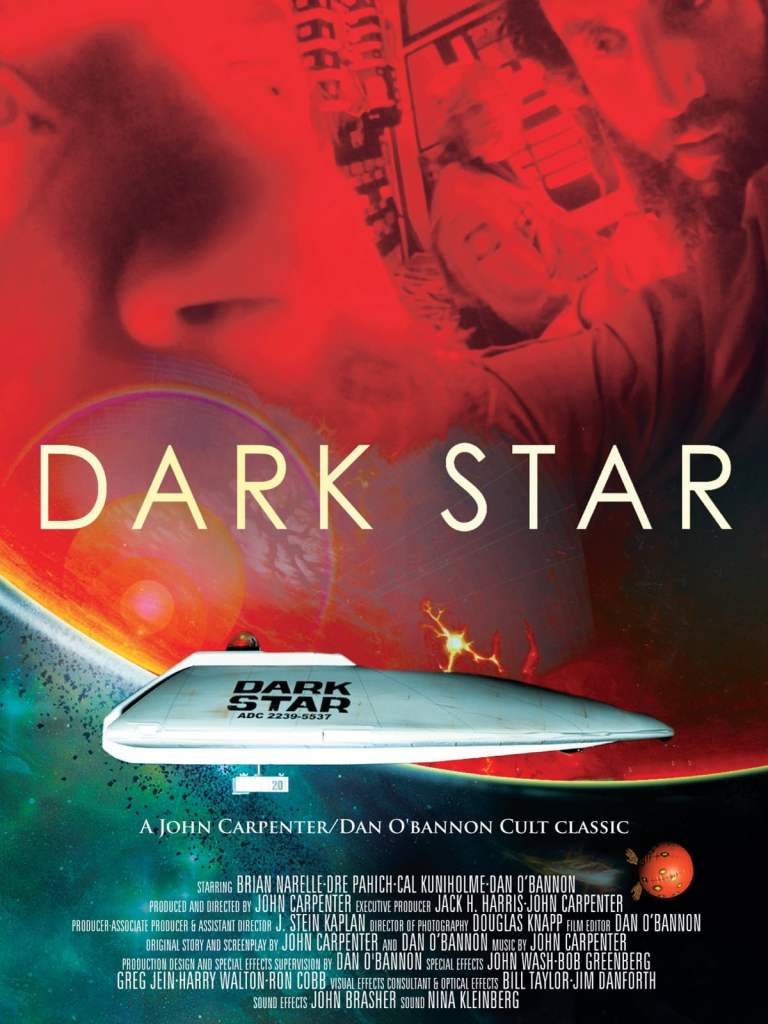
By Roger Ebert
Source: RogerEbert.com
“Dark Star” is one of the damnedest science fiction movies I’ve ever seen, a berserk combination of space opera, intelligent bombs, and beach balls from other worlds. It has a checkered history. It began as a student project by John Carpenter (later to direct “Halloween“) and Dan O’Bannon (later to write “Alien“), and grew over a period of time and expanding budgets into a full-length film.
It was finished some four years ago, before “Star Wars,” and might have had a big success as a cult film if its original distributor hadn’t been so chicken-hearted that he dumped it in a string of Southern California drive-ins and then pulled it out of commercial release. As it is, “Dark Star” has found audiences on the campus and revival circuits, has been a hit here at Facets Multimedia, and, at last, is having its first commercial run at the Three Penny Cinema.
It was finished some four years ago, before “Star Wars,” and might have had a big success as a cult film if its original distributor hadn’t been so chicken-hearted that he dumped it in a string of Southern California drive-ins and then pulled it out of commercial release. As it is, “Dark Star” has found audiences on the campus and revival circuits, has been a hit here at Facets Multimedia, and, at last, is having its first commercial run at the Three Penny Cinema.
The movie’s best sequence centers around the care and feeding of the pet alien they’ve taken on board (a sequence that O’Bannon may have drawn on for the original screenplay of “Alien”). The “Dark Star’s” onboard alien looks like a plastic beach ball with claws, and has a nasty way of sneaking out of sight; a crew member chases it into an elevator shaft and gets himself into a very tight spot. (The elevator sequence looks suspiciously as if it were filmed on the floor of a horizontal hallway photographed to look like a vertical shaft.)
Otherwise, life just sorta drifts past, until a chain of accidents leads to a situation where a bomb does not detach from the ship as planned, and will explode in 24 minutes, blowing the “Dark Star” to smithereens. The bomb cannot be disarmed because, intelligent little devil that it is, it’s convinced that it has a mission to self-destruct.
The movie’s best sequence centers around the care and feeding of the pet alien they’ve taken on board (a sequence that O’Bannon may have drawn on for the original screenplay of “Alien”). The “Dark Star’s” onboard alien looks like a plastic beach ball with claws, and has a nasty way of sneaking out of sight; a crew member chases it into an elevator shaft and gets himself into a very tight spot. (The elevator sequence looks suspiciously as if it were filmed on the floor of a horizontal hallway photographed to look like a vertical shaft.)
Otherwise, life just sorta drifts past, until a chain of accidents leads to a situation where a bomb does not detach from the ship as planned, and will explode in 24 minutes, blowing the “Dark Star” to smithereens. The bomb cannot be disarmed because, intelligent little devil that it is, it’s convinced that it has a mission to self-destruct.
And so, in an incredible and hilarious scene, a crew member floats out into space, confronts the stubborn thinking bomb, and uses pure logic in an attempt to reason it out of exploding. The strategy: If the bomb can be convinced it has no evidence that the universe really exists, then how can its instructions be valid?
This is a fun movie, and a bright and intelligent one. It bears few signs of having been made on a low budget, and the special effects are reasonably slick. And it has a mercifully low-key comic approach; many satiric comedies by young filmmakers are frantic and overwrought, but this one is wry, laid back and fond of its situations. And on the same program is “Hardware Wars,” a short subject starring steam irons, pop-up toasters and other kitchen appliances in outer space.
The Chords UK
INDIAN COUNTRY NEWS
"It is the duty of every man, as far as his ability extends, to detect and expose delusion and error"..Thomas Paine
Human in Algorithms
From the Roof Top
I See This
blog of the post capitalist transition.. Read or download the novel here + latest relevant posts
अध्ययन-अनुसन्धानको सार
 After the Crash