The Silencing of Dissent

By Chris Hedges

Source: Information Clearing House

The ruling elites, who grasp that the reigning ideology of global corporate capitalism and imperial expansion no longer has moral or intellectual credibility, have mounted a campaign to shut down the platforms given to their critics. The attacks within this campaign include blacklisting, censorship and slandering dissidents as foreign agents for Russia and purveyors of “fake news.”

No dominant class can long retain control when the credibility of the ideas that justify its existence evaporates. It is forced, at that point, to resort to crude forms of coercion, intimidation and censorship. This ideological collapse in the United States has transformed those of us who attack the corporate state into a potent threat, not because we reach large numbers of people, and certainly not because we spread Russian propaganda, but because the elites no longer have a plausible counterargument.

The elites face an unpleasant choice. They could impose harsh controls to protect the status quo or veer leftward toward socialism to ameliorate the mounting economic and political injustices endured by most of the population. But a move leftward, essentially reinstating and expanding the New Deal programs they have destroyed, would impede corporate power and corporate profits. So instead the elites, including the Democratic Party leadership, have decided to quash public debate. The tactic they are using is as old as the nation-state—smearing critics as traitors who are in the service of a hostile foreign power. Tens of thousands of people of conscience were blacklisted in this way during the Red Scares of the 1920s and 1950s. The current hyperbolic and relentless focus on Russia, embraced with gusto by “liberal” media outlets such as The New York Times and MSNBC, has unleashed what some have called a virulent “New McCarthyism.”

The corporate elites do not fear Russia. There is no publicly disclosed evidence that Russia swung the election to Donald Trump. Nor does Russia appear to be intent on a military confrontation with the United States. I am certain Russia tries to meddle in U.S. affairs to its advantage, as we do and did in Russia—including our clandestine bankrolling of Boris Yeltsin, whose successful 1996 campaign for re-election as president is estimated to have cost up to $2.5 billion, much of that money coming indirectly from the American government. In today’s media environment Russia is the foil. The corporate state is unnerved by the media outlets that give a voice to critics of corporate capitalism, the security and surveillance state and imperialism, including the network RT America.

My show on RT America, “On Contact,” like my columns at Truthdig, amplifies the voices of these dissidents—Tariq Ali, Kshama Sawant, Mumia Abu-Jamal, Medea Benjamin, Ajamu Baraka, Noam Chomsky, Dr. Margaret Flowers, Rania Khalek, Amira Hass, Miko Peled, Abby Martin, Glen Ford, Max Blumenthal, Pam Africa, Linh Dinh, Ben Norton, Eugene Puryear, Allan Nairn, Jill Stein, Kevin Zeese and others. These dissidents, if we had a functioning public broadcasting system or a commercial press free of corporate control, would be included in the mainstream discourse. They are not bought and paid for. They have integrity, courage and often brilliance. They are honest. For these reasons, in the eyes of the corporate state, they are very dangerous.

The first and deadliest salvo in the war on dissent came in 1971 when Lewis Powell, a corporate attorney and later a Supreme Court justice, wrote and circulated a memo among business leaders called “Attack on American Free Enterprise System.” It became the blueprint for the corporate coup d’état. Corporations, as Powell recommended in the document, poured hundreds of millions of dollars into the assault, financing pro-business political candidates, mounting campaigns against the liberal wing of the Democratic Party and the press and creating institutions such as the Business Roundtable, The Heritage Foundation, the Manhattan Institute, the Cato Institute, Citizens for a Sound Economy, the Federalist Society and Accuracy in Academia. The memo argued that corporations had to fund sustained campaigns to marginalize or silence those who in “the college campus, the pulpit, the media, and the intellectual and literary journals” were hostile to corporate interests.

Powell attacked Ralph Nader by name. Lobbyists flooded Washington and state capitals. Regulatory controls were abolished. Massive tax cuts for corporations and the wealthy were implemented, culminating in a de facto tax boycott. Trade barriers were lifted and the country’s manufacturing base was destroyed. Social programs were slashed and funds for infrastructure, from roads and bridges to public libraries and schools, were cut. Protections for workers were gutted. Wages declined or stagnated. The military budget, along with the organs of internal security, became ever more bloated. A de facto blacklist, especially in universities and the press, was used to discredit intellectuals, radicals and activists who decried the idea of the nation prostrating itself before the dictates of the marketplace and condemned the crimes of imperialism, some of the best known being Howard Zinn, Noam Chomsky, Sheldon Wolin, Ward Churchill, Nader, Angela Davis and Edward Said. These critics were permitted to exist only on the margins of society, often outside of institutions, and many had trouble making a living.

The financial meltdown of 2008 not only devastated the global economy, it exposed the lies propagated by those advocating globalization. Among these lies: that salaries of workers would rise, democracy would spread across the globe, the tech industry would replace manufacturing as a source of worker income, the middle class would flourish, and global communities would prosper. After 2008 it became clear that the “free market” is a scam, a zombie ideology by which workers and communities are ravaged by predatory capitalists and assets are funneled upward into the hands of the global 1 percent. The endless wars, fought largely to enrich the arms industry and swell the power of the military, are futile and counterproductive to national interests. Deindustrialization and austerity programs have impoverished the working class and fatally damaged the economy.

The establishment politicians in the two leading parties, each in service to corporate power and responsible for the assault on civil liberties and impoverishment of the country, are no longer able to use identity politics and the culture wars to whip up support. This led in the last presidential campaign to an insurgency by Bernie Sanders, which the Democratic Party crushed, and the election of Donald Trump.

Barack Obama rode a wave of bipartisan resentment into office in 2008, then spent eight years betraying the public. Obama’s assault on civil liberties, including his use of the Espionage Act to prosecute whistleblowers, was worse than those carried out by George W. Bush. He accelerated the war on public education by privatizing schools, expanded the wars in the Middle East, including the use of militarized drone attacks, provided little meaningful environmental reform, ignored the plight of the working class, deported more undocumented people than any other president, imposed a corporate-sponsored health care program that was the brainchild of the right-wing Heritage Foundation, and prohibited the Justice Department from prosecuting the bankers and financial firms that carried out derivatives scams and inflated the housing and real estate market, a condition that led to the 2008 financial meltdown. He epitomized, like Bill Clinton, the bankruptcy of the Democratic Party. Clinton, outdoing Obama’s later actions, gave us the North American Free Trade Agreement (NAFTA), the dismantling of the welfare system, the deregulation of the financial services industry and the huge expansion of mass incarceration. Clinton also oversaw deregulation of the Federal Communications Commission, a change that allowed a handful of corporations to buy up the airwaves.

The corporate state was in crisis at the end of the Obama presidency. It was widely hated. It became vulnerable to attacks by the critics it had pushed to the fringes. Most vulnerable was the Democratic Party establishment, which claims to defend the rights of working men and women and protect civil liberties. This is why the Democratic Party is so zealous in its efforts to discredit its critics as stooges for Moscow and to charge that Russian interference caused its election defeat.

In January there was a report on Russia by the Office of the Director of National Intelligence. The report devoted seven of its 25 pages to RT America and its influence on the presidential election. It claimed “Russian media made increasingly favorable comments about President-elect Trump as the 2016 US general and primary election campaigns progressed while consistently offering negative coverage of Secretary [Hillary] Clinton.” This might seem true if you did not watch my RT broadcasts, which relentlessly attacked Trump as well as Clinton, or watch Ed Schultz, who now has a program on RT after having been the host of an MSNBC commentary program. The report also attempted to present RT America as having a vast media footprint and influence it does not possess.

“In an effort to highlight the alleged ‘lack of democracy’ in the United States, RT broadcast, hosted, and advertised third party candidate debates and ran reporting supportive of the political agenda of these candidates,” the report read, correctly summing up themes on my show. “The RT hosts asserted that the US two-party system does not represent the views of at least one-third of the population and is a ‘sham.’ ”

It went on:

RT’s reports often characterize the United States as a ‘surveillance state’ and allege widespread infringements of civil liberties, police brutality, and drone use.

RT has also focused on criticism of the US economic system, US currency policy, alleged Wall Street greed, and the US national debt. Some of RT’s hosts have compared the United States to Imperial Rome and have predicted that government corruption and “corporate greed” will lead to US financial collapse.

Is the corporate state so obtuse it thinks the American public has not, on its own, reached these conclusions about the condition of the nation? Is this what it defines as “fake news”? But most important, isn’t this the truth that the courtiers in the mainstream press and public broadcasting, dependent on their funding from sources such as the Koch brothers, refuse to present? And isn’t it, in the end, the truth that frightens them the most? Abby Martin and Ben Norton ripped apart the mendacity of the report and the complicity of the corporate media in my “On Contact” show titled “Real purpose of intel report on Russian hacking with Abby Martin & Ben Norton.”

The blacklist published by the shadowy and anonymous site PropOrNot in November 2016 soon followed. The blacklist was composed of 199 sites PropOrNot alleged, with no evidence, “reliably echo Russian propaganda.” More than half of those sites were far-right, conspiracy-driven ones. But about 20 of the sites were major left-wing outlets including AlterNet, Black Agenda Report, Democracy Now!, Naked Capitalism, Truthdig, Truthout, CounterPunch and the World Socialist Web Site. The blacklist and the spurious accusations that these sites disseminated “fake news” on behalf of Russia were given prominent play in The Washington Post in a story headlined “Russian propaganda effort helped spread ‘fake news’ during the election, experts say.” The reporter, Craig Timberg, wrote that the goal of the Russian propaganda effort, according to “independent researchers who have tracked the operation,” was “punishing Democrat Hillary Clinton, helping Republican Donald Trump and undermining faith in American democracy.” Last December, Truthdig columnist Bill Boyarsky wrote a good piece about PropOrNot, which to this day remains essentially a secret organization.

The owner of The Washington Post, Jeff Bezos, also the founder and CEO of Amazon, has a $600 million contract with the CIA. Google, likewise, is deeply embedded within the security and surveillance state and aligned with the ruling elites. Amazon recently purged over 1,000 negative reviews of Hillary Clinton’s new book, “What Happened.” The effect was that the book’s Amazon rating jumped from 2 1/2 stars to five stars. Do corporations such as Google and Amazon carry out such censorship on behalf of the U.S. government? Or is this censorship their independent contribution to protect the corporate state?

In the name of combating Russia-inspired “fake news,” Google, Facebook, Twitter, The New York Times, The Washington Post, BuzzFeed News, Agence France-Presse and CNN in April imposed algorithms or filters, overseen by “evaluators,” that hunt for key words such as “U.S. military,” “inequality” and “socialism,” along with personal names such as Julian Assange and Laura Poitras, the filmmaker. Ben Gomes, Google’s vice president for search engineering, says Google has amassed some 10,000 “evaluators” to determine the “quality” and veracity of websites. Internet users doing searches on Google, since the algorithms were put in place, are diverted from sites such as Truthdig and directed to mainstream publications such as The New York Times. The news organizations and corporations that are imposing this censorship have strong links to the Democratic Party. They are cheerleaders for American imperial projects and global capitalism. Because they are struggling in the new media environment for profitability, they have an economic incentive to be part of the witch hunt.

The World Socialist Web Site reported in July that its aggregate volume, or “impressions”—links displayed by Google in response to search requests—fell dramatically over a short period after the new algorithms were imposed. It also wrote that a number of sites “declared to be ‘fake news’ by the Washington Post’s discredited [PropOrNot] blacklist … had their global ranking fall. The average decline of the global reach of all of these sites is 25 percent. …”

Another article, “Google rigs searches to block access to World Socialist Web Site,” by the same website that month said:

During the month of May, Google searches including the word “war” produced 61,795 WSWS impressions. In July, WSWS impressions fell by approximately 90 percent, to 6,613.

Searches for the term “Korean war” produced 20,392 impressions in May. In July, searches using the same words produced zero WSWS impressions. Searches for “North Korea war” produced 4,626 impressions in May. In July, the result of the same search produced zero WSWS impressions. “India Pakistan war” produced 4,394 impressions in May. In July, the result, again, was zero. And “Nuclear war 2017” produced 2,319 impressions in May, and zero in July.

To cite some other searches: “WikiLeaks,” fell from 6,576 impressions to zero, “Julian Assange” fell from 3,701 impressions to zero, and “Laura Poitras” fell from 4,499 impressions to zero. A search for “Michael Hastings”—the reporter who died in 2013 under suspicious circumstances—produced 33,464 impressions in May, but only 5,227 impressions in July.

In addition to geopolitics, the WSWS regularly covers a broad range of social issues, many of which have seen precipitous drops in search results. Searches for “food stamps,” “Ford layoffs,” “Amazon warehouse,” and “secretary of education” all went down from more than 5,000 impressions in May to zero impressions in July.

The accusation that left-wing sites collude with Russia has made them theoretically subject, along with those who write for them, to the Espionage Act and the Foreign Agent Registration Act, which requires Americans who work on behalf of a foreign party to register as foreign agents.

The latest salvo came last week. It is the most ominous. The Department of Justice called on RT America and its “associates”—which may mean people like me—to register under the Foreign Agent Registration Act. No doubt, the corporate state knows that most of us will not register as foreign agents, meaning we will be banished from the airwaves. This, I expect, is the intent. The government will not stop with RT. The FBI has been handed the authority to determine who is a “legitimate” journalist and who is not. It will use this authority to decimate the left.

This is a war of ideas. The corporate state cannot compete honestly in this contest. It will do what all despotic regimes do—govern through wholesale surveillance, lies, blacklists, false accusations of treason, heavy-handed censorship and, eventually, violence.


Chris Hedges, spent nearly two decades as a foreign correspondent in Central America, the Middle East, Africa and the Balkans. He has reported from more than 50 countries and has worked for The Christian Science Monitor, National Public Radio, The Dallas Morning News and The New York Times, for which he was a foreign correspondent for 15 years.


The Hamilton Hustle

By Matt Stoller

Source: The Baffler

AS DONALD TRUMP SETTLES INTO THE WHITE HOUSE, elites in the political class are beginning to recognize that democracy is not necessarily a permanent state of political organization. “Donald Trump’s candidacy is the first time American politics has left me truly afraid,” wrote Vox cofounder Ezra Klein just before the election. Andrew Sullivan argued in New York magazine that American democracy is susceptible, “in stressful times, to the appeal of a shameless demagogue.” Paul Krugman wrote an entire column on why republics end, citing Trump’s violations of political norms. But if you want to understand the politics of authoritarianism in America, the place to start is not with Trump, but with the cool-kid Founding Father of the Obama era, Alexander Hamilton.

I’m not just talking about the actual founder, though we’ll come back to him. I’m talking about the personage at the center of the Broadway musical, Hamilton.

The show is a Tony Award–winning smash hit, propelling its writer, Lin-Manuel Miranda, to dizzying heights of fame and influence. It is America’s Les Misérables, an achingly beautiful and funny piece of theater about a most unlikely icon of democratic inclusiveness, Alexander Hamilton.

I’m not going to dissect the show itself—the politics of it are what require reexamination in the wake of Trump. However, it should be granted one unqualified plaudit at the outset: Miranda’s play is one of the most brilliant propaganda pieces in theatrical history. And its construction and success tell us a lot about our current political moment. Before it was even written, the play was nurtured at the highest levels of the political establishment. While working through its material, Miranda road-tested song lyrics at the White House with President Obama. When it was performed, Obama, naturally, loved it. Hamilton, he said, “reminds us of the vital, crazy, kinetic energy that’s at the heart of America.” Michelle Obama pronounced it the best art she had ever seen.

The first couple’s comments were just the leading edge of a cultural explosion of praise. Actress Kerry Washington called it “life changing.” Lena Dunham said, “If every kid in America could see Hamilton they would thirst for historical knowledge and then show up to vote.” Saturday Night Live featured a sketch wherein Lorne Michaels begged guest host Miranda for Hamilton tickets (“I can do a matinee!”). It’s perhaps harder to list celebrities who haven’t seen Hamilton than those who have. And in Washington, D.C., politicians who haven’t seen the show are considered uncool.

Admiration for the play crossed the political spectrum. Conservative pop-historian Niall Ferguson opened up a book talk, according to one witness on Twitter, “with a rap set to music inspired by Hamilton.” Former secretaries of the treasury praised it, from Tim Geithner to Jack Lew to Hank Paulson. So did Dick Cheney, prompting Obama to note that the wonder of the play was perhaps the only thing the two men agreed on. Trevor Noah asked if Bernie Sanders, who had just seen the play, ran for president just so he would be able to get tickets. Rahm Emanuel, the mayor of Chicago and former White House chief of staff, raised eyebrows by jetting off to New York City to see a performance of Hamilton the night after Chicago teachers went on strike.

It’s not just that Hamilton is about a founding father, and thus inherently making statements about who we are as a culture. It’s become a status symbol within the Democratic establishment, offering them the chastened consolation that they might still claim solidarity with the nascent American democracy of the eighteenth century that’s stubbornly eluded them in the present-day political scene. Hillary Clinton quoted the play in her speech accepting the Democratic nomination, and told a young voter, “I’ve seen the show three times and I’ve cried every time—and danced hard in my seat.” The play has become a political football in the era of Trump. When Trump’s vice president, Mike Pence, saw the show, one of the cast members read him a special note, written by Miranda and several cast members, asking Pence to protect all of America. Hamilton cast members helped lead the Women’s March in Chicago to protest Trump’s inauguration. Right-wing website Breitbart has a hostile mini-Hamilton beat, noting that the play’s producers specifically requested non-white actors to fill the cast.

And after Trump won, Hamilton became a refuge. Journalist Nancy Youssef tweeted she overheard someone at the Pentagon say, “I am reaffirming my belief in democracy by listening to the Hamilton soundtrack.”

Beast Master

What’s strange about all of this praise is how it presumes that Alexander Hamilton was a figure for whom social justice and democracy were key animating traits. Given how Democrats, in particular, embraced the show and Hamilton himself as a paragon of social justice, you would think that he had fought to enlarge the democratic rights of all Americans. But Alexander Hamilton simply didn’t believe in democracy, which he labeled an American “disease.” He fought—with military force—any model of organizing the American political economy that might promote egalitarian politics. He was an authoritarian, and proud of it.

To assert Hamilton disliked democracy is not controversial. The great historian Henry Adams described an evening at a New York dinner, when Hamilton replied to democratic sentiment by banging the table and saying, “Your people, sir—your people is a great beast!” Hamilton’s recommendation to the Constitutional Convention, for instance, was to have a president for life, and to explicitly make that president not subject to law.

Professional historians generally avoid emphasizing Hamilton’s disdain for the people, at least when they write for the broad public. Better to steer safely clear of the freight train of publicity and money behind the modern Hamilton myth. One exception is amateur historian William Hogeland, who noted in a recent Boston Reviewessay that Hamilton had strong authoritarian tendencies. Hamilton, he wrote, consistently emphasized “the essential relationship between the concentration of national wealth and the obstruction of democracy through military force.”

Indeed, most of Hamilton’s legacy is astonishingly counter-democratic. His central role in founding both the financial infrastructure of Wall Street and a nascent military establishment (which supplanted the colonial system of locally controlled democratic militias) was rooted in his self-appointed crusade to undermine the ability of ordinary Americans to govern themselves. We should be grateful not that Hamilton structured the essential institutions of America to fit his vision, but that he failed to do so. Had he succeeded, we would probably be living in a military dictatorship.

Father of Finance

Viewers of the play Hamilton have a difficult time grasping this point. It just seems outlandish that an important American political official would argue that democracy was an actively bad system. Sure, America’s leadership caste has done plenty on its own to subvert the legal norms and folkways of self-rule, via voting restrictions, lobbying and corruption, and other appurtenances of access-driven self-dealing. But the idea of openly opposing the hallowed ideal of popular self-government is simply inconsistent with the past two hundred years of American political culture. And this is because, in the election of 1800, when Hamilton and his Federalist allies were finally crushed, America repudiated aristocracy and began the long journey toward establishing a democratic political culture and undoing some, though not all, of the damage wrought by Hamilton’s plutocratic-leaning Federalist Party.

Indeed, the shifting popular image of Hamilton is itself a gauge of the relative strength of democratic institutions at any given moment. In the roaring 1920s, when Wall Street lorded it over all facets of our public life, treasury secretary Andrew Mellon put Hamilton’s face on the ten-dollar bill. Mellon was the third richest man in the country, famous for, among other things, having his brother and chairman of one of his coal mining subsidiaries extoll the virtues of using machine guns to enforce labor discipline. Mellon himself, who later presided over the Great Depression, was routinely lauded by big business interests as the “greatest secretary of the treasury since Alexander Hamilton.” Big business leaders in Pittsburgh, such as Andrew Carnegie and Henry Clay Frick, worshipped Hamilton (as well as Napoleon).

During the next decade, as populists put constraints on big money, Hamilton fell into disrepute. In 1925, Franklin Delano Roosevelt, then just a lawyer, recognized Hamilton as an authoritarian, saying that he had in his mind after reading a popular new book on Hamilton and Jefferson “a picture of escape after escape which this nation passed through in those first ten years; a picture of what might have been if the Republic had been finally organized as Alexander Hamilton sought.” By 1947, a post-war congressional report titled “Fascism in Action” listed Hamilton as one intellectual inspiration for the Nazi regime. Hamilton’s name practically became an epithet among Democrats of the New Deal era, which makes it all the more surprising that he is the darling of the modern party.

Within this context, it’s useful to recognize that Hamilton the play is not the real story of Alexander Hamilton; rather, as historian Nancy Isenberg has noted, it’s a revealing parable about the politics of the finance-friendly Obama era. The play is based on Ron Chernow’s eight-hundred-page 2004 biography of Hamilton. Chernow argues that “Hamilton was an abolitionist who opposed states’ rights, favored an activist central government, a very liberal interpretation of the Constitution and executive rather than legislative powers.” Hamilton, he notes, “sounds . . . like a modern Democrat.” The abolition arguments are laughably false; Hamilton married into a slaveholding family and traded slaves himself. But they are only part of a much broader obfuscation of Hamilton’s politics.

No Accidental Coup

To understand how outrageous Chernow’s understanding of Hamilton is, we must go through a few key stories from Hamilton’s life. We should probably start with the Newburgh Conspiracy—Hamilton’s attempt to foment a military coup against the Continental Congress after the Revolution. In 1782 several men tried to organize an uprising against the Continental Congress. The key leader was Robert Morris, Congress’s superintendent of finance and one of Hamilton’s mentors. Morris was the wealthiest man in the country, and perhaps the most powerful financier America has ever known, with the possible exception of J. P. Morgan. His chief subordinate in the plot was a twenty-seven-year-old Hamilton, former aide-de-camp of George Washington and delegate to the Congress.

After the war, army officers, then camped out in Newburgh, New York, had not been paid for years of service. Morris and Hamilton saw in this financial-cum-political crisis an opportunity to structure a strong alliance between the military elite and wealthy investors. Military officers presented a petition to Congress for back pay. Congress tried to pass a tax to pay the soldiers, while also withholding payments owed to bondholders. Hamilton blocked this move. Indeed, according to Hogeland, “when a motion was raised to levy the impost only for the purpose of paying army officers, Hamilton shot it down: all bondholders must be included.” Meanwhile, Morris and Hamilton secretly encouraged General Horatio Gates at Newburgh to organize a mutiny. After unifying investors and the military elite, Morris and Hamilton calculated that the military officer corps would threaten Congress with force unless the Articles of Confederation were amended to allow full federal taxing power by federal officials. This coup attempt would then, they reasoned, force Congress to override state governments that were more democratic in their approach to political economy, and place aristocrats in charge.

According to Hogeland,

In Morris’s plan these taxes, collected not by weak state governments but by a cadre of powerful federal officers, would be earmarked for making hefty interest payments to wealthy financiers—including Morris himself, along with his friends and colleagues—who held millions of dollars in federal bonds, the blue-chip tier of domestic war debt.

The mutiny itself failed due to a public statement by George Washington opposing a military uprising. But in broader terms, the plot succeeded, once Washington promptly warned Congress about the unstable situation and urged that they take drastic action to centralize and federalize the structure of the American republic. Military officers received what would be the equivalent today of multi-million-dollar bonuses, paid largely in federal debt instruments. This effectively institutionalized the elite coalition that Morris and Hamilton sought to weaponize into a tool of destabilization. The newly unified creditors and military officers formed a powerful bloc of aristocratic power within the Congress that pushed hard to dramatically expand federal taxing power. This group “set up [Hamilton’s] career,” Hogeland writes, because by placing him in power over their asset base—a national debt—they would assure a steady stream of unearned income. Chernow obscures Hamilton’s participation in the mutiny, claiming in a rushed disclaimer to preserve his hero’s honor that Hamilton feared a military uprising—but he then proceeds to note that Hamilton “was playing with combustible forces” by attempting to recruit Washington to lead the coup. It’s a howling inconsistency bordering on falsification.

Snobs at the Falls

When Hamilton became Washington’s secretary of the treasury, he swiftly arranged the de facto payoff of the officer group at Newburgh, valuing their bonds at par and paying them the interest streams they wanted. Here was perhaps the clearest signal that the Federalist Party was structured as an alliance between bondholders and military elites, who would use a strong central government as a mechanism to extract money from the farming public. This was Hamiltonian statecraft, and it was modeled on the political system of the Whigs in Great Britain, the party of “monied interests” whose power was anchored by the Bank of England.

Chernow, a longtime Wall Street Journal financial writer, portrays Hamilton as a visionary financial genius who saw beyond the motley array of foolish yeoman farmers who supported his ideological foe Thomas Jefferson. In lieu of the static Jeffersonian vision of a yeoman’s republic, Chernow’s Hamilton is reputed to have created a dynamic, forward-looking national economy—though it’s more accurate to say that Hamilton was simply determined to shore up the enduring basis of a financial and industrial empire. Hillary Clinton even quoted the play paraphrasing Hamilton’s line, “They don’t have a plan—they just hate mine.” But in fact, there were competing modern visions of finance during the period, as Terry Bouton showed in Taming Democracy. And the one we have today—a public central bank, substantial government involvement in credit markets, paper money—has characteristics of both.

True to their own aristocratic instincts and affiliations, Hamilton and his mentor Morris wanted to insulate decision-making from democratic influence. Morris told Congress that redistributing wealth upward was essential so that the wealthy could acquire “those Funds which are necessary to the full Exercise of their Skill and Industry,” and thereby promote progress. While in office, Hamilton granted a group of proto-venture-capitalists monopoly control over all manufacturing in Paterson Falls, New Jersey, the site of some of the most powerful waterfalls on the East Coast. Hamilton, who captained this group of investors, thought it would power a network of factories he would then control. Among the prerogatives enjoyed by the funders of the Paterson Falls project was the authority to condemn lands and charge tolls, powers typically reserved to governments. More broadly, in the fight to establish a for-profit national bank owned and controlled by investors, he placed control over the currency in the hands of the wealthy, linking it to gold and putting private financiers in charge.

Morris and Hamilton sought, as much as possible, to shift sovereign powers traditionally reserved for governments into the hands of new chartered institutions—private corporations and banks—that would be strategically immunized from the democratic “disease.” These were not corporations or banks as we know them; they were quasi-governmental institutions with monopoly power. Jefferson sought to place an anti-monopoly provision in the Constitution precisely because of this well-understood link between monopoly finance and political power.

Chernow portrays this far-reaching debate over the future direction of America’s productive life as a byproduct of Hamilton’s unassailably noble attempt to have the federal government retire the Revolutionary War debt. This is simply false (and a very common lie, expressed with admiration by other prominent Hamilton fans like Alan Greenspan and Andrew Mellon). Hamilton wanted a large permanent debt; he wanted it financed so his backers could extract a steady income from the people by way of federal taxes. To pay off the debt would be to kill the goose laying the golden egg. By constricting the question of democracy to a question of accounting, Chernow misrepresents what was really at stake. It was a fight over democracy, authoritarianism, and political economy—and in many ways, the same one we’re having today.

The Gold Standard and the Iron Fist

In the 1780s and 1790s, Hamilton won this battle, and the effects were catastrophic. Interest rates shot up as a monopoly of finance gathered in the hands of the merchant class. The debt was owned by the wealthy, while ordinary farmers who had fought in the Revolution had to pay the tax in gold that they didn’t have. It was a heavily deflationary policy, and the era after the Revolution saw an economic contraction similar in size to that of the Great Depression, with a foreclosure crisis as severe. According to Bouton, “There were more Pennsylvanians who had property foreclosed by county sheriffs during the post-war decades than there were Pennsylvania soldiers who fought for the Continental Army.”

Protests broke out in the western parts of the country, similar to pre-Revolution-era revolts against the British, who, in extracting revenues for the Crown and its allies, were pursuing the same policies that Hamilton did. These protests were a response not to taxes, but to the specific tax structure Hamilton constructed. Western farmers, though not poor, had little access to cash, so they used whiskey as currency—a medium of exchange that farmers in many cases produced sporadically in backyard stills. Hamilton’s tax was a political attack on these farmers, whom he saw as his political opponents. The levy targeted whiskey because western farmers had converted this commodity into a competitive monetary system. The whiskey levy was also regressive, with a low rate on industrial distillers and a high rate for small farmers, with the goal of driving the farmers out of the whiskey business. Furthermore, Hamilton placed the collection authority for the tax in the hands of the wealthiest big distillers, who could then use it to drive their smaller competitors out of business. This was all intended not only to destroy the political power of small farmers, but to foment a rebellion that Hamilton could then raise an army to crush. And that’s just what happened.

In 1795, Washington and Hamilton raised more than ten thousand troops to march into Western Pennsylvania, the strongest redoubt of opposition to the new tax (known forever after as the Whiskey Rebellion). Washington, halfway through the march and perhaps doubting the wisdom of this use of military power, handed over command to Hamilton, and went home. Entrusted with executive power, Hamilton used indefinite detention, mass arrests, and round-ups; seized property (including food stores for the winter); and had soldiers administer loyalty oaths. He also attempted to collect testimony to use against his political enemies, such as William Findley and Albert Gallatin (who would later be Jefferson’s and Madison’s secretary of the treasury), which he “hoped to use,” as Hogeland writes, “to silence his political opponents by hanging them for treason.” This is the strong-armed tyranny that David Brooks (to take one among countless exemplars of latter-day Hamilton worship) celebrates when he says that Hamilton gave us “the fluid capital markets that are today the engine of world capitalism.” It is also, far from incidentally, what John Yoo cited as precedent when defending George W. Bush’s national security policies.

Similarly, Hamilton’s fights with John Adams in the late 1790s represented one of the most dangerous periods in American history, akin to the McCarthy era on steroids. The latter part of the French Revolution was as shocking to Americans of the early republic as the 1917 Russian Revolution was to their modern successors. It stoked the widespread fear among Federalists that any talk of democracy would lead to similar guillotine-style massacres; they began referring to Jefferson’s supporters as “Jacobins”—an epithet that was the 1790s equivalent of “terrorist” or “communist.” This was the era of the Alien and Sedition Acts, which made criticism of the government a federal crime. But in addition, and more frighteningly, Hamilton constructed the only partisan army in American history (titled the “New Army”) and tried to place himself at the head of it. Only Federalists could be officers. He envisioned himself leading an expedition into Florida and then South America, and mused aloud about putting Virginia “to the test” militarily. Ultimately, Adams—perhaps the most unlikely savior of self-governance in the annals of our history—figured out what Hamilton was doing and blocked him from becoming a New World Napoleon. The New Army was disbanded, and our military established a tradition of nonpartisanship.

Another Near Miss

When Thomas Jefferson won the presidency, he described that year’s presidential election as the “Revolution of 1800,” precisely because it was proof that self-government could work. Unlike the succession from Washington to Adams, this was a change in party control, the first peaceful transfer of power in a republic in modern history. Most popular accounts of the hard-fought 1800 ballot focus on Hamilton’s relationship with John Adams, his endorsement of Jefferson, and the Burr-Jefferson soap opera—and how all of these personal intrigues culminated in an eventual tie among electors. In fact, this is so well known that liberals unhappy with the outcome of the 2016 election tried to convince members of the Electoral College to overturn Trump’s victory, and titled their project “Hamilton electors.”

But there’s a darker story of the 1800 deadlock. It involves the more extreme wing of the Federalist Party, which simply tried to have the election overturned, risking civil war to do so. Federalists were inflamed at a host of purported Republican outrages, including the party’s opposition to the Alien and Sedition Acts and to the creation of the New Army. They also claimed the Republicans were sympathetic to France (with which we were then engaged in a post-Revolutionary “quasi-war”) and abetted domestic disturbances like the Whiskey Rebellion and a similar uprising a few years later known as the Fries’s Rebellion. In 1799, Federalists put forward “the Ross bill” to have the Senate effectively choose the next president by empowering a select committee to disallow electors. The bill was defeated by House members who didn’t want to delegate their authority to the Senate.

Then, after the election, Federalist allies in the lame duck session of Congress were considering, according to Jefferson, “a law for putting the government into the hands of an officer of their own choosing.” Jefferson threatened armed resistance, and both Pennsylvania and Virginia began military preparations. Ultimately, the Federalists backed down. As historian James Lewis pointed out, the election of 1800 produced a peaceful transition of power, but that was not necessarily a likely outcome.

Hamilton lost, but not without bequeathing to later American citizens a starkly stratified political economy. Bouton argues that the defeats of the middle class in the 1780s and 1790s narrowed democracy for everyone. As poor white men found the freedoms for which they fought undermined by a wealthy elite, they in turn “tried to narrow the concept to exclude others.” Much of the turn toward a more reactionary version of white supremacy in the early 1800s, in other words, can be laid at Hamilton’s feet. Later on, Hamilton’s financial elite were ardently in favor of slave power. Manhattan, not any Southern state, was the first political entity to follow South Carolina’s call for secession, because of the merchants’ financial and cultural ties to the slave oligarchy. In other words, Hamilton’s unjust oligarchy of money and aristocracy fomented a more unjust oligarchy of race. The aggrieved rites of ethnic, racial, and cultural exclusion evident in today’s Trump uprising would no doubt spark a shock of recognition among the foes of Hamilton’s plutocracy-in-the-making.

Rites of the Plutocrats

Hamilton had tremendous courage, insight, and brilliance. He is an important Founder, and not just because he structured early American finance. His life sheds light on some deep-rooted anti-democratic forces that have always existed in America, and in particular, on Wall Street. Much of the far-reaching contemporary Hamilton PR offensive is connected to the Gilder Lehman Institute, which is financed by bankers who back the right-wing Club for Growth and American Enterprise Institute (and support Hamilton’s beloved gold standard). Robert Rubin in 2004 started the Hamilton Project at the Brookings Institution, which laid out the framework for the Obama administration’s financial policies. Chernow has made millions on books fawning over J. P. Morgan, the Warburg financial family, and John D. Rockefeller. And thanks largely to the runaway success of Hamilton the musical, Chernow is now, bizarrely, regarded as a court historian of American democracy in the mold of Arthur Schlesinger Jr.

One of Hamilton’s biggest fans is Tim Geithner, the man who presided over the financial crisis and the gargantuan bank bailouts during the Obama presidency. In his 2014 memoir, Stress Test, Geithner wrote admiringly of Hamilton as the “original Mr. Bailout,” and said that “we were going to deploy federal resources in ways Hamilton never imagined, but given his advocacy for executive power and a strong financial system, I had to believe he would have approved.” He argues this was a financial policy decision. In doing so, he evades the pronounced anti-democratic impulses underlying the response to the financial crisis.

As economist Simon Johnson pointed out in a 2009 essay in The Atlantic titled “The Quiet Coup,” what the bailouts truly represented was the seizure of political power by a small group of American financiers. Just as in the founding era, we saw a massive foreclosure crisis and the evisceration of the main source of middle class wealth. A bailout, similar to one that created the national debt, ensured that wealth would be concentrated in the hands of a small group. The Citizens United decision and the ever-increasing importance of money in politics have strong parallels to the property disenfranchisement along class lines that occurred in the post-Revolutionary period. Just as turnout fell to record lows in much of the country in 2014, turnout collapsed after the rebellions were put down. And in another parallel, Occupy Wall Street protesters camped out across the country were evicted by armed guards—a martial response coordinated by banks, the federal government, and many Democratic mayors.

The Obama era looks like an echo of the Federalist power grabs of the 1780s and 1790s, both in its enrichment and glorification of financial elites and its open disdain for anything resembling true economic democracy. The Obama political elite, in other words, celebrates Hamilton not in spite of Hamilton’s anti-democratic tendencies, but because of them.

Set in contrast to the actual life and career of its subject, the play Hamilton is a feat of political alchemy—as is the stunningly successful marketing campaign surrounding it. But our generation’s version of Hamilton adulation isn’t all that different from the version that took hold in the 1920s: it’s designed to subvert democracy by helping the professional class to associate the rise of finance with the greatness of America, instead of seeing in that financial infrastructure the seeds of a dangerous authoritarian tradition.

In 1925, Franklin Roosevelt asked whether there might yet be a Jefferson to lead the forces of democracy against Hamilton’s money power. Perhaps someone—maybe Elizabeth Warren, who pointed out on PBS that Hamilton was a plutocrat—is asking that question again. That said, Hamilton is a great musical. The songs are catchy. The lyrics are beautiful. But the agenda is hidden, because in America, no political leader, not even Donald Trump, can credibly come right out and pronounce democracy a bad thing and agitate for rule by big finance. And the reason for that is that Alexander Hamilton, despite his success in structuring Wall Street, lost the battle against American democracy. Thank God for that.

8 Critical Factors Behind Every Food Crisis

FILE – In this Monday, Aug. 15, 2011 file photo, children from southern Somalia hold their pots as they line up to receive cooked food in Mogadishu, Somalia. A report by two U.S. government-funded famine and food agencies gives the highest death toll yet, estimating that 260,000 people died – more than double previous estimates. (AP Photo/Farah Abdi Warsameh, File)

By John Hawthorne

Source: Business Connect

From the beginning of time, their have been food crises in one form or another. Ancient books such as the Bible have records of various famines devastating portions of the world.

And while it’s easy to attribute these crises to a single cause, such as war or drought, the causes are usually much deeper and much more complex.

Nelson Mandela said, “Overcoming poverty is not an act of charity, it is an act of justice.”

In order for us to achieve the kind of justice envisioned by Mandela, it’s essential that we first understand the underlying causes of food crises. Only after we have understood can we then begin creating meaningful solutions.

With that in mind, here are 8 primary factors behind almost every global food crisis. While not all 8 of these will be present at a time, you will almost always find several of these at work.

Factor #1 – Poverty

One of the greatest factors in every food crisis is stark and abject poverty. This isn’t surprising. With enough money, anyone can ensure they have enough food. But with many developing nations sitting well below the poverty line, the population simply can’t afford the food they so desperately need.

Additionally, poverty has a distinct effect on food output. In Africa, for example, many farmers can’t afford proper irrigation and fertilizer. This, in turn, leads to lower yields, which then reduces the overall amount of food available to the population.

The population of the Sub-Saharan region of Africa is expected to grow at an astronomical rate, topping out at 2.4 billion by 2050. This will continue to exacerbate the poverty issue, which will then continue to drive the lack of sufficient food in the area.

Factor #2 – Drought and Desertification

Widespread droughts, leading to the desertification of particular locations also causes huge disruptions to food production. For example, leading up to and during the global food crisis of 2008, 110 countries experienced significant droughts. This caused even the most well-irrigated, fertile areas to become arid deserts, making it impossible to grow crops.

As Mark Hughes noted:

Australia is normally the second largest exporter of grain, after the U.S. The continent, though, is experiencing an ongoing drought that has been described as the worst in a century. Grain yields have shrunk and many silos remain empty. Australia’s drought is a major factor in global wheat stocks being at their lowest since 1979. In fact, many wheat and rice farmers are switching to crops that demand less water, such as wine grapes.

Additionally, farmers often let animals over-graze on their land, reducing the amount of vegetation and increasing desertification. If the soil becomes dry enough, it is ruined and unable to support any crops at all.

Finally, as populations grow, deforestation occurs at an increased rate, which then leads to less vegetation and more desertification.

Factor #3 – Political Pressure

In the past, the International Monetary Fund has pressured small farmers, particularly in impoverished African countries, to abandon agricultural farming in favor of industrial work. The money generated from this practice would be used to pay off debt and import food.

While it may sound like a working strategy, it has created catastrophic results.

As Eric Holt-Giménez noted:

The urban population increased seven-fold, swelling from 18% to 33% of the population. Millions of poor and unemployed workers have swelled the cities—with two-thirds of them living in slums. The manufacturing and industrial sector did not “take off” in African countries; the percent of the GDP coming from industry was 30% in 1961 and 32% in 2000. In the countryside, as plantations for agro-exports expanded, food production plummeted and poverty grew. Though the rural population, density increased by 180% as more farmers were crowded onto smaller plots.

Factor #4 – Increased Consumption of Meat and Dairy

Many countries have begun adopting a more Western diet, which includes eating significantly more meat and dairy. To make this happen, farmers have been forced to raise more cattle, and more cattle means more grain being consumed.

The problem, however, is that this causes a significant deficiency in terms of calories consumed versus calories available. A cow consumes approximately 700 calories worth of grain to produce a piece of meat containing only 100 calories. When this happens on a massive scale, an enormous shortage of food is the end result. The longer this deficit continues, the greater the imbalance will become.

Factor #5 – Increased Oil and Transportation Costs

When the price of oil goes up, the energy cost for planting and transporting foods goes through the roof. When food costs more to grow, it then costs more to sell. These rising costs then make it more difficult for the local population to purchase crops as well as for farmers to export their crops to industrialized nations.

Additionally, increased oil costs has led many countries to invest heavily in the development of agro-fuels. More agro-fuels always means less food available.

As Esther Vivas helpfully puts it:

The increase in the price of oil, which doubled in 2007 and 2008 and caused a big rise in the price of fertilizers and transport related to the food system, has resulted in increasing investment in the production of alternative fuels such as those of plant origin. Governments in the United States, the European Union, Brazil and others have subsidized production of agro-fuels in response to the scarcity of oil and global warming. But this green fuel production comes into direct competition with the production of food. To give just one example, in 2007 in the United States 20% of the total cereal harvest was used to produce ethanol and it is calculated in the next decade that this figure will reach 33%. We can imagine the situation in the countries of the South.

Factor #6 – Falling World Aid

At the peak of the 2007-2008 food crisis, food aid was at it’s lowest point since 1961. This is one of the oddities about the national food market. When cereal prices are low, countries look to sell their food through international aid. However, when food prices are high, they prefer to sell them on the open market for increased profits.

In other words, during food crises, when food is scarcest and at it’s highest prices, it isn’t available for international aid. When the bottom falls out of world aid, food crises grow in magnitude.

Factor #7 – International Conflicts

International conflicts are a particularly visible factor behind many food crises. During conflicts, it’s common for one country to restrict exports to another country, which then reduces the amount of food available to the general population.

Or, even worse, dictators will intentionally isolate their countries, refusing foreign aid that is desperately needed. Aid workers may be blocked from entering the country, making it difficult for the citizens to receive needed help. If foreign aid does come, they seize it for themselves, depriving the population of desperately needed sustenance.

Factor #8 – Disease

If a country experiences a particularly violent outbreak of a disease, it can completely disrupt the overall food supply. For example, the HIV/AIDS crisis in Africa has killed farmers, which in turn pushes families deep into poverty.

When a population is undernourished, drugs become less effective and can at times create intense hunger pains. These two factors combined create a vicious cycle of death, poverty, and hunger.

Additionally, certain highly contagious diseases can restrict the amount of aid available to a country. For example, during the 2014 Ebola epidemic in West Africa, aid workers were restricted from traveling to the region due to fear of spreading the disease.

Perfect Storms

Most food crises aren’t the result of a single factor. Rather, they are caused by a perfect storm of events that coalesce into a deadly storm.

For example, in 2011, Somalia was devastated by a drought that caused widespread crop failure. The food crisis was made even worse by a non-functioning government as well as a national conflict. All these forces combined to make it difficult for aid workers to reach those who so desperately needed help.

The result was that approximately 260,000 people died.

Because the problems are almost always complex and multi-layered, the solutions must be equally multi-faceted. Simple solutions typically exacerbate the problem at the expense of the local population.

The best solutions are those that involve numerous parties working together to create a tangible, workable solution.

There will always be food crises to one degree or another. But as we grow in our understanding of what causes them, we can also grow in our ability to bring them to an end.

The Morgan Freeman Psy-Op Proves How Desperate The ‘Deep State’ Has Become

By Andrew Korybko

Source: Sputnik International

Morgan Freeman’s latest publicly stunt permanently stained his legacy after the famous actor decided to join the fake news industry by passing off a blockbuster script as a true story.

Morgan Freeman declared in his latest two-minute video that “We have been attacked. We are at war”, but he’s wrong in saying that Americans have been victimized by Russia, but should have rather told the truth that they’re under attack by their own government. To channel Freeman, “Imagine this movie script”, albeit modified to reflect real-life events instead of conspiratorial ones:

A globalist power cabal made up of the permanent military, intelligence, and diplomatic bureaucracies (the “deep state”), in conjunction with the Democratic Party, “Cultural Marxist” professors, the Mainstream Media, and Hollywood have attacked American democracy using non-stop infowar operations against their own fellow citizens to spread propaganda and false information aimed at convincing people that the Republican candidate and future President of the United States is really a Russian puppet.

A few years ago this might have sounded just as ridiculous as the narrative that Freeman read off in front of the cameras, but the difference is that this actually happened whereas his story still remains the realm of fiction. The conspiracy theory that Russia somehow swayed the 2016 election has no basis in reality, and it’s very condescending to the millions of average Americans in the Midwest who swayed the election for Trump to even infer that these patriotic citizens were under the influence of a foreign intelligence operation at the time.

Midwesterners didn’t tip the election for Trump because President Putin, the FSB, RT, or Sputnik told them to — which they didn’t — but because they had enough of the old order of business in the US and were desperately craving a change, any change, to improve the all-around deteriorating conditions that have come to define their lives. Trump promised law and order, jobs and strong borders, and a no-nonsense approach to American domestic politics, the complete opposite of Hillary’s platform and exactly what Midwesterners wanted to hear.

Even without the DNC leaks, many of those folks would never have countenanced voting for Hillary due to her husband’s toxic legacy and that of his party. Moreover, these voters didn’t need proof of Hillary and the Democrats’ corruption because they had suspected it all along, though the amplification of their crimes by the global media vindicated them for what The Establishment had falsely claimed for years was just another tinfoil hat “conspiracy theory”.

Now about actual conspiracy facts, many people could never have thought that their own government would turn against them and attack America’s sacred political system, its electoral democracy, through the incessant demonization of Donald Trump and the plethora of fake news that they disseminated about him. When Trump claimed that his campaign was under surveillance by the Obama Administration, he was dismissed as a crackpot, but it’s since emerged just the other day that former National Security Advisor Susan Rice did in fact authorize the spying of Trump’s former campaign manager Paul Manafort.

On top of that, the never-ending assertions that Trump is in cahoots with the Russian government or somehow under the nefarious influence of shadowy Kremlin agents are regularly debunked by listening to the President and his Administration constantly talk about “Russian aggression” and watching them use this pretext to make hostile moves against Moscow. These actions strongly refute the claims of a secret Trump-Russian connection and most Americans understand that, but the “deep state” and their cohorts in the “Cultural Marxist” corners of academia, the Mainstream Media, Hollywood, and the masked mob of “Antifa” rioters believe that the population is just too stupid to see this and could therefore be easily misled into believing their fake news narrative that Putin’s proxy is in control of the White House.

The whole point behind this massive infowar operation against the minds of the American public is to delegitimize Trump’s election in a last-ditch bid to give the Democrats a chance to win back Congress during next year’s midterm elections. It’s also designed to influence the President’s domestic and foreign policy decision making, and it actually has succeeded to a degree in that respect if one holds the view that Trump truly believed what he said on the campaign trail but was later pressured by the “deep state” to take a decidedly neo-conservative stance towards International Affairs after he entered into office. Regardless, what’s important to focus on in this context are the American people themselves, who largely dismiss the conspiratorial, never-proven, and constantly debunked accusations that Morgan Freeman shamelessly told the American public with a straight face.

There’s a popular saying that one shouldn’t “shoot the messenger”, but that doesn’t mean that the said messenger is above criticism. Morgan Freeman is a beloved household name who’s universally praised for his excellent acting skills and the unforgettable memories that he’s imbued his audiences with, but politics isn’t his element, and no matter how much the “Committee to Investigate Russia’ pleads that it’s “non-partisan”, former National Intelligence Director James Clapper’s open involvement in the project proves that it’s linked to the same anti-Trump “deep state” that’s been undermining American democracy for over the past two years. Morgan Freeman should have known better than to lend his acting talent to pretending that a movie script is a real-life story, and that’s why so many people are disappointed in him on a deep, personal level.

The irony of it all is that Morgan Freeman could have actually done a lot of good if he had the courage to say the truth. Instead of imploring Trump to sit down in front of the American people, elaborate on Hillary’s “Russia Did It!” conspiracy theory, and then “legitimize” it through a full-blown nationwide anti-Russian witch hunt stretching from the Office of the Presidency all the way down to the paupers in the inner city, he himself could have sat down in front of the American people just as he did in his two-minute psy-op video and calmly explain the actual real-life “deep state” conspiracy against Trump and the American people. He didn’t do that, so there’s no use in speculating about “coulda, shoulda, woulda”, but for the sake of cracking a smile and thinking about what might have been, it sure would have been powerful if he channeled his blockbuster script but adapted it to actual events by saying:

“My fellow Americans, during this past election, we came under attack by our own government. I’ve called on the patriotic members of Congress and our intelligence community to use every resource available to conduct a thorough investigation to determine exactly how this happened. Our citizens are demanding accountability. For 241 years our democracy has been imperfect but nevertheless something to aspire to, and we owe it to the brave people who have fought and died to protect this great nation and save democracy. And we owe it to our future generations to continue the fight.”

But then again, Hollywood by its very nature is fake and deceptive, so it might be too much to ever hope for an American movie icon to stand up and say those brave words that were imagined above, though that doesn’t mean that they wouldn’t have resonated with tens of millions of dyed-in-the-wool patriotic Americans who are sick and tired of the “deep state’s” manipulative mind games.

Related Article:

Morgan Freeman, David Frum, and the no-good non-profit (The Baffler)

Saturday Matinee: A Short Vision

The Night Ed Sullivan Scared a Nation with the Apocalyptic Animated Short, A Short Vision (1956)

Source: Open Culture

On May 27, 1956, millions of Americans tuned in to The Ed Sullivan Show, expecting the usual variety of comedians, talents and musical guests. What they weren’t prepared for was a short animated film that Sullivan introduced thusly:

Just last week you read about the H-bomb being dropped. Now two great English writers, two very imaginative writers — I’m gonna tell you if you have youngsters in the living room tell them not to be alarmed at this ‘cause it’s a fantasy, the whole thing is animated — but two English writers, Joan and Peter Foldes, wrote a thing which they called “A Short Vision” in which they wondered what might happen to the animal population of the world if an H-bomb were dropped. It’s produced by George K. Arthur and I’d like you to see it. It is grim, but I think we can all stand it to realize that in war there is no winner.

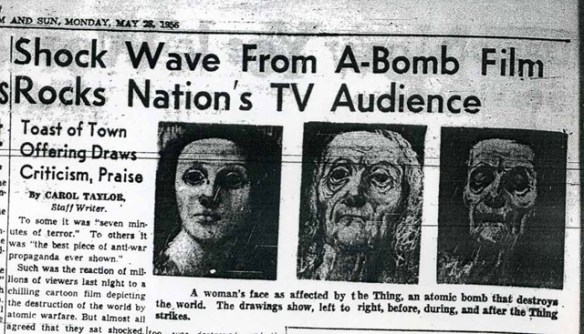
And with that, he screened the horrific bit of animation you can watch above. At the height of the atomic age, this film was a short sharp shock. Its vision of a nuclear holocaust is told in the style of a fable or storybook, with both animals and humans witnessing their last moments on earth, and ending with the extinguishing of a tiny flame. The mostly static art work is all the more effective when faces melt into skulls.

Many children didn’t leave the room of course, and the website Conelrad has a wonderful in-depth history of that night and collected memories from people who were traumatized by the short as a child. One child’s hair–or rather a small section of his hair–turned white from fright.

It was as formative a moment as The Day After would be to children of the ‘80s. The papers the next day reported on the short in salacious detail (“Shock Wave From A-Bomb Film Rocks Nation’s TV Audience”) and Sullivan not only defended his decision, but showed the film again on June 10.

The film was created by married couple Peter and Joan Foldes, and shot for little money in their kitchen on a makeshift animation table. Peter was a Hungarian immigrant who had studied at the Slade School of Art and the Courtlaud Institute and apprenticed with John Halas where he learned animation.

(Halas is best known for the animated feature version of Orwell’s Animal Farm.)

A Short Vision would go on in September of that year to win best experimental film at the 17th Venice Film Festival. (Peter Foldes would later make another disturbing and award-winning short called Hunger.)

Once so shocking, A Short Vision fell out of circulation. But a generation grew up remembering that they had seen something horrific on television that night (in black and white, not the color version above.) For a time, it was hard to find a mention of the film on IMDB and a damaged educational print was one of the few copies circulating around. Fortunately the British Film Institute has made a pristine copy available of this important Cold War document.

The Superpower That Fought Itself — And Lost

By William Astore and TomDispatch

Source: TomDispatch.com

After 19 al-Qaeda militants armed only with box-cutters and knives hijacked four American commercial airliners, the U.S. military moved with remarkable efficiency to rectify the problem. In the years since, in its global war on terror, the Pentagon has ensured that America’s enemies in Afghanistan, Iraq, Syria, and elsewhere have regularly been able to arm themselves with… well, not to beat around the bush, a remarkable range of U.S. weaponry.  The latest such story: a report that in recent fighting around the city of Tal Afar, the Iraqi military recovered a U.S.-produced FGM-148 Javelin anti-tank missile and launcher from an Islamic State weapons cache. That’s a weapon capable of taking out an M1 Abrams tank. And this is hardly the first time U.S. anti-tank missiles meant either for the Iraqi military or Syrian rebels backed by the CIA have turned up in the hands of ISIS militants. In 2015, that group released photos of its fighters using U.S.-made BGM-71 TOW anti-tank missiles.

Of course, when the American-trained, funded, and armed Iraqi army collapsed in the summer of 2014 in the face of relatively small numbers of ISIS fighters, that group took vast stores of U.S. weaponry and vehicles that they’ve used ever since. But that was hardly the end of it.  The U.S. soon began retraining and rearming its Iraqi allies to the tune of $1.6 billion for “tens of thousands of assault rifles, hundreds of armored vehicles, hundreds of mortar rounds, nearly 200 sniper rifles, and other gear,” much of which, a government audit found, the Pentagon simply lost track of. The weaponry, you might say, went missing in action. No one knew whose hands much of it ended up in and this wasn’t a new story, either.  For example, in 2007 the Government Accountability Office found that “the United States could not account for nearly 30% of the weapons it had distributed in Iraq since 2004 — about 200,000 guns.”

Similar stories could be told about Afghanistan, another country where U.S. weaponry has disappeared in remarkable quantities. (The Taliban, for instance, recently released a video of their fighters sporting weaponry normally used only by U.S. Special Operations personnel.) In short, the Pentagon has been arming itself, its allies, and its enemies in a profligate fashion for years now in its never-ending conflicts across the Greater Middle East and Africa. As TomDispatch regular and retired Air Force Lieutenant Colonel William Astore suggests today, since 9/11 the U.S. military has in some sense been fighting itself — and losing. Someday, when historians look back on this bizarre tale, they will have to explain one thing above all: Why, year after year, in the face of obvious and repetitive failure in such conflicts, was no one in Washington capable of imagining another course of action? Tom

The American Military Uncontained

Out Everywhere and Winning Nowhere

By William Astore

When it comes to the “world’s greatest military,” the news has been shocking. Two fast U.S. Navy ships colliding with slow-moving commercial vessels with tragic loss of life.  An Air Force that has been in the air continuously for years and yet doesn’t have enough pilots to fly its combat jets.  Ground troops who find themselves fighting “rebels” in Syria previously armed and trained by the CIA.  Already overstretched Special Operations forces facing growing demands as their rates of mental distress and suicide rise.  Proxy armies in Iraq and Afghanistan that are unreliable, often delivering American-provided weaponry to black markets and into the hands of various enemies.  All of this and more coming at a time when defense spending is once again soaring and the national security state is awash in funds to the tune of nearly a trillion dollars a year.

What gives?  Why are highly maneuverable and sophisticated naval ships colliding with lumbering cargo vessels?  Why is an Air Force that exists to fly and fight short 1,200 pilots?  Why are U.S. Special Operations forces deployed everywhere and winning nowhere?  Why, in short, is the U.S. military fighting itself — and losing?

It’s the Ops Tempo, Stupid

After 16 years of a never-ending, ever-spreading global war on terror, alarms are going off in Asia from the Koreas and Afghanistan to the Philippines, while across the Greater Middle East and Africa the globe’s “last superpower” is in a never-ending set of conflicts with a range of minor enemies few can even keep straight.  As a result, America’s can-do military, committed piecemeal to a bewildering array of missions, has increasingly become a can’t-do one.

Too few ships are being deployed for too long.  Too few pilots are being worn out by incessant patrols and mushrooming drone and bombing missions.  Special Operations forces (the “commandos of everywhere,” as Nick Turse calls them) are being deployed to far too many countries — more than two-thirds of the nations on the planet already this year — and are involved in conflicts that hold little promise of ending on terms favorable to Washington.  Meanwhile, insiders like retired General David Petraeus speak calmly about “generational struggles” that will essentially never end.  To paraphrase an old slogan from ABC’s “Wide World of Sports,” as the U.S. military spans the globe, it’s regularly experiencing the agony of defeat rather than the thrill of victory.

To President Donald Trump (and so many other politicians in Washington), this unsavory reality suggests an obvious solution: boost military funding; build more navy ships; train more pilots and give them more incentive pay to stay in the military; rely more on drones and other technological “force multipliers” to compensate for tired troops; cajole allies like the Germans and Japanese to spend more on their militaries; and pressure proxy armies like the Iraqi and Afghan security forces to cut corruption and improve combat performance.

One option — the most logical — is never seriously considered in Washington: to make deep cuts in the military’s operational tempo by decreasing defense spending and downsizing the global mission, by bringing troops home and keeping them there.  This is not an isolationist plea.  The United States certainly faces challenges, notably from Russia (still a major nuclear power) and China (a global economic power bolstering its regional militarily strength).  North Korea is, as ever, posturing with missile and nuclear tests in provocative ways.  Terrorist organizations strive to destabilize American allies and cause trouble even in “the homeland.”

Such challenges require vigilance.  What they don’t require is more ships in the sea-lanes, pilots in the air, and boots on the ground.  Indeed, 16 years after the 9/11 attacks it should be obvious that more of the same is likely to produce yet more of what we’ve grown all too accustomed to: increasing instability across significant swaths of the planet, as well as the rise of new terror groups or new iterations of older ones, which means yet more opportunities for failed U.S. military interventions.

Once upon a time, when there were still two superpowers on Planet Earth, Washington’s worldwide military posture had a clear rationale: the containment of communism.  Soon after the Soviet Union imploded in 1991 to much triumphalist self-congratulation in Washington, the scholar and former CIA consultant Chalmers Johnson had an epiphany.  What he would come to call “the American Raj,” a global imperial structure ostensibly built to corral the menace of communism, wasn’t going away just because that menace had evaporated, leaving not a superpower nor even a major power as an opponent anywhere on the horizon.  Quite the opposite, Washington — and its globe-spanning “empire” of military bases — was only digging in deeper and for the long haul.  At that moment, with a certain shock, Johnson realized that the U.S. was itself an empire and, with its mirror-image-enemy gone, risked turning on itself and becoming its own nemesis.

The U.S., it turned out, hadn’t just contained the Soviets; they had contained us, too.  Once their empire collapsed, our leaders imbibed the old dream of Woodrow Wilson, even if in a newly militarized fashion: to remake the world in one’s own image (if need be at the point of a sword).

Since the early 1990s, largely unconstrained by peer rivals, America’s leaders have acted as if there were nothing to stop them from doing as they pleased on the planet, which, as it turned out, meant there was nothing to stop them from their own folly.  We witness the results today.  Prolonged and disastrous wars in Iraq and Afghanistan.  Interventions throughout the Greater Middle East (Libya, Syria, Yemen, and beyond) that spread chaos and destruction.  Attacks against terrorism that have given new impetus to jihadists everywhere.  And recently calls to arm Ukraine against Russia.  All of this is consistent with a hubristic strategic vision that, in these years, has spoken in an all-encompassing fashion and without irony of global reach, global power, and full-spectrum dominance.

In this context, it’s worth reminding ourselves of the full scope of America’s military power.  All the world is a stage — or a staging area — for U.S. troops.  There are still approximately 800 U.S. military bases in foreign lands.  America’s commandos deploy to more than 130 countries yearly.  And even the world is not enough for the Pentagon as it seeks to dominate not just land, sea, and air but outer space, cyberspace, and even inner space, if you count efforts to achieve “total information awareness” through 17 intelligence agencies dedicated — at a cost of $80 billion a year — to sweeping up all data on Planet Earth.

In short, America’s troops are out everywhere and winning nowhere, a problem America’s “winningest” president, Donald Trump, is only exacerbating.  Surrounded by “his” generals, Trump has — against his own instincts, he claimed recently — recommitted American troops and prestige to the Afghan War.  He’s also significantly expanded U.S. drone strikes and bombing throughout the Greater Middle East, and threatened to bring fire and fury to North Korea, while pushing a program to boost military spending.

At a Pentagon awash in money, with promises of more to come, missions are rarely downsized.  Meanwhile, what passes for original thinking in the Trump White House is the suggestion of Erik Prince, the founder of Blackwater, to privatize America’s war in Afghanistan (and possibly elsewhere).  Mercenaries are the answer to Washington’s military problems, suggests Prince.  And mercs, of course, have the added benefit of not being constrained by the rules of engagement that apply to America’s uniformed service members.

Indeed, Prince’s idea, though opposed by Trump’s generals, is compelling in one sense: If you accept the notion that America’s wars in these years have been fought largely for the corporate agendas of the military-industrial complex, why not turn warfighting itself over to the warrior corporations that now regularly accompany the military into battle, cutting out the middleman, that very military?

Hammering a Cloud of Gnats

Erik Prince’s mercenaries will, however, have to bide their time as the military high command continues to launch kinetic strikes against elusive foes around the globe.  By its own admission, the force recent U.S. presidents have touted as the “finest” in history faces remarkably “asymmetrical” and protean enemies, including the roughly 20 terrorist organizations in the Afghanistan-Pakistan theater of operations.  In striking at such relatively puny foes, the U.S. reminds me of the mighty Thor of superhero fame swinging his hammer violently against a cloud of gnats. In the process, some of those gnats will naturally die, but the result will still be an exhausted superhero and ever more gnats attracted by the heat and commotion of battle.

I first came across the phrase “using a sledgehammer to kill gnats” while looking at the history of U.S. airpower during the Vietnam War.  B-52 “Arc Light” raids dropped record tons of bombs on parts of South Vietnam and Laos in largely failed efforts to kill dispersed guerrillas and interdict supply routes from North Vietnam.  Half a century later, with its laser- and GPS-guided bombs, the Air Force regularly touts the far greater precision of American airpower.  Yet in one country after another, using just that weaponry, the U.S. has engaged in serial acts of overkill.  In Afghanistan, it was the recent use of MOAB, the “mother of all bombs,” the largest non-nuclear weapon the U.S. has ever used in combat, against a small concentration of ISIS fighters.  In similar fashion, the U.S. air war in Syria has outpaced the Russians and even the Assad regime in its murderous effects on civilians, especially around Raqqa, the “capital” of the Islamic State.  Such overkill is evident on the ground as well where special ops raids have, this year, left civilians dead from Yemen to Somalia.  In other words, across the Greater Middle East, Washington’s profligate killing machine is also creating a desire for vengeance among civilian populations, staggering numbers of whom, when not killed, have been displaced or sent fleeing across borders as refugees in these wars. It has played a significant role in unsettling whole regions, creating failed states, and providing yet more recruits for terror groups.

Leaving aside technological advances, little has changed since Vietnam. The U.S. military is still relying on enormous firepower to kill elusive enemies as a way of limiting (American) casualties.  As an instrument of victory, it didn’t work in Vietnam, nor has it worked in Iraq or Afghanistan.

But never mind the history lessons.  President Trump asserts that his “new” Afghan strategy — the details of which, according to a military spokesman, are “not there yet” — will lead to more terrorists (that is, gnats) being killed.

Since 9/11, America’s leaders, Trump included, have rarely sought ways to avoid those gnats, while efforts to “drain the swamp” in which the gnats thrive have served mainly to enlarge their breeding grounds.  At the same time, efforts to enlist indigenous “gnats” — local proxy armies — to take over the fight have gone poorly indeed.  As in Vietnam, the main U.S. focus has invariably been on developing better, more technologically advanced (which means more expensive) sledgehammers, while continuing to whale away at that cloud of gnats — a process as hopeless as it is counterproductive.

The Greatest Self-Defeating Force in History?

Incessant warfare represents the end of democracy.  I didn’t say that, James Madison did.

I firmly believe, though, in words borrowed from President Dwight D. Eisenhower, that “only Americans can hurt America.”  So how can we lessen the hurt?  By beginning to rein in the military.  A standing military exists — or rather should exist — to support and defend the Constitution and our country against immediate threats to our survival.  Endless attacks against inchoate foes in the backlands of the planet hardly promote that mission.  Indeed, the more such attacks wear on the military, the more they imperil national security.

A friend of mine, a captain in the Air Force, once quipped to me: you study long, you study wrong.  It’s a sentiment that’s especially cutting when applied to war: you wage war long, you wage it wrong.  Yet as debilitating as they may be to militaries, long wars are even more devastating to democracies.  The longer our military wages war, the more our country is militarized, shedding its democratic values and ideals.

Back in the Cold War era, the regions in which the U.S. military is now slogging it out were once largely considered “the shadows” where John le Carré-style secret agents from the two superpowers matched wits in a set of shadowy conflicts.  Post-9/11, “taking the gloves off” and seeking knockout blows, the U.S. military entered those same shadows in a big way and there, not surprisingly, it often couldn’t sort friend from foe.

A new strategy for America should involve getting out of those shadowy regions of no-win war.  Instead, an expanding U.S. military establishment continues to compound the strategic mistakes of the last 16 years.  Seeking to dominate everywhere but winning decisively nowhere, it may yet go down as the greatest self-defeating force in history.

Assumption of US Dominance Has ended; Imperial Decline is Looming

By Danielle Ryan

Source: Covert Geopolitics

Iran, China, and Russia are challenging the US in the seas and skies. It’s a symptom of America’s declining global influence.

In his new book about the decline of US global power, historian Alfred McCoy writes, that faced with a fading superpower, incapable of paying its bills, other powers will begin to “provocatively challenge US dominion” in the seas and skies.

This is happening already with what appears to be increasing regularity, although perhaps “provocative” is not the right adjective to describe it.

The American military has been the chief provocateur in the seas and skies for decades, entering foreign airspace and territorial waters with impunity, expecting no retaliation. Now, powers like China, Iran and Russia are more actively challenging the US’s unchecked behavior.

In January, Iran detained ten American sailors overnight after two US Navy boats entered Iranian territorial waters. American exceptionalists were dismayed at Iran’s apparent show of disregard for US power, many blaming the incident on Obama’s “weakness.”

In May, US officials accused Beijing of an “unsafe intercept” when Chinese planes buzzed an American spy plane flying off the coast of China. Later that month, two US nuke ‘sniffer’ aircraft were intercepted by Chinese planes in the East China Sea. In July, Chinese jets again drove off an American spy plane flying over the Yellow Sea. Just last week, a US ship fired warning shots at an Iranian boat in the Persian Gulf after the craft approached within 150 yards and ignored American warnings to stay away.

Those are just a few examples from a spate of recent incidents that have seen US boats and planes intercepted or harassed. Not to mention, Russian and American jets are always buzzing and chasing each other off over the Baltic and the Black Sea.

This willingness to confront the US military may be indicative of the wider, aforementioned problem for Washington: Its global influence is waning, the country and its military are enjoying less respect and clout internationally, and rising powers are beginning to assert their own national interests more forcefully.

The assumption of US dominance in regions like the Western Pacific and South China Sea has ended. In Europe, Russia has not been shy about challenging the seemingly endless eastward expansion of NATO. In the Middle East, too, Russia has come to be seen as an equal to the US in terms of clout, influence and the ability to arbitrate in regional conflicts. Despite its archipelago of more than 800 bases across the world, the US can no longer dictate to the world in the way it once could.

All these powers, that the US has worked so hard to keep in check, are continuously being pushed toward each other by a common goal: to end US domination and build a more multipolar world.

Most often, these developments are portrayed as “muscle flexing” and “aggressive” by Western media, while American efforts to maintain global hegemony are seen almost exclusively as benign and crucially important for democracy and world peace.

Among American politicians and pundits, there’s a temptation to pick someone to blame for this diminishing power. Republicans often want to blame “weak” Obama, while Democrats prefer to blame George W. Bush. In future years, the focus of their blame will undoubtedly shift to Donald Trump for compounding the image of the once-superpower now in the midst of a flailing and embarrassing decline from within.

If we had to pinpoint the most significant turning point or catalyst, it would probably be the invasion of Iraq under Bush. But it’s not about one president or policy. What sets an empire on a path toward decline is rot from within the system. That system does not change with elections, no matter how radical the candidates.

It is the system Dwight D. Eisenhower warned about in a 1953 speech, two months into his presidency. Despite his military background, the former Supreme Commander of Allied Expeditionary Force in Europe warned against “a burden of arms draining the wealth and the labor of all peoples; a wasting of strength that defies the American system or the Soviet system or any system to achieve true abundance and happiness for the peoples of this earth.

Every gun that is made, every warship launched, every rocket fired signifies, in the final sense, a theft from those who hunger and are not fed, those who are cold and are not clothed,” he said.

In his farewell address eight years later, Eisenhower warned again: “We must guard against the acquisition of unwarranted influence, whether sought or unsought, by the military-industrial complex.”

But it’s not just the overuse of the military causing the problem. There are other trends which will eventually affect America’s global decline.

US infrastructure is crumbling. About 56,000 bridges across the country are marked as “structurally deficient.” The country cannot boast a single airport which ranks among the top 20 in the world. More than two-thirds of American roads are “in dire need of repair or upgrades” — and the American Society of Civil Engineers has given the overall condition of the country’s infrastructure a “D+” grade.

Recent OECD literacy, science and math tests have seen students from Singapore, Hong Kong and Japan come out on top, while the US trails 20 or 30 places behind. Over the long run, trends like this may contribute to the US losing its reputation for cutting edge technology and innovation. All of these factors contribute to imperial decline.

Like any declining empire in denial, the top priority becomes to preserve its status at any cost. A desperate attempt to preserve that dominance can be seen in Washington’s haphazard, erratic and nonsensical foreign policies. This is not at all president-specific. Each of the last four presidents has been foreign policy failures.

When speaking of the decline of American empire, people often assume it will happen in one big bang. We wake up one day, and the empire has suddenly fallen. Empires don’t rise or fall in a day. In reality, it can be so slow you barely notice it until it’s no longer possible to correct the course.

The US has, in the past 17 years, invaded Afghanistan, invaded Iraq, launched a “humanitarian” intervention in Libya which destroyed the country, fueled a proxy war in Syria and aided Saudi Arabia’s slaughter of Yemen. Now, the Trump administration appears to be angling for a war with Iran.

Contrary to the official narrative, none of this has been to do with democracy or fighting for human rights. It has been a scramble to maintain America’s status as the world’s top-decider and go-between.

China, which is forecast to have a bigger economy than the US by 2030, has managed to quietly expand its influence and strengthen its military without deploying it abroad or starting pointless wars. Meanwhile, the US has overextended itself around the globe to little avail. It has alienated powers like Russia and Iran by constantly saber rattling in their directions, slapping sanctions on any nation which fails to do its bidding — ultimately encouraging its so-called enemies to unite against it.

The growing willingness of other countries to outwardly challenge US power on the seas and in the skies may just be a visible example of the results.

Since 1991, we have lost our global preeminence, quadrupled our national debt, and gotten ourselves mired in five Mideast wars, with the neocons clamoring for a sixth, with Iran,” wrote Pat Buchanan in a recent piece for The American Conservative.

Americans concerned at the direction their country is taking should ask themselves whether continuing on the current course will be worth it.

History would argue it is not.

There are some sectors in the alternative media who are laughing at the efforts of the Eastern Alliance towards a multipolar world. Yet, they could not present a more viable alternative. They can describe the problem so eloquently, yet they seem to dwell more on the “hopelessness of the situation.”

We consider them part of the problem, and you are the solution.

US Seeks to Monopolize Cyberwarfare

By Ulson Gunnar

Source: New Eastern Outlook

The use of information to enhance martial power goes back to the beginning of human civilization itself, where propaganda and psychological warfare went hand-in-hand with slings, arrows, swords and shields.

The most recent iteration of this takes the form of social media and cyberwarfare where tools are being developed and deployed to influence populations at home and abroad, to manipulate political processes of foreign states and even tap into and exploit global economic forces.

In the beginning of the 21st century, the United States held an uncontested monopoly over the tools of cyberwarfare. Today, this is changing quickly, presenting an increasingly balanced cyberscape where nations are able to defend themselves on near parity with America’s ability to attack them.

To reassert America’s control over information and the technology used to broker it, Jared Cohen, current Google employee and former US State Department staff, has proposed a US-created and dominated “international” framework regarding cyberconflict.

His op-ed in the New York Times titled, “How to Prevent a Cyberwar,” begins by admitting the very pretext the US is using to expand its control over cyberwarfare is baseless, noting that “specifics of Russia’s interference in the 2016 America election remain unclear.”

Regardless, Cohen continues by laying out a plan for reasserting American control over cyberwarfare anyway, by claiming:

Cyberweapons won’t go away and their spread can’t be controlled. Instead, as we’ve done for other destructive technologies, the world needs to establish a set of principles to determine the proper conduct of governments regarding cyberconflict. They would dictate how to properly attribute cyberattacks, so that we know with confidence who is responsible, and they would guide how countries should respond.

Cohen, unsurprisingly, nominates the US to lead and direct these efforts:

The United States is uniquely positioned to lead this effort and point the world toward a goal of an enforceable cyberwarfare treaty. Many of the institutions that would be instrumental in informing these principles are based in the United States, including research universities and the technology industry. Part of this effort would involve leading by example, and the United States can and should establish itself as a defender of a free and open internet everywhere.

Cohen never explains how this US-dominated framework will differ from existing “international” frameworks regarding conventional warfare the US regularly abuses to justify a growing collection of devastating conflicts it is waging worldwide.

And as has been repeatedly documented, the United States’ definition of a “free and open internet everywhere” is an Internet dominated by US tech companies seeking to enhance and expand US interests globally.

Cohen ironically notes that:

Cyberweapons have already been used by governments to interfere with elections, steal billions of dollars, harm critical infrastructure, censor the press, manipulate public conversations about crucial issues and harass dissidents and journalists. The intensity of cyberconflict around the world is increasing, and the tools are becoming cheaper and more readily available.

Indeed, cyberweapons have already been used, primarily by the United States.

Jared Cohen himself was directly involved in joint operations between Google, Facebook, the US State Department and a number of other US tech and media enterprises which before and during 2011 set the stage for the so-called “Arab Spring.”

It included the training, funding and equipping of activists years ahead of the the uprisings as well as active participation in the uprisings themselves, including providing assistance to both protesters and militants everywhere from Libya to Syria in overthrowing governments targeted by Washington for regime change.

One such tool used in these efforts was described in a UK Independent article titled, “Google planned to help Syrian rebels bring down Assad regime, leaked Hillary Clinton emails claim,” which would report that:

An interactive tool created by Google was designed to encourage Syrian rebels and help bring down the Assad regime, Hillary Clinton’s leaked emails have reportedly revealed.

By tracking and mapping defections within the Syrian leadership, it was reportedly designed to encourage more people to defect and ‘give confidence’ to the rebel opposition.

The article would continue, mentioning Jared Cohen by name:

The email detailing Google’s defection tracker purportedly came from Jared Cohen, a Clinton advisor until 2010 and now-President of Jigsaw, formerly known as Google Ideas, the company’s New York-based policy think tank.

In a July 2012 email to members of Clinton’s team, which the WikiLeaks release alleges was later forwarded to the Secretary of State herself, Cohen reportedly said: “My team is planning to launch a tool on Sunday that will publicly track and map the defections in Syria and which parts of the government they are coming from.”

Would Cohen’s more recently proposed “framework” have prevented the United States’ use of these cyberweapons against sovereign states to undermine sociopolitical stability, overturn entire governments and plunge them into enduring chaos many still remain in 6 years later? Most likely not.

What Cohen and the interests he represents are truly concerned with is that nations are now not only able to recognize, prepare for and defend against US cyberwarfare, they may be capable of retaliating against the US.

Cohen’s proposal for an international framework to govern cyberwarfare simply seeks to define it in terms that leaves the US with both an uncontested monopoly over cyberwarfare as well as the means to wield it globally with absolute impunity.

It would be not unlike current “international” frameworks used to govern conflicts between nations which the US has used to justify an expansive, global campaign of extraterritorial war stretching from North Africa to Central Asia and beyond.

Such frameworks have become enablers of injustice, not a deterrence to it.

As nations from Iran to North Korea are discovering, the only true means of defending oneself from foreign military aggression is creating a plausible deterrence to dissuade foreign nations from attacking. This is done by creating a price for attacking and invading that is higher than the perceived benefits of doing so.

Nations like Russia and China have already achieved this balance with the United States in terms of conventional and nuclear warfare, and have now nearly established a similar deterrence in terms of cyber and information warfare. For the rest of the world, developing cyberdefense is not as costly as conventional military or nuclear arsenals, making cyberwarfare a corner of the battlefield unlikely to be monopolized by the US as it had done at the turn of the century.

Ensuring that no single nation ever has the opportunity to abuse such a monopoly again means exposing and confronting efforts by those like Google’s Jared Cohen and his proposal for an “international framework” for cyberwarfare that resembles the same sort of enabling the United Nations provides the US in terms of proliferating conventional conflicts across the globe.