The U.S. is ruled by the worst among us

By Carla Binion

Source: Intrepid Report

Is it possible for the human race to evolve beyond war, extreme income inequality, corporate money’s control of political systems, and other anti-democratic trends? Some people say even hoping for such evolution is too idealistic, even impossible. Others have said if humanity doesn’t evolve it will soon self-destruct. Martin Luther King once said society has to begin to either “love or perish.”

The U.S. today is rapidly becoming more an oligarchy than a democratic republic, and this oligarchy is polluting the environment, siphoning money from the poor and middle class, and dismantling civil liberties and democracy at an ever-accelerating pace. This trend won’t end well.

As our politicians hurtle downhill, the U.S. will experience many disasters and an eventual fatal crash. Many citizens feel their corrupt politicians of both major parties have taken so much power that the people can’t possibly play a significant role in improving the U.S. political system today.

Ordinary Americans often say we oppose our government’s perpetual wars, regressive tax system, extreme income inequality and other ills, but many say it would be impossible to reform the present system. I think meaningful change is possible based on what history has shown us.

The world has always included people who think it’s possible for the human race to evolve and others who say fundamental change isn’t possible. We’ve always had war and greedy politicians. Still, in some parts of the world at given moments in time, human beings have taken sudden leaps and left behind certain inhumane practices. If that weren’t true, we’d still have rampant blood sacrifices, witch burning and the same widespread use of slavery in the same areas of the world where they once existed.

Today some populations still practice those things, but many have evolved beyond them. The changes that happened started with a sort of “tipping point” where enough people acknowledged that a social ill such as slavery should end.

The more enlightened views, anti-slavery, anti witch-burning, etc., picked up speed, and the public took action to move beyond the old way. In a sense, the condoning of slavery, etc., became obsolete and unthinkably cruel. There is no reason to cling to the belief that the U.S. today can’t make perpetual illegal war and other egregious political abuses obsolete.

During the 1860s in the U.S. more and more people began to acknowledge slavery was unacceptable and started to challenge the power structure. Once the public conscience was awakened, people organized abolitionist groups, created the Underground Railroad, and spoke out publicly. Influential writers such as Ralph Waldo Emerson and Henry David Thoreau spoke out often against slavery. A slave, Frederick Douglass, wrote prolifically and gave passionate speeches.

If those abolitionists and writers had not believed a big leap in human evolution was possible, they would never have made the effort to organize or speak out. Their action started with their confidence that abolishing slavery was possible, and it’s not that they didn’t know what they were up against.

In his May 11, 1847, speech before the American Anti-Slavery Society, “The Right to Criticize American Institutions,” Frederick Douglass talked about the country’s entrenched pro-slavery power structure. He acknowledged that the U.S. government was then so committed to maintaining the atrocities of slavery for financial reasons that he would need to appeal to authorities outside the government to help end slavery.

There are relevant parallels in America today. People who want to help end our country’s continual illegal wars and corporate money’s control of our political system are in a position similar to the one Douglass described.

Douglass said, “Where, pray, can we go to find moral power in this nation, sufficient to overthrow Slavery? To what institution, to what party shall we apply for aid? . . . [Slavery] is such a giant crime, so darkening to the soul, so blinding in its moral influence, so well calculated to blast and corrupt all the human principles of our nature . . . that the people among whom it exists have not the moral power to abolish it. Shall we go to the Church for this influence? We have heard its character described. Shall we go to politicians or political parties.”

He added that instead of helping end slavery, the church, politicians, press and political parties were “voting supplies for Slavery—voting supplies for the extension, the stability, the perpetuation of slavery in this land.”

Today, U.S. politicians, press, political parties and most spiritual leaders keep voting for (by supporting or passively tolerating) perpetual war, income inequality and other injustices. Average citizens who see we need to evolve beyond these maladies feel they have nowhere to turn, just as Douglass did.

However, in the same speech, Douglass also said that although the pro-slavery government was very powerful, there was one thing it couldn’t resist. He said, “Americans may tell of their ability, and I have no doubt they have it, to keep back the invader’s hosts . . . of its capacity to build its ramparts so high that no foe can hope to scale them . . . but, sir, there is one thing it cannot resist, come from what quarter it may. It cannot resist truth. You cannot build your forts so strong, nor your ramparts so high, nor arm yourself so powerfully, as to be able to withstand the overwhelming moral sentiment against slavery now flowing into this land.”

It turns out he was right. It wasn’t that public opinion alone ended slavery, but it was a game-changing factor, just as strong public sentiment against the Vietnam War played an important role in its resolution.

At various points in history, when the people reached a tipping point and became fed up with given injustices, they started to be vocal and organize to move humanity in a healthier direction. Their collective efforts did change things for the better. Humanity evolved.

Even though U.S. politicians have unprecedented power to do evil and squelch dissent, the public can step up its efforts to speak, write and organize to help us evolve beyond perpetual war, devastating income disparity, and the country’s anti-democratic drift. Writers and other public figures can help by clarifying what is going on and urging the few politicians with conscience to join us in finding solutions.

Throughout history the big evolutionary leaps, including moves away from slavery in certain parts of the world, started with the widespread public attitude that change was both imperative and possible. It is imperative and possible for the U.S. to change its war-for-profit paradigm and its condoning and allowing the other government corruption covered here.

A fitting excerpt from the Declaration of Independence says: “Mankind are more disposed to suffer, while evils are sufferable than to right themselves by abolishing the forms to which they are accustomed.” People will put up with a large amount of abuse from their government before they make any effort to change it for the better.

It could be the U.S. public hasn’t yet reached a tipping point and will give in to a feeling of powerlessness. There is never a shortage of “can’t do” dialogue, and the pessimists have a point. We’re faced with daunting challenges.

However, as one of my favorite “lefties,” the late historian Howard Zinn once said, “To be hopeful in bad times is not being foolishly romantic. It is based on the fact that human history is a history not only of competition and cruelty but also of compassion, sacrifice, courage, kindness.

“What we choose to emphasize in this complex history will determine our lives. If we see only the worst, it destroys our capacity to do something. If we remember those times and places—and there are so many—where people have behaved magnificently, it energizes us to act, and raises at least the possibility of sending this spinning top of a world in a different direction. And if we do act, in however small a way, we don’t have to wait for some grand Utopian future. The future is an infinite succession of presents, and to live now as we think human beings should live, in defiance of all that is bad around us, is itself a marvelous victory.”

Can humanity evolve beyond continual war and rule by the worst among us? Yes and no. We can do it if enough of us begin to see we need this evolution in order for our species to survive, and if we start to believe change is doable and take action. We can’t evolve, and probably won’t survive, if most of us stay in denial about the need for change, give in to a sense of powerlessness and do nothing. Frederick Douglass’s idea that powerful evil political forces can be overcome via the truth and public moral sentiment, and Martin Luther King’s view that humanity must ultimately either love or perish, are keys to sorting out which path we should take.


Exposing the Giants: The Global Power Elite

Diego Rivera, Man at the Crossroads/Man, Controller of the Universe, 1933

By Robert J. Burrowes

Developing the tradition charted by C. Wright Mills in his 1956 classic The Power Elite, in his latest book, Professor Peter Phillips starts by reviewing the transition from the nation state power elites described by authors such as Mills to a transnational power elite centralized on the control of global capital.

Thus, in his just-released study Giants: The Global Power Elite, Phillips, a professor of political sociology at Sonoma State University in the USA, identifies the world’s top seventeen asset management firms, such as BlackRock and J.P Morgan Chase, each with more than one trillion dollars of investment capital under management, as the ‘Giants’ of world capitalism. The seventeen firms collectively manage more than $US41.1 trillion in a self-invested network of interlocking capital that spans the globe.

This $41 trillion represents the wealth invested for profit by thousands of millionaires, billionaires and corporations. The seventeen Giants operate in nearly every country in the world and are ‘the central institutions of the financial capital that powers the global economic system’. They invest in anything considered profitable, ranging from ‘agricultural lands on which indigenous farmers are replaced by power elite investors’ to public assets (such as energy and water utilities) to war.

In addition, Phillips identifies the most important networks of the Global Power Elite and the individuals therein. He names 389 individuals (a small number of whom are women and a token number of whom are from countries other than the United States and the wealthier countries of Western Europe) at the core of the policy planning nongovernmental networks that manage, facilitate and defend the continued concentration of global capital. The Global Power Elite perform two key uniting functions, he argues: they provide ideological justifications for their shared interests (promulgated through their corporate media), and define the parameters of action for transnational governmental organizations and capitalist nation-states.

More precisely, Phillips identifies the 199 directors of the seventeen global financial Giants and offers short biographies and public information on their individual net wealth. These individuals are closely interconnected through numerous networks of association including the World Economic Forum, the International Monetary Conference, university affiliations, various policy councils, social clubs, and cultural enterprises. For a taste of one of these clubs, see this account of The Links in New York. As Phillips observes: ‘It is certainly safe to conclude they all know each other personally or know of each other in the shared context of their positions of power.’

The Giants, Phillips documents, invest in each other but also in many hundreds of investment management firms, many of which are near-Giants. This results in tens of trillions of dollars coordinated in a single vast network of global capital controlled by a very small number of people. ‘Their constant objective is to find enough safe investment opportunities for a return on capital that allows for continued growth. Inadequate capital-placement opportunities lead to dangerous speculative investments, buying up of public assets, and permanent war spending.’

Because the directors of these seventeen asset management firms represent the central core of international capital, ‘Individuals can retire or pass away, and other similar people will move into their place, making the overall structure a self-perpetuating network of global capital control. As such, these 199 people share a common goal of maximum return on investments for themselves and their clients, and they may seek to achieve returns by any means necessary – legal or not…. the institutional and structural arrangements within the money management systems of global capital relentlessly seek ways to achieve maximum return on investment, and … the conditions for manipulations – legal or not – are always present.’

Like some researchers before him, Phillips identifies the importance of those transnational institutions that serve a unifying function. The World Bank, International Monetary Fund, G20, G7, World Trade Organization (WTO), World Economic Forum (WEF), Trilateral Commission, Bilderberg Group, Bank for International Settlements, Group of 30 (G30), the Council on Foreign Relations and the International Monetary Conference serve as institutional mechanisms for consensus building within the transnational capitalist class, and power elite policy formulation and implementation. ‘These international institutions serve the interests of the global financial Giants by supporting policies and regulations that seek to protect the free, unrestricted flow of capital and debt collection worldwide.’

But within this network of transnational institutions, Phillips identifies two very important global elite policy-planning organizations: the Group of Thirty (which has 32 members) and the extended executive committee of the Trilateral Commission (which has 55 members). These nonprofit corporations, which each have a research and support staff, formulate elite policy and issue instructions for their implementation by the transnational governmental institutions like the G7, G20, IMF, WTO, and World Bank. Elite policies are also implemented following instruction of the relevant agent, including governments, in the context. These agents then do as they are instructed. Thus, these 85 members (because two overlap) of the Group of Thirty and the Trilateral Commission comprise a central group of facilitators of global capitalism, ensuring that ‘global capital remains safe, secure, and growing’.

So, while many of the major international institutions are controlled by nation-state representatives and central bankers (with proportional power exercised by dominant financial supporters such as the United States and European Union countries), Phillips is more concerned with the transnational policy groups that are nongovernmental because these organizations ‘help to unite TCC power elites as a class’ and the individuals involved in these organizations facilitate world capitalism. ‘They serve as policy elites who seek the continued growth of capital in the world.’

Developing this list of 199 directors of the largest money management firms in the world, Phillips argues, is an important step toward understanding how capitalism works globally today. These global power elite directors make the decisions regarding the investment of trillions of dollars. Supposedly in competition, the concentrated wealth they share requires them to cooperate for their greater good by identifying investment opportunities and shared risk agreements, and working collectively for political arrangements that create advantages for their profit-generating system as a whole.

Their fundamental priority is to secure an average return on investment of 3 to 10 percent, or even more. The nature of any investment is less important than what it yields: continuous returns that support growth in the overall market. Hence, capital investment in tobacco products, weapons of war, toxic chemicals, pollution, and other socially destructive goods and services are judged purely by their profitability. Concern for the social and environmental costs of the investment are non-existent. In other words, inflicting death and destruction are fine because they are profitable.

So what is the global elite’s purpose? In a few sentences Phillips characterizes it thus: The elite is largely united in support of the US/NATO military empire that prosecutes a repressive war against resisting groups – typically labeled ‘terrorists’ – around the world. The real purpose of ‘the war on terror’ is defense of transnational globalization, the unimpeded flow of financial capital around the world, dollar hegemony and access to oil; it has nothing to do with repressing terrorism which it generates, perpetuates and finances to provide cover for its real agenda. This is why the United States has a long history of CIA and military interventions around the world ostensibly in defense of ‘national interests’.


Wealth and Power

An interesting point that emerges for me from reading Phillips thoughtful analysis is that there is a clear distinction between those individuals and families who have wealth and those individuals who have (sometimes significantly) less wealth (which, nevertheless, is still considerable) but, through their positions and connections, wield a great deal of power. As Phillips explains this distinction, ‘the sociology of elites is more important than particular elite individuals and their families’. Just 199 individuals decide how more than $40 trillion will be invested. And this is his central point. Let me briefly elaborate.

There are some really wealthy families in the world, notably including the families Rothschild (France and the United Kingdom), Rockefeller (USA), Goldman-Sachs (USA), Warburgs (Germany), Lehmann (USA), Lazards (France), Kuhn Loebs (USA), Israel Moses Seifs (Italy), Al-Saud (Saudi Arabia), Walton (USA), Koch (USA), Mars (USA), Cargill-MacMillan (USA) and Cox (USA). However, not all of these families overtly seek power to shape the world as they wish.

Similarly, the world’s extremely wealthy individuals such as Jeff Bezos (USA), Bill Gates (USA), Warren Buffett (USA), Bernard Arnault (France), Carlos Slim Helu (Mexico) and Francoise Bettencourt Meyers (France) are not necessarily connected in such a way that they exercise enormous power. In fact, they may have little interest in power as such, despite their obvious interest in wealth.

In essence, some individuals and families are content to simply take advantage of how capitalism and its ancilliary governmental and transnational instruments function while others are more politically engaged in seeking to manipulate major institutions to achieve outcomes that not only maximize their own profit and hence wealth but also shape the world itself.

So if you look at the list of 199 individuals that Phillips identifies at the centre of global capital, it does not include names such as Bezos, Gates, Buffett, Koch, Walton or even Rothschild, Rockefeller or Windsor (the Queen of England) despite their well-known and extraordinary wealth. As an aside, many of these names are also missing from the lists compiled by groups such as Forbes and Bloomberg, but their absence from these lists is for a very different reason given the penchant for many really wealthy individuals and families to avoid certain types of publicity and their power to ensure that they do.

In contrast to the names just listed, in Phillips’ analysis names like Laurence (Larry) Fink (Chairman and CEO of BlackRock), James (Jamie) Dimon (Chairman and CEO of JPMorgan Chase) and John McFarlane (Chairman of Barclays Bank), while not as wealthy as those listed immediately above, wield far more power because of their positions and connections within the global elite network of 199 individuals.

Predictably then, Phillips observes, these three individuals have similar lifestyles and ideological orientations. They believe capitalism is beneficial for the world and while inequality and poverty are important issues, they believe that capital growth will eventually solve these problems. They are relatively non-expressive about environmental issues, but recognize that investment opportunities may change in response to climate ‘modifications’. As millionaires they own multiple homes. They attended elite universities and rose quickly in international finance to reach their current status as giants of the global power elite. ‘The institutions they manage have been shown to engage in illegal collusions with others, but the regulatory fines by governments are essentially seen as just part of doing business.’

In short, as I would characterize this description: They are devoid of a legal or moral framework to guide their actions, whether in relation to business, fellow human beings, war or the environment and climate. They are obviously typical of the elite.

Any apparent concern for people, such as that expressed by Fink and Dimon in response to the racist violence in Charlottesville, USA in August 2017, is simply designed to promote ‘stability’ or more precisely, a stable (that is, profitable) investment and consumer climate.

The lack of concern for people and issues that might concern many of us is also evident from a consideration of the agenda at elite gatherings. Consider the International Monetary Conference. Founded in 1956, it is a private yearly meeting of the top few hundred bankers in the world. The American Bankers Association (ABA) serves as the secretariat for the conference. But, as Phillips notes: ‘Nothing on the agenda seems to address the socioeconomic consequences of investments to determine the impacts on people and the environment.’ A casual perusal of the agenda at any elite gathering reveals that this comment applies equally to any elite forum. See, for example, the agenda of the recent WEF meeting in Davos. Any talk of ‘concern’ is misleading rhetoric.

Hence, in the words of Phillips: The 199 directors of the global Giants are ‘a very select set of people. They all know each other personally or know of each other. At least 69 have attended the annual World Economic Forum, where they often serve on panels or give public presentations. They mostly attended the same elite universities, and interact in upperclass social setting[s] in the major cities of the world. They all are wealthy and have significant stock holdings in one or more of the financial Giants. They are all deeply invested in the importance of maintaining capital growth in the world. Some are sensitive to environmental and social justice issues, but they seem to be unable to link these issues to global capital concentration.’

Of course, the global elite cannot manage the world system alone: the elite requires agents to perform many of the functions necessary to control national societies and the individuals within them. ‘The interests of the Global Power Elite and the TCC are fully recognized by major institutions in society. Governments, intelligence services, policymakers, universities, police forces, military, and corporate media all work in support of their vital interests.’

In other words, to elaborate Phillips’ point and extend it a little, through their economic power, the Giants control all of the instruments through which their policies are implemented. Whether it be governments, national military forces, ‘military contractors’ or mercenaries (with at least $200 billion spent on private security globally, the industry currently employs some fifteen million people worldwide) used both in ‘foreign’ wars but also likely deployed in future for domestic control, key ‘intelligence’ agencies, legal systems and police forces, major nongovernment organizations, or the academic, educational, ‘public relations propaganda’, corporate media, medical, psychiatric and pharmaceutical industries, all instruments are fully responsive to elite control and are designed to misinform, deceive, disempower, intimidate, repress, imprison (in a jail or psychiatric ward), exploit and/or kill (depending on the constituency) the rest of us, as is readily evident.


Defending Elite Power

Phillips observes that the power elite continually worries about rebellion by the ‘unruly exploited masses’ against their structure of concentrated wealth. This is why the US military empire has long played the role of defender of global capitalism. As a result, the United States has more than 800 military bases (with some scholars suggesting 1,000) in 70 countries and territories. In comparison, the United Kingdom, France, and Russia have about 30 foreign bases. In addition, US military forces are now deployed in 70 percent of the world’s nations with US Special Operations Command (SOCOM) having troops in 147 countries, an increase of 80 percent since 2010. These forces conduct counterterrorism strikes regularly, including drone assassinations and kill/capture raids.

‘The US military empire stands on hundreds of years of colonial exploitation and continues to support repressive, exploitative governments that cooperate with global capital’s imperial agenda. Governments that accept external capital investment, whereby a small segment of a country’s elite benefits, do so knowing that capital inevitably requires a return on investment that entails using up resources and people for economic gain. The whole system continues wealth concentration for elites and expanded wretched inequality for the masses….

‘Understanding permanent war as an economic relief valve for surplus capital is a vital part of comprehending capitalism in the world today. War provides investment opportunity for the Giants and TCC elites and a guaranteed return on capital. War also serves a repressive function of keeping the suffering masses of humanity afraid and compliant.’

As Phillips elaborates: This is why defense of global capital is the prime reason that NATO countries now account for 85 percent of the world’s military spending; the United States spends more on the military than the rest of the world combined.

In essence, ‘the Global Power Elite uses NATO and the US military empire for its worldwide security. This is part of an expanding strategy of US military domination around the world, whereby the US/ NATO military empire, advised by the power elite’s Atlantic Council, operates in service to the Transnational Corporate Class for the protection of international capital everywhere in the world’.

This entails ‘further pauperization of the bottom half of the world’s population and an unrelenting downward spiral of wages for 80 percent of the world. The world is facing economic crisis, and the neoliberal solution is to spend less on human needs and more on security. It is a world of financial institutions run amok, where the answer to economic collapse is to print more money through quantitative easing, flooding the population with trillions of new inflation-producing dollars. It is a world of permanent war, whereby spending for destruction requires further spending to rebuild, a cycle that profits the Giants and global networks of economic power. It is a world of drone killings, extrajudicial assassinations, death, and destruction, at home and abroad.’


Where is this all heading?

So what are the implications of this state of affairs? Phillips responds unequivocally: ‘This concentration of protected wealth leads to a crisis of humanity, whereby poverty, war, starvation, mass alienation, media propaganda, and environmental devastation are reaching a species-level threat. We realize that humankind is in danger of possible extinction’.

He goes on to state that the Global Power Elite is probably the only entity ‘capable of correcting this condition without major civil unrest, war, and chaos’ and elaborates an important aim of his book: to raise awareness of the importance of systemic change and the redistribution of wealth among both the book’s general readers but also the elite, ‘in the hope that they can begin the process of saving humanity.’ The book’s postscript is a ‘A Letter to the Global Power Elite’, co-signed by Phillips and 90 others, beseeching the elite to act accordingly.

‘It is no longer acceptable for you to believe that you can manage capitalism to grow its way out of the gross inequalities we all now face. The environment cannot accept more pollution and waste, and civil unrest is everywhere inevitable at some point. Humanity needs you to step up and insure that trickle-down becomes a river of resources that reaches every child, every family, and all human beings. We urge you to use your power and make the needed changes for humanity’s survival.’

But he also emphasizes that nonviolent social movements, using the Universal Declaration of Human Rights as a moral code, can accelerate the process of redistributing wealth by pressuring the elite into action.


Conclusion

Peter Phillips has written an important book. For those of us interested in understanding elite control of the world, this book is a vital addition to the bookshelf. And like any good book, as you will see from my comments both above and below, it raised more questions for me even while it answered many.

As I read Phillips’ insightful and candid account of elite behavior in this regard, I am reminded, yet again, that the global power elite is extraordinarily violent and utterly insane: content to kill people in vast numbers (whether through starvation or military violence) and destroy the biosphere for profit, with zero sense of humanity’s now limited future. See ‘The Global Elite is Insane Revisited’ and ‘Human Extinction by 2026? A Last Ditch Strategy to Fight for Human Survival’ with more detailed explanations for the violence and insanity here: Why Violence? and Fearless Psychology and Fearful Psychology: Principles and Practice.

For this reason I do not share his faith in moral appeals to the elite, as articulated in the letter in his postscript. It is fine to make the appeal but history offers no evidence to suggest that there will be any significant response. The death and destruction inflicted by elites is highly profitable, centuries-old and ongoing. It will take powerful, strategically-focused nonviolent campaigns (or societal collapse) to compel the necessary changes in elite behavior. Hence, I fully endorse his call for nonviolent social movements to compel elite action where we cannot make the necessary changes without their involvement. See ‘A Nonviolent Strategy to End Violence and Avert Human Extinction’ and Nonviolent Campaign Strategy.

I would also encourage independent action, in one or more of several ways, by those individuals and communities powerful enough to do so. This includes nurturing more powerful individuals by making ‘My Promise to Children’, participating in ‘The Flame Tree Project to Save Life on Earth’ and signing the online pledge of ‘The People’s Charter to Create a Nonviolent World’.

Fundamentally, Giants: The Global Power Elite is a call to action. Professor Peter Phillips is highly aware of our predicament – politically, socially, economically, environmentally and climatically – and the critical role played by the global power elite in generating that predicament.

If we cannot persuade the global power elite to respond sensibly to that predicament, or nonviolently compel it to do so, humanity’s time on Earth is indeed limited.


Biodata: Robert J. Burrowes has a lifetime commitment to understanding and ending human violence. He has done extensive research since 1966 in an effort to understand why human beings are violent and has been a nonviolent activist since 1981. He is the author of ‘Why Violence?’ http://tinyurl.com/whyviolence His email address is flametree@riseup.net and his website is here. http://robertjburrowes.wordpress.com

Robert J. Burrowes
P.O. Box 68
Daylesford, Victoria 3460
Australia

Email: flametree@riseup.net

Websites:
Nonviolence Charter
Flame Tree Project to Save Life on Earth
‘Why Violence?’
Feelings First
Nonviolent Campaign Strategy
Nonviolent Defense/Liberation Strategy
Anita: Songs of Nonviolence
Robert Burrowes
Global Nonviolence Network

The Other Side of John McCain

By Max Blumenthal

Source: Consortium News

As the Cold War entered its final act in 1985, journalist Helena Cobban participated in an academic conference at an upscale resort near Tucson, Arizona, on U.S.-Soviet interactions in the Middle East. When she attended what was listed as the “Gala Dinner with keynote speech”, she quickly learned that the virtual theme of the evening was, “Adopt a Muj.”

I remember mingling with all of these wealthy Republican women from the Phoenix suburbs and being asked, ‘Have you adopted a muj?” Cobban told me. “Each one had pledged money to sponsor a member of the Afghan mujahedin in the name of beating the communists. Some were even seated at the event next to their personal ‘muj.’”

The keynote speaker of the evening, according to Cobban, was a hard-charging freshman member of Congress named John McCain.

During the Vietnam war, McCain had been captured by the North Vietnamese Army after being shot down on his way to bomb a civilian lightbulb factory. He spent two years in solitary confinement and underwent torture that left him with crippling injuries. McCain returned from the war with a deep, abiding loathing of his former captors, remarking as late as 2000, “I hate the gooks. I will hate them as long as I live.” After he was criticized for the racist remark, McCain refused to apologize. “I was referring to my prison guards,” he said, “and I will continue to refer to them in language that might offend some people because of the beating and torture of my friends.”

McCain’s visceral resentment informed his vocal support for the mujahedin as well as the right-wing contra death squads in Central America — any proxy group sworn to the destruction of communist governments.

So committed was McCain to the anti-communist cause that in the mid-1980s he had joinedthe advisory board of the United States Council for World Freedom, the American affiliate of the World Anti-Communist League (WACL). Geoffrey Stewart-Smith, a former leader of WACL’s British chapter who had turned against the group in 1974, described the organization as “a collection of Nazis, fascists, anti-Semites, sellers of forgeries, vicious racialists, and corrupt self-seekers. It has evolved into an anti-Semitic international.

Joining McCain in the organization were notables such as Jaroslav Stetsko, the Ukrainian Nazi collaborator who helped oversee the extermination of 7,000 Jews in 1941; the brutal Argentinian former dictator Jorge Rafael Videla; and Guatemalan death squad leader Mario Sandoval Alarcon. Then-President Ronald Reagan honored the group for playinga leadership role in drawing attention to the gallant struggle now being waged by the true freedom fighters of our day.

Being Lauded as a Hero

On the occasion of his death, McCain is being honored in much the same way — as a patriotic hero and freedom fighter for democracy. A stream of hagiographies is pouring forth from the Beltway press corps that he described as his true political base. Among McCain’s most enthusiastic groupies is CNN’s Jake Tapper, whom he chose as his personal stenographer for a 2000 trip to Vietnam. When the former CNN host Howard Kurtz asked Tapper in February, 2000, “When you’re on the [campaign] bus, do you make a conscious effort not to fall under the magical McCain spell?”

“Oh, you can’t. You become like Patty Hearst when the SLA took her,” Tapper joked in reply.

But the late senator has also been treated to gratuitous tributes from an array of prominent liberals, from George Soros to his soft power-pushing client, Ken Roth, along with three fellow directors of Human Rights Watch and “democratic socialist” celebrity Alexandra Ocasio-Cortez, who hailed McCain as “an unparalleled example of human decency.” Rep. John Lewis, the favorite civil rights symbol of the Beltway political class, weighed in as well to memorialize McCain as a “warrior for peace.”

If the paeans to McCain by this diverse cast of political climbers and Davos denizens seemed detached from reality, that’s because they perfectly reflected the elite view of American military interventions as akin to a game of chess, and the millions of dead left in the wake of the West’s unprovoked aggression as mere statistics.

There were few figures in recent American life who dedicated themselves so personally to the perpetuation of war and empire as McCain. But in Washington, the most defining aspect of his career was studiously overlooked, or waved away as the trivial idiosyncrasy of a noble servant who nonetheless deserved everyone’s reverence.

McCain did not simply thunder for every major intervention of the post-Cold War era from the Senate floor, while pushing for sanctions and assorted campaigns of subterfuge on the side. He was uniquely ruthless when it came to advancing imperial goals, barnstorming from one conflict zone to another to personally recruit far-right fanatics as American proxies.

In Libya and Syria, he cultivated affiliates of Al Qaeda as allies, and in Ukraine, McCain courted actual, sig-heiling neo-Nazis.

While McCain’s Senate office functioned as a clubhouse for arms industry lobbyists and neocon operatives, his fascistic allies waged a campaign of human devastation that will continue until long after the flowers dry up on his grave.

American media may have sought to bury this legacy with the senator’s body, but it is what much of the outside world will remember him for.

‘They are Not al-Qaeda’

McCain with Abdelhakim Belhaj, leader of the Libyan Islamic Fighting Group, a former Al Qaeda affiliate.

When a violent insurgency swept through Libya in 2011, McCain parachuted into the country to meet with leaders of the main insurgent outfit, the Libyan Islamic Fighting Group (LIFG), battling the government of Moamar Gaddafi. His goal was to make kosher this band of hardline Islamists in the eyes of the Obama administration, which was considering a military intervention at the time.

What happened next is well documented, though it is scarcely discussed by a Washington political class that depended on the Benghazi charade to deflect from the real scandal of Libya’s societal destruction. Gaddafi’s motorcade was attacked by NATO jets, enabling a band of LIFG fighters to capture him, sodomize him with a bayonet, then murder him and leave his body to rot in a butcher shop in Misrata while rebel fanboys snapped cellphone selfies of his fetid corpse.

slaughter of Black citizens of Libya by the racist sectarian militias recruited by McCain immediately followed the killing of the pan-African leader. ISIS took over Gaddafi’s hometown of Sirte while Belhaj’s militia took control of Tripoli, and a war of the warlords began. Just as Gaddafi had warned, the ruined country became a staging ground for migrant smugglers on the Mediterranean, fueling the rise of the far-right across Europe and enabling the return of slavery to Africa.

Many might describe Libya as a failed state, but it also represents a successful realization of the vision McCain and his allies have advanced on the global stage.

Following the NATO-orchestrated murder of Libya’s leader, McCain tweeted, “Qaddafi on his way out, Bashar al Assad is next.”

McCain’s Syrian Boondoggle

Like Libya, Syria had resisted aligning with the West and was suddenly confronted with a Salafi-jihadi insurgency armed by the CIA. Once again, McCain made it his personal duty to market Islamist insurgents to America as a cross between the Minutemen and the Freedom Riders of the civil rights era. To do so, he took under his wing a youthful DC-based Syria-American operative named Mouaz Moustafa who had been a consultant to the Libyan Transitional Council during the run-up to the NATO invasion.

In May 2013, Moustafa convinced McCain to take an illegal trip across the Syrian border and meet some freedom fighters. An Israeli millionaire named Moti Kahana who coordinated efforts between the Syrian opposition and the Israeli military through his NGO, Amaliah, claimed to have “financed the opposition group which took senator John McCain to visit war-torn Syria.”

This could be like his Benghazi moment,” Moustafa remarked excitedly in a scene from a documentary, “Red Lines,” that depicted his efforts for regime change. “[McCain] went to Benghazi, he came back, we bombed.”

During his brief excursion into Syria, McCain met with a group of CIA-backed insurgents and blessed their struggle. “The senator wanted to assure the Free Syrian Army that the American people support their cry for freedom, support their revolution,” Moustafa said in an interview with CNN. McCains office promptly released a photo showing the senatorposing beside a beaming Moustafa and two grim-looking gunmen.

Days later, the men were named by the Lebanese Daily Star as Mohammad Nour and Abu Ibrahim. Both had been implicated in the kidnapping a year prior of 11 Shia pilgrims, and were identified by one of the survivors. McCain and Moustafa returned to the U.S. the targets of mockery from Daily Show host John Stewart and the subject of harshly critical reports from across the media spectrum. At a town hall in Arizona, McCain was berated by constituents, including Jumana Hadid, a Syrian Christian woman who warned that the sectarian militants he had cozied up to threatened her community with genocide.

McCain with then-FSA commander Salam Idriss, right, and an insurgent, left, later exposed for kidnapping Shia pilgrims.

But McCain pressed ahead anyway. On Capitol Hill, he introduced another shady young operative into his interventionist theater. Named Elizabeth O’Bagy, she was a fellow at the Institute for the Study of War, an arms industry-funded think tank directed by Kimberly Kagan of the neoconservative Kagan clan. Behind the scenes, O’Bagy was consulting for Moustafa at his Syrian Emergency Task Force, a clear conflict of interest that her top Senate patron was well aware of. Before the Senate, McCain cited a Wall Street Journal editorial by O’Bagy to support his assessment of the Syrian rebels as predominately moderate,” and potentially Western-friendly.

Days later, O’Bagy was exposed for faking her PhD in Arabic studies. As soon as the humiliated Kagan fired O’Bagy, the academic fraudster took another pass through the Beltway’s revolving door, striding into the halls of Congress as McCain’s newest foreign policy aide.

McCain ultimately failed to see the Islamist “revolutionaries” he glad handled take control of Damascus. Syria’s government held on thanks to help from his mortal enemies in Tehran and Moscow, but not before a billion dollar CIA arm-and-equip operation helped spawn one of the worst refugee crises in post-war history. Luckily for McCain, there were other intrigues seeking his attention, and new bands of fanatical rogues in need of his blessing. Months after his Syrian boondoggle, the ornery militarist turned his attention to Ukraine, then in the throes of an upheaval stimulated by U.S. and EU-funded soft power NGO’s.

Coddling the Neo-Nazis of Ukraine

On December 14, 2013, McCain materialized in Kiev for a meeting with Oleh Tyanhbok, an unreconstructed fascist who had emerged as a top opposition leader. Tyanhbok had co-founded the fascist Social-National Party, a far-right political outfit that touted itself as the last hope of the white race, of humankind as such.” No fan of Jews, he had complained that a “Muscovite-Jewish mafia” had taken control of his country, and had been photographed throwing up a sieg heil Nazi salute during a speech.

None of this apparently mattered to McCain. Nor did the scene of Right Sector neo-Nazis filling up Kiev’s Maidan Square while he appeared on stage to egg them on.

Ukraine will make Europe better and Europe will make Ukraine better! McCain proclaimed to cheering throngs while Tyanhbok stood by his side. The only issue that mattered to him at the time was the refusal of Ukraine’s elected president to sign a European Union austerity plan, opting instead for an economic deal with Moscow.

McCain met with Social-National Party co-founder Oleh Tyanhbok.

McCain was so committed to replacing an independent-minded government with a NATO vassal that he even mulled a military assault on Kiev. “I do not see a military option and that is tragic,” McCain lamented in an interview about the crisis. Fortunately for him, regime change arrived soon after his appearance on the Maidan, and Tyanhbok’s allies rushed in to fill the void.

By the end of the year, the Ukrainian military had become bogged down in a bloody trench war with pro-Russian, anti-coup separatists in the country’s east. A militia affiliated with the new government in Kiev called Dnipro-1 was accused by Amnesty International observers of blocking humanitarian aid into a separatist-held area, including food and clothing for the war torn population.

Six months later, McCain appeared at Dnipro-1’s training base alongside Sen.’s Tom Cotton and John Barasso. “The people of my country are proud of your fight and your courage,” McCain told an assembly of soldiers from the militia. When he completed his remarks, the fighters belted out a World War II-era salute made famous by Ukrainian Nazi collaborators: “Glory to Ukraine!”

Today, far-right nationalists occupy key posts in Ukraine’s pro-Western government. The speaker of its parliament is Andriy Parubiy, a co-founder with Tyanhbok of the Social-National Party and leader of the movement to honor World World Two-era Nazi collaborators like Stepan Bandera. On the cover of his 1998 manifesto, “View From The Right,” Parubiy appeared in a Nazi-style brown shirt with a pistol strapped to his waist. In June 2017, McCain and Republican Speaker of the House Paul Ryan welcomed Parubiy on Capitol Hill for what McCain called a “good meeting.” It was a shot in the arm for the fascist forces sweeping across Ukraine.

McCain with Dnipro-1 militants on June 20, 2015

The past months in Ukraine have seen a state sponsored neo-Nazi militia called C14 carrying out a pogromist rampage against Ukraine’s Roma population, the country’s parliament erecting an exhibition honoring Nazi collaborators, and the Ukrainian military formally approving the pro-Nazi “Glory to Ukraine” greeting as its own official salute.

Ukraine is now the sick man of Europe, a perpetual aid case bogged down in an endless war in its east. In a testament to the country’s demise since its so-called “Revolution of Dignity,” the deeply unpopular President Petro Poroshenko has promised White House National Security Advisor John Bolton that his country — once a plentiful source of coal on par with Pennsylvania — will now purchase coal from the U.S. Once again, a regime change operation that generated a failing, fascistic state stands as one of McCain’s greatest triumphs.

McCain’s history conjures up memory of one of the most inflammatory statements by Sarah Palin, another cretinous fanatic he foisted onto the world stage. During a characteristically rambling stump speech in October 2008, Palin accused Barack Obama of “palling around with terrorists.” The line was dismissed as ridiculous and borderline slander, as it should have been. But looking back at McCain’s career, the accusation seems richly ironic.

By any objective standard, it was McCain who had palled around with terrorists, and who wrested as much resources as he could from the American taxpayer to maximize their mayhem. Here’s hoping that the societies shattered by McCain’s proxies will someday rest in peace.

Max Blumenthal is an award-winning journalist and the author of books including best-selling Republican Gomorrah: Inside the Movement That Shattered the PartyGoliath: Life and Loathing in Greater IsraelThe Fifty One Day War: Ruin and Resistance in Gaza, and the forthcoming The Management of Savagery, which will be published by Verso. He has also produced numerous print articles for an array of publications, many video reports and several documentaries including Je Ne Suis Pas Charlie and the newly released Killing Gaza. Blumenthal founded the GrayzoneProject.com in 2015 and serves as its editor.


Related Article:

John McCain: War Criminal, Not War Hero (CounterPunch)

The Suicidal Empire

By Dmitry Orlov

Source: Club Orlov

There are a lot of behaviors being exhibited by those in positions of power in the US that seem disparate and odd. We watch Trump who is imposing sanctions on country after country, dreaming of eradicating his country’s structural trade deficit with the rest of the world. We watch pretty much all of US Congress falling over each other in their attempt to impose the harshest possible sanctions on Russia. People in Turkey, a key NATO country, are literally burning US dollars and smashing iPhones in a fit of pique. Confronted with a new suite of Russian and Chinese weapons systems that largely neutralize the ability of the US to dominate the world militarily, the US is setting new records in the size of its already outrageously bloated yet manifestly ineffectual defense spending. As a backdrop to this military contractor feeding frenzy, the Taliban are making steady gains in Afghanistan, now control over half the territory, and are getting ready to stamp “null and void,” in a repeat of Vietnam, on America’s longest war. A lengthening list of countries are set to ignore or compensate for US sanctions, especially sanctions against Iranian oil exports. In a signal moment, Russia’s finance minister has recently pronounced the US dollar “unreliable.” Meanwhile, US debt keeps galloping upwards, with its largest buyer being reported as a mysterious, possibly entirely nonexistent “Other.”

Although these may seem like manifestations of many different trends in the world, I believe that a case can be made that these are all one thing: the US—the world’s imperial overlord—standing on a ledge and threatening to jump, while its imperial vassals—too many to mention—are standing down below and shouting “Please, don’t jump!” To be sure, most of them would be perfectly happy to watch the overlord plummet and jelly up the sidewalk. But here is the key point: if this were to happen today, it would cause unacceptable levels of political and economic collateral damage around the world. Does this mean that the US is indispensable? No, of course not, nobody is. But dispensing with it will take time and energy, and while that process runs its course the rest of the world is forced to keep it on life support no matter how counterproductive, stupid and demeaning that feels.

What the world needs to do, as quickly as possible, is to dismantle the imperial center, which is in Washington politically and militarily and in New York and London financially, while somehow salvaging the principle of empire. “What?!” you might exclaim, “Isn’t imperialism evil.” Well, sure it is, whatever, but empires make possible efficient, specialized production and efficient, unhindered trade over large distances. Empires do all sorts of evil things—up to and including genocide—but they also provide a level playing field and a method for preventing petty grievances from escalating into tribal conflicts.

The Roman Empire, then Byzantium, then the Tatar/Mongol Golden Horde, then the Ottoman Sublime Porte all provided these two essential services—unhindered trade and security—in exchange for some amount of constant rapine and plunder and a few memorable incidents of genocide. The Tatar/Mongol Empire was by far the most streamlined: it simply demanded “yarlyk”—tribute—and smashed anyone who attempted to rise above a level at which they were easy to smash. The American empire is a bit more nuanced: it uses the US dollar as a weapon for periodically expropriating savings from around the world by exporting inflation while annihilating anyone who tries to wiggle out from under the US dollar system.

All empires follow a certain trajectory. Over time they become corrupt, decadent and enfeebled, and then they collapse. When they collapse, there are two ways to go. One is to slog through a millennium-long dark age—as Western Europe did after the Western Roman Empire collapsed. Another is for a different empire, or a cooperating set of empires, to take over, as happened after the Ottoman Empire collapsed. You may think that a third way exists: of small nations cooperating sweetly and collaborating successfully on international infrastructure projects that serve the common good. Such a scheme may be possible, but I tend to take a jaundiced view of our simian natures.

We come equipped with MonkeyBrain 2.0, which has some very useful built-in functions for imperialism, along with some ancillary support for nationalism and organized religion. These we can rely on; everything else would be either a repeat of a failed experiment or an untested innovation. Sure, let’s innovate, but innovation takes time and resources, and those are the exact two things that are currently lacking. What we have in permanent surplus is revolutionaries: if they have their way, look out for a Reign of Terror, followed by the rise of a Bonaparte. That’s what happens every time.

Lest you think that the US isn’t an empire—a collapsing one—consider the following. The US defense budget is larger than that of the next ten countries combined, yet the US can’t prevail even in militarily puny Afghanistan. (That’s because much of its defense budget is trivially stolen.) The US has something like a thousand military bases, essentially garrisoning the entire planet, but to unknown effect. It claims the entire planet as its dominion: no matter where you go, you still have to pay US income taxes and are still subject to US laws. It controls and manipulates governments in numerous countries around the world, always aiming to turn them into satrapies governed from the US embassy compound, but with results that range from unprofitable to embarrassing to lethal. It is now failing at virtually all of these things, threatening the entire planet with its untimely demise.

What we are observing, at every level, is a sort of blackmail: “Do as we say, or no more empire for you!” The US dollar will vanish, international trade will stop and a dark age will descend, forcing everyone to toil in the dirt for a millennium while mired in futile, interminable conflicts with neighboring tribes. None of the old methods of maintaining imperial dominance are working; all that remains is the threat of falling down and leaving a huge mess for the rest of the world to deal with. The rest of the world is now tasked with rapidly creating a situation where the US empire can be dealt a coup de grâce safely, without causing any collateral damage—and that’s a huge task, so everyone is forced to play for time.

There is a lot of military posturing and there are political provocations happening all the time, but these are sideshows that are becoming an unaffordable luxury: there is nothing to be won through these methods and plenty to be lost. Essentially, all the arguments are over money. There is a lot of money to be lost. The total trade surplus of the BRICS countries with the West (US+EU, essentially) is over a trillion dollars a year. SCO—another grouping of non-Western countries—comes up with almost the same numbers. That’s the amount of products these countries produce for which they currently have no internal market. Should the West evaporate overnight, nobody will buy these products. Russia alone had a 2017 trade surplus of $116 billion, and in 2018 so far it grew by 28.5%. China alone, in its trade just with the US, generated $275 billion in surplus. Throw in another $16 billion for its trade with the EU.

Those are big numbers, but they are nowhere near enough if the project is to build a turnkey global empire to replace US+EU in a timely manner. Also, there are no takers. Russia is rather happy to have shed its former Soviet dependents and is currently invested in building a multilateral, international system of governance based on international institutions such as SCO, BRICS and EAEU. Numerous other countries are very interested in joining together in such organizations: most recently, Turkey has expressed interest in turning BRICS into BRICTS. Essentially, all of the post-colonial nations around the world are now forced to trade away some measure of their recently won independence, essentially snatching defeat from the jaws of victory. The job vacancy of Supreme Global Overlord is unlikely to attract any qualified candidates.

What everyone seems to want is a humble, low-budget, cooperative global empire, without all of the corruption and with a lot less life-threatening militarism. It will take time to build, and the resources to build it can only come from one place: from gradually bleeding US+EU dry. In order to do this, the wheels of international commerce must continue to spin. But this is exactly what all of the new tariffs and sanctions, the saber-rattling and the political provocations, are attempting to prevent: a ship laden with soya is now doing circles in the Pacific off the coast of China; steel I-beams are rusting at the dock in Turkey…

But it is doubtful that these attempts will work. The EU has been too slow in recognizing just how pernicious its dependence on Washington has become, and will take even more time to find ways to free itself, but the process has clearly started. For its part, Washington runs on money, and since its current antics will tend to make money grow scarce even faster than it otherwise would, those who stand to lose the most will make the Washingtonians feel their pain and will force a change of course. As a result, everyone will be pushing in the same direction: toward a slow, steady, controllable imperial collapse. All we can hope for is that the rest of the world manages to come together and build at least the scaffolding of a functional imperial replacement in time to avoid collapsing into a new post-imperial dark age.

Martial Law By Other Means: Corporate Strangulation of Dissent

By Glen Ford

Source: Black Agenda Report

The ‘hate speech’ trick, in practice, rewards Black people’s occupiers and abusers (the police) and renders voices of protest illegitimate and mute.”

The people that rule the United States are in the third year of a frenzy to blame Russia and its “trolls,” “dupes,” and witting or unwitting “colluders” – including a sitting president – for racial conflicts, eroding respect for public institutions and a general social breakdown in the nation. “We are at war!” they scream, incessantly, in a thousand well-placed voices. The relentless barrage of war-talk crowds out all other subjects in the corporate media — the Omnipresent Voice of Oligarchy — including the actual wars waged all across the globe by the U.S. and its shrinking gaggle of allies.

By now, 65 percent of Americans — if asked — tell pollsters they think Russia “interfered” in the 2016 elections. According to an NBC/Wall Street Journal poll  released late last month, 41 percent believe that whatever the Russians did had some effect on the election, and 30 percent think Hillary Clinton would be president if the Russians had not interfered.

“The relentless barrage of war-talk crowds out all other subjects in the corporate media — including the actual wars.”

People don’t volunteer these opinions; the question is presented by the pollsters and respondents select an answer among the multiple choices offered. However, a Gallup poll , taken during the same period, that allowed respondents to offer their own list of problems besetting the nation showed that less than one percent thought “the ongoing situation with Russia was the top issue.” Immigration was the top problem on people’s minds (22 percent), followed by dissatisfaction with the U.S. government (19 percent), and racism (7 percent). Concerns over “unifying the country,” “lack of respect for each other,” “the economy in general,” “health care,” and the catch-all, “ethics/morality/religious/family decline” rank in the even lower single digits – but almost nobody considers Russia to be a top problem.

Apparently, Americans don’t yet believe that anything like a “Pearl Harbor” has occurred, despite the Herculean efforts of the corporate media, the Democratic Party, old school Republicans, and the National Security State (Spookland). Undeterred, these fevered fomenters of hysteria insist that Russia’s “war” against the United States — aided by a “fifth column” composed of left-wing and right-wing web sites — must be answered by putting the nation on martial footing, through further curbs on freedom of speech and association at home, and relentless pursuit of full spectrum military dominance over all potential adversaries and competitors abroad.

Less than one percent thought ‘the ongoing situation with Russia was the top issue.’”

The oligarch-declared state of war requires that there be one set of “truths” and a common worldview to unite the nation at this time of peril — whether the people perceive such a peril, or not. If there is insufficient public resolve to respond to the “threat” from Moscow and their partners in Beijing, then that is blamed on Kremlin-disseminated disinformation designed to confuse Americans or cause them to lose faith in U.S. institutions, and to fight among themselves – to “hate” each other — thus requiring more censorship.

It is the ruling class that is in panic, and using Russia as an all-purpose foil. The U.S. is in terminal decline, and has already been economically surpassed by China, based on “purchasing power parity,” the standard of measurement preferred even by the U.S dominated International Monetary Fund. According to an analysis by business columnist Noah Smith in Bloomberg , “not only is China already the world’s largest economy, the gap between it and the U.S. can be expected to grow even wider.” Dean Baker , co-director of the Center for Economic and Policy Studies, says “China’s economy is already 25 percent larger than the U.S. economy and is on a path to be almost twice as large in a decade.”

The era of U.S. economic dominance has already ended, and the Potemkin façade of American economic supremacy is only maintained by the U.S. dollar’s artificial status as the main international reserve currency – from which pedestal it will ultimately be toppled, and the imperial era will be over. But this is an historical verdict that the U.S. rulers cannot accept. Having lost the economic capacity to lord over the planet, they must now rely on their military — a terror machine more expensive than most of the rest of the world’s militaries, combined — in a “generational,” twilight battle to preserve the empire. The Lords of Capital cannot imagine a world in which they are not on top. They have chosen permanent, “infinite” war.

Not only is China already the world’s largest economy, the gap between it and the U.S. can be expected to grow even wider.”

On the home front, the ruling class policy is eternal austerity, dictated by the requirements of capitalism at this stage in its decline. It is a horrifically destructive process of corporate consolidation (the big get bigger, devouring each other and everyone else) and the shrinking of the public sphere, through public sector starvation and privation. The job market is restructured, with more and more workers becoming “casual” or “contracted” — the “gig” economy — and millions of others (especially Blacks) made permanently redundant and disposable.

A regime of permanent war and austerity — the fate that both corporate parties plan for us — requires the manufacture and perpetual maintenance of war hysteria, and the methodical suppression of popular demands for economic rescue of the affected classes. It demands Russiagate and the snuffing out of radical dissent. This is not about Hillary Clinton, although she was the presidential choice of the great bulk of the ruling class because she could be trusted to pursue permanent war and austerity. It’s about preserving and serving the oligarchy under capitalism in terminal decline.

“A regime of permanent war and austerity requires the manufacture and perpetual maintenance of war hysteria, and the methodical suppression of popular demands for economic rescue of the affected classes.”

A similar process is underway in Europe, where the welfare state is besieged by the ruling bankers and corporate chiefs. Some leftish pundits describe the corporate parties’ lashing out at “the left and the right” as an offensive of “the center” — but that’s nonsense. In both the U.S. and Europe, the corporate governments are to the right of the public; they don’t represent some political “center” — they represent only their corporate selves. The corporate leaders of the Democratic Party are positioned way to the right of Democratic voters, and also rightward of the general American pubic on most key economic issues. They are carrying out their corporate duties to preserve and maintain austerity and war.

This compels them to make a spectacle of Russiagate, and to ensure that the show never ends, but takes on new forms of hysteria. And it requires that internet-based dissent be brought to heal, as Hillary would say — even at the cost of billions to one of the top oligarchs, Facebook’s Mark Zuckerberg, who has been mercilessly bludgeoned by his fellow corporatists. Facebook’s political tampering with its algorithms to marginalize left-wing sites like BAR cannot help but suggest that the company also puts its fingers on the scales of the algorithms whose results Facebook sells to advertisers. But Zuckerberg no doubt understands that the purge of “left and right” sites is in the best interest of his class, and has accepted to forgo some profits.

“The corporate leaders of the Democratic Party are positioned way to the right of Democratic voters, and also rightward of the general American pubic on most key economic issues.”

Facebook, Apple, Google, YouTube and Spotify all came down  on right-winger Alex Jones and his Infowars, this week, in what appeared to be a coordinated purge. Although the corporate media have long accused Jones of spreading “disinformation,” he was not purged for telling non-truths. Apple announced that “it does not tolerate hate speech.” Facebook said “false news” was not the issue, but that Jones had violated its policies by “glorifying violence” and “using dehumanizing language to describe people who are transgender, Muslims and immigrants.”

When it comes to “hate,” the high tech oligarchs rely heavily on the Southern Poverty Law Center (SPLC), the Morris Dees – Richard Cohen  legal outfit in Montgomery, Alabama. The Center has a special animus towards Black nationalists, to whom it dedicates a whole page  on its web site. “Most forms of black nationalism are strongly anti-white and anti-Semitic,” the SPLC declares, as if its white, Jewish leadership are expert in the Black American polity. In addition to naming Min. Louis Farrakhan and every Nation of Islam mosque, the site lists a slew of “Black Nationalist Hate Groups,” including book stores, the Black Riders Liberation Party and all its affiliates, various Black Israelites, both halves of the split New Black Panther Party, and the Revolutionary Black Panther Party, as well as the Nuwaubian Nation of Moors. We can assume that these groups’ internet sites and Facebook presence are marked for special attention and future purging.

The Southern Poverty Law Center has a special animus towards Black nationalists.”

But, many more Blacks will be caught up in the “hate speech” net that the high tech monopolists have deployed. Anyone that has gone to protests against killer cops has shouted words that could be deemed hate speech — because we do hate killer cops, and we do hate their armed occupation of our communities, and we have every right to say so among ourselves or to shout it to the world. Black people — and especially Black activists — must be most zealous in defense of free speech, knowing that our speech will be the first to be curtailed and outlawed.

We can expect no defense of Black speech rights from the Black misleadership class, which has always opted to cut off Black lips in order to silence a few white racists’ mouths. In the early Seventies, the Congressional Black Caucus and the Atlanta NAACP tried to get the Federal Communications Commission to ban campaign ads by J.B. Stoner, the arch-racist candidate for one of Georgia’s seats in the U.S. Senate. I argued loudly against attempting to create a “hate speech” standard for the public airwaves, warning that among the first victims of such a standard would be Min. Farrakhan, whose weekly radio program was aired on over 100 Black-oriented radio programs.

“Black people — and especially Black activists — must be most zealous in defense of free speech, knowing that our speech will be the first to be curtailed and outlawed.”

The FCC ruled in J.B. Stoner’s favor in 1972, but it was a good day for Black political speech, too. In the same way, the high tech monopolists’ assault on right-winger Alex Jones under a “hate speech” standard is bad news for Black political speech, and for radical speech. “Hate speech” is a trap. A few months ago, all but eleven members of the Congressional Black Caucus voted to make any assault on police a “hate crime,” thereby giving police the status of a protected class. The “hate speech” trick, in practice, rewards Black people’s occupiers and abusers (the police) and renders voices of protest illegitimate and mute.

We will need every energizing expletive in our vocabularies to mobilize our folks against the racist repression that must accompany the rulers’ plans for permanent austerity and war. We need to hate them very deeply for what they are trying to do to humanity, and to express that hatred at the top of our lungs and in every forum possible.


BAR executive editor Glen Ford can be contacted at Glen.Ford@BlackAgendaReport.com.

When Worse is the Enemy of Bad

By Paul Edwards

Source: CounterPunch.org

There comes a time in the decline of an empire when–in its hubris, its arrogance–it decouples from reason and blindly blunders toward its fate in a ludicrous ugly trance of stupidity.  To paraphrase Walter Cronkite–we are there.

Trump makes his one positive, even useful, gesture as President, and the decayed corpse of the Democratic Party bursts its cerements with a stinking roar of horror.

The claim that all that is wrong with America is due to the malignant machinations of Putin is the most blatantly false, potentially disastrous bucket of bullshit ever inflicted by the matrix on this ignorant, credulous, propagandized people.

The MSM–the PR arm of the War Machine Complex that owns us–has so infected the national mind with the sleazy fiction concocted by the Democrat’s Geezer Politburo–the DNC slugs, Schumer, Pelosi and their geriatric myrmidons–that Trumpophobe Automatons rage at Putin and howl for a war, the horror of which they can’t begin to imagine.

Because hostility, provocation and resultant war is exactly what is comprehended in this national insanity.  Blaming their election loss on Russia, after decades impoverishing working people for the obscene enrichment of the War Machine and its megacorporate monsters, would just be ridiculous if it weren’t so foolishly, desperately dangerous.

As vile, as odious as he is, Democrat honchos know they can’ t beat Trump by shell-gaming Americans for their Wall Street donors any more–hey, it worked fine for ages–so they slime him as a traitor in bed with that monster we’ve been made to fear most: Putin and the Evil Empire Redux.

More incredibly, they’ve persuaded so-called progressives, who, historically, fiercely defended the Bill of Rights and valiantly battled the house organs of the National Security State, that those goats nests of dishonesty and disease are pure, unsullied repositories of Constitutional rectitude.

After decades of proven baldfaced crime, deceit and the  dirtiest pool at home and abroad, the CIA, FBI, NSA, the Justice Department and the whole foetid nomenklatura of  sociopathic rats, are portrayed as white knights of virtue dispensing verity as holy writ.  And “progressives” buy it.

These are the vermin that gave us Vietnam, the Bay of Pigs, Chile, the Contras, Iraq’s WMD, and along the way managed to miss the falls of the Shah and Communism.

Truly an Orwellian clusterfuck, this.  War Party Dems misleading naive liberal souls sickened by Trump into embracing the dirty, vicious lunacy Hillary peddled to her fans, the bankers, brokers, and CEOs of the War Machine.

Trump is a fool who may yet blunder us into war; the Dems and the Deep State cabal would give us war by design.

The Satanic Nature of the Atomic Bombings of Hiroshima and Nagasaki

By Edward Curtain

Source: Dissident Voice

Ahab is forever Ahab, man.  This whole act’s immutably decreed.  ‘Twas rehearsed by thee and me billion years before this ocean rolled.  Fool!  I am the Fates’ lieutenant; I act under orders.

— Herman Melville, Moby Dick

The greatest evil is not now done in those sordid ‘dens of crime’ that Dickens loved to paint…But it is conceived and ordered (moved, seconded, carried, and minuted) in clean, carpeted, warmed, and well-lighted offices, by quiet men with white collars and cut fingernails and smooth-shaven cheeks who do not need to raise their voice.

— C. S. Lewis, author’s preface, 1962, The Screwtape Letters

American history can only accurately be described as the story of demonic possession, however you choose to understand that phrase.  Maybe radical “evil” will suffice.  But right from the start the American colonizers were involved in massive killing because they considered themselves divinely blessed and guided, a chosen people whose mission would come to be called “manifest destiny.”  Nothing stood in the way of this divine calling, which involved the need to enslave and kill millions and millions of innocent people that continues down to today.  “Others” have always been expendable since they have stood in the way of the imperial march ordained by the American god. This includes all the wars waged based on lies and false flag operations. It is not a secret, although most Americans, if they are aware of it, prefer to see it as a series of aberrations carried out by “bad apples.”  Or something from the past.

Our best writers and prophets have told us the truth: Thoreau, Twain, William James, MLK, Fr. Daniel Berrigan, et al.: we are a nation of killers of the innocent.  We are conscienceless.  We are brutal.  We are in the grip of evil forces.

The English writer D. H. Lawrence said it perfectly in 1923, “The American soul is hard, isolate, stoic and a killer.  It has never yet melted.”  It still hasn’t.

This August 6, 1945 file photo shows the destruction from the explosion of an atomic bomb in Hiroshima Japan AP-Photo-File

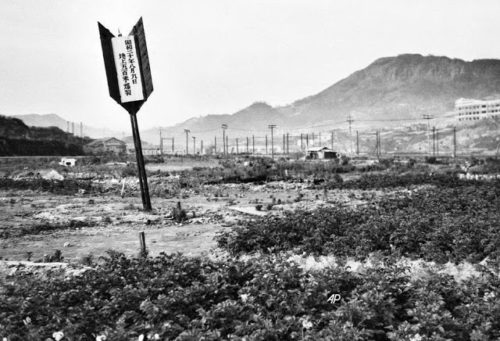
August 10, 1945: Arrow marks the spot where the atomic bomb hit in Nagasaki. Photo by AP

When on August 6 and 9, 1945 the United States killed 200-300 thousand innocent Japanese civilians with atomic bombs in Hiroshima and Nagasaki, they did so intentionally.  It was an act of sinister state terrorism, unprecedented by the nature of the weapons but not by the slaughter. The American terror bombings of Japanese cities that preceded the atomic bombings of Hiroshima and Nagasaki – led by the infamous Major General Curtis LeMay – were also intentionally aimed at Japanese civilians and killed hundreds of thousands of them.

Is there an American artist’s painting of Tokyo destroyed by the firebombing to go next to Picasso’s Guernica, where estimates of the dead range between 800 and 1,600?  In Tokyo alone more than 100,000 Japanese civilians were burnt to death by cluster bombs of napalm.  All this killing was intentional. I repeat: Intentional.  Is that not radical evil?  Demonic?  Only five Japanese cities were spared such bombing.

The atomic bombings were an intentional holocaust, not to end the war, as the historical record amply demonstrates, but to send a message to the Soviet Union that we could do to them what we did to the residents of Japan.  President Truman made certain that the Japanese willingness to surrender in May 1945 was made unacceptable because he and his Secretary-of-State James Byrnes  wanted to use the atomic bombs – “as quickly as possible to ‘show results’” in Byrnes’ words – to send a message to the Soviet Union.  So “the Good War” was ended in the Pacific with the “good guys” killing hundreds of thousands Japanese civilians to make a point to the “bad guys,” who have been demonized ever since.  Russia phobia is nothing new.

Satan always wears the other’s face.

Many Baby Boomers like to say they grew up with the bomb.  They are lucky. They grew up.  They got to be scared.  They got to hide under their desks and wax nostalgic about it.  Do you remember dog tags?  Those 1950s and 1960s?  The scary movies?

The children of Hiroshima and Nagasaki who died under our bombs on August 6 and 9, 1945 didn’t get to grow up.  They couldn’t hide.  They just went under. To be accurate: we put them under. Or they were left to smolder for decades in pain and then die.  But that it was necessary to save American lives is the lie. It’s always about American lives, as if the owners of the country actually cared about them.  But to tender hearts and innocent minds, it’s a magic incantation.  Poor us!

Fat Man, Little Boy – how the words echo down the years to the now fat Americans who grew up in the 1950s and who think like little boys and girls about their country’s demonic nature.  Innocence – it is wonderful!  We are different now. “We are great because we are good,” that’s what Hillary Clinton told us.  The Libyans can attest to that.  We are exceptional, special.  The next election will prove we can defeat Mr. Pumpkin Head and restore America to its “core values.”

Perhaps you think I am cynical.  But understanding true evil is not child’s play.  It seems beyond the grasp of most Americans who need their illusions.  Evil is real.  There is simply no way to understand the savage nature of American history without seeing its demonic nature.  How else can we redeem ourselves at this late date, possessed as we are by delusions of our own God-blessed goodness?

But average Americans play at innocence.  They excite themselves at the thought that with the next election the nation will be “restored” to the right course.  Of course, there never was a right course, unless might makes right, which has always been the way of America’s rulers.  Today Trump is viewed by so many as an aberration.  He is far from it.  He’s straight out of a Twain short story.  He’s Vaudeville. He’s Melville’s confidence man.  He’s us. Did it ever occur to those who are fixated on him that if those who own and run the country wanted him gone, he’d be gone in an instant?  He can tweet and tweet idiotically, endlessly send out messages that he will contradict the next day, but as long as he protects the super-rich, accepts Israel’s control of him, and allows the CIA-military-industrial complex to do its world-wide killing and looting of the treasury, he will be allowed to entertain and excite the public – to get them worked up in a lather in pseudo-debates.  And to make this more entertaining, he will be opposed by the “sane” Democratic opposition, whose intentions are as benign as an assassin’s smile.

Look back as far as you can to past U.S. presidents, the figureheads who “act under orders” (whose orders?), as did Ahab in his lust to kill the “evil” great white whale, and what do you see?  You see servile killers in the grip of a sinister power.  You see hyenas with polished faces. You see pasteboard masks.  On the one occasion when one of these presidents dared to follow his conscience and rejected the devil’s pact that is the presidency’s killer-in-chief role, he – JFK – had his brains blown out in public view.  An evil empire thrives on shedding blood, and it enforces its will through demonic messages.  Resist and there will be blood on the streets, blood on the tracks, blood in your face.

Despite this, President Kennedy’s witness, his turn from cold warrior to an apostle of peace, remains to inspire a ray of hope in these dark days. As recounted by James Douglass in his masterful JFK and the Unspeakable, Kennedy agreed to a meeting in May 1962 with a group of Quakers who had been demonstrating outside the While House for total disarmament.  They urged him to move in that direction.  Kennedy was sympathetic to their position.  He said he wished it were easy to do so from the top down, but that he was being pressured by the Pentagon and others to never do that, although he had given a speech urging “a peace race” together with the Soviet Union. He told the Quakers it would have to come from below.  According to the Quakers, JFK listened intently to their points, and before they left said with a smile, “You believe in redemption, don’t you?”  Soon Kennedy was shaken to his core by the Cuban missile crisis when the world teetered on the brink of extinction and his insane military and “intelligence” advisers urged him to wage a nuclear war.  Not long after, he took a sharp top-down turn toward peace despite their fierce opposition, a turn so dramatic over the next year that it led to his martyrdom.  And he knew it would.  He knew it would.

So hope is not all lost.  There are great souls like JFK to inspire us. Their examples flash here and there. But to even begin to hope to change the future, a confrontation with our demonic past (and present) is first necessary, a descent into the dark truth that is terrifying in its implications.  False innocence must be abandoned.  Carl Jung, in “On the Psychology of the Unconscious,” addressed this with the words:

It is a frightening thought that man also has a shadow side to him, consisting not just of little weaknesses – and foibles, but of a positively demonic dynamism. The individual seldom knows anything of this; to him, as an individual, it is incredible that he should ever in any circumstances go beyond himself. But let these harmless creatures form a mass, and there emerges a raging monster; and each individual is only one tiny cell in the monster’s body, so that for better or worse he must accompany it on its bloody rampages and even assist it to the utmost. Having a dark suspicion of these grim possibilities, man turns a blind eye to the shadow-side of human nature. Blindly he strives against the salutary dogma of original sin, which is yet so prodigiously true. Yes, he even hesitates to admit the conflict of which he is so painfully aware.

How can one describe men who would intentionally slaughter so many innocent people?  American history is rife with such examples up to the present day.  Iraq, Afghanistan, Libya, Syria, etc. – the list is very long.  Savage wars carried out by men and women who own and run the country, and who try to buy the souls of regular people to join them in their pact with the devil, to acquiesce to their ongoing wicked deeds.  Such monstrous evil was never more evident than on August 6 and 9, 1945.

Unless we enter into deep contemplation of the evil that was released into the world with those bombings of Hiroshima and Nagasaki, we are lost in a living hell without escape.  And we will pay.  Nemesis always demands retribution.  We have gradually been accepting rule by those for whom the killing of innocents is child’s play, and we have been masquerading as innocent and good children for whom the truth is too much to bear.  “Indeed, the safest road to Hell is the gradual one,” Screwtape the devil tells his nephew, Wormwood, a devil in training, “the gentle slope, soft underfoot, without sudden turnings, without milestones, without signposts.”  That’s the road we’ve been traveling.

The projection of evil onto others works only so long.  We must reclaim our shadows and withdraw our projections.  Only the fate of the world depends on it.


Related Article:

Barbarians at the Helm (Cindy Sheehan’s Speech in Hiroshima August 6th 2018)

US Intelligence Community as a Collapse Driver

By Dmitry Orlov

Source: Club Orlov

In today’s United States, the term “espionage” doesn’t get too much use outside of some specific contexts. There is still sporadic talk of industrial espionage, but with regard to Americans’ own efforts to understand the world beyond their borders, they prefer the term “intelligence.” This may be an intelligent choice, or not, depending on how you look at things.

First of all, US “intelligence” is only vaguely related to the game of espionage as it has been traditionally played, and as it is still being played by countries such as Russia and China. Espionage involves collecting and validating strategically vital information and conveying it to just the pertinent decision-makers on your side while keeping the fact that you are collecting and validating it hidden from everyone else.

In eras past, a spy, if discovered, would try to bite down on a cyanide capsule; these days torture is considered ungentlemanly, and spies that get caught patiently wait to be exchanged in a spy swap. An unwritten, commonsense rule about spy swaps is that they are done quietly and that those released are never interfered with again because doing so would complicate negotiating future spy swaps. In recent years, the US intelligence agencies have decided that torturing prisoners is a good idea, but they have mostly been torturing innocent bystanders, not professional spies, sometimes forcing them to invent things, such as “Al Qaeda.” There was no such thing before US intelligence popularized it as a brand among Islamic terrorists.

Most recently, British “special services,” which are a sort of Mini-Me to the to the Dr. Evil that is the US intelligence apparatus, saw it fit to interfere with one of their own spies, Sergei Skripal, a double agent whom they sprung from a Russian jail in a spy swap. They poisoned him using an exotic chemical and then tried to pin the blame on Russia based on no evidence. There are unlikely to be any more British spy swaps with Russia, and British spies working in Russia should probably be issued good old-fashioned cyanide capsules (since that supposedly super-powerful Novichok stuff the British keep at their “secret” lab in Porton Down doesn’t work right and is only fatal 20% of the time).

There is another unwritten, commonsense rule about spying in general: whatever happens, it needs to be kept out of the courts, because the discovery process of any trial would force the prosecution to divulge sources and methods, making them part of the public record. An alternative is to hold secret tribunals, but since these cannot be independently verified to be following due process and rules of evidence, they don’t add much value.

A different standard applies to traitors; here, sending them through the courts is acceptable and serves a high moral purpose, since here the source is the person on trial and the method—treason—can be divulged without harm. But this logic does not apply to proper, professional spies who are simply doing their jobs, even if they turn out to be double agents. In fact, when counterintelligence discovers a spy, the professional thing to do is to try to recruit him as a double agent or, failing that, to try to use the spy as a channel for injecting disinformation.

Americans have been doing their best to break this rule. Recently, special counsel Robert Mueller indicted a dozen Russian operatives working in Russia for hacking into the DNC mail server and sending the emails to Wikileaks. Meanwhile, said server is nowhere to be found (it’s been misplaced) while the time stamps on the files that were published on Wikileaks show that they were obtained by copying to a thumb drive rather than sending them over the internet. Thus, this was a leak, not a hack, and couldn’t have been done by anyone working remotely from Russia.

Furthermore, it is an exercise in futility for a US official to indict Russian citizens in Russia. They will never stand trial in a US court because of the following clause in the Russian Constitution: “61.1 A citizen of the Russian Federation may not be deported out of Russia or extradited to another state.” Mueller may summon a panel of constitutional scholars to interpret this sentence, or he can just read it and weep. Yes, the Americans are doing their best to break the unwritten rule against dragging spies through the courts, but their best is nowhere near good enough.

That said, there is no reason to believe that the Russian spies couldn’t have hacked into the DNC mail server. It was probably running Microsoft Windows, and that operating system has more holes in it than a building in downtown Raqqa, Syria after the Americans got done bombing that city to rubble, lots of civilians included. When questioned about this alleged hacking by Fox News, Putin (who had worked as a spy in his previous career) had trouble keeping a straight face and clearly enjoyed the moment. He pointed out that the hacked/leaked emails showed a clear pattern of wrongdoing: DNC officials conspired to steal the electoral victory in the Democratic Primary from Bernie Sanders, and after this information had been leaked they were forced to resign. If the Russian hack did happen, then it was the Russians working to save American democracy from itself. So, where’s the gratitude? Where’s the love? Oh, and why are the DNC perps not in jail?

Since there exists an agreement between the US and Russia to cooperate on criminal investigations, Putin offered to question the spies indicted by Mueller. He even offered to have Mueller sit in on the proceedings. But in return he wanted to question US officials who may have aided and abetted a convicted felon by the name of William Browder, who is due to begin serving a nine-year sentence in Russia any time now and who, by the way, donated copious amounts of his ill-gotten money to the Hillary Clinton election campaign. In response, the US Senate passed a resolution to forbid Russians from questioning US officials. And instead of issuing a valid request to have the twelve Russian spies interviewed, at least one US official made the startlingly inane request to have them come to the US instead. Again, which part of 61.1 don’t they understand?

The logic of US officials may be hard to follow, but only if we adhere to the traditional definitions of espionage and counterespionage—“intelligence” in US parlance—which is to provide validated information for the purpose of making informed decisions on best ways of defending the country. But it all makes perfect sense if we disabuse ourselves of such quaint notions and accept the reality of what we can actually observe: the purpose of US “intelligence” is not to come up with or to work with facts but to simply “make shit up.”

The “intelligence” the US intelligence agencies provide can be anything but; in fact, the stupider it is the better, because its purpose is allow unintelligent people to make unintelligent decisions. In fact, they consider facts harmful—be they about Syrian chemical weapons, or conspiring to steal the primary from Bernie Sanders, or Iraqi weapons of mass destruction, or the whereabouts of Osama Bin Laden—because facts require accuracy and rigor while they prefer to dwell in the realm of pure fantasy and whimsy. In this, their actual objective is easily discernible.

The objective of US intelligence is to suck all remaining wealth out of the US and its allies and pocket as much of it as possible while pretending to defend it from phantom aggressors by squandering nonexistent (borrowed) financial resources on ineffective and overpriced military operations and weapons systems. Where the aggressors are not phantom, they are specially organized for the purpose of having someone to fight: “moderate” terrorists and so on. One major advancement in their state of the art has been in moving from real false flag operations, à la 9/11, to fake false flag operations, à la fake East Gouta chemical attack in Syria (since fully discredited). The Russian election meddling story is perhaps the final step in this evolution: no New York skyscrapers or Syrian children were harmed in the process of concocting this fake narrative, and it can be kept alive seemingly forever purely through the furious effort of numerous flapping lips. It is now a pure confidence scam. If you are less then impressed with their invented narratives, then you are a conspiracy theorist or, in the latest revision, a traitor.

Trump was recently questioned as to whether he trusted US intelligence. He waffled. A light-hearted answer would have been:

“What sort of idiot are you to ask me such a stupid question? Of course they are lying! They were caught lying more than once, and therefore they can never be trusted again. In order to claim that they are not currently lying, you have to determine when it was that they stopped lying, and that they haven’t lied since. And that, based on the information that is available, is an impossible task.”

A more serious, matter-of-fact answer would have been:

“The US intelligence agencies made an outrageous claim: that I colluded with Russia to rig the outcome of the 2016 presidential election. The burden of proof is on them. They are yet to prove their case in a court of law, which is the only place where the matter can legitimately be settled, if it can be settled at all. Until that happens, we must treat their claim as conspiracy theory, not as fact.”

And a hardcore, deadpan answer would have been:

“The US intelligence services swore an oath to uphold the US Constitution, according to which I am their Commander in Chief. They report to me, not I to them. They must be loyal to me, not I to them. If they are disloyal to me, then that is sufficient reason for their dismissal.”

But no such reality-based, down-to-earth dialogue seems possible. All that we hear are fake answers to fake questions, and the outcome is a series of faulty decisions. Based on fake intelligence, the US has spent almost all of this century embroiled in very expensive and ultimately futile conflicts. Thanks to their efforts, Iran, Iraq and Syria have now formed a continuous crescent of religiously and geopolitically aligned states friendly toward Russia while in Afghanistan the Taliban is resurgent and battling ISIS—an organization that came together thanks to American efforts in Iraq and Syria.

The total cost of wars so far this century for the US is reported to be $4,575,610,429,593. Divided by the 138,313,155 Americans who file tax returns (whether they actually pay any tax is too subtle a question), it works out to just over $33,000 per taxpayer. If you pay taxes in the US, that’s your bill so far for the various US intelligence “oopsies.”

The 16 US intelligence agencies have a combined budget of $66.8 billion, and that seems like a lot until you realize how supremely efficient they are: their “mistakes” have cost the country close to 70 times their budget. At a staffing level of over 200,000 employees, each of them has cost the US taxpayer close to $23 million, on average. That number is totally out of the ballpark! The energy sector has the highest earnings per employee, at around $1.8 million per. Valero Energy stands out at $7.6 million per. At $23 million per, the US intelligence community has been doing three times better than Valero. Hats off! This makes the US intelligence community by far the best, most efficient collapse driver imaginable.

There are two possible hypotheses for why this is so.

First, we might venture to guess that these 200,000 people are grossly incompetent and that the fiascos they precipitate are accidental. But it is hard to imagine a situation where grossly incompetent people nevertheless manage to funnel $23 million apiece, on average, toward an assortment of futile undertakings of their choosing. It is even harder to imagine that such incompetents would be allowed to blunder along decade after decade without being called out for their mistakes.

Another hypothesis, and a far more plausible one, is that the US intelligence community has been doing a wonderful job of bankrupting the country and driving it toward financial, economic and political collapse by forcing it to engage in an endless series of expensive and futile conflicts—the largest single continuous act of grand larceny the world has ever known. How that can possibly be an intelligent thing to do to your own country, for any conceivable definition of “intelligence,” I will leave for you to work out for yourself. While you are at it, you might also want to come up with an improved definition of “treason”: something better than “a skeptical attitude toward preposterous, unproven claims made by those known to be perpetual liars.”