Was The Shootdown Of The Ukrainian Airplane Near Tehran Really A ‘Mistake’?

By Moon of Alabama

After the shoot down of the Ukrainian flight PS752 the big question within Iran and within its military and political circles is what went wrong.

An analysis of the circumstances under which the incident took place unfortunately shows that nothing went wrong. The strategic and tactical decisions that were made were all rational and made sense. But unfortunately shit happens even when everything else works as it is supposed to work.

The Iran Front Page has now published a full English language transcript of the press conference by IRGC Aerospace commander Brigadier General Amir-Ali Hajizadeh. It also provides a video with English subtitles of the talk. The narration he gives is highly plausible and has no contradictions within it.

A detailed reading of his talk also clears up some misconceptions in the earlier reporting and comments:

Regarding the details of the incident, I should say; well, you know the region’s conditions remained tense and the risk of conflict was high for over a week. It was really unprecedented compared to what we saw in previous years, even since the 1979 Revolution. The risk of conflict was very high; both the Americans and the Iranian Armed Forces were on highest alert. The Americans had also threatened to hit 52 sites in Iran.

This is a main point one must keep in mind. There really was a threat from the U.S. and everyone thought that war would break out within the next minutes or hours. Decisions made under such stress are more prone to be wrong:

What we know from our investigations and from what our friends explained is that, well, at that night, for example from [Tuesday] evening, the level of preparedness was at wartime conditions; the highest alert level communicated by the integrated air defence to all systems. Under such circumstances, a number of air defence systems was added to Tehran’s air defence ring. The first system – which was behind the incident – was deployed in Bidganeh in western Tehran.

An integrated air defense system provides a full picture of the air situation to all connected units. Fixed radars, defense missile units and command and control centers are connected by secure landlines, not by radio.

But the mobile Tor M1 system responsible for shooting down the Ukrainian airliner was added as a stand alone system. It is an relatively old system. Its operators only had a voice radio connection to other parts of the network. If they had a data connection at all it was also via radio and with very little throughput. The system did not have the full picture of the air situation. Its own radar has a maximum detection range of 25 kilometer (16 miles). In most practical situations it will be a lot less than that. Bidganeh, where the system was deployed, is some 30 kilometer away from Tehran airport. The Tor operator did not know that a civil airplane had just taken off:

At several stages, the Alert Level 3, which is the highest level, is communicated and emphasized to the entire network. So all air defence systems were at highest alert level. For several times, these systems including the one involved in the incident were notified by the integrated network that cruise missiles have been fired at the country. For a couple of times, they receive reports that ‘the cruise missiles are coming, be prepared’.

This is the normal ‘fog of war’ situation in which misinformation, or electronic interference, causes false alarms and where confusion sets in.

So you see the systems were at the highest alert level, where you should just press a button. They had been told cruise missiles were coming, and the air defence unit engaged in this incident and fired a missile. Now we have arranged an interview with this operator, which will be released soon as part of the plan to publicize the issue. He says in this interview that “we requested for several times that the country’s airspace be cleared of [civilian] flights.’ At the Alert Level 3, this is normal; such requests are made; well our dear brothers didn’t follow up the issue for certain considerations. So the planes fly despite the wartime situation.

This the major political issue, not a military one.

Iran’s strategic intent after the U.S. assassination of its national hero Qassem Soleimani was to project defiance to the U.S. Its revenge missile barrage on the U.S. base in Iraq was fired despite harsh U.S. warnings and threats of war against Iran.

The pin point hits on the selected targets, mostly maintenance shacks, was a warning that demonstrated Iran’s capabilities. I think it was necessary and worth the risk.

The political level decided that by leaving the airspace open and by showing normalcy it would further its strategic objective. Closing the airspace would have allowed the U.S. to claim that Iran is fearing its response and that it had shown weakness. The decision to not close the airspace was, I believe, strategically correct. But it had tactical costs which turned out to be high.

In those moments when the incident happens, this air defence unit realizes that there is a target – which it identified as a cruise missile – at a distance of 19 kilometres. […] Given the information sent to this operator – that it is a wartime situation and a cruise missile has been fired – this poor guy identifies it as a cruise missile.

The Tor M1 was developed in 1991. The radar signals it generates are shown on an analog tube-screen. The radar’s ‘hits’ on the screen are difficult to discriminate. At best one has speed, height and direction of a target and must draw conclusion from that. The Boeing jet broadcast the usual civil ADS-B signal but one has to expect that a U.S. cruise missile can and would do the same. The speed of the still climbing Boeing 737 was about 250 knots or 460 kilometers per hour (286 mi/h). That is within the range of the speed of a typical cruise missile. The plane needed a bit less than 8 seconds to fly one kilometer. That left little time for the Tor operator to decide and react.

Well at such a situation, he was obliged to contact, get approval. This is where this operator makes the mistake; but at that moment, his communication system was apparently disrupted – whether because of jamming systems or the high traffic. For that reason, he fails to contact [his commanders]. He had 10 seconds to decide; he could hit or not hit [the target]. Under such circumstances, he decides to make that bad decision; he engages, the missile is fired, and the plane is hit at this place. Then it returns through this track, and here’s the point where it hits the ground.

Radio communication can be unreliable. The people at the other side of the operators call may have been talking to someone else or could  not react immediately. Air defense personal is trained to always presume electronic interference by enemy forces. The U.S. has publicly bragged about its cyber-attacks on IRGC systems. U.S. air attacks typically come behind a wave of electronic countermeasures.

Under these circumstances – highest possible alarm level, current warnings of hostile cruise missiles, unknown target flying towards a presumably military objective, lack of communication, little decision time – the operator of the Tor system did what he was trained to do.

As a former military officer I can not see any fault in what the man did. That is why I find this statement by Iran’s President Rouhani to be wrong:

In a separate statement, Rouhani called the missile launch an “unforgivable mistake,” and he said officials must “address the weaknesses of the nation’s defense systems to make sure such a disaster is never repeated.”

Iran’s strategic intent is to withstand U.S. pressure and to show defiance. Closing the airspace would have contradicted that objective. The shooting down of flight PS752 happened during a tactical engagement by a small mobile unit which did what it was supposed to do. Communication fuck-ups happen all the time during war like situations. They often cause casualties but are unavoidable.

The general in his press conference claimed that his organization is guilty:

Our dear brothers at the Aviation Organization categorically rejected the possibility of a missile hitting the plane; they acted based on what they knew. I must say they were not guilty and have nothing to do with this. All the blame is on us; they’re innocent. The plane was also on its track, it made no mistake. It did the right thing, as did the Aviation Organization. Everyone did the right thing. Only one of our forces made a mistake. Since he is under our command, we are responsible for that. We must be accountable.

It is the right thing to say public relation wise. But the incident itself is not a military error or mistake.

What one can and should criticize is the slow reaction of the Iranian military command after the incident happened. It launched an internal investigation and told everyone to be silent about it. It took the generals three days to look for an excuse that was impossible to find because everything that had happened did happen for rational reasons. The air defense systems have to be dispersed to make them less easy to attack. Communication failures are to be expected during a war. The soldiers are trained to act autonomously when comm-failures happen. They did what they had to do.

It is sad that this incident happened and that 176 lost their life. But if one wants to find a person guilty for it one must look for the person who caused the whole situation. That person is not the lowly sergeant who pressed the button. That person is U.S. President Donald Trump.

The War Pigs Are Finally Revealing Themselves – And This Is Just The Beginning…

By Brandon Smith

Source: Alt-Market

In 2016 during the election campaign of Donald Trump one of the primary factors of his popularity among conservatives was that he was one of the first candidates since Ron Paul to argue for bringing US troops home and ending American involvement in the various elitist fabricated wars in the Middle East. From Iraq, to Afghanistan, to Syria and Yemen and beyond, the Neo-Cons and Neo-Libs at the behest of their globalist masters had been waging war oversees unabated for over 15 years. The time was ripe for a change and people felt certain that if Hillary Clinton entered the White House, another 4-8 years of war were guaranteed.

There was nothing to be gained from these wars. They were only dragging the US down socially and economically, and even the idea of “getting the oil” had turned into a farce as the majority of Iraqi oil has been going to China, not the US. General estimates on the costs of the wars stand at $5 trillion US tax dollars and over 4500 American dead along with around 40,000 wounded. The only people that were benefiting from the situation were globalists and banking elites, who had been clamoring to destabilize the Middle East since the day they launched their “Project For A New American Century” (PNAC). Truly, all wars are banker wars.

The Obama Administration’s attempts to lure Americans into supporting open war with the Assad regime in Syria had failed. Consistent attempts by George W. Bush and Obama to increase tensions with Iran had fizzled. Americans were showing signs of fatigue, FINALLY fed up with the lies being constructed to trick them into being complicit in the banker wars. Trump was a breath of fresh air…but of course, like all other puppets of the globalists, his promises were empty.

In my article ‘Clinton vs. Trump And The Co-Option Of The Liberty Movement’, published before the 2016 election, I warned that Trump’s rhetoric might be a grand show, and that it could be scripted by the establishment to bring conservatives back into the Republican/Neo-Con fold. At the time, leftist media outlet Bloomberg openly reveled in the idea that Trump might absorb and destroy the “Tea Party” and liberty movement and turn them into something far more manageable. The question was whether or not the liberty movement would buy into Trump completely, or remain skeptical.

Initially, I do not think the movement held onto its objectivity at all. Far too many people bought into Trump blindly and immediately based on misguided hopes and a desire to “win” against the leftists. The insane cultism of the political left didn’t help matters much, either.

When Trump started saturating his cabinet with banking elites and globalists from the CFR the moment he entered office, I knew without any doubt that he was a fraud. Close associations with establishment swamp creatures was something he had consistently criticized Clinton and other politicians for during the campaign, but Trump was no better or different than Clinton; he was just an errand boy for the elites. The singular difference was that his rhetoric was designed to appeal directly to liberty minded conservatives.

This meant that it was only a matter of time before Trump broke most of his campaign promises, including his assertions that he would bring US troops home. Eventually, the mask had to come off if Trump was going to continue carrying out the agenda of his masters.

Today, the mask has indeed come off. For the past three years Trump has made announcements of an imminent pull back of troops in the Middle East, including the recent claim that troops would be leaving Syria. All of the announcements were followed by an INCREASE in US troop presence in the region. Consistent attempts have been made to foment renewed strife with Iran. The build-up to war has been obvious, but some people on the Trump train still didn’t get it.

The most common argument I heard when pointing out all the inconsistencies in Trump’s claims as well as his direct links to globalists was that “He hadn’t started any wars, so how could he be a globalist puppet…?” My response has always been “Give it a little time, and he will.”

One of my readers noted recently that “Trump Derangement Syndrome” (TDS) actually goes both ways. Leftists double down on their hatred of Trump at every opportunity, but Trump cultists double down on their support for Trump regardless of how many promises he breaks. This has always been my biggest concern – That conservatives in the liberty movement would ultimately abandon their principles of limited government, the end to banking elites in the White House and ending illegal wars because they had invested themselves so completely in the Trump farce that they would be too embarrassed to admit they had been conned.

Another concern is that the liberty movement would be infected by an influx of people who are neo-conservative statists at their core. These people pretend to be liberty minded conservatives, but when the veil is lifted they show their true colors as the War Pigs they really are. A distinction has to be made between Bush era Neo-Con control freaks and constitutional conservatives; there are few if any similarities between the two groups, but the establishment hopes that the former will devour the latter.

I’ve noticed that the War Pigs are out in force this past week, beating their chests and calling for more blood. The US government has assassinated Iranian military commander Qasem Soleimani, retaliations against US targets have begun, and now the Iraqi government has demanded that US troops be removed from the region, to which Trump has said “no” and demanded payment instead. A new troop surge has been initiated and this WILL end in all out war. The tit-for-tat has just begun.

How do Trump cultists respond? “Kill those terrorists!”

Yes, many of the same people that applauded Trump’s supposed opposition to the wars three years ago are now fanatically cheering for the beginning of perhaps the most destructive war of all. The rationalizations for this abound. Soleimani was planning attacks on US targets in Iraq, they say. And, this might be true, though no hard proof has yet been presented.

I’m reminded of the Bush era claims of Iraqi “Weapons of Mass Destruction”, the weapons that were never found and no proof was found that they ever existed. The only weapons Iraq had were the weapons the US sold to them decades ago. Any government can fabricate an excuse for assassination or war for public consumption; the Trump Administration is no different.

That said, I think the most important factor in this debate has fallen by the wayside. The bottom line is, US troops and US bases should NOT be in Iraq in the first place. Trump himself stated this time and time again. Even if Soleimani was behind the attacks and riots in Iraq, US assets cannot be attacked in the region if they are REMOVED from the region as Trump said he would do.

There is only one reason to keep US assets in Iraq, Afghanistan or Syria at this time, and that is to create ongoing tensions in the area which can be used by the establishment to trigger a new war, specifically with Iran.

The War Pigs always have reasons and rationales, though. They say the Muslim world is a threat to our way of life, and I agree that their ideology is completely incompatible with Western values. That said, the solution is not sending young Americans to die overseas in wars based on lies. Again, these wars only benefit the bankers and globalists; they do not make us safer as a people. The only moral solution is to make sure the fascist elements of Muslim extremism are not imported to our shores.

The War Pigs say that we deserve payment for our “services rendered” in the region before we leave, echoing the sentiments of Donald Trump. I ask, what services? Payment for what? The invasion the Iraqi’s didn’t want, based on fallacies that have been publicly exposed? The US bases that should not be there in the first place? The hundreds of thousands dead from a war that had no purpose except to deliberately destabilize the region?

We will never get “payment” from the Iraqis as compensation for these mad endeavors, and the War Pigs know this. They want war. They want it to go on forever. They want to attach their egos to the event. They want to claim glory for themselves vicariously when we win, and they want to claim victimhood for themselves vicariously when our soldiers or citizens get killed. They are losers that can only be winners through the sacrifices of others.

The War Pigs defend the notion that the president should be allowed to make war unilaterally without support from congress. They say that this type of action is legal, and technically they are right. It is “legal” because the checks and balances of war were removed under the Bush and Obama Administrations. The passage of the AUMF (Authorization For Use Of Military Force) in 2001 gave the Executive Branch dictatorial powers to initiate war on a whim without oversight. Just because it is “legal” does not mean it is constitutional, or right.

In the end, the Trump bandwagon is meant to accomplish many things for the globalists; the main goal though is that it is designed to change liberty conservatives into rabid statists. It is designed to make anti-war pro-constitution activists into war mongers and supporters of big government, as long as it is big government under “our control”. But it’s not under our control. Trump is NOT our guy. He is an agent of the establishment and always has been.

For now, the saber rattling is aggressive but the actions have been limited. This will not be the case for long.  Some may ask why the establishment has not simply launched all out war now?  Why start out small?  Firstly, they need conservatives psychologically invested in the idea.  This may require a false flag event or attack on American civilians.  Secondly, they need to execute an extensive troop build-up, which could take a few months.  Declarations of a “need for peace” are always used to stall for time while the elites position for war.

War with Iran is pointless, and frankly, unwinnable, and the elites know this. It’s not just a war with Iran, it is a war with Iran, their allies, and every other nation that reacts negatively to our actions.  And, these nations do not have to react militarily, they can react economically by dumping US treasuries and the dollar as world reserve.

The establishment wants the US embroiled in Afghanistan, Iraq, Iran, etc. until we are so hollowed out from conflict that we collapse.

They also need a considerable distraction to hide their responsibility for the implosion of the Everything Bubble and the economic pain that will come with it. The end game for the establishment is for America to self destruct, so that it can be rebuilt into something unrecognizable and eternally monstrous. They want every vestige of our original principles to be erased, and to do that, they need us to be complicit in our own destruction. They need us to participate. Don’t participate, and refuse to support new banker wars. Don’t be a War Pig.

Another Stupid War

By Michael Krieger

Source: Liberty Blitzkrieg

All I wanted to do this week was work on part 2 of my localism series, but circumstances quickly got the best of me. The assassination of Iran’s top general Qassem Soleimani was an event of such historical significance, I feel obligated to detail my thoughts on what it means and how things unfold from here, especially given how much of a role geopolitics and questions of empire have played in my writings.

First off, we need to understand the U.S. is now at war with Iran. It’s an undeclared, insane and unconstitutional war, but it is war nonetheless. There is no world in which one government intentionally assassinates the top general of another government and that not be warfare. You can argue the U.S. and Iran were already engaged in low-level proxy wars, and that’s a fair assessment, but you can’t say we aren’t currently in a far more serious a state of war. We are.

Soleimani was not only a powerful general, he was a popular figure within Iran. Unlike other blows the U.S. and Iran have inflicted upon one another, this cannot be walked back. There’s no deescalation from here, only escalation. Even if you want to pretend this didn’t happen and turn back the clock, it’s impossible. This is a major event of historical proportions and should be seen as such. Everything has been turned up a notch.

Before discussing what happens next and the big picture implications, it’s worth pointing out the incredible number of blatant lies and overall clownishness that emerged from U.S. officials in the assassination’s aftermath. It started with claims from Trump that Soleimani was plotting imminent attacks on Americans and was caught in the act. Mass media did its job and uncritically parroted this line, which was quickly exposed as a complete falsehood.

It’s incredibly telling that CNN would swallow this fact-free claim with total credulity within weeks of discovering the extent of the lies told about Syrian chemical attacks and the Afghanistan war. Meanwhile, when a reporter asked a state department official for some clarification on what sorts of attacks were imminent, this is what transpired.

Naturally, we learned soon after from the Iraqi PM himself that Soleimani was in Iraq as part of a diplomatic effort to de-escalate tensions. In other words, he was apparently lured to Baghdad under false pretenses so he’d be a sitting duck for a U.S. strike. Never let the truth get in the way of a good story.

As you’d expect, some of the most ridiculous propaganda came from Mike Pompeo, a man who genuinely loves deception and considers it his craft.. For example:

Then there’s what actually happened.

https://twitter.com/sonofnariman/status/1213792565075550208

Moving on to the really big question: what does this assassination mean for the future role of the U.S. in the Middle East and American global hegemony generally? A few important things have already occurred. For starters, the Iraqi parliament passed a resolution calling for U.S. troops to leave. Even more important are the comments and actions of Muqtada al-Sadr.

Unmentioned in the above tweet, but extremely significant, is the fact al-Sadr has been a vocal critic of both the American and Iranian presence in Iraq. He doesn’t want either country meddling in the affairs of Iraqis, but the Soleimani assassination clearly pushed him to focus on the U.S. presence. This is a very big deal and ensures Iraq will be far more dangerous for U.S. troops than it already was. 

Going forward, Iran’s response will be influenced to a great degree by what’s already transpired. There are three things worth noting. First, although many Trump supporters are cheering the assassination, Americans are certainly nowhere near united on this, with many including myself viewing it as a gigantic strategic blunder. Second, it ratcheted up anti-American sentiment in Iraq to a huge degree without Iran having to do anything, as highlighted above. Third, hardliners within Iran have been given an enormous gift. With one drone strike, the situation went from grumblings and protests on the ground to a scene where any sort of dissent in the air has been extinguished for the time being.

Iranian leadership will see these developments as important victories in their own right and will likely craft a response taking stock of this much improved position. This means a total focus on making the experience of American troops in the region untenable, which will be far easier to achieve now.

If that’s right, you can expect less shock and awe in the near-term, and more consolidation of the various parties that were on the fence but have since shifted to a more anti-American stance following Soleimani’s death. Iran will start with the easy pickings, which consists of consolidating its stronger position in Iraq and making dissidents feel shameful at home. That said, Iran will have to publicly respond with some sort of a counterattack, but that event will be carefully considered with Iran’s primary objective in mind — getting U.S. troops out of the region.

This means no attacks on U.S. or European soil, and no attacks targeting civilians either. Such a move would be as strategically counterproductive as Assad gassing Syrian cities after he was winning the war (which is why many of us doubted the narrative) since it would merely inflame American public opinion and give an excuse to attack Iran in Iran. There is no way Iranian leadership is that stupid, so any such attack must be treated with the utmost skepticism.

It’s impossible to know exactly what will happen in the short-term, but in the much bigger picture I have a strong view of what this means. The assassination of Soleimani kicks off the beginning of the final chapter in the decline of U.S. imperial dominance. It will likely play out over the course of the first part of this decade (2020-2025), and by the time it’s over it’ll be undeniable that the U.S. is no longer the global hegemon it once was. The world at that stage will be unmistakably multi-polar.

The signs are everywhere.

This is not a time for despair, as there can be a huge silver lining to all of this. A singular focus on imperial hegemony has been terrible for most Americans. It has made us weak, it has destroyed the middle class, and it has entrenched a small subset of sociopaths into positions of total, unaccountable power.

The energy and spirit of the American people have been pushed aside and smothered so a bunch of defense contractors, politicians and finance criminals can play a game of RISK at the public’s expense. The transition is likely to be quite traumatic and fraught with danger, but empire has been a curse and has hollowed out the country. Shaking off empire at least gives us a shot at a revival.


The ‘Great Game’ is afoot: Killing Soleimani reflects US desperation in the Middle East

Source: Intrepid Report

By killing top Iranian military commander Qasem Soleimani, American and Israeli leaders demonstrated the idiom ‘out of the frying pan into the fire.’

US President Donald Trump and Israeli Prime Minister Benjamin Netanyahu are both politically and legally embattled—the former has just been impeached and the latter is dogged by an attorney general indictment and investigation into major corruption cases.

Despairing, out of options and united by a common cause, both leaders were on the lookout for a major disruption—that would situate them in a positive light within their countries’ respective media—and they found it.

The assassination of the Iranian major general in the Islamic Revolutionary Guard Corps and commander of its Quds Force, Soleimani, on January 3, along with several Iranian military leaders, by a US drone was a testament to the degree of that US and Israeli desperation.

Although there has been no official confirmation or denial of the Israeli role in the US operation, it is only logical to assume indirect or even direct Israeli involvement in the assassination.

Over the last few months, the possibility of a war against Iran has once more gained momentum, topping the agenda of Israel’s foreign policy makers. Politically beleaguered Netanyahu has repeatedly and tirelessly asked his friends in Washington to increase pressure on Teheran.

“Iran is increasing its aggression as we speak,” Netanyahu claimed on December 4, during a meeting with US Secretary of State Mike Pompeo. “We are actively engaging in countering that aggression.”

One can only assume what “active engagement” from the overtly militant Israeli point of view can possibly mean in this context.

Moreover, the fingerprints of Israeli intelligence, the Mossad, are unmistakably present in the assassination. It is plausible that the attack at Soleimani’s convoy near the Baghdad International airport was a joint CIA-Mossad operation.

It is well-known that Israel has more experience in targeted assassinations in the region than all Middle Eastern countries combined. It has killed hundreds of Palestinian and Arab activists this way. The assassination of Hezbollah’s top military leader—the movement’s second in command— Imad Mughniyah in February 2008, in Syria, was only one of numerous such killings.

It is no secret that Israel is itching for a war against Iran. Yet all of Tel Aviv’s efforts have failed to bring about US-led war similar to the Iraq invasion in 2003. The most that Netanyahu could achieve in terms of US support in that regard was a decision by the Trump administration to renege on the US commitment to the international community by withdrawing from the Iran Nuclear Treaty in May 2018.

That coveted Israeli war seemed assured when Iran, after various provocations and the slapping by Washington of yet more sanctions, shot down a US unmanned aerial vehicle that, as Iran maintained, violated the country’s airspace, on June 20, 2019.

Even then, the US response fell short of achieving the all-out war that Netanyahu has been so frantically seeking.

But much has happened since then, including a repeat of  Netanyahu’s failure to win a decisive election, thus securing another term in office, compounding the Israeli prime minister’s fully justified fear that he could eventually find himself behind bars for operating a massive racket of bribes and misuse of power.

Trump, too, has his own political woes, thus his own reasons to act erratically and irresponsibly. His official impeachment by the US House of Representatives on December 18 was the last of such bad news. He too needed to up the political ante.

If there is one thing that many Democratic and Republican lawmakers have in common is their desire for more Middle East military interventions and to maintain a stronger military presence in the oil and gas-rich region. This was reflected in the near-celebratory tone that  US officials, generals, and media commentators have used following the assassination of the Iranian commander in Baghdad.

Israeli officials too were visibly excited. Immediately following the killing of General Soleimani, Israeli leaders and officials issued statements and tweets in support of the US action.

For his part, Netanyahu declared that “Israel has the right to defend itself. The US has the same right exactly.” “Soleimani,” he added, “is responsible for the deaths of innocent US citizens and many others. He was planning further attacks.”

The last statement in particular, “he was planning further attacks,” points to the obvious joint intelligence and information sharing between Washington and Tel Aviv.

Benny Gantz, mistakenly celebrated for being a “centrist”, was no less militant in his views. When it comes to matters of national security, “there is no coalition and opposition,” he stated.

“The killing of Soleimani is a message to all the head of global terror: on your own heads be it,” the Israeli general, responsible for the death of thousands of innocent Palestinians in Gaza and elsewhere, also added.

Iran will certainly respond, not only against American targets but Israeli targets as well, for Teheran is convinced that Israel has played a major role in the operation. The pressing questions are more about the nature and the timing of the Iranian response: How far will Iran go to send even a stronger message back to Washington and Tel Aviv? and could Teheran communicate a decisive message without granting Netanyahu his wish of an all-out war between Iran and the United States?

Recent events in Iraq—the mass protests and attempt by unarmed protesters to storm the US embassy in Baghdad on December 31—were, to some extent, a game changer. Initially, they were understood as an angry response to US airstrikes on an Iranian-backed militia group on Sunday, but the protests had unintended consequences as well, particularly dangerous from a US military and strategic perspective. For the first time since the phony US ‘withdrawal’ from Iraq under the previous administration of Barack Obama in 2012, a new collective understanding began maturing among ordinary Iraqis and their representatives that the US must leave the country for good.

Acting quickly, the US, with palpable Israeli giddiness, assassinated Soleimani to send a clear message to Iraq and Iran that demanding or expecting an American withdrawal is a red line that cannot be crossed—and to the whole Middle East that the evident US retreat from the region will not be duplicated in Iraq.

Soleimani’s assassination was followed by yet more US airstrikes on Iran’s allies in Iraq, as to also emphasize the level of US seriousness and willingness to seek violent confrontation as a matter of course.

While Iran is now weighing in its responses, it must also be aware of the geostrategic consequences of its decisions. An Iranian move against US-Israeli interests would have to be convincing from the point of view of Iran and its allies, yet, again, without engaging in an all-out war.

Either way, Iran’s next move will define the Iranian-US-Israeli relations in the region for years to come and will further intensify the ongoing regional and international “Great Game,” on full display throughout the Middle East.

Soleimani’s assassination could also be understood as a clear message to both Russia and China as well, that the US is prepared to set the whole region on fire, if necessary, in order to maintain its strategic presence and to serve its economic interests—which mostly lie in Iraqi and Arab oil and gas.

This comes at the heel of a joint Russian, Chinese and Iranian naval drill in the Indian Ocean and the Gulf of Oman, starting on December 27. The news of the military exercises must have been particularly alarming to the Pentagon, as Iran, which was meant to be isolated and browbeaten, is increasingly becoming a regional access point to the emergent and resurfacing Chinese and Russian military powers respectively.

Soleimani was an Iranian commander, but his massive network and military alliances in the region and beyond made his assassination a powerful message sent by Washington and Tel Aviv that they are ready and unafraid to up their game.

The ball is now in the court of Iran and its allies.

Judging by past experiences, it is likely that Washington will regret assassinating the Iranian general for many years to come.


Ramzy Baroud is a journalist and the Editor of The Palestine Chronicle. He is the author of five books. His latest is “These Chains Will Be Broken: Palestinian Stories of Struggle and Defiance in Israeli Prisons” (Clarity Press, Atlanta). Dr. Baroud is a Non-resident Senior Research Fellow at the Center for Islam and Global Affairs (CIGA), Istanbul Zaim University (IZU). His website is www.ramzybaroud.net

Romana Rubeo is an Italian writer, translator and an editor at The Palestine Chronicle. Rubeo holds a Master’s Degree in Foreign Languages and Literature and specializes in Audio-Visual and Journalism Translation.

Iran’s Hero has Fallen, and Now the World is an Even More Dangerous Place

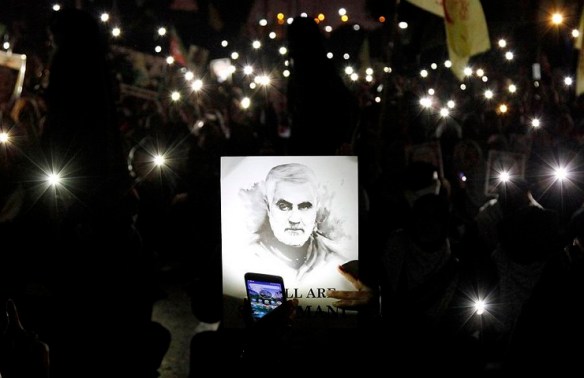
A Shiite Muslim illuminates a portrait of Iranian Revolutionary Guard Gen. Qassem Soleimani, with light from a mobile phone, during a rally to condemn his killing in Iraq by a U.S. airstrike, in Karachi, Pakistan, Sunday, Jan. 5, 2020. Iran has vowed “harsh retaliation” for the U.S. airstrike near Baghdad’s airport that killed Tehran’s top general and the architect of its interventions across the Middle East, as tensions soared in the wake of the targeted killing. (AP Photo/Ikram Suri)

By Andre Vitchek

Source: New Eastern Outlook

They say he came from a humble background, and worked himself up the ranks, becoming, as many believe, the second most powerful man in Iran. They say he had the chance to become the next Supreme Leader of the country.

Whenever I visit Iran, I am told how much he is loved by his people. He became the symbol of resistance against the West; the symbol of the strength and dignity of the nation which was attacked, colonized and starved by several Western capitals.

And now, Iran’s Quds Force commander Qassem Soleimani is no more. And the US Commander-in-Chief, Donald Trump, is proudly claiming responsibility for his demise.

The statement from the Pentagon came promptly, and it was clear:

“At the direction of the president, the US military has taken decisive defensive action to protect US personnel abroad by killing Qasem Soleimani… This strike was aimed at deterring future Iranian attack plans. The United States will continue to take all necessary action to protect our people and interests wherever they are around the world.”

Defensive action…

Almost immediately, RT and others asked me to analyze.

I could not help but to define what was done at the airport outside Baghdad, Iraq, as a vulgar and brutal extra-judicial killing.

***

For the last two months, I have been flying all over the world, writing about (and filming) all those horrors that the Empire unleashed against the people with different cultures, living in various parts of the world.

The Middle East, China, Latin America.

It appears that all boundaries have been crossed. Washington and its NATO allies have lost all restraint, shame and decency. They actually never had much of those, but now they have almost none.

Everything appears to be primitive, as in a badly directed mafia film. If the rulers of the West do not like some country? In that case they simply attack it, starve and destroy it. As brutal as that. No UN Security Council mediations, no arguments, and no pretending that there should be some legal process.

It has been happening to Hong Kong, To Bolivia, Venezuela and West Papua. It has also been happening to Iran, as well as China and Russia, although those countries have proven to be much tougher to eliminate, than Washington’s planners originally thought.

The same applies to individuals: people get murdered without second thought, some quickly, some very slowly and painfully. Julian Assange is one of them, being slowly tortured to death, in front of the entire world, despite legal and medical experts protesting and demanding his release.

The killing of Quassem Suleimani and others in Baghdad, was quick and totally unexpected.

The facial expressions of US officials were absolutely shocking: as if mafia bosses were caught in a corner of some filthy den by a bunch of amateur journalists. Unapologetically, they grinned at the lenses, suggesting: “So what? What are you going to do now? Challenge us? Us? We’ll break your legs, or something…”

And nobody, absolutely nobody really dares to challenge them! Not yet. Not at this moment.

It is one tested, bulletproof game. You destroy an entire country, or you kill a person, and then you show your piece; your well-maintained revolver, or two. You expose your guns and ugly row of teeth. You say, or you suggest without pronouncing it: “You have a wife, and two daughters back home, don’t you? You don’t want anything to happen to them, right?”

It is on that level, now. It is not any better than that, don’t you see?

If you defend yourself – you die; your family dies. Or your family members get violated. Or both.

You like it? You don’t like it? You absolutely detested it? Who cares! The Empire has guns. It is all it has. The ability to kill and to rape. It has become dumb, degenerate. It produces hardly anything of value. But it has millions of weapons, as well as a monstrous propaganda machine.

***

Now, seriously: what can Iran do? What can a nation with thousands of years of culture do?

Can it defend itself? Honestly, if you think it can, then say it: how?

If it retaliates, it could be erased from the face of the earth. If it doesn’t do anything, it will lose face, self-respect, as well as the purpose to continue with its struggle for true independence and its unique form of socialism.

For years and decades, Iran has been a thorn in the eye of the West. Its allies have fought against Western-injected terrorism in Iraq, Syria and Lebanon. Iranian ally in Lebanon, Hezbollah, has been defending the country against Israeli invasions, while providing social support to poor and needy citizens. Iran has been giving jobs and temporary shelter to many Afghan citizens, particularly those from Herat, people who have absolutely nothing left after the horrendous US/NATO occupation of the country. I worked in Afghanistan, and I saw tremendous lines in front of the Iranian consulate in Herat. Iran has even been deeply involved in Latin America, helping, building social housing in Venezuela, Evo’s Bolivia, and elsewhere.

And now, recently, it began moving closer and closer to two of Washington’s arch enemies: China and Russia.

Therefore, it has been decided in the annals of Washington and the Pentagon: Iran has to be stopped; destroyed. At any price. Meaning, any price which would have to be paid by the Iranian citizens.

***

I am convinced that this madness has to be stopped.

For Iran’s sake.

But also, because, if Iran is ruined, destroyed like Iraq, Libya or Afghanistan, someone will be next. First, most likely, Venezuela, and then Cuba. But then, perhaps, most likely, Russia or China, or both.

The Empire will not stop by itself.

If not opposed, it will get more and more emboldened.

It is a tremendous mistake to let it literally ‘get away with a murder’.

Today, a brave Iranian General has been murdered. Washington is smiling provocatively, cynically.

It is sending vibes to all corners of the world: “Stay on your couches in front of television sets. Be petrified. Do nothing. Or else!”

Yes, the world is scared. There are reasons to be scared. But the world simply has to act. These brutal, cowardly acts of degeneracy and fundamentalism/fanaticism committed by the Empire have to be stopped, sooner or later, in the name of our human race. Otherwise, soon, there will be no humanity left!

After Mossad Targeted Soleimani, Trump Pulled the Trigger

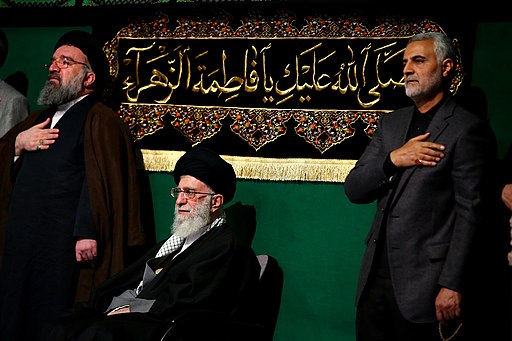
Iran’s Supreme Leader Ayatollah Khameini and Quds Force commander Qasem Soleimani, right (Credit: Wikimedia Commons)

By Jeffrey Morley

Source: The Deep State

Last October Yossi Cohen, head of Israel’s Mossad, spoke openly about assassinating Iranian general Qassem Soleimani, the head of the elite Quds Force in Iran’s Islamic Revolutionary Guard Corps.

“He knows very well that his assassination is not impossible,” Cohen said in an interview. Soleimani had boasted that the Israel’s tried to assassinate him in 2006 and failed.

“With all due respect to his bluster,” Cohen said, “he hasn’t necessarily committed the mistake yet that would place him on the prestigious list of Mossad’s assassination targets.”

“Is Israel Targeting Iran’s Top General for Assassination?” I asked on October 24. On Thursday, Soleimani was killed in an air strike ordered by President Trump.

Soleimani’s convoy was struck by U.S. missiles as he left a meeting at Baghdad’s airport amid anti-Iranian and anti-American demonstrations in Iraq. Supporters of an Iranian-backed militia had agreed to withdraw from the U.S. diplomatic compound in return for a promise that the government would allow a parliamentary vote on expelling 5,000 U.S. troops from the country.

The Pentagon confirmed the military operation, which came “at the direction of the president” and was “aimed at deterring future Iranian attack plans.” The Pentagon claimed in a statement that Gen. Soleimani was “actively developing plans to attack American diplomats and service members in Iraq and throughout the region.”

Israeli Prime Minister Bibi Netanyahu, under indictment for criminal charges, was the first and only national leader to support Trump’s action, while claiming that that Trump acted entirely on his own.

“Just as Israel has the right to self-defense, the United States has exactly the same right,” Netanyahu told reporters in Greece. “Qassem Soleimani is responsible for the deaths of American citizens and other innocents, and he was planning more attacks.”

Iranian President Hassan Rouhani vowed retaliation for the general’s death,  tweeting that “Iran will take revenge for this heinous crime.”

Capable Foe

Soleimani was the most capable foe of the United States and Israel in the region. As chief of the Al-Quds force, Soleimani was a master of Iran’s asymmetric warfare strategy, using proxy forces to bleed Iran’s enemies, while preserving the government’s ability to plausibly deny involvement.

After the U.S. invasions of Iraq, he funded and trained anti-American militias that launched low-level attacks on U.S. occupation forces, killing upward of 600 U.S. servicemen and generating pressure for U.S. withdrawal.

In recent years, Soleimani led two successful Iranian military operations: the campaign to drive ISIS out of western Iraq in 2015 and the campaign to crush the jihadist forces opposed to Syria’s Bashar al-Assad. The United States and Israel denounced Iran’s role in both operations but could not prevent Iran from claiming victory.

Soleimani had assumed a leading role in Iraqi politics in the past year. The anti-ISIS campaign relied on Iraqi militias, which the Iranians supported with money, weapons, and training. After ISIS was defeated, these militia maintained a prominent role in Iraq that many resented, leading to demonstrations and rioting. Soleimani was seeking to stabilize the government and channel the protests against the United States when he was killed.

In the same period, Israel pursued its program of targeted assassination. In the past decade Mossad assassinated at least five Iranian nuclear scientists, according to Israeli journalist Ronen Bergman, in an effort to thwart Iran’s nuclear program. Yossi Melman, another Israeli journalist, says that Mossad has assassinated 60-70 enemies outside of its borders since its founding in 1947, though none as prominent as Soleimani.

Israel also began striking at the Iranian-backed militias in Iraq last year. The United States did the same on December 29, killing 19 fighters and prompting anti-American demonstrations as big as the anti-Iranian demonstrations of a month ago.

Now the killing of Soleimani promises more unrest, if not open war. The idea that it will deter Iranian attacks is foolish.

“This doesn’t mean war,” wrote former Defense Department official Andrew Exum, “It will not lead to war, and it doesn’t risk war. None of that. It is war.“​

The Kuwaiti newspaper Al-Jarida reported a year ago that Washington had given Israel the green light to assassinate Soleimani. Al-Jarida, which in recent years has broken exclusive stories from Israel, quoted a source in Jerusalem as saying that “there is an American-Israeli agreement” that Soleimani is a “threat to the two countries’ interests in the region.” It is generally assumed in the Arab world that the paper is used as an Israeli platform for conveying messages to other countries in the Middle East.

Trump has now fulfilled the wishes of Mossad. After proclaiming his intention to end America’s “stupid endless wars,” the president has effectively declared war on the largest country in the region in solidarity with Israel, the most unpopular country in the Middle East.

America Escalates its “Democratic” Oil War in the Near East

By Michael Hudson

Source: CounterPunch

The mainstream media are carefully sidestepping the method behind America’s seeming madness in assassinating Islamic Revolutionary Guard general Qassim Suleimani to start the New Year. The logic behind the assassination was a long-standing application of U.S. global policy, not just a personality quirk of Donald Trump’s impulsive action. His assassination of Iranian military leader Suleimani was indeed a unilateral act of war in violation of international law, but it was a logical step in a long-standing U.S. strategy. It was explicitly authorized by the Senate in the funding bill for the Pentagon that it passed last year.

The assassination was intended to escalate America’s presence in Iraq to keep control of the region’s oil reserves, and to back Saudi Arabia’s Wahabi troops (Isis, Al Quaeda in Iraq, Al Nusra and other divisions of what are actually America’s foreign legion), to support U.S. control of Near Eastern oil as a buttress of the U.S. dollar. That remains the key to understanding this policy, and why it is in the process of escalating, not dying down.

I sat in on discussions of this policy as it was formulated nearly fifty years ago when I worked at the Hudson Institute and attended meetings at the White House, met with generals at various armed forces think tanks and with diplomats at the United Nations. My role was as a balance-of-payments economist, having specialized for a decade at Chase Manhattan, Arthur Andersen and oil companies in the oil industry and military spending. These were two of the three main dynamics of American foreign policy and diplomacy. (The third concern was how to wage war in a democracy where voters rejected the draft in the wake of the Vietnam War.)

The media and public discussion have diverted attention from this strategy by floundering speculation that President Trump did it, except to counter the (non-)threat of impeachment with a wag-the-dog attack, or to back Israeli lebensraum drives, or simply to surrender the White House to the neocon hate-Iran syndrome. The actual context for the neocon’s action was the balance of payments, and the role of oil and energy as a long-term lever of American diplomacy.

The balance of payments dimension

The major deficit in the U.S. balance of payments has long been military spending abroad. The entire payments deficit, beginning with the Korean War in 1950-51 and extending through the Vietnam War of the 1960s, was responsible for forcing the dollar off gold in 1971. The problem facing America’s military strategists was how to continue supporting the 800 U.S. military bases around the world and allied troop support without losing America’s financial leverage.

The solution turned out to be to replace gold with U.S. Treasury securities (IOUs) as the basis of foreign central bank reserves. After 1971, foreign central banks had little option for what to do with their continuing dollar inflows except to recycle them to the U.S. economy by buying U.S. Treasury securities. The effect of U.S. foreign military spending thus did not undercut the dollar’s exchange rate, and did not even force the Treasury and Federal Reserve to raise interest rates to attract foreign exchange to offset the dollar outflows on military accounts. In fact, U.S. foreign military spending helped finance the domestic U.S. federal budget deficit.

Saudi Arabia and other Near Eastern OPEC countries quickly became a buttress of the dollar. After these countries quadrupled the price of oil (in retaliation for the United States quadrupling the price of its grain exports, a mainstay of the U.S. trade balance), U.S. banks were swamped with an inflow of  foreign deposits – which were lent out to Third World countries in an explosion of bad loans that blew up in 1972 with Mexico’s insolvency. This destroyed Third World government credit for a decade, forcing it into dependence on the United States via the IMF and World Bank.

To top matters, of course, what Saudi Arabia does not save in dollarized assets with its oil-export earnings is spent on buying hundreds of billion of dollars of U.S. arms exports. This locks them into dependence on U.S. supply of replacement parts and repairs, and enables the United States to turn off Saudi military hardware at any point of time, in the event that the Saudis may try to act independently of U.S. foreign policy.

So maintaining the dollar as the world’s reserve currency became a mainstay of U.S. military spending. Foreign countries would not have to pay the Pentagon directly for this spending. They simply finance the U.S. Treasury and U.S. banking system.

Fear of this development was a major reason why the United States moved against Libya, whose foreign reserves were held in gold, not dollars, and which was urging other African countries to follow suit in order to free themselves from “Dollar Diplomacy.” Hillary and Obama invaded, grabbed their gold supplies (we still have no idea who ended up with these billions of dollars worth of gold) and destroyed Libya’s government, its public education system, its public infrastructure and other non-neoliberal policies.

The great threat to this is dedollarization as China, Russia and other countries seek to avoid recycling dollars. Without the dollar’s function as the vehicle for world saving – in effect, without the Pentagon’s role in creating the Treasury debt that is the vehicle for world central bank reserves – the U.S. would find itself constrained militarily and hence diplomatically constrained, as it was under the gold exchange standard.

That is the same strategy that the U.S. has followed in Syria and Iraq. Iran was threatening this dollarization strategy and its buttress in U.S. oil diplomacy.

The oil industry as buttress of the U.S. balance of payments and foreign diplomacy

The trade balance is buttressed by oil and farm surpluses. Oil is the key, because it is imported by U.S. companies at almost no balance-of-payments cost (the payments end up in the oil industry’s head offices here as profits and payments to management), while profits on U.S. oil company sales to other countries are remitted to the United States (via offshore tax-avoidance centers, mainly Liberia and Panama for many years). And as noted above, OPEC countries have been told to keep their official reserves in the form of U.S. securities (stocks and bonds as well as Treasury IOUs, but not direct purchase of U.S. companies being deemed economically important). Financially, OPEC countries are client slates of the Dollar Area.

America’s attempt to maintain this buttress explains U.S. opposition to any foreign government steps to reverse global warming and the extreme weather caused by the world’s U.S.-sponsored dependence on oil. Any such moves by Europe and other countries would reduce dependence on U.S. oil sales, and hence on the U.S’s ability to control the global oil spigot as a means of control and coercion. These are viewed as hostile acts.

Oil also explains U.S. opposition to Russian oil exports via Nordstream. U.S. strategists want to treat energy as a U.S. national monopoly. Other countries can benefit in the way that Saudi Arabia has done – by sending their surpluses to the U.S. economy – but not to support their own economic growth and diplomacy. Control of oil thus implies support for continued global warming as an inherent part of U.S. strategy.

How a “democratic” nation can wage international war and terrorism

The Vietnam War showed that modern democracies cannot field armies for any major military conflict, because this would require a draft of its citizens. That would lead any government attempting such a draft to be voted out of power. And without troops, it is not possible to invade a country to take it over.

The corollary of this perception is that democracies have only two choices when it comes to military strategy: They can only wage airpower, bombing opponents; or they can create a foreign legion, that is, hire mercenaries or back foreign governments that provide this military service.

Here once again Saudi Arabia plays a critical role, through its control of Wahabi Sunnis which motivates terrorist jihadis willing to sabotage, bomb, assassinate, blow up and otherwise fight any target designated as an enemy of “Islam,” the euphemism for Saudi Arabia acting as a U.S. client state. (Religion really is not the key; I know of no ISIS or similar Wahabi attack on Israeli targets.) The United States needs the Saudis to supply or finance Wahabi crazies. So in addition to playing a key role in the U.S. balance of payments by recycling its oil-export earnings into U.S. stocks, bonds and other investments, Saudi Arabia provides manpower by supporting the Wahabi members of America’s foreign legion, ISIS and Al-Nusra/Al-Qaeda. Terrorism has become the “democratic” mode of today U.S. military policy.

What makes America’s oil war in the Near East “democratic” is that this is the only kind of war a democracy can fight – an air war, followed by a vicious terrorist army that makes up for the fact that no democracy can field its own army in today’s world. The corollary is that, terrorism has become the “democratic” mode of warfare.

From the U.S. vantage point, what is a “democracy”? In today’s Orwellian vocabulary, it means any country supporting U.S. foreign policy. Bolivia and Honduras have become “democracies” since their coups, along with Brazil. Chile under Pinochet was a Chicago-style free market democracy. So was Iran under the Shah, and Russia under Yeltsin – but not since it elected Vladimir Putin president, any more than is China under President Xi.

The antonym to “democracy” is “terrorist.” That simply means a nation willing to fight to become independent from U.S. neoliberal democracy. It does not include America’s proxy armies.

Iran’s role as U.S. nemesis

What stands in the way of U.S. dollarization, oil and military strategy? Obviously, Russia and China have been targeted as long-term strategic enemies for seeking their own independent economic policies and diplomacy. But next to them, Iran has been in America’s gun sights for nearly seventy years.

America’s hatred of Iran is starts with its attempt to control its own oil production, exports and earnings. It goes back to 1953, when Mossadegh was overthrown because he wanted domestic sovereignty over Anglo-Persian oil. The CIA-MI6 coup replaced him with the pliant Shah, who imposed a police state to prevent Iranian independence from U.S. policy. The only physical places free from the police were the mosques. That made the Islamic Republic the path of least resistance to overthrowing the Shah and re-asserting Iranian sovereignty.

The United States came to terms with OPEC oil independence by 1974, but the antagonism toward Iran extends to demographic and religious considerations. Iranian support of its Shi’ite population and those of Iraq and other countries – emphasizing support for the poor and for quasi-socialist policies instead of neoliberalism – has made it the main religious rival to Saudi Arabia’s Sunni sectarianism and its role as America’s Wahabi foreign legion.

America opposed General Suleimani above all because he was fighting against ISIS and other U.S.-backed terrorists in their attempt to break up Syria and replace Assad’s regime with a set of U.S.-compliant local leaders – the old British “divide and conquer” ploy. On occasion, Suleimani had cooperated with U.S. troops in fighting ISIS groups that got “out of line” – meaning the U.S. party line. But every indication is that he was in Iraq to work with that government seeking to regain control of the oil fields that President Trump has bragged so loudly about grabbing.

Already in early 2018, President Trump asked Iraq to reimburse America for the cost of “saving its democracy” by bombing the remainder of Saddam’s economy. The reimbursement was to take the form of Iraqi Oil. More recently, in 2019, President Trump asked, why not simply grab Iraqi oil. The giant oil field has become the prize of the Bush-Cheney post 9-11 Oil War. “‘It was a very run-of-the-mill, low-key, meeting in general,” a source who was in the room told Axios.’ And then right at the end, Trump says something to the effect of, he gets a little smirk on his face and he says, ‘So what are we going to do about the oil?’”

Trump’s idea that America should “get something” out of its military expenditure in destroying the Iraqi and Syrian economies simply reflects U.S. policy.

In late October, 2019, The New York Times reported that: “In recent days, Mr. Trump has settled on Syria’s oil reserves as a new rationale for appearing to reverse course and deploy hundreds of additional troops to the war-ravaged country. He has declared that the United States has “secured” oil fields in the country’s chaotic northeast and suggested that the seizure of the country’s main natural resource justifies America further extending its military presence there. ‘We have taken it and secured it,’ Mr. Trump said of Syria’s oil during remarks at the White House on Sunday, after announcing the killing of the Islamic State leader, Abu Bakr al-Baghdadi.” A CIA official reminded the journalist that taking Iraq’s oil was a Trump campaign pledge.

That explains the invasion of Iraq for oil in 2003, and again this year, as President Trump has said: “Why don’t we simply take their oil?” It also explains the Obama-Hillary attack on Libya – not only for its oil, but for investing its foreign reserves in gold instead of recycling its oil surplus revenue to the U.S. Treasury – and of course, for promoting a secular socialist state.

It explains why U.S. neocons feared Suleimani’s plan to help Iraq assert control of its oil and withstand the terrorist attacks supported by U.S. and Saudi Arabia. That is what made his assassination an immediate drive.

American politicians have discredited themselves by starting off their condemnation of Trump by saying, as Elizabeth Warren did, how “bad” a person Suleimani was, how he had killed U.S. troops by masterminding the Iraqi defense of roadside bombing and other policies trying to repel the U.S. invasion to grab its oil. She was simply parroting the U.S. media’s depiction of Suleimani as a monster, diverting attention from the policy issue that explains why he was assassinated now.

The counter-strategy to U.S. oil, dollar and global-warming diplomacy

This strategy will continue, until foreign countries reject it. If Europe and other regions fail to do so, they will suffer the consequences of this U.S. strategy in the form of a rising U.S.-sponsored war via terrorism, the flow of refugees, and accelerated global warming (and extreme weather).

Russia, China and its allies already have been leading the way to dedollarization as a means to contain the balance-of-payments buttress of U.S. global military policy. But everyone now is speculating over what Iran’s response should be.

The pretense – or more accurately, the diversion – by the U.S. news media over the weekend has been to depict the United States as being under imminent attack. Mayor de Blasio has positioned policemen at conspicuous key intersections to let us know how imminent Iranian terrorism is – as if it were Iran, not Saudi Arabia that mounted 9/11, and as if Iran in fact has taken any forceful action against the United States. The media and talking heads on television have saturated the air waves with warnings of Islamic terrorism. Television anchors are suggesting just where the attacks are most likely to occur.

The message is that the assassination of General Soleimani was to protect us. As Donald Trump and various military spokesmen have said, he had killed Americans – and now they must be planning an enormous attack that will injure and kill many more innocent Americans. That stance has become America’s posture in the world: weak and threatened, requiring a strong defense – in the form of a strong offense.

But what is Iran’s actual interest? If it is indeed to undercut U.S. dollar and oil strategy, the first policy must be to get U.S. military forces out of the Near East, including U.S. occupation of its oil fields. It turns out that President Trump’s rash act has acted as a catalyst, bringing about just the opposite of what he wanted. On January 5 the Iraqi parliament met to insist that the United States leave. General Suleimani was an invited guest, not an Iranian invader. It is U.S. troops that are in Iraq in violation of international law. If they leave, Trump and the neocons lose control of oil – and also of their ability to interfere with Iranian-Iraqi-Syrian-Lebanese mutual defense.

Beyond Iraq looms Saudi Arabia. It has become the Great Satan, the supporter of Wahabi extremism, the terrorist legion of U.S. mercenary armies fighting to maintain control of Near Eastern oil and foreign exchange reserves, the cause of the great exodus of refugees to Turkey, Europe and wherever else it can flee from the arms and money provided by the U.S. backers of Isis, Al Qaeda in Iraq and their allied Saudi Wahabi legions.

The logical ideal, in principle, would be to destroy Saudi power. That power lies in its oil fields. They already have fallen under attack by modest Yemeni bombs. If U.S. neocons seriously threaten Iran, its response would be the wholesale bombing and destruction of Saudi oil fields, along with those of Kuwait and allied Near Eastern oil sheikhdoms. It would end the Saudi support for Wahabi terrorists, as well as for the U.S. dollar.

Such an act no doubt would be coordinated with a call for the Palestinian and other foreign workers in Saudi Arabia to rise up and drive out the monarchy and its thousands of family retainers.

Beyond Saudi Arabia, Iran and other advocates of a multilateral diplomatic break with U.S. neoliberal and neocon unilateralism should bring pressure on Europe to withdraw from NATO, inasmuch as that organization functions mainly as a U.S.-centric military tool of American dollar and oil diplomacy and hence opposing the climate change and military confrontation policies that threaten to make Europe part of the U.S. maelstrom.

Finally, what can U.S. anti-war opponents do to resist the neocon attempt to destroy any part of the world that resists U.S. neoliberal autocracy? This has been the most disappointing response over the weekend. They are flailing. It has not been helpful for Warren, Buttigieg and others to accuse Trump of acting rashly without thinking through the consequences of his actions. That approach shies away from recognizing that his action did indeed have a rationale—to draw a line in the sand, to say that yes, America WILL go to war, will fight Iran, will do anything at all to defend its control of Near Eastern oil and to dictate OPEC central bank policy, to defend its ISIS legions as if any opposition to this policy is an attack on the United States itself.

I can understand the emotional response of yet new calls for impeachment of Donald Trump. But that is an obvious non-starter, partly because it has been so obviously a partisan move by the Democratic Party. More important is the false and self-serving accusation that President Trump has overstepped his constitutional limit by committing an act of war against Iran by assassinating Soleimani.

Congress endorsed the assassination of Soleimani as ordered by Trump (and his neocon advisor, Secretary of State Pompeo) and is fully as guilty as he is for having approved the Pentagon’s budget. This is due to the Senate’s removal of the amendment to the 2019 National Defense Authorization Act where Bernie Sanders, Tom Udall and Ro Khanna inserted an amendment in the House of Representatives version, explicitly not authorizing the Pentagon to wage war against Iran or assassinate its officials. When this budget was sent to the Senate, the White House and Pentagon (a.k.a. the military-industrial complex and neoconservatives) removed that constraint. That was a red flag announcing that the Pentagon and White House did indeed intend to wage war against Iran and/or assassinate its officials. Congress lacked the courage to argue this point at the forefront of public discussion.

Conclusion

First came the 9/11 attack (Sept 2001).

In the wake of this, Congress passed the 2002 Authorization Act. This authorized the President to move against Al Qaeda.

Fast forward to today: Suleimani and Iran were fighting AGANST Al Qaeda and its offshoot, ISIS/Daesh. Saudi Arabia had asked Suleimani (with U.S. approval) to help negotiate a peace, whereby the Saudi’s would stop backing ISIS. It was an official mission invited by Iraq to negotiate peace between Saudi Arabia, Iran and Iraq.

This infuriated the United States, which wanted a permanent warfare there as an excuse to occupy Iraq and prevent a Shi’ite Crescent linking Iran, Iraq, Syria and Lebanon, which incidentally would serve as part of China’s Belt and Road initiative. So it killed Suleimani to prevent the peace negotiation.

The implication is that the US wants a PERMANENT occupation of Iraq, which is needed to secure the US grab of Iraq’s oil and Syria’s oil, as well as to prevent any non-U.S. oil transit.

The question is, how to get the world’s politicians – U.S., European and Asians – to see how America’s all-or-nothing policy is threatening new waves of war, refugees, extreme weather and the disruption of the oil trade in the Strait of Hormuz. Ultimately, the aim is to ensure neoliberal dollarization is imposed on all countries to subsidize US imperial hegemony.

It is a sign of how little power exists in the United Nations that no countries are calling for a new Nurenberg-style war crimes trial following the assassination, no threat to withdraw from NATO or even to avoid holding reserves in the form of money lent to the U.S. Treasury to fund America’s military budget.


Notes.

[1] https://www.axios.com/trump-to-iraqi-pm-how-about-that-oil-1a31cbfa-f20c-4767-8d18-d518ed9a6543.html. The article adds: “In the March meeting, the Iraqi prime minister replied, ‘What do you mean?’ according to the source in the room. And Trump’s like, ‘Well, we did a lot, we did a lot over there, we spent trillions over there, and a lot of people have been talking about the oil.’”

[2] Michael Crowly, “‘Keep the Oil’: Trump Revives Charged Slogan for new Syria Troop Mission,” The New York Times, October 26, 2019. . The article adds: “‘I said keep the oil,’ Mr. Trump recounted. ‘If they are going into Iraq, keep the oil. They never did. They never did.’”

Iraqi PM reveals Soleimani was on peace mission when assassinated, exploding Trump’s lie of ‘imminent attacks’

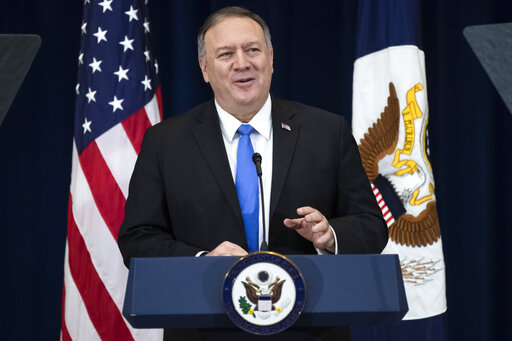
Secretary of State Mike Pompeo (AP Photo/Matt Rourke)

The Trump administration claimed Iranian general Qasem Soleimani was planning “imminent attacks” on US interests when it assassinated him. That lie was just destroyed, but not before countless corporate media outlets transmitted it to the public.

By Max Blumenthal

Source: The Grayzone

Desperate to justify the US drone assassination of Iranian Major General Qasem Soleimani, Secretary of State Mike Pompeo insisted that Washington had made an “intelligence-based assessment” that Soleimani was “actively planning in the region” to attack American interests before he was killed.

President Donald Trump justified his fateful decision to kill the Iranian general in even more explicit language, declaring that Soleimani was planning “imminent attacks” on US diplomatic facilities and personnel across the Middle East.

“We took action last night to stop a war,” Trump claimed. “We did not take action to start a war.”

Trump’s dubious rationale for an indisputably criminal assassination has been repeated widely across corporate media networks, and often without any skepticism or debate.

At a January 3 State Department briefing, where reporters finally got the chance to demand evidence for the claim of an “imminent” threat, one US official erupted in anger.

“Jesus, do we have to explain why we do these things?” he barked at the press.

Two days later, when Iraqi Prime Minister Adil Abdul-Mahdi addressed his country’s parliament, Trump’s justification for killing Soleimani was exposed as a cynical lie.

According to Abdul-Mahdi, he had planned to meet Soleimani on the morning the general was killed to discuss a diplomatic rapproachment that Iraq was brokering between Iran and Saudi Arabia.

Abdul-Mahdi said that Trump personally thanked him for the efforts, even as he was planning the hit on Soleimani – thus creating the impression that the Iranian general was safe to travel to Baghdad.

Soleimani had arrived in Baghdad not to plan attacks on American targets, but to coordinate de-escalation with Saudi Arabia. Indeed, he was killed while on an actual peace mission that could have created political distance between the Gulf monarchy and members of the US-led anti-Iran axis like Israel.

The catastrophic results of Soleimani’s killing recall the Obama administration’s 2016 assassination of Mullah Akhtar Muhammad Mansur, a Taliban leader who was eager to negotiate a peaceful end to the US occupation of Afghanistan. Mansur’s death wound up empowering hardline figures in the Taliban who favored a total military victory over the US and triggered an uptick in violence across the country, dooming hopes for a negotiated exit.

Since Soleimani’s assassination, Iraq’s parliament has voted to expel all US troops from the country and Iran’s Grand Ayatollah Ali Khamenei has sworn to exact a “severe revenge” on the “the criminals who have stained their hands with [Soleimani’s] and the other martyrs’ blood…”

Trump, for his part, tweeted a litany of gangster-like threats, promising to destroy Iranian cultural sites if it retaliated and pledging to sanction Iraq “like they’ve never been before” if it ousted US troops.

Trump’s treacherous assassination has brought the US closer to war than ever before against a country more militarily potent than any adversary it has faced since the Korean War. And as with the failed US invasion of Iraq, Washington’s casus belli for triggering this conflict was based on falsified intelligence sold to Americans by administration officials, and on a pliant Beltway media acting as their megaphone.

With its claim of “imminent attacks,” the Trump administration has essentially re-mixed Condoleeza Rice’s 2003 warning that “we don’t want the smoking gun to be a mushroom cloud.” Back then, the US attacked a sovereign state to rid it of WMD that did not exist. This time, it killed the second-most important Iranian official to prevent a killing spree that was not on the way. And Trump administration officials knew they were lying.

In fact, Pompeo pitched assassinating Soleimani to Trump several months ago, well before any attacks were “imminent.” And in the wake of the general’s killing, a US official revealed to the New York Times that the NSA had intercepted “communications the United States had between Iran’s supreme leader, Ayatollah Ali Khamenei, and General Suleimani showing that the ayatollah had not yet approved any plans by the general for an attack.”

But the preponderance of evidence exposing Trump’s basis for killing Soleimani as a titanic lie has not generated the same level of media interest as the lie itself.

On January 3, CNN assigned three reporters to disseminate the Trump administration’s disinformation about Soleimani, claiming without a hint of critical detachment that he was “planning specific attacks on US interests, including US personnel.”

After the story went live, CNN’s lead reporter, Jim Sciutto, reached out to another official US source to “confirm” his now-discredited piece of war propaganda. In Sciutto’s mind, if more than one US official says a thing, it must be true.

Sciutto is not just any run-of-the-mill national security reporter. During the Obama era, he accepted a job as chief of staff at the US Embassy in Beijing, placing himself at the center of Washington’s gathering Cold War with China. Now back behind CNN’s anchor desk, Sciutto poses as a ferocious critic of Trump while providing the Pentagon and State Department with reliable stenographic services.

No president in recent history has been despised more viscerally by the Beltway press corps than Trump. Nearly everything he says is met with disdain and suspicion, even when he is telling the truth.

But when Trump and his administration attempt to lie the public into war against a designated evildoer, a swath of the corporate media responds with reflexive trust, then shrugs when the lie is exposed in broad daylight.