FRIDAY THE THIRTEENTH IN PARIS AND THE UGLY TRUTH OF STATE TERROR

ISIS-and-the-false-flag-frame-up

By John Chuckman

Source: RINF

Mass murder, as that which just occurred in Paris, is always distressing, but that does not mean we should stop thinking.

Isn’t it rather remarkable that President Hollande, immediately after the event, declared ISIS responsible? How did he know that? And if he was aware of a serious threat from ISIS, why did he not take serious measures in advance?

Within days of Friday 13, French forces assaulted an apartment with literally thousands of bullets being fired, killing a so-called mastermind, Abdelhamid Abaaoud. Just how are you instantly elevated to the rank of “mastermind”? And if security people were previously aware of his exalted status, why did they wait until after a disaster to go after him?

Well, the ugly underlying truth is that, willy-nilly, France for years has been a supporter of ISIS, even while claiming to be fighting it. How do I know that? Because France’s foreign policy has virtually no independence from America’s. It could be described as a subset of American foreign policy. Hollande marches around with his head held stiffly up after getting off the phone at the Élysée Palace, having received the day’s expectations from Washington. He has been a rather pathetic figure.

So long as it is doing work the United States wishes done, ISIS remains an American protectorate, and regardless of Hollande’s past rhetoric, he has acted according to that reality. But something may just have changed now.

It is important to note the disproportionate attention in the West to events in Paris. I say disproportionate because there are equally ugly things going on in a number of places in the Middle East, but we do not see the coverage given to Paris. We have bombs in Lebanon and Iraq. We have daily bombings and shootings in Syria. We have cluster bombs and other horrors being used by Saudi Arabia in Yemen. And of course, there are the ongoing horrors of Israel against Palestinians.

We have endless interviews with ordinary people in Paris, people who know nothing factual to help our understanding, about their reaction to the terror, but when was the last time you saw personal reactions broadcast from Gaza City or Damascus? It just does not happen, and it does raise the suspicion that the press’s concern with Paris is deliberately out of proportion. After all, Israel killed about twenty times as many people in Gaza not very long ago, and the toll was heavily weighted with children, many hundreds of them. Events in Paris clearly are being exploited for highly emotional leverage.

Leverage against what? Arabs in general and Muslims in particular, just part of the continuing saga of deliberately-channeled hate we have experienced since a group of what proved (after their arrest) to be Israeli spies were reported on top of a truck, snapping pictures and high-fiving each other as the planes hit the World Trade Center in 2001. What those spies were doing has never been explained to the public. I’m not saying Israel is responsible for 9/11, but clearly some Israeli government interests were extremely happy about events, and we have been bombarded ever since with hate propaganda about Muslims, serving as a kind of constant noise covering the crimes Israel does commit against Palestinians and other neighbors.

It is impossible to know whether the attack in Paris was actually the work of ISIS or a covert operation by the secret service of an ISIS supporter. The point is a bit like arguing over angels on a pinhead. When you are dealing with this kind of warfare – thugs and lunatics of every description lured into service and given deadly toys and lots of encouragement to use them – things can and do go wrong. But even when nothing goes wrong in the eyes of sponsors for an outfit like ISIS, terrible things are still happening. It’s just that they’re happening where the sponsors want them to happen and in places from which our press carefully excludes itself. Terrible things, for example, have been happening in the beautiful land of Syria for four or five years, violence equivalent to about two hundred Paris attacks, causing immense damage, the entire point of which is to topple a popularly-supported president and turn Syria into the kind of rump states we see now in Iraq.

A covert operation in the name of ISIS is at least as likely as an attack by ISIS. The United States, Israel, Turkey, and France are none of them strangers to violent covert activities, and, yes, there have been instances before when a country’s own citizens were murdered by its secret services to achieve a goal. The CIA pushed Italian secret services into undertaking a series of murderous attacks on their own people during the 1960s in order to shake up Italy’s “threatening” left-wing politics. It was part of something called Operation Gladio. Operation Northwoods, in the early 1960s, was a CIA-planned series of terrorist acts on American civilians to be blamed on Cuba, providing an excuse for another invasion. It was not carried out, but that was not owing to any qualms in the CIA about murdering their own, otherwise no plan would have ever existed. The CIA was involved in many other operations inside the United States, from experiments with drugs to ones with disease, using innocent people as its subject-victims.

There have been no differences worth mentioning between Hollande’s France and America concerning the Middle East. Whatever America wants, America gets, unlike the days when Jacques Chirac opposed the invasion of Iraq, or earlier, when de Gaulle removed France’s armed forces from integration within NATO or bravely faced immense hostility, including a coup attempt undertaken by French military with CIA cooperation, when he abandoned colonialism in Algeria.

If anything, Hollande has been as cloyingly obsequious towards America’s chief interest in the Middle East, Israel, as a group of Republican Party hopefuls at a Texas barbecue fund-raiser sniffing out campaign contributions. After the Charlie Hebdo attack, Hollande honored four Jewish victims of the thugs who attacked a neighborhood grocery store with France’s highest honor, the Legion of Honor. I don’t recall the mere fact of being murdered by thugs ever before being regarded as a heroic distinction. After all, in the United States more than twenty thousand a year suffer that fate without recognition.

Israel’s Netanyahu at the time of the Charlie Hebdo attack actually outdid himself in manic behavior. He barged into France against a specific request that he stay home and pushed himself, uninvited, to the front row of the big parade down the Champs-Élysées which was supposed to honor free speech. He wanted those cameras to be on him for voters back home watching.

Free speech, you might ask, from the leaders of Egypt, Turkey, the UAE, and Israel, who all marched in front?  Well, after the free-speech parody parade, the Madman of Tel Aviv raced around someone else’s country making calls and speeches for Jewish Frenchmen to leave “dangerous” France and migrate “home” to Israel. It would in fact be illegal in Israel for someone to speak that way in Israel to Israelis, but illegality has never bothered Netanyahu. Was he in any way corrected for this world-class asinine behavior? No, Hollande just kept marching around with his head stiffly up. I guess he was trying to prove just how free “free speech” is in France.

But speech really isn’t all that free in France, and the marching about free speech was a fraud. Not only is Charlie Hebdo, the publication in whose honor all the tramping around was done, not an outlet for free speech, being highly selective in choosing targets for its obscene attacks, but many of the people marching at the head of the parade were hardly representatives of the general principle.

France itself has outlawed many kinds of free speech. Speech and peaceful demonstrations which advocate a boycott of Israel are illegal in France. So a French citizen today cannot advocate peacefully against a repressive state which regularly abuses, arrests, and kills some of the millions it holds in a form of bondage. And Hollande’s France enforces this repressive law with at least as much vigor as Israel does with its own version, in a kind of “Look, me too,” spirit. France also has a law which is the exactly the equivalent of a law against anyone’s saying the earth is flat: a law against denying or questioning the Holocaust. France also is a country, quite disgracefully, which has banned the niqab.

Now, America’s policy in the Mideast is pretty straightforward: subsidize and protect its colony Israel and never criticize it even on the many occasions when it has committed genuine atrocities.  American campaign finance laws being what they, politics back home simply permits no other policy. The invasion of Iraq, which largely was intended to benefit Israel through the elimination of a major and implacable opponent, has like so many dark operations backfired. I call the invasion a dark operation because although the war was as public as could be, all of America’s, and Britain’s, supposed intelligence about Iraq was crudely manufactured and the reasons for undertaking an act which would kill a million people and cripple an entire country were complete lies.

America’s stupid invasion created new room for Iran to exert its influence in the region – hence, the endless noise in Israel and Saudi Arabia about Iran – and it led directly to the growth of armed rabble groups like ISIS. There were no terrorists of any description in Saddam’s Iraq, just as there were no terrorists in Gadhafi’s Libya, a place now so infested with them that even an American ambassador is not safe.

Some Americans assert that ISIS happened almost accidentally, popping out of the dessert when no one was looking, a bit like Athena from the head of Zeus, arising from the bitterness and discontents of a splintered society, but that view is fatuous. Nothing, absolutely nothing, happens by accident in this part of the world. Israel’s spies keep informed of every shadowy movement, and America always listens closely to what they say.

It is silly to believe ISIS just crept up on America, suddenly a huge and powerful force, because ISIS was easy for any military to stop at its early stages, as when it was a couple of thousand men waving AK-47s from the backs of Japanese pick-up trucks tearing around Iraq. Those pick-up trucks and those AK-47s and the gasoline and the ammunition and the food and the pay required for a bunch of goons came from somewhere, and it wasn’t from Allah.

A corollary to America’s first principle about protecting Israel is that nothing, absolutely nothing, happens in Israel’s neighborhood that is not approved, at least tacitly, by the United States. So whether, in any given instance of supply and support for ISIS, it was Israel or Saudi Arabia or Turkey or America – all involved in this ugly business – is almost immaterial. It all had to happen with American approval. Quite simply, there would be hell to pay otherwise.

As usual in the region, Saudi Arabia’s role was to supply money, buying weapons from America and others and transshipping them to ISIS. Ever since 9/11, Saudi Arabia has been an almost pathetically loyal supporter of America, even to the extent now of often cooperating with Israel. That couldn’t happen before an event in which the majority of perpetrators proved to be Saudi citizens and which led to the discovery that large amounts of Saudi “go away” money had been paid to Osama bin Laden for years. But after 9/11, the Saudis feared for the continuation of their regime and now do what they are told.  They are assisted in performing the banking function by Qatar, another wealthy, absolute state aligned with the United States and opposing the rise of any possibly threatening new forces in its region.

Of course, it wasn’t just the discoveries of 9/11 that motivated Saudi Arabia. It intensely dislikes the growing influence of Iran, and Iran’s Shia Muslim identity is regarded by Sunni sects in Saudi Arabia in much the way 17th century Protestantism was viewed by an ultramontane Catholic state like Spain. The mass of genuine jihadists fighting in Syria – those who are not just mercenaries and adventurers or agents of Israel or Turkey or the Saudis – are mentally-unbalanced Sunni who believe they are fighting godlessness. The fact that Assad keeps a secular state with religious freedom for all just adds to their motivation.

ISIS first achievement was toppling an Iraqi government which had been excessively friendly to Iran in the view of Israel, and thereby the United States. Iraq’s army could have stopped them easily early on but was bribed to run away, leaving weapons such as tanks behind. Just two heavy tanks could have crushed all the loons in pick-up trucks. That’s why there was all the grotesque propaganda about beheadings and extreme cruelty to cover the fact of modern soldiers running from a mob. ISIS gathered weapons, territory, and a fierce reputation in an operation which saw President al-Maliki – a man disliked by the United States for his associations with Iran and his criticism of American atrocities – hurriedly leave office.

From that base, ISIS was able to gain sufficient foothold to begin financing itself through, for example, stolen crude sold at a discount or stolen antiquities. The effective splitting up of Iraq meant that its Kurdish population in the north could sell, as it does today, large volumes of oil to Israel, an unheard of arrangement in Iraq’s past. ISIS then crossed into Syria in some force to go after Assad. The reasons for this attack were several: Assad runs a secular state and defends religious minorities but mainly because the paymasters of ISIS wanted Assad destroyed and Syria reduced in the fashion of Iraq.

Few people in the press seem to have noted that ISIS never attacks Israel or Israeli interests. Neither does it attack the wheezingly-corrupt rulers of Saudi Arabia, the Islamic equivalent of ancient Rome’s Emperor Nero. Yet those are the very targets a group of genuine, independent warrior-fundamentalists would attack. But ISIS is not genuine, being supplied and bankrolled by people who do not want to see attacks on Israel or Saudi Arabia, including, notably, Israel and Saudi Arabia. ISIS also is assisted, and in some cases led, by foreign covert operators and special forces.

There does seem to be a good deal of news around the idea of France becoming serious in fighting ISIS, but I think we must be cautious about accepting it at face value. Putin is reported as telling ship commanders in the Mediterranean to cooperate and help cover the French aircraft carrier approaching. Hollande keeps calling for American cooperation too, as Putin has done for a very long time, but America’s position remains deliberately ambiguous. A new American announcement of cooperation with Turkey in creating a “safe zone” across the border with northern Syria is a development with unclear intentions. Is this to stop the Kurds Erdogan so despises fighting in the north of Syria from establishing themselves and controlling the border or is it a method for continued support of ISIS along the that border? Only time will tell.

I do think it at least possible Hollande may have come around to Putin’s view of ISIS, but America has not, and the situation only grows more fraught with dangerous possibilities. I’ve long believed that likely America, in its typically cynical fashion, planned to destroy ISIS, along with others like al-Nusra, once they had finished the dirty work of destroying Syria’s government and Balkanizing the country. In any event, Israel – and therefore, automatically, America – wants Assad destroyed, so it would be surprising to see America at this point join honestly with Putin and Hollande.

America has until now refused Russia any real support, including such basic stuff as sharing intelligence. It cooperates only in the most essential matters such avoiding attacks on each other’s planes. It also has made some very belligerent statements about what Russia has been doing, some from the America’s Secretary of Defense sounding a lot like threats. Just the American establishment’s bully-boy attitude about doing anything which resembles joining a Russian initiative does not bode well.

After all, Putin has been portrayed as a kind of Slavic Satan by American propaganda cranking stuff out overtime in support of Ukraine’s incompetent coup-government and with the aim of terrifying Eastern Europe into accepting more American weapons and troops near Russia’s border, this last having nothing to do with any Russian threat and everything to do with America’s aggressive desire to shift the balance of power. How do you turn on a dime and admit Putin is right about Syria and follow his lead?

And there are still the daily unpleasant telephone calls from Israel about Assad. How do you manoeuvre around that when most independent observers today recognize Assad as the best alternative to any other possible government. He has the army’s trust, and in the end it is the Syrian army which is going to destroy ISIS and the other psychopaths. Air strikes alone can never do that. The same great difficulty for Hollande leaves much ambiguity around what he truly means by “going to war against ISIS.”

It is an extremely complicated world in which we live with great powers putting vast resources towards destroying the lives of others, almost killing thousands on a whim, while pretending not to be doing so. We live in an era shaped by former CIA Director Allen Dulles, a quiet psychopath who never saw an opportunity for chaos he did not embrace.

The only way to end terror is to stop playing with the lives of tens of millions in the Middle East, as America has done for so long, and stop supporting the behaviors of a repressive state which has killed far greater numbers than the madmen of ISIS could dream of doing, demanding instead that that state make peace and live within its borders. But, at least at this stage, that is all the stuff of dreams.

Follow the Money: From Paris to ISIS to Paris

By James Corbett

Source: The Corbett Report

Let us for one moment accept the whole Paris attacks narrative hook, line and sinker.

That the French government could not possibly have foreseen an attack.

That a multi-site emergency exercise planned for the same day just happened to be simulating an armed group committing attacks around the city just hours before that very scenario unfolded.

That the “mastermind” of the attacks just happens to be the latest in a string of terrorist boogeymen who manage to escape capture time and time again.

OK, fine. The question that the French people should STILL be asking themselves, even if they believe all of that, is this: How does the Islamic State, a ragtag band of jihadis who are supposedly at war with the combined military might of the US, Turkey, the Saudis, the Russians, the Iraqis, the Iranians and many others (including, of course, the Syrians) manage to fund and coordinate spectacular international terror attacks, including not only the Paris attack, but also (apparently) bombings in Turkey and Lebanon, and the take down of Russian airliners? How is it that governments can flag and track the “suspicious” financial transactions of anyone withdrawing or transferring over $10,000 from their own bank account, but can’t seem to find a way to restrict cash flows, arms and munitions to a geographically isolated enemy who are dependent on oil sales for their financial survival?

Good question. Just don’t ask the US State Department spokesman those questions, because he doesn’t have the answers. When asked earlier this week by RT’s Gayane Chichakyan “whether the US has sanctioned any banks suspected of carrying out transactions for ISIL,” department spokesman Mark Toner responded with a resounding: “I’d have to look into that. I don’t have the answer in front of me.”

Apparently the question of how ISIS is financing its operations is of so little interest to the State Department that they haven’t bothered to look into it. So in the interest of helping them out with their homework, let’s connect a few dots, shall we?

Earlier this year it was revealed that French President François Hollande had authorized illegal shipments of arms to the Syrian terrorists in 2012. The deliveries–including cannons, machine guns, rocket launchers and anti-tank missiles–were in direct contravention of an EU embargo that was in place at the time.

In late 2012 it was revealed that one of the most prominent backers of the Syrian terrorists was the French government, who in addition to their illegal arms shipments were also delivering money directly to the terrorist opposition leaders.

Last year the French arms export industry enjoyed its best sales in 15 years, with revenues up 18%. The reason for the Merchant of Death bonanza? A spike in sales to Saudi Arabia and Qatar, two of the main funders and supporters of ISIS.

Of course, not all of the blame for the fostering, funding, arming, equipping and training of ISIS belongs to France. Much of it belongs to the United States, its Gulf allies, Turkey and Israel, as well as assorted other NATO members. But there is a line to be drawn from the arms and funds that France supplied to the “moderate” terrorists in Syria and the seeming international operational abilities of this seemingly unstoppable terrorist boogeyman group.

France is a nation in mourning. But perhaps the French people can reserve at least some of their outrage for the government which has used their own tax money to fund, supply and support the terrorists they are now at war with.


Related Video:

Syrian Passports Planted by Police At Scene of Paris Terror Attack Are Confirmed Fakes

265

By M. David

Source: CounterCurrentNews.com

In the aftermath of the French terrorist attacks last Friday, many people were shocked to hear claims from law enforcement that Syrian passports had been found near the bodies of two of the suspected Paris attackers. The thought that terrorists could be blown up, and yet have their passports survive seemed implausible, at the very least.

Now we know that those passports were in fact complete fakes according to the Wall Street Journal.

Those fakes were almost certainly made in Turkey, according to what police sources told Channel 4 News on Sunday.

Middle East Eye reports that “Greek officials said on Saturday that one of the two passports was held by someone who had registered as a refugee on the Greek island of Leros on 3 October.”

They added that “Officials denied, though, that a second attacker had taken a similar route, telling the Guardian there was “no indication whatsoever” that the assailant had enteredEurope through Greece.”

Meanwhile, law enforcement agencies across Europe have continued their investigation into the seven attackers, trying to figure out how they coordinated the series of attacks without supposedly attracting any attention from the intelligence community.

French and German Intelligence Services, however, did in fact know that the Paris attack was coming, over a month ago and yet they still apparently did nothing.

Police named one of the attackers as Omar Ismail Mostefai, a 29-year-old French citizen who was born and raised in Paris. In spite of claims by police that some of the attackers were there on Syrian passports, that was not the case.

Who put the fake Syrian passport at the scene of the crime?

Middle East Eye notes that “fake Syrian passports have become a valuable commodity in recent months and are freely traded on the black market, as they can help ease the path for non-Syrians to get protection as refugees in Europe.”

They add that “a Dutch journalist reported in September that he had bought a fake Syrian passport and ID card, both bearing the picture of the Dutch prime minister, for $825.”

But there would have been no need for French citizens to utilize such fake passports.

What does that tell us? The logical answer is that the passports were planted.

But who would plant them? Clearly, it would be foolish to imagine that one of the victims or bystanders just happened to have a fake Syrian passport, and they decided to plant it at the scene of the attacks.

Not only does it not make any sense that the passports would have survived explosions, but it makes even less sense that the passports would have been on the attackers at the time of the attacks.

Finally, it makes the least sense that French citizens would have fake Syrian passports, and would bring them to the attacks, only for police investigators to conveniently “find” them at the scene of the crime.

This really only leaves us with one logical possibility: that the fake Syrian passports were planted by law enforcement. The motivation is obvious: to bolster the government’s position that a military invasion of Syria is both necessary and a direct response to attacks from Syrian nationals.

France has moved to attack Syria in spite of the fact that these passports have now been confirmed fakes, with no logical connection to the terrorists they were found by. If law enforcement didn’t plant them near the bodies, then who did?


Related Video:

Militarization of the Police: A Reflection of United States Foreign Policy

By Abayomi Azikiwe

Source: Global Research

Over the last 14 months the notion of the United States as a bastion of human rights and democracy has been further shattered.

With the police killing of 18-year-old Michael Brown in Ferguson, Missouri, it set off not only a rebellion in this St. Louis County suburb but nationwide demonstrations across the country. The rebellion in Ferguson forced the Obama administration to pay some symbolic attention to the plight of African American people who have been largely ignored as it relates to domestic policy over the last several decades.

In fact when it comes to Civil Rights and Human Rights, there has only been regressive legislation and “benign neglect” since the late 1960s. Realizing the complexity of the crisis facing the African American people, other people of color communities and working people in general, the system would rather ignore the problems rather pay any attention to them.

Nonetheless, Ferguson proved to be a turning point in U.S. history. Periodicals published in states that are aligned with Washington issued editorial questioning the domestic and foreign policy posture of the administration of President Barack Obama.

Even though the Justice Department was sent into to St. Louis County to investigate the circumstances surrounding the killing of Michael Brown, no federal charges were ever filed against Darren Wilson or anyone else within the law-enforcement, judicial and municipal systems in the area. The lack of critical response by the Obama administration compounded the discontent after the local authorities decided that there was no probable cause for charges to be brought against Wilson and others in Ferguson.

The report issued by the Justice Department Civil Rights Division did demonstrate clearly that collusion was rampant within these various departments in St. Louis County. Electronic communications were retrieved which illustrated that the African American community was being grossly exploited through traffic stops, citations, questionable arrests and prosecutions.

Many of the suburban municipalities within St. Louis County are economically unviable and consequently utilized racial profiling and targeting as a means of generating revenue. The New York Times reported several weeks after the rebellion and mass demonstrations began in Ferguson that over 12,000 outstanding warrants existed in the small city of barely over 20,000 residents. This came out to approximately two warrants per household in Ferguson.

Residents with outstanding warrants were subjected to immediate arrests and even higher fines or possible jail terms. Such legal problems hampered people’s abilities to find and retain employment as well as maintain a stable family life.

What appears to have happened in regard to the situation in Ferguson and St. Louis County is there was an apparent agreement that Wilson and other officials would resign their positions in exchange for not being pursued further by the federal government. It was also announced that some form of amnesty would be granted for residents facing high fines and jail time after being systematically targeted by the police throughout the County.

Such a compromise does not approach the resolution of the deeper problems of national oppression and racism so prevalent within law-enforcement culture. High rates of unemployment and poverty are by-products of national oppression and class exploitation which the American system is built upon.

Militarization Unveiled in Ferguson

Rather than examine the causes behind the explosion in Ferguson, the response of the political superstructure and the law-enforcement agencies was to put down the rebellion with a vengeance. Police came on the scene with armored vehicles, batons, rubber bullets, tear gas, pepper spray, long range acoustic devices (LRAD) and other forms of highly-sophisticated and deadly weaponry.

Numerous law-enforcement departments were deployed in Ferguson along with the National Guard. Missouri Governor Jay Nixon declared a “state of emergency” while law-enforcement implemented a “no-fly zone” over the region.

The youth and workers who took to the streets both violently and non-violently were immediately criminalized. Journalists seeking to cover the story were attacked and arrested.

Corporate media pundits took to the airwaves over cable television networks to put their own spin on developments surrounding the mass demonstrations and rebellions. Those who fought back against the police and destroyed private property were labeled as criminals and thugs. These characterizations provided a rationale for the use of deadly force and the denial of basic democratic rights of due process.

Governor Nixon and local authorities blamed the unrest on “outside agitators” seeking to deflect attention away from the exploitative and repressive conditions so widespread in St. Louis County. President Obama and former U.S. Attorney General Eric Holder sought to define the forms of dissent that were acceptable those that were not.

Moreover, the question becomes: where did these weapons, tanks, noxious gases and sound devices come from? These are the same weapons that have been used against the people of Afghanistan, Iraq, Libya, Syria, Palestine, Lebanon, Yemen and other geo-political regions over the last several decades.

The federal government through the Pentagon supplies these armaments through grants to local law-enforcement agencies. Are these the best tools to fight street crime? Or are these weapons supplied to fight existing unrest and more violent rebellions and revolts that are bound to come in the future?

We Can’t Breathe: Eric Garner and the Impunity of the State

In Staten Island New York the police killing of Eric Garner provided additional lessons in our understanding of the current character of state repression. Garner’s encounter with the police was caught on a cellphone video and transmitted worldwide. His last words gasping “I Can’t Breathe” became a rallying cry for those who went into the streets by the tens of thousands in New York and across the country.

Apparently recording of this crime did not matter to the grand jury that acquitted the only police officer investigated in the killing. The billions around the world who saw the video knew that there were many officers who were involved in Garner’s death by holding him down, applying pressure to his vital areas and refusing to provide any medical attention while he lay dying.

The youth who videoed the killing was himself targeted for prosecution and jailed. Once again the Justice Department did not take any action against the cops or the grand jury which allowed the police and emergency medical technicians to walk free.

In response to the grand jury decision, tens of thousands of people went out in protest in Manhattan and other areas of New York City. They blocked streets, expressways, businesses and bridges. The city had not seen such an outpouring of spontaneous demonstrations in many years.

New York City has been notorious for its “stop and frisk” and “broken windows” theory of policing. This style of law-enforcement conduct rides the waves of gentrification and forced removals of African Americans, Latinos and working class people in general throughout the municipality.

Obviously there is a concerted effort to drive millions of oppressed, working class and poor people out of the cities throughout the U.S. In New York, despite claims by officials that crime has been reduced by 80 percent, the plight of marginalized working class has worsened.

The homeless problem in New York is worse than it has ever been in the city’s history. A recent front-page article in the Sunday New York Times published on August 29 exposed the plight of those living in homeless shelters.

Those are the ones who are inside although living with bed bugs and other vermin in over-crowded buildings. Others are unfortunately sleeping on the streets in subways, storefronts, in Times Square and other areas.

Nonetheless, the liberal administration of De Blassio has no program for providing decent housing to those who need it. Wall Street with all of its propaganda about an economic recovery ignores the conditions of the most vulnerable and miserable.

Baltimore: A Flashpoint for Repression and Impoverishment

Just earlier this year in late April young Freddie Grey was killed by the Baltimore Police Department. This was by no means an isolated incident since the city has a long tradition of systematic racism in housing and police-community relations.

However, after the killing of Grey who died in police custody, the community rose up in rebellion. Immediately the Governor declared yet another “state of emergency” moving into Baltimore personally and effectively taking control of the city from its African American woman Mayor Stephanie Rawlings-Blake.

What was interesting about the rebellion in Baltimore was the more developed counter-insurgency strategy and tactics implemented. Thousands of police officers from various agencies were deployed from across the state as was the case in Ferguson, along with thousands more National Guard troops.

Nonetheless, the authorities utilized a cadre of so-called “community groups” including churches, gang members, elected officials, and other operatives to come into the unrest areas encouraging youth and workers to leave the streets and go home. They were told by these “community activists” to abide by an unjust curfew and to work with the cops and the National Guard.

Tactically they were also covered by the corporate and government-controlled media to present another face of the community to the public. After the first three days of demonstrations and unrest, the media portrayed the community as being hostile to law-enforcement and private property. Suddenly by the time the National Guard and Governor had entered the city, the people who were presented to the press were residents opposed to the unrest and working towards “restoring order”, or we should say restoring the existing order.

Hundreds of these “community activists” stood between the crowds and the police with their backs to the law-enforcement agents and their faces towards the people. This was quite a symbolic effort to turn a section of the city against those who were fed up with the repression and exploitation.

Baltimore, like Detroit, has been hit over the last decade by massive home foreclosures and neighborhood blight. Hundreds of thousands have been forced out of their neighborhoods in East and West Baltimore to make room for the “developers and investors.” The banks were at the root cause of this displacement.

Also in Baltimore, it was announced during the spring that 25,000 households would be subjected to water shut-offs as what has been happening here since the imposition of emergency management and bankruptcy in 2013-2014. Although the emergency managers are being ostensibly withdrawn in Michigan, those who are the purported “elected officials” are carrying out the same draconian program of forced removals and benign neglect of the masses.

The lessons of Baltimore, Ferguson, New York and here in Detroit is that the workers and oppressed must be organized independently of the established two-party system. There must be a link drawn between law-enforcement repression, economic deprivation, gentrification and the denial of public services. The militarization of the police is designed to reinforce the system of oppression. All of these variables must be taken into consideration in any program of resistance and fightback against the structures of exploitation and political repression.

Militarization: From the 1960s to 2015

The militarization of U.S. society is as old as the American system itself. However, for the purpose of this discussion tonight we must look to events of the 1960s when cities exploded from Watts to Detroit during the period of 1965-1968.

Detroit proved to be a turning point in the militarization of the U.S. police when thousands of National Guard and federal troops were deployed to put down the rebellion in July 1967. The National Advisory Commission on Civil Disorder found in its report that the police played an integral part in sparking urban rebellions.

Rather than heed to a program of reform, the society became more militarized and repressive. Under the presidential administration of Lyndon B. Johnson an Office of Law Enforcement Assistance was created.

According to a website entitled “What-When-How”, it says that “In 1965, the Office of Law Enforcement Assistance was created in the U.S. Department of Justice. This was the predecessor to the Law Enforcement Assistance Administration (LEAA), which was established as a result of the work of the President’s Commission on Law Enforcement and Administration of Justice.”

By 1968, as a result of a Congressional Commission on crime in the streets, the Law-Enforcement Assistance Administration (LEAA) was created continuing to the early 1980s. This same above-mentioned website notes that to ostensibly achieve the aims of reducing crime in the cities:

“To achieve this objective, the notion of criminal justice planning was introduced to the country. Heretofore, planning in criminal justice was virtually nonexistent. With the passage of the Omnibus Crime Control and Safe Streets Act (1968), LEAA was authorized to provide funds to create a ‘state planning agency’ in each state that would have as its primary function the responsibility to develop a comprehensive statewide plan for the improvement of law enforcement throughout the state. The act also authorized the states to make grants from a population-based block grant allocation to units of local government to carry out programs and projects in accordance with the planning effort to improve law enforcement.”

By the early 1980s the further criminalization of African American and other oppressed communities was well underway. We have witness the growth in the prison-industrial-complex with a rise in the incarcerated population by 500 percent over the last three decades. The “school to prison pipeline” is a reality for the majority of the African American people.

A recent article in Atlantic magazine looks at this phenomena through the experiences of former inmates and the families whose loved ones have been incarcerated. With no real jobs program on a federal level and the rising rates of poverty and marginalization, this problem will not be solved short of drastic and sweeping policy initiatives that are well beyond anything that is being advocated by the White House, Congress and the corporate community.

Therefore, the struggle for justice in the U.S. is up to the people themselves. The organized masses working in solidarity with the oppressed and working people around the globe are the remedies to seriously address these concerns.

This is the charge of the labor movement and the international solidarity struggle. We are part of both and will work with any and every one to achieve total freedom.

Abayomi Azikiwe is the editor of Pan-African News Wire.

Note: This address was delivered on October 7, 2015 before the UAW Local 140 School of the Americas Watch (SOAW) Labor Caucus mobilization and recruitment meeting held at the union hall in Warren, Michigan right outside of Detroit.

The meeting entitled “Resisting Oppression: Reflecting on Our Communities a Global and Local Perspective,” also featured Maria Luisa Rosal, Field Organizer for SOA Watch, who presented a historical review of the SOA in Latin America. Jerry and Laronda King of the Civil and Human Rights Committee co-chaired the meeting. Azikiwe began his talk with expressions of solidarity with the UAW members at Fiat Chrysler who were just hours away from a possible strike that would have shut down auto production. Another tentative deal was reached prior to the Midnight deadline at least temporarily averting a strike. This tentative deal like the first one will have to be voted on by the rank and file workers.

Oil and Money – Lessons Learned

petrodollar-systemThis is a concluding post for an excellent 7 part long-form series featured on the Hipcrime Vocab blog. While this serves as an adequate synopsis of what was covered, I highly recommend the series for it’s depth and scope starting with the introduction.

Source: Hipcrime Vocab

The first thing I learned is that I bit off more than I could chew, lol. I was intending a simple book review, and it turned into a lot more than I intended to write. I also learned how difficult and thankless a task blogging can be. I’m glad at least a few of you chimed in to let me know you enjoyed it.

One major thing I learned (which I already sort-of knew) is how much real resources have to do with the economy, and economic history, despite economists’ insistence that land, labor and capital are all that matter. In fact, real resources appear to be the MAJOR driver of our economic fortunes. Even Forbes magazine had to admit: The Recessions of 1973,1980,1991,2001,2008 Were Caused By High Oil Prices. Energy doesn’t matter, huh?

I was really taken aback at how recent this all is. I was somewhat aware the historic problem with oil was that there was too much of the stuff.  Eric Roston, in The Carbon Age, writes, “Gasoline was a throwaway by product of kerosene refining until the early 1900s, used sometimes in solvents or as fuel for stoves. In 1892, two cents a gallon was a decent price. For another thirty years, apothecaries were the makeshift filling stations.”

But I had no idea just how much of a glut there was and how people thought it would last forever. That it was so cheap we needed the Texas Railroad Commission to hold back production so that the prices would be high enough. I mean, this substance contains the equivalent of ten to eleven years of human labor (1750 Kilowatt hours of human labor), for crying out loud! And it is a non-renewable resource! I was amazed at how far we went in coming up with new uses for the stuff, to the point destroying perfectly good and workable infrastructure just so we could use more of it. Can anything be more insane?

The long boom was driven by the exploitation of oil as a resource. This led to the dominance of the ICE (Internal Combustion Engine). All of the knock-on effects of the ICE were behind the post-war boom. I mean, you could write a book about all the economic development caused by cars and trucks. In fact, truck driver/delivery is still the most common job in most states to this day! The ability to deliver goods cheaply anywhere had so many knock-on effects, from the creation of whole new cities to the rise of big-box retailers. Let’s not forget that everything in that big-box retailer is made from plastic which is made from petroleum feedstocks. Kunstler calls the suburbs the greatest misallocation of resources in human history. It’s easy to see how that’s true.

I didn’t know that it was only as late as 1959 that petroleum overtook coal to be more than 50 percent of our energy use. I didn’t know that coal only became the world’s predominant energy source after 1900. Before that, we were still essentially in a wood/biofuel economy. As I wrote before, that’s pretty recent – less than three generations.

 We think of the 19th century as the era of coal, but as the distinguished Canadian energy economist Vaclav Smil has pointed out, coal only reached 5% of world energy supply in 1840, and it didn’t get to 50% until about 1900.

The modern oil industry began in 1859, but it took more than a century for oil to eclipse coal as the world’s No. 1 source. “The most important historical lesson,” Dr. Smil says, is that “energy resources require extended periods of development.”

The Power Revolutions (WSJ)

Peak oil ideas made it sound like oil (specifically petroleum) was the only resource that matters to the economy, so that once oil production stops growing, the economy will collapse. That’s clearly not the case (oil is 36 percent of the world’s energy). There are lots of other fuels in the mix. However, things like fracking, tar sands, and offshore drilling clearly mean that cheap, easy-to-get oil is on the wane. Oil is cheap now because of fracking – not the tight oil itself, but rather because the fear of it is keeping prices low by the Saudis. That will change. I’m always amazed at the people who run out and buy SUVs the minute the oil price goes down. Do they expect it to be cheap forever or do they expect to drive their car for only a year? It’s also cheap because our economy is in the crapper.

Forget who the candidates are and all the campaigning and the billions of dollars spent– If oil prices are high, the economy is in recession, and the incumbent party will lose power. You can pretty much predict any presidential election by this fact alone. Two-thousand is the only one that sort-of breaks the mold, and that was such a bizarre election between the hanging chads, the voting fraud and the Supreme Court. In other words, it’s not just the economy driven by energy prices – it’s the political world too. Everything else is just meaningless fluff.

At the end of the day, whether a president presides over a good economy or a bad economy is almost entirely down to oil prices.

The other thing that strikes you is the “Groundhog Day” nature of the situation. Oil prices get high, we get worried about the environment, and there’s a great boom in alternative energy, energy efficiency, environmental impacts, worries about the economy and supply chains, and so forth. Then oil prices go down and we forget all about alternative energy and all the inherent problems with relying on a finite resource. All the progress toward getting off of oil stagnates, and people assume oil will be cheap forever. Then they get high again, and suddenly it all becomes important again, and we have to go back to square one (compare the EV-1 to Tesla, for example. Heck, Edison built an electric car!). Charles Mann had a great line along the lines of “The human propensity to see flukes of good fortune as never coming to an end,” or something like that.

Given the manipulation of oil prices, it’s hard to see natural economic factors as ever being able to do the right thing when it comes to energy. When prices get high, new supply comes online and alternatives are pursued. But then oil prices crush the economy, demand falls more in line with supply, the price falls, and the initiatives are halted. It feels like the invisible hand is attached to an idiot. Maybe this time we’ll finally get serious.

Prices are temporary conditions. Peak oil is permanent.

The drug dealer analogy of us being addicted to oil is shopworn, but it is just so accurate. It was only once we were addicted to the product that they could jack up the price, and then we HAD to pay what they demanded. But like a drug that devastates the lives of its users, when you hit rock-bottom you try to get on the twelve-step program and get your life back. Then, the dealers will lower the price to keep you addicted, and the cycle begins again. Plus, every dealer wants to be your dealer, so they need to be just a little bit cheaper than the next guy. Barring that, they will bind together with the other dealers to keep the price high and protect their “turf.” The economics of drug dealing and oil are eerily similar. I wonder if anyone’s formally studied this.

In the past each new energy source was added on to the previous ones. Now we are talking about substitution – a totally different ballgame. That is, new energy sources will replace old. That’s substitution, not expansion.

Cheap oil combined with the opening up of China drove globalization. There is no way we could build the largest moving structures ever built to transport goods if we didn’t have a fuel source cheap enough to make it worthwhile. A single ship can move 19,000 containers, enough to move 300 million tablet computers.

That oil played a role in foreign policy shouldn’t be a surprise, but looking at exactly how it led to the invasions of Afghanistan and Iraq, the civil war in Syria, the removal of Qaddafi, the propping up or removing of dictators, and the positioning of armies around the globe was still eye-opening. So much foreign policy is dictated by access to oil. So much…

I was actually unaware of the Eurodollar and how I caused the fall of Bretton Woods. As Smith illustrates, going back to the gold standard is practically impossible (sorry libertarians). I was unaware of the role that Petrodollar recycling played in the Latin American debt crisis. I was aware of how the Petrodollars funded terrorism. I’m sure readers of Dmitry Orlov were familiar with the role oil and grain prices played in the fall of the Soviet Union. Again, this made Reagan look like a genius.

What I really wanted to describe is how the oil price crisis came about and how it led directly to the rise of Neoliberalism. I also wanted to show how Jimmy Carter’s “failure” and Ronald Reagan’s “success” was based mostly on oil prices. Some people would take issue with that, but it’s hard to separate one from the other. Is it 100 percent? Maybe not, but what percentage was oil prices? Seventy? Fifty? Twenty-five? Surely it played a role.

The problem is that it made Neoliberalism look like a success. People came to believe that unions were evil, and tax cuts for the rich and corporations, deregulation, and speculation were the magic keys to prosperity. But throughout the Neoliberal reign, oil prices were either stable or crashing. When that wasn’t the case, as in 2007-2008, the system came apart. The rise of China also made Neoliberalism appear to work. But it was smoke and mirrors – cheap uneducated labor, overinvestment, state-controlled enterprises, artificially cheap currencies, entire cities built with no people in them, etc. It was a Potemkin’s village on the scale of a nation. Globalization is a Ponzi scheme.

But now Neoliberalism is literally tearing the world apart. Some major reasons:

1.) Turning the speculators loose. The oil price rise and the food price rise seem to be mainly problems of market speculations (i.e. greed and fear, always the real movers of markets, not supply and demand). This has, in turn, led to political turmoil as we saw in the Arab Spring. If speculation continues to cause price rises for essentials like food, fuel and water to pad the fortunes of speculators, expect more chaos and collapse. Even in the U.S., the actions of Enron and “Kenny-boy” lay caused serious harm to economies, not expansion. And we spent enough on the bailouts to give every unemployed person a job and every homeless person a home, with billions left over. Is this how economies should be run?

2.) The suppression of worker wages has caused massive hardship around the world. The abandonment of full employment as a policy goal has led to a worldwide unemployment crisis that is destabilizing the world. Unemployed people have nothing to lose. People with nothing to lose tend to revolt (see above). The gutting of social services and welfare safety nets has also led to poverty and desperation all around the world. It calls into question the ability of capitalism to deliver broad increases in living standards everywhere. We are clearly not seeing that. We’ve been in reverse for some time. Shouldn’t an economic system make us ALL richer, rather than provide winners and losers? If it can’t, what kind of system is it?

3.) Globalism spreads not only the wealth around, but the poverty too. Some countries, notably Western Europe, have attempted to defend their citizens, while others like the United States, did nothing to insulate its workers from third-world wages and working conditions (and even encouraged them). Rising living standards in China and India are one thing, but falling living standards in formerly wealthy countries make the rich capitalists richer, but cause anger and consternation which is easily exploited by the unscrupulous and power-hungry. This is also destabilizing. Just look at all the anger in the U.S. today searching for a scapegoat.

4.) Austerity and the straitjacketing of governments has led to wealthy, industrialized countries “undeveloping.” The United States is a nation of private affluence and public squalor, with one-third of its children living in poverty, entire cities abandoned and crumbling, urban areas too expensive for median income workers, the infrastructure of a banana republic, poor access to education and healthcare, pockets of poverty, ghettoes, etc. Greece is being gutted as an example to the West. This is leading to rise of right-wing parties in Europe, again redolent of the run-up to the Second World War.

5.) The faith in Markets to solve all problems is especially disastrous with an ongoing environmental crisis. Instead of rationing or capping, instead we get easily gamed “cap and trade” markets to reduce emissions. Nature is just “natural capital,” and every drop of water, tree leaf, and grain of sand must be assigned an owner and a price. In other words, all of nature must be subsumed into the market, because markets are the only way we can solve our problems! This is a Neoliberal idea. Look at how the United States responded to the crisis in the seventies by contrast.

6.) Debt crises have caused massive hardship around the world. As I learned, Mexico’s reputation as a haven for poverty, prostitution, drug gangs, etc. was only after the Latin American debt crisis of 1982. That, in turn, led the massive influx of Latin American refugees into the United States turning America into a Latin country overnight.  Prior to 1979, places like Afghanistan, Iran, Lebanon, Egypt, Iraq, Algeria, Syria and Libya were stable, secular, relatively prosperous places (See this. And this). Now look at them. Yes, they had dictators and human rights violations. But compare it to today. Latin America has fared somewhat better, largely by finding a way to reject or bypass Neoliberalism. Africa has not fared well, either. Note that you only heard about collapse and famine after the 1980’s (remember Ethiopia?). Yes, Africa was poor before then, but it seemed to be heading in the right direction. Not any more.

7.) People from these wrecked countries are heading to the Western industrialized countries in massive waves of migration–Latin America for the United States and Canada, and the Middle East and Africa for the European Union. This has driven down wages and caused the rise of nativist parties. Everyone is heading for the lifeboats as more and more countries become failed states. There is simply not enough room for all. But rebuilding these countries would mean abandoning the Neoliberal paradigm, forgoing debt and putting into place quasi-socialist policies. Then again, the rich can always retreat to floating offshore islands (and eventually space colonies).

It’s clear that much of the money that has not been collected by governments has gone not only into speculation as opposed to productive activity, but in purchasing political representation. This has led to democracies devolving into oligarchies and a mistrust of democracy in general. The buying of politicians and the media blocks any attempts to deal with collapsing systems. We’ve seen ever greater instability and ever greater bubbles under Neoliberalism now that government has been “contained” and workers have been “disciplined.”

The answer to our problems should be clear: abandon Neoliberalism and return to the mixed economy. Stop hamstringing governments. End speculation. Tax the rich. Close offshore tax shelters. Raise tariffs. Defend domestic industries. Write down the debts. Pursue full employment policies such as a job guarantee, reduced working hours and an basic income guarantee. Distribute essential social services through the government, and let the market handle non-necessities. Regulate to deal with externalities. Impose limits on natural resource extraction. Decarbonize energy.

All of this used to be common-sense. Now it beyond the pale.

The problem is, it’s a ratchet effect. We cannot go back, because TPTB will not allow it. And since the 1970s, they learned they had to not only control the government, but the information we imbibe day after day, otherwise we would instruct our government to do something the powerful may not want. Instead, we had to be convinced that Neoliberalism is the only valid economy – hence the think tanks, talk radio, publishing mills, Fox news, etc. Any sense of common purpose or solidarity is evil “socialism.” As we learned, even “liberal” news sources are fully dedicated to defending this paradigm at all costs, even at the cost of credibility. And the funding of the political classes by the wealthy will ensure that anything that threatens the fortunes of the oligarchs will be a non-starter, even if people do see past the media rhetoric.

The change in economics swallowed the hope of the sixties. How much does it have to do with Neoliberalism, and how much with oil prices? A lot of commenters say, “Hey, the oil is gone, we just need to learn to be peasants.” They point out that American wages stopped growing in 1973, around the time domestic oil production peaked in the U.S. But I think that’s simplistic. American wages stopped growing, not everyone else’s–not what we’d expect in an energy descent scenario. Rather, I think it was the wealth transfer of the seventies, and the politics it engendered, that was the primary culprit. The oil shock opened the door for globalized Neoliberalism, and that is the primary cause of our misfortune. By using oil as an excuse to be politically passive, we remove any chance at creating an economy that works better for all and play into the hands of the powerful.

I think old economy Steve puts it best. Or shall we say, “mixed economy” Steve:

OY4w945

The Suspicious Downing of Russia’s Metrojet Airbus A321-200. “The ISIS is a Creation of the CIA”

151101114659-02-russia-plane-crash-1101-large-169

By Larry Chin

Source: Global Research

The explosion and crash of Russian Metrojet Airbus A321-200 over Egypt’s Sinai peninsula raises ominous new questions. There are going to be numerous theories bandied about in the course of another long international “investigation”, accompanied with endless political spin from all sides.

We hear numerous variations that boil down to two basic theories: catastrophic mechanical failure or bomb.

Many officials have already ruled out a missile strike because there was no evidence of a missile launch nor an engine burn. US satellites detected heat around the plane before the explosion, but the cause of the heat is unknown. In an Associated Press account, US aviation analyst Paul Beaver stated, “It doesn’t tell us if it was a bomb, or if someone had a fight in the airplane with a gun—there is a whole raft of things that could happen in this regard.” Adding to the mystery, Beaver also noted that in the event of a fuel tank or engine explosion, “engines are designed so that if something malfunctions or breaks off, it is contained within the engine”. The plane broke up at high altitude.

Most recently, British officials have more strongly suggested that a bomb was the cause. And now, US intelligence officials are coming forward to embrace the idea of a bomb.

Looking past the political smoke, one scenario deserves scrutiny.

The Islamic State (IS) has taken responsibility for the incident. In a manifesto, the IS claimed to have brought down the Russian plane in retaliation for Russian military intervention in Syria.

Egyptian officials immediately derided the claim as propaganda that damages the image of Egypt. But at the same time, the authenticity of the IS propaganda has not been debunked. The nature of the propaganda was in keeping with previous manifestos; CIA standard procedure. There is “insufficient evidence” to support the claim, but there never is sufficient evidence. By design.

Given the amply documented fact that the IS (ISIS, ISIL, etc.) is a creation of US intelligence, and function as assets and military-intelligence fronts of the CIA and Washington—financed, recruited and trained by the US and its allies— why shouldn’t the claims of responsibility be taken at face value?

In an era in which false flag atrocities and deception have constituted US foreign policy, it is in no way inconceivable that forces aligned with Washington committed yet another act of terrorism, another act of war, to send a message of warning and/or provocation to Moscow.

This is by no means the first time that the downing of a plane has been exploited for political purpose, aimed at Russia. The false flag shootdown of MH-17 and the cover-up and propaganda that followed offers a ghastly example. The history of American covert operations is rife with atrocities involving planes.

The CIA is opportunistic, flexible, and selective with its work. In this conveniently-timed case, Washington can deny terrorism, warn about terrorism, poo-pooh the jihadist rhetoric (sourced to their own propaganda machine), and express sympathy, all at the same time that a brutal political message is sent to Moscow.

This scenario is not merely “conspiracy theory” when viewed against current big picture realities, and the fact that a superpower war is underway. As chronicled by Michel Chossudovsky:

While the media narrative acknowledges that Russia has endorsed the counter-terrorism campaign, in practice Russia is (indirectly) fighting the US-NATO coalition by supporting the Syrian government against the terrorists, who happen to be the foot soldiers of the Western military alliance, with Western mercenaries and military advisers within their ranks. In practice, what Russia is doing is fighting terrorists who are supported by the US.

The forbidden truth is that by providing military aid to both Syria and Iraq, Russia is (indirectly) confronting America.

Moscow will be supporting both countries in their proxy war against the ISIL which is supported by the US and its allies.

Russia is now directly involved in the counter-terrorism campaign in coordination with the Syrian and Iraqi governments.

In fact, as written in Tru Publica, the war in Syria is not about the Islamic State.

In fact,

“the countries involved in this war are now from all four hemispheres of the planet who are now represented and engaged in a conflict that will definitely be a fight to the very end.”

We can even go beyond this measured view. From Ukraine to Syria, to hot spots across the Middle East and North Africa, we are witnessing an increasingly open war between Washington and Russia, no different than the Cold War (Vietnam, etc.) but with stakes even higher, engulfing far more of the planet. Add to this the increasing tensions between the United States and China, and the map of the global conflict is literally worldwide. What cannot be argued is that the war between the superpowers is intensifying, perhaps past the brink.

The downing of a Russian passenger plane and the death of hundreds of Russians would mean nothing to the war criminals with grand aspirations of conquest for the geography and resources of the most resource-rich chunks of the Earth.

Russia has openly and resolutely waged effective military counter-terrorism operations against the terror fronts of the US and NATO—all jihadist terrorist armies, including ISIS, ISIL, Al-Qaeda, and Al-Nusra, which are all US and CIA fronts. What Moscow has done is call Washington’s bluff and upping the ante.

Put simplistically, Moscow said:

“If you (US-NATO) truly wish to combat terrorism throughout the region, then we will ‘help you’, by actually doing it.”

These operations were followed by agonized and flummoxed whines from Washington, as more and more of the Anglo-American empire’s terror assets have been hampered from their massive attempt to topple the Assad regime. The Vienna-Geneva Peace Talks are a charade that buys time for Washington to counter the Russian actions.

Moscow, acting as the actual “good guys”, have “ruined everything”; ripped the “false good guy” mask off of Washington’s massive criminal operation. This embarrassment to the empire had to be met with a desperate reply.

Was Metrojet Airbus A321-200 part of this response? The message from the Islamic State (aka the CIA) clearly was.

The message was received: Russian President Vladimir Putin’s spokesman Dmitri Peskov quickly rejected any connection between the crash and the Russian military operation in Syria, while Putin himself has vowed that nothing will succeed in scaring them off.

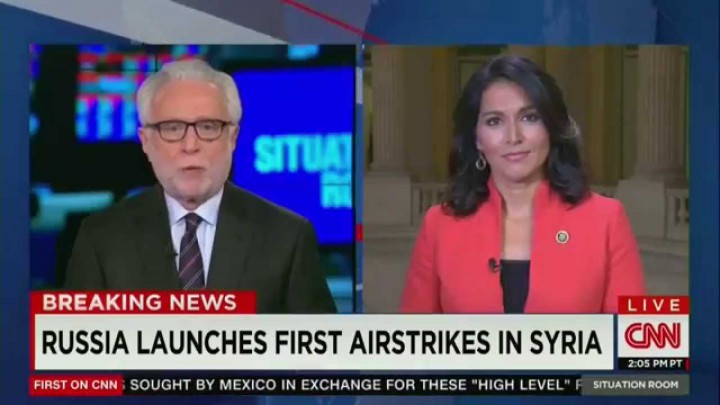
Headline News: US Congress Member Speaks the Truth on CNN

maxresdefault

In a time when politicians are expected to lie and corporate news networks more often than not self-censor (if/when covering actual news), it’s indeed a headline story when a member of congress speaks the truth on a corporate cable news program. Not surprisingly for those who’ve followed her career, the refreshingly honest words came from Rep. Tulsi Gabbard.

Gabbard was one of the first female combat veterans and became the youngest woman elected to a U.S. state office (as Representative for for Hawaii’s 42nd House District ) at age 21 in 2002. In 2004, Gabbard deployed with her Hawaii Army National Guard unit for a 12-month tour in Iraq where she served in a field medical unit as a specialist with a 29th Support Battalion medical company. Upon her return from Iraq in 2006 Gabbard served as a legislative aide for U.S. Senator Daniel Akaka in Washington, DC. During this time she attended the Accelerated Officer Candidate School at the Alabama Military Academy and finished as the distinguished honor graduate in March 2007  (a first for a woman in the Academy’s 50-year history). From 2011 and 2012 Gabbard served in the Honolulu City Council and in 2012 became the first American Samoan and Hindu member of the US Congress. On October 12, 2015 Captain Gabbard was promoted to Major at a ceremony at the National Memorial Cemetery of the Pacific, the same day she was disinvited by the DNC from the Democratic presidential debate for publicly stating she wanted to see more debates. Gabbard has been politically outspoken as a pro-choice and same-sex marriage supporter and has advocated for alternative energy, Native Hawaiian rights and a return of the Glass-Steagall Act. She has also opposed the use of drones to kill U.S. citizens.

As cynical as most of us should be about politics and government in this day and age, it’s promising when individuals who seem to have the honesty, intelligence and work ethic to be a true leader rise through the ranks. It’s especially hopeful for those who’d like to see more women in positions of power (other than Hillary, Palin, Fiorina, etc), regardless of whether improved leadership does anything significant to fix the current system.

Statements from Gabbard in the CNN segment that may startle those who habitually get news from corporate media include:

“The U.S. and the CIA are working to overthrow the Syrian government of Assad…

…while Russia, a long-time ally of Assad for decades now, is working to defend or uphold the Syrian government of Assad, and this puts us in a position of a possible direct head-to-head conflict with Russia as long as the U.S. and CIA continue down this path.”

(H/T: Truthstream Media)

Why Russia is Serious About Fighting Terrorism and the US Isn’t

obama_on_isis_10-1-2015_8-50-53_am

By Maram Susli

Source: New Eastern Outlook

Russia in the few days it has been of fighting terrorism in Syria has achieved far more than the US coalition. According to the New York Times, Russia’s fighter jets are conducting nearly as many strikes in a typical day as the American-led coalition has been carrying out each month this year, a number which includes strikes conducted in Iraq – not just Syria.

Whilst the US has been bombing ISIS for over a year, ISIS has only grown and gained more ground in Syria. A few months ago ISIS took over the ancient city of Palmyra in Syria, a UNESCO world heritage-listed site.

In spite of the fact that the US government acknowledged ISIS cannot be defeated without ground troops, they have refused to work with the Syrian military, the only force on the ground commanded by the only UN-recognized government in the country, and the only force capable and willing to fight ISIS.

On the other hand Russia is coordinating with the Syrian military on the ground, assisting Syrian troops in gaining ground against terrorism. The discrepancy shows a lack of honesty on the part of the US when it comes to its real agenda in Syria vs its proclaimed goal of fighting terrorism. The US is capable of more, the US military is the most powerful and technologically advanced force in the world. It is logical to conclude that they are willfully throwing the fight against terrorism in Syria and the reasons for that should be examined.

ISIS Serves US Geopolitical Interests, Threatens Russia’s

It has become clear that the US’s main objectives in Syria is not their expressed goal of ‘fighting ISIS’, but regime change, isolating Russian influence, the Balkanization and the creation of failed states. US presidential candidate and former Secretary of State Hillary Clinton herself stated that ‘removing Assad is the top priority”.

The US sees the Syrian state as one of the last spheres of Russian influence beyond the borders of the former Soviet Union, and a threat to its Israeli ally in the region. The presence of ISIS and other terrorists groups serves these interests. The US has a history of using terrorism to topple governments friendly to Russia. Al Qaeda itself was borne of the US objective to topple the Soviet friendly government of Afghanistan. The dismemberment of Russian-friendly Serbia and the creation of Kosovo was done via the same means.

More recently ISIS was a direct result of the US’s intervention in Iraq, and have only arrived in Libya and Syria in the wake of overt US-backed regime change efforts there. Although Libya and Iraq did not have relations with Russia as strong as Syria’s, Russia was still their main weapons supplier. It is therefore not surprising that since Russia entered the war in Syria, Saudi clerics and the Muslim Brotherhood – both US state assets – declared ‘jihad’ on Russia.

The former Defence Intelligence Agency (DIA) Chief Michael Flynn said in an interview that he believed the US had made a willful decision to allow ISIS to grow in Syria. A 2012 declassified DIA report, wrote if the US and its allies continued to destabilize Syria by arming extremist insurgents “there is the possibility of establishing a declared or undeclared Salafist principality in eastern Syria… and this is exactly what the supporting powers to the opposition want, in order to isolate the Syrian regime.”

The CIA had trained thousand of ‘rebels’, not to fight ISIS, but admittedly to fight the Assad government and Syrian military – showing once again that the real objective behind the US’ involvement is regime change. Media across the West has even admited this, including the Washington Post which would report:

…the CIA has since 2013 trained some 10,000 rebels to fight Assad’s forces. Those groups have made significant progress against strongholds of the Alawites, Assad’s sect.

Russia Has More to Gain by Truly Fighting Terrorism 

On the other hand Russia has clear geopolitical interests behind defending the Syrian state against terrorism. Syria has been an ally of Russia for decades, and it hosts Russia’s only Mediterranean naval base. Russian Foreign Minister Lavrov stated that Russia is entering Syria to prevent ‘another Libyan scenario,’ or in other words – to prevent it from turning into a failed state as the US had done to Libya.

Furthermore Russian interests in fighting terrorism are tied directly to Russia’s own national security. Russia has had problems in the past with terrorism within their own borders and in particular, Chechnya. Chechen fighters who have joined ISIS in Syria, have now threatened to take the fight to Moscow. Jabhat Al Nusra, Syria’s Al Qaeda faction, have also called for terror attacks in Russia. In an interview with 60 minutes, Russia’s President Vladimir Putin stated that it is better to fight terrorists in Syria than wait until they return to Russia.

Terrorism poses far greater risks to Russia’s national security than it does to the US. Not only is their proximity closer, but terrorists in Russia have the potential to cleave off part of the state and overrun entire Russian towns. This is not the case for the US, whose only risk to national security would be civilian deaths due to bombings, and that is not necessarily something that the US government would find a real ‘problem,’ and in fact, might even see as a possible opportunity.

The US Seeks Only to Contain ISIS

The US only wants to contain ISIS within Syria and Iraq’s borders indefinitely – not to defeat them. This was admitted to by a member of the current US government and party, Democratic Rep. Adam Smith to CNN who stated:

…we need to find partners that we can work with in Syria to help us contain ISIS. So it is a difficult problem to figure out the best strategy. I agree, they have safe haven there in parts of Syria and that will have to be part of the strategy for containing ISIS. 

Chairman of the U.S. House Intelligence Committee, Rep. Devin Nunes told CBS news:

 I think we are containing ISIS within the borders of Iraq and Syria. Outside of that we’re not doing much.

US President Barack Obama himself stated that he would like to like to:

…continue to shrink ISIL’s sphere of influence, its effectiveness, its financing, its military capabilities to the point where it is a manageable problem.

This suggests that President Obama wants to maintain ISIS sphere power to a contained manageable circle, like a diseases that is treated but never cured. Obama perhaps got his policies on the advice of the Brooking Institute think-tank, which stated:

Should we defeat ISIS? Rather than defeat, containing their activities within failed or near-failing states is the best option for the foreseeable future.

The US is Not Actually Bombing ISIS

The US bombing of ISIS has been mostly nominal, an exercise in perception management. Although the US Defense Intelligence Agency makes regular claims to have bombed specific targets, rarely is video evidence of the bombing strikes published. On the other hand the Russian military regularly releases video of most of the strikes on Russia Today. It was also leaked that the US had forbade its fighter jets from targeting a long list of ISIS training camps, which turn out thousands of fighters a month.

Award winning journalist Robert Fisk told the Australian program Lateline that the US could have bombed a convoy of ISIS militants who were taking over Palmyra, but instead allowed them to take over a Syrian military post as well as the ancient City which they have now begun to destroy. When the US has dropped bombs on ISIS run territory they have used the opportunity to primarily destroy Syria’s oil infrastructure. Likewise the US has largely avoided bombing ISIS and Al Qaeda targets in the Syrian district of North Hama in an attempt to prevent Syrian troops from gaining ground.Russia is now striking these targets long the benefactors of US-granted impunity.

The US Has ‘Forgotten’ its War with al Qaeda, Now Protects It

Perhaps the most ironic development of Russia’s involvement in Syria’s fight against terror, is the anger expressed by the US government and its media at Russia’s bombing of Al Qaeda (Jabhat Al Nusra) targets.

Former US National Security Adviser Zbigniew Brzezinski, the man largely responsible for the creation of Al Qaeda, expressed his frustration with the fact that Russia was targeting Al Qaeda as well as ISIS through his twitter account. Pro-NATO media has all but forgotten its war with Al Qaeda, and avoids any mention of its existence preferring to concentrate on ISIS instead. They have especially tried to avoid bringing to light the fact that Russia is bombing Al Qaeda in Syria where the US has largely avoided doing so including Homs, Hama, Idlib, and around Aleppo.

In the same CNN article which accuses Russia of not targeting ISIS but rather‘Syrian rebels”, two maps displayed from the Institute for the Study of War shows a very telling story. The first shows the areas in which Jabhat al Nusra controls or jointly controls with its allies – the so called moderate rebels receiving US-backing – but on a map showing locations of Russian strikes, Jabhat al Nusra territory can scarcely be seen, obstructed by highly concentrated Russian strikes – in other words – it is finally being wiped out of these areas.

The US is Continuing to Fund and Arm Terrorists

The map further illustrates how US-backed ‘moderate rebels’ working alongside Al Qaeda has become such common knowledge. In the past, commanders of rebel groups labeled ‘moderate’ by the US government have fought alongside ISIS, and reiterated their support of ISIS in satellite news interviews.

Recently “moderate rebels” from the so-called “Free Syrian Army” Division 16 joined Al Nusra in their attacks against the Kurdish city of Sheikh Maqsud in Aleppo. Pro-NATO media has even been reduced to calling the rebels ‘relatively moderate’. Relative to Al Qaeda and ISIS?

In any case, ‘moderate’ has always been a relative term, unlike the word secular which is the US run media dares not use to describe the US backed insurgency. Last week the US abandoned a Pentagon program to train rebels to fight ISIS, after all but five defected to Al Qaeda taking their weapons and training with them. Past attempts by the US to arm ‘vetted rebels’ has resulted in TOW anti-tank missiles ending up in the hands of Al Qaeda. But instead of admitting to the fact that ‘moderate rebels’ do not exist and ceasing the illegal armament of extremist insurgents, the US government has instead chosen to openly back “established rebel groups” who have close ties to Al Qaeda. The US is now sending yet another shipment of TOW missiles to these extremist groups through its ally Saudi Arabia.

Al Qaeda is not the only terrorist group the US has been accused of arming. This month, footage filmed by the Iraqi military of an oil refinery that had been captured by ISIS, shows US supply crates full of food and weapons having been delivered to Islamic State militants by parachute. In 2014, footage of another US supply drop to ISIS in Kobane Syria also emerged online. Only a few days ago the US airdropped 50 tons of ammunition into Hasake region of Syria, where there has been a lot of ISIS activity. Most of the weaponry used by ISIS is US made. In January this year, an Iraqi MP Majid al-Ghraoui publically accused the US of supplying ISIS with weapons through airdrops.

Iraq Trusts Russia More Than the US in a Real Fight Against Terrorism

The Iraqi government has become increasingly suspicious of the US’ lack of real commitment in fighting ISIS. On the other hand, Russian strikes have thus far been so effective against ISIS that the Iraqi government has asked Russia to take on a bigger role against ISIS than the US.

Russia has in turn signaled that it may start bombing ISIS in Iraq as well as Syria, with the permission of the Iraqi government. Unlike the US, Russia has not broken international law and has sought permission to enter Iraq and Syria from each respective state’s legitimate government.

With these actions Russia has called the US’ bluff on fighting ISIS, and is effectively forcing the US to do a better job of convincing the Iraqi government that it is truly fighting ISIS. If Russia does enter Iraqi airspace, it will more easily cross into Syrian airspace to provide supplies to the Syrian government, since the US has bullied many countries in the region to close their airspace to Russian aircraft. Furthermore, if Iraq asks Russia to enter, it is a scenario that would reverse any of the influence the US had gained in Iraq throughout its lengthy occupation of the country since 2003.

The US has been backed into a corner, and in doing so, has exposed itself and its allies as the source of terrorism, not champions truly fighting it. Terrorism has always been a means by which the US has sought to deconstruct Russian spheres of influences. Ironically over the last decade it has also simultaneously perpetuated the myth that it is actually fighting a war against terror. However as its allied states grow increasingly tired of this game, how long can the US continue to juggle this duplicity, before the entire deck of cards crumbles?

Maram Susli also known as “Syrian Girl,” is an activist-journalist and social commentator covering Syria and the wider topic of geopolitics. especially for the online magazineNew Eastern Outlook”.